Tuesday, October 25, 2005

Big Art

I just ran across an artist whose work is new to me: Eric Grohe. He specializes in large-scale murals, such as the one shown a far right (click for a larger view). This mural now covers the plain brick wall shown in the left-hand photo. Amazing, isn’t it?

From the Eric Grohe website:

Eric Grohe Murals Working in cooperation with architects, designers, art commissions and community representatives, Eric Grohe creates mural art that transforms the environment and communities as well. He believes that his art should involve, challenge and inspire the viewer; not simply adorn, but integrate with its architectural surroundings.

The large public mural projects are painted on site and typically take several months, giving the local community a unique opportunity to witness the day-to-day creation of a work of art.

Mr. Grohe continues to refine the technologies, methods and equipment that ensure the permanence and cost effectiveness of his work. For large-scale exterior projects, he prefers to use Keim Mineral Paint from Germany. Murals painted in the 19th century with Keim have retained their original appearance to this day. The paint crystallizes into mineral substrates and will not fade, peel or blister. Mr. Grohe is one of just a few muralists in the country skilled in the use of this unique and superior paint.

Grohe murals are designed to endure, for the enjoyment of generations to come.

There are many more photos up on Eric Grohe’s site — worth a visit…

Quote of the Day

From the Mudville Gazette:

"because as I look around at the state of this nation and see all of the weak little pampered candy-asses that are whining about this or protesting that, I’d be afraid to leave the fate of this nation entirely up to them."

First Lieutenant Bruce Bishop, on the reason why he’s going to stay in the National Guard.

Bruce, from us out here in the hustings: you da man!

Fatally Wounded

ScrappleFace nails it again:

"The Bush foreign policy continues to be fatally-wounded by clarity of purpose, dogged persistence and a pathetic failure to capitulate in the face of opposition. At a time when a real leader would be paralyzed with self-doubt over the meaningless deaths of 2,000 American troops, Bush continues to act as if freeing 25 million Iraqis from decades of oppression, torture and death is somehow worth the price paid by those who volunteered to fight."

Read the whole thing right now!

Mountweazels

Suppose you publish a valuable reference work — one that required a large investment to create, and therefore is worth protecting? For example, if you publish an encyclopedia or a dictionary, you don’t want other publishers to simply copy your hard work.

I would have guessed that there really wasn’t a big problem here, as it would seem obvious on inspection that a work had been copied. But apparently this is not the case. In fact, the publishers resort to inserting fake articles in encyclopedias, and fake words in dictionaries, precisely so that they can prove in court that a work was copied and not independently created.

The New Yorker has an interesting piece on this phenomenon, talking about the search for the fake words in the New Oxford American Dictionary. There’s quite a debate going on in the world of lexicographical authorities.

Oh, and Mountweazels — here’s the explanation for that:

Turn to page 1,850 of the 1975 edition of the New Columbia Encyclopedia and you’ll find an entry for Lillian Virginia Mountweazel, a fountain designer turned photographer who was celebrated for a collection of photographs of rural American mailboxes titled “Flags Up!” Mountweazel, the encyclopedia indicates, was born in Bangs, Ohio, in 1942, only to die “at 31 in an explosion while on assignment for Combustibles magazine.”

If Mountweazel is not a household name, even in fountain-designing or mailbox-photography circles, that is because she never existed. “It was an old tradition in encyclopedias to put in a fake entry to protect your copyright,” Richard Steins, who was one of the volume’s editors, said the other day. “If someone copied Lillian, then we’d know they’d stolen from us.”

Miers

I am neutral on the Miers nomination.

The statement above will register my stand on the Truth Laid Bear’s survey.

I’ve been staying well away from this blogobattle, as I’m not particularly well-armed. Of course I want to get the best possible replacement for O’Connor — but we could argue all day about what “best” means, and I have no independent way to judge Miers. On the one hand, I’m inclined to trust President Bush’s judgment on judges (he’s done very well there, so far as I can tell); on the other hand, many pundits and bloggers whose opinions I have great respect for are passionately opposed. So I’m stuck in the middle on Miers, and there I think I’ll stay…

Rosa Parks, RIP

Rosa Parks — that name instantly conjures intense feelings and images for me. Her famous, courageous act of defiance in 1955 was followed by many years of dignified activism. She was an altogether admirable person.

I was only three years old in 1955, so of course I do not remember the actual event that made her a household name. And we did not discuss civil rights in the home where I grew up; at least, not that I can remember. My first recollection of Rosa Parks is from elementary school, where my fourth grade teacher (Mrs. Fitzpatrick) told her story in an attempt to get the all-white class to understand a little bit about racial discrimination and segregation. Mainly what I got from her story was this: Mrs. Fitzpatrick clearly thought Rosa Parks was a saint walking upon the earth.

A few years later, in high school and beyond, I started reading a lot of history; a habit and a hobby which continues to this day. My first readings of history were of two events that I had much curiousity about: the American civil rights movement, and World War II. Rosa’s place in the civil rights movement is well-documented in zillions of places; I won’t repeat it here. But for me (and many others) she was a kind of icon of the civil rights movement: both an inspiration and a continuing force. And her abiding, overriding dignity struck me profoundly, especially by contrast with some of the more flamboyant or radical black leaders. A world full of people like Rosa would be a world full of peace, love, and tolerance. Her life helped change our world in very positive ways; she will be missed and mourned…

Wikipedia has a good article on Rosa Parks.

The blogosphere takes note:

Michelle Malkin has a roundup.

TigerHawk connects two daughters of Alabama.

Althouse has a commenter who says:

Notwithstanding the efforts of M L King and other purported black leaders, Rosa Parks’ simple act of civil disobedience (refusing to give up her bus seat for a white man) was the tipping point in the advancement of civil rights in America. She should inspire us all to appreciate how personal courage can lead to extraordinary public legacies.

God bless you Ms Parks!

La Shawn Barber has a roundup and commentary.

Parks and her husband Raymond didn’t have children, as far as I can tell from news accounts of her life. In a way, I suppose those she inspired to stand up to injustice were her offspring. Once people understand the power they have in a free country, the moral authority to demand justice, watch out. I once heard this line from a movie: “Change the way people think, and things will never be the same.”

Whatever her reasons that fateful day, I glad she decided to stay in her seat.

Kate at Small Dead Animals says “They don’t make civil rights leaders like they used to.

Outside the Beltway has a brief history, and says:

The civil rights leaders of today pale in comparison to Parks and her compatriots. I was born a decade after Parks' act of defiance and went to school, mostly in the South, in schools that had recently desegregated. By that time, the culture had changed sufficiently that the idea of segregated institutions was inconceivable.

Rest in peace.

Rest in peace, Rosa Parks…

Running on Metal

The two big problems with hydrogen power for cars are these:

1. Where does the hydrogen come from?

2. How do you store hydrogen in the car?

A group of Israelis at a company called Engineuity believe they have the answer.

From IsraCast:

The Hydrogen car Engineuity is working on will use metals such as Magnesium or Aluminum which will come in the form of a long coil. The gas tank in conventional vehicles will be replaced by a device called a Metal-Steam combustor that will separate Hydrogen out of heated water. The basic idea behind the technology is relatively simple: the tip of the metal coil is inserted into the Metal-Steam combustor together with water where it will be heated to very high temperatures. The metal atoms will bond to the Oxygen from the water, creating metal oxide. As a result, the Hydrogen molecules are free, and will be sent into the engine alongside the steam.

Now this is very clever, solving both of the core problems with one not-so-exotic technique. In this solution, the hydrogen comes from water — no problem there, we’ve got plenty of water all over the place, especially if the system can use salt water. And what could be easier or safer to store than water? One of the major problems facing most hydrogen storage ideas is “hydrogen density": how much hydrogen can you pack into a given volume?

The approach to hydrogen storage I’ve seen most often discussed is to use metal hydrides, especially magnesium. Such a system could hold about 8% of its weight in hydrogen. A practical car would need something like 40 pounds of hydrogen in a full tank. With a magnesium hydride storage system, that means you’d need 500 pounds of “fuel”. Much worse, though, is this: the magnesium hydride system is a very exotic, still unproven technology. It’s prone to contamination problems and longevity problems. And nobody is really sure what would happen in the event of an accident.

For this Israeli system, the hydrogen is about 11% of the weight of the water — so you’d need 360 pounds of water to hold 40 pounds of hydrogen. In addition, you’d need 480 pounds of magnesium, or 360 pounds of aluminum, to “soak up” all that oxygen in the water. So in total you’d need 720 to 840 pounds of “fuel” — more than the magnesium hydride system, but not exotic and very safe.

The numbers I quote above are not in the IsraCast article; I derived these from first principles using just the assumption that 40 pounds of hydrogen is roughly the same energy content as a tank of gasoline in a modern car. I’m not assuming any radical improvements in overall efficiency, or any radical changes in what drivers find desirable in a car. In other words, my starting point is to duplicate today’s car, but with hydrogen technology.

The IsraCast article paints a much more optimistic picture, without backing it up. For example, they say that to refuel the car would typically require 220 pounds of metal. Tey also claim that this should cost no more than filling your tank with gasoline — I don’t know where they buy their aluminum or magnesium, but in these parts you won’t be buying it for anything like $0.25/pound (if you believe their 220 pound claim), much less $0.10/pound (if you believe my numbers). This looks expensive to me, unless someone comes up with a way to radically reduce the cost of producing the metal.

Which brings me to one last point: while this clever Israeli technique neatly solves the core car problems, it doesn’t address another one: where does the energy come from to run all these cars? In their system, the energy input goes into refining the metal, either from ore or from reclaimed metal oxides produced by the cars. Refining metal is a very energy-intensive process, and that energy has to come from somewhere. In favor of their system is that it allows that energy consumption to be very centralized, making it possible to consider things like nuclear power or massive hydroelectric facilities. But however it’s done, it would have to be with power production that doesn’t currently exist — and to make any sense at all, it would have to be power production that didn’t use hydrocarbons. A big challenge there…

Monday, October 24, 2005

Chaparral Web

Often on our morning walks we’ll spy the classic ring-and-spoke webs of an orb-weaving spider that is common in the chaparral. In the fall, when the mornings are often moist, these webs will be covered with a very fine mist that refracts the morning light, making them highly visible with great contrast against the background. This is especially true in the very early morning light, and even more so if you can catch a web lit by the sun with the background still in the dark.

The web at right is from our walk this morning.

Misty Morning

I took the picture at right on our morning walk (Debi, and our field spaniels Mo’i and Lea). It’s common for us to be able to see fog or mist in the valleys to the west of us while on these walks. It’s a little less common, but certainly not uncommon, for the tendrils of mist and fog to waft their way to our house. And occasionally we get well and truly “socked in”.

This morning, as we left our house on our walk, the sun was out (the birds were chirping, too!). As we climbed the hill we normally walk up, and our views of the western valleys got more expansive, we saw the mist creeping our way. When we reached the top of the hill and turned around to come home, the mist crept toward us. The hill poking through the mist in the picture at right is about 200' higher than our house — which by this time was completely socked in. In the distance you can see Cajon Mountain.

As we walked back toward home, we decended right into that mist — and the next thing we knew, the world looked like the fogged-in scene at right. Kinda weird, to start out in the sunlight and come back in the fog!

The weather forecast claims that we have a 50% chance of showers tonight and tomorrow. Here’s hoping!

Rhus Ovata

This chaparral plant is very common on the north-facing valley slopes where we live. Commonly known as the “sugar sumac” (why, I have no idea!) or the “lemonade berry” (because you can make a refreshing lemonade-like drink by soaking its berries in water), Rhus ovata is a member of the sumac family and is extraordinarily well-adapted to the hot, dry climate of the chaparral.

I took the picture at right on our walk this morning. The red/pink/white structures are, I believe, the beginnings of the fruit which will form during the fall.

The drought-resistance of this plant is legendary. During our recent five years of drought, Rhus ovata was, on many hillsides, the only vibrantly green plant left. I’ve never seen one that looked sickly, even in the driest, nastiest summer. And they’re fire-resistant — we may be planting some of these!

Making Us Crazy

Early this morning I cut up a big pork loin roast into cubes and stuffed it into our slow-cooker, along with some onion, garlic, cumin, and a chipotle pepper. Ten hours later — about 5 hours from now — we will have carnitas, probably my all-time favorite Mexican food.

But in the meantime, the delicious, intoxicating aroma of cooking carnitas is wafting through our house. And it’s making us crazy. Crazier, anyway.

Somehow the dogs don’t seem to care about this smell. Isn’t that weird? With their sensitive noses, I figured the intense meatness of this smell would reduce them to quivering, whining, begging lumps of canine protoplasm. But they’re asleep, as though nothing were going on.

Go figure!

Update: Well, maybe the dogs knew something we didn’t. Despite the glorious odor while it was cooking, the resulting carnitas were less than excellent. Not even very good. In fact, they were just barely on the right side of awful. Somewhere between the slow-cookery and the final saute, something went horribly wrong…

Dog's Prayer

A Dog’s Prayer

by Beth Norman Harris

Treat me kindly , my beloved master, for no heart in all the world is more grateful for kindness than the loving heart of me. Do not break my spirit with a stick, for although I should lick your hand between blows, your patience and understanding will more quickly teach me the things you would have me do.

Speak to me often, for your voice is the world’s sweetest music, as you must know by the fierce wagging of my tail when your footstep falls upon my waiting ear.

When it is cold and wet, please take me inside, for I am now a domesticated animal, no longer used to bitter elements. And I ask no greater glory than the privilege of sitting at your feet beside the hearth.

Though had you no home, I would rather follow you through ice and snow than rest upon the softest pillow in the warmest home in the land, for you are my god and I am your devoted worshipper.

Keep my pan filled with fresh water, for although I should not reproach you were it dry, I cannot tell you when I suffer thirst.

Feed me clean food so that I may stay well to romp and play and do your bidding, to walk by your side, and stand ready willing and able to protect you with my life should your life be in danger.

And beloved master , should the Great Master see fit to deprive me of my health or sight, do not turn me away from you. Rather, hold me gently in your arms as skilled hands grant me the merciful boon of eternal rest … and I will leave you knowing with the last breath I draw, my fate was ever safest in your hands.

Senior Exercise

I came across this exercise suggested for seniors, to build muscle strength in the arms and shoulders. It seems so easy, I thought I’d pass it on. The article suggested doing it three days a week. Begin by standing on a comfortable surface, where you have plenty of room at each side. With a 5-LB. potato sack in each hand, extend your arms straight out from your sides, and hold them there as long as you can. Try to reach a full minute, then relax.

Each day, you’ll find that you can hold this position for just a bit longer. After a couple of weeks, move up to 10-lb. potato sacks. Then 50-lb. potato sacks, and then eventually try to get to where you can lift a 100-lb. potato sack in each hand and hold your arms straight for more than a full minute.

Once you feel confident at that level, put a potato in each of the sacks.

Tip of the hat to the maternal one…

Brown Envelopes

A commentary piece in today’s WSJ (by Stuart Karle, the Wall Street Journal’s general counsel) contains this paragraph:

From the WSJ “In Defense of a Press Shield Law($) (emphasis added):

That’s the irony of Miller/Cooper. Shielding sources is supposed to enable journalists to report valuable information that the public otherwise couldn’t get; here, deals with sources deprived the public of perhaps the most relevant information: the identity not of Mr. Wilson’s wife, but of the sources. It’s hard to believe that if Miller/Cooper had refused to cloak Messrs. Rove’s and Libby’s identities forevermore the story wouldn’t have gotten out anyway. A brown envelope to a blogger would have served the purpose.

The WSJ is the blogger-friendliest MSM publication that I’ve seen. Their commentators frequently mention blogs, both as sources and as corroboration. James Taranto with his “Best of the Web Today” is a blogger who happens to work for the WSJ, and publishes the blog as part of his job. And this paragraph seems typical of the WSJ’s assumption that bloggers are part of the landscape of news reporting … and occasionally, they’re even useful <smile>.

What’s surprising isn’t what you see in the WSJ. The absence of such things in the rest of the MSM (and I know I’m over-generalizing here, but I believe the point is valid) is what’s surprising. What’s up with them, anyhow? Perhaps they just see bloggers as threatening? Or is that an overly simple way of dismissing their dissing?

Michael Yon

Michael Yon has filed another report in his remarkable series from Iraq, this one about the recent elections. A teaser:

From Michael Yon’s report “Purple Fingers":

Major Yayha laughed, “Yes, no longer afraid to talk with Police or Army. This is good change.” The moment was warm and fuzzy, but the true situation is not. There is little doubt that the people are getting more confident in their new world, but the under-theme is still Jungle Law. Major Yayha expressed gratitude to America for supporting Iraq, and I did not have the heart to say that many Americans are ready to abandon him powerless and adrift on windswept sands.

And his conclusion:

It had been quiet from my perch. The guns had been silenced long enough that we could hear the Iraqi voice speak for a second time. The voice was louder, stronger, and prouder than it had been in January.

You really don’t want to miss this — go read the whole thing at “Purple Fingers"…

Oh, and the photo at right (click for a larger view) is some GI humor that Michael Yon captured in passing: “Turn Your Hamster into a Fighting Machine!” <smile>…

Dog Rules

The evolution of dog rules in a household:

1. The dog is not allowed in the house.

2. Okay, the dog is allowed in the house, but only in certain rooms.

3. The dog is allowed in all rooms, but has to stay off the furniture.

4. The dog can get on the old furniture only.

5. Fine, the dog is allowed on all the furniture, but is not allowed to sleep with humans on the bed.

6. Okay, the dog is allowed on the bed, but only by invitation.

7. The dog can sleep on the bed whenever he wants, but not under the covers.

8. The dog can sleep under the covers by invitation only.

9. Okay, the dog can sleep under the covers every night.

10. Humans must ask permission to sleep under the covers with the dog.

That pretty much sums it up at our house, with Mo’i and Lea!

Tip of the hat to Tammy Bruce — I went to her blog expecting political commentary and got this smile-inducer instead. Good trade!

The Rottweiler Speaks

Just go read this right now. But put down your cup of coffee before your do it!

Hackaday

Here’s one of the geekliest blogs I’ve seen in a while: Hackaday, a blog that promises:

hack a day serves up a fresh hack each day, every day from around the web and a special how-to hack each week.

Tip 'o the hat to Simon for the link.

Simon recommended “Hacking Sleep", but my favorite of the still-current hacks was do-it-yourself railgun (pictured at right above). The Hackaday post on the railgun led me to the Railgun Blog — a classic technoblog, quite well done…

Wouldn’t a personal railgun be just the ticket for taking care of our gopher problem? Hmmmm…

Sunday, October 23, 2005

Stumblina

Our most pitiful cat, she’s a manx that we found while out on a hike in a seabird sanctuary. When we found her, we thought she was a goner — her rear end was all bloody and she had no tail; we thought it had been ripped off by a car or something. She hopped around like a little rabbit, because one of her front legs was useless. Turns out that she’s naturally tailless (all manxes are), and she was just sick and dehydrated. The useless leg was a birth deformity. With a little TLC she recovered very nicely, and we had another slightly grumpy little cat. Her name is a play on both “Thumblina” for her small size, and “stumble” for her odd feline gait.

While we don’t know for sure what her history is, I’m afraid it was an example of the worst kind of uncaring stewardship. Most likely her deformity made her undesirable to the family that owned her — and to “solve” the problem, they took this poor little kitten out and dumped her on a sandbar jutting out into the salt water San Diego Bay. Where we found her, there was no food and no water — and she could never have hopped far enough to find either one. She’d have died shortly of dehydration, starvation, or both.

We never recorded the date that we found her, but it must have been in the range of 1987 to 1989. That makes her something like 16 to 18 years old. She’s been a well-loved member of our household for all those years, but only because we were lucky enough to find her…

The picture at right was taken in August 2004. At the moment, she’s in decline (though she rallied a bit in the past couple of days). So far as we know, there’s nothing really wrong with her other than old age, but she’s got the typical feline reaction to not feeling well: she stops eating. She’s the proverbial “bag of bones” now, and of course that hastens the decline. We hydrate her with subcutanaceous fluids when she needs it, and we try every trick we can think of to get her to eat — and the last couple of days, that seems to be working. She can’t make it to the litter box anymore, so we’ve got her in absorbent “diapers” — not particularly cute, but effective at keeping her from wallowing in wet bedding. We keep her warm and as comfortable as we can. But even with the recent rally, it’s clear that someday soon we’ll be mourning her, and remembering the best moments…

Click on the photo for a larger view of this cat who escaped an awful fate…

Good Reason

A senior citizen in Florida bought a brand new Corvette convertible. He took off down the road, flooring it to 80 mph and enjoying the wind blowing through what little hair he had left on his head.

"This is great,” he thought as he roared down I-75. He pushed the pedal to the metal even more. Then he looked in his rear view mirror and saw a highway patrol trooper behind him, blue lights flashing and siren blaring. “I can get away from him with no problem " thought the man and he tromped

it some more and flew down the road at over 100 mph. Then 110, 120 mph.

Then he thought, “What am I doing? I’m too old for this kind of thing."He pulled over to the side of the road and waited for the trooper to catch up with him!

The trooper pulled in behind the Corvette and walked up to the man. “Sir,” he said, looking at his watch. “My shift ends in 30 minutes and today is Friday. If you can give me a reason why you were speeding that I’ve never heard before, I’ll let you go."

The man looked at the trooper and said, “Years ago my wife ran off with a Florida State Trooper, and I thought you were bringing her back."

"Have a good day, Sir,” said the Trooper.

3D Photos

Anaglyphs are images that simulate three dimensional images by supplying slightly different images to your right and left eyes. The most common way to make anaglyphs is to take two black-and-white photos from a few inches apart (as your eyes are), color one (by convention, the left one) red and the other blue, then merge them together. To view them you need the “3D glasses” with a red filter over your left eye and a blue filter over your right eye.

The image at right is an anaglyph that I made this morning, using a handheld digital camera and Photoshop. The image is of a chaparral-covered hillside adjacent to my home. I had to do some “fixing” with Photoshop, as I had aimed the camera slightly differently between the two photos, plus I rotated the camera slightly. But once I fixed that stuff, coloring and merging them was easy — and the results, to my surprise, quite effective. If you click on the photo at right to get the full sized copy, and use the 3D glasses, you’ll be able to easily see how the various shrubs are at different distances. To my eye, these distances seem quantized, as if there were some fixed number of “layers” to the resulting 3D image. I speculate that this is a side-effect of pixelization — the image isn’t “analog” like what your eyes actually see, but is composed of discrete pixels — so the offsets between the images for your left and right eye are limited to integral pixels. Of course in the real world our eyes are doing the same thing, but … there are many more “pixels", and the pixels are not on a regular grid, which I believe would mitigate the quantization to a large degree.

There’s another surprise for me in making this anaglyph: the resulting image, viewed without 3D glasses, looks quite blurred. But with the 3D glasses, all the crisp detail comes back! This I didn’t expect at all…

Saturday, October 22, 2005

They Came in Peace

Our soldiers were on a peace-keeping mission in Lebanon on October 22, 1983, when a terrorist’s bomb exploded outside their barracks. On that sad day, 241 of America’s finest died. In a separate attack, 50 French peace-keepers were also killed.

With 20/20 hindsight, it’s obvious that we should have taken action then against the burgeoning militant Islamic movement. It’s one of the few faults I can find with President Reagan’s leadership of this country.

Black Five, remembering this anniversary, found some most appropriate words from a speech President Reagan gave:

From Black Five:

…May I share something with you I think you’d like to know? It’s something that happened to the Commandant of our Marine Corps, General Paul Kelley, while he was visiting our critically injured Marines in an Air Force hospital. It says more than any of us could ever hope to say about the gallantry and heroism of these young men, young men who serve so willingly so that others might have a chance at peace and freedom in their own lives and in the life of their country.

I’ll let General Kelley’s words describe the incident. He spoke of a “young Marine with more tubes going in and out of his body than I have ever seen in one body."

“He couldn’t see very well. He reached up and grabbed my four stars, just to make sure I was who I said I was. He held my hand with a firm grip. He was making signals, and we realized he wanted to tell me something. We put a pad of paper in his hand - and he wrote 'Semper Fi.' “

Well, if you’ve been a Marine or if, like myself, you’re an admirer of the Marines, you know those words are a battle cry, a greeting, and a legend in the Marine Corps. They’re Marine shorthand for the motto of the Corps - “Semper Fidelis” - “always faithful."

General Kelley has a reputation for being a very sophisticated general and a very tough Marine. But he cried when he saw those words, and who can blame him? That Marine and all those others like him living and dead, have been faithful to their ideals. They’ve given willingly of them selves so that a nearly defenseless people in a region of great strategic importance to the free world will have a chance someday to live lives free of murder and mayhem and terrorism. I think that young Marine and all of his comrades have given every one of us something to live up to.

They were not afraid to stand up for their country or, no matter how difficult and slow the journey might be, to give to others that last, best hope of a better future. We cannot and will not dishonor them now and the sacrifices they’ve made by failing to remain as faithful to the cause of freedom and the pursuit of peace as they have been.

I will not ask you to pray for the dead, because they’re safe in God’s loving arms and beyond need of our prayers. I would like to ask you all - wherever you may be in this blessed land - to pray for these wounded young men and to pray for the bereaved families of those who gave their lives for our freedom…

This incident stands out in my mind as a stark example of the need to confront danger to our country. One can easily engage in a frustrating “what if” thought experiment: what if President Reagan had reacted to the Beirut bombing in the same way President Bush did to 9/11? In particular, suppose President Reagan had established the policy to treat the harborers of terrorists no differently than the terrorists themselves, and had militarily confronted both? Surely the world would be a better, more peaceful place today — and the World Trade Center towers would still be there…

Spirit Panorama

The Mars rovers — Spirit and Opportunity — are still in great condition, doing hard science every day up on the surface of the Red Planet. Most recently Spirit has been exploring the summit of Husband Hill, after a months-long, very difficult climb. The panoramas at right are taken from the summit of that hill; the top one is a normal view; the bottom one a 3D view (requires special glasses with red and blue lenses). Click on them for larger views…

From the JPL web site:

Before moving on to explore more of Mars, NASA’s Mars Exploration Rover Spirit looked back at the long and winding trail of twin wheel tracks the rover created to get to the top of “Husband Hill.” Spirit spent several days in October 2005 at this location, perched on a lofty, rock-strewn incline next to a precarious outcrop nicknamed “Hillary.” Researchers helped the rover make several wheel adjustments to get solid footing before conducting scientific analysis of the rock outcrop. The rock turned out to be similar in appearance and composition to a rock target called “Jibsheet” that the rover had studied several months earlier and hundreds of meters away.

To the west are the slopes of the “Columbia Hills,” so named for the astronauts of the Space Shuttle Columbia. Beyond the hills are the flat plains and rim of Gusev Crater.

Spirit took this 360-degree panorama of images with its navigation camera on the 627th Martian day, or sol, (Oct. 7, 2005) of its exploration of Gusev Crater on Mars. This view is presented in a cylindrical projection with geometric seam correction.

APOD

Astronomy Picture of the Day brings us:

Ring Galaxy AM 0644-741 from Hubble

How could a galaxy become shaped like a ring? The rim of the blue galaxy pictured on the right is an immense ring-like structure 150,000 light years in diameter composed of newly formed, extremely bright, massive stars. That galaxy, AM 0644-741, is known as a ring galaxy and was caused by an immense galaxy collision. When galaxies collide, they pass through each other — their individual stars rarely come into contact. The ring-like shape is the result of the gravitational disruption caused by an entire small intruder galaxy passing through a large one. When this happens, interstellar gas and dust become condensed, causing a wave of star formation to move out from the impact point like a ripple across the surface of a pond. The intruder galaxy has since moved out of the frame taken by the Hubble Space Telescope and released to commemorate the anniversary of Hubble’s launch in 1990. Ring galaxy AM 0644-741 lies about 300 million light years away.

Friday, October 21, 2005

Revenge

I don’t know if this is for real, but … I sure like the concept!

Tired of receiving mounds of unsolicited letters and offers in the mail? Want to fight back? Want to get rid of that old tire in your garage that the garbage man won’t take? Then read on…

If you’re curious why this document was developed, it was due to the hundreds of unsolicited letters sent to me by a very annoying company called MCI. They love to mail people unsolicited letters 1-2 times per week despite requesting to be taken off their mailing lists. Well, here’s a completely LEGAL way to fight back against idiots like MCI. You can mail their junk back to them for FREE using their own postage-paid envelopes. The only catch is that it will be attached to 50 lbs of additional junk you’ve gathered from around your house (rocks, bricks, old shingles, etc.). This works, so please read on…

Read the whole thing here.

Doo Loo

Imagine this: you’re an intrepid Antarctic explorer, camping with your team on a long expedition of scientific discovery on the vast frozen ice plains. The flat, completely exposed frozen ice plains. When you need to take care of certain bodily functions normally not mentioned in public, and normally conducted in private, just how do you accomplish this? And add to that the unbelievably cold environment — what on earth do you do when you need to poo?

Simon has the answers:

From 75 Degrees South:

No discussion of Antarctic camping would be complete without some mention of the toilet facilities! For peeing we use the simple but effective pee flag, which is just a marker to indicate where to go. This keeps all the waste in one place and ensures we don’t contaminate the snow collection point (where we get our fresh water from). This is particularly important if it is a site which we use year after year. The girls can make full use of the pee flag too thanks to an invention called a pee funnel (I won’t go into any more detail on that one).

Although the pee flag is fine most of the time, when it’s four in the morning and blowing a gale outside it takes a lot of motivation to get out of that nice warm sleeping bag and put on all your outside gear just to relieve yourself. For moments like that you need a pee bottle! Yes, it’s just like it sounds - a wide-topped, screw cap flask, preferably well labelled to distinguish it from your water bottle. Although the use of pee bottles may be shunned by purists (and indeed hygienists), I challenge anyone to sit through a four day Antarctic gale and not be singing their praises by the end of it.

Of course when you spend several days or more in the field eventually you are going to need to go for a poo (although some people make a valiant effort to avoid this - I believe the record is 5 days). To make that a more comfortable experience we put together a “doo loo”. Upon arrival each pair of skidoos has a tarpaulin thrown over them and tied down to prevent snow from getting into the engines. One of these pairs is assigned as the doo loo and is set up slightly differently. The skidoos are parked a bit further apart than normal so that a wooden board with a hole in it can be fitted between the two skidoos. A deep pit in the snow is dug below the board. The tarp is secured with snow on three sides and at the front it is held down by a couple of Jerry cans of fuel. There you have it - your own windproof, private toilet cubicle. Because it’s so cold it doesn’t actually smell as bad as you might imagine and you can even fit a toilet roll neatly on the skidoo handlebars - luxury!

You should add his site to your regular reading — there’s always some fascinating tidbit up there…

Sounds of Saturn

In honor of Halloween, the JPL folks have put up a feature called “The Eerie, Bizarre Sounds of the Saturnian System”. You can listen to one of them here. The graphic at right is a spectragraph over time — a “sonic fingerprint” that’s interesting to examine as you listen to the sound…

From the Cassini-Huygens web site:

Saturn is a source of intense radio emissions, which have been monitored by the Cassini spacecraft. The radio waves are closely related to the auroras near the poles of the planet. These auroras are similar to Earth’s northern and southern lights. This is an audio file of Saturn’s radio emissions.

The Cassini spacecraft began detecting these radio emissions in April 2002, when Cassini was 374 million kilometers (234 million miles) from the planet, using the Cassini radio and plasma wave science instrument. The instrument has now provided the first high resolution observations of these emissions, showing that show an amazing array of variations in frequency and time. In this example, it appears as though the three rising tones are launched from the more slowly varying narrowband emission near the bottom of this display. If this is the case, it represents a very complicated interaction between waves in Saturn’s radio source region, but one which has also been observed at Earth.

Time on this recording has been compressed such that 13 seconds corresponds to 27 seconds. Since the frequencies of these emissions are well above the audio frequency range, we have shifted them downward by a factor of 260.

The Cassini-Huygens mission is a cooperative project of NASA, the European Space Agency and the Italian Space Agency. The Jet Propulsion Laboratory, a division of the California Institute of Technology in Pasadena, manages the mission for NASA’s Science Mission Directorate, Washington, D.C. The Cassini orbiter was designed, developed and assembled at JPL. The radio and plasma wave science team is based at the University of Iowa, Iowa City.

I think these guys are having way too much fun <smile>. But they deserve it — the Cassini-Huygens mission is already a spectacular success…

Thursday, October 20, 2005

Sixty Years

A WWII soldier frozen in the Sierra Nevada...

Earlier this week, a couple of hikers on Mt. Mendel (in the Kings Canyon area of the Sierra Nevadas) found the frozen body of a soldier in the ice just below the peak. Mt. Mendel is the righthand peak in the photo; click on it for a larger view. From the San Jose Mercury-News:

A glacier-encased body believed to be a World War II airman who crashed into the Sierra Nevada in 1942 was flown off the mountain and into a Fresno laboratory for identification, the county's deputy coroner said Thursday.

Blustery conditions kept rangers at Kings Canyon National Park from reaching the frozen remains for two days after two ice climbers reported last weekend they had seen a man's head, shoulder and arm protruding from the thick ice. About 80 percent of the body was buried in the glacier on the side of the 13,710-foot Mount Mendel. The remote wilderness area can only be reached by hiking two or three days, or by helicopter when the weather allows, rangers said.

More information on this unusual event here, here, and here.

A Little Girl and a Bullet

One of the infinite ways that war is hell...

Thunder6 at "365 and a Wakeup" is always a powerful writer. Recently he posted about a little girl accidentally shot in a battle. An awful thing, and reading the beginning of his story you'd think that it would have a dismally sad ending. But it does not — not only is the ending a happy one, but it illustrates the best of our soldiers. An excerpt from the middle, where we pick up the story right after the little girl is struck by the wayward bullet:

But she wasn’t left alone. Instead her father picked up his beloved daughter and carried her trembling form out into the dusty street. As he stumbled outside the door, blinded by the agony only a parent can know, his movements were tracked by two sets of practiced eyes. Those eyes belonged to our two battle seasoned medics, who had heard the painful cacophony and leapt to action as surely as if someone had bellowed out their names. The medics assessed the situation in less then a second, and then without pause they both set out at a dead sprint. In those first terrible seconds they recognized how grave the girls condition was, and passing the information to one of our platoon sergeants. While they struggled to stabilize their patient the little girl continued emptying her precious life into the street. As the medics labored under the harsh light of their LED flashlights, SSG Rock was making coordinations with a MEDEVAC helicopter for immediate pickup. Fortunately they didn’t have to wait long.

Read the whole thing; bring some kleenex with you, though. Do we have a wonderful bunch of soldiers or what?

Winning Pictures

Prize wildlife photos...

In a British Wildlife Photographer of the Year contest, the photo at far right has won the overall prize. The photo to its left, and several others at the link above, are the winners in several categories (in this case, "Animals in Their Environment").

The BBC's article starts with this:

A swirling image of a peregrine falcon sweeping into a flock of starlings has won Manuel Presti this year's Wildlife Photographer of the Year award.

The Italian caught the action scene, titled Sky Chase, high above a city park in Rome.

"Sky chase is a powerful image and, like it or not, it's one that you will never forget," said Mark Carwardine, one of this year's judges.

The competition has become one of the most prestigious in world photography.

It is organised by BBC Wildlife Magazine and London's Natural History Museum. This year brought 17,000 entries from over 55 countries.

Wander on over there and gaze at the pictures of some really talented photographers. Click on either of these photos for a larger view.

The Statue

Unfortunately, yet another "urban legend"...

The photo at right has been widely distributed by email; I've received several copies of it from various people. The accompanying text makes a compelling and moving story, calculated to get you all riled up about the mainstream media:

This statue currently stands outside the Iraqi palace, now home to the 4th Infantry division. It will eventually be shipped home and put in the memorial museum in Fort Hood, Texas.

The statue was created by an Iraqi artist named Kalat,who for years was forced by Saddam Hussein to make the many hundreds of bronze busts of Saddam that dotted Baghdad.

Kalat was so grateful for the Americans liberation of his country;he melted 3 of the heads of the fallen Saddamand made the statue as a memorial to the American soldiersand their fallen warriors. Kalat worked on this memorial night and day for several months.

To the left of the kneeling soldier is a small Iraqi girl giving the soldier comfort as he mourns the loss of his comrade in arms.

Do you know why we don't hear about this in the news? Because it is heart warming and praise worthy. The media avoids it because it does not have the shock effectthat a flashed breast or controversy of politics does.

Trouble is, it's just not true. At least, it's not true in some of the important details. Here's a couple of excerpts from the Snopes article, but do read the whole thing:

Origins: The sculture pictured above is real, and it was indeed crafted by an Iraqi sculptor from bronze recovered by melting down statues of former Iraqi leader Saddam Hussein, but the explanatory text accompanying the photo is quite misleading: The Iraqi sculptor was not "forced by Saddam Hussein to make the many hundreds of bronze busts of Saddam," he did not produce the memorial shown because he was "so grateful that the Americans liberated his country," and the monument was not his idea. Members of the U.S. Army paid the sculptor, who had previously worked on a few other Saddam statues, to create the work pictured according to a design of their choosing.

The officers didn't question Mr. Alussy further about his political views. Had they pressed him, they might have learned that he's harshly critical of the U.S. and bitter over an American rocket attack during the war that killed his uncle. In an interview, he says he thinks the war was fought for oil and holds the U.S. responsible for the violence and unemployment that have plagued Iraq since.

I wish I understood why people feel compelled to twist reality in this fashion. There are more than enough real reasons to be contemptuous of the mainstream media; there's no need to make them up...

Time to Duck

A big city lawyer went duck hunting in rural Tennessee. He shot and dropped a bird, but it fell into a farmer’s field on the other side of a fence.

As the lawyer climbed over the fence, an elderly farmer drove up on his tractor and asked him what he was doing.

The litigator responded, “I shot a duck and it fell in this field, and now I’m going to retrieve it."

The old farmer replied, “This is my property, and you are not coming over here."

The indignant lawyer said, “I am one of the best trial attorneys in the United States and, if you don’t let me get that duck, I’ll sue you and take everything you own.

The old farmer smiled and said, “Apparently, you don’t know how we settle disputes in Tennessee. We settle small disagreements like this with the “Three Kick Rule."

The lawyer asked, “What is the Three Kick Rule?"

The Farmer replied, “Well, because the dispute occurs on my land, first I kick you three times and then you kick me three times and so on back and forth until someone gives up."

The attorney quickly thought about the proposed contest and decided that he could easily take the old codger. He agreed to abide by the local custom.

The old farmer slowly climbed down from the tractor and walked up to the attorney. His first kick planted the toe of his heavy steel toed work boot into the lawyer’s groin and dropped him to his knees. His second kick to the midriff sent the lawyer’s last meal gushing from his mouth. The lawyer was on all fours when the farmer’s third kick to his rear end sent him face-first into a fresh cow pie.

The lawyer summoned every bit of his will and managed to get to his feet.

Wiping his face with the arm of his jacket, he said, “Okay. Now it’s my turn."

To which, the old farmer smiled and said, “Naw, I give up. You can have the duck."

Pumpkin Cat

The cat o'lantern...

But how did he get in there?

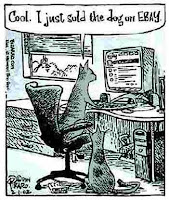
Sold!

What your cats do when you're away from home...

I can think of at least three of our cats who would do this if they could!

Tuesday, October 18, 2005

Dione

Another amazing Cassini photo...

Saturn's moon Dione is placed in a setting here that's straight out of one of those awful pulp science-fiction paperbacks -- the bright grey moon set against the majesty of the giant planet Saturn. From the Cassini web site:

Speeding toward pale, icy Dione, Cassini's view is enriched by the tranquil gold and blue hues of Saturn in the distance. The horizontal stripes near the bottom of the image are Saturn's rings. The spacecraft was nearly in the plane of the rings when the images were taken, thinning them by perspective and masking their awesome scale. The thin, curving shadows of the C ring and part of the B ring adorn the northern latitudes visible here, a reminder of the rings' grandeur.

It is notable that Dione, like most of the other icy Saturnian satellites, looks no different in natural color than in monochrome images.

Images taken on Oct. 11, 2005, with blue, green and infrared (centered at 752 nanometers) spectral filters were used to create this color view, which approximates the scene as it would appear to the human eye. The images were obtained with the Cassini spacecraft wide-angle camera at a distance of approximately 39,000 kilometers (24,200 miles) from Dione and at a Sun-Dione-spacecraft, or phase, angle of 22 degrees. The image scale is about 2 kilometers (1 mile) per pixel.

When I first saw this image, I thought that the edge-on rings were some kind of camera artifact, and I thought that the ring's shadows were the result of either a time exposure or some artist "cleaning up" the photo. The fact that those are real elements in the photo -- we'd see them if we were there -- makes this somehow even more astonishing to me.

Oh, what I would give to be able to take a seat in Cassini, and see with my own eyes what our precocious robot is seeing...

As usual, click on the photo for a larger view...

APOD

AE Aurigae: The Flaming Star

APOD brings us...

Is star AE Aurigae on fire? No. Even though AE Aurigae is named the flaming star, the surrounding nebula IC 405 is named the Flaming Star Nebula, and the region appears to harbor red smoke, there is no fire. Fire, typically defined as the rapid molecular acquisition of oxygen, happens only when sufficient oxygen is present and is not important in such high-energy, low-oxygen environments such as stars. The material that appears as smoke is mostly interstellar hydrogen, but does contain smoke-like dark filaments of carbon-rich dust grains. The bright star AE Aurigae, visible just below the image center, is so hot it is blue, emitting light so energetic it knocks electrons away from surrounding gas. When a proton recaptures an electron, red light is frequently emitted, as seen in the surrounding emission nebula. Pictured above, the Flaming Star nebula lies about 1,500 light years distant, spans about 5 light years, and is visible with a small telescope toward the constellation of the Charioteer (Auriga).

Click on the picture for a larger view.

Clancy

In memoriam...

Randy Cassingham is, amongst other things, the author of the weekly email publication This is True (more on that below). Randy's cat Clancy (pictured at right in a favorite pose) was his longtime friend and companion. Yesterday Clancy died, and Randy (of course!) put up a web page that is a tribute to Clancy. On it, he says:

Clancy was a sweet boy who liked sleeping right next to me -- or, more often in the winter, on me. When I rolled over, he'd "surf the wave" and stay right with me, and when I settled down he would too. But in recent months it was getting clear he was in distress. He has always loved to jump up into my arms (I'm tall, and the floor is a long way away, so I taught him to jump up to me rather than rely on me to bend down to pick him up). But over time, his jumps were less and less powerful -- he wasn't making it all the way to my arms. And in recent weeks, he wouldn't even make the attempt; he was simply tired and, perhaps, hurting.

Any of you who are (like us) kept by your animals will recognize and identify with the sentiment that Randy expresses. Read the whole thing!

On This is True: I first ran into this email publication over seven years ago. I subscribed for years to the free edition, but about three years ago upgraded to his "premium" edition. For that entire period I've looked forward to receiving the latest edition each week. It's very hard for this writer to imagine how Randy manages to keep up the consistent quality of this wonderful little publication, issue after issue after issue, but somehow he does it. He never fails to put a smile on my face and to make me laugh out loud (sometimes in inappropriate work situations <smile>!), and usually has some interesting points to ponder. If you're not already a subscriber to This is True, you really should at least go sign up for the free edition. Try it for a while, and I'll bet you'll want to upgrade to the premium edition!

Rain!

And the fire danger drops to near zero...

When I toddled off to bed last night, we'd had a total of about a third of an inch of rain over the past couple of days, and the radar didn't show any more coming. So it was a very pleasant surprise to wake up this morning and discover that overnight we'd had quite a bit more rain -- almost another half inch -- for a total of 0.75 inches (19 mm) in the past two days. And it is raining nicely as I write this.

Now to you folks who don't live in the desert, that may not seem like a lot of rain. For the high-desert chaparral, though, to have this much rain right as our traditional fire season starts means a significant dimunition in the fire danger, for a least a week or two. All the abundant fuel in the chaparral (the dead twigs, leaf litter, etc.) has now been thoroughly wetted, and will not easily catch fire via wind-blown embers. This is the primary mechanism by which chaparral fires spread, so wet fuel is a big deal. And to dry the fuel out after this much rain will take a prolonged period of dry weather -- hence the several weeks of safety purchased by this rain.

Yahoo for the rain!

Monday, October 17, 2005

Estonia Power

Some nice exposure for Estonia...

For reasons that aren't entirely clear to me, Estonia has recently been getting quite a bit of good press in the U.S., both in the mainstream media and in the blogosphere. For example, Publius Pundit has a nice piece today, that starts like this:

In less time than it takes for a new baby to reach U.S. voting age, the nation of Estonia has transformed itself from a cold, gray, stagnant outpost of the Soviet Empire to one of the world’s most impressive dynamic democracies. Its banks are pristine, its one of the most wired countries in the world, it is famous for its absence of corruption, as well as its flat tax, its sound stable money, its property rights, its free trade (unilaterally done with no miserable CAFTA battle, as Alvaro Vargas Llosa noted.) The only shortage out there for Estonia is enough praise for this marvelous nation that is lighting a flame for the rest of the world.

In the rest of that article, he points to this comment on another blog, from someone whose sentiments (and sighs) I certainly share:

[Sigh] "Filing an annual tax return online, as 80% of Estonians do, takes a few minutes."

Processing these tax returns takes an average five days.

Estonia has a flat tax of 24% on personal and corporate income.

"Estonia's economy showed 9.9% year-on-year growth in the latest quarter -- Europe's fastest rate."

[Figures & quotes from The Economist 10/15/05.]

[Another sigh]

Maybe the Estonian government hired a new public relations firm?

Morning Walk

In the chaparral after a rain...

One of the nice things about being unemployed and living in the chaparral country of San Diego County is that I'm now completely free to take walks in the morning. With Debi and our two dogs (Mo'i and Lea), I've been walking every morning in the hills that surround our home.

This morning was even grander than usual. We had some rain last night -- not a whole lot, but enough to wash all the dust from the leaves of the chaparral, and to accent all the lovely high desert morning smells. The freshly cleaned leaves gave a new, dark green appearance to our hillsides. The smells of high desert chaparral are hard to put into words. The dominant small is from sage; the same sage that's commonly used as a spice. It's always the strongest at night and in the early morning; after a rainfall it is at the absolute peak -- strong and sharp in your nostrils. Along with the sage, there are dozens of odiferous nuances as you walk along; some from the leaves (like sage), others from flowers or stems that you crush as you walk. It's a veritable symphony of smell in the early morning after a rain, and that symphony is playing very loudly. The intensity of this desert perfume has to be experienced to be believed...

Something interesting about these smells -- nearly all of them serve a distinct purpose for the plant, usually either an insect repellant or an outright insecticide. The sharp odor of sage, for instance, is from a chemical that is quite an effective insect repellent -- even appearing in commercial products for use by people, and commonly planted in gardens to ward off bugs. Strange, somehow, to think that these things that we find so attractive are either obnoxious or fatal to insects!

Rhma

She's doing great!

A few weeks ago I told you about a little Iraqi girl with a severe medical problem, and how some concerned Americans conspired to make sure she got the help she needed. Michael Yon now reports that Rhma has had the surgery she needed, and the results were terrific. He posted this email from one of her nurses:

Rhma did absolutely beautifully during surgery. Her oxygen saturation is now between 87 and 91 and she is pink! She looks like a different child. Her Mom just kept holding her hands, looking at her nail beds and smiling. She has been very stable and has not required any medications to keep her blood pressure up. She is still on the ventilator just to allow her to rest for the night but she'll be off it in the morning. I will keep you posted.

This is very sweet good news on top of the political good news of the Iraqi constitutional referendum...

Sunday, October 16, 2005

A Storm!

Rain, lightning, and thunder...oh my!

The first picture at right is a snapshot of our local NEXRAD weather radar. The lower right circle is a close-up of the area around our home, and you can see that it's raining. As of this post, we've accumulated 4 mm--that may not sound like much, but it's a whole bunch of rain for mid-October, and very, very welcome as we enter the high-risk part of our fire season.

Recall that the Cedar Fire occured at the end of October in 2003, and you can see why we worry about such things...

The middle picture shows the barometric pressure here for the past week; it's notable mostly for the precipitous drop that's recorded for the past (about) 30 hours. This is the classic sign of an impending storm. The rightmost picture is temperature (red line) and humidity (green line) over the past week. You can see that the storm's onset included a dramatic drop in temperatures and an equally dramatic rise in relative humidity. In particular you can see the sharp rise to nearly 100% humidity at the onset of the rain just a couple of hours ago.

The NOAA forecast has good chances of rain from now through Tuesday evening, and we are making offerings to whatever rain gods we can identify, in the hopes of helping the weather forecasters improve their accuracy...

Bravo, Iraq!

From all that I've been able to read so far, it appears that (a) the turnout in the Iraqi election was very high, (b) the Constitutional referendum is going to pass--easily, and (c) the terrorist attacks were much less numerous, and much less effective, than threatened by the Al-Qaeda leadership.

Bravo, Iraq! May the "Spirit of the Purple Finger" live on eternally!

What good news for this Sunday...

Friday, October 14, 2005

Dem Minnesotans

Sure are a peculiar lot...

Two Minnesotans walk into a pet shop in Dingle. They head to the bird section and Sven says to Hans, "Dat's dem." The owner comes over and asks if he can help them. "Yeah, we'll take four of dem dere little budgies in dat cage up dere," says Sven. The owner puts the budgies in a paper bag. Hans and Sven pay for the birds, leave the shop and get into Sven's pickup and drive to the top of the Conor Pass. At the Conor Pass, Sven looks down at the 1000 ft. drop and says, "Dis looks like a grand place." He takes two birds out of the bag, puts them on his shoulders and jumps off the cliff. Hans watches as Sven falls all the way to the bottom. Looking down at the remains of his best pal, Hans shakes his head and says "Dis budgie jumping is too dangerous for me."

Moments later Ole arrives up at Conor Pass. He's been to the pet shop, too and walks up to the edge of the cliff carrying another paper bag in one hand and a shotgun in the other. "Hi, Hans. Watch dis," Ole says. He takes a parrot from the bag and throws himself over the edge of the cliff. Hans watches as, half way down, Ole takes the shotgun and shoots the parrot. Ole continues to plummet down and down until he hits the bottom and breaks every bone in his body. Hans shakes his head and says, "And I'm never trying dat parrotshooting either."

Hans is just getting over the shock of losing two friends when Lars appears. He's also been to the pet shop and is carrying a paper bag out of which he pulls a chicken. Lars then grasps the chicken by the legs holds it over his head and hurls himself off the cliff and disappears down and down until he hits a rock and breaks his spine. Once more Hans shakes his head. "First der was Sven with his budgie jumping, den Ole parrotshooting--and now Lars is hengliding..."

Estonian Political Hopeful

Would you believe I know this woman?

Updated (below).

And my wife isn't too happy about that...

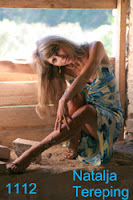
Natalja Tereping (click on the photo for a larger view) was an employee in the Tallinn offices of a company I used to work for (Stac, which then became Previo). She was our bookkeeper and office assistant there for years. An Estonian friend of mine sent me this picture of Natalja this morning along with the interesting news that she is running for a seat on the Tallinn city council, representing the Mustamäe area (if I'm reading the Estonian language web sites correctly). She's a member of the center-right "Res Publica" party, one of the dominant political parties in Estonia.

I have never had a discussion about politics with Natalja, so I don't know what has driven her to do this, or what positions she holds. The center-right platforms of her party are not too awfully far from my own more libertarian leanings, so most likely she and I could have a civil conversation on Tallinn's political situation, if I actually knew very much about it (I don't).

All that aside, can you think of a single female candidate for American political office (at any level) with the movie star/model attractiveness that Natalja has? Not one comes to my mind. It's hard to see how this could hurt Natalja's chances in the election, especially amongst the men...

Go, Natalja, go!

Update (10/17): My Estonian friend tells me that Natalja has received only seven votes (one of which was her own!), and has lost the election. How sad!

Seeds

Collected from our yard...

These seeds caught my eye as my wife and I took our morning walk with the dogs. I have no idea what the plant is.

The thing that caught my eye at first was the symmetry (more obvious on some of the seeds still on the plant) -- perfect four-pointed "stars" with "layers" of seeds. Upon closer examination I saw something more curious, though. Each seed has a tuft of fibers coming out of it, presumably to catch the breeze and disperse the seeds. The fibers for each seed are being pulled from two of the spoke structures -- this is what produces the symmetrical form that first caught my eye.

What an elaborate setup!

As usual, click on the picture for a larger view...

Thursday, October 13, 2005

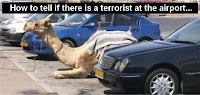
Terrorist Detection

A surefire method...

And a tip of the Jamulian hat to my mom for this contribution to excellence in homeland security...

Wednesday, October 12, 2005

U.N. Approval

An international symbol for marriage...

We're told that the United Nations has approved this new, official international symbol for marriage.

I don't think any married male will have any difficulty understanding this!

But will the married women understand?

I just asked my wife, and got a smack in the head as an answer. Oddly enough, I know how to interpret that: yes, she understood.

Monday, October 10, 2005

Barometric Oddities

Periodic atmospheric pressure variation...

At right you see a chart of the past week's barometric pressure at our home. There is a regular variation in the pressure that occurs twice a day (a diurnal cycle). The peak-to-peak variation is roughly 0.7 in/hg, or 2.2 millibars.

When I first saw this variation I thought it was some kind of heating effect on my instrument, or some other data artifact, and not a real pressure variation. However, the more I studied it, the stranger it looked. What, for instance, could account for the cycle being twice a day? So I did what I always do when faced with such a mystery: I googled.

It turns out that this diurnal pressure cycle is very well-known, and it's real. I've never seen it before because (a) the variation is quite small, and (b) until this past year I've never owned a sensitive enough recording barometer.

Although the diurnal cycle turns out to be very complex in nature, I can summarize what I discovered as follows:
--The large peaks (daily at around 10 AM PST) are mainly caused by solar heating of the atmosphere.
-- The lesser peak (daily at around 10 PM PST) are mainly caused by a solar tidal effect.
-- The solar tidal cycles (unexpectedly) dominate the lunar tidal cycles because of a resonance with a normal mode of atmospheric oscillation of approximately 12 hour period that closely matches the solar cycle, greatly amplifying it.

Because solar heating is the dominant underlying mechanism, there are some aspects of the atmospheric tides that are quite different than the oceanic tides:
-- The 10 AM peak is far larger at the equator than at higher latitudes.
-- Inland locations have greater 10 AM peaks than ocean locations (because there are greater heating effects on land masses).

There are also pressure variations with periods longer than a day. There is a pronounced annual cycle that relates to the seasonal change of temperature -- but its polarity varies by altitude. For locations below about 1300 feet in altitude have lower pressures in the summertime; locations above 1300 feet have higher pressures in the summertime (and, I suppose, right at 1300 feet there's no difference at all!). There are also several cycles --not well studied--that seem to be related to lunar cycles.

This turned out to be far more interesting, and complicated, than the instrumentation problem I suspected! You can read more about these phenomena here, here, here, and here.

Sunday, October 9, 2005

Santa Anas Gone!

The chart at right shows the temperature (red line) and relative humidity (green line) at our home for the past week. You can see a three-day period with low relative humidity, starting just before midnight on the 4th and ending around 5 pm on the 7th. That's one signature of a Santa Ana condition; the other is the wind speed and direction. This time, for whatever reason, the winds never really picked up to high speeds, and only intermittently shifted direction.

Yesterday (the 8th) afternoon the humidity increased dramatically while the temperature decreased, and this morning it felt downright chilly this morning (to the heat-acclimated amongst us; you residents of northern climates can stop laughing now). A welcome break, indeed.

Unfortunately our one-week forecast says it will be hot again by the end of the coming week, well into the 90s...

Java Performance

IBM on the "Java urban legend" of poor performance:

Pop quiz: Which language boasts faster raw allocation performance, the Java language, or C/C++? The answer may surprise you — allocation in modern JVMs is far faster than the best performing malloc implementations. The common code path for new Object() in HotSpot 1.4.2 and later is approximately 10 machine instructions (data provided by Sun; see Resources), whereas the best performing malloc implementations in C require on average between 60 and 100 instructions per call. And allocation performance is not a trivial component of overall performance — benchmarks show that many real-world C and C++ programs, such as Perl and Ghostscript, spend 20 to 30 percent of their total execution time in malloc and free — far more than the allocation and garbage collection overhead of a healthy Java application.

The article also has a bunch of interesting links...

Friday, October 7, 2005

Killer Daddy

"What on earth is this?" was my first reaction to seeing this comic. It's horrible looking, and when you read the text, you discover it's propaganda of the crudest sort — like some of the awful anti-Semitic stuff that came out of Hitler's regime.

But this ... this comic is aimed at kids! And it's brought to you by People for the Ethical Treatment of Animals (PETA). It's all the evils of fishing, and it is attempting to recruit children to defy their parents.

Just. Like. Hitler. And. Stalin.

A sample of the lovely rhetoric:

Until your daddy learns that it’s not “fun” to kill,keep your doggies and kitties away from him.He’s so hooked on killing defenseless animalsthat they could be next!

And this:

Imagine that a man dangles a piece of candy in front of you. You love candy so you reach for it. But, as you grab thecandy, a huge metal hook stabs through your hand and you’re ripped off the ground. You fight to get away, but it doesn’t do any good. You are caught, and there is nothing that you can do about it. You’d feel really scared, wouldn’t you?That would be an awful trick to play on someone, wouldn’t it? But guess what? Your daddy plays that same wicked trick on fish and fish get scared too!

Every time I read anything at all about this organization — including their own mailers that they send me — I come away with the impression of madness and diabolical evil. After reading this one, I want to take a shower. Can't you just see some PETA pervert cackling to himself (or herself — can't show a gender bias here!) as they pen the propaganda and paint the lurid comic? Can you imagine a ... normal ... person doing this?

As usual, click on the photo for a larger view...
A tip of the hat to Junkyard Blog.

Fire No Threat

The two fires that burned near us for the past few days are nearly out. As best we can tell, the danger is over.

Whew!

The Best

Last night, President Bush gave a speech at the National Endowment for Democracy. The entire conservative blogosphere seems to be abuzz about it. Mostly they are lavishly praising it; a few say "gee, that's nice — but why didn't we hear this years ago?"

I was glued to my screen as I watched the video playback (both the transcript and the video are available at the White House web site). It was a riveting speech; well-written, well-delivered, and with a much-needed message about why we're fighting the war on terror (including in Iraq), and why we're winning it. I can't add much to what the rest of the blogosphere has already said. I will say this, though (agreeing with some other observers): it's the best speech I've ever seen President Bush make. Period. An example of the rhetoric:

Over the years these extremists have used a litany of excuses for violence — the Israeli presence on the West Bank, or the U.S. military presence in Saudi Arabia, or the defeat of the Taliban, or the Crusades of a thousand years ago. In fact, we're not facing a set of grievances that can be soothed and addressed. We're facing a radical ideology with inalterable objectives: to enslave whole nations and intimidate the world. No act of ours invited the rage of the killers — and no concession, bribe, or act of appeasement would change or limit their plans for murder.

On the contrary: They target nations whose behavior they believe they can change through violence. Against such an enemy, there is only one effective response: We will never back down, never give in, and never accept anything less than complete victory.

Do read and view the whole thing.

Flat Tax

Today's Wall Street Journal has a commentary piece called "The World is Flat" ($) that endorses and encourages the notion of a flat tax for the U.S. It concludes:

Russia, for example, has reported that it now gets more tax revenues from the rich from its 13% flat tax than from its pre-existing Swiss cheese tax code with massive evasion and 50%-plus tax rates. Russia's revenues with the flat tax grew in real terms by 28% in 2001, 21% in 2002, and 31% in 2003, according to a recent analysis by the Hoover Institution. If the U.S. had that kind of revenue growth, our politicians would be wringing their hands over what to do with budget surpluses.

Last year the Internal Revenue code achieved a new Olympic record for complexity, with nine million words -- 12 times the length of the King James Bible. High tax rates and mindless tax complexity are an economic ball and chain. We hope President Bush's tax reform commission will cut through the class-warfare blather later this month and endorse a simple, broad-based, single-rate tax system.

As many of you know, I have made many visits to Estonia and Russia in the post-Soviet era. I've often noted the amazing sustained economic expansion in Estonia, which was the first country to implement a flat tax (Russia did so years later). Estonia, as the WSJ piece mentions, has already reduced their flat tax rate from 26% to 24%, and is planning to reduce it yet again to 20%. By any measure I'm aware of, the flat tax has been a resounding success in every country that has implemented it. When the flat tax is compared with the U.S. income tax system, the U.S. system comes away looking just plain silly. And yet somehow the U.S. does not seem to have nearly the political will it would take to switch to the flat tax; the pundits collective wisdom is that such a change borders on impossible.

Why is this? Well, most of the answers to this question that I have read focus on the vested interests that many groups and individuals have in our current tax code. For example, the solar energy credits are a boon to the solar energy industry, so their lobbyists support this particular piece of the tax code. There are thousands upon thousands of such specific benefits built into our tax code, and an interesting segment of the lobbyist population spends their time promoting them. Fair enough, but I suspect that's not the entire explanation. Also mentioned — and this resonates strongly with me — is the fact that our political system in many ways owes its incredible growth during the 20th century to the leverage politicians have because of our byzantine income tax. What better way to get your particular tweak to the tax code than to help elect your very own Congressman?

These factors have been enough, so far, to keep the flat tax movement from gaining much foothold in the U.S., despite the fact that poll after poll has shown overwhelming support by the electorate for a flat tax (see this Tax Foundation poll). Steve Forbes — perhaps the most visible proponent of the flat tax in the U.S. — was treated as if he were on the lunatic fringe of political thought, and an unserious contender, during his Presidential primary runs in 1996 and 2000. Is there no hope for us?

I am feeling optimistic that the flat tax will get a thorough hearing in the next election cycle (2008), though I can't explain exactly why. And I think there's even a reasonable chance that within the next few years enough political momentum can be generated to get a flat tax passed in the U.S. One interesting possibility in our federalist system is that a state could be the first to do so, and I think that's actually the most likely scenario. Success in a state would help spread flat tax fever in the U.S., much more so than any amount of European success, I'd wager. And I can easily imagine states like Idaho, Utah, or Wyoming jumping into the flat tax boat. Here's hoping!