This list of phrases and their translations (definitions) might help you understand the mysterious language of science in general and medicine / biology specifically. These special phrases are also applicable to anyone working on a Ph.D. dissertation, academic paper or journal article at a university anywhere on earth.
Research Phrases Translation / Meaning It has long been known ... I didn't look up the original reference. A definite trend is evident ... These data are practically meaningless. Of great theoretical and practical importance ... Interesting to me. While it has not been possible to provide definite answers to these questions ... An unsuccessful experiment, but I still hope to get it published. Three of the samples were chosen for detailed study ... The results of the others didn't make any sense. Typical results are shown ... This is the prettiest graph. These results will be shown in a subsequent report... I might get around to this sometime, if I'm pushed / funded. The most reliable results are those obtained by Jones ... He was my graduate assistant. It is believed that... I think. It is generally believed that ... A couple of other people think so, too. It is clear that much additional work will be required before a complete understanding of the phenomenon occurs ... I don't understand it. Correct within an order of magnitude ... Wrong. In my experience ... Once. In case after case ... Twice. In a series of cases ... Thrice. According to statistical analysis. Rumor has it. A statistically oriented projection of the significance of these findings. A wild guess. Thanks are due to Joe Blotz for assistance with the experiment and to George Frink for valuable discussions ... Blotz did the work and Frink explained to me what it meant. A careful analysis of obtainable data... Three pages of notes were obliterated when I knocked over a glass of wine. It is hoped that this study will stimulate further investigation in this field ... I quit.

Showing posts with label Science. Show all posts
Showing posts with label Science. Show all posts
Friday, September 13, 2013
Phrases Commonly Found in Science Research Papers...
...along with translations into ordinary English:

Sunday, September 8, 2013
Data Compression: Curiosity's “Focus-Merge” Images...
The Curiosity rover currently exploring Mars has an interesting image manipulation capability on board that is effectively a form of data compression, albeit a very unconventional one.
Since early in the days of digital cameras, photographers have realized that there are ways to combine multiple digital images of the same scene to provide a better composite image. One of the first uses of this technique was to increase the camera's effective depth-of-field with a technique called focus stacking or focus bracketing. The idea is simple enough: you take several images of precisely the same scene, but each with different focus settings. Then you combine the parts of each image that are in focus, so that the entire resulting image is in focus.
Focus stacking is particularly useful in macro (close-up) photography, because the lenses used have very shallow depth of field. Digital photographers routinely use focus stacking today, generally with software such as Photoshop. You might start with images taken at 4 or 5 focus settings, then combine them carefully to get one image as a result. This is especially useful with studio or product photography, where your subject is stationary.
From the perspective of data size, this is a very inefficient process. To get a single final image, you have to move several full size images from the camera to your focus stacking software. For an earthbound digital photographer, that's a few seconds of time as the memory card gets read. For Curiosity, millions of miles away on Mars, it's an entirely different story – it has to send all those images over a very slow communications link.
Now Curiosity has a macro camera (the MAHLI imager), and it has a major depth-of-field challenge. It's designed to capture images of rocks for geologists to study, and those rocks generally have surfaces that are far from flat. But sending multiple images for focus stacking over that slow data link is a more bandwidth than they'd like to use. The solution: implement focus stacking right on the Curiosity rover, so that only the final, all-in-focus image has to be transmitted. The MAHLI team calls this technique “focus-merge”
How do they accomplish this feat, normally done with human manipulation?
First, the MAHLI team built an in-focus sensing capability into the camera that extends across the entire image. On every image, the camera knows which pixels are in focus and which are not. This is similar to (but more extensive than) the multiple-areas autofocus capability of most high-end digital SLRs today. This in-focus data is stored with each image taken.
Then for any given rock that MAHLI is imaging, they'll take several photos (2 to 8, depending on the rock's depth variation) at different focus settings. Software on board Curiosity then scans all the images pixel-by-pixel, choosing the image with the best focus for each pixel. It also creates a visualization map showing the image selected at each pixel (using 2 to 8 gray levels, with blacker being more distant).
To anyone who has done much macro photography (as I have, with wildflowers), the result approximates magic: extreme close-up photos with essentially infinite depth-of-field. I really can't use this technique with wildflowers, because the darned things are highly unlikely to be still at microscopic scales. But I can envy the result nonetheless.
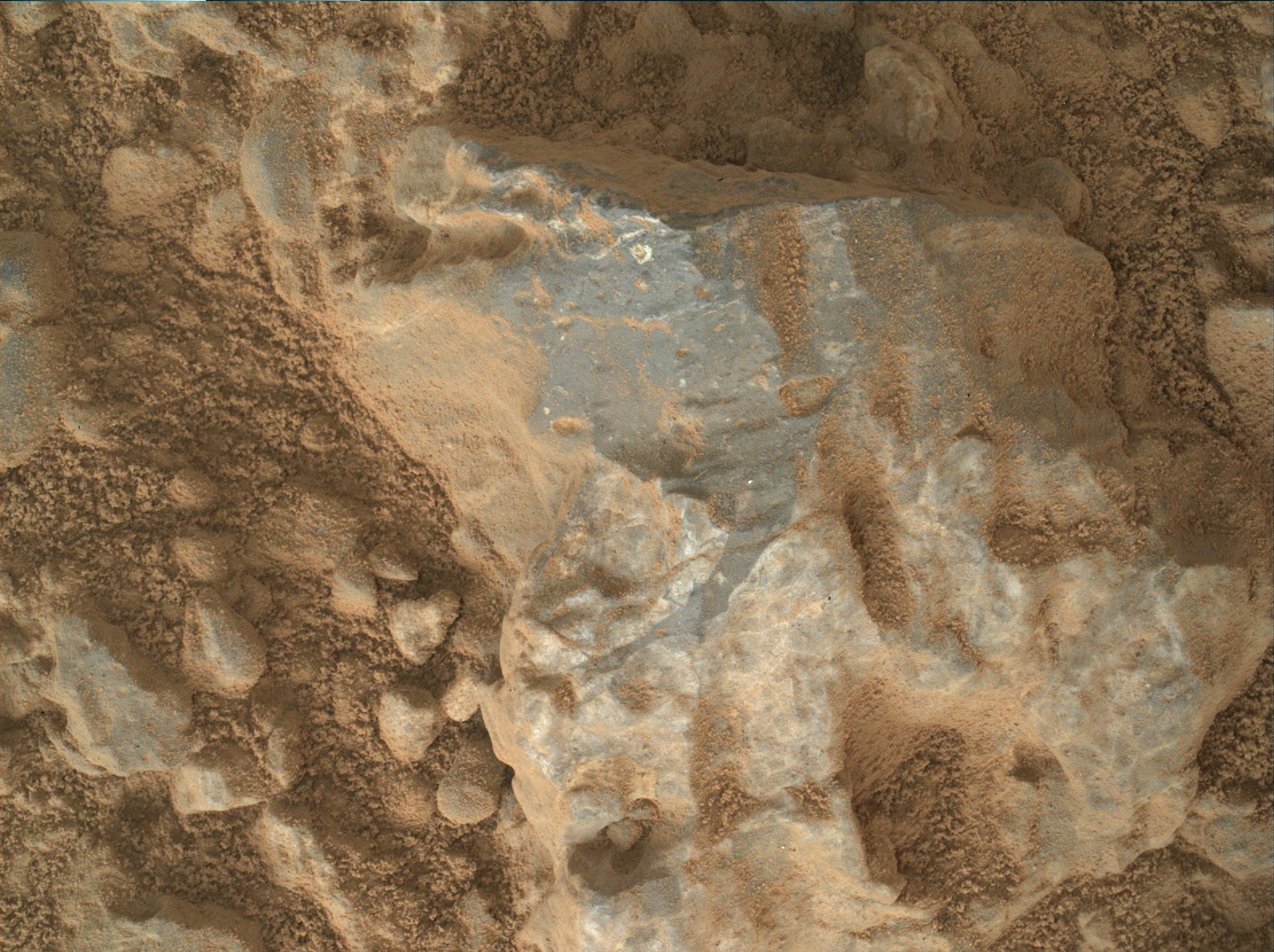
Here's a recent Curiosity focus-merge image of a rock's surface (on top) and it's matching focus map (at bottom):

Since early in the days of digital cameras, photographers have realized that there are ways to combine multiple digital images of the same scene to provide a better composite image. One of the first uses of this technique was to increase the camera's effective depth-of-field with a technique called focus stacking or focus bracketing. The idea is simple enough: you take several images of precisely the same scene, but each with different focus settings. Then you combine the parts of each image that are in focus, so that the entire resulting image is in focus.
Focus stacking is particularly useful in macro (close-up) photography, because the lenses used have very shallow depth of field. Digital photographers routinely use focus stacking today, generally with software such as Photoshop. You might start with images taken at 4 or 5 focus settings, then combine them carefully to get one image as a result. This is especially useful with studio or product photography, where your subject is stationary.
From the perspective of data size, this is a very inefficient process. To get a single final image, you have to move several full size images from the camera to your focus stacking software. For an earthbound digital photographer, that's a few seconds of time as the memory card gets read. For Curiosity, millions of miles away on Mars, it's an entirely different story – it has to send all those images over a very slow communications link.
Now Curiosity has a macro camera (the MAHLI imager), and it has a major depth-of-field challenge. It's designed to capture images of rocks for geologists to study, and those rocks generally have surfaces that are far from flat. But sending multiple images for focus stacking over that slow data link is a more bandwidth than they'd like to use. The solution: implement focus stacking right on the Curiosity rover, so that only the final, all-in-focus image has to be transmitted. The MAHLI team calls this technique “focus-merge”
How do they accomplish this feat, normally done with human manipulation?
First, the MAHLI team built an in-focus sensing capability into the camera that extends across the entire image. On every image, the camera knows which pixels are in focus and which are not. This is similar to (but more extensive than) the multiple-areas autofocus capability of most high-end digital SLRs today. This in-focus data is stored with each image taken.
Then for any given rock that MAHLI is imaging, they'll take several photos (2 to 8, depending on the rock's depth variation) at different focus settings. Software on board Curiosity then scans all the images pixel-by-pixel, choosing the image with the best focus for each pixel. It also creates a visualization map showing the image selected at each pixel (using 2 to 8 gray levels, with blacker being more distant).
To anyone who has done much macro photography (as I have, with wildflowers), the result approximates magic: extreme close-up photos with essentially infinite depth-of-field. I really can't use this technique with wildflowers, because the darned things are highly unlikely to be still at microscopic scales. But I can envy the result nonetheless.
Here's a recent Curiosity focus-merge image of a rock's surface (on top) and it's matching focus map (at bottom):
Tuesday, September 3, 2013
Prince Rupert's Drop...
I have read about Prince Rupert's Drops, but I had never before seen one demonstrated – especially not at 130,000 frames per second! If you're interested in science, you'll enjoy this 7 minute mini-documentary...
Saturday, August 31, 2013
An Annular Eclipse of the Sun...
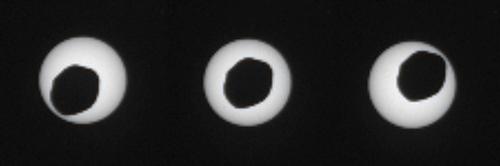
Down on the surface of Mars, the Curiosity rover looked up to see a beautiful annular eclipse of the sun by the Martian moon Phobos. You can easily see that Phobos is not spherical – it's shaped more like a potato than a ball...
Friday, August 30, 2013
Under the Ice...
Bigger than the Grand Canyon, this one was just discovered under Greenland's icecap:

We're a long way from knowing even our own planet very well. Other planets (and even more so other stars) we've just barely scratched the surface. Literally...
We're a long way from knowing even our own planet very well. Other planets (and even more so other stars) we've just barely scratched the surface. Literally...
Thursday, August 22, 2013
Sprites...
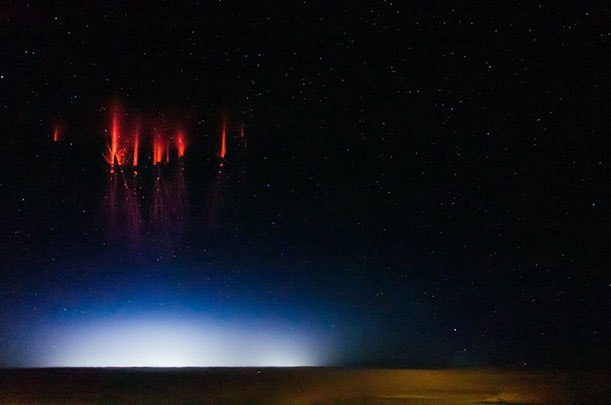
I first started reading about sprites (aka “red lightning”) just a few years ago. Now I'm starting to see good photos of these spectacular natural phenomena, like the one below. I'd love to see one of these myself!
Wednesday, August 21, 2013
Sometimes Science Gets It Wrong the First Time...
But often it gets it right. It can be interesting and fun to watch the process of science changing its mind, and more so the earlier you can catch the process. I first ran into this with the great plate tectonics debate in geology; that had begun shortly before I was born, and really wasn't over for another 30 years or so, when plate tectonics became nearly universally accepted as the process that shapes the earth's surface.
I just read a piece of science news that strikes me as possibly, just possibly, the beginnings of another such change. Most likely it will turn out to be nothing - but there's a chance that it's the beginning of a big change in cosmology (and physics). I'm fascinated that the mathematics of the current theory of the universe's expansion is basically the same as the mathematics of the alternative explanation being put forth. There have been quite a few discoveries in science that started with just such an observation...
I just read a piece of science news that strikes me as possibly, just possibly, the beginnings of another such change. Most likely it will turn out to be nothing - but there's a chance that it's the beginning of a big change in cosmology (and physics). I'm fascinated that the mathematics of the current theory of the universe's expansion is basically the same as the mathematics of the alternative explanation being put forth. There have been quite a few discoveries in science that started with just such an observation...
Saturday, August 17, 2013
Friday, August 16, 2013
Curiosity: Occultation...
Curiosity recently took a sequence of images of the Martian moon Phobos occulting its sister moon Deimos. Phobos is physically larger than Deimos, and is in a lower orbit, so its apparent size from the surface of Mars is much larger. The good folks at JPL took this sequence of images and made a movie out of them:
Tuesday, August 13, 2013
Book Review...
I've just finished reading The Riddle of the Labyrinth: The Quest to Crack an Ancient Code, by Margalit Fox. It's the story of the decoding of Linear B script, which was much more of an accomplishment than many today remember. The first clay tablets bearing Linear B script were discovered in the late 1800s, and the form of the tablets made it crystal clear that Linear B was a script. Prior to that, objects were found with Linear B script on them (especially seals), but nobody recognized the odd symbols as a script; they were thought to be merely decoration.
For over 50 years after the tablets were discovered – until Michael Ventris' key breakthrough in 1953 – nobody knew how to interpret the Linear B script. For most of that period, even the kind of script Linear B was (alphabetic, syllabic, or logographic) was unknown. And for that entire period, the language that the script was recording was unknown.
I first read about Linear B something like thirty years ago, and I've long wanted to learn more about how it was decoded. On the face of it, the problem seemed insurmountable to me: an unknown script, recording an unknown language, and no equivalent of the Rosetta Stone to help. How in the world could someone decode that?
Like many such achievements, the decipherment involved several people, much cleverness, and had several breakthrough “Ah ha!” moments. One of the main players (Alice Kober) got little contemporaneous credit. There were amateurs, professionals, and academic hobbyists. At least one curmudgeon was present. There was a borderline lunatic, much obsession, and a possible suicide. And of course there were academic rivalries and jealousies, and abuse of power. In other words, it's a pretty typical story of science, with lots of human interest.
I was quite satisfied with the book, especially for telling the stories of all the players in what appears to be an even and fair-minded way. I wish it had a bit more detail about how the decipherment was accomplished, but there is enough there to give the reader the basic idea without too much work.
Recommended for anyone interested in the history of science, or in ancient languages...
For over 50 years after the tablets were discovered – until Michael Ventris' key breakthrough in 1953 – nobody knew how to interpret the Linear B script. For most of that period, even the kind of script Linear B was (alphabetic, syllabic, or logographic) was unknown. And for that entire period, the language that the script was recording was unknown.
I first read about Linear B something like thirty years ago, and I've long wanted to learn more about how it was decoded. On the face of it, the problem seemed insurmountable to me: an unknown script, recording an unknown language, and no equivalent of the Rosetta Stone to help. How in the world could someone decode that?
Like many such achievements, the decipherment involved several people, much cleverness, and had several breakthrough “Ah ha!” moments. One of the main players (Alice Kober) got little contemporaneous credit. There were amateurs, professionals, and academic hobbyists. At least one curmudgeon was present. There was a borderline lunatic, much obsession, and a possible suicide. And of course there were academic rivalries and jealousies, and abuse of power. In other words, it's a pretty typical story of science, with lots of human interest.
I was quite satisfied with the book, especially for telling the stories of all the players in what appears to be an even and fair-minded way. I wish it had a bit more detail about how the decipherment was accomplished, but there is enough there to give the reader the basic idea without too much work.
Recommended for anyone interested in the history of science, or in ancient languages...
Saturday, August 3, 2013
Al Gore Faked It...
The inimitable Anthony Watts has an incredibly detailed takedown of the experiment shown in Al Gore's video Climate 101. The claim in the video is that the experiment is simple and high school level that anyone could replicate.
So Mr. Watts tried to replicate it, going way out of his way to run the experiment precisely as the video shows it.
And failed.
He concludes, quite reasonably, that Al Gore and Bill Nye (the science guy, who was also in the video) either never ran the experiment at all (it was all fake, just for show) or they ran it and failed, but used it anyway. Either way: Al Gore faked it.
As Mr. Watts points out, carefully: this in no way invalidates Al Gore's claims about CO2. It simply proves that Al Gore is a liar and a cheater.
But I guess we all suspected that anyway, didn't we?
So Mr. Watts tried to replicate it, going way out of his way to run the experiment precisely as the video shows it.
And failed.
He concludes, quite reasonably, that Al Gore and Bill Nye (the science guy, who was also in the video) either never ran the experiment at all (it was all fake, just for show) or they ran it and failed, but used it anyway. Either way: Al Gore faked it.
As Mr. Watts points out, carefully: this in no way invalidates Al Gore's claims about CO2. It simply proves that Al Gore is a liar and a cheater.
But I guess we all suspected that anyway, didn't we?
Tuesday, July 2, 2013
Sunday, June 30, 2013
Saturday, June 29, 2013
A New Discovery...
It's amazing just how big this world of ours is – big enough that archaeologists continue to make major discoveries in still-remote places. Announced yesterday: the discovery of an untouched, intact pre-Inca tomb in Peru...
D-Wave Processor Validated...
Scientists at USC have validated that the D-Wave “Vesuvius” processor chip is in fact operating as a quantum computing device.
That's not the same as saying that they have fully functional quantum computer, ready to rock and roll (and solve all those pesky traveling salesman problems)...
That's not the same as saying that they have fully functional quantum computer, ready to rock and roll (and solve all those pesky traveling salesman problems)...
Friday, June 28, 2013
Sea Level Change...
Measuring sea level change is difficult even with the best of modern instruments. Figuring out the sea level thousands of years ago is even harder.
We think of the rocks that form the sea bed and continents as hard, solid, stable things. In fact they are not – over geological time scales, the rocks move, sometimes a lot. I got a first-hand look at this on the Baltic islands of Estonia, especially Saremaa and Hiumaa. These islands are rising out of the sea, growing a little higher and bigger each year. If you lived there, you'd probably thing that meant the sea level was declining – that's what it looks like to you, standing on “solid” ground. But in fact, the limestone that makes up those islands is slowing rising – and in this case, geologists know exactly why. During the last Ice Age, an enormous mass of ice on the land pressed it down, displacing magma deep under the crust. After the Ice Age ended (and the ice all melted), that weight was lifted – and the land is slowly resuming its natural level. Geologists estimate that for the next 100,000 to 400,000 years, the land will continue to slowly rise. And residents will probably still think the sea is receding :)
We think of the rocks that form the sea bed and continents as hard, solid, stable things. In fact they are not – over geological time scales, the rocks move, sometimes a lot. I got a first-hand look at this on the Baltic islands of Estonia, especially Saremaa and Hiumaa. These islands are rising out of the sea, growing a little higher and bigger each year. If you lived there, you'd probably thing that meant the sea level was declining – that's what it looks like to you, standing on “solid” ground. But in fact, the limestone that makes up those islands is slowing rising – and in this case, geologists know exactly why. During the last Ice Age, an enormous mass of ice on the land pressed it down, displacing magma deep under the crust. After the Ice Age ended (and the ice all melted), that weight was lifted – and the land is slowly resuming its natural level. Geologists estimate that for the next 100,000 to 400,000 years, the land will continue to slowly rise. And residents will probably still think the sea is receding :)
Monday, June 24, 2013

Quantum Mechanism of Photosynthesis Worked Out...
The amazingly high efficiency of photosynthesis was long unexplainable by ordinary chemistry. A few years ago, scientists concluded that a “room temperature” quantum-mechanical system must be responsible. Now researchers have figured out the actual mechanism, and it's even more amazing than they'd expected it to be. If a similar system can be constructed for man-made solar power systems, we're going to see some mighty awesome solar panels!
Subscribe to:
Posts (Atom)