
Showing posts with label Astronomy. Show all posts
Showing posts with label Astronomy. Show all posts
Saturday, August 31, 2013
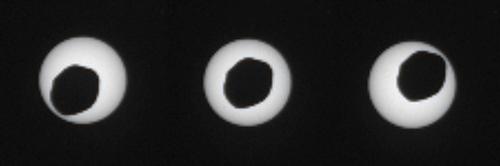
An Annular Eclipse of the Sun...
Down on the surface of Mars, the Curiosity rover looked up to see a beautiful annular eclipse of the sun by the Martian moon Phobos. You can easily see that Phobos is not spherical – it's shaped more like a potato than a ball...

Monday, June 24, 2013

Tuesday, June 4, 2013
Saturday, April 20, 2013
Monday, April 15, 2013
Thirty Meter Telescope...

Not so very long ago, the largest telescope in the world was the Hale Telescope, here in San Diego on Mt. Palomar. That telescope is still in operation, 200" in diameter – a light-collecting area of about 20 square meters. The Thirty Meter Telescope is 30 meters in diameter, giving it a light-collecting area of about 707 square meters – over 35 times bigger than the Hale Telescope.
Awesome!
Saturday, March 23, 2013
Sunday, March 17, 2013
Light Echoes...
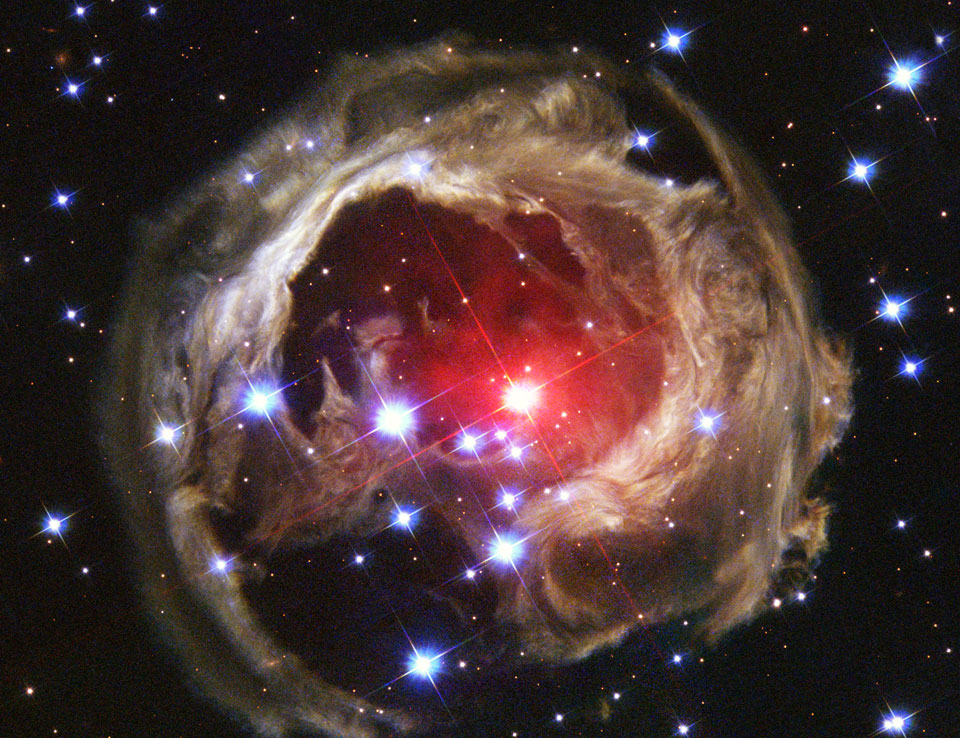
Remember V838 Monocerotis? It was a science sensation in 2002 when it was briefly the brightest star in the Milky Way galaxy. APOD is featuring a recent Hubble photo of it today, showing the dust clouds that are being lit by the (now) 11 year old sphere of light emitted by V838 Mono back in 2002. Full resolution version here...
Sunday, February 24, 2013
M51...
M51, the “Whirlpool Galaxy”, as seen by the Hubble Telescope. Full resolution version here. Via APOD, of course...


Wednesday, February 13, 2013
Monday, January 21, 2013
Lunar Companion...
Tonight the moon is just over half full, and as I walked the dogs (6:15 pm local time) it was nearly straight overhead and shining bright in a clear sky. I glanced up at it while I was walking, and noted that there is a bright star quite close to the moon – less than one lunar diameter away, towards the northeast. A star that appeared that bright, that close to a bright moon, almost surely was a planet.
So when I brought the dogs in, I grabbed our binoculars and walked back outside to check. Sure enough, that's Jupiter shining brightly so close to the moon. I couldn't see any surface features in the binoculars, but I could make out three moons of Jupiter, all in a row (from my perspective) – a giveaway that it is Jupiter.
I'm surprised this conjunction wasn't mentioned on any of the web sites I frequent. I can't remember a closer conjunction between those two bodies. With a little googling, I found this press release:
So when I brought the dogs in, I grabbed our binoculars and walked back outside to check. Sure enough, that's Jupiter shining brightly so close to the moon. I couldn't see any surface features in the binoculars, but I could make out three moons of Jupiter, all in a row (from my perspective) – a giveaway that it is Jupiter.
I'm surprised this conjunction wasn't mentioned on any of the web sites I frequent. I can't remember a closer conjunction between those two bodies. With a little googling, I found this press release:
Slooh Space Camera to Broadcast Live Feeds of Super Close Moon / Jupiter ConjunctionLooks like I caught it perfectly, even if by accident!
On Monday, January 21st, the Moon will appear amazingly close in the sky to the largest planet in our solar system, Jupiter. The Waxing Gibbous Moon - the lunar phase between first quarter Moon and a full Moon - will be approximately one degree south of Jupiter appearing to be only a pen width apart. This will be closest conjunction between the two celestial bodies until 2026.
Slooh Space Camera will cover the event live on Slooh.com, free to the public, Monday, January 21st at 6:00 PM PST / 9:00 PM EST / 02:00 UTC (1/22) - International times here: http://goo.gl/xySeo - accompanied by real-time discussions with Slooh President, Patrick Paolucci, Astronomy Magazine columnist, Bob Berman, and astro-imager Matt Francis of the Prescott Observatory. Viewers can watch live on their PC or IOS/Android mobile device at t-minus zero.
By good fortune, the Great Red Spot will be traveling across the middle of Jupiter's disk during Slooh's live broadcast.
If skies are clear, individuals can view the conjunction by looking at the Moon and finding the brightest star in the sky next to the Moon, which will be Jupiter. Individuals with binoculars or telescope may capture more detail of Jupiter, including some of the satellites.
Sunday, January 13, 2013
NGC 602...
A “small” star cluster, just 200 light-years across. Taken by the Hubble, via APOD, of course. Full resolution photo here.


Friday, January 4, 2013
Tycho's Central Peak...


APOD is featuring a photo of those central peaks today, taken a year and a half ago by the Lunar Reconnaissance Orbiter (LRO) – another one of NASA's largely unsung scientific robotic exploration heroes. Even better, APOD links to this interactive high-resolution photo viewer, which shows the same photo in spectacular 1.5 meter per pixel resolution. Awesome!

Saturday, December 29, 2012

Friday, December 28, 2012
Friday, November 23, 2012
Close Call?
This is kind of scary – some scientists think that a billion ton comet may have missed hitting the earth by just a few hundred kilometers, in 1883. If it had hit the earth, that would have been called an “extinction event”. Yikes!
Thursday, November 15, 2012
Homeless Planet?
Astronomers have spotted a planet wandering in space, not gravitationally bound to any star. I'm amazed they were able to spot it without the light from a nearby star to illuminate it...
Tuesday, October 23, 2012
Saturday, October 20, 2012
Orionid Meteor Shower Peaks Tonight...
Get thyself out to watch it. This particular meteor shower is created by the remnants and debris from Halley's comet. On the west coast, 3 to 5 am is the best time to see it...
Friday, October 19, 2012

Saturday, October 6, 2012
Potentially Very Bright Comet Discovered...
It's potentially very bright because it's going to pass quite close to the sun, in late 2013. Such predictions in the past have proved quite unreliable; some are bright, some are not. The actual brightness depends on a lot of factors, only one of which is how close it appears to the sun. Another critical factor: how many times it's been close to the sun before (which determines how much volatile material is left in the comet).
But...if they're right, and this comet really is brighter than the full moon, then it will almost certainly be the brightest comet in the history of humankind. That will make it quite an event to see!
But...if they're right, and this comet really is brighter than the full moon, then it will almost certainly be the brightest comet in the history of humankind. That will make it quite an event to see!
Subscribe to:
Posts (Atom)