We're talking about the Opportunity on Mars, the pluckly little rover that just keeps on going and going. It's been “asleep” for the Martian winter, and yesterday finally got enough power to motor up and roll around a bit. All systems are working just fine. Over the next few weeks, Opportunity will get more and more sunshine on its solar panels, and will do increasing amounts of exploration work around the Endeavour crater where it's currently located.
In a few months, barring some mishap, Opportunity will be joined on the Martian surface by a new rover, this one named Curiousity. This new rover is much bigger, longer-lived, and more capable than Opportunity – but for those of us who have been avidly following the adventures of Opportunity (and it's lost sibling, Spirit), Curiousity will be hard put to match its predecessors...

Showing posts with label Spirit. Show all posts
Showing posts with label Spirit. Show all posts
Thursday, May 10, 2012

Thursday, August 11, 2011
Opportunity on Spirit Point...

If you've forgotten all about Spirit and Opportunity, here's a reminder: they landed on Mars in 2003, and were designed to be operational for just 3 months. Spirit lasted 7 years (it died last fall) and Opportunity is still going strong 8 years later. Much of the credit for this unexpected longevity is due to the design team, but some of it is just plain luck: it turns out that the dust devils that frequently whisk across the Martian surface keep the explorers' solar panels relatively free of dust. Prior to the actual mission, engineers were expecting the red Martian dust to slowly accumulate on the solar panels. This would slowly reduce their power output until finally the explorers would run out of juice. The entire team was surprised – very pleasantly! – that the unpredictable dust devils have been coming along frequently enough to blow the panels clean well before the explorers ran out of juice...
Wednesday, May 25, 2011
Tuesday, August 3, 2010
Dust Devil...

Winter is just ending in Spirit's part of Mars, and NASA has not yet heard from it since it shut down to “hibernate” for the winter. It may be the end of the line for Spirit; the reports from NASA don't sound very optimistic. The main problem was that it got stuck in one place of soft soil (probably resting its belly on a rock), and couldn't move to a nice, sunny spot for the winter...
Monday, June 7, 2010
Spirit Finds Carbonates...
The Spirit rover has found clear evidence of carbonate rocks on Mars. Carbonate rocks form only in neutral or alkaline water, in conditions conducive to life-as-we-know-it. Actually, Spirit recorded the evidence for the carbonate rocks way back in 2005 – but the evidence was recorded on a sensor that was covered in dust, and the dust distorted the readings. Just recently scientists figured out how to remove the distortion computationally, and thereby found the carbonate rock's “signature”. The same instrument has collected data for about six years, and the same computational technique means that much of that data can now be “cleaned up”, quite likely leading to other “new” discoveries with old data...
Monday, February 1, 2010
Tuesday, June 30, 2009
The Spirit Still Moves...
 Spirit – NASA's Martian explorer, that is – is still alive and kicking on the surface of Mars, over five years into it's 90 day planned mission. Two big events recently: an unexpected windstorm cleaned the dust off its solar panels, giving it a big energy boost, and it got stuck in the sand. The crew at JPL is carefully maneuvering, trying to get unstuck. The fact that one of the six wheels is stuck (and has been, for a long time now) isn't helping.
But during all the messing about trying to get unstuck, Spirit is still doing science. At the moment, it's taking advantage of the fact that its wheels are digging through the loose, sandy soil to study what's been exposed. And it's interesting stuff!
Monday, February 6, 2006
Mars Rocks
From the official Mars Rovers web site: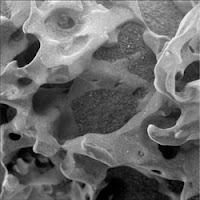
Hardened Lava Meets Wind on Mars
NASA’s Mars Exploration Rover Spirit used its microscopic imager to capture this spectacular, jagged mini-landscape on a rock called “GongGong.” Measuring only 3 centimeters (1.2 inches) across, this surface records two of the most important and violent forces in the history of Mars — volcanoes and wind.
GongGong formed billions of years ago in a seething, stirring mass of molten rock. It captured bubbles of gases that were trapped at great depth but had separated from the main body of lava as it rose to the surface. Like taffy being stretched and tumbled, the molten rock was deformed as it moved across an ancient Martian landscape. The tiny bubbles of gas were deformed as well, becoming elongated. When the molten lava solidified, the rock looked like a frozen sponge.
Far from finished with its life, the rock then withstood billions of years of pelting by small sand grains carried by Martian dust storms that sometimes blanketed the planet. The sand wore away the surface until, little by little, the delicate strands that enclosed the bubbles of gas were breached and the spiny texture we see today emerged.
Even now, wind continues to deposit sand and dust in the holes and crevices of the rock.
Similar rocks can be found on Earth where the same complex interplay of volcanoes and weathering occur, whether it be the pelting of rocks by sand grains in the Mojave desert or by ice crystals in the frigid Antarctic.
GongGong is one of a group of rocks studied by Spirit and informally named by the Athena Science Team to honor the Chinese New Year (the Year of the Dog). In Chinese mythology, GongGong was the god-king of water in the North Land. When he sacrificed his life to knock down Mount BuZhou, he defeated the bad Emperor in Heaven, freed the sun, moon and stars to go from east to west, and caused all the rivers in China to flow from west to east.
Spirit’s microscopic imager took this image during on the rover’s 736th day, or sol, of exploring Mars (Jan. 28, 2006). The rock lies in the “Inner Basin” between “Husband Hill” and “McCool Hill” in Gusev Crater. Spirit acquired the image while the rock was fully shadowed, with diffuse illumination mostly from the top in this view.
As usual, click on the thumbnail for a larger view of this remarkable micrograph…
Thursday, November 10, 2005
Everest on Mars

Spirit and Opportunity — the extraordinarily successful mobile probes on Mars — have now been operating for very close to two years. Not bad at all for missions designed to last just three months!
Recently Spirit climbed to the top of the Columbia Hills, and on a peak the scientists at JPL have named “Everest", the Spirit probe paused to take this 360 degree panorama of the spectacular view it was enjoying. You can click on the image at right to get a slighly larger view — or you can go to the rover site to get a truly enormous (40+ MB!) version, nearly big enough to wallpaper your livingroom with.
I’ve repeated this so many times I’m sure my long-timer readers are bored to hear it again, but … these two probes are making manned space exploration (at least as it’s currently practiced) look like a positively silly waste of time, energy, and money. And they’re not alone — Spirit and Opportunity have dozens of “brothers” and “sisters", like Cassini-Huygens around Saturn, the Hayabusa probe, and many more. Many of those probes all by themselves are producing more good, hard, useful science results than all of the manned space missions combined. And they’re doing it for one helluva lot less moolah…
Saturday, October 22, 2005
Spirit Panorama


The Mars rovers — Spirit and Opportunity — are still in great condition, doing hard science every day up on the surface of the Red Planet. Most recently Spirit has been exploring the summit of Husband Hill, after a months-long, very difficult climb. The panoramas at right are taken from the summit of that hill; the top one is a normal view; the bottom one a 3D view (requires special glasses with red and blue lenses). Click on them for larger views…
From the JPL web site:
Before moving on to explore more of Mars, NASA’s Mars Exploration Rover Spirit looked back at the long and winding trail of twin wheel tracks the rover created to get to the top of “Husband Hill.” Spirit spent several days in October 2005 at this location, perched on a lofty, rock-strewn incline next to a precarious outcrop nicknamed “Hillary.” Researchers helped the rover make several wheel adjustments to get solid footing before conducting scientific analysis of the rock outcrop. The rock turned out to be similar in appearance and composition to a rock target called “Jibsheet” that the rover had studied several months earlier and hundreds of meters away.
To the west are the slopes of the “Columbia Hills,” so named for the astronauts of the Space Shuttle Columbia. Beyond the hills are the flat plains and rim of Gusev Crater.
Spirit took this 360-degree panorama of images with its navigation camera on the 627th Martian day, or sol, (Oct. 7, 2005) of its exploration of Gusev Crater on Mars. This view is presented in a cylindrical projection with geometric seam correction.
Subscribe to:
Posts (Atom)