Showing posts with label Space. Show all posts

Sunday, September 8, 2013

Data Compression: Curiosity's “Focus-Merge” Images...

The Curiosity rover currently exploring Mars has an interesting image manipulation capability on board that is effectively a form of data compression, albeit a very unconventional one.

Since early in the days of digital cameras, photographers have realized that there are ways to combine multiple digital images of the same scene to provide a better composite image.  One of the first uses of this technique was to increase the camera's effective depth-of-field with a technique called focus stacking or focus bracketing.  The idea is simple enough: you take several images of precisely the same scene, but each with different focus settings.  Then you combine the parts of each image that are in focus, so that the entire resulting image is in focus.

Focus stacking is particularly useful in macro (close-up) photography, because the lenses used have very shallow depth of field.  Digital photographers routinely use focus stacking today, generally with software such as Photoshop.  You might start with images taken at 4 or 5 focus settings, then combine them carefully to get one image as a result.  This is especially useful with studio or product photography, where your subject is stationary.

From the perspective of data size, this is a very inefficient process.  To get a single final image, you have to move several full size images from the camera to your focus stacking software.  For an earthbound digital photographer, that's a few seconds of time as the memory card gets read.  For Curiosity, millions of miles away on Mars, it's an entirely different story – it has to send all those images over a very slow communications link.

Now Curiosity has a macro camera (the MAHLI imager), and it has a major depth-of-field challenge.  It's designed to capture images of rocks for geologists to study, and those rocks generally have surfaces that are far from flat.  But sending multiple images for focus stacking over that slow data link is a more bandwidth than they'd like to use.  The solution: implement focus stacking right on the Curiosity rover, so that only the final, all-in-focus image has to be transmitted.  The MAHLI team calls this technique “focus-merge”

How do they accomplish this feat, normally done with human manipulation?

First, the MAHLI team built an in-focus sensing capability into the camera that extends across the entire image.  On every image, the camera knows which pixels are in focus and which are not.  This is similar to (but more extensive than) the multiple-areas autofocus capability of most high-end digital SLRs today.  This in-focus data is stored with each image taken.

Then for any given rock that MAHLI is imaging, they'll take several photos (2 to 8, depending on the rock's depth variation) at different focus settings.  Software on board Curiosity then scans all the images pixel-by-pixel, choosing the image with the best focus for each pixel.  It also creates a visualization map showing the image selected at each pixel (using 2 to 8 gray levels, with blacker being more distant).

To anyone who has done much macro photography (as I have, with wildflowers), the result approximates magic: extreme close-up photos with essentially infinite depth-of-field.  I really can't use this technique with wildflowers, because the darned things are highly unlikely to be still at microscopic scales.  But I can envy the result nonetheless.

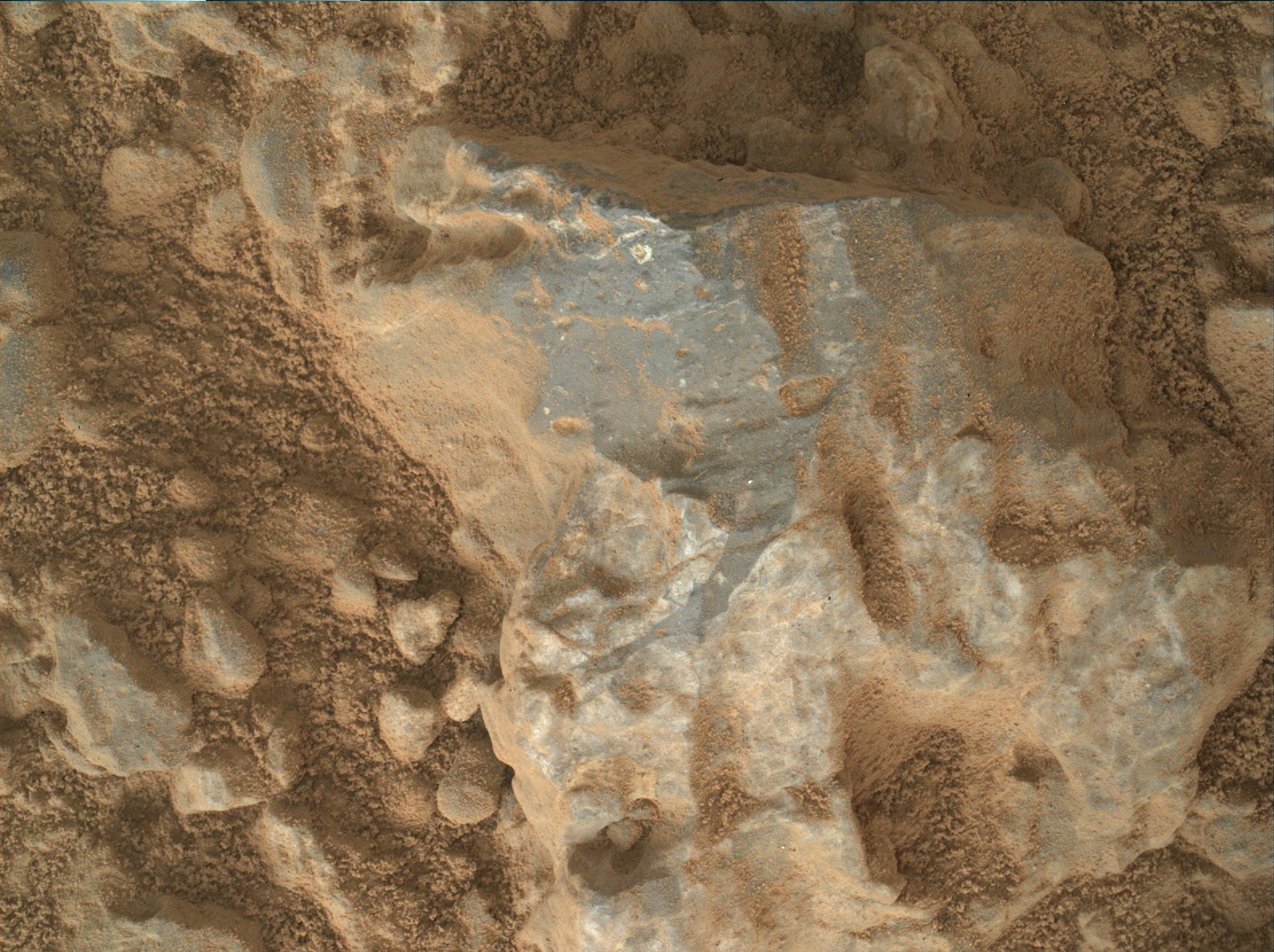
Here's a recent Curiosity focus-merge image of a rock's surface (on top) and it's matching focus map (at bottom):


Tuesday, September 3, 2013

Saturday, August 31, 2013

An Annular Eclipse of the Sun...

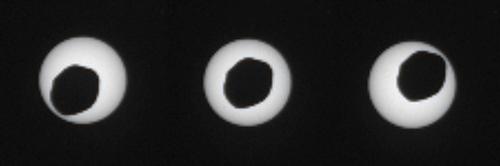
Down on the surface of Mars, the Curiosity rover looked up to see a beautiful annular eclipse of the sun by the Martian moon Phobos. You can easily see that Phobos is not spherical – it's shaped more like a potato than a ball...


Thursday, August 15, 2013

Grasshopper Hops Sideways...

carSpaceX's test vehicle, dubbed “Grasshopper”, makes a test flight that adds a new maneuver: a lateral move away from, and then back to, the launch pad:


SpaceX seems to be carefully pushing their test vehicle along, trying one or two new things on each flight.  Their budgets are a tiny fraction of NASA's budget for rocket development, and yet they've arguably accomplished much more than NASA has managed, and in a very short time.  If they can figure out how to make money from the private sector, there's a lot of potential there – but that is a mighty big “if”. 

Right now, 100% of their revenue comes from NASA contracts.  I'm glad to see the cost reduction this affords NASA, but I'd much rather just shut down the manned space program at NASA – that would save a lot more money...

Tuesday, July 2, 2013

Sunday, June 30, 2013

Hyperion...

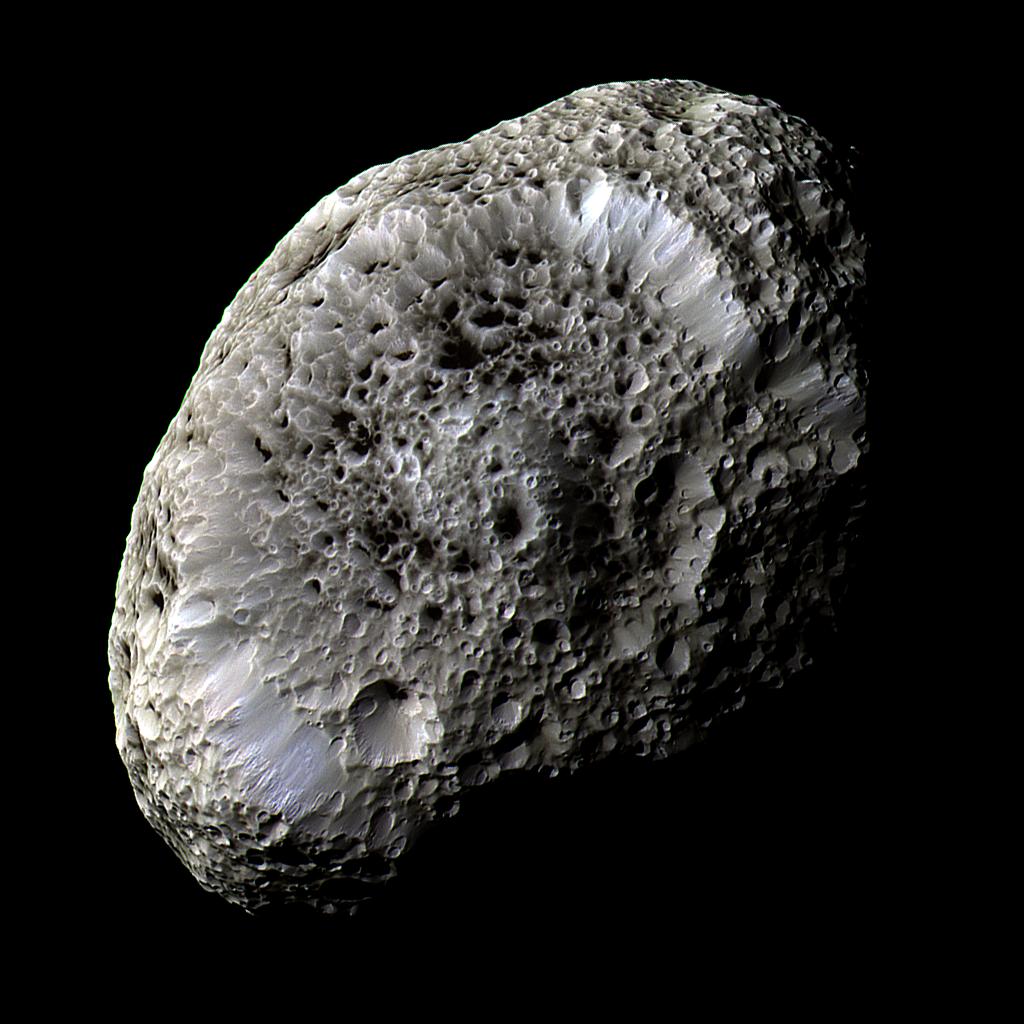
Hyperion, moon of Saturn.  From Cassini, via APOD, of course:


Tuesday, June 11, 2013

Tuesday, April 30, 2013

Hurricane on Saturn...

NASA is calling it “The Rose”.  I'll call it awesome:


Thursday, April 25, 2013

Three Years of the Sun...

...in just three minutes!

Tuesday, April 9, 2013

Sunday, April 7, 2013

Apollo 11...

If you were a sentient being on July 20, 1969, then almost certainly you spent that evening and night glued to a television set, watching and listening as Apollo 11 landed on the moon, and as Armstrong and Aldrin took that first, too-short “moon walk”.  That was me – in the basement of my Uncle Donald's house, watching a little black-and-white screen for 10 hours or so straight.

I was the only one in that household interested enough to watch; my Aunt Marion was completely disinterested, my cousin Jonathan too busy chasing willing maidens, and my Uncle Donald (who was generally interested in science) was dismissive for reasons I never understood.  But I was eagerly vacuuming up every scrap of information I could get my hands on.  That information was quite limited back then – there was no Internet, of course.  Printed publications were always days to years behind, absolutely useless for this purpose.  The only media that could provide near-realtime images and sound was television – so, like hundreds of millions of others, I sat in front of the magic box.

The voice network called “CAPCOM” was available for the public; it was running (foreground or background) during all the contemporaneous coverage.  Some other voice networks were occasionally patched in, but they were full of acronyms that nobody bothered explaining, so while they sounded cool they didn't really help elucidate what was going on.  The science and technology reporters had a really tough job – they were trying to explain some pretty complicated things in a way that “Joe Everyman” would understand.  I was frequently frustrated by their failure to talk about more interested and more complex aspects.  But...this coverage was as good as it got, back then.

Now someone has put together an awesome web site that shows how one might experience Apollo 11 if it occurred today.  I watched, enthralled, as the entire descent phase of Apollo 11 played out before my eyes.  CAPCOM was on, along with the Flight Director's net.  Transcripts for both play live.  Video from the sequence camera is on screen.  All of this is synchronized, and you can jump around any way you'd like.

For me, watching this was almost like traveling back in time.  I was back in my uncle's basement, watching on the little black-and-white screen – and fully immersed in the excitement and anticipation of the moment.  I didn't have a heart monitor going, but I'm certain my pulse and blood pressure were elevated.

Highly recommended!

Wednesday, April 3, 2013

Planetary Photos...


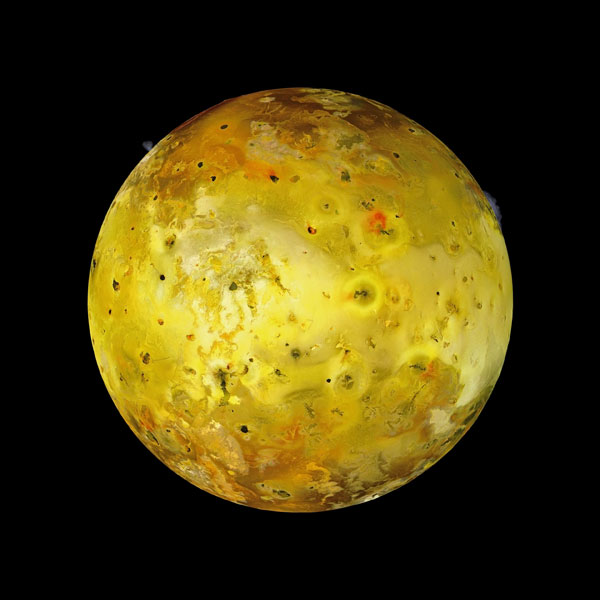
Michael Benson makes planetary photographs from original science data, using up to hundreds of images to make a mosaic.  He also goes to great lengths to get the color “right”, meaning that the color in his photos is what we would see if we could somehow get to the planet (or moon) in question.  Below is one example: Jupiter's fantastical moon Io:


There's a collection of his images in this article.

Saturday, March 23, 2013

Curiosity is Back Online!

Hip hip hooray! 

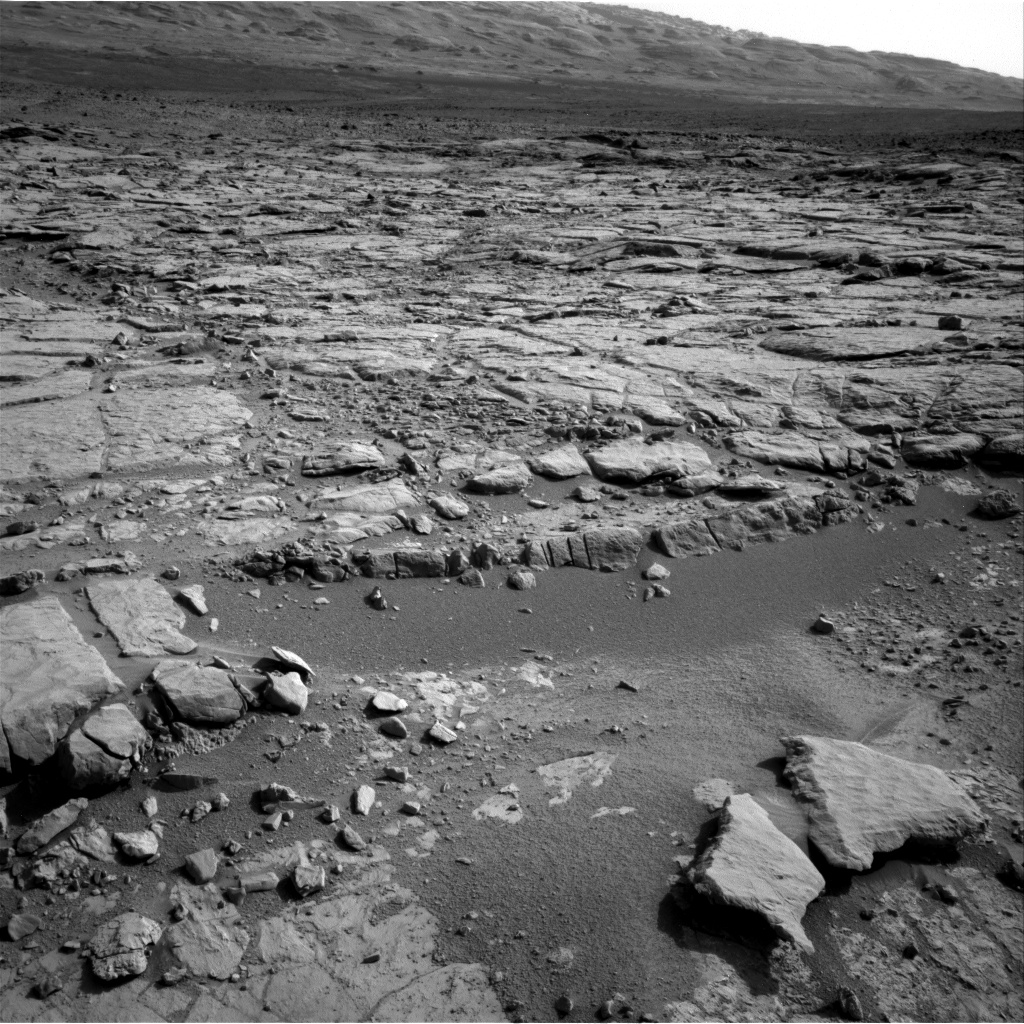
Curiosity has been offline for several weeks, after a software glitch (and possibly a memory failure; reports vary).  The photo at right was returned amongst the first new batch since the glitch first occurred.  It's very nice to see that!  In just over a week, Curiosity (and all of Mars) will be on the opposite side of the Sun from Earth, so for a few weeks after that it will be “radio silence” for all the robotic explorers orbiting and sitting on the surface of Mars.  Let's hope they all wake back up successfully when Mars is out of occlusion!

Sunday, March 17, 2013

Light Echoes...

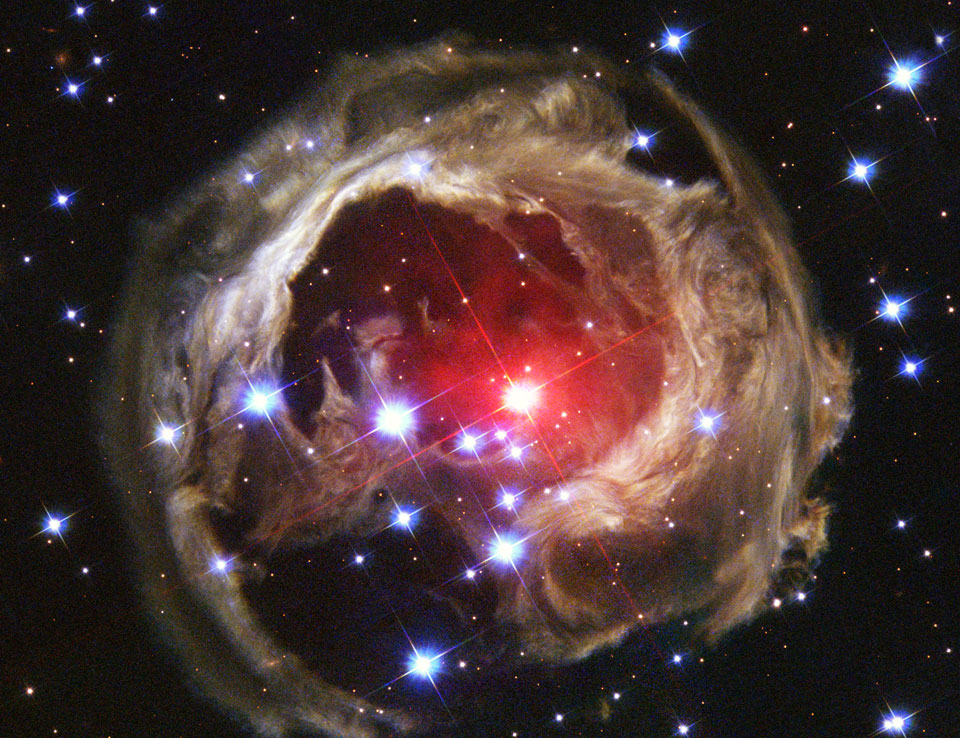
Remember V838 Monocerotis?  It was a science sensation in 2002 when it was briefly the brightest star in the Milky Way galaxy.  APOD is featuring a recent Hubble photo of it today, showing the dust clouds that are being lit by the (now) 11 year old sphere of light emitted by V838 Mono back in 2002.  Full resolution version here...


Saturday, March 16, 2013

Mt. Sharp, in Considerable Detail...

Mt. Sharp rises from the floor of Gale Crater on Mars, which is where Curiosity is busy exploring.  NASA just released a panorama of Mt. Sharp, composed of many photos taken months ago.  It shows the huge mountain in quite sharp detail.  The version below (and the full resolution version here) are the color-corrected version, processed to look as though the scene were viewed on earth...


Saturday, March 9, 2013

Chinese Junk Takes Out Russian Satellite...

Space junk, that is – not a ship.  This prognosis pretty much sums it up:
It is not immediately clear whether the satellite is merely wounded or completely incapacitated.
Oops...

(Many) More Solutions to the Three-Body Problem...

When I first read the title of this article, I thought it was referring to a different (though related) problem: computing the course of a satellite (one body) through a two-body system (such as the Earth and the Moon).  When I was a kid first learning about space travel, this was a notoriously unsolved problem.  Instead of the usual sort of mathematical solution to this problem, navigators at NASA resorted to finite state models to solve the problem.  Later on (in the '70s, if memory serves me right), mathematicians did develop equations that solved that particular three-body problem, but systems with more bodies (like Jupiter and Saturn) remained challenging, and were still normally solved with finite state modeling.

But this article is about a different sort of three-body problem – stable orbits of three-body systems.  Similar, and still interesting, though...