Tuesday, November 18, 2014

Dogs: data vs. popularity...

Dogs: data vs. popularity...  Dog owners are irrationally attached to their favorite breeds, and we're no exception: we love our Field Spaniels, a breed that very few people in the U.S. have ever even heard of, much less seen.  The chart at right (more detail here) attempts to visualize the popularity of dog breeds versus an objective assessment of the reasons why a breed might be popular.  We could debate the parameters they chose until the cows come home, but give the authors this: it's a reasonable stab at it.  Furthermore, the chart passes the sniff test – some of the breeds in the upper left (the “Inexplicably overrated”) clearly belong there, and some of the breeds in the lower right (the “Overlooked treasures”) just as clearly belong there.  Our beloved Field Spaniels are too small a breed to even show up on this chart, but if they did, they'd probably be down in the lower right, alongside the Welsh Springer Spaniels (a close relative).

Wanna start an entertaining fight?  Follow these steps:
  1. Gather a number of dog lovers in a room
  2. Shut the doors
  3. Toss a copy of this chart into the room
  4. Run

Farcical...

Farcical...  Bret Stephens in today's Wall Street Journal:
As headlines go, “ Obama Moves Close to Calling Russian Action in Ukraine an Invasion,” from a weekend story in the New York Times , must surely rank among the year’s most revealing. The Obama presidency has long been at odds with the obvious. Once this was called hope.

Now it is generally recognized as farce.
A farce – that's a reasonably accurate portrayal of the entire Obama presidency.  What a damned shame that the first black American president also had to be so ragingly incompetent...

Your feel-good story of the day...

Your feel-good story of the day...  We recently fixed up our old, beat-up RV and gave it to our house cleaner in San Diego – one of the most satisfying things we ever did...

I am no longer concerned about mainland China...

I am no longer concerned about mainland China...  Any culture that could produce the video at right – and have it become wildly popular (over 5 million views at this writing) – is well down the path to doom...

Consequences of ObamaCare, part 945,823...

Consequences of ObamaCare, part 945,823...  Via CoyoteBlog, who describes one consequence to the business he founded and runs:
So, as a result, I am required by law, under harsh financial penalties, to purchase a product that is not available to me.  Had President Obama required that I buy 2 pounds of rocks from Mars, the result would not have been any more unfair.
Repeal it, Republicans!

Remy on GruberGate...

Remy on GruberGate...

Our income tax system is unfair!

Our income tax system is unfair!  The graph at right is taken from this American Enterprise Institute article.  Each column shows the net taxes paid by each quintile (fifth) of income earners.  By net taxes, they mean income taxes less transfers (such as earned income credits, welfare, etc.) from the federal government.

The bottom line is very simple: virtually all net income taxes are paid by Americans in the upper income quintile.

On what planet is that fair?

It's even worse for residents of states with high income taxes (such as California, Massachusetts, New York, etc.) ... in some of those states, virtually all net taxes are paid by the upper decile (tenth)!

Monday, November 17, 2014

“…these doors might not be that secure!”

“…these doors might not be that secure!”  Oh, I would so love to drive on this road!

Reading the tea leaves...

Reading the tea leaves...  These are some Darjeeling tea leaves, hydrated after steeping them for my morning tea.  The photo is 15x magnification...

“The most likely outcome is that regulators will freeze in place today’s business models, thereby slowing innovation and change.”

“The most likely outcome is that regulators will freeze in place today’s business models, thereby slowing innovation and change.”  Nick Gillespie with an excellent piece in Time on Obama's call for “net neutrality” and regulation of the Internet.  A bit more:
There are specific interests who are doing well by the current system and they want to maintain the status quo via government regulations. That’s understandable but the idea that the government will do a good job of regulating the Internet (whether by blanket decrees or on a case-by-case basis) is unconvincing, to say the least. The most likely outcome is that regulators will freeze in place today’s business models, thereby slowing innovation and change.

That’s never a good idea, especially in an area where new ways of bundling and delivering content are constantly being tried.
For a moment I found myself thinking that maybe our legislators were smart enough to see that regulating the Internet was a bad idea.  Then I woke up...

A clever application of physics...

A clever application of physics...  When I first read this headline – “Magnets in helmets might make football safer” – I groaned, and expected to read some pseudo-science claiming more miraculous magnetic effects like those sold by so many Dr. Oz-like charlatans.  Instead I found something totally realistic: using the repelling force of “like poles” on powerful magnets to reduce the deceleration force when two football helmets smack into each other.  Properly done, using magnets for this can be the equivalent of adding a thick layer of foam to the outside of a helmet.  Very clever!

Breathtakingly audacious lawsuit...

Breathtakingly audacious lawsuit...  There are two neighbors in Texas.  One of them owned four pit bull dogs; the other owned a beagle.  The four pit bulls got into the beagle's yard through a hole in the fence that the pit bulls made.  The pit bulls killed the 10 year old beagle.

So, naturally, a lawsuit was filed – but not the one you're most likely expecting.  The beagle's owner decided not to pursue a civil suit, because the police had already taken the actions he thought were needed.  The pit bulls' owner is suing the beagle's owner, asking for $1 million in damages, citing injuries and anxiety resulting from her attempts to retrieve her pit bulls from the neighbor's yard.

Clearly, the human species still has some evolving to do.  The good news?  The venue is in Texas, where the citizens have been known to help evolution along on occasion...

“Bubble-Ball”

“Bubble-Ball”  This looks like fun!

Sunday, November 16, 2014

It's another below-freezing day...

It's another below-freezing day...  So I installed some more replacement lamps today.  These three are in our “TV room” on the second floor.  The wide angle lens on the iPhone makes it look like two of the lamps are a couple miles down the road, but in reality the furthest one is about 20' away :)

When we bought the house, there was a very fancy, modern-looking Italian light that stretched all the way across this long ceiling.  It had five low-voltage lamps, each just 20 watts, strung out along a pair of tightly stretched cable that looked like stainless steel.  The whole affair looked like something that might be on the Starship Enterprise, but it put out a paltry amount of light in five beams, as if someone had hung five flashlights from the ceiling.  The new lights have 100 watt (equivalent) LED bulbs in them, very nicely lighting up this entire area.  They look much more like our style, too.

I'm beginning to expect now that each project I begin will run into problems.  This one sure did.  The first lamp I put up, I ran into a junction box with metric screws (4mm, 0.7 pitch).  I didn't even know there was such a thing.  And where did the builder find one around here?  It's as if I opened my front door and spotted a kangaroo!  The second lamp's junction box had totally stripped threads – the lamp I removed had been glued to it.  I ran up to the Ridley's in Hyrum and got a new box.  Sheesh.  The third lamp's junction box was very badly miswired: the hot and cold wires were crossed, and the safety ground wasn't connected.

I wonder what I'll find on my next project!

Fly...

Fly...  This one died of natural causes, so far as I can tell.  I found it on a window sill.  The piece of wood holding it upright is a chip of oak flooring.  Taken at 25x magnification.  Flies sure are a lot hairier than I'd imagined!

“They didn’t understand how men could not see these problems, but it’s because so many of us are being so goddamn quiet.”

“They didn’t understand how men could not see these problems, but it’s because so many of us are being so goddamn quiet.”  What's it like to be a woman in the tech industry?  Are there few women in tech because the experience is so bad?

I don't know Randi Harper; to the best of my knowledge I've never met her or talked to her.  Reading her description of her current job makes me hope I have the chance someday:
Cat herder, spine of steel, puzzle master, obfuscated code whisperer. I complain a lot about things that go bump in the night. Then I track down the monsters and kick them in the junk. I could solve world hunger with a 200 line perl script.
That's a geek with a sense of humor :)  And about as DevOpsy as you can get...

The quote at the beginning of this post is Randi's, from a two-part piece she's written that's guaranteed to have provoke a strong reaction:
Still Here, Part 1: A Memoir
Still Here, Part 2: Call to Arms
I spent 34 years in the tech industry, from 1979 through 2013 (I'm not counting my 6 years in the Navy).  I did a lot of different things, including starting my own businesses, working as an engineer, running datacenter IT, and executive management.  Over those years, I worked with a number of women: peers, superiors, and subordinates.  There were far fewer of them than there were men, to my disappointment (because I like working with women).  Just like the men I worked with, some of the women were good at their jobs, some not so good.  No woman I've ever worked with has told me that she had experienced anything like what Randi describes in Part 1 – but that obviously doesn't mean it didn't happen.  I have had the unhappy experience of investigating accusations of sexual harassment leveled by a subordinate.  Most of these were real, but (so far as I'm aware) isolated instances not part of a pattern the women involved were experiencing.  Certainly none of the women I interviewed ever asserted anything otherwise.

If Randi's experience is actually widespread amongst women in tech, I am appalled – on multiple levels, but in particular because it must mean that some women I worked with were subjected to it.  I wonder what I could have done differently that would have encouraged these women to simply talk with me about it?

Randi's onto something here, I think.  I'm uncomfortable with the inevitable inference that this is somehow the victim's fault, but ... speaking as a former manager, I can guarantee that if a manager doesn't even know about something, they for damned sure can't do anything about it.  Any halfway decent human being (and yes, I'm including managers in that group), if presented with this sort of abuse, would want to do something about it.

I'm no longer in a position (because I'm retired) to help anyone directly.  But I'm hoping that Randi's call to arms will help motivate others to speak up if they're being subjected to the sorts of horrible behavior Randi experienced...

Environmental problems you don't hear about...

Environmental problems you don't hear about...  One of these I discovered years ago, in reading a book about why cities are so dirty.  Once people stopped low temperature combustion (like wood fires, or coal fires) that made carbon soot in staggering quantities, why do cities still get dirty so quickly?  Especially noticeable is the black crud that accumulates on building walls.  What is that?  As you might guess, it's a complicated mess of stuff, but it's dominated by rubber dust – the tiny particles of rubber that wear off tires.  It turns out that is really nasty stuff, and it's been implicated in quite a few health issues that city dwellers suffer much more than rural folks.  There's a much higher concentration of rubber dust in cities.

This morning I read about another pollutant that in many ways reminds me of this: microscopic fibers shed by garments made with synthetic (plastic) fibers.  These are far larger fragments than rubber dust particles, but still small enough in many cases to affect individual cells.  It sounds like something we really should understand better than we currently do...

“Because we’re primates with vested interests in tracking social hierarchies and patterns of social affiliation.”

“Because we’re primates with vested interests in tracking social hierarchies and patterns of social affiliation.”  I read this articleOn the Origin of Celebrity – hoping that it would help me understand the phenomenon of celebrity, which has long been a complete mystery to me.  The article raised far more questions for me than it answered.  The basic thesis it puts forth is that celebrity obsession is an innate, genetically transmitted, characteristic of primates.  One paragraph's lead is “So with think a lot about status relations...”, which lost me completely.  I spend exactly zero time thinking about status relations, and I didn't realize that other people do.

Does that mean I'm not a primate?  Not human?

I have a suspicion that this is closely related to introversion (and I'm a fairly extreme introvert, self-trained in the art of getting along with extroverts).  I did a quick search to see if this correlation has been noted before, and found a few anecdotal mentions, but nothing more.  If I'm right, the inverse would be true: extroverts would be more likely to think about status relations, and therefore more likely to be obsessed with celebrities.

One experience I've had many times is to be in a room full of people (usually a business meeting of some kind) wherein someone will say something that everyone finds funny – everyone except me, as I didn't understand it.  Sometimes its a reference to sports (which I pay no attention to), but more often its a reference to some celebrity.  I've always chalked up the celebrity “misses” to my lack of interest, and have long been puzzled why all the other people did have enough interest to have absorbed these things.  Now I'm wondering if all or part of this was yet another difference between extroverts (who dominate in the management world that I was long part of) and introverts...

4°F...

4°F...  That's what it got down to last night.  It's much warmer now, though: 7°F.

One of my neighbors has a ewe, and she's baaaing like crazy.  That's about what I felt like doing when I walked outside this morning...

I left the house at about 6 am, headed for Angie's for breakfast.  This is turning into a regular thing for me, having a Sunday breakfast of chicken-fried steak and eggs with a scone at Angie's.  Yum!  This morning when I walked out the front door, my boots crunched loudly on the snow.  My windshield was clear, so I didn't have to scrape it.  When I tried to start the truck, the engine didn't catch at first.  That never happens on my Toyota Tundra – the engine always starts up within a fraction of a second of my turning the key.  This morning it took 10 seconds or so of cranking before it started, and then it ran ragged for 30 seconds or so.  Maybe my oil froze :)  It was fine after that, thankfully.  I had the heater up full blast for the entire 20 minute drive, and the interior of the truck never got above 20°F.

It's going to take us a while to get used to these low temperatures...

Saturday, November 15, 2014

In my basement window casement...

In my basement window casement...

When the sun came up this morning...

When the sun came up this morning ... I could see that it looks like winter outside!  All this will be gone in a few hours, though – the forecast for today has temperatures well above freezing, and the sun shining.  The photos below are all from our front yard, where I dared walk in the snow for a little way :)

Actually it was quite comfortable – it's already over freezing, and I have a pair of Muck arctic sport boots, and those things keep my feet toasty even at 5°F.

Check out the icicles!  I haven't seen icicles since the last time I was in Estonia in the winter, probably 15 years ago...


Inclusion...

Inclusion...  Found in a rock that was cleaved in the process of building our fireplace.  The cleaved surface has hundreds of crystalline inclusions like this, with lots of different colors.  Wandering over the surface with a microscope is like looking at a jewelry store cabinet...

What could this be?

What could this be?  Why, it's a piece of Hershey's chocolate!  But what are all those little specks visible in the photo (60x, click to embiggen)?  I'm guessing the light brown specks are nut fragments, but what's the black?  The light is coming from the right, and the letters are indented into the chocolate...

Winter preparations...

Winter preparations...  The early snowfall motivated me to get ready for winter.  Warm boots and gloves were the first priority, followed quickly by arctic coveralls and thermal underwear.  I finally got delivery of the snow blade for my tractor.  It's a beauty, with a hydraulic “flipper” to switch it from left-sided to right-sided, and a very nice float-and-skid mechanism to follow the pavement without gouging it.  It should make my life much easier this winter...

Barn: progress report...

Barn: progress report...  The siding crew was here again yesterday.  They installed the tarpaper and mesh base for the rock that will be on the lower four feet of our barn's wall.  The roofers were here to repair some underlayment that had blown off, and to install flashing between the second floor walls and first floor roof.  On Monday the siding crew will install the second floor siding, and possibly start on the rock.

I spent a few hours on the tractor, filling the electrical trench in (covering the conduit).  On Monday I'll be getting a load of road base, and I'll be using it to put in the base for the barn's transformer.  If it dries out enough, I'll be trenching for water, gas, and network on Sunday...

Philae is asleep on 67P...

Philae is asleep on 67P...  If we're really lucky, it will wake up again when enough sunlight hits its solar panels.  One piece of good news: all the science data collected during its primary science phase was successfully downloaded.  Given the triple failure of the attachment mechanisms (reverse thrusters, harpoons, augers), it's a miracle that Philae did anything useful at all.  In fact, most of the science instruments performed as designed.  Even the comet sampling drill may have worked (we won't know until the downloaded data is analyzed), despite Philae's off-kilter landing...

The Department of Energy...

The Department of Energy ... claims to be making big money on it's “green tech”  loan program, despite losses from the bankruptcy of Solyndra, Fisker Auto, amongst other spectacular failures.  CoyoteBlog calls BS on this crazy claim.  They're actually losing money, as you would expect.  It's only the bizzaro-world accounting of the political class shows profit where there are actually losses.  Orwell was right about doublespeak; he just had the date 30 years too early...

Friday, November 14, 2014

The case of the smoking bulb...

The case of the smoking bulb...  That's an LED bulb, a “candelabra” bulb enclosed in a glass envelope.  When I installed this particular bulb and turned it on for the first time, the glass envelope instantly filled with black smoke.  Interestingly, the LEDs were still working, though not much light escaped through the smoke.  I let it set for a few days to see if smoke would dissipate, but it did not.  So I took the bulb outside, broke the glass envelope (which allowed the smoke to dissipate), then brought it back in to take a peek under the microscope (photo at right) – where I see the proverbial smoking gun.  The yellow brick-shaped thingy is a single LED, magnified 60x.  There are dozens of these LEDs arrayed cylindrically to make up the entire bulb.  They're soldered to a cylindrically-shaped printed circuit board of some type, presumably made of a material that can take fairly high temperatures (these bulbs get quite hot in normal operation).  Those tiny little balls you see scattered about the surface are made of solder – highly conductive metal.  Normally on a soldered surface you wouldn't see very many of these; I think something must have gone awry in the soldering machine for this bulb.  I'd bet the problem was caused by some of these solder balls causing a short circuit.  When I plugged the lamp into a socket without the glass envelope on (dangerous, as high voltages are exposed), all but two of the LEDs worked fine.  The two dead ones were adjacent to each other, and the surface between them slightly blackened – that's probably where the short circuit happened.

Into the trash you go, dead bulb!  The vendor has already shipped me a replacement – when I emailed them about the black smoke, they offered to replace it immediately...

There once was...

There once was ... a playground for “special needs” kids in Seattle.  It was a really nice place for these kids; the only one in the entire Seattle area.  It was safe, too – in ten years of operation, not a single kid had ever been injured.

So naturally the Seattle Parks Department ordered it destroyed, citing it as “extremely dangerous”.

We elect governments with the brains of a demented flea, and then we do things like entrust them with our healthcare.  That self-extermination gene theory of mine is starting to look better by the minute...

Quote of the day...

Quote of the day...  From P. J. O'Rourke:
“There is only one basic human right, the right to do as you damn well please.  And with it comes the only basic human duty, the duty to take the consequences.”
That may be the best condensation of libertarianism I've ever seen...

A clarifying example...

A clarifying example ... of how politicians think.  The FCC has been signaling for months that it's considering some level of Internet regulation (especially for ISPs).  Just this week Obama announced his support for regulating the Internet like a utility (a la cable TV).  Nobody knows what's actually going to happen; right now it's all just blather.  Now imagine that you're the CEO of an ISP planning to invest $18 billion into rolling out broadband nationwide.  The uncertainty about how ISPs will (or will not) be regulated means that you no longer know whether you can recover your $18 billion investment and make a profit, so naturally you halt the investment until the regulatory uncertain gets cleared up.

In a sane world, that CEO (Randall Stephenson of AT&T) would be lauded for his careful management of shareholder's money.  In the real world of Washington, D.C. he's being called everything from an extortionist to evil incarnate.  I listened to a few minutes of a C-SPAN house hearings broadcast this morning that was nothing but one insult after another being hurled at Stephenson. 

There are times when I think our species has some sort of genetic coding for self-extermination...

The science of ... snow rollers!

The science of ... snow rollers!  There are a lot more snow roller photos, along with an explanation of how they form...

Thursday, November 13, 2014

Barn: progress report...

Barn: progress report...  The siding crew has completely finished all the siding on the first floor, and have installed the soffits on the first floor roof.  They just left a little while ago, looking mighty cold.  Two of the builders were here today installing sheathing on the ceiling in the garage section, which they have now finished (photo).

The original plan was to sheath the interior walls and ceiling with 1/2" plywood.  Jim J., my builder, rather gently persuaded me to use what I called “chipboard” instead.  He did it by giving me an education on the differences between chipboard and oriented-strand board (OSB), which was an area that I knew absolutely nothing about.  It turns out there's a big difference between the two.  Chipboard is practically obsolete these days.  It was made by pressing wood chips, randomly oriented, together with glue and resin.  It wasn't very strong, and the glues used were inferior.  It's main claim to fame was that it was cheap.  OSB is made in a much different way, with longer, thinner purpose-cut chips that are carefully oriented in the manufacturing process to provide high strength in all directions, and a higher strength in one particular direction.  The glues, resins, and waxes used to bond it all together in a hot press are far superior to what they used for chipboard.  The result is actually stronger than plywood, mainly because OSB contains no interior voids (all but aircraft grade plywood does).  The particular OSB we're using for sheathing has one smooth side (you can see the reflection in the photo) that's smoother than the A side of plywood, ready for paint with no sanding required.  It's really kind of amazing how much better materials are available these days...

So what does a winter wuss do when there's white stuff outside?

So what does a winter wuss do when there's white stuff outside?  He assembles shelves, of course.  At right is one of our storerooms (in the basement), now fully equipped with nice steel wire shelving.  I'm quite happy with my choice of shelving (purchased through Amazon).  It's very sturdy, rated for 800 lbs. per shelving unit, and up to 300 lbs. on any one shelf.  The assembly is easy, though a bit tedious.  No tools are required; basically it all snaps or screws together with just one's hands.

I've got three more units to assemble today, for our second storeroom.  Two more units should arrive here soon, possibly today...

Barn: progress despite the white stuff!

Barn: progress despite the white stuff!  The siding contractors are here, beavering away in their winter garb, hanging siding on the barn.  The last time I looked (a couple hours ago), they had three sides of the first story done.

Jim J. and his partner Ray L. were here this morning, installing sheathing on the ceiling of the first story, where the garage door hardware and opener will be mounted.  The garage door guy is overdue; Jim's trying to track him down.

The Rocky Mountain Power folks sent an inspector out to see if we did ok on the conduit that was installed in the trench yesterday.  We passed, with flying colors.  Now I need to backfill all that trench (that will go much faster than digging it!), get road base in to set the transformer base into, then call them for another inspection.  Only if we pass that one will they put us in queue for the actual work of connecting the power.

Yesterday I decided to make a change in our plans for using the barn.  I've been thinking about this change for several weeks now – especially every time I walk up onto the second floor of the barn.  Our original plan for where to put my office/electronics workshop was in a big room in the house's basement – about 300 sq. ft., though slightly oddly shaped.  There are pros and cons to having an office down there, but the biggest con for me was no view.  The size was ok, though the slightly odd layout would mean things wouldn't be exactly as I'd like them.  The second floor of the barn is way bigger (2,000 sq. ft.) than any conceivable need we have for storage, though it's possible I'll live to regret those words :)  The east end of the barn's second floor has four windows: one looking south, two looking east, and one looking north.  All of them have really nice views.  I could easily partition off 500 or 600 sq. ft. of that space, finish it (walls and insulation), put a little wood stove in there, and have a very nice space for me to work in.  Yesterday I decided to go for it; I talked with my builder and he's perfectly ok with doing it, when the rest of the barn is finished.  He's going to put in a stovepipe right away, though, so that the roofer can properly handle that when he puts down the steel.

Now I can hardly wait for it to be done!

What's that white stuff, part 2...

What's that white stuff, part 2...  Well, it's coming down in large quantities now.  Big, fluffy snowflakes.  There's about a half inch on the driveway, and it looks like it's coming down at the rate of about an inch an hour.  It better not do that between now and Saturday!


Great moments in conduit laying...

Great moments in conduit laying...  I took these two photos late yesterday afternoon, while Jim J. and his son Talon were laying the conduit in the completed trench.  Talon has the perfect physique for working in the narrow (12") trench.  The two of them worked straight through until they finished it all, just before dark.  It's now ready for inspection.

There are many aspects of life up here that are markedly different than what we grew used to in California.  One of them is that it is completely normal (and common) here for kids to work with their parents – as I and my siblings did when we were growing up.  Jim has two sons that work with him often, and several other contractors I've used in the house did the same thing.  The flooring contractor had five family members involved in the business, and their office lady brought her daughter in frequently.  These kids are all learning what it's like to earn a living, instead of watching TV and playing games.  No wonder the Mormons are so successful, collectively!


What's that white stuff?

What's that white stuff?  It's snow, and it's coming down with a completely unreasonable enthusiasm.  Depending on which forecast I choose to believe, we're in for 3 to 5 inches of the stuff.  Looks like I won't be digging trenches today, either.

The radar picture at right shows that I'm in for a lot more snow, too.  The forecast says it is likely to be coming down from now through Saturday evening.  Yikes!

The day of the lights...

The day of the lights...  It was too darned cold out yesterday for me to work outside, so I spent much of the day installing new light fixtures.  The first one – a chandelier for a little room upstairs we're calling the “reading room” – turned out to be a much bigger challenge than I was expecting.  In the first photo below, you can see that the junction box is mounted off-center in the place constructed for it.  I can't imagine why someone would do that, but they did.  Naturally, the chandelier we bought needed every bit of that space; it wouldn't fit if mounted directly to the box.  So I had to fabricate an adapter plate (see second photo) to allow the mounting bolts to be off-center from the junction box – but in the exact center of the mount.  In the third photo you can see that my plate worked.  The next two photos show the chandelier installed – it looks great in that room (Debbie picked these lights, of course).

Then I installed two new lights for our entrance way (the last two photos).  The existing lights were coyote-ugly, and had tiny little 8 watt lamps that were so dim I used a flashlight there at night.  The news ones have 60 watt bulbs and are vastly more attractive...

The wisdom of farmers...

The wisdom of farmers...  Via my mom, who for once is enjoying warmer temperatures than I am...
Farmer John once lived on a quiet rural highway but as time went by, the traffic slowly built up and eventually got so heavy and so fast that his free range chickens were being run over, at a rate of three to six a week.

So Farmer John called the local police station to complain, "You've got to do something about all these people driving so fast and killing all my chickens," he said to the local police officer.

"What do you want me to do?" asked the policeman.

"I don't care, just do something about those crazy drivers!"

So the next day the policeman had the Council erect a sign that said:

   SCHOOL CROSSING

Three days later Farmer John called the policeman and said, "You've still got to do something about these drivers. The ‘school crossing' sign seems to make them go even faster!"

So again, they put up a new sign:

   SLOW: CHILDREN AT PLAY

That really sped them up. So Farmer John called and said, "Your signs are no good. Can I put up my own sign?"

In order to get Farmer John off his back said "Sure. Put up your own sign."

The phone calls to the Police Station stopped, but curiosity got the better of the Officer, so he called Farmer John, “how’s the problem with the speeding drivers? Did you put up your sign?"

"Oh, I sure did and not one chicken has been killed.

The policeman was really curious and thought he'd better go out and take a look at the sign. He also thought the sign might be something the Police could use elsewhere, to slow drivers down..

So he drove out to Farmer John's house.

His jaw dropped the moment he saw the sign.

           --- NUDIST COLONY ---
   Slow down and watch out for chicks!
That would certainly work for me :)

If life gives you nails...

If life gives you nails ... then obviously, you sculpt with them.  Well, that's what John Bisbee says, anyhow!  Many more photos here...

Follow the bouncing Philae...

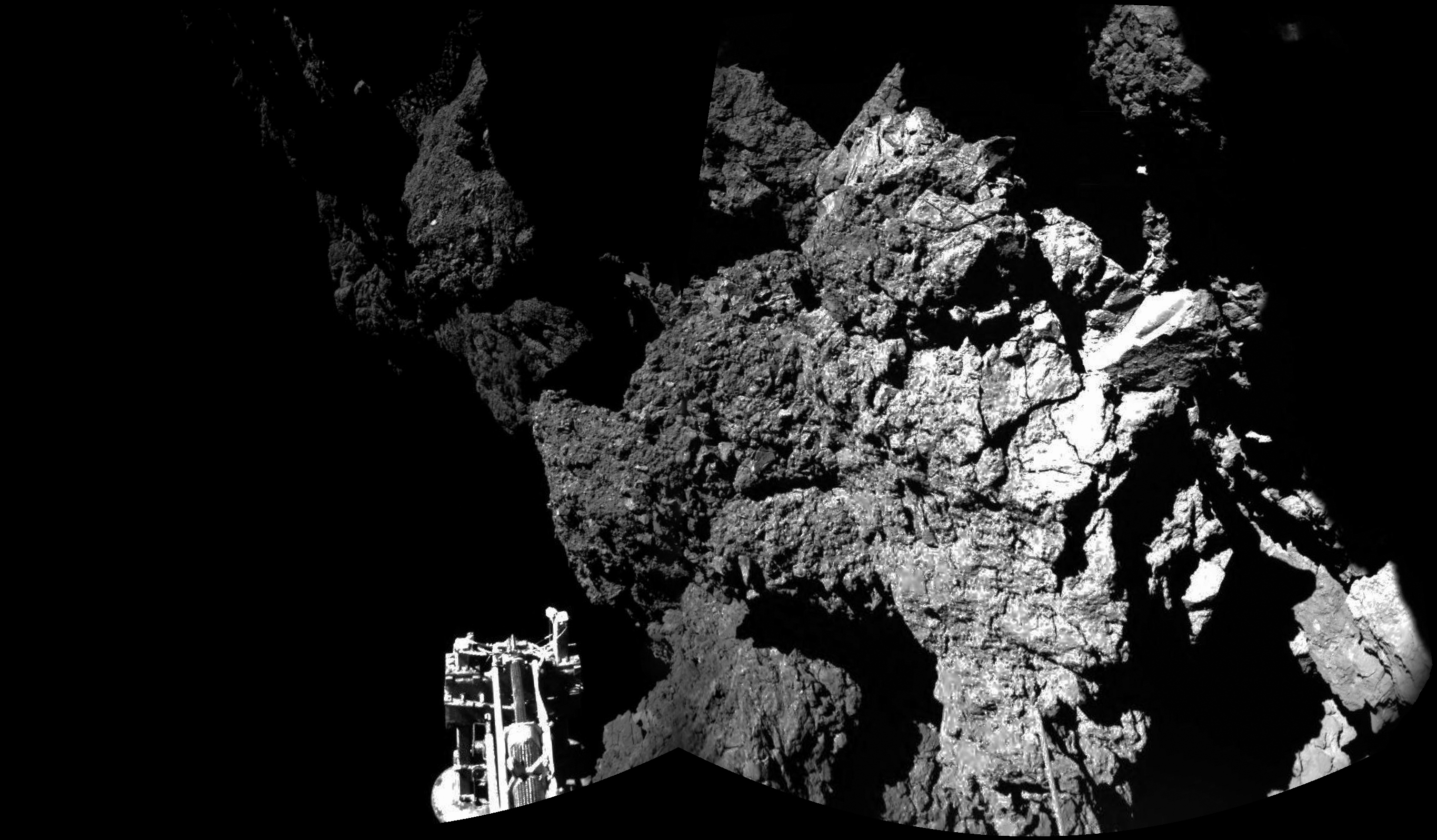
Follow the bouncing Philae...  The Philae lander made it down to Comet 67P's surface, but not in the way it was designed to do.  The lander actually impacted the comet's surface at exactly the place and time it was supposed to, but all three devices that were intended to attach Philae to the surface failed (auger screws, harpoons, and down-thrusters).  These devices are needed because gravity there is far too weak to do the job; the comet's mass is too small to create a strong gravitational field.  Because these devices all failed, Philae struck the surface as planned – but then bounced back up, at about 1/3 of its initial impact speed.  It traveled up, at an angle, and rotating slowly – and then nearly two hours later, after bouncing as high as a kilometer off the surface, it came back down.  At that point it bounced yet again, it's rotations changed a little, and for a few more minutes it “flew”.  Then it landed a third time, and stayed down.

The image above was taken on the surface, at the place where Philae finally came to rest.  The scientists have only a rough idea where Philae is actually located on the comet, but it's definitely a long way from the intended site, and it's on a much rougher surface than the they aimed for.  It appears that Philae is perched somehow on just two of its three legs, nearly sideways to the ground.  The lighting where it rests is far from optimal, and the team is considering making attempts to flop Philae back over on its feet.  They're also working hard on figuring out exactly where it is.

The fact that Philae came down in an unexpected place isn't necessarily bad news, overall.  The opportunities for science may actually be greater in the more rugged territory where Philae ended up.  On the other hand, the lifetime may be cut short if they can't get more solar power.  It's a fascinating example of a space robot needing engineering and science assistance from earth to make a “save” from the unexpected failures and consequences of them...

The surprising history of sliced bread...

The surprising history of sliced bread...  I was very surprised to learn that the first commercially sliced bread was produced in 1928.  I would have guessed much earlier than that!  I wouldn't have guessed that being sliced was the main claim to Wonder Bread when it first came out, either.  One thing that didn't surprise me: at one point, the government banned sliced bread.  The stupidity of government is eternal...

Our sun...

Our sun ... in a gorgeous time-lapse movie covering the last two weeks of October 2014.  You can see AR 2192 (the largest sunspot in over 20 years) moving around the sun...

Wednesday, November 12, 2014

Barn: conduit is being run!

Barn: conduit is being run!  This morning the builder's son (Trent J.) finished up the shovel work on the conduit trench (I finished the tractor work on this two days ago).  Now the builder (Jim J.) is installing the conduit in the trench, with the pull rope inside of it.  The pull rope in this case is rated for 500 lbs. of pull strength.  The power company will attach it to the wires and pull them through. 

Once all this is installed in the trench, we'll get the power company out here to inspect.  Assuming we pass, that sets our place in the queue for their contract work.  Last I checked, that queue was about three weeks long...

Barn: the siding is going on!

Barn: the siding is going on!  A crew of five showed up this morning, unloaded all sorts of tools (including a 20' metal-bending brake), and went right to work.  Much hammering, sawing, and metal bending is happening (and all in the cold, now at 22°F)...

Awesome geekery!

Awesome geekery!  That's a drawing of 18th century Italian scientist Amedeo Avogadro...

Common “myth-conceptions”...

Common “myth-conceptions” ... the world's most contagious falsehoods.  Via friend, former colleague, and occasional reader Aleck L.  One example to give you a flavor:
Napoleon was short.  A tall tale.  At 5'7", he was actually above average height for a Frenchman of that time.

Acer palmatum...

Acer palmatum ... otherwise known as “fall color”.  Via BPOD, of course...

Mechanical Fourier analysis (transform)!


Mechanical Fourier analysis (transform)!  I've only read about, and seen photos of, these machines that were invented by Albert Michelson, the physicist most famous for his measurements of the speed of light.  These machines were manufactured into the early part of the 20th century. 

The video is a bit of a tease, as it's only the introductory video for a series of six – the rest of which will be released over the next couple of months.  It does show a little bit of the machine in operation, though.  It also gives you a bit of background and history if you're not familiar with Michelson's machine...

An unlikely occurrence...

An unlikely occurrence ... wherein the Wall Street Journal editorial board agrees with me, this time on Obama's call for “net neutrality”.  Their conclusion:
Whatever “liberal” used to mean, it now means a self-interested machine of influence peddling and rent extraction. Well do we recall Cass Sunstein, Mr. Obama’s colleague at the University of Chicago, saying President Obama would surprise the world by being a “smart” regulator. What a bunch of hooey that turned out to be. Meanwhile Americans are undoubtedly tired of hearing how Washington has become America’s richest, most recession-proof area code. Net neutrality is one more example of how it got that way.
Indeed...

Kids react to old cameras...

Kids react to old cameras... The “old cameras” these kids are looking at are from the '90s, when auto-loading film, electric advance, auto-focusing, etc. were common features.  I wonder how the kids would have reacted to the cameras common in my youth?  An old Brownie, perhaps?  Or a twin-lens reflex probably would really have freaked them out!

Beautiful trumpet rendition of our national anthem...

Beautiful trumpet rendition of our national anthem...

8°F...

8°F...  That's the temperature in Paradise on this lovely November morning.  Brrrrr!

Philae is on the way toward it's landing on 67P...

Philae is on the way toward it's landing on 67P...  Live streaming coverage:


Tuesday, November 11, 2014

And the trenching continues...

And the trenching continues...  After I finished fixing the irrigation pipe late this morning, I started back on the trenching.  Now I'm working on trenches that are inside our back yard, which means I'm tearing up the lawn I worked so hard on earlier this year.  Oh, well, the grass will grow back again.  I think :)

The trench I'm working on in the photo will be carrying a water pipe (at 48"), a gas pipe (at 36") and two direct-burial CAT-6 network cables (also at 36").  Just a little bit in front of where the tractor sits in the photo, another trench will branch off to the left.  That trench will carry water and gas under our driveway (where there's a 4" ABS pipe) where they will be stubbed out.  That's a provision for a future greenhouse.  Then the trench I'm working on will carry on straight into the center of our house, where the water and network will enter directly into the “mechanical room” in our basement.  Just before that trench his the house, another branch will head due east for about 40', carrying the gas line to the gas meter.

The back yard will be a real mess when I finish with this :(

House roof: the steel is going on!

House roof: the steel is going on!  The first two photos show the machine that takes a coil of steel sheet and turns it into a finished standing-seam panel, 16" wide and any length.  The last photo shows the NE corner of our house and the first panels being installed...


Barn: siding arrived...

Barn: siding arrived...  The only thing that happened with the barn today is that a building supply truck arrived with the siding and trim boards.  It provided a moment's distraction from the shivering, though :)

The pile of siding doesn't look nearly big enough to cover the whole barn.  We'll see if I'm right.

We were expecting the rock to arrive today, but it was a no-show.  The masons are supposed to start on the rock tomorrow, but that will be just a bit difficult if they have no rocks to install!

Pipe: 0, backhoe: 1...

Pipe: 0, backhoe: 1...  Yesterday while trenching near our barn, I managed to bust another section of 6" irrigation pipe.  I used the backhoe to get within about 3" of the pipe (I knew right where it was), then tried to use a shovel to locate the pipe.  The danged clay was so hard-packed, 2' down, that I couldn't make a dent in it.  So I thought I'd be real careful with backhoe and dig a little closer.  First try, and you see the results in the first photo.  Dang it!  So I ran back up to Valley implement and bought another “repair kit”.  Then this morning I dug out the pipe, completely exposing it, cleaned around it with a shovel (the only time I was warm today!), sawed out the broken bits (second photo), washed all the soil off the ends (third photo), and then slipped a piece of pipe and repair coupler on to fix it (last photo).

The whole process of repairing the pipe took about four hour, plus the two hours to get the parts...


I'm not used to working in the cold...

I'm not used to working in the cold...  After working outside most of the day today, that is becoming quite obvious :)  It's been between 23°F and 38°F all day today.  For part of the late morning it was sunny, and when that lovely fusion-powered orb was showing, I was plenty warm.  When I was shoveling this morning, I was also warm.  But most of the day I've been using my tractor's backhoe to dig trenches – and the wind is blowing, and the sun is hiding behind clouds, and I got cold!  I've had to retreat to the warmth of the house on several occasions, to allow my fingers and toes to regain feeling.  As I type this, my feet still feel like frozen blocks of ice, though my fingers seem to be functioning ok.

And it's not even winter yet!

Yikes!  I need to find some warm winter wear, that's for sure...

Veteran's Day...

Veteran's Day...  I can't say it any better than Ronald Reagan did, on this day in 1985...

Holiday dinner party...

Holiday dinner party...  Via my lovely bride...

Remembering Halala Pala...

Remembering Halala Pala...  Yesterday Debbie received the card below from the staff at VCA (the veterinarians who treated his cancer).  We've been impressed over the years with both their skills and their caring.  This is another example...


Italy comes to its senses...

Italy comes to its senses...  It's probably only a brief interlude, but yesterday an Italian appellate court overturned the manslaughter convictions of six geologists.  Their “crime”?  Failing to accurately predict an earthquake...

“Net neutrality”...

“Net neutrality”...  What do I think about it?  I think about it in apocalyptic terms: if enacted, it would be the end of the Internet as we know it.  Bye bye, competition and lively innovation; hello, stifling regulation and taxes.  Bye bye, small and innovative ISPs; hello, a few big moribund and hidebound ISPs (think AT&T).

For the details, see Andy Kessler's plain language, even-handed primer.  Following the money trail, Forbes talks about the inevitable taxation that would follow.

“Net neutrality” is a carefully selected term – it sounds positive, it sounds like something nobody in their right mind would be against.  In actuality it is a euphemism for regulation.  The way that the nice-sounding net neutrality would be implemented is by creating a regulatory bureaucracy, and that bureaucracy would start publishing rules and regulations by the hundred, and charging fees and taxes.  The result of that is totally predictable, as we've seen this movie many times before: innovation will be stifled (by all the regulations), large incumbents will be empowered (as the relative cost of regulatory compliance for them is low), and new entrants will be discouraged (it would have to be an extraordinarily well-funded startup to be able to pay for regulatory compliance and the associated documentation).  Our ISP in California was a small, one-man operation that provided radio-linked Internet access.  His startup was self-funded.  If ISPs were regulated as a utility, he would never have started his little company – and we would have been stuck with the terribly inferior (and much more expensive) satellite ISP that we used before he started his company.  Multiply that by a few tens of thousands, because that's how many ISPs we have now.  If net neutrality is implemented, it's easy to predict that all these ISPs will be consolidated into a few big ones, or they'll go out of business.

One aspect of the net neutrality proponents' argument astonishes me: they're actually arguing that consumers should get something for nothing.  It's the socialist mindset applied to technology.  What do I mean?  Consider that the central argument for net neutrality proponents is the notion of “no fast lanes”.  Said another way, they want anyone to be able to access anything, as much as they want to, with no restrictions or costs.  The ISPs are in the business of renting their pipes, and their pipes can only carry so many bits per second (called “bandwidth”).  It's exactly analogous to your plumbing pipes: they can only carry so many gallons per minute.  The net neutrality proponents want to tell the ISPs that they can't restrict how much data any source (like Google, or Netflix) tries to push down their pipes – and they also can't charge any more for it.  That means that the only way the ISPs could pay for bigger pipes is to charge the consumer – and when the FCC regulates the ISPs as a utility, those price increases will have to be approved by the FCC.  The likely result is the same one we had when the FCC regulated AT&T: slow service and slower increases.  It's a recipe for an Internet quagmire.  It will work just as well as Venezuela's attempts to regulate toilet paper prices.

Even more astonishing to me is that the Democrats manage to get some political traction with this when there is no problem that needs to be solved.  Their entire argument is couched in scary-sounding hypotheticals: the ISPs could block web sites; the ISPs could create “fast lanes” (which actually might be a good idea!), etc.  None of these things are problems today.  It's as if they said “grocery stores could carry only Wonder Bread!” and used that as an excuse to regulate grocery stores!  That hypothetical argument totally ignores the beneficial effects of competition.  The grocery store that carries only Wonder Bread would soon find itself out-competed by other stores.  The ISP that blocks Netflix will find itself out-competed by other ISPs – and thanks to the current lack of regulation, there are plenty to choose from.  We live out in the sticks in northern Utah, and we have nine ISPs to choose from: one cable provider, two DSL infrastructure providers, two satellite providers, two cellular providers, and two wireless point-to-point providers.  If our cable provider decides to block sites we want access to, with one phone call I'll switch to an ISP that doesn't.  Where's the problem?

Imposing a regulatory regime on the incredibly successful Internet should be an absolute last resort that is considered only in the presence of a huge problem that the competitive landscape doesn't address.  Today is not that day...