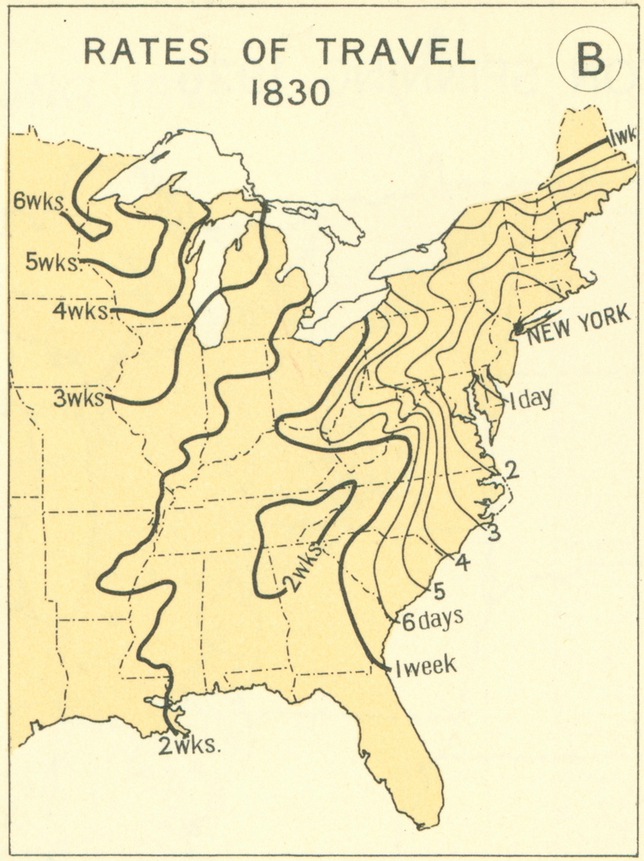
Check out the map at right. It shows how long it took to travel from New York City to various parts of the eastern U.S. – in 1830. Looks like about three weeks to Chicago! But you could get anywhere in New Jersey in just a day (though why would you want to?).
This article has several such maps, for dates ranging from 1800 to 1930. Fascinating stuff!
Saturday, January 12, 2013
Misleading News...
Holman Jenkins, writing in the WSJ($), sets us straight:
Said the New York Times climate blog, in an assertion that was echoed throughout the media: "The temperature differences between years are usually measured in fractions of a degree, but 2012 blew away the previous record, set in 1998, by a full degree Fahrenheit."I had a similar discussion with several colleagues at work (my former work, I should say!). They saw this same news, and their first reaction was “Dang, guess that global warming is for real after all!” Knowing my AGW skepticism, they could hardly wait to tell me :) It took all of 30 seconds to figure out what was really going on, exactly as Jenkins so nicely describes. The AGW enablers picked two arbitrary data points and implied something much greater than those data points actually showed – and their message was heard by the credulous, loud and clear...
Really? If that were true, then hair-on-fire news should have been the fact that 2012 was 2.13 degrees hotter than 2011. That's a far more dramatic change, and in a single year.
Nor was it mentioned that 2008, in the contiguous U.S., was two degrees cooler than 2006. Or that 2000, 2002, 2003, 2004, 2008, 2009, 2010 and 2011 were all cooler than 1998 by a larger margin than 2012 was hotter than 1998.
Are you getting the picture? None of this was mentioned because it makes a mockery of using trends in the Lower 48 as a proxy for global warming, the misguided intent that permeated media coverage of the NOAA revelation.
Labels:
Anthropogenic Global Warming,
Propaganda
Friday, January 11, 2013
Last Day...
Today is my last day at work; I'm officially retired as of this afternoon.
Wow.
I'll be back blogging tomorrow...
Wow.
I'll be back blogging tomorrow...
Labels:
Awesome,
Retirement,
ServiceNow
Thursday, January 10, 2013
Little Johnny Strikes Again...
Via reader Jim M.:
LITTLE JOHNNY STRIKES AGAIN
The teacher asked the class to use the word 'fascinate' in a sentence.
Molly put up her hand and said, 'My family went to my granddad's farm, and we all saw his pet sheep. It was fascinating.'
The teacher said, 'That was good, but I wanted you to use the word 'fascinate, not fascinating'.
Sally raised her hand. She said, 'My family went to see RockCity and I was 'fascinated.'
The teacher said, 'Well, that was good Sally, but I wanted you to use the word 'fascinate.'
Little Johnny raised his hand.
The teacher hesitated because she had been burned by Little Johnny before.
She finally decided there was no way he could damage the word 'fascinate', so she called on him.
Johnny said, 'My aunt Gina has a sweater with ten buttons, but her boobs are so big she can only fasten eight.'
The teacher sat down and cried.
Labels:
Humor
How to Tear Out the Heart of a Dog Lover...
Via the irreplaceable Rachel Lucas, whose dog looks just like this one:
This brings tears to my eyes...
Labels:
Dogs
Balanced Rocks...
I have a hard time accepting that these are for real. Many more photos here, and explanations here. In some of the photos, it seems clear by inspection that the rocks are not actually balanced. Maybe...
Labels:
Awesome
Wednesday, January 9, 2013
Country Music Songs...
Via my mom, who loves Country & Western music. I'd never figured out why, but now I begin to understand. I might have to listen to a few of the songs mentioned here:
Art Collmeyer...
Yesterday I heard from my friend Cliff F. that a former colleague of ours, Art Collmeyer, had died this past September at age 70. I knew him mainly from his time as CEO of Stac spin-off HiFn, nearly 20 years ago.
My fondest memory of Art involves, of all things, email. I was running the IT team at Stac at the time, and Art asked me to come talk with his secretary about an email problem. I went to her desk, and asked what the problem was. The problem, she said, was that each time Art replied to an email, it had her return address on it. I told her that Art must have some configuration issue on his email, and I'd better go see him. “No, no,” she said. “You don't understand. I answer Art's email for him!”
Upon some investigation, I discovered that a couple times a day Art's secretary would log into his email, forward all Art's email to herself, log into her email, print out all the new ones, and hand the papers to Art – who would then scribble his answers onto the printout and hand them back to his secretary. The she logged back into her email and replied, transcribing Art's scribbles. The solution was easy – I just told her to stop forwarding Art's emails to herself, and to simply reply from Art's account. Problem solved. But then I went in to talk with Art to find out why he did his email this way. I've forgotten the words he used, but with fine humor he told me that he considered it a waste of his time to learn how to use email. He knew perfectly well how to write an answer with a pen, and he had far better things to do with his time than to learn this new-fangled thing called email!
I recall one other conversation I had with Art, when he somehow discovered that back in the '80s I had done some design work on special effects generators for TV stations. It turns out that he had been involved in some of the early digital graphics efforts, and his company had identified the TV stations as a potential market for them. To this day, he's the only other person I've ever met who had a detailed knowledge of that market.
Above all, though, I remember Art as a genuinely nice guy – something that is far from universal for people with achievements like his own. I'm saddened to hear of his death...
More info here and here...
My fondest memory of Art involves, of all things, email. I was running the IT team at Stac at the time, and Art asked me to come talk with his secretary about an email problem. I went to her desk, and asked what the problem was. The problem, she said, was that each time Art replied to an email, it had her return address on it. I told her that Art must have some configuration issue on his email, and I'd better go see him. “No, no,” she said. “You don't understand. I answer Art's email for him!”
Upon some investigation, I discovered that a couple times a day Art's secretary would log into his email, forward all Art's email to herself, log into her email, print out all the new ones, and hand the papers to Art – who would then scribble his answers onto the printout and hand them back to his secretary. The she logged back into her email and replied, transcribing Art's scribbles. The solution was easy – I just told her to stop forwarding Art's emails to herself, and to simply reply from Art's account. Problem solved. But then I went in to talk with Art to find out why he did his email this way. I've forgotten the words he used, but with fine humor he told me that he considered it a waste of his time to learn how to use email. He knew perfectly well how to write an answer with a pen, and he had far better things to do with his time than to learn this new-fangled thing called email!
I recall one other conversation I had with Art, when he somehow discovered that back in the '80s I had done some design work on special effects generators for TV stations. It turns out that he had been involved in some of the early digital graphics efforts, and his company had identified the TV stations as a potential market for them. To this day, he's the only other person I've ever met who had a detailed knowledge of that market.
Above all, though, I remember Art as a genuinely nice guy – something that is far from universal for people with achievements like his own. I'm saddened to hear of his death...
More info here and here...
Labels:
Death
Brushing Rocks on Mars...
Martian rocks are covered with a thick layer of reddish dust and dirt, largely obscuring the actual characteristics of the rocks themselves. Curiosity carries a rotating wire brush – a kind of Martian whisk broom – designed to clean off rocks so that its instruments can get a clear view. It just made the first use of this tool; results at right. I'd say it worked pretty well!
Lakes With Ice – on Titan!?!
The intrepid Cassini robot explorer is still zipping around the Saturnian system, returning reams and reams of great science data. One product of recent close passes to Saturn's moon Titan is high-resolution radar images of the Titanian surface (one of these is at right).
The bright areas on this image are from ground areas covered with frozen methane “ice”; these areas reflect radar well. The dark areas are suspected of being liquid methane “lakes”. Some of these are quite large, about like the U.S. Great Lakes. But look closely, and you'll see some lake-shaped areas that are of intermediate brightness. Scientists think these are lakes of liquid methane that are partially covered with frozen methane ice.
Titan is one of the most fascinating objects in our solar system. The surface gravity is just 0.14g, or about 1/7th of Earth's. The atmospheric pressure is about 50% higher than Earth's, but it's very cold (just above -300°F) and it has no oxygen. Even so, biologists think that its at least possible that there might be life on Titan. I would love to see a Curiosity-style rover exploring Titan...
The bright areas on this image are from ground areas covered with frozen methane “ice”; these areas reflect radar well. The dark areas are suspected of being liquid methane “lakes”. Some of these are quite large, about like the U.S. Great Lakes. But look closely, and you'll see some lake-shaped areas that are of intermediate brightness. Scientists think these are lakes of liquid methane that are partially covered with frozen methane ice.
Titan is one of the most fascinating objects in our solar system. The surface gravity is just 0.14g, or about 1/7th of Earth's. The atmospheric pressure is about 50% higher than Earth's, but it's very cold (just above -300°F) and it has no oxygen. Even so, biologists think that its at least possible that there might be life on Titan. I would love to see a Curiosity-style rover exploring Titan...
Things I Did Not Know...
What's the difference between “Holland” and “The Netherlands”? The answer is much more interesting – and involved – than I expected it to be!
Labels:
Geography,
Government,
Politics
Domino...
Oatmeal's latest comic; a story about a cat named Domino. It's a sad story with a happy ending...
The Art of the Rant...
When it comes to producing collectible rants, few living authors can match Megan McArdle. She's just published another fine one, this time on the (apparently dead serious) proposal by some Democrats (and their fanboys) to mint a few trillion dollar platinum coins and use them to pay off the national debt. An excerpt from Megan's beautiful rant on the subject:
The Great Platinum Coin Caper is everything that is wrong with Washington: a stupid partisan maneuver that erodes the institutions of our government for no gain other than an immediate political win. The only good thing that can be said about it is that the President seems to be too sensible to actually consider doing it. Nonetheless, the fact that intelligent people like Professor Krugman are even discussing this debacle, much less endorsing it, is a depressing reminder of just how nasty and short-sighted our nation’s capital has become.That last sentence is my quote of the day. You will most definitely want to go read the whole beautiful thing!
When I was reporting on Wall Street, I used to be told with some regularity that government was needed to counteract the short-term thinking of the business sector, who never thought much beyond the next quarterly earnings report. This now seems as quaintly adorable as picture hats and daily milk deliveries. An ADHD day trader with a cocaine habit and six months to live has considerably more long-term planning skills than our current congress.
Officers vs. Enlisted, Part 38,205...
For the record, I was an enlisted man in the U.S. Navy. I was not an officer. Via reader Jim M.:
A new Marine Captain was assigned to an outfit in a remote post in the Afghanistan Desert . During his first inspection of the outfit, he noticed a Camel hitched up behind the mess tent.
He asks the Sergeant why the camel is kept there.
The nervous sergeant said, ‘Well sir, as you know, there are 250 men here on the post and no women. And sir, sometimes the men have ‘urges’. That’s why we have Molly The Camel.’
The Captain says, ‘I can’t say that I condone this, but I understand about ‘urges’, so the camel can stay.’
About a month later, the Captain starts having his own ‘urges’. Crazy with passion, he asks the Sergeant to bring the camel to his tent. Putting a ladder behind the camel, the Captain stands on the ladder, pulls his pants down and has wild, insane sex with the camel. When he’s done, he asks the Sergeant,’Is that how the men do it?’
‘Not really, sir. They usually just ride the camel into town. Where the girls are.’
On What Planet Does This Make Sense?
On Planet California, of course. The Reader's Digest version:
An attorney works for a law firm with many attorneys. He steals money from one of the law firm's clients. The law firm fires him. The fired lawyer tries to collect unemployment benefits, which by law are not paid to people fired for “cause”. The California Employment Development Department, or EDD (the bureaucracy that makes these decisions) rules that the attorney can collect unemployment benefits – because the law firm in question did not have an explicit, written policy forbidding stealing from customers.
I'm not kidding. This really happened. Actually, it happens every day – I can't recall a case where the California EDD ever ruled against an employee.
We're doomed.
Much more here, courtesy of CoyoteBlog...
An attorney works for a law firm with many attorneys. He steals money from one of the law firm's clients. The law firm fires him. The fired lawyer tries to collect unemployment benefits, which by law are not paid to people fired for “cause”. The California Employment Development Department, or EDD (the bureaucracy that makes these decisions) rules that the attorney can collect unemployment benefits – because the law firm in question did not have an explicit, written policy forbidding stealing from customers.
I'm not kidding. This really happened. Actually, it happens every day – I can't recall a case where the California EDD ever ruled against an employee.
We're doomed.
Much more here, courtesy of CoyoteBlog...
Labels:
California,
Doom
Nest...
Yesterday we received our new thermostat, called a “Nest”, 2nd generation. Ours is just like the photo at right. We bought it to replace a roughly 10 year old thermostat we'd purchased from a now-defunct home automation company. Our old thermostat had a very conventional display and controls, which means it was very difficult to use, along the same lines as modern electronic watches. It did have the ability to “talk” on the network, but the software for it was just awful, and only worked on Windows.
I'd heard about the Nest thermostat some months ago from a colleague. I figured I'd wait until the bugs had been worked out (and there are inevitably bugs!), and until some reviews came in. Last week I heard about the second generation version, which I could reasonably hope worked out some bugs from the first generation. Also I found some reviews, which ranged from merely positive to all-out fanboy ravings. So I took the plunge and ordered it.
A slight aside: a frequent comment I see about the Nest is that it's expensive – and at $250, compared to a $40 or $50 conventional electronic thermostat, it is. But really that's about like comparing a bicycle with a Toyota – you're not talking about the same kind of device at all. I don't know about you, but I expect to pay more for the Toyota than for the bicycle (though there are some darned expensive bicycles these days!). Clearly there is more cost in the Toyota, and for most of my travel needs, much more benefit. So I'm willing to pay extra for it. Ditto with a thermostat. It's something that I use at least twice each and every day, and it controls something expensive to run, so I'm willing to pay a little more for it. And just for comparison purposes, at $250, the Nest was less than half the price I paid for our previous thermostat!
Yesterday afternoon I set off to install the Nest. When I opened the box, the first thought I had was “Apple!”. That is, the packaging looked like something you'd buy from Apple, right down to the choices in packing materials. The presentation was a little work of art, just like opening a box from Apple. Someone paid close attention even to this detail.
What was in the box surprised me (I hadn't read anything at all about installing the Next prior to buying it). First surprise: it comes with a quite nice little screwdriver, with an ergonomic handle and a magnetically secured dual flat blade/Phillips head screwdriver – the only tool I needed to install it. Nice! Second surprise: the installation booklet came with a set of wire labels, so that I could label all the old wires before removing them. This is a very nice detail, and I'm sure it saves them a lot of time on support calls. Third surprise: it comes with an assortment of mounting adapters that will let you mount the Nest in any circumstance I can imagine. In our case, our old thermostat was (much) larger than the Nest, so we had a big, rectangular hole in the wall. No problem; the Nest's box includes a white plastic plate designed to handle this precise issue. Nice, Nest.
It took me perhaps five minutes to remove my old thermostat and label the old wires. Then perhaps another five minutes to install the Nest's base plate and connect the (labeled!) wires to it. Then I snapped in the actual Nest. The installation instructions basically end at this point, with a sentence that tells you to follow the on-screen directions to finish setting up the Nest. There's a web URL in case you get in trouble, but otherwise, that's it.
So when my Nest powered up, I really didn't know what to expect. I was actually a bit surprised at this point, as I expected to have to first attach the Nest to my computer to set it up (I could see the micro-USB port on its bottom). But the installation booklet made it clear that the setup was performed through the Nest itself. The reason this surprised me is that the Nest's “user interface” is pretty darned basic: you can twist it clockwise or counter-clockwise, and you can push it to “click” it – but that's it. No more user interface! So I wondered how on earth I would, say, enter my WiFi password?
The answer delighted me, in fact I laughed out loud (which quite amused Debbie). When you get to the point where you need to enter information, the Nest's display shows a circle of possibilities (such as the letters of the alphabet). Then you just twist the Nest to select the one you want, and push it to “click” and select it. That's it! It took me no more than five more minutes to get it connected to our WiFi and to handle the other bits of its setup.
There was one little scary bit, though. During the setup, there is a stage where the Nest tells you what sort of equipment it detected. In our home we have both a heater and an air conditioner, but the Nest reported only finding an air conditioner. In our case we have five wires connected to our thermostat, and I made the connections blindly following their directions – I had no idea which wire did what. I remembered that when I installed our old thermostat, I basically had to reverse-engineer our heating and cooling system to figure out precisely what each wire did, then figure out which of the numerous terminals on the thermostat to connect them to. I recall that it took me several tries to get it working. Naturally, that got me imagining that I was about to go through the same thing again.
But first I thought I'd double-check that I'd actually installed the wires correctly. So I pulled the Nest off it's mount and looked at my wiring job. Oops! The white wire wasn't actually in its little socket! I pushed it into place and secured it, popped the Nest back on, and voila! A little screen came up telling me that the Nest had detected an equipment change – and that now I had both a heater and an air conditioner. Yay!
Next, I went to Nest's web site and registered my Nest. That allows me to control my Nest from any web browser. Sweet! Then I went to the Apple app store, and downloaded the free Nest app – and now I can control my Nest from my iPhone. Super sweet! And all that took me another five minutes, tops. The Nest people have made this a very painless process.
I don't have much experience with actually using the Nest yet. I can report that it does the things you'd expect a thermostat to do (turn the heater on when it's too cold, turn the air conditioner on when its too hot), but I can't report on the Nest's vaunted learning features yet. That will take a few weeks, as the Nest builds its knowledge of our habits. What I can report on is what the geeks would call the “user interface” – what it's like for a human to actually use the thing. Our Nest is mounted in our hallway, and we're finding the user interface to be as natural and simple as an old-fashioned mechanical thermostat. The main thing one needs to do with a thermostat is to set the desired temperature, and on the Nest you do that by turning the dial. It feels very natural, very simple. There are separate set points for the heater and the air conditioner, and switching between them is just a click. Again, simple and natural. The fancier features are available from a menu, and while that's not quite as simple as setting the temperature, it's darned close. Best of all: you don't need to remember anything all, as the screen provides all the reminders anyone would need.
I've left out one of our favorite features of the Nest's user interface: it detects your presence in front of it, and turns its screen on. That's a very simple idea, but one that delights both of us.
Compared with our old thermostat, the Nest's user interface is spectacularly usable – but that's mostly a statement about how bad the old one was :)
The web site and iPhone apps are not quite as impressive. They're fine, and easy enough to use – they just didn't delight me in the same way the Nest itself did. In particular, the iPhone app doesn't let you use rotation the same way the Nest itself does. I'd love to be able to move a set point by dragging it around the dial with my finger, but I can't – instead, I have to “click” on an up or down button. Perfectly functional, but not the same experience as the Nest. I can imagine that some might actually find it confusing, simply because it's different than the Nest itself. But the fact that I can now check – and change – my thermostat from anywhere at all, any time at all, more than makes up for my picky complaints about the iPhone user interface!
Bottom line: two thumbs up for the Nest...
I'd heard about the Nest thermostat some months ago from a colleague. I figured I'd wait until the bugs had been worked out (and there are inevitably bugs!), and until some reviews came in. Last week I heard about the second generation version, which I could reasonably hope worked out some bugs from the first generation. Also I found some reviews, which ranged from merely positive to all-out fanboy ravings. So I took the plunge and ordered it.
A slight aside: a frequent comment I see about the Nest is that it's expensive – and at $250, compared to a $40 or $50 conventional electronic thermostat, it is. But really that's about like comparing a bicycle with a Toyota – you're not talking about the same kind of device at all. I don't know about you, but I expect to pay more for the Toyota than for the bicycle (though there are some darned expensive bicycles these days!). Clearly there is more cost in the Toyota, and for most of my travel needs, much more benefit. So I'm willing to pay extra for it. Ditto with a thermostat. It's something that I use at least twice each and every day, and it controls something expensive to run, so I'm willing to pay a little more for it. And just for comparison purposes, at $250, the Nest was less than half the price I paid for our previous thermostat!
Yesterday afternoon I set off to install the Nest. When I opened the box, the first thought I had was “Apple!”. That is, the packaging looked like something you'd buy from Apple, right down to the choices in packing materials. The presentation was a little work of art, just like opening a box from Apple. Someone paid close attention even to this detail.
What was in the box surprised me (I hadn't read anything at all about installing the Next prior to buying it). First surprise: it comes with a quite nice little screwdriver, with an ergonomic handle and a magnetically secured dual flat blade/Phillips head screwdriver – the only tool I needed to install it. Nice! Second surprise: the installation booklet came with a set of wire labels, so that I could label all the old wires before removing them. This is a very nice detail, and I'm sure it saves them a lot of time on support calls. Third surprise: it comes with an assortment of mounting adapters that will let you mount the Nest in any circumstance I can imagine. In our case, our old thermostat was (much) larger than the Nest, so we had a big, rectangular hole in the wall. No problem; the Nest's box includes a white plastic plate designed to handle this precise issue. Nice, Nest.
It took me perhaps five minutes to remove my old thermostat and label the old wires. Then perhaps another five minutes to install the Nest's base plate and connect the (labeled!) wires to it. Then I snapped in the actual Nest. The installation instructions basically end at this point, with a sentence that tells you to follow the on-screen directions to finish setting up the Nest. There's a web URL in case you get in trouble, but otherwise, that's it.
So when my Nest powered up, I really didn't know what to expect. I was actually a bit surprised at this point, as I expected to have to first attach the Nest to my computer to set it up (I could see the micro-USB port on its bottom). But the installation booklet made it clear that the setup was performed through the Nest itself. The reason this surprised me is that the Nest's “user interface” is pretty darned basic: you can twist it clockwise or counter-clockwise, and you can push it to “click” it – but that's it. No more user interface! So I wondered how on earth I would, say, enter my WiFi password?
The answer delighted me, in fact I laughed out loud (which quite amused Debbie). When you get to the point where you need to enter information, the Nest's display shows a circle of possibilities (such as the letters of the alphabet). Then you just twist the Nest to select the one you want, and push it to “click” and select it. That's it! It took me no more than five more minutes to get it connected to our WiFi and to handle the other bits of its setup.
There was one little scary bit, though. During the setup, there is a stage where the Nest tells you what sort of equipment it detected. In our home we have both a heater and an air conditioner, but the Nest reported only finding an air conditioner. In our case we have five wires connected to our thermostat, and I made the connections blindly following their directions – I had no idea which wire did what. I remembered that when I installed our old thermostat, I basically had to reverse-engineer our heating and cooling system to figure out precisely what each wire did, then figure out which of the numerous terminals on the thermostat to connect them to. I recall that it took me several tries to get it working. Naturally, that got me imagining that I was about to go through the same thing again.
But first I thought I'd double-check that I'd actually installed the wires correctly. So I pulled the Nest off it's mount and looked at my wiring job. Oops! The white wire wasn't actually in its little socket! I pushed it into place and secured it, popped the Nest back on, and voila! A little screen came up telling me that the Nest had detected an equipment change – and that now I had both a heater and an air conditioner. Yay!
Next, I went to Nest's web site and registered my Nest. That allows me to control my Nest from any web browser. Sweet! Then I went to the Apple app store, and downloaded the free Nest app – and now I can control my Nest from my iPhone. Super sweet! And all that took me another five minutes, tops. The Nest people have made this a very painless process.
I don't have much experience with actually using the Nest yet. I can report that it does the things you'd expect a thermostat to do (turn the heater on when it's too cold, turn the air conditioner on when its too hot), but I can't report on the Nest's vaunted learning features yet. That will take a few weeks, as the Nest builds its knowledge of our habits. What I can report on is what the geeks would call the “user interface” – what it's like for a human to actually use the thing. Our Nest is mounted in our hallway, and we're finding the user interface to be as natural and simple as an old-fashioned mechanical thermostat. The main thing one needs to do with a thermostat is to set the desired temperature, and on the Nest you do that by turning the dial. It feels very natural, very simple. There are separate set points for the heater and the air conditioner, and switching between them is just a click. Again, simple and natural. The fancier features are available from a menu, and while that's not quite as simple as setting the temperature, it's darned close. Best of all: you don't need to remember anything all, as the screen provides all the reminders anyone would need.
I've left out one of our favorite features of the Nest's user interface: it detects your presence in front of it, and turns its screen on. That's a very simple idea, but one that delights both of us.
Compared with our old thermostat, the Nest's user interface is spectacularly usable – but that's mostly a statement about how bad the old one was :)
The web site and iPhone apps are not quite as impressive. They're fine, and easy enough to use – they just didn't delight me in the same way the Nest itself did. In particular, the iPhone app doesn't let you use rotation the same way the Nest itself does. I'd love to be able to move a set point by dragging it around the dial with my finger, but I can't – instead, I have to “click” on an up or down button. Perfectly functional, but not the same experience as the Nest. I can imagine that some might actually find it confusing, simply because it's different than the Nest itself. But the fact that I can now check – and change – my thermostat from anywhere at all, any time at all, more than makes up for my picky complaints about the iPhone user interface!
Bottom line: two thumbs up for the Nest...
Labels:
Automation,
Home,
Product Review
Tuesday, January 8, 2013
Oops: Sun Spot Count Unexpectedly Low – Again......
Solar scientists have various models aimed at predicting the variabilities in the sun's luminance (or irradiance, the sun's total energy output). The main (though not the only) variable is related to sunspot count – somewhat counter-intuitively, the lower the sunspot count, the lower the sun's luminance. Skeptics of anthropogenic global warming (AGW), myself included, have pointed out the close correlation between the sun's luminance and temperatures in the Earth's atmosphere. In particular, the rising temperatures seen in the '90s and early '00s exactly corresponded with higher sunspot counts (and higher solar luminance). Recent mainstream climatology studies have, somewhat obliquely, found the same thing.
So it is of great interest to AGW skeptics to note that the more recent lack of a warming trend in Earth's atmospheric temperature correlates rather well with a lack of sunspots – the sunspot counts are coming in consistently well below the predictions by the solar scientists' models. Besides providing yet another really nice example of models gone horribly wrong, this also provides more support for the skeptic's hypothesis that the primary driver of “global warming” isn't greenhouse gases at all, but rather solar luminance.
The latest solar luminance numbers from NASA are plotted at right, with the dots being the actual data and the blue curve the smoothed equivalent. The green curves are the predictions (from 2007) of the two main families of solar luminance models, each with their cadre of solar science supporters (there were also a few solar scientists who thought both models were bunk). The red curve is a revised model, published in 2009 at which point it was quite clear that both original models were way off. The 2009 model isn't faring much better.
Robert Zimmerman, who collected and published this data, says:
So it is of great interest to AGW skeptics to note that the more recent lack of a warming trend in Earth's atmospheric temperature correlates rather well with a lack of sunspots – the sunspot counts are coming in consistently well below the predictions by the solar scientists' models. Besides providing yet another really nice example of models gone horribly wrong, this also provides more support for the skeptic's hypothesis that the primary driver of “global warming” isn't greenhouse gases at all, but rather solar luminance.
The latest solar luminance numbers from NASA are plotted at right, with the dots being the actual data and the blue curve the smoothed equivalent. The green curves are the predictions (from 2007) of the two main families of solar luminance models, each with their cadre of solar science supporters (there were also a few solar scientists who thought both models were bunk). The red curve is a revised model, published in 2009 at which point it was quite clear that both original models were way off. The 2009 model isn't faring much better.
Robert Zimmerman, who collected and published this data, says:
Meanwhile, on January 2 the solar scientists at the Marshall Space Flight Center once again lowered their prediction for the upcoming solar maximum, dropping their predicted peak sunspot number from 72 to 69. This is the fifth month in a row that they have changed their prediction, and the fourth in a row in which they have dropped it. Considering that we are now only a few months from when they say maximum should occur, their constant revision of their prediction suggests they really haven’t the faintest idea what causes the solar cycle, and are merely guessing at what they think will happen.I agree. They haven't a clue. I wish they would just admit the mystery and get to work solving it!
Labels:
Anthropogenic Global Warming,
Skeptic,
Sun,
Sunspots
Monday, January 7, 2013
Reaction Engines' Pre-Cooler...
A fascinating technological development, passed along by friend, neighbor, and reader Dick F. The video is a bit hyperbolic (they are looking for investors :), but the technology and its potential are fascinating nonetheless.
If you're not familiar with the challenges of jet engines at high speeds, you might be surprised to find that one of the most difficult challenges is heat – not from the combustion of fuel, but rather from the compression of the air being rammed into the front of the engine. The pre-cooler developed by Reaction Engines is aimed at solving that challenge. If they pull it off, hypersonic passenger aircraft traveling at 5,000 km/hour (3,000 miles/hour) are almost certainly in our future. I don't know about you, but personally I love the idea of traveling from San Diego to London in 90 minutes or so...
Labels:
Awesome,
Technology
An Environmentalist Discovers Science...
Fascinating speech via reader and friend Doug W., who says:
Transcript (a little different than the actual speech) available here...
I have never been quite sure what to think about the GM food scare, but in general my BS detectors were vibrating. Fascinating. Of course, his climate change stuff is still off, but it’s still worth a listen.
Transcript (a little different than the actual speech) available here...
Labels:
Environmentalism,
Revelation,
Science
Worst Recession Ever...Gets Even Worse...
I've posted this chart before; this is just another in a series of updates to it. It gets more terrifying the more time goes by...
Labels:
Economics,
Infographic,
Recession
Q & A...
The question:
If someone from the 1950s suddenly appeared today, what would be the most difficult thing to explain to them about life today?The best answer (awesome++):
To expand on the while there are a lot of obvious differences between now and 1950 in terms of technology, culture, etc., I wonder which changes or new things they'd grasp easily and which would be utterly perplexing.
I possess a device, in my pocket, that is capable of accessing the entirety of information known to man.
I use it to look at pictures of cats and get in arguments with strangers.
Labels:
Awesome,
History,
Humor,
Technology
Sunday, January 6, 2013
Tolkien...
Christopher Tolkien is not happy about the Lord of the Rings movies, and anticipates the worst from The Hobbit. The word “eviscerated” is used...
Labels:
Tolkien
Bet You Didn't Know These Were Visible!
Dave Carter, writing at Ricochet has a post that starts like this:
How can you not love a post that starts by discussing the phenomenon of visible cow farts (which I have observed myself)? Mr. Carter is hands-down my favorite truck driver...
I noticed a couple of things while driving up from Hannibal, Missouri into Iowa last weekend. The first was that the bottom had completely fallen out of the thermometer and taken the temperature with it. Second, and there is really no polite way to describe this observation, … but when the temperature drops below 18 degrees Fahrenheit, one can actually see cow flatulence. I know it's not a savory thought. Nor is the phenomenon easy to see. In fact, its almost as elusive as a partial lunar eclipse, or the backbone of a Republican, but I saw it just the same. Which, of course, set me to thinking about what passes from Washington DC these days.And then just keeps getting better.
How can you not love a post that starts by discussing the phenomenon of visible cow farts (which I have observed myself)? Mr. Carter is hands-down my favorite truck driver...
Where Are People Moving Too?
Within the U.S. and Canada, one view of the answer is in the map at right, which shows as blue those states/provinces with more people moving to them, orange with more people moving from them, and red for states with about the same amount of people moving too or from them.
Mind you, this view is a bit biased: it measures moves by Atlas Van Lines, which means it's looking at a slice of relatively well-off movers (a great many people cannot afford to pay the likes of Atlas for their services). Another thing to watch: some of the absolute numbers are very small. For example, 3 people moved out of Newfoundland, and 9 people moved in. With a sample that small, I don't think we learned very much about Newfoundland!
But even with all the caveats, there are some surprises on here (for me, at least). Why are people leaving Wyoming? Why are people moving to Washington? Why aren't more people leaving California (like they are New York, New Jersey, Connecticut, and Illinois)?
Mind you, this view is a bit biased: it measures moves by Atlas Van Lines, which means it's looking at a slice of relatively well-off movers (a great many people cannot afford to pay the likes of Atlas for their services). Another thing to watch: some of the absolute numbers are very small. For example, 3 people moved out of Newfoundland, and 9 people moved in. With a sample that small, I don't think we learned very much about Newfoundland!
But even with all the caveats, there are some surprises on here (for me, at least). Why are people leaving Wyoming? Why are people moving to Washington? Why aren't more people leaving California (like they are New York, New Jersey, Connecticut, and Illinois)?
Labels:
Population
Employee Notice!
Via my mom:
EMPLOYEE NOTICE
**************************
Due to the current financial situation caused by the slowdown in the economy, the Government has decided to implement a scheme to put workers of 50 years of age and above on early, mandatory retirement, thus creating jobs and reducing unemployment.
This scheme will be known as RAPE (Retire Aged People Early).
Persons selected to be RAPED can apply to the Government to be considered for the SHAFT program (Special Help After Forced Termination).
Persons who have been RAPED and SHAFTED will be reviewed under the SCREW program (System Covering Retired-Early Workers).
A person may be RAPED once, SHAFTED twice and SCREWED as many times as the Government deems appropriate.
Persons who have been RAPED could get AIDS (Additional Income for Dependents & Spouse) or HERPES (Half Earnings for Retired Personnel Early Severance).
Obviously persons who have AIDS or HERPES will not be SHAFTED or SCREWED any further by the Government.
Persons who are not RAPED and are staying on will receive as much SHIT(Special High Intensity Training) as possible. The Government has always prided themselves on the amount of SHIT they give our citizens.
Should you feel that you do not receive enough SHIT, please bring this to the attention of your MP, who has been trained to give you all the SHIT you can handle.
Sincerely,
The Committee for Economic Value of Individual Lives (E.V.I.L.)
Rep. John Boehner and Sen. Mitch McConnell
PS - Due to recent budget cuts and the rising cost of electricity, gas and oil, as well as current market conditions, the Light at the End of the Tunnel has been turned off.
Saturday, January 5, 2013
An Open Letter to Senator Diane Feinstein...
Awesome, Marine:
Senator Dianne Feinstein,And yes, we most certainly do deserve better...
I will not register my weapons should this bill be passed, as I do not believe it is the government's right to know what I own. Nor do I think it prudent to tell you what I own so that it may be taken from me by a group of people who enjoy armed protection yet decry me having the same a crime. You ma'am have overstepped a line that is not your domain. I am a Marine Corps Veteran of 8 years, and I will not have some woman who proclaims the evil of an inanimate object, yet carries one, tell me I may not have one.
I am not your subject. I am the man who keeps you free. I am not your servant. I am the person whom you serve. I am not your peasant. I am the flesh and blood of America. I am the man who fought for my country. I am the man who learned. I am an American. You will not tell me that I must register my semi-automatic AR-15 because of the actions of some evil man.
I will not be disarmed to suit the fear that has been established by the media and your misinformation campaign against the American public.
We, the people, deserve better than you.
Respectfully Submitted,
Joshua Boston
Cpl, United States Marine Corps
2004-2012
Labels:
Awesome,
Gun Control,
Marines
Java in 2013...
Nice little article about what we can expect this year...
Labels:
2013,
Geek,
Java,
Programming
New English Letter Frequency Tables...
Many older ciphers (and some less sophisticated current ciphers) are based on letter substitution (instead of “a”, write “m”, instead of “b”, write “j”, and so on). A basic tool for cryptanalysts trying to break such a cipher is tables of “letter frequencies”. These tables show how often each letter appears in ordinary writing for any particular language. Even more importantly, the tables will include how often each “digram” (pair of letters) and “trigram” (triplets of letters) appears. With these tables and a little additional cleverness for polyalphabetic substitution ciphers, all you need is enough encrypted messages and you can break the code.
Letter frequency tables have been readily available for a long time. I remember first seeing them in the 1970s (when I was studying cryptography in the U.S. Navy), and the tables I saw then were quite old – WWII-era. The English letter frequency tables most often used today were generated by a fellow named Mark Mayzner in the early 1960s. He analyzed (the hard way!) some 20,000 English words to generate his tables.
It turns out that Mr. Mayzner is still alive, and just last month he wrote Peter Norvig to ask if he might update those tables using today's much easier methods and vastly larger accessible texts. Peter did exactly that, and the results are here – and freely downloadable!
Letter frequency tables have been readily available for a long time. I remember first seeing them in the 1970s (when I was studying cryptography in the U.S. Navy), and the tables I saw then were quite old – WWII-era. The English letter frequency tables most often used today were generated by a fellow named Mark Mayzner in the early 1960s. He analyzed (the hard way!) some 20,000 English words to generate his tables.
It turns out that Mr. Mayzner is still alive, and just last month he wrote Peter Norvig to ask if he might update those tables using today's much easier methods and vastly larger accessible texts. Peter did exactly that, and the results are here – and freely downloadable!
Labels:
Awesome,
Cryptography,
English
Flying Pig Moment...
This was certainly unexpected: the Ninth Circuit court has overturned the 2003 District Court ruling that San Diego had violated the constitution (both state and federal) by leasing land in Balboa Park to the Boy Scouts of America. I say “unexpected” because the Ninth Circuit is by far the most liberal of the Circuit courts, and routinely issues opinions that (a) comport with progressive viewpoints, and (b) get reviewed and overturned by the Supreme Court (chart at right courtesy of the invaluable SCOTUSBlog's 2011 “stat pack”). Out of the blue, contrary to their usual progressive position support, nearly 10 years after the original ruling, the Ninth Circuit reverses this. A nice gift for the Boy Scouts!
Labels:
Ninth Circuit,
Surprise
Economists Say: “End the Drug War!”
Gary Becker and Kevin Murphy are noted economists, both professors at the University of Chicago and both fellows at the Hoover Institution. In addition, Mr. Becker is the 1992 Nobel Economics prize winner. In other words, they are both mainstream economists – not fringe lunatics like me.
They argue persuasively for an end to the war on drugs, and for legalization (whether limited or complete) of currently illicit drugs ($WSJ). Their arguments are the mostly same as mine: the war on drugs hasn't worked at its primary purpose (lowering the rate of use of potentially dangerous drugs), it's enabled a huge criminal enterprise, and the cost (measured any way you'd like, including dollars and the criminalization of private choices) is outrageous. The only argument of mine that they left out is the moral argument: that government has no right to prevent me from freely choosing to use drugs, so long as in doing so I don't harm anyone else.
Most of those arguing for decriminalization of drugs, unlike me, are primarily motivated by their desire to use these drugs without risking their liberty. Our politicians know that this group, treated as a demographic, has little impact at the polls and doesn't significantly contribute to political campaigns. Therefore they get little attention compared with the rest of Americans, who still support the war on drugs by large (though declining) majorities. So I'm not anticipating change anytime soon, and perhaps not within my own lifetime. Still, it's nice to see my own position laid out so nicely by mainstream thinkers in a mainstream publication...
They argue persuasively for an end to the war on drugs, and for legalization (whether limited or complete) of currently illicit drugs ($WSJ). Their arguments are the mostly same as mine: the war on drugs hasn't worked at its primary purpose (lowering the rate of use of potentially dangerous drugs), it's enabled a huge criminal enterprise, and the cost (measured any way you'd like, including dollars and the criminalization of private choices) is outrageous. The only argument of mine that they left out is the moral argument: that government has no right to prevent me from freely choosing to use drugs, so long as in doing so I don't harm anyone else.
Most of those arguing for decriminalization of drugs, unlike me, are primarily motivated by their desire to use these drugs without risking their liberty. Our politicians know that this group, treated as a demographic, has little impact at the polls and doesn't significantly contribute to political campaigns. Therefore they get little attention compared with the rest of Americans, who still support the war on drugs by large (though declining) majorities. So I'm not anticipating change anytime soon, and perhaps not within my own lifetime. Still, it's nice to see my own position laid out so nicely by mainstream thinkers in a mainstream publication...
Labels:
Economics,
Politics,
War on Drugs
Led by Giants...
The irreplaceable Mark Steyn on the fiscal cliff “deal” – ridiculous, unseemly, repulsive, and wicked. Yup, that about sums it up. An excerpt:
Around the world, the only interest of friends and enemies alike in this third-rate Beltway hokum is (to return to the theme of my book) the question of whether America is capable of serious course correction – and, from debt ceiling to supercommittee to fiscal cliff and now back to debt ceiling, the political class keeps sending back the answer: No, we're not. For a good example of how Washington drives even the greatest minds round the bend, consider Charles Krauthammer's analysis on Fox News the other night:But you'll definitely want to read the whole thing...
"I would actually commend Boehner and Paul Ryan, who in the end voted 'yes' for a bad deal. But they had to do it."
If courage is the willingness to take a stand and vote for a bad deal because you've been painted into a corner and want Obama to fly back to Hawaii at the cost of another $3 million in public funds that could have gone to algae subsidies so he'll stop tormenting you for a week or two, then truly we are led by giants.
But is that all there is? As the old song says: What's it all about – algae? Is it just for the moment we live? What's it all about when you sort it out – algae? Are we meant to take more than we give?
If you think politics is a make-work project for the otherwise unemployable, then the system worked just fine. And I don't mean only the numbers:
On Monday, 300 million Americans did not know what their tax rates would be on Tuesday. That's ridiculous.
Then, Senate Minority Leader Mitch McConnell spent the night alone in a room with Joe Biden (which admittedly few of us would have the stomach for). And when they emerged they informed those 300 million Americans what their tax rates now were. That's unseemly.
Then, in the small hours of the morning, the legislature rubber-stamped it. That's repulsive.
There's a term for societies where power-brokers stitch up the people's business in back rooms and their pseudo-parliaments sign off on it at 3 a.m., and it isn't a "republic of limited government by citizen-representatives."
There are arguments to be made in favor of small government: My comrades and I have done our best over the years, with results that, alas, in November were plain to see. There are arguments to be made in favor of big government: The Scandinavians make them rather well. But there is absolutely nothing to be said for what is now the standard operating procedure of the Brokest Nation in History: a government that spends without limit and makes no good-faith effort even to attempt to balance the books. That's profoundly wicked. At a minimum, the opposition, to use a quaint term, should keep the people's business out in the sunlight and not holed up in a seedy motel room with Joe Biden all night.
Labels:
Fiscal Cliff,
Humor,
Politics,
Steyn
Friday, January 4, 2013
Groundhog Day...
Via reader Jim M., this observation:
In 2013, both Groundhog Day and the State of the Union address will occur on the same day. This is an ironic juxtaposition of events. One involves a meaningless ritual in which we look to an insignificant creature of little intelligence for prognostication.Ouch. But it sounds right, doesn't it?
The other involves a groundhog.
A Win on Two Counts!
Via my mom, who declares it a winner for (a) the cinematography, and (b) the score (Kenny G.):
Labels:
Cinematography,
Music,
Nature
The Right Point...
Why would a train (carrying biofuel) cross the U.S.-Canada border 24 times without unloading? Why, because they could make millions of dollars that way, of course! Read about it here.
The author makes exactly the right point: this only happened because of central economic planning. In a free market, this wouldn't have made any sense at all. With the unintended (I'm willing to presume) consequences of central planning, these sorts of outcomes are almost inevitable. Given the opportunity, people will game the system. It's in our selfish genes...
Labels:
Central Planning,
Economics,
Fail,
Progressive,
Unintended Consequences
48 Hours in Tallinn...
I love seeing articles like this pop up in the mainstream press. Little Estonia is being discovered! I miss visiting there...it's been eight years now...
Tycho's Central Peak...
Tycho is a large, relatively young crater on Earth's moon, easily spotted with the naked eye (see photo with red location dot at right). Tycho has a prominent set of central peaks (as seen in the photo at far right) that can be seen even with binoculars.
APOD is featuring a photo of those central peaks today, taken a year and a half ago by the Lunar Reconnaissance Orbiter (LRO) – another one of NASA's largely unsung scientific robotic exploration heroes. Even better, APOD links to this interactive high-resolution photo viewer, which shows the same photo in spectacular 1.5 meter per pixel resolution. Awesome!
What Explains the Rise and Fall of Violent Crime?
In the years since 1960 in the U.S., the rate of violent crime rose dramatically from about 3 per year per million people, to over 15 in 1988, and then back down to 8 last year (and still falling fast). Why such large swings?
Kevin Drum (a journalist) reports on a theory proposing a very simple cause: environmental lead (Pb), primarily from leaded gasoline. Before my more rabidly conservative readers explode in apoplexy: yes, I know this is in Mother Jones. Yes, I know who Kevin Drum is. Those two facts don't mean the man's wrong - read it; don't just reflexively dismiss it because of its source.
It's an interesting idea with some compellingly suggestive evidence (though less than proof positive at the moment). This also suggests that renewed efforts to reduce environmental lead would be very beneficial...
Kevin Drum (a journalist) reports on a theory proposing a very simple cause: environmental lead (Pb), primarily from leaded gasoline. Before my more rabidly conservative readers explode in apoplexy: yes, I know this is in Mother Jones. Yes, I know who Kevin Drum is. Those two facts don't mean the man's wrong - read it; don't just reflexively dismiss it because of its source.
It's an interesting idea with some compellingly suggestive evidence (though less than proof positive at the moment). This also suggests that renewed efforts to reduce environmental lead would be very beneficial...
Labels:
Crime,
Environment,
Lead,
Science
Curiosity: Looking Around...
Curiosity is still exploring things in the bottom of Gale Crater. Almost every day there's a new set of imagery to beguile anyone curious about Mars. I love the way (these days) NASA just throws all the raw images out there for us to peruse...
Thursday, January 3, 2013
Straight Out of Science Fiction...
NASA is actually considering capturing an asteroid, hauling it back toward Earth, and parking it in lunar orbit. Wow! That's straight out of a pulp magazine's space opera of the '50s!
It gets a little less exciting as you examine the details...
First, we're talking about a really little asteroid - just twenty feet or so in diameter. Secondly, NASA really doesn't have much interesting in mind for this thing. They want to study it (which could be done anywhere, of course), and (wait for it!) they want to land astronauts on it. Why? Because that's one of their goals, given to them by Obama. And it's too damned hard to go out and land astronauts on asteroids in their native milieu - so of course, we need to bring the asteroids to us. So we can land on it, plant a little flag, do a little brag, and then knock a few rocks off with a rock hammer.
Once again, for what these combined missions would cost (the robotic mission to capture an asteroid, plus the manned mission to the asteroid once it's parked in orbit around the moon), we could make 10 or so Cassini missions, sending capable robotic explorers on long, complex missions in the outer solar system. Such missions would return vastly more science data than this single manned mission.
Naturally, we won't do it. The political optics for the robotic missions suck, unfortunately. It's apparently only a few curmudgeons like me who support them. Everyone else wants the drama and romance of the manned missions, even if there's nothing particularly useful about them...
It gets a little less exciting as you examine the details...
First, we're talking about a really little asteroid - just twenty feet or so in diameter. Secondly, NASA really doesn't have much interesting in mind for this thing. They want to study it (which could be done anywhere, of course), and (wait for it!) they want to land astronauts on it. Why? Because that's one of their goals, given to them by Obama. And it's too damned hard to go out and land astronauts on asteroids in their native milieu - so of course, we need to bring the asteroids to us. So we can land on it, plant a little flag, do a little brag, and then knock a few rocks off with a rock hammer.
Once again, for what these combined missions would cost (the robotic mission to capture an asteroid, plus the manned mission to the asteroid once it's parked in orbit around the moon), we could make 10 or so Cassini missions, sending capable robotic explorers on long, complex missions in the outer solar system. Such missions would return vastly more science data than this single manned mission.
Naturally, we won't do it. The political optics for the robotic missions suck, unfortunately. It's apparently only a few curmudgeons like me who support them. Everyone else wants the drama and romance of the manned missions, even if there's nothing particularly useful about them...
Do Armed Citizens Actually Succeed in Stopping Criminals?
Here's one case where an armed citizen stopped a robbery, with the incident captured on video:
My progressive friends love to find ways of dismissing the abundant examples of such things. They're pretty tricky about it, too. For example, one statistic trotted out again after the Sandy Hook shooting was the dearth of examples of mass murders in the U.S. that were stopped by armed citizens. A mass murder is defined (by the FBI) as a murder with four or more victims. So the statistic cited is that very few (3, to be precise, since 1970) cases are on record where an armed citizen stopped a murderous shooter after the murderer had already killed 4 or more people. However...there are dozens of cases (150 to 200, depending on the source, since 1970) where armed citizens stopped murderous shooters after they shot at least one person, but before they killed 4 or more people.
Well, all righty then, progressives. You go right ahead and cite your statistic, and go right ahead disarming yourselves. I'll think of it another way. Would I rather be (a) in an unarmed crowd, or (b) an armed crowd, when some nutcase opens fire toward me? That's a pretty easy question for me to answer!
Here's some more reading about mass killings stopped by armed citizens and the general effects of armed citizens on crime rates.
Debbie and I are going to go live in a state with “must issue” concealed carry laws...
My progressive friends love to find ways of dismissing the abundant examples of such things. They're pretty tricky about it, too. For example, one statistic trotted out again after the Sandy Hook shooting was the dearth of examples of mass murders in the U.S. that were stopped by armed citizens. A mass murder is defined (by the FBI) as a murder with four or more victims. So the statistic cited is that very few (3, to be precise, since 1970) cases are on record where an armed citizen stopped a murderous shooter after the murderer had already killed 4 or more people. However...there are dozens of cases (150 to 200, depending on the source, since 1970) where armed citizens stopped murderous shooters after they shot at least one person, but before they killed 4 or more people.
Well, all righty then, progressives. You go right ahead and cite your statistic, and go right ahead disarming yourselves. I'll think of it another way. Would I rather be (a) in an unarmed crowd, or (b) an armed crowd, when some nutcase opens fire toward me? That's a pretty easy question for me to answer!
Here's some more reading about mass killings stopped by armed citizens and the general effects of armed citizens on crime rates.
Debbie and I are going to go live in a state with “must issue” concealed carry laws...
Labels:
Gun Control,
Politics
Regular Expression Visualizer...
Here's a nice little web-based regular expression visualizer (IPv4 address matcher example shown at right).
I'd have killed for something this like 15 years or so ago, when I was first learning how to construct regular expressions. They were so darned hard to read! What the heck would
\d{1,3}\.\d{1,3}\.\d{1,3}\.\d{1,3}
mean to any normal person? Now, after years and years of practice, the symbolic equivalent of this is kind of “built in” to my brain, just as with Java or JavaScript constructs...
I'd have killed for something this like 15 years or so ago, when I was first learning how to construct regular expressions. They were so darned hard to read! What the heck would
\d{1,3}\.\d{1,3}\.\d{1,3}\.\d{1,3}
mean to any normal person? Now, after years and years of practice, the symbolic equivalent of this is kind of “built in” to my brain, just as with Java or JavaScript constructs...
Labels:
Geek,
Regular Expressions
I Would Love to Do This...
But I suspect Debbie would kill me if I did...
Labels:
Awesome,
Recreation
Subscribe to:
Posts (Atom)


