They are under construction, and this site has some very cool photos of it:
Showing posts with label Cool. Show all posts
Wednesday, June 19, 2013
Thursday, June 13, 2013
B-36...
The B-36 “Peacemaker” bomber was an enormous post-WWII strategic bomber – the first designed to carry nuclear weapons. The design of the B-36 eventually evolved into a configuration with 6 huge radial piston engines and 4 jet engines – 10 engines in all.
The flight engineer's station on B-36 was an awesomely complex collection of switches, dials, indicators, and controls. Here's a terrific virtual tour of that flight engineer's station, that lets you look all around.
Via reader Simi L...
The flight engineer's station on B-36 was an awesomely complex collection of switches, dials, indicators, and controls. Here's a terrific virtual tour of that flight engineer's station, that lets you look all around.
Via reader Simi L...
Monday, June 10, 2013
Look, Ma, No Microphone!
Scientists are trying to capture voice audio by analyzing high-speed video of people talking. This sounds much like the challenge (already successfully done) of recovering audio from photographs of mechanical sound recordings (like Edison's early cylindrical wax recordings)...
Wednesday, April 3, 2013
Plant Circles in African Deserts...
What causes these odd-looking circles – so-called “fairy rings” – found in the Namib desert? Answer: sand termites.
Sunday, March 10, 2013
Tuesday, February 26, 2013
Cool Stop-Motion Short Film...
Very cool little film. Watching this reminded me of the old Nick Park flicks (esp. Wallace and Grommit). On this one, I wonder how they managed to keep all those positions so accurately...
Labels:
Awesome,
Cool,
Photography,
Stop-Motion
Wednesday, January 23, 2013
Super-TIGER Breaks Balloon Record...
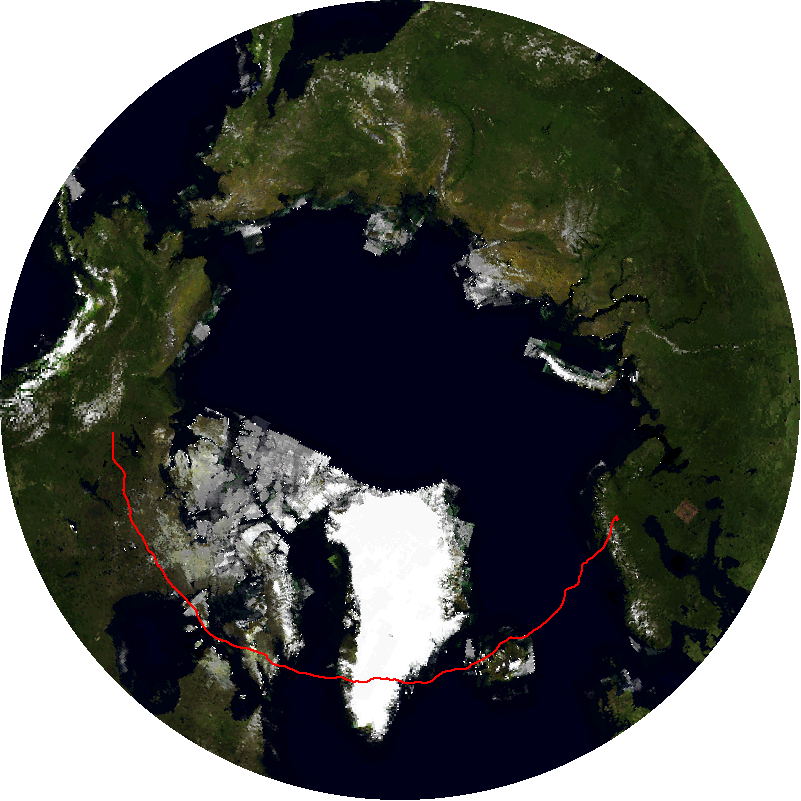
Super-TIGER is a cosmic ray experiment lofted by balloon over Antarctica. It recently broke the record for length of a balloon flight by staying aloft for over 45 days. The map at right shows its track over Antarctica, color-coded for which circuit it's on: green for first, blue for second, and red for the current third circuit...
Labels:
Antarctica,
Cool,
Cosmic Rays,
Science
Friday, January 18, 2013
Operation Stratosphere...
I'd have a lot of fun with a project like this: send cameras aloft (via balloon) into the stratosphere, taking 360° still and video images all the way up and down. Bonus: image the balloon bursting! One example result: you can explore the image below in a 360° viewer.
Tuesday, December 11, 2012
If Google Was Around in the '60s...
...what might it have looked like? Here's a very cool interactive animation that old fogeys like me and the young 'uns will both enjoy – though most likely for very different reasons...
Labels:
Cool,
History,
Technology
Saturday, November 3, 2012
NetQuakes...
Something like two years ago, I first read about the U.S. Geological Survey (USGS) “NetQuakes” program. Basically the USGS wants to get a denser network of seismographs in certain earthquake-prone area, such as southern California. To reduce the cost of such a network, they came up with a capital idea: enlist a network of volunteer “seismograph hosts”. Each of these hosts had to have a home with a concrete slab, power, and Internet access. That describes just about every house around here, including ours. So I signed up to be a volunteer.
Nothing whatsoever happened after that, until last week – when completely out of the blue, a nice young fellow from USGS called me and asked if I was still interested. Of course I said yes, and last Thursday he showed up with a GeoSIG IA-2 “Internet Accelerograph” (PDF datasheet) just like the one at right, and a few tools. I had picked out a spot underneath my IT gear that he thought was just dandy, and in just a few minutes he had the thing installed, powered up, checked out, and connected to the Internet (via WiFi!). The bracket that holds the instrument (seen in the photo as the metallic plate on the bottom) is bolted to my slab and leveled. The instrument itself snicks right into that bracket – so as my slab moves, the instrument itself moves.
And exactly what is the instrument? The summary: a three-axis accelerometer with some smarts around it to pick the “strong motion” events to bother reporting, and to record not only the event itself but some time both before and after it. The whole thing is running on an ARM processor; the OS is Linux. Quite the modern piece of gear!
The data it collects is published up to the Internet and is publicly accessible. The page for my particular instrument is here; a map of all the instruments is here (from here you can get to the data for any instrument). The image below shows what the seismograph (all three axes) produces for an event it records:
If you'd like to volunteer for NetQuakes, here's the signup page.
Nothing whatsoever happened after that, until last week – when completely out of the blue, a nice young fellow from USGS called me and asked if I was still interested. Of course I said yes, and last Thursday he showed up with a GeoSIG IA-2 “Internet Accelerograph” (PDF datasheet) just like the one at right, and a few tools. I had picked out a spot underneath my IT gear that he thought was just dandy, and in just a few minutes he had the thing installed, powered up, checked out, and connected to the Internet (via WiFi!). The bracket that holds the instrument (seen in the photo as the metallic plate on the bottom) is bolted to my slab and leveled. The instrument itself snicks right into that bracket – so as my slab moves, the instrument itself moves.
And exactly what is the instrument? The summary: a three-axis accelerometer with some smarts around it to pick the “strong motion” events to bother reporting, and to record not only the event itself but some time both before and after it. The whole thing is running on an ARM processor; the OS is Linux. Quite the modern piece of gear!
The data it collects is published up to the Internet and is publicly accessible. The page for my particular instrument is here; a map of all the instruments is here (from here you can get to the data for any instrument). The image below shows what the seismograph (all three axes) produces for an event it records:
If you'd like to volunteer for NetQuakes, here's the signup page.
Labels:
Cool,
Earthquake,
Home,
Science
Thursday, September 20, 2012
Wednesday, September 19, 2012
Tuesday, September 18, 2012
Wednesday, July 25, 2012
Florida One...
Via my mom, this mini-documentary about the manufacture of a Boeing 737 for Southwest Airlines:
Labels:
Cool
Tuesday, June 26, 2012
Thursday, June 21, 2012
Power Excitement...
We had a bit of an unusual occurrence here today: SDG&E needed to replace a utility pole, and they did it with a helicopter. The pole in question was an old wooden pole carrying a “pole pig” (one of the big, cylindrical things you see on lots of poles out in the sticks; the things weigh about 250 pounds). This particular one supplies the 120VAC to my neighbor's house, but it's actually located within our property line (on an SDG&E easement) – but nowhere near any roads. It is a hard-to-access piece of dense chaparral. The SDG&E workers could barely hike to the old pole; they weren't too excited at the thought of carting a new one up there, with a new pole pig, and then hauling the old pole pig out.
You can see them working on the first step above right: they're disconnecting the old pole pig. After they did that, they lowered it to the ground. But they didn't start on this until they'd disconnected power from my neighbor's house – and unfortunately for us, that meant our power went off as well. Apparently they had already dug the hole for the new pole, because just after they finished this step, they started the fun part with the helicopter. At left you can see the helicopter “parked” and being rigged up to the new steel pole. This is about a quarter mile from my house. The bottom of the new pole is toward the right side of the photo, with some men working on it. In the background, between the helicopter and the pole, you can see the new pole pig all ready to be hauled up there. A little to the left of that, you can see a red gadget of some kind. I only figured out what that was after watching them work. Once the helicopter had dropped the new pole into the hole, the pilot dipped it a few feet to put some slack in the cable holding the pole, then triggered something that caused that red gadget to disconnect from the pole. It was very slick; just left a loop of cable attached to the pole, and the helicopter was free to depart.
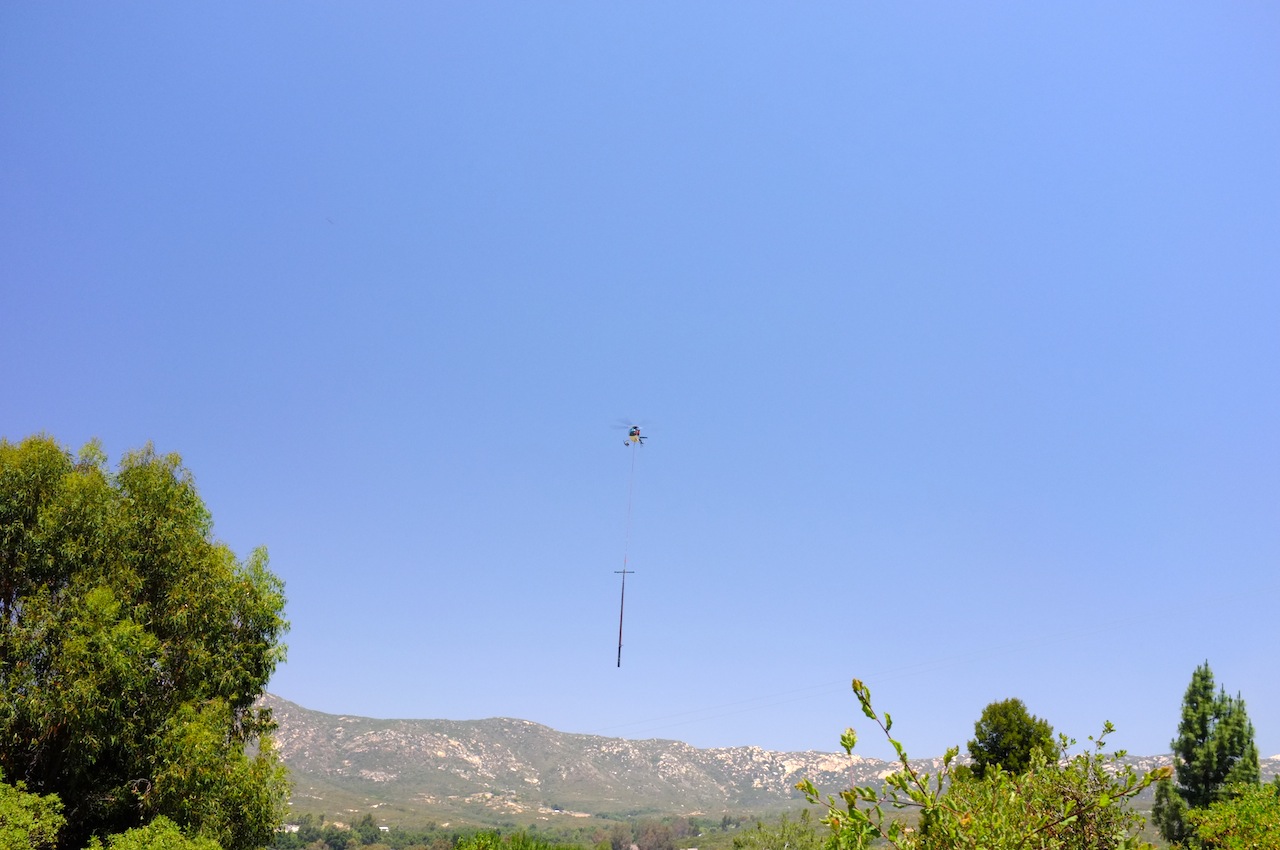
Once the pole was all rigged to the helicopter, I walked back up to my yard to watch the action. Shortly after I got back, the helicopter roared up from where it was parked, dangling the big steel pole beneath it (at right). On the way to the new pole's location, they went right over my head, about 50 feet above me. This was mildly disconcerting :-)
Then the pilot swooped over and down, and dropped it right in the hole with a minimum of fuss (at left). A couple of men on the ground guided it in, but the pilot was darned close right from the start. I clocked it: it was 2 minutes, 40 seconds from the time the pilot flew over my head until the time he disconnected from the pole and left.
Once the pole was in the ground, there was still more work for the helicopter. The next step was to haul that nice, shiny new pole pig up to the new pole to install it. After that, the helicopter hauled the old pole pig back down to the SDG&E trucks. Then the helicopter's work was done, and the pilot flew off into the sunset. Well, not really, but you know what I mean. Speaking of the pilot, in the photo below (taken as he was lowering the pole) you can see him leaning quite a long way out of his window. This is all so he could see directly below him. If you know anything about flying a helicopter, you'll know that it takes two hands to fly one: on your left is the collective, and between your legs is the cyclic. To hover generally takes constant manipulation of both. It's a mystery to me how that pilot was able to fly while hanging halfway out the cockpit window!
But the rest of the SDG&E crew wasn't nearly finished yet. They had to move all the wires (both power and telephone) from the old pole to the new one. Then they had to connect the new pole pig. Finally, last step: they had to go back to a different pole (this one was reachable by truck) and reconnect power to my neighbor and us. Total time for the job: 5 hours, 34 minutes.
One more mystery remains for me. The crew was up on the new pole working away within a few minutes of the helicopter dropping it off. Normally for a pole like that you'd need some concrete poured around it – and you'd have to wait for it to cure. No waiting here! I'm wondering what magic they used to make that pole safe and secure in such a hurry...
You can see them working on the first step above right: they're disconnecting the old pole pig. After they did that, they lowered it to the ground. But they didn't start on this until they'd disconnected power from my neighbor's house – and unfortunately for us, that meant our power went off as well. Apparently they had already dug the hole for the new pole, because just after they finished this step, they started the fun part with the helicopter. At left you can see the helicopter “parked” and being rigged up to the new steel pole. This is about a quarter mile from my house. The bottom of the new pole is toward the right side of the photo, with some men working on it. In the background, between the helicopter and the pole, you can see the new pole pig all ready to be hauled up there. A little to the left of that, you can see a red gadget of some kind. I only figured out what that was after watching them work. Once the helicopter had dropped the new pole into the hole, the pilot dipped it a few feet to put some slack in the cable holding the pole, then triggered something that caused that red gadget to disconnect from the pole. It was very slick; just left a loop of cable attached to the pole, and the helicopter was free to depart.
Once the pole was all rigged to the helicopter, I walked back up to my yard to watch the action. Shortly after I got back, the helicopter roared up from where it was parked, dangling the big steel pole beneath it (at right). On the way to the new pole's location, they went right over my head, about 50 feet above me. This was mildly disconcerting :-)
Then the pilot swooped over and down, and dropped it right in the hole with a minimum of fuss (at left). A couple of men on the ground guided it in, but the pilot was darned close right from the start. I clocked it: it was 2 minutes, 40 seconds from the time the pilot flew over my head until the time he disconnected from the pole and left.
Once the pole was in the ground, there was still more work for the helicopter. The next step was to haul that nice, shiny new pole pig up to the new pole to install it. After that, the helicopter hauled the old pole pig back down to the SDG&E trucks. Then the helicopter's work was done, and the pilot flew off into the sunset. Well, not really, but you know what I mean. Speaking of the pilot, in the photo below (taken as he was lowering the pole) you can see him leaning quite a long way out of his window. This is all so he could see directly below him. If you know anything about flying a helicopter, you'll know that it takes two hands to fly one: on your left is the collective, and between your legs is the cyclic. To hover generally takes constant manipulation of both. It's a mystery to me how that pilot was able to fly while hanging halfway out the cockpit window!
But the rest of the SDG&E crew wasn't nearly finished yet. They had to move all the wires (both power and telephone) from the old pole to the new one. Then they had to connect the new pole pig. Finally, last step: they had to go back to a different pole (this one was reachable by truck) and reconnect power to my neighbor and us. Total time for the job: 5 hours, 34 minutes.
One more mystery remains for me. The crew was up on the new pole working away within a few minutes of the helicopter dropping it off. Normally for a pole like that you'd need some concrete poured around it – and you'd have to wait for it to cure. No waiting here! I'm wondering what magic they used to make that pole safe and secure in such a hurry...
Labels:
Cool,
Helicopter,
Home,
Power
Saturday, June 16, 2012
Tuesday, June 12, 2012
Saturday, June 2, 2012
What Is This?
At right is a photo of downtown Tokyo, Japan, at night. But there's something odd about the river running across the photo – what's that glowing blue stuff?
I'm going to make you go read the article to find out. But I'll tell you this: it's really, really cool...
Friday, April 13, 2012
Subscribe to:
Posts (Atom)