Barn progress... I installed about half the lights in the garage section of the barn yesterday (6 of 11); I should be able to finish the rest of those today. While I was doing that wiring, a building supply delivery truck showed up, bringing the wallboard and “mud” for my future office on the second floor of the barn. The builder will be here early next week to actually do the work.
The truck had a particularly long boom crane on it, designed to allow the delivery of heavy construction products up to five stories high, or 45' away from the truck horizontally. The photo at right (click to embiggen) shows the crane partially extended to deliver our wallboard. The crane operator used a belt-mounted remote control. This let him stand right where he wanted it to go, and then guide it in very precisely. The two guys on the truck humped all that wallboard up my stairs to the second floor. They were wishing I had bigger windows so that they could have used the crane :)
Later in the day, a Fedex freight truck showed up with a 494 pound pallet full of my new Grizzly dust collection system. Naturally it's a giant kit, with hundreds of parts. I unpacked it all (see photo at left) to make sure nothing was damaged in shipping. That thing is built like the proverbial tank – if any damage occurred, I'm certain it was on whatever the box hit, not on the dust collection system itself! The system is far larger than I was imagining. Assembling is going to pose some interesting challenges for this one-man operation. The motor/impeller assembly weighs about 180 pounds, and it needs to be hoisted to the top of a six or seven foot high device – I'm going to have to get some local muscle to help, or come up with some sort of hoist. One possibility: I can drive my tractor into the workshop, so I may be able to lift the assembly with the loader. Or I could mount a block to the roof, then pull it up with the tractor. What fun!
Thursday, March 12, 2015
Wednesday, March 11, 2015

“I was stunned. I didn’t know what to say.”
More guns ≠ more crime...
More guns ≠ more crime... Criminologist Gary Kleck – no stranger to controversy he – has published a new study debunking the trope that more guns cause more crime. It's sure to twist progressive knickers...
Speechless, I am...
Speechless, I am... USB typewriters. I had thought that the faddish attraction to vacuum tube amplifiers was the ultimate expression of this particular type of insanity – but I think a USB typewriter (at prices approaching $1,000!) eclipses even that...
Strange nonchaotic attractors in the heavens...
Strange nonchaotic attractors in the heavens... Spotted in the strange pulsations of a distant variable star...
Quote of the day...
Quote of the day... From Strategy Page:
The accountants always win in the end.Read the details of how ISIS is disintegrating from within. It's encouraging, and gives a good explanation of how air power actually does have a good chance of bringing ISIS down (and accountants figure in this). At the very least it should dramatically weaken them; in the best case it will defeat them...
Powerful photos...
Powerful photos... Thirty-one, including the one at right which had me in tears the first time I saw it years ago...
Photos from the window seat of an airplane...
Photos from the window seat of an airplane... Twenty-seven beauties like the one at right!
What did I think of Hillary Clinton's email explanations?
What did I think of Hillary Clinton's email explanations? Inquiring readers want to know. Well, the Wall Street Journal editorial board had basically the same reaction I did, which I can sum up with one word: “preposterous!” Their lead:
Do go read the whole piece – it hits all the notes I would...
Hillary Clinton’s admirers say she’ll run for President in part by invoking the glory days of the 1990s. For a taste of that era, we recommend her brief press conference Tuesday explaining why she had used a private email account as Secretary of State. It had everything nostalgia buffs could want—deleted evidence, blustery evasions, and preposterous explanations that only James Carville could pretend to believe.I'm not even sure about Carville :)
Do go read the whole piece – it hits all the notes I would...
Tuesday, March 10, 2015
There were a lot of guys from Samoa and Guam...
Geek: “Dieharder” random number generator test suite...
Geek: “Dieharder” random number generator test suite... I hadn't run into this before. There have been several times when I wished I had access to such a test suite. Digging into this will make a good weekend project for me sometime...
Geek: a searchable catalog of NASA open source software...
Geek: a searchable catalog of NASA open source software... There's quite a bit of interesting stuff in here...
Dasatinib and quercetin...
Dasatinib and quercetin... You may be hearing a lot more about these. Quercetin is available over the counter today (though I have no idea what the quality of it is, and the supplements industry is notoriously fraud-filled).
6.5 million Americans are over 112 years old...
6.5 million Americans are over 112 years old... Not really, of course. But that's what the Social Security Administration's records say. You can probably guess what a wide door that opens for fraud – and, of course, that door is being used by tens of thousands of crooks. At least tens of thousands, and quite possibly, many more.
Who's the idiot that thought it was a good idea for the federal government to manage healthcare? Every time we turn over a bureaucratic rock, we find more festering incompetence, fraud, and waste. I'd have thought the Post Office was all the example anyone needed. The $900 toilet seats purchased by the Pentagon might have been another clue. The “stay in line until you die” lists at the Veteran's Administration might have clued someone in, too. Apparently all of this together is still insufficient to convince the progressives that it's a bad idea to have government managing anything...
Life in Paradise...
Life in Paradise... For the past three days, every afternoon we've had people showing up at our door with complete evening meals – hot, tasty food ready to eat. Two of these times the people were complete strangers to us. Why is this happening? That's a bit of a story...
It started in our driveway last Thursday afternoon, as Debbie and I walked out to her truck to drive up to Angie's (in Logan) for dinner. We hadn't been there for a couple weeks, and we both felt like some comfort food. Our driveway still had patches of ice, but the afternoon was warm and it was melting. Wet ice, as you may know, is very slippery. Then add to that the fact that Debbie was wearing leather-soled cowboy boots. They might as well have been Teflon-coated. You can probably guess what happened next: her slippery feet slipped on the slimy ice, and down she went.
After an uncomfortable night, we went to see a doctor on Friday morning. The verdict: a “strained” back and knee. A “strain” is less severe than a “sprain”, but more than just “pulled”. I'm not sure how they come up with this terminology, but the doctor made it clear this was nothing to worry about, that she'd recover completely and quickly, and she just needed some rest, to wear a knee brace for a while, and a little pharmacological assistance (muscle relaxant and analgesic). Home we went.
Fast forward to Saturday morning, when our friend and neighbor Tim D. came over to visit. I was out in the barn working on the wiring, and he went in to chat with Debbie. When she came hobbling slowly to the door, wearing the brace, he knew something was up. He got all the details when talking with her.
I've learned enough about living in an LDS (Mormon) community by now that I should have known what was going to happen next, but it got me by surprise anyway. Tim is a former bishop, a devout Mormon, and upon learning about Debbie's injury (however minor!) he sprang into action as though she was now a quadriplegic. A few hours after he left, Alan and Nikki L. (another set of friends and neighbors) showed up to visit with Debbie. They were there both to comfort her and to interrogate her about our dining preferences. Later that afternoon, they showed up with a ready-to-eat meal, which of course we disposed of very quickly. This is despite our protestations that all this was entirely unnecessary, as (a) I can cook, and (b) Debbie wasn't bedridden, just slowed down. They insisted anyway, Alan telling me, basically, to “shut up and embrace it”, because it was going to happen no matter what we said.
Sunday and Monday afternoon, women who were part of the local LDS ward's Relief Society showed up with another installment. Sunday's meal was particularly good: roast beef with potatoes, carrots, a salad, and dessert, all ready to eat.
Yesterday morning, Michelle H. (the wonderful woman who does the heavy cleaning in our house every couple of weeks) came over as planned – but she was all prepared to do a lot more (I think Debbie's condition has been wildly exaggerated in the rumor mill) to help out. She was ready to do the cooking (note the assumption that the male animal of the household can't prepare food!), take care of the animals, etc. We didn't actually need any of that help, but it was comforting to know that if we did need it, it would be readily available.
The local Mormons are enjoying our discomfiture with all this, I think :) But I have to say that we're enjoying the food and the opportunity to meet some members of our community who are new to us.
Monday morning I ran down to the Post Office to pick up our mail. When I walked in the door, the postmaster asked me how Debbie was doing. His assistant wanted to know if we were happy with the meals. They both knew all the details of Debbie's fall, which is typical of any small community, I suspect – but after spending so much time in California, it's sure not something I'm used to. Everyone is connected here, somehow (including, of course, through the LDS church that the majority of our community are members of). Brent, our postmaster, is the brother of the woman who runs the local Relief Society. Linda, his assistant, is actually a neighbor of ours (and a water rights expert currently working on getting our well permit). Both are LDS.
Out in the Post Office lobby, where the P.O. boxes are, another woman greeted me with good wishes for Debbie. I had no idea who this woman was, and it must have showed in my face, so she explained that her husband pointed me out as they drove into the Post Office (the lobby has big windows). He knows me because we'd previously chatted in the Post Office lobby, and he remembered where I lived – and had heard in church that Debbie (whom he'd never met) had fallen. So when his wife ran in to pick up their mail, she was full of concern and good wishes – even though she'd never met (or heard of) either of us before!
We love living here. After forty-plus years in California, land of adjacent strangers, to live in a community that actually is a community is jarring in some ways, but comforting in so many more...
It started in our driveway last Thursday afternoon, as Debbie and I walked out to her truck to drive up to Angie's (in Logan) for dinner. We hadn't been there for a couple weeks, and we both felt like some comfort food. Our driveway still had patches of ice, but the afternoon was warm and it was melting. Wet ice, as you may know, is very slippery. Then add to that the fact that Debbie was wearing leather-soled cowboy boots. They might as well have been Teflon-coated. You can probably guess what happened next: her slippery feet slipped on the slimy ice, and down she went.
After an uncomfortable night, we went to see a doctor on Friday morning. The verdict: a “strained” back and knee. A “strain” is less severe than a “sprain”, but more than just “pulled”. I'm not sure how they come up with this terminology, but the doctor made it clear this was nothing to worry about, that she'd recover completely and quickly, and she just needed some rest, to wear a knee brace for a while, and a little pharmacological assistance (muscle relaxant and analgesic). Home we went.
Fast forward to Saturday morning, when our friend and neighbor Tim D. came over to visit. I was out in the barn working on the wiring, and he went in to chat with Debbie. When she came hobbling slowly to the door, wearing the brace, he knew something was up. He got all the details when talking with her.
I've learned enough about living in an LDS (Mormon) community by now that I should have known what was going to happen next, but it got me by surprise anyway. Tim is a former bishop, a devout Mormon, and upon learning about Debbie's injury (however minor!) he sprang into action as though she was now a quadriplegic. A few hours after he left, Alan and Nikki L. (another set of friends and neighbors) showed up to visit with Debbie. They were there both to comfort her and to interrogate her about our dining preferences. Later that afternoon, they showed up with a ready-to-eat meal, which of course we disposed of very quickly. This is despite our protestations that all this was entirely unnecessary, as (a) I can cook, and (b) Debbie wasn't bedridden, just slowed down. They insisted anyway, Alan telling me, basically, to “shut up and embrace it”, because it was going to happen no matter what we said.
Sunday and Monday afternoon, women who were part of the local LDS ward's Relief Society showed up with another installment. Sunday's meal was particularly good: roast beef with potatoes, carrots, a salad, and dessert, all ready to eat.
Yesterday morning, Michelle H. (the wonderful woman who does the heavy cleaning in our house every couple of weeks) came over as planned – but she was all prepared to do a lot more (I think Debbie's condition has been wildly exaggerated in the rumor mill) to help out. She was ready to do the cooking (note the assumption that the male animal of the household can't prepare food!), take care of the animals, etc. We didn't actually need any of that help, but it was comforting to know that if we did need it, it would be readily available.
The local Mormons are enjoying our discomfiture with all this, I think :) But I have to say that we're enjoying the food and the opportunity to meet some members of our community who are new to us.
Monday morning I ran down to the Post Office to pick up our mail. When I walked in the door, the postmaster asked me how Debbie was doing. His assistant wanted to know if we were happy with the meals. They both knew all the details of Debbie's fall, which is typical of any small community, I suspect – but after spending so much time in California, it's sure not something I'm used to. Everyone is connected here, somehow (including, of course, through the LDS church that the majority of our community are members of). Brent, our postmaster, is the brother of the woman who runs the local Relief Society. Linda, his assistant, is actually a neighbor of ours (and a water rights expert currently working on getting our well permit). Both are LDS.
Out in the Post Office lobby, where the P.O. boxes are, another woman greeted me with good wishes for Debbie. I had no idea who this woman was, and it must have showed in my face, so she explained that her husband pointed me out as they drove into the Post Office (the lobby has big windows). He knows me because we'd previously chatted in the Post Office lobby, and he remembered where I lived – and had heard in church that Debbie (whom he'd never met) had fallen. So when his wife ran in to pick up their mail, she was full of concern and good wishes – even though she'd never met (or heard of) either of us before!
We love living here. After forty-plus years in California, land of adjacent strangers, to live in a community that actually is a community is jarring in some ways, but comforting in so many more...
Monday, March 9, 2015
Taking notes...
Taking notes... I noticed many years ago that if I took notes, pen on paper style, at a lecture or meeting, I'd remember the important things much better. This was true even if I threw the notes away and never looked at them again. In my corporate life I then developed a habit of taking extensive notes at meetings and often even during one-on-one conversations. When I was managing teams of engineers, this was extremely useful, as it allowed me to remember many different things in a complex and ever-shifting environment.
Now there's research that backs up my observation about the value of taking notes...
Replace alcohol?
Replace alcohol? Ryan Cooper wants the government to fund research for a replacement for alcohol – because it's such a terrible recreational drug (highly addictive and physiologically damaging with heaving long-term use). He makes the point that alcohol is worse in many ways than the currently illegal recreational drugs, including even heroin.
I'm not sure we need new research here. Seems to me we just need to make the already existing, much safer drugs (like marijuana) legal. Consumers can then freely choose to abstain, to use the safer drugs, or continue to use alcohol...
Follow the money...
Follow the money... Oh, my:
"Follow the money." That apocryphal phrase, attributed to Watergate whistle-blower "Deep Throat," explains why the biggest threat to Hillary Rodham Clinton's presidential dreams is not her emails. It's her family foundation. That's where the money is: corporate money, foreign money, gobs of money sloshing around a vanity charity that could be renamed "Clinton Conflicts of Interest Foundation."If these allegations prove to have any truth to them at all, that really might doom Hillary's quest for the monarchy presidency...
Sunday, March 8, 2015
Human-generated random data...
Human-generated random data... This is, so far as I can tell, a completely useless (and almost certainly not random!) idea. Also, it appears to be broken. But their “About” page is one of the best I've seen in a long time :)
The Apple way...
The Apple way... The Apple Watch had a challenge. Unlike any of Apple's previous products, a watch is perceived by many to be a fashion accessory or even a piece of jewelry. That means that some customers will want the rich look of gold – preferably, a nice 18K gold as is traditional for watchmakers going back hundreds of years. Probably any other manufacturer would simply have said “OK, make a gold model.” Apple noted, however, that traditional 18K gold has two problems. First, it's expensive, especially when gold is going for $1,200+ an ounce. Second, it's relatively soft – though 18K gold is much harder than 24K gold, it's still soft enough that it's easily scratched.
So Apple developed a new kind of 18K gold (see this explanation) that uses less gold and is more durable. Very clever, that. Also a great example of what can happen at the conjunction of visionary product development, scale, (almost) unlimited funding, and total vertical integration...
Quote of the day...
Quote of the day... This one is from a New York Times article (I read them so that you don't have to :) about the things the must be done to make online education attractive as an alternative to traditional (and very expensive) universities. The article focuses on credentialing, specifically on alternatives to the traditional college degree that's embodied in a diploma. As my long-time readers (all four of you) will know, I'm not happy with the existing diploma system, as the possession of a diploma from an American university really tells you very little about what that person actually knows, or can do. So this quote really caught my eye:
Meanwhile, the best credentials I know of currently are open source project contributions...
The standard diploma has roughly the same amount of information that prisoners of war are required to divulge under the Geneva Conventions.Ha! Yes, that's absolutely true. The fact that a candidate programmer has a degree from (say) Carnegie-Mellon University tells a prospective employer almost nothing at all about that candidate's suitability for the job. Some of the alternative credentialing ideas mentioned in the article (Mozilla's Open Badges, in particular) are attempting to address that problem. Traditional universities have a conflict with these alternative credentialing ideas, though – to the extent that they succeed, they will (a) provide less expensive alternatives to the university, and (b) expose the mediocrity of the education those expensive universities are delivering.
Meanwhile, the best credentials I know of currently are open source project contributions...
European tree of the year...
European tree of the year... This oak tree in Orissaare, Estonia, was just voted the 2015 “Tree of the Year” in a contest amongst 14 European countries.
I've traveled extensively in Estonia in the period from just after their independence from the Soviet Union in 1991 through 2004. The map that guided my explorations had numerous interesting botanical specimens marked on it, and after seeing the beauty of a few of them I started making it a point to visit them. This tree in Orissaare was one of those marked on that map, and I visited it twice – once in about 1995, then again in 2002, on one of my last visits to Estonia.
This particular tree is located on the eastern side of Saaremaa, the biggest Estonian island in the Baltic Sea, on the western border of the country. If you view the map at left on Google Maps, you'll be able to see exactly where it's located by zooming out.
The first time I visited this tree was before the economic boom in Saaremaa, and the town's infrastructure was still in pretty bad shape. I bought my lunch in a small grocery store, and sat beneath the tree to have myself a little picnic. A couple of people walked by, but nobody stopped to talk. The second time I visited, Orissaare (and the rest of the island) was far more prosperous, with lots of fresh paint, repaired structures, and even a bit of pavement here and there. On that visit, I couldn't have my picnic under the tree, as there were all sorts of people playing several different games (though not football!) right around the tree. I sat on the edge of the field to eat my picnic lunch, which that time came from a small, new restaurant serving allegedly local cuisine. I'm not entirely sure what it was, but it had fish, potatoes, and a lot of dill in it – and was quite tasty!
It was fun to see a tree I know in the news :)
I've traveled extensively in Estonia in the period from just after their independence from the Soviet Union in 1991 through 2004. The map that guided my explorations had numerous interesting botanical specimens marked on it, and after seeing the beauty of a few of them I started making it a point to visit them. This tree in Orissaare was one of those marked on that map, and I visited it twice – once in about 1995, then again in 2002, on one of my last visits to Estonia.
The first time I visited this tree was before the economic boom in Saaremaa, and the town's infrastructure was still in pretty bad shape. I bought my lunch in a small grocery store, and sat beneath the tree to have myself a little picnic. A couple of people walked by, but nobody stopped to talk. The second time I visited, Orissaare (and the rest of the island) was far more prosperous, with lots of fresh paint, repaired structures, and even a bit of pavement here and there. On that visit, I couldn't have my picnic under the tree, as there were all sorts of people playing several different games (though not football!) right around the tree. I sat on the edge of the field to eat my picnic lunch, which that time came from a small, new restaurant serving allegedly local cuisine. I'm not entirely sure what it was, but it had fish, potatoes, and a lot of dill in it – and was quite tasty!
It was fun to see a tree I know in the news :)
Saturday, March 7, 2015
All the sub-panelz are mine!
All the sub-panelz are mine! I finished wiring in the sub-panel for the woodworking shop this afternoon. The photo at right shows it with the cover off, and absolutely nothing wired into it yet :) But it has power, and I've tested the safety ground and neutral wires, just to be sure I don't have problems later on.
After I finished with this, I spent a couple hours getting started on the lights in the garage section. It will probably take me a couple days just to get the basic wiring in place, then another day to actually install the ten lights I'm putting up in there...
Never in a million years...
Never in a million years ... would this have occurred to me: photographing people covered in honey. It's far more interesting and beautiful than I would have guessed. Watch the video at the link...
Uranium emissions, visualized in a cloud chamber...
Geek: integer overflow/underflow in C/C++...
Geek: integer overflow/underflow in C/C++... My first reaction on reading this paper was this: geez, guys, it's 2015. This problem has been around since about 1945. Is this really still a mystery and a source of problems? I've run into this issue (and other numerical representation issues) over my entire career, and I've no sense that things have actually gotten better over time.
With respect to integer overflow/underflow, the fundamental issue is very easy to understand: computers generally represent integers in a way that limits the range of integers that can be represented. For example, in today's computers a single byte can represent all the integers between 0 and 255. If you try to add, say, 200 + 100, the result (300) cannot be represented in a single byte – that's an example of integer overflow.
We humans don't generally run into integer overflow or underflow, as we don't have any particular limits on the size of integers we can represent. Computers, on the other hand, do have this limitation – and therefore computer programmers have to deal with it. This is where the problems start, as there are many possible ways one could deal with it – including ignoring the possibility altogether, which is in practice what most programmers actually do. This is the source of much trouble.
The problem is complicated by at least two things in modern computers: the fact that multiple sizes of integers are available (generally, but not always, some even number of bytes), and the fact that both signed and unsigned integers can be represented. For instance, a single byte unsigned can represent integers in the range 0..255, whereas a single signed byte can represent integers in the range -128..127. Older computers (and a few still in production) through a different variable into the mix: they represented integers by schemes other than the now-ubiquitous two's complement encoding. I've worked extensively with computers that used one's complement integer encoding and signed binary coded decimal (where the sign is held in a special bit), and to a lesser extent with zoned decimal encodings. Each of these has their own special variations of the overflow/underflow problem, though of course being fixed size encodings they all have the problem.
Anyway, it just seems kind of silly that at this stage of software development we still don't have a standard way of handling integer overflow/underflow, and we still haven't managed to educate programmers about the problems they cause. Actually, it's worse than that – even within the past few years I've run into programmers in very responsible positions, sometimes with years of experience, who don't actually understand the source of overflow and underflow, and who believe the problem can be safely ignored most of the time. They're wrong and they don't even know it...
With respect to integer overflow/underflow, the fundamental issue is very easy to understand: computers generally represent integers in a way that limits the range of integers that can be represented. For example, in today's computers a single byte can represent all the integers between 0 and 255. If you try to add, say, 200 + 100, the result (300) cannot be represented in a single byte – that's an example of integer overflow.
We humans don't generally run into integer overflow or underflow, as we don't have any particular limits on the size of integers we can represent. Computers, on the other hand, do have this limitation – and therefore computer programmers have to deal with it. This is where the problems start, as there are many possible ways one could deal with it – including ignoring the possibility altogether, which is in practice what most programmers actually do. This is the source of much trouble.
The problem is complicated by at least two things in modern computers: the fact that multiple sizes of integers are available (generally, but not always, some even number of bytes), and the fact that both signed and unsigned integers can be represented. For instance, a single byte unsigned can represent integers in the range 0..255, whereas a single signed byte can represent integers in the range -128..127. Older computers (and a few still in production) through a different variable into the mix: they represented integers by schemes other than the now-ubiquitous two's complement encoding. I've worked extensively with computers that used one's complement integer encoding and signed binary coded decimal (where the sign is held in a special bit), and to a lesser extent with zoned decimal encodings. Each of these has their own special variations of the overflow/underflow problem, though of course being fixed size encodings they all have the problem.
Anyway, it just seems kind of silly that at this stage of software development we still don't have a standard way of handling integer overflow/underflow, and we still haven't managed to educate programmers about the problems they cause. Actually, it's worse than that – even within the past few years I've run into programmers in very responsible positions, sometimes with years of experience, who don't actually understand the source of overflow and underflow, and who believe the problem can be safely ignored most of the time. They're wrong and they don't even know it...
Oopsie...
Oopsie... Spelling errors can creep into the most unlikely places. Like, for instance, the title on a video associated (screen capture at right) with this Financial Times article. I suspect someone's going to get a little talking-to this morning – those British publications take their spelling and style guidelines quite seriously :)
Email outage...
Email outage... Yesterday our family email (which is hosted by GMail) was down for close to 24 hours. The symptoms were that we stopped receiving any new mail, and the URL we normally used to access our mail stopped working (though the default GMail URL still worked). If you're the geekly sort, you probably immediately said “DNS problem!”, and in fact that's what it was. Once that got resolved, our missed emails started trickling in, much to the general relief of my family members.
Two observations from this experience:
First, how dependent on email (and the Internet, more generally) we've become! Our email has become one of the rhythms in our lives – we expect certain emails to arrive at certain times of the day, and when they don't arrive, it feels like a major disconnection – a bit like the power going out, or the road to your house being shut down. Some of my family members, when reporting the outage, had a distinct tinge of, well, panic in their voices. In actual fact, it's nothing so vital (though for my sister, who uses email in her business, a bit more so). Nevertheless, when it's cut off, we don't like it. Not. One. Little. Bit.
Second, how amazingly reliable email has become. My family has been using this (free!) GMail service for about ten years now. In all that time, we've only had a couple of short outages. We access our email from the web on multiple browsers, from email “fat clients” (like Mozilla's Thunderbird), from iPads, and from smart phones. Wherever we are, whenever we want it, however we want to access it – it just works. This reliability is in marked contrast to the self-hosted Microsoft Exchange email server that I maintained for roughly ten years prior to that. That beast would go down about once a week, and sometimes it took hours of troubleshooting (by me!) to get it back up again. I lived in fear of updates to that server, because about one in four of them would knock it offline. Contrast that with our GMail experience: I spend zero time managing the service, and it just always works. Well, almost always. Google deserves a great deal of credit for building such a reliable system. Such things do not happen by accident!
Two observations from this experience:
First, how dependent on email (and the Internet, more generally) we've become! Our email has become one of the rhythms in our lives – we expect certain emails to arrive at certain times of the day, and when they don't arrive, it feels like a major disconnection – a bit like the power going out, or the road to your house being shut down. Some of my family members, when reporting the outage, had a distinct tinge of, well, panic in their voices. In actual fact, it's nothing so vital (though for my sister, who uses email in her business, a bit more so). Nevertheless, when it's cut off, we don't like it. Not. One. Little. Bit.
Second, how amazingly reliable email has become. My family has been using this (free!) GMail service for about ten years now. In all that time, we've only had a couple of short outages. We access our email from the web on multiple browsers, from email “fat clients” (like Mozilla's Thunderbird), from iPads, and from smart phones. Wherever we are, whenever we want it, however we want to access it – it just works. This reliability is in marked contrast to the self-hosted Microsoft Exchange email server that I maintained for roughly ten years prior to that. That beast would go down about once a week, and sometimes it took hours of troubleshooting (by me!) to get it back up again. I lived in fear of updates to that server, because about one in four of them would knock it offline. Contrast that with our GMail experience: I spend zero time managing the service, and it just always works. Well, almost always. Google deserves a great deal of credit for building such a reliable system. Such things do not happen by accident!
Barn progress...
Barn progress... I've been working away at the electrical wiring in our barn. Yesterday I mounted a sub-panel in the workshop and started to wire it into the main breaker panel. There's a 65' run between them, with three 90° bends required. The sub-panel has a 50 amp capacity, so I'm using 6 gauge wire: two “hot” wires, one neutral, and one safety ground. I'm using separate wires (rather than romex) to make it easier to pull it through the 3/4" conduit. I'll have that finished with a another couple hours of work.
Meanwhile, I've mounted an LED ceiling fixture in the bathroom, with a wall switch, and I've ordered lights for the garage section (10 lights) and the workshop (15 lights). I figure each light is about 30 to 45 minutes of work, so I've got a few days of work just to get the lights up. Both of these areas present some light-mounting challenges, as there are obstacles on the ceiling. In the garage area I can't mount any lights where the garage door traverses, and in the workshop area I have the large “hatch” in the ceiling (to hoist heavy items up into storage). I haven't yet decided how to deal with the latter issue.
Yesterday I ordered the first pieces of equipment for my woodworking shop. This feels like a milestone of sorts, as that woodworking shop was one of the big motivations for building the barn in the first place. The first two pieces of gear: a dust-collection system (a 3HP Grizzly model that gets good reviews) and a table saw. On the table saw I splurged a bit to get a SawStop model with their safety technology. I've watched their hot dog demonstrations several times in person (see the link for a video), and each time I was astonished at just how well it worked – it stops the blade so quickly that there's barely a nick in the hot dog they feed directly into the spinning blade. The blade and the brake are destroyed in the process, but for around $100 they can be replaced, and you're back in business. That seems like a very small price to save one's finger, no?
I'm a careful guy around power tools; I have a lot of respect for the damage they can do to the user. Table saws have always worried me, though I've never hurt myself when using one. With that completely exposed blade that you're pushing work into, it would be so easy to make a tiny mistake that cost you a finger. One little slip, and it's “bye bye” to a finger or two. On most other power tools, you're not feeding work into the blade, so the danger is substantially lower. Consider, for instance, operating a drill press: you have the work clamped or held on the work table, and you turn a control to lower the drill into the work – this is inherently a much safer task than pushing a piece of wood straight into a spinning disk rimmed with sharp carbide teeth. Also the table saw is one of the central tools for any fine woodworking – one would probably spend more time with it than with any other dangerous power tool. Add all that up, and it starts to make sense to spend a bit more to help preserve my digits.
Both the saw and the dust collection system require 220V single-phase electrical connections. More wiring :) With any luck at all, they will arrive within two weeks, and probably a week or so after that I'll have them up and running. Once I have an operable table saw, I can start actually building some things of wood. Woo hoo!
Meanwhile, I've mounted an LED ceiling fixture in the bathroom, with a wall switch, and I've ordered lights for the garage section (10 lights) and the workshop (15 lights). I figure each light is about 30 to 45 minutes of work, so I've got a few days of work just to get the lights up. Both of these areas present some light-mounting challenges, as there are obstacles on the ceiling. In the garage area I can't mount any lights where the garage door traverses, and in the workshop area I have the large “hatch” in the ceiling (to hoist heavy items up into storage). I haven't yet decided how to deal with the latter issue.
Yesterday I ordered the first pieces of equipment for my woodworking shop. This feels like a milestone of sorts, as that woodworking shop was one of the big motivations for building the barn in the first place. The first two pieces of gear: a dust-collection system (a 3HP Grizzly model that gets good reviews) and a table saw. On the table saw I splurged a bit to get a SawStop model with their safety technology. I've watched their hot dog demonstrations several times in person (see the link for a video), and each time I was astonished at just how well it worked – it stops the blade so quickly that there's barely a nick in the hot dog they feed directly into the spinning blade. The blade and the brake are destroyed in the process, but for around $100 they can be replaced, and you're back in business. That seems like a very small price to save one's finger, no?
I'm a careful guy around power tools; I have a lot of respect for the damage they can do to the user. Table saws have always worried me, though I've never hurt myself when using one. With that completely exposed blade that you're pushing work into, it would be so easy to make a tiny mistake that cost you a finger. One little slip, and it's “bye bye” to a finger or two. On most other power tools, you're not feeding work into the blade, so the danger is substantially lower. Consider, for instance, operating a drill press: you have the work clamped or held on the work table, and you turn a control to lower the drill into the work – this is inherently a much safer task than pushing a piece of wood straight into a spinning disk rimmed with sharp carbide teeth. Also the table saw is one of the central tools for any fine woodworking – one would probably spend more time with it than with any other dangerous power tool. Add all that up, and it starts to make sense to spend a bit more to help preserve my digits.
Both the saw and the dust collection system require 220V single-phase electrical connections. More wiring :) With any luck at all, they will arrive within two weeks, and probably a week or so after that I'll have them up and running. Once I have an operable table saw, I can start actually building some things of wood. Woo hoo!
Friday, March 6, 2015
Quadruple vision...
Quadruple vision... The Hubble telescope has imaged a spectacular example of “gravitational lensing” (see image at right, click to embiggen). The yellowish supernova seen four times is actually behind the closer galaxy that appears to be centered between them. The gravity field of that galaxy is acting like a lens, bending the light from the supernova around itself so that we see four different images of the supernova. This is a phenomenon Einstein predicted as a consequence of his general relativity theorem...
Thursday, March 5, 2015
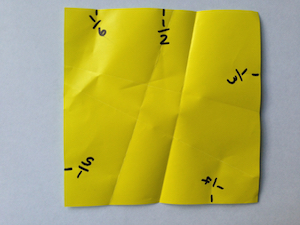
Folding fractions...
Folding fractions... You can easily fold a piece of paper to half its width – but can you do a third, or a seventh, or a nineteenth? Sure you can!
Horses in the moonlight...
Horses in the moonlight... This morning when I got up at 3 am to take Mo'i for a walk, I didn't turn the outside lights on – there was no need. The moon was nearly full, and quite high, the sky was crystal clear, and there's snow covering most of the ground. The result was fairly bright lighting outside, more than enough to see the color of our flags, our orange trailer and FJ, etc. Walking was no problem at all. The temperature outside was around 20°F, cold enough to make the snow crunchy.
As Mo'i and I walked around the yard, I noticed a dim light across the street from me, along the dirt road that borders the property belonging to my neighbor to the east (Gary and Elaine S.). Thinking that it might be someone broken down in a car, I walked over there with Mo'i. It was a beautiful walk in the moonlight, just a few hundred yards but full of sensory delights. In addition to the cool white moonlight there was the crunch of my boots on the ice and snow, the occasional sound of ice falling off a tree, the snuffling of my neighbor's two horses, and the aroma of their pasture.
When we got to the light, I discovered it was a small round sign that said “Vivint”. I'd never heard of Vivint before, but with a little googling I discovered it was a home security company. Apparently there's an alarm system in the adjacent horse barn. I'd never noticed the lit sign before; perhaps it was recently installed, or perhaps I just never noticed it in the glare of the outside lights I usually have on when I walk the dogs at night.
As I checked out the light, my neighbor's two horses came trotting over to greet us; black shapes in the moonlight, accompanied by horsey sounds and smells. One of them is entirely black, the other also black except for a small white blaze on its forehead. They looked a little spooky in the moonlight; a bit like the black horses ridden by the Nazgûl of the Lord of the Rings. Both of the horses remembered me from previous encounters, but both were leery of Mo'i at first. Within a minute or so, though, both of them were rubbing noses with a delighted Mo'i, who's always been interested in large animals. I think the horses were very happy to have some company on a cold morning; they complained a little bit when we left...
As Mo'i and I walked around the yard, I noticed a dim light across the street from me, along the dirt road that borders the property belonging to my neighbor to the east (Gary and Elaine S.). Thinking that it might be someone broken down in a car, I walked over there with Mo'i. It was a beautiful walk in the moonlight, just a few hundred yards but full of sensory delights. In addition to the cool white moonlight there was the crunch of my boots on the ice and snow, the occasional sound of ice falling off a tree, the snuffling of my neighbor's two horses, and the aroma of their pasture.
When we got to the light, I discovered it was a small round sign that said “Vivint”. I'd never heard of Vivint before, but with a little googling I discovered it was a home security company. Apparently there's an alarm system in the adjacent horse barn. I'd never noticed the lit sign before; perhaps it was recently installed, or perhaps I just never noticed it in the glare of the outside lights I usually have on when I walk the dogs at night.
As I checked out the light, my neighbor's two horses came trotting over to greet us; black shapes in the moonlight, accompanied by horsey sounds and smells. One of them is entirely black, the other also black except for a small white blaze on its forehead. They looked a little spooky in the moonlight; a bit like the black horses ridden by the Nazgûl of the Lord of the Rings. Both of the horses remembered me from previous encounters, but both were leery of Mo'i at first. Within a minute or so, though, both of them were rubbing noses with a delighted Mo'i, who's always been interested in large animals. I think the horses were very happy to have some company on a cold morning; they complained a little bit when we left...
Wednesday, March 4, 2015
The Musashi is found!
The Musashi is found! The wreck of the Japanese super-battleship Musashi (sunk in the WWII Battle of Leyte Gulf) has been found. A team of researchers funded by Paul Allen found the wreck after eight years of work...
Geek: the evolution of character codes...
Geek: the evolution of character codes... For an aging geek like me, this paper was a trip down memory lane. In the '70s, while writing software for Univac computers that were part of the U.S. Navy's NTDS system, I often wrote programs to convert textual data from one character encoding to another. This was a common problem, as there was no “one standard to rule them all” as there is today with Unicode. Instead we used a combination of different character encodings, and if we wanted one system or program to communicate with another, we had to write a conversion program to do it.
The character encodings that I worked with included several widely used ones: Baudot, FIELDATA, ASCII, and EBCDIC, all discussed in the linked paper. We also used some special-purpose, typically application-specific encodings that were basically primitive compression schemes – these were especially common in what we'd call log data today. For instance, one system I worked on kept a log (on magnetic tape!) of all the targets we had identified and tracked. Space on that tape was at a premium, so many simple tricks were used to conserve characters. One that I recall: in an ASCII character stream (5 bits per character), we had a special “numbers-only” mode that was initiated by a control character. Once in that mode, codes from 0x00 to 0x63 represented decimal digit pairs (00 to 99), and 0x64 dropped us out of that mode. This was useful because a high percentage of a log was comprised of numbers – so why “waste” an entire ASCII character for just one digit? If you had a number with 8 or more sequential digits (and we had many of these), this character encoding would save bits.
What a different world with Unicode today!
The character encodings that I worked with included several widely used ones: Baudot, FIELDATA, ASCII, and EBCDIC, all discussed in the linked paper. We also used some special-purpose, typically application-specific encodings that were basically primitive compression schemes – these were especially common in what we'd call log data today. For instance, one system I worked on kept a log (on magnetic tape!) of all the targets we had identified and tracked. Space on that tape was at a premium, so many simple tricks were used to conserve characters. One that I recall: in an ASCII character stream (5 bits per character), we had a special “numbers-only” mode that was initiated by a control character. Once in that mode, codes from 0x00 to 0x63 represented decimal digit pairs (00 to 99), and 0x64 dropped us out of that mode. This was useful because a high percentage of a log was comprised of numbers – so why “waste” an entire ASCII character for just one digit? If you had a number with 8 or more sequential digits (and we had many of these), this character encoding would save bits.
What a different world with Unicode today!
Quote of the day...
Quote of the day... From Josh Bloom, writing at Science 2.0:
There are many reasons to end the war on drugs, and this is but one of them...
The "war on drugs" has been a dismal failure by any measure. Turning cancer patients and others with severe pain into collateral damage in this un-winnable war is inhuman.I have only suffered from serious pain a couple of times in my life. On both those occasions, luckily for me, I was easily able to obtain powerful opioid painkillers. That may not be true, should I need them again – and I, for one, am not looking forward to suffering because of that.

There are many reasons to end the war on drugs, and this is but one of them...
Glasses to treat color blindness...
Glasses to treat color blindness... For real! But only certain kinds of color blindness, albeit the most common ones. These glasses work by blocking particular light frequencies – those sensed by both red and green “cones” (the color-sensitive photo-sensing cells on your retina). By blocking the common sensitivity, the glasses improve the eye's ability to discriminate between colors. My favorite part: the effectiveness of these glasses was discovered entirely by accident!
I sure hope they've gotten better...
I sure hope they've gotten better ... than they were when I was in the Navy (the early '70s). I was on the USS Long Beach CGN-9 (now decommissioned and sold for scrap), and we had a pair of 5 inch guns on board. A crew of Marines manned those guns, and we occasionally engaged in some target practice – usually shooting at either towed targets or at stationary targets on small islands off the coast of California.
The ability of our gun crews to miss their target was the stuff of USS Long Beach legend. We heard stories of ships that would refuse to tow targets for us to shoot at, from the (entirely justified) fear that our guns would hit them instead of the target – no matter how long the towline was. I remember watching target practice against an island target and seeing shells landing hundreds of yards from their aim point. From all I could tell, the bad reputation our guns had was well-earned.
I was an enlisted guy, and my living quarters (a “berthing compartment”) was shared with 40 or 50 other technically-oriented enlisted guys (ETs and DSs, for the most part). Our berthing compartment was right next to the Marines' berthing compartment, and there was a seldom used hatch (door) between the two. One day after target practice we heard a commotion from the Marines' side. A couple of us went over to see what the fuss was, and it turned out that a bunch of Marines were delivering some physical justice to the gun crew – for having dishonored the Marine Corps with their bad shooting.
One hopes things aren't quite so bad these days...
The ability of our gun crews to miss their target was the stuff of USS Long Beach legend. We heard stories of ships that would refuse to tow targets for us to shoot at, from the (entirely justified) fear that our guns would hit them instead of the target – no matter how long the towline was. I remember watching target practice against an island target and seeing shells landing hundreds of yards from their aim point. From all I could tell, the bad reputation our guns had was well-earned.
I was an enlisted guy, and my living quarters (a “berthing compartment”) was shared with 40 or 50 other technically-oriented enlisted guys (ETs and DSs, for the most part). Our berthing compartment was right next to the Marines' berthing compartment, and there was a seldom used hatch (door) between the two. One day after target practice we heard a commotion from the Marines' side. A couple of us went over to see what the fuss was, and it turned out that a bunch of Marines were delivering some physical justice to the gun crew – for having dishonored the Marine Corps with their bad shooting.
One hopes things aren't quite so bad these days...
Weirder and weirder...
Weirder and weirder... The latest episode in the Hillary-didn't-use-government-email saga is an odd twist indeed: the email address she used for official business (hdr22-at-clintonemail.com) was hosted on a private email server. These days it's pretty darned odd for an individual to go to all the trouble of acquiring, installing, configuring, and maintaining a private email servers. Even businesses are moving toward hosted email (services like Google's GMail) to save money and the need for expertise. Often the motive is the realization that email security is hard, and getting harder every day.
So why would Clinton have her own email server? I don't know the answer to that, of course – but it's darned hard to think of a benign reason for her to do so. If she was some kind of a geek, I could pass it off as a hobbyist sort of thing – but she's famously not a geek. The only other motivations I can come up with revolve around a desire for secrecy – which in the case of a government official would be (a) inappropriate, and (b) illegal.
The Clinton machine's response to all this? It boils down to “Shut up! You’re talking to the next President of the United States, you insignificant worm!” How's that for a pleasant thought to start your morning with?
So why would Clinton have her own email server? I don't know the answer to that, of course – but it's darned hard to think of a benign reason for her to do so. If she was some kind of a geek, I could pass it off as a hobbyist sort of thing – but she's famously not a geek. The only other motivations I can come up with revolve around a desire for secrecy – which in the case of a government official would be (a) inappropriate, and (b) illegal.
The Clinton machine's response to all this? It boils down to “Shut up! You’re talking to the next President of the United States, you insignificant worm!” How's that for a pleasant thought to start your morning with?
The cure for cyber-bullying...
The cure for cyber-bullying... A father unmasks some men who made disgusting online comments about his daughter – and suddenly there was an attitude change. There's an entrepreneurial opportunity here for a nerdy version of the old-fashioned hard-boiled detective...
A pill that provides the benefits of exercise?
A pill that provides the benefits of exercise? Maybe. I'll take that as a substitute for the flying car I thought I'd have by now...
First I read a transcript of Netanyahu's speech...
First I read a transcript of Netanyahu's speech ... (here) and I felt a flicker of hope for the free world. I felt the presence of an adult in the room. I heard the pride of a patriot defending the country he loves.
And then I read the comments to this piece on the Huffington Post, and all is black and despair again...
Tuesday, March 3, 2015
Progress report...
Progress report... We've been slowly whittling away at the 25 million little things that need to get done around the place. We've hung numerous pieces of art, built a bed board, rewired the entire first floor (second floor and basement still to go), installed a couple dozen heating registers (and even more remain to be done), installed interior door hardware on the five doors in the barn, and (yesterday) did the first bit of wiring in the barn.
That last bit was a learning experience for me – I'd never used plastic conduit before, so I was learning as I went. I installed two outlets on the ceiling, right next to the garage door opener's motor, and ran conduit with 14/2G romex between there and the breaker panel. When doing a project like this, one becomes acutely aware of all the angles in the building :) That run took 8 pieces of straight conduit and 7 90° bends (called “sweeps” for some reason), along with a surface-mounted junction box and a threaded connector for the circuit breaker panel. The installation involved mis-cutting several pieces of conduit, glue, and creative use of English (especially phrases involving words with four letters). I did get it installed and working, though – and the rest of the wiring should involve somewhat less learning...
Rosetta's shadow...
Rosetta's shadow... This photo was taken on Valentine's Day, on Rosetta's swoop low over Comet 67P. The camera's resolution at this height is 11 cm (about 4 inches) per pixel – so you're seeing some mighty fine detail here. If you look closely, you can see deposits of “snow”, shadows of angular features, overlapping “plates”, and, amazingly, the fuzzy shadow of Rosetta itself (near the bottom center)...
A dust devil on Mars...
A dust devil on Mars... Captured from high above by the HiRISE camera on the Mars Reconnaissance Orbiter (MRO). If you're a denizen of one of the darker corners of the Intertubes, then this is dust raised by a vehicle traveling to a secret CIA interrogation compound, or persuasive evidence of intelligent life on Mars, or an imminent invasion of Earth by Little Green Men. NASA's implausible story about a Martian dust devil is obviously just cover for the real story. Via APOD, of course...
Dawn is approaching Ceres...
Dawn is approaching Ceres... Here's a bunch of good information about it...
Photographers and their famous photos...
Photographers and their famous photos... A fascinating collection...
Why is this completely unsurprising?
Why is this completely unsurprising? Headline in the New York Times this morning:
I'm actually amazed that the New York Times – sometimes known as the branch of the Democratic Party with press credentials – reported this at all. They toned down both the headline and the content to make this seem like less of a deal than it is, but at least they did report it.
The Clintons seem to embody the old saw “laws are for the little people.” You and I, or any non-Democrat, could never get away with something like this. The Clintons, Obama, or any other high-profile Democrat? Move along now, nothing to see here...
Hillary Clinton Used Personal Email Account at State Dept., Possibly Breaking RulesWhat rules did she break? That would be those “rules” called “the law” – particularly the Federal Records Act of 1950 that requires government officials to preserve all records of their official business (paper or electronic).
I'm actually amazed that the New York Times – sometimes known as the branch of the Democratic Party with press credentials – reported this at all. They toned down both the headline and the content to make this seem like less of a deal than it is, but at least they did report it.
The Clintons seem to embody the old saw “laws are for the little people.” You and I, or any non-Democrat, could never get away with something like this. The Clintons, Obama, or any other high-profile Democrat? Move along now, nothing to see here...
Rope.
Tree.
Progressive politicians and their press lapdogs.
Some assembly required.
Monday, March 2, 2015
Breakfast of memories...
Breakfast of memories... This morning, as on many mornings, I made myself some hot cereal: a good 7-grain cereal, to which I added dried currants, a little maple syrup, and some of our great local whole milk.
As I ate it, a memory sprang up – of a cold June morning in 2007 near Lassen Volcano National Park, in a cabin I'd rented for a trip I took with my dad. I made oatmeal for him that morning, because he was cold and wanted something warm inside him. I had maple syrup and dried currants, and a little half-and-half, all things he loved, so I mixed up a batch and passed it over. The memory was of his face as he ate it: pure delight in the cascade of flavors and textures. He wore an ear-to-ear smile, and slurped it all down, loudly – then asked for seconds.
I wish I could share my cereal with you this morning, dad. I know you'd love it...
As I ate it, a memory sprang up – of a cold June morning in 2007 near Lassen Volcano National Park, in a cabin I'd rented for a trip I took with my dad. I made oatmeal for him that morning, because he was cold and wanted something warm inside him. I had maple syrup and dried currants, and a little half-and-half, all things he loved, so I mixed up a batch and passed it over. The memory was of his face as he ate it: pure delight in the cascade of flavors and textures. He wore an ear-to-ear smile, and slurped it all down, loudly – then asked for seconds.
I wish I could share my cereal with you this morning, dad. I know you'd love it...
Labels:
Pater
Smallest bacteria evah!
Smallest bacteria evah! With a volume of around 0.009 cubic micrometers, these little beasties are really, really small – about as small, scientists think, as it's possible for a bacterium to be. How small is that? Well, a cup would hold about 237 trillion of them.
This got me to pondering just how many bacteria does a typical person have wandering around in their body. It turns out I'm not the first person to wonder that, and there's a lot of information on the topic out there. Estimates are that about 100 trillion bacteria live in your typical human. These bacteria, on average, are much larger than the little beasties just found – and a typical person has about 5 pounds (~2kg) of bacteria in them. Many of these bacteria are essential for life, not just freeloaders and parasites. Some, of course, are not so benign.
I knew that my body had a bunch of hitchhikers, but I didn't realize I had quite that many! And that's just bacteria – things get even crazier when you look at the virus load...
This got me to pondering just how many bacteria does a typical person have wandering around in their body. It turns out I'm not the first person to wonder that, and there's a lot of information on the topic out there. Estimates are that about 100 trillion bacteria live in your typical human. These bacteria, on average, are much larger than the little beasties just found – and a typical person has about 5 pounds (~2kg) of bacteria in them. Many of these bacteria are essential for life, not just freeloaders and parasites. Some, of course, are not so benign.
I knew that my body had a bunch of hitchhikers, but I didn't realize I had quite that many! And that's just bacteria – things get even crazier when you look at the virus load...
Coding is not the new literacy...
Coding is not the new literacy... Fascinating discussion of what the “new literacy” actually needs to be. Hint: it's not coding :)
Invisibility glasses?
Invisibility glasses? The headline caught my eye, but it's a bit misleading. The manufacturer doesn't claim that these glasses will actually make you invisible – just more difficult for face recognition technology to identify you. I'm not so sure that benefit is worth the cost of wearing such an ugly pair of glasses, not even considering the price tag (which is, as yet, unspecified)...
Best explanation of vortices I've ever seen...
Sunday, March 1, 2015
How much damage can one president do?
How much damage can one president do? If this is true, then quite a bit. And if it's true, I hereby apologize profusely to all the Israelis I know (and some whom I call friend). Whilst hanging my head in abject shame.
A sad thought: the fact that I don't immediately dismiss this as twaddle tells you all you need to know about the depths of my despair over the future of my country...
A new word...
A new word... Via my brother Scott.
The Oxford English Dictionary (OED) doesn't have an entry for ineptocracy. Googling it shows 105,000 hits, though – so someone is using it – and it will probably be in the next edition of the OED...
Morning ponder...
Morning ponder... Is this a good idea, a bad idea, or a great idea? I'm still thinking about it...
Rank web sites by “truth” in search results?
Rank web sites by “truth” in search results? Google is allegedly working on a new way to rank web pages, replacing the current links based ranking with one based on a judgment about the accuracy of a web page's contents.
I can imagine this working well for a limited set of web page content – those pages for which an actual objective truth might be determined. For example, suppose you had web pages whose entire purpose was to provide the result of 2 + 3. I'd have no problem with web pages giving the answer 5 being ranked higher than others. That makes sense.
But what about those web pages – the vast majority of them – for which there is no objective truth? The first example that came to mind was a political web site extolling the virtues of one candidate over another. Should the web pages favoring one candidate be ranked higher than others, because of some algorithm's determination of truthiness? The linked article suggests that the algorithm uses a combination of “authoritative” sources and majority opinion to determine truthiness. That strikes me as a very bad idea, and one subject to manipulation by devious activists. We wouldn't see any of those in politics, would we?
The dependence on majority opinion strikes me as particularly pernicious. This would have the effect of stifling dissident opinion across a wide range of topics. For example, in the debate over global warming, the web pages expressing skeptical opinions would be ranked low (and would therefore be less often visited). Similarly, the web pages claiming sightings of UFO on Mars would be ranked low, as would pages offering minority views on dietary guidelines. In all cases, the pages comporting with majority views would be at the top of search results – and in today's world, that would tend to regeneratively bolster that majority view. Debate and dissonance is vital in our human society, and I'd hate to see anything emerge from the Internet that would discourage it.
I think the right thing for Google to do with this algorithm is to offer it as an optional feature, one that the user has control over...
I can imagine this working well for a limited set of web page content – those pages for which an actual objective truth might be determined. For example, suppose you had web pages whose entire purpose was to provide the result of 2 + 3. I'd have no problem with web pages giving the answer 5 being ranked higher than others. That makes sense.
But what about those web pages – the vast majority of them – for which there is no objective truth? The first example that came to mind was a political web site extolling the virtues of one candidate over another. Should the web pages favoring one candidate be ranked higher than others, because of some algorithm's determination of truthiness? The linked article suggests that the algorithm uses a combination of “authoritative” sources and majority opinion to determine truthiness. That strikes me as a very bad idea, and one subject to manipulation by devious activists. We wouldn't see any of those in politics, would we?
The dependence on majority opinion strikes me as particularly pernicious. This would have the effect of stifling dissident opinion across a wide range of topics. For example, in the debate over global warming, the web pages expressing skeptical opinions would be ranked low (and would therefore be less often visited). Similarly, the web pages claiming sightings of UFO on Mars would be ranked low, as would pages offering minority views on dietary guidelines. In all cases, the pages comporting with majority views would be at the top of search results – and in today's world, that would tend to regeneratively bolster that majority view. Debate and dissonance is vital in our human society, and I'd hate to see anything emerge from the Internet that would discourage it.
I think the right thing for Google to do with this algorithm is to offer it as an optional feature, one that the user has control over...
Saturday, February 28, 2015
If you know us...
If you know us ... then you know that Debbie and I are basically Amazon groupies. We've been Amazon Prime members since (literally) the first day it was offered, and a significant percentage of our total purchases are made from Amazon. While it started with just books, Amazon now dominates many kinds of our purchases – only a few categories do we buy mostly elsewhere (food, cars, furniture, and art, mainly).
Why are we such Amazon devotees? Broad selection, the buyer reviews, good prices, an overall convenient and pleasant experience, and great customer service are the main reasons.
This morning I had another example of Amazon's great customer service. About a week ago, I ordered a 4 pack of vacuum cleaner backs for our monster “shop” vacuum. A couple days later the box showed up – but only had a 2 pack inside. So I returned the box and asked for a replacement – a very simple process, because the UPS man picked up the return. A couple days later, the replacement showed up – and it was another 2 pack! As I'd paid for 4, I wasn't terribly pleased about this. So I went online and started a chat session with a customer service representative. This took just a couple minutes. Here's a transcript of our chat:
Meanwhile, we'll continue our happy shopping experiences at Amazon!
Why are we such Amazon devotees? Broad selection, the buyer reviews, good prices, an overall convenient and pleasant experience, and great customer service are the main reasons.
This morning I had another example of Amazon's great customer service. About a week ago, I ordered a 4 pack of vacuum cleaner backs for our monster “shop” vacuum. A couple days later the box showed up – but only had a 2 pack inside. So I returned the box and asked for a replacement – a very simple process, because the UPS man picked up the return. A couple days later, the replacement showed up – and it was another 2 pack! As I'd paid for 4, I wasn't terribly pleased about this. So I went online and started a chat session with a customer service representative. This took just a couple minutes. Here's a transcript of our chat:
Amazon: Good Morning, I am Chris. How may I help you today?Now a couple of free vacuum cleaner bags isn't exactly a big thing – but the attitude and pleasant handling of the issue sure is. There are a lot of companies that really ought to study what Amazon does, and apply some of what they observe to their own business.
me: I ordered this item, received the wrong one, returned it, got the replacement, and it was the wrong one AGAIN. I'm wondering how I can get the right one :)
Amazon: I'm sorry to hear you have received the same wrong item twice but I'll be glad to help you on this. Tom to be honest, if you are telling me that the replacement is wrong again, that means that our whole inventory probably is wrong. I will file a ticket, the item will be removed from the webpage until this is fixed. So I can offer you a full refund of the original order.
me: What I ordered was a 4 pack (2 packs of 2). What I got was 1 pack of 2. Could you send me the second pack of 2? I'd rather have the bags than the refund :)
Amazon: Sure Tom I understand that, and I want to help you. :) but if I create a replacement I am afraid you will get the same problem again. So it does not make any sense.
me: Ok, then I guess the return/refund is the only way to go. Dang. I can do that from the web site directly.
Amazon: Well, lets do this Tom. Keep that replacement, I will create a returnless refund as an exception for this inconvenience. And then when the item is corrected and available back in the web page, you can order them with the refund money.
me: Well, that's very nice of you - thanks!
Amazon: Not a problem at all. I mean this is completely our fault, so I want to at least compensate you, you already had to go through the hassle of returning the original order. So, no worries, this time feel free to keep them. An email confirmation of the returnless refund will be sent.
me: Thanks, Chris!
Meanwhile, we'll continue our happy shopping experiences at Amazon!
Magnolia sprengeri...
Magnolia sprengeri... Via BPOD, of course. The text of today's entry contains this, which surprised me:
I chose today's image for its illustration of how cameras capture colours, and why it isn't always useful to rely on photographs if one wants to know the "true" colour of an object. It's a contemporaneous subject, as there seems to have been much debate about a dress the past couple days: "The Science of Why No One Agrees on the Color of This Dress" (via Wired).Most botanists I've met wouldn't know an Internet meme if it smacked them upside the head :)
In today's photograph, those parts of the unfurling flower in shadow have a bluish-cast, including not only the tepals but also the fuzzy hairs on the distant perules (or bud scales). Those parts exposed directly to the rays of the sun have a daytime "white" light to them, which is most noticeable on the forefront line of those fuzzy hairs, though some tepals have a bit of daytime light on them as well. To make matters more confusing, some of the tepals are side-lit so that they are glowing with the light that has diffused through the tepal. For another photograph of a flower from this particular plant, this time in late-evening golden light, see this previous entry on 'Eric Savill' magnolia. Different lighting conditions, different colours.
For scientific photographs and scans, colour calibration charts or cards are often inserted into the images to permit later correction to standard colours under standard conditions. For example, see this specimen of Corydalis aurea from the UBC Herbarium, but do note that while the colour calibration chart is present, the image is not yet calibrated--e.g., the black in the chart is not a true black.
Comet 67P, up close and personal...
Comet 67P, up close and personal... A recent photo returned by Rosetta, from its Valentine's Day low pass. As I was perusing it this morning, it occurred to me (for about the 10,000th time) just how monochromatic most things in the solar system are. The few bodies that have significant color variation (Io, Jupiter, Earth) really stand out. Even red Mars is mostly, well, red...
So my mother sent me...
So my mother sent me ... a collection of the most horrible illustrated puns I have ever seen. It included some that even my father would have rejected as cringe-worthy (and believe me, his pun standards were extremely low). For the sanity of my tiny band of readers, I refuse to publish them. But ... buried in the midst of that collection was the photo at right (click to embiggen). When I got to the line about politicians, I laughed until I hurt...
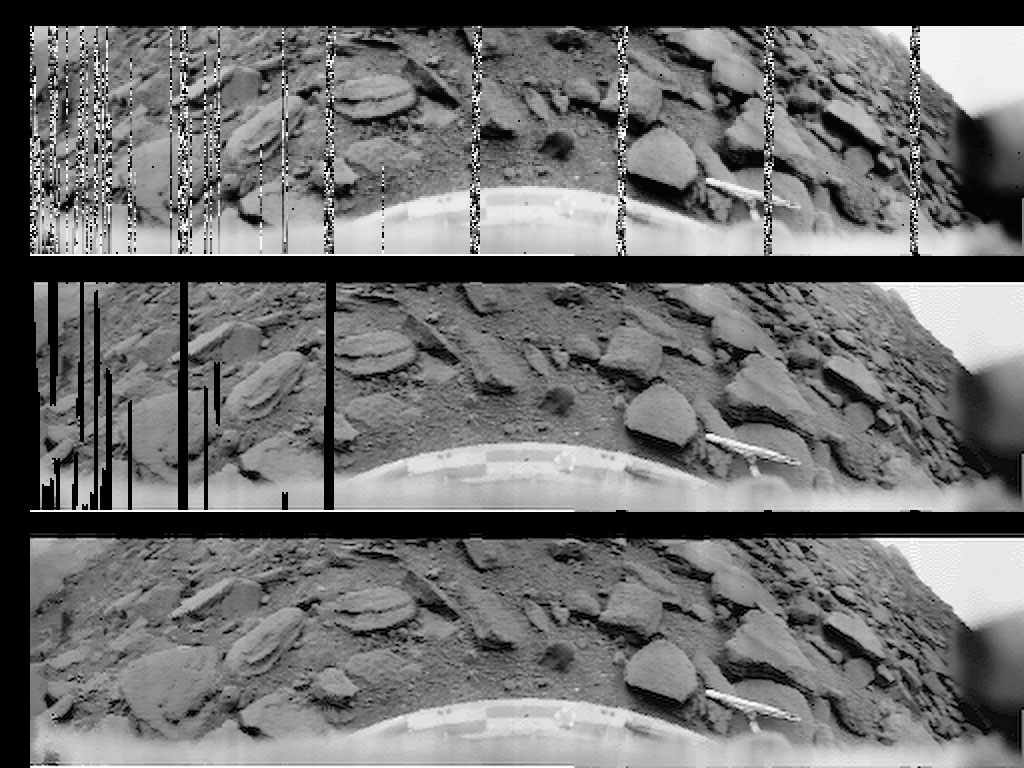
Soviet space photos...
Soviet space photos... These are hard to find, but now hundreds of them have been collected in one place. The one at right was taken on October 20, 1975 by the Venera 9 spacecraft, shortly after landing on the surface of Venus. This was in the days before CCD camera photosensors, so the picture was made with a mechanical scanner moving the image over a single photocell...
Rice paddies...
Rice paddies... Really! This is a photo of terraced rice paddies in Yunnan, China. As usual, click to embiggen...
Street art...
Street art... A delightful collection, passed along by my sister Holly. One of these (the one dependent on shadows, from Lithuania) reminded me strongly of several similar works I've seen in Estonia. The two countries are quite close together, and this makes me wonder if there's something cultural going on there. I saw quite a few pieces of sculpture in public places of Estonia that depended on some sort of optical illusion – usually either shadow effects, or requiring you to stand in a particular spot to see it...
A red iguana and iPhone kind of afternoon...
A red iguana and iPhone kind of afternoon... Debbie and I drove down to Salt Lake City yesterday, to enjoy another fine meal at the Red Iguana. Once again, I forgot to take photos. Apparently I lose my mind in the presence of such great food!
We got the mole sampler plate again, to help us choose what we wanted. We both settled on the same thing: Lomo de puerco en mole de almendras. What's that? Here's the description, from their menu:
On the way down to the restaurant, we stopped in at the Apple store in Farmington. We wanted to take a look at the iPhone 6 – our current contract runs out next month, and we're wondering if we want to upgrade. The two sizes available had us wondering which one we would prefer. We both liked the iPhone 6+ – the screen is very easy to read (mainly because of the increased size), the keyboard is easier to use (for the same reason), and the camera is optically stabilized (Debbie wants that for videos of dog runs; I want that for long exposures). The thing is so big that it won't fit in a normal pocket, though. I'm likely to opt for a belt clip. I'm not sure what Debbie will do...
We got the mole sampler plate again, to help us choose what we wanted. We both settled on the same thing: Lomo de puerco en mole de almendras. What's that? Here's the description, from their menu:
Almonds, chile guajillo, chile guero, yellow zucchini, milk, peanut butter and onions, served with a roasted pork loin stuffed with dried fruit, sun-dried tomatoes, Swiss chard and pine nuts.It was brains-fall-out-on-the-table good. I also had their flan for dessert (superb!), and Debbie had their hot rice pudding. We have about 5 pounds of leftovers we'll force ourselves to eat later today :)
On the way down to the restaurant, we stopped in at the Apple store in Farmington. We wanted to take a look at the iPhone 6 – our current contract runs out next month, and we're wondering if we want to upgrade. The two sizes available had us wondering which one we would prefer. We both liked the iPhone 6+ – the screen is very easy to read (mainly because of the increased size), the keyboard is easier to use (for the same reason), and the camera is optically stabilized (Debbie wants that for videos of dog runs; I want that for long exposures). The thing is so big that it won't fit in a normal pocket, though. I'm likely to opt for a belt clip. I'm not sure what Debbie will do...
Friday, February 27, 2015
Megan McArdle is a serial clear thinker...
Megan McArdle is a serial clear thinker... Which means, of course, that you should pay attention to her musings. From a recent post:
Most of the people who "believe" in evolution don't have much more scientific foundation for their beliefs than a young-earth creationist does for theirs. I would be slightly surprised to learn that the reporters asking the questions -- or, for that matter, President Obama -- could deliver more than a few vague sentences about how evolution works, desperately dredged up from the Life Sciences module of their seventh-grade science class. And many such "believers" will conveniently discard their support for evolutionary models if their own closely held moral beliefs are threatened -- witness the outrage when Larry Summers suggested that biology might have produced different distributions of mathematical ability between men and women. We're talking about a process that determined that male black widow spiders should be eaten after they mate. Of course it could have.Read the whole thing...
A morning ponder...
A morning ponder... Ran across this story:
And what beliefs do I hold that I couldn't be persuaded to change?
Jerry Taylor of the Cato Institute tells a story about Julian Simon, the late and great economist.He was at some environmental forum, and he said, “How many people here believe that the earth is increasingly polluted and that our natural resources are being exhausted?” Naturally, every hand shot up. He said, “Is there any evidence that could dissuade you?” Nothing. Again: “Is there any evidence I could give you — anything at all — that would lead you to reconsider these assumptions?” Not a stir. Simon then said, “Well, excuse me, I’m not dressed for church.”Think about how pervasive these fixed beliefs are in today's society. Think anthropogenic global warming, the welfare state, affirmative action, progressivism, conservatism, etc. How many people holding such beliefs couldn't be persuaded to change their views by any evidence whatsoever?
I love that story, for what it says about the fixity of these beliefs, immune to evidence, reason, or anything else.
And what beliefs do I hold that I couldn't be persuaded to change?
Laugh line of the day...
Laugh line of the day... By Pascal-Emmanuel Gobry, in The Week, in an article titled “The terrifying vulnerability of the U.S. military”:
And he has an excellent point...
What are the signs that an organization has become a bureaucracy? The first is excessive PowerPoint.Hah!
And he has an excellent point...
Thursday, February 26, 2015
Posted without comment...
Posted without comment ... as my wife reads this blog. My mom sent this to me. You may infer what you wish about my family. Trust me, it won't be anything we haven't already thought of...
A group of women were at a seminar on how to live in a loving relationship with their husband.
The women were asked, "How many of you love your husband?"
All the women raised their hands.
Then they were asked, "When was the last time you told your husband you loved him?"
Some women answered today, a few yesterday, and some couldn't remember.
The women were then told to take out their cell phones and text to their husband: "I love you, sweetheart."
The women were then instructed to exchange phones with another person, and to read aloud the text message they received, in response.
Below are 11 replies; some are hilarious. If you have been married for quite a while ... a sign of true love ... who else would reply in such a succinct and honest way?
1. Who the hell is this?
2. Eh, mother of my children, are you sick or what?
3. Yeah, and I love you too. What's up with you?
4. What now? Did you crash the car again?
5. I don't understand what you mean?
6. What the heck did you do now?
7. Don't beat about the bush, just tell me how much you need?
8. Am I dreaming?
9. If you don't tell me who this message is actually for, someone will die.
10. I thought we agreed you wouldn't drink during the day.
11. Your mother is coming to stay with us, isn't she?

Wandering minds perform better?
Wandering minds perform better? If that's true, then I'm in great shape – my mind wanders all over the damned place!
Only in the U.S...
Only in the U.S. ... are male babies routinely circumcised for non-religious reasons. Why? What are the pros and cons? Jessica Wapner has a good piece on the subject. There are a few more angles to this than I was aware of...
Curiosity is looking closely...
Curiosity is looking closely ... at those rippled rocks I pointed out recently. It's using MAHLI, the MArs Hand Lens Imager.
Bright spots on Ceres...
Bright spots on Ceres... The Dawn robotic explorer is approaching the asteroid Ceres, and as it draws closer the images it's returning get better and better. One recent image (at right) shows two bright spots at the bottom of a basin (or crater).
NASA scientists don't know what the bright spots are. Two speculative explanations: some kind of volcanic activity (possibly involving water), or some sort of shiny surface that reflects more sunlight. The UFO crazies are of course all over this, with some claiming this is clearly an alien spaceship.
Personally, I think it's most likely some litter left behind by some alien tourist who took one look at Earth and ran away screaming after seeing a political TV ad...
NASA scientists don't know what the bright spots are. Two speculative explanations: some kind of volcanic activity (possibly involving water), or some sort of shiny surface that reflects more sunlight. The UFO crazies are of course all over this, with some claiming this is clearly an alien spaceship.
Personally, I think it's most likely some litter left behind by some alien tourist who took one look at Earth and ran away screaming after seeing a political TV ad...
Bad customer service is not a new thing...
Bad customer service is not a new thing... Some Babylonians were complaining about it (on a clay tablet, seen at right) nearly 4,000 years ago! Here's the conclusion of the tablet's translation:
Take cognizance that (from now on) I will not accept here any copper from you that is not of fine quality. I shall (from now on) select and take the ingots individually in my own yard, and I shall exercise against you my right of rejection because you have treated me with contempt.That's not much different from the conclusion of some complaint letters I've written :)
Wednesday, February 25, 2015
Geek: Oopsie. Major oopsie!
Geek: Oopsie. Major oopsie! The basic sort library functions in Java (including Android) and Python are broken. Broken as in they can sometimes crash, given the right inputs. Java's sort implementation is over ten years old, and (to the best of my knowledge) this bug hasn't been reported before. One particularly interesting aspect is that the bug was found during an attempt to formally prove the algorithm's correctness. If you're not a computer science geek, you might not realize just how difficult proving correctness is. In fact it is so difficult that almost exactly zero of the software you use everyday is proven to be correct...
The consequences of affirmative action, part 72,663...
The consequences of affirmative action, part 72,663... This isn't really a new story, but more a recent example of an old and familiar one. The so-called “affirmative action” programs are really about dictating college admission and graduation outcomes in a race-neutral way. I'm over-simplifying here, but the general idea is that if 15% of the population is black, then 15% of the admissions to a university should be black, and 15% of the graduates should be black.
If, in fact, the qualifications of applicants were race-neutral, then this would make perfect sense. However, the reality is that blacks on average are less prepared for university than whites. There are a variety of reasons researchers have put forward to explain this, and many of them aren't based on genetics at all. For example, some postulate that black culture de-emphasizes the importance of education, and even stigmatizes it. Whatever the reasons actually are, the reality is that blacks of college-admission age are less prepared than whites.
Both blacks and whites are less prepared than Asian students (or Jewish students, from a religious perspective). Once again, most researchers postulate non-genetic, usually cultural, explanations for this. But whatever the reasons, Asians of college-admission age are, on average, more prepared than either blacks or whites.
To implement an affirmative action program that dictates admission and graduation outcomes when preparedness isn't race-neutral, obviously the standards for admission (and graduation) also cannot possibly be race-neutral. There is no other way to get equal outcomes when the “inputs” are unequal. Therefore admission standards under affirmative action programs are most difficult for Asians, and least difficult for blacks. That's pretty simple and straightforward – but it leads to outrage amongst the students held to a tougher standard, and amusing denials from the affirmative action crowd (who don't like to admit that they're fighting racial discrimination with more racial discrimination).
The solution seems obvious to me, and it's the same solution propounded by both Martin Luther King and Clarence Thomas: end discrimination of all kinds. As Thomas famously said:
If, in fact, the qualifications of applicants were race-neutral, then this would make perfect sense. However, the reality is that blacks on average are less prepared for university than whites. There are a variety of reasons researchers have put forward to explain this, and many of them aren't based on genetics at all. For example, some postulate that black culture de-emphasizes the importance of education, and even stigmatizes it. Whatever the reasons actually are, the reality is that blacks of college-admission age are less prepared than whites.
Both blacks and whites are less prepared than Asian students (or Jewish students, from a religious perspective). Once again, most researchers postulate non-genetic, usually cultural, explanations for this. But whatever the reasons, Asians of college-admission age are, on average, more prepared than either blacks or whites.
To implement an affirmative action program that dictates admission and graduation outcomes when preparedness isn't race-neutral, obviously the standards for admission (and graduation) also cannot possibly be race-neutral. There is no other way to get equal outcomes when the “inputs” are unequal. Therefore admission standards under affirmative action programs are most difficult for Asians, and least difficult for blacks. That's pretty simple and straightforward – but it leads to outrage amongst the students held to a tougher standard, and amusing denials from the affirmative action crowd (who don't like to admit that they're fighting racial discrimination with more racial discrimination).
The solution seems obvious to me, and it's the same solution propounded by both Martin Luther King and Clarence Thomas: end discrimination of all kinds. As Thomas famously said:
...there is a 'moral and constitutional equivalence' between laws designed to subjugate a race and those that distribute benefits on the basis of race in order to foster some current notion of equality. Government cannot make us equal; it can only recognize, respect, and protect us as equal before the law. That affirmative action programs may have been motivated, in part, by good intentions cannot provide refuge from the principle that under our Constitution, the government may not make distinctions on the basis of race.
Extortion trumps cooperation?
Extortion trumps cooperation? This article talks about a new solution to the classic game theory problem usually dubbed “Prisoner’s Dilemma”. This new solution says that in some cases a strategy they dub “extortion” can beat the traditional cooperative solutions. This is an interesting result, and the piece is fun to read – but that's not what caught my eye.
One of the authors of the new solution is Freeman Dyson, the famous physicist with a fascinating career. He also happens to be 91 years old, and it still (obviously) a productive scientist. In the last decade or so he's been a vocal skeptic of the anthropogenic global warming hypothesis, and his skepticism was one of the factors driving my own.
Now here he is publishing a paper that's rather far afield from his usual haunts. I'll take that as evidence of a curious mind, a health skeptical outlook, and of those little gray cells still working just fine despite his advancing years...
One of the authors of the new solution is Freeman Dyson, the famous physicist with a fascinating career. He also happens to be 91 years old, and it still (obviously) a productive scientist. In the last decade or so he's been a vocal skeptic of the anthropogenic global warming hypothesis, and his skepticism was one of the factors driving my own.
Now here he is publishing a paper that's rather far afield from his usual haunts. I'll take that as evidence of a curious mind, a health skeptical outlook, and of those little gray cells still working just fine despite his advancing years...
Tuesday, February 24, 2015
We took the day off today...
We took the day off today ... and drove (with our three dogs) down to Bear River Migratory Bird Refuge, which is about 40 minutes from our house. There's a 12 mile long loop road through the marshy refuge, and we spent almost three hours exploring it. The temperature was just above freezing (37°F), and many of the shallower areas were iced over. We saw thousands upon thousands of tundra swans, innumerable ducks (some of the quite beautiful) that we couldn't identify (our bird book is still in a box somewhere!), four great blue herons, many cormorants, a bazillion Canadian geese, one cheeky marsh wren, several dozen hawks, a bald eagle, grebes, and lots of coots. In other words, we saw a lot of birds!
I took some photos to try to give a flavor of the place, and in one of them you just might be able to pick out the hundreds of white dots – tundra swans, as photographed without a telephoto lens :)
Food models...
Food models... When I visited Japan in the early '70s, one of the more delightful things I ran into was the display of food models that could be found in a glass cabinet in the entrance of every restaurant, like the ramen models at right. Without speaking a word of Japanese, I could learn a great deal about the food served by that restaurant. I had quite a few meals that were obtained simply by pointing to what I wanted.
At the time I was in Japan, these models were made of wax. In one of the shopping districts, I ran into a shop that made and sold them, so I got to see a bit of the process, which was fascinating. These days the models are made of plastic, and the process of making them is a bit different...
On the relative dangers of recreational drugs...
On the relative dangers of recreational drugs... I find these results completely unsurprising, but I don't know if that's how most people would react. Over a lifetime of managing hundreds of employees, I've dealt with far more human problems caused by alcohol than with any other drug. I have, quite literally, never had a problem I had to deal with that was caused by marijuana – even though amongst the young people I managed the use of marijuana was very widespread (nearly as widespread as alcohol use, I believe). I've had to deal with a few problems caused by meth, cocaine, or heroin use – but I will also observe that these were all behavioral problems, not problems with the ability to perform at work. Alcohol use, on the other hand, has caused numerous issues that affected both performance and behavior in the workplace. I would think it is obvious to any manager that alcohol is a vastly more impactful and dangerous drug than marijuana.
Funny how the law treats alcohol use so much more benignly than marijuana use...
Subscribe to:
Posts (Atom)