Saturday, February 7, 2015

Baptism...

Baptism...  Last week, our neighbors invited us to the baptism of their son (Nic, photo at right), which took place this morning.  I'd never been to a baptism of any kind before, so the entire experience was new to me.  Debbie has been to several Catholic baptisms, but she tells me this was a completely different experience for her as well.

Nic's dad (Alan) educated us about what the expectations were for dress and general behavior.  I wore a dress shirt, slacks and a tie; Debbie a skirt – for both of us, basically alien costumes at this point (we wear jeans most of the time).  That's Debbie all dolled up at left; you don't get a photo of me :)

The baptism featured music and talks by family members, on (of course) religious themes.  There were several prayers, also by family members.  Alan dunked Nic in the baptismal font, with a very short ceremony.  Then there was a confirmation ceremony, marking the formal confirmation of Nic's membership in the church.  After that, a small army of family members plus us gathered at Nic's home for a celebratory luncheon (photos of that below).

We were flattered by the invitation – we've only known Nic's family for a few months, and of course we don't share their faith.  Though this was at it's heart a religious ceremony, there was also a big social component to it – and that, especially, we really appreciated.  We already know our neighbors here far better than we ever did in any of our homes in San Diego.

The luncheon featured three different homemade hearty soups (I had an Italian soup that was basically a spicy chowder with sausage), several breads, and an incredible variety of desserts.  Debbie had baked some of her signature double-dark chocolate, pecan-topped brownies – quite a few pieces of which disappeared immediately.  I didn't count the people there, but I think there were probably was 40 or so people there.  That food disappeared pretty quickly :)


Morning in Paradise...

Morning in Paradise...  We “slept in” until 3 am this morning – Mo'i didn't wake us up (first time in weeks), and we weren't worried about little Maka Lea, as he looked great last night.  So we got up and checked on Mo'i, and took him for a walk – and to my surprise, his behavior was back to his pre-urination-problems norm.  I don't know if it was an anomaly from this morning, or if it's the new normal ... but I sure hope it's the latter, as we'll get some more sleep.  We also checked on Maka Lea, and he's looking great – all the symptoms that so worried us earlier this week are gone, with no indication that they're coming back.  We have no idea why.  That's ok.

The weather outside this morning was spring-like: 52°F, downright balmy.  We're supposed to get some rain today, too.  It's hard to believe it's winter.

Debbie and I are doing something very unusual for us today: we're attending the baptism of Nicolas (Nic) L., one of our neighbor's kids.  It's going to be held at the Hyrum Stake Center, just a few miles from our house.  Afterwards we'll be going to a celebratory lunch at our neighbor's home, which is just a few hundred feet from ours.  These folks (like nearly everyone around here) were very welcoming and helpful to me when I first moved in and started remodeling our new home.  Their kids play in our “pine forest”, and we often hear them as they tear around their yard (and ours!) yelling, screaming, and having a grand time.  Nic is probably the quietest kid of the bunch, but he's got a smile that just doesn't quit, and he employs it often.  This will be an interesting experience for us, the first LDS function we'll see in person.  I've been told by another neighbor that I should expect to encounter some well-meaning Mormons looking for a “missionary moment” – a chance to get us committed to listening to an LDS pitch.  I was also told to expect that upon moving into the neighborhood, but I managed to defuse all of that by having a frank conversation (about my disinterest) anytime someone wandered close to the topic.  In general, the Mormons I've met and come to know are far too polite to impose when it's clear there's no interest – unlike some very persistent members of other faiths that I've encountered over the years (yes, Jehovah's Witnesses, I'm looking at you)...

Friday, February 6, 2015

Mo'i in the moonlight...

Mo'i in the moonlight...  Just before 2 am I woke up, after about 7 hours of good, solid sleep.  That's a lot more than I've been getting recently, mainly because of Mo'i and his age-related problems (he barks to be let outside generally between 1 and 3 am), and Maka Lea's illness.  So last night I went to bed very early, and I woke up on my own before Mo'i did.

I woke Mo'i up (he was very startled!) and took him outside for a walk.  I didn't need to turn on any outside lights, as the moon was shining brightly in the clear sky.  I really didn't need a jacket, either – it was 38°F outside.  That's much warmer than usual for a February night here, and it's forecast to be that way for several more days.  The moonlight was bright enough that I could (dimly) see color in the evergreens and in the orange paint of our FJ Cruiser.  Mo'i walked confidently, making his way to the trees whose trunks are full smells he wanted to imbibe, and letting him find the vole runways that he loves to hunt on.  I delighted in the moonlit vista of snow-covered mountains, startlingly bright over the quiet and darkened valley.  That was a more pleasant walk than 2 am walks generally are :)

After we came back inside, I checked on little Maka Lea.  We'd taken him to the vet yesterday afternoon, worried about the vomiting, diarrhea, and continued lack of urination. The vet reported that he was just about perfect in every way she could test for.  Blood, urine, X-rays, urethra check – all showed a kitty in remarkably good health, especially for his age.  There just was no discernible reason for the symptoms we were seeing.  So last night we decided to let him stay with the rest of the cats, out of his isolation cage, and we just hoped for the best.  This morning when I checked on him, he looked happy and calm – and there were no pools of vomit or diarrhea around him.  Because he's now sharing litter boxes with the other cats, we can't tell if he's urinating.  We're still worried about that, but we'll just have to watch for other signs of urinary tract blockage.  For now, though, we're cheered by his apparent turnaround...

Thursday, February 5, 2015

So cute it hurts...

So cute it hurts...

Oh, ain't that the truth!

Oh, ain't that the truth!  My mother said it, so it must be :)
During a woman’s medical examination, the doctor says, "Your heart, lungs, pulse and blood pressure are all fine.

Now let me see the part that gets you ladies into all kinds of trouble."

The lady starts taking off her panties but is interrupted by the doctor: "No! No! Just stick out your tongue!"

Bumper snickers...

Bumper snickers...  Friend, former colleague, and inheritor of my SSH bugs Tim B. passes along a couple of funnies:


Reading that second one got me to thinking... Here in Paradise, Utah, what we see is:
  • The sense that choices like home schooling or private schooling are smart and admirable.
  • Everybody owns guns.  I quite literally have yet to meet someone here who isn't a gun owner, and doesn't shoot.
  • I haven't heard a protectionist word.
  • There is intense opposition to government-dictated healthcare in general, and to ObamaCare in particular.
  • Even though smoking violates the LDS church's health laws, and 90+% of the people here are Mormon, there are still a lot of smokers.  More, in fact, than in California (I've read the rate is about double).  Unlike in California, there is wide acceptance of smoking (and drinking, for that matter).  Several of the tradesmen I've hired are Mormons and unabashed smokers.  Surprisingly, to me, there doesn't seem to be nearly the stigma associated with smoking here as that which we see in California.
  • None of the tradesmen I've hired here are union members.  I've asked them all (it's a selection criteria for me).  I've been told repeatedly that nobody here joins a union unless they're forced to by job circumstances, and even those folks are ashamed of themselves.
  • I've met several fellow incandescent bulb hoarders.  
  • All the stores here default to plastic bags, though you can generally get paper bags if you ask.
  • Logan is a small city (49,000 people).  It has two Walmart supercenters, plus a Sam's Club.  We go there often.
  • The local restaurants, and all the homes we've eaten at, all serve plenty of red meat, sugary treats, and fatty foods.  There seems to be a general sense that food guidelines issued by the federal government are somewhere between foolish and Communist sabotage – and they're completely ignored.
People here have heard of places like California, so the bumper sticker would still make sense to them.  But they wouldn't relate to it personally...

The next Turing test?

The next Turing test?  Computer-controlled robots are now writing letters with pens.  The motivation is direct mail marketers who want you to open their letter, instead of just throwing it in the recycle bin.  Here's an interesting piece on that topic.  This passage caught my eye:
But the other half the time I’m kind of cracked up by the fact that the most avid prosecutors of Alan Turing’s sly and audacious 1950 thought-experiment have been not philosophers or computer scientists or advanced A.I. labs but … marketers. The former folks have foundered for years on the difficulties of understanding the fractal contours of human consciousness. The latter just want you to open up their damn mail. Comprehending the mysteries of human thought and behavior is hard. Emulating it? Not so much! It’s partly why Turing’s test is so unsettling: Man, are we really that easy to copy?
Marketers (of all kinds, not just direct mail) have long been pushing hard on technologists.  Another classic example is animation – a lot of early computer-generated animations were done with marketing money.  The linked article doesn't mention it, but there's another odd-at-first-glance driver for a lot of high tech stuff: pornography.  Pornographers were amongst the first to see a way to earn money from online video, and they provided a lot of the funding for early video-on-computer development.  Actually, they're still doing so – only these days their focus is on 3D video technology, online.

“Americans are begging for a deal...”

“Americans are begging for a deal...”  So says a high-ranking Iranian military official.

Ordinarily I'd dismiss such talk as posturing twaddle from an entirely unreliable source.  These days?  It's all too believable that the Obama administration would place more value on the appearance of a deal than on the substance of Iran being armed with nuclear weapons.  The more paranoid on the conservative side even posit that Obama wants a nuclear-armed Iran, to counterbalance the nuclear-armed Israel.  Is that likely?  I don't think so.  Is it plausible?  Unfortunately, yes.  Yes, it is.

Sick kitty...

Sick kitty...  Maka Lea is sick, and we don't know what the problem is.  He's our sweet little wobbly cat –  he has some neurological damage from high fevers when he was a wee kitten.  Though the photo at right was taken eight years ago, he still looks exactly like this.

Debbie first noticed that he had problems with urination, but two trips to the vet found nothing wrong.  Yesterday afternoon he started vomiting, and last night it continued.  He looks ok otherwise, and as any cat owner knows well, a cat vomiting isn't necessarily a sign of a problem.  However, when it's repeated (as his has been) and combined with another symptom (like the urination problem), it's worrying.  So we're off to the vet again today...

Wednesday, February 4, 2015

It's all a big lie...

It's all a big lie...  The government's 5.6% unemployment figure, that is.  If you're a regular reader of this blog, then you already know the published unemployment number is a crock of steaming, aromatic bovine excretion.  Sadly, this reality is a big surprise to most Americans.  One American who does understand it is Jim Clifton, CEO of Gallup (the folks who do all those polls).  He wrote an article about this recently, calling it The Big Lie.  Here's a passage from it:
There's no other way to say this. The official unemployment rate, which cruelly overlooks the suffering of the long-term and often permanently unemployed as well as the depressingly underemployed, amounts to a Big Lie.

And it's a lie that has consequences, because the great American dream is to have a good job, and in recent years, America has failed to deliver that dream more than it has at any time in recent memory. A good job is an individual's primary identity, their very self-worth, their dignity -- it establishes the relationship they have with their friends, community and country. When we fail to deliver a good job that fits a citizen's talents, training and experience, we are failing the great American dream.

Read the whole thing...

Tuesday, February 3, 2015

Sushi in Cache County...

Sushi in Cache County...  There are several sushi restaurants in Logan, and we've tried three of them.  Two of them we'd rate as “ok”, but a long way from the glory of Hana Sushi in El Cajon (our favorite sushi spot before we moved up here).

But now we've discovered another source of sushi here – one that's just as good as any sushi restaurant we've tried here, but for less than half the price.  It's a most unlikely place to find sushi: a grocery store.  Macey's in Millville, to be specific.  You can gorge yourself on decent sushi purchased there for under $20, which is remarkably inexpensive as sushi goes.  And you can eat it at home, surrounded by peace and quiet.

I suspect we'll be visiting Macey's for sushi quite often :)

Epic drone crashes...

Epic drone crashes ... and the best drone rescue evah!

The end days are nigh, part 40,273...

The end days are nigh, part 40,273...

Homo sapiens is doomed...

My kind of groundhog...

My kind of groundhog...  Showing exquisite groundhog judgement and good taste, Jimmy the groundhog bit the mayor's ear.

You go, groundhog!

Can we ship Jimmy to Washington, D.C.?

Radio Shack is going down...

Radio Shack is going down...  For the last time, it appears.  It's hard to imagine how any physical store could compete with the likes of Amazon, DigiKey, Mouser, or the other 10M or so online stores...

Where do software developers dream of working?

Where do software developers dream of working?  The best developers I've known over my career want to work either for themselves (that is, their own start-up company), for other start-ups, or for companies doing big, impressive, exciting things (Google, Apple, etc.).

What's not on that list?  The federal government.

It's really, really hard for me to imagine that the U.S. Digital Service is going to attract a significant number of good engineers.

It's really, really easy for me to imagine that it's going to attract hordes of incompetent, entitled engineers for whom Wally (of the Dilbert strip) is the model.  Just contemplating the inevitable office buildings full of mandatory bureaucratic managers is enough to make me feel nauseous.

You know how the U.S. Post Office compares to, say, UPS, in customer service, responsiveness, reliability, and innovation?  Yeah, that will be how the U.S. Digital Service compares with, say, Apple...

It happens every time...

It happens every time...  It seems like every few years, some technology pundits will start squeaking about how electronic technology has hit a wall: there's no way that devices can get any smaller or any faster.  Every time they have reasons that sound plausible – this or that barrier is preventing any progress.  And each and every time, some clever scientist, engineer, or (increasingly) team comes up with yet another breakthrough that completely demolishes the previously impossible-to-overcome barrier.

This just might be the next such breakthrough...

This is gonna leave a mark...

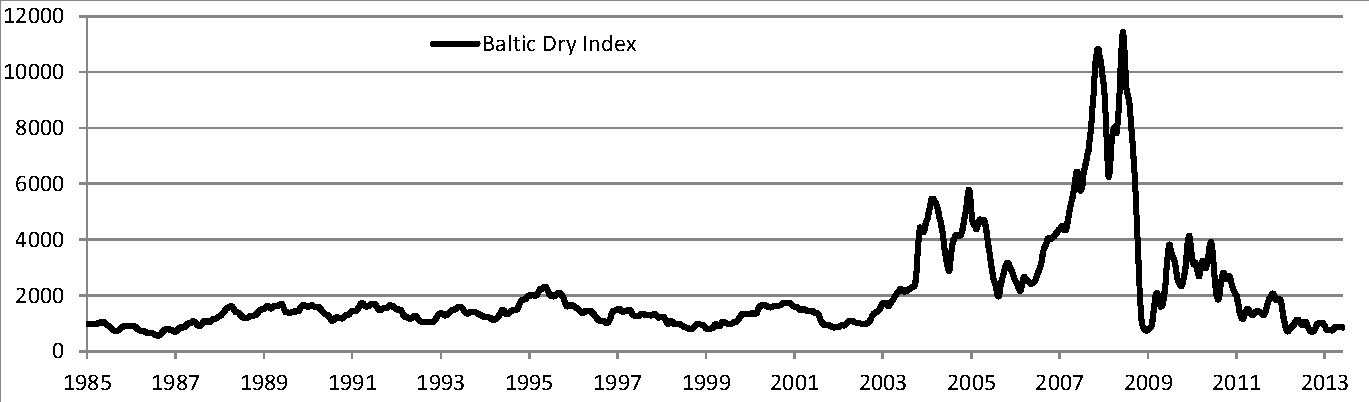
This is gonna leave a mark ... but I'm not sure exactly what this mark is gonna look like...

The graph at right is for the Baltic Dry Index, a rough gauge for the price of shipping stuff by sea.  In our globalized economy, an amazingly high fraction of the ordinary things we all buy are shipped by sea (or their components are), so the cost of shipping has more of an impact than you might immediately think.

What drives this cost is complicated (see the linked Wikipedia article above) and interesting.  There is of course the usual economic force of supply (shipping capacity) versus demand (goods to be shipped).  Added to that, though, are the interesting variables of the high capital costs of ships, the typically high leverage of shipping companies (with some notable and large exceptions), and the long lag time to build new ships (generally 2 to 3 years.  There's also another phenomenon: every time shipping capacity exceeds demand, there are idle ships – very expensive – and somehow the accident rate always goes up during these periods.  Lots of ships are lost to storms, explosions and fires at sea, and never-explained circumstances.

Well, the bottom is falling out of the Baltic Dry Index.  There's a lively discussion at Zero Hedge.  What does it all mean?  Partly it's over-capacity: ships ordered during the boom times of a few years ago are coming on line, and their added capacity exceeds even a growing demand.  However, shipping demand plummeted during the recent recession, and still has a long way to go before it has recovered to pre-recession levels – thus making the over-supply situation even worse.  With the price of shipping plummeting, the more leveraged and less profitable shippers are going to start failing (there will be bankruptcies and pennies-on-the-dollar buyouts), and there will probably be a jump in accidents at sea as ship owners see insurance payouts as a better route than non-profitable shipping runs.  We'll also probably see price reductions – small for most things, but larger for those goods for which shipping costs are a significant fraction of their overall cost (think bulk goods like ores, coal, etc.).  It might provide a boost for the stock market, too.

How long will it last?  I haven't a clue.  Are there bad outcomes possible?  Oh, certainly.  With enough failures in the shipping industry, capacity could fall dramatically – and as it approaches demand, shipping prices will crawl back up out of the cellar, unwinding all the positive effects of lower costs.  In that respect, its a bit like oil prices – though the overall contribution of shipping costs to the economy is tiny by comparison to that of oil...

“We will come to regret this, bitterly.”

“We will come to regret this, bitterly.”  That's a quote from the Patterico blog, talking about the (now presumed) FCC proposal to regulate the Internet in the U.S.  Here's a slightly less succinct, but more pungent, assessment from Warren Meyer of CoyoteBlog:
Here is my official notice -- you have been warned, time and again.  There will be no allowing future statements of "I didn't mean that" or "I didn't expect that" or "that's not what I intended."   There is no saying that you only wanted this one little change, that you didn't buy into all the other mess that is coming.   You let the regulatory camel's nose in the tent and the entire camel is coming inside.  I guarantee it.
 Mr. Meyer's post is titled “Sorry, But All You Internet Users Appear to Be Idiots” – rude, but definitely to the point.

Some members of the FCC have been rather publicly itching to get their bureaucratic mitts on the Internet for quite some time, and the money-motivated political types (that would be all but about three of them) have long been eying it as a source of untapped bribes campaign funding.  What has stopped these leeches from following through with their desires is the utter lack of any excuse reason for doing so.  What's different now?  The notion of “net neutrality” has somehow caught on, giving them the perfect political cover for a power grab.  Why the notion of net neutrality has caught on is a complete mystery to me – it's an entirely hypothetical problem, with zero current or historical examples.  Competitive pressures seem very likely to keep it from ever being a problem.  Nevertheless, the non-technical masses have somehow become terrified of net inequality, and the bleating can be heard far and wide.  Me, I see the disgusting leers of toad-like bureaucrats as they reach for ever more power...

Monday, February 2, 2015

I love living here...

I love living here...  Last night, near 6 pm, our “dog alarm” went off – someone was at the door, and the dogs were doing their usual berserker thing.  Debbie and I were both upstairs, and it took me a bit to get down to the door.  By then there was nobody in sight – but the paper cutouts (below left) were taped to our door.  When I got up to the door, I could see a plate of yummy-looking cupcakes on our porch (two are missing from the photo below center, already gobbled up by the cupcake addict I'm married too) along with the card (at right).  I went outside, and saw an unfamiliar car exiting our driveway onto the road.


We don't know who this was from.  The card was addressed to “Tom & Debbie”, so it's someone who knows us – but that's quite a few people!  I suspect it is from one of our immediate neighbors, but even from that group there are several people it could be.

But it really doesn't matter who did it.  We lived in California for over 30 years, and never once had anything even remotely like this happen.  We've only been here together for just over a month...

Sunday, February 1, 2015

Goat vs. horse...

Goat vs. horse...  Both look quite happy!
NGC 4676...  Via APOD, of course.  High resolution version here...

Three kinds of programmers...

Three kinds of programmers...  I've never seen the three categories called out so specifically, but this article does a nice job of defining them:
  • Computer scientist
  • Computational scientist
  • Software developer
I am most definitely in the latter category, though just for fun I've done a teensy little bit of actual computer science, and even a little bit of computational science (bond valuations) professionally.  But the vast majority of the programming I've done both professionally and privately is software development – the program I wrote was itself the objective.

One of the challenges I had when poking into the ClimateGate software dump was that those programs were written by computational scientists (the climatologists developing climate models).  That was a challenge because the programs were not written to be maintainable or even understandable by anyone other than the author.  They were also teeming with horrifying bugs, especially a tendency to fail utterly with the tiniest little issue in the inputs.  That sort of program rarely emerges from a software development shop, even as a prototype.  On the whole, I think the computational scientists could learn a great deal from both the other kinds of programmers.

Computer scientists, for me, are mostly a source of knowledge. Folks like Donald Knuth and James Gosling have, through their work, gave me the intellectual tools to be a better software developer.  I've mooched a great deal from that group.  Only rarely have I made any contribution at all to that body of knowledge – just a couple of email exchanges with real computer scientists where maybe I gave them an idea or helped them clarify a finding.  One thing I know for sure: the best computer scientists are also great software developers, and have done a good deal of it...

The end times are nigh, part 12,983...

The end times are nigh, part 12,983...  In New York City, expectant mothers fill out a form for requesting a birth certificate.  On that form is the following question:
Do you identify as male or female?
Seriously.

I'm pretty sure I won't live long enough to see such a thing in rural Cache County, Utah.  I certainly hope not...

An unusual afternoon yesterday...

An unusual afternoon yesterday...  When we bought our new home, it came with a greenhouse, the kind made with pipe “hoops” supporting a plastic covering.  It hadn't been used for several years – its heater was disconnected, the water was disconnected, and it had been used as a junk repository for a while.  The biggest challenge with the greenhouse, though, was its placement: for some reason the previous owner had oriented it with the long axis north-south, in a spot with big evergreen trees to its west and southwest, and a larger building to its east.  Consequently, in the winter it got about 30 minutes of sunshine a day.  Not so good :)

Last year we decided that we'd like to have a greenhouse ourselves – but we wanted one made of glass, not plastic.  And we wanted it placed in a slightly more sensible location.  We have the perfect spot for a greenhouse, on the south side of the acre or so that we're going to put a garden.  That spot has a 12 acre field to the south of it, so the greenhouse will get plenty of sunshine in the winter, when it needs it.  That's a project for later this year, or (more likely) next year.

Meanwhile, we had this plastic greenhouse that we wanted to get rid of.  We've been trying to find someone who could make good use of it, asking around the network of people we know here.  Yesterday those efforts finally paid off when the co-worker (Chris W.) of the son of fellow who built our barn called me out of the blue and said “I’ll take it!”  She, her husband Gary, and their daughter Hailey showed up just before noon yesterday.  They had a little trailer behind their car, lots of enthusiasm, and a bunch of tools.

So we all went to work.  Chris, Gary, and I grabbed screwdrivers, wrenches, hammers, drills, crowbars, and cold chisels and commenced reducing the greenhouse to its constituent parts.  Debbie and Hailey helped carry things over to the trailer, and Debbie made us some hot chocolate when we got cold.  There were the usual challenges: reluctant screws, broken parts, nails that had be pulled, etc.  At one point a piece fell on Debbie's arm (painful, but no major damage).  Chris got a bunch of burrs on her pants at one point.  The electrical bits didn't want to come off.  On several occasions, Gary and I needed to apply a healthy dose of brute force, aided by crowbars and cold chisels, to get it apart. 

But in about four hours we had that greenhouse completely torn to bits.  All the parts made of metal or plastic were in good shape.  Anything made of wood was pretty much shot.  Then we had to somehow fit all that stuff into their little trailer.  Gary supervised the packing, and in short order had everything almost packed in.  One wooden piece stuck out the back about 2", so he tied the door on the trailer shut as much as it would go, and declared victory.  They drove off (literally) into the sunset with their new greenhouse.  We're now left with a completely exposed pile of junk where the greenhouse used to be.  That will be a project for another day :)

Saturday, January 31, 2015

Geek: Ok, so I'm late to this party...

Geek: Ok, so I'm late to this party ... but Java 8's new streams and method references are awesome!  I'm still getting used to the new lambda support, and so far, not finding it to be particularly useful in the kinds of coding I'm doing.  But streams and method references?  Wahoo!!!

For whatever reason, the notion of applying primitives like filters, min, sum, and so on to collections of objects has been something I've done a lot of.  In the past, I've often extended the generic collection types (ArrayList and HashMap, especially) to provide these primitives as I needed them.  The new Stream library allows me to do the same thing without having to extend the generic types at all, while still having superbly readable code.  I'm feeling much Stream love here :)

Suppose I told you...

Suppose I told you ... that if you wanted to farm potatoes, you'd have to either give half your potatoes to the government – for free – or else pay a prohibitively large cash fee.  If you didn't do one of these, the government would forbid you from raising potatoes.  Of course, being an American, you'd probably say “That’s total crap!  No way are we putting up with that!  I’d expect to hear something like that about Eastern Backwardistan, not in America!”

But you'd be wrong, because that's exactly what we're doing with raisins in America.  The law requiring this was part of FDR's “New Deal”.  The Supreme Court is reviewing the legality of it...

Preparations are underway...

Preparations are underway ... for the 2016 Democratic convention (and Obama's universally anticipated farewell speech) in Charlotte, North Carolina.  They're remodeling their stadium with a new retractable roof. 

Via my mom, who accuses me of stealing Reddy, her neighborhood red fox.  I think what actually happened is that Reddy heard about events in Charlotte, and took off to join the fun!

W33...

W33...  Via APOD, of course.  High-resolution version here...

How the progressives think, part 238,342...

How the progressives think, part 238,342...  Most of us (especially homeowners!) have often had to make a choice between hiring someone to get a job done and doing it ourselves.  We just did that with our barn: we hired painters to paint the inside (and in the spring, they'll do the outside), rather than doing it ourselves.  Basically we traded off the cost of hiring someone (presumably skilled and equipped with all the right tools) versus the time and effort to do it ourselves.  Sometimes we decide one way, sometimes another.  Sometimes we decide we can do it better ourselves (as with me and the electrical work in the house), sometimes we'd rather pay to have someone else do it (as with the painters in the barn).  That's all commonplace for most adults.

Unless you're a progressive, though, you most likely didn't consider the taxes Uncle Sam won't collect when you do it yourself.  For instance, when I decided to do my own electrical work, the electricians didn't get to do it.  They didn't get paid for it, so they didn't pay taxes on the income I didn't provide.  If you're a real progressive, then you think I should pay those taxes when I do the work myself.

My first inclination was to laugh at this, assuming it was a joke.  Then I read up more on the topic, and discovered that they (the progressives) are serious.  This topic is being bandied about by progressives in power (in California and Massachusetts, in particular) as a possible legislative initiative for this year.

Man, we escaped from California in the nick of time!

Ace, writing on the same topic, includes this joke that I am shamelessly stealing:
A man owned a small farm in Vermont. The Vermont Labor Board claimed he was underpaying his help, so they sent an agent down to interview him.

"I need a list of your employees and how much you pay them," demanded the agent.

"Well," replied the farmer, "there's my farm hand -- I pay him $200 per week plus free room and board.

The cook has been here a bit more than a year and I pay her $150 every week plus free room and board.

Then there's the half-wit who works about 18 hours per day and does about 90% of the work.  He makes $10 per week, pays his own room and board, and I buy him a bottle of bourbon every Saturday night.  And, once in a while, he's pretty sociable with my wife."

"That's the guy I want to talk to -- the half-wit," says the agent.

"You're talking to him," replied the farmer.
It's things like this that make me doubt this country's chances for long-term survival...

Trivializing concern and involvement...

Trivializing concern and involvement...  Remy nails it again.

I've been sort of bemusedly watching my Twitter feed and the hashtags that appear on it.  I've been vaguely bothered by the whole hashtag phenomenon.  On the one hand, it seems like a great technical solution to the problem of how to find out what people are saying on a particular subject.  On the other hand, often (but certainly not always) people are using hashtags more as a trivially easy way to show their agreement with some expressed concern, like Michelle Obama and her #bringbackourgirls sign.  In a way, they're like the MIA/POW wristbands so popular in the '70s, or the peace sign pendants in the '60s.  While at first they may have been a meaningful symbol of where someone stood, they quickly became meaningless and insignificant tokens used by someone who really doesn't care (or even understand) the issue at hand, but wants to pretend that they do.

Why would someone do this?  Social acceptance is the obvious answer, and I see no reason to doubt this is the major motivator.  One variant of that is a bit earthier, but memorable – I remember overhearing a conversation between two boys in my 12th grade English class.  The gist of the conversation was that if you wanted to get laid by a hippy girl, the key was to wear a peace sign necklace – just 99 cents at a local store.  Cheap, easy social acceptance at work :)

Friday, January 30, 2015

The happy fox...

The happy fox...  We took a drive up to Hardware Ranch yesterday.  This elk refuge is just 20 miles from our home, with most of the drive being up a beautiful canyon with a rushing stream plunging through a narrow forested floor interspersed with larger meadows.  Our goal was to see the elk herd, which congregates near the feeding station in the winter.  We did see the elk, though at some distance.  However, while we sat gawking at the elk, Debbie spotted something much closer and much more interesting: a red fox, hunting in the field just below us, perhaps 300' away. 

The photo at right is not mine, but the fox in it looks like a freshly bathed version of the one we saw.  Ours looked like it had spent some time recently in a muddy area – it's tail was matted, and the entire fox looked quite dirty.  As we watched, it was hunting (most likely for voles, which are extremely common here).  We saw it pounce several times, and after one of them it took a minute or so to eat something it caught...

Muskrat love...

Muskrat love...  Well, not so much.  Debbie went downstairs to visit with our cats yesterday morning, and shortly thereafter hollered up at me to come down and “see something”.  When I walked into the cattery, she and the cats were all looking out one of the room's windows.  It opened into a casement, and in the bottom was a small (and quite unhappy!) muskrat, very much like the photo at right (which I did not take).

The cats were all “Get that annoying thing out of here!”  Debbie was pretty much the same.  All of them looked at me :)  We got a plastic bucket that had a snap lid, and managed to herd the thing into it.  I took it out into our field and let it go – where, most likely, it made a good meal for a hawk or a dog...


Progress report...

Progress report...  The barn is being painted, and the dog agility “room” is being textured first.  The workers have been at it since Monday, and it's starting to look a lot nicer inside.  Instead of bare OSB, now we have light-colored walls that brighten the rooms.  The garage part is a very light green, so light you can just barely tell there's a tint to it.  The wood shop is a warm, bright yellow – very cheerful!  The agility room will be a light bluish-gray, a color picked to coordinate with the electric blue foam flooring that's going in there.  Said flooring is on order and should be here in about three weeks.  The hardware for the interior doors arrived yesterday, and I'll be installing that as soon as the painters are done.

I've been just a bit under the weather the past few days – some sort of low-grade bug that just sapped my energy level, nothing more.  Debbie made some tlapeno soup yesterday, and ever since I ate a gigantic pig trough full of yet, I've been feeling better :)  That stuff is Mexican penicillin!  I've been doing just a few easy things inside the house, and putzing around with some programming (not much physical effort there!).  I'll most likely take it easy again today, but I can feel that I'm on the mend, and I suspect I'll be back to normal tomorrow at the latest...

Thursday, January 29, 2015

A little morning humor...

A little morning humor...  Via reader Simi L.:
Not feeling well, and being concerned about his immortality, Barack Obama consults with a psychic about the date of his death.

Closing her eyes and reaching out to the future, she tells the President, “You will die on a Jewish holiday.”

With much anxiety, Barack asks, “Which holiday?”

“It really doesn’t matter.”  She replies.  “Whenever you die, it will be a Jewish holiday.
Ah, Simi ... thanks for the belly laugh!

Wednesday, January 28, 2015

I got to get me one of these!

I got to get me one of these!  It's so much fun to watch this video.  A car with “insane mode” – that's pure, distilled awesome!  I had nothing but happy thoughts after seeing it.  Then I made the mistake of reading through the comments (mostly from people having the same reaction I did) and seeing this:

I don't want to be on the same planet with these people...

Geek: the impossible just takes a little longer...

Geek: the impossible just takes a little longer...  The reason I started coding again is because I'm working on bringing up my new blog (SlightlyLoony).  It will probably be a few months before I actually start posting there, as I have quite a bit of coding to do before it will work the way I want it to.  Partly that's because I'm hosting it on Ghost, which is a brand-new and not fully baked yet blogging platform.  Mostly, though, it's because I want some features that the Ghost platform doesn't support, and likely never will.

One of those features I wanted is the ability to upload some data to the blog periodically, and then have that data available to people reading the blog.  For instance, I'd like to have the weather forecast for the next few days show up.  I can “scrape” that sort of data from other web sites, then package it up for display on my blog – but to do that, I need to upload that data to the blog server somehow.  Many blogging platforms provide an API for that sort of thing, but Ghost does not.  I spent quite a bit of time on the Ghost forums, researching the issue and asking questions about it.  The conclusion from expert Ghost developers: it can't be done.

This morning I came up with a way to do it, and I whipped up a prototype and tested it – it works!  Best of all, it's easy as can be.  Here's how it works:
  • I created a special “bucket” on Amazon's AWS S3 storage service.  This bucket has the name “assets.www.slightlyloony.com”.
  • I created a DNS record (a CNAME record) that aliases “assets.www.slightlyloony.com” to the S3 storage URL.
  • I wrote a program that uploads the data of interest to a particular set of files within the S3 bucket.
  • In my client side code (running in the blog reader's browser), whenever I want to access some of that data, I use the URL “http://assets.www.slightlyloony.com/[file name]” to get it.  The browser thinks it's on the same host, because “assets.www.slightlyloony.com” is a subdomain of “www.slightlyloony.com”, where the browser loaded the page from.  No cross-site scripting rules are violated by this.

Holy rocks?

Holy rocks?  Well, holey, really.  Scientists have discovered that the combination of hot rocks (like cooling lava) with microscopic pores in them promotes the development of nucleic acids that can replicate.  In other words, that might be how life began on Earth...

A different kind of optical illusion...

A different kind of optical illusion...  I love this collection of paintings by Ron Gonsalves!

The unending pain of ObamaCare...

The unending pain of ObamaCare...  Reader and friend Larry E. emailed me on this while I was reading the article on Hot Air yesterday :)  It seems that when you tote up all the costs, the federal government is spending about $50,000 for each person covered under the law.  That's far more than it would have cost simply to purchase a pre-ObamaCare policy for each of them.

I like the way Hot Air closed their article:
You were lied to. Again.
Yes.  Yes you were.

Apple makes some great products...

Apple makes some great products ... and they reap great rewards for doing so.  I know that great design is hard.  In a lifetime of engineering, I've only made a couple of designs that I thought were great, and I'm not sure how many people would agree with my assessment :)  But the world abounds with examples of great design, though relatively few of them are in the tech world.  With the example of Apple to validate the model, I'm surprised there aren't a host of Apple wannabes (that is, design-focused high tech manufacturers) visible to the consumer public.  But there aren't...

On a trip I made recently, I had a three hour layover in Houston.  I spent a good part of that time in a store that carried high-end laptops (Dell, HP, Asus, etc.).  All of these laptops cost less (though sometimes not all that much less) than Apple's MacBook Pro, which I use.  None of them, in my not-so-humble opinion, matched Apple's physical design, fit, or finish.  They were very nice laptops, mind you – but they all had easily visible design flaws, or fit and finish issues.  Then there's the fact that they all had Windows as their operating system (with one exception: a Dell that could be purchased with Ubuntu Linux).  After 8 years of using OS X, there is no freaking way I'd go back to the nightmare named Windows.  Not happening.  And Linux's desktops, while much improved, aren't even close to being as usable as OS X yet.

So an Apple fanboi I shall remain, for now :)

A big step yesterday...

A big step yesterday...  I've been a subscriber to The Wall Street Journal for over 30 years, since my first print subscription in 1981.  In the '90s I switched to online-only, mainly because the print edition was always a day late where I lived.  At first the online edition was a mere shadow of the print edition, but within just a few years it was the better choice anyway.  I've been reading (well, at least skimming) that paper every day for all those years.

Starting next week, that's coming to an end – my subscription expires on February 4th, and I'm not renewing.  It's not that I'm no longer interested in its content – I am.  The main reason I'm stopping is that Dow Jones (the publisher) has finally managed to raise the subscription price to the point where I just can't justify it any more.  It's now $300 a year, nearly a dollar a day, to read content that I can largely find elsewhere for free.

So sadly, and reluctantly, I'm saying goodbye...

Tuesday, January 27, 2015

Holy crap!

Holy crap!  I wrote some more code today (Java, JavaScript, HTML, and CSS).  After discovering that bits and pieces of it actually worked, I even committed it to GitHub.  Amazing!

Thermal imaging...

Thermal imaging...  Just a few years ago, this infrared imaging technology cost tens of thousands of dollars for a low-end device.  Now it's available as a teensy add-on to an iPhone or Android, for a couple hundred dollars.  After some quick testing around the house, I can tell you that it works as least as well as those military-grade devices the last time I saw one of them in action.  I haven't seen it in low light level situations yet (we'll try it tonight), but it looks very promising.  Here are three shots I took around the house:


The first one shows Miki, watching Debbie eat her lunch (and hoping for some of it to drop down within his range).  Note how his head – and especially his eyes – glow brightly.  Those are the areas where his body is losing the most heat.

The middle photo is of our kitchen table top, without my hand in the photo.  I made this by placing my left hand on the table top, counting to five, then taking my hand away and snapping the photo.  The infrared camera is sensing the very slight temperature difference caused by my hand's presence a few seconds before I took the photo.  My hand's image was still clearly present 20 seconds later, then rapidly faded away.

The last photo is a closeup of Miki's head (still sitting, waiting hopefully).  The resolution isn't even close to the visible light camera, but it's plenty good enough to discern what you're seeing.

I'm looking forward to trying this tonight, to see if we can spot some wildlife...

Obama rebuilds the American dream...

Obama rebuilds the American dream...  Via my mom:
One Old Lady Who Loves Obama - A DIFFERENT TAKE...

This is certainly a different way to look at what is happening.  One 82-year-old lady loves Obama and she may have a very good point. She says that Obama is amazing, and is rebuilding the American dream!

She gives us an entirely new slant on the "amazing" job Obama is doing, and she says that she will thank God for the President.  Keep reading for her additional comments and an explanation. When discussing Obama, she says:
1. Obama destroyed the Clinton Political Machine, driving a stake through the heart of Hillary's presidential aspirations - something no Republican was ever able to do.

2. Obama killed off the Kennedy Dynasty - no more Kennedys trolling Washington looking for booze and women wanting rides home.

3. Obama is destroying the Democratic Party before our eyes!  Dennis Moore had never lost a race. Evan Bayh had never lost a race.  Byron Dorgan had never lost a race. Harry Reid - soon to be GONE!  These are just a handful of the Democrats whose political careers Obama has destroyed. By the end of 2014, dozens more will be gone.  Just think, in December of 2008 the Democrats were on the rise. In two election cycles, they had picked up 14 Senate seats and 52 House seats. The press was touting the death of the Conservative Movement and the Republican Party. However, in just one year, Obama put a stop to all of this and gave the House and the Senate - back to the
Republicans.

4. Obama has completely exposed liberals and progressives for what they are. Sadly, every generation seems to need to re-learn the lesson on why they should never actually put liberals in charge.  Obama is bringing home the lesson very well: Liberals tax, borrow and spend. Liberals won't bring themselves to protect America.  Liberals want to take over the economy. Liberals think they know what is best for everyone. Liberals are not happy until they are running YOUR life.

5. Obama has brought more Americans back to conservatism than anyone since Reagan. In one year, he has rejuvenated the Conservative Movement and brought out to the streets millions of freedom loving Americans. Name one other time when you saw your friends and neighbors this interested in taking back America!

6. Obama, with his "amazing leadership," has sparked the greatest period of sales of firearms and ammunition this country has seen.  Law abiding citizens have rallied and have provided a "stimulus" to the sporting goods field while other industries have failed, faded, or moved off-shore.

7. In all honesty, one year ago I was more afraid than I have been in my life. Not afraid of the economy, but afraid of the direction our country was going. I thought, Americans have forgotten what this country is all about. My neighbors and friends, even strangers, have proved to me that my lack of confidence in the greatness and wisdom of the American people has been flat wrong.

8. When the American people wake up, no smooth talking teleprompter reader can fool them! Barack Obama has served to wake up these great Americans! Again, I want to say: "Thank you, Barack Obama!" After all, this is exactly the kind of hope and change we desperately needed!!

9. He made Jimmy Carter happy since Jimmy is no longer the worst president we've ever had.
A cheerful read, if you don't think too critically about the assertions.  While I wish I felt the same optimism that the author does, I do not.  I see little evidence (as opposed to talk) that the American electorate is actually supportive of (much) smaller government.  I do remember similar public feelings – when Carter was president – and after a brief flirtation with sanity, the electorate reverted right back to big government proponents (remember the Clinton administration?).  The government is now vastly larger by any method of measurement than it was during Carter's term.  I won't be surprised at all if the government continues to grow, even if we managed to elect, say, Ted Cruz.

Monday, January 26, 2015

Barn progress...

Barn progress...  The painters were here today and Friday, taping and (today) starting to prime the OSB.  On Wednesday the texturing guys will be here, probably for two days, making the walls in Debbie's agility court purty.  Once that texturing is done, the entire first floor will be painted.  Woo hoo!

The folks at Agri-Service came down today and picked up my tractor.  It's going into the shop for a 100 hour service (routine) and for some testing to see if they can find the source of a slow (but very irritating!) hydraulic leak.  We timed it so that we had a week's forecast with no snow in it, so I won't be snowed in without a plow...

Progress report...

Progress report...  We did a lot of different things today.

First, we replaced about 15 of those god-forsaken CFL pigtail bulbs with daylight LEDs – far more light, and at a color temperature we find pleasing (the old bulbs were about the amber of a smoky candle, and not much brighter).  Much better in the rooms we fixed.  The main challenge with this process is finding the right LED bulbs to fit the various fixtures.  This danged house must have 15 kinds of light bulbs in it!  And there are another 6 or 7 rooms left to go :)

Then we replaced the broken wine refrigerator with a new one.  The old refrigerator was a conventional compressor-type cooling unit (just like an ordinary kitchen refrigerator).  The new one uses a thermoelectric cooling unit (using Peltier devices), and consequently is completely silent (no moving parts).  Wine refrigerators, it turns out, are not a standard size – they vary in height, width, and depth.  So far as we could tell, there are no two the same.  The new one we bought is about 3/4" wider and 2" shorter than the one we're replacing.  It's under-counter, so that meant I had to cut 3/4" of the cabinet's facing off (there was plenty of room behind the facing).  I clamped a piece of wood in the right place to act as a guide, then used a battery-powered oscillating saw to do the cutting.  This let me cut right down to the floor and right up to the bottom of the cabinet top, and it made a very nice smooth cut.  It was so nice, in fact, that we're not going to put a trim strip up to cover the cut – it looks finished just the way it is.

Finally, we fixed a silly switch arrangement for the light in the walk-in closet in our bedroom.  That closet was originally an office when the house was first built.  The second owner converted it into a closet, installing shelving along the walls, but not changing the location of the switches and outlets.  One (of several) unfortunate consequences of this decision was that the light switch ended up on the inside of the closet, and worse, on the inside of a shelving unit.  To turn the light on, you had to walk into the closet, make a 180° turn, then fumble around in the dark between clothes on the shelf to flip the switch.  This is not what we wanted :)  So I carefully measured and cut a hole for a junction box on the bedroom side of the closet wall, adjacent to where the existing switch box is located.  Then I wired a new switch into that box, connecting it to the existing wiring inside the junction box that the old switch was mounted in.  Then I removed the old switch, and we're covering that old box with a blank plate.  Now we have a switch where it belongs – outside the closet, next to the door – very convenient.

In the process of doing that wiring, I used a tool that was new to me: a circuit breaker tracer.  I found an outlet that I guessed was on the same circuit breaker as the light, and plugged a signal transmitter into it.  That unit sends a low-power radio signal into the wire.  Then I took the tracer unit – the size and shape of a very fat carpenter's pencil – and ran it up and down the circuit breaker panel.  It squawked on one circuit breaker, and when I shut that one off, the outlets and light in the closet were all dead.  That whole process took about 60 seconds, and eliminated the need to shut off one breaker at a time to find the right one.  Very nice!

Bureaucracies are the same everywhere...

Bureaucracies are the same everywhere...  Yes, even in Canada.

   Tree.
   Rope.
   Bureaucrats.
   Some assembly required.

Quote of the day...

Quote of the day...  This time from the Ricochet Daily Shot, on the subject of Loretta Lynch, Obama's candidate to replace Eric Holder as U.S. Attorney General:
Barring any last minute revelations of her killing a bunch of hookers or something, she is expected to be confirmed. (Even if she did off the call girls, she'd probably still be better than Eric Holder.)
Indeed.

Broadband Internet everywhere, for cheap?

Broadband Internet everywhere, for cheap?  That's the vision of Elon Musk, CEO of SpaceX and Tesla.  A couple of weeks ago he announced his intent to create a $10 billion network of low earth orbit satellites as the first step in an interplanetary Internet backbone.  These satellites, presumably launched by SpaceX, would provide Internet access to every spot on the planet.  Late last week, he announced a $1 billion round of financing, led by investments from Google and Fidelity – the first step toward realizing that vision.

Current satellite-based Internet distribution is almost entirely done with satellites in geosynchronous orbit, about 26,000 miles above the earth's surface.  At that altitude a radio signal takes about 1/7 of a second to travel between the earth and the satellite, a delay that is the inevitable result of the speed of light.  That delay may seem small, but it adds up very quickly.  The simplest possible web page (with no images or any other non-textual content) requires a minimum of 5 earth-to-satellite-to-earth signal trips (for the geeks: 3 to establish a TCP connection, then one request/response pair).  Each of those trips takes 2/7th of a second, so 5 trips takes 1 3/7ths seconds – and that's the fastest you can get!  There are some tricksy things that can be done to reduce the number of round trips, but the absolute best one can do is still so many trips that browsing the web feels sluggish – a very different experience than one gets with terrestrial Internet connections.  The geosynchronous satellites do have one very compelling advantage, though: a single satellite can service an entire continent (North America, for example).

Musk's vision for satellites in low earth orbits would have quite a different operating characteristic.  First and foremost, they'd be less than about 1,200 miles high – I'm guessing 500 or 600 miles.  Below roughly 500 miles the atmospheric drag limits satellite lifetimes.  Higher satellites increase the speed of light latency, but also increase the “footprint” (the size of the area the satellite can service).  On the other hand, smaller footprints might be desirable, to limit the number of connections that a single satellite must be capable of.  So my guess is Musk will opt for the lower orbital altitudes, to optimize performance and minimize individual satellite size and complexity.  To guarantee global 24x7 coverage, Musk will need hundreds of satellites – even more if there is to be redundancy.  Hence the $10B price tag, even with assumptions about SpaceX drastically reducing the cost of a launch.

Suppose Musk actually pulls this off (and his track record is pretty darned good).  What would that mean for Internet access?  It would mean that no matter where you were – in a city or in Antarctica – you could get 100mbps+, low-latency Internet access.  Broadband for all.  At sufficient scale (not a small constraint, mind you), the $10B price tag will look like peanuts compared to terrestrial methods that require things like digging trenches and burying cables or fiber.  In other words, if Musk gets enough people on the system, it has the potential to be cheaper than existing broadband connections.  Much cheaper.  If the orbits are at 500 or 600 miles altitude, the latency will be very comparable to terrestrial networks – in other words, no performance downside.

Internet distribution could be the killer app for space.  Google and Fidelity are apparently persuaded that that's a good bet.

And Elon Musk will own the world :)

What would Feynman do?

What would Feynman do?  This is an old blog post by Eric Lippert, but I saw it for the first time today.  It speculates on how Richard Feynman might have answered one of the crazy “lateral thinking” interview questions that used to be a fad at many high tech companies, including (most notoriously) Microsoft, Oracle, and Google.  Some of it is quite funny, especially if you're a Feynman fan.  Here's a sample:
Interviewer: Forget about measuring the voltage already! Suppose you can't reach the fixture to measure its voltage.

Feynman: Again, I must point out that it seems very odd to ask a question about diagnosis of an electrical system while not allowing the diagnostician to use common electrical tools. But anyway, you said that I was on the right track, so let's go with that. We know that modern dimmers do not put a variable resistance across the AC signal; rather, they selectively "cut out" a variable-sized portion of the wave and leave the rest of the cycle in its normal size and shape. We could build a device that works analogously to a dimmer, but much slower. The device could have a couple of rotating cams that flip a switch on and off once a second. Now we need not disassemble any of the switches, or cut the power at the panel. We attach the device to the first switch, flip the second switch off, and the third switch on. Since we have already established that the switches are single-location switches that have been wired correctly according to the NEC, we know that the switch in the "up" position is energizing its lamp and the one in the down position is off.  Now we go into the other room. The lamp that is off is controlled by the third switch, the lamp that is on is controlled by the second, and the one that is flipping on and off every second is controlled by the first. This system will work no matter what kind of lamps are in the fixtures, provided of course that they are good lamps, not burned out.
This reminds me of a story I read about Feynman, though I've forgotten where I read it, and why the story was being told.  In the story, someone who knew Feynman wondered out loud why the altimeter in an airplane always seemed to be wrong.  Feynman launched into a learned discussion of how the altimeters worked (bellows-type pressure gauge), the loose correlation between air pressure and altitude (due to humidity, temperature, and wind), and the numerous engineering problems associated with bellows-type pressure gauges (including non-linearity of the spring force in the bellows, thermal expansion and stiffness variation, and the “stiction” effects caused by metal crystals rubbing on each other).  Feynman's companion asked how Feynman came to know all this about how altimeters worked – and it turned out that the only thing Feynman knew was that they used bellows-type pressure gauges.  Everything else he deduced or inferred – classic Feynman...

Sunday, January 25, 2015

Coding again...

Coding again...  It's just over a year since the last time I wrote any Java code.  Today I wrote a short little program, doing a little web scraping – and it works.  I've forgotten tons of details, but I know the concepts very well (I should, after 15 years of Java experience!), so I'm picking those details up very quickly.  Before I could start writing code, I had to renew my subscription for my IDE (JetBrains' IntelliJ IDEA – I love the darned thing).  Then I discovered that IDEA doesn't like the default OS X 10.10 Java version – it wants a down-rev (Java 6) because of problems in the later JRE libraries.  So off I went to downgrade my Java.  That made all sorts of other things complain, and my log was growing at a prodigious rate – had to track down three hateful apps and figure out how to make them shut up.  Finally I could try writing some code!

My dumb little program reads a URL to get the HTML content, then parses it with a regular expression to get the three particular parts that I wanted.  It took a while, but I got it all working.  One of these fine days it will be part of something I want on my new blog: the ability to present third-party content that lives at a URL that varies (typically daily or more often).  JavaScript running in the browser is not permitted to look at the HTML of any site other than the one being browsed, so it can't do things like this.  My plan is to have a program that runs a few times a day on a server, finds all these content pointers, and then updates an assets file on the blog's server so that information is available to the code running on the reader's browser...

Progress report...

Progress report...  An electrical day.  I raided Home Depot for a couple additional ceiling boxes and some LED lamps.  Then Debbie and I put up the last two lighting fixtures in the cattery.  Those two had the same junky boxes as the first two, totally unsuitable for hanging lamps from.  In the process of installing the last two (which are controlled by the same wall switch), I discovered that the switch was miswired – and that it was (like many others in the house) a cheap piece of crap that was only working intermittently.  I fixed the wiring and replaced the switch.  Then I did the same exact thing in our bedroom, replacing two cheap switches that were operating intermittently.  One of them made a delightful sparking sound every time you turned on the lights.  Fixed now.

So now the cattery has beautiful bright white (daylight color temperature) lighting, even and mostly free of shadows.  Extra bonus: the switches work correctly, both there and in our bedroom.  I only have about 150 outlets and 60 switches to go...

Saturday, January 24, 2015

A domain name transfer experience...

A domain name transfer experience...  If you've any experience with managing domains (like “jamulblog.com”), then you're probably already cringing.  In the tech world, this particular service has about the same reputation as used car dealers, or schlocky lawyers.  But I just had a good experience, and that's worth a shout out.  I've now moved two domains to Namecheap, and something remarkable happened: it was easy, fast, and when I ran into challenges, I had very fast and good service.  I selected them based on some reviews I read and the price.  I've been surprised – in a good way! – by how easy their web site was to use, how zippy it was, and by the great service.  An outstanding combination!

Progress report...

Progress report...  Debbie and I worked on upgrading the lighting in the cattery today.  The existing lighting is four sets of 6' long track lighting, each with four wimpy 25 watt spot lights – 400 watts total for a 500+ square foot room.  That's not enough!  We're replacing each track light with a fixture that holds three 100 watt bulbs, so we'll end up with 1,200 watts of light.  Since we're using LED lamps, that means we'll really have about 150 watts of electricity used, to produce the same amount of light as 1200 watts of incandescent bulbs.

But...that's not going to happen until we get all those fixtures up, and naturally that's harder than we expected.  When I took down the first track lighting, I discovered that the previous owner had installed a chintzy wall box (intended for outlets, and not very good even for that!), totally unsuitable for hanging a heavy ceiling fixture from.  It was unsuitable (and not compliant with code) even for the danged track lighting, but for a normal ceiling fixture it would be downright dangerous.  So it was off to the hardware store to buy a new junction box designed for the intended purpose.  Actually, I wanted to buy four of them, since I figured that all four fixtures would have the same problem.  Alas, they only had two in stock.

We spent the next couple of hours wrestling the old junction boxes out of the ceiling without enlarging the 4" hole.  This involved hammers, chisels, pliers, and creative swearing (mostly at the previous owner, may lice of 1,000 jihadists infest him).  Then I installed the new boxes (easy when you have the right one!) and Debbie held up the new fixtures while I wired them up.  We got two up today – installed correctly – and we'll put the other two up once we can lay our hands on a couple more ceiling junction boxes of the type we need.

What should have been a 30 minute job ended up taking most of the day.  Sheesh!  But the new fixtures put out a nice, even lighting – perfect for the cattery.

I did one other thing today that I've been putting off: testing the two network cables we buried, running between the house and the barn.  I have a Fluke MS2-100 network cable tester – a lovely piece of kit – so this was an easy thing to do.  I had Debbie in the basement on the phone to change the reflector (part of the tester) from one cable to the other, while I was out in the barn with the main part of the tester.  Both cables tested out as 100% good, which I'm actually a little surprised at.  Those cables are 4' underground, laid over uneven trench bottom that has some rocks, and then covered with soil that I drove over (with my tractor) to compact.  I wouldn't have been a bit surprised if both were damaged, but it looks like they survived intact.  Yay!  My backup plan was to run a radio link between the two buildings, but the cable will give me a much faster link...

Friday, January 23, 2015

How government is destroying small business...

How government is destroying small business...  Warren Meyer (of CoyoteBlog, and a small business owner himself) has an outstanding discussion.  Every politician should be forced to read this, and tested on his or her understanding – and the results made public...

The trip home...

The trip home...  I flew from Richmond, Virginia to Salt Lake City (connecting through Houston) on Wednesday.  The flight was almost uneventful.  The exception was that on the last leg, about a half hour out of Houston, I ordered a soda to drink.  The flight attendant handed me the soda, I set it on my tray table, and the guy in front of me chose that moment to violently lean his seat back.  The soda went flying, and upended all over my lap.  Soaked, I was, and in a most uncomfortable way.  Then the jerk decided to get all angry about it, saying it was my fault for being so stupid as to put my soda on the tray table.  The flight attendant just rolled her eyes, and I let it go – my experience with the stupid, which is far broader than I wish it was, suggests that pushing back against stupid that burns that hard is completely useless.

Upon arriving in Salt Lake City, I called Debbie (who was waiting in the cell phone lot) to come pick me up.  Mere seconds later, she rolled up – with Miki and Race in the back seat.  After a hug and a kiss and some happy dogs, we drove back home to a lovely shower and an even lovelier big, comfortable bed.  It's always so good to get home, even after a wonderful trip like the one I just took, with a week to see my immediate family and their spouses.

I took the photos below as we approached Salt Lake City, crossing the Wasatch mountains.  As always, click to embiggen...


The Daily Shot...

The Daily Shot...  If you're one of the three people who regularly read my blog, then you already know that I'm a fan of the Ricochet web site – despite the fact that its unabashedly conservative perspective is in considerable conflict with my own beliefs.  It's chock full of interesting and entertaining writers, and (even better) a lively set of commenters who are remarkably civil.  The site charges a small annual fee for anyone who wants to comment (or have full access), which means that they know who the commenters are.  That small little bit of information is enough to let them control the flamers and trolls – and provide a lovely little island of civility of an otherwise verbally violent Internet.  I cherish that!

The same web site publishes a free daily email called “The Daily Shot.”  It's a little cheeky, full of information, and a good deal of fun to read.  I've been reading it for a while now, and I still look forward to its arrival in my inbox every morning.  Here's their own description:
The Ricochet Daily Shot is a quick, smart, fun way to catch up on today's big events -- and get a preview of what's coming up tomorrow. It's meant to be a fast snapshot of the news from a decidedly Ricochet perspective, packed with enough information to tide you over until you have a chance to sit down with your favorite non-left wing news outlet, assuming you've found such a thing.

The Daily Shot gives you just the right amount of news, wit, and information to make it through the day, and to dazzle and dumbfound the liberals in your wake.
You can subscribe to it here.  Recommended...

The Rosetta web site...

The Rosetta web site ... just dumped a bunch of beautiful images of Comet 67P, including the one at right.  Go take a look!

An upside-down iceberg...

An upside-down iceberg...  The iceberg shown at right recently flipped over, revealing the ice without debris or sublimation...

4,018 days (11 years!) into its 90-day mission...

4,018 days (11 years!) into its 90-day mission ... the Opportunity rover on Mars celebrates with a hilltop panorama.  What an amazing success that little robot (along with its now-dead sibling, Spirit) has been, so far lasting more than 44 times its design lifetime!

Learning sequence inversion...

Learning sequence inversion...  I just read an article about one fellow's experience in learning about how computers work with ones and zeroes.  This guy first learned how to program in some high-level language, and then took it upon himself to learn assembly and machine language.  For him, the experience was revelatory – he clearly hadn't really understood how computers worked before that (and actually, he probably still doesn't understand how the hardware works).

It struck me, as I read, that this is precisely inverted from my own learning experience.  The first thing I learned was how the computer hardware worked. Then I learned how the ones and zeroes stored in RAM controlled that hardware – machine language.  Then I learned how assembly language made it easier for people to read and create machine language programs (by using an assembler).  Much, much later I learned about higher level languages (BASIC, FORTRAN, CMS-2, PL/1, and COBOL, specifically).

I learned machine language with the aid of a “repertoire card” (or “rep card” for short) – a one-page summary of all the machine language instructions the computer was capable of.  The rep card that I owned was a single letter-sized piece of light cardboard, laminated, with printing on the front and back.  It listed all the machine-language instructions, with the binary encoding, execution time (in clock cycles), and affected registers and flags.  I'd love to have a copy of that thing, for old times sake, but I haven't been able to find one.  The Computer History Museum appears to have oneThis web page has a piece of a similar one, shown at right.  That single sheet of cardboard was the only programming documentation I had for several years as I started to program.

This “bottoms-up” approach to learning how to program makes great sense to me, most likely because that's how I learned it :)  For me, high level languages are still the fuzziest part of my knowledge, and I'm still learning more about them all the time.  This isn't entirely because of the bottoms-up approach, of course – that area is changing rapidly, and even the top-down learners have to devote considerable effort to that if they want to keep up.  But many (most, actually) programmers who learned top-down never learn assembly language, or machine language – a fact that I still have trouble wrapping my brain around...

Computers keep getting smaller...

Computers keep getting smaller...  The first truly general-purpose computer that I owned was one I built in about 1976, almost forty years ago.  It was a 4 MHz Z80 with a whopping 64kb of RAM and a dual 8" voice-coil floppy disk.  Woo hoo!  That thing weighed about 100 lbs (mainly because of the linear power supply's giant transformer), and was the size of an under-counter mini refrigerator.  It had a 64 x 16 character CRT and a clicky keyboard.  Over the years since then, my main working computer has gradually shrunk, until now I have a Mac Powerbook Pro, with an absurdly fast CPU, gobs of RAM, and a giant SSD – all in a package the size of a skinny notebook.  As I type this, I'm using an add-on clicky keyboard (das keyboard) and a wireless mouse. 

Where do computers go from here?  What do they look like when they get smaller?

Above right you see one group's vision: the computer shrinks to fit into the mouse.  Video is transmitted wirelessly to a monitor.  Everything else is in the mouse.  Now I'm not at all sure these folks have a winner of an idea, but it certainly is illustrative of the possibilities as compute hardware keeps shrinking.  I often marvel at the compute power I hold in my hand when using my iPhone; this really isn't much different than that.  It will be interesting to see the computer form ideas popping forth over the next few years...