Barn: progress report... The siding crew has completely finished all the siding on the first floor, and have installed the soffits on the first floor roof. They just left a little while ago, looking mighty cold. Two of the builders were here today installing sheathing on the ceiling in the garage section, which they have now finished (photo).
The original plan was to sheath the interior walls and ceiling with 1/2" plywood. Jim J., my builder, rather gently persuaded me to use what I called “chipboard” instead. He did it by giving me an education on the differences between chipboard and oriented-strand board (OSB), which was an area that I knew absolutely nothing about. It turns out there's a big difference between the two. Chipboard is practically obsolete these days. It was made by pressing wood chips, randomly oriented, together with glue and resin. It wasn't very strong, and the glues used were inferior. It's main claim to fame was that it was cheap. OSB is made in a much different way, with longer, thinner purpose-cut chips that are carefully oriented in the manufacturing process to provide high strength in all directions, and a higher strength in one particular direction. The glues, resins, and waxes used to bond it all together in a hot press are far superior to what they used for chipboard. The result is actually stronger than plywood, mainly because OSB contains no interior voids (all but aircraft grade plywood does). The particular OSB we're using for sheathing has one smooth side (you can see the reflection in the photo) that's smoother than the A side of plywood, ready for paint with no sanding required. It's really kind of amazing how much better materials are available these days...
Thursday, November 13, 2014
So what does a winter wuss do when there's white stuff outside?
So what does a winter wuss do when there's white stuff outside? He assembles shelves, of course. At right is one of our storerooms (in the basement), now fully equipped with nice steel wire shelving. I'm quite happy with my choice of shelving (purchased through Amazon). It's very sturdy, rated for 800 lbs. per shelving unit, and up to 300 lbs. on any one shelf. The assembly is easy, though a bit tedious. No tools are required; basically it all snaps or screws together with just one's hands.
I've got three more units to assemble today, for our second storeroom. Two more units should arrive here soon, possibly today...
Barn: progress despite the white stuff!
Barn: progress despite the white stuff! The siding contractors are here, beavering away in their winter garb, hanging siding on the barn. The last time I looked (a couple hours ago), they had three sides of the first story done.
Jim J. and his partner Ray L. were here this morning, installing sheathing on the ceiling of the first story, where the garage door hardware and opener will be mounted. The garage door guy is overdue; Jim's trying to track him down.
The Rocky Mountain Power folks sent an inspector out to see if we did ok on the conduit that was installed in the trench yesterday. We passed, with flying colors. Now I need to backfill all that trench (that will go much faster than digging it!), get road base in to set the transformer base into, then call them for another inspection. Only if we pass that one will they put us in queue for the actual work of connecting the power.
Yesterday I decided to make a change in our plans for using the barn. I've been thinking about this change for several weeks now – especially every time I walk up onto the second floor of the barn. Our original plan for where to put my office/electronics workshop was in a big room in the house's basement – about 300 sq. ft., though slightly oddly shaped. There are pros and cons to having an office down there, but the biggest con for me was no view. The size was ok, though the slightly odd layout would mean things wouldn't be exactly as I'd like them. The second floor of the barn is way bigger (2,000 sq. ft.) than any conceivable need we have for storage, though it's possible I'll live to regret those words :) The east end of the barn's second floor has four windows: one looking south, two looking east, and one looking north. All of them have really nice views. I could easily partition off 500 or 600 sq. ft. of that space, finish it (walls and insulation), put a little wood stove in there, and have a very nice space for me to work in. Yesterday I decided to go for it; I talked with my builder and he's perfectly ok with doing it, when the rest of the barn is finished. He's going to put in a stovepipe right away, though, so that the roofer can properly handle that when he puts down the steel.
Now I can hardly wait for it to be done!
Jim J. and his partner Ray L. were here this morning, installing sheathing on the ceiling of the first story, where the garage door hardware and opener will be mounted. The garage door guy is overdue; Jim's trying to track him down.
The Rocky Mountain Power folks sent an inspector out to see if we did ok on the conduit that was installed in the trench yesterday. We passed, with flying colors. Now I need to backfill all that trench (that will go much faster than digging it!), get road base in to set the transformer base into, then call them for another inspection. Only if we pass that one will they put us in queue for the actual work of connecting the power.
Yesterday I decided to make a change in our plans for using the barn. I've been thinking about this change for several weeks now – especially every time I walk up onto the second floor of the barn. Our original plan for where to put my office/electronics workshop was in a big room in the house's basement – about 300 sq. ft., though slightly oddly shaped. There are pros and cons to having an office down there, but the biggest con for me was no view. The size was ok, though the slightly odd layout would mean things wouldn't be exactly as I'd like them. The second floor of the barn is way bigger (2,000 sq. ft.) than any conceivable need we have for storage, though it's possible I'll live to regret those words :) The east end of the barn's second floor has four windows: one looking south, two looking east, and one looking north. All of them have really nice views. I could easily partition off 500 or 600 sq. ft. of that space, finish it (walls and insulation), put a little wood stove in there, and have a very nice space for me to work in. Yesterday I decided to go for it; I talked with my builder and he's perfectly ok with doing it, when the rest of the barn is finished. He's going to put in a stovepipe right away, though, so that the roofer can properly handle that when he puts down the steel.
Now I can hardly wait for it to be done!
What's that white stuff, part 2...
What's that white stuff, part 2... Well, it's coming down in large quantities now. Big, fluffy snowflakes. There's about a half inch on the driveway, and it looks like it's coming down at the rate of about an inch an hour. It better not do that between now and Saturday!
Great moments in conduit laying...
Great moments in conduit laying... I took these two photos late yesterday afternoon, while Jim J. and his son Talon were laying the conduit in the completed trench. Talon has the perfect physique for working in the narrow (12") trench. The two of them worked straight through until they finished it all, just before dark. It's now ready for inspection.
There are many aspects of life up here that are markedly different than what we grew used to in California. One of them is that it is completely normal (and common) here for kids to work with their parents – as I and my siblings did when we were growing up. Jim has two sons that work with him often, and several other contractors I've used in the house did the same thing. The flooring contractor had five family members involved in the business, and their office lady brought her daughter in frequently. These kids are all learning what it's like to earn a living, instead of watching TV and playing games. No wonder the Mormons are so successful, collectively!
What's that white stuff?
What's that white stuff? It's snow, and it's coming down with a completely unreasonable enthusiasm. Depending on which forecast I choose to believe, we're in for 3 to 5 inches of the stuff. Looks like I won't be digging trenches today, either.
The radar picture at right shows that I'm in for a lot more snow, too. The forecast says it is likely to be coming down from now through Saturday evening. Yikes!
The day of the lights...
The day of the lights... It was too darned cold out yesterday for me to work outside, so I spent much of the day installing new light fixtures. The first one – a chandelier for a little room upstairs we're calling the “reading room” – turned out to be a much bigger challenge than I was expecting. In the first photo below, you can see that the junction box is mounted off-center in the place constructed for it. I can't imagine why someone would do that, but they did. Naturally, the chandelier we bought needed every bit of that space; it wouldn't fit if mounted directly to the box. So I had to fabricate an adapter plate (see second photo) to allow the mounting bolts to be off-center from the junction box – but in the exact center of the mount. In the third photo you can see that my plate worked. The next two photos show the chandelier installed – it looks great in that room (Debbie picked these lights, of course).
Then I installed two new lights for our entrance way (the last two photos). The existing lights were coyote-ugly, and had tiny little 8 watt lamps that were so dim I used a flashlight there at night. The news ones have 60 watt bulbs and are vastly more attractive...
The wisdom of farmers...
The wisdom of farmers... Via my mom, who for once is enjoying warmer temperatures than I am...
Farmer John once lived on a quiet rural highway but as time went by, the traffic slowly built up and eventually got so heavy and so fast that his free range chickens were being run over, at a rate of three to six a week.That would certainly work for me :)
So Farmer John called the local police station to complain, "You've got to do something about all these people driving so fast and killing all my chickens," he said to the local police officer.
"What do you want me to do?" asked the policeman.
"I don't care, just do something about those crazy drivers!"
So the next day the policeman had the Council erect a sign that said:
SCHOOL CROSSING
Three days later Farmer John called the policeman and said, "You've still got to do something about these drivers. The ‘school crossing' sign seems to make them go even faster!"
So again, they put up a new sign:
SLOW: CHILDREN AT PLAY
That really sped them up. So Farmer John called and said, "Your signs are no good. Can I put up my own sign?"
In order to get Farmer John off his back said "Sure. Put up your own sign."
The phone calls to the Police Station stopped, but curiosity got the better of the Officer, so he called Farmer John, “how’s the problem with the speeding drivers? Did you put up your sign?"
"Oh, I sure did and not one chicken has been killed.
The policeman was really curious and thought he'd better go out and take a look at the sign. He also thought the sign might be something the Police could use elsewhere, to slow drivers down..
So he drove out to Farmer John's house.
His jaw dropped the moment he saw the sign.
--- NUDIST COLONY ---
Slow down and watch out for chicks!
If life gives you nails...
If life gives you nails ... then obviously, you sculpt with them. Well, that's what John Bisbee says, anyhow! Many more photos here...
Follow the bouncing Philae...
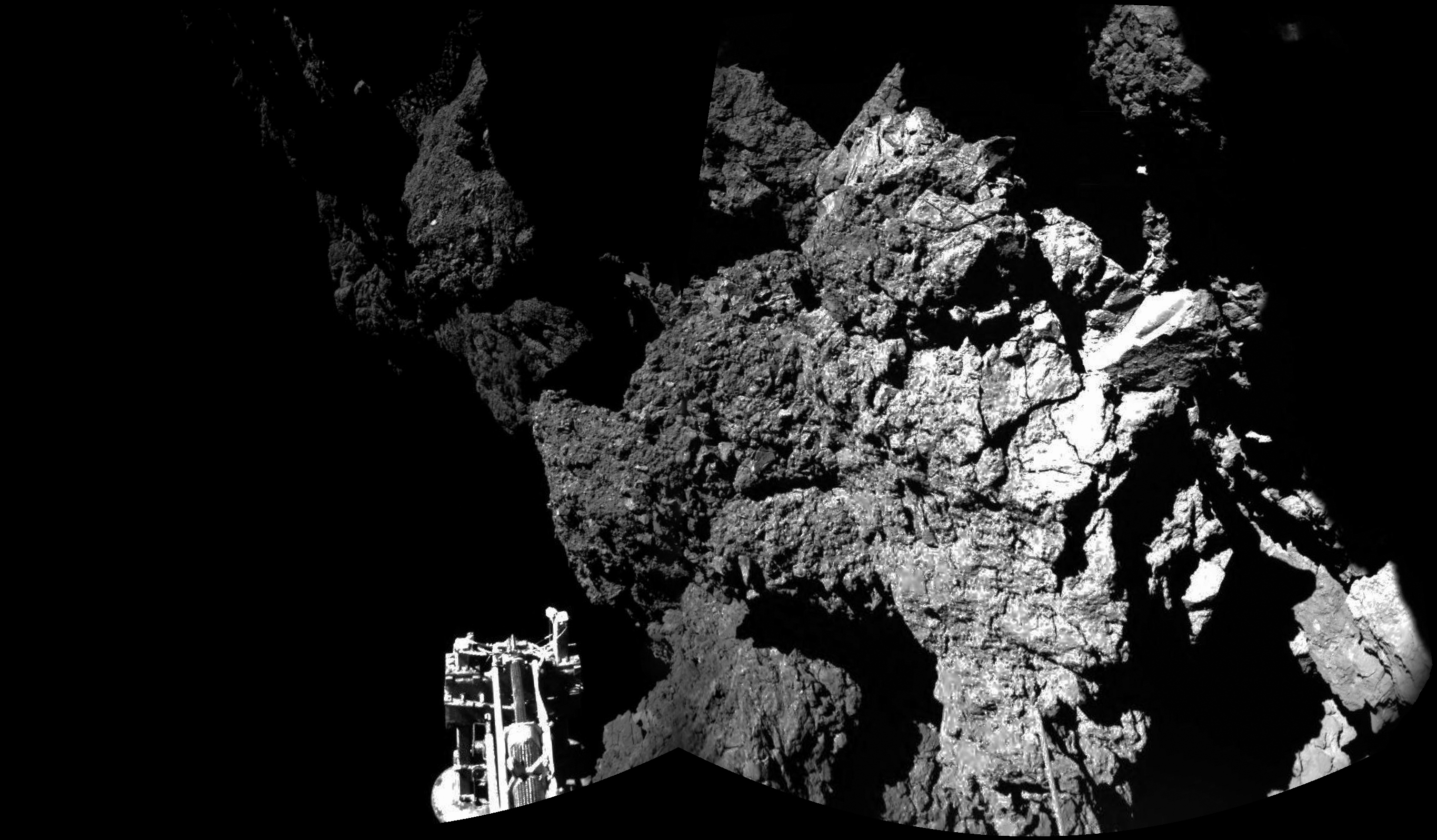
Follow the bouncing Philae... The Philae lander made it down to Comet 67P's surface, but not in the way it was designed to do. The lander actually impacted the comet's surface at exactly the place and time it was supposed to, but all three devices that were intended to attach Philae to the surface failed (auger screws, harpoons, and down-thrusters). These devices are needed because gravity there is far too weak to do the job; the comet's mass is too small to create a strong gravitational field. Because these devices all failed, Philae struck the surface as planned – but then bounced back up, at about 1/3 of its initial impact speed. It traveled up, at an angle, and rotating slowly – and then nearly two hours later, after bouncing as high as a kilometer off the surface, it came back down. At that point it bounced yet again, it's rotations changed a little, and for a few more minutes it “flew”. Then it landed a third time, and stayed down.
The image above was taken on the surface, at the place where Philae finally came to rest. The scientists have only a rough idea where Philae is actually located on the comet, but it's definitely a long way from the intended site, and it's on a much rougher surface than the they aimed for. It appears that Philae is perched somehow on just two of its three legs, nearly sideways to the ground. The lighting where it rests is far from optimal, and the team is considering making attempts to flop Philae back over on its feet. They're also working hard on figuring out exactly where it is.
The fact that Philae came down in an unexpected place isn't necessarily bad news, overall. The opportunities for science may actually be greater in the more rugged territory where Philae ended up. On the other hand, the lifetime may be cut short if they can't get more solar power. It's a fascinating example of a space robot needing engineering and science assistance from earth to make a “save” from the unexpected failures and consequences of them...
The image above was taken on the surface, at the place where Philae finally came to rest. The scientists have only a rough idea where Philae is actually located on the comet, but it's definitely a long way from the intended site, and it's on a much rougher surface than the they aimed for. It appears that Philae is perched somehow on just two of its three legs, nearly sideways to the ground. The lighting where it rests is far from optimal, and the team is considering making attempts to flop Philae back over on its feet. They're also working hard on figuring out exactly where it is.
The fact that Philae came down in an unexpected place isn't necessarily bad news, overall. The opportunities for science may actually be greater in the more rugged territory where Philae ended up. On the other hand, the lifetime may be cut short if they can't get more solar power. It's a fascinating example of a space robot needing engineering and science assistance from earth to make a “save” from the unexpected failures and consequences of them...
The surprising history of sliced bread...
The surprising history of sliced bread... I was very surprised to learn that the first commercially sliced bread was produced in 1928. I would have guessed much earlier than that! I wouldn't have guessed that being sliced was the main claim to Wonder Bread when it first came out, either. One thing that didn't surprise me: at one point, the government banned sliced bread. The stupidity of government is eternal...
Our sun...
Wednesday, November 12, 2014
Barn: conduit is being run!
Barn: conduit is being run! This morning the builder's son (Trent J.) finished up the shovel work on the conduit trench (I finished the tractor work on this two days ago). Now the builder (Jim J.) is installing the conduit in the trench, with the pull rope inside of it. The pull rope in this case is rated for 500 lbs. of pull strength. The power company will attach it to the wires and pull them through.
Once all this is installed in the trench, we'll get the power company out here to inspect. Assuming we pass, that sets our place in the queue for their contract work. Last I checked, that queue was about three weeks long...
Barn: the siding is going on!
Barn: the siding is going on! A crew of five showed up this morning, unloaded all sorts of tools (including a 20' metal-bending brake), and went right to work. Much hammering, sawing, and metal bending is happening (and all in the cold, now at 22°F)...
Awesome geekery!
Awesome geekery! That's a drawing of 18th century Italian scientist Amedeo Avogadro...
Common “myth-conceptions”...
Common “myth-conceptions” ... the world's most contagious falsehoods. Via friend, former colleague, and occasional reader Aleck L. One example to give you a flavor:
Napoleon was short. A tall tale. At 5'7", he was actually above average height for a Frenchman of that time.
Mechanical Fourier analysis (transform)!
The video is a bit of a tease, as it's only the introductory video for a series of six – the rest of which will be released over the next couple of months. It does show a little bit of the machine in operation, though. It also gives you a bit of background and history if you're not familiar with Michelson's machine...
An unlikely occurrence...
An unlikely occurrence ... wherein the Wall Street Journal editorial board agrees with me, this time on Obama's call for “net neutrality”. Their conclusion:
Whatever “liberal” used to mean, it now means a self-interested machine of influence peddling and rent extraction. Well do we recall Cass Sunstein, Mr. Obama’s colleague at the University of Chicago, saying President Obama would surprise the world by being a “smart” regulator. What a bunch of hooey that turned out to be. Meanwhile Americans are undoubtedly tired of hearing how Washington has become America’s richest, most recession-proof area code. Net neutrality is one more example of how it got that way.Indeed...
Kids react to old cameras...
Beautiful trumpet rendition of our national anthem...
Philae is on the way toward it's landing on 67P...
Philae is on the way toward it's landing on 67P... Live streaming coverage:
Tuesday, November 11, 2014
And the trenching continues...
And the trenching continues... After I finished fixing the irrigation pipe late this morning, I started back on the trenching. Now I'm working on trenches that are inside our back yard, which means I'm tearing up the lawn I worked so hard on earlier this year. Oh, well, the grass will grow back again. I think :)
The trench I'm working on in the photo will be carrying a water pipe (at 48"), a gas pipe (at 36") and two direct-burial CAT-6 network cables (also at 36"). Just a little bit in front of where the tractor sits in the photo, another trench will branch off to the left. That trench will carry water and gas under our driveway (where there's a 4" ABS pipe) where they will be stubbed out. That's a provision for a future greenhouse. Then the trench I'm working on will carry on straight into the center of our house, where the water and network will enter directly into the “mechanical room” in our basement. Just before that trench his the house, another branch will head due east for about 40', carrying the gas line to the gas meter.
The back yard will be a real mess when I finish with this :(
The trench I'm working on in the photo will be carrying a water pipe (at 48"), a gas pipe (at 36") and two direct-burial CAT-6 network cables (also at 36"). Just a little bit in front of where the tractor sits in the photo, another trench will branch off to the left. That trench will carry water and gas under our driveway (where there's a 4" ABS pipe) where they will be stubbed out. That's a provision for a future greenhouse. Then the trench I'm working on will carry on straight into the center of our house, where the water and network will enter directly into the “mechanical room” in our basement. Just before that trench his the house, another branch will head due east for about 40', carrying the gas line to the gas meter.
The back yard will be a real mess when I finish with this :(
House roof: the steel is going on!
House roof: the steel is going on! The first two photos show the machine that takes a coil of steel sheet and turns it into a finished standing-seam panel, 16" wide and any length. The last photo shows the NE corner of our house and the first panels being installed...
Barn: siding arrived...
The pile of siding doesn't look nearly big enough to cover the whole barn. We'll see if I'm right.
We were expecting the rock to arrive today, but it was a no-show. The masons are supposed to start on the rock tomorrow, but that will be just a bit difficult if they have no rocks to install!
Pipe: 0, backhoe: 1...
Pipe: 0, backhoe: 1... Yesterday while trenching near our barn, I managed to bust another section of 6" irrigation pipe. I used the backhoe to get within about 3" of the pipe (I knew right where it was), then tried to use a shovel to locate the pipe. The danged clay was so hard-packed, 2' down, that I couldn't make a dent in it. So I thought I'd be real careful with backhoe and dig a little closer. First try, and you see the results in the first photo. Dang it! So I ran back up to Valley implement and bought another “repair kit”. Then this morning I dug out the pipe, completely exposing it, cleaned around it with a shovel (the only time I was warm today!), sawed out the broken bits (second photo), washed all the soil off the ends (third photo), and then slipped a piece of pipe and repair coupler on to fix it (last photo).
The whole process of repairing the pipe took about four hour, plus the two hours to get the parts...
I'm not used to working in the cold...
I'm not used to working in the cold... After working outside most of the day today, that is becoming quite obvious :) It's been between 23°F and 38°F all day today. For part of the late morning it was sunny, and when that lovely fusion-powered orb was showing, I was plenty warm. When I was shoveling this morning, I was also warm. But most of the day I've been using my tractor's backhoe to dig trenches – and the wind is blowing, and the sun is hiding behind clouds, and I got cold! I've had to retreat to the warmth of the house on several occasions, to allow my fingers and toes to regain feeling. As I type this, my feet still feel like frozen blocks of ice, though my fingers seem to be functioning ok.
And it's not even winter yet!
Yikes! I need to find some warm winter wear, that's for sure...
And it's not even winter yet!
Yikes! I need to find some warm winter wear, that's for sure...
Veteran's Day...
Remembering Halala Pala...
Remembering Halala Pala... Yesterday Debbie received the card below from the staff at VCA (the veterinarians who treated his cancer). We've been impressed over the years with both their skills and their caring. This is another example...
Italy comes to its senses...
Italy comes to its senses... It's probably only a brief interlude, but yesterday an Italian appellate court overturned the manslaughter convictions of six geologists. Their “crime”? Failing to accurately predict an earthquake...
“Net neutrality”...
“Net neutrality”... What do I think about it? I think about it in apocalyptic terms: if enacted, it would be the end of the Internet as we know it. Bye bye, competition and lively innovation; hello, stifling regulation and taxes. Bye bye, small and innovative ISPs; hello, a few big moribund and hidebound ISPs (think AT&T).
For the details, see Andy Kessler's plain language, even-handed primer. Following the money trail, Forbes talks about the inevitable taxation that would follow.
“Net neutrality” is a carefully selected term – it sounds positive, it sounds like something nobody in their right mind would be against. In actuality it is a euphemism for regulation. The way that the nice-sounding net neutrality would be implemented is by creating a regulatory bureaucracy, and that bureaucracy would start publishing rules and regulations by the hundred, and charging fees and taxes. The result of that is totally predictable, as we've seen this movie many times before: innovation will be stifled (by all the regulations), large incumbents will be empowered (as the relative cost of regulatory compliance for them is low), and new entrants will be discouraged (it would have to be an extraordinarily well-funded startup to be able to pay for regulatory compliance and the associated documentation). Our ISP in California was a small, one-man operation that provided radio-linked Internet access. His startup was self-funded. If ISPs were regulated as a utility, he would never have started his little company – and we would have been stuck with the terribly inferior (and much more expensive) satellite ISP that we used before he started his company. Multiply that by a few tens of thousands, because that's how many ISPs we have now. If net neutrality is implemented, it's easy to predict that all these ISPs will be consolidated into a few big ones, or they'll go out of business.
One aspect of the net neutrality proponents' argument astonishes me: they're actually arguing that consumers should get something for nothing. It's the socialist mindset applied to technology. What do I mean? Consider that the central argument for net neutrality proponents is the notion of “no fast lanes”. Said another way, they want anyone to be able to access anything, as much as they want to, with no restrictions or costs. The ISPs are in the business of renting their pipes, and their pipes can only carry so many bits per second (called “bandwidth”). It's exactly analogous to your plumbing pipes: they can only carry so many gallons per minute. The net neutrality proponents want to tell the ISPs that they can't restrict how much data any source (like Google, or Netflix) tries to push down their pipes – and they also can't charge any more for it. That means that the only way the ISPs could pay for bigger pipes is to charge the consumer – and when the FCC regulates the ISPs as a utility, those price increases will have to be approved by the FCC. The likely result is the same one we had when the FCC regulated AT&T: slow service and slower increases. It's a recipe for an Internet quagmire. It will work just as well as Venezuela's attempts to regulate toilet paper prices.
Even more astonishing to me is that the Democrats manage to get some political traction with this when there is no problem that needs to be solved. Their entire argument is couched in scary-sounding hypotheticals: the ISPs could block web sites; the ISPs could create “fast lanes” (which actually might be a good idea!), etc. None of these things are problems today. It's as if they said “grocery stores could carry only Wonder Bread!” and used that as an excuse to regulate grocery stores! That hypothetical argument totally ignores the beneficial effects of competition. The grocery store that carries only Wonder Bread would soon find itself out-competed by other stores. The ISP that blocks Netflix will find itself out-competed by other ISPs – and thanks to the current lack of regulation, there are plenty to choose from. We live out in the sticks in northern Utah, and we have nine ISPs to choose from: one cable provider, two DSL infrastructure providers, two satellite providers, two cellular providers, and two wireless point-to-point providers. If our cable provider decides to block sites we want access to, with one phone call I'll switch to an ISP that doesn't. Where's the problem?
Imposing a regulatory regime on the incredibly successful Internet should be an absolute last resort that is considered only in the presence of a huge problem that the competitive landscape doesn't address. Today is not that day...
For the details, see Andy Kessler's plain language, even-handed primer. Following the money trail, Forbes talks about the inevitable taxation that would follow.
“Net neutrality” is a carefully selected term – it sounds positive, it sounds like something nobody in their right mind would be against. In actuality it is a euphemism for regulation. The way that the nice-sounding net neutrality would be implemented is by creating a regulatory bureaucracy, and that bureaucracy would start publishing rules and regulations by the hundred, and charging fees and taxes. The result of that is totally predictable, as we've seen this movie many times before: innovation will be stifled (by all the regulations), large incumbents will be empowered (as the relative cost of regulatory compliance for them is low), and new entrants will be discouraged (it would have to be an extraordinarily well-funded startup to be able to pay for regulatory compliance and the associated documentation). Our ISP in California was a small, one-man operation that provided radio-linked Internet access. His startup was self-funded. If ISPs were regulated as a utility, he would never have started his little company – and we would have been stuck with the terribly inferior (and much more expensive) satellite ISP that we used before he started his company. Multiply that by a few tens of thousands, because that's how many ISPs we have now. If net neutrality is implemented, it's easy to predict that all these ISPs will be consolidated into a few big ones, or they'll go out of business.
One aspect of the net neutrality proponents' argument astonishes me: they're actually arguing that consumers should get something for nothing. It's the socialist mindset applied to technology. What do I mean? Consider that the central argument for net neutrality proponents is the notion of “no fast lanes”. Said another way, they want anyone to be able to access anything, as much as they want to, with no restrictions or costs. The ISPs are in the business of renting their pipes, and their pipes can only carry so many bits per second (called “bandwidth”). It's exactly analogous to your plumbing pipes: they can only carry so many gallons per minute. The net neutrality proponents want to tell the ISPs that they can't restrict how much data any source (like Google, or Netflix) tries to push down their pipes – and they also can't charge any more for it. That means that the only way the ISPs could pay for bigger pipes is to charge the consumer – and when the FCC regulates the ISPs as a utility, those price increases will have to be approved by the FCC. The likely result is the same one we had when the FCC regulated AT&T: slow service and slower increases. It's a recipe for an Internet quagmire. It will work just as well as Venezuela's attempts to regulate toilet paper prices.
Even more astonishing to me is that the Democrats manage to get some political traction with this when there is no problem that needs to be solved. Their entire argument is couched in scary-sounding hypotheticals: the ISPs could block web sites; the ISPs could create “fast lanes” (which actually might be a good idea!), etc. None of these things are problems today. It's as if they said “grocery stores could carry only Wonder Bread!” and used that as an excuse to regulate grocery stores! That hypothetical argument totally ignores the beneficial effects of competition. The grocery store that carries only Wonder Bread would soon find itself out-competed by other stores. The ISP that blocks Netflix will find itself out-competed by other ISPs – and thanks to the current lack of regulation, there are plenty to choose from. We live out in the sticks in northern Utah, and we have nine ISPs to choose from: one cable provider, two DSL infrastructure providers, two satellite providers, two cellular providers, and two wireless point-to-point providers. If our cable provider decides to block sites we want access to, with one phone call I'll switch to an ISP that doesn't. Where's the problem?
Imposing a regulatory regime on the incredibly successful Internet should be an absolute last resort that is considered only in the presence of a huge problem that the competitive landscape doesn't address. Today is not that day...
Monday, November 10, 2014
Six bills the new GOP congress should pass...
Six bills the new GOP congress should pass... Glenn Reynolds (aka “Instapundit”) has six great choices that I'd support. I won't hold my breath for any of them, though. I suspect (4) is the only one that could possibly garner enough political support to even be proposed.
I haven't picked up a copy of USA Today for about 20 years. I'm astonished to find this column in that publication...
The letter “F”...
The letter “F”... This is what a penciled “F” on a piece of graph paper looks like at 60x. Sure doesn't look like this to the naked eye!
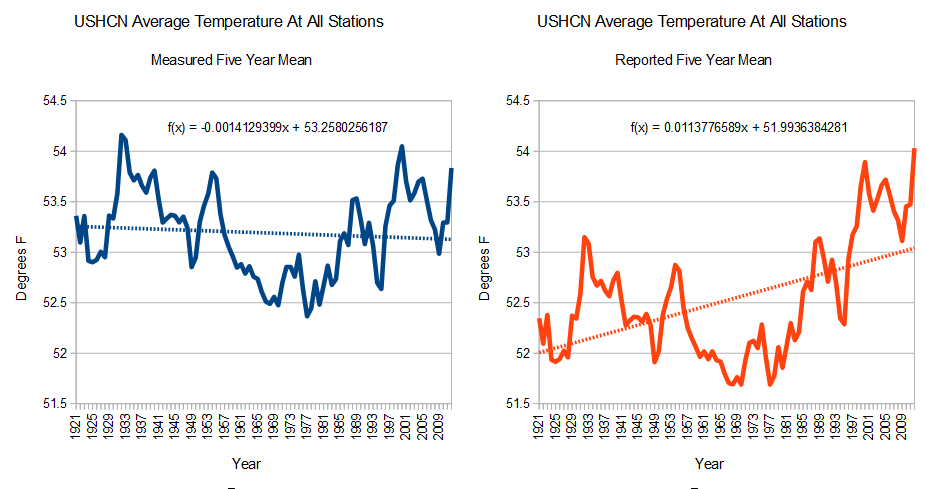
This doesn't look good...
This doesn't look good... The graph at right neatly encapsulates what many are calling fraudulent science. The blue line is the raw temperature average; the red is the same data after “adjustment”. I'll call it “very suspicious”, as the adjustment reasons and methodology are not disclosed.
This particular data is from USHCN, but many other sources of climate data worldwide show similar discrepancies between the raw data and the presented data. The entire issue could be easily resolved if the climatologists would simply release their adjustment methodologies – but to date, not a single one has. This raises all sorts of red flags for me, as it's the antithesis of the way science is normally conducted...
Should we choose our Congress-critters randomly?
Should we choose our Congress-critters randomly? William F. Buckley famously said:
I'd rather entrust the government of the United States to the first 400 people listed in the Boston telephone directory than to the faculty of Harvard University.That's a colorful way of saying that he'd rather be governed by randomly selected citizens than by elites, and that's a notion I have a lot of sympathy for. I've observed before that by and large, the sort of people who want to be elected are precisely those people I don't want elected. The natural extension of that thought is that randomly-selected people who don't want the job would make better Representatives and Senators than those we elect.
As this article points out, that general notion is something already embodied in American government, in the form of jury selection. The process is called sortition, and it has a long and honorable history.
The idea of using sortition to choose Congress-critters is an interesting ponder, though it's extremely unlikely to ever actually be used. It would require a Constitutional amendment, and every lobbying organization in the universe would oppose it with all their might – including, most especially, the politicians themselves.
The key to making sortition work for this purpose would be to identify the candidate pool to randomly choose from. It could be as simple as everyone over 21, or it could be more restrictive. For instance, perhaps we'd exclude those with a criminal record, or those who didn't graduate from high school (or have an equivalent certification). Perhaps we'd enter some people twice or more: those with military service, or who are business owners. That pool of candidates has much opportunity for tweaking.
And then, of course, we'd need a really good true random number generator to actually select our new Congress-critters :)
Would this be better than our current system? My first thought: how could it possibly be worse?!?!
True random number generation...
True random number generation... This article (by John Denker, author of numerous other interesting documents) discusses building a low cost true random number generator using the audio system of just about any computer system. I've no idea how good the result of that would be, but this article is full of useful information about how to process and analyze the data from such a source to generate a useful random number stream...
Electronic medical records...
Electronic medical records... Every doctor I've talked to about electronic medical records hates them. They require huge amounts of the doctor's time to enter, they're very hard to read, and they're organized in a most inconvenient way. Every doctor also told me that they liked some of benefits – especially the ability to search – but that it wasn't worth the effort.
Why is this?
Part of it seems to be (rather incredibly) bad implementations. In other words, crappy software. That's totally believable, and we can expect that to get better as time goes by – unless there's a government mandate, which of course there is. In that case, progress is likely to be somewhere between glacial and retrograde.
Aside from those considerations, though, there's another issue: medical records are a great example of unstructured data. There is no such thing as a single form that can contain all the information on an old-fashioned, hand-written, paper medical record. The information is there in text, in prose that a doctor wrote to convey some meaning subtler than can be contained by a diagnostic code. The medical record systems try mightily to eliminate the need for this prose – but they do it by creating a plethora of blanks on forms that must be checked, coded, etc. Those things are not designed for humans to read, they're designed for computers. There's a fundamental disjoint between how computers store and process information, and how humans do it – and electronic medical records are attempting to do both.
Does that mean it's impossible to make electronic medical records as good as old-fashioned paper medical charts? I don't know. But I do know it will be very hard to make them work well, and the transition will be painful and full of errors. There may well be offsetting benefits, but I'm not sure they're larger than the effort and consequences of moving to electronic medical records.
Here's something to ponder. There's another kind of record out there that has some similarities, along with a huge commercial incentive to go electronic: mortgage paperwork. From a technical perspective, this is a far easier problem than medical records – there's relatively little about real estate that requires unstructured data. The mortgage industry has poured hundreds of millions of dollars into the effort to eliminate the paperwork through electronic records. Success to date? Nearly zero.
This stuff is hard...
Why is this?
Part of it seems to be (rather incredibly) bad implementations. In other words, crappy software. That's totally believable, and we can expect that to get better as time goes by – unless there's a government mandate, which of course there is. In that case, progress is likely to be somewhere between glacial and retrograde.
Aside from those considerations, though, there's another issue: medical records are a great example of unstructured data. There is no such thing as a single form that can contain all the information on an old-fashioned, hand-written, paper medical record. The information is there in text, in prose that a doctor wrote to convey some meaning subtler than can be contained by a diagnostic code. The medical record systems try mightily to eliminate the need for this prose – but they do it by creating a plethora of blanks on forms that must be checked, coded, etc. Those things are not designed for humans to read, they're designed for computers. There's a fundamental disjoint between how computers store and process information, and how humans do it – and electronic medical records are attempting to do both.
Does that mean it's impossible to make electronic medical records as good as old-fashioned paper medical charts? I don't know. But I do know it will be very hard to make them work well, and the transition will be painful and full of errors. There may well be offsetting benefits, but I'm not sure they're larger than the effort and consequences of moving to electronic medical records.
Here's something to ponder. There's another kind of record out there that has some similarities, along with a huge commercial incentive to go electronic: mortgage paperwork. From a technical perspective, this is a far easier problem than medical records – there's relatively little about real estate that requires unstructured data. The mortgage industry has poured hundreds of millions of dollars into the effort to eliminate the paperwork through electronic records. Success to date? Nearly zero.
This stuff is hard...
Sherlock Holmes debugging...
Sherlock Holmes debugging... I never thought of it quite like this, but the general technique described (working backwards from the symptoms) is what I think of as normal debugging. I've observed before that software engineers who are really good at this are relatively rare, and they tend to be the same people who have a deep understanding of entire systems (not just a component or two). I can add another observation: if you ask most software engineers how they feel about debugging, almost always they'll tell you that either they love it or they hate it. There doesn't seem to be any middle ground. And the ones who love it the ones who are likely to be very good at it...
Free speech being strangled...
Free speech being strangled... Along with many other (mostly older) observers, I've watched sadly as America's strong tradition of free speech is slowly strangled by ideas like “political correctness” and “offense-free zones”. This movement toward unfree speech comes most powerfully from the left, with progressive control of our university campuses leading to increasingly awful attempts to muzzle free speech. It's not exclusive to the left, though: plenty of conservatives would like to limit what you can say – for instance, they'd like to muzzle criticism of the military, or promotion of abortion. A pox on them all!
Harvey Silverglate has a piece in today's Wall Street Journal that looks at the left's abuses. He concludes:
Hypersensitivity to the trauma allegedly inflicted by listening to controversial ideas approaches a strange form of derangement—a disorder whose lethal spread in academia grows by the day. What should be the object of derision, a focus for satire, is instead the subject of serious faux academic discussion and precautionary warnings. For this disorder there is no effective quarantine. A whole generation of students soon will have imbibed the warped notions of justice and entitlement now handed down as dogma in the universities.I agree, Mr. Silverglate. But how do we stop this?
Politically correct slavery...
Politically correct slavery... For decades now, Cuba has been sending medical teams to hot spots in the world. I've always thought of this as a sort of public relations effort on the part of the Cuban government – they can't afford to dispense the kinds of humanitarian aid that the Western countries do, but sending small teams of doctors and nurses they could do.
Now I learn that Cuba is actually profiting from these efforts! Mary Anastasia O'Grady has a piece in today's Wall Street Journal that details how Cuba does this. The doctors aren't going voluntarily, and the money Cuba is paid for this doesn't go to the doctors. It's slavery, all dressed up to look nice for the leftists in the world...

Sunday, November 9, 2014
Digging position...
Digging position... I spent most of my day today with my tractor in digging position, as shown in this photo (click to embiggen). Note that all four wheels are off the ground, and the tractor is standing up on the loader bucket (in front) and two outriggers (in back). This provides a far more stable platform for the backhoe to operate from. If I sit the tractor on even just the front tires, with the back held up by the outriggers, it still wobbles all over the place.
The area around our barn's northeast corner looks like a kid has been playing with an oversized Tonka toy – there are piles of dirt everywhere, and a crazy-quilt patchwork of holes and trenches. This is where I've been working today, to trench the place where electricity, natural gas, water, and network will enter the barn. For some stupid reason, we've got all four of them entering on the same 10 feet or so of wall!
NGC 6543 – the Cat's Eye nebula...
NGC 6543 – the Cat's Eye nebula... As seen by the Hubble Space Telescope. Via APOD, of course. It looks like one of those super high-speed photos of an explosion that just went off, which, in a sense, it is...
Well, duh...
Well, duh... Meta-study of the impact of genetically modified crops reveals ... that their impact is overwhelmingly positive...
Saturday, November 8, 2014
A real balancing act...
A real balancing act... The two videos below show “balance artist” Rocky Byun balancing various objects in very unlikely-looking positions. It's visually very compelling, even when you discover (as I did with a little googling) that there's a trick to what he's doing. You can see it pretty easily in the second video – the objects all are inserted into a cup-shaped depression in a stone, usually a piece of soft pumice. That means he's not really balancing on a point, as you might think, but rather on a small supportive surface. It's still an impressive performance, but a bit shy of the magical performance it starts out looking like...
NGC 660: a polar ring galaxy...
NGC 660: a polar ring galaxy... This image was captured by the Gemini observatory on Mauna Kea, on the Big Island of Hawai'i. Via APOD, of course. Full resolution here...
What's the biggest cash crop?
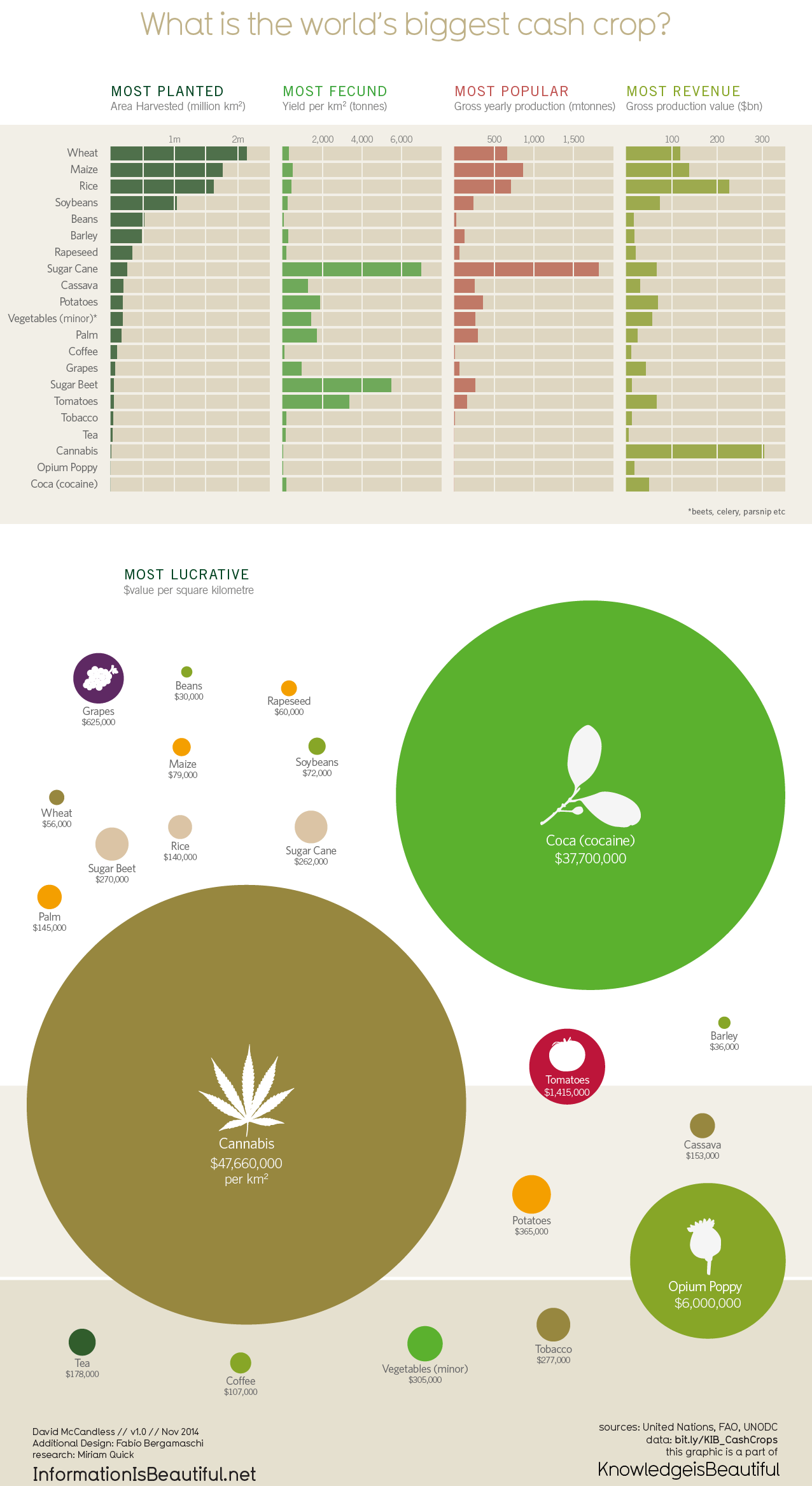
What's the biggest cash crop? It's marijuana, by a good margin – though I'm not sure how rigorous the data is that supports those numbers. The closest competition is from rice; nothing else is even remotely close – so even if the data is considerably in error, the standings don't change much. As the linked article suggests, it surely won't be long before the needy/greedy governments around the world take note of the success of Colorado collecting taxes on marijuana (3x initial estimates) has been. I'd long thought that legalization would greatly reduce the price of marijuana, but that doesn't seem to be the experience so far...
Some programming language musings...
Some programming language musings... First up, a paper by the authors of Julia. It's already on my list of winter explorations. Then here's a discussion of Rust vs. Go. Go was already on my list; I'm adding Rust, too. Lots of interesting developments in computer languages the last few years, after a decade or so of not much that interested me...
Whatever you might think of him...
Whatever you might think of him ... and I find much to admire ... you must admit that Elon Musk thinks big...
Progress report...
Progress report... Lots of things happened yesterday!
The roofers finished “drying in” our home's roof. That means it's now covered with waterproof material – the “underlayment” that will end up beneath the steel roof. The roofers actually got done early in the day. They tidied up a bit, then left for their shop to start bending metal for our roof. The installation of the steel will start on Monday.
Most of the day I worked alone on trenching, but in the afternoon my neighbor (Tim D.) joined me again for a couple of hours. We made much faster progress with his help, and now the only thing left is the finishing work at the ends. Today I'll be out trenching near the pole, where I have to worry about things like ripping out the natural gas main that feeds several dozen homes to our west, or the cable TV line that feeds our house :) I'll be digging very carefully there, at times with a shovel instead of the backhoe!
In the afternoon, the fellow installing the septic tank (Eric) for our barn showed up. He brought with him a backhoe that I couldn't help but envy. For starters, it has a 240 HP diesel engine. It's boom is extensible, so that his total reach is over 25' (or 20' deep!). The bucket holds over a cubic yard of material (vs. less than one cubic foot on mine!) – about a 30x difference. But most of all I envied the totally effortless way that his backhoe sliced through even the most compacted soil as if it were sand. He had the hole dug for the 1,000 gallon concrete septic tank in very short order – 15 minutes at most. Later a delivery truck arrived with the two halves (top and bottom) of the septic tank. The bottom weighs 6,000 pounds, the top 5,000 pounds. The delivery truck had a large crane attached to it, with a 30,000 pound lift capacity. The septic tanks are made in a factory just 20 miles away, and this truck belongs to that factory. The truck driver had the bottom offloaded and positioned roughly in the right place in about 5 minutes. With the tank bottom hanging about a foot over the bottom of the hole, Eric and I swung it into the right place and the crane dropped it right down. Then Eric installed some asphalt-based mastic (sticky soft sealant) in a groove molded around the top edge of the bottom half. The top half of the septic tank has a matching “tongue” that fits into that groove, squeezing the mastic to make a perfect seal. The crane then roughly positioned the top half of the tank right over the bottom half, and Eric and I moved it slightly to get it in exactly the right place. The crane operator let it down gently, and ... that was it! We could see the mastic squeezing out the side of the seam between the two halves – we got it on correctly. The entire operation took less than a half hour. With the right tools and machinery, a job that looks intimidatingly large and hard can actually be small and easy. Eric will be back today to dig the gravel trench drainage field for the septic tank and fill it with gravel. He'll put a straw “cap” over the gravel to keep soil from clogging the gravel, then backfill over the top with soil.
Finally, today we had the plumbers over to do the final installation work for the sink in our basement cattery. We now have a beautiful custom cattery cabinet with an oversized stainless steel sink and a high-capacity faucet and sprayer. Yay!
The roofers finished “drying in” our home's roof. That means it's now covered with waterproof material – the “underlayment” that will end up beneath the steel roof. The roofers actually got done early in the day. They tidied up a bit, then left for their shop to start bending metal for our roof. The installation of the steel will start on Monday.
Most of the day I worked alone on trenching, but in the afternoon my neighbor (Tim D.) joined me again for a couple of hours. We made much faster progress with his help, and now the only thing left is the finishing work at the ends. Today I'll be out trenching near the pole, where I have to worry about things like ripping out the natural gas main that feeds several dozen homes to our west, or the cable TV line that feeds our house :) I'll be digging very carefully there, at times with a shovel instead of the backhoe!
In the afternoon, the fellow installing the septic tank (Eric) for our barn showed up. He brought with him a backhoe that I couldn't help but envy. For starters, it has a 240 HP diesel engine. It's boom is extensible, so that his total reach is over 25' (or 20' deep!). The bucket holds over a cubic yard of material (vs. less than one cubic foot on mine!) – about a 30x difference. But most of all I envied the totally effortless way that his backhoe sliced through even the most compacted soil as if it were sand. He had the hole dug for the 1,000 gallon concrete septic tank in very short order – 15 minutes at most. Later a delivery truck arrived with the two halves (top and bottom) of the septic tank. The bottom weighs 6,000 pounds, the top 5,000 pounds. The delivery truck had a large crane attached to it, with a 30,000 pound lift capacity. The septic tanks are made in a factory just 20 miles away, and this truck belongs to that factory. The truck driver had the bottom offloaded and positioned roughly in the right place in about 5 minutes. With the tank bottom hanging about a foot over the bottom of the hole, Eric and I swung it into the right place and the crane dropped it right down. Then Eric installed some asphalt-based mastic (sticky soft sealant) in a groove molded around the top edge of the bottom half. The top half of the septic tank has a matching “tongue” that fits into that groove, squeezing the mastic to make a perfect seal. The crane then roughly positioned the top half of the tank right over the bottom half, and Eric and I moved it slightly to get it in exactly the right place. The crane operator let it down gently, and ... that was it! We could see the mastic squeezing out the side of the seam between the two halves – we got it on correctly. The entire operation took less than a half hour. With the right tools and machinery, a job that looks intimidatingly large and hard can actually be small and easy. Eric will be back today to dig the gravel trench drainage field for the septic tank and fill it with gravel. He'll put a straw “cap” over the gravel to keep soil from clogging the gravel, then backfill over the top with soil.
Finally, today we had the plumbers over to do the final installation work for the sink in our basement cattery. We now have a beautiful custom cattery cabinet with an oversized stainless steel sink and a high-capacity faucet and sprayer. Yay!
Friday, November 7, 2014
It was a trenching experience...
It was a trenching experience... With a lot of help from my friend and neighbor (Tim D.), we dug about 220 feet of 42 inch deep trench yesterday. Tim is visible, along with his dogs, in the last photo below. He worked in the trench, monitoring the depth (with the marked up piece of pipe to the left) and fine-finishing the bottom with a shovel. I worked the backhoe to dig out the bulk of the soil. Some of the areas we dug into were compacted clay, hard enough to pose a challenge for my little Kubota. But we did it!
The first two photos show the electrical trench in the morning, before we got started. The trench the tractor is working on is for the “primary side” of our barn's power connection. Where I was standing when I took the first photo is approximately where the barn's transformer will be mounted. Just barely visible, behind and to the right of the tractor, is the telephone pole we'll be connecting that transformer to. The second trench crossing the first at an angle is leading between the barn and the house. It will carry lines for natural gas, potable water, and network. I'll be working on that trench once the electrical trench is finished. For the second photo, I sat in the tractor's seat looking west to the barn. The end of the trench is where the transformer will sit, about 12' from the service entrance on the barn. There will be a short underground “secondary side” run there as well.
Yesterday morning in Paradise...
Yesterday morning in Paradise... Winter is definitely approaching! Note my tractor sitting out there, stopped where we finished trenching on Wednesday afternoon...
Just a few more days...
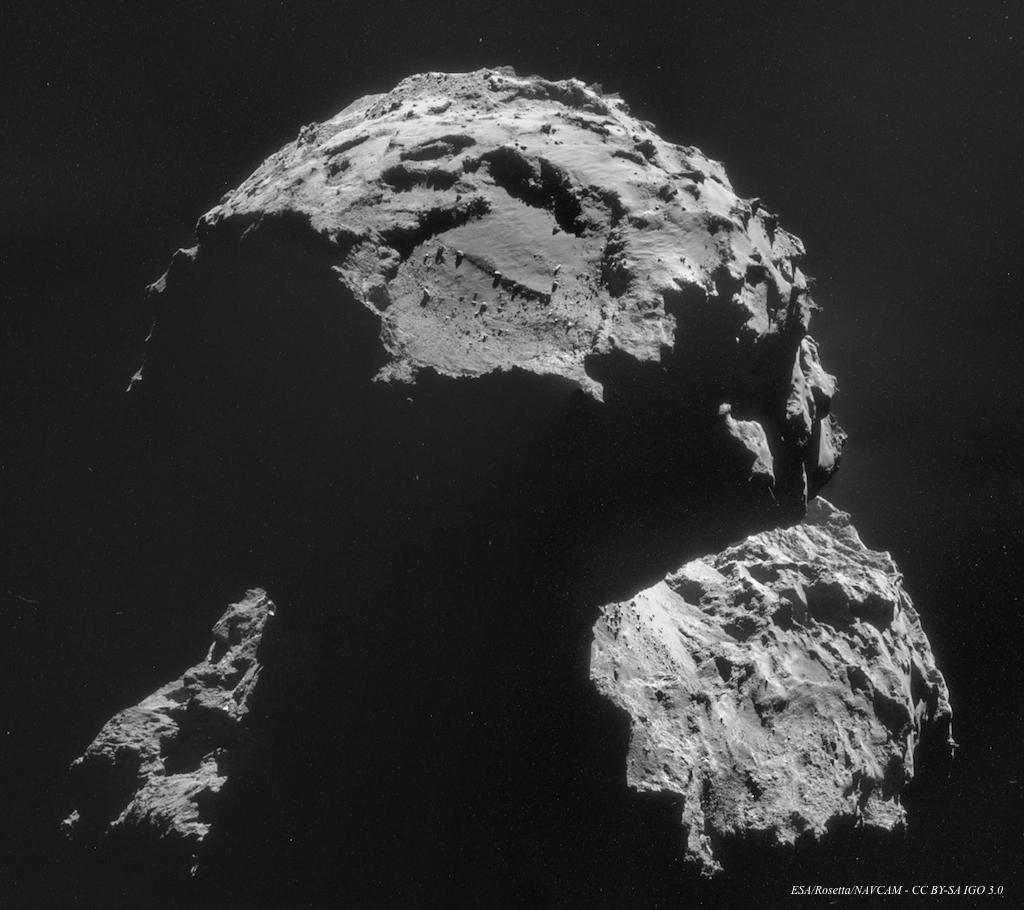
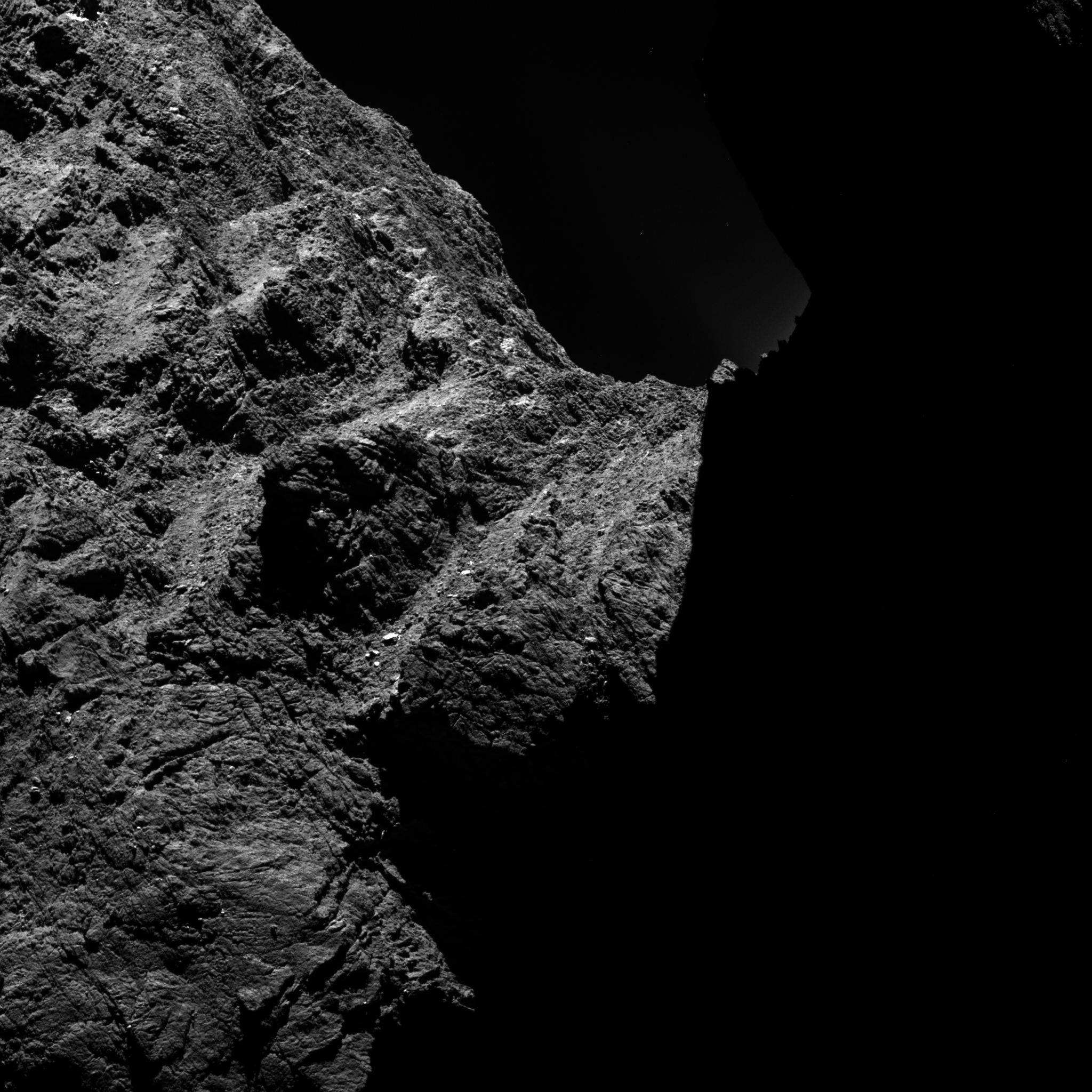
Just a few more days ... until Philae attempts to land on Comet 67P. At right is a photo of the surface (not the landing site) from a few days ago...
“This is no way to run a railroad.”
“This is no way to run a railroad.” Peggy Noonan, on Obama's response to Tuesday's elections...
Lost in space...
Lost in space... A CalTech experiment has discovered evidence of something long expected: stars that are in the inter-galactic “voids” – the vast regions of not-quite-empty space between galaxies. Computational models of star movement within galaxies shows that inevitably some stars will be thrown out of their galaxy, sometimes very energetically. These individual stars, at long distances, don't emit enough light to be imaged. The CalTech experiment appears to have discovered their cumulative glow.
When I first read about these orphaned stars, probably 30 or 40 years ago, the first thought I had was to imagine what inhabitants of a planet of such a star might think. Their astronomers would be able to see all the stars that were parts of galaxies, but might not be able to see any other orphaned stars. Until their astronomy advanced sufficiently (as ours apparently just has), they might well think they were unique. A self-centered universe notion might survive for a long time there :)
You just can't make this stuff up...
You just can't make this stuff up... The U.S. Supreme Court is going to decide whether throwing some fish overboard violates the Sarbanes-Oxley Act. Seriously!
3D printed guns made practical?
3D printed guns made practical? Most 3D printers available today (especially at a price that ordinary people can afford) use some kind of thermoplastic material to make objects. Guns made from plastic are challenging, to say the least – plastic just isn't strong enough to withstand the dynamic forces at play in containing an explosion, which is exactly what a gun does.
One enterprising fellow has come up with a possible solution to this: a special kind of bullet that essentially contains a “disposable barrel” in the shell (some of this ammunition is at right). This is something that could easily be outlawed, but ... it also wouldn't take a sophisticated machine shop to make it, nor would it take a lot of skill. An individual or group who badly wants to make a weapon is going to be able to do it this way, with parts, machines, and materials readily available today.
There's another approach I've read about that I suspect has even more promise in the long run: to create a gun-like weapon that uses tiny rockets instead of conventional ammunition. By switching to a rocket, the need for a strong, heat-resistant barrel is eliminated. The major disadvantage to using a rocket is accuracy – but that assumes that the rocket is unguided. Off-the-shelf technology can be used to create a guided rocket today, though the cost is fairly high (over $100 a round). But those costs are coming down very rapidly, for a host of reasons. I'd bet that within 5 years one could make a 3D printable, guided-rocket weapon with ammunition that cost under $20 a round – and was deadly accurate to very long distances, and was capable of carrying incendiary or explosive warheads.
When such weapons are available to ordinary citizens, governments are going to have a much more difficult time imposing their will on an unhappy citizenry. We're already seeing a bit of this at work, mainly in the Middle East. There are many reports of social media (especially Twitter) being used to coordinate rebel military campaigns. Drones you can buy from Amazon are being used by rebel forces for reconnaissance. I've read two reports that those same drones have been equipped with small warheads and used as weapons. Radio-controlled planes are being used by Hezbollah and the Syrian rebels, and probably others as well.
It's interesting to ponder what this development means in the long run. I'm inclined to think that it's mainly bad for thugocracies (like the Assads in Syria), but good for democracies (because it will clarify the thinking of politicians if they know there is a limit to how much they can piss off the public). Clearly, though – just like any other weapons – evil people will be eager to jump on these as new tools for their trade...
One enterprising fellow has come up with a possible solution to this: a special kind of bullet that essentially contains a “disposable barrel” in the shell (some of this ammunition is at right). This is something that could easily be outlawed, but ... it also wouldn't take a sophisticated machine shop to make it, nor would it take a lot of skill. An individual or group who badly wants to make a weapon is going to be able to do it this way, with parts, machines, and materials readily available today.
There's another approach I've read about that I suspect has even more promise in the long run: to create a gun-like weapon that uses tiny rockets instead of conventional ammunition. By switching to a rocket, the need for a strong, heat-resistant barrel is eliminated. The major disadvantage to using a rocket is accuracy – but that assumes that the rocket is unguided. Off-the-shelf technology can be used to create a guided rocket today, though the cost is fairly high (over $100 a round). But those costs are coming down very rapidly, for a host of reasons. I'd bet that within 5 years one could make a 3D printable, guided-rocket weapon with ammunition that cost under $20 a round – and was deadly accurate to very long distances, and was capable of carrying incendiary or explosive warheads.
When such weapons are available to ordinary citizens, governments are going to have a much more difficult time imposing their will on an unhappy citizenry. We're already seeing a bit of this at work, mainly in the Middle East. There are many reports of social media (especially Twitter) being used to coordinate rebel military campaigns. Drones you can buy from Amazon are being used by rebel forces for reconnaissance. I've read two reports that those same drones have been equipped with small warheads and used as weapons. Radio-controlled planes are being used by Hezbollah and the Syrian rebels, and probably others as well.
It's interesting to ponder what this development means in the long run. I'm inclined to think that it's mainly bad for thugocracies (like the Assads in Syria), but good for democracies (because it will clarify the thinking of politicians if they know there is a limit to how much they can piss off the public). Clearly, though – just like any other weapons – evil people will be eager to jump on these as new tools for their trade...
French graphics from WWI...
French graphics from WWI... Not the old-school Victorian-era graphics, not art deco, but definitely modern looking. If you know much about the history of WWI, you'll find many of these very evocative...
Subscribe to:
Posts (Atom)