Wednesday, January 16, 2013

Do You Know What This Is?

You probably think it's a snowflake, right?

Wrong.

It's a baby picture of Frosty the Snowman.

This cruelty was inflicted by my lovely bride.

Martian Images...

Both in today's dump from Curiosity.  The top one is in true color, a close-up taken with the MHLI camera (full resolution).  The bottom one is a composite panorama of images taken by the Mast camera (full resolution), color-adjusted to show what the scene would look like were it on Earth.


Basic Science Errors in the Mainstream Media...

It surprises me how commonly I find basic science errors in publications from mainstream media.  Here's an article in The Economist that provides a great example.  The offending paragraph:
It is true, and was the basis of Edison's showmanship, that low-frequency alternating current can be more hazardous than an equivalent direct current. By oscillating at a similar frequency (50-60 hertz) to the human heart, a sufficiently strong alternating current can cause that organ to beat arhythmically and thereby induce ventricular fibrillation—a potentially deadly condition that needs to be corrected immediately.
Most of the rest of the article is at least close to accurate, but this paragraph is laughably inaccurate.  For starters, the statement that alternating current oscillates at a similar frequency is off, by a factor of 60.  The author appears to have confused oscillations per second (in alternating current) with beats per minute (of our hearts).  He then goes on to develop a theory, unknown to science, that this similarity of frequency is the reason why alternating current induces arhythmia.  It's just wrong; completely made up so far as I can tell.

The mainstream media is full of this sort of thing.  It's a rare day that goes by without me spotting at least one of them.  Most of them never get corrected, or even noted by any commenters.  This can only mean one of two things, I think: either people who are reasonably science-literate have just given up, or there aren't very many science-literate people.  Come to think of it, it could be both at the same time.

Doom...

Guide to Etiquette Around the World...

Nice little interactive infographic full of information on things like gestures, tipping, dining protocol, etc...

Some Beautiful Photos...

Stunning collection, including this one:


Incandescent Stupidity...

Via the irreplaceable Rachel Lucas, who says it better than I possibly could:
...is one of the best distillations of the lunacy of opposition to legal private ownership of guns, and also of the incandescent stupidity of advertising a place as a “Gun-Free Zone”.

It’s also an interesting study of people who I hope are at least dimly aware of the cognitive dissonance that would give vertigo to a rational person.


I love Project Veritas!

Zooniverse...

I ran across the Zooniverse site completely by accident yesterday.  It's a portal into a series of web sites designed to allow ordinary citizens to help out on large science projects.  The general theme is to help sort through very large quantities of data that aren't amenable to computer analysis.  People are very good at detecting patterns, and a number of these web sites seek to exploit that with large numbers of human pattern-detectors.

For example, Planet Four (that would be Mars) is one of the sites is looking for people to help classify some odd features on the enormous collection of high-resolution photos taken by satellites whizzing around Mars.  There are so many of these photos that many of them have never been viewed by a human!

You have no excuse to be bored!

Tuesday, January 15, 2013

More Interesting Music...

Passed along by reader Larry E.:

How'd He Do That?

Solar Ballet...

This flare (from 12/31/2012) is gigantic: the entire Earth would easily fit within it.  Via APOD, of course:

Data Visualization Tools...

A nice, curated collection of data visualization tools...

Multiplication...

I haven't yet worked out why this “trick” works...


...but I will!

Akin's Laws...

Every time I run across these (and I've done so several times over the years), I'm struck by how applicable the majority of these are to software development:
Akin's Laws of Spacecraft Design

1. Engineering is done with numbers. Analysis without numbers is only an opinion.

2. To design a spacecraft right takes an infinite amount of effort. This is why it's a good idea to design them to operate when some things are wrong .

3. Design is an iterative process. The necessary number of iterations is one more than the number you have currently done. This is true at any point in time.

4. Your best design efforts will inevitably wind up being useless in the final design. Learn to live with the disappointment.

5. (Miller's Law) Three points determine a curve.

6. (Mar's Law) Everything is linear if plotted log-log with a fat magic marker.

7. At the start of any design effort, the person who most wants to be team leader is least likely to be capable of it.

8. In nature, the optimum is almost always in the middle somewhere. Distrust assertions that the optimum is at an extreme point.

9. Not having all the information you need is never a satisfactory excuse for not starting the analysis.

10. When in doubt, estimate. In an emergency, guess. But be sure to go back and clean up the mess when the real numbers come along.

11. Sometimes, the fastest way to get to the end is to throw everything out and start over.

12. There is never a single right solution. There are always multiple wrong ones, though.

13. Design is based on requirements. There's no justification for designing something one bit "better" than the requirements dictate.

14. (Edison's Law) "Better" is the enemy of "good".

15. (Shea's Law) The ability to improve a design occurs primarily at the interfaces. This is also the prime location for screwing it up.

16. The previous people who did a similar analysis did not have a direct pipeline to the wisdom of the ages. There is therefore no reason to believe their analysis over yours. There is especially no reason to present their analysis as yours.

17. The fact that an analysis appears in print has no relationship to the likelihood of its being correct.

18. Past experience is excellent for providing a reality check. Too much reality can doom an otherwise worthwhile design, though.

19. The odds are greatly against you being immensely smarter than everyone else in the field. If your analysis says your terminal velocity is twice the speed of light, you may have invented warp drive, but the chances are a lot better that you've screwed up.

20. A bad design with a good presentation is doomed eventually. A good design with a bad presentation is doomed immediately.

21. (Larrabee's Law) Half of everything you hear in a classroom is crap. Education is figuring out which half is which.

22. When in doubt, document. (Documentation requirements will reach a maximum shortly after the termination of a program.)

23. The schedule you develop will seem like a complete work of fiction up until the time your customer fires you for not meeting it.

24. It's called a "Work Breakdown Structure" because the Work remaining will grow until you have a Breakdown, unless you enforce some Structure on it.

25. (Bowden's Law) Following a testing failure, it's always possible to refine the analysis to show that you really had negative margins all along.

26. (Montemerlo's Law) Don't do nuthin' dumb.

27. (Varsi's Law) Schedules only move in one direction.

28. (Ranger's Law) There ain't no such thing as a free launch.

29. (von Tiesenhausen's Law of Program Management) To get an accurate estimate of final program requirements, multiply the initial time estimates by pi, and slide the decimal point on the cost estimates one place to the right.

30. (von Tiesenhausen's Law of Engineering Design) If you want to have a maximum effect on the design of a new engineering system, learn to draw. Engineers always wind up designing the vehicle to look like the initial artist's concept.

31. (Mo's Law of Evolutionary Development) You can't get to the moon by climbing successively taller trees.

32. (Atkin's Law of Demonstrations) When the hardware is working perfectly, the really important visitors don't show up.

33. Space is a completely unforgiving environment. If you screw up the engineering, somebody dies (and there's no partial credit because most of the analysis was right...)

The Last Roll of Kodachrome...

Fascinating documentary about a professional photographer who got the last roll of Kodachrome film ever produced.  The photographer is Steve McCurry, a famous National Geographic photographer.


Back in my film photography days, I used a lot of Kodachrome (and also Ektachrome). Digital cameras (especially the incredibly capable cameras starting 3 or 4 years ago) have completely upended photography. As I've noted before, for myself the freedom to take as many photos as I want has been the biggest impact. With film, I carefully rationed each frame, as they were expensive. With my modern digital cameras I can take thousands of photos and store them on a single SD card, or even hours of video – and the incremental cost to me is precisely zero...

Flowers...

Obama: an Unmitigated Disaster...

Interesting piece by Arnold Trebach.  An excerpt:
To put fine point on the matter, our president terrifies me, even though during most of my life I have been a liberal Democrat and voted for him in his first election.

If viewed honestly his first term has been an unmitigated disaster. The national debt is at an historic high. So is unemployment. Despite these sad, undeniable facts, he was elected to another term. That of course is typical of his history for much of his life. He is a master politician of the Chicago school and yet a disaster as a manager and practical leader.
I sure would like to see more of this sort of rational thinking from progressives and liberals...

Shenandoah...

Just ran across this beautiful rendition of one of my favorite American folk songs: Shenandoah:

Monday, January 14, 2013

Stereoscopic Images...

When I was a kid, my uncle had a little device called a “View-Master” (which you can read about here) and a bunch of “reels” for it showing photographs of U.S. National Parks.  The twist is that the View-Master showed you 3D, full color photographs – reasonably detailed and quite sharp.  I was fascinated by the thing; that 3D effect was entrancing.  I had no idea how it worked, though I could see that there were actually two photos of each scene on the “reels”, one for each of my eyes.

The phenomenon exploited by the View-Master is the same one that lets us see the real world in 3D: the fact that our two eyes are a short distance apart and see slightly different perspectives on the same scene.  Our brains process that information and turn it into the vivid 3D world.  View-Master uses photographs taken by two cameras spaced apart horizontally (like our eyes), and then presents them to our eyes to trick our brain into seeing essentially the same 3D image we'd see if we were actually there, where the camera was.

For years I've played with stereo photographs without any special equipment or software, either to take them or to view them.  For example, the photos below I took yesterday with a hand-held camera.  First I took the photo on the right (which is actually for your left eye); then I moved the camera about four inches to the right and took the photo on the left (which is actually for your right eye).  Nothing tricky about this, other than I held the camera as close to the same height as I could, and was careful to point it at the same object for each photo:


Here's the part that may seem a little magical to you if you've never actually done it: you don't need a View-Master (or any other stereoscope) to see these images as a 3D image.  You just need to be able to cross your eyes.  Seriously.  This web site has a great description of how to do it (right where it says – wait for it – “How To Do I”.  Just as the author says, once you get started with it, it's remarkably easy to do.  I've been doing this for 30 years or so, after accidentally discovering the technique myself (I didn't read about it until many years later).

If you use my image pair above, you should see some little pillars formed by something rain-resistant (like a pebble) so that falling rain erodes everything around it, but not the pillar holding up the rain-resistant item.  These rain pillars are very common around here because our rain normally falls straight down – we generally don't have wind and rain at the same time.  These pillars should be vividly 3D if you do it right.  The sticks above the mud will also be vividly 3D.  Can you do it?

This 3D imaging is something I'd like to putz around with, now that I have some time to do it...

Rolling in the Deep, an a capella Cover...

After seeing my post yesterday, reader Larry E. sent along this video of another similar artist.  Awesome:


More of Mike Tompkin's stuff here...

Weight Bearing!

We just got back from a followup with Debbie's surgeon – and she now has permission to start putting weight on her (formerly) broken knee.  This is a huge milestone for her!  She's ramping up slowly, from 15 lbs today to her full weight in three weeks.  Woo hoo!

The Bronze Rat...

A parable, via reader Jim M., with a nice twist:
A tourist walked into a Chinese curio shop in San Francisco . While looking around at the exotic merchandise, he noticed a very lifelike, life-sized, bronze statue of a rat. It had no price tag, but was so incredibly striking the tourist decided he must have it. He took it to the old shop owner and asked, "How much for the bronze rat ?"

"Ahhh, you have chosen wisely! It is $12 for the rat and $100 for the story," said the wise old Chinaman.

The tourist quickly pulled out twelve dollars. "I'll just take the rat, you can keep the story".

As he walked down the street carrying his bronze rat, the tourist noticed that a few real rats had crawled out of the alleys and sewers and had begun following him down the street. This was a bit disconcerting so he began walking faster.

A couple blocks later he looked behind him and saw to his horror the herd of rats behind him had grown to hundreds, and they began squealing.

Sweating now, the tourist began to trot toward San Francisco Bay .

Again, after a couple blocks, he looked around only to discover that the rats now numbered in the MILLIONS, and were squealing and coming toward him faster and faster.

Terrified, he ran to the edge of the Bay and threw the bronze rat as far as he could into the Bay.

Amazingly, the millions of rats all jumped into the Bay after the bronze rat and were all drowned.

The man walked back to the curio shop in Chinatown .

"Ahhh," said the owner, "You come back for story?"

"No sir," said the man, "I came back to see if you have a bronze Democrat."

Sunday, January 13, 2013

Beloved Leader...

Via Jim M.:
Kim Jung Un had NO military experience whatsoever before Daddy made him a four-star general.  This snot-nosed twerp had never accomplished anything in his life that would even come close to military leadership.   He hadn't even so much as led a Cub Scout troop, coached a sports team, or commanded a military platoon.   So he is made the "Beloved Leader" of North Korea.  Terrific!

Oh shoot!   I'm sorry.   I just remembered that we did the same thing.  We took an arrogant community organizer, who had never worn a uniform, and made him Commander-in-Chief.  A guy who had never had a real job, worked on a budget, or led anything more than an ACORN demonstration, and we made him President of the United States – TWICE!

I'm sorry I brought this up.   Never mind.

Best White House Petition Evah!

Sign it here!  As I write this, it's three quarters of the way there.  The entire petition:
Eliminate armed guards for the President, Vice-President, and their families, and establish Gun Free Zones around them
Gun Free Zones are supposed to protect our children, and some politicians wish to strip us of our right to keep and bear arms. Those same politicians and their families are currently under the protection of armed Secret Service agents. If Gun Free Zones are sufficient protection for our children, then Gun Free Zones should be good enough for politicians.

Geezer a capella...

Legislative Frenzy...

Now there's a phrase finely crafted to strike fear into my heart.  The Democratic party has complete control of both the legislative and executive branches of state government (Governor Moonbeam is of course a Democrat, and both the Senate and the Assembly have Democratic super-majorities that render the few Republicans there completely toothless).  Even worse, California's politicians include a more than generous selection of loons and creeps – think Nancy Pelosi, minus the IQ, charm, restraint, and physical attractiveness.

Now they're talking about even stricter gun controls than we already have here.  One of the least objectionable proposals is to require a license (at $50 a year!) to buy ammunition.  It goes downhill from there.

I weep for my state (and I'm leaving).  I weep for my country.  Then I think about revolution...

NGC 602...

A “small” star cluster, just 200 light-years across.  Taken by the Hubble, via APOD, of course.  Full resolution photo here.


Almost Freefall – Woo Hoo!!

I would love to try this!  But I don't want to go to Haiti to do it...

Dog and Puppy, Teacher and Pupil...

This video went viral last week amongst the world's dog lovers.  If you love dogs but have spent the past week on Mars and haven't seen this, then prepare yourself for a treat:

The Misty Mountains, a capella

Two of my favorite things, that I never thought of together before.  First, The Misty Mountains is a song from the new Hobbit movie (which I have not seen, and won't until it comes out on Blue-Ray).  Second, it's being sung a capella (voices only, no instruments) – by a very modern a capella artist who is cleverly using modern technology for this ancient art form.  Peter Hollens is the artist's name, and he's got quite a few songs available on YouTube and iTunes.  He uses modern audio editing, mixing, and recording systems to have himself singing all the a capella parts (normally a capella music is sung by groups of people singing different parts, often in different registers).  At the same time, he's using modern video recording and editing systems to create a music video, visually showing how he's singing multiple parts (or solos).

I find the result quite engaging, and the music is beautiful.  If you enjoy a capella music, you'll want to hear this (and perhaps explore some of his other songs).

Cold Weather in Jamul...

Okay, now all of you who think that a Californian's ideas about what constitutes “cold weather” is funny, just go ahead and start laughing.  Done yet?  Just remember, when you're freezing your sorry butt off, we're warm and sunny...

Friday night was our coldest of the season so far.  It was below freezing for 9 hours, and got down to 27°F (-3°C).  That provoked all sorts of phenomena that we seldom see here.  For example, ice formations in our hummingbird feeders – and very annoyed-looking hummingbirds who kept poking their beaks through the feeder's holes, but got no satisfaction in return.  A group of them hollered at me when I brought my camera out to capture this (for us) unusual sight.

Then I wandered over to our icy patio (practically breaking my neck in the process, slipping on the ice-covered sidewalk).  There I spotted our ash bucket, full of water, and solidly frozen over.  I couldn't break the ice with my hand, but with the heel of my boot I managed to break a bit out.  The ice was about a half inch (one cm) thick – something I've never seen here before. 

I think Al Gore must be in town, celebrating the sale of his loser network to Al Jazeera.  If you ever wanted evidence that there is no fairness in the world, you needn't look any further than Al Gore...

Saturday, January 12, 2013

The Last Day...

Yesterday morning I did my last potentially useful act at work: I sat with a group of my team members and answered questions they had, while being videotaped.  The questions were mainly things they imagined they'd want to ask, but wouldn't be able to because I'm not there any more.  The nature of the questions really drove something home to me: just how valuable experience is.  It almost doesn't matter what that experience is (I exaggerate, but not all that much).  The simple fact that I have been working for 45 years is valuable – I've seen a lot of things about how businesses work (or don't), dealt with lots of personalities, etc.  Working in IT for so long means I know a lot of things about how IT works.  Having been a low-level programmer for so long means I know about things like how networking works.  And on and on.  Most of the questions were about things related to my general experience, as opposed to any particular technical skill.  And how did I get this experience?  Mostly by being in situations where I had nobody experienced to guide me.  I suspect my leaving is, in the long run, very good for my team :)

In these litigious times, on your last day at work you're required to visit Human Resources for the “exit interview”.  In this choreographed event, you get information about your termination “rights” (such as the COBRA health insurance), your final paycheck, and you're given an opportunity to proffer some final advice to the company.  I didn't take advantage of the latter, as I'm sure nobody would actually pay attention to anything I said :)

For someone like me who is departing voluntarily and amicably, there's really very little to do in these exit interviews.  But nevertheless, we had something most unexpected happen right in the middle of mine.  I was huddled in a little conference room with Danielle (one of the company's local HR folks).  On the speakerphone was another HR person, Heather from San Jose, who was being trained.  We were going over a few questions I had when someone knocked on the conference room door.  A young lady with a funny look on her face (I interpreted it as disbelieving) said that someone wanted to see Tom (that would be me!).  This made no sense to either Danielle or myself, but I got up and went to see who it was.

Well, it was the entire Automation Team (the team I've been a developer and architect for these past five years).  Some of the team wasn't physically present, as they were on a business trip to England – but they were “there” anyway, thanks to Facetime on an iPhone!  It seems that the team was afraid I was going to walk straight out the door after my exit interview, and they'd miss the chance for something they wanted to do.

Or rather, something they wanted to present: a parting gift for me upon my retirement.  Not the traditional gold watch (thank goodness!), but rather an engraved baseball bat:


Now if you know me, but not through work, this probably is quite puzzling.  I know absolutely nothing about sports, don't watch them, don't know how to play them, and have no interest in them.  So why a baseball bat?  Well, for many years now (starting long before my job at ServiceNow even), my standard answer for any management challenge was “baseball bats”.  Need to motivate an employee to greater productivity?  A baseball bat, wielded vigorously, should do the trick.  Got a vendor whose prices are too high?  Just bring a baseball bat to your next meeting with him.  You get the idea.  It was a longstanding joke that all my colleagues knew about.

So they got me a beautifully finished baseball bat (in a velvet bag!), and somehow managed to get it laser-engraved as above.  I like that “Imperial Wizard” title, but they would never let me actually put it on my business cards (they had the boring title “Automation Architect” on them).

I'm feeling quite sentimental about this gift.  They've been a great bunch of folks to work with.

Then it was back to my exit interview, up to make my round of good-byes with the team.  Then I went down to hand in my laptop to the IT guys (James wouldn't let me keep it, dang it!).  Finally, I collected my box of personal possessions, enlisted Satya (our team's test guy) to help carry my server down, turned in my badge at the front desk, and then out to my truck to leave.

It was a sad drive home...

Something New on Mars...

Interesting image in today's raw image dump from Curiosity (on Mars).  This one is from the MHLI camera, showing a close-up of the rocky surface.  You can see the little “blueberries” frequently observed on the Martian surface, but there's also something new (to me, at least): the white bits that look almost like someone filled in some pits with silicone rubber caulking.  Other images in the same series show even more of this.  There's no explanation posted for this yet, so I have no idea what that white stuff actually is (I'm certain it's not really silicone rubber caulking :)


Flying Pig Moment: AGW Skeptics Might Be Right?

I was simply gobsmacked by this story out today about a new report from the National Research Council. The lead:
In the galactic scheme of things, the Sun is a remarkably constant star. While some stars exhibit dramatic pulsations, wildly yo-yoing in size and brightness, and sometimes even exploding, the luminosity of our own sun varies a measly 0.1% over the course of the 11-year solar cycle.

There is, however, a dawning realization among researchers that even these apparently tiny variations can have a significant effect on terrestrial climate. A new report issued by the National Research Council (NRC), "The Effects of Solar Variability on Earth's Climate," lays out some of the surprisingly complex ways that solar activity can make itself felt on our planet.
Well I'll be dipped in peanut butter! This is exactly what for years now many AGW skeptics have been urging climate scientists to examine – the causes for the clear correlation between solar irradiance and climate.  The scientists are presenting this as a new revelation (the better to get research dollars approved, I'm sure), but who cares?  Understanding the actual physics underlying climate is so much better than diddling models!

Travel is Just a Bit Faster These Days...

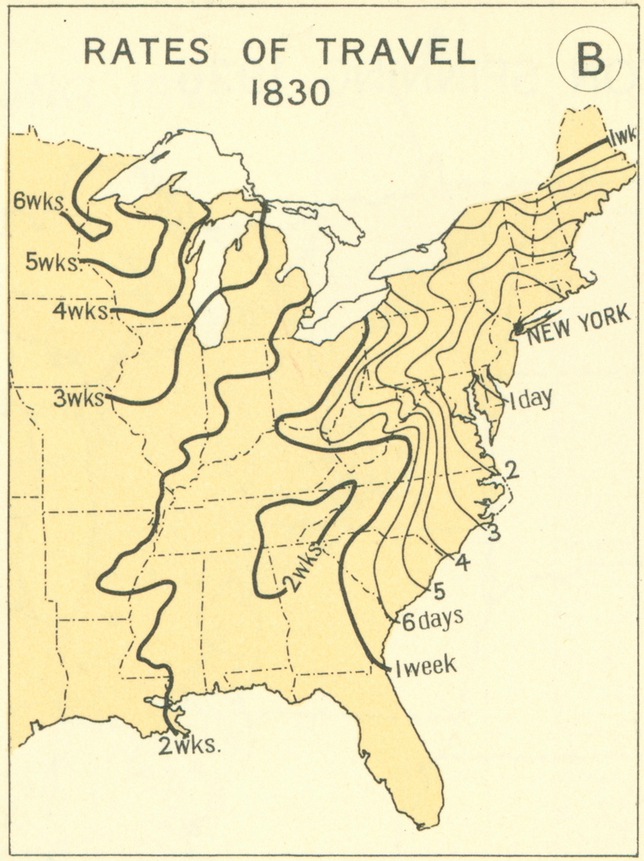
Check out the map at right. It shows how long it took to travel from New York City to various parts of the eastern U.S. – in 1830.  Looks like about three weeks to Chicago!  But you could get anywhere in New Jersey in just a day (though why would you want to?).

This article has several such maps, for dates ranging from 1800 to 1930.  Fascinating stuff!

Misleading News...

Holman Jenkins, writing in the WSJ($), sets us straight:
Said the New York Times climate blog, in an assertion that was echoed throughout the media: "The temperature differences between years are usually measured in fractions of a degree, but 2012 blew away the previous record, set in 1998, by a full degree Fahrenheit."

Really? If that were true, then hair-on-fire news should have been the fact that 2012 was 2.13 degrees hotter than 2011. That's a far more dramatic change, and in a single year.

Nor was it mentioned that 2008, in the contiguous U.S., was two degrees cooler than 2006. Or that 2000, 2002, 2003, 2004, 2008, 2009, 2010 and 2011 were all cooler than 1998 by a larger margin than 2012 was hotter than 1998.

Are you getting the picture? None of this was mentioned because it makes a mockery of using trends in the Lower 48 as a proxy for global warming, the misguided intent that permeated media coverage of the NOAA revelation. 
I had a similar discussion with several colleagues at work (my former work, I should say!).  They saw this same news, and their first reaction was “Dang, guess that global warming is for real after all!”  Knowing my AGW skepticism, they could hardly wait to tell me :)  It took all of 30 seconds to figure out what was really going on, exactly as Jenkins so nicely describes. The AGW enablers picked two arbitrary data points and implied something much greater than those data points actually showed – and their message was heard by the credulous, loud and clear...

Friday, January 11, 2013

Last Day...

Today is my last day at work; I'm officially retired as of this afternoon.

Wow.

I'll be back blogging tomorrow...

Thursday, January 10, 2013

Some Timely Posters...

Via my mom (the first one) and reader Jim M.:


Little Johnny Strikes Again...

Via reader Jim M.:
LITTLE JOHNNY STRIKES AGAIN

The teacher asked the class to use the word 'fascinate' in a sentence.

Molly put up her hand and said, 'My family went to my granddad's farm, and we all saw his pet sheep. It was fascinating.'

The teacher said, 'That was good, but I wanted you to use the word 'fascinate, not fascinating'.

Sally raised her hand. She said, 'My family went to see RockCity and I was 'fascinated.'

The teacher said, 'Well, that was good Sally, but I wanted you to use the word 'fascinate.'

Little Johnny raised his hand.

The teacher hesitated because she had been burned by Little Johnny before.

She finally decided there was no way he could damage the word 'fascinate', so she called on him.

Johnny said, 'My aunt Gina has a sweater with ten buttons, but her boobs are so big she can only fasten eight.'

The teacher sat down and cried.

A Visual Pun...

Via friend and colleague Aleck L.:


Ha!

How to Tear Out the Heart of a Dog Lover...

Via the irreplaceable Rachel Lucas, whose dog looks just like this one:


This brings tears to my eyes...

Balanced Rocks...

I have a hard time accepting that these are for real.  Many more photos here, and explanations here.  In some of the photos, it seems clear by inspection that the rocks are not actually balanced.  Maybe...

Wednesday, January 9, 2013

Country Music Songs...

Via my mom, who loves Country & Western music.  I'd never figured out why, but now I begin to understand.  I might have to listen to a few of the songs mentioned here:

Art Collmeyer...

Yesterday I heard from my friend Cliff F. that a former colleague of ours, Art Collmeyer, had died this past September at age 70.  I knew him mainly from his time as CEO of Stac spin-off HiFn, nearly 20 years ago.

My fondest memory of Art involves, of all things, email.  I was running the IT team at Stac at the time, and Art asked me to come talk with his secretary about an email problem.  I went to her desk, and asked what the problem was.  The problem, she said, was that each time Art replied to an email, it had her return address on it.  I told her that Art must have some configuration issue on his email, and I'd better go see him.  “No, no,” she said.  “You don't understand.  I answer Art's email for him!”

Upon some investigation, I discovered that a couple times a day Art's secretary would log into his email, forward all Art's email to herself, log into her email, print out all the new ones, and hand the papers to Art – who would then scribble his answers onto the printout and hand them back to his secretary.  The she logged back into her email and replied, transcribing Art's scribbles.  The solution was easy – I just told her to stop forwarding Art's emails to herself, and to simply reply from Art's account.  Problem solved.  But then I went in to talk with Art to find out why he did his email this way.  I've forgotten the words he used, but with fine humor he told me that he considered it a waste of his time to learn how to use email.  He knew perfectly well how to write an answer with a pen, and he had far better things to do with his time than to learn this new-fangled thing called email!

I recall one other conversation I had with Art, when he somehow discovered that back in the '80s I had done some design work on special effects generators for TV stations.  It turns out that he had been involved in some of the early digital graphics efforts, and his company had identified the TV stations as a potential market for them.  To this day, he's the only other person I've ever met who had a detailed knowledge of that market.

Above all, though, I remember Art as a genuinely nice guy – something that is far from universal for people with achievements like his own.  I'm saddened to hear of his death...

More info here and here...

Brushing Rocks on Mars...

Martian rocks are covered with a thick layer of reddish dust and dirt, largely obscuring the actual characteristics of the rocks themselves.  Curiosity carries a rotating wire brush – a kind of Martian whisk broom – designed to clean off rocks so that its instruments can get a clear view.  It just made the first use of this tool; results at right.  I'd say it worked pretty well!

Lakes With Ice – on Titan!?!

The intrepid Cassini robot explorer is still zipping around the Saturnian system, returning reams and reams of great science data.  One product of recent close passes to Saturn's moon Titan is high-resolution radar images of the Titanian surface (one of these is at right).

The bright areas on this image are from ground areas covered with frozen methane “ice”; these areas reflect radar well.  The dark areas are suspected of being liquid methane “lakes”.  Some of these are quite large, about like the U.S. Great Lakes.  But look closely, and you'll see some lake-shaped areas that are of intermediate brightness.  Scientists think these are lakes of liquid methane that are partially covered with frozen methane ice.

Titan is one of the most fascinating objects in our solar system.  The surface gravity is just 0.14g, or about 1/7th of Earth's.  The atmospheric pressure is about 50% higher than Earth's, but it's very cold (just above -300°F) and it has no oxygen.  Even so, biologists think that its at least possible that there might be life on Titan.  I would love to see a Curiosity-style rover exploring Titan...

Even More Linux Commands...

Another nice collection of Linux command line tricks...

Things I Did Not Know...

What's the difference between “Holland” and “The Netherlands”?  The answer is much more interesting – and involved –  than I expected it to be!

Domino Amplification...

It never occurred to me that the physics of dominoes would be interesting:

Domino...

Oatmeal's latest comic; a story about a cat named Domino.  It's a sad story with a happy ending...

The Art of the Rant...

When it comes to producing collectible rants, few living authors can match Megan McArdle.  She's just published another fine one, this time on the (apparently dead serious) proposal by some Democrats (and their fanboys) to mint a few trillion dollar platinum coins and use them to pay off the national debt.  An excerpt from Megan's beautiful rant on the subject:
The Great Platinum Coin Caper is everything that is wrong with Washington: a stupid partisan maneuver that erodes the institutions of our government for no gain other than an immediate political win. The only good thing that can be said about it is that the President seems to be too sensible to actually consider doing it. Nonetheless, the fact that intelligent people like Professor Krugman are even discussing this debacle, much less endorsing it, is a depressing reminder of just how nasty and short-sighted our nation’s capital has become.

When I was reporting on Wall Street, I used to be told with some regularity that government was needed to counteract the short-term thinking of the business sector, who never thought much beyond the next quarterly earnings report. This now seems as quaintly adorable as picture hats and daily milk deliveries. An ADHD day trader with a cocaine habit and six months to live has considerably more long-term planning skills than our current congress.
That last sentence is my quote of the day.  You will most definitely want to go read the whole beautiful thing!

Officers vs. Enlisted, Part 38,205...

For the record, I was an enlisted man in the U.S. Navy.  I was not an officer.  Via reader Jim M.:
A new Marine Captain was assigned to an outfit in a remote post in the Afghanistan Desert . During his first inspection of the outfit, he noticed a Camel hitched up behind the mess tent.

He asks the Sergeant why the camel is kept there.

The nervous sergeant said, ‘Well sir, as you know, there are 250 men here on the post and no women. And sir, sometimes the men have ‘urges’. That’s why we have Molly The Camel.’

The Captain says, ‘I can’t say that I condone this, but I understand about ‘urges’, so the camel can stay.’

About a month later, the Captain starts having his own ‘urges’. Crazy with passion, he asks the Sergeant to bring the camel to his tent. Putting a ladder behind the camel, the Captain stands on the ladder, pulls his pants down and has wild, insane sex with the camel. When he’s done, he asks the Sergeant,’Is that how the men do it?’

‘Not really, sir. They usually just ride the camel into town. Where the girls are.’

On What Planet Does This Make Sense?

On Planet California, of course.  The Reader's Digest version:

An attorney works for a law firm with many attorneys.  He steals money from one of the law firm's clients.  The law firm fires him.  The fired lawyer tries to collect unemployment benefits, which by law are not paid to people fired for “cause”.  The California Employment Development Department, or EDD (the bureaucracy that makes these decisions) rules that the attorney can collect unemployment benefits – because the law firm in question did not have an explicit, written policy forbidding stealing from customers.

I'm not kidding.  This really happened.  Actually, it happens every day – I can't recall a case where the California EDD ever ruled against an employee.

We're doomed.

Much more here, courtesy of CoyoteBlog...


Another Very Fine Rachel Rant...

This time on gun control and the 2nd Amendment...

Nest...

Yesterday we received our new thermostat, called a “Nest”, 2nd generation.  Ours is just like the photo at right.  We bought it to replace a roughly 10 year old thermostat we'd purchased from a now-defunct home automation company.  Our old thermostat had a very conventional display and controls, which means it was very difficult to use, along the same lines as modern electronic watches.  It did have the ability to “talk” on the network, but the software for it was just awful, and only worked on Windows.

I'd heard about the Nest thermostat some months ago from a colleague.  I figured I'd wait until the bugs had been worked out (and there are inevitably bugs!), and until some reviews came in.  Last week I heard about the second generation version, which I could reasonably hope worked out some bugs from the first generation.  Also I found some reviews, which ranged from merely positive to all-out fanboy ravings.  So I took the plunge and ordered it.

A slight aside: a frequent comment I see about the Nest is that it's expensive – and at $250, compared to a $40 or $50 conventional electronic thermostat, it is.  But really that's about like comparing a bicycle with a Toyota – you're not talking about the same kind of device at all.  I don't know about you, but I expect to pay more for the Toyota than for the bicycle (though there are some darned expensive bicycles these days!).  Clearly there is more cost in the Toyota, and for most of my travel needs, much more benefit.  So I'm willing to pay extra for it.  Ditto with a thermostat.  It's something that I use at least twice each and every day, and it controls something expensive to run, so I'm willing to pay a little more for it.  And just for comparison purposes, at $250, the Nest was less than half the price I paid for our previous thermostat!

Yesterday afternoon I set off to install the Nest.  When I opened the box, the first thought I had was “Apple!”.  That is, the packaging looked like something you'd buy from Apple, right down to the choices in packing materials.  The presentation was a little work of art, just like opening a box from Apple.  Someone paid close attention even to this detail.

What was in the box surprised me (I hadn't read anything at all about installing the Next prior to buying it).  First surprise: it comes with a quite nice little screwdriver, with an ergonomic handle and a magnetically secured dual flat blade/Phillips head screwdriver – the only tool I needed to install it.  Nice!  Second surprise: the installation booklet came with a set of wire labels, so that I could label all the old wires before removing them.  This is a very nice detail, and I'm sure it saves them a lot of time on support calls.  Third surprise: it comes with an assortment of mounting adapters that will let you mount the Nest in any circumstance I can imagine.  In our case, our old thermostat was (much) larger than the Nest, so we had a big, rectangular hole in the wall.  No problem; the Nest's box includes a white plastic plate designed to handle this precise issue.  Nice, Nest.

It took me perhaps five minutes to remove my old thermostat and label the old wires.  Then perhaps another five minutes to install the Nest's base plate and connect the (labeled!) wires to it.  Then I snapped in the actual Nest.  The installation instructions basically end at this point, with a sentence that tells you to follow the on-screen directions to finish setting up the Nest.  There's a web URL in case you get in trouble, but otherwise, that's it.

So when my Nest powered up, I really didn't know what to expect.  I was actually a bit surprised at this point, as I expected to have to first attach the Nest to my computer to set it up (I could see the micro-USB port on its bottom).  But the installation booklet made it clear that the setup was performed through the Nest itself.  The reason this surprised me is that the Nest's “user interface” is pretty darned basic: you can twist it clockwise or counter-clockwise, and you can push it to “click” it – but that's it.  No more user interface!  So I wondered how on earth I would, say, enter my WiFi password?

The answer delighted me, in fact I laughed out loud (which quite amused Debbie).  When you get to the point where you need to enter information, the Nest's display shows a circle of possibilities (such as the letters of the alphabet).  Then you just twist the Nest to select the one you want, and push it to “click” and select it.  That's it!  It took me no more than five more minutes to get it connected to our WiFi and to handle the other bits of its setup.

There was one little scary bit, though.  During the setup, there is a stage where the Nest tells you what sort of equipment it detected.  In our home we have both a heater and an air conditioner, but the Nest reported only finding an air conditioner.  In our case we have five wires connected to our thermostat, and I made the connections blindly following their directions – I had no idea which wire did what.  I remembered that when I installed our old thermostat, I basically had to reverse-engineer our heating and cooling system to figure out precisely what each wire did, then figure out which of the numerous terminals on the thermostat to connect them to.  I recall that it took me several tries to get it working.  Naturally, that got me imagining that I was about to go through the same thing again.

But first I thought I'd double-check that I'd actually installed the wires correctly.  So I pulled the Nest off it's mount and looked at my wiring job.  Oops!  The white wire wasn't actually in its little socket!  I pushed it into place and secured it, popped the Nest back on, and voila!  A little screen came up telling me that the Nest had detected an equipment change – and that now I had both a heater and an air conditioner.  Yay!

Next, I went to Nest's web site and registered my Nest.  That allows me to control my Nest from any web browser.  Sweet!  Then I went to the Apple app store, and downloaded the free Nest app – and now I can control my Nest from my iPhone.  Super sweet!  And all that took me another five minutes, tops.  The Nest people have made this a very painless process.

I don't have much experience with actually using the Nest yet.  I can report that it does the things you'd expect a thermostat to do (turn the heater on when it's too cold, turn the air conditioner on when its too hot), but I can't report on the Nest's vaunted learning features yet.  That will take a few weeks, as the Nest builds its knowledge of our habits.  What I can report on is what the geeks would call the “user interface” – what it's like for a human to actually use the thing.  Our Nest is mounted in our hallway, and we're finding the user interface to be as natural and simple as an old-fashioned mechanical thermostat.  The main thing one needs to do with a thermostat is to set the desired temperature, and on the Nest you do that by turning the dial.  It feels very natural, very simple.  There are separate set points for the heater and the air conditioner, and switching between them is just a click.  Again, simple and natural.  The fancier features are available from a menu, and while that's not quite as simple as setting the temperature, it's darned close.  Best of all: you don't need to remember anything all, as the screen provides all the reminders anyone would need.

I've left out one of our favorite features of the Nest's user interface: it detects your presence in front of it, and turns its screen on.  That's a very simple idea, but one that delights both of us.

Compared with our old thermostat, the Nest's user interface is spectacularly usable – but that's mostly a statement about how bad the old one was :)

The web site and iPhone apps are not quite as impressive.  They're fine, and easy enough to use – they just didn't delight me in the same way the Nest itself did.  In particular, the iPhone app doesn't let you use rotation the same way the Nest itself does.  I'd love to be able to move a set point by dragging it around the dial with my finger, but I can't – instead, I have to “click” on an up or down button.  Perfectly functional, but not the same experience as the Nest.  I can imagine that some might actually find it confusing, simply because it's different than the Nest itself.  But the fact that I can now check – and change – my thermostat from anywhere at all, any time at all, more than makes up for my picky complaints about the iPhone user interface!

Bottom line: two thumbs up for the Nest...

Tuesday, January 8, 2013

Oops: Sun Spot Count Unexpectedly Low – Again......

Solar scientists have various models aimed at predicting the variabilities in the sun's luminance (or irradiance, the sun's total energy output).  The main (though not the only) variable is related to sunspot count – somewhat counter-intuitively, the lower the sunspot count, the lower the sun's luminance.  Skeptics of anthropogenic global warming (AGW), myself included, have pointed out the close correlation between the sun's luminance and temperatures in the Earth's atmosphere.  In particular, the rising temperatures seen in the '90s and early '00s exactly corresponded with higher sunspot counts (and higher solar luminance).  Recent mainstream climatology studies have, somewhat obliquely, found the same thing.

So it is of great interest to AGW skeptics to note that the more recent lack of a warming trend in Earth's atmospheric temperature correlates rather well with a lack of sunspots – the sunspot counts are coming in consistently well below the predictions by the solar scientists' models.  Besides providing yet another really nice example of models gone horribly wrong, this also provides more support for the skeptic's hypothesis that the primary driver of “global warming” isn't greenhouse gases at all, but rather solar luminance.

The latest solar luminance numbers from NASA are plotted at right, with the dots being the actual data and the blue curve the smoothed equivalent.  The green curves are the predictions (from 2007) of the two main families of solar luminance models, each with their cadre of solar science supporters (there were also a few solar scientists who thought both models were bunk).  The red curve is a revised model, published in 2009 at which point it was quite clear that both original models were way off.  The 2009 model isn't faring much better.

Robert Zimmerman, who collected and published this data, says:
Meanwhile, on January 2 the solar scientists at the Marshall Space Flight Center once again lowered their prediction for the upcoming solar maximum, dropping their predicted peak sunspot number from 72 to 69. This is the fifth month in a row that they have changed their prediction, and the fourth in a row in which they have dropped it. Considering that we are now only a few months from when they say maximum should occur, their constant revision of their prediction suggests they really haven’t the faintest idea what causes the solar cycle, and are merely guessing at what they think will happen.
I agree. They haven't a clue. I wish they would just admit the mystery and get to work solving it!

Monday, January 7, 2013

Reaction Engines' Pre-Cooler...

A fascinating technological development, passed along by friend, neighbor, and reader Dick F. The video is a bit hyperbolic (they are looking for investors :), but the technology and its potential are fascinating nonetheless.

If you're not familiar with the challenges of jet engines at high speeds, you might be surprised to find that one of the most difficult challenges is heat – not from the combustion of fuel, but rather from the compression of the air being rammed into the front of the engine.  The pre-cooler developed by Reaction Engines is aimed at solving that challenge.  If they pull it off, hypersonic passenger aircraft traveling at 5,000 km/hour (3,000 miles/hour) are almost certainly in our future. I don't know about you, but personally I love the idea of traveling from San Diego to London in 90 minutes or so...

An Environmentalist Discovers Science...

Fascinating speech via reader and friend Doug W., who says:
I have never been quite sure what to think about the GM food scare, but in general my BS detectors were vibrating. Fascinating. Of course, his climate change stuff is still off, but it’s still worth a listen.

Transcript (a little different than the actual speech) available here...

Graphic of the Day...


Worst Recession Ever...Gets Even Worse...

I've posted this chart before; this is just another in a series of updates to it.  It gets more terrifying the more time goes by...


Q & A...

The question:
If someone from the 1950s suddenly appeared today, what would be the most difficult thing to explain to them about life today? 

To expand on the while there are a lot of obvious differences between now and 1950 in terms of technology, culture, etc., I wonder which changes or new things they'd grasp easily and which would be utterly perplexing.
The best answer (awesome++):
I possess a device, in my pocket, that is capable of accessing the entirety of information known to man.

I use it to look at pictures of cats and get in arguments with strangers.

53 Jokes...

Ok, this had me laughing – a lot.  Excellent:

Sunday, January 6, 2013

Tolkien...

Christopher Tolkien is not happy about the Lord of the Rings movies, and anticipates the worst from The Hobbit.  The word “eviscerated” is used...

Bet You Didn't Know These Were Visible!

Dave Carter, writing at Ricochet has a post that starts like this:
I noticed a couple of things while driving up from Hannibal, Missouri into Iowa last weekend.  The first was that the bottom had completely fallen out of the thermometer and taken the temperature with it.  Second, and there is really no polite way to describe this observation, … but when the temperature drops below 18 degrees Fahrenheit, one can actually see cow flatulence.  I know it's not a savory thought.  Nor is the phenomenon easy to see.  In fact, its almost as elusive as a partial lunar eclipse, or the backbone of a Republican, but I saw it just the same.  Which, of course, set me to thinking about what passes from Washington DC these days.
And then just keeps getting better.

How can you not love a post that starts by discussing the phenomenon of visible cow farts (which I have observed myself)?  Mr. Carter is hands-down my favorite truck driver...

Where Are People Moving Too?

Within the U.S. and Canada, one view of the answer is in the map at right, which shows as blue those states/provinces with more people moving to them, orange with more people moving from them, and red for states with about the same amount of people moving too or from them.

Mind you, this view is a bit biased: it measures moves by Atlas Van Lines, which means it's looking at a slice of relatively well-off movers (a great many people cannot afford to pay the likes of Atlas for their services).  Another thing to watch: some of the absolute numbers are very small.  For example, 3 people moved out of Newfoundland, and 9 people moved in.  With a sample that small, I don't think we learned very much about Newfoundland!

But even with all the caveats, there are some surprises on here (for me, at least).  Why are people leaving Wyoming?  Why are people moving to Washington?  Why aren't more people leaving California (like they are New York, New Jersey, Connecticut, and Illinois)?

I'm Not Sure How This Ended...

...because it cuts off in mid-action:

Masculinity...

Via reader Simi L.:

Employee Notice!

Via my mom:
EMPLOYEE NOTICE
**************************
Due to the current financial situation caused by the slowdown in the economy, the Government has decided to implement a scheme to put workers of 50 years of age and above on early, mandatory retirement, thus creating jobs and reducing unemployment.

This scheme will be known as RAPE (Retire Aged People Early).

Persons selected to be RAPED can apply to the Government to be considered for the SHAFT program (Special Help After Forced Termination).

Persons who have been RAPED and SHAFTED will be reviewed under the SCREW program (System Covering Retired-Early Workers).

A person may be RAPED once, SHAFTED twice and SCREWED as many times as the Government deems appropriate.

Persons who have been RAPED could get AIDS (Additional Income for Dependents & Spouse) or HERPES (Half Earnings for Retired Personnel Early Severance).

Obviously persons who have AIDS or HERPES will not be SHAFTED or SCREWED any further by the Government.

Persons who are not RAPED and are staying on will receive as much SHIT(Special High Intensity Training) as possible. The Government has always prided themselves on the amount of SHIT they give our citizens.

Should you feel that you do not receive enough SHIT, please bring this to the attention of your MP, who has been trained to give you all the SHIT you can handle.

Sincerely,
The Committee for Economic Value of Individual Lives (E.V.I.L.)

Rep. John Boehner and Sen. Mitch McConnell

PS - Due to recent budget cuts and the rising cost of electricity, gas and oil, as well as current market conditions, the Light at the End of the Tunnel has been turned off.