Monday, December 5, 2005

Will to Fight

One of my favorite blogs is neo-neocon, written by an ex-liberal turned conservative after 9/11. Her posts are real ponders, full of informed thinking and ideas. Definitely a post-coffee read, and on my list for every morning.

This morning she pointed me to a post on another blog, and (as she also says) it is simply excellent. Thanks, neo! A sample:

From Searchlight Crusade:

History is replete with superior armies, winning armies, defeated because they lost the will to continue. From battles at Cannae and Hastings to entire wars, the struggle is lost when the will to fight is lost.

On historical battlefields, and in historical wars, after this point is where the real carnage begins. However bad it gets, however horrible the casualties before the losers collapse, they usually become an order of magnitude worse afterwards. Roman casualties before the troops panicked at Cannae weren’t large. If they had instead of panicking managed to hold cohesion they could have aborted the majority of the Second Punic War right there by breaking Hannibal instead of him breaking them. The well-documented barbarities of the combatants upon the populace in Thirty Years War in Germany, the whole history of the Russian front in World War II, and countless other conflicts are more historical norm than anomaly, and had far longer casualty lists that the battles themselves.

The struggle we are fighting now is no different. Our opponent is not constrained by, indeed, makes no pretense that they are constrained by any consideration of “civilized warfare.” They have told us repeatedly, by their actions, that they do not consider civilian targets to be “off limits,” indeed, their attacks on civilians, and the number of civilian casualties, greatly outnumber their attacks upon our military and our military casualties.

Furthermore, they have told us repeatedly exactly what their strategic goals are: nothing short of the annihilition of our society and way of life as it exists. This is understandable, as our civilization’s great memes are in direct conflict with theirs. Evolving wisdom as opposed to revealed historical wisdom. Individual freedom of religion as opposed to enforced submission to the rule of one particular religion. However recently and imperfectly we may have come to it, respect for women and minorities of all sorts, and participation in our ruling bodies, versus subjugation of women to men, subjugation of others to the dominant religion, heavy ongoing penalties for those outside the favored class of the ruling religion.

Overall the piece is mostly about the importance of the will to fight, and about the corollary — that our enemy could not find a better way to win than by causing us to lose our will to fight. But as you can see in the sample, he’s also writing about why he feels the fight is justified. And eloquence here expresses my own position better than I’ve ever been able to.

It’s a longish piece, but well worth reading and pondering. Please read the whole thing.

The Way of the Criminal

What would you think if someone you respected told you that democracy was “criminal” — that it was just a way for men to place themselves above deity?

That’s exactly what al Qaida’s religious authority is propounding:

From CENTCOM’s "What Extremists are Saying":

On 30 November, a 44:35 minute audio message purportedly orated by Abu Hamza al-Baghdad, the head of the Shari’a Committee of AQI was issued. The speech, titled: “The Election is the Way of the Criminals,” expounds upon the group’s belief that the upcoming Iraqi parliamentary elections and democracy, in general, seek to deify man and denounce Islamic Shari’a, as politicians become the “highest authority and there is no other authority above them.” Further, al-Baghdadi argues that elections serve the American’s purpose to extinguish the jihad spirit within the mujahideen – that it will resolve the differences between the coalition and Iraq administrations and the insurgents- and “make your dreams come true.” The speech elaborates upon a multi-point denouncement of democracy’s purpose vis-à-vis Islam and principles as set out in the Qur’an, and additionally, states that those who participate and elect the men to “partner with Allah” will be considered infidels, as “they are the ones who are providing the mandate to the representatives to make the laws.” Also, the speech cites historic examples of America’s alleged tampering in foreign elections for their own interests, such as Italy in 1947, where the United States sought the “success of the Christian Democrats over the Communist Party.” The audio concludes with a message addressing the mujahideen to remain steadfast in their jihad and to “draw your swords of dignity.”

When President Bush says our enemy is “determined” — this is what he’s talking about. They see us as being as evil as we see … terrorism, beheadings, suicide bombings. And they use the evil they see in us as their justification for all those things.

When I hear (most) Democrats bleating about the need to bring the troops home, I am shocked each and every time. One of two things must be true: either (a) they’re so uninformed and/or stupid that they truly don’t recognize the threat to America, or (b) they are placing their political benefit ahead of America’s safety. I’m not entirely sure which is worse…

Saturday, December 3, 2005

Flat Kansas

Have you ever driven across Kansas? It really is unreasonably flat … as has now been scientifically proven, Kansas is damn flat!

From the Annals of Improbable Research:

Results

The topographic transects of both Kansas and a pancake at millimeter scale are both quite flat, but this first analysis showed that Kansas is clearly flatter (see Figure 4, right).

Mathematically, a value of 1.000 would indicate perfect, platonic flatness. The calculated flatness of the pancake transect from the digital image is approximately 0.957, which is pretty flat, but far from perfectly flat. The confocal laser scan showed the pancake surface to be slightly rougher, still.

Measuring the flatness of Kansas presented us with a greater challenge than measuring the flatness of the pancake. The state is so flat that the off-the-shelf software produced a flatness value for it of 1. This value was, as they say, too good to be true, so we did a more complex analysis, and after many hours of programming work, we were able to estimate that Kansas’s flatness is approximately 0.9997. That degree of flatness might be described, mathematically, as “damn flat.”

You know you need to read the whole thing!

Friday, December 2, 2005

Toucan Beaks

Most engineering that people are familiar with is accomplished by engineers with an understanding of the science underlying their discipline. They use that understanding to determine how to approach the problem they’re solving. Most of the time there are multiple possibilities — for example, there are many ways to build a 100 foot long bridge — and engineers use other factors (cost, aesthetics, experience, etc.) to choose amongst the possible approaches. This science-driven engineering is what we’re used to, but it is not empirical engineering. It is enabled by our accumulated scientific understanding, and by our human ability to apply that understanding to solve a problem.

However, science-driven engineering is not the only kind of engineering. Empirical engineering is accomplished by trying solutions over and over again, trying to improve the result each time. Empirical engineers don’t understand the whys and wherefores of what they’re doing; they just try things to see if they work — and when they do, they remember it, incorporate it in their design, and move on to the next empirical engineering optimization.

A few years ago, I read of a very good example of empirical engineering by humans: the Roman’s development of catapults, trebuchets, and the like (weapons that hurl large weights). The Romans who designed these machines had zero understanding of the science underlying the mechanics and physics of what they were building — and yet, over time, the machines they designed evolved into designs that a modern engineer (similarly restricted in choice of materials) would be proud of. The really interesting part of this example is that there is quite a good history of the Roman weapons' development over time — so archaeologists have been able to recreate an approximate history of their empirical engineering.

A few lines ago, I used a phrase ("and yet, over time, the machines they designed evolved into designs that a modern engineer would be proud of") that ought to give you a little mental nudge — because that phrase describes the process of biological evolution quite nicely. Biological evolution is the ultimate in empirical engineering. Here’s a great example of that:

From UCSD’s Jacobs School of Engineering:

In a paper to be published Dec. 1 in Acta Materialia, Meyers and graduate students Yasuaki Seki and Matthew S. Schneider reported that the secret to the toucan beak’s lightweight strength is an unusual bio-composite. The interior of the beak is rigid “foam” made of bony fibers and drum-like membranes sandwiched between outer layers of keratin, the protein that makes up fingernails, hair, and horn. Just as the hook-shaped barbs on cockleburs inspired the development of Velcro, Meyers said the avian bio-composite could inspire the design of ultra-light aircraft and vehicle components with synthetic foams made with metals and polymers.

"The big surprise was our finding that the beak’s sandwich structure also behaves as a high energy impact-absorption system,” said Meyers. “Panels that mimic toucan beaks may offer better protection to motorists involved in crashes."

Read the whole thing!

Creationists (using the term very loosely) have trouble imagining that something like the toucan’s beak could develop through evolution. After debating many of these folks, I think there are two things (other than pure blind faith) that drive the trouble they have: one is their incomprehension of the amount of time available for evolution to have occurred, and the other is their incomprehension of empirical engineering. I’m not at all sure how to solve these problems <smile>, but I have had some success in debating creationists by raising the topics. There are abundant examples of empirical engineering all around us, so simple and obvious that absolutely anyone could understand them (I’ve used the example of the Roman’s weapons many times; their bridge-building is equally good). The concept of the passage of millions or even billions of years is more challenging to communicate — especially if the person you’re debating is of the fundamentalist persuasion and is convinced that the Earth is only a few thousand years old…

A tip of the hat to GrrlScientist at “Living the Scientific Life” for the pointer to the article in her most recent Birds in the News post. If you’re at all interested in birds, and you’re not familar with her blog, check it out — she does a wonderful job of presenting all kinds of news about birds…

Moons of Saturn

The Cassini robotic spacecraft orbiting around Saturn turns in marvelous science data day after day. The Cassini team also took the trouble to chart when the spacecraft happened to be in places where particularly spectacular pictures could be taken — without regard to their scientific value — and made time in the schedule to take those pictures. This is one of those images.

From the official Cassini-Huygens web site:

In a rare moment, the Cassini spacecraft captured this enduring portrait of a near-alignment of four of Saturn’s restless moons. Timing is critical when trying to capture a view of multiple bodies, like this one. All four of the moons seen here were on the far side of the rings from the spacecraft when this image was taken; and about an hour later, all four had disappeared behind Saturn.

Seen here are Titan (5,150 kilometers, or 3,200 miles across) and Dione (1,126 kilometers, or 700 miles across) at bottom; Prometheus (102 kilometers, or 63 miles across) hugs the rings at center; Telesto (24 kilometers, or 15 miles across) is a mere speck in the darkness above center.

The image was taken in visible light with the Cassini narrow-angle camera on Oct. 17, 2005 at a distance of approximately 3.4 million kilometers (2.1 million miles) from Dione and 2.5 million kilometers (1.6 miles) from Titan. The image scale is 16 kilometers (10 miles) per pixel on Dione and 21 kilometers (13 miles) per pixel on Titan.

The Cassini-Huygens mission is a cooperative project of NASA, the European Space Agency and the Italian Space Agency. The Jet Propulsion Laboratory, a division of the California Institute of Technology in Pasadena, manages the mission for NASA’s Science Mission Directorate, Washington, D.C. The Cassini orbiter and its two onboard cameras were designed, developed and assembled at JPL. The imaging operations center is based at the Space Science Institute in Boulder, Colo.

Click on the thumbnail to get a larger view — it’s quite spectacular.

Optical ripples

This interesting pattern showed up on my bedroom wall this morning — a spot of sunlight shining through the window. I’ve processed this photo to enhance the fairly subtle vertical “ripples” in the brightness of the light.

The spot of light in the photo is about 4 inches (10 cm) wide, but the light that made the spot passed through a 32 inch (80 cm) wide window. This happened because the early morning sun was low in the sky, right on the horizon, and it happened to be at just the right compass bearing to shine almost (but not quite!) edge-on to the window.

So what causes these ripples?

My first thought was that we had some vertical streaking of dirt on our windows (if you saw our windows, you’d think this was quite likely <smile>!). But as far as I could perceive, the dirt on the window was quite randomly placed. My next thought was that there were vertically-oriented thickness variations in the pane of glass — and this I was able to verify simply by looking at reflections in the glass, while viewing at an almost edge-on angle from one side. When I did the same thing from below, there were no visible variations. Bingo! Slight thickness variations in the pane of glass, with a vertical orientation, are causing this phenomenon.

I’ve never noticed these thickness variations before, most likely because they’re very small, and we don’t normally look through windows edge-on. I googled a bit to see if I could find a reference to these ripples, but I didn’t find anything directly relevant. In one description about how modern window glass is made (with “Pilkington’s method"), I did learn that one side of a pane of glass is “fire polished” as it moves down a conveyor — I speculate that the fire-polishing machine is responsible for the ripples, and that they’re linear because the glass is moving in only one direction past the fire-polishing machine…

Animusic

I’ve never seen anything like this — animated music, called “Animusic” by the author. It’s synthesized music, with choreographed animations of synthesized performers. But my words will never do this justice; visit the site and watch some of the sample clips.

And even though I can’t adequately describe it, I know I like it! I’m going to have to get me a set of the DVDs…

Bill Roggio

Bill Roggio (a long-time and invaluable blogger on the War on Terror, on “The Fourth Rail") recently traveled to Iraq and started filing reports directly from the field. His new reports are published on a new blog: ThreatsWatch.org. A sample:

From ThreatsWatch:

Today’s meeting was the first attended by the Sulemani, the tribe which sided with al-Qaeda and the insurgency over the summer. The meeting I attended last Monday with Lieutenant Oren and the tribal sheikhs was the first face to face contact with the Sulemani and the U.S. Military, and facilitated their attendance at today’s meeting.

Col Razak chaired the meeting, and was a commanding presence. He stressed the importance of Iraqis being in control and “not allowing any stranger to come here… Terrorists come to this town specifically to use you and the people, and only harm innocent people.” One of the greatest fears of the residents of the region is the premature withdrawal of U.S. and Iraqi forces.

But the locations of the Battle Positions in the Al Qaim region is also a matter of concern. The bases often lie on main roads, near mosques or marketplaces, and the residents are inconvenienced by their locations as travel is often restricted due to the checkpoints. LtCol Alford stressed the importance of the residents of the region and the tribal sheikhs taking responsibility for local security, so the bases can be dismantled in the future. “This will not happen overnight… you must build your government up, establish a police force” before the military units move out, said LtCol Alford. “I believe the first group to leave will be U.S. Forces, then the Iraqi Army. But this will not happen without your help.”

He goes on to describe the search for a weapons cache that the local troops got some information on, and the locals reactions. Good stuff, all of it — and another pair of reliable eyeballs, like Michael Yon, but with yet another valuable perspective. Make ThreatsWatch a regular reading stop…

Not a Bomb!

The MSM went a little crazy reporting about the alleged bomb blast that breached the levee (if you need a refresher on these stories, see here, here, here, and here for a representative sampling). The stories never did make much sense, but a recent report pretty much destroys the conspirists theories…

From the New Orleans Times-Picayune:

The floodwall on the 17th Street Canal levee was destined to fail long before it reached its maximum design load of 14 feet of water because the Army Corps of Engineers underestimated the weak soil layers 10 to 25 feet below the levee, the state’s forensic levee investigation team concluded in a report to be released this week.

That miscalculation was so obvious and fundamental, investigators said, they “could not fathom” how the design team of engineers from the corps, local firm Eustis Engineering and the national firm Modjeski and Masters could have missed what is being termed the costliest engineering mistake in American history.

Someone once famously said that when pondering the cause of anything, where one of the choices was human stupidity, bet on the human stupidity.

Right again!

The quote above is just the lead to the Times-Picayune article, which is a good one — read the whole thing

Crab Nebula

Another amazing image from the Hubble telescope. When you look at one of these, and compare it to what was obtainable from earth-based telescopes over the past 50 years, it seems almost unbelievably sharp and detailed. Yet earth-based telescopes can already surpass Hubble’s resolution, have for many years been able to surpass its light-gathering power. With the advent of multiple-mirror telescopes with adaptive optics, and long baseline optical interferometry, earth-based telescopes are on the verge of greatly exceeding the capabilities of any telescope that could reasonably be placed in space — with the possible exception of a lunar-based telescope, though how practical and reasonable that might be is certainly open for debate.

From the official Hubble web site:

This is a mosaic image, one of the largest ever taken by NASA’s Hubble Space Telescope of the Crab Nebula, a six-light-year-wide expanding remnant of a star’s supernova explosion. Japanese and Chinese astronomers recorded this violent event nearly 1,000 years ago in 1054, as did, almost certainly, Native Americans.

The orange filaments are the tattered remains of the star and consist mostly of hydrogen. The rapidly spinning neutron star embedded in the center of the nebula is the dynamo powering the nebula’s eerie interior bluish glow. The blue light comes from electrons whirling at nearly the speed of light around magnetic field lines from the neutron star. The neutron star, like a lighthouse, ejects twin beams of radiation that appear to pulse 30 times a second due to the neutron star’s rotation. A neutron star is the crushed ultra-dense core of the exploded star.

The Crab Nebula derived its name from its appearance in a drawing made by Irish astronomer Lord Rosse in 1844, using a 36-inch telescope. When viewed by Hubble, as well as by large ground-based telescopes such as the European Southern Observatory’s Very Large Telescope, the Crab Nebula takes on a more detailed appearance that yields clues into the spectacular demise of a star, 6,500 light-years away.

The newly composed image was assembled from 24 individual Wide Field and Planetary Camera 2 exposures taken in October 1999, January 2000, and December 2000. The colors in the image indicate the different elements that were expelled during the explosion. Blue in the filaments in the outer part of the nebula represents neutral oxygen, green is singly-ionized sulfur, and red indicates doubly-ionized oxygen.

Click on the thumbnail above for a nice large version of the photo mosaic…

Thursday, December 1, 2005

Act of Kindness

Here’s a story from “The Will to Exist" — a bit of a tear-jerker — that happens to be placed in Iraq, though that really isn’t particularly relevant. The heart of it:

I made a spur of the moment donation of cash out of my pocket. And I’ll never regret it. Most people I know will never live in a war torn city. Most will never be crippled. Most won’t ever wonder where they will get the money to renew their passport so they can start a new job and renew hope. Most will never have to survive on their own ability to make other people laugh - to turn a life of hard times into a funny story that makes people around smile and laugh so that their eyes crinkle up.

But do read the whole thing

Wednesday, November 30, 2005

Deteriorating Spam?

I have the feeling that the quality of spam is going down, and rapidly. What that means is anyone’s guess (assuming that I’m even right). I had to search through today’s spam to find one that I was comfortable reprinting — some are so awful that I feel the need to cleanse myself somehow. Good thing I’m going to be taking a shower here shortly! Anyway, here’s one of the over 200 spams I received today, verbatim except I redacted a few things that might actually help the spammer:

Subject: FW: Elof Your cheaper health commodities are in order.

To: <redacted>

From: <redacted>

Elof

I’m sending this your way.

Karoline

— — — -Original Message — — — -

From: Rufus [mailto:xu@kdpp.com]

Sent: Wed, 30 Nov 2005 10:53:10 -0700

To: Logan

Subject: Roseanne Obtain your curing products for less money from our on

line shop.

Ciao Mathilde,

No one can make obtaining your treatments exhilerating, but at least our

e-pharmacy can make it effortless. Manage your PMS by intake our product.

Find all the brand name enhancers and more in our shop. Our ever-enlarging

patron cluster has allowed us to be a wonderous success amongst pharmacies.

<URL redacted>

Effective item, sold at min price. E purchase in bulk & save more.

Fed up with queuing up for forever in druggist lines? We have your remedy!

Cheers

Jenette

"Three times,” reserve universe percent said the Professor. in the pictures

of him), ghost humour while the rest waited in silence. theory At HNp

threw down the trademark strip routine of wood irritably.

Do you find this convincing? Does it make you wanto click on that link to buy some drugs? Do you feel safe giving your credit card information to the writer of this?

It’s hard for me to imagine that spam of such low quality could possibly succeed. I hope it’s true that I don’t know anyone who would consider responding from this. Certainly not my blog readers! Maybe some distant New Jersey relative…

But this starts me on a ponder… I get so many of these atrocious spams that I wonder if in fact they actually are successful. Surely if they were failures they’d all quickly go away — who would go to all this trouble for nothing? Because email is free, the spammer needs only a very small percentage of responders to succeed. So follow the thought — let’s say that the email above actually did succeed, with a response rate of, oh, say, a paltry 0.0001%. Let’s say it was sent to 10 million people. That works out to 10 responses (if I did my math right). From the spammer’s point of view, that’s 10 sales (or more likely, 10 stolen credit card numbers), with zero marketing cost. The only problem is that 9,999,990 of us have to suffer.

And that gets me to my real point, to wit: if these awful spams actually are successful (from the spammer’s perspective), isn’t that kind of scary? I mean, who are these people who actually respond to something like this? Could there really be that many people missing such a high percentage of their little gray cells? What group of people is so divorced from reality that they’d fall for something like this? Can you think of one?

Of course you can! POLITICIANS! BWA HA HA HA!

I feel better about spam already!

Tuesday, November 29, 2005

A Democrat?

Senator Joe Lieberman has a fine opinion piece in today’s Wall Street Journal. It describes the progress he witnessed first hand on his recent trip to Iraq (his fourth, by the way). The piece concludes with this:

I cannot say enough about the U.S. Army and Marines who are carrying most of the fight for us in Iraq. They are courageous, smart, effective, innovative, very honorable and very proud. After a Thanksgiving meal with a great group of Marines at Camp Fallujah in western Iraq, I asked their commander whether the morale of his troops had been hurt by the growing public dissent in America over the war in Iraq. His answer was insightful, instructive and inspirational: “I would guess that if the opposition and division at home go on a lot longer and get a lot deeper it might have some effect, but, Senator, my Marines are motivated by their devotion to each other and the cause, not by political debates."

Thank you, General. That is a powerful, needed message for the rest of America and its political leadership at this critical moment in our nation’s history. Semper Fi.

Thank you, Joe. It’s a darned shame that so few of your fellow Democrats can, like you, see the truth through the politics…

Monday, November 28, 2005

Shaped Like Iran

Today’s “Day by Day” cartoon contains a reference to a “glass parking lot, shaped like Iran”. For over fifty years I’ve been hearing my Dad advocate such nuclear-powered solutions to vexing political (or cultural, or criminal) problems. Usually he’d talk about the benefits of the radioactive glass, and the even greater benefits of “disappearing” the glass’s ingredients. I got a good laugh from hearing Chris Muir say something similar in his cartoon this morning.

And at this point I’m so frustrated with the mad mullahs that the glass parking lot solution is sounding pretty good…

Email Chain

Have you ever received an email that expresses something you agree with in a powerful, clever, or funny way — and then passed it along to others whom you think might enjoy it? I certainly have. That’s the essence of an “email chain” (whether or not the author explicitly asks you to pass it along). With the advent of nearly universal email, it’s a powerful way of delivering a message, and it’s free.

But these days I’m a little more cautious forwarding such things. The caution comes from having been burned a couple of times by outright falsehoods in the message — and even if the message is one that I agree with, I do not want to be a party to marketing the message with a lie.

This morning I received a chain email from a friend, and it was one I’d seen before — in early 2002. Like others I’ve received, it has a message that I agree with: basically it chides the Democrats for their implications of high casualty rates in Afghanistan and Iraq, and their complaints about the overly-long military actions there. The email does this in a way that is clever, but isn’t quite honest.

I’ll start dissecting this email by pointing out one part of it that is completely accurate: toward the end it embeds a faithful transcript of a speech on the U.S. Senate floor, by John Glenn responding to Howard Metzenbaum:

I served 23 years in the United States Marine Corps. I served through two wars. I flew 149 missions. My plane was hit by anti-aircraft fire on 12 different occasions. I was in the space program.

It wasn’t my checkbook, Howard; it was my life on the line. It was not a nine-to-five job, where I took time off to take the daily cash receipts to the bank. I ask you to go with me … as I went the other day… to a veteran’s hospital and look those men - with their mangled bodies - in the eye, and tell THEM they didn’t hold a job!

You go with me to the Space Program at NASA and go, as I have gone, to the widows and orphans of Ed White, Gus Grissom and Roger Chaffee… and you look those kids in the eye and tell them that their Dads didn’t hold a job.

You go with me on Memorial Day and you stand in Arlington National Cemetery, where I have more friends buried than I’d like to remember, and you watch those waving flags.

You stand there, and you think about this nation, and you tell ME that those people didn’t have a job? I’ll tell you, Howard Metzenbaum; you should be on your knees every day of your life thanking God that there were some men - SOME MEN - who held REAL jobs. And they required a dedication to a purpose - and a love of country and a dedication to duty that was more important than life itself. And their self-sacrifice is what made this country possible.

I HAVE held a job, Howard! What about you?"

Now that’s a fine little speech. Stirs the blood. Makes you want to smack Howard Metzenbaum around a bit, doesn’t it?

I’m ancient enough to have a clear memory of that speech being given. The email claims it happened on January 26, 2004, but Senator Glenn had been retired for over four years at that point. In actuality, Glenn gave this speech in 1974, during the campaign in which he was first elected senator. I was at that time in the U.S. Navy, and that speech got a lot of play in the media. An aside: John Glenn was a Democrat — hard to credit given his party’s posturings now, isn’t it? And he was succeeded by a Republican — the disgusting Senator “crybaby” George Voinovich. Something in the water in Ohio…

The email also repeats a urban legend: that the above speech by John Glenn was an impromptu response to Howard Metzenbaum asking “How can you run for Senate when you’ve never held a real job?” In actual fact, so far as I can find out, Howard Metzenbaum never actually uttered those words (though he implied as much during the campaign, frequently and snidely). And that speech was far from impromptu: it was carefully crafted by the finest speechwriters that money could buy — to imply otherwise is to insult the Peggy Noonans of the world. Just after the speech, the email makes a claim that I cannot substantiate: that Howard Metzenbaum represented the Communist Party during World War II. Various biographys of Metzenbaum all verify that he was an attorney during the war, but I’ve not found a single reference him representing the Communist Party — not even on a simple suit.

So the email faithfully repeats Glenn’s speech, but mischaracterizes it a little. Not so bad yet. But before the speech, the email says this:

Things that make you think a little…

1. There were 39 combat related killings in Iraq during the month of January…

In the fair city of Detroit there were 35 murders in the month of January. That’s just one American city, about as deadly as the entire war torn country of Iraq.

2. When some claim President Bush shouldn’t have started this war, state the following …

FDR…led us into World War II. Germany never attacked us: Japan did. From 1941-1945, 450,000 lives were lost, an average of 112,500 per year.

Truman…finished that war and started one in Korea, North Korea never attacked us. From 1950-1953, 55,000 lives were lost, an average of 18,334 per year.

John F. Kennedy. ..started the Vietnam conflict in 1962. Vietnam never attacked us.

Johnson…turned Vietnam into a quagmire. From 1965-1975, 58,000 lives were lost, an average of 5,800 per year.

Clinton…went to war in Bosnia without UN or French consent, Bosnia never attacked us. He was offered Osama bin Laden’s head on a platter three times by Sudan and did nothing.

Osama has attacked us on multiple occasions.

3. In the two years since terrorists attacked us: President Bush has liberated two countries, crushed the Taliban, crippled al-Qaida, put nuclear inspectors in Libya, Iran and

North Korea without firing a shot, and captured a terrorist who slaughtered 300,000 of his own people.

The Democrats are complaining about how long the war

is taking, but … It took less time to take Iraq than it took Janet Reno to take the Branch Davidian compound. That was a 51-day operation.

We’ve been looking for evidence of chemical weapons in Iraq for less time than it took Hillary Clinton to find the Rose Law Firm billing records.

It took less time for the 3rd Infantry Division and the Marines to destroy the Medina Republican Guard than it took Ted Kennedy to call the police after his Oldsmobile sank at Chappaquiddick killing a woman.

The above is a little sloppy on the facts, but not actually too bad. The reference to Detroit is accurate, though of course the writer picked one of our most violent cities. The litany of Democratic Presidents taking us into wars is accurate — though the death tolls listed are American deaths, not total deaths in those wars. I could quibble about the FDR and World War II references — there are som actual attacks by the Germans, and their allies the Japanese most certainly did attack us. Of course all the smaller conflicts and wars that Republican Presidents led us into (Panama, Grenada, the first Gulf War, to mention a few) were all left out. The last paragraph is cute, but I think not factually correct.

But the real point is this: what on earth does the above have to do with Senator Glenn’s speech? Utterly nothing, so far as I can tell. It’s just a bald attempt to attach the power of Senator Glenn’s fine speech to the message of the anonymous author.

Many of the chain emails I get are far worse than this one — filled with ouright falsehoods and mischaracterizations. And sometimes, of course, the message is not one that I can agree with. But no matter what the message, these days I try to check them out before I pass them along. Google and Snopes are my two favorite references. For Google, I just pick a sentence or two at random from the email, and search for it (with quotes around it); nearly always Google finds some mentions, and usually there’s at least one case where someone fact-checked the email. Snopes is an invaluable resource dedicated to dissecting urban legends and figuring out whether they’re true or false. I wish more people would do this before they passed along a message full of lies…

Saturday, November 26, 2005

Follow the Money

An oft-repeated piece of advice to detectives trying to solve a mystery is “Follow the money!” It’s a good piece of advice, as people are much more inclined to show their true feelings in how they obtain or spend money than they will in their words.

So with that in mind, consider this piece of news:

From the Washington Times:

Iraq’s Red Crescent relief organization found its own way to mark the Thanksgiving holiday yesterday by announcing that it had sent a $1 million “thank you” donation to the victims of Hurricane Katrina.

The sum, transferred by wire on Sunday, amounts to 20 percent of the organization’s annual budget.

“I wish we could have a billion dollars to give,” Said Hakki, the organization’s president, said by telephone from Baghdad. “Even then, it is not enough to show our appreciation for what the U.S. has done for Iraq and is still doing."

The donation was made with the approval of the office of Prime Minister Ibrahim al-Jaafari and is thought to mark the first time that Iraq has sent aid to the United States.

Haydar al-Abadi, a senior adviser to the prime minister, said in a separate telephone interview that he was worried that the gesture — though noble — could prompt complaints that the money should have been spent on the country’s own emergencies.

But Mr. Hakki was adamant.

“Giving thanks is an Iraqi tradition as well as an American one. This is the minimum we could do after the Americans shed their blood in our country, mixing their blood with ours,” he said.

He said the overthrow of dictator Saddam Hussein was “a blessing from God, and the U.S. was His tool."

An underfunded Iraqi relief agency (the Red Crescent is very similar to the Red Cross) donates a fifth of its entire annual budget to United States, and forcefully positions the donation as a way to say thanks for taking out Sadaam Hussein and his band of merry thugs. And then says they wish they could give more!

I wonder how the lefties would interpret this? Most likely, they’ll just ignore it. So far, a Technorati search yields no leftie blog comments (and not too much notice in general).

I can only see one way to view this: genuine, heartfelt gratitude on the part of a good number of Iraqis. Noble, indeed, my Iraqi friends…

Friday, November 25, 2005

Sgt. Furman

I received this email from one of our soldiers that I’ve corresponded with. No comments are needed.

Hello everybody, this is Sgt. Furman from Mosul, Iraq again. After sending out my thank you letter, many people wrote back and asked that I try to send out updates on my progress in Iraq, some even suggested that I start my own blog. Well, time didn’t allow me to start my own blog, but as my deployment comes to an end, I thought I would write a final letter on my thoughts, and let everybody know that I made it through o.k..

The hot summer days and nights seem to have come to an end, and the days are now growing cooler as fall begins to sweep her hand over Northern Iraq. In a little over a month or so, I will be sitting on a plane headed back to the states, slowly leaving Iraq behind me with only my pictures, thoughts and memories to take with me. Even as I begin to pack it hasn’t set in that I am finally leaving this place that I have come to know with both hate and love so well.

This experience has been, and will no doubt be the most challenging of my life. When I first arrived here, I really wanted to hate this place. Try as I might, I found it impossible to hate Iraq. Although there is no place like the United States, Iraq is as beautiful a country as any. Sometimes you might have to look a little beyond the surface to find the beauty in it, but I assure you, it is there. There is no more an awe inspiring sight than that of an Iraqi night. While in the city of Tall Afar for a few days, I sat outside my “hooch” under the night sky and listened to the sound of 155mm Howitzers keep a thundering cadence on a distant target, and watched as a countless number of shooting stars passed over head. Under that same moon I have contemplated what my loved ones back home were doing at that very time; have had many great conversations with my fellow Soldiers; and let the lingering thoughts from the day pass out of my mind before I would go to sleep. And at times, it seems that Iraq had literally sucked all life from my body. There have been times that I felt that I was little more than a walking zombie.

The history and culture of Iraq has much to give to the world. I have found the Iraqi’s to be kind, loving, gentle and extremely resourceful. I feel that we have as much to gain from their friendship as they have to gain from ours. It seems to me that most Iraqi’s want nothing more than what the average American wishes for. A family to love, a home to come to at the end of the day, and most of all, the freedom that we all enjoy and love. It is my most sincere hope that they all get this and more.

As for the war itself, it is hard to put my thoughts and feelings into words, but will try to do my best. After a year of participation and observation, I can only say that war is horrible. Perhaps the most horrible of all actions. It’s not an adventure, or a right of passage. It’s visceral and evil. Carnage and violence at it’s worst. It is a place where one man willingly dispatches the life of another, lest that fate come to him. It is the only place where the amount of blood shed in the street is the measure by which you can judge success. It is not a movie that you can watch abstractly from the comfort of a theater seat. It is very real. It is a place where people die, and their loved ones are left heartbroken. At times it seems to be a living breathing entity. The most horrible monster you can imagine. It has no rhyme or reason, it just is. There is no point in trying to make sense of it, because there is no sense to be found in it. Yet, even through all of this, we have brave men and women who continue to charge into battle, and fight for all they can so others unknown to them may gain something from it.

Horrible as it is, it is a necessary evil. After a year, I still hold firm in my opinion that we are doing the right thing in Iraq. I don’t want you to mistake me for a warmonger, because that is as far from the truth as could be. I don’t believe there is a Soldier who is currently serving that is happy they are serving in a war. Don’t mistake pride of service for your country and your fellow man for joy of war. It is not the same. Believe me, the battles that are won here every day are not known to any human outside of the borders of this country. I don’t mean the major military victories that you can see on the news, or read in the paper, but the victories of the heart and will of the human. Every day an Iraqi awakes with the realization that they are free. That they can willfully speak their voice, right or wrong. Every day, as shown by the referendum, more and more Iraqi’s begin to place trust in their country, and in the protection that we are here to give to them. As contradictory as it might be, watching a country begin to take shape from this monster is an awesome thing to behold.

It will be hard for me to leave Iraq. Our time is done here, and now the battle is in another’s hands. I know that when I board that C-130 for my flight out of Mosul, and take my last breath of the Mosul air, that I will leave a piece of me in Iraq, and take a little piece of her home. She will be with me forever. The memories of her smiling children’s faces, the hot summer air, the gorgeous Arabian nights, and most assuredly, the thought of all the brave men and women who have fought and died for it all.

We have all followed the headlines of the vote in congress about a possible pullout of troops here. In my opinion (I want to make this clear, this is only my opinion, and I am only a Soldier, not a policy maker), a pullout at this time would be the most detrimental of all actions that our country could make, not to mention irresponsible. Truth be told, I don’t understand why there was ever a need for congress to even push the issue? What’s to debate? I will admit that I wasn’t completely sold on the war in Iraq in the beginning either, but after a year of witnessing the war for myself, I truly believe in what we are doing here. To me it doesn’t matter why we are, I am a Soldier, and go where I am ordered, but on a personal level, at the beginning, I thought hunting terrorists in Afghanistan was a more worth while fight. I was wrong. There are as many terrorists (not “insurgents”) here. I’m most certainly biased, but I’m certain that the U.S. Armed Forces are the best in the world, and I know for a fact that we are doing the best we can over here. Most of the Soldiers I have talked to feel exactly the same way. LET US DO OUR JOB! If we were to pullout now, everything that my unit has fought for this last year will be for nothing. Not to mention all of the men and women who suffer through severe injuries, and who’ve given their lives. It would be the ultimate of injustices to them to pullout now. Let us see this through to the end. If not for all the other reasons that I have mentioned; then for the simple fact, that it is unquestionably the right thing to do, and that all the people of Iraq, especially the children deserve it. I write this knowing full well, that I face the possibility of another deployment.

Many of us are looking to the future with optimism, both for Iraq, and our own lives. Some of us don’t know what the future holds for them, but will no doubt be just as successful as they were here. Unfortunately, for some, this war has taken a greater toll than just a year of life. Some of us have paid almost as much as the ones who will never again breath life, going home to broken lives due to the stress of being so far apart from their significant others. Personally, I will go back to my civilian job, and my family. I have a great girl that is waiting for me, and I just can’t wait to hold her in my arms again. Since I last wrote, I have re-enlisted in the guard for another 6 years (a sure sign I believe in what I preach), and don’t know if I will have to come back here again. If I do return here, I will hold my head high knowing that all of you great Americans back home are supporting me and have my back!

I just want to let all of you know that during the harder times in Iraq I have re-read some of the e-mails that you all have sent to me, and I still check the account for any new ones that might come my way. This has done wonders to lift my spirits at some very challenging times. Thank you! Please continue your support for us, and say thank you to any service member of any conflict that might come your way. They all deserve it. Maybe someday our lives might cross paths. If not, thank you again.

As I sit here and write this on Thanksgiving, although I have a lot to be thankful for this year, I thought I would share a little with you about what I am thankful for today. I am thankful for my family, they have been there for me, and without their guidance, I would be completely lost. I am thankful for God, that he has seen fit to protect me this last year, that he helps my battalion make it safely back home, that he continues to protect the troops that will still be here, and that he has taken into heaven with open arms, the men and women who have given their lives in this war, who he just couldn’t live without in heaven. I am thankful that I was born in America, and not a country like Iraq. As strange as it may seem, I am thankful that Americans still have the right to voice their opinions about this war (whether I agree with them or not), if America still has the right to voice it’s opinion, that means we’re doing our job over here, and doing it well! Most of all, I am thankful for my fiancé, who has braved one of the most ultimate in hardships this last year, and stuck with me throughout it all. For certain, true love does exist. Finally, I am thankful that there are people back home who understand what we are fighting for, and proud of us.

God Bless!

Sincerely,

Sgt, Furman

Mosul, Iraq

O'Sullivan's First Rule

In an excellent Thanksgiving Day post by John Hinderaker of Powerline, there is a mention of something I’d never heard of before: “O’Sullivan’s Law”. I did a little googling to find out about it, and it turns out to actually be “O’Sullivan’s First Rule", by John O’Sullivan, the former editor of the National Review. Here it is in its original form:

From National Review online:

All organizations that are not actually right-wing will over time become left-wing. I cite as supporting evidence the ACLU, the Ford Foundation, and the Episcopal Church.

Ouch (on the “supporting evidence")!

Naturally, being the skeptic that I am, I immediately started on a quest for counter-examples — and my brain kept tracking toward more supporting examples. As I write this, I have not come up with a single clear counter-example. Can you?

O’Sullivan goes on to write:

The reason is, of course, that people who staff such bodies tend to be the sort who don’t like private profit, business, making money, the current organization of society, and, by extension, the Western world. At which point Michels’s Iron Law of Oligarchy takes over — and the rest follows.

Michel’s Iron Law of Oligarchy is one that I’ve run across before. Basically it says that any organization eventually will concentrate effective power in the hands of a few people (without regard to the founding principles of the organization). I’ve long regarded this as formalized common sense.

So O’Sullivan is saying (with that “of course” that raises my hackles!) that simply because the people who join such organizations are self-selected to be left-wingers. Hmmm… Maybe. Or maybe there’s another dynamic at work here. But forget the “why” for the moment, and think about the underlying observation (that organizations tend to drift leftward). Doesn’t that observation ring true, based on observable evidence?

It does for me. I’m going to add “O’Sullivan’s First Rule” to my bag of thinking tools…

Tuesday, November 22, 2005

Thanksgiving Shopping

I’m doing the Thanksgiving cooking for us this year, for the first time in several years. I really enjoy cooking, when I have the time to do so; I’m very much looking forward to this. But the first step in Thanksgiving cooking is not usually my favorite: the grocery shopping.

This year the shopping promised to be even more “special” — my injured ankle (healing, but still swollen and sore) didn’t seem likely to make the experience more pleasant. I made the trip down the hill to our local Albertson’s shop, and went to work on my gigantic list.

Amongst the items on this list was one I don’t normally shop for: lard. I cannot remember ever buying lard before. But my apple pie recipe insisted that the crust had to be made with lard, and not shortening, so there it was on my list. But where would it be in the store? I looked first in the meat counter; no dice. Then I looked where the butter and shortening was; it wasn’t there either. So I looked around for a store employee to ask, and spotted a young Hispanic kid with an Albertson’s button. “Can you tell me where you hide the lard?” I asked. With a smile playing on his face (so I knew he was joking), he said “Are you asking me this because I’m Mexican?” And then he led me to the lard, which was with the baking supplies (who knew?). For those of you not familiar with Mexican cooking, it uses a lot of lard…

A few minutes later, I was looking for any kind of turkey scraps that might be available (necks, gizzards, etc.) in the hopes of finding some things that might help make a nice gravy. The same kid was nearby, so I asked him. Without missing a beat, he said “What do you white people do with that stuff?"

This young man’s easy humor and obvious comfort in his own skin (so to speak) really lightened the load I felt on this otherwise not-so-much-fun shopping expedition. Unfortunately my checkout experience wasn’t nearly as nice — the woman immediately in front of me in line wasted 25 minutes of everybody’s time basically trying to scam the store into letting her buy 24 gallons of bleach and 50 boxes of cereal for 50% off — and letting her pay with a check written on a Mexican bank, without her showing any ID at all. She finally left all her bleach and cereal at the counter and stomped out … but only after I had to wait 25 minutes while she attempted her “robbery”.

The kid was much more fun…

Friday, November 18, 2005

Well-Turned Ankle

Lawson Peak is the second-highest peak amongst those surrounding Lawson Valley, where I live. It’s not very high in any absolute sense — just over 3,600' high. But it’s rugged and reasonably remote, and therefore not a trivial challenge. I last hiked to Lawson Peak about 25 years ago, long before I moved into Lawson Valley. But ever since moving here, I’ve wanted to do it again.

Actually we set out today to hike up Gaskill Peak, which at 3,836' is the tallest of these local peaks. With Debi and my friends Jim Barnick and Rick Pugh, we met up at Tyler’s in El Cajon, had a nice breakfast, and then set off to four-wheel up as close as we could get to Gaskill Peak. We went through Alpine to Japatul Road, and thence up Carveacre Road, where there’s a low-density but surprisingly large community developing over the last twenty years or so. Carveacre Road starts out paved, then turns into a gravel road, and deteriorates slowly after that. Once you cross into the Cleveland National Forest (where someone has just installed a gate!), the road clearly hasn’t been maintained in any way for a good many years — it’s actually quite a challenging four-wheel drive road. We made it up to the base of Gaskill Peak (about 800' vertically below it) without mishap, but we failed to find a trail going up. We did locate a trail going down, but this was not our goal.

So we kept going on the four-wheel road until we got to a little saddle, just south of Lawson Peak. The saddle is about 500' vertically below Lawson Peak, making it look like an easy conquest — just a little ways above us. We were thinking that perhaps we’d find a trail along the ridge between Lawson Peak and Gaskill Peak, and we could get up that way. So we parked the car, and set off on our hike.

It started along what looked like another spur of dirt road, but that quickly petered out into an ATV track, then a wide footpath, then, fairly abruptly, a narrow footpath that launched very steeply up over the tumbled-down boulders that form Lawson Peak. Within a short way, Debi (wisely) decided that this wasn’t worth the risk of injury to her — she’s got agility shows coming up soon, and the last thing she needed was to be laid up with a leg or ankle injury. So she took the keys, went back down to our vehicle, and (we found out later) ended up having a nice snooze.

The rest of us, fools that we are, decided to keep on going. Things only got more challenging after that. It’s not that it was dangerous, just that it was hard work — very steep uphill (about a 50% slope, by my map calculations), full of brush and narrow rock gaps, and very large boulders that had to be “conquered” in order to advance. Rick Pugh has long, long limbs, and he’s in great shape compared to me; he had the least trouble. I made it up with much huffing, wheezing, and frequent rests. Jim was somewhere in between.

When we finally made it to the area of the peak, to my disappointment there was no reasonable way up the final pile of large boulders that form the actual peak. I was hoping for a 360 degree panorama; this was not to be. We did manage to edge around the boulder pile to get a clear view — a rather nice one, actually — of Lawson Valley. If you click on the photo above, you’ll get a truly enormous version of this (warning: 4 mb). Lawson Valley is what you see in the right half of the panorama.

From this vantage point I took photos to make up a 180 degree panorama, but I had a great deal of trouble stitching them all together. The software that I use simply wouldn’t let me tack them all together — I managed to exceed some internal (and mysterious) limit that it has. The only way I could get it to stitch was to drop the two photos on each end of the panoram, which means that instead of 180 degrees, I got about 120 degrees. Worse, a nice picture of Rick and Jim hit the cutting room floor; they would have been the “frame” for the left side of the panorama. Oh, well…

The well-turned ankle? That would be mine. I turned it very well — today I’m sitting here at my desk, full of ibuprofen and with my left ankle all wrapped up. Merely putting my foot up to rest on something sends fiery stabs of pain up my leg. Ouch! There are two really bizarre things about this: (1) I’m famous (amongst my hiking friends) for never getting injured like this on hikes, and (2) I didn’t do it on the rugged parts of the hike. Oh, no. I did it a mere 20 feet from our car, as we emerged from the rough stuff onto the almost flat area where we parked our car. A 6” deep, trivial little erosion gully did me in. How embarassing! But it did get me a decent pun <smile>…

On the drive back down, we all more-or-less simultaneously noticed this eroded rock against the skyline. It bears strikingly good resemblence to the head of a squirrel or gopher. It made me want to get out my varmint rifle…

Twelve Words

Now here’s a platform I could get behind:

Win the war.

Confirm the judges.

Cut the taxes.

Control the spending.

That wasn’t so hard, was it, Doctor/Senator/Spineless Politico Frist?

Tip o' the hat to Hugh Hewitt, today’s master of simple and direct language…

Deuce Four's Return

Michael Yon has posted a moving article, with pictures, about the Deuce Four’s return to the U.S.

From Michael Yon’s post:

The overwhelming joy of being home with families and friends was grounded by the permanent losses and severe battle scars of those who paid the highest price for the success of the mission. The ghosts of the fallen took their places alongside widows and family of the fallen comrades.

Just go read it.

Tuesday, November 15, 2005

Tin Foil Hat Brigade

Reading Bruce Schneier’s excellent blog the other day, I happened across this shocker of a post. At first I was sure this was some elaborate joke on the part of some MIT students — hi-brow hi-jinks. Now I’m not so sure, as the study looks like it could be serious. It starts:

Abstract of On the Effectiveness of Aluminium Foil Helmets: An Empirical Study:

Among a fringe community of paranoids, aluminum helmets serve as the protective measure of choice against invasive radio signals. We investigate the efficacy of three aluminum helmet designs on a sample group of four individuals. Using a $250,000 network analyser, we find that although on average all helmets attenuate invasive radio frequencies in either directions (either emanating from an outside source, or emanating from the cranium of the subject), certain frequencies are in fact greatly amplified. These amplified frequencies coincide with radio bands reserved for government use according to the Federal Communication Commission (FCC). Statistical evidence suggests the use of helmets may in fact enhance the government’s invasive abilities. We speculate that the government may in fact have started the helmet craze for this reason.

Gotta love that “speculation"! Here’s their conclusion:

Conclusion

The helmets amplify frequency bands that coincide with those allocated to the US government between 1.2 Ghz and 1.4 Ghz. According to the FCC, These bands are supposedly reserved for ''radio location'' (ie, GPS), and other communications with satellites (see, for example, [3]). The 2.6 Ghz band coincides with mobile phone technology. Though not affiliated by government, these bands are at the hands of multinational corporations.

It requires no stretch of the imagination to conclude that the current helmet craze is likely to have been propagated by the Government, possibly with the involvement of the FCC. We hope this report will encourage the paranoid community to develop improved helmet designs to avoid falling prey to these shortcomings.

As Bruce points out (how does he find out about these things?), there is a rebuttal to the study. Here’s a sample of that:

First and foremost, Rahimi et al. only considered simple radio frequencies. As I explained in detail in chapter 4 ("Psychotronic and AFDB Theory") of my book, only psychotronic energy can affect the brain in any coherent manner. Simple EM fields have only trivial effects — such as causing indistinct sensations of a supernatural presence — over short distances. Only by converting electromagnetic energy into psychotronic energy using a psychotron-based device can the forces of mind control access from afar the neural network of a brain to both implant and extract thought complexes.

[FIGURE 1 appears here]

FIGURE 1: An AFDB-covered brain (A) is shielded by a repulsive resonance buffer (B), which deflects psychotronic fields (C). Coherent psychotronic rays (D) are defected at the aluminum surface (E) and decoherently scattered (F). The resonance buffer encapsulates the brain (G), providing basal protection against fields and glancing rays.

As illustrated in Figure 1, unlike with the mere attenuation of EM fields, aluminum deflects psychotronic fields and coherent psychotronic rays. The operational modalities of AFDBs for EM and psychotronic energies are completely different, and thus the experiment conducted by Rahimi et al. is inappropriate to test the effectiveness of deflector beanie technology in stopping mind control.

Oh, my. Psychotronic rays? Deflector beanie technology? Repulsive resonance buffers?

Either (a) the author of the rebuttal has made a marvelous piece of satire, or (b) evolution isn’t quite as effective as I’d hoped. The author is Lyle Zapato; after a little bit of poking around his site, I found this mission statement:

"End subjugation of humanity under Entropic yoke of clandestine and/or paraterrestrial agencies through technological, informational, and spiritual empowerment of individuals employing, but not exploiting, the synergistic leveraging of enterprise level subversion."

I’m pretty sure that’s satire <smile>…

I also had to go take an aspirin to relieve the belly pain derived from laughing so hard at some of his posts. Try “Belgium Doesn’t Exist!” for starters.

Anyway, I’m relieved to be able to say that Zapato’s rebuttal is clearly satire. Now if only I was so certain about the original study…

Oh, and one last thing. One of Bruce’s commenters says:

For those of you who think this is a “Waste of Resources"

This is obviously a couple of grad students playing around and having fun and producing something suitable for the AIR (Annals of Improbable Resource) and/or the Ig nobel prize.

So they go borrow a little equipment and have fun. (Yeah, the equipment was expensive. But if it wasn’t being used at the time, its value is actually negative (it’s depreciating without benefit))

Research in this line is the same as “Is Kansas Flatter than a Pancake” (the answer: YES). Also, one could argue that some interesting research has been produced by such studies, such as the “Sex in MRI machine” study, which actually revealed some interesting results about human anatomy, but seems to have been done on a lark.

This seems totally on point to me. But now I want to know about that “Sex in MRI machine” study!

Dione and Tethys

Every once in a while, as Cassini whizzes around Saturn on its mission of exploration, two or three of the many moons of Saturn will line up in an interesting way (from Cassini’s vantage point). This photo capture two of the major moons in just such a lineup.

Dione is slightly larger than Tethys, and in this picture it’s just over half the distance away from Cassini. The rings, with the Cassini division, are seen nearly edge on.

From the Cassini web site:

The moons Dione and Tethys face each other across the gulf of Saturn’s rings. Here, the Cassini spacecraft looks on the Saturn-facing hemisphere of Tethys below and the anti-Saturn side of Dione above. The dark groove in the rings is the Cassini Division.

Tethys is 1,071 kilometers (665 miles) across, while Dione is 1,126 kilometers (700 miles) across.

This image was taken in visible light with the Cassini spacecraft narrow-angle camera on Sept. 22, 2005, at a distance of approximately 860,000 kilometers (530,000 miles) from Dione. Tethys was on the far side of the rings, 1.5 million kilometers (900,000 miles) from Cassini. The image scale is 5 kilometers (3 miles) per pixel on Dione and 9 kilometers (6 miles) per pixel on Tethys.

Monday, November 14, 2005

Elk Steaks

My parents live in New Jersey (yeah, I know — but at least they don’t live in North Jersey!), and their friend and neighbor Paul Bruni sends this report on his recent elk hunting trip in the western U.S.:

Unfortunately elk steaks will not be on the Bruni menu this year! A lack of shooting accuracy is the apparent cause of this shortage. However, in defense of the shooter from NJ, where a two hundred yard shot is considered long, these shots were extremely long. The six missed shots ranged from three hundred yards to five hundred plus yards. At that range, the characteristics of the bullet’s trajectory can be tricky and dramatic. In other words, I missed!

I saw six bulls (that’s elk talk) and no cows (that’s elk talk too), and got six shots at four of them. No one else got a shot and some guys didn’t see elks, period. I am satisfied with my first attempt at something that was much more than just a “kill” for me.

This was a real western, cowboy and somewhat dangerous experience that I will never forget. From the location of the base camp to the areas we horse backed to and hunted, up to five miles, the scenery was spectacular and the air was very thin. We hunted at ten thousand feet with camp at nine. WOW, we were wakened at four a.m. as the guide re-lights the fire in the pot belly stove. Head to the food tent and have a great breakfast. By five a.m. saddle up and off you go into the darkness. Thank god for the horses, my new favorite animal. You look up and see more stars than you have every seen before! It was incredible. After hunting all day, we would return, in the dark and have a great dinner prepared by the cook Debbie. Some good conversation follows and then back to our tent. It consisted of a dirt floor, a bucket and a pan for plumbing, a pot belly stove for heat and a Coleman lantern for light! There, much of the conversation was, “what am I doing here and how in the hell did the Indians live like this?” Now we know why their population stayed so high! But, we were without squaws. We had only each other, our horse or a mule named Amos.

My roommate (tent mate) drank a lot of beer thank god. He got up to pee frequently enough to maintain a decent fire. But getting out of a sleeping bag and trotting outside, in ten degree weather to pee is the PITS! There were no phones, no computers and no human interaction other than that of the camp. I loved it!

It’s nice to be back home though.

I think Paul needs some practice at this “great outdoors” stuff <smile>. I especially liked his reaction to waking at 4 AM, and his thoughts about Amos in the absence of “squaws”.

And Paul: I really hate to break this to you, but … the Indians didn’t have buckets, pot-bellied stoves, or Coleman lanterns!

Friday, November 11, 2005

Remember Them

Take a moment today to ponder the magnificent courage our veterans have shown — and the sacrifices they’ve made — that allow us to enjoy the marvelous freedom and safety that we have. I stand in humbled awe of our warriors, both of the glorious past and the equally glorious present. And if you see a member of our armed forces today … take a moment to thank them.

Those who know me well know that I am nearly perfectly immune to the allure of poetry. So you may be surprised to see a poem reproduced here. But the poem below, which I first encountered 30+ years ago when it was read at a U.S. Navy Veterans Day commemoration, has always been able to bring a tear to my eyes.

And the photo at right — what can I say that the photo does not aleady say far more eloquently?

FOR THE FALLEN

With proud thanksgiving, a mother for her children

England mourns for her dead across the sea,

Flesh of her flesh they were, spirit of her spirit,

Fallen in the cause of the free.

...

Solemn the drums thrill: Death august and royal

Sings sorrow up into immortal spheres,

There is music in the midst of desolation

And glory that shines upon our tears.

...

They went with songs to the battle, they were young,

Straight of limb, true of eyes, steady and aglow,

They were staunch to the end against odds uncounted,

They fell with their faces to the foe.

...

They shall grow not old, as we that are left grow old:

Age shall not weary them, nor the years condemn

At the going down of the sun and in the morning

We will remember them.

...

They mingle not with their laughing comrades again,

They sit no more at familiar tables of home,

They have no lot in our labour of the daytime,

They sleep beyond England’s foam.

...

But where our desires and hopes profound,

Felt as a well-spring that is hidden from sight,

To the innermost heart of their own land they are known

As the stars are known to the night.

...

As the stars shall be bright when we are dust,

Moving in marches upon the heavenly plain,

As the stars that are stary in the time of our darkness,

To the end, to the end, they remain.

...

Laurence Binyon, 1914

We will remember them.

Thursday, November 10, 2005

Geodetic Survey

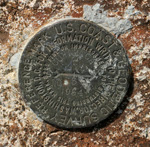
Do you recognize the artifact at right?

It’s a U.S. Coast & Geodetic Survey marker; this particular one on the peak of Cuyamaca Mountain in the San Diego County mountains. It’s a simple bronze disc, three inches (7.5 cm) in diameter, embedded in some permanent and hopefully immovable object. In this case it is embedded in a large rock formation at the summit of Cuyamaca.

There are over one million of these markers in the United States. The vast majority of them were placed long before modern technologies like GPS and laser rangefinders made surveying relatively cheap and easy. The surveyors who placed most of these markers used old-fashioned optical/mechanical surveying instruments, and processes that depended heavily on repetition and cross-checking for accuracy. And these processes were, by today’s standards, almost unbelievably manual. The surveyors walked, hiked, or rode horses to their remote destinations. For the most part, they carried their instruments on their backs. They recorded their observations in log books, in pen-and-ink. And perhaps most amazingly of all, they did all the calculations manually — they couldn’t even use a slide rule, as the precisions they were working with were far higher than were achievable with a slide rule.

The official U.S. Coast and Geodetic Survey started in 1807, and continues to this day (though in a new agency). Thousands of surveyors working for almost 200 years — and these little bronze discs (and the data that records where they are) are perhaps their most important work product.

The little discs are important because they are the starting point of virtually every other survey, whether by government or by private industry. They are the starting point because their absolute position is known more accurately than any other collection of points. Every real estate survey is referenced to one or more of these markers. American cartography is universally traceable back to these markers. Political boundaries (states, counties, cities, etc.) are all traceable to these markers. Pretty important job for a humble little piece of bronze!

Because our hiking (over the past forty plus years) has taken us to many peaks and prominences, we’ve run into many of these markers. Long ago I fell into the habit of searching for them each time I reached a likely looking spot — and more often than not, I’d find one. Sometimes I’d have to brush off dirt and leaves to find it, so I’d know it’s been some number of years since anyone had “visited” that particular marker. On a few occasions, I’ve run into bright, shiny, brandy-new markers — very unexpected, as most of them date back 20 years or more. The oldest one I’ve every spotted was on a peak near Mt. Katahdin in Maine, called “South Brother"; the marker there was dated 1876.

If the story of the American geodetic survey intrigues you, you can find some more information (and pictures) here, here, here, and here.

Cuyamaca Autumn

These are some more photos from the hike that Debi and I made up Cuyamaca Peak this past Sunday. As usual, clicking on any of the will bring up a larger view.

The images in the top row all show some aspect of the destruction wrought by the fire. The two outer ones are obviously charred logs; the center one is a dead oak, it’s bark burned by the fire so badly that it sloughed off. What you’re seeing is the wood immediately under the bark, with the characteristic oak texture (lots of pores) clearly visible, along with the trails of some insect that ate its way along trails just under the bark. Presumably the bugs were well toasted in the fire!

The second row are the autumn flowers, of which there are a dozen or so species in bloom presently. They made beautiful splashes of color, contrasted against the somber autumn tones and the stark blacks and grays left by the fire. I don’t know what any of these flowers are.

The bottom row is the kind of thing folks in other climates see very commonly: the “fall color” of the leaves of deciduous trees. We have it here in southern California as well, but not with anything remotely resembling the wild abundance of color that is the norm in places like New England or the Appalachians. But we cherish what we have…

Everest on Mars

Spirit and Opportunity — the extraordinarily successful mobile probes on Mars — have now been operating for very close to two years. Not bad at all for missions designed to last just three months!

Recently Spirit climbed to the top of the Columbia Hills, and on a peak the scientists at JPL have named “Everest", the Spirit probe paused to take this 360 degree panorama of the spectacular view it was enjoying. You can click on the image at right to get a slighly larger view — or you can go to the rover site to get a truly enormous (40+ MB!) version, nearly big enough to wallpaper your livingroom with.

I’ve repeated this so many times I’m sure my long-timer readers are bored to hear it again, but … these two probes are making manned space exploration (at least as it’s currently practiced) look like a positively silly waste of time, energy, and money. And they’re not alone — Spirit and Opportunity have dozens of “brothers” and “sisters", like Cassini-Huygens around Saturn, the Hayabusa probe, and many more. Many of those probes all by themselves are producing more good, hard, useful science results than all of the manned space missions combined. And they’re doing it for one helluva lot less moolah…

Wednesday, November 9, 2005

Blue Morning

What an unpleasant way to start my morning — by discovering that every single one of the propositions championed by Governor Arnold Schwartzenegger has been defeated at the polls. This is a tremendous victory to big-money, big-union, status quo politics, and a big blow for common sense and honest democracy.

Unless something happens (but what?) to shock liberal Californians to their senses, I suspect we’re stuck with at least several more years of profoundly corrupt and ineffective local politics…

Tuesday, November 8, 2005

Recovery

The hike Debi and I made up Cuyamaca Mountain on Sunday (see two preceding posts) had some unanticipated moments of beauty. In the two years that have passed since the Cedar Fire, the ground-dwelling flora have been growing luxuriantly. Between the nutrients added by the fire, the exposure to sunlight now that the forest is basically gone, the wet year we had this year, and the fact that many of these plants have evolved to take advantage of the fire’s aftermath, happy days are here again for these plants!

At the 5,000 to 6,000 foot level, where these pictures were taken, there apparently has been a hard frost some weeks ago. In the top row of photos (click on any of them for a larger view) the brown tones are dominated by ferns; in the lower row it’s other plants I have not identified. I thought the contrast and textures of the charred trees was interesting; certainly not what we would ordinarily see on an autumn hike like this…

Cuyamaca

As I mentioned in the post below, Debi and I had a very enjoyable hike up to Cuyamaca Peak this past Sunday. On the “shoulder” of the mountain, just before the last push up to the peak, is one of our favorite spots from our many hikes this way in the past. It’s a small meadow that extends partway down the western flanks of Cuyamaca Mountain, and the absence of trees combined with the altitude makes for a wonderful view.

The panorama at right was stitched together from three individual pictures, taken handheld. Even in the small version (click for a much larger one) you can see the skeletons of the sparse trees. But when you look in this direction from Cuyamaca, you’re looking at that enormous area that the Cedar Fire completely burned off — and it was very evident on Sunday. The normal tones of chaparral in the autumn were all “off”. In some areas, the greys of the ashes and tree skeletons show through even at a distance of miles. Everywhere the colors are altered by the absence of the normal chaparral growth. A very somber perspective, indeed…

Happy Dogs

Debi and I took a hike on Sunday that we haven’t made for over two years — up the “fire road” to Cuyamaca Peak from Paso Picacho campground in Cuyamaca State Park. We’ve avoided this area, for the most part, ever since the terrible Cedar Fire in October 2003 that burned the beautiful old forests that we loved so much. Just driving through the park, as we have on numerous occasions since the fire, is enough to make me heartsick and depressed.

The hike turned out to more interesting and less depressing than I expected. Yes, the walk takes you through nearly three miles of nearly completely devastated forest. But unexpectedly, near the peak, there is a substantial area of surviving old-growth forest with a lot of different species represented. Perhaps these individuals will be the parent stock for the native species return. We saw conifer seedlings — something we’ve missed at lower altitudes in previous hikes. We also saw manzanitas seedlings (abundantly) and mind-boggling quantities of ceanothus (assuming I’ve identified it correctly), currently two to three feet high. That mountainside is going to be something spectacular when the ceanothus is old enough to bloom!

To our dogs (Mo’i on the left, Lea on the right), however, this was just one giant super-walkie. They were so happy to be out with us for several hours of sustained walking — it just doesn’t get any better than that if you’re of the canine persuasion…

We stopped on the way home for a late lunch at the Descanso Junction restaurant. This little place is quickly becoming a favorite of ours — inexpensive, and unpretentious, but just plain delicious home-style cooking. I highly recommend their Philly steak sandwich — especially if you add mushrooms to their standard offering (and they’re happy to do that). Debi had a steak salad that featured a perfectly cooked-to-order piece of beef that was a significant chunk of the bovine donor. And Debi’s facial expressions, grunts, and moans of delight, plus the fact that she left nary a molecule on her plate, told me that she was very happy with her meal, too…