


Monday, October 24, 2011
Monday, October 10, 2011


 As we got closer to the top, we saw more and more survivors of the 2007 wildfires (like the Ponderosa at right), many of which are charred up to 15 or 20 feet from the ground. We also saw something that was most encouraging: hundreds of young pine trees, and unbelievable numbers of baby cedar trees. In some places, the baby cedars (all less than 2 feet high) looked like some kind of ground cover, a veritable mat of greenery. These babies are too young – maybe just a year – to be fire pioneers. I'm not sure what caused this cedar explosion, but it sure is nice to see. The peak of Cuyamaca looks like some kind of development – there are several buildings in various stages of construction, some heavy equipment, and building materials in piles all over the place. I'm not sure what they're doing up there, but the result is that the peak area is almost unrecognizable to someone like us who has been visiting there for thirty years...

Thursday, November 10, 2005

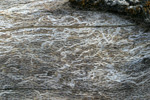

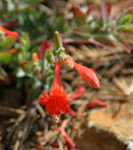


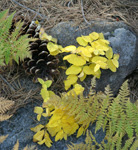

These are some more photos from the hike that Debi and I made up Cuyamaca Peak this past Sunday. As usual, clicking on any of the will bring up a larger view.
The images in the top row all show some aspect of the destruction wrought by the fire. The two outer ones are obviously charred logs; the center one is a dead oak, it’s bark burned by the fire so badly that it sloughed off. What you’re seeing is the wood immediately under the bark, with the characteristic oak texture (lots of pores) clearly visible, along with the trails of some insect that ate its way along trails just under the bark. Presumably the bugs were well toasted in the fire!
The second row are the autumn flowers, of which there are a dozen or so species in bloom presently. They made beautiful splashes of color, contrasted against the somber autumn tones and the stark blacks and grays left by the fire. I don’t know what any of these flowers are.
The bottom row is the kind of thing folks in other climates see very commonly: the “fall color” of the leaves of deciduous trees. We have it here in southern California as well, but not with anything remotely resembling the wild abundance of color that is the norm in places like New England or the Appalachians. But we cherish what we have…
Tuesday, November 8, 2005


The hike Debi and I made up Cuyamaca Mountain on Sunday (see two preceding posts) had some unanticipated moments of beauty. In the two years that have passed since the Cedar Fire, the ground-dwelling flora have been growing luxuriantly. Between the nutrients added by the fire, the exposure to sunlight now that the forest is basically gone, the wet year we had this year, and the fact that many of these plants have evolved to take advantage of the fire’s aftermath, happy days are here again for these plants!
At the 5,000 to 6,000 foot level, where these pictures were taken, there apparently has been a hard frost some weeks ago. In the top row of photos (click on any of them for a larger view) the brown tones are dominated by ferns; in the lower row it’s other plants I have not identified. I thought the contrast and textures of the charred trees was interesting; certainly not what we would ordinarily see on an autumn hike like this…

As I mentioned in the post below, Debi and I had a very enjoyable hike up to Cuyamaca Peak this past Sunday. On the “shoulder” of the mountain, just before the last push up to the peak, is one of our favorite spots from our many hikes this way in the past. It’s a small meadow that extends partway down the western flanks of Cuyamaca Mountain, and the absence of trees combined with the altitude makes for a wonderful view.
The panorama at right was stitched together from three individual pictures, taken handheld. Even in the small version (click for a much larger one) you can see the skeletons of the sparse trees. But when you look in this direction from Cuyamaca, you’re looking at that enormous area that the Cedar Fire completely burned off — and it was very evident on Sunday. The normal tones of chaparral in the autumn were all “off”. In some areas, the greys of the ashes and tree skeletons show through even at a distance of miles. Everywhere the colors are altered by the absence of the normal chaparral growth. A very somber perspective, indeed…

Debi and I took a hike on Sunday that we haven’t made for over two years — up the “fire road” to Cuyamaca Peak from Paso Picacho campground in Cuyamaca State Park. We’ve avoided this area, for the most part, ever since the terrible Cedar Fire in October 2003 that burned the beautiful old forests that we loved so much. Just driving through the park, as we have on numerous occasions since the fire, is enough to make me heartsick and depressed.
The hike turned out to more interesting and less depressing than I expected. Yes, the walk takes you through nearly three miles of nearly completely devastated forest. But unexpectedly, near the peak, there is a substantial area of surviving old-growth forest with a lot of different species represented. Perhaps these individuals will be the parent stock for the native species return. We saw conifer seedlings — something we’ve missed at lower altitudes in previous hikes. We also saw manzanitas seedlings (abundantly) and mind-boggling quantities of ceanothus (assuming I’ve identified it correctly), currently two to three feet high. That mountainside is going to be something spectacular when the ceanothus is old enough to bloom!
To our dogs (Mo’i on the left, Lea on the right), however, this was just one giant super-walkie. They were so happy to be out with us for several hours of sustained walking — it just doesn’t get any better than that if you’re of the canine persuasion…
We stopped on the way home for a late lunch at the Descanso Junction restaurant. This little place is quickly becoming a favorite of ours — inexpensive, and unpretentious, but just plain delicious home-style cooking. I highly recommend their Philly steak sandwich — especially if you add mushrooms to their standard offering (and they’re happy to do that). Debi had a steak salad that featured a perfectly cooked-to-order piece of beef that was a significant chunk of the bovine donor. And Debi’s facial expressions, grunts, and moans of delight, plus the fact that she left nary a molecule on her plate, told me that she was very happy with her meal, too…
