Friday, January 12, 2007

Scrap Thieves

A fellow Jamulian wrote me last night with some interesting information. It seems that there has been a rash of thefts of two sorts in the area…

One sort is thefts of metal scrap (primarily copper, I think). In the recent case of Bob Orlosky and the murder of Charles Crow, one of the possibilities raised is that Charles Crow and the other two people in their vehicle were raiding Bob Orlosky’s scrap yard — or that Bob believed they were doing so, accurately or not. Several of my readers commented that there had been other thefts of scrap, including just a few days before the murder on Bob Orlosky’s property.
Now I’ve learned that Robby Ivy (a long-time resident of Lawson Valley, and the fellow who provided the land for the Lawson Valley fire station) was robbed of some scrap metal (copper wire) just this week. Sheriff’s Deputy Brown handled the case, and told Robby that such thefts have been occurring recently all over the Jamul area.
The other sort is thefts of oak wood (for firewood). This happens every winter as the demand for firewood increases; the prices of $200 or more for a cord of wood attracts a certain low class of people with a chain saw and a truck — apparently whether or not they have any rights to the wood. Recently the gate at the base of Hilary Road (a road on private land in Lawson Valley) was torn up so that a truck could get through. The oak thieves didn’t even take the down, dead wood — instead, they cut down some of our beautiful (and threatened) live oaks. These scum make my blood boil…and bring to mind a refrain from a fellow blogger, appropriately modified:

Oak tree. Rope. Oak thief.
Some assembly required.

The floor is open (in the comments) for good ideas about how to address this plague. Meanwhile, I’m cleaning and maintaining my weapons, making certain I have plenty of ammunition on hand, and thinking about how to turn our field spaniels into vicious thief-biters!

Monday, January 8, 2007

Politics

A couple of my loyal readers (in other words, about three quarters of them) have written to ask why my political blogging has virtually stopped, and how I’m feeling about recent political events. I’ll answer with these words of wisdom…

Mark Twain: Suppose you were an idiot. And suppose you were a member of Congress. But then I repeat myself.

Winston Churchill: I contend that for a nation to try to tax itself into prosperity is like a man standing in a bucket and trying to lift himself up by the handle.

George Bernard Shaw: A government which robs Peter to pay Paul can always depend on the support of Paul.

James Bovard: Democracy must be something more than two wolves and a sheep voting on what to have for dinner.

Douglas Casey: Foreign aid might be defined as a transfer of money from poor people in rich countries to rich people in poor countries.

P. J. O’Rourke: Giving money and power to government is like giving whiskey and car keys to teenage boys.

Frederic Bastiat: Government is the great fiction, through which everybody endeavors to live at the expense of everybody else.

Ronald Reagan: Government’s view of the economy could be summed up in a few short phrases: If it moves, tax it. If it keeps moving, regulate it. And if it stops moving, subsidize it.

Will Rogers: I don’t make jokes. I just watch the government and report the facts.

P. J. O’Rourke: If you think health care is expensive now, wait until you see what it costs when it’s free.

Voltaire: In general, the art of government consists of taking as much money as possible from one party of the citizens to give to the other.

Pericles (in 430 B.C.!): Just because you do not take an interest in politics doesn’t mean politics won’t take an interest in you.

Mark Twain: No man’s life, liberty, or property is safe while the legislature is in session.

Anonymous: Talk is cheap . .. except when Congress does it.

Winston Churchill: The inherent vice of capitalism is the unequal sharing of the blessings. The inherent blessing of socialism is the equal sharing of misery.

Sunday, January 7, 2007

Cuyamaca Hike

Yesterday four of us (Debbie, myself, Jim Barnick, and his girlfriend Michelle) took a short hike up the maintenance road from Paso Picacho campground toward Cuyamaca Peak. We didn’t make it all the way up — this was our first hike of the season, and we weren’t quite up to an 1,700 foot elevation change. Also, as we got closer to the top the conditions got icier and snowier (although the air temperature was quite pleasant); we met people coming down bundled up like Arctic explorers, using ski poles to help them stay upright. And we could see footprints of people wearing ice cleats — not a good sign.

We also had Miki the wonder-puppy along for the hike, and he had a wonderful time. He especially enjoyed the snow and ice along the road. There was a puppy “ah ha!” moment along the trail when he figured out that he could eat snow; after that he was happily munching snow and licking the ice all along the trail. And at one point he was carrying around a small snowball on his back. My theory is that the squirrels threw a snowball at him, but I don’t think anyone else was buying that… We saw deer prints in the snow, and we saw deer several places around the mountain — the very first time since the Cedar Fire in October 2003. We’re hoping that this portends a return of the wildlife to Cuyamaca, especially the mountain lions and bobcats (we still haven’t seen any of them since the fire). This past year, and on this trip, we have seen many very healthy-looking hawks — so the rodents must be back in force. It looks like the wildlife is returning…

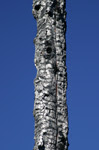
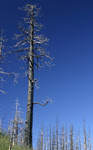
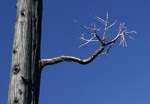
So we made it up almost to the “saddle", just below the final 500' or so push to the peak, just at the edge of the area where most of the trees were saved from the Cedar Fire (just over three years ago now). The area we walked through was nearly devoid of living trees — it had been an almost pure conifer forest, and except for a few cedars whose tops have survived, they are all burned. On this walk, you’re in a tree graveyard, with skeletons of dead trees still poking into the sky all around. A few seem to have fallen on their own as they decompose; many more have been cut down. The cut trees are being chipped, or harvested for fencing or firewood. If you like forests and trees, it’s a very somber and sad sight…

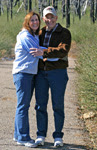
Jim and Michelle have been “an item” for just a few months now, but they act like they’ve been together for a hundred years. It’s very nice to see our old friend so happy in a relationship, and nicer yet for being so completely unexpected. Michelle basically dropped into his life from outer space; the apparently committed bachelor Jim suddenly has a “serious” girlfriend. They were very cute on the trail, holding hands and smooching…

Miki Report

Miki is almost a year old — still very much a puppy, but also starting to mature into a “real” dog. He’s developing a very sweet personality, too.

Yesterday we took him along on a hike we took (more on that in a subsequent post). He had a wonderful time with all the new smells, and playing in the snow and ice. Whenever there was an icy patch in the road we were walking on (a frequent occurrence!), he’d head for it — apparently to delight in the sensation of slipping and sliding. Something we’ve noticed about Miki is that he seems to really, really hate losing his balance or being flipped over. Our other dogs all treat this as part of playing, but not Miki — he’ll resist any attempt to knock him over, and very effectively, too. This makes his delight in the ice all the more mysterious.

As you can see in the photos, he is developing into a very nice specimen of a field spaniel. About the only “ding” we can see is that his ears are shorter than most field spaniels (a breed noted for its long, droopy ears, accentuated by long, curly hair on them). Other than that, he’s just about perfect…

Ice in Jamul

Debbie came running into my office at daybreak yesterday, telling me that I absolutely had to come see something. I went into the living room and she just pointed outside. A small Italian Stone Pine (pinus pinea) in our yard was covered with ice!

This isn’t quite as crazy as it might appear at first blush. First, what I didn’t show you in the photos is that the ice is very localized to just the bottom branches. Second, what you most likely don’t know is that I have a sprinkler set up to put water on this plant every morning at 4 am. In our hot, dry summer heat, the early morning hours are the best time to sprinkle water. In the winter, however, on those rare mornings when we have a below-freezing temperature, it’s not such a smart thing!

I’ve turned the sprinklers off for the winter…

Friday, January 5, 2007

CFL Rant

Compact Fluorescent Lamps (CFLs) have been much in the news lately, especially with Wal-Mart’s decision to promote them. Many environmentalists would like to see incandescent light bulbs (the old-fashioned kind of light bulb with the glowing filament) banned outright, because they are quite inefficient — most of the electricity they consume produces heat, not light.

Occasionally mentioned, but mostly in a dismissive way, is that CFLs (or any fluorescent lamp, for that matter) produce light that is quite visibly different than that produced by incandescent bulbs, or by the sun. Personally, I find the light from most fluorescent bulbs to be unpleasant — harsh and color-distorting — though I have seen some fluorescent lighting whose light is less awful than most. What exactly is the difference in the light the various kinds of bulbs put out?

The difference is in the spectrum of light that the bulbs emit. The sun and incandescent bulbs both produce what scientists call “warm-body” light, by which they mean the light emitted when something gets really, really hot. Cooler warm-body light is reddish to our eye, such as the light emitted by a red-hot piece of metal. Hotter warm-body light is bluer to our eye, such as the light emitted by the sun. But in all cases, warm-body light emitters put out some light of every possible color — the difference in their apparent color is caused by the relative intensity of the various colors. So the red-hot piece of metal puts out a lot of red light, some orange light, a bit of yellow light, a small amount of green light, and very little blue or violet light. The sun, on the other hand, puts out a lot of every color — which is why it’s light appears white to our eyes.

CFLs (and all fluorescent light bulbs) work by a completely different phenomenon: fluorescent emission, which of course is how they get their name. The inside walls of CFLs are coated with phosphors — substances which emit light in the visible range of colors when they are illuminated by ultraviolet light. Unlike incandescent light bulbs, the inside of a CFL is not a vacuum — instead it contains (usually) mercury vapor at a very low pressure. There is so little mercury required for this that the bulbs are not dangerous individually. When CFLs are turned on, an arc of electricity flows through the mercury vapor, which then produces high intensity ultraviolet light (which we cannot see). This light strikes the phosphors, which then emit visible light.

But here’s the catch: phosphors emit light of a distinct color. Any given phosphor will emit light of a specific color — green, red, blue, etc. This is very, very different than warm-body light emission. Of course none of us want to light our homes with some pure colored light — so the CFL manufacturers combine multiple phosphors in every bulb to simulate whiter light. It is exactly what happens with stage lighting when spot lights of multiple colors are aimed at the same point, and the colors mix. For example, if a blue spot and a yellow spot are aimed at the same point, we perceive green lighting. With three colored spots (red, green, and blue, for example), we can simulate white light. However, our eyes are being “tricked", and this simulated white light is not the same as the white light from a warm-body emitter. The “harsh” look of such simulated white light comes from the fact that the individual colors have to be much brighter than that same color would be in white light from a warm-body emitter. The color distortion is caused by objects that reflect colors that are different than the colors actually in the simulated white light. With the simulated white light, such objects appear much darker and less colorful than they would under light from a warm-body emitter.

Scientists use an instrument called a spectrograph to measure the spectrum of light. Most of us don’t have access to a “real” spectrograph — but I’ll bet you’ve got many of them lying about your home. These are what I call “dual-purpose” spectrographs: not only can they be used as a spectrograph, but they will also play music or video. I’m talking about CDs or DVDs — the side with the music or video makes a very nice diffraction grating, which is the heart of a real spectrograph. I’m sure you’ve noticed the rainbow effect they produce — that’s the diffraction grating at work.

Grab a CD or DVD, and take it to a lamp that uses an incandescent light bulb (this includes halogen lamps, if you have them). Hold the CD or DVD about chest-height, while you’re standing, and experiment with different orientations until you see a strong rainbow of light. You won’t have much trouble doing this, I’m sure. Now note the nature of that rainbow — because you’re reflecting light from a warm-body emitter (that incandescent light bulb), you’ll see a broad rainbow with every possible color in it — very pretty, isn’t it?

Now take that CD or DVD over to a CFL lamp, and do the same thing. Whoa! Not the same thing at all! What you see now is bright reflected images of the lamp in each of the colors emitted by the phosphors it contains. Most CFLs use three phosphors: red, green, and violet. Better (whiter, “full spectrum") CFLs will use four, five, or even more phosphors. But in all cases, you will see something very different than you see with a warm-body emitter.

Here’s the bottom line: it is not possible to make a CFL that accurately simulates natural lighting from a warm-body emitter. Our eyes evolved to use natural lighting, so lighting from CFLs (or any fluorescent lamp) looks unnatural. The harshness and color distortion can be improved — by using more phosphors — but it cannot be made perfect.

So… If you like the energy savings of a CFL (and who wouldn’t?), and you’re willing to trade off lighting quality to get the savings, by all means go for the CFL. But I’m going for the halogen (a very hot, very white, warm-body emitter)…

Thursday, January 4, 2007

Totally Plausible

Tip of the hat to reader RickP:

Three Explorers Are Captured…

A Frenchman, an Englishman and a New Yorker were exploring the jungle and were captured by a fierce tribe. As they sit in a hut, awaiting their fate, the chief comes to them and says, “The bad news is that now that we’ve caught you, we’re going to kill you, and then use your skins to build a canoe. The good news is that you get to choose how you die."

The Frenchman says, “I take ze poison.” The chief gives him some poison, the Frenchman says, “Vive la France!” and drinks it down.

The Englishman says, “A pistol for me, please.” The chief gives him a pistol, he points it at his head, says, “God save the queen!” and blows his brains out.

The New Yorker says, “Gimme a fork.” The chief is puzzled, but he shrugs and gives him a fork. The New Yorker takes the fork and starts jabbing himself all over — the stomach, the sides, the chest, everywhere.

There’s blood gushing out all over, it’s horrible. The chief is appalled, and screams, “What are you doing???"

The New Yorker looks at the chief and says, “So much for your canoe, asshole!"

That is so New Yorker!

Friday, December 29, 2006

Adding Fractions

A teacher’s union president can’t add simple fractions (from the New York Daily News):

The radio audience was live and the question for teachers union president Randi Weingarten involved sixth-grade math: “What’s 1/3rd plus 1/4th?"

Weingarten, however, is a not a sixth-grader or a math teacher. She’s a lawyer and a union boss who once taught high school social studies - and no one told her there was going to be a quiz.

"I would actually have to do it on paper,” she said when asked yesterday to complete the math problem on WNYC’s “Brian Lehrer Show” where she was a guest.

Mike Pesca, who was filling in for Lehrer, introduced the show’s education topic by saying American college grads can’t do basic math while high school grads in Canada and middle-schoolers in India have no trouble.

After Weingarten stumbled, another guest quickly produced the correct answer: 7/12ths, leaving Weingarten to explain herself.

I’m not surprised by this in the slightest, but it’s still very disappointing. As the story goes on to report, many people would not only be unsurprised, they’d be uncritical.

Not me.

This very American attitude about education makes me fear for our country’s future. Adding fractions is a terrific example of a very basic mathematics skill. One could also find many examples of basic science and technology skills where sampling a broad population — including professionals and college graduates — would reveal similar general ignorance amongst Americans. In many parts of the world, such a result would be almost unimaginable, and … shameful. But not here, for some reason I simply cannot fathom.

I fear that in 10, 20, or 30 years, the pool of talent that drives our math, science, and technology will have shifted so that it lies largely outside the U.S. — and that we will suffer the severe economic consequences (and derived political consequences) of that shift.

I’d sure like to be wrong on this one, but I don’t think I am…

Best Astronomy Images

Phil Plait blogs at Bad Astronomy, always an interesting spot to visit in the blogosphere. He’s got a particularly interesting post up right now, wherein he makes his “top ten” picks of astronomy images for the year. This has been a particularly good year for amazing astronomy images, and I was expecting to see ten familiar ones on his list. Instead, I found eight stunning images that I had never seen — much to my loss. Go take a look!

Sunday, December 24, 2006

Dallo Pleads Guilty

Almost six months ago, Jodi Burnett — delivering newspapers on her regular pre-dawn route — was killed by a recklessly speeding teenager, Jonny Dallo of Jamul. I’ve posted about this case several times (in chronological order): here, here, here, here, here, and here.

This tragic case generated a huge amount of local interest and emotional heat, with a couple of general perspectives emerging. One perspective, which I share, is that Jonny Dallo’s choice to recklessly speed was the proximate cause of Jodi Burnett’s death, and he should be held accountable for having made that choice. The other perspective holds that Jodi’s death was a tragic accident, and that we should mourn both Jodi’s death and the pain the accident caused Jonny Dallo and his family. Another couple of factors also contributed to the furor: Jonny Dallo’s father happens to be a very successful businessman, and the Dallo family happens to be Chaldean. As feelings ran high immediately following Jodi’s death, some quite ugly prejudice against both successful businessmen and against Chaldeans emerged.

Jonny Dallo (after being pulled from his car at the scene with no major injuries) was brought before the court, where he pled “not guilty.” The community wondered what would happen in the following trial, with a well-funded defense fighting the charges. This Thursday events took another turn, as Jonny Dallo entered a guilty plea (from the San Diego Union-Tribune):

A 19-year-old Jamul man pleaded guilty in Superior Court yesterday to vehicular manslaughter charges in connection with a June crash that killed a newspaper carrier.

Jonathan Dallo faces up to six years in prison at a Feb. 8 sentencing hearing set by Judge Herbert J. Exarhos, prosecutor Terrie Roberts said in an interview.

Dallo was charged with causing a June 29 car crash on state Route 94 at Rancho Miguel Road that killed 40-year-old Jodi Burnett of Spring Valley, a carrier for The San Diego Union-Tribune.

The prosecutor said Dallo was going more than 90 mph in the left-turn lane around 4 a.m. when he slammed into the rear of the Ford F-150 truck Burnett was driving.

Burnett was waiting to turn left from eastbound state Route 94 onto Rancho Miguel Road, police said. The impact threw the truck onto its side on the westbound side of Route 94, police said. Burnett, who was not wearing a seat belt, was thrown from the cab.

Judge Exarhos is a locally well-known judge who’s been involved in quite a few high profile cases over the years, including the Andy Williams high school shooting case, the de Santiago Lakeside postal hostage case, and former San Diego mayor Roger Hedgecock’s conspiracy case. Like most judges these days, he will allow plea bargains that short-circuit the trial process by the defendant negotiating a sentence agreement with the prosecutor, generally in return for reduced charges or sentences, or both.

The unexpected change of plea from “not guilty” to “guilty” — especially in the presence of a high-powered defense — strongly suggests to me that a plea bargain has been reached. I’ve not been able to find any public disclosure of such an arrangement, so probably we won’t know for certain until February 8th. But it’s hard to imagine what other reason there might be for Jonny changing his plea to “guilty"…

Plea bargains are, in general, a very controversial tool of the prosecutor (who has complete discretion about whether to entertain them). Their acceptance by judges is also controverial. But the notion is very well established in our system of jurisprudence at this point. Prosecutors often seek plea bargains, both to ensure some punishment on a weak case and to relieve their workload. I have some sympathy for the former reason, but none for the latter — the prosecutors represent the public, and the public’s interest is arguaby shortchanged by many plea bargains. Defendants often seek plea bargains as well, but their motivation is distinctly contrary to the public interest: they are seeking less punishment for their crime than the law dictates.

So in the case of Jonny Dallo, I worry that the high-power defense managed to convince the prosecutor that they had a weak case — and that they negotiated a light sentence agreement in return for the guilty plea.

We’ll see on February 8th.

I hope I’m wrong, as I believe it’s important for our community that Jonny Dallo be held accountable, under the law, for Jodi Burnett’s tragic and untimely death…

Friday, December 22, 2006

Self-Defense?

Today’s San Diego Union-Tribune has an article about the first hearing in the Charles Crow murder case. In this hearing, Orlosky’s attorney (Paul Pfingst — a former District Attorney himself) presented some elements of Orlosky’s side of the story, including a rough outline of his version of events. There were also some interesting comments by Orlosky’s friends and neighbors. The lead:

A Jamul electrical contractor charged with murder was defending himself against potential thieves who tried to run him down when he caught them, his lawyer told a judge yesterday.
Joseph “Bob” Orlosky “was being ripped off” when he fired on three men he found driving a Jeep on a dirt road that cuts through his rural East County property about 8:30 p.m. on Dec. 1, Orlosky’s lawyer, former District Attorney Paul Pfingst, told Superior Court Judge Charles W. Ervin.
“The victims tried to kill Mr. Orlosky and Mr. Orlosky defended himself,” Pfingst said.

This is pretty close to one of the scenarios that I and several commenters have speculated about in past posts on this event. It makes a lot more sense than the idea that Orlosky just randomly started shooting at the vehicle Crow was in, for no good reason.
Another excerpt:

Pfingst told the judge Orlosky never left Jamul during the time police were looking for him and was continuing his business and consulting with Pfingst about surrendering.

Several commentors on previous posts speculated that Orlosky was hiding out here in Jamul. It appears they were right. If it’s true that he was continuing his business affair, that seems pretty brazen — and I’m amazed that his contacts with other people didn’t lead to him being caught…
The police outlined their version of events:

Police in court documents said Crow, 23, and his two companions were traveling in a Jeep Cherokee north on Wisecarver Truck Trail in Jamul when they passed a white Ford truck.
After coming upon a locked gate across the road, they returned south on Wisecarver Truck Trail. Orlosky ran from behind his parked truck, stood in the road and fired a rifle at them, police said.
Orlosky again fired at the Jeep after it passed him, hitting Crow in the head and Monge in the elbow, police said. They said the Jeep stalled after turning onto Skyline Truck Trail, and Crow’s companions jumped out to hide in bushes, making several calls to 911. They remained hidden until sheriff’s deputies arrived.

This is more-or-less what we heard in the earliest reports. There’s no statement in here about Orlosky’s motivation for shooting. I infer from the absence of an expressed motive that the police (and the District Attorney) are uncertain of a motive, or that they believe a motive will detract from their murder charge. Or it could be that they just don’t want to make their theory about the motive public at this point.
Here’s Orlosky’s version of events:

Pfingst said Orlosky had been watching television in his living room when sensors he had installed along the road warned that intruders were on his property.
Fearing he was about to be robbed, Pfingst said, Orlosky went to investigate and was nearly run down. “The people who were on that property had no legitimate reason to be there at that time of night,” Pfingst said.

This jibes with some of the things asserted by commentors on earlier posts; things I had not been able to find any public information on. And in its rough outline, it matches one of the scenarios we have discussed in previous posts: that Orlosky’s motive for the shooting was to defend himself or his property, or both. This makes much more sense than a random, unmotivated shooting. It doesn’t necessarily justify Orlosky’s actions; we’d have to know a lot more about what happened to be able to determine that. One possible scenario is that the boys were on Orlosky’s property, Orlosky got angry — but wasn’t actually directly threatened in any way — and started shooting. That would be, in my opinion at least, an unjustified act. However, another possible scenario is that the boys were on Orlosky’s property, saw him on the road, interpreted his presence as a threat, and tried to run him down — at which point Orlosky started shooting. In that scenario, Orlosky’s actions might be justified.
Note to friends and family of Charles Crow: I am not asserting that either of the above scenarios is what actually occurred. I am simply outlining the range of possibilities I see in a case that this concerned Jamul citizen would like to understand. As a local resident, I have a vested interest in understanding why this murder occurred a mile or so from my home. I’d like to know whether we had a lunatic shooting people at random, or we had a homeowner defending himself and his property. Those are two very different versions of events…
The UT reporter managed to get some additional information that didn’t come from a press release or a transcript, the first time that’s occurred in their reporting on this story:

Outside the courtroom, Orlosky’s sister, Dana Ross of San Carlos, said that her brother had lost “hundreds of thousands of dollars” in copper wiring and equipment to thieves.
Pfingst said that just two weeks before the shooting, Orlosky had made a citizen’s arrest on three men he said he had caught stealing copper wiring on his property.
A former neighbor, Maggie Schweitzer, said Orlosky often came to her aid when trespassers approached her home. “He is a good man,” she said, “and we knew from the beginning he was protecting his family and his property.”

Again, this jibes with some of the information posted by commentors on previous posts; information that I could not corroborate at all. The statements paint a sketchy picture of a man who perhaps isn’t either a lunatic or the human manifestation of evil, as well as some context to understand how Orlosky was feeling on the night of the shooting.
This is more than I expected to have made public at this stage of affairs. It will be interesting — and comforting — to see the story unfold in more detail as the case progresses…

Monday, December 18, 2006

Orlosky Pleads Not Guilty

This is being reported on 10News.com:

A man suspected of killing a 23-year-old Jamul resident along a back-country road in East County earlier this month pleaded not guilty Monday to murder, attempted murder and firearms charges.

Joseph “Bob” Orlosky, 55, was ordered held on $2 million bail.

Orlosky turned himself in to authorities Friday in connection with a Dec. 1 shooting that left construction worker Charles Crow dead.

Orlosky was charged with one count of murder, two counts of premeditated attempted murder and one count of shooting into an occupied vehicle, Deputy District Attorney Kristian Trocha said.

There’s no indication when the trial might be held. I’m not expecting much more information until the trial begins…

Saturday, December 16, 2006

A Lot Smarter!

From reader Jack:

Recently I decided to take up again that brutal game of golf. I went to the Sycuan Golf Course practice area and started chipping and putting. As I came off the green there was a little girl standing there … perhaps 6 years old at the most. Here is the ensuing dialogue between us:

Girl: Excuse me. Have you seen my Grandpa?

Concerned this girl was left alone I replied:

Me: No honey. What does he look like?"

Girl (without missing a beat): Oh, he has gray hair like you but he’s a lot smarter!"

Authors note: LUCKY GUESS ON HER PART! I thought, to myself, he couldn’t be that smart to leave his Granddaughter alone…and I don’t think he was pleased with me telling him so? But who cares what he thought?!

Slide Rule Lessons

Two of my readers (independently, so far as I know) actually asked me to publish lessons on how to use a slide rule. I published one last week, and this morning I was working on a second lesson. Then it occurred to me that someone else might have done this already, so I Googled a bit and found that my friend Mike Konshak, of the International Slide Rule Museum, already had an excellent slide rule course up on the web!

I don’t see much point in duplicating what he’s done, and I don’t see much opportunity to do it better. So at the risk of alienating a significant fraction of my readers, I hereby declare my slide rule lessons have been adjourned. Go look at Mike’s course!

Orlosky Surrenders

From this morning’s San Diego Union-Tribune:

Suspect in rifle slaying of Jamul man surrenders

By Pauline Repard
December 16, 2006
A fugitive suspected of fatally shooting a passenger in a Jeep in Jamul two weeks ago turned himself in yesterday, sheriff’s officials said.
Joseph “Bob” Orlosky, 55, of Jamul surrendered at the Central Jail in downtown San Diego about 4:30 p.m. in the company of his attorney, sheriff’s Lt. Dennis Brugos said.
Orlosky was booked on suspicion of one count of murder and two counts of attempted murder. Bail was set at $2 million.
Last week, homicide investigators identified Orlosky as the suspect in the attack. Charles Crow, 23, of Jamul was shot and killed Dec. 1, and one of his two companions was wounded.
The three men were in a Jeep, driving along Wisecarver Truck Trail near Skyline Truck Trail about 8:30 p.m., when they passed a white pickup. They reportedly turned around and passed the truck again.
On the second pass, a man in camouflage pants and jacket allegedly climbed out of the pickup and opened fire on the Jeep with a high-powered rifle. Rounds hit Crow and the second passenger, who was slightly wounded. The driver was unhurt.
Public records showed that Orlosky lives on Wisecarver Truck Trail.
Brugos said Orlosky’s attorney called a homicide detective yesterday and arranged to meet a detective with the San Diego Regional Fugitive Task Force at the jail to surrender.

Well, that’s a big relief to know that Bob Orlosky is now behind bars, and not wandering around our hills with a rifle. I’d imagine that it’s some comfort to Chuck Crow’s family and friends as well, from a different perspective…
The news coverage of this tragedy has been very disappointing, and the story above continues that record of shallow coverage. Commenters on the several posts about this story have brought up far more details (which, I should note, I have no way to verify) than all the local media combined. I’ve searched extensively using Google, Google Images, and Google News, and have been unable to find references to several of the more interesting things that commenters have mentioned: photos of the jeep after the shooting on Wisecarver Truck Trail, copper scraps found in the jeep, or the glass and bullet casings allegedly found along Wisecarver. If these elements of the story are indeed true, and the media hasn’t dug deep enough to uncover things ordinary citizens know, then it’s one more piece of evidence about the ineffectiveness of our mainstream media.
As if we needed more evidence.
Bob Orlosky is behind bars. I look forward to more details of this story emerging, though I suspect that won’t happen until the trial…

Friday, December 15, 2006

Slide Rule Collection

Thanks to a very generous fellow — Mike Konshak, of the International Slide Rule Museum — I now have access to a “real” server to host the web site for my slide rule collection. If you’d like to see the beginnings of it, you can find it here. Right at the moment there are only a dozen or so items on line, but I’ll be posting more on a regular basis, hopefully a few each evening I can spare some time.

I’d love to hear what you think of it — leave comments here, or drop me a line…

Wednesday, December 13, 2006

Emotions Running High

I received this email this morning (I am not including the name, since I do not have the permission of the writer to use it):

Wow!! who are you to write a story defending a KILLER??? Why??? This man Orlowsky is obviously not in the right by any means. I dont think that it is right that you can write a public story making a defensive story for him, something that he should be doing if he had probable reasoning for fireing a rifle in the middle of the street. Mind you not on HIS property. Why would he have a rifle on him anyway? Who carries a rifle around? And if innocent why is he running? This really upsets our family reading your story defending this man. What are you crazy too? Do you think like a killer? Chuck was a very nice young man with NO enemies and never would he have had a confrontation that led to murder or any violent crime like has happened. He did not deserve this nor do we deserve to read some non sense story you have written defending the man that killed our loved one.

Several people, including (obviously) this writer, have read my posts and somehow concluded that I am defending Bob Orlosky.
So, for the record, let me make the following points:
1. I do not know Bob Orlosky; to my knowledge I have never met the man.
2. I do not hold any belief that Bob Orlosky is innocent. To the contrary, as I have pointed out several times in posts and comments, his behavior argues for his guilt.
3. I did not know Charles (Chuck) Crow; to my knowledge I have never met the man.
4. I do not hold any belief that Charles Crow is guilty of anything that could have justified his murder.
All four points above are true — but I (and anyone else who is thinking instead of feeling) can observe (not accuse) that the story as presented in the news doesn’t add up; it simply doesn’t make any sense. I and others on these posts have observed this fact, and speculated on what the facts might actually be. Amongst those speculations: (a) Bob Orlosky is a completely crazy homicidal maniac, (b) Charles Crow and his buddies did something to anger or otherwise provoke Bob Orlosky — and those actions might or might not have been enough to justify the shooting.
The writer above clearly is leaning towards (a). Personally, I find (b) more plausible. The only information I have of this incident is that which has been published in the news; my opinion is formed from that information and a general knowledge of human nature gained in over 50 years of experience. The writer above implies that he or she has personal knowledge of Charles Crow. Other commenters claim or imply personal knowledge of Charles Crow, Bob Orlosky, or others less directly involved. Their opinions obviously reflect that knowledge, and to some extent (as with the writer above) the bias such knowledge produces.
There’s nothing at all wrong with any of this.
It’s human nature. It’s human nature to wonder what the hell actually happened on that Friday night. It’s human nature to worry about the possible variations that represent more risk to ourselves and those we love. It’s human nature to doubt the purity of anyone’s motivations or actions, for such purity is rarely seen.
There’s nothing wrong with any of this, the above writer’s complaints notwithstanding.
There’s also nothing at all wrong with the above writer’s complaint. The writer’s pain is obvious, and one can’t help but sympathize with that. Equally obvious is the writer’s knowledge of, and admiration for, Charles Crow. This writer knew Charles Crow, and is angered by even speculation that he did anything at all to provoke this crime. I can (and do) sympathize with this, even while disagreeing — for it’s exactly the behavior that I would hope my friends would exhibit, should anyone ever speculate about my involvement in something like this. But while my friends were shocked and offended at the speculations (because they feel that they know me), I would still acknowledge that others who don’t know me might have different perspectives — and those perspectives would be less biased than those of my friends…
But to answer the writer’s specific questions, and to rebut some of his or her points:
1. “This man Orlowsky is obviously not in the right by any means": What is “obvious” to the writer is not at all obvious to me. I don’t know what happened that Friday night, and therefore I don’t know whether Bob Orlowsky was justified in his actions. For that matter, I don’t know that Bob Orlowsky even took any actions. His behavior — running away, going into hiding — certainly isn’t what we all expect of an innocent man. However, there are plenty of well-documented cases where innocent men or women fled, usually because they were afraid of being accused of (and convicted and sentenced for) some crime they were innocent of. I can hear people getting all twitchy on me just at that statement, so let me be clear: I am not saying that I believe Bob Orlosky is innocent. In fact, I think his behavior argues against his innocence. But I also do not believe his guilt is “obvious” — for the possibility exists that there were mitigating circumstances, or even that Bob Orlosky didn’t commit this crime at all. I simply don’t know enough facts to reach a judgment — I wasn’t there on that Friday night, I don’t know any of the parties involved, and I am not privy to the results of the Sheriff’s investigation.
2. “I dont think that it is right that you can write a public story making a defensive story for him": Sorry, but I disagree with that on two levels. First, I did not make a “defensive story", I simply speculated on what the possible scenarios would be. Second, I have every right to do so — this is America, and we have this thing called “freedom of speech” here.
3. “not on HIS property": The rifle wasn’t fired on his own property? How do you know that? I have not seen any information in the news or on the Sheriff’s site about exactly where the shooting took place. If that is accurate information, then it is a damning piece of information with respect to Bob Orlosky. I would like to know this information for certain.
4. “Why would he have a rifle on him anyway? Who carries a rifle around?” If someone were invading my property, and I felt threatened, then I would for darned certain get out my gun and defend myself. As with my earlier statement, I am not claiming that this is what happened, simply noting the possibility — something this writer is dismissing.
5. “And if innocent why is he running?” Actually, as I mentioned earlier, innocent people do sometimes run. Certainly in the majority of cases, runners are guilty. But innocent runners are more common than most people imagine — which is why running from a crime is not considered evidence by the justice system. It’s an indication, to be sure, and it’s often a correct indication — but not always.
6. “This really upsets our family reading your story defending this man. What are you crazy too?” I’m sorry if you’re upset by my story; that reaction was not my intention. But…you own that reaction, not me — it was your choice to be upset. And you don’t have to read my blog — if you don’t like what I have to say, you’re free to go elsewhere. And I have the right to “think out loud” here, just as you have the right to send me that email. We have a right in America to freedom of speech — but there is no right to be free from being offended. Now as to whether or not I’m crazy — well, I think you’d get different answers to that from different folks. More than a few would say that I was, in fact, a few beers short of a six-pack…

Sunday, December 10, 2006

A Suspect!

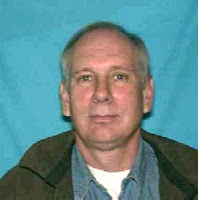
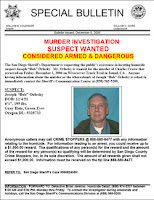
The San Diego Sheriff’s Department has identified a suspect in the murder of Charles Crow — a local man named Joseph “Bob” Orlosky (mug shot at right), who owns or has an interest in property on Wisecarver Truck Trail, near where the crime occurred.

The press reports about this murder have been skimpy and inconsistent, as have the comments on this blog (see my earlier posts here and here). Of all the various speculations I’ve run across, the one that seems most plausible to me is that the three men in the truck were out “four wheeling", just for fun, on what they believed was a road they had a right to be on. In this hypothetical scenario, Bob Orlosky got angry about these four wheelers because (rightly or wrongly, as the case may be) he believed they didn’t have a right to be there.
The complete special bulletin is at right. Click on the picture to get a full-sized view, or click here to see the original.
The above scenario seems most plausible to me because I witnessed something very much like this (without, of course, the violent ending) on my neighbor’s property, just a few feet from my own property. What I saw was a couple of slightly-drunk guys (neither of whom was Charles Crow) in a four-wheel drive pickup driving off-road to get around a gate on my neighbor’s private road. In doing so, they caused considerable damage to my neighbor’s property — scarring a hillside, destroying several trees, and leaving the area just generally ugly. Furthermore, once they got around the gate, they were trespassing on my neighbor’s property. Now my neighbor didn’t react at all like (in the hypothetical scenario above) we’re speculating that Bob Orlosky did. Instead, he called in the Sheriff’s Department (who responded very quickly) and engaged in a little creative barrier-building to keep these jerks from violating his property again. The two jerks in question, by the way, insisted that they had every right to be on that road, because the road was public, not private. They were just plain wrong about that, but that didn’t keep them from asserting it.
The point of the preceding story is that there may be more to the Charles Crow/Bob Orlosky story that we haven’t heard yet. For instance, perhaps there were words exchanged, and perhaps the boys in the truck were on private land (I don’t know whether this is the case), and perhaps they refused to leave — and Bob Orlosky got angry. That certainly wouldn’t justify a murder, but at least it would make the incident easier to understand. Or (this is pure speculation, folks) perhaps Bob Orlosky was threatened by the truck in some way, and was defending himself — in which case his actions might be justifiable (though going into hiding afterwards certainly wouldn’t be, and by doing so he casts much doubt on that scenario). Just to continue my point that we don’t know everything yet, consider this: suppose Bob Orlosky shot at the truck because it was headed straight for him, at high speed, on a road that he owned? Wouldn’t that put a different color on things?
At least one commenter has interpreted my reaction as support for Bob Orlosky (whom I have never met, or even heard of, until this crime occurred). This same commenter even implied that I might be actively helping Bob Orlosky avoid capture. So, just to make things clear (if the above discussion didn’t): I want Bob Orlosky captured as badly as anyone does. I live a mile from the murder scene; if (as some commenters have speculated) Bob Orlosky is some kind of nutcase who perpetrated this crime for no good reason, then I want him locked up where he won’t hurt anyone else — like me or the people I care about! But at the same time, I note that there are many facts not yet in public evidence. The scenario that seems most unlikely to me is that Bob Orlosky murdered Charles Crow for absolutely no reason, with absolutely no provocation. If the full facts ever become public, my guess is that the crime will become more understandable, because we will then learn what the provocation was. And we can then make a judgment about whether the provocation justified the crime. Acknowledging that there was likely some kind of provocation is not the same thing as saying the crime was justified (because that depends entirely on the specifics of the provocation). I’m not saying that the murder was justified, or even that it was likely justified — simply that the possibility exists that it was, because of facts that we don’t know.

Wednesday, December 6, 2006

Crow Murder

As some of the comments on my previous post on this subject show, the victim (Charles “Chuck” Crow, seen at right) in last Friday’s murder was a local resident. His friends and relatives cannot imagine any motivation for a murderer to attack him, and they took some umbrage at my ponderings (and the comments) on the reasons for this crime. Their reaction is understandable (and forgivable), but off target: none of us were accusing or blaming the victim here, simply pointing out how difficult this crime is to understand. And apparently the police are having the same difficulty — it’s been five days since the crime, and there have been no arrests, no charges, and no announcements of import. All we can do is hope that the police are actually making progress…

The San Diego Union-Tribune’s story today:

Charles “Chuck” Crow was a new father working to buy a home when he was shot and killed in a bizarre attack by a gunman wearing camouflage who also wounded another man.
The father of a baby boy, Charles “Chuck” Crow, 23, loved riding his off-road vehicle in the desert on weekends. He was fatally shot Friday night outside Jamul.
The 23-year-old construction worker had been laboring long hours trying to save money to buy a house for his young family.
“And now he’s gone,” said Rose Moran, 22, the mother of their 5-month-old son, Evan.
Crow’s mother called her son’s slaying senseless.
“I just don’t understand why somebody would fire an assault rifle on a car full of innocent young men who were just driving by,” Teri Crow said yesterday.
“Why would somebody do this?”
Sheriff’s detectives have yet to establish a motive for the shooting, which occurred about 8:30 p.m. Friday near Skyline Truck Trail and Wisecarver Truck Trail northeast of Jamul.
Charles Crow and two friends were driving on Wisecarver Truck Trail near his home when they passed a white Ford pickup that was parked on the side of the road.
A short time later they turned around and were driving back toward Skyline Truck Trail when they again came upon the pickup. This time a man stepped out, went to the center of the road and fired several shots at them with a high-powered rifle.
Crow, who was a passenger, was killed and another passenger was wounded but not seriously.
Authorities are searching for the shooter, described as an unshaven white man with gray hair. He was wearing a green camouflage jacket, pants and a floppy brimmed hat.
Sheriff’s Lt. Dennis Brugos said yesterday that investigators issued a search warrant on a vehicle that matched the description given by witnesses.
He declined to say whether the vehicle’s owner had been found or interviewed, saying he didn’t want to jeopardize the investigation.
Crow’s family and friends said they want to see his killer brought to justice.
“He had so much to live for. He had so much to offer,” said Katie Castellanos, Charles Crow’s cousin.
The youngest of three children, Crow loved fixing cars and riding his off-road vehicle in the Imperial Valley desert on the weekend.
He lived with his family at his parents' home in Jamul but was planning to a buy a house nearby and wanted to help his future wife set up a day-care center there.
This year he began working for a waterproofing company co-owned by a boyhood friend, Ely Leeyer.
“He was stoked to be working for us,” Leeyer said. “He had his own crew. He was doing a good job.
“This was real unfortunate.”
A viewing is scheduled at 10 a.m. Sunday at Glenn Abbey Memorial Park and Mortuary, 3838 Bonita Road, Bonita. Funeral services will follow at 1:30 p.m.

Monday, December 4, 2006

Slide Rule Lesson #1

This post, dear readers, is being inflicted upon you at the request of one of my, er, less conventional readers. He actually asked me to explain a bit about how slide rules work, and how you use them.

So I’ll start with the basics. The “scale” you see in the photo (click on it to enlarge it) goes by many different names, depending on exactly where you find it. On the slide rule that I scanned to make this picture, it’s called a “C” scale; that name is just a convention and doesn’t actually mean anything. Virtually all slide rules made after about 1900 used “C” to mean this line. One early device that used this line was called “Napier’s bones"; they were engraved on ivory sticks (the “bones"), and invented by the famous mathemetician Napier. Later they were found engraved on sticks of wood invented by a fellow namd Gunter; these were called “Gunter’s rules” and were in use for hundreds of years.

Whatever instrument you find this line on, you read it from left to right, with the values ranging from 1 to 10 (even though the right-hand side just says “1"; this is another common, though not universal, convention). You’ll note that ticks are not evenly spaced, as they would be on a ruler that was measuring a distance. Instead, the position of the number is proportional to the logarithm (base 10) of that number. The center of the scale isn’t 5, as you would expect on an ordinary ruler — it’s about 3.2. And the logarithm of 3.2 is about .5, which is why it’s halfway across the scale.

Confused yet? Let’s try an example, just to show you how a Gunter’s rule was used. Suppose you wanted to multiply 2.2 times 3.3. You would start by taking a pair of dividers (like a compass, but with two points instead of a point and a pencil or pen). The first step is to lay the divider along the rule from 1 to 2.2 (see the red “divider” on the left side of the photo). Now for step two: take the divider without changing its setting and put the left-hand point onto 3.3 (see the red “divider” on the right side of the photo). The answer — 7.26 — is read a the right-hand point.

What magic allowed this to happen? Well, it’s the magic of logarithms. You can multiply any two numbers together by adding their logarithms and then taking the antilogarithm of the result. You could do this with the giant tables of logarithms found in old reference books, but that’s quite tedious and only makes sense if you need your answer to a quite high precision. But if you only need two or three decimal places of accuracy, the Gunter’s rule could give you the answer quite conveniently. With a little practice, you can multiply two numbers on a Gunter’s rule in just a few seconds, and very reliably. It’s a machine that automates the computing and addition of logarithms, and taking the antilogarithm to get the answer you want.

The same general principle can be used to divide. Using the same photo, we can show how to divide 7.26 by 2.2. The first step is exactly the same as above, setting the dividers for 2.2. The second step is to set the right-hand point of the divider on 7.26 — and then the answer, 3.3, is under the left-hand point.

Modern slide rules perform multiplication and division using exactly the same principles, but use a number of ingenious mechanical aids to make it faster and more accurate than a Gunter’s rule. More about these improvements in a separate post…