Friday, December 16, 2005

PowerPaws

For four days last week, Debbie and her girlfriend Sharon took their dogs (Mo’i, in Debbie’s case) to a training camp called “PowerPaws”. This was a pretty intensive effort, with 8+ hours a day of actual field work with the dogs. Debbie was very tired when she called me each night, and she tells me that Mo’i was tired too — and that takes some doing!

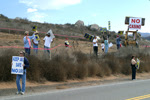
Anyway, the photo at right is of Debbie and her classmates (Sharon was in a different class, with more accomplished handlers and dogs). My lovely bride and our studly dog Mo’i are at the lower left.

Spitzer's Galaxy

From APOD, another amazing image:

Gaze through the dusty plane of our Milky Way Galaxy in infrared light. The cosmic panorama is courtesy of the Galactic Legacy Infrared Mid-Plane Survey Extraordinaire (GLIMPSE) project and the Spitzer Space Telescope. The galactic plane itself runs through the middle of the false-color view that spans nine degrees (about 18 full moons) across the southern constellation Norma. Spitzer’s infrared cameras see through much of the galaxy’s obscuring dust revealing many new star clusters as well as star forming regions (bright white splotches) and hot interstellar hydrogen gas (greenish wisps). The pervasive red clouds are emission from dust and organic molecules, pocked with holes and bubbles blown by energetic outflows from massive stars. Intensely dark patches are regions of dust too dense for even Spitzer’s infrared vision to penetrate.

Click on the thumbnail to get a tasty, large portion…

Reminder

This letter (published in this morning’s Wall Street Journal) from four ambassadors to the U.S., from countries that were part of the Soviet Union until just a few years ago. It was such a good commentary on the meaning of the successful elections in Iraq that I’ve reproduced it in entirety:

Iraq’s Future, Our Past

By RASTISLAV KACER, PETR KOLAR, JANUSZ REITER, and ANDRAS SIMONYI

When it comes to tyranny, we believe we can offer some personal experience. After all, it was only a short while ago that our countries emerged from Soviet oppression. During the decades of dictatorship, our peoples' attempts to restore freedom and democracy were crushed. Who would have thought in 1956 in Hungary, in 1968 in Czechoslovakia, or in 1980 in Poland, that we could get rid of the dictatorial regimes in our lifetimes and shape our own future?

The memories of tyranny are still alive in the minds of many Czechs, Hungarians, Poles and Slovaks. We also remember the challenges we faced early in our democratic transition. It is a testament to the resilience of our peoples that we are where we are now — members of NATO and the European Union, and strong allies of the U.S. We got here by believing in the transformational power of democracy and a market economy. But we needed others to believe in us, too. We could not have made it alone. We needed the perseverance and support of Western democracies for freedom finally to arrive.

The attainment of our immediate goals of stability and prosperity could have made us complacent. It has not. We feel that as free and democratic nations we have a duty to help others achieve the security and prosperity that we now enjoy. That is why we have been part of the coalition to help democracy emerge in Iraq.

Establishing democracy in Iraq was never going to be easy. Yet it is essential for the political and economic stability of the entire Middle East — and also vital for the security of our countries. We are convinced that for Iraq to become a vigorous partner in the war on terrorism, the Iraqis will need our continuous help for rebuilding their country, as well as for establishing democratic institutions and a market economy. The good news is that we are not alone; it’s a truly international partnership, based on a U.N. mandate. More than 30 nations are on the ground with the coalition and NATO, and more than 80 have signed up for the “new international partnership” with Iraq. European countries work closely with the U.S. on strengthening stability and democracy in Iraq, and the U.N. is providing key support to achieve our goals.

The Visegrád Group, which includes our countries, has been one of the most effective regional partnerships in Europe established after the changes of 1989. With our vast experience in transitioning from dictatorship to democracy, we can be of special help. Although the Central European reality is quite different from Iraq, we offer our assistance in building democratic institutions as well as civil society. We can share the successes and challenges of our transition with the Iraqis, as we all know that freedom comes at a price. The experiences from the area of responsibility of the Multinational Division Central-South prove that transformation in Iraq can be completed with success. Right now we are transferring more power and responsibilities to the local Iraqi authorities, which, thanks to our assistance, are capable of securing their future.

Democratic transition is a long, painful process. It requires sacrifice. But, more than anything, it requires a belief that democratic values will prevail and people will have a better life as a result. We had that belief to guide us during the most difficult years of transition and we want to keep that belief alive in the people of Iraq. Maybe it takes countries with vivid recollections of tyranny to serve as the institutional memory of a larger community of democracies. If so, we are ready to fulfill that role.

Messrs. Kacer, Kolar, Reiter and Simonyi are, respectively, the Slovak, Czech, Polish and Hungarian ambassadors to the U.S.

"…we got here by believing in the transformational power of democracy and a market economy…"

Words for many liberal, anti-war Americans to ponder the real meaning of, and to consider there applicability to Iraq. I cherish them…

Tuesday, December 13, 2005

Top 10

Anyone who’s ever been responsible for supporting users of Information Technology (employees, customers, parents, kids, whatever) will appreciate these gems. A sample:

From MisterOrange at The Search for a Good Story:

# 9 – Know Your Needs

This one could also be called “Learn Linux.” Many admins get wooed into the idea that “managed solutions” are always the correct ones. A web interface on a switch is cute, but rarely useful. A huge Cisco router may not always be necessary, sometimes a ‘lo-fi’ approach is best. When you want a spam solution, before looking at $5,000 servers and huge licensing fees for Windows Server software take a look at one of those old ‘junk’ PCs you have in the closet, download your favorite distro of Linux, and install procmail and spamassassin. You (and your budget) will thank me later.

Quote of the Day

Notice that this quote is by an Army General:

"There are only two kinds of people that understand Marines: Marines and the enemy. Everyone else has a second-hand opinion."

Gen. William Thornson, U.S. Army

Tip of the hat to Politics of a Patriot

Ring Mysteries

More good science from the robotic Cassini probe orbiting Saturn. This time it has discovered some unexpected phenomena in the ring system, by looking at the rings edge-on:

From the Cassini-Huygens web site:

Viewing Saturn’s rings very close to edge-on produces some puzzling effects, as these two images of the F ring demonstrate.

The upper image was acquired from less than a tenth of a degree beneath the ringplane and shows a mysterious bulge. Such a feature has not been seen previously by the Cassini spacecraft from this angle. It is possible that, because of the very shallow viewing angle, the Cassini spacecraft’s view takes a long path through the ring, making very faint material visible. It also may be that an embedded object of a kilometer or so in size stirs up the neighboring ring particles to create a bulge. Alternatively, an impact into an embedded moonlet that was covered with debris could produce a cloud like this.

Images taken by the Voyager spacecrafts showed clumps that might have been produced in these ways. Cassini’s investigations will help to determine the vertical extent of such clumps and understand their origins.

The lower image was obtained from less than a hundredth of a degree beneath the ringplane. Across the center of the rings is a dark lane, giving them an appearance not unlike that of a spiral galaxy, seen edge-on.

Both images were taken using the clear spectral filters (predominantly visible light) on the Cassini spacecraft narrow-angle camera. The images have been magnified by a factor of two. The top image was obtained at a distance of 3.6 million kilometers (2.2 million miles) from Saturn on Nov. 11, 2005 and shows wispy fractures on Dione’s trailing hemisphere. The image scale is 22 kilometers (14 miles) per pixel. The bottom image was acquired at a distance of 2.5 million kilometers (1.6 million miles) from Saturn on Nov. 5, 2005. The image scale is 15 kilometers (9 miles) per pixel.

The Cassini-Huygens mission is a cooperative project of NASA, the European Space Agency and the Italian Space Agency. The Jet Propulsion Laboratory, a division of the California Institute of Technology in Pasadena, manages the mission for NASA’s Science Mission Directorate, Washington, D.C. The Cassini orbiter and its two onboard cameras were designed, developed and assembled at JPL. The imaging operations center is based at the Space Science Institute in Boulder, Colo.

Classic Lileks

James Lileks has posted a year-end roundup that you really don’t want to miss. A sample:

From James Lileks' “A 2005 Rollick":

Iran announces it will no longer allow inspectors into the Khomeini Memorial Peaceful Nuclear Research Facility for Hastening the Destruction of Israel. European diplomats threaten to take the matter to the U.N. Subcommittee of the Task Force for Occasionally Threatening to Issue a Strongly-Worded Report. But the group’s next meeting isn’t until 2007, and it must first take up the horror of Israel’s security fence. Iran promises to allow inspections in exchange for 500 million Euros, payable in coins of enriched uranium. The E.U. agrees, with the condition that the interest rate on the loan will be adjusted upward if Iran makes nuclear bombs. If they actually detonate a bomb there would be an immediate balloon payment, make no mistake about it.

And one more sample:

Hurricane Katrina strikes precisely at the moment when the dynamite charges, personally installed by Karl Rove, blow up New Orleans’s levees. Teams of the same ninjas the Bushies used to rig the Diebold voting machines have already disabled the buses that could be used in evacuation. Initial media reports indicate that refugees in the Superdome have resorted to murder, cannibalism, voodoo, keno, and possibly jai alai. FOX anchor Shep Smith is consumed on camera by zombies. His last words indicate that he shares their outrage, if not their desire for sweet, sweet brains. In the weeks that follow it becomes obvious that the hurricane was caused by global warming—specifically, a 0.07 percent rise in median ocean temperature that caused New Orleans police officers to snatch DVDs from Wal-Mart shelves. The destruction of New Orleans, and the attendant effect on refinery capacity, is exposed by media crusaders as part of a GOP plot to raise gas prices and cripple the economy in time for the midterm elections, so they can run on a platform of “You like that? You want some more? Well do you?”

But just go read the whole thing!

Torture

The Wall Street Journal, in this morning’s edition, has an editorial about progress in the US debate on the use of torture. An interesting passage:

From the WSJ “Tortuous Progress” ($)

Mr. Cheney’s stand is smoking out the critics, who for months have hid behind incantations first about Abu Ghraib, which numerous probes have proved had nothing to do with interrogations, and then the so-called “torture memos,” which sanctioned no specific interrogation techniques. So congratulations of a sort to the Washington Post, perhaps the most vociferous promoter of the “torture narrative,” for finally admitting in a Sunday editorial what so offends its editors.

It turns out to be “waterboarding,” a rare interrogation technique reportedly used against the hardest al Qaeda detainees. The method involves immobilizing a detainee and inducing a feeling of suffocation. The Post says it should be banned both as torture and contrary to the U.S. Constitution. That’s certainly worth debating, though the Post may get an argument from U.S. servicemen who’ve endured the waterboard as part of training to resist interrogation — proof that, if practiced properly, it does no lasting physical harm.

There’s also last week’s ABC News report that 11 of 12 captured al Qaeda kingpins who have talked only did so after being waterboarded. This would appear to contradict so many glib suggestions, such as those in an open letter yesterday from Congressmen calling themselves the New Democrat Coalition, that such techniques “just plain don’t work.” The truth is that sometimes they do work.

I had not heard about that ABC news report, but I’m not particularly surprised. The argument has been often made that torture “never” produces desirable results (the claim is that people simply lie or make up stories to avoid the pain). I find this assertion unlikely, mainly because it’s all too easy to imagine myself spilling the beans when faced with the prospect of horrible pain, disfigurement, injury, etc. I wouldn’t last long.

It’s also interesting that this story (the 11 of 12 successful uses of torture) wasn’t more widely published. To me, at least, it’s an important counterpoint to the point of view getting the most play in the media — that all torture and coercion is bad.

Later in the same editorial, they make a point I’ve often made (though not so eloquently) in my own internal debates on the subject of torture:

But let’s say waterboarding were banned. The critics are still conveniently vague about just what interrogation techniques they would allow. The Post frowns on “other CIA pressure methods.” Well, what are they? Sleep deprivation? Exposure to hot and cold? Stress techniques such as kneeling for a long time? Or how about good cop-bad cop interrogation of the kind practiced in the average American police precinct? That can certainly be “degrading” and “cruel” if you interpret those words in the most expansive manner.

Part of the problem with interpreting those words is that they depend on the context. All things being equal, we can’t think of a worse human rights abuse than blowing someone to bits with a Hellfire missile. Yet no one objected when that happened to al Qaeda leader Hamza Rabia in Pakistan two weeks ago. If certain individuals can be ethically targeted for death in a war, then wouldn’t the same hold true for rough interrogation methods? A strange code of morality would allow the killing of Rabia but not his stressful questioning to prevent further murders he might plan against innocent civilians.

If it is moral to kill an enemy, how can torturing that same enemy be immoral? It’s ok to end someone’s life, but not ok to cause him to suffer and unwillingly give up information, but leave him alive? I can’t connect the dots on that moral argument.

And that leads to a potentially uncomfortable counter-argument: that if it’s moral to kill your enemy, then anything short of killing him is also moral — including torture of any kind. Am I willing to go so far?

A thought experiment is in order… First, hypothesize that Osama Bin Laden was standing right in front of me, on his way to (say) blow up Los Angeles with a dirty nuke. I have my Smith & Wesson 7 shot .357 magnum revolver in my hand, fully loaded. Do I have a moral problem with firing all seven rounds into Bin Laden? Absolutely not. In fact, I have a moral problem with not doing so.

Continuing the experiment: suppose Bin Laden isn’t holding the dirty nuke himself. He’s merely coordinating the attack — he knows who all the attackers are, what their plans are, what the nuke looks like, etc. Along with the revolver, I have a red-hot branding iron. Do I have a moral problem with pressing that branding iron into Bin Laden’s flesh in the hopes of getting him to tell me the whereabouts of his co-conspirators? Into his eyeballs? Into his genitals? Permanently disfiguring him? Crippling him?

A few lines ago I was perfectly ok with killing the SOB. Would I now hesitate to cause him some pain? Uh, no. No, I would not hesitate.

Continuing the thought experiment: does it really matter what name I use in the experiment? Substitute “Abdul Al Cameldriver” for “Osama Bin Laden", and I come to the same conclusions.

From a stricly moral perspective, I have no problem with torturing my enemies. I said that carefully, for I most definitely do have moral problems in other cases — for example, I think torturing criminal suspects is completely beyond the pale. It’s also a rather completely different set of circumstances.

The Geneva Convention (which many of the arguments against torture rest on) was designed to accomplish something very different. It’s a framework in which nations at war with one another agree — mutually — to honor certain rules with respect to the treatment of prisoners and captured civilians. This convention has benefits for both sides, and depends on the mutual benefit to provide an incentive for compliance. In World War II, both the Axis and the Allies treated their prisoners fairly well, and in part, certainly, this occurred because each side knew that their fair treatment of prisoners of war would encourage similar treatment by the opposing side.

In the war on terror, this symmetry is completely missing. Our enemies show no mercy on their prisoners — in fact, they behead them and distribute the videos. Absent the moral argument and absent the practical reasons (which is really what the Geneva Convention formalizes), what reason do we have to refrain from coercing information from our enemies in the war on terror?

I hold that there is no reason to refrain, and every reason to proceed. I, for one, would sleep better knowing that sophisticated electronic instruments were being daily applied to our Al Qaeda prisoners, delivering heretofore unknown levels of pain in an effort to extract every possible nugget of useful information from them. If they should expire in the process, I’ll shed no tears. As they shed no tears for the innocent victims they behead, much less our warriors that they kill.

Sunday, December 11, 2005

Populations

The map at right (and click on it for a larger view) is sold by ODT; I’m not sure who actually created it. If you look at it closely, you’ll see all the countries look a mite odd. What they’ve done is to keep the boundaries of all the countries in at least roughly the right place, but they’ve changed the area of each country to correspond to its population. So some physically large countries (say, Greenland) are very small on this map because they have very small populations; likewise some physically small countries (like Japan) appear to be much larger because their populatiosn are large.

There were several surprises on this map for me. One was Russia, which really shouldn’t have surprised me, as I know its population really isn’t that large. And then there’s southeast Asia in general — yikes!

Study this thing, and I promise you’ll have some sobering moments…

Saturday, December 10, 2005

Jamul Casino Groundbreaking

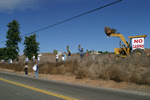
At right is photo of a billboard trumpeting the alleged groundbreaking of the proposed Jamul Indian Casino (the billboard is on State 94, just west of the intersection with Jamacha Boulevard in Rancho San Diego). I say “alleged” because there is some question about whether any ground is actually being broken, or even if that’s the intent.

The story gets a little complicated, but the starting point is simple enough: the Jamul band of the Kumeyaay Indians want to open a casino, for all the usual and obvious reasons. Meaning basically exactly one reason: to make money.

The Jamul Indians live on a six acre reservation along State 94, just south of the town of Jamul. The non-Indian residents of Jamul are overwhelmingly opposed to the casino, because they fear its effects on their quiet and rural community (I am one of those opposed). In fact, I have not met a single non-Indian who is in favor of the casino.

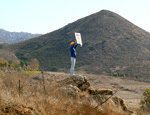
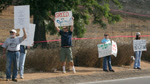
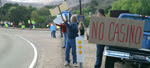
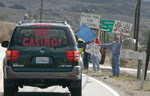
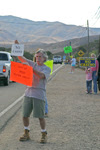
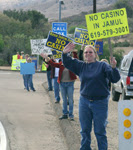
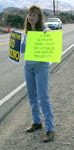
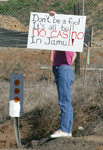
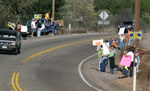
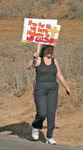
The photo at right shows one of the protesters we saw today, taking the high ground overlooking State 94. Westbound drivers could see this person for miles. I’ll scatter more of my favorite protester shots throughout this long post; there are many more at the bottom of it…

The first hitch in the casino plans was a doozy: six acres wasn’t enough room for a casino, so the Jamul Indians tried to annex an adjacent 81 acre lot, and then make it part of their reservation. That would have been plenty of room for them to build a casino complex, complete with shops, restaurants, and plenty of parking. But the need to annex the 81 acres provided those opposed with an easy target — and they did everything possible to prevent the Jamul Indians from accomplishing their annexation. Very successfully, in fact. So the Jamul Indians, fed up (or so they say — more on that later), decided to give up on the annexation, and instead drew up plans for a casino on their six acres. Since there wasn’t enough horizontal space for their rather grandiose plans, they came up with a vertical solution: 30 stories of casino. If you don’t know Jamul, you may not realize just out far out and wacky that sounds to the locals. I believe it’s true that we have no buildings over two stories tall in all of Jamul. The area surrounding the reservation is rolling hills draped in meadows and chaparral. A 30 story skyscraper would fit in here about as well as a mobile home in New York City.

There is some controversy about the actual intent of the Jamul Indians with this announcement, however. One school of thought has it that the Indians are desperate and out of options, and are actually just trying to scare the locals into caving on the annexation of the 81 acres — and they have no actual intention of following through on the 30 story casino. The PR piece they published a few weeks ago mentioned one thing that sounded convincingly serious to me: they said that the reservation residents' homes were being moved off the reservation to make room for the casino. That didn’t sound like bluster to me. Well, today we had a chance to look around the reservation — and it appeared to me that there were still homes on it. Furthermore, I didn’t actually see any evidence of homes having been moved (though I can’t be sure that’s correct).

And then we met Walter (and his very friendly dog). I spotted Walter standing alone on a little bump, with a good view, off to the side and away from any of the protesters. He has the classic profile of an American Indian, and he didn’t look unhappy about the protesters, so I approached him and introduced myself, and we had a short conversation. He didn’t give us his last name, and didn’t want me to take a picture of him (which is too bad, as he has a very photogenic face) — but he did tell us that he’s one of the Jamul Indians who is fighting the casino (and other issues) in court. Based on that, I believe he must have been Walter Rosales. If I’m correct, we met a very interesting man, indeed — he (together with a couple of co-petitioners) has been involved in close to ten lawsuits against the other Jamul Indians, including at least one that made it all the way to the Supreme Court of the U.S. (where the petition for a writ of certiorari was denied in 2004). Anyway, Walter told us that his lawsuit (or lawsuits) were still going, and that he was confident that he would prevail. He was utterly unconcerned about the casino actually being built, though he said he was happy to see all the protesters out there. Meeting Walter cheered me up even more than seeing all the protesters! More on Walter and his lawsuits can be found here and here.

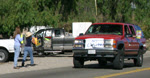
Today (December 10) the Jamul Indians had scheduled a ground-breaking ceremony, complete with live music, food, and prizes. A couple of weeks ago they published and distributed to local residents a PR-flack written pamphlet touting the casino and all its supposed benefits to locals (mainly jobs and business relationships), and wall-papering over all the many reasons why the locals object to it. It also tried valiantly to paint a picture of the ground-breaking ceremony as entertainment, and invited one and all to attend.

Though I knew of no organized plans for protests, this was obviously a golden opportunity for exactly that. So together with my friend Jim Barnick, I decided to head down there to see what we could see. I was hoping for a substantial protest (which, if the press latched onto it, might get the issue a little more attention), and I was curious to see if there was any evidence about whether this ground-breaking was for real, or if it was a sham.

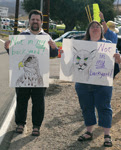
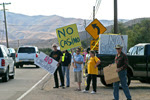
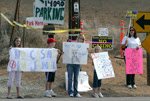
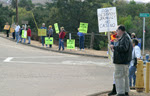
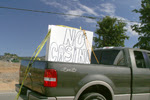
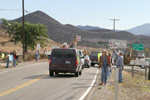
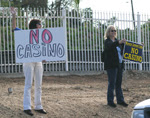
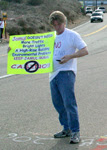
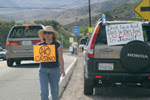
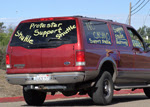
Well, as the pictures below make very obvious, we were not disappointed on the issue of a highly-visible protest! By a combination of count and extrapolation, we estimate that there were between 150 and 200 protestors out along State 94. That’s an interesting fraction of the entire population of Jamul (and they sure look like locals to me!). Every individual protester we met was cheerful, enthusiastic, and spirited. Nearly all the signs were strictly amateur (though sometimes very clever or pointed) productions; only a couple of the graphically perfect signs you often see at professional organized protests were in evidence. In other words, this protest had all the hallmarks of a heartfelt, grass-roots effort. Very uplifting for an opposition fellow like myself, even though so far as I know they have no actual plan that has a chance of prevailing — they’re all just yelling and hoping to get someone’s attention…

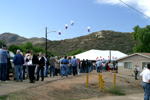
There were people showing up to attend the ground-breaking ceremony (and they were getting heckled by the protesters as they pulled into the parking area). At right is the line of people waiting to get into the ceremony, just before the doors opened. Looks like less than 100 to me. The parking lot, by my count and extrapolation, had about 120 cars in it. Some of the protesters told us that many of the cars belonged to invited guests from other reservations, but I had no way to confirm that assertion.

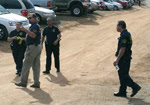
We saw one thing that surprised us very much: there was a massive display of armed force at the Jamul Indian reservation. You can see four of these security guys at right; all were armed with (at least) handguns, and all wore shirts proclaiming that they were off-duty officers. Whether that’s true or not, I don’t know. These security folks were scattered over a wide area, and moved about, but we estimate they had somewhere between 12 and 20 of them present. Then in addition, there was a CHP car (with one officer), and a sheriff’s car (with either one or two officers; we couldn’t see inside it clearly) also present. That adds up to a considerable show of force, for no reason at all that I could see. Certainly the protesters were hardly a threat — not counting the many children present with their parents, I suspect the average age of the protestors was between 40 and 50, and you can see in the photos that they aren’t exactly commando types. I wonder what the tribe was thinking? Just scared by all the emotion in the community? I was much more worried by the security guys than I was by the protestors. One security guy accosted us as we walked into the reservation. He asked us whether we were with the protesters, and I said (truthfully) “no”. But then I asked him what would have happened had I said “yes” — and he just shrugged, looked a little embarrased, and laughed it off. But now I wish I’d lied and said “yes", just so I could have seen what would happen. And a little later, I caught a snippet of conversation amongst the four in the picture, and the tenor and tone of the conversation wasn’t reassuring. Especially considering they were carrying weapons (with plenty of ammunition, I noticed — one of the four had at least 8 clips on his belt)…

Well, all in all it was an interesting experience, and definitely uplifting for anyone opposed to the casino. Jim and I were very glad we decided to go. I’m now cheering for Walter Rosales and his co-petitioners, as I think they probably represent the last hope of defeat for the casino — unless, by some miracle, the protests today draw some attention from someone who knows another yet-unexplored path to stopping it. I’ll close with the remainder of my protest photos:

Bravo Cafe

Just say the words “Bravo Cafe” to anybody who knows Jamul, and you’re certain to see them smile — and if they’re hungry, they may start drooling. In Jamul, if you want a home-cooked meal or a treat, the Bravo Cafe is where you go…

Bravo Cafe is owned by Manoli (and I hope I didn’t mangle the spelling of his name!) and his wife Rosio, helped out by their kids (especially his daughter Esmeralda) and several employees. It’s located at the intersection of State 94 and Steele Canyon Road, right across the road from the Ranch Feed Store (and kitty-corner from the 7-11). Manoli is smiling (in disbelief as I took his picture <smile>) in the middle photo, and his whole family (minus the latest addition) is in the painting on the right hanging on the Bravo Cafe’s wall. Debi and I stop here several times a week, for huge and delicious salads, outrageously good sandwiches (including several unusual ones), smoothies, and the soups that Manoli is justly famous for locally. My favorite soups are his lemon chicken (I’m drooling now!) and albondigas — followed closely by lentil. Yum!

Jim Barnick and I stopped in this morning for a little breakfast — I had one of Manoli’s unique (and huge!) BLTs with fresh orange juice, and Jim had a bacon breakfast bagel. Just plain excellent!

Manoli and his entire family are the epitome of the warm, friendly folks you generally find out here in Jamul. They greet everyone with a smile, and most of the locals by name (I’m “Mr. Tom” to them, far more respect than I get from most people!). The food they prepare and serve certainly isn’t pretentious or fancy. It’s like home-cooking: fresh, just-plain-good food with very generous servings. Just to give you an idea: they serve many of their sandwiches with a fork, and you need it — because the sandwich is so over-stuffed that good things fall all over your plate as you eat it!

As usual, click on the photos for a larger view…

Friday, December 9, 2005

Jamul Casino

For many years, the Jamul Indian Village has been trying to get a casino built on 81 acres adjoining their 6 acre reservation on State 94, just south of the town of Jamul. This project has faced intense local opposition, mainly from non-Indians (including from me!) who do not want their quiet rural lifestyle disturbed. That core argument has spawned many secondary arguments that might actually have a chance in the courts: fire protection problems, environmental problems, water consumption problems, traffic problems, etc. For years the surrounding communities and even higher level opposition has succeeded in preventing the Jamul Indian Village from getting permission to use those 81 acres for a casino.

Recently they tired of the game, and announced a new plan: to build a 30 story casino on the 6 acres that is unarguably their reservation, where they have the legal right to do whatever they want to. This building would become the largest (in volume and square feet of floor space) structure in San Diego County. On the face of it there seems to be little the opposition can do about this, though some local politicians (most notably County Supervisor Dianne Jacobs) publicly refuse to give up, and are still fighting the good fight.

Myself? I am resigned to the casino being built. What I fear the most, as an impact, is (a) the traffic resulting from casino visitors, and (b) the likely change in the ambiance in the town of Jamul. Today Jamul is defined by the Bravo Cafe, the Greek Sombrero, the feed store, the Jamul flower shop, and the 7-11 (I’ve just listed a significant fraction of all businesses in Jamul). It’s a community — we know each other on a personal level, many of us are friends. What will it be like after the casino? I don’t know, but I can’t imagine it will stay the same…

A few weeks ago the Jamul Indian Tribe announced a ground-breaking ceremony on December 10 (tomorrow!). A PR piece they circulated to locals is a second-rate (and far too obvious) hack job, which to me lends credence to the claims of some opposition folks that the ground-breaking ceremony is in fact a sham, designed really to scare the holy s**t out of the locals. To what end? To get them to withdraw their objections to the original 81 acre plan, which would have single-story architecture designed to blend into the surrounding area (or so the claim is). I have no clue who is right on this, but (together with my friend Jim Barnick) I decided to attend the ground-breaking to see if I can figure it out.

Meanwhile, I ran across a fairly level-headed press report (a very rare thing indeed, on this or any other topic!) that’s worth reading. The passage that stood out to me was this one:

From the Voice of San Diego:

In the casinos, Indians are not selling us their culture but our own toxic desires. Gaming adds up to nothing of value, and it can set family and tribal members and neighbors against each other.

The article has a condensed history of the issue, and some perspective from both sides. Go read the whole thing!

Thursday, December 8, 2005

Shut Up!

Ali at Free Iraqi is one of the Middle Eastern bloggers I read every day. His post of a couple days ago, about the trial of Saddam Hussein, got the ponder going. Ali ends the post with this:

These two were very polite with the judge all the time (Barzan was even begging for mercy on one session) but as soon as they saw a simple Iraqi citizen with no power (or so they think) they regained that arrogant look and assumed the faces of the rulers again! How coward and how stupid at the same time! But it was more than great (and surprisingly shocking) to hear the words of that simple man from Dujail saying to Barzan, “Shut up!”.

Ali — the “Free Iraqi", blogger — finds it “surprisingly shocking” to hear an ordinary citizen tell Saddam Hussein to shup up. The more I think about that statement, the more sympathy I feel for Ali and the other “ordinary” Iraqi citizens. What a remarkable transition for them these past few years have been…

Near the beginning of his post, Ali says this:

There I saw an average Iraqi, who has no power or wealth, a man whom Saddam used to sign the execution order of hundreds like him without even knowing the name of one of them, standing boldly and exposing this monster’s horrible crimes. He was not afraid and returned Saddam’s words with stronger ones. I must admit that I saw this man as a hero and I think many Iraqis share a similar view with that of mine, as these people terrorized us for such a long time that even hearing their names used to paralyze us with fear.

"…even hearing their names used to paralyze us with fear.” I think that’s very difficult for most of us non-Iraqis to really internalize, as our comfortable and relatively safe lives have never included such a threat from our own country. Last night, this passage had me lying awake thinking for a while, just trying to get into Ali’s skin a bit. What must it have been like during Hussein’s thugocratic rule? In the end, all I could do is shudder in horror.

Yell it, Ali: “Shut up, Saddam!” Right up until one of your fellow citizens has the honor of ending that evil man’s life, and shuts him up forever…

Oh, My!

Via TigerHawk (click for a larger view).

Imagine it’s 1941, and Ted Kennedy, Howard Dean, and John Kerry are in Pearl Harbor when the Japanese make their sneak attack. The picture at right shows what might have happened…

There’s a little tiny graphic on the picture that credits it to SacredCowBurgers.com. Now with a name like that, I thought I might be in for a treat — and I was (but check it out yourself!). The site appears to be the solo work of Jay D. Dyson, who not only makes visual parodies (many of them are excellent), but also offers some commentary with each one. On the one pictured here, he says:

Each year that I do a parody on the anniversary of the surprise attack on Pearl Harbor, I usually find it difficult to avoid repeating the previous year’s theme.

This year, that was decidedly not the case.

After suffering through countless episodes of the patently anti-American antics of today’s Democrats, this parody came effortlessly. And what’s more, the core truth of this satire simply cannot be denied. There can be no doubt that the conduct featured here is precisely what the Democrats would do if we had another Pearl Harbor!

Just take a long, hard look at current events: our nation is scarcely four years past the 9/11 attacks, we are currently involved in a war to assure the longevity of a fledgling democracy where terror once reigned, and what are the leaders of the Democrats doing? Why, pulling all kinds of ridiculously anti-American, anti-troop and anti-victory stunts whenever they get a microphone or camera put in front of them!

And the truly nutty part? These jerkoffs think they should be in charge of our great nation! They actually believe they’re entitled to call the shots! *brrr!* Creepy!

I am so looking forward to 2006 when Americans can stand up for our great nation and throw these lousy bums out on their ear.

Amen to that, brother.

Blog Patterns

I’m a little bemused by yet another unlikely looking pattern in the visitors to my blog: 80% of today’s visitors found me by searching Google for images of Ann Coulter. Now mind you, Ann is a very attractive woman — so I’m not surprised people are looking for pictures of her. Especially since she was splashed all over for an incident where a bunch of liberal college students heckled her so intensely that she had to give up on her speech (and if you know anything about Ann Coulter, then you know she’s not easy to back down!). What really surprises me is this: the picture at right, and a copy of the Time cover Ann was on, are the only two photos of Ann on my blog — and the one at right is the 25th hit on Google Images. And yet this is 80% of my visitors!

This must be a message in here somewhere. I’d like to think it was the power of Ann’s rhetoric, and the justice of her (conservative) cause, that made so many people want to search for her picture. But I suspect it’s just what you suspect: a bunch of guys mooning (or something) after a beautiful woman. So the message for me is … stop blogging about the nonsense I usually blog about, and just put up pictures of beautiful women.

Sigh.

Update: Something I meant to mention above (but forgot!) is that until today, the front-runner just about every day for the past two months has been Google Images searches for “rabbit”. I’m not joking! Try it yourself and see what happens!

Midway

A few days ago, a friend (Rick Pugh) asked if I’d be interested in visiting the Midway Aircraft Carrier Museum on Pearl Harbor Day. Absolutely! was my answer, and we were actually able to pull this off. We started by having a very nice breakfast at a place with an unlikely name: “Hash House a go go”. I can’t account for the name (no “go go” in evidence), but the food was very good; memorable, in fact. I am planning to go back there with my lovely bride one of these fine days…

Anyway, after fortification we set off downtown to the Navy Pier, where the old USS Midway is now permanently docked. Parking was easy; plenty of room on the pier itself (though it’s cash-only, and I had to bum some bucks from Rick). We were on board in just a few minutes, with a minimum of fuss, and there were no crowds. Bad for their business, but good for us!
We first took a tour of the island, on the advice of the first (of many!) helpful and knowledgable docents we ran into. He told us it was likely to get crowded and hurried as the day went on, so we took his advice and went on the first island tour of the day. The large photograph at right is a panoramic view (made from three individual photos) from the “air boss” position high in the island. The island is on the starboard (right) side of the ship, and you’re looking aft (toward the rear) through about amidships (directly across). From left to right, the aircraft visible include a COD (nose and port wing), the nose of an S-3 Viking, (almost hidden behind the awning) an F-14 Tomcat, an F/A-18 Hornet(in the background, in desert colors), an F-4 Phantom, an A-6 (foreground), an RA-5 Vigilante (background), and an H-3 SeaKing. And there were even more aircraft on the flight deck forward of these, and a few more on the hangar deck! The smaller picture at right is Rick sitting in the Air Boss' chair, looking out over the flight deck…
The photo at right was taken from near the bow, looking aft on the flight deck. In it, left to right, you can see another F-4 Phantom, an E-2 Hawkeye (with it’s wings folded, and the radome “flying saucer” on top), and an A-7. To an old Navy electronics guy like myself, there are some interesting things on the mast over the island: an SPS-10 radar antenna, and an SPS-48 radar antenna. The SPS-10 is a truly ancient piece of gear, of World War II vintage — tubes and prehistoric servos. They were laughably old — and belonged in a museum — when I was in the Navy (in the '70s), but a docent told me that it was still in service when the Midway was decommissioned in 1992. The SPS-48 is a considerably more modern system, but still quite old. It was one of the first of the so-called “3D” radars to be deployed. By “3D", they mean that in addition to bearing and distance (what most radars do), it also detects the altitude of a target. It does this by using a fixed-array antenna that is scanned in elevation by changing the frequency of the transmission — a relatively simple, but easy and reliable, fixed-array antenna technique. Since the fixed-array scans only in elevation, the antenna still rotates to scan in azimuth.
At right, from left-to-right: the F/A-18 Hornet, Rick looking at the big radial piston engines on the COD, an F-4 Phantom procedures trainer, and an A-4 Skyhawk on the hangar deck. This was the first time I’d seen an F/A-18 up close and personal; I was struck by how much more advanced the construction was compared with any of the other aircraft on board. Virtually every piece of its fuselage and wings are compound curves; everything is very smooth, with a nearly complete absence of the usual angular protuberances. Very impressive, even just to the casual eyeball. In my Navy career I made quite a few trips to-and-from carriers at sea; most frequently the USS Enterprise, and almost always by helicopter. But once — just once — I flew in the back seat of an F-4, catapult-launched from the Big E (and landing at Cubi Point, Subic Bay, Phillipines). That was a serious kick in the pants, especially after the pilot learned I was interested in aerobatics, and we did a few things that I suspect weren’t in the original flight plan. And twice I landed on the Big E in a COD. Now the COD is a small, rugged plane with a relatively low landing speed — so a carrier landing in a COD is a very far cry from a carrier landing in, say, an F-4. But I’m here to tell you that it was plenty exciting for me. The most memorable part, for me, was the initial approach to the carrier — it looked like such a tiny speck, lost in the vast ocean, and landing on that speck just didn’t seem very likely. Or very wise. Naturally, the pilots made it seem like a cakewalk…
Last, but certainly not least (for me, anyway!) — at right is Rick standing next to a system that I am very familiar with: a Univac CP-642B computer. This particular computer is part of a complete Ship’s Inertial Navigation System (SINS). I trained on this system, and in fact even helped debug some software on it, way back in the early '70s. This was the first inertial navigation system deployed on US ships, and for its day was quite a remarkable system. An inertial navigation system is one that figures out where it is by very precisely measuring every movement it has made since leaving another precisely known place. By integrating all those movements over time, it can calculate exactly where it is at any moment. In practice, inertial navigation systems were built back then by combining a “stable platform” and three accelerometers. The stable platform is a system of three or four gyroscopes, mounted on different axes, and it always points in the same direction (it’s mounted on a gimballed platform to allow this), no matter how the ship twists and turns. The accelerometers measure every teensy little acceleration (speeding up or slowing down) in the three different directions (usually thought of as left/right, forward/backward, and up/down). With a little math and that information, you can figure out where you are — and that’s exactly what SINS does.
For me, though, the most interesting part is the CP-642B. You see, that was the first computer I ever worked on; the first one that I ever understood. By today’s standards, it is almost humorously incapable: 30 bit word length, a blazing 100KHz clock speed, and 32 kilowords of excruciatingly slow (and tempermental) magnetic core memory. But this is what I cut my digital teeth on, and so I have a sort of sentimental attachment to the beast. I haven’t seen one of these things for close to 30 years, so I was quite surprised to discover that within moments of walking up to the thing, I could remember all kinds of details about how it works, and how to operate it. I do believe I could still key in a program, run it, single-step it, and so on. For any geeks out there: that control panel with all the lights is something you just can’t have these days. There’s a light for every bit in every register in the computer, and you can press that light to toggle the state of that bit. A momentary paddle switch allows you to stop the computer’s execution at any point, and then you can see the complete internal state of the computer at that moment. Very primitive — but it’s amazing what we managed to get done with this machine…

Wednesday, December 7, 2005

2,471

Sixty-four years ago today, on December 7, 1941, the Imperial Japanese Navy made a sneak attack on Pearl Harbor, just outside of Honolulu, Hawai’i. The attack killed 2,471 Americans (2,403 military and 68 civilians). It was a complete success for Japan from a tactical perspective; a disaster from a strategic perspective.

Today we remember… We remember our country’s great loss, and we remember the strength and resiliency our parents' generation showed in the face of evil and adversity.
And I hope that their descendants — the Americans of today — can do the same with respect to the evil and adversity we face today from terrorists like Al Qaida…

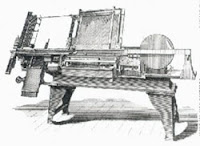
Paige Compositor

Did you know that Samuel Clemens suffered a business failure that forced him into bankruptcy? Somehow this chapter of Samuel Clemens' life has managed to escape my attention until quite recently.

The business failure was related to an automatic typesetting machine called the “Paige Compositor”. From a description on the site of the Mark Twain House:

The Paige Compositor was an automatic–typesetting machine invented by James W. Paige. Little is known about the inventor of the Paige Compositor. James W. Paige was born in upstate New York in January 1842. While living in Rochester, he applied for his first patent on a typesetter in 1872, and the patent was granted in 1874. He then moved to Hartford between 1874–77 to work for the Farnham Type–Setter Company, which was trying to put together a workable typesetter by combining the gravity-fed Farnham machine with the Thompson distributor. The Farnham Type–Setter Company rented space for about five years at the Colt Firearms factory. The rest of Paige’s life centered around the Paige Compositor, trying to market it and make it work. Paige eventually died in the poorhouse, but no one knows where or when.

Twain’s love for technology and his background in printing led him to invest in the compositor. Between 1880 and 1894 he invested a fortune into its development, resulting in his near bankruptcy. In an 1889 letter to his brother Orion, Twain writes,

“All the other inventions of the human brain sink pretty nearly into commonplaces contrasted with this awful mechanical miracle. Telephones, telegraphs, locomotives, cotton gins, sewing machines, Babbage calculators, Jacquard looms, perfecting presses, Arkwright’s frames – all mere toys, simplicities! The Paige Compositor marches alone & far in the lead of human inventions."

The Paige Compositor was, by all accounts I’ve found, a jaw-droppingly astonishing kind of machine. It had over 18,000 parts and could set type faster than its competitor (the Linotype machine) — when it worked. But it was failure-prone, and very difficult and expensive to manufacture. The inventor was a perfectionist who didn’t want to go to market with a less-than-perfect machine — and so was beat to market by several years by the Linotype. There are lots of parallels here in my own industry (software).

In a biography of Sameul Clemens (by Albert Bigelow Paine, available online), there’s a good discussion of this episode. A sample:

By the end of ’88 the income from the books and the business and Mrs. Clemens’s Elmira investments no longer satisfied the demands of the type-setter, in addition to the household expense, reduced though the latter was; and Clemens began by selling and hypothecating his marketable securities. The whole household interest by this time centered in the machine. What the Tennessee land had been to John and Jane Clemens and their children, the machine had now become to Samuel Clemens and his family. “When the machine is finished everything will be all right again” afforded the comfort of that long-ago sentence, “When the Tennessee land is sold.”

They would have everything they wanted then. Mrs. Clemens planned benefactions, as was her wont. Once she said to her sister:

“How strange it will seem to have unlimited means, to be able to do whatever you want to do, to give whatever you want to give without counting the cost.”

It’s an interesting read, worth it if you are at all interested in Samuel Clemens.

More information about the Paige Compositor here, here, and here

Tallinn Photo

One of my favorite places (Tallinn, Estonia) is visible on this synthesized photo of a night view of Europe from space. The original photo was darker and didn’t have Tallinn marked.

From Astronomy Picture of the Day (APOD):

Can you find your favorite European city? The above digital fantasy of Europe at Night is a digital composite of archived satellite images taken both during the day and night. This image is different from what an astronaut would see for reasons including a complete lack of clouds and an unrealistic exaggeration of lights and contrasts. Even so, the geography underlying the image is captivating. Nighttime light patterns have been accumulated from the USAF Defense Meteorological Satellite Program (DMSP) Operational Linescan System.

Tuesday, December 6, 2005

APOD

Astronomy is a “hard” science that nevertheless works with things of great beauty…

From Astronomy Picture of the Day (APOD):

These wisps of gas are all that remain visible of a Milky Way star. Many thousands of years ago that star exploded in a supernova leaving the Veil Nebula, pictured above. At the time, the expanding cloud was likely as bright as a crescent Moon toward the constellation of Cygnus, visible for weeks to people living at the dawn of recorded history. The supernova remnant lies about 1400 light-years away and covers over five times the size of the full Moon. The above image of the Veil was made clearer by digitally dimming stars in the frame. The bright wisp at the top is known as the Witch’s Broom Nebula and can be seen with a small telescope. The Veil Nebula is also known as the Cygnus Loop.

Click on the thumbnail for a (gorgeous) larger view…