Showing posts with label Casino. Show all posts

Friday, August 3, 2007

Revised Casino, Revised

Updated and bumped:

Mike W. (one of my readers) spotted an interesting change on the Lakes Entertainment web site. Here's what it says now:
Casino Highlights
  • 1,000 gaming devices, 20 table games and 5 poker tables
  • Enclosed parking garage
  • 20 minutes to downtown San Diego
  • Proven gaming market
  • Population - 11 million/100 mile radius
Project Status
  • Signed development and financing agreement
  • Currently planning to build on existing reservation
They dropped the completion date! I'm not entirely sure what this change means, but it sure is hard to see it as anything other than good news!

Original Post:

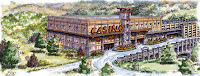
The Lakes Entertainment web site is now showing the revised casino plans:

Casino Highlights
- 1,000 gaming devices, 20 table games and 5 poker tables
- Enclosed parking garage
- 20 minutes to downtown San Diego
- Proven gaming market
- Population - 11 million/100 mile radius
Project Status
- Signed development and financing agreement
- Currently planning to build on existing reservation
- Opening estimated January 2009

Assuming those are Class 2 gaming devices (not requiring any agreement with the State), this is a plan for a tiny and far less profitable casino than the proposal we heard last fall. It appears to be either 3 or 4 stories high, versus the 27 or 30 or whatever was really being planned (I’ve heard so many variations that I’m not sure what the reality was).
While I’m sure that the tribe and Lakes Entertainment are completely correct to say there are fewer obstacles in the way of getting this plan implemented, I believe it’s also true that the (much) smaller profit incentive means it’s much less likely that Lakes Entertainment will be willing to fund a prolonged, difficult legal battle. In other words, I think this development means the casino project is now more vulnerable to challenge…

Thursday, March 22, 2007

JAC gets a BB

The webmaster for the Jamulians Against the Casino site dropped me a note today to let me know about the new “bulletin board” he’s now got running there.

I just went up and registered — a painless, 15 second process — and put a post up. Obviously the word has not yet gotten out about this, as there are only a few posts up there now. Having a single place for the community to discuss the Jamul Indian Casino issues is a great thing. I appreciate all the comments I’ve had on my casino-related posts, but…my blog is not dedicated to this one issue, as the new JAC bulletin board is, and my blog would never make a good “community room” — but the JAC site would!

So if you’re a fellow Jamulian, and you’re concerned about the casino, drop on by there, register, and check back frequently. If the word gets out to enough people, we should be able to have a lively discussion there — and hopefully generate some good ideas. It’s also a way for us to coordinate our actions, and I hope the JAC uses it for that purpose…

Suddenly a vision came to me: a collection of scruffy Jamulians (including me!) demonstrating in front of the Governator’s smoking tent. Burning casinos in effigy. Declaring a connection between casinos and global warming. And autism. And clearly that ground is prime habitat for the Hermes Copper! If we can get the Goracle, the science-challenged, and the environmentalist wackos on our side, we’ll win for sure!

See what happens when I post late in the afternoon?

Friday, March 16, 2007

Disaster in Jamul

With permission, I am reprinting this email sent by a Jamul resident to the San Diego Union-Tribune and the Voice of San Diego:

Disaster in Jamul

I found it very interesting while I was doing some research on Southern California Intertribal Court Judge Anthony Brandenburg that on the web page for the Intertribal Court of San Diego it lists under Member Tribes only Pala, Pauma, Rincon, San Pasqual, La Jolla, Mesa Grande and Santa Ysabel. I do not see the Jamul Indian Village any where on the site so why would the Sheriff’s office support an eviction notice from this “Court” when it appears they do not even have jurisdiction? This is information Sheriff Deputies or Captain Chambers could check just like any other citizen. I certainly can understand why Walter Rosales and Karen Toggery, their attorney plus concerned friends would expect Sheriff Deputies to protect them from unlawful home invasion that led to violent, illegal evictions and their homes being unjustly demolished.

Shame on the Sheriff’s Department for supporting the “Mafia” like tactics of the Jamul Indian Village and Lakes Gaming.

Linda Ivy

Jamul, CA

This is yet another example of how the country-within-a-country nature of America’s relationship with the American Indians complicates seemingly ordinary events, and leads to results that look crazy. Who would have believed that the sheriffs and police would just look on as Americans were clubbed and pepper-sprayed by hired thugs?

I have no expertise on the great, entangled mess that is the body of law and regulation controlling this relationship. My own investigations into the actual status of the Jamul Indian Village are completely inconclusive — authoritative-sounding people on both sides of the issue make contradictory claims, and support them. I have trouble getting excited about who is right or wrong on this issue (and I suspect the answer is somewhat plastic anyhow). What I could get excited about is a movement to remove the distinction, so that it no longer mattered whether the tribe was “certified", whether Walter Rosales had the “right blood” to be a Jamul Indian tribe member, or any of the other crazy questions that arise because we’ve made this artificial distinction between classes of Americans.

But it may well be that the fate of the casino rests on the answers to questions like the one that Linda Ivy raises in her email. For that reason, it behooves us all both to raise the questions (as Linda has done) and to try our best to follow the maze of headache-inducing rules and laws that determine the answers.

I think I’ll order a big bottle of aspirin…

Thursday, March 15, 2007

Casino Update

This morning, Lakes Entertainment (the company backing the Jamul Indian Village’s attempts to build a casino) released their financial results for fiscal 2006. The press release announcing the results contained this nugget:

Based on recent meetings between the Jamul Indian Village (“Jamul Tribe”) and the State of California, Lakes and the Jamul Tribe are currently re-evaluating the Jamul Tribe’s alternatives for its casino project. Depending on which direction Lakes and the Jamul Tribe decide to take, the proposed gaming facility will be reduced in size and scope. As a result, during the fourth quarter of 2006, Lakes recorded unrealized losses on notes receivable related to the Jamul project of approximately $6.3 million, which reduced the overall 2006 net unrealized gain on notes receivable related to this project to approximately $2.0 million.

I’m no expert on corporate finance, and certainly not on the financial ins-and-outs of gaming companies — but here’s my stab at translating that into plain English:

First, the Jamul Indian Village has borrowed some amount of money from Lakes Entertainment, in one or more loans, which at some point in the future they will have to repay. My presumption would be that this money is to be used to promote, get clearance for, build, and operate the casino. My further presumption would be that the use of this money is essentially controlled by Lakes; I can’t imagine they would simply hand it over to the Jamul Indian Village. But — key point — repayment of this money will depend on the existence and profitability of the casino. The more profitable the casino, the more likely (and the faster) this note would be repaid.

For the purposes of their financial statement (which is the public disclosure of their financial condition), Lakes can’t simply record the loans (the “notes receivable") as if they are certain to be repaid. Obviously there is considerable risk to these loans, and that must somehow be disclosed. The conventional way to do that is for the firm’s financial officer (and auditor) to make a judgment about the probability that the note will be repaid, and to record current profits or losses based on that judgment. In most companies there would be a bias toward overstating the positives in such judgments, so when you look at numbers like this — pure judgments on someone’s part — generally it’s smart not to think of them as having been objectively arrived at. These judgments are what we’re seeing here with the recording of a $6.3 million loss. Since I don’t know the size of the entire loan, I don’t what percentage of it has been written off now as a loss — but it would have to be a huge loan for this to be an insignificant portion of it. I can’t quantify it precisely, but it sure looks to me like this was a significant write-down.

In other words, it looks to me like Lakes Entertainment isn’t very optimistic about their investment in the Jamul Indian Village Casino. If you’re a typical Jamulian, that’s very good news indeed — for who would know better than Lakes what the actual situation is?

Also interesting in that press release is the statement about reduced size and scope of the casino. Part of that, surely, is the recent announcement by the Jamul Indian Village that they’ve dropped out of the negotiations with the state, and that they’re going to switch to games not covered by the compact. This statement in the press release implies that the size of the casino may also be reduced. I don’t want to see the casino at all — but if the casino does get built, the smaller, the better. So I’ll take that as good news, too.

We certainly don’t see in this year’s statement of Lakes Entertainment financial results the same buoyant, upbeat assessment of the Jamul Indian Village Casino that we saw last year. Another difference you can see is that Lakes is making good money in other areas now — especially the televised poker tournament — and I would bet that leads the management team to focus more on those profitable areas, and less on the risky or unprofitable areas. That would also be good news…

Patrick Webb (attorney for Walter Rosales and Karen Toggery) made a statement the other day about things coming down to the wire from the perspective of the Jamul Indian Village. This financial report from Lakes Entertainment looks like validation of his musings…

Wednesday, March 14, 2007

Sheesh

Just yesterday, I wrote this:

Leon Acebedo, the tribal chairman, is known to some locals as “Lying Leon”. I can’t help but wonder whether he actually did warn the opponents on Saturday about this possibility. I also can’t help but wonder to what degree the executive council is under his thumb, and their “override” was engineered…

Today, Rob Davis (writing for Voice of San Diego) reports:

Jamul tribal chairman Leon Acebedo told me yesterday that he’d warned opponents that he didn’t have the authority to make such an agreement, that his 51-member tribe’s executive council could overrule him. They unanimously did Monday morning.

Jacob said that no such warning was given Saturday, when the agreement helped diffuse a tense standoff between tribal security and casino opponents. The agreement, which Acebedo signed, said the tribal council would meet Monday to “affirm” the d´etente.

In an interview today, Acebedo said that he, in fact, had not told opponents that he could be overturned.

"I was very aware that I could be overridden,” he said. “I didn’t talk to them (the opponents) about it. I just wrote what was requested of me."

Looks like Leon is living up to his moniker.

Tuesday, March 13, 2007

Dètente Canceled

Just two days after promising to leave the homes of Walter Rosales and Karen Toggery untouched for at least a week, the Jamul Indian Village has destroyed them. Via Rob Davis, writing in the Voice of San Diego:

After years of delays, the Jamul tribe followed through on its plans to demolish the homes of Toggery and Walter Rosales, who lived on the reservation but are not members of the legally recognized tribe.

In doing so, the Jamul tribe reversed course on promises its chairman gave to casino protestors over the weekend. At a Saturday standoff where casino opponents were clubbed and pepper sprayed, tribal chairman Leon Acebedo helped resolve the confrontation by assuring opponents that no construction would happen until Friday.

But Monday morning, the Jamul tribe’s executive council unanimously rejected the temporary reprieve offered by Acebedo, who said he warned opponents Saturday that he didn’t have the authority to issue such a delay.

Leon Acebedo, the tribal chairman, is known to some locals as “Lying Leon”. I can’t help but wonder whether he actually did warn the opponents on Saturday about this possibility. I also can’t help but wonder to what degree the executive council is under his thumb, and their “override” was engineered…

An aside: isn’t Rob Davis' reporting and writing on this story a refreshing change from the pap that the Union-Buffoon has been serving up? I stole the headline for this post straight out of his article…

Later in the Rob’s article, there is this thought from Patrick Webb (the attorney for Walter and Karen) about why the Jamul Indian Village is suddenly breaking off negotiations with the state, and acting to clear the buildings off the land:

"I think it’s down to the wire for everybody,” Webb said. “We have yet to decide what’s putting the pressure on them to do this. We can only assume it’s coming from Lakes Gaming, which has the money up."

Webb’s notion that there is pressure on the Jamul Indian Village to get something done sounds right to me. I can’t think why else there would suddenly be this outbreak of dramatic and rash actions on their part. And his suspicion of Lakes as the source certainly makes sense — for what other entity has any sway on the Jamul Indian Village at all?

Finally, here’s the last paragraph of Rob’s article (but go read the whole thing), with a quote from Karen Toggery:

"You can’t sit here and cry, it’s not going to help,” she said. “I’m not going to give up, if that’s what they think. Land is the most precious thing you can have."

Karen’s not crying, and she will keep fighting. So will we all. I have a fantasy about a future ceremony, jointly held by a new Jamul Indian Village administration and the local residents of Jamul, wherein we burn every last shred of paper related to the monstrous casino.

After we get a burn permit, of course.

Monday, March 12, 2007

JAC

The webmaster for the JAC (Jamulians Against the Casino) web site contacted me today to let me know that their web site, while still under construction, is up and running. There’s useful information up there, especially (at the moment) with regard to the history of the Jamul Indian Village and their efforts to build a casino here.

Go take a look!

Sunday, March 11, 2007

So Sad

Yesterday morning as I bought some repair items at the Jamul hardware store, I heard a discussion amongst several people there about the “commotion” down at the Jamul Indian Reservation. The folks there weren’t entirely sure what was going on, but they suspected that Walter Rosales and Karen Toggery were being evicted. After leaving the hardware store, I drove down to see for myself. The people I talked to there gave me a confused and contradictory version of events, so I wasn’t sure what was going on. The one thing I could be sure of is that there was a vocal confrontation and a significant police presence.

Walter and Karen are Jamul Indians and long-time residents of the reservation who oppose the casino. They refused to move off the reservation, and were “disenrolled” from the tribe late last year — allegedly because of inadequate documentation of their membership in the tribe, but really, I’m sure, because of their opposition to the casino.

Late yesterday, a reader left a comment on my blog, and this was the first verification I had that Walter and Karen were in fact evicted. Here’s the comment in its entirety — a first-hand account of what happened:

We received a phone call alerting us that the casino faction was forcibly taking Walter and Karen out of their houses this morning about 7:40 a.m. It was a very sad state of events, thugs hired by the casino proponents took them out of their houses and then started throwing all their belongings into U Haul vans. Walter called 911 but it took awhile for deputies to respond and actually sheriff deputies did nothing … did absolutely nothing … to protect Walter or Karen and their homes and property. And later when many residents and Walter and Karen’s attorney Patrick Webb accompanied Walter to his house the thugs beat and pushed and maced people with the sheriff deputies still doing nothing. Everyone felt so helpless because we could not help Walter and Karen protect their homes. Walter is such a kind, gentle man. When someone told him not to give up, he likened it to being in a difficult situation in Vietnam with the Marines and things worked out. I hope this does. I hope all of San Diego County sees the type of people the greed of casinos have turned these criminals into that call themselves casino proponents. Unfortunately it ended with their belongings being hauled off to a storage facility. Robby and I took Walter’s two roosters and two pet conures. Walter had his dog and Karen’s cat was brought out to her in a cardboard box. They were not allowed to go back to their homes. Jamul residents that were hurt filed complaints against the so called “Jamul Indian Police”. Grievances will be filed against the Sheriff’s Department. Diane Jacob arrived to try and intervene but with little success other that a written promise from the lying Leon Acevedo, so called tribal chief promising not to level the homes until after the close of business next Friday. It actually did not seem like something like this could happen in America.

Indeed. How could something like this happen in America?

Well, there are several answers to that. The one most immediately applicable here is that we are seeing (once again) the strangeness that can occur at the intersection of American law and Indian law — the tortured mess that is our law regarding the country-within-a-country status of American Indian reservations. But today — unlike a few years ago — we could see this happening even outside a reservation, thanks to the Supreme Court’s Kelo decision, which opened the doors wide for any municipality (or other government unit) to “condemn” anyone’s property for any purpose they deem worthwhile — including simply replacing someone’s home with something that generates more taxes for the government. Like a casino…

I got to pondering this morning about all the events that had to be in place for Walter and Karen to be evicted yesterday:

The notion of Indian reservations, with their quasi-independent systems of government, had to be in place.

Casinos had to be illegal off-reservation, but legal on-reservation.

Walter and Karen had to be Indians living on a reservation in a desirable place to locate a casino.

A majority of the Indians on their reservation had to support the notion of building a casino.

The reservation had to secure funding for the casino (which the Jamul Indians have done by striking a bargain with Lakes Entertainment).

A majority of the Indians on the Jamul Indian reservation had to be willing to take some very radical steps. Their six-acre reservation is so small that they couldn’t possibly have a casino and still live on their reservation — so they had to be willing to relocate off-reservation to do this. To some members of the reservation (including Walter and Karen), some of the reservation is hallowed ground, with the ashes of their ancestors and their possessions. And a majority of the Indians had to be willing to force the objectors to comply with the majority’s wishes.

What’s motivating all this?

Money, of course. Period, end of story. It’s all about the money.

Do you find that as sad — and pathetic — as I do? Here’s a group of Americans (the Indians) who, were they assimilated into the rest of America, would have the same opportunities as the rest of us. We’d find them in all kinds of jobs, with the same range of success we see in the rest of our citizens. Instead, they’re part of the reservation system, isolated to some extent in their own culture — and feeling desperate enough about their collective situation to be willing to do the things I outlined above. There’s a message in this about the utter failure of the reservation system…

There are a couple of news stories about the incident. Here are a few excerpts from those stories:

Toggery said she was still in her pajamas when she was ordered to leave her home. “I said I am not going to open my door until I get ahold of my attorney,” Toggery said. “They finally kicked it open."

Walter Rosales was also evicted Saturday morning. He was forced to grab his animals and leave a home he says he inherited from his uncle in 1987. “I was evicted this morning be a bunch of goons, you know, the old goon squad,” Rosales said.

The situation got even more heated when County Supervisor Dianne Jacob — she also opposes the casino — showed up. Jacob said she may place an emergency call to the governor to stop the evictions.

"I strongly oppose the evictions that have take place here today,” Jacobs said. “I think it’s wrong. I think it’s shameful"

"I will promise you this — if there is one piece of dirt that’s moved that looks like they are starting construction that I will notify the governor’s office immediately and ask them to intervene and take action,” Jacobs said.

The evictions led to confrontations with neighbors opposed to the casino in which tribal police used pepper spray and metal batons. Sheriff’s deputies stepped in and paramedics treated some people.

Nobody was immediately hospitalized, although one man shot in the eyes with pepper spray went into a hospital later in the day.

The confrontation ended only after negotiations among Jacob, the Sheriff’s Department, the tribal chairman and Patrick Webb, a lawyer working with Rosales and Toggery who is also a Jamul resident.

Acebedo said he would pay for a nearby house in which Rosales and Toggery could stay and agreed that their homes would not be demolished for a week – giving state and federal courts a chance to consider the legality of the evictions.

What a sad, sad tale.

I, and many other local residents, hope that Walter and Karen prevail. My own support for them derives from two things: one, the just plain awful and unfair way they’ve been treated, and two, the fact their objective (stopping the casino) coincides with my own. I’d like to see the casino stopped in its tracks. I’d like to see the Indians succeed the way the rest of Americans do, instead of by desperate maneuvers like this casino that would evict them from their own property and hold them in thrall (by their debt) to the shady world of gambling companies. I’d also like to see the tribal system completely dismantled to remove the artificial differences it creates — to the tribes' detriment — between American Indians and the rest of Americans.

I can dream, can’t I?

The Union-Buffoon article also contained this nugget:

Tribal leaders also announced that they plan to sidestep a 1999 agreement with the state and fill the casino with less profitable games so they can get around local opposition.

Under federal law, the so-called “Class 2” games, based on bingo and poker, don’t require an agreement with state governments as do Las Vegas-style games.

“We’ve broken off negotiations with the state,” said tribal Chairman Leon Acebedo.

This is an interesting development, one that has always been present as a possibility. I infer from this that the Jamul Indian tribe (and their backers, Lake Entertainment) have been entirely unsuccessful in negotiating a profitable casino operation under the pact that governs tribal gambling for most games in California.

The spin from casino supporters in the rest of the article is that this is a good thing for them, and that there is still a profitable casino to be had. But clearly this is the less desirable course for them, or else they would have skipped the negotiations in the first place. However, it must be attractive enough, as a business proposition, for Lakes Entertainment to be willing to fund it anyway. From my personal perspective, it doesn’t matter what games are being played inside the casino — the monstrosity and the people it will attract are just as antithetical to our community either way…

Monday, March 5, 2007

Casino Update

The Voice of San Diego — a refreshing change from the Pulitzer Prize winning San Diego Union-Buffoon — has an informative, well-written article today on the Jamul Casino. In this one article, they’ve got more information than the Union-Buffoon has managed to get into the sum of all their articles on the subject. A sample:

At the same time, for Toggery and Rosales, it is an intensely personal quest. They are reluctant dissidents, convinced of their cause but hesitant to embrace the hero label bestowed by fellow, non-tribal opponents. The two protest that the casino would destroy burial sites they consider sacred.

But they also worry that their battle may end soon. Eviction notices were taped to their doors Feb. 24, promising they’d be removed from their homes within five days. The Jamul tribal chairman says the two dissidents will be gone in 90 days. The casino, he says, will be built by 2009, the latest promised construction date.

This is why Toggery and Rosales talk about human fences and their plans to stand in front of bulldozers. This is why a neighbor hired security so the two could sleep soundly at night. This is why Toggery says she is afraid to leave her home for more than an hour, fearful she won’t have a house when she returns.

Still, they have fought the casino, despite the alienation, the threats, the severance of longstanding familial relations.

"What we have here, and what’s in the ground, it should stay,” Toggery says. “As long as you have one person who believes, that’s all that really matters."

As they say, go read the whole thing.

One very useful thing I discovered while reading this article is that the Jamul Indian Casino web site has finally put the environmental impact report (EIR) online. They did it in a quite awkward fashion however, so I’ve downloaded all the individual Word document files they provided and put them in a single ZIP file, which you can download and save yourself.

I haven’t had a chance to read the entire report myself yet (but I will, as it’s not that long). However, a quick sampling of a couple of sections shows that (as usual for such things) it’s more a public relations piece than it is an objective, factual report. It’s what I was expecting, but not what I was hoping for. The EIR was commissioned by the tribe and Lakes Entertainment (their backers), and it sounds like it. If Jamulians Against the Casino were to make an EIR, I suspect that darned near every issue listed would have a completely different conclusion. An awful lot of time and money is spent on EIRs, which are required by law in many circumstances, but I really can’t see the point when the result is so obviously biased…

Saturday, February 3, 2007

The Good, the Bad, and the Ugly

From a story in the San Diego Union-Buffoon, which, per their normal practice, doesn’t involve any actual investigation — just 'reporting' in the most literal sense:

Walter Rosales and Karen Toggery, who have lifelong blood ties to the village but are not officially enrolled, argued that the Jamul tribe has been hijacked by officers and members wrongly recognized by the U.S. Bureau of Indian Affairs. The two contend they are the tribe’s rightful leaders, one of several claims they have pursued in a series of unsuccessful suits dating back to the mid-1990s.

Southern California Intertribal Court Judge Anthony Brandenburg, sitting as a circuit judge in the first hearing of the Jamul Indian Village Tribal Court, rejected the plaintiffs' argument that the court lacked jurisdiction to serve as a legal forum for the eviction proceedings.

This is both the bad news and the ugly news. It’s bad (from my perspective, and that of many of my fellow Jamulians) because it means that the casino we don’t want to see built has one less obstacle to overcome. It’s ugly because this intra-tribal fight has turned into a full-blown, very public battle pitting two members of this tiny tribe against the other 30 or so members who support building the casino. It’s difficult for an outsider to imagine what this must feel like, on either side. But it can’t be pleasant for anyone…

Rosales and Toggery contend that land grading and casino construction would desecrate the tiny Jamul reservation, where funerary objects of their family members have been burned and buried near their homes as part of Kumeyaay Indian rituals.

The two cite such objections in an injunction lawsuit against the California Native American Heritage Commission that was filed last month in county Superior Court. They succeeded yesterday in getting a Superior Court order halting crews from dismantling the reservation’s meeting hall until a hearing on their injunction motion takes place March 19.

There’s the good news: one obstacle to the casino has at least gained the standing to be heard before the court, and the building work is, at the very least, delayed until the hearing date in March.

Friday, August 25, 2006

Jamul Casino EIR

The EIR (Environmental Impact Report) for the proposed Jamul Indian Casino has been long awaited by the majority in the community who oppose this project (including us). An article in this morning’s San Diego Union-Tribune says that it is due to be released today sometime, and will be made available on the Jamul Indian Village web site. The newspaper has a copy of the report already, and according to them there are only two unmitigatable impacts listed. One is a traffic impact, and the other is how the casino would change Jamul’s appearance:

The only other such impact was described as the project’s “visual transformation of land within the Jamul valley.” However, the report adds that “this is a trend that began long ago with San Diego County’s approval of residential subdivisions and commercial facilities” in Jamul.

That finding is as close as the report comes to addressing a primary objection of opponents – that the casino would alter the fundamental character of Jamul, a bedroom community that considers itself a rural enclave despite its 20-mile proximity to downtown San Diego.

Lead consultant Joe Broadhead of Environmental Data Systems said the report does not analyze potential changes in community character because that is difficult to gauge and subjective to assess. Instead, he said, “We break all of the (related) issues down to their component parts – air quality, traffic, noise” and other factors that can be quantified.

In other words, they completely bypassed one of the major objections of the community — that the presence of the casino would irrevocably change the rural character of Jamul. It looks to me like they’re setting up their legal arguments with the claim that Jamul’s rural character has already changed.

I don’t know whether a change in the rural character is actually something that could be successfully used to challenge an EIR. But I can’t imagine any other species than lawyers who would make a straight-faced claim that the monstrous proposed casino would NOT change Jamul’s character. There must be a significant part of law school devoted to thrashing the common sense out of every lawyer…

Tuesday, June 27, 2006

Jamul Casino

News today the Jamul Indian tribe has revised its plans for the Jamul Casino: instead of building a 30+ story monster as a single project, now they’re planning to build in two phases. The first phase would occupy 4 of the reservations 6 acres, with 8 or 9 levels of parking, 2 levels of casino, and 1 level of offices — for 11 or 12 stories altogether (3 of which would be underground). After the casino was open, a second project would be built, covering the remaining two acres of the reservation. This would be a hotel. There are no firm plans for this hotel yet, but it could be 20 or more stories high, according to the Jamul tribal spokesperson.

This doesn’t sound like much of an improvement to me; really the only change is the nature of the skyline impact. While that’s obnoxious (under either the old plan or the new plan), the worst impacts are all still there, all caused by the huge numbers of people and cars added to the Jamul area: increased traffic, energy consumption, water consumption, and fire danger. Not to mention the rather complete destruction of the character of Jamul, which is rural (one of the major businesses in town is the feed store).

This news from the Jamul tribe seems to be prompted by the scheduled release of the long awaited Environmental Impact Report (EIR), which is due on July 26. I read this “news” as a sop to the locals, a hope — forlorn, I think — by the tribal supporters of the casino that they can get more local support, or at least less strident opposition.

I think they’re wrong,and San Diego County Supervisor Diane Jacobs expressed my feelings well in a statement she made yesterday (after being asked to comment on what the EIR should address):

“I don’t need an environmental study to tell me how flagrantly ridiculous this monster proposal is for a postage-stamp-sized village,” she said. “Residents, environmental groups, state and federal representatives and two California governors already know that the area is too rural and too biologically valuable for large-scale commercial development. The tribe and its out-of-state gaming financial backers are wasting their time and money, in addition to making enemies out of the community.”

Indeed. Though I don’t live in the town of Jamul (I live about 8 miles away from it, in rural Lawson Valley), and though the impact to me would indirect, I am one of those stridently opposed to the casino. My reasons: even the indirect impacts to me would be inconvenient and annoying (especially the traffic impacts to state highway 94), and the character of the town of Jamul is part of the overall rural atmosphere that attract my wife and I to this area in the first place. Our quality of life would be irreversibly diminished by the presence of a casino and all its associated hoopla, hustle, bustle, misdemeanors, and crime. It’s entirely possible that the impact would be so profound that we’d no longer want to live here, though I hope that’s not the case.

What I’d really like to see is this: the Jamul casino project dying such an unpleasant death, with such losses to its investors, that it is never resurrected again. Even better would be if its failure discouraged other such monstrous projects, in other areas.

Friday, March 31, 2006

Jamul Casino

Well, it looks like the Jamul Indian Tribe has secured financing to build their casino:

Lakes Entertainment, Inc. Announces Signing Development Financing and Services Agreement with Jamul Indian Village

MINNEAPOLIS — (BUSINESS WIRE) — March 31, 2006 — Lakes Entertainment, Inc. (Nasdaq:LACO) today announced that it has signed a development financing and services agreement with the Jamul Indian Village, a federally recognized tribe located near San Diego, California. This agreement will help assist the Jamul Tribe in developing a first class casino with related amenities/services on its existing six acre reservation which the Jamul Tribe will manage ("Casino Project").

Under the terms of the agreement, in addition to providing development design and construction oversight, Lakes will also advance to the Jamul Tribe sufficient sums to finance the design and construction of the Casino Project. Lakes will receive a flat fee of $15,000,000 for its development design services, and a flat fee of $15,000,000 for its construction oversight services. Each of these fees will be payable to Lakes evenly over the first five years after the opening date of the Casino Project. In connection with Lakes financing of the Casino Project, the Jamul Tribe will pay interest over a ten year period on sums advanced by Lakes equal to the rate charged to Lakes for obtaining the funds necessary plus 5%. Sums previously advanced by Lakes to the Jamul Tribe in connection with the Tribe’s proposed casino resort on land adjacent to the reservation are to be included in the financing for the Casino Project. Tim Cope, President and Chief Financial Officer of the Company stated, “We are extremely excited for the Jamul Indian Village as they take another step forward to achieving economic self-sufficiency. Designing, building and financing a large first class casino on their existing Indian land presents a tremendous opportunity for the Jamul Indian Village and our Company. We look forward to immediately starting the architectural plans and anticipate beginning construction within the next twelve months."

I’m not an expert on corporate finance, and especially not in the gambling industry — but I do know something about it (I was once the CEO of a public company, and I’m generally an entrepreneurial sort). This is a strange sort of deal. The two $15M flat fees seem outrageously exhorbitant, and they’re covering activities that would normally be billed hourly. The big, round numbers and huge amounts add up, basically, to a way to spin a large fee — I’d guess the PR folks think that’s more palatable to someone (I’m not sure who they care about pleasing). The rest of it (the construction cost) is structured as a straight loan, at cost plus 5% — which today would mean a 9% or 10% rate. Again, that’s outrageously high, and suggests one of several things: a large risk being covered by the large rate of return, an awesomely naive customer, or a downright desperate customer who can’t get financed anywhere else.

If you’re a regular reader, you know my stance on the casino: I hate the very idea of the thing, and I hope like hell that it won’t be built. But after reading this press release I can’t help but feel sorry for the Jamul Indian Tribe — because this deal stinks to high heaven. It looks to me like they’re being taken to the cleaners on this one…

Which is just one more reason to hope that the Jamul Casino is stopped…

Friday, February 17, 2006

Casino Update

Lakes Entertainment, Inc. (based in Minnesota, of all places!) is the investor and speculator funding the Jamul Indian tribe’s attempts to build a casino just outside the town of Jamul. Lakes Entertainment is a public company, trading under the symbol WPTE. They were delisted from NASDAQ after getting into some trouble with the SEC; they claim to have resolved these issues and are now in the process of being re-listed.

My readers will know that this casino is something I am vehemently opposed to, so we try to follow the news on this issue. The process of getting approval for such a casino is far from transparent — there’s an awful lot about it that’s not only invisible, but unknown. An observer like me gets the impression that the process isn’t even well-defined. This is the perfect setup for corruption, for dirty money to drive the outcome.

Well, Lakes Entertainment just announced their fiscal 2005 results, and they’ve issued a press release about it (the usual practice for a public company). Buried in there is this little gem (emphasis added):

The net unrealized gain on notes receivable was $5.2 million and $3.1 million for 2005 and 2004, respectively, related to the adjustment to fair value of the Company’s notes receivable from Indian tribes. During 2005 the net unrealized gain of $5.2 million included unrealized gains of approximately $11.4 million, which were partially offset by unrealized losses of approximately $6.2 million primarily related to the termination of the agreement with the Kickapoo Traditional Tribe of Texas. The unrealized gains of approximately $11.4 million related primarily to increased probability of opening related to the casino development projects with the Pokagon Band of Potawatomi Indians in New Buffalo, Michigan and with the Jamul Indian Village near San Diego, California.

Read at face value, this says that the company believes its chances of getting the Jamul Casino built have increased so much that they should book some increased value (the “unrealized gains") on their balance sheet. However, as I read this company’s financial report (and look at their stock price), it’s easy to see that they must be desperate for anything resembling good news — so I have to be a bit skeptical of their statement. And its one of those judgment things; there’s no objective criteria that I’m aware of that would let us accurately set a fair value on this.

So I guess I’m not quite sure what to read into this. I am sure that I hate seeing anything that says the casino is more likely to be built!

And I really, really like the trend on the WPTE stock price — let’s hope that continues, right into the ground…

Friday, December 9, 2005

Jamul Casino

For many years, the Jamul Indian Village has been trying to get a casino built on 81 acres adjoining their 6 acre reservation on State 94, just south of the town of Jamul. This project has faced intense local opposition, mainly from non-Indians (including from me!) who do not want their quiet rural lifestyle disturbed. That core argument has spawned many secondary arguments that might actually have a chance in the courts: fire protection problems, environmental problems, water consumption problems, traffic problems, etc. For years the surrounding communities and even higher level opposition has succeeded in preventing the Jamul Indian Village from getting permission to use those 81 acres for a casino.

Recently they tired of the game, and announced a new plan: to build a 30 story casino on the 6 acres that is unarguably their reservation, where they have the legal right to do whatever they want to. This building would become the largest (in volume and square feet of floor space) structure in San Diego County. On the face of it there seems to be little the opposition can do about this, though some local politicians (most notably County Supervisor Dianne Jacobs) publicly refuse to give up, and are still fighting the good fight.

Myself? I am resigned to the casino being built. What I fear the most, as an impact, is (a) the traffic resulting from casino visitors, and (b) the likely change in the ambiance in the town of Jamul. Today Jamul is defined by the Bravo Cafe, the Greek Sombrero, the feed store, the Jamul flower shop, and the 7-11 (I’ve just listed a significant fraction of all businesses in Jamul). It’s a community — we know each other on a personal level, many of us are friends. What will it be like after the casino? I don’t know, but I can’t imagine it will stay the same…

A few weeks ago the Jamul Indian Tribe announced a ground-breaking ceremony on December 10 (tomorrow!). A PR piece they circulated to locals is a second-rate (and far too obvious) hack job, which to me lends credence to the claims of some opposition folks that the ground-breaking ceremony is in fact a sham, designed really to scare the holy s**t out of the locals. To what end? To get them to withdraw their objections to the original 81 acre plan, which would have single-story architecture designed to blend into the surrounding area (or so the claim is). I have no clue who is right on this, but (together with my friend Jim Barnick) I decided to attend the ground-breaking to see if I can figure it out.

Meanwhile, I ran across a fairly level-headed press report (a very rare thing indeed, on this or any other topic!) that’s worth reading. The passage that stood out to me was this one:

From the Voice of San Diego:

In the casinos, Indians are not selling us their culture but our own toxic desires. Gaming adds up to nothing of value, and it can set family and tribal members and neighbors against each other.

The article has a condensed history of the issue, and some perspective from both sides. Go read the whole thing!