Friday, November 11, 2005

Remember Them

Take a moment today to ponder the magnificent courage our veterans have shown — and the sacrifices they’ve made — that allow us to enjoy the marvelous freedom and safety that we have. I stand in humbled awe of our warriors, both of the glorious past and the equally glorious present. And if you see a member of our armed forces today … take a moment to thank them.

Those who know me well know that I am nearly perfectly immune to the allure of poetry. So you may be surprised to see a poem reproduced here. But the poem below, which I first encountered 30+ years ago when it was read at a U.S. Navy Veterans Day commemoration, has always been able to bring a tear to my eyes.

And the photo at right — what can I say that the photo does not aleady say far more eloquently?

FOR THE FALLEN

With proud thanksgiving, a mother for her children

England mourns for her dead across the sea,

Flesh of her flesh they were, spirit of her spirit,

Fallen in the cause of the free.

...

Solemn the drums thrill: Death august and royal

Sings sorrow up into immortal spheres,

There is music in the midst of desolation

And glory that shines upon our tears.

...

They went with songs to the battle, they were young,

Straight of limb, true of eyes, steady and aglow,

They were staunch to the end against odds uncounted,

They fell with their faces to the foe.

...

They shall grow not old, as we that are left grow old:

Age shall not weary them, nor the years condemn

At the going down of the sun and in the morning

We will remember them.

...

They mingle not with their laughing comrades again,

They sit no more at familiar tables of home,

They have no lot in our labour of the daytime,

They sleep beyond England’s foam.

...

But where our desires and hopes profound,

Felt as a well-spring that is hidden from sight,

To the innermost heart of their own land they are known

As the stars are known to the night.

...

As the stars shall be bright when we are dust,

Moving in marches upon the heavenly plain,

As the stars that are stary in the time of our darkness,

To the end, to the end, they remain.

...

Laurence Binyon, 1914

We will remember them.

Thursday, November 10, 2005

Geodetic Survey

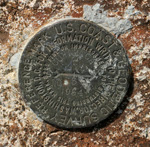
Do you recognize the artifact at right?

It’s a U.S. Coast & Geodetic Survey marker; this particular one on the peak of Cuyamaca Mountain in the San Diego County mountains. It’s a simple bronze disc, three inches (7.5 cm) in diameter, embedded in some permanent and hopefully immovable object. In this case it is embedded in a large rock formation at the summit of Cuyamaca.

There are over one million of these markers in the United States. The vast majority of them were placed long before modern technologies like GPS and laser rangefinders made surveying relatively cheap and easy. The surveyors who placed most of these markers used old-fashioned optical/mechanical surveying instruments, and processes that depended heavily on repetition and cross-checking for accuracy. And these processes were, by today’s standards, almost unbelievably manual. The surveyors walked, hiked, or rode horses to their remote destinations. For the most part, they carried their instruments on their backs. They recorded their observations in log books, in pen-and-ink. And perhaps most amazingly of all, they did all the calculations manually — they couldn’t even use a slide rule, as the precisions they were working with were far higher than were achievable with a slide rule.

The official U.S. Coast and Geodetic Survey started in 1807, and continues to this day (though in a new agency). Thousands of surveyors working for almost 200 years — and these little bronze discs (and the data that records where they are) are perhaps their most important work product.

The little discs are important because they are the starting point of virtually every other survey, whether by government or by private industry. They are the starting point because their absolute position is known more accurately than any other collection of points. Every real estate survey is referenced to one or more of these markers. American cartography is universally traceable back to these markers. Political boundaries (states, counties, cities, etc.) are all traceable to these markers. Pretty important job for a humble little piece of bronze!

Because our hiking (over the past forty plus years) has taken us to many peaks and prominences, we’ve run into many of these markers. Long ago I fell into the habit of searching for them each time I reached a likely looking spot — and more often than not, I’d find one. Sometimes I’d have to brush off dirt and leaves to find it, so I’d know it’s been some number of years since anyone had “visited” that particular marker. On a few occasions, I’ve run into bright, shiny, brandy-new markers — very unexpected, as most of them date back 20 years or more. The oldest one I’ve every spotted was on a peak near Mt. Katahdin in Maine, called “South Brother"; the marker there was dated 1876.

If the story of the American geodetic survey intrigues you, you can find some more information (and pictures) here, here, here, and here.

Cuyamaca Autumn

These are some more photos from the hike that Debi and I made up Cuyamaca Peak this past Sunday. As usual, clicking on any of the will bring up a larger view.

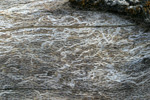
The images in the top row all show some aspect of the destruction wrought by the fire. The two outer ones are obviously charred logs; the center one is a dead oak, it’s bark burned by the fire so badly that it sloughed off. What you’re seeing is the wood immediately under the bark, with the characteristic oak texture (lots of pores) clearly visible, along with the trails of some insect that ate its way along trails just under the bark. Presumably the bugs were well toasted in the fire!

The second row are the autumn flowers, of which there are a dozen or so species in bloom presently. They made beautiful splashes of color, contrasted against the somber autumn tones and the stark blacks and grays left by the fire. I don’t know what any of these flowers are.

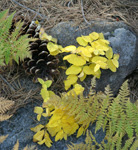
The bottom row is the kind of thing folks in other climates see very commonly: the “fall color” of the leaves of deciduous trees. We have it here in southern California as well, but not with anything remotely resembling the wild abundance of color that is the norm in places like New England or the Appalachians. But we cherish what we have…

Everest on Mars

Spirit and Opportunity — the extraordinarily successful mobile probes on Mars — have now been operating for very close to two years. Not bad at all for missions designed to last just three months!

Recently Spirit climbed to the top of the Columbia Hills, and on a peak the scientists at JPL have named “Everest", the Spirit probe paused to take this 360 degree panorama of the spectacular view it was enjoying. You can click on the image at right to get a slighly larger view — or you can go to the rover site to get a truly enormous (40+ MB!) version, nearly big enough to wallpaper your livingroom with.

I’ve repeated this so many times I’m sure my long-timer readers are bored to hear it again, but … these two probes are making manned space exploration (at least as it’s currently practiced) look like a positively silly waste of time, energy, and money. And they’re not alone — Spirit and Opportunity have dozens of “brothers” and “sisters", like Cassini-Huygens around Saturn, the Hayabusa probe, and many more. Many of those probes all by themselves are producing more good, hard, useful science results than all of the manned space missions combined. And they’re doing it for one helluva lot less moolah…

Wednesday, November 9, 2005

Blue Morning

What an unpleasant way to start my morning — by discovering that every single one of the propositions championed by Governor Arnold Schwartzenegger has been defeated at the polls. This is a tremendous victory to big-money, big-union, status quo politics, and a big blow for common sense and honest democracy.

Unless something happens (but what?) to shock liberal Californians to their senses, I suspect we’re stuck with at least several more years of profoundly corrupt and ineffective local politics…

Tuesday, November 8, 2005

Recovery

The hike Debi and I made up Cuyamaca Mountain on Sunday (see two preceding posts) had some unanticipated moments of beauty. In the two years that have passed since the Cedar Fire, the ground-dwelling flora have been growing luxuriantly. Between the nutrients added by the fire, the exposure to sunlight now that the forest is basically gone, the wet year we had this year, and the fact that many of these plants have evolved to take advantage of the fire’s aftermath, happy days are here again for these plants!

At the 5,000 to 6,000 foot level, where these pictures were taken, there apparently has been a hard frost some weeks ago. In the top row of photos (click on any of them for a larger view) the brown tones are dominated by ferns; in the lower row it’s other plants I have not identified. I thought the contrast and textures of the charred trees was interesting; certainly not what we would ordinarily see on an autumn hike like this…

Cuyamaca

As I mentioned in the post below, Debi and I had a very enjoyable hike up to Cuyamaca Peak this past Sunday. On the “shoulder” of the mountain, just before the last push up to the peak, is one of our favorite spots from our many hikes this way in the past. It’s a small meadow that extends partway down the western flanks of Cuyamaca Mountain, and the absence of trees combined with the altitude makes for a wonderful view.

The panorama at right was stitched together from three individual pictures, taken handheld. Even in the small version (click for a much larger one) you can see the skeletons of the sparse trees. But when you look in this direction from Cuyamaca, you’re looking at that enormous area that the Cedar Fire completely burned off — and it was very evident on Sunday. The normal tones of chaparral in the autumn were all “off”. In some areas, the greys of the ashes and tree skeletons show through even at a distance of miles. Everywhere the colors are altered by the absence of the normal chaparral growth. A very somber perspective, indeed…

Happy Dogs

Debi and I took a hike on Sunday that we haven’t made for over two years — up the “fire road” to Cuyamaca Peak from Paso Picacho campground in Cuyamaca State Park. We’ve avoided this area, for the most part, ever since the terrible Cedar Fire in October 2003 that burned the beautiful old forests that we loved so much. Just driving through the park, as we have on numerous occasions since the fire, is enough to make me heartsick and depressed.

The hike turned out to more interesting and less depressing than I expected. Yes, the walk takes you through nearly three miles of nearly completely devastated forest. But unexpectedly, near the peak, there is a substantial area of surviving old-growth forest with a lot of different species represented. Perhaps these individuals will be the parent stock for the native species return. We saw conifer seedlings — something we’ve missed at lower altitudes in previous hikes. We also saw manzanitas seedlings (abundantly) and mind-boggling quantities of ceanothus (assuming I’ve identified it correctly), currently two to three feet high. That mountainside is going to be something spectacular when the ceanothus is old enough to bloom!

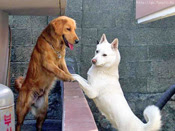
To our dogs (Mo’i on the left, Lea on the right), however, this was just one giant super-walkie. They were so happy to be out with us for several hours of sustained walking — it just doesn’t get any better than that if you’re of the canine persuasion…

We stopped on the way home for a late lunch at the Descanso Junction restaurant. This little place is quickly becoming a favorite of ours — inexpensive, and unpretentious, but just plain delicious home-style cooking. I highly recommend their Philly steak sandwich — especially if you add mushrooms to their standard offering (and they’re happy to do that). Debi had a steak salad that featured a perfectly cooked-to-order piece of beef that was a significant chunk of the bovine donor. And Debi’s facial expressions, grunts, and moans of delight, plus the fact that she left nary a molecule on her plate, told me that she was very happy with her meal, too…

Monday, November 7, 2005

Just Wondering

These important questions arrived in yesterday’s email:

Can you cry under water?

How important does a person have to be before they are considered assassinated instead of just murdered?

If money doesn’t grow on trees then why do banks have branches?

Since bread is square, then why is sandwich meat round?

Why do you have to “put your two cents in"… but it’s only a “penny for your thoughts"? Where’s that extra penny going to?

Once you’re in heaven, do you get stuck wearing the clothes you were buried in for eternity?

Why does a round pizza come in a square box?

What disease did cured ham actually have?

How is it that we put man on the moon before we figured out it would be a good idea to put wheels on luggage?

Why is it that people say they “slept like a baby” when babies wake up like every two hours?

If a deaf person has to go to court, is it still called a hearing?

If you drink Pepsi at work in the Coke factory, will they fire you?

Why are you IN a movie, but you’re ON TV?

Why do people pay to go up tall buildings and then put money in binoculars to look at things on the ground?

How come we choose from just two people for President and fifty for Miss America?

Why do doctors leave the room while you change? They’re going to see you naked anyway.

If a 911 operator has a heart attack, whom does he/she call?

Why is “bra” singular and “panties” plural?

Do illiterate people get the full effect of Alphabet soup?

Who was the first person to look at a cow and say, “I think I’ll squeeze these dangly things here, and drink whatever comes out!"

Why do toasters always have a setting that burns the toast to a horrible crisp, which no decent human being would eat?

Why is there a light in the fridge and not in the freezer?

When your photo is taken for your driver’s license, why do they tell you to smile? If you are stopped by the police and asked for your license, are you going to be smiling?

If Jimmy cracks corn and no one cares, why is there a stupid song about him?

Can a hearse carrying a corpse drive in the carpool lane?

If the professor on Gilligan’s Island can make a radio out of a coconut, why can’t he fix a hole in a boat?

Why do people point to their wrist when asking for the time, but don’t point to their crotch when they ask where the bathroom is?

Why does Goofy stand erect while Pluto remains on all fours? They’re both dogs!

What do you call male ballerinas?

Can blind people see their dreams? Do they dream?

If Wyle E. Coyote had enough money to buy all that ACME stuff, why didn’t he just buy dinner?

If corn oil is made from corn, and vegetable oil is made from vegetables, what is baby oil made from?

If electricity comes from electrons, does morality come from morons?

Is Disney World the only people trap operated by a mouse?

Do the Alphabet song and Twinkle, Twinkle Little Star have the same tune?

Why did you just try singing the two songs above?

Why do they call it an asteroid when it’s outside the hemisphere, but call it a hemorrhoid when it’s in your butt?

Did you ever notice that when you blow in a dog’s face, he gets mad at you, but when you take him for a car ride; he sticks his head out the window?

Do you ever wonder why you gave me your e-mail address in the first place?

Hat tip to John & Grayle Blecker

Landmarks

As we walk through the hills around our home, we see the scene around us change every few minutes. Familiar landmarks move around, change perspective and shape, appear and disappear. Probably the most evident aspect of the scene around us is the horizon and the peaks that shape it. I took the panorama at right on yesterday morning’s walk, just to illustrate this phenomenon. The five most promienent peaks are labeled on the photo (click at right to bring up a large view).

Gaskill Peak and Lawson Peak are part of the mountains that surround Lawson Valley (where we live). They are visible on our entire mile-long hike, though their relative position changes quite dramatically. Viejas Mountain is also visible the entire time, but here you see much more of it than you would from our house (which is 400 or 500 feet lower in elevation). But Cajon Mountain and Cuyamaca Peak are not visible at all from our home. They appear, bit by bit, as we hike up the hill.

Before GPS, these clearly visible, well-defined peaks would have made wonderful landmarks to use with a compass, topographic map, and protractor to figure out exactly where you were. I’ve done this as an exercise, and it’s pretty easy to locate yourself with an accuracy of 50 feet or so — nearly as good as the GPS (without WAAS). But the old-fashioned way sure is a lot more work! The information that comes effortlessly from the GPS can only be duplicated with 5 or 10 minutes of concentrated work.

Meanwhile, we’ll just enjoy the shifting scenery on our walk…

Sunday, November 6, 2005

Sexy in New Jersey?

Skippy (who hasn’t had sex for 220 days!) at Enjoy Every Sandwich, takes a look at the New Jersey gubenatorial race:

As we all know, there’s a gubenatorial election in the Graden State on Tuesday. Well, we all know it, but very few of us actually care. This race is essentially over and has been for a year. Ever since he announced his candidacy, it has been a forgone conclusion that US Senator and trazilionaire Jon Corzine will soon be custodian of the world’s largest garbage dump.

The worst part is that the race couldn’t have been more boring. Maybe I’ve been spoiled by Jersey politics, controlled as it is by a cabal of sundry Sopranos and barely closeted homosexuals who realize their “truth” in their fifties.

If you can handle Skippy’s very direct and unihibited writing style, the rest of his post is hysterically funny. Especially if you’re from New Jersey, or (like me) an escapee from New Jersey…

Thursday, November 3, 2005

Fan Behavior

I’m working on an electronic design that includes a fan to exhaust warm air, and a filter on the air intake to keep the electronics from getting covered in dust. The finished project will be placed in a somewhat dirty room that is quite remote from where I will be monitoring the equipment. I want to sense whether the filter is dirty enough to restrict air flow. Of course I can (and will be) monitoring temperatures, but I’m looking for something that’s a more direct measure of air flow.

I had an idea: that there should be a difference in fan speed between a clean filter and a dirty filter. The fan speed should go down, I thought, if the filter was clogged up (as it would be working harder, kind of like a car going uphill). So I decided to test this thought out. I connected a small fan (an 80 mm “case fan") to 12 VDC, and monitored its RPM. Sitting on my desk, this fan rotated at just under 4,500 RPM. Then I put a piece of cardboard across the intake side of the fan, expecting the RPM to go down, though I didn’t know by how much. The RPM with the cardboard completely blocking the intake was 4,700 RPM — it went up! This effect was completely repeatable…

Does anyone know the explanation for this?

Flaming Paris

For the past seven nights in a row, Paris has been burning. You’d never know it from the MSM, but riots and other disturbances have been steadily escalating. Last night, over 100 cars were burned, a shopping center set ablaze and destroyed, people were injured, public and private property vandalized, and even a police station briefly taken over. French politicians are in full crisis mode, right up to Chirac. Gateway Pundit has been running a series of must-read posts on these events. The rioters are Islamic youths, primarily young men. The excuse: the deaths of two teenagers a week ago, electrocuted, we’re told, as they fled from police.

What’s really going on?

I have no personal knowledge of the situation in Paris, but I have researched several dozen sources over the past week. I was taken by surprise by the riots in Paris, so I wanted to understand how such a thing could happen. After all this research, I conclude there are two major factors underlying the explosion of violence in Paris:

1. French policies that discourage integration of immigrant communities, and encourage the development of “enclaves” of foreign culture. These policies almost certainly derive from widely held racist views, no matter how the French intellectuals dress them up. For example, European elites, in talking about the Islamic ghettos that dot the European scene, will pat themselves on the back and say things like: “We’re sooooo superior to the U.S. — we’re tolerant of the Islamic culture here, and we let them freely recreate these islands of Islamic culture within Europe.” Really? Here’s another view (mine): you’re all smug racists, convinced of your own superiority (over everybody, including Muslims and Americans), and the only way you’re going to tolerate alien cultures and ways of thinking is to bottle them all up in some place where they won’t offend your sense of propriety. Like a nice Islamic slum.

2. French economic policies, resulting in very few available jobs (which go first to the “real” Frenchmen, of course) and a massive public dole. The direct result of these policies is a large unemployed population in the isolated immigrant communities — people with no way up, no incentive to leave, and lots of anger. If you wanted to design a volatile situation, this might be what you end up with.

So what’s the answer? Darned if I know! I suppose it’s possible that somehow the French people will wake up some day, and take some concrete action to deal with the situation. But who knows what that action would be? I’m not sure we’d like it all that much. For instance, suppose their reaction was to throw all the Islamic people out of France? That’s millions of people at this point…we’d have a massive humanitarian problem then, and of course the anger and volatility of the situation would only increase. I can imagine good outcomes as well, though they don’t seem very likely: the French could vote out their entire corrupt government and replace it with an honest, pragmatic one. I don’t think I’ll live that long <smile>…

If there’s any good in this situation at all, it’s this: events like this are probably the only thing that could shock the European people and political structure into actually helping America in the war on terror…

Tuesday, November 1, 2005

Ship Tracker

This site keeps track of a large number of ships in near realtime, using GPS as the source of positon data. There are facilities for finding ships by name, call sign, and more. I’m not sure what fraction of ships are participating, but when you look at the world map it’s clearly quite a large number of vessels.

Having spent time at sea myself (in the U.S. Navy), I can easily imagine how wonderful this web site must be for the friends and relatives of the cargo ships' crew members. Anytime they want to, they can see exactly where their loved ones are.

And of course there are numerous practical uses as well: identifying ships in the way of storms, or those nearby someone who needs help, and so on.

This is a terrific example of several technologies (GPS, web, radio in this case) being used together in a novel way to provide a capability I’m sure nobody anticipated even just a few years ago…

Stereo Image

This is not an anaglyph, and you don’t need any special glasses to view it. You just need to learn how to view it, and most people don’t find it very difficult — just a little weird. Here’s how you view it:

First, sit a comfortable viewing distance from the screen, as close as you can without straining your eyes to focus on the picture.

Then orient yourself so that the border between the two pictures at right is directly in front of your eyes, both vertically and horizontally.

Easy so far — but now comes the tricky part. “Cross” your eyes until you see three pictures, instead of two. You will probably have to move your head slightly, and change the amount you’ve crossed your eyes, to get everything to line up, but when you do, the center picture of the three will be a 3D picture with full depth — it kind of “pops” right out of the screen, visually.

This works much better with the larger view you get when you click on the little photo…

A Dog, A Rope

It doesn’t take much to make our dogs outragously, completely-out-of-control happy. Here Lea (our seven year old female field spaniel) is playing with a rope — and having an absurd amount of fun with such a simple toy!

These pictures were taking just before daybreak yesterday, as we left our house for our morning walk. That’s contributing to this dogly joy, of course. Also adding to it: the “rope” in question is actually a horse lead that we use for a leash — and the dogs know that leashes mean walks.

It doesn’t seem to matter how often or how regularly we go on our walks. Each one is a new occasion for dogly joy; they never tire of them and the walks never become just a routine. They sure make being happy look easy…

Monday, October 31, 2005

Elect Iraq

Details of the Iraqi political process are remarkably absent from the reports of our MSM — and that’s a real shame, because watching the Iraqi experiment in democracy is going to be interesting, no matter what the outcome. Fortunately a number of blogs are filling in for the failures of the MSM.

Publius Pundit reports that the party structures in Iraq are evolving in interesting and complex ways, reflecting the integration of the Sunni Arab politicians into the overall political process (now that the Constitution has been approved, this is really a necessity from their perspective) and the dis-integration of the radical Shiite Arab politicians. Both of these developments are very encouraging for the eventual success of democracy in Iraq. And both of these developments put the lie to those who proclaimed (before the Iraq war) that “Arabs aren’t ready for democracy.” The Iraqis don’t seem to be having a lot of trouble understand the subtleties of their flavor of democracy…

From Publius Pundit:

...it is worth emphasizing that the Ayatollah Ali Sistani and the other grand ayatollahs are not endorsing a political party or coalition this time. I’ve long held a positive view of Sistani’s role in this process, going back to shortly after the fall of Saddam, but this is a good thing. It was good that Sistani endorsed the United Iraqi Alliance list back in January to get the process rolling, but the Shia don’t need guidance on this now.

BTW, the girl in the photo above right is holding a card that says “Elect Iraq.” Elect Iraq, not some particular person or party. Someone over there understands the real power of democracy, and has found powerful way to express it in just two words…

Meanwhile, over at Iraq the Model, Omar reports on a citizen’s committee formed to influence the political process to press for civil rights and what I’ll call “quality in government” (now that almost sounds silly as I write that <smile>). Or, as Omar puts it himself (I’m assuming that by “community” he means “committee":

The basic theme of the community is to take a promise from politicians, civil society activists and MPs (current or running for office) to preserve and protect the rights and freedoms every Iraqi citizen is supposed to enjoy under the new constitution and under the internationally recognized conventions and laws and to work to introduce amendments in the constitution whenever believed necessary for the protection of these rights and freedoms.

The founders of the community named five main points in the constitution that require urgent reconsideration…

Consider how much has to be working for such a thing to take place — it’s a very encouraging train of thought. It indicates to me a rather deep understanding of the democratic political process. It also represents a most refreshing departure from politics-by-explosives…

Take a moment to read these two blogger’s posts: you’ll find them much more observant and useful than the blather the MSM is pouring into America’s ears and brains! As usual, click on either photo for a larger view…

Alito

Alito is exactly the kind of judge that conservatives wanted Bush to nominate in the first place — and he’s exactly the kind of judge that liberals didn’t want him to nominate.

Based on what I’ve read over the past few days, Judge Alito looks good to me, but then, I’m no expert on such matters. However, from a purely political perspective this nominee looks like a winner from every direction. The liberals will have to make up their mind whether they’re going to take their opposition all the way to a filibuster. If they do not, Alito will be easily confirmed — a good political outcome from my perspective. If they do take it to filibuster, then we’re going to have a rousing political battle which I think is almost certainly going to end up with the liberals backing down (a good outcome) or the “nuclear option” being taken, taking away the privilege of filibuster for Supreme Court nominees (also a good outcome). The only bad outcome, politically, would be if the liberals managed to filibuster successfully, without the nuclear option being taken — and it’s hard for me to imagine a way for them to pull that off.

So I’m quite happy with this nomination; count me as a firm supporter on this one, as opposed to being neutral on Harriet Miers. Again, this is from purely a political perspective, as I don’t know enough about Judge Alito to have an independent opinon of his qualifications for the job.

Sunday, October 30, 2005

Hope

Despite the MSM’s incessant bleating about all the awful news from Iraq (killed! explosions! bombs! riots!), there really is a lot of progress in Iraq. The military blogs written by soldiers actually in Iraq complain bitterly about the wrong-headed picture painted by the MSM — just short of outright lies (usually), but very much omitting much that is true. The Iraqi blogs express similar sentiments about news coverage, and are much better informed and realistic about the political situation. Strategy Page is reliably level-headed and observant; reporting the world (including Iraq) as one might imagine a soldier would want it reported: fact-based, analytical, unbiased (good and bad news is equally well covered). They’ve got a post today that is full of detail about the improving capabilities of the Iraqi military and police forces — very encouraging, on the whole. It concludes:

From Strategy Page:

The Iraqi battalions are able to make terrorist attacks much more costly, for the terrorists. Thus the recent terrorist attack on the Palestinian hotel, resulted in over a dozen terrorist personnel killed or captured because of prompt action by Iraqi soldiers and police. As a result of this, two more trends are in evidence. First, more and more of the terrorist activity is moving outside of heavily policed Baghdad, to smaller towns where there are fewer security personnel. Second, more Sunni Arabs are giving up on plans for any quick take over of the government. These Kurdish and Shia Arab police and army officers were not supposed to show up so quickly, if ever. But there they are.

If these trends continue, this is very good news indeed! Let us hope the Iraqi forces can push the terrorist forces way back — say, to Iran and Syria…

Friends

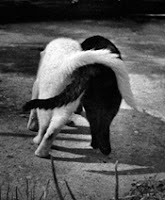
Aren’t these just the sweetest photos?

My favorite is the black and white kitties, leaning into each other with their tails “hugging”. What’s yours?
Click on any of them for a larger view…