Thursday, December 8, 2005

Oh, My!

Via TigerHawk (click for a larger view).

Imagine it’s 1941, and Ted Kennedy, Howard Dean, and John Kerry are in Pearl Harbor when the Japanese make their sneak attack. The picture at right shows what might have happened…

There’s a little tiny graphic on the picture that credits it to SacredCowBurgers.com. Now with a name like that, I thought I might be in for a treat — and I was (but check it out yourself!). The site appears to be the solo work of Jay D. Dyson, who not only makes visual parodies (many of them are excellent), but also offers some commentary with each one. On the one pictured here, he says:

Each year that I do a parody on the anniversary of the surprise attack on Pearl Harbor, I usually find it difficult to avoid repeating the previous year’s theme.

This year, that was decidedly not the case.

After suffering through countless episodes of the patently anti-American antics of today’s Democrats, this parody came effortlessly. And what’s more, the core truth of this satire simply cannot be denied. There can be no doubt that the conduct featured here is precisely what the Democrats would do if we had another Pearl Harbor!

Just take a long, hard look at current events: our nation is scarcely four years past the 9/11 attacks, we are currently involved in a war to assure the longevity of a fledgling democracy where terror once reigned, and what are the leaders of the Democrats doing? Why, pulling all kinds of ridiculously anti-American, anti-troop and anti-victory stunts whenever they get a microphone or camera put in front of them!

And the truly nutty part? These jerkoffs think they should be in charge of our great nation! They actually believe they’re entitled to call the shots! *brrr!* Creepy!

I am so looking forward to 2006 when Americans can stand up for our great nation and throw these lousy bums out on their ear.

Amen to that, brother.

Blog Patterns

I’m a little bemused by yet another unlikely looking pattern in the visitors to my blog: 80% of today’s visitors found me by searching Google for images of Ann Coulter. Now mind you, Ann is a very attractive woman — so I’m not surprised people are looking for pictures of her. Especially since she was splashed all over for an incident where a bunch of liberal college students heckled her so intensely that she had to give up on her speech (and if you know anything about Ann Coulter, then you know she’s not easy to back down!). What really surprises me is this: the picture at right, and a copy of the Time cover Ann was on, are the only two photos of Ann on my blog — and the one at right is the 25th hit on Google Images. And yet this is 80% of my visitors!

This must be a message in here somewhere. I’d like to think it was the power of Ann’s rhetoric, and the justice of her (conservative) cause, that made so many people want to search for her picture. But I suspect it’s just what you suspect: a bunch of guys mooning (or something) after a beautiful woman. So the message for me is … stop blogging about the nonsense I usually blog about, and just put up pictures of beautiful women.

Sigh.

Update: Something I meant to mention above (but forgot!) is that until today, the front-runner just about every day for the past two months has been Google Images searches for “rabbit”. I’m not joking! Try it yourself and see what happens!

Midway

A few days ago, a friend (Rick Pugh) asked if I’d be interested in visiting the Midway Aircraft Carrier Museum on Pearl Harbor Day. Absolutely! was my answer, and we were actually able to pull this off. We started by having a very nice breakfast at a place with an unlikely name: “Hash House a go go”. I can’t account for the name (no “go go” in evidence), but the food was very good; memorable, in fact. I am planning to go back there with my lovely bride one of these fine days…

Anyway, after fortification we set off downtown to the Navy Pier, where the old USS Midway is now permanently docked. Parking was easy; plenty of room on the pier itself (though it’s cash-only, and I had to bum some bucks from Rick). We were on board in just a few minutes, with a minimum of fuss, and there were no crowds. Bad for their business, but good for us!
We first took a tour of the island, on the advice of the first (of many!) helpful and knowledgable docents we ran into. He told us it was likely to get crowded and hurried as the day went on, so we took his advice and went on the first island tour of the day. The large photograph at right is a panoramic view (made from three individual photos) from the “air boss” position high in the island. The island is on the starboard (right) side of the ship, and you’re looking aft (toward the rear) through about amidships (directly across). From left to right, the aircraft visible include a COD (nose and port wing), the nose of an S-3 Viking, (almost hidden behind the awning) an F-14 Tomcat, an F/A-18 Hornet(in the background, in desert colors), an F-4 Phantom, an A-6 (foreground), an RA-5 Vigilante (background), and an H-3 SeaKing. And there were even more aircraft on the flight deck forward of these, and a few more on the hangar deck! The smaller picture at right is Rick sitting in the Air Boss' chair, looking out over the flight deck…
The photo at right was taken from near the bow, looking aft on the flight deck. In it, left to right, you can see another F-4 Phantom, an E-2 Hawkeye (with it’s wings folded, and the radome “flying saucer” on top), and an A-7. To an old Navy electronics guy like myself, there are some interesting things on the mast over the island: an SPS-10 radar antenna, and an SPS-48 radar antenna. The SPS-10 is a truly ancient piece of gear, of World War II vintage — tubes and prehistoric servos. They were laughably old — and belonged in a museum — when I was in the Navy (in the '70s), but a docent told me that it was still in service when the Midway was decommissioned in 1992. The SPS-48 is a considerably more modern system, but still quite old. It was one of the first of the so-called “3D” radars to be deployed. By “3D", they mean that in addition to bearing and distance (what most radars do), it also detects the altitude of a target. It does this by using a fixed-array antenna that is scanned in elevation by changing the frequency of the transmission — a relatively simple, but easy and reliable, fixed-array antenna technique. Since the fixed-array scans only in elevation, the antenna still rotates to scan in azimuth.
At right, from left-to-right: the F/A-18 Hornet, Rick looking at the big radial piston engines on the COD, an F-4 Phantom procedures trainer, and an A-4 Skyhawk on the hangar deck. This was the first time I’d seen an F/A-18 up close and personal; I was struck by how much more advanced the construction was compared with any of the other aircraft on board. Virtually every piece of its fuselage and wings are compound curves; everything is very smooth, with a nearly complete absence of the usual angular protuberances. Very impressive, even just to the casual eyeball. In my Navy career I made quite a few trips to-and-from carriers at sea; most frequently the USS Enterprise, and almost always by helicopter. But once — just once — I flew in the back seat of an F-4, catapult-launched from the Big E (and landing at Cubi Point, Subic Bay, Phillipines). That was a serious kick in the pants, especially after the pilot learned I was interested in aerobatics, and we did a few things that I suspect weren’t in the original flight plan. And twice I landed on the Big E in a COD. Now the COD is a small, rugged plane with a relatively low landing speed — so a carrier landing in a COD is a very far cry from a carrier landing in, say, an F-4. But I’m here to tell you that it was plenty exciting for me. The most memorable part, for me, was the initial approach to the carrier — it looked like such a tiny speck, lost in the vast ocean, and landing on that speck just didn’t seem very likely. Or very wise. Naturally, the pilots made it seem like a cakewalk…
Last, but certainly not least (for me, anyway!) — at right is Rick standing next to a system that I am very familiar with: a Univac CP-642B computer. This particular computer is part of a complete Ship’s Inertial Navigation System (SINS). I trained on this system, and in fact even helped debug some software on it, way back in the early '70s. This was the first inertial navigation system deployed on US ships, and for its day was quite a remarkable system. An inertial navigation system is one that figures out where it is by very precisely measuring every movement it has made since leaving another precisely known place. By integrating all those movements over time, it can calculate exactly where it is at any moment. In practice, inertial navigation systems were built back then by combining a “stable platform” and three accelerometers. The stable platform is a system of three or four gyroscopes, mounted on different axes, and it always points in the same direction (it’s mounted on a gimballed platform to allow this), no matter how the ship twists and turns. The accelerometers measure every teensy little acceleration (speeding up or slowing down) in the three different directions (usually thought of as left/right, forward/backward, and up/down). With a little math and that information, you can figure out where you are — and that’s exactly what SINS does.
For me, though, the most interesting part is the CP-642B. You see, that was the first computer I ever worked on; the first one that I ever understood. By today’s standards, it is almost humorously incapable: 30 bit word length, a blazing 100KHz clock speed, and 32 kilowords of excruciatingly slow (and tempermental) magnetic core memory. But this is what I cut my digital teeth on, and so I have a sort of sentimental attachment to the beast. I haven’t seen one of these things for close to 30 years, so I was quite surprised to discover that within moments of walking up to the thing, I could remember all kinds of details about how it works, and how to operate it. I do believe I could still key in a program, run it, single-step it, and so on. For any geeks out there: that control panel with all the lights is something you just can’t have these days. There’s a light for every bit in every register in the computer, and you can press that light to toggle the state of that bit. A momentary paddle switch allows you to stop the computer’s execution at any point, and then you can see the complete internal state of the computer at that moment. Very primitive — but it’s amazing what we managed to get done with this machine…

Wednesday, December 7, 2005

2,471

Sixty-four years ago today, on December 7, 1941, the Imperial Japanese Navy made a sneak attack on Pearl Harbor, just outside of Honolulu, Hawai’i. The attack killed 2,471 Americans (2,403 military and 68 civilians). It was a complete success for Japan from a tactical perspective; a disaster from a strategic perspective.

Today we remember… We remember our country’s great loss, and we remember the strength and resiliency our parents' generation showed in the face of evil and adversity.

And I hope that their descendants — the Americans of today — can do the same with respect to the evil and adversity we face today from terrorists like Al Qaida…

Paige Compositor

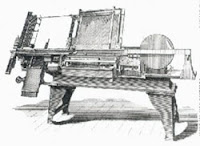
Did you know that Samuel Clemens suffered a business failure that forced him into bankruptcy? Somehow this chapter of Samuel Clemens' life has managed to escape my attention until quite recently.

The business failure was related to an automatic typesetting machine called the “Paige Compositor”. From a description on the site of the Mark Twain House:

The Paige Compositor was an automatic–typesetting machine invented by James W. Paige. Little is known about the inventor of the Paige Compositor. James W. Paige was born in upstate New York in January 1842. While living in Rochester, he applied for his first patent on a typesetter in 1872, and the patent was granted in 1874. He then moved to Hartford between 1874–77 to work for the Farnham Type–Setter Company, which was trying to put together a workable typesetter by combining the gravity-fed Farnham machine with the Thompson distributor. The Farnham Type–Setter Company rented space for about five years at the Colt Firearms factory. The rest of Paige’s life centered around the Paige Compositor, trying to market it and make it work. Paige eventually died in the poorhouse, but no one knows where or when.

Twain’s love for technology and his background in printing led him to invest in the compositor. Between 1880 and 1894 he invested a fortune into its development, resulting in his near bankruptcy. In an 1889 letter to his brother Orion, Twain writes,

“All the other inventions of the human brain sink pretty nearly into commonplaces contrasted with this awful mechanical miracle. Telephones, telegraphs, locomotives, cotton gins, sewing machines, Babbage calculators, Jacquard looms, perfecting presses, Arkwright’s frames – all mere toys, simplicities! The Paige Compositor marches alone & far in the lead of human inventions."

The Paige Compositor was, by all accounts I’ve found, a jaw-droppingly astonishing kind of machine. It had over 18,000 parts and could set type faster than its competitor (the Linotype machine) — when it worked. But it was failure-prone, and very difficult and expensive to manufacture. The inventor was a perfectionist who didn’t want to go to market with a less-than-perfect machine — and so was beat to market by several years by the Linotype. There are lots of parallels here in my own industry (software).

In a biography of Sameul Clemens (by Albert Bigelow Paine, available online), there’s a good discussion of this episode. A sample:

By the end of ’88 the income from the books and the business and Mrs. Clemens’s Elmira investments no longer satisfied the demands of the type-setter, in addition to the household expense, reduced though the latter was; and Clemens began by selling and hypothecating his marketable securities. The whole household interest by this time centered in the machine. What the Tennessee land had been to John and Jane Clemens and their children, the machine had now become to Samuel Clemens and his family. “When the machine is finished everything will be all right again” afforded the comfort of that long-ago sentence, “When the Tennessee land is sold.”

They would have everything they wanted then. Mrs. Clemens planned benefactions, as was her wont. Once she said to her sister:

“How strange it will seem to have unlimited means, to be able to do whatever you want to do, to give whatever you want to give without counting the cost.”

It’s an interesting read, worth it if you are at all interested in Samuel Clemens.

More information about the Paige Compositor here, here, and here

Tallinn Photo

One of my favorite places (Tallinn, Estonia) is visible on this synthesized photo of a night view of Europe from space. The original photo was darker and didn’t have Tallinn marked.

From Astronomy Picture of the Day (APOD):

Can you find your favorite European city? The above digital fantasy of Europe at Night is a digital composite of archived satellite images taken both during the day and night. This image is different from what an astronaut would see for reasons including a complete lack of clouds and an unrealistic exaggeration of lights and contrasts. Even so, the geography underlying the image is captivating. Nighttime light patterns have been accumulated from the USAF Defense Meteorological Satellite Program (DMSP) Operational Linescan System.

Tuesday, December 6, 2005

APOD

Astronomy is a “hard” science that nevertheless works with things of great beauty…

From Astronomy Picture of the Day (APOD):

These wisps of gas are all that remain visible of a Milky Way star. Many thousands of years ago that star exploded in a supernova leaving the Veil Nebula, pictured above. At the time, the expanding cloud was likely as bright as a crescent Moon toward the constellation of Cygnus, visible for weeks to people living at the dawn of recorded history. The supernova remnant lies about 1400 light-years away and covers over five times the size of the full Moon. The above image of the Veil was made clearer by digitally dimming stars in the frame. The bright wisp at the top is known as the Witch’s Broom Nebula and can be seen with a small telescope. The Veil Nebula is also known as the Cygnus Loop.

Click on the thumbnail for a (gorgeous) larger view…

Monday, December 5, 2005

Will to Fight

One of my favorite blogs is neo-neocon, written by an ex-liberal turned conservative after 9/11. Her posts are real ponders, full of informed thinking and ideas. Definitely a post-coffee read, and on my list for every morning.

This morning she pointed me to a post on another blog, and (as she also says) it is simply excellent. Thanks, neo! A sample:

From Searchlight Crusade:

History is replete with superior armies, winning armies, defeated because they lost the will to continue. From battles at Cannae and Hastings to entire wars, the struggle is lost when the will to fight is lost.

On historical battlefields, and in historical wars, after this point is where the real carnage begins. However bad it gets, however horrible the casualties before the losers collapse, they usually become an order of magnitude worse afterwards. Roman casualties before the troops panicked at Cannae weren’t large. If they had instead of panicking managed to hold cohesion they could have aborted the majority of the Second Punic War right there by breaking Hannibal instead of him breaking them. The well-documented barbarities of the combatants upon the populace in Thirty Years War in Germany, the whole history of the Russian front in World War II, and countless other conflicts are more historical norm than anomaly, and had far longer casualty lists that the battles themselves.

The struggle we are fighting now is no different. Our opponent is not constrained by, indeed, makes no pretense that they are constrained by any consideration of “civilized warfare.” They have told us repeatedly, by their actions, that they do not consider civilian targets to be “off limits,” indeed, their attacks on civilians, and the number of civilian casualties, greatly outnumber their attacks upon our military and our military casualties.

Furthermore, they have told us repeatedly exactly what their strategic goals are: nothing short of the annihilition of our society and way of life as it exists. This is understandable, as our civilization’s great memes are in direct conflict with theirs. Evolving wisdom as opposed to revealed historical wisdom. Individual freedom of religion as opposed to enforced submission to the rule of one particular religion. However recently and imperfectly we may have come to it, respect for women and minorities of all sorts, and participation in our ruling bodies, versus subjugation of women to men, subjugation of others to the dominant religion, heavy ongoing penalties for those outside the favored class of the ruling religion.

Overall the piece is mostly about the importance of the will to fight, and about the corollary — that our enemy could not find a better way to win than by causing us to lose our will to fight. But as you can see in the sample, he’s also writing about why he feels the fight is justified. And eloquence here expresses my own position better than I’ve ever been able to.

It’s a longish piece, but well worth reading and pondering. Please read the whole thing.

The Way of the Criminal

What would you think if someone you respected told you that democracy was “criminal” — that it was just a way for men to place themselves above deity?

That’s exactly what al Qaida’s religious authority is propounding:

From CENTCOM’s "What Extremists are Saying":

On 30 November, a 44:35 minute audio message purportedly orated by Abu Hamza al-Baghdad, the head of the Shari’a Committee of AQI was issued. The speech, titled: “The Election is the Way of the Criminals,” expounds upon the group’s belief that the upcoming Iraqi parliamentary elections and democracy, in general, seek to deify man and denounce Islamic Shari’a, as politicians become the “highest authority and there is no other authority above them.” Further, al-Baghdadi argues that elections serve the American’s purpose to extinguish the jihad spirit within the mujahideen – that it will resolve the differences between the coalition and Iraq administrations and the insurgents- and “make your dreams come true.” The speech elaborates upon a multi-point denouncement of democracy’s purpose vis-à-vis Islam and principles as set out in the Qur’an, and additionally, states that those who participate and elect the men to “partner with Allah” will be considered infidels, as “they are the ones who are providing the mandate to the representatives to make the laws.” Also, the speech cites historic examples of America’s alleged tampering in foreign elections for their own interests, such as Italy in 1947, where the United States sought the “success of the Christian Democrats over the Communist Party.” The audio concludes with a message addressing the mujahideen to remain steadfast in their jihad and to “draw your swords of dignity.”

When President Bush says our enemy is “determined” — this is what he’s talking about. They see us as being as evil as we see … terrorism, beheadings, suicide bombings. And they use the evil they see in us as their justification for all those things.

When I hear (most) Democrats bleating about the need to bring the troops home, I am shocked each and every time. One of two things must be true: either (a) they’re so uninformed and/or stupid that they truly don’t recognize the threat to America, or (b) they are placing their political benefit ahead of America’s safety. I’m not entirely sure which is worse…

Saturday, December 3, 2005

Flat Kansas

Have you ever driven across Kansas? It really is unreasonably flat … as has now been scientifically proven, Kansas is damn flat!

From the Annals of Improbable Research:

Results

The topographic transects of both Kansas and a pancake at millimeter scale are both quite flat, but this first analysis showed that Kansas is clearly flatter (see Figure 4, right).

Mathematically, a value of 1.000 would indicate perfect, platonic flatness. The calculated flatness of the pancake transect from the digital image is approximately 0.957, which is pretty flat, but far from perfectly flat. The confocal laser scan showed the pancake surface to be slightly rougher, still.

Measuring the flatness of Kansas presented us with a greater challenge than measuring the flatness of the pancake. The state is so flat that the off-the-shelf software produced a flatness value for it of 1. This value was, as they say, too good to be true, so we did a more complex analysis, and after many hours of programming work, we were able to estimate that Kansas’s flatness is approximately 0.9997. That degree of flatness might be described, mathematically, as “damn flat.”

You know you need to read the whole thing!

Friday, December 2, 2005

Toucan Beaks

Most engineering that people are familiar with is accomplished by engineers with an understanding of the science underlying their discipline. They use that understanding to determine how to approach the problem they’re solving. Most of the time there are multiple possibilities — for example, there are many ways to build a 100 foot long bridge — and engineers use other factors (cost, aesthetics, experience, etc.) to choose amongst the possible approaches. This science-driven engineering is what we’re used to, but it is not empirical engineering. It is enabled by our accumulated scientific understanding, and by our human ability to apply that understanding to solve a problem.

However, science-driven engineering is not the only kind of engineering. Empirical engineering is accomplished by trying solutions over and over again, trying to improve the result each time. Empirical engineers don’t understand the whys and wherefores of what they’re doing; they just try things to see if they work — and when they do, they remember it, incorporate it in their design, and move on to the next empirical engineering optimization.

A few years ago, I read of a very good example of empirical engineering by humans: the Roman’s development of catapults, trebuchets, and the like (weapons that hurl large weights). The Romans who designed these machines had zero understanding of the science underlying the mechanics and physics of what they were building — and yet, over time, the machines they designed evolved into designs that a modern engineer (similarly restricted in choice of materials) would be proud of. The really interesting part of this example is that there is quite a good history of the Roman weapons' development over time — so archaeologists have been able to recreate an approximate history of their empirical engineering.

A few lines ago, I used a phrase ("and yet, over time, the machines they designed evolved into designs that a modern engineer would be proud of") that ought to give you a little mental nudge — because that phrase describes the process of biological evolution quite nicely. Biological evolution is the ultimate in empirical engineering. Here’s a great example of that:

From UCSD’s Jacobs School of Engineering:

In a paper to be published Dec. 1 in Acta Materialia, Meyers and graduate students Yasuaki Seki and Matthew S. Schneider reported that the secret to the toucan beak’s lightweight strength is an unusual bio-composite. The interior of the beak is rigid “foam” made of bony fibers and drum-like membranes sandwiched between outer layers of keratin, the protein that makes up fingernails, hair, and horn. Just as the hook-shaped barbs on cockleburs inspired the development of Velcro, Meyers said the avian bio-composite could inspire the design of ultra-light aircraft and vehicle components with synthetic foams made with metals and polymers.

"The big surprise was our finding that the beak’s sandwich structure also behaves as a high energy impact-absorption system,” said Meyers. “Panels that mimic toucan beaks may offer better protection to motorists involved in crashes."

Read the whole thing!

Creationists (using the term very loosely) have trouble imagining that something like the toucan’s beak could develop through evolution. After debating many of these folks, I think there are two things (other than pure blind faith) that drive the trouble they have: one is their incomprehension of the amount of time available for evolution to have occurred, and the other is their incomprehension of empirical engineering. I’m not at all sure how to solve these problems <smile>, but I have had some success in debating creationists by raising the topics. There are abundant examples of empirical engineering all around us, so simple and obvious that absolutely anyone could understand them (I’ve used the example of the Roman’s weapons many times; their bridge-building is equally good). The concept of the passage of millions or even billions of years is more challenging to communicate — especially if the person you’re debating is of the fundamentalist persuasion and is convinced that the Earth is only a few thousand years old…

A tip of the hat to GrrlScientist at “Living the Scientific Life” for the pointer to the article in her most recent Birds in the News post. If you’re at all interested in birds, and you’re not familar with her blog, check it out — she does a wonderful job of presenting all kinds of news about birds…

Moons of Saturn

The Cassini robotic spacecraft orbiting around Saturn turns in marvelous science data day after day. The Cassini team also took the trouble to chart when the spacecraft happened to be in places where particularly spectacular pictures could be taken — without regard to their scientific value — and made time in the schedule to take those pictures. This is one of those images.

From the official Cassini-Huygens web site:

In a rare moment, the Cassini spacecraft captured this enduring portrait of a near-alignment of four of Saturn’s restless moons. Timing is critical when trying to capture a view of multiple bodies, like this one. All four of the moons seen here were on the far side of the rings from the spacecraft when this image was taken; and about an hour later, all four had disappeared behind Saturn.

Seen here are Titan (5,150 kilometers, or 3,200 miles across) and Dione (1,126 kilometers, or 700 miles across) at bottom; Prometheus (102 kilometers, or 63 miles across) hugs the rings at center; Telesto (24 kilometers, or 15 miles across) is a mere speck in the darkness above center.

The image was taken in visible light with the Cassini narrow-angle camera on Oct. 17, 2005 at a distance of approximately 3.4 million kilometers (2.1 million miles) from Dione and 2.5 million kilometers (1.6 miles) from Titan. The image scale is 16 kilometers (10 miles) per pixel on Dione and 21 kilometers (13 miles) per pixel on Titan.

The Cassini-Huygens mission is a cooperative project of NASA, the European Space Agency and the Italian Space Agency. The Jet Propulsion Laboratory, a division of the California Institute of Technology in Pasadena, manages the mission for NASA’s Science Mission Directorate, Washington, D.C. The Cassini orbiter and its two onboard cameras were designed, developed and assembled at JPL. The imaging operations center is based at the Space Science Institute in Boulder, Colo.

Click on the thumbnail to get a larger view — it’s quite spectacular.

Optical ripples

This interesting pattern showed up on my bedroom wall this morning — a spot of sunlight shining through the window. I’ve processed this photo to enhance the fairly subtle vertical “ripples” in the brightness of the light.

The spot of light in the photo is about 4 inches (10 cm) wide, but the light that made the spot passed through a 32 inch (80 cm) wide window. This happened because the early morning sun was low in the sky, right on the horizon, and it happened to be at just the right compass bearing to shine almost (but not quite!) edge-on to the window.

So what causes these ripples?

My first thought was that we had some vertical streaking of dirt on our windows (if you saw our windows, you’d think this was quite likely <smile>!). But as far as I could perceive, the dirt on the window was quite randomly placed. My next thought was that there were vertically-oriented thickness variations in the pane of glass — and this I was able to verify simply by looking at reflections in the glass, while viewing at an almost edge-on angle from one side. When I did the same thing from below, there were no visible variations. Bingo! Slight thickness variations in the pane of glass, with a vertical orientation, are causing this phenomenon.

I’ve never noticed these thickness variations before, most likely because they’re very small, and we don’t normally look through windows edge-on. I googled a bit to see if I could find a reference to these ripples, but I didn’t find anything directly relevant. In one description about how modern window glass is made (with “Pilkington’s method"), I did learn that one side of a pane of glass is “fire polished” as it moves down a conveyor — I speculate that the fire-polishing machine is responsible for the ripples, and that they’re linear because the glass is moving in only one direction past the fire-polishing machine…

Animusic

I’ve never seen anything like this — animated music, called “Animusic” by the author. It’s synthesized music, with choreographed animations of synthesized performers. But my words will never do this justice; visit the site and watch some of the sample clips.

And even though I can’t adequately describe it, I know I like it! I’m going to have to get me a set of the DVDs…

Bill Roggio

Bill Roggio (a long-time and invaluable blogger on the War on Terror, on “The Fourth Rail") recently traveled to Iraq and started filing reports directly from the field. His new reports are published on a new blog: ThreatsWatch.org. A sample:

From ThreatsWatch:

Today’s meeting was the first attended by the Sulemani, the tribe which sided with al-Qaeda and the insurgency over the summer. The meeting I attended last Monday with Lieutenant Oren and the tribal sheikhs was the first face to face contact with the Sulemani and the U.S. Military, and facilitated their attendance at today’s meeting.

Col Razak chaired the meeting, and was a commanding presence. He stressed the importance of Iraqis being in control and “not allowing any stranger to come here… Terrorists come to this town specifically to use you and the people, and only harm innocent people.” One of the greatest fears of the residents of the region is the premature withdrawal of U.S. and Iraqi forces.

But the locations of the Battle Positions in the Al Qaim region is also a matter of concern. The bases often lie on main roads, near mosques or marketplaces, and the residents are inconvenienced by their locations as travel is often restricted due to the checkpoints. LtCol Alford stressed the importance of the residents of the region and the tribal sheikhs taking responsibility for local security, so the bases can be dismantled in the future. “This will not happen overnight… you must build your government up, establish a police force” before the military units move out, said LtCol Alford. “I believe the first group to leave will be U.S. Forces, then the Iraqi Army. But this will not happen without your help.”

He goes on to describe the search for a weapons cache that the local troops got some information on, and the locals reactions. Good stuff, all of it — and another pair of reliable eyeballs, like Michael Yon, but with yet another valuable perspective. Make ThreatsWatch a regular reading stop…

Not a Bomb!

The MSM went a little crazy reporting about the alleged bomb blast that breached the levee (if you need a refresher on these stories, see here, here, here, and here for a representative sampling). The stories never did make much sense, but a recent report pretty much destroys the conspirists theories…

From the New Orleans Times-Picayune:

The floodwall on the 17th Street Canal levee was destined to fail long before it reached its maximum design load of 14 feet of water because the Army Corps of Engineers underestimated the weak soil layers 10 to 25 feet below the levee, the state’s forensic levee investigation team concluded in a report to be released this week.

That miscalculation was so obvious and fundamental, investigators said, they “could not fathom” how the design team of engineers from the corps, local firm Eustis Engineering and the national firm Modjeski and Masters could have missed what is being termed the costliest engineering mistake in American history.

Someone once famously said that when pondering the cause of anything, where one of the choices was human stupidity, bet on the human stupidity.

Right again!

The quote above is just the lead to the Times-Picayune article, which is a good one — read the whole thing

Crab Nebula

Another amazing image from the Hubble telescope. When you look at one of these, and compare it to what was obtainable from earth-based telescopes over the past 50 years, it seems almost unbelievably sharp and detailed. Yet earth-based telescopes can already surpass Hubble’s resolution, have for many years been able to surpass its light-gathering power. With the advent of multiple-mirror telescopes with adaptive optics, and long baseline optical interferometry, earth-based telescopes are on the verge of greatly exceeding the capabilities of any telescope that could reasonably be placed in space — with the possible exception of a lunar-based telescope, though how practical and reasonable that might be is certainly open for debate.

From the official Hubble web site:

This is a mosaic image, one of the largest ever taken by NASA’s Hubble Space Telescope of the Crab Nebula, a six-light-year-wide expanding remnant of a star’s supernova explosion. Japanese and Chinese astronomers recorded this violent event nearly 1,000 years ago in 1054, as did, almost certainly, Native Americans.

The orange filaments are the tattered remains of the star and consist mostly of hydrogen. The rapidly spinning neutron star embedded in the center of the nebula is the dynamo powering the nebula’s eerie interior bluish glow. The blue light comes from electrons whirling at nearly the speed of light around magnetic field lines from the neutron star. The neutron star, like a lighthouse, ejects twin beams of radiation that appear to pulse 30 times a second due to the neutron star’s rotation. A neutron star is the crushed ultra-dense core of the exploded star.

The Crab Nebula derived its name from its appearance in a drawing made by Irish astronomer Lord Rosse in 1844, using a 36-inch telescope. When viewed by Hubble, as well as by large ground-based telescopes such as the European Southern Observatory’s Very Large Telescope, the Crab Nebula takes on a more detailed appearance that yields clues into the spectacular demise of a star, 6,500 light-years away.

The newly composed image was assembled from 24 individual Wide Field and Planetary Camera 2 exposures taken in October 1999, January 2000, and December 2000. The colors in the image indicate the different elements that were expelled during the explosion. Blue in the filaments in the outer part of the nebula represents neutral oxygen, green is singly-ionized sulfur, and red indicates doubly-ionized oxygen.

Click on the thumbnail above for a nice large version of the photo mosaic…

Thursday, December 1, 2005

Act of Kindness

Here’s a story from “The Will to Exist" — a bit of a tear-jerker — that happens to be placed in Iraq, though that really isn’t particularly relevant. The heart of it:

I made a spur of the moment donation of cash out of my pocket. And I’ll never regret it. Most people I know will never live in a war torn city. Most will never be crippled. Most won’t ever wonder where they will get the money to renew their passport so they can start a new job and renew hope. Most will never have to survive on their own ability to make other people laugh - to turn a life of hard times into a funny story that makes people around smile and laugh so that their eyes crinkle up.

But do read the whole thing

Wednesday, November 30, 2005

Deteriorating Spam?

I have the feeling that the quality of spam is going down, and rapidly. What that means is anyone’s guess (assuming that I’m even right). I had to search through today’s spam to find one that I was comfortable reprinting — some are so awful that I feel the need to cleanse myself somehow. Good thing I’m going to be taking a shower here shortly! Anyway, here’s one of the over 200 spams I received today, verbatim except I redacted a few things that might actually help the spammer:

Subject: FW: Elof Your cheaper health commodities are in order.

To: <redacted>

From: <redacted>

Elof

I’m sending this your way.

Karoline

— — — -Original Message — — — -

From: Rufus [mailto:xu@kdpp.com]

Sent: Wed, 30 Nov 2005 10:53:10 -0700

To: Logan

Subject: Roseanne Obtain your curing products for less money from our on

line shop.

Ciao Mathilde,

No one can make obtaining your treatments exhilerating, but at least our

e-pharmacy can make it effortless. Manage your PMS by intake our product.

Find all the brand name enhancers and more in our shop. Our ever-enlarging

patron cluster has allowed us to be a wonderous success amongst pharmacies.

<URL redacted>

Effective item, sold at min price. E purchase in bulk & save more.

Fed up with queuing up for forever in druggist lines? We have your remedy!

Cheers

Jenette

"Three times,” reserve universe percent said the Professor. in the pictures

of him), ghost humour while the rest waited in silence. theory At HNp

threw down the trademark strip routine of wood irritably.

Do you find this convincing? Does it make you wanto click on that link to buy some drugs? Do you feel safe giving your credit card information to the writer of this?

It’s hard for me to imagine that spam of such low quality could possibly succeed. I hope it’s true that I don’t know anyone who would consider responding from this. Certainly not my blog readers! Maybe some distant New Jersey relative…

But this starts me on a ponder… I get so many of these atrocious spams that I wonder if in fact they actually are successful. Surely if they were failures they’d all quickly go away — who would go to all this trouble for nothing? Because email is free, the spammer needs only a very small percentage of responders to succeed. So follow the thought — let’s say that the email above actually did succeed, with a response rate of, oh, say, a paltry 0.0001%. Let’s say it was sent to 10 million people. That works out to 10 responses (if I did my math right). From the spammer’s point of view, that’s 10 sales (or more likely, 10 stolen credit card numbers), with zero marketing cost. The only problem is that 9,999,990 of us have to suffer.

And that gets me to my real point, to wit: if these awful spams actually are successful (from the spammer’s perspective), isn’t that kind of scary? I mean, who are these people who actually respond to something like this? Could there really be that many people missing such a high percentage of their little gray cells? What group of people is so divorced from reality that they’d fall for something like this? Can you think of one?

Of course you can! POLITICIANS! BWA HA HA HA!

I feel better about spam already!

Tuesday, November 29, 2005

A Democrat?

Senator Joe Lieberman has a fine opinion piece in today’s Wall Street Journal. It describes the progress he witnessed first hand on his recent trip to Iraq (his fourth, by the way). The piece concludes with this:

I cannot say enough about the U.S. Army and Marines who are carrying most of the fight for us in Iraq. They are courageous, smart, effective, innovative, very honorable and very proud. After a Thanksgiving meal with a great group of Marines at Camp Fallujah in western Iraq, I asked their commander whether the morale of his troops had been hurt by the growing public dissent in America over the war in Iraq. His answer was insightful, instructive and inspirational: “I would guess that if the opposition and division at home go on a lot longer and get a lot deeper it might have some effect, but, Senator, my Marines are motivated by their devotion to each other and the cause, not by political debates."

Thank you, General. That is a powerful, needed message for the rest of America and its political leadership at this critical moment in our nation’s history. Semper Fi.

Thank you, Joe. It’s a darned shame that so few of your fellow Democrats can, like you, see the truth through the politics…