Sunday, July 23, 2006

Horse Fire

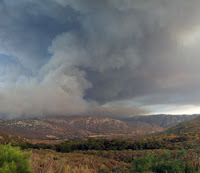
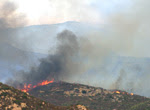
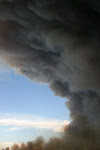
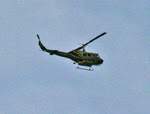
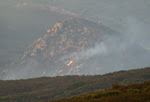
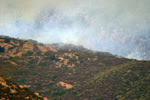
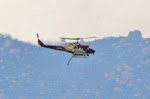
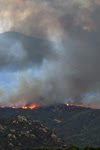
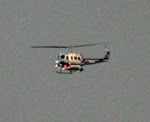
The fire that I posted about earlier today now has an official name: the “Horse Fire” (so called, I presume, because it started in the upper reaches of Horsethief Canyon). According to the last information for this evening, it has now consumed over 6,000 acres and is completely uncontained. During the day there were 4 tanker planes, 4 helicopters, 50 engines, 4 water tenders, 4 bulldozers, and 500 firemen fighting the fire. Now that its after dark, the aircraft have stood down — but the fire crews and all that equipment will be at it all night, in the relative cool and still air. We wish them all well.

This evening, just before dark, Debbie and I, along with Jim (our friend and neighbor), set off on a reconnoiter. This was prompted by the rapid growth of the smoke plume combined an ambiguous CDF message telling us that the fire was burning away from us — but that a community between us and the fire (Carveacre) was “threatened”. This made no sense to us, so we decided to see if we could eyeball it ourselves. The lack of up-to-date and accurate information in these situations is extremely frustrating. On the one hand you’re at risk of life and property from a distant foe; on the other hand you have one heck of a time finding out anything about that foe. The urge to go see it yourself is just about irresistable in those circumstances.

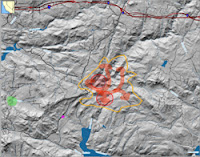
So we went. The map at right has several hand-drawn elements. The green area at left is where our home is. The purple dot near the center is where we were able to drive to (the road was closed further on). The orange circumference is my guess, based on observation from that one point, about the perimeter of the fire (as of about 7pm tonight). The red arrows are my nearly completely uniformed guess about the path of the fire, which has now broken up into numerous fires forming a ragged perimeter. The nearly circular red areas with slanting stripes are areas that showed on MODIS satellite data as having an active fire in them (as of about 11 am).

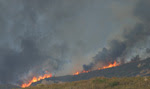
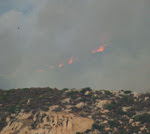
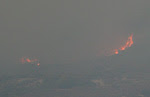
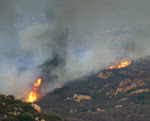
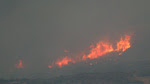
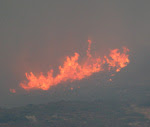
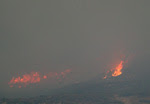
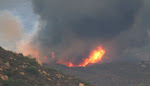
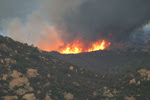
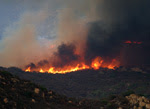
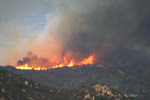
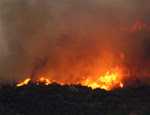
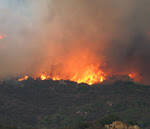
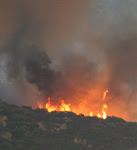
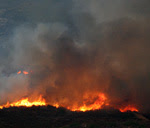
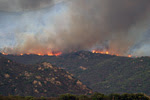
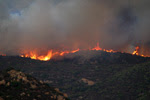
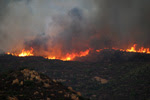
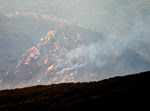
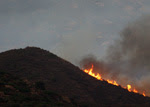
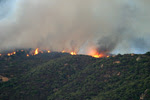
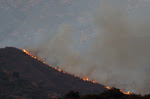
While the scene was dramatic and full of easily observed fires, it was actually quite reassuring. The fire’s center of mass was clearly at a considerable distance (at least a couple miles from where we stood), and much of the terrain between us and it had already been consumed by the fire. There were a few hot spots that were closer, in particular an entire ridge, perhaps a half mile long, that was ablaze just north of Lake Barrett. It seemed to be marching slowly and steadily toward the lake, with no action being taken to stop it. If that fire changed course and headed west, toward Lawson Peak and Gaskill Peak, that would take the fire toward us. There were also a few hotspots visible toward the junction of Lyons Valley Road and Japatul Road; if they broke loose they could also threaten us. But…these were just hotspots, and looked like (to our uneducated eyes) they could be handled by the fire crews. It certainly didn’t look like either Carveacre or Lawson Valley was in imminent danger.

The good news is the same as reported earlier, only much more so because the fire is so much larger now: an enormous swath of the fuel that was such a threat in a Santa Ana condition is now gone. Assuming we survive this one intact, our risk of a catastrophic blaze just got lowered substantially…

I saw something surprising while watching the fire, and was reminded of it as I processed my photos: there were a large number of birds in flight near the fire (I caught quite a few by accident in the photos). Many of the were either raptors, crows, or ravens. I’m guessing that they’re taking advantage of the fire, by hunting the rodents that expose themselves while fleeing the fire. That’s a twist I’d never thought of before. The mice have a choice: stand still and be roasted, or run and be eaten. Once again, for the umpteenth time, I’m very grateful that we humans don’t have to worry much about other animals trying to eat us…

Below are a selection of the bazillion photos I took at the scene. Most of these were taken with a hand-held 620mm lens (stabilized), under very challenging low-light/high-constrast conditions. Please be forgiving of the (many) technical shortcomings — these were not taken in a studio. As usual, click on any thumbnail to get a larger (sometimes much larger!) view…

Fire

Debbie looked out our window about an hour ago and saw a thick column of smoke rising over the mountains, to our east-northeast - a certain indication of a chaparral fire. These fires are a constant worry for us, as we live in an area that hasn’t burned for many years — which means that a huge amount of fuel has built up. Each year when the chaparral gets dry (as happened within the past month), we’re surrounded on all sides by dry, easy-to-ignite, fast-burning fuel. A mental model of five-gallon gasoline cans spaced a few feet apart over the entire landscape isn’t far off the mark…

So we worry when we see smoke on the horizon. And the worry is exacerbated when (as was the case this morning) the wind is blowing that smoke right over our heads — as that means the fire is burning toward us. On the plus side, there’s almost no wind this morning — and wind is the biggest risk factor for brush fires…

On the map at right, our home is in the area marked by a green dot, and the fire took the path shown by the arrow (this is approximate, based on CDF reports). As I write this, the wind has shifted and the fire is now burning toward the northeast, up Horsethief Canyon in the general direction of Pine Valley. This is a completely unpopulated wilderness area that hasn’t burned for over 25 years; access is very limited and the terrain is extremely rugged in many areas. The CDF has numerous aircraft, engines, bulldozers, and ground crews on the fire — a fast response much appreciated by all the locals. And it looks like we can breath easier in this case…the winds are low, blowing the fire away from us, and it seems likely the fire crews will be able to get it under control soon. Helping them is the fact that I-8 is directly in the fire’s path, so they have easy access for all their equipment, should it get that far…

On the plus side, thinking very selfishly: this fire is removing some dangerous fuel that is upwind of us in a Santa Ana condition. The “Santa Anas” are winds we get a few times each year, blowing hot, dry, and hard off the desert, backwards from our normal wind pattern. They are the most dangerous time for fires, because the winds dry out the fuel and push the fires very, very quickly. Both of the big fires that have occurred near us since we moved out to Lawson Valley (the Cedar Fire and the Pines Fire) happened during a Santa Ana. So having some fuel removed in that general direction is a really good thing for us. The 90 degree swath from (about) NE to SE of us is the main danger direction for Santa Anas, and this fire will remove the fuel from about 15 degrees of that, and from only a couple miles away. A few more fires like that and our risk will go down significantly.

Update at 1 PM:

A most unlikely thing is happening: it’s raining! The forecast had a 20% chance for today, but we’ve seen those forecasts so many times — and never any rain — that we just ignore them. I wonder if the rain might have been precipitated by the smoke from the fire? In any case, we got just a small amount of rain, but enough to wet down all the brush — a major risk reduction for us. The CDF news says the fire is still growing, is well-established, and has consumed 300 acres of Horsethief Canyon. It’s still headed away from us…

Update at 3:30 PM:

The rain has stopped — but we got a quarter inch in total. That may not sound like much to those of you living in the green parts of the world, but here in the high desert it’s a veritable flood! I don’t know if it rained on the fire, though…

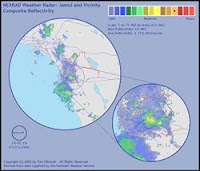
The image at right is a screen capture of the National Weather Service’s radar image, right at the peak of the rain. The smaller circle to the lower right is a magnified view of our area, centered on our house. You can see that we’re right in the most intense part of the rainfall. To the right of the yellowish high-intensity rain cell that our home is in, you can see a smaller, slightly less-intense cell — that one appears to be right smack over the fire. So maybe they did get some rain on the fire after all!

I called the CDF, and they’re now reporting that it has consumed 500 acres, and is burning in the Pine Canyon wilderness area. They’re listing several communities as “threatened", including Carveacre (which is between the fire and us) and the Barrett Lake Honor Camp (which is full of dishonorable people — go figure). As best I can tell, that means that they haven’t ruled out the possibility of the fire heading west or south, though its currently burning to the east…

The smell of smoke is strong in the air. The wind isn’t blowing the smoke onto us, though high-level air currents, far above ground level, are blowing the smoke plume high overhead. I think the rain fell right through the smoke plume, picking up the smoke particles on the way down. Now outside it is very humid, considerably cooler (in the 70s!), and very strongly smelling of damp smoke…

Saturday, July 22, 2006

Death of Liberalism

Just ran across this piece, two years old but still perfectly applicable. It’s written by Raymond S. Kraft, a fellow I don’t know, but who sounds a lot like a local personality named Roger Hedgecock. Both call themselves “recovering lawyers", and both became talk show hosts. Mr. Kraft, however, is by far the superior writer. In googling around a bit to learn about him (and to make sure this wasn’t a hoax), I discovered that he’s written many interesting essays. This one, however, is particularly good:

The Death of Liberalism

by Raymond S. Kraft

The threat is great, the battle is hard, therefore we should do nothing. We might lose!

The gangs are running wild in L.A. Somebody might get hurt. Get rid of the police!

Sixty-three years ago, Nazi Germany had overrun almost all of Europe and hammered England to the verge of bankruptcy and defeat, and had sunk more than four hundred British ships in their convoys between England and America for food and war materials.

Bushido Japan had overrun most of Asia, beginning in 1928, killing millions of civilians throughout China, and impressing millions more as slave labor.

The US was in an isolationist, pacifist, mood, and most Americans and Congress wanted nothing to do with the European war, or the Asian war.

Then along came Pearl Harbor on December 7, 1941, and in outrage Congress unanimously declared war on Japan, and the following day on Germany, which had not attacked us.

It was a dicey thing. We had few allies.

France was not an ally, the Vichy government of France aligned with its German occupiers. Germany was not an ally, it was an enemy, and Hitler intended to set up a Thousand Year Reich in Europe. Japan was not an ally, it was intent on owning and controlling all of Asia. Japan and Germany had long-term ideas of invading Canada and Mexico, and then the United States over the north and south borders, after they had settled control of Asia and Europe.

America’s allies then were England, Ireland, Scotland, Canada, Australia, and Russia, and that was about it. There were no other countries of any size or military significance with the will and ability to contribute much or anything to the effort to defeat Hitler’s Germany and Japan, and prevent the global dominance of Nazism. And we had to send millions of tons of arms, munitions, and war supplies to Russia, England, and the Canadians, Aussies, Irish, and Scots, because none of them could produce all they needed for themselves.

All of Europe, from Norway to Italy, except Russia in the east, was already under the Nazi heel.

America was not prepared for war. America had stood down most of its military after WWI and throughout the depression, at the outbreak of WWII there were army units training with broomsticks over their shoulders because they didn’t have guns, and cars with “tank” painted on the doors because they didn’t have tanks. And a big chunk of our navy had just been sunk and damaged at Pearl Harbor.

Britain had already gone bankrupt, saved only by the donation of $600 million in gold bullion in the Bank of England that was the property of Belgium and was given by Belgium to England to carry on the war when Belgium was overrun by Hitler - actually, Belgium surrendered one day, because it was unable to oppose the German invasion, and the Germans bombed Brussells into rubble the next day anyway just to prove they could.

Britain had been holding out for two years already in the face of staggering shipping loses and the near-decimation of its air force in the Battle of Britain, and was saved from being overrun by Germany only because Hitler made the mistake of thinking the Brits were a relatively minor threat that could be dealt with later and turning his attention to Russia, at a time when England was on the verge of collapse in the late summer of 1940.

Russia saved America’s ass by putting up a desperate fight for two years until the US got geared up to begin hammering away at Germany. Russia lost something like 24 million people in the seiges of Stalingrad and Moscow, 90% of them from cold and starvation, mostly civilians, but also more than a million soldiers. More than a million. Had Russia surrendered, then, Hitler would have been able to focus his entire campaign against the Brits, then America, and the Nazis would have won that war.

Had Hitler not made that mistake and invaded England in 1940 or 1941, instead, there would have been no England for the US and the Brits to use as a staging ground to prepare an assault on Nazi Europe, England would not have been able to run its North African campaign to help take a little pressure off Russia while America geared up for battle, and today Europe would very probably be run by the Nazis, the Third Reich, and, isolated and without any allies (not even the Brits), the US would very probably have had to cede Asia to the Japanese, who were basically Nazis by another name then, and the world we live in today would be very different and much worse.

I say this to illustrate that turning points in history are often dicey things. And we are at another one.

There is a very dangerous minority in Islam that either has, or wants and may soon have, the ability to deliver small nuclear, biological, or chemical weapons, almost anywhere in the world, unless they are prevented from doing so.

France, Germany, and Russia, have been selling them weapons technology at least as recently as 2002, as have North Koria, Syria, and Pakistan, paid for with billions of dollars Saddam Hussein skimmed from the “Oil For Food” program administered by the UN with the complicity of Kofi Annan and his son.

The Jihadis, the militant Muslims, are basically Nazis in Kaffiyahs - they believe that Islam, a radically conservative (definitely not liberal!) form of Wahhabi Islam, should own and control the Middle East first, then Europe, then the world, and that all who do not bow to Allah should be killed, enslaved, or subjugated. They want to finish the Holocaust, destroy Israel, purge the world of Jews. This is what they say.

There is also a civil war raging in the Middle East - for the most part not a hot war, but a war of ideas. Islam is having its Inquisition and its Reformation today, but it is not yet known which will win - the Inquisition, or the Reformation.

If the Inquisition wins, then the Wahhabis, the Jihadis, will control the Middle East, and the OPEC oil, and the US, European, and Asian economies, the techno-industrial economies, will be at the mercy of OPEC - not an OPEC dominated by the well-educated and rational Saudis of today, but an OPEC dominated by the Jihadis.

You want gas in your car? You want heating oil next winter? You want jobs? You want the dollar to be worth anything? You better hope the Jihad, the Muslim Inquisition, loses, and the Islamic Reformation wins.

If the Reformation movement wins, that is, the moderate Muslims who believe that Islam can respect and tolerate other religions, and live in peace with the rest of the world, and move out of the 10th century into the 21st, then the troubles in the Middle East will eventually fade away, and a moderate and prosperous Middle East will emerge.

We have to help the Reformation win, and to do that we have to fight the Inquisition, i.e., the Wahhabi movement, the Jihad, Al Qaeda, the Islamic terrorist movements.

We have to do it somewhere.

We cannot do it nowhere. And we cannot do it everywhere at once.

We have created a focal point for the battle now at the time and place of our choosing, in Iraq. Not in New York, not in London, or Paris, or Berlin, but in Iraq, where we did and are doing two very important things:

(1) We deposed Saddam Hussein. Whether Saddam Hussein was directly involved in 9/11 or not, it is indisputed that Saddam has been actively supporting the terrorist movement for decades. Saddam is a terrorist. Saddam is, or was, a weapon of mass destruction, who is responsible for the deaths of probably more than a million Iraqis and two million Iranians.

(2) We created a battle, a confrontation, a flash point, with Islamic terrorism in Iraq. We have focused the battle. We are killing bad guys there, and the ones we get there we won’t have to get here, or anywhere else. We also have a good shot at creating a democratic, peaceful Iraq, which will be a catalyst for democratic change in the rest of the Middle East, and an outpost for a stabilizing American military presence in the Middle East for as long as it is needed.

The Euros could have done this, but they didn’t, and they won’t. We now know that rather than opposing the rise of the Jihad, the French, Germans, and Russians were selling them arms - we have found more than a million tons of weapons and munitions in Iraq. If Iraq was not a threat to anyone, why did Saddam need a million tons of weapons?

And Iraq was paying for French, German, and Russian arms with money skimmed from the UN Oil For Food Program (supervised by UN Secretary General Kofi Annan and his son) that was supposed to pay for food, medicine, and education, for Iraqi children.

World War II, the war with the German and Japanese Nazis, really began with a “whimper” in 1928. It did not begin with Pearl Harbor. It began with the Japanese invasion of China. It was a war for fourteen years before America joined it. It officially ended in 1945 - a 17 year war - and was followed by another decade of US occupation in Germany and Japan to get those countries reconstructed and running on their own again . . . a 27 year war. World War II cost the United States an amount equal to approximately a full year’s GDP - adjusted for inflation, equal to about $12 trillion dollars, WWII cost America more than 400,000 killed in action, and nearly 100,000 still missing in action.

[The Iraq war has, so far, cost the US about $120 billion, which is roughly what 9/11 cost New York. It has also cost about 1,000 American lives, which is roughly 1/3 of the 3,000 lives that the Jihad snuffed on 9/11.]

But the cost of not fighting and winning WWII would have been unimaginably greater - a world now dominated by German and Japanese Nazism.

Americans have a short attention span, now, conditioned I suppose by 30 minute TV shows and 2-hour movies in which everything comes out okay. The real world is not like that. It is messy, uncertain, and sometimes bloody and ugly. Always has been, and probably always will be.

If we do this thing in Iraq successfully, it is probable that the Reformation will ultimately prevail. Many Muslims in the Middle East hope it will. We will be there to support it. It has begun in some countries, Libya, for instance. And Dubai. And Saudi Arabia. If we fail, the Inquisition will probably prevail, and terrorism from Islam will be with us for all the foreseeable future, because the Inquisition, or Jihad, believes they are called by Allah to kill all the Infidels, and that death in Jihad is glorious.

The bottom line here is that we will have to deal with Islamic terrorism until we defeat it, whenever that is. It will not go away on its own. It will not go away if we ignore it.

If the US can create a reasonably democratic and stable Iraq, then we have an “England” in the Middle East, a platform, from which we can work to help modernize and moderate the Middle East. The history of the world is the clash between the forces of relative civility and civilization, and the barbarians clamoring at the gates. The Iraq war is merely another battle in this ancient and never-ending war. And now, for the first time ever, the barbarians are about to get nuclear weapons. Unless we prevent them. Or somebody does.

The Iraq war is expensive, and uncertain, yes. But the consequences of not fighting it and winning it will be horrifically greater. We have four options -

1. We can defeat the Jihad now, before it gets nuclear weapons.

2. We can fight the Jihad later, after it gets nuclear weapons (which may be as early as next year, if Iran’s progress on nuclear weapons is what Iran claims it is).

3. We can surrender to the Jihad and accept its dominance in the Middle East, now, in Europe in the next few years or decades, and ultimately in America.

4. Or we can stand down now, and pick up the fight later when the Jihad is more widespread and better armed, perhaps after the Jihad has dominated France and Germany and maybe most of the rest of Europe. It will be more dangerous, more expensive, and much bloodier then.

Yes, the Jihadis say that they look forward to an Islamic America. If you oppose this war, I hope you like the idea that your children, or grandchildren, may live in an Islamic America under the Mullahs and the Sharia, an America that resembles Iran today.

We can be defeatist, as many Democrats and Liberals, peace-activists and anti-war types seem to be, and concede, surrender, to the Jihad, or we can do whatever it takes to win this war against them.

The history of the world is the history of civilizational clashes, cultural clashes. All wars are about ideas, ideas about what society and civilization should be like, and the most determined always win. Those who are willing to be the most ruthless always win. The pacifists always lose, because the anti-pacifists kill them.

In the 20th century, it was Western democracy vs. communism, and before that Western democracy vs. Nazism, and before that Western democracy vs. German Imperialism. Western democracy won, three times, but it wasn’t cheap, fun, nice, easy, or quick. Indeed, the wars against German Imperialism (WWI), Nazi Imperialism (WWII), and communist imperialism (the 40-year Cold War that included the Vietnam Battle, commonly called the Vietnam War, but itself a major battle in a larger war) covered almost the entire century.

The first major war of the 21st Century is the war between Western Judeo/Christian Civilization and Wahhabi Islam. It may last a few more years, or most of this century. It will last until the Wahhabi branch of Islam fades away, or gives up its ambitions for regional and global dominance and Jihad, or until Western Civilization gives in to the Jihad.

Senator John Kerry, in the debates and almost daily, makes 3 specious claims:

1. We went to Iraq without enough troops.

We went with the troops the US military wanted. We went with the troop levels General Tommy Franks asked for. We deposed Saddam in 30 days with light casualties, much lighter than we expected.

The real problem in Iraq is that we are trying to be nice - we are trying to fight the 1% of the population that is Jihadi, and trying to avoid killing the 99% of the population that is not a threat. We could flatten Fallujah in minutes with a flight of B52s, or seconds with one nuclear cruise missile - but we don’t. We’re trying to do brain surgery, not ampute the patient’s head. The Jihadis amputate heads.

2. We went to Iraq with too little planning.

This is a specious argument too, for it supposes that if we had just had “the right plan” the war would have been easy, cheap, quick, and clean. That is not an option. It is a guerrrilla war against a determined enemy, and no such war ever has been or ever will be easy, cheap, quick, and clean. This is not TV.

3. We proved ourselves incapable of governing and providing security.

This too is a specious argument. It was never our intention to govern and provide security. It was our intention from the beginning to do just enough to enable the Iraqis to develop a representative government and their own military and police forces to provide their own security, and that is happening. The US and the Brits and other countries there have trained over 100,000 Iraqi police and military, now, and will have trained more than 200,000 by the end of next year. We are in the process of transitioning operational control for security back to Iraq. It will take time. It will not go with no hitches. This is not TV.

Remember, perspective is everything, and America’s schools teach too little history. The Cold war lasted from about 1947 at least until the Berlin Wall came down in 1989. Forty-two years. Europe spent the first half of the 19th century fighting Napoleon, and from 1870 to 1945 fighting Germany. World War II began in 1928, lasted 17 years, plus a ten year occupation, and the US still has troops in Germany and Japan. World War II resulted in the death of more than 50 million people, maybe more than 100 million people, depending on which estimates you accept.

The US has taken a little more than 1,000 KIA in Iraq. The US took more than 4,000 KIA on the morning of June 6, 1944, the first day of the Normandy Invasion to rid Europe of Nazi Imperialism. In WWII the US averaged 2,000 KIA a week for four years. Most of the individual battles of WWII lost more Americans than the entire Iraq war has done so far.

But the stakes are at least as high . . . a world dominated by representative governments with civil rights, human rights, and personal freedoms . . . or a world dominated by a radical Islamic Wahhabi movement, by the Jihad, under the Mullahs and the Sharia.

I do not understand why the American Left does not grasp this. Too much TV I guess.

The Liberals are supposed to be in favor of human rights, civil rights, liberty, freedom, and all that. But not for Iraqis, I guess. In America, but nowhere else. 300,000 Iraqi bodies in mass graves in Iraq, not our problem. The US population is about twelve times that of Iraq, so let’s multiply 300,000 by twelve. What would you think if there were 3,600,000 American bodies in mass graves in America because of George Bush? Would you want another country to help liberate America?

"Peace Activists” always seem to demonstrate where it’s safe and ineffective to do so, in America. Why don’t we see Liberal Peace Activists demonstrating in Iran, Syria, Iraq, Sudan, North Korea, in the places in the world that really need peace activism the most?

The Liberals are supposed to be in favor of human rights, civil rights, democracy, multiculturalism, diversity, etc., but if the Jihad wins, wherever the Jihad wins, it is the end of civil rights, human rights, democracy, multiculturalsim, diversity, etc. American Liberals who oppose the liberation of Iraq are coming down on the side of their own worst enemy. If the Jihad wins, it is the death of Liberalism. Everywhere the Jihad wins, it is the death of Liberalism.

And American Liberals just don’t get it.

Raymond S. Kraft

Well said, and some points worth an all-out ponder…

Horse in the Road

Driving down one of the twisty, windy parts of Lawson Valley road, on the way home after running some errands this morning, I came around a corner to find a rearing horse in the middle of the road. By the time I stopped, it was only about 25 feet from the nose of my truck. A young girl, perhaps 13 or 14 years old, was clinging to the horse’s mane and screaming continuously — obviously terrified. The horse looked wild-eyed and frightened as well.

I’ve never been in the presence of a horse bucking and rearing like this. I was amazed how fast that horse could move up-and-down. It was a big horse, too — when it reared back, its front hooves were well over my head (and more than a little intimidating).

I put my four-way flashers on and got out of the truck, truly not at all sure what to do. I could see an older woman — presumably the girl’s mother — running up a side street, obviously upset and very overheated (it was well over 100 degrees F out). I could see that the girl had let go of the reins, so I figured grabbing them might be a good idea — but I didn’t want to make things worse by spooking the horse. So I just approached slowly and carefully — the horse didn’t even seem to see me — stayed out of range of those flailing front hooves, and I managed to catch the reins. Then when the horse came down to the pavement the next time, I pulled down hard — and that worked. In fact, it was almost like throwing a switch. The horse kind of twitched a couple times, but completely stopped trying to buck or rear up.

The girl jumped off, and ran off to her mother, who by that time had gotten close to us. I led the horse off the road, and it followed me quite docilely, as though nothing had ever happened. After tying its reins to a mailbox post, I went over to talk with the mother. She was very relieved, as you might well imagine — had some nice things to say, though I hope its true that any adult encountering such a situation would try to do the same. The girl who was riding the horse never said a word to me, or to her mother in my presence — she just clung to her mother’s leg, hard, and buried her face in her mother’s side. Poor thing — I’ll bet it’s a while before she climbs on a horse again…
Quite an adventure, compared with shopping at Home Depot! When I got home, just a few minutes later, I was still feeling the effects of the adrenaline that was pumping strong while I was near that horse — strange feeling, shaky and a bit light-headed…

Record Heat

It’s take-your-breath-away hot out here. Easily hot enough to fry an egg on your car fender. Hot in the shade. Hot even with a breeze — even with just 3% relative humidity.

It’s hot!

We had one five-minute period that was 112F — which is two degrees hotter than the previous five-minute high I’ve recorded in my weather station (which has been running for five years now).

The puppy woke us at 3:30 AM this morning, and when I took it out for a walk I was amazed at how warm it felt. I looked at the weather station, and it was 86F — really, really weird for us in the pre-dawn morning. I knew right then it would be hot today.

It’s hot!

Friday, July 21, 2006

The Window

As I followed my usual routine this morning, reading the news on my computer, I happened to glance out my office window (which faces north). I’m so glad I did…because brushstrokes of fire, set on a dark purple-blue background, framed by the silouhettes of our local mountains, covered about 90 degrees of the sky. A gorgeous new moon smiled at the fiery sunrise from a perch in the black night sky.

Beautiful. Just beautiful.

And a minute later, it was gone…

Thursday, July 20, 2006

Choices and Challenges

A week ago I posed a thought experiment to my readers, and several responded. I was looking in particular for one of Jonny Dallo’s friends to respond — they were, in the comments, excusing his actions as a “mistake” or an “accident”. Their emotion is evident — their friend is accused of an awful crime, killing a woman — and their defense of Jonny very passionate, if not particularly articulate. I wanted to see how those friends would respond to a scenario with the same basic elements, minus their friendship with the perpetrator.

BTW, if this is all new to you, search (at right) for “Jodi Burnett” and “Dallo” to get the posts and their comments for all the context…

While I had several interesting responses to my thought experiment, the responses didn’t come from one of Jonny’s friends. Until last night:

I am friends with Jonny and I guess you can call me an “apologists for Jonny Dallo.” For one thing when we say Jonny is a good kid we are not excusing him of what he did. Jonny should have consequences. That is what your friends are for I mean if I did something wrong I hope my family and friends stick it out with me. I think he should be punished but if you go in to “what if it was your mom or your friend” then are laws will never work. I mean every case is different, there are many people who do not believe in the death penalty but what is your family was the victim? I bet your view would change. I give my support to Jonny as a friend but yes what he did was wrong! If you break the law you should be punished no matter what. Joe should and so should Jonny!

"Joe” was the perpetrator in my thought experiment.

Whoever you are, my anonymous commenter, I commend you for thinking clearly about friendship and your friend’s responsibilities. And you are not a Jonny Dallo apologist. You’re articulating the exact opposite notion here…

As you read the comment above, the commenter’s internal conflict is evident: his (or her) friend did a bad thing, and the need for punishment is acknowledged — but Jonny is still his friend, and he’s going to “stick it out” with Jonny.

Imagine yourself in my commenter’s position: a friend or a loved one kills someone unintentionally, but as a result of choices and decisions they made. How do you respond to this? There are, I think, three basic possibilities:

1. You can allow your feelings for your friend or loved one romp freely over logic, and simply deny either the crime or the need for punishment. Many of Jonny’s friends — the ones I’m calling “Jonny apologists” — appear to have taken this route. This is a relatively easy course to take, it seems to me — there’s no pesky need to confront anyone, and it feels like loyalty.

2. You can say to yourself that you simply don’t want someone who does things like that to be my friend, and walk away. This is a more difficult course, cutting off emotional ties that may well be quite powerful — but its also a way to escape the discomfort of the situation. It’s harsh, but it’s easy to imagine someone feeling justified in taking the action.

3. You can do what my commenter has done: acknowledge your friend’s responsibility, acknowledge the need for punishment, and still maintain your friendship. This, I think, is the most difficult course of all — for it requires confronting your friend (and perhaps other mutual friends as well), if you’re going to be honest about your feelings and your position. A friend like this (and unlike the preceding two) could offer comfort and counsel to a perpetrator coming to terms with his choices and actions, their consequences, and his feelings about them.

Tough choices for Jonny’s friends. But Jonny’s got at least one friend taking that most difficult route…

Wednesday, July 19, 2006

Inglorious English

Most languages around the world have some elements of irregularity — words and phrases that don’t follow the rules. But linguists say that English is the most irregular of all.

The sentences below are nice examples of one particular irregularity in English: words that are spelled the same, but pronounced differently and have different meanings. They make it much easier for native English speakers to see what the fuss is about. Read them out loud for the full effect…

The bandage was wound around the wound.

The farm was used to produce produce.

The dump was so full that it had to refuse more refuse.

We must polish the Polish furniture.

He could lead if he would get the lead out.

The soldier decided to desert his dessert in the desert.

Since there is no time like the present, he thought it was time to present the present.

A bass was painted on the head of the bass drum.

When shot at, the dove dove into the bushes.

I did not object to the object.

The insurance was invalid for the invalid.

There was a row among the oarsmen about how to row.

They were too close to the door to close it.

The buck does funny things when the does are present.

A seamstress and a sewer fell down into a sewer line.

To help with planting, the farmer taught his sow to sow.

The wind was too strong to wind the sail.

Upon seeing the tear in the painting I shed a tear.

I had to subject the subject to a series of tests.

How can I intimate this to my most intimate friend?

Then there’s the English idiom. All languages have idioms, but linguists say that English idioms are the craziest of them all…

There is no egg in eggplant, nor ham in hamburger; neither apple nor pine in pineapple. English muffins weren’t invented in England or French fries in France. Sweetmeats are candies while sweetbreads, which aren’t sweet, are meat.

We take English for granted. But if we explore its paradoxes, we find that quicksand can work slowly, boxing rings are square and a guinea pig is neither from Guinea nor is it a pig.

And why is it that writers write but fingers don’t fing, grocers don’t groce and hammers don’t ham? If the plural of tooth is teeth, why isn’t the plural of booth, beeth? One goose, 2 geese. So one moose, 2 meese?

One index, 2 indices? Doesn’t it seem crazy that you can make amends but not one amend? If you have a bunch of odds and ends and get rid of all but one of them, what do you call it?

If teachers taught, why didn’t preachers praught? If a vegetarian eats vegetables, what does a humanitarian eat?

Sometimes I think all the English speakers should be committed to an asylum for the verbally insane.

In what language do people recite at a play and play at a recital? Ship by truck and send cargo by ship? Have noses that run and feet that smell? How can a slim chance and a fat chance be the same, while a wise man and a wise guy are opposites?

You have to marvel at the unique lunacy of a language in which your house can burn up as it burns down, in which you fill in a form by filling it out and in which, an alarm goes off by going on.

English was invented by people, not computers, and it reflects the creativity of the human race, which, of course, is not a race at all. That is why, when the stars are out, they are visible, but when the lights are out, they are invisible.

And why doesn’t “Buick” rhyme with “quick"?

Godless

I just finished reading “Godless: the Church of Liberalism” (by Anne Coulter), and it was both surprising and what I expected.

The expected part was Ms. Coulter’s trademark rapier wit, which will have anybody who’s not clinicly disturbed both wincing and laughing. Her barbs are mainly (but not entirely!) directed at liberals, so those who are not of the liberal persuasion will doubtless find it much more entertaining. As always, I’m in awe of Ms. Coulter’s ability to sneak a zinger into the most unlikely places. One example: in this book’s discussion of radio-carbon dating, she calls it an excellent tool for determining Helen Thomas' actual date of birth. Oooh, ouch! But I laughed out loud at that one…

The surprising part was the last few chapters of the book, which are all about Ms. Coulter’s skeptical views of Darwinist evolution. Knowing that she is a devout Christian, I expected those chapters to be ideological, faith-based rants — and therefore of little interest to me. In fact, those chapters are anything but that sort of rant. They raise interesting questions about the validity of evolution that I don’t have the expertise to answer — I’ve always just accepted evolutionary theory as the consensus view of science, and presumed that it was backed with the same rigor as (say) our understanding of chemistry or physics. Ms. Coulter makes the case that in fact evolution is not backed up by the evidence.

A point she makes repeatedly is that if it’s true (as evolutionary theory asserts) that new species evovled gradually, then the fossil record should have many examples of those intermediate forms — and those fossils have not been found. For example, if it’s true that early squirrels evolved into bats (as evolutionary biologists currently believe), then where are those half-squirrel/half-bat fossils? I can’t poke any holes in this point — every possible explanation I can think of for the absence of intermediate fossils seems unreasonable, and without any evidence I’m aware of.

Ms. Coulter also uses the squirrel/bat example to make another point: the unlikeliness of many presumed evolutionary paths. In this case, evolutionary biologists posit that the short wrist and finger bones of the early squirrels gradually elongated into the wing bones of bats. She asks a good question: how on earth could having these longer and longer bones ever have done those posited (but never seen in fossils) squirrels any good? And evolutionary theory says that they must have been beneficial mutations, else they would not have survived and prospered…and eventually become bats. Interesting question, and I know of no plausible answer.

Even with my limited knowledge of evolution, I caught Ms. Coulter on one error: she criticizes science for not having observed any speciation since they started looking about 150 years ago. The fallacy there is a question of time: 150 years is a tiny, tiny fraction of 2 billion or so years that life has been evolving on Earth (assuming evolution is correct). It shouldn’t be surprising that we haven’t witnessed speciation in such a small time period.

It’s an interesting and entertaining book, and I’ll recommend it — especially to anyone who enjoys the unrestrained display of a first-class wit…

Tuesday, July 18, 2006

Oh, No They Don't!

Tip o’the hat to JimM:

A Simple Thank You

Last week, while traveling to Chicago on business, I noticed a Marine sergeant traveling with a folded flag, but did not put two and two together. After we boarded our flight, I turned to the sergeant, who’d been invited to sit in First Class (across from me), and inquired if he was heading home.

No, he responded.

Heading out I asked?

No. I’m escorting a soldier home.

Going to pick him up?

No. He is with me right now. He was killed in Iraq. I’m taking him home to his family.

The realization of what he had been asked to do hit me like a punch to the gut. It was an honor for him. He told me that, although he didn’t know the soldier, he had delivered the news of his passing to the soldier’s family and felt as if he knew them after many conversations in so few days. I turned back to him, extended my hand, and said, Thank you. Thank you for doing what you do so my family and I can do what we do.

Upon landing in Chicago the pilot stopped short of the gate and made the following announcement over the intercom.

"Ladies and gentlemen, I would like to note that we have had the honor of having Sergeant Steeley of the United States Marine Corps join us on this flight. He is escorting a fallen comrade back home to his family. I ask that you please remain in your seats when we open the forward door to allow Sergeant Steeley to deplane and receive his fellow soldier. We will then turn off the seat belt sign."

Without a sound, all went as requested. I noticed the sergeant saluting the casket as it was brought off the plane, and his action made me realize that I am proud to be an American.

So here’s a public Thank You to our military Men and Women for what you do so we can live the way we do.

Stuart Margel — Washington, D.C.

Jim also included links to the two pictures below, first and second place winners in the 63rd Pictures of the Year International competition. They are not photos of the incident described above, but obviously of a very similar one. The comments are the photographer’s (Todd Heisler of The Rocky Mountain News):

When 2nd Lt. James Cathey’s body arrived at the Reno Airport, Marines climbed into the cargo hold of the plane and draped the flag over his casket as passengers watched the family gather on the tarmac. During the arrival of another Marine’s casket last year at Denver International Airport, Major Steve Beck described the scene as one of the most powerful in the process: “See the people in the windows? They’ll sit right there in the plane, watching those Marines. You gotta wonder what’s going through their minds, knowing that they’re on the plane that brought him home,” he said. “They’re going to remember being on that plane for the rest of their lives. They’re going to remember bringing that Marine home. And they should."

The night before the burial of her husband’s body, Katherine Cathey refused to leave the casket, asking to sleep next to his body for the last time. The Marines made a bed for her, tucking in the sheets below the flag. Before she fell asleep, she opened her laptop computer and played songs that reminded her of 'Cat,' and one of the Marines asked if she wanted them to continue standing watch as she slept. “I think it would be kind of nice if you kept doing it,” she said. “I think that’s what he would have wanted."

I think she was right.

Crime Map

An interesting new service went live yesterday here in San Diego County: an interactive crime map. And miracle of miracles (considering that it’s a government effort), the thing actually works quite nicely.

The image at right shows the zip code where I live, and the crime incidents of the past three months. There are simple tools available to zoom and pan the map, and very basic information on each incident listed.

After generating the map above, I spent some time looking at other areas in the county, to see how our area compares. Conclusion: I live where the angels live. Within a one mile radius of my home there wasn’t a single crime report in the past 90 days — but just about anywhere else in the county would find somewhere between a dozen and hundreds of reports.

I think I’ll just stay home.

Saturday, July 15, 2006

Hot Weather Treat

Actually I have this dish quite frequently — it’s one of my favorite warm weather snacks (or meals, if you eat enough of it!). It’s easy to make, cold, very digestable, and tasty:

Tom’s Hot Weather Food

Ingredients:

— one or two (depending on size) good eating tomatoes, chilled

— one can of chilled garbanzo beans, best quality you can get (they vary widely)

— half cup or so of frozen corn (optional)

— two or three tbsps of tarragon — fresh if possible, finely minced just before use; otherwise dried whole leaves powdered just before use. This is important!

— two or three tbsps of good olive oil (don’t be cheap here!)

— splash of basalmic vinegar (optional)

— fresh ground pepper and salt to taste

Prepare the tarragon, salt, and pepper in the bottom of a bowl large enough to hold the entire concoction. Then cover with the olive oil and mix thoroughly. Set aside (or make in advance; you’ll get even more of that lovely tarragon flavor). Dice the tomatoes into eatin' sized chunks. Throw the tomatoes into a strainer to drain them. Dump the garbanzos out of the can on top of them, to drain them too. Dump the whole mess into the bowl with the olive oil and spices. Throw in the corn, if you want it. Splash a little basalmic vinegar onto it, if that sounds good. Mix it all up. Eat it.

I just finished this meal…yum! And now I’m headed off for a nice, big glass of cabernet…

Demo Done!

But no thanks to this rotten tool that I was not very optimistic about. No, that thing turned out to be even more useless than I feared — both because of the lawsuit-mandated low mass, and the particulars of our laundry room.

We were told this house was built in 1982 (we bought it in 1999). But judging from the fossils we found under our tiles, and the primitive nature of the glue that held them down (closely resembling the more viscous portions of the La Brea tar pits), I’d say our old laundry room tiles were laid in the late Cretaceous Era. Enough time has passed so that the tiles had themselves mineralized, and had become one with the concrete.

So in the end I dragged out my trusty air hammer, put my biggest chisel bit in it (just one inch wide), and hammered off all 150 square feet of tile. Oh, my aching arms!

But it’s done. Debbie cleaned up while I hammered (which was a huge help), and we got it all done in just four hours. Now for the cleanup!

Friday, July 14, 2006

Common Ground

Put down your coffee, now!

Even in the middle of war, it is possible to find common ground:

A U.S. Marine squad was marching north of Faluijiah when they came upon an Iraqi terrorist, badly injured and unconscious. On the opposite side of the road was an American Marine in a similar but less serious state. The Marine was conscious and alert and as first aid was given to both men, the squad leader asked the injured Marine what had happened.

The Marine reported, “I was heavily armed and moving north along the highway here, and coming south was a heavily armed insurgent.

We saw each other and both took cover in the ditches along the road. “I yelled to him that Saddam Hussein is a miserable, lowlife scumbag, and he yelled back that Ted Kennedy is a good-for-nothing, fat, left wing liberal drunk."

"So I said that Osama Bin Ladin dresses and acts like a frigid, mean-spirited lesbian! He retaliated by yelling, Oh yeah? Well, so does Hillary Clinton!"

"And, there we were, in the middle of the road, shaking hands, when a truck hit us"

Tip o’the hat to Judy R…

Calendars

An old-fashioned paper calendar — the kind with a page for each month — hangs on my office wall. Just now I happened to glance over at it, and … the page that’s showing is for March! Well, at least it’s for this year!

But that got the ponder going, because not so very many years ago I was completely dependent on such calendars (or a daily diary, or other such planner). And now I (obviously) rarely use one. What’s happened?

For me, the first thing that happened was electronic organizers (such as the Palm Pilot). When those gadgets first got really usable, back in the mid '90s or so, I “adopted” one. I used them for years, even though keeping them synchronized (with Outlook’s calendar, a must in the corporate world) and writing with that silly little stylus was a real pain in the butt. The benefits made it worth the trouble, especially the fact that I could easily carry my schedule around and at the same time make it visible to all those I worked with.

But for the past year or so, I’ve stopped using the organizer. I still have one, but I haven’t powered it up for quite a while. I experimented with various other things, all of them complete flops, until my recent discovery of Google Calendar. I’ve been using it for a few weeks now, and I’ve been more than just pleased — it is, for me, almost a perfect solution. Because’s Google Calendar is web-based, I can share my calendar with anyone I care to. I can keep multiple calendars, for different purposes. I can get to my calendars from anywhere in the world, so long as I have web access. It sends me email reminders when its time to do something (and it will send them to my cell phone, if I want it to). I don’t have to worry about backing it up, or any other kind of maintenance — Google does it all for me. And best of all, it’s absolutely free.

So my Norman Rockwell paper calendar just sits there on my wall. There’s not a note of any kind on it — it’s completely pristine. And maybe in another four or five months, I’ll look at it again. Meanwhile, I’ll click on over to my Google calendar to see what I’m supposed to do today. Oh, yeah — work!

Thursday, July 13, 2006

A Fine Speech

When visiting the Villainous Company blog yesterday morning, I came across the transcript of this speech — a riveting, must-read talk given by General Lehnert, the Commanding General of Marine Corps Installations West. He gave this speech on July 5, to the Military Affairs Advisory Council here in San Diego.

You really don’t want to miss it. The contrast between the General’s hard-headed pragmatism and the typical politician’s limp-wristed pandering is a fine thing to behold…

Transcript of General Lehnert’s July 5, 2006 speech:

Good morning ladies and gentlemen.

Eight days ago, I was present in the audience when Tom Brokaw addressed the 2006 Stanford graduating class. After the initial pleasantries and one-liners, Mr. Brokaw said something unexpected.

He told the class that they were the children of privilege, fortunate to be attending one of the finest educational institutions in the country, the anointed because they had both the test scores for admittance and parents who were able to afford their tuition. He noted that they could likely expect rapid advancement in almost any endeavor they choose and that they were destined to lead the most powerful country in the world.

The class was beaming.

And then Brokaw reminded them that the liberties and freedoms they enjoyed were being defended by young people their age that did not have their advantages. That at this time thousands of men and women were fighting, dying and suffering debilitating injury to ensure that the rest of us could live the American dream.

There was an uncomfortable shifting in the seats, followed by slow but growing applause from the audience.

When we sent my son to Stanford four years ago, we filled out a form asking for demographic information. One of the questions for the parents said, what is your profession? After it was a list of about thirty professions including doctor, lawyer, congressman, educator, architect. Military was not listed so I filled in “other"

My son was the only graduate who had a parent serving in the armed forces.

As I was introduced to his friends parents, it was interesting to watch their reaction. Few had ever spoken to a member of the military. One asked me how my son was able to gain admittance with the disadvantage of having to attend “those DoD schools”. Many voiced support for our military and told me that they’d have served but clearly military service was not for their kind of people.

This year of the so-called elite schools, Princeton led them with nine graduates electing military service. Compare that with 1956 when over 400 of the Princeton graduating class entered the military. Most of the other Ivy League schools had no one entering the military this year.

I wonder how many of you know the young people who are serving today. I won’t embarrass anyone by asking for a show of hands to ask how many really know a young enlisted Marine who has been to war.

I am going to try to give you a better feel about those who serve our nation.

Our Marines tend to come from working class families. For the most part, they came from homes where high school graduation was important but college was out of their reach. The homes they come from emphasize service. Patriotism isn’t a word that makes them uncomfortable.

The global war on terrorism has been ongoing for nearly five years with Marines deployed in harms way for most of that time. It is a strange war because the sacrifices being levied upon our citizens are not evenly distributed throughout society. In fact, most Americans are only vaguely aware of what is going on.

That isn’t the case aboard the Marine bases in Southern California where we see the sacrifice everyday as we train aboard those open spaces that you covet for other purposes.

Many of our Marines are married and 70% of our married Marines live in your communities, not aboard Marine bases. These Marines coach your soccer teams. They attend your places of worship. They send their kids to your schools. However, in many ways they are as different from the rest of the citizens of Southern California as my son was different from the rest of the students at Stanford.

One of the huge differences between the rest of society and our Marine families, is when Marine daddies and mommies go to work, some of them never come home. The kids know that. The spouses know that. Week after week we get reports of another son, father, husband who wont be coming back. During the past four years, over 460 Marines from Southern California bases have been killed by the enemy. 107 more have died in Iraq and Afghanistan due to accidents. 6500 have been wounded, some of them multiple times.

You will never know or meet Brandan Webb age 20 or Christopher White age 23 or Ben Williams age 30. They were all assigned to First Battalion First Marine Regiment, Camp Pendleton, California. They were some of the Marines who died this week out of Marine bases in Southern California.

Last Friday, we hosted a golf tournament at Camp Pendleton to raise money for wounded Marines. There are a lot of expenses that the government cannot legally pay for from appropriated funds. The people who attended the tournament genuinely wanted to help and we invited a couple of dozen wounded Marines to golf with them. As I watched the teams leave for a shotgun start, I saw three Marines sitting by themselves and went over to talk to them. Clearly they’d been told by their chain of command that this was their appointed place of duty. They were sitting in the sun chatting, probably not unhappy with the duty but mildly uncertain as to why they were there.

I asked them why they wern’t golfing and they said that they’d never learned. No one in their families ever played golf and that this was the first time they’d ever been on a golf course. I asked them how many times they’d deployed. One of the young men had just returned from his third deployment and had been wounded every time. The others teased him for being a bullet magnet. I asked him if he was going to stay in and he thought for a moment what to say to a general and he said, “I think I’d like to try college. No one in my family has ever gone."

I asked these Marines if I could buy them a beer. They looked at me and smiled. One of them said, “We can’t ask you to break the rules sir. None of us are 21 yet."

They seemed much older. As I left them I wondered about a policy that gives a young man the power of deciding who will live and who will die but wont let him drink a beer.

I thought about these young Americans who had never shot golf but had shot and killed other men in order to carry out foreign policy.

On the 10th of August we will open a wounded warrior barracks at Camp Pendleton. Few taxpayers dollars were used. We were able to raise the money through the Semper Fidelis fund to house those Marines who no longer need to be hospitalized but who suffer debilitating injuries and need follow-on care. Heretofore, when regiments left for the war, they left their non-deployables behind. These Marines often had to live in WWII era barracks with open squad bays and gang heads down the hallway. Those having limited mobility found it difficult and uncomfortable. It was no way to treat our wounded warriors. We’re fixing it.

Mira Costa College. Though deployed soon after signing up for college, he took his textbooks to war. Last month he received Mira Costas highest award for academic excellence, the Medal of Honor for Academic Excellence.

Brendan described studying pre-calculus while fragments from explosions struck the sandbag shelter he was in. Brendan lef the Corps this week and has been accepted to the University of California Los Angeles to study math and economics.

Later this morning I’ll be meeting with educators across the California University system. We are trying to make California more veteran friendly. California hosts 40% of the combat power of the Marine Corps and 40% of the Marine veterans who leave the Corps do so out of Southern California bases. 96% have participated in the Montgomery GI Bill and are eligible for benefits but only a small number enter the California University system.

That’s because California, unlike other states did not provide any veterans preference or even reach out to veterans. These combat veterans score in the top 50% of their age group, are drug free and morally straight but are lost to California and return to other states that aggressively work to attract them.

Several months ago, I along with senior leadership of all the Services, met with Governor Schwarzenegger and told him that California was not an education friendly state for military veterans. To his credit, he is trying to change that and this meeting today is a natural outgrowth of his support.

In Iraq, the media talks about the casualties. They seldom report the successes. I don’t think that this is intentional. It is just more difficult to quantify progress and reduce it to a sound bite.

Some of you may recall almost exactly two years ago when a four man sniper team from 2nd Battalion, 4th Marines was killed on a rooftop in Ramadi. It made news because sniper teams aren’t supposed to get ambushed and because an M40A1 sniper rifle was now in the hands of the enemy.

Over the next two years, that rifle was used against Americans and we wanted it back. Last week, a 21 year old Marine sniper from 3rd Battalion, Fifth Marines out of Camp Pendleton obseved a military aged male videotaping a passing patrol of amphibious assault vehicles near Camp Habbaniya. After radioing the patrol and telling them to stay low, the Marine watched the man aiming a sniper rifle that looked remarkably like his own.

He killed the enemy sniper with one round to the head. Seconds later, another insurgent entered on the passenger side and was surprised to see his partner dead. That hesitation was enough time to allow Sgt Kevin Homestead age 26 to kill the insurgent before he could drive off.

When the Marines went down to inspect the scene, they saw that the sniper rifle was one of their own. It was the same M-40A1 sniper rifle looted from the 2/4 sniper team exactly two years earlier.

We are making progress in Iraq. The Iraqi Army is more capable each month. In the Anbar province we have brought the 1st Iraqi Division - the most capable of the Iraqi formations - to the former British RAF base of Habbaniyah - between Fallujah and Ramadi. We are standing up the 7th Division. In Baghdad, Iraqi brigades own parts of the city and are reporting directly to the US Army Division commander as component units.

The Iraqi Police are the essential element - and the most difficult challenge. In an insurrection, the insurgent specifically targets the local security elements of the government - because they are essential to maintaining control via interaction with the community, intelligence gathering, and law enforcement against petty and organized crime, traffic control. These police units are having good success in places like Fallujah. Ramadi is a different kettle of fish. Some of the police departments haven’t been paid in months and the intimidation campaign is in full force.

My Chief of Staff, Colonel Stu Navarre formerly the Commander of the 5th Marine Regiment told me this story. One day in December, the Ramadi Police Dept Operations Officer (#3 in the pecking order) did not come to work. When we inquired, he told us that the day before his 10 year old son had been kidnapped fter school and transported to the north side of Ramadi. He was called by the kidnappers and advised of his son’s location. When the Operations Officer arrived at the location, he found his son alive, with a note pinned to his shirt, “If you go to work tomorrow, you will never see your son again. We know where you live.” I wonder how many of us would show up for work with that kind of intimidation.

Your fellow Americans in uniform in Iraq and Afghanistan are doing a superb job in the most dangerous places on earth. They believe in what they are doing. The majority of the sergeants, corporals, and privates enlisted after 9-11.

They knew what they were signing up for. They want to deploy in defense of the nation. We are sending best leadership to the combat zone.

Service in Iraq/Afghanistan has become the norm for our Marine and Army leaders, and an essential part of their experience/qualifications for advancement.

Finally, the American people have continued to demonstrate an unprecedented level of support for their fellow Americans in uniform - as well as the understanding that these young men and women are executing the policies of their elected representatives.

Reconstructing an entire nation takes time. Think about our own experience during the American Revolution. Despite having a homogeneous nation with no incipient insurgency, it was thirteen years from the Revolution to the ratification of the Constitution. We seem to have forgotten that it takes time to build institutions.

Introduction of a stable, representative form of government in Iraq is revolutionary in its impacts on the region and the world. Iraq is at the center of the Mid-East, the Arab world, and Shia Islam. Iraq has been, and will continue to be a major producer of natural resources - especially oil. It is at the center of the chess board. Iraq separates two sponsors of terrorism - Iran and Syria - and with Afghan istan - isolates Iran. It is no coincidence that Muammar Qadaffi has sensed the change in the wind and sought to distance himself from terrorism and WMD and become a legitimate player in world politics.

The Iraqis are capable of running Iraq.

Today, thousands of young Iraqis are lining up to become soldiers and policemen - despite constant, highly lethal attacks on recruiting stations, police stations, and army checkpoints. Concurrently, there is no more dangerous job than being a candidate for office or an elected official in Iraq. We should not underestimate the absolute danger to any Iraqi that steps up to plate for law, order, and progress. The enemy is absolutely committed to winning. For him, there is really no other option. He also understands that the center of gravity is the commitment of the American people.

One of my major concerns is quality of life issues for our Marines, Sailors and their families. We are making significant progress but we have a long way to go. We are building 1600 more homes at Miramar to give our Marines and Sailors decent places to live. California is a beautiful State. It is also extraordinarily expensive and we are the gypsies in your castle often driving 50 or 60 miles one way to because those are the only places that our junior Marines can afford to live.

We are replacing worn out World War II vintage barracks that we make our single Marines live in. When I took over, I visited some of the open squad bay barracks at Camp Horno in Pendleton. A young Marine corporal and veteran of the fighting in Iraq looked at me and said, “Sir, I lived better in Fallujah.” That hurt but he was right. A couple of weeks later I had a chance to talk to the Commandant and tell him the same story. I told him that at the rate we were replacing barracks, we wouldn’t have decent enlisted quarters until 2036. To his credit, he listened and we now plan to have them replaced by 2013.

This won’t come without a cost because the Marine Corps doesn’t get more money to build barracks, we have to realign our priorities and not buy other things that we need. It was a significant decision by our senior leadership but the right thing to do.

With our Navy partners we are going after Pay Day Lenders. Pay Day Lenders are the parasites found outside of our military bases in Southern California who pray on young Marines and Sailors because the lenders know they are uninformed consumers. Pay day lenders take avantage that California has some of the weakest laws in the country. In North Carolina, pay day lenders are limited to 36% annual percentage rates of interest. Here in San Diego we regularly see rates of 460% and I have seen rates as high as 920% being charged legally against our service members. Service members go into a cycle of debt. Ultimately because we expect our Marines to be financially responsible, their ability to reenlist, compete for good jobs and keep a security clearance is effected.

Let me be clear. Pay day lenders are not providing our Marines with a service. They are parasites, bottom feeders and scumbags. One of them sent me a note recently telling me that he was a member of an honorable profession and that I should back off. He told me that a pay day lending institution had been found in the ruins of Pompey after Mount Vesuvius erupted. I responded to him that archeologists also found a whore house and that antiquity did not bequeath virtue. It is a shameful practice.

We also recognize that military leaders have a responsibility to educate our service members and their families about sound money management. We are doing that. We are using our base papers, information campaigns and personal intervention to tell them that there are alternatives to the pay day lending institutions.

Both the State and Federal legislatures have heard our message as well and there are bills making their way through the process to significantly curtail the excesses of payday lenders.

I know that many of you came here today to find out what I would say about the airport situation at Miramar.

So as not to disappoint you, let me be clear.

The Marines came to Miramar ten years ago as a result of a BRAC decision and four subsequent BRAC rounds determined that the interrelationship of the Marine and Navy bases in Southern California provided a capability that was unmatched anywhere in the country.

The Marine Corps uses its bases as a projection platform for combat power. 25,000 Marines from California bases are presently deployed in harms way and over 3,000 of them are from Miramar.

Through the years, we have accommodated our neighbors development needs. Often we allowed infrastructure that was unpopular elsewhere but vital to the community. San Diego’s primary landfill is located at Miramar. A nuclear generation facility sits aboard Marine Corps property at Camp Pendleton and powers 2.2 million Southern California homes. We want to be good neighbors and work hard at it.

We examined the proposal for joint use of Miramar carefully, provided all data requested and saw that data ignored. Joint use does not work at Miramar. Thus the real issue is whether you want a civilian airport at Miramar or Marines.

If you want us to leave, you should say so. However you must understand that no matter what names are used to describe us in the Union Tribune, the decision whether or not to leave does not rest with the military leadership in Southern California. It rests with your elected leaders and most of them have clearly put defense needs above local requirements and said no to Miramar. The decision rests with the appointed civilian leadership in the department of defense. They’ve said no as well.

Sadly this controversy has effected local civil military relations. There is no way you can sugar coat it or pretend otherwise. But we are here. If our leadership tells us to leave we will. We will take our Marines, our families, our wounded and if necessary we will dig up our dead. However right now our leadership says we stay. And whether or not we remain in San Diego, the Marine Corps is committed to protecting your liberties and your freedoms.

We know that this is a difficult issue. We know that we have many friends in San Diego but we also know that we have others who see the economic potential of development of the military installations. They say that they love the military but would rather love them somewhere else than in their backyard.

If you take nothing away from this talk, I’d hope you understand and appreciate what a remarkable group of young people currently serve in your Armed Forces today. Want to know what Marine Generals talk about when we are together? We talk about what a remarkable privilege it is to lead these extraordinary Americans.

I started by mentioning Tom Brokaw. His book coined the phrase, The Greatest Generation” and our nation responded in kind. Twenty years from now we may recognize that this young generation currently serving has the same qualities of greatness.

On the battlefield today are future CEOs of corporations, university presidents, congressmen, state governors, Supreme Court justices and perhaps a future president of the United States.

Take the time to meet one of these young people. You wont be disappointed.

OK, I’ve talked long enough. I’d be happy to take your questions.

General Lehnert is the CG of Marine Corps Installations West

Well said, General. It’s very refreshing to hear an adult voice from someone in a leadership position…

Wednesday, July 12, 2006

Oh, Those Marines!

Take a good, hard look at these Marine helicopters. See anything that inclines you to hysterical laughter?

Now that’s my idea of great camouflage!

Accident or Crime?

Consider these events:

Joe is a young man, a college student, and by all accounts hard-working, honest, and just plain pleasant to be around. His several girlfriends adore him, and his fellow students tend to think Joe will be one of the class’s success stories.

Joe is a fun-loving guy, and this past July 4th he had a party at his house in a rural area just outside the town of Jamul. Right after he and his guests ate their all-American barbeque dinner, they went out on the patio and sang a rousing and heart-felt (though not very competent) rendition of “The Star-Spangled Banner”. Joe punctuated each stanza by firing his rifle into the air. Then Joe and his guests went back inside to watch a soccer game on TV.

A half mile from Joe’s house, Sam and Sophie live in a little bungalow with their two kids. Sophie was outside watering the patio plants, when a rifle bullet fell from the sky, penetrating her skull and killing her (and her unborn baby girl) instantly.

Police traced the bullet to Joe’s rifle.

The story above is fiction, but I wrote it as background for this question: how should Joe’s actions be thought of and treated — as an accident or as a crime? My fictional story deliberately avoided anything to do with cars, because somehow we seem to think about deaths and injuries involving cars differently than just about anything else.

To me, this is a no-brainer: Joe knew darned well that firing a gun is dangerous, and that injury or damage could result. But he made the choice to fire his gun anyway, despite knowing the danger of doing so — the epitome of reckless behavior. My own take would be that Joe should be held fully accountable for his criminal action that resulted in Sophie’s death — this was no accident.

Judging from the comments to my posts about the very similar issues that arise in the case of Jonny Dallo and Jodi Burnett (see here, here, here, and here), some of my readers hold a very different view. They would say that Joe is a good kid, that it makes no sense in such a tragic situation to ruin two lives, that Joe didn’t intend to kill Sophie — therefore Joe’s punishment should be much lighter than what I would advocate, possibly with no jail time at all.

But I wonder if these apologists for Jonny Dallo would actually apply the same logic to Joe’s actions that led to Sophie’s death. In particular, I wonder if their reactions to Jonny’s actions leading to Jodi’s death are colored by the fact that they know Jonny — in other words, that they are reacting emotionally, mainly in sympathy with Jonny, and their statements reflect that, rather than a general belief that reckless behavior shouldn’t be severely punished.

Here’s a thought experiment for the commenters who believe Jonny should not be severely punished: suppose you were Sam (Sophie’s husband), or Sam’s neighbor Sally. How would you feel about the death of Sophie and her baby? Would you think about it as an accident, or as a crime? Would you think it proper to punish Joe severely? Or would you say there’s no point to such punishment, and Joe should be punished lightly, or not at all?

I hope it’s true that even the Jonny Dallo apologists would agree that Joe should be held criminally accountable — this would restore some of my faith in my fellow citizens. It’s totally understandable that Jonny’s friends and family would want to stand up for him, and that they’d find it almost impossible to accept that severe punishment was what he deserved. But nobody knows my fictional Joe, Sam, or Sophie … so anyone thinking about this story should be able to do so without the bias of a pre-existing relationship.

So how about it, readers? Anyone willing to take the thought experiment, and comment on it?

Why We Fight

Tip o’the hat to reader Sid F., who says:

[This] is a way for people to send comments of support to the people of India in their time of need.

Why is this important?

It is important because this is why all the people who served and are serving in Iraq and Afghanstan believe so strongly in what they are doing there.

They fight against terror over there so we don’t have happen here what happened in India today.

It’s why they Fight. It is why we should fight for them and support them in every possible way.

Thank you.

Can’t think of a darned thing to add to that!

Real Education Reform

I read a commentary piece in the Wall Street Journal this morning with great interest — it describes an effort (in New Jersey, of all places!) to transfer control of education funding from derelict school districts to the parents. The money quote:

Remedial Education ($WSJ)

The remedy these parents seek is fundamentally different from the one established by more than three decades of litigation across the country. Courts in states like New York, Texas and California have ordered massive increases in school funding to fulfill state constitutional mandates for educational “equity” or “adequacy,” all on the belief that more money will boost school quality and student performance. The funds have produced new programs and bureaucracies, but too often they fail to trickle down to the students by way of improved educational quality.

In any area other than education such a remedy would be considered bizarre. Suppose you purchased a car whose warranty promised “thorough and efficient” transportation, and it turned out to be a lemon. If you sued to enforce the warranty, would a court order a multibillion dollar payment to the auto maker in the hope that someday it would produce a better product? Of course not: It would order the company to give your money back so you could buy a different car.

The author of the piece (Clint Bollick, recipient of a 2006 Bradley Prize, president of the Alliance for School Choice) is supportive of the plaintiffs (the parents). He doesn’t seem to have a read on the proabability of the suit’s success. Knowing the liberality of the New Jersey courts and the influence of public employee unions in general, I’d guess the chances aren’t good. But I sure like the sound of it — and wouldn’t be just gorgeous irony if the kick in the butt that our primary education system so badly needs came from New Jersey?

You might wonder just how badly the school districts named in the suit are actually doing. Here’s the scoop:

One of the defendant school districts in the new suit, Englewood City, spends $19,194 per student, well over twice the national average. But at Dismus Middle School, over two-thirds of the students do not have basic proficiency in math and fewer than half are proficient in language arts literacy. Newark, a recipient of massive Abbott funding, spends $16,351 per student and pays its teachers an average salary of $76,213. Yet in 24 of its schools, fewer than half the students demonstrate basic proficiency in math or language arts. At William H. Brown Academy and at Dr. Martin Luther King, Jr. School, fewer than one of every 10 students demonstrates basic math proficiency. It’s time to try something else for these children.

Amen to that.

But … anticipating the court will find against the plaintiffs, and uphold the status quo (though I’d certainly be pleased if it went the other way) … I wonder what theory the court would use? Perhaps they’ll find a new “right” in the Constitution — the right for public employees to waste our hard-earned dollars and to fail utterly in their duty to educate our kids, forever and without consequence.

Let’s hope that Newark’s Chancery Court can find the wisdom — and the courage — to buck the forces-that-be in New Jersey. What a refreshing change it would be for the citizens of that state (those who haven’t already fled to more hospitable territory, such as California, Siberia or Iran) to find themselves admired for their bold reform, instead of scorned for their corrupt and moronic local government…

Estonian Fires

I associate forest fires primarily with dry, hot conditions — the conditions we have in Southern California every year, and also in much of the rest of the Western U.S. Of course we also have forest fires in damper places, such as Maine and Minnesota. But somehow Estonia has always seemed to me like it should be relatively immune to fires, with its extensive swamps and utter lack of anything even remotely resembling a desert. So it was with some surprise that I read this story:

TALLINN - With temperatures above 30 degrees Celsius and no rain for quite a while, firefighters have been frantically trying to put out 22 forest fires, the largest of which are burning through Kurtna and Kuusalu.

About 180 hectares of woods are ablaze in Kurtna, located in the northeastern Ida-Virumaa region. In Kuusalu, some 30 kilometers east of Tallinn, 20 hectares of forest are burning, the Rescue Board duty officer told the Baltic News Service.

Soon after midday on July 11, rescuers were informed about a fire in the western Laane County where two hectares of fields were in flames.

Fire fighting also continues on Saaremaa Island and in Jarva County, where forests have been burning for several days now.

For the Celsius-challenged out there, 30C is about 86F — not quite as hot as we are, but certainly not cool. And a quick look at the relative humidity shows that it’s 50% right now, so (compare to us) its pretty muggy there. But 22 forest fires! One hectare is about two and a half acres, so these are (by our standards) very small forest fires. No area of Estonia is truly remote, though there are plenty of areas without established roads. I know all of the areas with fires quite well; the fires in Kurtna and Saaremaa particularly surprise me, as they’re relatively close to “civilization”. Fires that small and that close to civilization here would be extinguished with great speed. I can only guess why that’s not true in Estonia: that they don’t have the equipment and organization that we do, because they don’t have forest fires that often. But I’m just guessing…

Tuesday, July 11, 2006

Warning

Tip o’the hat to JimM:

Please pass this on to everyone in your email address book. It is spreading fast so be prepared should you get this call. Most of us take those summons for jury duty seriously, but enough people skip out on their civic duty, that a new and ominous kind of scam has surfaced.

Fall for it and your identity could be stolen, reports CBS. In this con, someone calls pretending to be a court official who threateningly says a warrant has been issued for your arrest because you didn’t show up for jury duty. The caller claims to be a jury coordinator. If you protest that you never received a summons for jury duty, the scammer asks you for your Social Security number and date of birth so he or she can verify the information and cancel the arrest warrant. Sometimes they even ask for credit card numbers. Give out any of this information and bingo! Your identity just got stolen.

The scam has been reported so far in 11 states, including Oklahoma , Illinois , and Colorado . This (scam) is particularly insidious because they use intimidation over the phone to try to bully people into giving in formation by pretending they’re with the court system. The FBI and the federal court system have issued nationwide alerts on their web sites, warning consumers about the fraud.

Apparently this scam, which first surfaced a couple of years ago, is being used again — and fairly frequently.

More information here and here.

Be careful!

Tool Law

This coming weekend, I am planning to put down new linoleum tile in our laundry room, and to install some much-needed storage. The first step in this project is to get rid of the old tiles, which are the old-fashioned glued-on linoleum tiles, probably 25 years old.

Debbie and I have done this several times, in several houses, and we are quite familiar with the process. There’s a particular tool that makes this job quite easy: a heavy iron bar with a roughly 8” wide blade on the end. The idea is that you swing the heavy bar while scraping the blade along the already-cleared floor; when it hits the edge of a tile the inertia of the heavy bar puts a lot of force on the blade edge, and the tile either shatters or pops up off the glue.

We once owned one of these tools, but somehow we managed to misplace it (or perhaps we lent it to someone). So yesterday I made the epic journey to the nearest Home Depot (about 40 minutes away) to buy another one. They no longer carry the tool I’m familiar with — all they have are similar blades attached to lightweight tubular steel or fiberglass handles. No more heavy iron bar handles. I asked a Home Depot guy, thinking I might be looking in the wrong place, or they’d turned into a special order item. But he told me the sad story: somewhere, someone using the tool I knew managed to hurt themselves with it. They filed suit against the manufacturer and the place where they bought it: Home Depot. The theory of the suit was that the tool’s design was faulty; the heavy weight of the handle made it dangerous (it also makes it work, but that was apparently not relevant). The suit went to a jury trial, and the jury found against the manufacturer and Home Depot. The manufacturer was a tiny company that made just this one tool; they went bankrupt. Home Depot settled instead of appealing, and in the settlement paid a substantial sum of money — and agreed not to carry heavy-handled tile removing tools any more.

Sigh.

I asked the Home Depot guy if the new lightweight tools worked. He said that for the really easy jobs (which mine, thankfully, may well be) they worked ok, though it took a lot more effort than the old tool. He also told me that the steel-handled model (which I bought) could be used like a chisel — you could pound on the end of the handle with a small sledge, and get an effect similar to the old heavy-handled tool. This would be more dangerous than the old tool, but never mind something silly like commonsense or logic…

So… Thanks to some nameless plaintiff (and his enabling attorney), my life this weekend will be made much more difficult. I can no longer purchase the tool that really works well; instead, I have to suffer with an inferior tool. As I’m sweating my way through this project, I plan on inventing new curses to direct to the plaintiff and his attorney. And if I hurt myself while pounding on the end of the handle of this inferior new tool, I’ll be inspired to new heights of cursing.

But I won’t sue them.

Monday, July 10, 2006

Quality

A friend emailed me yesterday to let me know her cell phone had broken, so I wouldn’t be alarmed if I tried to reach her and got the “out of service” message. That got me to pondering how much our expectations have changed within my own lifetime…

It boils down to the quality of things. As I think about it, the quality of darned near everything I use has radically improved during my lifetime. Growing up in the 1950s and 1960s, when we went to use anything more complex than a salt shaker, we were a little surprised when it worked, and not at all surprised if it failed. Today when we use things with thousands, or even millions, of parts, we’re very surprised when it fails, and completely unsurprised if it works. We take our gadgets for granted.

But it occurred to me that it’s not just gadgets that have improved; it’s much more basic things as well. Tires for our cars are a good example — my first car (a 1965 Dodge Dart, and what a misnomer that is!) got flat tires quite regularly, and the tread on those tires sure didn’t last very long. I had to check the pressures, and put air in, on an almost daily basis. What a difference today, where one of the major contribution to tire failure — what little there is — is that owners never check the pressure.

If you stop and think about it, I’ll be you can think of all sorts of things like this in your own experience. I remember when ballpoint pens didn’t necessarily work when you bought a new one, and they weren’t cheap, disposable things, either. I remember leaking cans of food in the grocery store — when’s the last time you ever saw a leaking can? I remember carrying basic tools and spare parts in my car — and using them. I remember buying simple tools at the hardware store, and then discovering they were broken when I got home. Now I pay much less for the same tools (in real dollars), and they’re vastly better tools.

How about you? Do you have the same sense?