As many of my readers already know, I didn't graduate from college. I took a few courses, most especially an extension course at UCSD called EPSE, but I never obtained a degree in my chosen engineering fields (electronic hardware and software).
Usually one considers competence in the field to be a prerequisite for hiring an engineer. Competence isn't the only measure of an employee's worth – some
personality traits can make a competent person useless as an employee,
and others can make up for a great deal of incompetence. But in general, competence is high on the list of requirements when hiring someone.
An engineering degree is a proxy for competency – if someone has managed to get such a degree from a reputable school, one can assume a high probability that the degree holder has at least some competence in the chosen field. That's not always true, of course: there are people with degrees who are in fact incompetent. But still, possession of a degree at least increases the probability of competence.
Some companies will accept other evidence of competence for an engineer. I've noted in the past that this tends to be very company-specific; some, especially larger companies, have apparently inviolable policies requiring engineers to have degrees. Others are much more flexible.
I got my start as an engineer at just such a flexible company: a relatively small company (< 100 employees) who was willing to take a chance on a deal I offered them. I proposed to work for free for 90 days (something you couldn't do today!), and at the end of that period they would either let me go or hire me. They hired me long before the 90 days was up. Once I had employment experiences to show on my resume, and the engineering community in San Diego got to know me, the question of my competency never seriously arose again. I had side-stepped the engineering degree hurdle.
I have the impression that getting started in engineering without a degree is increasingly difficult, though I have no concrete evidence to support that. A market is forming, however, for something I wish had been available to me: competence testing. This would allow a non-degreed, but competent, engineer to prove his or her competence in a way that ought to satisfy many employers. I hope this takes off. As someone who has hired many engineers over the years, I certainly wish this tool had been available to me when hiring!

Showing posts with label Education. Show all posts
Showing posts with label Education. Show all posts
Sunday, August 4, 2013

Saturday, August 3, 2013
Where Can Teachers Become Millionaires?
The capitalist system – aka “free markets” – reward producers according to the demand for their goods or services. We see that in America very clearly in the technology sector, where companies that make highly desired products are rewarded with profits: think Apple, Google, Samsung, etc. We also see it in the service sector, even in industries like janitorial services, where a few large companies (ServPro, Molly Maids, etc.) dominate through instant availability, consistent good service, and fair prices.
In these industries, and most others, the best producers can (and have!) become millionaires. One exception is the education industry. There's no way a “rock star” teacher can become a millionaire, the way a “rock star” programmer or doctor can. That's because education in the U.S. is regulated, institutionalized, and (for the most part) either directly run by the government or controlled (through funding) by the government.
Is there any place on Earth where this is not true? Where a teacher can become a millionaire? Yes, there is: South Korea, where a parallel, for-profit educational system has grown up. The results are fascinating. As you read the article, keep a watch for things that are directly the consequence of a free market for education – and the contrast with the public schools (which still exist in South Korea, and aren't all that much different than ours).
In these industries, and most others, the best producers can (and have!) become millionaires. One exception is the education industry. There's no way a “rock star” teacher can become a millionaire, the way a “rock star” programmer or doctor can. That's because education in the U.S. is regulated, institutionalized, and (for the most part) either directly run by the government or controlled (through funding) by the government.
Is there any place on Earth where this is not true? Where a teacher can become a millionaire? Yes, there is: South Korea, where a parallel, for-profit educational system has grown up. The results are fascinating. As you read the article, keep a watch for things that are directly the consequence of a free market for education – and the contrast with the public schools (which still exist in South Korea, and aren't all that much different than ours).
Friday, May 31, 2013
The Real Cost of Easy Student Loans...
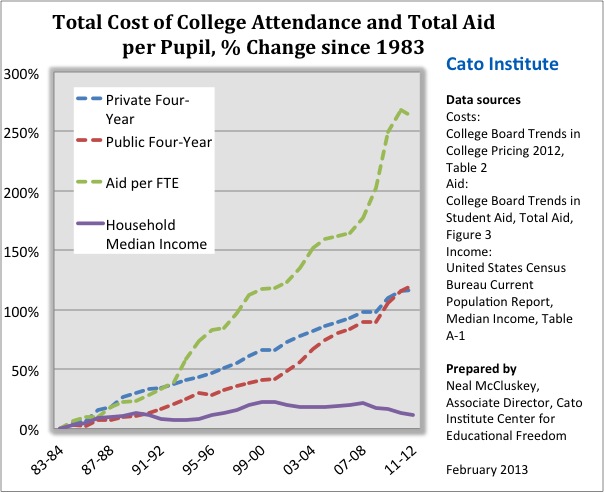
Federal aid for college students, it’s really no secret, is driven by what works politically, not what’s best for students. While logic and evidence strongly suggest that aid mainly enables colleges to raise their prices at breakneck speeds, politicians talk nonstop about aid making college “affordable.” Financial reality simply does not trump appearing to “care.” But on Friday, the Obama administration appears poised to take aid exploitation to a new level.I've written before about the unintended consequences of easy-to-obtain student loans, but here it's been quantified. Note how the costs of universities (both public and private) rises steadily as the amount of aid to students increases. Numerous pieces of evidence (follow the links) provide a compelling case that the easy loans directly increase those education costs. The main driver is simple marketplace economics: the universities compete with each other to attract students, who are, of course, the source of revenue for them. The main way they attract students is to add amenities - and those cost money. To pay for the amenities, they raise prices. This is all basic capitalism, but the government has their thumb on the scale - by providing all that easy money, they've grossly distorted the “buying decision”. Students and their parents don't have to make tough, financial-based decisions about where to go to school, as almost everyone can borrow enough money to go almost anywhere, if they can get accepted...
Saturday, May 18, 2013
College Tuition Increases...
This article rants and raves about the cost of college tuition, which for the past 20 years or so has been rising much faster than inflation. The author explores several possible reasons for the increase, but none of them are satisfyingly simple and obvious.
There is such a reason, however: the fast ramp of college tuition almost exactly correlates with the easing of student loan availability. Way back in the Cretaceous era when I was examining the possibility of going to college, there's no way that I could have gotten a student loan. These days, thanks to numerous Federal and State programs, if you can fog a mirror and get admitted to any college, you can easily get a loan to pay not only your tuition, but your books and living expenses as well.
So why would that make college tuition increase? Because the marketplace for college has been distorted by the government subsidies and guarantees in the student loan market – a student selecting a college no longer needs to worry so much about what it costs. Because the loans are so easy to get, the only pricing pressure comes from a students deferred need to pay off the loan. This greatly reduces the pressure on colleges and universities to keep their prices low, as the “buyers” not longer care so much about the price. Instead, they are now motivated to spend more money to compete for student loans (the fact that a student comes along with the loan is just a cost of doing business for them, and a relatively minor one).
This is yet another example of the government's intervention causing a huge distortion in the market. Like the housing bubble, the taxpayers are going to be on the hook again – because a large fraction of all the trillions in student loans are guaranteed by some Federal program or another. Of course “Federal guarantee” is just the polite way of saying “They're going to stick their hands in my pocket to steal the money”...
There is such a reason, however: the fast ramp of college tuition almost exactly correlates with the easing of student loan availability. Way back in the Cretaceous era when I was examining the possibility of going to college, there's no way that I could have gotten a student loan. These days, thanks to numerous Federal and State programs, if you can fog a mirror and get admitted to any college, you can easily get a loan to pay not only your tuition, but your books and living expenses as well.
So why would that make college tuition increase? Because the marketplace for college has been distorted by the government subsidies and guarantees in the student loan market – a student selecting a college no longer needs to worry so much about what it costs. Because the loans are so easy to get, the only pricing pressure comes from a students deferred need to pay off the loan. This greatly reduces the pressure on colleges and universities to keep their prices low, as the “buyers” not longer care so much about the price. Instead, they are now motivated to spend more money to compete for student loans (the fact that a student comes along with the loan is just a cost of doing business for them, and a relatively minor one).
This is yet another example of the government's intervention causing a huge distortion in the market. Like the housing bubble, the taxpayers are going to be on the hook again – because a large fraction of all the trillions in student loans are guaranteed by some Federal program or another. Of course “Federal guarantee” is just the polite way of saying “They're going to stick their hands in my pocket to steal the money”...
Monday, March 25, 2013
Mandatory School Subject: Chess...
The little country of Armenia has made the study of chess a required subject in its public schools. There seem to be two objectives: grooming chess masters (to make Armenia a chess powerhouse), and training young minds to think.
Where and when I grew up (New Jersey, in the '50s and '60s), chess was popular. We had no actual chess classes, but we did have a chess club that offered instruction, and it was easy to get matches at any level. I was a semi-serious player in junior high school, active in the schools chess club; less so before and after that. I do believe that having an enjoyable pastime that required intellectual discipline and active thought was helpful in developing my mind. I can't say it was all chess, though, as I had several such pastimes. More important to me at the time was my interest in designing electronic systems. Later – specifically, while teaching myself how to program in the '70s – I remember noting that the process of designing and writing programs “felt” a lot like the process of seriously playing chess. There's the body of practical experience to learn from, elements of strategy and tactics in the design, and even the notion of sequential execution (that is, the way chess moves occur in a specific order is analogous to the way computers execute instructions one after the other). On occasion, I've even thought of programming as involving an active opponent :)
I can't help but wonder what the results of this experiment will be...
Where and when I grew up (New Jersey, in the '50s and '60s), chess was popular. We had no actual chess classes, but we did have a chess club that offered instruction, and it was easy to get matches at any level. I was a semi-serious player in junior high school, active in the schools chess club; less so before and after that. I do believe that having an enjoyable pastime that required intellectual discipline and active thought was helpful in developing my mind. I can't say it was all chess, though, as I had several such pastimes. More important to me at the time was my interest in designing electronic systems. Later – specifically, while teaching myself how to program in the '70s – I remember noting that the process of designing and writing programs “felt” a lot like the process of seriously playing chess. There's the body of practical experience to learn from, elements of strategy and tactics in the design, and even the notion of sequential execution (that is, the way chess moves occur in a specific order is analogous to the way computers execute instructions one after the other). On occasion, I've even thought of programming as involving an active opponent :)
I can't help but wonder what the results of this experiment will be...
Thursday, March 21, 2013
Accomplishment is So 1900s!
Way back in the Paleozoic era, when I was going to grade school, the kids who actually accomplished something – whether in academic studies, shop course, or athletics – were recognized in little ceremonies held in the school auditorium. Those students were lauded for their accomplishments, and quite overtly held up to the less-accomplished others as examples to emulate. The celebrations were sincere, and the accomplishments real.
That was then.
These days, grade schools seem to be going out of their way to devalue actual accomplishment. I see two approaches, sometimes taken at the same time.
One approach is to celebrate everyone, whether accomplished or not. One common manifestation of that around here are the bumper stickers parents proudly put on their car, proclaiming “My child was student of the month at XXX” (where XXX is some school). If you drive around any community here, you'll see the same bumper sticker on lots of cars – far more cars than there are months in the year. I'm not sure how they hand these bumper stickers out, but it sure as hell isn't one per school per month!
Then there's the opposite approach, in the news today: just stop celebrating accomplishment altogether. We wouldn't want the poor, under-achieving little darlings to feel bad about under-achieving, would we? It might not be their fault, after all.
What absolute crap.
We're teaching our kids that you don't need to actually accomplish anything in order to succeed. This isn't exactly preparing them for any corner of the real world that I've seen (except maybe the Post Office or the DMV). The real world that I know demands actual accomplishment and performance. Businesses are reluctant to fork over wages and benefits for people that don't actually get things done.
I hear the pealing of the bell of doom...
That was then.
These days, grade schools seem to be going out of their way to devalue actual accomplishment. I see two approaches, sometimes taken at the same time.
One approach is to celebrate everyone, whether accomplished or not. One common manifestation of that around here are the bumper stickers parents proudly put on their car, proclaiming “My child was student of the month at XXX” (where XXX is some school). If you drive around any community here, you'll see the same bumper sticker on lots of cars – far more cars than there are months in the year. I'm not sure how they hand these bumper stickers out, but it sure as hell isn't one per school per month!
Then there's the opposite approach, in the news today: just stop celebrating accomplishment altogether. We wouldn't want the poor, under-achieving little darlings to feel bad about under-achieving, would we? It might not be their fault, after all.
What absolute crap.
We're teaching our kids that you don't need to actually accomplish anything in order to succeed. This isn't exactly preparing them for any corner of the real world that I've seen (except maybe the Post Office or the DMV). The real world that I know demands actual accomplishment and performance. Businesses are reluctant to fork over wages and benefits for people that don't actually get things done.
I hear the pealing of the bell of doom...
Sunday, March 17, 2013
Kids Are Learning to Program, Starting in Second Grade!
In Vietnam.
Any American who has looked at the educational systems in other countries is quite likely to be shocked by their evident superiority in preparing their students to work in the real world. I've had this experience personally when looking at the educational systems in the former Soviet Union (in particular, in Estonia and St. Petersburg).
Education isn't the only prerequisite to innovation, and America still has a leg up on some of the other requirements (in particular, access to capital). But all of the factors that once gave America an unbeatable edge are rapidly eroding here – and rapidly growing elsewhere. I can't help but come to the conclusion that in the not-too-distant future (say, 10 or 20 years), many other parts of the world will out-innovate the United States. It's hard to imagine how we could turn that around, especially with the ascendancy of “Progressive” politics in the past 20 years or so.
It's very sad for us, but very hopeful for the Vietnams of the world...
Any American who has looked at the educational systems in other countries is quite likely to be shocked by their evident superiority in preparing their students to work in the real world. I've had this experience personally when looking at the educational systems in the former Soviet Union (in particular, in Estonia and St. Petersburg).
Education isn't the only prerequisite to innovation, and America still has a leg up on some of the other requirements (in particular, access to capital). But all of the factors that once gave America an unbeatable edge are rapidly eroding here – and rapidly growing elsewhere. I can't help but come to the conclusion that in the not-too-distant future (say, 10 or 20 years), many other parts of the world will out-innovate the United States. It's hard to imagine how we could turn that around, especially with the ascendancy of “Progressive” politics in the past 20 years or so.
It's very sad for us, but very hopeful for the Vietnams of the world...
Thursday, March 14, 2013
Education...
If you're a regular reader of this blog, you've heard me railing about the poor quality of our public education system. If this topic is of interest to you, you need to read Sarah Hoyt's story. Just go read it...
Friday, February 8, 2013
Another Step Backwards...
Every year we need fewer farmers and more engineers. This is a natural consequence of the world's economy evolving toward mechanization and automation. The jobs available in the evolving economy are more intellectual, less manual. So naturally, our schools need to better prepare students for this new world, by equipping them with the skills to get jobs in it. Right?
Wrong. California has decided that math needs less emphasis.
Doom...
Wrong. California has decided that math needs less emphasis.
Doom...
Sunday, January 27, 2013
Unbundling Education and Certification...
American universities and colleges provide (allegedly) two distinct services that have always been bundled together: they educate, and they certify (via the degree) that the education has actually been accomplished. The convention has always been that if you want that certification (the degree), then you must attend class (the education) – even if you've already obtained that education through some other means (for instance, by education yourself).
The University of Wisconsin is about to change that. They're going to provide the certification (that degree) to anyone who can pass their tests for it. In other words, they are going to unbundle the certification and the education.
This has the potential both for good and bad, like most things. One possible good outcome: the emergence of specialized degrees, especially those aimed at certifying an individual's readiness for gainful employment. This will be enabled by the relatively low cost of a certification program as compared to an entire curriculum. Employment-focused degrees would be worth a lot to American industry if they're well done. One possible bad outcome: the emergence of schlock degrees, wherein the only real requirement is forking over some money. Just as for the schlock schools and correspondence courses that exist today, the education industry will have to develop defenses against these. Probably the main defense will be the same one as today: the reputation of the issuing school.
The University of Wisconsin is about to change that. They're going to provide the certification (that degree) to anyone who can pass their tests for it. In other words, they are going to unbundle the certification and the education.
This has the potential both for good and bad, like most things. One possible good outcome: the emergence of specialized degrees, especially those aimed at certifying an individual's readiness for gainful employment. This will be enabled by the relatively low cost of a certification program as compared to an entire curriculum. Employment-focused degrees would be worth a lot to American industry if they're well done. One possible bad outcome: the emergence of schlock degrees, wherein the only real requirement is forking over some money. Just as for the schlock schools and correspondence courses that exist today, the education industry will have to develop defenses against these. Probably the main defense will be the same one as today: the reputation of the issuing school.
Zappa on Education...
Frank Zappa was an interesting man, far beyond his music, which is how I first came to know about him. I still listen to his music frequently. I think there's a lot of truth in this:
Saturday, January 19, 2013
The Graduation Myth...
Robert Weissberg on our education system:
America lives in a fantasy world regarding education. We think that more years of schooling makes for more knowledgeable workers, when the truth is that we are promoting bad habits that are hard to reverse. Many business managers deal with that truth by hiring more motivated immigrants with solid work habits, giving their good employees more hours, or automating tasks.Read the whole thing...
As far as improving American education by turning out ever more graduates, the venerable Professor Pogo nailed it: we have met the enemy and he is us.
Saturday, November 3, 2012
“Go To” Statement Considered Harmful...
I've been programming computers for over 40 years now, in more languages than I can remember accurately. Those languages include dozens of machine languages, close-to-machine languages (C, especially) and dozens more high level languages. A few years before I started programming, the pioneering computer scientist Edsger Dijkstra published his famous monograph Go To Statement Considered Harmful – and, silly me, I thought that every living programmer was very familiar with it. It was the seminal work that led to the notion of “structured programming”, which in turn quickly advanced into a rich and diverse set of programming language design ideas that is still evolving today. Mr. Dijkstra started it all with that paper.
Last week, I discovered that several of my colleagues – all much younger than I – had never even heard of Dijkstra's monograph. Worse, they'd never heard of the notion that “go to” statements were harmful. They knew they shouldn't use them, but really didn't have any idea of why. It was just something they'd been told. I sent them a link to the paper, which is reproduced online.
For some reason that I can't quite identify, I found this just as shocking as the day a few years back when I discovered that many quite effective young programmers had no idea how computers actually worked. I'm sure it has something to do with the fact that both of these things are central to my practice of the programming art. That makes it difficult for me to understand how anyone could effectively practice programming without the same understanding – but the evidence is agin me...
Last week, I discovered that several of my colleagues – all much younger than I – had never even heard of Dijkstra's monograph. Worse, they'd never heard of the notion that “go to” statements were harmful. They knew they shouldn't use them, but really didn't have any idea of why. It was just something they'd been told. I sent them a link to the paper, which is reproduced online.
For some reason that I can't quite identify, I found this just as shocking as the day a few years back when I discovered that many quite effective young programmers had no idea how computers actually worked. I'm sure it has something to do with the fact that both of these things are central to my practice of the programming art. That makes it difficult for me to understand how anyone could effectively practice programming without the same understanding – but the evidence is agin me...
Friday, October 19, 2012
Why America Is In Trouble...
The Internet makes information available to everyone, free of charge. Sometimes it does much more, as (for instance) with the free educational material that's popping up all over the place. What a wonderful opportunity people have today – with just a few clicks, they can sign up for (say) a course on calculus, or physics, or electronics. How could anyone be against this? What a fine thing!
Whoops.
Minnesota has decided that this is most definitely not okay. They've ordered Coursera (a free educational site) to stop delivering their content to Minnesota residents.
Doomed. We're doomed. Estonia is going to win...
Whoops.
Minnesota has decided that this is most definitely not okay. They've ordered Coursera (a free educational site) to stop delivering their content to Minnesota residents.
Doomed. We're doomed. Estonia is going to win...
Tuesday, October 2, 2012
Monday, October 1, 2012
Squandering Public Education Money...

Unless you're a teacher's union member, of course. Or a politician benefiting from the union donations.
Every once in a while, you really need a revolution to clear out the rot. Public education in the U.S. is long, long overdue for a such revolution. Anyone up for a little “Education Spring”?
Wednesday, August 22, 2012
Top TED...
The top 20 most-watched TED talks. I've only seen five of them. I'm very curious to see what other people find interesting...
Sunday, July 29, 2012
The New York Times Offers a Solution...
Long time readers know that periodically I rail on about the sorry state of math and science education in the U.S. One of my oft-expressed worries is the rather evident superiority of the schooling of so many kids from other countries. I have personal experience in this regard with the kids from Estonian and Russian school systems.
Now the New York Times (in the person of Andrew Hacker, an emeritus professor of Political Science at Queen's College, and frequently quoted by the same crowd that quotes Noam Chomsky – in other words, he's a far-left “Progressive”) offers us a simple solution: get rid of algebra. In other words, if a subject is “too hard” for American students, the answer is to get rid of the subject. To quote the good professor:
It's illuminating to see the liberal mind at work. Depressing, but illuminating...
Now the New York Times (in the person of Andrew Hacker, an emeritus professor of Political Science at Queen's College, and frequently quoted by the same crowd that quotes Noam Chomsky – in other words, he's a far-left “Progressive”) offers us a simple solution: get rid of algebra. In other words, if a subject is “too hard” for American students, the answer is to get rid of the subject. To quote the good professor:
Instead of investing so much of our academic energy in a subject that blocks further attainment for much of our population, I propose that we start thinking about alternatives. Thus mathematics teachers at every level could create exciting courses in what I call “citizen statistics.” This would not be a backdoor version of algebra, as in the Advanced Placement syllabus. Nor would it focus on equations used by scholars when they write for one another. Instead, it would familiarize students with the kinds of numbers that describe and delineate our personal and public lives.So instead of teaching them one of the most basic mathematics skills, we should instead teach them how to add, subtract, multiply, and divide (the only arithmetic necessary to understand the CPI).
It could, for example, teach students how the Consumer Price Index is computed, what is included and how each item in the index is weighted — and include discussion about which items should be included and what weights they should be given.
It's illuminating to see the liberal mind at work. Depressing, but illuminating...
Sunday, June 10, 2012
You Are Not Special...
What a refreshing message for high school graduates! Over the past twenty years or so, I've run into so many young Americans who really could have used this message. Really what they needed was to have been raised and educated in a manner consistent with this message – as so many young people outside America are.
Several readers sent me links to transcripts of this speech, but I was holding out for the video. In this day and age, one can be pretty much certain that something like this would be videotaped. Turns out I had four separate videos to choose from :-)
Several readers sent me links to transcripts of this speech, but I was holding out for the video. In this day and age, one can be pretty much certain that something like this would be videotaped. Turns out I had four separate videos to choose from :-)
Saturday, June 2, 2012
Grade Inflation...

What is grade inflation? Just look at the red line (percentage of students receiving an “A” grade) on the graph at right. That's grade inflation. Today nearly half of all grades given in colleges are an “A”.
This doesn't help the student at all. People evaluating students on the basis of their grades will know, like I do, about grade inflation. The same kind of grade inflation is occurring with GPA scores, too. Grade inflation makes grades (whether letter grades or GPAs) useless as a way to assess a graduate's achievement. This is precisely the same effect that affirmative action have.
So who is helped by grade inflation? Short answer: the institutions of higher education.
Here are three articles (one, two, three) discussing both the facts and the impacts of grade inflation.
Every time something makes me think about American higher education, I'm overcome with a feeling of impending doom. Damn. I need a drink...
Subscribe to:
Posts (Atom)