Thursday, October 27, 2005

Skywalk

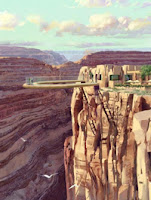
When I first saw an email describing the Grand Canyon Skywalk, I suspected a hoax — a good artist could create this, even if there were no plans to build it. But this is for real, researched by Snopes and found to be true. You can read more about it on the Hualapai Nation’s web site. From their description:

The Glass Bridge Construction of the Skywalk began March of 2004 and is estimated to be completed by early 2006.

Upon completion, the Glass Bridge will be suspended 4,000 feet above the Colorado River on the very edge of the Grand Canyon. On May 2005, the final test was conducted and the stucture passed engineering requirements by 400 percent, enabling it to withstand the weight of 71 fully loaded Boeing 747 airplanes (more that 71 million pounds). The bridge will be able to sustain winds in excess of 100 miles per hour from 8 different directions, as well as an 8.0 magnitude earthquake within 50 miles. More than one million pounds of steel will go into the construction of the Grand Canyon Skywalk.

I would love to walk on that thing!

Click on the photo for a larger view…

Dewy Webs

Wandering up the hill on our morning walk, we saw lots and lots of these non-orb spider’s webs in the chaparral shrubs. We had a heavy dew last night, so the webs were chock-a-block full of dew drops. If you caught them at just the right angle with respect to the sun, you got a brilliant rainbow effect — quite spectacular!

But I have to wonder what the poor little cold-blooded spiders think of all this dew. Do they like waking up with their “house” flooded? Is it a good thing or a bad thing to a spider. I have nary a clue…

Click on the photo for a larger view.

Needles

As we left for our walk this morning, sun just rising, I caught these dew drops hanging from the needles of the Italian Stone Pines that line our driveway.

Click on the photo for a larger view…

Dilbert Blog

Scott Adams (the creator of Dilbert, every nerd’s favorite cartoon) has started a blog. Naturally it’s called the “Dilbert Blog”.

His latest post is a ponder on how one would go about being a good looter (one hopes this is with tongue firmly in cheek). He describes his plan and then says:

There’s a good chance I’d be killed by the hurricane before I did any quality looting, but that’s a risk I’m willing to take for free pants that aren’t my size.

Are you laughing? If not, you’re just not a Dilbert kind of person. My personal research tells me that there is a strict dichotomy when it comes to appreciating Scott Adams' humor.

Me? I was ROFL (rolling on the floor, laughing)!

The 2000 Party

If you truly believed that the deaths of 2000 American soldiers in Iraq was unjustified, and you decided to demonstrate to promote your belief — would you also think it was appropriate to have a party atmosphere at that demonstration?

I would not. As it happens, I support our actions in Iraq and I believe that the high cost (in every sense) of the war in Iraq is worth it: for the protection of the rest of us, and for the betterment of mankind. But I respect those with opposing opinions on this matter, if those opinions were arrived at by some means other than Michael Moore, Barbara Streisand, George Soros, and other such sources of anti-enlightenment. And I would even think a demonstration — somber, sober, respectful — at a milestone, however arbitrary, such as the 2000th death in Iraq, was appropriate for people with such views.

But a party? A celebration? That’s just awful!

You can see zombie’s page here (with more photos if you can stand them).

Tip of the hat to Little Green Footballs

Iranic Quandary

What do you do with a country that openly proclaims that another country should be “wiped off the map"? The man at right is Iranian President Mahmud Ahmadinejad (click for a slightly larger view). He is a radical Moslem zealot, widely believed to be one of the principals in the taking of American hostages in Jimmy Carter’s presidency. Here’s what he actually said yesterday:

From the Asia Times:

"Once, his eminency Imam [Ruhollah] Khomeini - leader of the 1979 Islamic revolution], stated that the illegal regime of the Pahlavis must go, and it happened. Then he said the Soviet empire would disappear, and it happened. He also said that this evil man Saddam [Hussein] must be punished, and we see that he is under trial in his country. His eminency also said that the occupation regime of Qods [Jerusalem, or Israel] must be wiped off from the map of the world, and with the help of the Almighty, we shall soon experience a world without America and Zionism, notwithstanding those who doubt."

Remember, this is the President of Iran. There are others within Iran with power and influence are aren’t quite so overtly and publicly radical, but there’s every reason to believe that President Ahmadinejad accurately represents the true beliefs and world views of the other Iranian leaders — most especially because without their support he couldn’t possibly occupy the position he now does.

From Strategy Page:

President Mahmoud Ahmadinejad urged Moslems everywhere to work towards the destruction of Israel. Usually, such sentiments are not uttered publicly by senior officials, but left to local journalists and junior officials. This statement caused an international uproar, which will soon pass.

So what’s the right way to respond to such a statement from the leader of a country? Condemnation, certainly, and at least from some quarters that condemnation was almost instantly forthcoming. The usual suspects were silent. But what else? My personal take is that such inflammatory rhetoric is unfortunate, and is not helping the progress of peace in the Middle East — but if the rhetoric wasn’t followed up by tangible action, then no response other than condemnation is called for.

But … from what I can read, Iran is following up the rhetoric with action, albeit covert and denied action. Iran stands accused of actively supporting and fomenting terrorism, most especially in Iraq. If we are certain that Iran is a state supporting terrorism, then I believe direct action by the U.S. is called for — to protect our own safety. Then it boils down to what actions can and should be taken, and here I’d have to know a lot more about the situation on the ground over there to be able to venture an opinion. I can only hope that our government is (a) better informed that I, and (b) is actively working on an action program to get Iran under control…

Wednesday, October 26, 2005

Hogan and Bella

What could be more endearing than seeing a helpless little fawn being cared for by a mighty hunter?

The dog in the photo at right is Ch. Bowbridge Croc (aka “Hogan"), a champion Rhodesian Ridgeback owned by Jennifer Aftanas of Vancouver, British Columbia. From the story by Valerie Wilson, published in Vancouver Island’s “Nanaimo Daily News” on August 13, 2004:

Meantime Hogan, weighing in at about 100 pounds, decided - to the amazement of his owners that he too would lend a hand in helping young Bella recover. Originally bred in South Africa to hunt lions, hence the breed’s older name African Lion Hound. Hogan began fussing over the youngster. He kept a watchful eye over Bella, grooming her and even allowing her to cuddle up beside him in his bed. “You can come on my bed and I’m going to clean your ears!” Aftanas said of Hogan’s affection for the fawn. He looked after Bella cleaning her and helping out until she was well enough to go for recovery"

Read the whole thing.

Thanks, mom. Click on the photo for a larger view.

Rabbits

Rabbits. Every day when I look at my blog’s logs to see what brings people to read my prattling, the answer is rabbits. Specifically, a search for rabbit photos on Google Image Search.

Never mind all my pontificating on weighty subjects; never mind the strange and interesting science and technology I introduce to my readers. What really matters is my rabbit photo.

Sigh.

APOD

The Cassini-Huygens spacecraft is running around the Saturnian system, a bit like a kid who’s running around the candy store sampling all the delights on offer. Recently it made a close pass by Dione, one of Saturn’s moons, where it took the picture at right. Astronomy Picture of the Day selected it for today’s picture:

What does the surface of Saturn’s moon Dione look like? To find out, the robot Cassini spacecraft currently orbiting Saturn flew right past the fourth largest moon of the giant planet earlier this month. Pictured above is an image taken about 4,500 kilometers above Dione’s icy surface, spanning about 23 kilometers. Fractures, grooves, and craters in Dione’s ice and rock are visible. In many cases, surface features are caused by unknown processes and can only be described. Many of the craters have bright walls but dark floors, indicating that fresher ice is brighter. Nearly parallel grooves run from the upper right to the lower left. Fractures sometimes across the bottom of craters, indicating a relatively recent formation. The lip of a 60-kilometer wide crater runs from the middle left to the upper center of the image, while the crater’s center is visible on the lower right. Images like this will continue to be studied to better understand Dione as well as Saturn’s complex system of rings and moons.

Click on the photo for a larger view…

Tuesday, October 25, 2005

Big Art

I just ran across an artist whose work is new to me: Eric Grohe. He specializes in large-scale murals, such as the one shown a far right (click for a larger view). This mural now covers the plain brick wall shown in the left-hand photo. Amazing, isn’t it?

From the Eric Grohe website:

Eric Grohe Murals Working in cooperation with architects, designers, art commissions and community representatives, Eric Grohe creates mural art that transforms the environment and communities as well. He believes that his art should involve, challenge and inspire the viewer; not simply adorn, but integrate with its architectural surroundings.

The large public mural projects are painted on site and typically take several months, giving the local community a unique opportunity to witness the day-to-day creation of a work of art.

Mr. Grohe continues to refine the technologies, methods and equipment that ensure the permanence and cost effectiveness of his work. For large-scale exterior projects, he prefers to use Keim Mineral Paint from Germany. Murals painted in the 19th century with Keim have retained their original appearance to this day. The paint crystallizes into mineral substrates and will not fade, peel or blister. Mr. Grohe is one of just a few muralists in the country skilled in the use of this unique and superior paint.

Grohe murals are designed to endure, for the enjoyment of generations to come.

There are many more photos up on Eric Grohe’s site — worth a visit…

Quote of the Day

From the Mudville Gazette:

"because as I look around at the state of this nation and see all of the weak little pampered candy-asses that are whining about this or protesting that, I’d be afraid to leave the fate of this nation entirely up to them."

First Lieutenant Bruce Bishop, on the reason why he’s going to stay in the National Guard.

Bruce, from us out here in the hustings: you da man!

Fatally Wounded

ScrappleFace nails it again:

"The Bush foreign policy continues to be fatally-wounded by clarity of purpose, dogged persistence and a pathetic failure to capitulate in the face of opposition. At a time when a real leader would be paralyzed with self-doubt over the meaningless deaths of 2,000 American troops, Bush continues to act as if freeing 25 million Iraqis from decades of oppression, torture and death is somehow worth the price paid by those who volunteered to fight."

Read the whole thing right now!

Mountweazels

Suppose you publish a valuable reference work — one that required a large investment to create, and therefore is worth protecting? For example, if you publish an encyclopedia or a dictionary, you don’t want other publishers to simply copy your hard work.

I would have guessed that there really wasn’t a big problem here, as it would seem obvious on inspection that a work had been copied. But apparently this is not the case. In fact, the publishers resort to inserting fake articles in encyclopedias, and fake words in dictionaries, precisely so that they can prove in court that a work was copied and not independently created.

The New Yorker has an interesting piece on this phenomenon, talking about the search for the fake words in the New Oxford American Dictionary. There’s quite a debate going on in the world of lexicographical authorities.

Oh, and Mountweazels — here’s the explanation for that:

Turn to page 1,850 of the 1975 edition of the New Columbia Encyclopedia and you’ll find an entry for Lillian Virginia Mountweazel, a fountain designer turned photographer who was celebrated for a collection of photographs of rural American mailboxes titled “Flags Up!” Mountweazel, the encyclopedia indicates, was born in Bangs, Ohio, in 1942, only to die “at 31 in an explosion while on assignment for Combustibles magazine.”

If Mountweazel is not a household name, even in fountain-designing or mailbox-photography circles, that is because she never existed. “It was an old tradition in encyclopedias to put in a fake entry to protect your copyright,” Richard Steins, who was one of the volume’s editors, said the other day. “If someone copied Lillian, then we’d know they’d stolen from us.”

Miers

I am neutral on the Miers nomination.

The statement above will register my stand on the Truth Laid Bear’s survey.

I’ve been staying well away from this blogobattle, as I’m not particularly well-armed. Of course I want to get the best possible replacement for O’Connor — but we could argue all day about what “best” means, and I have no independent way to judge Miers. On the one hand, I’m inclined to trust President Bush’s judgment on judges (he’s done very well there, so far as I can tell); on the other hand, many pundits and bloggers whose opinions I have great respect for are passionately opposed. So I’m stuck in the middle on Miers, and there I think I’ll stay…

Rosa Parks, RIP

Rosa Parks — that name instantly conjures intense feelings and images for me. Her famous, courageous act of defiance in 1955 was followed by many years of dignified activism. She was an altogether admirable person.

I was only three years old in 1955, so of course I do not remember the actual event that made her a household name. And we did not discuss civil rights in the home where I grew up; at least, not that I can remember. My first recollection of Rosa Parks is from elementary school, where my fourth grade teacher (Mrs. Fitzpatrick) told her story in an attempt to get the all-white class to understand a little bit about racial discrimination and segregation. Mainly what I got from her story was this: Mrs. Fitzpatrick clearly thought Rosa Parks was a saint walking upon the earth.

A few years later, in high school and beyond, I started reading a lot of history; a habit and a hobby which continues to this day. My first readings of history were of two events that I had much curiousity about: the American civil rights movement, and World War II. Rosa’s place in the civil rights movement is well-documented in zillions of places; I won’t repeat it here. But for me (and many others) she was a kind of icon of the civil rights movement: both an inspiration and a continuing force. And her abiding, overriding dignity struck me profoundly, especially by contrast with some of the more flamboyant or radical black leaders. A world full of people like Rosa would be a world full of peace, love, and tolerance. Her life helped change our world in very positive ways; she will be missed and mourned…

Wikipedia has a good article on Rosa Parks.

The blogosphere takes note:

Michelle Malkin has a roundup.

TigerHawk connects two daughters of Alabama.

Althouse has a commenter who says:

Notwithstanding the efforts of M L King and other purported black leaders, Rosa Parks’ simple act of civil disobedience (refusing to give up her bus seat for a white man) was the tipping point in the advancement of civil rights in America. She should inspire us all to appreciate how personal courage can lead to extraordinary public legacies.

God bless you Ms Parks!

La Shawn Barber has a roundup and commentary.

Parks and her husband Raymond didn’t have children, as far as I can tell from news accounts of her life. In a way, I suppose those she inspired to stand up to injustice were her offspring. Once people understand the power they have in a free country, the moral authority to demand justice, watch out. I once heard this line from a movie: “Change the way people think, and things will never be the same.”

Whatever her reasons that fateful day, I glad she decided to stay in her seat.

Kate at Small Dead Animals says “They don’t make civil rights leaders like they used to.

Outside the Beltway has a brief history, and says:

The civil rights leaders of today pale in comparison to Parks and her compatriots. I was born a decade after Parks' act of defiance and went to school, mostly in the South, in schools that had recently desegregated. By that time, the culture had changed sufficiently that the idea of segregated institutions was inconceivable.

Rest in peace.

Rest in peace, Rosa Parks…

Running on Metal

The two big problems with hydrogen power for cars are these:

1. Where does the hydrogen come from?

2. How do you store hydrogen in the car?

A group of Israelis at a company called Engineuity believe they have the answer.

From IsraCast:

The Hydrogen car Engineuity is working on will use metals such as Magnesium or Aluminum which will come in the form of a long coil. The gas tank in conventional vehicles will be replaced by a device called a Metal-Steam combustor that will separate Hydrogen out of heated water. The basic idea behind the technology is relatively simple: the tip of the metal coil is inserted into the Metal-Steam combustor together with water where it will be heated to very high temperatures. The metal atoms will bond to the Oxygen from the water, creating metal oxide. As a result, the Hydrogen molecules are free, and will be sent into the engine alongside the steam.

Now this is very clever, solving both of the core problems with one not-so-exotic technique. In this solution, the hydrogen comes from water — no problem there, we’ve got plenty of water all over the place, especially if the system can use salt water. And what could be easier or safer to store than water? One of the major problems facing most hydrogen storage ideas is “hydrogen density": how much hydrogen can you pack into a given volume?

The approach to hydrogen storage I’ve seen most often discussed is to use metal hydrides, especially magnesium. Such a system could hold about 8% of its weight in hydrogen. A practical car would need something like 40 pounds of hydrogen in a full tank. With a magnesium hydride storage system, that means you’d need 500 pounds of “fuel”. Much worse, though, is this: the magnesium hydride system is a very exotic, still unproven technology. It’s prone to contamination problems and longevity problems. And nobody is really sure what would happen in the event of an accident.

For this Israeli system, the hydrogen is about 11% of the weight of the water — so you’d need 360 pounds of water to hold 40 pounds of hydrogen. In addition, you’d need 480 pounds of magnesium, or 360 pounds of aluminum, to “soak up” all that oxygen in the water. So in total you’d need 720 to 840 pounds of “fuel” — more than the magnesium hydride system, but not exotic and very safe.

The numbers I quote above are not in the IsraCast article; I derived these from first principles using just the assumption that 40 pounds of hydrogen is roughly the same energy content as a tank of gasoline in a modern car. I’m not assuming any radical improvements in overall efficiency, or any radical changes in what drivers find desirable in a car. In other words, my starting point is to duplicate today’s car, but with hydrogen technology.

The IsraCast article paints a much more optimistic picture, without backing it up. For example, they say that to refuel the car would typically require 220 pounds of metal. Tey also claim that this should cost no more than filling your tank with gasoline — I don’t know where they buy their aluminum or magnesium, but in these parts you won’t be buying it for anything like $0.25/pound (if you believe their 220 pound claim), much less $0.10/pound (if you believe my numbers). This looks expensive to me, unless someone comes up with a way to radically reduce the cost of producing the metal.

Which brings me to one last point: while this clever Israeli technique neatly solves the core car problems, it doesn’t address another one: where does the energy come from to run all these cars? In their system, the energy input goes into refining the metal, either from ore or from reclaimed metal oxides produced by the cars. Refining metal is a very energy-intensive process, and that energy has to come from somewhere. In favor of their system is that it allows that energy consumption to be very centralized, making it possible to consider things like nuclear power or massive hydroelectric facilities. But however it’s done, it would have to be with power production that doesn’t currently exist — and to make any sense at all, it would have to be power production that didn’t use hydrocarbons. A big challenge there…

Monday, October 24, 2005

Chaparral Web

Often on our morning walks we’ll spy the classic ring-and-spoke webs of an orb-weaving spider that is common in the chaparral. In the fall, when the mornings are often moist, these webs will be covered with a very fine mist that refracts the morning light, making them highly visible with great contrast against the background. This is especially true in the very early morning light, and even more so if you can catch a web lit by the sun with the background still in the dark.

The web at right is from our walk this morning.

Misty Morning

I took the picture at right on our morning walk (Debi, and our field spaniels Mo’i and Lea). It’s common for us to be able to see fog or mist in the valleys to the west of us while on these walks. It’s a little less common, but certainly not uncommon, for the tendrils of mist and fog to waft their way to our house. And occasionally we get well and truly “socked in”.

This morning, as we left our house on our walk, the sun was out (the birds were chirping, too!). As we climbed the hill we normally walk up, and our views of the western valleys got more expansive, we saw the mist creeping our way. When we reached the top of the hill and turned around to come home, the mist crept toward us. The hill poking through the mist in the picture at right is about 200' higher than our house — which by this time was completely socked in. In the distance you can see Cajon Mountain.

As we walked back toward home, we decended right into that mist — and the next thing we knew, the world looked like the fogged-in scene at right. Kinda weird, to start out in the sunlight and come back in the fog!

The weather forecast claims that we have a 50% chance of showers tonight and tomorrow. Here’s hoping!

Rhus Ovata

This chaparral plant is very common on the north-facing valley slopes where we live. Commonly known as the “sugar sumac” (why, I have no idea!) or the “lemonade berry” (because you can make a refreshing lemonade-like drink by soaking its berries in water), Rhus ovata is a member of the sumac family and is extraordinarily well-adapted to the hot, dry climate of the chaparral.

I took the picture at right on our walk this morning. The red/pink/white structures are, I believe, the beginnings of the fruit which will form during the fall.

The drought-resistance of this plant is legendary. During our recent five years of drought, Rhus ovata was, on many hillsides, the only vibrantly green plant left. I’ve never seen one that looked sickly, even in the driest, nastiest summer. And they’re fire-resistant — we may be planting some of these!

Making Us Crazy

Early this morning I cut up a big pork loin roast into cubes and stuffed it into our slow-cooker, along with some onion, garlic, cumin, and a chipotle pepper. Ten hours later — about 5 hours from now — we will have carnitas, probably my all-time favorite Mexican food.

But in the meantime, the delicious, intoxicating aroma of cooking carnitas is wafting through our house. And it’s making us crazy. Crazier, anyway.

Somehow the dogs don’t seem to care about this smell. Isn’t that weird? With their sensitive noses, I figured the intense meatness of this smell would reduce them to quivering, whining, begging lumps of canine protoplasm. But they’re asleep, as though nothing were going on.

Go figure!

Update: Well, maybe the dogs knew something we didn’t. Despite the glorious odor while it was cooking, the resulting carnitas were less than excellent. Not even very good. In fact, they were just barely on the right side of awful. Somewhere between the slow-cookery and the final saute, something went horribly wrong…