Sunday, July 3, 2016

Paradise ponders...

Paradise ponders...  The puppies are growing like little furry weeds.  I haven't weighed them, but I think Mako (the boy, and biggest) is getting close to 30 pounds.  The two of them continue their roughhousing, but with sharper teeth and (much) more muscle behind it – whenever I get in the way, I come away with cuts and punctures :)  In the 90 second video at right, you can see them being puppies – but after they spent 10 minutes beating each other up.

Race (our adult border collie) is especially tolerant of the puppies.  There have been quite a few times when he had two puppies hanging off him (on his ears or lower jaw), and he just keeps playing.  Miki is getting a bit more tolerant of them, though he still does lots of growling and will nip at them when they're especially bad (say, when there's one hanging on each of his ears!).  Both of them are still doing great:


When I first took the dogs out this morning, it was still a half hour or so before sunrise. The high clouds overhead, though, were fully lit. This made for a pretty high-contrast scene that isn't quite faithfully captured by my camera.  Our eyes have an essentially logarithmic response to brightness, whereas the camera's image sensor is linear.  This makes it nearly impossible to photograph a scene with very high contrast and have it look like what your eye sees.  Someday someone is going to make a log response sensor, I just know it.  Photography will get ever so much easier when they do :)

The construction crew has knocked off for the long weekend.  Here's what our three construction projects look like right now:


The first photo shows the yawning pit outside our bedroom, where the sun room will go.  Notice the basement windows are fully exposed, and the old steel casements are gone.  Each of those windows will get a poured concrete casement, with an area 50% larger than they used to be (to let more light in).  Then a seven-sided foundation (7 sides of a regular dodecagon) will be poured, a conventional joist floor built, and the sun room installed on top. 

The middle photo shows the craters outside our kitchen window.  These are where the six footers for our deck will go.  These footers will be poured concrete, using the “BigFoot” forms at right.  A cardboard tube is inserted in the top of this form to make the complete footer.  We'll have larger ones at the outside (farthest from the house), as those footers will be supporting both the deck and the roof over it.  The deck will be redwood on top of treated joists, with 18" of crawl space underneath.  The area under the deck is where nearly all of the underground services enter our house (power, water, septic, cable, phone, and gas) and where services to the barn leave (water, gas, and network).  You have to be mighty careful digging in that area!

The last photo shows the area outside our front door, where we used to have a brick walkway and a large poured concrete porch.  Now there's just this giant hole :)  Here there will be a mud room, roughly 10' x 12', built on conventional footers and foundation.  It will have a porch that is semi-circular, seen from above, made from concrete faced with rock.  That porch will be fairly close to our driveway, so we'll need a much shorter walkway.  This will also be of rock.

Friday, July 1, 2016

Optical illusions...

Optical illusions...  The one at right is a real mind-bender.  But it was the second place winner in a recent contest!
Here's the first place winner, at left.

Awesome illusions, these are.  In both cases it makes absolutely no difference that I understand the mechanisms.  My brain is fooled anyway...

Kudos for above-and-beyond customer service...

Kudos for above-and-beyond customer service...  About 18 months ago, I purchased 30 sets of the garden hose quick-connect shown at right.  I converted all my hoses to use these, and I absolutely loved how easy it makes changing hoses, sprinklers, etc.  I always had trouble getting the connections watertight with standard hose connectors, plus it was extra difficult (especially to undo them!) if it was cold outside.  These things make it a snap, literally.

But there is one problem with them, and I'll call it a design flaw.  The problem is that the female half of the connector (on the right side in the photo above) has an O-ring inside it – and if you are stupid enough to turn on the water when there's no corresponding male half inserted in it, that O-ring is likely to blow right out.  Your chances of locating it in the grass is somewhere between slim and none.

So a couple weeks ago, I found the LR Nelson company's web site and wrote to their customer service department describing the problem, telling them that I had several connectors made useless by this, and asked them if they had replacement O-rings or (failing that) if they could tell me the dimensions of the O-ring.  They're readily available in just about any size under the sun, so even just knowing the dimensions would have made me happy.

I got no response by email, so I just wrote it off as another failed attempt to get customer service (a far too familiar occurrence), and I made a mental note to find another source for quick connects.  Then this afternoon I discovered a box on my doorstep, from the Fiskars company.  I think of Fiskars as a company that makes scissors and pruning tools, so when I saw the name on the label I was scratching my head trying to remember what the heck I had ordered like that.  Then I opened it up and discovered – complete replacement quick-connects for all 11 female connectors that I'd had a washer blow out on.  Instead of sending me some O-rings worth a dollar or so, or the dimensions which would cost them nothing at all, they sent me 11 new quick-connect sets worth about $80.  It turns out that Fiskars acquired Nelson in 2014, which is why the box came from them.  Well, Fiskars/Nelson has a surprised and happy customer here. 

That's definitely customer service above and beyond, and kudos to them for that!

High expectations...

High expectations...  Mom had very high expectations of her kids, both as children and continuing through their adulthood.  I suspect this is an extension of the equally high expectations she had for herself – she would berate herself often for laziness, sloth, or something she did that was less than brilliant.

When I was still living at home, mom would often say things like “That’s ok, but you can do better!”, or “That’s not good enough!  With your abilities, you should be better than that!”  Versions of this continued, for me, less and less frequently until about twenty years ago when they stopped altogether.

I've known for quite some time that my siblings and I all had very different reactions to this.  For me, these were motivational: I interpreted them as the combination of two things.  First, that my mom thought I could do darn nearly anything – and secondly, that the only thing stopping me from anything I wanted was my own laziness or self-doubt.

Through the time that I finished high school, my mom's exhortations served as a counter-balance to my uniformly awful experiences in school.  I've written about my school experiences before, but in short I was bored to the edge of madness, I was in class with people much older than me (and physically and psychologically), and my introversion kept me effectively terrorized the entire time I was in school except when I was hiding in the library or in science or math class (where I actually felt competent).  If it weren't for mom's hectoring, I think it's likely I would have given up on school altogether.

After I finished high school, mom didn't let up at all.  I was accepted to a university that my parents could ill afford.  They had to borrow against the farm to raise the money; back then someone like me could never have qualified for a student loan.  I went for one semester – only to discover that the environment there was even worse for me than high school had been.  My maturity level and mental state at that point was such that I'd be certain to fail at university.  I couldn't keep spending my parent's money for a school that I wasn't ready for, so I dropped out and came back home.  I had a series of odd jobs for a while, then joined the U.S. Navy to avoid being drafted (I had number 17 in the draft lottery, which meant I'd be going to Vietnam for certain).  During this period, mom was particularly hard on me.  The odd jobs – all admittedly awful, menial jobs far beneath my abilities – she was pushing me hard to find a way to learn skills that would challenge me.

For instance, I once had a job assembling the electronic coffee pots used on passenger airplanes.  This was all mechanical assembly; the circuit boards were all built somewhere else.  Most days when I came home from that job, mom would hector me – wanting to know if I'd spoken with the firm's one electrical engineer to see if I could get an internship or anything that would help build my skills.  If I said “no”, she was all over me in a very unpleasant way.  To my complete amazement, when I finally did work up the courage to speak to the engineer (a god-like creature in my view), he readily agreed to take me on as an intern for a couple hours after each work day.  That internship was a formative experience – but I never would have done that if it weren't for mom humiliating me for not doing it :)

So for me, mom's high expectations and all the badgering when I didn't measure up were most definitely motivational.  I was about 16 or 17 when I finally realized that there was some validity to her expectations – and her exhortations started to actually be motivating in a positive way.  This was especially true the first two years or so that I was in the U.S. Navy.  Though I was stationed in California, over 2,000 miles from her in New Jersey, with letters and phone calls she continued pushing me to learn more, do more, be more.  In that period I started studying, hard, on my own.  Much of the time I was studying things of particular interest to me: history, religion, math, science, electronics, and programming.  Sometimes, though, I was studying things she urged me to – especially writing, but also evolution (and I never did find out why she pushed me on that particular subject).

For some of my siblings, I've discovered, mom's high expectations were less effective as motivation.  Instead they more like impossible ideals that were frustrating in their unreachability.  I'm the oldest child, and my siblings are certain I was treated much differently because of that.  I'm less certain of that; in fact, in some ways I think the expectations (especially from my dad) were higher because of that.  It doesn't really matter, though.  We each live in our own version of reality, and we'll never really understand anyone else's.  For myself, though, I am thankful for my mom's high expectations of me...

Paradise ponders...

Paradise ponders...  Jim Johnson and his crew were here early this morning, loading up the first (and heaviest) of the two big chunks of our former front porch.  He guesses that this chunk weighs in at two to three tons.  It took several attempts to figure out how to get it onto his dump trailer.  First they tried lifting it with the backhoe, but it couldn't raise the block entirely off the ground.  Then they turned the tractor around to use the bucket, which just barely lifted the block off the ground.  Another 100 pounds and I'd bet they couldn't have done it.  The photos below show the whole process.  That chunk was so heavy that we were worried about the chains breaking; luckily they didn't.


Today the construction crew is hoping to get the concrete forms in place for the sun room foundation and new casements.  Those forms are going to be a bit tricky, as the sun room isn't a nice rectangle – instead it has seven sides all at 30° angles from each other.  I'm curious to see how they do that!

My office is a lovely, cool, 70°F right now, even though it's already warming up outside.  I can't hear the air conditioner working at all.  I love my new air conditioner!


Thursday, June 30, 2016

Paradise ponders...

Paradise ponders...  I'm writing this in my office, which is at a lovely 70°F, while right outside my office door it's 107°F.  This is because Ryan Osborne and his crew from Leading Edge came out today and installed my new split-system air conditioner.  It's a Pioneer model I chose for the combination of good reviews and quiet operation.  It works great, easily cooling my office to the desired temperature.  The photo at right shows the inside part of the split system; the other part is about twice this size and is hanging on the outside wall, out of sight.  I can scarcely believe how quiet it is, too – the inside unit is just barely audible if everything else in my office is silent, and the outside unit I can't hear at all.  Woo hoo!

Meanwhile, Jim Johnson and the crew from Cache Homes were busy doing the demolition work that is the first phase of our current construction project.  At right you can see one of them at work with a jackhammer, trying to reduce our former front porch to manageable chunks.  We all got surprised by what a solid job was done on that porch – about 5 yards of concrete poured as a single giant piece.  Someone wasn't scrimping on concrete :)

A little later, excavation work started for the foundation of our sun room.  Late yesterday afternoon, this same area started flooding with water after the loader drover over it.  We figured out that there was a 2" PVC line feeding an old (and defunct) irrigation system.  The loader's weight split the line.  Jim dug it out in an area beyond any excavation he was planning, and early this morning I capped it off.  This afternoon, the excavation began in earnest, as you can see at left.  The first bit of work is to clear around the basement casements, because the old steel casements are being replaced with larger concrete boxes.  One of these will be used to let our cats move between the sun room and their current home in our basement.


The Flag...

The Flag...  A few years ago, mom undertook one of her last big crafts projects: making a Revolutionary War flag from an old section of picket fence.  That flag is now installed on our shed, as you can see at right (click to embiggen).

At left is a reproduction of an authentic Revolutionary War flag.  You can see that she did a good job of duplicating it!

When I received the flag, it was in perfect condition.  My sister Holly and her husband Warren packed it into the POD full of my mom's stuff they shipped out here.  There were two eye hooks screwed into the back, near the top of it.  I'm guessing it was hung like a picture, on a wire from a single nail or screw.  I didn't dare do something as simple as that, as we frequently get fairly strong winds.  So I screwed two more eye hooks into the bottom, and then put four “L” hooks into the side of the shed, so that each would engage an eye hook.  That took some careful measuring!  It all worked on the first try, though – I just sat the flag's eye hooks down onto the “L” hooks, and now it's not going anywhere.

I'll remember mom every time I walk out to my shed now...

Wednesday, June 29, 2016

Kindnesses and gifts...

Kindnesses and gifts...  My brother Scott tells this story:
One of the most unusual, in fact probably extremely rare styles of giving that Mom had was her special and surprising way of being very generous with her heart to complete strangers.

Extremely early in the morning or when the timing was right she would go all out creating a half dozen or more of these huge unbelievably gorgeous custom bouquets made of fresh cuttings of various extra pretty flowers, shrubs and trees found all around our 12 acre nursery ( which no longer exists ). Each bouquet would weigh a hefty 5 to 10 pounds each. Most of these plant materials were unusual and extremely hard to find. She'd keep them fresh longer by making sure that the base of the cuttings stayed moist. Each one of these bouquets could easily sell for $150 each today. Once she had these carefully packed in the trunk of her car she would go out to quite a few garage or yard sales. She'd usually search for low cost little treasures that would make nice presents for her friends, great tiny things that would help her with her crafting or perhaps an aqua colored glass object to add to her aqua colored glass collection.

During this shopping adventure and right before leaving a yard sale - if anyone gave her a real authentic smile, was very polite, helpful or any kind of positive behavior she would open up the trunk of her car and pull out one of these bouquets and give it to this nice person along with her healthy smile. I've personally witnessed seeing the look of shock on the faces of these lucky recipients, as well as hearing their responses and seeing tears of joy rolling down their cheeks. Some of them would ask something like "What did I do to deserve this?".  My Mom would answer: " Because of your beautiful smile and personality" or something just as wonderful.
I'm ashamed of myself for not having thought to write about this aspect of mom's character.  My only defense is that we saw this side of her so much that ... I tended to think it was normal.

I'll add to Scott's story by pointing out that many times her “gift” was just some simple and kind words.  There are so many times that I witnessed this that it's hard to pick out just one to relate – but remember, please, that this sort of thing happened very often with her.  On one of her visits to us in California, mom, dad, Debbie and I all went out to one of our favorite Thai restaurants, on Orange Avenue in Coronado.  The hostess and waiter was a woman perhaps 40 years old, Thai, who spoke English well, but with an attractive Thai accent.  She was very attentive to us during our meal, and helped mom and dad (then unfamiliar with Thai food) choose appropriate items from the menu.  During all of this, she maintained a calm, professional demeanor.  At the end of our meal, my mom told her, very directly, that her service to us had been spectacularly good, and that her voice was so attractive that my mom would like to listen to it all day long.  Our waitress' face lit up like she'd just won the lottery – she was transformed.  Ten minutes later, as we left the restaurant, she was talking with the owner and still beaming.

Mom often said something along the lines of “You never know if you’ll have another chance – so if someone deserves some praise, give it to them right now!”  She truly lived by that maxim; on some days she left a trail of cheer and smiles behind her everywhere she went.  I try to do the same, very much following her example, as do my siblings...

Construction has started!

Construction has started!  We've been waiting for this day for quite a while.  There are three new pieces of our house being tacked on this summer.  First, we're putting in a roofed deck with a built-in grill.  Second, a sun room, about 12' x 14', outside our bedroom.  This will be an aluminum-framed all-glass room on the east side of our house, with a clear shot of the southern sun.  Finally, there will be a mud room, about 12' x 10', on the front of our house. 

The first step is demolition of existing concrete slabs, removal of two steel casements, and excavation of the area underneath the sun room and mud room (preparatory to pouring foundations).  The demo work is mainly being done by Matt and his big ol' loader.  Matt seems to enjoy thumping concrete slabs to break them :)


Tuesday, June 28, 2016

Fish Thermidor...

Fish Thermidor...  This is the first in a series of posts I'm making to publish my mom's recipes.  The origin of the dish's name is interesting – it involves the French revolution!

Reading this recipe brought back some sweet, sweet memories for me.  I loved my mom's fish thermidor, and because she didn't make it very often, it was always a real treat when she did.  I haven't tried making this myself (in fact, until this afternoon I'd never even seen the recipe before), but it looks pretty straightforward.  It also looks like it would work with just about any kind of fish...
Elinor Dilatush's Fish Thermidor

12 small onions
1 lb. fish fillets
l/2c milk
1/2 c light cream
3 T soft butter
3 T flour
1/2 c grated Swiss cheese
1 t salt
pepper to taste
3 T lemon juice
paprika
soft bread crumbs
poultry seasoning

Peel onions and cook covered in 1/2 inch boiling salted water 25 minutes.  Drain and place in greased casserole. While onions are cooking sprinkle the fish with pepper and cut into serving size pieces. Because flounder today is much smaller than years ago and this is an old recipe - I changed way of preparing. Combine milk and cream and bring to gentle boil.  Blend soft butter and flour and stir a little of the hot milk into butter/flour mixture - then add mix into hot milk stir constantly until thickened.  Add cheese and some pepper to taste, cook until cheese melts, stir in lemon juice.  Place pieces of fish on top of onions - gently pour sauce over all.  Top with soft crumbs mixed with seasoning and sprinkle with paprika.  Put in 500°F preheated oven for 10 - 12 minutes.

Monday, June 27, 2016

Religious – but not moral – self-determination...

Religious – but not moral – self-determination...  When I was a child still living at home, I never had any clear understanding of what my parents' religious beliefs were.  In hindsight that seems rather remarkable – not the sort of thing that happens by accident.  In addition, I know something now that I didn't know as a child: our parents were determined not to indoctrinate us with any particular religious belief.  I know this from conversations I had (separately) with both my mom and my dad.

Growing up, I had the vague notion that mom had some sort of Christian faith.  This notion came more from inference than from anything she overtly professed.  For instance, she urged me at one point to attend Sunday school with my cousin (whose family was very religious).  Another time, she expressed some concern that we were growing up without exposure to the Bible.  We owned a Bible, with the family tree inscribed in it, but I never saw either mom or dad reading from it, and certainly they never read from it to us.  Other than those vague sorts of things, religion never really came up at home.  My dad was less ambiguous – he fairly frequently mocked religious people, most especially those who wore their religion on their sleeve, but didn't have the morality to match their talk.  I was pretty certain that dad didn't hold any religious beliefs (Christian or otherwise).

I remember eating dinner at my cousin's house when I was quite young, and being admonished to “wait for grace” when I started to dig into the plate set before me.  Saying grace before a meal was a new ritual for me.  Later I discovered that many of my friends' families had a similar habit – even though they never did so at lunch when we were in school.  Encountering this ritual was the first recollection I have of running into the actual practice of religion.

After that meal at my Uncle Donald's house, I asked mom why they said grace before the meal.  I can still remember her reaction to that: her face had various emotions playing over it, but what she said was “They’re giving thanks to God for the meal they are about to eat.” – the straightforward answer.  Naturally, my response was to ask why they would do such a thing, and what did God have to do with it?  I think mom was sorry she started down that path :)  But she tried hard to give me a direct and unbiased answer.  I don't remember her exact words any more, but I came away from that conversation with an understanding that many people believed there was a divine being, called God, who created the world and everything in it, and that it was incumbent upon them to worship and honor this God.  Furthermore, these people believed that their soul lived on after their bodies died, and where their soul lived (heaven or hell) depended on one's behavior and faith during life.

One thing I did not walk away with: any sense at all that my mom thought such beliefs were right or wrong.  When I asked, she said: “That’s something you’ll have to make up your own mind about.”

That, I know, is an unusual stance for any parent to take.  But that's exactly the stance they did take, and (much later) I discovered that it was very deliberate.  My dad was an atheist (though I didn't know this until the '90s!), and mom an agnostic (I didn't know that for certain until the '80s).  My dad was fairly certain in his own beliefs, my mom much less so.   Something they shared: a determination to not indoctrinate their kids with their own beliefs.  They wanted us to make up our own minds on the subject.  My dad expressed this most clearly to me in a talk we had on one of our many trips together.  He recollected how before they were even married, he and mom talked about their shared belief that kids should be free to explore their religious inclinations on their own, without having their parents' beliefs crammed down their little throats –  or even used to influence them.  I don't know how common such a parental stance is, but I don't know anyone else whose parents shared it.  Most parents seem to consider it a duty of theirs to inculcate their children in their own religious beliefs, and indeed many religions feature such inculcation as a fundamental parental responsibility.

But that stance was specific to religious beliefs, and most definitely not the case with regard to moral beliefs.  Both mom and dad had very well-formed moral senses, centered on honesty and charitable behavior (they subscribed enthusiastically to the Golden Rule).  We were not left to our own devices on a moral code – they spent a lot of time and effort molding us to share their version of morality.  I think they succeeded in this reasonably well.

I found out just yesterday that my brother Scott shares my own reaction to our parents' decision not to indoctrinate us on religion: we are both profoundly grateful to them for the gift of letting us decide for ourselves what we believed.  My own questions about religion (and the question of whether a god or gods existed at all) sent me on a quest that lasted some fifteen years.  My starting point was simple enough: I didn't understand why so many people believed in the existence of a god.  I think this derived from the simple fact that my parents never told me that gods existed – had they done so when I was very young, I'm pretty sure I'd have grown up believing that blindly.  My quest led me to extensive reading about dozens of religions, including all the “mainstream” religions.  I read a dozen or so English versions of the Bible (some quite different than others), the Koran (in English translation, of course), the Torah, and quite a few other texts relevant to other religions.  I went to several church services, including Protestant, Catholic, and Episcopal churches.  I've been in prayer meetings in a mosque, several synagogues, visited a Buddhist monastery, talked with a master at a Shinto temple, and much more.  Mom (especially) and dad encouraged me in these explorations, which I suspect is an uncommon thing.  More recently, having moved into an area where the vast majority of the population are members of the LDS church (Mormons), I've read the Book of Mormon and several other books about the LDS church, the better to understand my neighbors and new friends.  Had I been indoctrinated by my parents into their chosen religion (or absence of it), I doubt I would ever have undertaken this quest – most likely, I would simply have assumed that my parents were right (and that the parents of those who were members of other religions were wrong).  My life has been much richer for having made this investigation – not only did I finally make up my own mind, but I now have a reasonably well-informed appreciation of many religions, and of religiosity in general.

And I have that gift of self-determination from mom and dad to thank for it...

Sad duties...

Sad duties...  This morning I went through some of my mother's belongings, things that had been in her luggage when she traveled from Virginia to Utah about a month ago.  Mostly it's perfectly ordinary stuff that wouldn't mean much to anyone outside my immediate family – some cups, a little stuffed bear, her wallet and purse, a pillow, and so on.  But to any of her children, many of these ordinary items are suffused with a “mom” aura, as they are things we'd seen her use or appreciate many times.  One such item that got to me was a collection of plastic discs designed to hold hands of cards.  The only time I've ever seen or used such things was when I was playing cards with mom.

So I have a case of the sads this morning...

Puppy update...

Puppy update...  The little monsters (Mako and Cabo) are two very spoiled and happy little puppies.  They're growing quickly; Mako is approaching 30 pounds, and Cabo is around 25.  They play just as roughly as they did a few weeks ago, but now they're more dangerous – they have larger, sharper teeth, more mass, and a lot more muscle.  We've started just a teensy bit of training, for recall (that is, to get them to come to us when we call their name).  The little stinkers figured out very quickly that when we have treats on our person (which they can easily smell), all they have to do is run back and forth between us to get their tummies full of goodies.  I'm not sure we're actually training them for the right thing :)

I had them outside yesterday for a bit of a photo session.  As usual, you can click on any of the thumbnails to embiggen them.  First Mako:


Then Cabo:

Sunday, June 26, 2016

Never give up...

Never give up...

So sad...

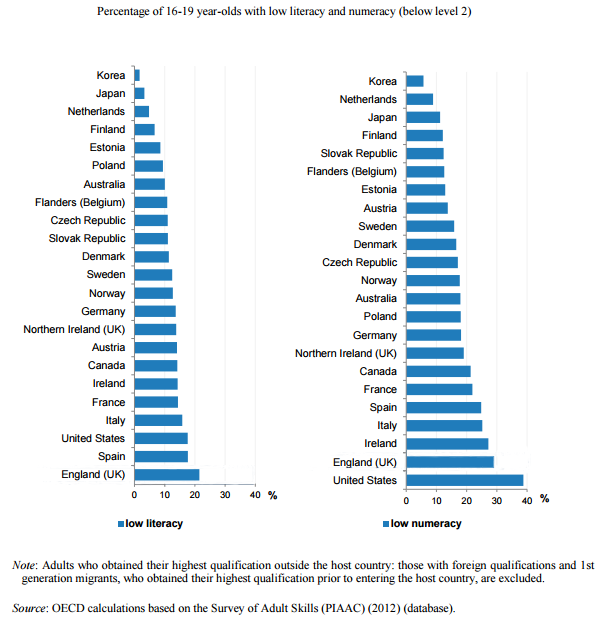
So sad...  The graph at right (click to embiggen; source) jibes with my own experiences hiring people here in the U.S. vs. in Estonia and Russia.  I still remember my utter shock when I first evaluated potential employees in Estonia, back in '93 – their superior math and science knowledge, in particular, were simply stunning when compared with typical American candidates.

A few years ago, I sent the video at left to a friend of mine in Estonia.  His response?  He was positive it was a put-on, that those couldn't be real people randomly interviewed on the street.  No adult, he said, could really be that ignorant.

Oh, yes they could...

Learning to read...

Learning to read...  I started reading at a very young age, and a large part of the credit for that goes to my mom.  I have no memory at all of my earliest brushes with reading, just stories about it that mom told me years later. 

According to her, when I was three (but nearly four), she was reading a kid's story out loud to me, and I asked her how she was doing that.  She sat me in her lap, put the book down in front of me, and started pointing to the words as she read them.  After that, I apparently insisted on her doing that whenever she read to me; for some reason the act of reading fascinated the young me.  Mom told me that by the time we'd read a few books like this, I was recognizing many words – and learning how to pronounce them from their spelling.  She didn't use any sort of method or curriculum to teach me, just the examples and practice – and lots of encouragement.  We had several hundred books at home, many of them inherited from my paternal grandparents.  Many of these books were aimed at children or juveniles (such as the Uncle Wiggly series by Howard Garis, and the Dr. Doolittle series by Hugh Lofting).  By the time I entered first grade (I never went to kindergarten; back then parents had the choice of skipping it), I was reading books on my own.

Mom told me that she tried the same thing with my brother Scott and my sister Holly, but neither of them (as toddlers) had the same interest in it that I did.  Both are avid readers as adults, but they didn't start as young as I did.

My own memories of reading when young start when I was seven or eight years old.  I have two very clear memories of reading at that age.

The first was reading novels from the Reader's Digest Condensed Books that my parents were buying almost from their outset in 1950.  We had dozens of these books on our shelves, and each of them contained about five novels (and sometimes, non-fiction).  These were my introduction to adult literature.  Their shorter length and dumbed-down vocabulary were absolutely perfect for me at that time.  When I first started reading them, mom would check the novels first to make sure I wasn't reading something she thought I shouldn't.  Then she discovered that prohibiting a particular volume just made me want to read it more – so she gave up :)  There were quite a few occasions when she had some conversations with me that were very awkward for her, when I started asking about things I'd read in the novels.  She consistently encouraged me to read them, though.  I devoured those books; by the time I was about ten I'd read every one we owned, and longed for more.

The second clear memory was when I was eight years old, not long after my birthday, and mom coming home from a yard sale with a complete copy of the World Book Encyclopedia from the early '50s, in great condition.  She was very excited about it, as she hoped it was something I would be able to learn from.  I don't think she expected what my reaction was: I was determined to read the entire thing.  I did, too, though it took me several years to do it.  I spent a lot of time with a dictionary by my side while I did that, and I remember sometimes having to read whole sets of articles that cross-referenced each other.  That was a real challenge for the small me!  All through that period, my mom was encouraging me to keep at it.  Of course I couldn't assimilate all that knowledge to be found in those volumes, but the breadth of exposure to ideas and facts that reading gave me has benefited me for my entire life.  I remember that period as transformative for me, most especially for the introduction to science, math, technology, and history those volumes gave me.  They also introduced me to the very idea of learning from books (sans teacher), and that's something I've been doing all my life since then.

I never would have done that reading without my mom's help and prodding – and without that reading, I'm certain my life would have taken a very different course...

Update 6/27/2016: My brother Scott emailed me with this:
You were probably 4 or 5 when you could read a lot. I wanted to be like you and I tried reading but every book I tried was boring as hell except for science fiction. When I was 5 or 6 years old I read Jules Verne's 'Mysterious Island'. It was a spine tingling sensational experience for me. I felt like I was there with the characters exploring that island and meeting Captain Nemo. It was a real joy for me to read this book even though I was a very slow reader, and that's when I got hooked on reading which for me was mostly cartoons, comic books and science fiction. So when I wasn't drawing or working on the farm (90% of my spare time) - I would read. I remember bragging about how young I was when I read that book as I was proud as heck with myself for accomplishing this at this age as soon as I put the book down.  That was a fat book.

You know you're having a bad day...

You know you're having a bad day ... when you make a network cable that tests bad (one open conductor), so you replace both ends – and it still tests bad!  That's exactly what just happened to me.  I couldn't believe it when the cable tested bad after replacing both new ends I'd just installed.  I tracked it down: there was actually a flaw in the cable itself, a place where one conductor got kinked and broke.

First time that has ever happened to me, in over 50 years of building electronic gear.

That cable was “proudly” made in the U.S., too...

Saturday, June 25, 2016

Just saying...

Just saying...  I scanned in some more paper today (love my paperless system!), and I noticed a feature that counts the total pages scanned to any folder.  I've been using this system for just under 18 months now, and I have scanned 266 pages of medical-related stuff.  The vast majority of this is either Explanation of Benefits (EOBs) from our insurance company, or bills from medical providers.  That's about one page of paperwork every other day.

Am I the only one who thinks this is a bit ... excessive?

We're still receiving EOBs and bills for Debbie's latest injury, a month ago.  But so far, we've received stuff for:
  • paramedics who treated Debbie at the fairgrounds
  • ambulance that took her to the hospital
  • emergency room
  • three different labs for blood and urine tests
  • four different X-rays and CAT scans at the hospital
  • evaluation for surgery
  • medical ward (while waiting for surgery and recovering from it)
  • transitional care unit
  • physical therapy at the hospital
  • physical therapy at home
  • surgeon who did the knee repair
  • anesthesiologist
  • surgery room
  • drugs from hospital pharmacy
  • followup exam at the surgeon's offices (not at the hospital)
  • X-rays at the surgeon's office
Surely there's a better way than subjecting everyone who needs medical care to this sort of paperwork avalanche.  It's as though you took your car in for repair, and then got 40 “Explanation of Repair” forms, along with bills from the oil wholesaler, the mechanic, the lift, the billing department, the guy who cleans the place up, the spark plug manufacturer, and the other 35 parts they used.

Just saying...

All men are created equal...

All men are created equal...  While I cannot recall either mom or dad ever using that particular (famous) phrase, I'm certain they'd both have agreed with it.  I've written before about one particularly memorable example of my dad's lack of racial prejudice.  Mom was of one mind with dad on that subject, and she showed it in her daily behavior.  My younger readers may not realize that such blindness to race was far from the norm back then.  It certainly wasn't a rare thing to have a family free of outright racial or religious prejudice – but it was, I think, a minority of them.  I remember that most families I knew (neighbors, friends', etc.) had adults who didn't hesitate to express, forcefully and perhaps vulgarly, their own racial prejudices.  This wasn't restricted to white families, either – I recall a Chinese friend whose father hosted a burning hatred of black men. 

My own family, thanks to mom and dad, contrasted sharply with these experiences.  Mom and dad weren't militant in any sense.  Even during the civil rights movement in the '60s, they were quietly unprejudiced, but not really trying to change the world outside their family.  But they were sure determined that their own children would not be raised as unthinking racists.  We kids saw this through their actions.  Some of mom's actions I remember:
  • Gertrude Ames was the mom in the black family that were tenants on our farm.  I remember mom swapping cooking tips and recipes with Gertrude, entrusting Gertrude with babysitting us (including my youngest brother as an infant), and just generally treating her exactly as she would any other woman.  It's not so much that mom did anything special with Gertrude, it's that she didn't.
  • One of my friends in junior high school was a classmate named Matthew G. who lived a mile or so from our house, along a back road.  I had been over to Matt's house a number of times before he ever came over to ours.  On that first visit of his, my mom invited him in to have lunch with us.  Matt's family was Jewish, and they kept kosher at his home – so the lunch my mom had prepared, with sandwiches and milk, Matt knew he couldn't eat.  He was very embarrassed, literally turning red.  Mom gently asked him if she could call his mom to find out what he could eat, which made Matt feel better – and then she called Matt's mom and got the first lesson in her life on making a kosher meal.  Her good-humored and open-minded approach soon had both Matt and his mom laughing, and it wasn't long before the mom's came up with an acceptable meal for Matt, served on paper plates and in disposable cups.  We kids saw that mom didn't care if he was Jewish, that she respected his religion's beliefs, and had no problem with accommodating them to the extent she could.  Something that made a particular impression on me was how easy it was to talk something like that dietary conflict out with an equally open adult (Matt's mom).
  • When I was perhaps 7 or 8 years old, someone knocked on our door on Halloween evening.  We didn't get a lot of trick-or-treaters, but we did get a few most years, and mom always had some nice treats ready.  On the occasion I am remembering, when we opened the door there were three cute little kids in homemade costumes (the norm back then!) on the porch, and a teen-aged girl just behind keeping an eye on them.  All of them were strangers to us, all of them were black, and when my mom opened the door, the girl immediately started to round the kids up to leave.  Mom then said something like “Now which kind of treats would you like?”, making it clear as could be that they were welcome to choose some treats out of the bowl she was holding out.  There was some hesitation, but then the kids came shyly forward and picked out some stuff while the girl looked uncomfortable and worried.  Mom was being as nonthreatening, cheerful, and smiley as she could possibly be.  Finally the kids left, and even the girl had a tentative smile.  Mom shut the door, sat down, and started crying.  My dad heard her, and came in to find out what was wrong.  I remember her saying how awful it was that these little kids would think they couldn't come to our house on Halloween just because they were colored (that was the then-proper term).  This incident sticks in my memory, I'm sure, because I started asking questions about what was going on – and both mom and dad tried their best to explain racial prejudice to me.  That's a surprisingly hard concept to get across to a naive kid with no experience of it.
Mom's absence of prejudice wasn't perfect, though.  In recent years – mainly since 9/11 – she was afraid of Muslims, and in particular of Muslim women with covered faces.  This fear led rather directly to the kinds of prejudicial behavior that she so abhorred in any other circumstance.  For instance, there's no way that mom would have gone through a checkout stand with a clerk she knew was Muslim.  The first time I encountered this in her, around ten years ago, I was shocked – precisely because it was so counter to every prior experience I had with her.  On that occasion I went to WalMart with her, and when she saw a woman wearing a hijab, she abruptly abandoned her partly filled shopping cart and left the store, with an open-mouthed me trailing behind.  I didn't know what had happened until we got back to her car!

I'm so very thankful that I was raised by parents that set such a fine example of racial and religious harmony.  My life would have been much poorer had I instead been taught to fear and loath those different than myself...

Now here's an interesting idea!

Now here's an interesting idea!  CANZUK.  And maybe Brexit made it more likely...

Friday, June 24, 2016

Ground Observer Corps...

Ground Observer Corps...  Most Americans alive today likely have never heard of this organization, also known as GOC.  It was modeled after the British civilian observers mobilized in WWII, and the goal of it was to search the skies for enemy aircraft.  In the earlier days of WWII, there was no radar – so visual observation was the only practical way to spot and identify an aircraft.  More information about the GOC can be found here, here, here, here, and here.

When the U.S. joined the war in December 1941, my mom was just nine years old.  At the end of the war with Germany, in 1945, she was almost thirteen.  Despite her young age, she volunteered for the Ground Observer Corps – which was mainly composed of women, children, and men too old or physically unable to fight.  She joined it when she was ten years old, and she wasn't the youngest volunteer by a long shot.

I first learned about mom's participation in the GOC in the mid-'80s, when she saw a structure in California that reminded her of the watch tower she knew from her GOC days, and she mentioned it.  After that we had several long conversations about her experiences in the GOC, and WWII in general.  

The particular GOC group she was part of kept two observers on station 24x7 in a concrete tower (around 20' high) located above the ocean beach just east of Plum Island, which itself is just south of Sandy Hook, New Jersey.  Like most of the observers there, she bicycled from home to the tower for each of her watches.  She stood four hour watches, five times a week.  Her group was responsible not only for spotting German aircraft, but also German submarines.  These occasionally prowled along the American east coast, and they were especially prevalent near large ports.  The tower where mom stood watches was close to two of America's largest cargo ports: New York and Newark.

Mom never saw a German aircraft, though her group did report a few “unknowns” – aircraft that they could not identify.  All of them turned out to be experimental aircraft flying from one of the many military air bases in the area.  She did spot two German submarines, both times at night, and both times with no running lights (as was usual for German submarines operating in U.S. waters).  Like the other observers who spotted submarines, she spotted them by their silhouettes when they were backlit by the moon or more distant (and lit up) ships.  She could still recall her fear and excitement at calling in the report – by getting the operator on a standard telephone and saying the magic phrase “Army flash.”   That caused the operator to connect her to an Army center where these reports were collected, verified, and perhaps acted upon.  The two subs my mom spotted submerged again before they could be attacked; so far as she knows, her reports didn't result in any military action.

Of interest to me was how the Army managed to make use of kids like my mom for this effort.  When she started, the only “equipment” she got was a set of flash cards with photos and silhouettes of the aircraft and submarines she was supposed to identify (both friendly and enemy).  She spent hours studying and practicing with these cards, and was only allowed to man the observation tower when she passed a test administered by the Army liaison officer to her group.  She was tremendously proud of the fact that she passed that test on her first attempt, about a month after she got the set of flash cards.  This was, perhaps, another example of her powers of memory.

Later in the war, the observation tower got two pairs of WWI-era binoculars – far from the top-of-the-line, but a heck of a lot better than having nothing at all.  Only after they had the binoculars could mom see well enough to actually identify a submarine from its silhouette.

My mom's partner on watch was one of three people (in a rotation): a young woman a few years older than her, a WWI destroyer veteran, and a older lady around 50 years old.  She remembered long conversations with these three people, all of whom she became very friendly with.  The veteran, in particular, fascinated her because of his understanding of how to stand a watch: how to preserve your best eyesight (by staying in total darkness), how to stay awake and alert, and on the importance of avoiding false alarms.  That fellow made a big impression on her, and was also responsible for expanding her four-letter word vocabulary :)

In my conversations with mom about the GOC, it seemed to me that the most important thing about it for her was that it gave her a sense of actually helping the war effort in a tangible way.  She, like most others not actually at war, was filled with the sense of the existential danger facing the country – and she desperately wanted to contribute to winning.  The only other thing she did that gave her a similar sense of participation were the drives to collect metal (especially aluminum) that she spent a lot of time doing in 1943 and 1944.  But the watches she stood for the GOC gave her an especially direct sense of helping in a way that was as close to being a soldier as it was possible for her to do.

Something I've thought about often, since then, is just how young she was at the time she volunteered for the GOC.  I don't have many clear memories of any kind at just ten or twelve years old, but I certainly wasn't doing anything that could be even remotely construed as helping a war effort!  Mom was then about the same age that I was when President Kennedy was assassinated.  I remember that event clearly enough – but only a few isolated vignettes.  I couldn't tell you much about the context I was in; I was just a kid, consumed with the things that most kids in those days were consumed with.  None of that was particularly memorable.  My mom, at the same age, was keenly aware of the country being at war.  She followed the war news avidly, as did everyone she knew who was still stateside.  She was aware of the setbacks and victories, and she remembered them all still, forty years later when I had those conversations with her.  For instance, she recalled vividly the sense of joy and hope she had (as did those around her) upon hearing about Doolittle's raid on Tokyo in April 1942, when she was just nine years old.  Her memories of those years seemed to me to be more like the memories of an adult's experience, not those of a child.  But child she was.

I've read several history books that covered the GOC, including one that was entirely dedicated to it.  All of them conclude that from a military standpoint, the GOC was actually a net negative – about 90% of the GOC's reports of enemy aircraft or ships were judged to be false, and quite a bit of military resource was spent chasing them down.  But in one sense, at least, the GOC was a resounding success.  My mom's sense of wartime participation was far from unique.  The GOC was a huge morale booster for its volunteers (over a million civilians!), and even at the time the leadership of it recognized the value of that.  During the war there were several efforts by military commanders to shut the GOC down, but those efforts were always shot down by senior commanders who understood that the GOC was about more than spotting airplanes.

Somehow I'm certain that my mom would agree with that...


Great Britain voted to leave the European Union...

Great Britain voted to leave the European Union...  That sure surprised me!  I have no idea what the economic impact will be, either to Great Britain, the EU, or the U.S.  But I've long thought that the whole idea of the EU was fatally flawed – especially the fact that unelected, unaccountable bureaucrats ran the thing.  As Nigel Farage said repeatedly during the campaign: a vote for “Leave” is a vote for independence and democracy.  I'll take that over (possible) negative economic impact – which is most likely short-lived anyway.

For me, perhaps the most exciting possibility this opens up is that the entire EU will collapse.  First, Great Britain was one of the largest net contributors to the EU – and that means that the remaining EU will now have a lot less money per capita to play around with, reducing the attraction for all the net takers.  Second, the independence-leaning politicians of the other EU members are likely to be greatly emboldened by this vote – and even more so if the exit is free of horrible economic consequences.  Third, there will be a contingent within the EU who wants to punish Great Britain for their sin of leaving – and I think that the debate over that issue (whether to punish Great Britain with import/export duties, passport restrictions, etc., or to welcome them as they have Switzerland) will serve to further weaken the collective will to maintain the EU.

Way to go, Great Britain!

Thursday, June 23, 2016

An old-fashioned skill...


An old-fashioned skill...  For about half my mom's life, the cash registers used by check-out clerks at grocery stores and most other retail stores were mechanical devices.  My younger readers may have trouble believing this, but bar code scanners had not yet been invented.  The poor clerks had to manually enter every single price into their mechanical cash register, which added them together using a complicated set of gears, levers, and so on.  The total showed up in the form of a miniature billboard for each digit.  Such a thing is almost unimaginable these days!

At least up until the early '70s, when I left home to join the Navy, my mom was able to do something completely unique in my own experience.  As we loaded up her shopping cart in the grocery store, she would mentally add together the cost of all the items in the cart.  So far as she was concerned, that cash register (and the clerk) were there to cheat her out of her money (something she never had much of), so she would double-check them.  It was fairly common for her to catch an error, too – I'd guess it was maybe 20% or 25% of our shopping trips.  Somehow more than half the time the error was in the store's favor, too :)  Each time her mentally-computed total didn't match the total on that cash register, she'd make the clerk go over the whole thing, using the tape generated by the cash register (which just had prices, not the name of the item).  Sometimes the error was an incorrectly entered price, and sometimes it was a mismatch between the price marked on the shelves and the price the clerk looked up.  In every case, mom would insist on getting the error fixed (even when it was in her favor) before she'd hand over any money.

When we were grocery shopping, she was buying for six people (she and my dad, and four kids).  There would be a lot of different items in that shopping cart – and yet, most of the time, her mentally-computed total matched the clerk's total to the penny.  Can you do this?  I certainly can't!

So how did she do this?

One thing to understand is that for girls who went to school when and where she did, this was a skill taught to them as something ordinary, along with reading and writing.  Really!  I did some research on this a while back, and discovered that the general technique was commonly taught in the U.S. (usually just to girls) as far back as the early 1800s – and probably much earlier than that.  The video at right, if you can get past the thick Australian accent, demonstrates the general method my mom described to me.  Even with no practice at all, I can do it for a short list of numbers.  But a long list of numbers, incrementally added while you're shopping?  I don't think so!

I suspect her ability to do this sort of arithmetic was somehow related to her ability to remember the cards played during a game.  Both of them seem to me to be astounding feats of memory – and in both cases, she dismissed them as simple things that any idiot should be able to do effortlessly. 

In the '80s and later, when I went shopping with her, I noticed that she no longer double-checked the clerk.  When I queried her about this, she told me that she could still do that mental arithmetic, but it was no longer worth the effort, because she hardly ever caught an error.  I suspect part of her dropping it was also the fact that money wasn't quite so tight with she and my dad any more.  About 10 years ago, I asked her again, and she told me she'd lost the skill – but wasn't going to put the effort back into re-learning it.

It seems somehow a shame that people generally no longer have this mental arithmetic skill.  Once this was a common skill, but today someone with this skill looks like a magician performing tricks.  On the other hand, I'd trust my calculator's answer more than any answer a human produced :)  

Wednesday, June 22, 2016

Paradise ponders...

Paradise ponders...  The field in the photo at right is our south alfalfa field, just after it was baled (on the first cutting of the year).  Those bales are more than twice as close together as the best cutting last year (the last one).  Scott N., the fellow who leases the field from us, is indeed a happy fellow.  All of the fields he leases are producing at a high level this year, but he tells me that our field has the highest yield per acre of all of them.  He's not sure why, but he's absolutely positive that he likes it :)

For about a week now, we've had the two puppies in separate crates.  They often bark at each other across the 3 feet or so that separates them.  It occurred to me (just) today that perhaps if they couldn't see each other, they would fuss at each other less.  So today I tried draping a blanket across the end of one crate (Cabo's) – and it seems to work!  Debbie reports much less barking today.

I've spent a few hours today dealing with bills, trying to straighten out the air travel mess from last month (when I canceled some flights, added some, and rescheduled others, and changed all sorts of things – all by phone, so no paper records).  I think I finally got through it all.  Sheesh...

This is...

This is ... quite the court transcript.  I've never seen anything like this before :)

The card player...

The card player...  My mom loved to play cards – almost any game was fine with her.  For a time in the late '50s and early '60s, she was a fairly serious contract bridge player, playing several evenings a week.  She was consistently one of the top ten players in New Jersey during this period.  As we kids got older, she had less evening time for that sort of thing, and her card playing became more social and recreational, and less serious.

I asked her once how she got started playing cards, and why she loved them so much.  Part of the answer I could easily guess: her dad and his friends (both in Maine and in New Jersey) were avid card players – usually penny-ante poker, accompanied by lots of beer, cigarettes, joshing, and laughter.  Even when she was quite young, they often let her join the game (and participate in the beer, cigarettes, cussing, and joshing :)  Purely recreational and social.

The other part of the answer, though, was a surprise to me.  She joined a bridge club in high school, found that she had a real talent for the game.  There were two things that were easy for her, but that most people found quite difficult.  First, she had no problem remembering all the cards played in a game.  Not just which cards, but who they were played by and in what order.  Up until a year or so before she died, so far as I can tell her card memory was perfect.  Secondly, the complex bidding system used in contract bridge made sense to her almost instantly (that's something I've never been able to wrap my head around, despite trying several times).  Two months after she joined the bridge club (this was in 10th grade), she was the number one player at her school – and she stayed number one until she graduated.

That experience with the bridge club was her gateway to serious card playing.  By “serious”, I mean that she studied each game she learned to understand the strategy and tactics.  This study wasn't from a book, but rather from her own experience and practice – but it was very deliberate.  If you talked with her about poker, for example, she could go on for hours about the subtle differences in the odds for different variations in poker.  She never did understand the mathematics of probability, but she did understand it intuitively, just through her own experience.  I once found an odds table for a particular variation of poker, and went through it with her.  She couldn't tell me what the specific probabilities were, but she could rank them.  For any given hand, she could quite accurately tell you how many to discard and draw, based on her intuitive understanding of the probabilities.  She had this same sort of knowledge for every card game she had mastered – and that was a lot of card games!

Whenever the family got together with her, no matter where or when, she always wanted to play cards with us.  I can't think of anything that she enjoyed more.  As an adult, once I left the Navy (where card-playing is the standard time-passing mechanism) I rarely played cards – except when visiting with mom, or when she was visiting me.  In my head, playing cards is closely correlated to being with mom.  When I recall something about her (especially her laughter), very often it's associated with playing cards.

She was the card-playing mom.  My mom, our mom.  I miss her...

Morning in Paradise...

Morning in Paradise...  The field adjoining our front lawns was baled and trucked out yesterday.  The yield was unusually high, putting a big smile on Scott N.'s face (he's the fellow who leases our field to grow hay).  That cleared me to turn on the sprinklers for my lawn, which I did this morning.  As I cleared one nozzle, I noted the beautiful sunrise over the Wasatch Mountains to our east, and managed to get a photo of it looking over the fields across the highway east of our home.  That grass hay field is owned by the LDS church, who leases it out to Mike Clawson, a local dairy farmer. 

This morning I'll be transporting the kittens we're fostering, along with their mom, to a veterinary clinic about 25 miles north of us.  This clinic works with the Four Paws rescue organization to neuter stray or feral cats at low cost.  In a week or so, we'll be handing these kittens – now over 3 pounds each – over to Four Paws for adoption.  The little calico girl will be staying behind with us...

Tuesday, June 21, 2016

Paradise ponders...

Paradise ponders...  Scott and I made a trip down to the PODS storage facility in Salt Lake City this morning, to bring back a load of the stuff my sister Holly and her husband packed up a couple of weeks ago.  The pod made the trip in good order; we saw very little damage to the stuff inside (one plastic tub collapsed, and we haven't yet inspected the stuff in it, and one piece of furniture had a corner's finished rubbed off).  A couple of the things I was most concerned about made it just fine.  We may discover a bit more damage when we unwrap stuff, but I'm not expecting anything serious – it all looks great.

It was really hot down there doing heavy physical work.  The pod had been moved out onto the pavement for our access, and it was in the full sun on a day with a forecast for a 99°F high.  By the time we were done filling Scott's trailer, we were both hot and thirsty.  It's quite a bit warmer in Salt Lake City than in Paradise, and I suspect it's more humid as well.  When we got back to Paradise, it felt almost cool by comparison :)

We took about 2/3 of the pod's contents this morning, and it's all going to Scott's basement for further sorting.  We're headed back down to Salt Lake City to pick up the rest of the stuff next Tuesday.  The next load will head to my barn for sorting and (for some things) shipment back to other people.  I suspect it will be two or three weeks before we finally have completed all that work.

On our drive back to Paradise, I got a most unexpected phone call: from Danny Roger, the chaplain for Rocky Mountain Hospice, the folks who cared for mom while she was here in Utah.  He was checking up on Scott and I, to make sure we were ok, and whether we needed any support from him or their associated psychologist.  It's been almost two weeks since mom died, and nearly every day since then someone from the hospice has reached out to us in one way or another.  It almost feels like we're disappointing them when I tell them that we're doing ok, and don't need anything in the way of assistance ... but it sure is comforting to know that if we did need some help, it would be available...