 Check out these amazing photos! Click any of the small images to get a larger version...
Tip of the hat to Jim M. for sending them along...


Thursday, May 24, 2007
Check out these amazing photos! Click any of the small images to get a larger version...Wednesday, May 23, 2007
Part of my daily reading routine is a stop at Cute Overload to see what new delights have been posted. Every day, several new photos, audio clips, or video clips of animals are posted. “Cute Overload” is a very apt name for this site, and if you love animals, you’ll find it irresistible…
A big “thank you” to SimiL for a good laugh:
The IRS decides to audit Ralph, and summons him to the IRS office. The IRS auditor is not surprised when Ralph shows up with his attorney. The auditor says, 'Well, sir, you have an extravagant lifestyle and no full-time employment, which you explain by saying that you win money gambling. I’m not sure the IRS finds that believable.'
'I’m a great gambler, and I can prove it,' says Ralph. 'How about a demonstration?'
The auditor thinks for a moment and said, 'Okay. Go ahead.' Ralph says, 'I’ll bet you a thousand dollars that I can bite my own eye.' The auditor thinks a moment and says, 'No way! It’s a bet.' Ralph removes his glass eye and bites it. The auditor’s jaw drops.
Ralph says, 'Now, I’ll bet you two thousand dollars that I can bite my other eye.'
The auditor can tell Ralph isn’t blind, so he takes the bet.
Ralph removes his dentures and bites his good eye. The stunned auditor now realizes he has wagered and lost three grand, with Ralph’s attorney as a witness. He starts to get nervous.
'Want to go double or nothing?' Ralph asks. 'I’ll bet you six thousand dollars that I can stand on one side of your desk, and pee into that wastebasket on the other side, and never get a drop anywhere in between.'
The auditor, twice burned, is cautious now, but he looks carefully and decides there’s no way this guy can manage that stunt, so he agrees again. Ralph stands beside the desk and unzips his pants, but although he strains mightily, he can’t make the stream reach the wastebasket on the other side, so he pretty much urinates all over the desk.
The auditor leaps with joy, realizing that he has just turned a major loss into a huge win. But Ralph’s attorney moans and puts his head in his hands. 'Are you okay?' the auditor asks. 'Not really,' says the attorney. 'This morning, when Ralph told me he’d been summoned for an audit, he bet me twenty thousand dollars that he could come in here and piss all over your desk and that you’d be happy about it.'
This pretty much hits on all cylinders: the good guy wins, he pissed on the IRS, and the lawyer is screwed. Hooray!
Although many Americans don’t seem to know it, there are foreign journalists embedded with American troops in both Iraq and Afghanistan. Some of these reporters come from countries where strong anti-American sentiment is the norm, and suspicion of the motives and actions of the U.S. military rampant.
Jeff Emmanuel, writing for the American Thinker, thought to look at these reporters and their reactions to being embedded. He discovered that many of these reporters emerge from their “embed” experience with far different attitudes than they held previously. Do go read the whole thing, but here’s a sample:
The most spectacular recent case of a journalist with an anti-war mindset being completely overwhelmed into a change of heart by American soldiers, according to the PAO, was a Greek public television reporter who had been embedded with an infantry unit that became entrenched in a 45-minute firefight with insurgents. Yanked out of the line of fire by a soldier who put the journalist’s life above his own, he waited under cover and in fear of his life for the almost hour-long duration of the battle, with the best view possible of American soldiers in action against an armed and murderous enemy. He credits his having lived to tell the tale directly to those young troops.
"He had tears in his eyes as he talked about it,” said the PAO. “He just kept saying, ‘they saved my life, they saved my life…these are great men; they are heroes.' Even after telling it several times, he couldn’t get through the story without choking up - and this was a man who had arrived here with all of the disdain for the Iraq mission and for the American soldiers who he [like seemingly most Europeans] had seen as the bad guys in this fight."
While it may be decried by some for causing journalists, who claim to be “objective” and “neutral” in their reporting, to lose their cold detachment and actually begin to see the soldiers they live alongside as humans, it is that very fact that makes the practice of embedding reporters with military units so beneficial to both parties. Rather than observing events from a safely detached distance - and thus being able to remove the human element from the equation - embedded reporters are forced to face up to the humanity of their subjects, and to share common experiences - often of the life-and-death variety - with those who they are covering.
Our soldiers are doing us proud over there…
Tuesday, May 22, 2007
Over the weekend, Jimmy Carter — former President of the United States (though that’s sometimes hard to believe!) — had this to say:
I think as far as the adverse impact on the nation around the world, this administration has been the worst in history. The overt reversal of America’s basic values as expressed by previous administrations, including [those of] George H.W. Bush and Ronald Reagan and Richard Nixon and others, has been the most disturbing to me.
My reaction to that was to simply dismiss it as the addled rambling of a sick and disturbed old man. I pity him, and as an American I find his presence shameful. And I wish he’d move to someplace where they’d appreciate his ceaseless “blame America first” ranting and his manifest Bush derangement syndrome. Like Palestine, for example. Or Venezuela.
But Christopher Hitchens has a different reaction. He says:
"Worst in history,” as the great statesman from Georgia has to know, has been the title for which he has himself been actively contending since 1976. I once had quite an argument with the late Sen. Eugene McCarthy, who maintained adamantly that it had been right for him to vote for Ronald Reagan in 1980 for no other reason. “Mr. Carter,” he said, “quite simply abdicated the whole responsibility of the presidency while in office. He left the nation at the mercy of its enemies at home and abroad. He was the worst president we ever had."
Mr. Hitchens verbally eviscerates the former President in this manner for his entire column, ending with this thought:
The quotation with which I began comes from an interview that he gave last week to the Arkansas Democrat-Gazette. He also went on the British Broadcasting Corporation to make spiteful and cheap remarks on the retirement of Prime Minister Tony Blair, calling him “loyal, blind, apparently subservient.” Yes, that’s right, Mr. Carter. Just the way to make friends and assert “America’s basic values.” Show us your peanut envy. Heap insults on a guest in Washington: a thrice-elected prime minister who was the first and strongest ally of the United States on the most awful day in its recent history. A man who was prepared to risk his own career to be counted as a friend. A man who was warning against the Taliban, against Slobodan Milosevic, and against Saddam Hussein when George Bush was only the governor of Texas. Leaders like that deserve a little respect even when they are wrong—but don’t expect any generosity or courtesy from the purse-mouthed preacher man from Plains, who just purely knows he was right all along, and who, when that fails, can always point to the numberless godly victories that he won over the forces of evil.
And then there’s the memorable title Mr. Hitchens chose for the column: Peanut Envy.
Purse-mouthed. Ouch.
I wonder if Jimmy is even slightly embarrassed?
I note with disgust (but not surprise) that his fellow Democrats are utterly silent about his ravings…
Monday, May 21, 2007
Thank you, SimiL:
A very successful lawyer parked his brand new Porsche Carrera GT in front of his office, ready to show it off to his colleagues. As he got out, a truck came along too close to the curb and completely tore off the driver’s door!
Fortunately, a cop in a police car was close enough to see the accident and pulled up behind the Porsche, his lights flashing. But, before the cop had a chance to ask any questions, the lawyer started screaming hysterically about how his Porsche, which he had just picked up the day before, was now completely ruined and would never be the same, no matter how hard the body shop tries to make it new again.
After the lawyer finally wound down from his rant, the cop shook his head in disgust and disbelief. “I can’t believe how materialistic you lawyers are,” he said. “You are so focused on your possessions that you neglect the most important things in life!"
"How can you say such a thing?” asked the lawyer.
The cop replied, “Don’t you even realize that your left arm is missing? It got ripped off when the truck hit you!!!"
"OH, MY GOD!” screamed the lawyer. “MY ROLEX!!!"
Sunday, May 20, 2007
Last night, with the excellent company of my wife and our good friend Jim Barnick, we watched the Disney/Pixar animated movie “Cars”. I haven’t enjoyed a movie so much in years.
Though the plot was trite and completely predictable, the characters (all cars!) were wonderfully done, the dialog sweet, cute, and very funny. While there was dialog that most likely would only be understood by adults, there was plenty of appeal for kids. The dialog was modern, but the style — good, squeaky-clean, pure fun — was classic Walt Disney. And the animation was simply spectacular, from front to back. A couple of particular sequences stood out for me: splashing water, and a nighttime scene of blinking neon lights on a city street — but that’s like saying that a couple of Belgian chocolates stood out in a world championship chocolate contest. The whole thing was delectable!
My last visit to a movie theater must be at least five years ago, probably more like ten. That whole experience was awful, completely independently of the movie itself — jam-packed with noisy, rude people, smelling of rancid popcorn, seats covered with who-knows-what (and who wants to know, really?) … and you pay handsomely for this experience. By contrast, our very modest “home theater” has only the audience we want, the excellent company of our friends, cats, and dogs, and … the pause button. Modern electronic miracles give us THX audio and a giant high-quality screen. DVDs (and NetFlix!) give us all the content we could ever want. I cannot understand how the movie theaters stay in business!
Friday, May 18, 2007
I spotted this on the rear bumper of a beat-up Ford pickup truck parked at the Jamul Post Office:
Ted Kennedy’s car has killed more people than my gun!
As James Taranto might say: Mary Jo Kopechne could not be reached for comment.
Most of the time, the antics of Congress leave me uncertain whether to laugh or cry. This, though, just makes me mad:
An amendment to the defense authorization bill, introduced by Rep. Robert Andrews (D-N.J.), a member of the armed services panel, failed Wednesday night by a vote of 216-202 with six Republicans voting in favor of the amendment together with 196 Democrats.
Andrews’ amendment, which had strong support from House Armed Services Committee chairman Ike Skelton (D-Mo.), would have prevented funds authorized in the bill for the wars in Iraq and Afghanistan from being used to plan a contingency operation in Iran.
The one area where I expect some actual performance from our Federal government is on defense. When I look around the world today for threats (current or potential) to my country, it’s not hard to find them. Certainly Iran would appear on anybody’s list of such threats. Who could think that a country run by the mad mullahs, with a certifiably wacko president, daily threatening to wipe Israel and the United States “off the map", and actively working on nuclear weapons — was not a threat?
So what does Congress do?
They try — and damned near succeed! — to prevent our armed forces from spending any money at all in making contingency plans concerning Iran. Had they succeeded, one could imagine the day when Iran drops a nuke on Tel Aviv, Baghdad, or (via missile) Washington — and our military would be completely hamstrung by the absence of any well-thought out planning. They’d have to respond in a hurried, ill-informed, completely ad hoc fashion. None of the usual preparatory work (especially for logistics chains) would have been done. This is not how we became the world’s greatest military power.
There were 418 House votes on the Andrews amendment. Of those votes, 202 were for the amendment (and 97% of those were Democrats). Could there really be 202 Representatives who are so moronic, so clueless, so suicidal as to vote to cripple this country’s potential response to a belligerent, nuclear-armed Iran?
Apparently, the answer is “yes”.
This vote is actually pretty frightening if you consider that the Democrats are edging closer and closer to an active policy of appeasement and denial of the threat of fundamentalist Islamic fascism. This vote, seen through that lens, looks a lot like preemptive surrender. The word “Islam” means “submission” — and that sure looks like what the Democrats are trying hard to do…
A tribute to a fallen warrior.
Now there’s something you just don’t see every day — much to the shame of the American lamestream media. Kudos to the writer (Dan Morse) and his employer (the Washingon Post).
The lead:
The turnout seemed entirely fitting for a Marine who was described — with little apparent hyperbole — as the toughest guy in the house. More than 1,000 mourners, from generals to civilians, packed the Naval Academy Chapel in Annapolis yesterday to honor Maj. Douglas A. Zembiec, who was killed last week outside Baghdad.
Five hours later, after the sound of taps had faded over his coffin at Arlington National Cemetery, came what Zembiec, 34, might have considered the finest tribute of all.
About 40 enlisted men gathered under a tree, telling stories about their former commander. Some had flown in from as far away as California, prompting one officer to observe: Your men have to follow your orders; they don’t have to go to your funeral.
The men knew firsthand how Zembiec, who lived outside Annapolis, had come to be known as the Lion of Fallujah.
This story, read aloud by a close friend (Eric L. Kapitulik), says it all:
While Zembiec was stationed at Camp Pendleton after the Fallujah campaign, his parents visited. Zembiec and his father, Don, drove onto the base to shoot skeet and were stopped at the gate by a young Marine. Are you Captain Zembiec’s father? the Marine asked. Yes, his father said.
"I was with your son in Fallujah,” the Marine said. “He was my company commander. If we had to go back in there, I would follow him with a spoon."
"I would follow him with a spoon."
Sounds like a great epitaph for an American hero.
Don’t you wish we saw more of this in our lamestream media? Wouldn’t it be more interesting to read more stories like this, and read less mindless adoration of Reid, Pelosi, Kennedy, Byrd, etc. — and less equally mindless bashing of Bush?
Thursday, May 17, 2007

As my regular readers know, I’m skeptical about anthropogenic (i.e., caused by human activity) global warming. But here’s someone who apparently believes the link between human activity and global warming is much more direct than you might have imagined. This is a letter to the editor of the Arkansas Democrat-Gazette, published on April 16, 2007:
You may have noticed that March of this year was particularly hot. As a matter of fact, I understand that it was the hottest March since the beginning of the last century. All of the trees were fully leafed out and legions of bugs and snakes were crawling around during a time when, on a normal year, we might see a snowflake or two.
This should come as no surprise to any reasonable person. As you know, Daylight Saving Time started almost a month early this year. You would think that the members of Congress would have considered the effect that an extra hour of daylight would have on our climate. Or did they?
Perhaps this is another plot by a liberal Congress to make us believe that global warming is a real threat. Perhaps next time there should be serious studies performed before Congress passes laws with such far-reaching effects.
Connie M. Meskimen
Hot Springs
This is so sad on so many levels…
Of course, there’s a good joke line or two in here. Something in the water in Hot Springs, perhaps. Or something about the hicks in Arkansas. A friend suggested that perhaps the author was also a member of the Flat Earth Society, and another responded that perhaps she’d already fallen off!
But what sticks in my head about this is my own personal experiences with scientific illiteracy, and the frequent polls done showing that only small percentages of our adult population realize that the moon is a satellite of the earth, that sound doesn’t travel in space, that water is a compound of hydrogen and oxygen, and so on ad nauseum.
The icing on the cake, of course, is how the basic science misunderstanding leads straight into a cuckoo conspiracy theory. Too rich!
Wednesday, May 16, 2007
From Ann Coulter, in response to the recent French election of pro-American, anti-Islamic fascism President Nicholas Sarkozy:
The Democratic Party is now officially the only organization on Earth that does not take the threat of Islamic fascism seriously. Between the Democrats and the media, America has gone from its usual position as the world’s last hope to radical Islam’s last hope.
Ouch!

Oh, my. Now we find a Gitmo detainee filing a lawsuit claiming that he is being “tortured” — by under-inflated balls, unscented deodorant, and the absence of a DVD player. Click on the picture to see the details.
I mean, really — is this any way to run a war? Is our objective to win, or to lose? Permitting nonsense like this, with straight faces, truly makes me wonder…
Sigh.
Courtesy of The Smoking Gun.
In my reading this morning, I found this interesting article in a most unlikely place:
Climate Momentum Shifting: Prominent Scientists Reverse Belief in Man-made Global Warming - Now Skeptics
Growing Number of Scientists Convert to Skeptics After Reviewing New Research
Following the U.S. Senate’s vote today on a global warming measure it is an opportune time to examine the recent and quite remarkable momentum shift taking place in climate science. Many former believers in catastrophic man-made global warming have recently reversed themselves and are now climate skeptics. The names included below are just a sampling of the prominent scientists who have spoken out recently to oppose former Vice President Al Gore, the United Nations, and the media driven “consensus” on man-made global warming.
The list below is just the tip of the iceberg. A more detailed and comprehensive sampling of scientists who have only recently spoken out against climate hysteria will be forthcoming in a soon to be released U.S. Senate report. Please stay tuned to this website, as this new government report is set to redefine the current climate debate.
In the meantime, please review the list of scientists below and ask yourself why the media is missing one of the biggest stories in climate of 2007. Feel free to distribute the partial list of scientists who recently converted to skeptics to your local schools and universities. The voices of rank and file scientists opposing climate doomsayers can serve as a counter to the alarmism that children are being exposed to on a daily basis.
Where did I find it? On the U.S. Senate’s web site, in the section from the Senate Committee on Environment & Public Works (EPW), where you can (and should!) read the whole thing…
Tuesday, May 15, 2007
This morning, Michael Moore (the revolting "creator" of Fahrenheit 911) challenged Fred Thompson to a "Presidential" debate. This is wacky on several counts, including the fact that Fred Thompson isn't even in the race yet, and the fact that no candidate in their right mind -- on either side -- would debate a mindless, slimy, jiggling ball of self-righteous ignorance like Michael Moore.
Most candidates would simply ignore the squeals of a such a pig, figuring they wouldn't want to raise the likes of Michael Moore up in anyone's estimation (including his own) by deigning to respond. I'm pretty sure most PR flacks would recommend that approach. Which makes it all the more surprising to see this video response by Fred Thompson just a few hours after Michael Moore's "challenge".
If Fred keeps up this kind of fast, sharp, no-holds-barred politicking, he just might end up with my vote. He's got my interest and my full attention right now...
These are funny to anyone, but probably most of all to anyone who is owned by a cat (or eight of them, like us):
"Managing senior programmers is like herding cats.” — Dave Platt
"Do not meddle in the affairs of cats, for they are subtle and will piss on your computer.” — Bruce Graham
"There is no snooze button on a cat who wants breakfast.” — Unknown
"Thousands of years ago, cats were worshipped as gods. Cats have never forgotten this.” — Anonymous
"Cats are smarter than dogs. You can’t get eight cats to pull a sled through snow.” — Jeff Valdez
"In a cat’s eye, all things belong to cats.” — English proverb
"As every cat owner knows, nobody owns a cat.” — Ellen Perry Berkeley
"One cat just leads to another.” — Ernest Hemingway
"Dogs come when they’re called; cats take a message and get back to you later.” — Mary Bly
"Cats are rather delicate creatures and they are subject to a good many ailments, but I never heard of one who suffered from insomnia.” — Joseph Wood Krutch
"People that hate cats, will come back as mice in their next life.” — Faith Resnick
"There are many intelligent species in the universe. They are all owned by cats.” — Anonymous
"I have studied many philosophers and many cats. The wisdom of cats is infinitely superior.” — Hippolyte Taine
"No heaven will not ever Heaven be; Unless my cats are there to welcome me.” — Unknown
"There are two means of refuge from the miseries of life: music and cats.” — Albert Schweitzer
"The cat has too much spirit to have no heart.” — Ernest Menaul
"Dogs believe they are human. Cats believe they are God.” — Anonymous
"Time spent with cats is never wasted.” — Colette
"Some people say that cats are sneaky, evil, and cruel. True, and they have many other fine qualities as well.” — Missy Dizick
"You will always be lucky if you know how to make friends with strange cats.” — Colonial American proverb
"Cats seem to go on the principle that it never does any harm to ask for what you want.” — Joseph Wood Krutch
"I got rid of my husband. The cat was allergic.” — Anonymous
"My husband said it was him or the cat … I miss him sometimes.” — Anonymous
"Cats aren’t clean, they’re just covered with cat spit.” — Anonymous

Courtesy of Mother Earth News, a handy-dandy chart with clear instructions for the ten most useful knots you can tie. As usual, click on the picture at right to get a large version…
Impress your friends, too!
Monday, May 14, 2007
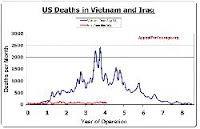
Study the graph at right for a few minutes (click on it to get a larger version).
What’s your reaction?
If (like me) you’re old enough to remember the news reports during the Vietnam war, you might have the same reaction I did: the anti-war agitation in the media now is at least roughly similar to what we saw in the late 1960s and (especially) the early 1970s — but the casualties we suffered in Vietnam dwarfed the casualties we’re suffering in Iraq, and clearly the level of anti-war emotion in today’s American public doesn’t even come close to the anti-war emotion in the public toward the end of Vietnam, when we had many anti-war riots and (as I can personally attest) soldiers and sailors were routinely disrespected and reviled.
What do you think is going on here?
Saturday, May 12, 2007
Unknown source:
"Political correctness” is a doctrine fostered by a delusional, illogical liberal minority, and rabidly promoted by an unscrupulous mainstream media, which holds forth the proposition that it is entirely possible to pick up a turd by the clean end.
Yup, that pretty much sums it up.
Friday, May 11, 2007
Richard Perle:
George Tenet and, more important, our premier intelligence organization managed to find weapons of mass destruction that did not exist while failing to find links to terrorists that did—all while missing completely the rise of Islamist fundamentalism. We have made only a down payment on the price of that failure.
So that’s what an articulate bitch-slapper sounds like!
In what alternative universe does this actually make sense?
Zimbabwe, which is enduring economic collapse and environmental degradation, could become chairman of the UN’s Commission on Sustainable Development when a formal vote of its 53 members takes place today.
If so, Francis Nhema, Mr Mugabe’s environment and tourism minister, will lead the body charged with monitoring the world’s pledges made at the Earth Summit in Rio de Janeiro in 1992.
By any rational measure I can think of, Zimbabwe would be one of the last countries we’d look to for leadership on anything (other than, perhaps, thuggery and maintenance of gerontological dictatorships). On “sustainable development” in particular, Zimbabwe has an admirable record … of the exact opposite! Their economic infrastructure has completely imploded under Mugabe’s rule. A once-thriving economy has degenerated into one of Africa’s worst economic basket-cases — and if you know anything about Africa, you know it’s tough to stand out amongst their economic basket-cases.
And yet the U.N. is quite likely to hand control of the U.N. Commission on Sustainable Development. Sadly, we can’t even claim this is some sort of bureaucracy fart — the U.N. really does seem to make a habit of this particular flavor of ludicrousness. Remember when the U.N. Commission on Human Rights was chaired by Libya?
It’s past time to simply get rid of the U.N. It’s doing more harm than good in the world. The few branches of it that are actually doing defensible work should be “spun out” into standalone charitable efforts — and the rest of it demolished. Some sort of monument at Turtle Bay would be appropriate — the inscription could read:
Here once stood the headquarters of an organization created with the idea that all nations were created equal. After some experience, it became clear that all nations were not created equal, so the experiment was terminated.
Wednesday, May 9, 2007

This past weekend, Debbie and Mo’i were competing in agility trials held in Salt Lake City, Utah. The weather was very cool — just how Mo’i likes it — and he ran with unusual speed and energy. A photographer captured Mo’i just as he was charging out of the collapsible tunnel obstacle. Look at that face! Mo’i was having a grand old time out there!
Miki was also in Salt Lake City, but he was competing in conformation. Both Mo’i and Miki did well — Mo’i had two qualifying runs (both on the jumpers course), and was well under the course time on one of them. Miki got second place in one of his shows, but unfortunately there weren’t enough field spaniels competing for this to count.
Everybody is back home now, safe and sound…
Scott Adams (creator of the Dilbert comic) has a blog that is on my daily read list for several reasons, including the wicked sense of humor you’d expect from the guy who gave us Dilbert, Dogbert, Alice, and the pointy-haired boss. For example, today he posted about his ideal form of government, and the closest example on earth: Taiwan’s raucous democracy. Scott likes the fights in the legislature, and imagines the equivalent in the U.S.:
Pause to consider how much you would pay to see Nancy Pelosi kick Dick Cheney in the nuts on national television. I’ll bet it’s a big number. Imagine that after she delivers the kick, Trent Lott flings a wing tipped shoe at the back of her head and knocks her off the dais. Now how much would you pay? Personally, I’m in triple digits already and the imaginary brawl has barely started. Can it get any better?
Oh, yes it can — go read the whole thing!
And yes, Scott, I would most definitely buy a season ticket every year!
Tuesday, May 8, 2007
My four long-term readers will know that I grew up in New Jersey (admittedly not a fact that I brag about). My parents still live in New Jersey, quite close to a U.S. Army base called Fort Dix.
Yesterday six men were arrested for plotting a terror attack on the soldiers at Fort Dix. This is being covered by every news organization under the sun, and new facts are still emerging, so I’m not going to bother linking.
But one element of this event stands out: how the FBI discovered the plot.
It turns out that these terrorists, like their brethren in the Middle East, made a video of their training program. Apparently they wanted to use this in their recruiting program, so they needed some DVDs. So what did they do? They took the video tape down to a local store, and asked that copies be made. Fortunately a clerk at the store was bright enough to realize that this was something the authorities might want to know about, and he made a very welcome call. The rest, apparently, was traditional police work. The FBI tracked the terror cell until they thought it was getting ready to act, and then they rolled it up.
Way to go, G-men! And my thanks to that as-yet-identified clerk who made that call…
Monday, May 7, 2007
Randall Munroe posts his original web comics, generally a few times a week, at his site XKCD (A webcomic of romance, sarcasm, math, and language). To anyone with even a small geek streak, they are often hysterically funny — and usually with a point.
Like today’s gem:
Geeks (or geek wannabes): put XKCD on your daily reading list. You won’t regret it!
If you’re paying any attention at all to what’s happening in the world, then you know by now that Nicolas Sarkozy has won the French presidential election. Sarkozy has been characterized by the French press (which is echoed by our own) as the conservative candidate — but we would recognize him only as conservative when compared to his rival. French politics are very different than ours, so a comparison is difficult — but many of his positions would strike us as rather far to the left, and his right-most positions would resonate with, say, Joe Lieberman.
But…Sarkozy is a raving “Yankeephile”. He loves America and Americans. In his acknowledgment speech he went out of his way to mention that his France will be a good friend to the Americans. This is flying pigs rhetoric coming from the mouth of the man who will be French president in just over a week! I’m so used to American-bashing by French politicians that I reflexively “raise the shields” when reading about any of them. This guy, on the other hand, would embarrass quite a few Americans with his unabashed admiration — one can imagine a great number of squirming French as they listen to him, not to mention all the other Europeans…
First Merkel in Germany, now Sarkozy in France. Have the Europeans finally had enough socialism? Merkel has been a huge disappointment in that regard; she’s hamstrung by the need to develop coalitions, and those coalitions cannot agree on substantive change. Will it be the same in France? I suspect it will. But one wild card, I think, is Sarkozy’s combative, assertive personality — he just might pull off substative change by sheer force of will.
I sure hope so, because if he fails to do so, I suspect France-as-we-know-it, love it or hate it, will disappear within a few years. In its place: a caliphate…
The youth of France protested Sarkozy’s victory by burning almost 400 cars and injuring 28 police. Unbeknownst to most Americans, this car-burning has been going on every night since 2005, with 100 or so cars being burned every night — some 125,000 cars in all so far. One wonders what this French fascination with burned cars is! The press has developed a tacit threshold of about 200 cars per night; below that threshold they don’t even report it. So the only thing remarkable about this car burning is that the numbers bumped up slightly in the wake of the election. Just last month they had two nights with over 500 cars burned, for no particular reason that I could discern. So last night’s low burnt car tally is actually comforting, in a small and perverse way…
Sunday, May 6, 2007
The Russia Journal (primarily a news site about Russia) provides today’s quote from their “Sunday Sermon” piece called “Stand Up for Estonia!":
That’s what makes this important. Estonia picked itself up from the gray rubble of Soviet colonization in 1991 and transformed itself into a first-world state with a true national identity. Its success is a standing rebuke to the backwardness of what Russia remains and what other oppressed nations can become if they are left alone.
Other countries in Eastern Europe are still trying to dig out from the legacy of the Soviet past. Estonia’s clean governance, low taxes, steadily growing economy, soaring foreign investment and 4% unemployment are an amazing and atypical transformation in just a decade and a half.
The last sentence of the first paragraph above particularly resonates with me…
From the news reports I’ve read in the past 48 hours, it appears that the Estonian/Russian tensions are easing a bit, and that Russia’s cutoff of trade with Estonia is backfiring. Little Estonia is getting lots of diplomatic support, including EU resolutions, threats about Russia’s bid to join the WTO, and a resolution from the gasbags in the U.S. Senate. I can’t imagine Putin being intimidated by any of these publicly visible reactions — after all, it’s just politicians yakking away and thinking themselves important — but I do have some hope that there have been some behind-the-scenes events that have made a difference…
Saturday, May 5, 2007

Bernard Harcourt is one of those names that catches my attention whenever I see it — if he’s written something, it’s bound to be interesting and enlightening. Mr. Harcourt is Julius Kreeger Professor of Law and Criminology at the University of Chicago Law School — and he is also an inspired researcher and analyst.
This time I ran across him at the Volokh Conspiracy, one of my regular blog reads. Mr. Harcourt made a series of guest posts there, discussing his recently released study: From the Asylum to the Prison: Rethinking the Incarceration Revolution. The graph at right is taken from that study.
The thick black line at the top of the graph is the aggregate incarceration rate — the sum of prison incarceration and mental institution incarceration. Below that are two separate lines for each form of incarceration. Separately in the study (available at the link above) is a graph showing homicide rates: it is a nearly perfect inverse of the aggregate incarceration rate. In other words, the more people who are incarcerated (no matter where they are incarcerated), the lower the homicide rate. This comes as no surprise to me — if you’re willing to believe that usually the criminal justice system does its job correctly, then of course the more bad guys who are locked up, the less bad things they will do. Doh! But some liberals will be quite puzzled — the usual response to this sort of data will be to wonder why so many people are locked up if the crime rate is low. The problem is that these pesky facts don’t jibe very well with the liberal narrative, (sort of like the relationship between gun ownership and crime rates), so they are, naturally, puzzled.
But the graph at right was a real surprise to me. The biggest surprise was just how many people used to be incarcerated for mental illness — I had no idea that the rate was so high! The highest rate of mental institution occurred in 1948, when one of every 159 adults in the U.S. was in a mental institution. Today that rate is about one in 7,000 adults. By contrast, today’s prison incarceration rate is about one adult in 167 — a very high rate, and in fact the highest in the world — but not as high as our one-time mental institution incarceration rate.
If you stare at that graph for a moment (click on it to get a larger version), you’ll be tempted to think that when we dramatically changed the way in which we incarcerated mentally ill people (a reaction to revelations of horrible abuses in the '60s), we dumped tens of thousands of people onto the streets who later became criminals. You’re tempted because you see the precipitous decline in mental institution incarceration in the late 1960s and early 1970s followed a steady rise in the criminal incarceration rate starting in the mid 1970s. But Mr. Harcourt, seeing the same thing, warns us that this simple explanation cannot be right, because the populations are significantly different. If you read the study, you can get all the details, but basically mental institution incarcerees were considerably more likely to be white, female, and older than the prison incarcerees. The same population didn’t just move from mental institutions to prisons. Mr. Harcourt is as puzzled by this as we are.
But the inverse correlation between incarceration rates and homicide rates is clear and strong. These data strongly suggest that mental institutions and prisons, in their respective times, were both places where we safely “stored” people who were likely to commit homicide — and that both were effective protections against homicide for the rest of society. Of course there are more considerations than simply the homicide rate — I certainly would not advocate going back to the way we used to incarcerate people in mental institutions! Nevertheless, the lesson here is instructive: incarceration works. To many, like myself, this seems obvious — but to many liberals, it is an article of their political faith that incarceration (i.e., punishment and accountability) is an ineffective tool of social policy…
Friday, May 4, 2007
Every winter, most of our hummingbirds (including the most numerous of our four local species) migrate to warmer climates (mostly Costa Rica). Each spring they straggle back into our area, until by roughly May 1st they are all back.
And so again this year. Our most common species is probably the Black-chinned (Archilochus alexandri), followed by Anna’s (Calypte anna), Costa’s (Calypte costae), and the fairly rare Allen’s (Selasphorus sasin). The male Allen’s stand out because of their coppery orange color. According to our reference books, they are strictly migratory visitors, though in the summer we see them at our feeders every day.
Speaking of feeders… At the moment we have seven feeders, each with eight feeding holes, holding a total of ten quarts of hummingbird “nectar”. While there are hummingbirds on them all day long, in the couple of hours closest to dawn and dusk is when they are the busiest. Last night, in a window with four feeders, I watched well over 100 hummingbirds jostling for access to the 32 feeding holes on those feeders. Watching with me were three cats (Maka Lea, Tippy, and Boots) and one dog (Lea). Hummingbirds don’t make a lot of noise individually, but…150 or so hummingbirds, all aggressively attacking the 32 feeding holes, that made quite a racket!
This morning I made six quarts of hummingbird food. We’ve experimented a lot with various ratios of sugar to water, food coloring, etc. I’ve also read many different opinions about how one should make the “nectar”. Some of these recipes are amazingly precise (e.g., “mix one quart of water with three cups plus one-and-a-quarter teaspoons of organic fructose"). Some sources said ordinary sugar (sucrose) is fine; other sources recommended pure fructose; still others recommended blends. My conclusion: either nobody really knows, or it doesn’t really matter. Ordinary table sugar is by far the least expensive of the alternatives, so we tried that. The hummingbirds loved it. We have several times experimented with various ratios of sugar to water — the hummingbirds will drink them all, even if there’s only a small amount of sugar. But if feeders with various ratios are hung side-by-side, the feeders will empty in order of the sugar concentration. The hummingbirds, given a choice, go for the feeder with the most sugar. We’ve also experimented with food coloring, to see if the hummingbirds cared. It’s clear that they do not care one whit about food coloring — we can leave it out altogether, make it the traditional red, or make it purple, orange, green, or even black — and they don’t care, they’ll happily drink it anyway.
In the summer, when we’re feeding hundreds of hummingbirds, it’s not at all unusual for us to use 25 or 30 pounds of sugar each month. I haven’t been rigorously tracking it, but subjectively our use is going up each year — and so is the number of hummingbirds visiting us. Last night’s show was the most I’ve ever seen in one place, anywhere. I suspect that our consistent feeding (we’re quite religious about keeping the feeders full) and the open water (a dripper bird-bath) nearby is maintaining an artificially large local population. It seems quite likely that this population is dependent on our feeders. And since we’ve been doing this for almost ten years, it is certain that there are now multiple generations of dependent hummingbirds. If something happened to us and the feeders were no longer filled, I’m sure the population would scatter elsewhere in a quest for food. But so long as we keep the feeding up, I suspect we’ll have this beautiful local concentration of hummers to enjoy…
Did you ever wonder how the Iraqis themselves feel about the talk in the U.S. (and elsewhere) about withdrawing the troops? Listen to Hoshyar Zebari (the Iraqi Foreign Minister):
Iraqis are standing up every day, and we persevere because there is no other option. We will not surrender our country to terrorists. They have failed to cripple the elected government, and they have failed to intimidate us into submission. Iraqis reject their vision of a future whose hallmarks are bloodshed and hatred.
Those calling for withdrawal may think it is the least painful option, but its benefits would be short-lived. The fate of the region and the world is linked with ours. Leaving a broken Iraq in the Middle East would offer international terrorism a haven and ensure a legacy of chaos for future generations. Furthermore, the sacrifices of all the young men and women who stood up here would have been in vain.
Iraqis, for all our determination and courage, cannot succeed alone. We need a healthy and supportive regional environment. We will not allow our country to be a battleground for settling scores in regional and international conflicts that adversely affect stability inside our borders. Only with continued international commitment and deeper engagement from our neighbors can we establish a stable democratic, federal and united Iraq. The world should not abandon us.
Don’t Abandon Us is the title of his article; the excerpt above is his conclusion. Read the whole thing.
Reid, Murtha, Pelosi, Obama, Edwards, Kerry, and the overwhelming majority of Democratic kin unabashedly want to abandon the Iraqi people to their fate. I’m sure they would bristle to hear their position described as abandonment; they would prefer to describe it in friendlier terms. But abandonment is exactly what it is, and it would immoral to do so. I am convinced that it would also be a strategic error to hand Iraq to al Qaida; an error that would come back to bite us in future years. Ignoring the terrorist threat (of which al Qaida is but the most prominent example) won’t make it go away, no matter how much the white-flaggers would wish it to…
Thursday, May 3, 2007
Tip o’the hat to SimiL for this gem…
"It appears we have appointed our worst generals to command forces, and our most gifted and brilliant to edit newspapers! In fact, I discovered by reading newspapers that these editor/geniuses plainly saw all my strategic defects from the start, yet failed to inform me until it was too late. Accordingly, I’m readily willing to yield my command to these obviously superior intellects, and I’ll, in turn, do my best for the Cause by writing editorials - after the fact."
Robert E. Lee, 1863
Sounds like Rumsfeld channeled Lee…
Wednesday, May 2, 2007

If David Keene is right, California Senator Diane Feinstein is another corrupt oinker stealing money from the U.S. taxpayers. A lot of money:
The problems stem from her subcommittee activities from 2001 to late 2005, when she quit. During that period the public record suggests she knowingly took part in decisions that eventually put millions of dollars into her husband’s pocket — the classic conflict of interest that exploited her position and power to channel money to her husband’s companies.
In other words, it appears Sen. Feinstein was up to her ears in the same sort of shenanigans that landed California Rep. Randy “Duke” Cunningham (R) in the slammer. Indeed, it may be that the primary difference between the two is basically that Cunningham was a minor leaguer and a lot dumber than his state’s senior senator.
If Keene’s analysis is correct, Feinstein advocated — from a very powerful perch — contracts which put millions of dollars into the pockets of she and her husband. The most charitable possible interpretation is that there was a severe and (illegally) undisclosed conflict of interest, whether or not it was abused. Appearances suggest much worse: the active advocacy of contracts that directly benefited her.
Why on earth hasn’t the Senate Ethics Committee sanctioned her? And why isn’t the news media all over this egregious corruption?
Oh, that’s right — she’s a Democrat. She’s exempt from petty moral and legal concerns, because she’s got, you know, truth and justice on her side…
One begins to wonder if California should start importing some politicians from Mexico, in order to reduce the levels of corruption…
Tree. Rope. Corrupt politician. Some assembly required…
Tuesday, May 1, 2007
As many of my readers already know, for over ten year ending in 2004 I was a frequent visitor to the little Baltic country of Estonia. Two different companies that I worked for in that period had software development facilities in Tallinn, the largest city in Estonia. In that period I made quite a few friends there, and traveled extensively throughout the country. I’m very fond of Estonia and its people.
Estonia’s history is one of turmoil and conflict, and amazingly complex for such a tiny country. Of relevance to this post is its history from World War II onwards.
The entire country of Estonia was overrun by the Nazis early in the war. Some Estonians — a small, but significant minority — actively collaborated with the Nazi occupiers. The Nazis drafted some men involuntarily into its armed forces, but other Estonians volunteered — including for concentration camp guard duty and extermination squad duty. There was also an active resistance against the Nazis, in which a number of Estonians were killed or injured. During this period there was a very small community of ethnic Russian people in Estonia, variously estimated at 1.5% to 3.5% of the total population.
Later in the war, the Soviet Army overran Estonia from the other direction. Just as with the Nazis, a small but significant minority of Estonians collaborated with the Soviets. There were Estonian units in the Soviet Army, but the most apparent collaboration was political — some ethnic Estonians joined the Communist party and became local implementors of the Soviet domination. Again, just as with the Nazis, there was an active military resistance to the Soviet occupation that wasn’t stamped out until the 1960s. During this period of Soviet occupation, hundreds of thousands of ethnic Russians emigrated to Estonia, which had become part of the Soviet Union. Most of these Russian immigrants were concentrated in approximately half the land area of the country, where they became the overwhelming majority of the population. Other parts of the country were still ethnic Estonian in majority. Depending on whether you count military personnel (the Soviets had several large military facilities in Estonia), and depending on who did the counting, the ethnic Russians at their peak formed between 45% and 65% of the total population of the country.
The Soviet occupation of Estonia lasted for over 40 years, until 1991. During this period, an entire generation of Estonians experienced life as a subjugated, second-class people. Many ethnic Russians in Estonia deny this, but the evidence seems incontrovertible to me — educational opportunity, economic opportunity, and freedom of movement were all different (and worse) for the ethnic Estonians. In 1991, as the Soviet Union was falling apart, ethnic Estonians (and a few ethnic Russians) formed a separatist movement and carried out an almost non-violent “singing revolution” that won Estonia’s independence.
After the Soviet withdrew their military, and after the initial waves of emigration (mainly ethnic Russians returning to Russia) and immigration (mainly ethnic Estonians who had escaped the occupations returning to their native land), the population over the whole country has settled down to roughly 60% ethnic Estonian and 40% ethnic Russian. Different sources for these numbers vary by a surprising amount even today, and of course there are other ethnic groups in Estonia as well.
For the past 16 years, since independence from the Soviet Union, little Estonia has been dealing with the tensions between these two ethnic communities. My ethnic Estonian friends largely perceive the ethnic Russians as the leftovers of a hated oppressor, as interlopers, and mainly interested in returning Estonia to Russia. My ethnic Russian friends have a much more varied set of perceptions and attitudes. Some of them appear to be exactly what the ethnic Estonians fear. Some of them are much more moderate, especially with respect to rejoining Russia. Most of them have learned enough Estonian to become citizens; some of them are quite fluent in Estonian. Only one amongst all my ethnic Russian friends ever stated assimilation into Estonian culture as an objective — all the rest seem, actively or passively, to be committed to keeping their Russian culture. For example, most of the children of my ethnic Russian friends attend Russian-language schools.
This past week, the Estonian government decided to move a monument in Tallinn out of the Old Town area to a military cemetery on the outskirts of the city. This particular monument had been erected by the Soviets in honor of their soldiers who were killed while driving the Nazis from Estonia. Many ethnic Estonians were insulted by this monument to an oppressor’s army — especially because it stood in the heart of Estonian history and culture: the Old Town of Tallinn. It was a highly visible reminder of the Soviet Army that not only drove out the reviled Nazis, but also forcibly evicted thousands of Estonians, herded them off to gulags where many died, and stomped the Estonian resistance out of existence. This Soviet Army was the instrument that enabled their oppression, and they resented this memorial to it. The ethnic Russians, on the other hand, see this memorial as honoring their fallen comrades who had been engaged in a wholly honorable duty: clearing the fair land of Estonia of the execrable Nazis. To them, moving the monument was an insult to heroes — and inexplicable, as the Estonians were themselves the great beneficiaries of their fighting.
So the movement of the monument was guaranteed to whip up tensions, as that action was keenly felt by the emotions of both groups. But to make matters worse, it appears that Russian intelligence was active amongst several ethnic Russian groups inside Estonia, doing everything they could to make the tensions even higher. Their objective: to topple the current government of Estonia, which the Russians perceive (quite correctly, I think) as unfriendly to their interests. The best documented example of their actions I’ve been able to find is the planting of outrageous stories in Russian-language newspapers, both in Estonia and in Russia. For example, one of these stories claimed that the Estonian government had not moved the monument in whole, but had instead hacked it up into dozens of pieces and reassembled it in a sloppy, disrespectful manner. This story is now known to have been written in Russia (presumably by the foreign intelligence agency), then distributed through the leader of a militant Russian group in Estonia (this leader is now under arrest). Russian intelligence stands accused of many other actions to raise tensions as well. Yesterday a delegation of Russian diplomats arrived in Tallinn for discussions — and before they left, they announced that their goal was to bring down the current Estonian government!
Over the past few days, thousands of people in several Estonian cities have rioted. Tallinn’s Old Town area saw the most violence and damage; one man was killed and dozens were injured. About 1,000 people were arrested, though most have been released. Tensions between the ethnic Estonian and ethnic Russian communities are very high; worse, I think, than even immediately following independence from the Soviet Union.
My ethnic Estonian friends are all worried that Russia will use these recent events and increasing tensions as a pretext to invade and re-occupy Estonia. At least one of my friends is worried enough to start sending her family and assets out of the country. I think this is overreaction, and quite premature, but I can’t blame them for their fear and concern. The EU and NATO memberships aren’t likely to translate into direct military defense if it were needed. I believe Finland, the U.S., Britain, and Poland are the most likely military forces who actually would come to Estonia’s aid — and only the Finns could do so very quickly.
My ethnic Russian friends seem much less concerned about a Russian invasion (and, so far as I know, none of them would welcome it). They are more inclined to believe that the Russian government will, at most, try to get a pro-Russian government installed in Tallinn. I think this is most likely myself; it would be quite a gamble for Russia to simply annex Estonia. On the other hand, as an American friend of mine commented yesterday, from Russia’s perspective the West probably looks quite wimpy right now — it’s not inconceivable that the Russians have talked themselves into believing that the West would not come to Estonia’s aid. We Americans are quite tied up now with various aspects of the global war on terror, plus the ongoing tension with Iran. The British don’t look like they’d be real excited about a front in Europe. Poland would almost certainly be willing, but their capabilities are limited. The Finns are hard to read — they’re committed by treaty to defend Estonia, and there are now substantial Finnish assets in Estonia — but on the other hand their politics are not generally supportive of military intervention. So I can make the case myself for Russia feeling as though they might be able to get away with retaking Estonia — but I believe they’d be making a terrible mistake (for Russia) by doing so.
More than anything, I just hate seeing these events happen to little Estonia, the Baltic land that I’ve come to love. All my friends are agitated by this, whatever side of the fence they’re on. And it’s very hard to see any path out of this mess that is good for everyone — I’m afraid that resolution likely means that one side or the other “wins” and the other “loses", and that’s a darned shame…
Monday, April 30, 2007

Those two sad-looking, T-shirted field spaniels are Lea (on the left) and Mo’i (on the right). Within the space of a week, both of them managed to cause a late-night trip to the emergency veterinary hospital!
First was Mo’i. We had a mole removed (and tested for malignancy); a routine procedure. It was benign, which is wonderful. But the six stitches that closed the wound were to much for Mo’i — he chewed them out one evening. We discovered him with a gaping wound and no stitches — so off to the hospital we went.
Then just a couple of days after that, as we were getting ready to go to bed, we discovered a huge swelling on Lea’s front-right shoulder. We knew darned well it hadn’t been there just a few hours prior, and we were concerned about that fast growth. So off we went to the emergency veterinary hospital again! They diagnosed it as an infected abscess, and she had minor surgery that night to drain it and explore for the cause (suspect: foxtail). But the exploratory surgery found no cause at all, so we don’t know why she suddenly developed this alarming infection…
As I write this, Mo’i is almost completely healed — enough that he’ll be running in an agility competition this Thursday. Lea had her drain removed a few days ago, and is healing nicely — but it will be a couple of weeks before she can run again.
And the T-Shirts? They’re wearing them as a way to keep them from biting out their stitches. The only other way to keep those stitches intact is with a great big conical collar (the “Elizabethan collar"). The dogs really hate those things, so we prefer the T-Shirt route…
StrategyPage has an interesting article about what troops are actually doing the U.N. peacekeeping duties around the world. Where the bullets are actually flying, those peacekeeping duties are dominated by South Asian troops. The European, Japanese, and Korean troops that are participating in these duties tend to be in the relatively safe areas, especially behind the lines in logistics roles:
The wealthier nations don’t like to send their own troops, because such missions are not politically popular. Sometimes they do anyway, but the politicians pay the price, and often pull the plug on the effort if it causes too much negative feedback from the voters. But for the South Asian nations, the peacekeeping is a source of national pride. Even the losses (123 Indians, 95 Pakistanis, 80 Bangladeshis and 56 Nepalis killed so far) do not discourage the folks back home, but simply reinforce the honorable and courageous nature of the service.
Pondering this, I realized that the U.N. is effectively an agency for mercenaries — the U.N. pays attractive wages and benefits for soldiers to do its “dirty work", and the rich nations pay for it. The U.S. and a few of our allies are exceptions to this general pattern, but otherwise it holds quite well. The fact that the U.N. is the paymaster (and not the rich nations directly) apparently puts enough makeup on the otherwise unattractive notion of using mercenaries so that the oh-so-moral rich nations (I’m thinking especially of Europe here, and most especially of France and Germany) can feel good about it. But wash off that makeup and look at the simple facts: those South Asian soldiers are paid (albeit indirectly) to do the fighting that the rich nations can’t muster the cojones to do themselves…
Through my own reading of history, I associate the use of mercenaries (and especially a dependence on mercenaries) with societies or cultures that are near the end of their rope. Prior to reading this article, I hadn’t thought of the U.N. as a mercenary agency. Now that I am, I’m also wondering what this portends for (especially) Europe…
Monday, April 23, 2007
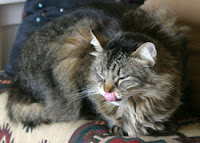
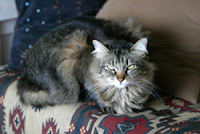
Halala Pala is one of our eight cats, the biggest of the bunch. His name ("Halala” or “Ha” for short) means “big mellow” in Hawaiian, and that fits his personality very well.
We’re pretty sure he’s mostly (or entirely) of a cat breed called “Maine Coon", which are noted for their appearance, their size, their reluctance to jump, and their funny little squeaky voices. Halala has all of these characteristic traits. Most cats that look this big are actually mostly fluffed up hair; Halala is really that big!
I caught him yesterday morning just hanging out on our chair…
Sunday, April 22, 2007
Mark Steyn, in his column today, weighs in on the very predictable liberal hooting and hollering for more gun control following the Virginia Tech massacre. Naturally, being Mark Steyn, he does so in fine style. Here’s a story — a true story, by the way — that forms part of his argument:
A few years back, a couple of alienated loser teens from a small Vermont town decided they were going to kill somebody, steal his ATM cards, and go to Australia. So they went to a remote house in the woods a couple of towns away, knocked on the door, and said their car had broken down. The guy thought their story smelled funny so he picked up his Glock and told 'em to get lost. So they concocted a better story, and pretended to be students doing an environmental survey. Unfortunately, the next old coot in the woods was sick of environmentalists and chased 'em away. Eventually they figured they could spend months knocking on doors in rural Vermont and New Hampshire and seeing nothing for their pains but cranky guys in plaid leveling both barrels through the screen door. So even these idiots worked it out: Where’s the nearest place around here where you’re most likely to encounter gullible defenseless types who have foresworn all means of resistance? Answer: Dartmouth College. So they drove over the Connecticut River, rang the doorbell, and brutally murdered a couple of well-meaning liberal professors. Two depraved misfits of crushing stupidity (to judge from their diaries) had nevertheless identified precisely the easiest murder victims in the twin-state area.
Then Mr. Steyn articulates perfectly an observation I’ve never been able to say quite so clearly:
To promote vulnerability as a moral virtue is not merely foolish. Like the new Yale props department policy, it signals to everyone that you’re not in the real world.
Exactly. “Not in the real world” pretty much sums up the liberal perspective (if that’s actually a good characterization of their bleating) on gun control.
"Promoting vulnerability” is a very nice turn of phrase to describe the lunacy of disarming the law-abiding citizenry, don’t you think?
Thursday, April 19, 2007
Words just fail me…
"I believe myself that the secretary of state, secretary of defense and — you have to make your own decisions as to what the president knows — (know) this war is lost and the surge is not accomplishing anything as indicated by the extreme violence in Iraq yesterday,” said Senator Harry Reid, Democrat from Nevada and Senate Majority Leader.
In his following comments, Senator Reid made it clear that he meant exactly what he said in the preceding quote: that in his judgment, the war in Iraq is “not winnable militarily”.
So…
One of the highest ranking, most powerful members of the political party that controls the legislative branch of the Federal government has decided the United States — by far the most powerful country on the planet — cannot win the war in Iraq. The sniveling worm is ready to unilaterally hand victory to Al Qaida.
After five and a half years of open warfare and struggle on three continents…
After our military forces (with some help, to be fair) have taken out huge numbers of Al Qaida fighters and inflicted grievous harm to the organization…
After Osama Bin Laden has been driven into hiding, and dozens of other Al Qaida leaders killed or captured…
After we have freed the Afghan people from the Taliban and the Iraqi people from the evil despot Saddam…
And just as objective reports on the ground in Iraq cite much progress at just about every level — including ever-increasing readiness of the newly independent Iraqi government to stand on their own feet…
...Harry Reid, that sorry excuse for an American, wants to chuck it all in. Give up. Retreat. Declare defeat. And fight terrorism with economic sanctions and diplomacy. Which, after seeing the results of Nancy Pelosi’s trip to Damascus, we can say with some authority are just code words for appeasement.
Harry Reid and Nancy Pelosi are entirely representative of their party, unfortunately. About the most charitable interpretation I can make of their behavior is that they’ve allowed their partisanship to overwhelm their patriotism. But that’s really just another kind of spin — the truth is, I’m afraid, much simpler:
They’re traitors.
And they’re in charge of Congress.
And they want to put one of theirs in the White House…
Wednesday, April 18, 2007
As some of you actually noticed, the blog was down for a few hours today. I have monitors that continuously watch the Internet connectivity for my server, and today around noon every possible red light and warning buzzer went off. With a little bit of diagnostic work I figured out that it wasn’t one of my servers — it was the entire Internet connection to my server closet, dead as the proverbial doornail.
My servers are not in the boondocks with me — they’re located in the basement of a friend’s home in La Mesa, which is a relatively civilized place, with cable, DSL, grocery stores, etc. My friend’s home is about a 40 minute drive from my home, so whenever something like this happens (thankfully not very often!), I’m faced with the need to make a roughly 90 minute round trip. Usually the problem is simple to fix: just reboot (or power cycle) the DSL router, and I’m back on the air.
But that didn’t work today. Something more serious was wrong. And that meant I needed to get a cell phone (for nobody was home at my friend’s house), and the contact information, circuit number, etc. so I could call Covad (my ISP) and troubleshoot it with them. So off I went, back to my house to pick up this stuff, and then back again to my friend’s house.
When I got back to my friend’s house the second time, my friend (also Tom) was home, and he joined me for the troubleshooting. I went through all the troubleshooting procedures with the very friendly Covad folks, but they couldn’t bring the connection back to life. Through our testing, they figured out that there was a “connectivity problem” — in other words, that somewhere between the telephone company’s office and my friend’s house, the wiring was broken. Fixing this entails a long process involving phone company representatives, appointments, etc. It would take days or (worst case) weeks to get my system back on the air. It didn’t look good.
As a last resort, I decided to check the box where the phone company’s wiring connects to the wiring I had installed. I opened it up, made sure the connections were tight — it all looked fine. But my friend noticed that a foot or so from the box, the wiring to my server cabinet was taped together. The tape looked old, but neither of us could remember having made a junction — especially one that was taped like that. I figured the most likely thing was that we’d forgotten doing it — after all, it had been over a year since we installed this thing. But just for the sake of completeness, without any real hope that this would prove to be the problem, I decided to unwrap the tape and check it out.
I’m very glad I did, as what we discovered was, in fact, the problem!
The first thing we noticed under the tape was that all eight wires in each cable were twisted together — with the insulation still intact. That certainly wasn’t going to work! And after I untwisted them, the two pieces of cable just fell apart — it most definitely wasn’t connected at all.
Ah ha! The problem! And easily fixed, too — my friend noted that there was enough slack that we could simply connect the fresh cut directly to the phone company box, and voila! Everything came back up and worked great.
Which left one mystery: just how did the cable come to be cut at around noon today? My friend then remembered a crucial little bit of information: his gardener had been there today, and he had been wielding a power trimmer. This is just the sort of tool that could cause the damage we saw, and the timing was right as well. Apparently the gardener whacked the cable (sawing off my server cabinet from the Internet) and either decided to hide the accident by taping the wires back together, or he was so ignorant of the mysteries of electronics that he thought he actually fixed it by twisting it together and taping it up. He never mentioned it to my friend.
That’s a new one on me — my “data center” taken out by a gardener!
The tragedy at Virginia Tech is already being used by the left as a vehicle to push through gun control laws. Every time a gun is used in a high-profile crime, this is the predictable consequence.
This time, more than most, it seems to be a particularly moronic response.
Because, in fact, the Virginia Tech campus was a particularly good experiment in rather complete gun control. All guns are banned on campus — even the campus police have no guns, and even faculty and students with concealed-carry permits are not allowed to have those guns on campus. Cho (the murderer) was violating the law when he brought his weapons on campus and used them to kill and wound dozens of people. He had obtained the weapons illegally in the first place. In other words, under existing laws, every step of Cho’s path was illegal.
But it didn’t stop him.
And neither will another slew of laws stop future murders.
I’ve never been able to understand how the left can look at situations like this and decide that the answer is more gun control laws. There just seems to be something about guns that turns a leftish brain to mush. Not only do they have trouble understanding arguments that gun control is actually increases the risks to ordinary, law-abiding citizens — they also manage to avoid acknowledging the abundance of actual evidence supporting that notion.
There are a lot of places in the world (not just in the U.S.!) where ordinary, law-abiding citizens are allowed to carry guns — and in some cases, are actually encouraged to do so. And there are a lot of places in the world (including in the U.S.) where ordinary citizens are forbidden to carry guns. This is not a recent development; it has been true for many years. The world has been conducting an experiment on the effectiveness of gun control in reducing the incidence of violence — and scientists have studied this.
But you won’t hear the left crowing about the results of these studies, or using them as evidence to support their quest for more gun control legislation. Why not?
Because the studies show that increased gun control not only fails to reduce violence upon the citizenry, it actually increases it. The mechanism isn’t hard to discern: citizens who can defend themselves with weaponry equivalent to what the bad guys have are simply less vulnerable.
Well, duh!
There are already reports of several students and faculty who have concealed carry permits and who were in a position to stop Cho — but, being law-abiding citizens, they did not have their guns with them. It also turns out that last year, in response to yet another campus shooting, the Virginia state assembly considered a bill to allow students and faculty who passed a review and permit process to carry guns on campus. The Virginia Tech administration lobbied against this legislation, and in the end the bill never made it out of committee. Afterwards, the Virginia Tech spokesman crowed about their victory, and declared that because this bill was defeated, the students and their parents would feel safe on campus.
I wonder how safe they’re feeling today?
I wonder how the parents of the dead and wounded students would react to that spokesman’s declaration of victory today?
But most of all, I wonder at how anyone can look at situations like this and conclude that disarming the citizenry is the action needed. Me, I think it would be much more productive to train the faculty and students in firearms use and safety, and to issue weapons and ammunition just as we issue books. Think about it — Cho would have had weapons either way, but in my scenario he wouldn’t have gotten very far before some pissed-off coed dropped him in his tracks…
Sunday, April 15, 2007
I have a sure-fire way to cut our income taxes substantially — by half, at least. My plan has just two elements:
Outlaw tax withholding.
Today the vast majority of Americans have both their federal and state income taxes withheld from every paycheck. Instead, I’d like to see every U.S. citizen who earns an income make out a check every quarter to pay their taxes (this is what contractors do today). By making every citizen cut a check, we’ll make every citizen aware that they’re paying it (many people never even think about the withheld taxes). By making it quarterly, the size of the tax bite will be that much more evident.
Hold all elections on April 16th.
It is no accident that “tax day” is a long way from election day. Let’s fix that, and hold elections when the pain of tax extraction is fresh and clear in the voter’s minds. I promise you that politicians promising tax cuts will get extra attention that close to tax day!
What do you think about my simple, two-step plan?
Saturday, April 14, 2007
About seven months ago, I posted about the non-breaking Kevlar shoelaces I’d discovered. Well, today I finally had to replace my first pair of them. They lasted seven months, instead of the few weeks (or even just a few days!) that I’d get out of the ordinary types of shoelaces. I have no complaints about them at all, and they were worth every penny!


This afternoon I took Miki and Lea on a walk around the yard, and found this fellow in bloom uphill from where we park our cars. Gorgeous thing!
I also took about thirty photos of one of the bazillion bees working hard at collecting all the pollen and nectar, but not a single one of them came out. Those busy bees are amazingly difficult photographic subjects…
Just a few weeks ago I was searching for information on an unusual French slide rule (the “Supremathic"). I posted a question a Yahoo Group (ISRG), and a French slide rule collector named Marc Thomas responded with some very useful information. He and I exchanged several emails, and a couple of weeks ago he mentioned that he and his wife (Dominique) would be visiting the U.S. to see their daughter. It turns out that their daughter lives in Riverside, California, which is just 100 miles or so north of us. So Marc wondered if perhaps he could visit while he was over here.
Although meeting another collector (and showing off my collection!) sounded like an interesting experience, my first thoughts were to discourage him. Most Americans who try to find our home have trouble (we’re way, way out in the boondocks!), so what were the chances of a Frenchman, in unfamiliar territory, locating us? I wrote back to tell him I’d love to meet up, but that he should be concerned about the distance and remoteness. I figured that would be the end of that…
But yesterday morning, I got another email from Marc — he and his wife were in Riverside, and he wondered if it would be possible to visit with us that very afternoon! So I wrote up some very detailed directions for him, and sent them off by email. The plan was for him to arrive sometime after 4 PM, and he’d call if he couldn’t make it.
Well, 4 PM rolled around, and no call from Marc. And 15 minutes later, a little red car came rolling up our driveway, and out popped Marc and Dominique. They made it!
For the next couple of hours, we had a most enjoyable meeting with these folks. It turns out that Marc is a professor of mathematics, and Dominique a professor of history. Dominique and Debbie immediately got into a conversation about cats, and dogs — and Dominique was fascinated by our birds, especially the hummingbirds. Marc and I went through a couple dozen of my slide rules, and it was great fun to show him several that he had read about, seen photos of, but had never actually seen in person. Debbie got to show off her collection of ribbons from dog competitions, and it was a lot of fun to watch Dominique going through them — she particularly liked the multi-colored “title” ribbons.
Marc and Dominique wanted to drive back to Riverside in the daylight, so they had to leave quite early. We could hardly blame them for wanting to drive while it was light, but we would have greatly enjoyed a longer visit. It was quite an adventure for them to drive all the way down here, and they got to see some parts of California rarely seen by most Americans, let alone people from another country. And it was quite an adventure for us as well — meeting this very interesting couple with a vastly different life experience than ours, but still having many points of common interest. Marc is the first slide rule collector who has ever actually seen my collection — while I have parts of it on the web, and I correspond with dozens of collectors, not a single one has ever made it out here before!
