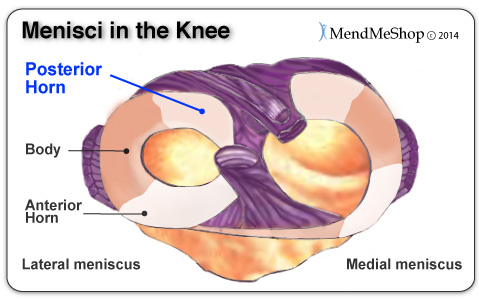
Debbie update... We just heard back from her orthopedist after he had a chance to review her knee MRI. There's a clear diagnosis: a posterior horn medial meniscus tear. The orthopedist unequivocally recommended surgery for her tear (they vary quite a bit). We're in the process of getting that set up right now.
This is actually a bit of a relief for us. The meniscus tear, in the grand scheme of things, is far from the worst sorts of injury that can happen to a knee. Debbie's already experienced one of the worst: a tibial plateau fracture, and a bad one at that. Generally surgery to repair meniscus tears is arthroscopic, low risk, and fast recovery. We're hoping that hers will fall into that category.
Also, there's quite likely a bit of a bonus for Debbie in this surgery. When she had her tibial plateau fracture surgery (two and a half years ago), the surgeon “installed” a significant quantity of very expensive hardware – a fancy plate and a half dozen or so titanium screws. She could never bring herself to schedule a surgery just to remove that hardware, so she's been clanking around with it (well, it doesn't really clank) ever since. We're going to see if it can be removed at the same time the meniscus repair is done.
Phone just rang, and she has an appointment with a knee specialist next Thursday...
Thursday, June 11, 2015
Precipitation in Paradise...
Precipitation in Paradise... We had a surprise thunderstorm last night. The forecast was for overcast, but we got a bit more than that – four tenths of an inch more, to be precise! Our backyard is now once again a mud bowl, and it will take a few days to dry out. Meanwhile, we have more rain actually forecast for this afternoon.
A couple of months ago, the locals with long experience here were worried about a drought. Now they're worried about their hay rotting in the sopping fields. Crop dusters (both fixed wing and helicopter) are having a boom time here, as many fields are too wet for a tractor spraying rig to traverse them. I also saw a fantastical machine the other day (too far away to get a photo): a spraying machine with around a 100' wide spray boom, all running on the sort of giant balloon tires you see on dune buggies, but scaled way up. Those tires spread the weight of the rig over quite a large ground area, and he wasn't sinking into the muck at all. The photo at right will give you the general idea, but the one I saw was much larger...
Visual perspectives...
There's something similar that I hope to do in my retirement: capture natural sounds that we cannot hear because they are too low or too high in frequency, or their modulation is too low or too high in frequency. I'd also like to develop a phase-array microphone that will let me accurately point a camera at the source of a sound (especially for birds). Way back in the early '80s I briefly played around with these notions, but the compute power available then made it impractical. Today the compute power in my iPhone is more than adequate! Digital audio capture and electronic phase delay has also gotten much easier and cheaper than it used to be. I think the most challenging aspect of these projects today will be the digital signal processing (software), not the hardware...
Wednesday, June 10, 2015
Yet another way to choose where to retire...
Yet another way to choose where to retire... I didn't have this information when we chose Cache County, Utah – but it's nice to have the affirmation anyway. The map shows UFO sightings per capita, and Cache County basically doesn't have any. I read that as the population here being a bit more grounded than in many other places. Northern California, Oregon, Maine, and Washington state: I'm looking at you...
“I say we should ban cows and human farting.”
“I say we should ban cows and human farting.” So says friend and former colleague Simon M. in his sarcastic reaction to the news about the EPA proposing to regulate methane, carbon dioxide, and other “climate change inducing” chemicals from commercial airliners.
His comment relates to the fact that cow farts and human farts are also sources of methane, and therefore potentially subject to EPA regulation as well. Mandated Beano, anyone? I suspect my wife would approve :)
Aircraft engines produce (primarily) nitrogen, water vapor, and carbon dioxide as exhaust gas components. There isn't much room to make the engines more efficient, as commercial pressure from high fuel prices has done wonders there already. Nitrogen isn't a concern with respect to climate change. Carbon dioxide is the main thing the EPA is proposing to regulate. The EPA does not propose regulating water vapor emissions, despite the fact that water vapor is dozens of times more potent a greenhouse gas than carbon dioxide is.
So lets think about this for a moment. The EPA tells commercial aircraft manufacturers that they must reduce the carbon dioxide emissions. What mechanisms do the manufacturers have available to them? The most obvious one is to switch to fuels that have more of their energy in hydrogen, rather than carbon – which will have the effect of increasing water vapor emissions. Which, remember, are far worse for climate change than carbon dioxide is.
Now does this make sense in any universe? Sure it does! In the universe of the loony politicians!
The only other choices are to switch to exotic fuels that don't have carbon in them (very, very expensive), or to slow down the aircraft (because overall fuel consumption goes down non-linearly with speed, thus reducing emissions).
Shakespeare wrote (in Henry the Sixth) “The first thing we do, let's kill all the lawyers.” I think his priorities were slightly off – first should have been the environmentalist wackos, then the lawyers (which has the knock-on effect of getting most politicians as well)...
His comment relates to the fact that cow farts and human farts are also sources of methane, and therefore potentially subject to EPA regulation as well. Mandated Beano, anyone? I suspect my wife would approve :)
Aircraft engines produce (primarily) nitrogen, water vapor, and carbon dioxide as exhaust gas components. There isn't much room to make the engines more efficient, as commercial pressure from high fuel prices has done wonders there already. Nitrogen isn't a concern with respect to climate change. Carbon dioxide is the main thing the EPA is proposing to regulate. The EPA does not propose regulating water vapor emissions, despite the fact that water vapor is dozens of times more potent a greenhouse gas than carbon dioxide is.
So lets think about this for a moment. The EPA tells commercial aircraft manufacturers that they must reduce the carbon dioxide emissions. What mechanisms do the manufacturers have available to them? The most obvious one is to switch to fuels that have more of their energy in hydrogen, rather than carbon – which will have the effect of increasing water vapor emissions. Which, remember, are far worse for climate change than carbon dioxide is.
Now does this make sense in any universe? Sure it does! In the universe of the loony politicians!
The only other choices are to switch to exotic fuels that don't have carbon in them (very, very expensive), or to slow down the aircraft (because overall fuel consumption goes down non-linearly with speed, thus reducing emissions).
Shakespeare wrote (in Henry the Sixth) “The first thing we do, let's kill all the lawyers.” I think his priorities were slightly off – first should have been the environmentalist wackos, then the lawyers (which has the knock-on effect of getting most politicians as well)...
Paradise progress...
Paradise progress... Debbie's still doing fine. We've got a followup appointment with her orthopedist in two weeks, and we're both hoping that the level of pain and sensitivity has gone way down by then.
Today has been a day of chores and running around for me. Mostly little things, but I did get the screen replaced in the screen door of our kitchen. Replacement was necessitated by Race running straight through the old one to get outside, as though it wasn't even there. One second we had a nice, taut screen door; the next second the screen was flapping in the breeze and Race was a mere dot in the corner of the yard. Sigh. I ran to Home Depot, got some “pet proof” screen and an expanded metal grille for the bottom half of the door. I spent the best part of the day removing the screen door, cleaning out all the old screen (the rubber spline had become one with the frame), stretching and splining the new screen, installing the grille, and finally reinstalling the door. Every single step of the way something went wrong, of course. There was much Navy-learned language employed; the box elder bugs all ran away and the dogs were blushing.
Palliative care...
Palliative care ... is prescribed for the U.S.:
WASHINGTON—Saying there were no other options remaining and that continued intervention would only prolong the nation’s suffering, experts concluded Tuesday that the best course of action is to keep the United States as comfortable as possible until the end.It's one of those times where The Onion doesn't really seem like satire...
According to those familiar with its condition, the country’s long, painful decline over the past several decades has made it clear that the most compassionate choice at this juncture is to do whatever is possible to ensure America is at ease during its last moments.
Tuesday, June 9, 2015
I had conversations like this many times...
I had conversations like this many times... I once worked for a company named Stac Electronics. At one point the company hired a new CEO (J.T., for insiders). Read today's Dilbert strip:
This brought back instant memories, and for me, some laughter. That CEO – who was running a software company – had technical expertise that was over-matched by any randomly-selected decomposing aardvark. I was, at the time, the company's chief technical officer. After my first few attempts to have a meaningful conversation with him (my boss!) about anything I did, I gave up. Then I started entertaining myself at his expense, by trying to see just how nonsensical a conversation I could have without him picking up on it.
I never found the limit. He resigned (for other reasons) before he had any clue what I was doing...
This brought back instant memories, and for me, some laughter. That CEO – who was running a software company – had technical expertise that was over-matched by any randomly-selected decomposing aardvark. I was, at the time, the company's chief technical officer. After my first few attempts to have a meaningful conversation with him (my boss!) about anything I did, I gave up. Then I started entertaining myself at his expense, by trying to see just how nonsensical a conversation I could have without him picking up on it.
I never found the limit. He resigned (for other reasons) before he had any clue what I was doing...
Paradise update...
Paradise update... We're back from getting Debbie's knee MRI. It wasn't fun :( She's happy to be back home, in bed, her Savannah cat (Jahar) by her side...
Monday, June 8, 2015
Paradise Progress...
Paradise Progress... Debbie is doing just fine. She's not happy about being black-and-blue, or in pain, or not being able to even hobble around – but she's showing signs of improvement (pain is subsiding, she's eating better, and the swelling is going down all over). I'd post some photos of the black-and-blue, but I'm being threatened with all sorts of horrible punishments if I even think about that very hard. Tomorrow she goes in for an MRI of her knee. This is the same knee she broke over two years ago, and we want to make sure there's no cartilage or ligament damage.
Yesterday and today I made great progress repairing the damage to our back yard from all the hectic trenching we did last fall to get services (gas, water, electricity, network) to the shed. I've been holding off until the ground dried out enough for me to run the tractor over the back lawn without leaving deep ruts. I've been doing a lot of shovel work, using the forklift to replace concrete slabs back from where we'd removed them, and the loader to move small mountains of soil around to fill in trenches. Today I finished everything I can immediately do with the tractor. Tomorrow I'll start the finish leveling by hand, with shovel and rake. I'm guessing I've got two or three days of work on that, and then I'll be planting grass seed.
Now that the back yard has dried out, and isn't a giant bowl of mud, we're letting the dogs run around back there. They love it – an acre of nice green grass all to themselves!
I picked up my new glasses today. I can see again – hurray!
Yesterday and today I made great progress repairing the damage to our back yard from all the hectic trenching we did last fall to get services (gas, water, electricity, network) to the shed. I've been holding off until the ground dried out enough for me to run the tractor over the back lawn without leaving deep ruts. I've been doing a lot of shovel work, using the forklift to replace concrete slabs back from where we'd removed them, and the loader to move small mountains of soil around to fill in trenches. Today I finished everything I can immediately do with the tractor. Tomorrow I'll start the finish leveling by hand, with shovel and rake. I'm guessing I've got two or three days of work on that, and then I'll be planting grass seed.
Now that the back yard has dried out, and isn't a giant bowl of mud, we're letting the dogs run around back there. They love it – an acre of nice green grass all to themselves!
I picked up my new glasses today. I can see again – hurray!
Sunday, June 7, 2015
Just listen...
Just listen ... to this whiny, self-important little mind: Why I Defaulted on My Student Loans. The author is one Lee Siegel, best known for his sock-puppetry at The New Republic a few years back. This conspicuous moron:
This is what we get when we encourage a culture of entitlement – morons who believe they're entitled to have the rest of us pay for whatever they want.
I have no patience for that attitude, and I am not willingly going to pay for his chioces. Our student loan programs may be administered by idiots, and they are most definitely contributing to the high cost of college these days (especially when college is more about the amenities and the partying than the education), but still: it was his choice to partake. Lee Siegel and the others like him should have their student loan payments extracted from them by force if that's what it takes...
- Chose to go to colleges with expensive tuitions
- Chose to borrow the money to do so
- Willingly accepted the offered loan
This is what we get when we encourage a culture of entitlement – morons who believe they're entitled to have the rest of us pay for whatever they want.
I have no patience for that attitude, and I am not willingly going to pay for his chioces. Our student loan programs may be administered by idiots, and they are most definitely contributing to the high cost of college these days (especially when college is more about the amenities and the partying than the education), but still: it was his choice to partake. Lee Siegel and the others like him should have their student loan payments extracted from them by force if that's what it takes...
New Horizons...
New Horizons... The NASA robotic explorer New Horizons is set to do a close flyby of the planet (or whatever they're calling it these days) Pluto. At it's closest approach, on July 14th, it will be just 7,800 miles from Pluto's surface.
How close is that? At it's closest approach to Earth, Pluto is almost 46 billion miles away. Aiming New Horizons to approach within just 7,800 miles is phenomenally good aiming. It's the equivalent of shooting a gun at a target a mile away, and deliberately missing the bulls-eye by exactly a tenth of an inch. NASA was able to make some course corrections along the way, but still ... that's mighty fine shooting!
New Horizons was launched in January 2006, over nine years ago. That's one very long voyage it's on. It's still in perfect condition, too – a testament to some excellent engineering and fabrication work. Surviving nine years in the harsh environment of space didn't happen by accident. The mission of the New Horizons explorer will continue for at least another year, exploring the Kuiper Belt for the first time. The mission team has identified several Kuiper Belt objects that they'd like to fly by, and if they get their extended mission (through about 2020) funded, they'll be able to do it. The funding required is far less than the launch of an ISS mission, but nevertheless it's at risk due to the priorities given (pretty much totally useless) manned spaceflight...
How close is that? At it's closest approach to Earth, Pluto is almost 46 billion miles away. Aiming New Horizons to approach within just 7,800 miles is phenomenally good aiming. It's the equivalent of shooting a gun at a target a mile away, and deliberately missing the bulls-eye by exactly a tenth of an inch. NASA was able to make some course corrections along the way, but still ... that's mighty fine shooting!
New Horizons was launched in January 2006, over nine years ago. That's one very long voyage it's on. It's still in perfect condition, too – a testament to some excellent engineering and fabrication work. Surviving nine years in the harsh environment of space didn't happen by accident. The mission of the New Horizons explorer will continue for at least another year, exploring the Kuiper Belt for the first time. The mission team has identified several Kuiper Belt objects that they'd like to fly by, and if they get their extended mission (through about 2020) funded, they'll be able to do it. The funding required is far less than the launch of an ISS mission, but nevertheless it's at risk due to the priorities given (pretty much totally useless) manned spaceflight...
Innovations in education...
Innovations in education... These sorts of articles always leave me with a funny feeling, as they generally leave out the education method that's worked so well for me: self-education. It's not that I think there's no place for pedagogy – there clearly is. The vast majority of people I know both got their education in some sort of institutional setting, and expect that's where their education (and their kids') will come from. But I think there's a place for autodidacts as well.
Institutional education (i.e., schools) weren't completely useless for me, but they weren't far off. I was bored out of my skull in just about every classroom; the few exceptions provide the few good memories of my school experience that I have. Part of the problem was the slow pace, but the bigger problem was the shallow treatment of just about every subject. I was constantly wondering Why? Why? Why? in nearly every subject, and I wasn't getting answers from either the teachers (to whom I was an annoying pest) or the texts (which even then I could tell were glossing over huge areas of interesting knowledge).
On the other hand, the schools provided me with something I did need: access to textbooks (there was no Internet back then, so books were the only source of recorded knowledge), through the school libraries. Those books I absorbed on my own, almost entirely. Every once in a while I'd have a question I couldn't figure out, and a librarian (most often) or a teacher (occasionally) would answer it. All too often, though, what I got was an admonition to stick to material more suited to my age. For example, in high school I got very interested in understanding how semiconductors (the basis of transistors) worked – and when I asked my physics teacher about it, he advised me to wait until I was in college to investigate that. So I learned about semiconductors from a book checked out from the school library, instead – and what I wanted to understand was easily accessible by an interested high school student with a limited mathematics background.
Once I left high school, I continued my exploration of science and engineering on my own. I had my own motivations, even if I didn't understand them, and I didn't need a teacher to be able to learn the things I wanted to. That has been a lifelong habit of mine, continuing even now in my dotage.
This is the source of that funny feeling I mentioned at the start of this post. I've never quite been able to figure out why so many people seem to depend on institutional education. I'm convinced at this point, after having met quite a few others with the same point of view, that the answer has little to do with native intelligence (that mainly seems to affect the speed with which one learns) and much more to do with the motivation and will of the individual. There's something else as well, something to do with that expectation of institutional education. I've heard a great many people make the assumption that if they wanted to learn X, then they'd have to go to school (take a course, etc.) to do so. Relatively few people assume that they can learn X on their own. I have no idea why that's the case, because these days – especially with the information resources available for free on the Internet – there's very little in the way of obstacles impeding anyone from learning just about anything.
I have the sense that self-education is on the rise, though. It's definitely more respectable in the engineering world these days :) I think the Internet is making it more common, as well. I hope so...
Institutional education (i.e., schools) weren't completely useless for me, but they weren't far off. I was bored out of my skull in just about every classroom; the few exceptions provide the few good memories of my school experience that I have. Part of the problem was the slow pace, but the bigger problem was the shallow treatment of just about every subject. I was constantly wondering Why? Why? Why? in nearly every subject, and I wasn't getting answers from either the teachers (to whom I was an annoying pest) or the texts (which even then I could tell were glossing over huge areas of interesting knowledge).
On the other hand, the schools provided me with something I did need: access to textbooks (there was no Internet back then, so books were the only source of recorded knowledge), through the school libraries. Those books I absorbed on my own, almost entirely. Every once in a while I'd have a question I couldn't figure out, and a librarian (most often) or a teacher (occasionally) would answer it. All too often, though, what I got was an admonition to stick to material more suited to my age. For example, in high school I got very interested in understanding how semiconductors (the basis of transistors) worked – and when I asked my physics teacher about it, he advised me to wait until I was in college to investigate that. So I learned about semiconductors from a book checked out from the school library, instead – and what I wanted to understand was easily accessible by an interested high school student with a limited mathematics background.
Once I left high school, I continued my exploration of science and engineering on my own. I had my own motivations, even if I didn't understand them, and I didn't need a teacher to be able to learn the things I wanted to. That has been a lifelong habit of mine, continuing even now in my dotage.
This is the source of that funny feeling I mentioned at the start of this post. I've never quite been able to figure out why so many people seem to depend on institutional education. I'm convinced at this point, after having met quite a few others with the same point of view, that the answer has little to do with native intelligence (that mainly seems to affect the speed with which one learns) and much more to do with the motivation and will of the individual. There's something else as well, something to do with that expectation of institutional education. I've heard a great many people make the assumption that if they wanted to learn X, then they'd have to go to school (take a course, etc.) to do so. Relatively few people assume that they can learn X on their own. I have no idea why that's the case, because these days – especially with the information resources available for free on the Internet – there's very little in the way of obstacles impeding anyone from learning just about anything.
I have the sense that self-education is on the rise, though. It's definitely more respectable in the engineering world these days :) I think the Internet is making it more common, as well. I hope so...
Saturday, June 6, 2015
Progress in Paradise...
Progress in Paradise... Debbie's doing fine. There were a few changes today. The most noticeable one: she developed a spectacular shiner (a black eye), with a dark blue/purple bruise extending nearly all the way around her eye. This afternoon that same part of her face swelled, but it has since gone back down. The pain and swelling in various other places is starting to recede. The pain medication she's taking is an excellent appetite suppressant, but I managed to find some food that she enjoyed: french fries and turkey salad from a place that's new to us. It's called “Juniper”, and it's located in downtown Logan. Our neighbor Tim D. recommended it to us for the soups (which I bought some of, but we haven't tried yet). I tried a halibut sandwich, and it was just plain delicious. The fish was perfectly done, and there was plenty of it – on a nice bun that tasted homemade, though there are enough great bakeries here that it could be store-bought. It's clear this is a place that we will return to.
In between other things today, I managed to get the lawn mowed. I also mowed down about an acre of weeds to the west of our house. Things are looking much neater around the homestead :)
I took the dogs for a walk in which we passed a neighbor's pasture that is currently the home to a couple of beautiful horses. The horses were interested in the dogs, and vice versa. Race got a good nose-rub in with the second of the horses in the photos below:
I've posted a couple photos of the robin chicks, in a low nest built in a half-dead tree in our front yard. Here's what they looked like today – they're outgrowing their puny nest:
In between other things today, I managed to get the lawn mowed. I also mowed down about an acre of weeds to the west of our house. Things are looking much neater around the homestead :)
I took the dogs for a walk in which we passed a neighbor's pasture that is currently the home to a couple of beautiful horses. The horses were interested in the dogs, and vice versa. Race got a good nose-rub in with the second of the horses in the photos below:
I've posted a couple photos of the robin chicks, in a low nest built in a half-dead tree in our front yard. Here's what they looked like today – they're outgrowing their puny nest:
D-Day...
Light blogging alert...
Light blogging alert... On Thursday evening I took our dogs for a short walk just before we planned to retire. When I came back in the house, Debbie was sitting on the bottom of the stairs, looking dazed and a bit confused. She'd fallen down the stairs just a minute or so earlier – she'd been walking down them in her stocking feet, and the slipped out from under her. I saw her hand swelling up rapidly, and she was feeling pain in her knee (the one she broke two years ago), head (which had a big bump), and hand. Time for the ER.
There we had the same general sort of experience we've had before with medical care here – all good. The people, in particular, were wonderful. The ER doctor on duty was the same fellow who saw Debbie after her fall in March. When we walked in, she was the only patient there – but soon afterward, the ER filled up, so naturally things got a little slower. We were there for a couple hours. They got her on pain medication quickly, then it was X-ray time. Lots of X-rays, from head to toe. The good news: nothing was broken. The bad news: lots of bruising, a broken vein in her hand (hence the swelling), and the pain in the knee (twice injured already) is worrisome. We've got an MRI scheduled for next Tuesday to get the knee checked out more thoroughly.
Meanwhile, Debbie is doped up and laid up. I'm taking care of all the things she normally does, plus helping her out as needed. She can't (yet) walk or get around on her own, so there's lots to do.
So blogging will be light...
There we had the same general sort of experience we've had before with medical care here – all good. The people, in particular, were wonderful. The ER doctor on duty was the same fellow who saw Debbie after her fall in March. When we walked in, she was the only patient there – but soon afterward, the ER filled up, so naturally things got a little slower. We were there for a couple hours. They got her on pain medication quickly, then it was X-ray time. Lots of X-rays, from head to toe. The good news: nothing was broken. The bad news: lots of bruising, a broken vein in her hand (hence the swelling), and the pain in the knee (twice injured already) is worrisome. We've got an MRI scheduled for next Tuesday to get the knee checked out more thoroughly.
Meanwhile, Debbie is doped up and laid up. I'm taking care of all the things she normally does, plus helping her out as needed. She can't (yet) walk or get around on her own, so there's lots to do.
So blogging will be light...
71 years ago today...
71 years ago today ... the Allies invaded Normandy, marking the start of the extended invasion from the Nazi's west (the Soviets were already attacking from the Nazi's east). After much hard fighting, the Allies brought the Nazis to their knees, and the European front of WWII was over.
I've walked Omaha beach in Normandy, and visited quite a few sites of battles in WWII. I've also visited three Nazi concentration camps, and the ruins of Soviet fortifications in Estonia, and Nazi gun emplacements outside St. Petersburg (Leningrad). While I've read quite a bit of history (especially of WWII and the rise to power of the Nazis and the Meiji), but physically visiting the sites of the events I'd read about was more moving, more profound than reading alone could ever be. On the Pacific side, I've visited Hiroshima, Nagasaki, Okinawa, Tarawa, and Peleliu. My reading of history and those experiences have shaped me, especially politically. I wish more Americans could (and would) do the same...
Friday, June 5, 2015
Progress in Paradise...
Progress in Paradise... Debbie and I managed to get all the EVA foam laid down in her indoor agility court, on the west side of our shed. The first photo below shows the work in progress; the second shows the finished result. Installing this stuff was actually quite easy, though we had to learn some new tricks along the way. One unexpected challenge: the squares of foam are cut to metric size. Though they were sold as one yard square of 3/4" thick foam, they are actually one square meter (39.37" on a side) and 2 cm thick (which is slightly more than 3/4"). This made our layout just a tad more tricky than we'd first imagined, as of course our room is laid out in feet and inches. Oh, well :)
The EVA foam is pretty tough stuff. Cutting it with a knife, or possibly with big shears, looked like it would be a real pain in the patoot. So I did the obvious thing and looked it up on google: presto! A whole world of video tutorials, written descriptions, etc. The answer turned out to be straightforward: use a hot knife. Great. Where does one get a hot knife? Well it turns out I already had one, and didn't even know it! Last year I bought a Weller soldering gun, to do some heavy duty soldering. In the kit was a pair of hot knife bits. They can only cut about 1/4" deep, but three passes and I had it. It worked like a champ, especially when we figured out that Debbie could separate the cut while I wielded the (massive) soldering gun. I made one mistake while doing the whole floor, and we managed to re-use the square I messed up anyway.
While we were partway through this exercise, a crew from Statewide Paving showed up to “seal” our driveway. This isn't something I knew about until last year, when our neighbor Tim D. – a former paving supervisor – educated me about it. This is an area of business rife with shady operators and inferior products, so choosing the right product and contractor is important. These folks Tim had done business with before, and he knew that they did good work with the best product (a pure asphalt spray that contains no water).
The photos below show them at work on two of the three phases of the job. The first phase is simply cleaning off the driveway (no photo). They use a special wheeled blower with a 10 HP gas engine; it's powerful enough to blow fist-sized rocks right off the driveway. They also scrape any heaped-up soil or other junk off the pavement. This first phase is more than half the labor of the whole job. The second phase is filling in all the pits and cracks with a special thick asphalt (first photo below). Then, finally, they spray on the sealer (last photo). The guys were really good with a piece of plywood used as a shield to keep the spray off our lawn and plants.
Because our driveway had never been sealed before, they're going to put two coats on. The second coat goes on today.
So what does a sealer do, anyway? It makes the top surface of the pavement watertight, and (when done right) fills in all the little pits in the top surface. Both of these effects prevent water from infiltrating the pavement and then freezing in the winter (which would crack the pavement). Asphalt pavement, when first laid down, is a mixture of asphalt, gravel, and sand. It's not solid, though – in fact, it's rather porous. The sealer puts that waterproof layer on top...
The EVA foam is pretty tough stuff. Cutting it with a knife, or possibly with big shears, looked like it would be a real pain in the patoot. So I did the obvious thing and looked it up on google: presto! A whole world of video tutorials, written descriptions, etc. The answer turned out to be straightforward: use a hot knife. Great. Where does one get a hot knife? Well it turns out I already had one, and didn't even know it! Last year I bought a Weller soldering gun, to do some heavy duty soldering. In the kit was a pair of hot knife bits. They can only cut about 1/4" deep, but three passes and I had it. It worked like a champ, especially when we figured out that Debbie could separate the cut while I wielded the (massive) soldering gun. I made one mistake while doing the whole floor, and we managed to re-use the square I messed up anyway.
While we were partway through this exercise, a crew from Statewide Paving showed up to “seal” our driveway. This isn't something I knew about until last year, when our neighbor Tim D. – a former paving supervisor – educated me about it. This is an area of business rife with shady operators and inferior products, so choosing the right product and contractor is important. These folks Tim had done business with before, and he knew that they did good work with the best product (a pure asphalt spray that contains no water).
The photos below show them at work on two of the three phases of the job. The first phase is simply cleaning off the driveway (no photo). They use a special wheeled blower with a 10 HP gas engine; it's powerful enough to blow fist-sized rocks right off the driveway. They also scrape any heaped-up soil or other junk off the pavement. This first phase is more than half the labor of the whole job. The second phase is filling in all the pits and cracks with a special thick asphalt (first photo below). Then, finally, they spray on the sealer (last photo). The guys were really good with a piece of plywood used as a shield to keep the spray off our lawn and plants.
Because our driveway had never been sealed before, they're going to put two coats on. The second coat goes on today.
So what does a sealer do, anyway? It makes the top surface of the pavement watertight, and (when done right) fills in all the little pits in the top surface. Both of these effects prevent water from infiltrating the pavement and then freezing in the winter (which would crack the pavement). Asphalt pavement, when first laid down, is a mixture of asphalt, gravel, and sand. It's not solid, though – in fact, it's rather porous. The sealer puts that waterproof layer on top...
Thursday, June 4, 2015
Subscribe to:
Posts (Atom)