Our living room opens onto our patio through a sliding glass door, or at least it used to. Our old door was an old-fashioned glass door made of many individual panes of glass all held together by a wooden frame. Our dogs, through years of scratching at the door, had worn through one of the wooden frame pieces, and burst one pane of glass right out of the door. I made some emergency repairs with epoxy on the day it happened – and then we bought a replacement door. This time it's a conventional hinged door (not sliding), and with a steel frame. The dogs will not hurt this one!
I guessed that replacing the door would take a couple of days for Debbie and I, and that we might need some help (the new door was heavy!). So we lined up Jimmy B. (our friend and neighbor) for some help, and this weekend was scheduled.
Saturday we “demoed” (demolished) the old door first. This ended up taking most of the day, and involved one major frustration. Once we got the old door physically out of the wall, we did a trial fit of the new door. It's outside trim was larger than the hole left by the old door – we needed to cut between a half inch and an inch of stucco all the way around the door. That's about 22 feet of stucco to cut. Some of you may not be familiar with stucco – it's basically a half to three-quarters of an inch of concrete slapped onto a wire mesh made of high tensile strength steel wire.
I'd never cut stucco before, so I did some Googling and found lots of advice. All of it recommended using a diamond saw blade on a 7" angle grinder. Naturally, this is a tool I didn't own (doesn't it always work that way?). So down to Lowe's I went (an hour's round trip) to buy an angle grinder and a 7" serrated diamond blade. I got back home, unpacked the new tool – and promptly discovered that there was no way the blade would fit on the angle grinder. Argh! Back down to Lowe's I went, whereupon I met up with a very helpful tools guy. It seems that California passed a law that went into effect on January 1 of this year, outlawing angle grinders that would accept a saw blade. Anywhere else in the U.S. I could still buy one, but not here. Double argh! Damn the nanny state! However, the tool guy did make one very helpful suggestion: the diamond blade would do the same job on a worm-drive circular saw – and that's a tool I happened to own. So back home I went, and drug out the huge, heavy, worm-drive circular saw. I fitted the diamond blade and went to work cutting stucco. This worked extremely well, but generated huge quantities of fine white dust. We had to seal up the house with plastic to keep the dust out, and even so some leaked in.
Once we got the hole cut, the more satisfying work began. On Saturday evening we got the door in place, tacked it in (just enough to keep it from falling out). On Sunday, we adjusted it for level and squareness, screwed it into the frame very securely, then filled the voids all around with construction foam (wonderful stuff!). Then came the really fun part, the part that involved some craftsmanship: we formed a concrete support for the sill, patched the stucco all around the outside of the frame, and then re-grouted the gap between the inside sill and the entranceway tile. That took all day, but when we were done it actually looked like a real door. Now the only thing we have left to do is to trim off the construction foam that expanded outside the frame, and then mount some trim boards around the inside of the frame. Easy stuff!
The work we did on Sunday was strangely satisfying to me, in the same way that writing some challenging software is satisfying. It's something about the need to engage my brain, the pure craftsmanship involved in building something, and obtaining pleasing results. All of that put together is a reliable way for me to have a good day.
Plus we have a new door!

Monday, June 25, 2012

Charlottesville, Virginia: Epicenter of Greekness...
The University of Virginia is currently dealing with it's own version of the economic crisis facing Greece. On the one side, fiscal sanity and a modicum of rationality – and unattractive squareness. On the other side, a belief in magic, a second helping of irrationality – and media-friendly progressivism. Who will win? The Wall Street Journal describes the mess...
Dance of the Robots...
These are industrial robots – by far the most common kind of robot, though many people have never seen one before. They come in many varieties; this one is a general-purpose type that can be fitted with many different tools at the working end. Someone with far too much time on their hands put this together. I don't care much for the music, but I find the idea of choreographed robots fascinating...and strangely attractive:
Quote of the Day...
Via my mom, a tweet from David Burge (aka Iowahawk):
Apparently, I'm supposed to be angrier about what Mitt Romney does with his money than what Barack Obama does with mine.
ObamaCare...
Today is probably the big day: the day that the Supreme Court announces their ruling on the challenge to ObamaCare's constitutionality. Though they still have the option to delay their ruling even longer, if they follow their traditional schedule of ruling announcements, today would be the day.
Some folks (like myself) have trouble understanding how ObamaCare supporters could be supporters – the flaws of the bill are numerous and pretty obvious. Here's an interesting post on a very liberal web site that lists the 10 things we're going to miss if ObamaCare is struck down.
To me, this list is a wonderful capsule view of the progressive mentality. Basically it's a list of benefits without any tinge of the consequent costs. It's tantamount to saying “Wouldn't you like to have a bag of gold delivered into your hands every morning?” – without ever stopping to think how you're going to pay for it. Don't worry about it! The government will provide. Why, yes, of course I'd like my daily bag of gold!
Idiots. Shallow, self-centered, feel-good, irrational, “gimme-gimme” obliviots. The trouble is, there are so damned many of them that they've managed to elect a government. They deserve the government they elect. Trouble is, they drag me (and my wallet!) along with them, kicking and screaming.
November 2012. It may be this country's last real hope, else we go the way of Greece...
Some folks (like myself) have trouble understanding how ObamaCare supporters could be supporters – the flaws of the bill are numerous and pretty obvious. Here's an interesting post on a very liberal web site that lists the 10 things we're going to miss if ObamaCare is struck down.
To me, this list is a wonderful capsule view of the progressive mentality. Basically it's a list of benefits without any tinge of the consequent costs. It's tantamount to saying “Wouldn't you like to have a bag of gold delivered into your hands every morning?” – without ever stopping to think how you're going to pay for it. Don't worry about it! The government will provide. Why, yes, of course I'd like my daily bag of gold!
Idiots. Shallow, self-centered, feel-good, irrational, “gimme-gimme” obliviots. The trouble is, there are so damned many of them that they've managed to elect a government. They deserve the government they elect. Trouble is, they drag me (and my wallet!) along with them, kicking and screaming.
November 2012. It may be this country's last real hope, else we go the way of Greece...
Balancing the Budget – in 10 Minutes...
When you need a budget done quickly and effectively, just go to your nearest talk show host for assistance:
Sunday, June 24, 2012
Holder, If You Won't Explain...
...then other people are going to start speculating on what you're hiding. Here's one smart guy came up with, quite plausible (if horrifying):
Saturday, June 23, 2012
Read-Only Memory...
This post at NYC Resistor, about EPROMs, set me off on a little trip down memory lane this morning...
“EPROM” stands for Eraseable, Programmable Read-Only Memory. The “ROM” part just means some memory (a place to store information) that can be read, but not written (modified, erased, etc.). However, they can be programmed one time. You could think of them as being analagous to a printed book – you can read the information in the book, but you can't actually change what's been printed on the page, once it's been printed.
 This sort of memory is essential in virtually every electronics design that includes a computer, and in many other areas as well. I designed a lot of electronic gadgets that included a finite state machine, and these often included a ROM as well. EPROMs, like the 1702A (at right) and it's many descendants, were an enormous improvement over the previous forms of ROMs – you could erase and reprogram them (like being able to magically erase a printed book and replace the text with text of your choice). If you're an engineer developing a design of some sort, you might go through many cycles of design/build/test during the course of finishing a product, and the EPROM made it easy to do that.
The 1702A EPROM was the first of these I'd ever run into. I first started using it in the mid-'70s, and it was a huge improvement over previous ROM technology. The way you erased one of these EPROMs is to shine a very bright, short-wave ultraviolet light through the clear window for an hour or so. We bought specially little light-tight boxes to do this in, as the short-wave ultraviolet light is dangerous for people. When I first heard about these things, I thought the idea very odd – no other electronic device I'd ever heard of worked with UV light. But the convenience was undeniable.
Today the idea of a UV-erasable EPROM seems quite quaint. EEPROMs (Electrically-Eraseable Read-Only Memory) have completely taken over. These ROMs require That's what's in your USB memory stick, or your Solid-State Disk. The laptop I'm writing this on has a 512GB SSD – that's an EEPROM with 4,398,046,511,104 bits of information in it. The 1702A held 2,048 bits, roughly 2 billionths as much information as my laptop's SSD. But what came before EPROMs?
The first kind of ROM that I ever ran into personally was built from a matrix of capacitors made from a double-sided printed circuit board. Once side of the board had a series of parallel lines etched in one direction, while the other side had orthoganal parallel lines (at 90° direction). Each intersection of lines from the two sides represented one bit of information. To make a “1”, there was a small, square pad of copper on both sides of that intersection. These pads formed a tiny capacitor, and appropriate electronics could detect these. That first ROM I saw had 16 lines on each side of the circuit board, making 256 intersections – so it was a 256 bit (or 32 byte) ROM. It was most definitely not eraseable – nor was it programmable. The only way you could change the value of this ROM was to manufacture a new one from scratch! The electronics that “read” that ROM was roughly the size of a shoebox, and quite unreliable – I spent many hours “tuning” those darned things back in the early '70s, on U.S. Navy cryptographic equipment.
The next kind of ROM I saw was used as the “bootstrap” (a small, simple program that loaded a bigger, more complex program) for the 642-A and 642-B computers I worked on, again in the U.S. Navy in the early '70s. This ROM was made with a “plug-board” – essentially a big connector with some of the pins wired together. Each pair of pins wired together was a single “1” bit, and each pair of pins not wired together was a “0” bit. This particular ROM had 32 words of information, with each word being 30 bits long – so 960 bits all together. This was implemented with four connectors, each having 480 pins (that's a big connector!). This ROM was programmable – with a really skinny pair of pliers and a magnifying glass, you could plug or unplug wires to change bits from “1” to “0” and vice versa. Just once I had to do this, when a field modification came out. I remember that it took me several days of quite painstaking work to change the bootstrap programs for all four of the affected computers on my ship.
When I first started doing digital design work in the mid '70s, there was a kind of PROM (programmable, but not eraseable) available at fairly low cost. These were little integrated circuits (chips, or ICs) that you could program by blowing microscopic little fuses that were actually constructed of silicon on the chip. One did this with a PROM “programmer” – a little electronic gadget that you “talked” to through a serial port. These parts were readily available with up to a few thousand bits, and in the smaller sizes were fairly economical. Still, in each design/build/test cycle you'd have to throw the old one away and “burn” a new one – a process that was not only potentially expensive, but was annoyingly slow. The 1702A EPROM was an enormous improvement over that, and really quite revolutionized the way that I did my design work, as I no longer had to worry much about either the cost or the time of the ROM in a design/build/test cycle...
“EPROM” stands for Eraseable, Programmable Read-Only Memory. The “ROM” part just means some memory (a place to store information) that can be read, but not written (modified, erased, etc.). However, they can be programmed one time. You could think of them as being analagous to a printed book – you can read the information in the book, but you can't actually change what's been printed on the page, once it's been printed.
 This sort of memory is essential in virtually every electronics design that includes a computer, and in many other areas as well. I designed a lot of electronic gadgets that included a finite state machine, and these often included a ROM as well. EPROMs, like the 1702A (at right) and it's many descendants, were an enormous improvement over the previous forms of ROMs – you could erase and reprogram them (like being able to magically erase a printed book and replace the text with text of your choice). If you're an engineer developing a design of some sort, you might go through many cycles of design/build/test during the course of finishing a product, and the EPROM made it easy to do that.
The 1702A EPROM was the first of these I'd ever run into. I first started using it in the mid-'70s, and it was a huge improvement over previous ROM technology. The way you erased one of these EPROMs is to shine a very bright, short-wave ultraviolet light through the clear window for an hour or so. We bought specially little light-tight boxes to do this in, as the short-wave ultraviolet light is dangerous for people. When I first heard about these things, I thought the idea very odd – no other electronic device I'd ever heard of worked with UV light. But the convenience was undeniable.
Today the idea of a UV-erasable EPROM seems quite quaint. EEPROMs (Electrically-Eraseable Read-Only Memory) have completely taken over. These ROMs require That's what's in your USB memory stick, or your Solid-State Disk. The laptop I'm writing this on has a 512GB SSD – that's an EEPROM with 4,398,046,511,104 bits of information in it. The 1702A held 2,048 bits, roughly 2 billionths as much information as my laptop's SSD. But what came before EPROMs?
The first kind of ROM that I ever ran into personally was built from a matrix of capacitors made from a double-sided printed circuit board. Once side of the board had a series of parallel lines etched in one direction, while the other side had orthoganal parallel lines (at 90° direction). Each intersection of lines from the two sides represented one bit of information. To make a “1”, there was a small, square pad of copper on both sides of that intersection. These pads formed a tiny capacitor, and appropriate electronics could detect these. That first ROM I saw had 16 lines on each side of the circuit board, making 256 intersections – so it was a 256 bit (or 32 byte) ROM. It was most definitely not eraseable – nor was it programmable. The only way you could change the value of this ROM was to manufacture a new one from scratch! The electronics that “read” that ROM was roughly the size of a shoebox, and quite unreliable – I spent many hours “tuning” those darned things back in the early '70s, on U.S. Navy cryptographic equipment.
The next kind of ROM I saw was used as the “bootstrap” (a small, simple program that loaded a bigger, more complex program) for the 642-A and 642-B computers I worked on, again in the U.S. Navy in the early '70s. This ROM was made with a “plug-board” – essentially a big connector with some of the pins wired together. Each pair of pins wired together was a single “1” bit, and each pair of pins not wired together was a “0” bit. This particular ROM had 32 words of information, with each word being 30 bits long – so 960 bits all together. This was implemented with four connectors, each having 480 pins (that's a big connector!). This ROM was programmable – with a really skinny pair of pliers and a magnifying glass, you could plug or unplug wires to change bits from “1” to “0” and vice versa. Just once I had to do this, when a field modification came out. I remember that it took me several days of quite painstaking work to change the bootstrap programs for all four of the affected computers on my ship.
When I first started doing digital design work in the mid '70s, there was a kind of PROM (programmable, but not eraseable) available at fairly low cost. These were little integrated circuits (chips, or ICs) that you could program by blowing microscopic little fuses that were actually constructed of silicon on the chip. One did this with a PROM “programmer” – a little electronic gadget that you “talked” to through a serial port. These parts were readily available with up to a few thousand bits, and in the smaller sizes were fairly economical. Still, in each design/build/test cycle you'd have to throw the old one away and “burn” a new one – a process that was not only potentially expensive, but was annoyingly slow. The 1702A EPROM was an enormous improvement over that, and really quite revolutionized the way that I did my design work, as I no longer had to worry much about either the cost or the time of the ROM in a design/build/test cycle...
Friday, June 22, 2012
Hotel Astoria...

The hotel was gorgeous, and ridiculously luxurious (though this was very adequately reflected in the room rate). I greatly enjoyed walking around the nearby parts of the city, especially the almost adjacent large park and the naval museum. In the latter, within minutes of my arrival staff had identified me as American, had someone out to interview me, and (most surprising to me) after getting my name they quickly identified me as a former U.S. Navy member – right down to my “rate” (my job), rank, and major duty stations.
But the most vivid memory I have of these two trips where I stayed at the Astoria was is this: the disjoint between the luxury of my lodgings and the shabbiness of our subsidiary's offices. This was only exacerbated by my discovery (through conversations with our employees there) that our workers thought of our office building as rather grand and even a bit ostentatious. For the couple of weeks (between the two trips) that I stayed there, I found this daily context switch between the hotel and the office very strange indeed...
89 Cliches...
Anyone who has worked with executives of the MBA variety has almost certainly run into at least a few of the cliche-spouting ignoramus variety. These folks have risen to positions of power, sometimes as the executive in charge of hundreds or even thousands of employees. Working with one of these people, if you're not one of them, can be highly entertaining. It can also be awesomely frustrating, as you try to get something done but find the path to achievement blocked by an immovable boulder of ignorance.
The “cliche-spouting” seems to be more than a pattern – it's a practically infallible “tell”, a signal that raises the hackles of anyone experienced in the ways of the pointy-haired boss. If that describes you, then you'll find this article very funny. At least at first. After that, you may (like me) find yourself reminded of unhappy and frustrating past experience. For me, painful memories of a past boss (a CEO) came right to mind, in which I re-experienced things I'd rather not have re-experienced. You were warned :-)
The “cliche-spouting” seems to be more than a pattern – it's a practically infallible “tell”, a signal that raises the hackles of anyone experienced in the ways of the pointy-haired boss. If that describes you, then you'll find this article very funny. At least at first. After that, you may (like me) find yourself reminded of unhappy and frustrating past experience. For me, painful memories of a past boss (a CEO) came right to mind, in which I re-experienced things I'd rather not have re-experienced. You were warned :-)

Thursday, June 21, 2012
Power Excitement...


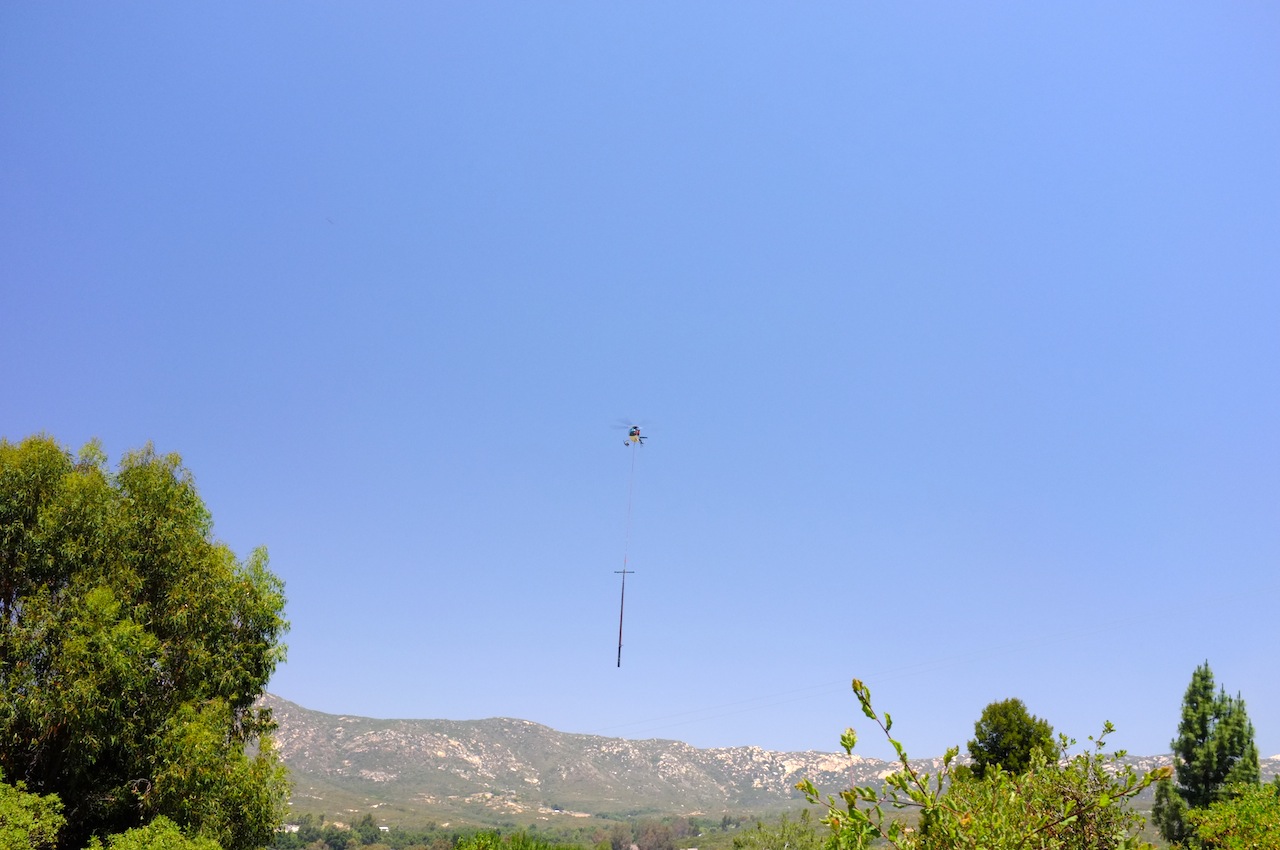

Once the pole was in the ground, there was still more work for the helicopter. The next step was to haul that nice, shiny new pole pig up to the new pole to install it. After that, the helicopter hauled the old pole pig back down to the SDG&E trucks. Then the helicopter's work was done, and the pilot flew off into the sunset. Well, not really, but you know what I mean. Speaking of the pilot, in the photo below (taken as he was lowering the pole) you can see him leaning quite a long way out of his window. This is all so he could see directly below him. If you know anything about flying a helicopter, you'll know that it takes two hands to fly one: on your left is the collective, and between your legs is the cyclic. To hover generally takes constant manipulation of both. It's a mystery to me how that pilot was able to fly while hanging halfway out the cockpit window!

One more mystery remains for me. The crew was up on the new pole working away within a few minutes of the helicopter dropping it off. Normally for a pole like that you'd need some concrete poured around it – and you'd have to wait for it to cure. No waiting here! I'm wondering what magic they used to make that pole safe and secure in such a hurry...
Lamestream Media Hypocrisy...
This time from the lamestream leader (the New York Times), nicely caught and laid out by Mollie Hemingway...
The Radiation Problem...
A strange twist on a subject I've blogged about before: the problem of hard radiation exposure on any manned space mission beyond the near-Earth environment. This involves reality TV shows, Mars, and Snooki...
Asteroid Caught on Video...
Astronomers at the InfraRed Telescope Facility in Hawai'i captured this video of a small asteroid that passed quite close to the Earth just a couple of days ago:
Subscribe to:
Posts (Atom)