Thursday, August 18, 2016

An old memory...

An old memory...  I found the photo at right in my mom's collection.  It shows the vegetable market that was once on the farm I grew up on, along the highway.  This photo shows the market 20 or 30 years before my memories of it.  There are gas pumps in the photo that I don't remember, and I remember a large, square covered area right about where the sign is in the photo.

I've been told that I “helped” selling apples and vegetables at the market, and that my grandfather (Earle Dilatush) was much amused by that.  I have no memory of helping out.  I do remember the (to me) enormous baskets of apples, the displays of vegetables, the lovely aromas, and the excitement of people stopping by to buy produce. My dad told me that the market was torn down in the fall of 1957, when I was just 5.  That makes the market one of my very earliest memories.

I don't believe any of my siblings (all younger than I) remember the market.  For their sake: it was located along US 130, just north of the nursery entrance and sign they surely remember, and south of the Ames' home.  At least until the late 1960s, the foundations of the market building were still poking out of the ground just west of the dirt road alongside US 130.

There are several men in the photo.  I believe the man on the right is my grandfather, younger than I knew him.  The child in the photo may well be my father, which would date this photo to roughly 1932.

Wednesday, August 17, 2016

Construction update...

Construction update...  The sun room installers showed up as promised today.  Woo hoo!  The work has begun!  Some photos below...

The installers arrived and started work while we were at a doctor's appointment for Debbie.  When we drove in, they were just about to start nailing down the aluminum flashing (the white edging you can see in the first photo).  That flashing had all been cut and bent incorrectly, and I stopped them just barely in time.  While we had told the salesman that we intended to put rock along the facing, it seems he'd neglected to pass that along to the installers.  That would have been a real pain in the behind to fix if they had been even an hour further along.  Whew!

The installers confirmed the estimate of a week for completion.  Next Wednesday, we should have an actual sun room.  Woo hoo!


Paradise Ponders...

Paradise Ponders...  A beautiful morning here today.  I snapped this as I filled our bird feeders.  The early morning sun had just lit up the Wellsville Mountains to our west, but not yet the valley floor where our home is...

Tuesday, August 16, 2016

Construction update...

Construction update...  Well, for once things went according to plan :)  The concrete workers showed up this morning, set up the forms, and just as they finished a concrete truck rolled in and filled them up.  This afternoon the forms will be stripped and we will have a foundation for our future filling station!  Some photos:


The basic laws of human stupidity...

The basic laws of human stupidity...  I ran into these once, long ago (even before I started blogging!).  Yesterday I found them again, and now they're posted for posterity.  Just to give you a taste, here's the first:
THE FIRST BASIC LAW

The First Basic Law of Human Stupidity asserts without ambiguity that

Always and inevitably everyone underestimates the number of stupid individuals in circulation.

At first, the statement sounds trivial, vague and horribly ungenerous. Closer scrutiny will however reveal its realistic veracity. No matter how high are one's estimates of human stupidity, one is repeatedly and recurrently startled by the fact that:
  1. people whom one had once judged rational and intelligent turn out to be unashamedly stupid.
  2. day after day, with unceasing monotony, one is harassed in one's activities by stupid individuals who appear suddenly and unexpectedly in the most inconvenient places and at the most improbable moments.
The First Basic Law prevents me from attributing a specific numerical value to the fraction of stupid people within the total population: any numerical estimate would turn out to be an underestimate. Thus in the following pages I will denote the fraction of stupid people within a population by the symbol s.

I don't know why...

I don't know why ... I keep watching these things.  All it does is bring on the doom...

Monday, August 15, 2016

Construction update...

Construction update...  Last week we had absolutely nothing happen.  This afternoon, our builder showed up to put rebar into the footer for the gasoline and diesel filling station we're building.  A little later, the concrete truck showed up, and they poured and leveled the footer (photos below).  The blue pipe section (filled with gravel in the last two photos) is a drain for any water that happens to leak into the enclosure.  Tomorrow morning the concrete gang is supposed to show up to set up forms for the walls, and to pour them.  Woo hoo!


My builder tells me that the framing guys should show up on Wednesday or Thursday to frame out our mudroom (a couple days work).  On Wednesday the installer from Four Seasons is supposed to show up to start installing our sun room.  He's estimating a week of work on that.  We might actually have some progress this week!

One hell of a meal!

One hell of a meal!  This afternoon I made a treat for Debbie and I: maple sesame salmon.  I used Ora King salmon, which like like so well that we haven't purchased any other kind for months.  The only other change I made to the recipe was to add some sliced green onion to the marinade before the reduction step (and that was a winner), and I cut the garlic in half (Debbie was being nice to me – she loves garlic, and I dislike it in most dishes).

We will most definitely be making this one again!

Collatz Conjecture...

Collatz Conjecture...  A great video about this famous math problem...

Curiosity is exploring...

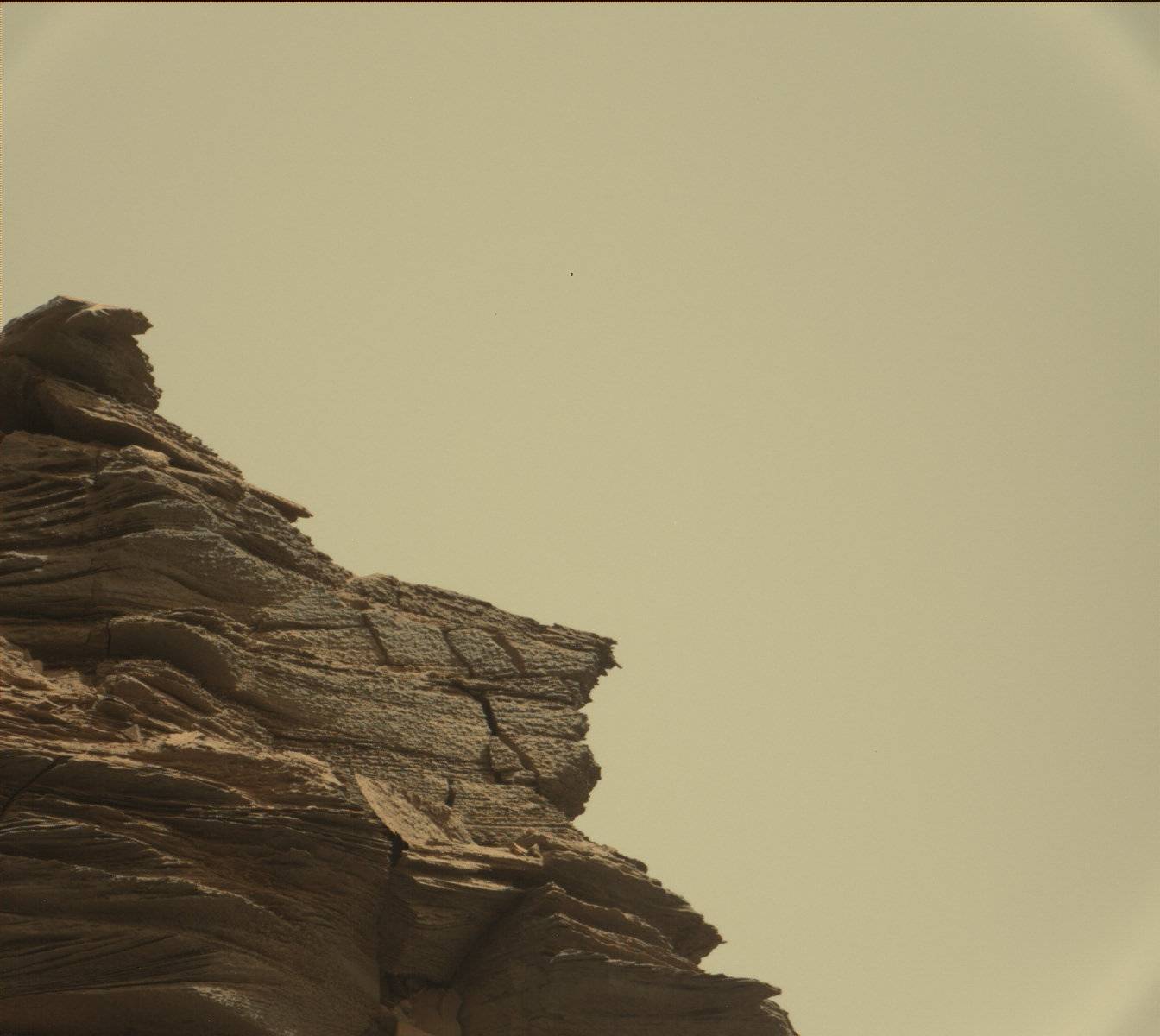
Curiosity is exploring ... some fairly rugged terrain!

Keyhole nebula...

Keyhole nebula...  Via APOD, of course.  Full res version.

Do you need a backup solution?

Do you need a backup solution?  I've been using BackBlaze for almost two years now, and I just had an experience with them that confirms my appreciation of them.  If you need backup (and even if you think you've already got your backup problem solved), go visit that link.

I had my mom's computer backed up through BackBlaze.  I did this after a couple of failures of the backup hard disks I had originally set up for her some years ago.  After she died earlier this year, I needed to wipe her computer clean in preparation for the next person to receive it.  There was about 100GB of data on that computer that I didn't want to lose, and all of that data was backed up on BackBlaze.  I decided to try their USB thumb drive restore delivery service.  They charge $99 for that, but then refund the entire $99 when you return the thumb drive

Well, the short story is that it all worked great.  A few days after I ordered the restore, it showed up in the mail.  A few days after I returned the thumb drive, the refund showed up on my credit card.

So ... in addition to the simplest backup product I've ever used and ridiculously simple recovery of files (via a web page), I can now say with personal experience that their bulk restore system is equally awesome. 

I found out about BackBlaze when I ran into their hard disk statistics, which they publish as a free service to the world.  I've used these on several occasions to guide my purchase of hard disks. 

What a great company and great products!

Sunday, August 14, 2016

A strange blind spot...

A strange blind spot...  I'm not sure what brought this to mind last night, but I got to thinking about several conversations I've had over the years related to world population (of humans) and food supply.  Not all of these conversations were with younger people, so the blind spot I'm referring to here isn't strictly related to age.

Here's the blind spot: many people (Americans, at least) don't remotely understand what a change there's been in food production, world wide, over the past 50 or 60 years.  And they most especially don't understand why this has happened.

In my youth, the world's population was roughly half what it is today, and world food production was insufficient for the needs of that much smaller population.  That simple pair of facts was enough to ensure that millions of people were starving or severely malnourished.  I saw this personally when I traveled throughout southeast Asia and Africa while I was in the U.S. Navy in the '70s.  I saw children with the distended bellies characteristic of starvation.  I participated in emergency food deliveries to the east coast of Africa during widespread famines. 

Today the situation has completely turned around.  While the world population has doubled, the world's food production has tripled.  The world now makes more than enough food for all its human inhabitants.  The only large populations of people starving or malnourished today are doing so for political reasons (think North Korea or Venezuela) – not because the food isn't available.

So how did this quite radical change come about, and especially how did it happen within the span of a single human life?  It's a big, complicated question with a complex answer, but it can be simplified to two causes: Norman Borlaug and capitalism.  Yes, really.

If you don't know about Norman Borlaug, you really should get yourself educated.  The man was amazing, and his work has probably saved over a billion people from starving to death.  Yes, really.

The much-maligned capitalism, via its inherent profit motive, has increased agricultural production everywhere it has touched.  The map above right shows net agricultural production for the two years ending in 2001.  The greenish countries are net agricultural exporters.  I couldn't find a map to illustrate this, but as of a few years ago China is now a net exporter, and India is on the cusp of being so.  There are also several countries in Africa that are now net exporters, including South Africa.  You can see that the current net importers are closely correlated with those countries that don't have effective capitalist economic systems.  A couple of countries serve as beautiful examples.  First, there's China: the country's agricultural output very closely tracks its adoption of capitalism in agriculture (the last sector the government reformed).  It is an astonishing textbook example of the power of the profit incentive – just 40 years ago, people in China were still starving because the country could neither produce enough food to feed itself nor afford to buy it.  Now it produces enough food to export, despite its population having more than doubled.  Then there's little Israel, which will be a net food exporter within a few years.  It is surrounded by countries with similar geography and climate, and yet Israel alone is anywhere near self-sufficiency on food.  Even Egypt with its huge advantage of the Nile valley still isn't nearly self-sufficient.  The only relevant difference between Israel and its neighbors is its full-throated adoption of capitalism.

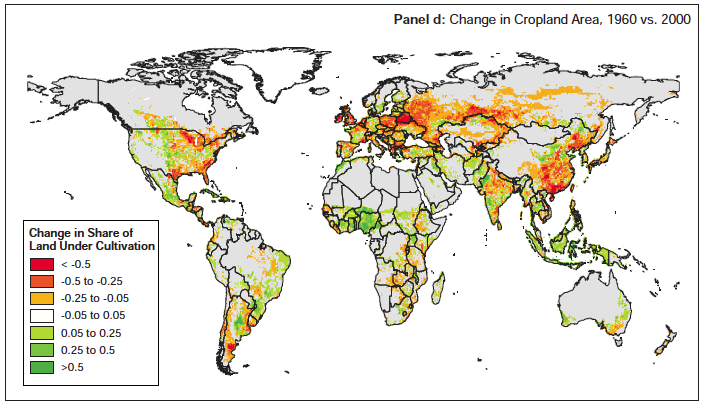
Here's yet another piece of that blind spot: despite the amazing increases in food production I outlined above, the amount of cultivated land in the world is declining.  Yes, really.  Anyone who travels extensively across the U.S. can tell you this first hand: land is returning to forest in many parts of the country.  In some parts of the world, particularly in developing countries, land under cultivation is increasing.  In other parts of the world – particularly in developed countries, land under cultivation is decreasing.  The net, worldwide, is a peak around 2012, and a gradually increasing decline since then.  Agriculture is so efficient these days that it takes less and less land to feed an increasing population.

One last piece of the puzzle that I've been surprised people are generally unaware of: the world's population is increasing at a declining rate.  In fact, fertility rates are generally the lowest amongst the more developed nations (think Japan, Germany, etc.) and the highest amongst the undeveloped nations (Africa and southeast Asia, especially).  The U.S. is a bit of an anomaly in that mix – we still have a relatively high fertility rate.  Overall, though, the world's fertility rate is declining, and while opinions vary on when we might reach peak population, few economists or demographers disagree that we will reach that point, and most agree it will be before the end of the current century.

This story I've tried to encapsulate here in short form is, in my view, one of the most amazing stories in all of human history – and yet so many people who are actually living through this don't seem to even be aware of it!

Saturday, August 13, 2016

The true size of...

The true size of ... many countries is far different than most people believe, largely thanks to the dominance of the Mercator projection for maps of the world.  A web site I just found helps anyone understand the relative size of countries through a simple technique: you drag the map of one country to superimpose it upon another.  The projection is automatically corrected.  The image at the right is from this web site; it shows the country of Estonia (a place I'm very familiar with) superimposed on a map of Utah (a place I'm even more familiar with).  If you were to look at Utah and Estonia on a standard (Mercator projection) world map, you might think they were of similar size!

Beautiful!

Beautiful!  Found here...

Wednesday, August 10, 2016

The old lady...

The old lady...  This is a painting that I've inherited from my mom.  It's an oil painting on wood, not the usual canvas.  Mom didn't paint it herself – she inherited it from her dad (my grandfather).  I'm told that her dad bought an auction lot that included this painting, and that he liked it, so he kept it.  My mom had sentimental reasons for keeping this, then – and now I do.

The painting is signed “De Wilde Edw”, which I took to mean Edward De Wilde.  Searching for an artist of this name got me nowhere.  Then I tried searching the name exactly as written, and also got nowhere.  So I contacted an art appraiser I am acquainted with (here in Logan), and she looked up the name in a reference book she owns.  Bingo!  At least, I think it's a bingo :)  She found an artist named “Edouard De Wilde” who lived and painted in New York City in the early 20th century.  He was neither well-known nor well-regarded :)  The difference in spelling, my appraiser friend tells me, is quite a common thing for immigrants who would often spell their given name as if translated to English.

I'm not sure where I'm going to hang this painting.  Most likely it will go in my office, where I'll see it every day and be reminded of my mom...

Tuesday, August 9, 2016

A squirrel's eye view...

A squirrel's eye view...  Now there's a blog post title I never expected to write!

Monday, August 8, 2016

You've heard me rave...

You've heard me rave ... about my “paperless office” solution, with a Fujitsu ScanSnap iX500 scanner and DEVONthink Pro Office.  I've been using these to process all my paperwork for over a year and a half now.  I'm to the point now where I'd really be unhappy if I had to go back to paper.  I'm totally and completely addicted to the search capability in DEVONthink Pro Office – and the scanner works so well, so effortlessly, that I still have trouble believing it. 

Now I've got a new reason to celebrate the glories of this setup: dealing with the large amount of paper that I just inherited from my mom.  I have several boxes full of papers with all sorts of things on them that I'd like to preserve and share with my relatives: her recipes, her letters, jokes, saved emails and letters from dad, her kids, and her friends, and so on.  I'm guessing that I've got 2,000 to 3,000 pages of such documents (that's not counting the 1,000+ photos).  So far I've scanned in about 700 pages.  I've spent around 10 hours doing this, mainly in unpacking, removing creases, fixing dog-ears, etc. to prepare the papers for scanning.  The scanning process itself is crazy fast at 25 pages per minute.  It takes about a minute per full page (and much less for smaller pages) to convert the scanned images to an images-plus-text PDF format; as I write this, my computer is chunking away on about 100 pages of that work.

I'm delighted with how easy this is to do, and how effective the results are.  I can now search through mom's papers just as if I had Google available for them.  For instance, just now I searched for “cobbler” and found three copies of “Marion’s Peach Cobbler”.  The search took under one second.  An aside: I'm astonished that mom had any recipes from (I presume) my Aunt Marion – she had a reputation for producing food that nobody wanted to eat, other than my Uncle Donald (her husband and my dad's brother).

Just as critical to the success of this work is my shredder: a Fellowes 225Mi.  That thing is a workhorse and a half.  It shreds up to 30 pages at a time, shrugs off staples and paperclips, and chews through CDs, DVDs, credit cards, etc. with the greatest of ease.  The results of the shredding are tiny little pieces of paper, like grains of rice.  It compresses nicely, and also makes a great fire starter :) 

The giant pile of photos won't be quite so easy, unfortunately.  I will be scanning them on a flatbed scanner, to get the best resolution possible.  Where I have negatives, I'll be scanning them as well, for the same reason.  Each photo will have to be scanned manually, one-at-a-time.  Slides I can do in batches of 20.  Even more challenging, many of the photos have writing on the back, and I want to preserve that as well - and that means those photos will have to be scanned twice (once for each side).  That's gonna take a while!

Mom's paintings...

Mom's paintings...  Here are a batch of my mom's paintings, unpacked as I go through her stuff.  I have quite a few more after these!  Many of these I'll be shipping out to relatives and mom's friends, but a few of them will stay here in Paradise.  One of those will be the fourth one in this batch, the mailboxes.  The second one (a van Gogh knockoff) will be staying in Newton (not far from Paradise) with my brother Scott.

It's been several years since mom last painted a picture.  I think she started taking lessons in the '80s, so that means her painting spanned about 30 years.  I have absolutely no clue what order these were painted in :)  For me, mom's craft works, including these paintings, are my favorite mementos of her...


Sunday, August 7, 2016

A Valentine's Day card...

A Valentine's Day card...  This was from my dad to my mom, for Valentine's Day in 2003.  I just found it while going through my mom's papers.  I was very surprised to find this – it's not the sort of hand-made card I'd expect my dad to have made.  When I first spotted the cover, with the big, poorly-drawn heart, I figured it was a kid that made it.  Then I started reading what was printed on it (“Especially carried by camel-back to you!”), and at the printing itself, and I realized dad made it.

Paradise ponders...

Paradise ponders...  Last night I made some apricot ice cream from a bucket of apricots that our friend Michelle H. (aka “bee’s knees”) gave us.  The photo at right shows the apricots just before I pureed them.  The recipe is simple: I scalded the apricots in boiling water for about 30 seconds, to loosen the skin.  Then we peeled them, and squeezed the pits out – and threw the fruits' flesh into the blender (the photo).  Then I ran the blender for a few minutes to liquefy the fruit.  I should have strained the result to get out any threads and skin remaining, but I forgot that.  Then I added about 3 cups of cream, 1 cup of milk, and sugar to taste (in this case, about 1.5 cups).  The sugar is tricky: frozen ice cream tastes less sweet than the unfrozen mix, so you have to add more sugar than you'd think when tasting the mix.  It's a bit of an art to get it right.  Then I just froze it in our Musso ice cream maker.  This afternoon we each had a nice dish of this for dessert.  Yum!

Early this morning we took a drive up to Hardware Ranch, looking for wildlife.  Other than a good assortment of deer (including a spotted fawn), we didn't see much at all.  We especially didn't see anything in the way of birds.  Weird!  Before we left, the dogs and I enjoyed the pretty sunrise (at right).

Basically all the rest of the day today I've been working on my mom's belongings.  I'm starting to make a dent in the rather large pile of her stuff in my office.  In particular, I've been scanning like mad, followed by shredding.  I'm saving very few of the documents, just those with some special meaning or significance, where a good scan just won't do...

Saturday, August 6, 2016

Paradise ponders...

Paradise ponders...  This morning Abby S. was over for our regular tutoring session on programming.  She's learning how to write some detailed routines that involve loops, including nested loops and nested conditionals.  I think I may have hurt her head a little bit :)

Early this afternoon, Debbie and I headed down to the Maddox Drive-In and had ourselves a fine lunch.  It was a steak sandwich for me (and it really was a steak, not some thinly sliced stuff), and Debbie had a shrimp basket.  Both very yummy!  I had sarsaparilla, and Debbie had root beer – both homemade, and both excellent.

Afterwards we made a grand loop to get home.  We drove north from Perry (where Maddox is) along the western front of the Wellsville Mountains, then east on State 30 toward Logan, then south on State 23 toward Wellsville.  It was a pretty drive, partly through areas we'd never visited before, and that's always fun and interesting.  That stretch of State 30 that we drove on had lots of safflower fields (a couple photos below) growing on dry (unirrigated) farms.  It sure appears to be thriving!  The plants are allowed to go to seed, then the seed is harvested and pressed for the oil.

Friday, August 5, 2016

Paradise ponders...

Paradise ponders...  Quite a bit got since yesterday afternoon on our construction projects!  Late last night a heating and air conditioning guy showed up to install a heating duct for our mud room (visible in the sixth photo below).  Just by happenstance our home has a floor duct alongside the front door.  Our builder cut a hole in the house's rim board, and there was the duct, right there – very convenient!  So we simply cut out that register transition (so now that register inside the house will not put out any warm air) and extended it with an insulated duct to a register transition on the mud room floor.  We won't miss the register inside the house, as there are several other ducts nearby.

This morning, the insulation crew showed up.  Two very hard-working guys had all the insulation installed in about two hours.  All but the last two photos show that work.  The fourth photo shows some interesting “shells” they were using.  These shoot (literally, with gunpowder!) small fasteners through bats of insulation into the concrete foundation.  This is how they attached the bats to the insides of the foundation walls.  It was interesting to see how they handled all the little challenging details, like the ends of the joist runs.  These two fellows had obviously done all of this many times – they zipped through all the work very efficiently.

Later this afternoon, our builder showed up with his son and installed the tongue-and-groove OSB sub-floor sheathing.  They were interesting to watch, too – especially when it came to the funny angles in the sun room floor.  They did it a far easier way than I'd have done.  I would have carefully measured the outline of the rim board, and then attempted to transfer those measurements to an 8x4 piece of sheathing.  They simply installed the 8x4 sheet and let it overhang.  Then they traced out the actual rim board edges and sawed it off (as you can see in the last photo).  Much easier!  Our builder has done this a time or two, methinks.  :)


Another piece of paper...

Another piece of paper ... that my mom saved.  It's also another one that I had no idea existed.  It's a letter from the captain of the USS Long Beach, the ship I served on.  My mom probably didn't realize that this was a standard form letter, hand typed by a yeoman from a template provided by the Navy Bureau of Personnel (BUPERS).  The Navy did quite a few things like this, attempting in their ham-handed way to generate some good public relations through their enlistee's families.  My mom also likely didn't realize that this particular event being roundly praised (my advancement to DS2) was guaranteed, conditional on my meeting minimum requirements, by the six year enlistment commitment I'd made.  Part of that was fast-tracked promotion to E5 upon graduating successfully from “C” school (which I did) and passing the tests for E5 (which I also did, not long before this letter was typed up).

If you're unfamiliar with U.S. Navy enlistee designations, the “Data Systems Technician” was my rating.  It was often shortened to “DS”.  Basically a data systems technician was the IT guy of the day.  The job was a bit different back then, though: we did relatively little on software, configuration, or administration (tasks that dominate the work today).  Instead we spent most of our time doing actual electronic repair, right down to the component level.  We had to be very proficient with oscilloscopes, meters, Ohm's law, soldering irons, and so on to do the job.  A modern IT guy might not know any of these things, but can configure routers or administer the daylights out of a Linux system :)  The “Second Class” was my rank, the Navy's term for an enlisted person at rank E5 (which means fifth from the bottom-most rank).  The second class was often shortened to just “2”, and “DS2” the short form of Data Systems Technician Second Class.  The short form is certainly much easier to type!

That particular captain, Captain Frank R. Fahland, was known by the crew as “Frank the fish”, mostly for the appearance of his face.  May 1974 is quite shortly after I arrived on board the ship, and I'm certain that the captain had absolutely no idea who I was.  The ship had a crew of 1,200 men, and he and I had never met.  The boilerplate text in the letter is technically truthful, but for data systems technicians the competition wasn't all that keen – the Navy was desperate for more of them, and you had to be pretty darned bad to fail the qualifications :)

I'm afraid my mom was a bit deceived about the glory being showered on me by Frank the Fish :)

Broad Mouth Fire...

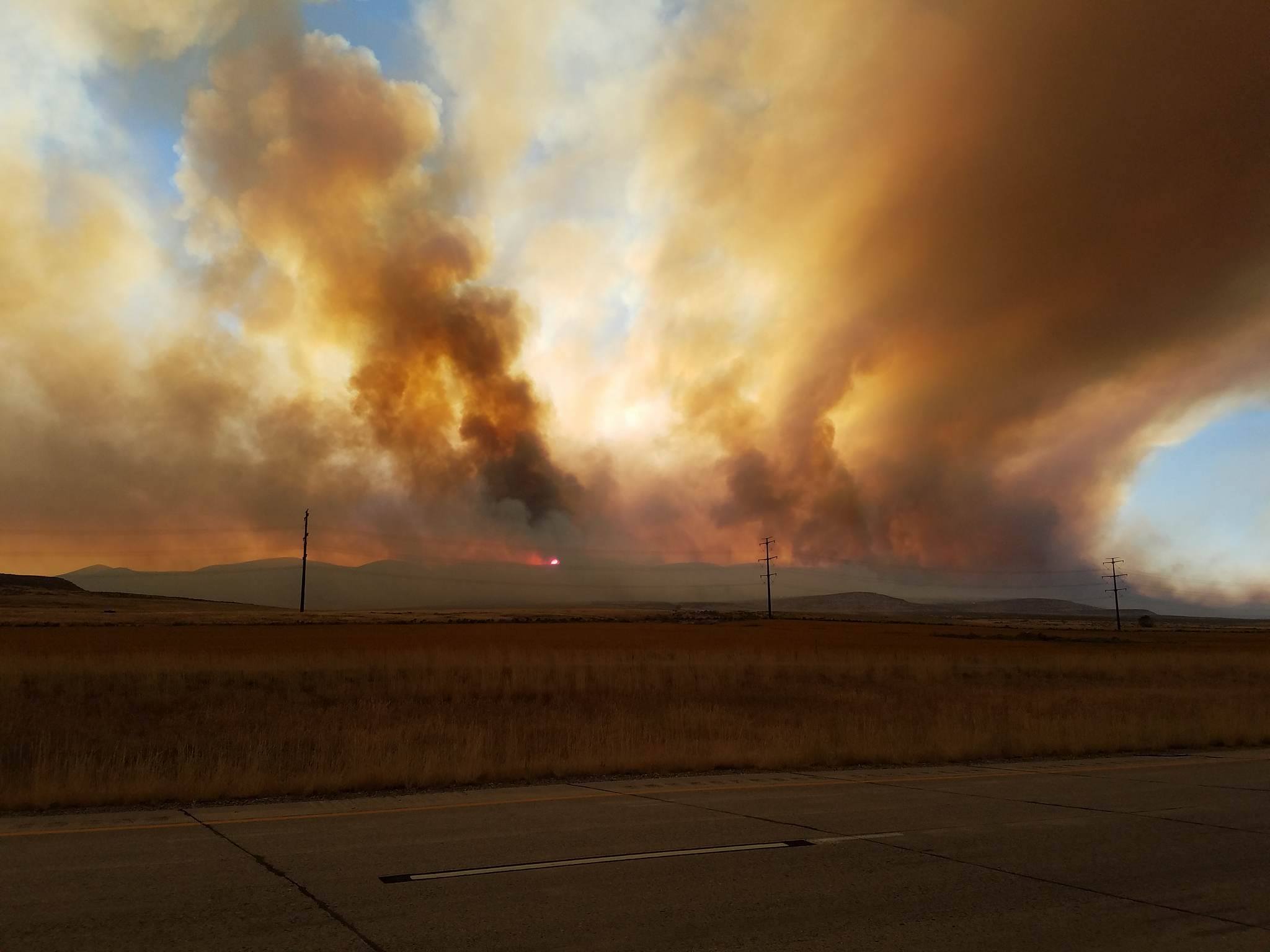
Broad Mouth Fire...  This is a fire that's been giving us a smoky atmosphere for about a week now, in a fairly remote area of Box Elder County, but near the edge of Cache County (where we live).  The fire currently is burning about 30 miles to our northwest, and it's burning to the south and west (which is not toward us).  As I write, the fire has burned about 10,000 acres and its only 15% contained.  Locals tell me that the area that's burning is mostly sage and grass, with scattered juniper and pinyon pine, and this sounds right.  That's far less fuel (and therefore far less scary) than we had in the chaparral where we used to live, down in southern California.

I learned about some online fire resources in the course of researching this fire.  First thing I found was the Utah Fire Info site, which, amazingly enough, is a government effort.  It's quite good.  That took me to another great government-generated resource: realtime fire updates via Twitter.  Kudos, Utah state government!  The Twitter feed took me in turn to another resource (not government): a wildfire viewer, with multiple layers of information.