Showing posts with label Global Warming. Show all posts

Friday, June 26, 2009

Anthropomorphic Global Warming Skepticism...

On April 26, 2006, Strassel appeared on The Da...Image via Wikipedia

As I've noted in previous posts, skepticism about anthropomorphic (human-caused) global warming is on the rise. Here's yet another piece of evidence for that: a nice piece in the WSJ by Kimberly Strassel, a well-known political columnist. She writes:

The number of skeptics, far from shrinking, is swelling. Oklahoma Sen. Jim Inhofe now counts more than 700 scientists who disagree with the U.N. -- 13 times the number who authored the U.N.'s 2007 climate summary for policymakers. Joanne Simpson, the world's first woman to receive a Ph.D. in meteorology, expressed relief upon her retirement last year that she was finally free to speak "frankly" of her nonbelief. Dr. Kiminori Itoh, a Japanese environmental physical chemist who contributed to a U.N. climate report, dubs man-made warming "the worst scientific scandal in history." Norway's Ivar Giaever, Nobel Prize winner for physics, decries it as the "new religion." A group of 54 noted physicists, led by Princeton's Will Happer, is demanding the American Physical Society revise its position that the science is settled. (Both Nature and Science magazines have refused to run the physicists' open letter.)

The collapse of the "consensus" has been driven by reality. The inconvenient truth is that the earth's temperatures have flat-lined since 2001, despite growing concentrations of C02. Peer-reviewed research has debunked doomsday scenarios about the polar ice caps, hurricanes, malaria, extinctions, rising oceans. A global financial crisis has politicians taking a harder look at the science that would require them to hamstring their economies to rein in carbon.

Some of this skepticism, I'm sure, is the natural result of the political machinery absorbing the enormous cost of global warming “mitigation”, and wondering whether this cost made sense politically. A few politicians may even be wondering if the cost makes sense in ordinary terms (e.g., the benefit is greater than the cost). But mostly, I suspect, the new skepticism is derived from the politician's hyper-sensitivity to issues that might stand between them and re-election – and they're hearing from the electorate that global warming mitigation is most definitely one of those issues. I know my congress-critters have heard from me on that point, loud and clear – and two of them have responded by indicating that they're hearing such resistance a lot.
Reblog this post [with Zemanta]

Sunday, June 7, 2009

More Dyson...

I just love the way Freeman Dyson thinks. And then when I reflect on his age (85), I'm always astonished. A sampler:
No doubt that warming is happening. I don’t think it is correct to say “global,” but certainly warming is happening. I have been to Greenland a year ago and saw it for myself. And that’s where the warming is most extreme. And it’s spectacular, no doubt about it. And glaciers are shrinking and so on.

But, there are all sorts of things that are not said, which decreases my feeling of alarm. First of all, the people in Greenland love it. They tell you it’s made their lives a lot easier. They hope it continues. I am not saying none of these consequences are happening. I am just questioning whether they are harmful.

There’s a lot made out of the people who died in heat waves. And there is no doubt that we have heat waves and people die. What they don’t say is actually five times as many people die of cold in winters as die of heat in summer. And it is also true that more of the warming happens in winter than in summer. So, if anything, it’s heavily favorable as far as that goes. It certainly saves more lives in winter than it costs in summer.

So that kind of argument is never made. And I see a systematic bias in the way things are reported. Anything that looks bad is reported, and anything that looks good is not reported.

A lot of these things are not anything to do with human activities. Take the shrinking of glaciers, which certainly has been going on for 300 years and has been well documented. So it certainly wasn’t due to human activities, most of the time. There’s been a very strong warming, in fact, ever since the Little Ice Age, which was most intense in the 17th century. That certainly was not due to human activity.

And the most serious of almost all the problems is the rising sea level. But there again, we have no evidence that this is due to climate change. A good deal of evidence says it’s not. I mean, we know that that’s been going on for 12,000 years, and there’s very doubtful arguments as to what’s been happening in the last 50 years and (whether) human activities have been important. It’s not clear whether it’s been accelerating or not. But certainly, most of it is not due to human activities. So it would be a shame if we’ve made huge efforts to stop global warming and the sea continued to rise. That would be a tragedy. Sea level is a real problem, but we should be attacking it directly and not attacking the wrong problem.
Read the whole thing.

Monday, May 25, 2009

They Don't Even Seem to Notice...

Many times when I'm reading recent climatology research, I'll run across a statement that immediately strikes me as contraindicating anthropomorphic (i.e., human-caused) global warming – but somehow the climatologists just ignore it. In an article I read this morning, it happened again:

For example, during the 'Holocene thermal maximum,' the warmest period of the past 10,000 years, the Arctic average temperature was two to three degrees warmer than it is today, while the global average was only a degree or so warmer.

"But based on lake sediments from Baffin Island, our data show that this area of the Arctic experienced temperatures five degrees warmer than today," said Briner.

Let's see now. One thing they neglect to mention above is that the Holocene maximum was a 4,000 year long period, starting 9,000 years ago. So what they're saying is that for almost half of the past 10,000 years, the Arctic temperatures were about 5°C (9°F) warmer than they are today. I don't think those higher temperatures back then were caused by SUVs and private jets!

There's a consistent pattern amongst these research reports that just doesn't add up:
  1. Climatologists doing actual research (as opposed to bulding computer models) consistently find historical data indicating that (a) the Earth's climate has broad long-term natural swings, not caused by human activity, (b) the Earth's climate has smaller short-term swings that correlate well with the sun spot count, and (c) patterns of climate change that don't jibe with the patterns found in the models.
  2. Climatologists “back-testing” computer climate models consistently find that the models don't match reality. In back-testing, the researchers take data from some past period (say, 2,000 years ago), feed it into the model, and check to see if the model successfully predicts what happened afterward. If the model did succeed in such predictions, you'd have some reason to believe that by feeding in today's data you could predict what will happen down the road. It's the gold standard used for testing all models that have the ambition to predict the future. Nobody has built a climate model yet that survives back-testing.
  3. Climatologists building computer climate models consistently throw out (or arbitrarily “adjust”) data that doesn't produce the results they believe are correct. The two glaring examples I know of are (a) tossing out satellite based atmospheric temperature measurements, and (b) adjusting historical temperature records before feeding them into their models.
How on earth can these scientists make statements like the one I highlighted above, and yet go on propounding the notion of impending climate doom caused by anthropomorphic global warming?

I just don't get it...

Monday, May 11, 2009

Temperature Data...

I've mentioned before the web-based efforts of Surface Stations to have volunteers audit and photograph all 1,221 official NOAA surface temperature measurement sites. They're not done yet, but they just passed a milestone: over 70% of those sites have now been audited. The graph at right shows the results.

These are the same sites that the NOAA and Jim Hansen of NASA specifically call out as being more accurate and more reliable that satellite-based temperature measurements. The cumulative errors that Surface Stations has now documented in these stations is approximately the same as the difference between the satellite measurements and the surface measurements.

In other words, the satellites are right.

And global warming isn't nearly as severe as its adherents would have us believe.

If I believed in an afterlife, I'd hope there was a special sort of hell reserved for corrupt scientists...

Saturday, May 9, 2009

Sunspots...

I've posted before about the unusually low number of sunspots we're seeing right now, and about the correlation between the number of sunspots and the overall solar radiation. It may seem a little counterintuitive, but the fact is that the sun radiates more energy when there are more sunspots, and vice versa.

Well, the low number of sunspots continues. At the moment we are experiencing the longest sustained period of low sunspot occurrence since 1928, and there's no end in sight yet. That also means we're experiencing a long and sustained reduction in solar radiation output, and therefore of its heating of the Earth. Historically periods of low sunspot activity have correlated nicely with periods of lower temperatures on the Earth, most famously with the period known as the Maunder Minimum. Naturally, the warmenists loudly proclaim that variations in sunspot activity will have no impact on the Earth's climate – they are certain that the correlations of historical low sunspot activity and low temperatures is entirely coincidental.

Looks like we may have a chance here to find out for sure. If our low sunspot activity continues for another year or so, the warmenists will have a hard time explaining a “coincidental” drop in global temperatures. Which, by the way, we're already seeing.

Tuesday, January 27, 2009

Thursday, January 8, 2009

Sunday, January 4, 2009

Flying Pig Moment...

I rarely link to the Huffington Post; it's the haunt of a stable of liberal/socialist/communist (really!) political writers who rarely say anything I could agree with. Most recently they added Bill Ayers – former Weathermen leader, domestic terrorist – to their lineup (I'm not making this up!). But today I read a story there that definitely qualifies as a flying pig. It's written by Harold Ambler, a musician, writer, and owner of the site Talking About the Weather. He's not an expert on climate, just an interested observer who isn't dependent on grant money. A small sample (but do go read the whole thing, even though it's on the Huffington Post):
Mr. Gore has gone so far to discourage debate on climate as to refer to those who question his simplistic view of the atmosphere as "flat-Earthers." This, too, is right on target, except for one tiny detail. It is exactly the opposite of the truth.

Indeed, it is Mr. Gore and his brethren who are flat-Earthers. Mr. Gore states, ad nauseum, that carbon dioxide rules climate in frightening and unpredictable, and new, ways. When he shows the hockey stick graph of temperature and plots it against reconstructed C02 levels in An Inconvenient Truth, he says that the two clearly have an obvious correlation. "Their relationship is actually very complicated," he says, "but there is one relationship that is far more powerful than all the others, and it is this: When there is more carbon dioxide, the temperature gets warmer." The word "complicated" here is among the most significant Mr. Gore has uttered on the subject of climate and is, at best, a deliberate act of obfuscation. Why? Because it turns out that there is an 800-year lag between temperature and carbon dioxide, unlike the sense conveyed by Mr. Gore's graph. You are probably wondering by now -- and if you are not, you should be -- which rises first, carbon dioxide or temperature. The answer? Temperature. In every case, the ice-core data shows that temperature rises precede rises in carbon dioxide by, on average, 800 years. In fact, the relationship is not "complicated." When the ocean-atmosphere system warms, the oceans discharge vast quantities of carbon dioxide in a process known as de-gassing. For this reason, warm and cold years show up on the Mauna Loa C02 measurements even in the short term. For instance, the post-Pinatubo-eruption year of 1993 shows the lowest C02 increase since measurements have been kept. When did the highest C02 increase take place? During the super El NiƱo year of 1998.
I'm certain that at least half the writers at the Huffington Post have orgasmic reactions to the even a whisper of the Goreacle's voice (the other half probably requires visual stimulation, such as a photo of the Goreacle's Hitler-esque speechifying, as well). So why on this earth would the Huffington Post publish this piece by Harold Ambler?

The only reason I can think of is that the Huffington Post folks are trying to provide political cover for Obama and the Democrats to not spend money on mitigating global warming. Their political base has high expectations for serious and incredibly expensive expenditures all based on the notion of anthropomorphic global warming. At this point, to anyone with even 5% of their brain cells functioning, such expenditures are obvious madness – if we're going to spend money, the place to do it is in buttressing the economy, not destroying it with the “green” initiatives demanded by the Goreacle's followers.

If I'm right, this is just one more illustration of the shallowness of the left's ideology.

If I'm wrong, I'd love to know why the Huffington Post (till now a fervent supporter of the Goreacle, brooking no dissent at all) has published this piece...

Thursday, December 18, 2008

Storm Total: 5.35 Inches!

It looks like this storm is done with; we got our last rain about an hour ago and the radar looks clear. The pressure bottomed out at 29.55 inches of mercury, the second-lowest I've ever recorded (in six years of weather tracking). Our creeks are flowing and catch-ponds are starting to fill; in the past 7 years this hasn't happened until late January or February. And our yard is greening, over a month ahead of the schedule we've had in recent years. All good! And a chance of even more rain is forecast for Monday...

Meanwhile, the paper reports:

The dry season that long-range forecasters had predicted for Southern California has taken a sharp turn toward very wet.

Wednesday, the second storm in three days battered the region, forcing dramatic rescues from flood waters near the border and causing the death of a man in Tijuana.

San Diego has had more than twice its normal seasonal rainfall for mid-December. Although residents should catch a break over the next few days, the rainy pattern might be in place through the end of month, according to the National Weather Service.

That dry season that was forecast? That was the global-warming models at work. In the past few months, those models seem to be running right off the tracks, predicting phenomena that are the opposite of what reality turns out to be. Most of those models forecast a sustained and expanding drought for our area – but instead, it's starting to look like the end of the drought...

Saturday, November 29, 2008

Glaciers Growing?

I first started reading reports of growing glaciers a few months ago, in Alaska. Now reports are coming in from all over the world: for the first time in over 250 years, glaciers in Alaska, Canada, New Zealand, Greenland, and now Norway are growing. From the latest report:
After years of decline, glaciers in Norway are again growing, reports the Norwegian Water Resources and Energy Directorate (NVE). The actual magnitude of the growth, which appears to have begun over the last two years, has not yet been quantified, says NVE Senior Engineer Hallgeir ElvehĆøy.

The flow rate of many glaciers has also declined. Glacier flow ultimately acts to reduce accumulation, as the ice moves to lower, warmer elevations.

I wonder why the warmies aren't reporting on this latest exciting development? Why isn't the Goreacle all atwitter with indignation? And Jim Hansen – shouldn't he be agitating for global action to warm up the environment?

Oh, that's right, now I remember – according to their “models” we're right in the midst of a calamitous warming trend!

Just like this news about glaciers, you probably also haven't read about the latest events in the world of science. One of them: a petition, signed by 30,000 scientists, calling for an end to the dogmatic advocacy of global warming and a return to normal, skeptical science. Increasing evidence for the non-existence of global warming was one of the primary motivations for this petition – after, of course, the shame and misgivings most professional scientists experience upon examining the “science” of global warming. Dr. Freeman Dyson is an eloquent spokesman for these scientists...

Friday, November 21, 2008

Wednesday, October 1, 2008

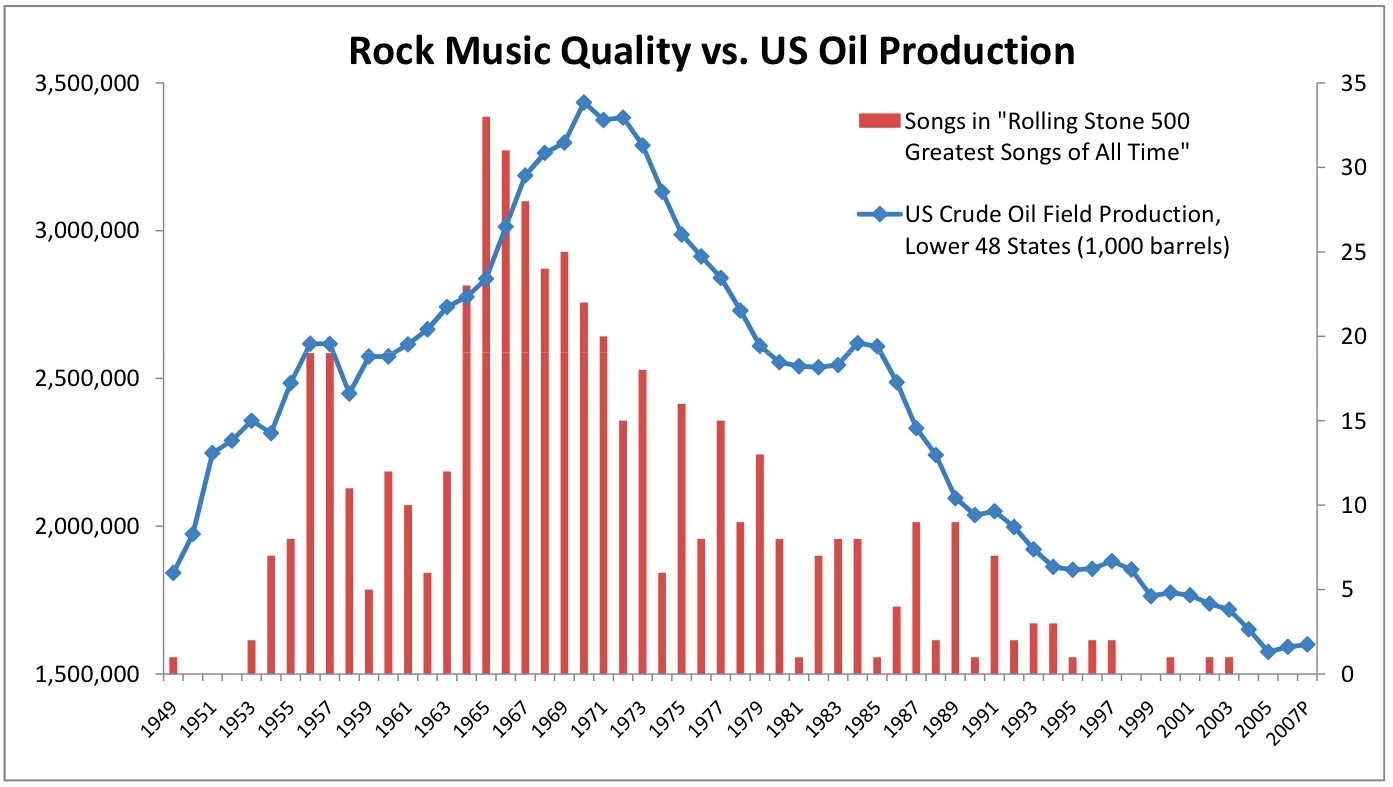
Correlation is Not Causation...

Found this little gem through Climate Skeptic. Just look at those two curves – obviously they are very closely correlated. Immediately the human mind leaps to the conclusion that one of them caused the other – but that seems quite unlikely in this case.

Because, you know, rock 'n roll songs really aren't very closely related to U.S. domestic oil production. Just sayin'...

Read the whole snarky thing...

Thursday, September 25, 2008

Mucking Up the Data...

Here's a wonderfully detailed and documented example of how NASA takes perfectly good data (which doesn't happen to support AGW) and “adjusts” it until it does. In a nutshell, here's what it says: NASA took data from a source that is provably very reliable and consistent, but which didn't show any global warming trends. Then NASA applied a series of adjustments to that data, and used the adjusted data as part of their global warming model. After all the adjustments, the data magically supports their global warming hypothesis.

It's as though you weighed yourself on the same scale every day of your life and kept meticulous records of that – but then your doctor didn't believe the results, and applied his own arbitrary set of adjustments to your data.

Your tax dollars, hard at work. But not for your benefit...

Solar Wind at a Minimum...

NASA held a news conference earlier this week, and this was the main topic:
The intensity of the sun's million-mile-per-hour solar wind has dropped to its lowest levels since accurate records began half a century ago...
The data they're talking about comes from the Ulysses spacecraft, which has long been in orbit around the sun.

There's much more to the story than just this carefully crafted statement from NASA, however. The solar wind they're referring to is “blown” outward from the sun by the pressure of the sun's radiation. The only reason why the solar wind would have diminished is because the sun's radiation output has diminished – which we already know from other measurments. So in that sense this new piece of data is completely unsurprising, but still useful as confirmation.

NASA gets a significant part of its funding as science grants, independently from the space program funding. The science grant gravy train has never been as magnificent as it has during these days of anthropomorphic global warming (AGW) fears. So NASA, for years now, has been very careful to craft its public presentations in such a way as to support AGW fears – they've got a lot of money riding on that. This week's press conference was a real problem for the message crafters, though, because you don't have to be particularly bright to figure out that if there's good evidence that the sun's radiation output is declining, then hey, that might just have something to do with the fact that the planet has been cooling for several years.

And if the planet is now cooling because the sun's radiation is lower, then perhaps the planet might have been warming earlier because the sun's radiation was increasing back then.

And maybe all this AGW talk is just a bunch of hooey.

But NASA doesn't like that answer very much, because then there's much less reason to fund all their AGW-related programs so lavishly.

Oops.

Sunday, September 7, 2008

Lipstick On A Pig...

Michael Mann is the creator of the infamous “hockey stick” temperature graph (at right) that in 2001 started the whole anthropomorphic (human-caused) global warming (AGW) madness. Though he is a scientist, Mann did something very unlike a scientist: he published his results, but not details of his data and methods that would allow independent scientists to replicate and verify his work. Replication and verification is a cornerstone of the scientific method, and it absolutely relies on full and open disclosure of everything underlying a result.

Mann was roundly criticized for this transgression, by both skeptics and advocates of AGW. So recently he published a reworked version of his original study, and this time he was more open about his data and methods. Warren Meyer, writing at Climate Skeptic, dubbed this new study “Lipstick on a Pig” – read his excellent article to see why. Meyer's post led me to Steve McIntyre's outstanding Climate Audit site and this article, where McIntyre did something very interesting that makes the root of his skepticism very accessible to people who don't know the math and are not climate experts. Spend a few minutes looking at the links below and you'll come away with a much better understanding of why I and many others are so skeptical of AGW.

First of all, here's the links (from Climate Audit): Part 1, Part 2, Part 3, Part 4, and Part 5. McIntyre broke this into five parts only because of limitations of the software he used to produce them.

The posts themselves delve into the technical reasons (though not too deeply) why so many scientists are concerned about Mann's study. But the graph animations linked above are simple enough for anyone to understand. McIntyre took all the temperature data that Mann started with, reformatted it so that he could display each source of data on an identical graph, and then flips through them one after the other. What anyone is immediately struck by is just how random the data is – there's no clear pattern in it at all. As a commenter observes, by cherry-picking and massaging this data, one could make a graph that has any shape you'd like it to have!

And cherry-picking and massaging is exactly what Mann has done with this data. What he most definitely did not do is simply average it all out – others have done this, however, and found no trend whatsoever. I'm not saying that a simple average is the right thing to do – but I am saying that if a simple average shows no trend at all, and Mann's manipulation shows the pronounced hockey stick, then we should be very skeptical indeed of Mann's results.

This kind of data manipulation hocus-pocus would be instantly condemned – and rejected – in just about every other field of science I'm familiar with. No reputable scientist would even consider relying on such a shaky foundation for public policy decisions that have trillions of dollars in economic impact.

Why are we allowing this to happen with AGW? Why do so many people listen to Al Gore rather than use their own common sense? I sure wish I knew the answer to that...

Saturday, September 6, 2008

Huh?

At first this article caught my interest because the main subject was interesting: an archaeological find of humans in Switzerland some 5,000 years ago. But as I read the lead, I did a double-take:
Some 5,000 years ago, on a day with weather much like today's, a prehistoric person tread high up in what is now the Swiss Alps, wearing goat leather pants, leather shoes and armed with a bow and arrows.

The unremarkable journey through the Schnidejoch pass, a lofty trail 2,756 metres (9,000 feet) above sea level, has been a boon to scientists. But it would never have emerged if climate change were not melting the nearby glacier.
The emphasis above is mine. The rest of the article make clear the author's believe that the glaciers are melting today because of anthropomorphic (i.e., human-caused) global warming (AGW).

So...in the space of three sentences – the first three, no less – and with no apparent intended irony or sarcasm, this article (1) states plainly that 5,000 years ago the climate under today's glacier was warm, and (2) introduces the notion that anthropomorphic global warming is causing the glacier to melt, thus revealing our frozen Swiss hunter.

Presumably not even the most fanatic believer in AGW believes that the warm climate 5,000 years ago was caused by human activity. What amazes me is their assured acceptance of the notion that the many warm cycles our planet has experienced in the past are all different (and ok, somehow) than the current warming (assuming, even, that such warming is really occurring – something I am none too sure about). In other words, even though Earth has had hundreds of warm periods, dozens of them within the span of human history, AGW believers are certain that if another warming period occurs, it could only be because of (bad!) human activity.

And this set of assumptions is pervasive enough to make it into completely unrelated articles like this one.

I heard an interesting theory at work a few days ago. My coworker proposed this notion: that mankind has some sort of deep need to always be facing some upcoming disaster. Therefore if no real disaster is readily at hand, mankind will make one up through some sort of organic community process.

As I think back over my lifetime, it's not hard to plug in the looming disaster over each period of my life – the Soviets and their super-technology when I was a kid (think Sputnik), then the Communists and their quest for world domination. Oh, and let's not forget nuclear winter, over-population, the year 2000, and on and on. Yup, there always seems to have been one overriding looming disaster, except on a few occasions when we had two of them at once. Makes me wonder if my coworker might be right...

Sunday, August 31, 2008

Solar Irradiance vs. Climate...

Some scientists advocate the notion that small changes in solar irradiance (basically the brightness of the sun) make a major contribution to the changes in the Earth's climate, most especially the average temperature. I've seen bits and pieces of their work before, and while there are some very suggestive correllations, I haven't seen much in the way of plausible mechanisms explored.

Still, the apparent fact that solar irradiance is well-correllated with average global temperatures is very suggestive. I think we can be fairly certain that climate changes on Earth do not cause the sun to get brighter or dimmer. It's at least plausible on the face of it that changes in solar brightness do cause temperature changes on Earth. And it seems highly unlikely that a correllation like this could be a coincidence:
There's much more where this came from, in a very readable seven-page report available here (PDF). The discussion on the current solar cycle is particularly interesting...

Friday, July 18, 2008

Well, Whattya Know!

The American Physical Society (APS, a group of physicists) has reversed its previous position supporting the notion of anthropomorphic global warming (AGW), and has now declared that there is considerable skepticism about AGW within its ranks. Here's their rather direct conclusion:

Even if temperature had risen above natural variability, the recent solar Grand Maximum may have been chiefly responsible. Even if the sun were not chiefly to blame for the past half-century’s warming, the IPCC has not demonstrated that, since CO2 occupies only one-ten-thousandth part more of the atmosphere that it did in 1750, it has contributed more than a small fraction of the warming. Even if carbon dioxide were chiefly responsible for the warming that ceased in 1998 and may not resume until 2015, the distinctive, projected fingerprint of anthropogenic “greenhouse-gas” warming is entirely absent from the observed record. Even if the fingerprint were present, computer models are long proven to be inherently incapable of providing projections of the future state of the climate that are sound enough for policymaking. Even if per impossibilethe models could ever become reliable, the present paper demonstrates that it is not at all likely that the world will warm as much as the IPCC imagines. Even if the world were to warm that much, the overwhelming majority of the scientific, peer-reviewed literature does not predict that catastrophe would ensue. Even if catastrophe might ensue, even the most drastic proposals to mitigate future climate change by reducing emissions of carbon dioxide would make very little difference to the climate. Even if mitigation were likely to be effective, it would do more harm than good: already millions face starvation as the dash for biofuels takes agricultural land out of essential food production: a warning that taking precautions, “just in case”, can do untold harm unless there is a sound, scientific basis for them. Finally, even if mitigation might do more good than harm, adaptation as (and if) necessary would be far more cost-effective and less likely to be harmful.

In short, we must get the science right, or we shall get the policy wrong. If the concluding equation in this analysis (Eqn. 30) is correct, the IPCC’s estimates of climate sensitivity must have been very much exaggerated. There may, therefore, be a good reason why, contrary to the projections of the models on which the IPCC relies, temperatures have not risen for a decade and have been falling since the phase-transition in global temperature trends that occurred in late 2001. Perhaps real-world climate sensitivity is very much below the IPCC’s estimates. Perhaps, therefore, there is no “climate crisis” at all. At present, then, in policy terms there is no case for doing anything. The correct policy approach to a non-problem is to have the courage to do nothing.

This paper is consistent with multiple earlier statements by Freeman Dyson, a prominent physicist. In far more technical terms than I have expressed, it is also consistent with my own observations.

Debates within the science community are common (and also an important part of the scientific process). But it is relatively unusual for a debate to remain unresolved until it reaches the level of the AGW debate.

I'm really glad to see this development. To me, it looks like a little bit of sanity shining on a real mess in the world of science. More here, here, and here...

Tuesday, June 24, 2008

Quote of the Day...

Via FoxNews:
“CEOs of fossil energy companies know what they are doing and are aware of the long-term consequences of continued business as usual. In my opinion, these CEOs should be tried for high crimes against humanity and nature.”
Spoken yesterday by James Hansen, director of the NASA Goddard Institute for Space Studies. He is the highest ranking climate scientist in our government. And he's seriously loony.

Your tax dollars at work.

Thursday, May 29, 2008

Global Warming?

Global warming (or the allegation of it, at least) has implications for the tourism business. One of those implications is that you can now book passage on a ship that will take you on a trip through the fabled Northwest Passage, north of Canada. The ship is no ordinary ship – it's one of the most powerful ice-breakers on the planet, built in Russia for their northern ports.

So you book your trip, and you're traveling through the Northwest Passage. The ice is gone, thanks to global warming, right? Well...
What irony. I am a passenger on one of the most powerful icebreakers in the world, travelling through the Northwest Passage - which is supposed to become almost ice-free in a time of global warming, the next shipping route across the top of the world - and here we are, stuck in the ice, engines shut down, bridge deserted. Only time and tide can free us.
Maybe not – in this case, one of the world's most powerful icebreaker was held captive for a week. They're lucky it wasn't all winter! In many places in the Arctic this year, the ice cover is more extensive than has ever been recorded. This isn't getting much play in the lamestream media, I suppose because it doesn't fit the global warming storyline very well (it's kinda hard to see how global warming could create more ice.

You can read the whole thing here, and a good blog post about it here...