Sunday, August 14, 2016

A strange blind spot...

A strange blind spot...  I'm not sure what brought this to mind last night, but I got to thinking about several conversations I've had over the years related to world population (of humans) and food supply.  Not all of these conversations were with younger people, so the blind spot I'm referring to here isn't strictly related to age.

Here's the blind spot: many people (Americans, at least) don't remotely understand what a change there's been in food production, world wide, over the past 50 or 60 years.  And they most especially don't understand why this has happened.

In my youth, the world's population was roughly half what it is today, and world food production was insufficient for the needs of that much smaller population.  That simple pair of facts was enough to ensure that millions of people were starving or severely malnourished.  I saw this personally when I traveled throughout southeast Asia and Africa while I was in the U.S. Navy in the '70s.  I saw children with the distended bellies characteristic of starvation.  I participated in emergency food deliveries to the east coast of Africa during widespread famines. 

Today the situation has completely turned around.  While the world population has doubled, the world's food production has tripled.  The world now makes more than enough food for all its human inhabitants.  The only large populations of people starving or malnourished today are doing so for political reasons (think North Korea or Venezuela) – not because the food isn't available.

So how did this quite radical change come about, and especially how did it happen within the span of a single human life?  It's a big, complicated question with a complex answer, but it can be simplified to two causes: Norman Borlaug and capitalism.  Yes, really.

If you don't know about Norman Borlaug, you really should get yourself educated.  The man was amazing, and his work has probably saved over a billion people from starving to death.  Yes, really.

The much-maligned capitalism, via its inherent profit motive, has increased agricultural production everywhere it has touched.  The map above right shows net agricultural production for the two years ending in 2001.  The greenish countries are net agricultural exporters.  I couldn't find a map to illustrate this, but as of a few years ago China is now a net exporter, and India is on the cusp of being so.  There are also several countries in Africa that are now net exporters, including South Africa.  You can see that the current net importers are closely correlated with those countries that don't have effective capitalist economic systems.  A couple of countries serve as beautiful examples.  First, there's China: the country's agricultural output very closely tracks its adoption of capitalism in agriculture (the last sector the government reformed).  It is an astonishing textbook example of the power of the profit incentive – just 40 years ago, people in China were still starving because the country could neither produce enough food to feed itself nor afford to buy it.  Now it produces enough food to export, despite its population having more than doubled.  Then there's little Israel, which will be a net food exporter within a few years.  It is surrounded by countries with similar geography and climate, and yet Israel alone is anywhere near self-sufficiency on food.  Even Egypt with its huge advantage of the Nile valley still isn't nearly self-sufficient.  The only relevant difference between Israel and its neighbors is its full-throated adoption of capitalism.
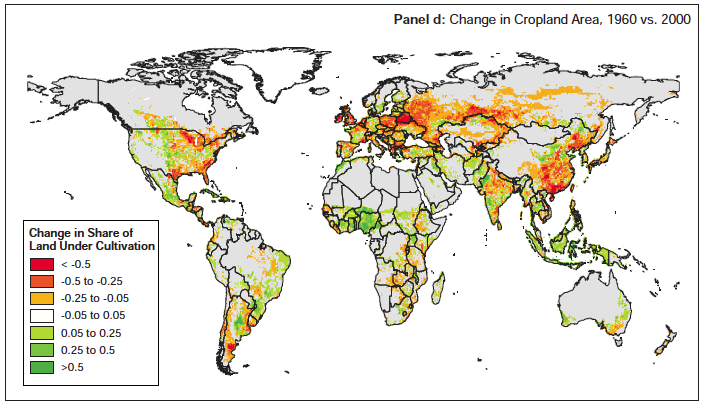
Here's yet another piece of that blind spot: despite the amazing increases in food production I outlined above, the amount of cultivated land in the world is declining.  Yes, really.  Anyone who travels extensively across the U.S. can tell you this first hand: land is returning to forest in many parts of the country.  In some parts of the world, particularly in developing countries, land under cultivation is increasing.  In other parts of the world – particularly in developed countries, land under cultivation is decreasing.  The net, worldwide, is a peak around 2012, and a gradually increasing decline since then.  Agriculture is so efficient these days that it takes less and less land to feed an increasing population.

One last piece of the puzzle that I've been surprised people are generally unaware of: the world's population is increasing at a declining rate.  In fact, fertility rates are generally the lowest amongst the more developed nations (think Japan, Germany, etc.) and the highest amongst the undeveloped nations (Africa and southeast Asia, especially).  The U.S. is a bit of an anomaly in that mix – we still have a relatively high fertility rate.  Overall, though, the world's fertility rate is declining, and while opinions vary on when we might reach peak population, few economists or demographers disagree that we will reach that point, and most agree it will be before the end of the current century.

This story I've tried to encapsulate here in short form is, in my view, one of the most amazing stories in all of human history – and yet so many people who are actually living through this don't seem to even be aware of it!

Saturday, August 13, 2016

The true size of...

The true size of ... many countries is far different than most people believe, largely thanks to the dominance of the Mercator projection for maps of the world.  A web site I just found helps anyone understand the relative size of countries through a simple technique: you drag the map of one country to superimpose it upon another.  The projection is automatically corrected.  The image at the right is from this web site; it shows the country of Estonia (a place I'm very familiar with) superimposed on a map of Utah (a place I'm even more familiar with).  If you were to look at Utah and Estonia on a standard (Mercator projection) world map, you might think they were of similar size!

Beautiful!

Beautiful!  Found here...

Wednesday, August 10, 2016

The old lady...

The old lady...  This is a painting that I've inherited from my mom.  It's an oil painting on wood, not the usual canvas.  Mom didn't paint it herself – she inherited it from her dad (my grandfather).  I'm told that her dad bought an auction lot that included this painting, and that he liked it, so he kept it.  My mom had sentimental reasons for keeping this, then – and now I do.

The painting is signed “De Wilde Edw”, which I took to mean Edward De Wilde.  Searching for an artist of this name got me nowhere.  Then I tried searching the name exactly as written, and also got nowhere.  So I contacted an art appraiser I am acquainted with (here in Logan), and she looked up the name in a reference book she owns.  Bingo!  At least, I think it's a bingo :)  She found an artist named “Edouard De Wilde” who lived and painted in New York City in the early 20th century.  He was neither well-known nor well-regarded :)  The difference in spelling, my appraiser friend tells me, is quite a common thing for immigrants who would often spell their given name as if translated to English.

I'm not sure where I'm going to hang this painting.  Most likely it will go in my office, where I'll see it every day and be reminded of my mom...

Tuesday, August 9, 2016

A squirrel's eye view...

A squirrel's eye view...  Now there's a blog post title I never expected to write!

Monday, August 8, 2016

You've heard me rave...

You've heard me rave ... about my “paperless office” solution, with a Fujitsu ScanSnap iX500 scanner and DEVONthink Pro Office.  I've been using these to process all my paperwork for over a year and a half now.  I'm to the point now where I'd really be unhappy if I had to go back to paper.  I'm totally and completely addicted to the search capability in DEVONthink Pro Office – and the scanner works so well, so effortlessly, that I still have trouble believing it. 

Now I've got a new reason to celebrate the glories of this setup: dealing with the large amount of paper that I just inherited from my mom.  I have several boxes full of papers with all sorts of things on them that I'd like to preserve and share with my relatives: her recipes, her letters, jokes, saved emails and letters from dad, her kids, and her friends, and so on.  I'm guessing that I've got 2,000 to 3,000 pages of such documents (that's not counting the 1,000+ photos).  So far I've scanned in about 700 pages.  I've spent around 10 hours doing this, mainly in unpacking, removing creases, fixing dog-ears, etc. to prepare the papers for scanning.  The scanning process itself is crazy fast at 25 pages per minute.  It takes about a minute per full page (and much less for smaller pages) to convert the scanned images to an images-plus-text PDF format; as I write this, my computer is chunking away on about 100 pages of that work.

I'm delighted with how easy this is to do, and how effective the results are.  I can now search through mom's papers just as if I had Google available for them.  For instance, just now I searched for “cobbler” and found three copies of “Marion’s Peach Cobbler”.  The search took under one second.  An aside: I'm astonished that mom had any recipes from (I presume) my Aunt Marion – she had a reputation for producing food that nobody wanted to eat, other than my Uncle Donald (her husband and my dad's brother).

Just as critical to the success of this work is my shredder: a Fellowes 225Mi.  That thing is a workhorse and a half.  It shreds up to 30 pages at a time, shrugs off staples and paperclips, and chews through CDs, DVDs, credit cards, etc. with the greatest of ease.  The results of the shredding are tiny little pieces of paper, like grains of rice.  It compresses nicely, and also makes a great fire starter :) 

The giant pile of photos won't be quite so easy, unfortunately.  I will be scanning them on a flatbed scanner, to get the best resolution possible.  Where I have negatives, I'll be scanning them as well, for the same reason.  Each photo will have to be scanned manually, one-at-a-time.  Slides I can do in batches of 20.  Even more challenging, many of the photos have writing on the back, and I want to preserve that as well - and that means those photos will have to be scanned twice (once for each side).  That's gonna take a while!

Mom's paintings...

Mom's paintings...  Here are a batch of my mom's paintings, unpacked as I go through her stuff.  I have quite a few more after these!  Many of these I'll be shipping out to relatives and mom's friends, but a few of them will stay here in Paradise.  One of those will be the fourth one in this batch, the mailboxes.  The second one (a van Gogh knockoff) will be staying in Newton (not far from Paradise) with my brother Scott.

It's been several years since mom last painted a picture.  I think she started taking lessons in the '80s, so that means her painting spanned about 30 years.  I have absolutely no clue what order these were painted in :)  For me, mom's craft works, including these paintings, are my favorite mementos of her...


Sunday, August 7, 2016

A Valentine's Day card...

A Valentine's Day card...  This was from my dad to my mom, for Valentine's Day in 2003.  I just found it while going through my mom's papers.  I was very surprised to find this – it's not the sort of hand-made card I'd expect my dad to have made.  When I first spotted the cover, with the big, poorly-drawn heart, I figured it was a kid that made it.  Then I started reading what was printed on it (“Especially carried by camel-back to you!”), and at the printing itself, and I realized dad made it.

Paradise ponders...

Paradise ponders...  Last night I made some apricot ice cream from a bucket of apricots that our friend Michelle H. (aka “bee’s knees”) gave us.  The photo at right shows the apricots just before I pureed them.  The recipe is simple: I scalded the apricots in boiling water for about 30 seconds, to loosen the skin.  Then we peeled them, and squeezed the pits out – and threw the fruits' flesh into the blender (the photo).  Then I ran the blender for a few minutes to liquefy the fruit.  I should have strained the result to get out any threads and skin remaining, but I forgot that.  Then I added about 3 cups of cream, 1 cup of milk, and sugar to taste (in this case, about 1.5 cups).  The sugar is tricky: frozen ice cream tastes less sweet than the unfrozen mix, so you have to add more sugar than you'd think when tasting the mix.  It's a bit of an art to get it right.  Then I just froze it in our Musso ice cream maker.  This afternoon we each had a nice dish of this for dessert.  Yum!

Early this morning we took a drive up to Hardware Ranch, looking for wildlife.  Other than a good assortment of deer (including a spotted fawn), we didn't see much at all.  We especially didn't see anything in the way of birds.  Weird!  Before we left, the dogs and I enjoyed the pretty sunrise (at right).

Basically all the rest of the day today I've been working on my mom's belongings.  I'm starting to make a dent in the rather large pile of her stuff in my office.  In particular, I've been scanning like mad, followed by shredding.  I'm saving very few of the documents, just those with some special meaning or significance, where a good scan just won't do...

Saturday, August 6, 2016

Paradise ponders...

Paradise ponders...  This morning Abby S. was over for our regular tutoring session on programming.  She's learning how to write some detailed routines that involve loops, including nested loops and nested conditionals.  I think I may have hurt her head a little bit :)

Early this afternoon, Debbie and I headed down to the Maddox Drive-In and had ourselves a fine lunch.  It was a steak sandwich for me (and it really was a steak, not some thinly sliced stuff), and Debbie had a shrimp basket.  Both very yummy!  I had sarsaparilla, and Debbie had root beer – both homemade, and both excellent.

Afterwards we made a grand loop to get home.  We drove north from Perry (where Maddox is) along the western front of the Wellsville Mountains, then east on State 30 toward Logan, then south on State 23 toward Wellsville.  It was a pretty drive, partly through areas we'd never visited before, and that's always fun and interesting.  That stretch of State 30 that we drove on had lots of safflower fields (a couple photos below) growing on dry (unirrigated) farms.  It sure appears to be thriving!  The plants are allowed to go to seed, then the seed is harvested and pressed for the oil.

Friday, August 5, 2016

Paradise ponders...

Paradise ponders...  Quite a bit got since yesterday afternoon on our construction projects!  Late last night a heating and air conditioning guy showed up to install a heating duct for our mud room (visible in the sixth photo below).  Just by happenstance our home has a floor duct alongside the front door.  Our builder cut a hole in the house's rim board, and there was the duct, right there – very convenient!  So we simply cut out that register transition (so now that register inside the house will not put out any warm air) and extended it with an insulated duct to a register transition on the mud room floor.  We won't miss the register inside the house, as there are several other ducts nearby.

This morning, the insulation crew showed up.  Two very hard-working guys had all the insulation installed in about two hours.  All but the last two photos show that work.  The fourth photo shows some interesting “shells” they were using.  These shoot (literally, with gunpowder!) small fasteners through bats of insulation into the concrete foundation.  This is how they attached the bats to the insides of the foundation walls.  It was interesting to see how they handled all the little challenging details, like the ends of the joist runs.  These two fellows had obviously done all of this many times – they zipped through all the work very efficiently.

Later this afternoon, our builder showed up with his son and installed the tongue-and-groove OSB sub-floor sheathing.  They were interesting to watch, too – especially when it came to the funny angles in the sun room floor.  They did it a far easier way than I'd have done.  I would have carefully measured the outline of the rim board, and then attempted to transfer those measurements to an 8x4 piece of sheathing.  They simply installed the 8x4 sheet and let it overhang.  Then they traced out the actual rim board edges and sawed it off (as you can see in the last photo).  Much easier!  Our builder has done this a time or two, methinks.  :)


Another piece of paper...

Another piece of paper ... that my mom saved.  It's also another one that I had no idea existed.  It's a letter from the captain of the USS Long Beach, the ship I served on.  My mom probably didn't realize that this was a standard form letter, hand typed by a yeoman from a template provided by the Navy Bureau of Personnel (BUPERS).  The Navy did quite a few things like this, attempting in their ham-handed way to generate some good public relations through their enlistee's families.  My mom also likely didn't realize that this particular event being roundly praised (my advancement to DS2) was guaranteed, conditional on my meeting minimum requirements, by the six year enlistment commitment I'd made.  Part of that was fast-tracked promotion to E5 upon graduating successfully from “C” school (which I did) and passing the tests for E5 (which I also did, not long before this letter was typed up).

If you're unfamiliar with U.S. Navy enlistee designations, the “Data Systems Technician” was my rating.  It was often shortened to “DS”.  Basically a data systems technician was the IT guy of the day.  The job was a bit different back then, though: we did relatively little on software, configuration, or administration (tasks that dominate the work today).  Instead we spent most of our time doing actual electronic repair, right down to the component level.  We had to be very proficient with oscilloscopes, meters, Ohm's law, soldering irons, and so on to do the job.  A modern IT guy might not know any of these things, but can configure routers or administer the daylights out of a Linux system :)  The “Second Class” was my rank, the Navy's term for an enlisted person at rank E5 (which means fifth from the bottom-most rank).  The second class was often shortened to just “2”, and “DS2” the short form of Data Systems Technician Second Class.  The short form is certainly much easier to type!

That particular captain, Captain Frank R. Fahland, was known by the crew as “Frank the fish”, mostly for the appearance of his face.  May 1974 is quite shortly after I arrived on board the ship, and I'm certain that the captain had absolutely no idea who I was.  The ship had a crew of 1,200 men, and he and I had never met.  The boilerplate text in the letter is technically truthful, but for data systems technicians the competition wasn't all that keen – the Navy was desperate for more of them, and you had to be pretty darned bad to fail the qualifications :)

I'm afraid my mom was a bit deceived about the glory being showered on me by Frank the Fish :)

Broad Mouth Fire...

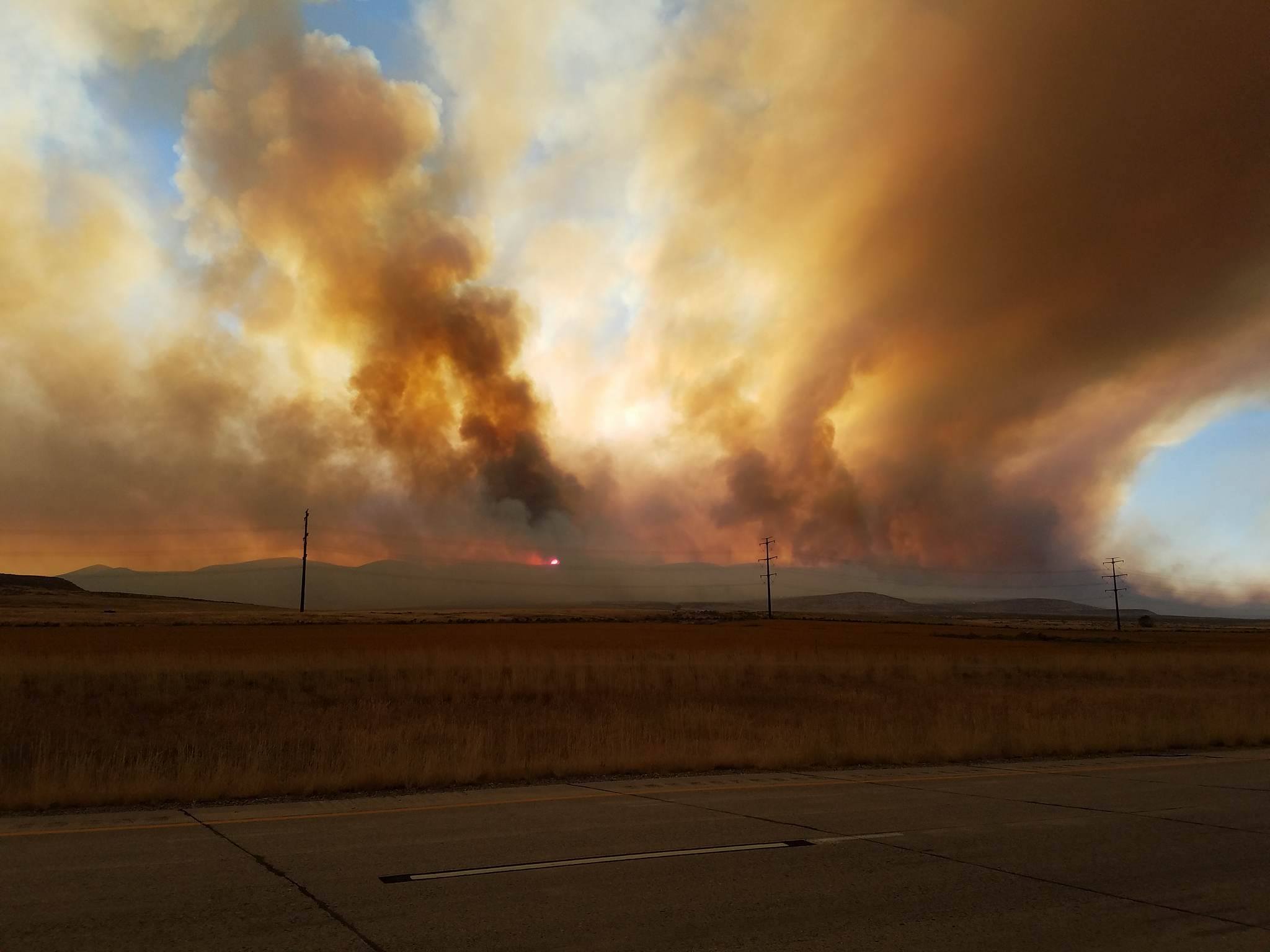
Broad Mouth Fire...  This is a fire that's been giving us a smoky atmosphere for about a week now, in a fairly remote area of Box Elder County, but near the edge of Cache County (where we live).  The fire currently is burning about 30 miles to our northwest, and it's burning to the south and west (which is not toward us).  As I write, the fire has burned about 10,000 acres and its only 15% contained.  Locals tell me that the area that's burning is mostly sage and grass, with scattered juniper and pinyon pine, and this sounds right.  That's far less fuel (and therefore far less scary) than we had in the chaparral where we used to live, down in southern California.

I learned about some online fire resources in the course of researching this fire.  First thing I found was the Utah Fire Info site, which, amazingly enough, is a government effort.  It's quite good.  That took me to another great government-generated resource: realtime fire updates via Twitter.  Kudos, Utah state government!  The Twitter feed took me in turn to another resource (not government): a wildfire viewer, with multiple layers of information.

Thursday, August 4, 2016

Ran across a piece of paper...

Ran across a piece of paper ... in my mom's things that brought back all sorts of memories...

I have no idea how my mom got this paper.  It's the class scores and standing for the U.S. Navy Basic Electricity & Electronics Program (known colloquially as “BEEP” school).  There are only two possibilities, realistically: either the school mailed it to her, or I gave it to her.  The former, I think, is the more likely.  To the best of my knowledge, mom never told me she had this.  The paper is a single sheet of bond paper, with mimeographed class scores on it.  For my younger readers, mimeographing was how we made copies of a document before we had copiers, and yes, I am that old.  The paper is quite worn and dog-eared, and falling apart at the creases – it has obviously been folded and unfolded many times.  This seems an odd artifact to garner my mom's attentions, but obviously it did.

BEEP school was a real turning point for me.  It was the very first time I was ever in a class where the students were highly motivated, the subject was of great interest to me, and I had access to a first-class lab and library.  I went to BEEP school in San Diego, right after getting out of boot camp.  It was the first taste I had of the “real” Navy. 

BEEP school, if I'm remembering correctly, had 18 “modules” of curriculum, each intended to last a week.  Because BEEP school routinely enrolled students with anything from zero electronics exposure to credentialed electrical engineers, they started out each module with a test to see if you already knew the material – in which case you'd skip that module and move on to the next one.  Your scores on the 18 modules were aggregated, and all who graduated in any given week were called a “class”.  The class standing for each such class was then calculated and became part of your record. 

At the time I took that test, in 1972, I had been a ham radio operator (with a general license) for just over 10 years.  I'd been designing, building, troubleshooting, and operating radio receivers and transmitters for most of that time.  I knew a thing or two about electronics, but I didn't really know how much I knew – I'd never had any way to measure myself relative to others.

The instructors at BEEP school told us that we should “test out” of as many modules as we could.  Being the damned fool that I was (then), I took their advice to heart and worked my way through all 18 modules in two days.  So ... instead of 18 glorious weeks in San Diego, where I could have been doing all sorts of fun things with all the free time I'd have because I already knew the material – I had just two days.  Dang it!  My classmates were incredulous that I could be so stupid as to blow that opportunity.  They had far superior knowledge of the world's ways that I did.  :)

On the other hand, I now had a measurement of my own skills in electronics compared with the other people in my class.I did very well on those module tests, well enough to be number one in my class – something that had never happened to me before.  It's hard to overstate what an impact that had on me, mainly because it showed me that I could hold my own when it came to a technical subject.  My further U.S. Navy schooling (these were “C” schools in Mare Island) just reinforced this confidence-building success.  My instructors were very surprised when I told them that I'd had no class on electricity or electronics, being self-taught. They were also impressed that I also knew practical aspects (especially in terms of troubleshooting and, of all things, soldering).  Even when they had engineers come through the school, they didn't generally have much in the way of practical experience.  All of this was recognition on a level that I'd never experienced before.  I was being treated with a respect that I'd never had, and that was a feeling I very much liked. 

Even today, nearly 45 years later, those memories are powerful.  And all brought back by a piece of paper that my mom (who didn't know anything I've written here) unaccountably had and saved...

Paradise ponders...

Paradise ponders...  The building inspector was here this morning, and signed off on the work so far.  He also did the final inspection (about a year late!) on our shed.  It was actually a lot of fun to walk the inspector through – he was fascinated with all sorts of stuff, and kept making envious sounds and exclaiming things like “Wow!  That’s really cool!” :)  He seemed to especially like my electric hoist, that works though a hatch between the first and second floors of the shed.

The path is now clear for running the heating duct to the mud room, insulating the floor of the mud room and sun room, and installing the sub-flooring.  Once the mud room's sub-floor is in place, we could actually start using our front door again.  All we'd need is some sort of temporary stairway...

Wednesday, August 3, 2016

Paradise ponders...

Paradise ponders...  The past couple of days saw some progress on our construction projects.  First the builders installed the “plates” (the greenish treated 2x4s clearly visible in the third photo).  These plates are held to the concrete with lag bolts embedded in the foundation.  There's actually a thin layer of special foam between the plates and the concrete; this forms a watertight seal even in the presence of slight imperfections in the surface of either the foundation or the 2x4.  Next up was the “rim board” – the sheets of 1" thick OSB standing vertically on top of the plates.  Finally came the joists, those marvels of engineered wood I blogged about earlier.  As I write this, the mud room and sun room are finished to this stage.  Tomorrow morning an inspector is due, to sign off on this stage of work.  Next up: on Friday, the insulation team will be here to put R50 insulation between the joists, and in the afternoon the builders will install the OSB tongue-and-groove sub-flooring.  There's a pile of 2x6s remaining from the lumber delivery.  I'm guessing that these will be used for framing the mud room, but that's just a guess...


This morning I started the work on the “filling station” we're putting up, to dispense gasoline and diesel for our trucks, tractor, and various other machinery.  This will be located near our driveway entrance, adjacent to the concrete apron for our outbuilding.  The nozzles, filters, gauge, and hoses will all be housed in a small building there.  This will be constructed of 8" cinder block, with inside dimensions of 32" wide by 16" deep.  It's roof will be a single large stone slab, and the outside will be faced with rock.  The inside will be taller than it looks: from 3' underground to 6' above ground; a 9' vertical span.

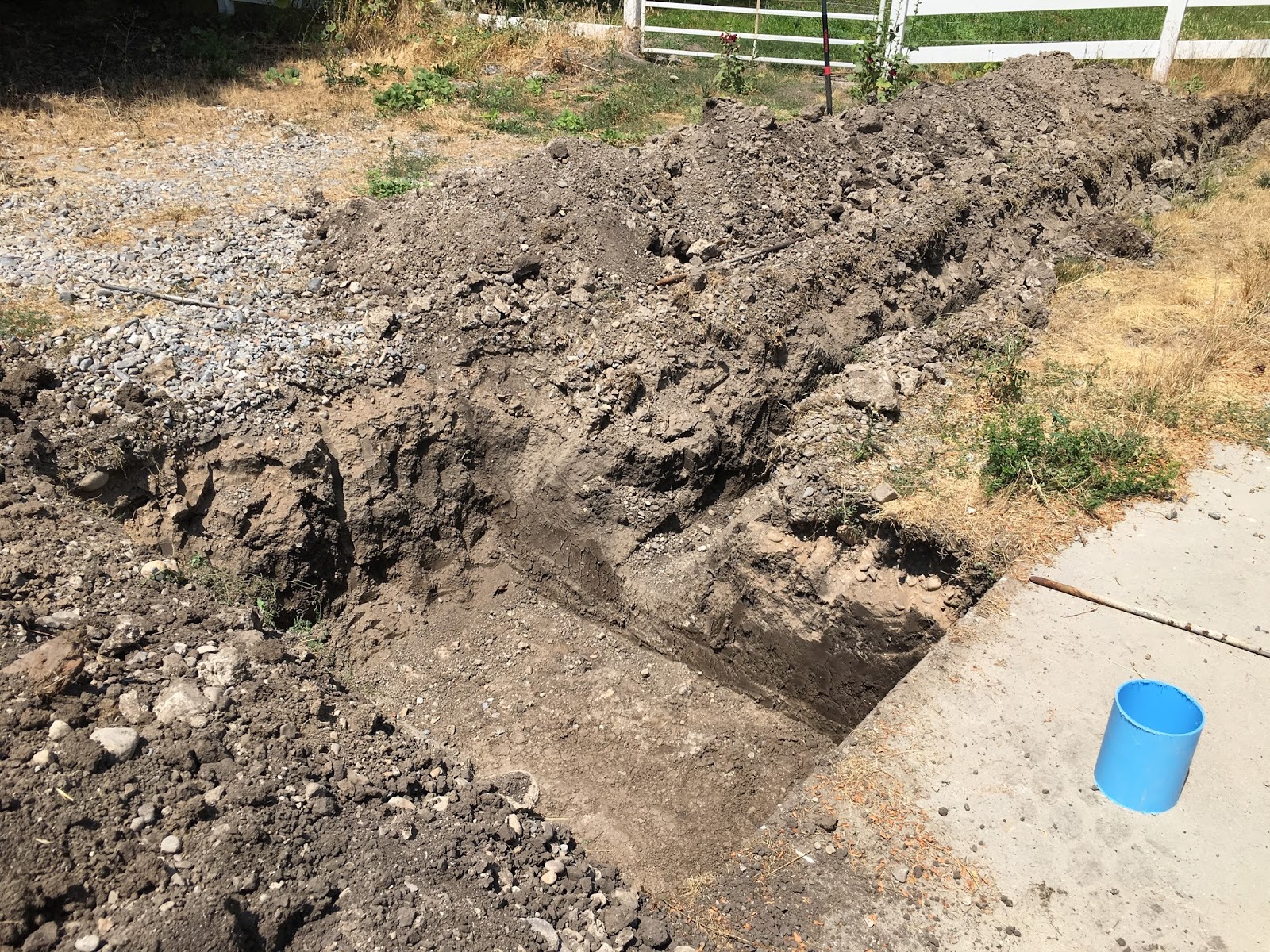
What I did this morning was to dig the hole for the footer and foundation for this building, and also a ditch for the gasoline and diesel pipes to be buried in.  The footer (on the advice of our mason) extends a foot out from all sides; it will be a 6' x 4'8" x 8" slab of reinforced concrete with a 6" diameter drain hole in the exact center.  From the footer, a wall of 8" thick reinforced concrete will rise to 6" above ground level to form the base for the cinder block.  We're hoping to have all of that poured within two weeks.  The hole:


The majority of that gravel and soil I dug out with my backhoe, but the “finish work” was all by hand, with a plain old shovel.  In the 90°F heat, that was hard work!  It didn't help a bit that the soil there is quite wet once I get down about 2'.  I think that's because of the irrigation canal, which is about 50' away.  Hopefully it's not a leak of some kind!

Jahar, our Savannah cat, had us a bit worried starting last night when I cleaned his litter box – and discovered it contained nothing.  If you own cats, you know this is pretty weird.  So this morning I hauled him off to the vet, yowling and hissing and spitting, and generally being scary pissed off.  When I got him there, they (of course) wanted a weight – and tiny little Madison, a vet tech there, just reached into the carrier and hauled him out, all the while he was acting like a furry chainsaw.  I'm about three times her size, but I would have hesitated much more than she did!  Dr. Russell gave him the once over, and pronounced him just fine as far as she could tell – temperature normal, weight the same as last visit, bladder not full, and poop production just fine (as demonstrated while Dr. Russell was holding him :).  So I brought him back home with instructions to basically just watch carefully for the next couple days.  Debbie just told me that he's been eating and drinking, so maybe whatever his problem was has just resolved itself...

Monday, August 1, 2016

Going through mom's belongings...

Going through mom's belongings ... and I found this letter, never sent.  It was one of the things I found in an envelope tucked into a corner of her purse.  The envelope is practically worn out, and many of the documents have obviously been folded and unfolded many times.  Several of the items in this envelope are either complete mysteries to me – mementos of some aspect of my mom's life that I don't know about – or they're big surprises.  Some of those surprises I don't think I'll be sharing publicly :)  Some I will probably do so at some point.  This particular letter was so worn out that I had to tape together before I could scan it. 
A letter to my children and grandchildren

April 27,1998

Tomorrow is the big "O" day [TD: "O" presumably means "Operation"], I go in to have surgery to give me two new knees and hopefully a new lease on a better life.

This letter is just in case something goes wrong and I do not live through this procedure. I fully expect to, but just in case I wanted to say a few things to you.

The most precious moments have been with family - husband, children and grandchildren. The joyful times we had camping stand out in my memory. Some of the candlelight dinners with Dad stand out in my memory.  The first summer I took all four granddaughters up to camp is one of my most favorite memories. They are so beautiful and they got along so wonderful. Seeing the enjoyment Tami, Amber and Marci gave to the old folks at the nursing home in Lincoln has got to be on the list.  Watching the little girls grow into young adulthood is almost frightening. It seemed to happen a lot faster than it did with our own children and that happened fast enough.

Watching all four of our children grow and flourish and each give to this world something wonderful. We don't have to look too far to know how special you all are and how lucky we are to have had you.

You all share what I feel is the best of both of us parents. Passing that on to friends and children will maybe do a little bit to make this earth a mite more wonderful.

You are all precious to me - you have all given wonderful meaning to my life. I love you all. I will always be with you in little ways. Hug each other - much better than fighting. Hold on to the things that are 'right' to hold onto. Don't give in or up when life seems to turn the wrong way. Always do to others the things you would like to have done to you. Always love and look out for family and friends.

When you are in Maine, play a game of cards with me in mind. Enjoy the camp as much as you are able. Enjoy your siblings and your children each and everyday.  Hug each other every chance you get - hard.

Remember the good times we have had and forgive me the bad times - please. I love you all so much.

I don't know why she signed it with an “86”.  I had no idea this letter existed.  Finding it pretty much stopped me in my tracks for today...

Update 8/3/2016: my brother Scott knew what the “86” was all about.  It seems my mom's friend (Joyce) liked to call herself “Agent 99” after a character in an old television show, and my mom called herself “Agent 86”, or just “86” for short.

Giving her stuff away...

Giving her stuff away...  Before my mom left Virginia, she gave away many of her belongings (or arranged for them to be given away when she was gone).  One of the things she gave away was her painting supplies.  For quite a few years, mom took lessons and painted (in oil or acrylic, not water paints to my knowledge).  Many of these paintings were gifts; others hung in her home. 

She still had all the supplies until early this year, when she discovered that Hannah D., the young daughter of her neighbor in Virginia, was taking up painting.  Mom gave her a big pile of supplies, including brushes, palettes, and a great collection of paint.  Mom got to see the first painting that Hannah did, but not the second (above).  She'd have loved this one: hummingbirds, penstemon, and lots of bright colors.  And she'd especially have loved the fact that Hannah was making good use of her gift.

Thinking of you, mom.  Every day...

On her recent visit with us...

On her recent visit with us, our Polish friend Jo B. left a sizeable bag of “sweets” with us as a gift: chocolate confections of various kinds, plus some wrapped caramels that were hard and crumbly, rather than soft as we're used to having caramel.  The photo at right shows a couple of examples.  We've really been enjoying these, but now our supply is dwindling.

So I got to wondering whether I could find these delectables on Amazon.  Yes, of course!  I noticed that the word “Wawel” appeared on each piece of candy, and it had the little ® after it (for registered trademark).  I guessed that Wawel was a brand or maker, and searched for it in food.  Voila!  Lots of Wawel products available on Amazon.

Not so very many years ago, a product like this would only have been available through a specialty store (likely in a big city), or through a specialty mail-order catalog (likely one catering to Polish immigrants).  It would have been a real challenge to locate a source, and the price would have been high, too (specialty stores generally have lower turnovers, and therefore must have higher profit margins – and higher prices).  Today all it took was about 30 seconds of brand identification and a few keystrokes on my web browser – and now I know I can order these any time I want them, and at quite a reasonable price, too!

Paradise ponders...

Paradise ponders...  Yesterday I finished assembling the table and chairs that will go on our deck.  These were sold through Amazon by a company called Oakland Living (a furniture wholesaler), but were manufactured in China by some company I can't identify.

You may remember that I nominated the table's assembly instructions as “worst assembly instructions evah!”  Well, the assembly instructions for the chairs were possibly even worse.  In particular, the chair's instructions don't tell you the proper placement of some very important parts – and if you got them wrong, you could easily damage the chair.  I've seen how these “spring rocker” chairs are assembled before, so I figured it out pretty easily.  I can imagine, though, that quite a few people get it wrong and end up either damaging the chair, or even hurting themselves.

I'm guessing that Oakland Living buys from many different manufacturers, so probably the instructions for all their stuff aren't quite so bad.  But if they are ... watch out!

Earlier this morning, while it was still relatively cool out, I geared up to work with my steel-bladed weed whacker.  I then wandered about the west side of our property, taking out teasels wherever I found them.  The timing on these matter – if I were to wait too long, they'd go to seed and I'd have a bazillion more next year.  If I do it too quickly, then the late-sprouting teasels escape my marauding.  Today was just about right: the smallest teasels I found were about 2' high, and easy to spot.  None of them were in seed yet.  They're all on the ground now...

Yesterday I started going through my mom's belongings, doing a first pass on sorting it for trash, stuff to give away, stuff to send to relatives, and stuff to scan or save.  It's a bigger job than I had imagined, mainly because there are so many questions to get answered.  The questions range from “What the heck is this?” to “Did any of our relatives want this?”  I'm leaning on my sister a lot for help with these things. 

Yesterday I came across the jewelry at right.  My sister tells me that these are some of my mom's favorite pieces.  I'm about as far from a connoisseur of jewelry as it's possible to get (remember, I like my women naked, unpainted, and unadorned :), so I have no useful opinion about them.  The women in my life are uninterested in them; they are not the style that appeals to them.  And yet ... they are my mom's favorites.  I'm really torn about what to do with them.  I may just give them away to some of the residents at Williamsburg, where mom stayed happily, but briefly.  Or maybe I'll find a way to display them, as a memento.  My only plan right now is to ponder...