Wednesday, August 16, 2006

Different World

This comparison between the accomplishments of Muslims versus the accomplishments of Jews, as measured by Nobel prizes awarded, took me quite by surprise. The basic data is verified by Wikipedia here and here. Take a gander:

The Global Islamic population is approximately 1,200,000,000, or 20% of the world population.

They have received the following Nobel Prizes:

Literature:

1988 - Najib Mahfooz

Peace:

1978 - Mohamed Anwar El-Sadat

1994 - Yaser Arafat

Physics:

1990 - Elias James Corey

1999 - Ahmed Zewail

Medicine:

1960 - Peter Brian Medawar

1998 - Ferid Mourad

The Global Jewish population is approximately 14,000,000, or about 0.02% of the world population.

They have received the following Nobel Prizes:

Literature:

1910 - Paul Heyse

1927 - Henri Bergson

1958 - Boris Pasternak

1966 - Shmuel Yosef Agnon

1966 - Nelly Sachs

1976 - Saul Bellow

1978 - Isaac Bashevis Singer

1981 - Elias Canetti

1987 - Joseph Brodsky

1991 - Nadine Gordimer World

Peace:

1911 - Alfred Fried

1911 - Tobias Michael Carel Asser

1968 - Rene Cassin

1973 - Henry Kissinger

1978 - Menachem Begin

1986 - Elie Wiesel

1994 - Shimon Peres

1994 - Yitzhak Rabin

Physics:

1905 - Adolph Von Baeyer

1906 - Henri Moissan

1907 - Albert Abraham Michelson

1908 - Gabriel Lippmann

1910 - Otto Wallach

1915 - Richard Willstaetter

1918 - Fritz Haber

1921 - Albert Einstein

1922 - Niels Bohr

1925 - James Franck

1925 - Gustav Hertz

1943 - Gustav Stern

1943 - George Charles de Hevesy

1944 - Isidor Issac Rabi

1952 - Felix Bloch

1954 - Max Born

1958 - Igor Tamm

1959 - Emilio Segre

1960 - Donald A. Glaser

1961 - Robert Hofstadter

1961 - Melvin Calvin

1962 - Lev Davidovich Landau

1962 - Max Ferdinand Perutz

1965 - Richard Phillips Feynman

1965 - Julian Schwinger

1969 - Murray Gell-Mann

1971 - Dennis Gabor

1972 - William Howard Stein

1973 - Brian David Josephson

1975 - Benjamin Mottleson

1976 - Burton Richter

1977 - Ilya Prigogine

1978 - Arno Allan Penzias

1978 - Peter L Kapitza

1979 - Stephen Weinberg

1979 - Sheldon Glashow

1979 - Herbert Charles Brown

1980 - Paul Berg

1980 - Walter Gilbert

1981 - Roald Hoffmann

1982 - Aaron Klug

1985 - Albert A. Hauptman

1985 - Jerome Karle

1986 - Dudley R. Herschbach

1988 - Robert Huber

1988 - Leon Lederman

1988 - Melvin Schwartz

1988 - Jack Steinberger

1989 - Sidney Altman

1990 - Jerome Friedman

1992 - Rudolph Marcus

1995 - Martin Perl

2000 - Alan J. Heeger

Economics:

1970 - Paul Anthony Samuelson

1971 - Simon Kuznets

1972 - Kenneth Joseph Arrow

1975 - Leonid Kantorovich

1976 - Milton Friedman

1978 - Herbert A. Simon

1980 - Lawrence Robert Klein

1985 - Franco Modigliani

1987 - Robert M. Solow

1990 - Harry Markowitz

1990 - Merton Miller

1992 - Gary Becker

1993 - Robert Fogel

Medicine:

1908 - Elie Metchnikoff

1908 - Paul Erlich

1914 - Robert Barany

1922 - Otto Meyerhof

1930 - Karl Landsteiner

1931 - Otto Warburg

1936 - Otto Loewi

1944 - Joseph Erlanger

1944 - Herbert Spencer Gasser

1945 - Ernst Boris Chain

1946 - Hermann Joseph Muller

1950 - Tadeus Reichstein

1952 - Selman Abraham Waksman

1953 - Hans Krebs

1953 - Fritz Albert Lipmann

1958 - Joshua Lederberg

1959 - Arthur Kornberg

1964 - Konrad Bloch

1965 - Francois Jacob

1965 - Andre Lwoff

1967 - George Wald

1968 - Marshall W. Nirenberg

1969 - Salvador Luria

1970 - Julius Axelrod

1970 - Sir Bernard Katz

1972 - Gerald Maurice Edelman

1975 - Howard Martin Temin

1976 - Baruch S. Blumberg

1977 - Roselyn Sussman Yalow

1978 - Daniel Nathans

1980 - Baruj Benacerraf

1984 - Cesar Milstein

1985 - Michael Stuart Brown

1985 - Joseph L. Goldstein

1986 - Stanley Cohen [& Rita Levi-Montalcini]

1988 - Gertrude Elion

1989 - Harold Varmus

1991 - Erwin Neher

1991 - Bert Sakmann

1993 - Richard J. Roberts

1993 - Phillip Sharp

1994 - Alfred Gilman

1995 - Edward B. Lewis

The Jews are not demonstrating with their dead on the streets, yelling and chanting and asking for revenge; the Jews are not promoting brain washing the children in military training camps, teaching them how to blow themselves up and cause maximum deaths of Jews and other non-Muslims.

The Jews don’t hijack planes, nor kill athletes at the Olympics; the Jews don’t traffic slaves, nor have leaders calling for Jihad and death to all the Infidels.

The Jews don’t have the economic strength of petroleum, nor the possibilities to force the world’s media to see “their side” of the question.

Perhaps the world’s Muslims should consider investing more in standard education and less in blaming the Jews for all their problems…

It doesn’t surprise me that Jews, with their culture that glorifies intellectual accomplishment, would be over-represented in the Nobel prizes. Nor does it surprise me that Muslims are under-represented — in modern times, at least, it appears that Muslim culture has drifted very far toward mysticism irrationality. But the degree of the difference I was shocked by.

I see this as very worrisome evidence about how different modern Muslim society is from modern Western society. It tells me that a significant fraction of the human population — 1.2 billion people — is stuck in some kind of primitive intellectual wasteland that has kept them from participating in the extraordinary accomplishments of (the rest of) mankind over the past century. And this makes me worried about whether we’ll ever succeed in integrating modern Muslim society with the rest of the world — the beliefs and intellectual contexts of the two groups may just be too far separated to be integratable.

That’s my depressing ponder for the day…

Tip o’the hat to frequent contributor JimM…

Big Two Five

And we’re celebrating with sushi!

Tuesday, August 15, 2006

Lemurian Fellowship

As you get close to Ramona, heading north California on State 67, you’ll pass a landscaped hill and driveway on your right. There’s a big sign on the hill, saying simply “Lemurian Fellowship”. I’ve passed that sign many times, and wondered just what it could be referring to.

Now, thanks to a little googling, I know the answer.

My first thought (this being California) is that it was some kind of society dedicated to friendly relations between mankind and lemurs. Perhaps too friendly, in a NAMBLA sort of way, so I was a little afraid to go there. But, thankfully, the Lemurian Fellowship has nothing whatsoever to do with lemurs, or unnaturally friendly relations with them.

Whew!

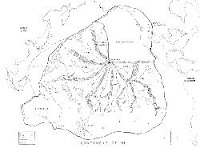
But as I explored in more detail what the Lemurian Fellowship was really all about, I wasn’t greatly comforted. It turns out that the Lemurian Fellowship is a cult religion/philosophy, with their core belief being that a superior human civilization existed until about 26,000 years ago, when the continent they lived on ("Mu", also called “Lemuria") sank into the Pacific Ocean. The map at upper right is allegedly a map of this lost continent.

From the Lemurian Fellowship's pamphlet “Into the Sun":

THE FIRST AND GREATEST CIVILIZATION

At one time in human history, there was a civilization where people enjoyed a peace of mind not possible in today’s world. Its population understood and lived by divine law, personally and nationally, enabling them to build the most magnificent civilization the world has known, which flourished for fifty thousand years.

The first human society was organized 78,000 years ago on the Continent of Mu (Lemuria), which once covered most of what is now the Pacific Ocean. The civilization began when a few outstanding individuals of above average mental ability realized the possibilities of a better way of life. Through close observation, practice, and divine assistance, they gradually acquired an understanding of universal law, becoming known as Elders. Gathering other deeper thinkers, they took the first steps toward social unity by teaching those who joined this effort to live cooperatively in conformance with God’s laws.

Within an incredibly short time, the Lemurian or Mukulian Empire developed, prosperous and at peace with all. Growing into a benign and cooperative power, it eventually achieved cultural and material accomplishments which would seem impossible today. But a fatal mistake was made. As the civilization grew, untrained helpers were brought in to perform manual labor. Gradually this proletarian element increased, while the citizenry shrank because few were being trained to become citizens. Eventually, the proletariat began taking over, administering the government according to their own ideas. The great Empire began to decline, and around 24,000 B.C., after cataclysmic upheavals, the continent sank beneath the waves of the Pacific.

As usual in such a cult, not a shred of what most people would consider “evidence” is presented to support their fundamental beliefs. For example, in the section of the pamphlet dedicated to persuading you that Mu actually existed, you’ll find this:

Consider Malden Island in the central Pacific. Uninhabited when discovered in 1798, Malden was waterless, barren, uninhabitable. Yet it contained remnants of forty massive stone temples. Radiating from the temples in every direction are highways paved with basalt blocks – highways leading into the Pacific Ocean! Where did these highways go originally? By whom and for whom were they built?

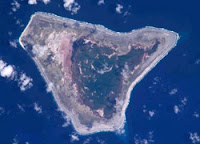
Jane Resture’s authoritative Oceania site has a slightly different take (NASA satellite photo of Malden Island at right):

There is abundant evidence to show that Polynesians lived on Malden before its discovery by white men. Earliest explorers reported stone-faced platforms and graves. Several descriptions have been given of these, together with speculations as to when and by whom they were built.

The late Dr. J. Macmillan Brown draws a highly imaginative picture of “great temple pyramids” dating from a time when Malden formed part of a “vanquished empire,” and people coming on pilgrimages to it from “fertile archipelagos within canoe distance of its shores,” which now have sunk. Kenneth P. Emory, Bishop Museum anthropologist, who studied the ruins in 1924, has published an account which agrees not at all with these fantastic ideas. The stone structures are located around the beach ridges, principally on the north and south. They include temple platforms, called marae, house sites, and graves. They indicate that Polynesians lived on Malden for several generations, and that this was not many centuries ago. Comparisons with stone structures on Tuamotu atolls show that a population of between 100 and 200 natives could have produced all of the Malden structures. Maraes of a similar type are found on Ra’ivavae, one of the Austral Islands. The natives got their water from wells, remains of which have been found, always dry or salty at present.

At least they don’t appear to have a proclivity to violence, like the radical Islamic fundamentalists; I take some small comfort from that.

But … they walk among us…

Monday, August 14, 2006

Last Supper

I’ve blogged about the Descanso Junction Cafe before. It’s a little family restaurant just off of I-8 in Descanso. For those of you not familiar with rural San Diego County, Descanso is a little town at the base of the Cuyamaca Mountains, about 3,500' high. There are a lot of retired folks living there (especially, for some reason, retired police officers), along with long-distance commuters (it’s about 40 miles from there into the concentration of jobs in San Diego) and a few people who actually make their living right there.

The Descanso Junction Cafe has been open under new owners for a few years, and it has become one of the places we frequent. Partly it’s for the good homestyle food (at very fair prices), and partly it’s for the homey, familiar atmosphere. It’s certainly not fancy — some of the seats are in need of repair, the china is a little tired, and the flatware is very … flat. The waitresses have big, honest smiles and are pleasantly sassy — but they’re not going to coddle you. Setting your table generally means dumping the silverware and paper napkins in a pile for you to sort out on your own. And it’s most definitely a community sort of place — almost everyone eating there is a local, and you see all sorts of community-oriented signs, fund-raising cans, and the like there. It’s obvious that the owners think of themselves as part of the community.

We love it.

But a couple of weeks ago the owners announced that starting today there would be no more dinner served at the Descanso Junction Cafe. There just weren’t enough customers coming in for it to pay — so from now on, it’s 6 am to 2 pm, breakfast and lunch only. Last night, Debbie, Jim (our neighbor and friend), and myself made the trip up there for our last supper at the old cafe. And it was a good one, of course. I had the special: a seafood platter with grilled halibut, scampi, and fish-and-chips style cod. Delicious!

Of course we’ll still be coming up for lunch. And while we haven’t often been there for breakfast, I forsee more of this in our future.

Somehow we’ve got to make it worthwhile for them to open for dinner again!

Sunday, August 13, 2006

Mene Sculpture

Being the proud owners of three beautiful field spaniels (or is it the other way around?), we’re naturally always on the lookout for art that relates to field spaniels. I have an automatic search going on eBay all the time, looking for new stuff that pops up. And a few months ago, a doozy came along — a bronze sculpture of two field spaniels chasing a goose. The sculptor was Pierre-Jules Mene, who probably made this sculpture between 1850 and 1860 (according to the art dealer selling this on eBay). If that’s correct, it’s from the earliest days of the breed — and the two dogs in the sculpture have exactly that look. There’s a short biography of Mene below.

Not being knowledgable about art at all, I did a whole bunch of research before bidding on this piece. As best I could figure from the bazillion places where you can buy Mene works (the dude was prolific, just as the biography points out!), it was worth about $2,500 to $3,500 — a lot more than we were willing to pay. But the current bid was way below that, in the range we might consider, so I sniped it at the last second — and to our great surprise we ended up taking the piece, at a price we were happy to pay for such a thing of beauty.

We waited with bated breath for several days until it showed up — it was shipped from England. The dealer did a terrific job packing it, and it arrived at our place unscathed. It now sits on our livingroom table, as we can’t think where better to put it, where we can look at it as we’d like.

When we started looking for field spaniel art, it never dawned on us that someone might have made a field spaniel sculpture. Now I’m looking for more…

The photo at right is a stereo pair. If you know the trick about crossing your eyes to view them, you can see a stereograph (like the old ViewMasters) by looking at the larger version (click on the little one to get it). Otherwise you’ll need a stereo viewer.

Pierre Jules Mene (1810 - 1877) was born in Paris, France on March 25th 1810. He was the most successful and prolific Animalier sculptor of his time, especially in commercial terms, and he is considered an equal to any in ability. His father was a successful metal turner who taught his son how to work with metals and the principles of casting at an early age. Mene married in 1832 at the age of twenty-two and earned his living by doing small jobs relating to his training with metals such as furniture adornments and clock decorations. Like Barye and Fremiet he spent a great deal of his time at the Jardin des Plantes in Paris drawing. There he invested many hours sketching the animals from which he would make his sculptures. Though he did receive minimal instruction in art he never attended any of the prestigious art schools and was for the most part a self taught artist.

By 1837 Mene had established the first of his many foundries where he would cast all of his own bronzes throughout his successful career. His first exhibit was at the Salon of 1838 of a Dog and Fox which he cast in bronze. Mene continued to exhibit at the annual Salons, submitting one or more models every year throughout his lifetime. Mene won several medals at the annual Salon as well as being awarded First Class Medals at the London Exhibitions of 1855 and 1861. His favorite subjects were horses of which he is considered to be the master at portraying. Next to horses Mene modeled many sculptures of dogs, both at work and at play. He created bronze sculpture ranging from animal portraits, to combat groups, to domestic animals, and equestrian groups of both racing and hunting. It is estimated that he modeled over 150 different subjects during his lifetime and the number of bronze casts produced from these models range well into the thousands.

Mene was a very personable and outgoing individual and by his sheer personality alone he drew the finest craftsmen to work for him in his foundry. His home also became a fashionable meeting place for the painters, sculptors, and musicians of Paris. Pierre Jules Men was truly a man of his art, being just as comfortable entertaining the intellectuals of Paris as he was with his apron on among his foundry workers. His bronzes were widely sold through out Europe and America and he experienced great success in his business. In 1861 Mene was awarded the Cross of the Legion d’Honneur in recognition for his contributions to art. His bronzes, as well as those of his son in law Auguste Cain, were cast with the highest quality, detail, and workmanship, literally setting a new standard that all other foundries tried to meet. Mene cast his works in large editions but took personal care and diligence to make sure that all of the models and casts were kept in perfect condition throughout the edition so that even the last bronze cast in an edition was just as sharp and detailed as the first one that was produced. He did not seek public commissions and he declined many offers to do monuments. Instead he concentrated on his successful business of producing and marketing his very popular bronze sculptures.

After his death in 1877 his foundry was run by his son-in-law Auguste Cain who continued to produce both Mene’s and his own works in the highest standard of quality and continued to submit bronzes in Mene’s name until 1879. Upon the death of Cain in 1892 Mene’s foundry was finally closed and many of his models were sold to the Susse Freres foundry. They published a catalogue of the complete works of P. J. Mene including all of the sizes and subjects. Susse Freres continued to cast and sell Mene’s bronzes into the 20th century, all of them bearing their foundry mark or seal.

Names

The 2,996 Project has signed up over 1,700 blogs so far. I’ve only visited a few dozen of them, but I can tell you that the blogs are an enormously varied group — personal blogs, political blogs, American blogs, foriegn blogs, blogs set up just for this project — just about any kind of blog (or blogger!) you can think of is participating.

But as I look at the list of participating blogs, some of the names just jump out. Some blog names bring a smile all by themselves. Some are a little shocking, touching, or a little risque, or just plain weird. Below are some that just jumped out at me, for whatever reason…

Pondering Penguin

Evil Mommy

Snarkypants

Everybody can Just Bite my Ass

Bona Fide Bunkum

Womb with a View

The 82nd Chairborne Division

MoMmY nEeDsA mAi-tAi !!!

Walking on Alligators

mad-dogs-and-englishmen

Have you seen my Camel?

Katnippia

What Chu Tawkin Bout

Poor Impulse Control

purplefishguts

Tales from Creekistan

Teacher With a Tude

Insane_mom_5

Fish Fear Me

Keep My Soldier Safe

Empty Cerebrations

The June Cleaver Diaries

Used Kitty Litter

Jottings from Jersey

That Loony Yid

In Mommy We Trust (sort of)

Psychedelic Armadillo

All Drains Lead To The Ocean

Viking Humping Witch

the dissident frogman: time to take sides

Accidental CEO

SchnozzFest

The Random Neural Firings of a Free Bohemian

Kudzu and Koolaid

The Insurgent Scrapbooker

A Day In The Night Of A Stripper

This is NOT the Life I pictured

The Plaid Sheep

Hank the Llama

Coalition of the Swilling

Jarhead’s Firing Range

Binary Blonde

Retarded Rugrat

What the hell is wrong with you?

Excess in Moderation

Evil Conservative

Stir Fry Kitty

Mister Priapus' House of Vitriol and Mirth

Life in a Blender

United Possums International

Nukejuggler

Who Would Reagan Vote For?

Taylor Cat House

Go suck a lemon

The Ladies, Goddesses And Bitches Writing Consortium

Wenches Blog

Saturday, August 12, 2006

Be a Sniper

Do you bid on items at eBay? Have you had the frustrating experience of having the highest bid right up to the last second, only to have someone to outbid you — and you have no time to respond?

Chances are that you lost out to an “auction sniper” — someone using the strategy of making a winning bid at the last possible second. This strategy works particularly well with eBay, where the auctions end at a well-defined time that isn’t changed.

When I first started bidding for items on eBay, this happened to me quite often, until (being slow on the uptake) it finally dawned on me that this wasn’t some bad luck on my part, but an actual strategy others were pursuing. So I started sniping myself, without knowing that this was a strategy with a name and a broad following. And it worked — I started winning more and more auctions, until finally it got to the point where the only time I was losing was when the price was higher than I wanted to pay, or when I got sniped by someone bidding even closer to the auction’s close than I was.

This observation (those really closely bids) got me to wondering if some bidders were using software to do their bidding at precisely the right moment. I could easily imagine how to write such software. So I started googling…and discovered the term “auction sniping” and the wide, wide world of sniping software. There are sniping programs you can buy (some of them quite expensive!), and web sites that will do your sniping for you (for a fee, of course). Being the open source software geek that I am, I wondered if someone might have made a free, open source sniping program — and indeed they have. JBidWatcher is exactly such a program. Best of all — like a lot of open source software — it is a really well-written piece of software, and well-supported. Several magazine reviews called it the best sniper out there.

I also ran into some serious academic papers studying sniping (and validating it as a winning strategy). One of the paper’s authors put it this way:

"Our analysis explicitly shows that the winning strategy is to bid at the last moment as the first attempt rather than incremental bidding from the start."

There’s a good article about the academic studies here, and the papers themselves are here, here, here, and here (all are PDFs; you’ll need the free Adobe Acrobat Reader, which is most likely already installed on your computer, to view them).

So after getting all educated about bidding strategies and sniping software, I downloaded JBidWatcher a couple of weeks ago and started using it for my eBay bidding. It’s got a solid “two thumbs up!” rating from me — I haven’t run into a single flaw, and so far I’ve managed to win every bid I’ve made using it. My favorite feature — which I believe is unique to JBidWatcher — is “multisniping”. This lets you set up an automatic sniping bid on multiple auctions of the same item, even where you only want one of them. JBidWatcher will snipe one after the other until either you win one, or you lost them all. Just last night I won a multisnipe auction, where I lost the first auction but won the second one. These two auctions closed just one minute apart in the middle of my night; I’d never have won either of them without JBidWatcher doing the work for me while I was asleep.

Don’t bid on eBay without it!

Friday, August 11, 2006

Scales Falling?

I note in my morning tour through the lamestream media that there is a sudden burst of editorializing and commentary from the European press (especially the British) that sounds — (gasp) — rational!

One hardly knows what to say after the past three or four years of non-stop, unmitigated America- and Bush-bashing…

Just this morning, I read:

— A British commentator supporting the notion of paying extra attention to young male Arabs (that would be “racial profiling"!) in airport security. He talked about how Europeans have been in a state of denial about the threat of radical Islamic fundamentalism — and how the U.S. is the only place that isn’t! Obviously he isn’t tuned into our moonbats, but that’s ok…

— A French editorial talking about America’s “good example” when it comes to integrating immigrants into society.

— A British commentator praising American patriotism and our willingness to fight for our freedoms, even when those wars are overseas. He spoke disparagingly of the European tendency to see Americans as “primitive” and “unsophisticated", saying that in reality it was they (the Europeans) who were being unsophisticated as they pretended that terrorism wasn’t predominantly carried out by Islamic fascists.

What’s that I hear? I think it’s the sound of pigs flying. Yes, yes — a whole flock of them just flew over my house!

The Choice

Every parent wants to know about their childrens' career plans. But sometimes it might be better not knowing:

An old country preacher had a teenage son and it was getting time for the boy to give some thought to choosing a profession. Like many young men, the boy didn’t really know what he wanted to do, and he didn’t seem too concerned about it.

One day, while the boy was away at school, the father decided to try an experiment. He went into the boy’s room and placed on his study table three objects: a Bible, a silver dollar and a bottle of whiskey.

"I’ll just hide behind the door,” the old preacher said to himself, “and when he comes home from school this afternoon, I’ll see which object he picks up. If it’s the Bible, he’s going to be a preacher like me, and what a blessing that would be! If he picks up the dollar, he’s going to be a businessman, and that would be okay, too . But if he picks up the bottle, he’s going to be a no-good drunkard, and, Lord, what a shame that would be."

The old man waited anxiously, and soon heard his son’s footsteps as he entered the house whistling and headed for his room. He tossed his books on the bed, and as he turned to leave the room he spotted the objects on the table. With curiosity in his eyes, he walked over to inspect them.

Finally, he picked up the Bible and placed it under his arm. He picked up the silver dollar and dropped it into his pocket. He uncorked the bottle and took a big drink.

"Lord have mercy,” the old man whispered. “He’s gonna be a Politician!"

Did a few real politicians come right to mind as you read the punch line? Sure did for me…

Tip o’the hat to TonyL for this one…

Thursday, August 10, 2006

HPWREN

Unbeknownst to me, UCSD and USD have been collaborating on a project called High Performance Wireless Research and Education Network (or HPWREN) for a while now. HPWREN has several interesting capabilities, some of which were put to good use during the recent Horse Fire. That last link has some terrific “movies” made from still pictures taken at intervals of a couple of minutes, showing the progress of the Horse Fire.

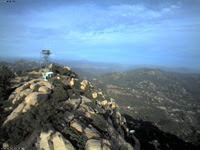
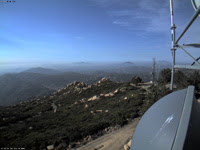
But the most interesting discovery for me is that HPWREN has several near-realtime web cameras (they update every two minutes) mounted on good vantage points around the county — and one of them is just a couple miles south of me, on Lyons Peak. This camera is actually four cameras in one, with each camera centered on a compass cardinal point and viewing a quadrant. The pictures at right I captured just before posting this; they show north and east views. My home is out of sight, just right of center in the left hand photo. The bulk of the Horse Fire was between Barrett Lake and Lake Morena, nearly dead-center in the right hand photo. These two cameras in particular would have been very useful (and in hindsight, very comforting) during the Horse Fire.

I’ve written to the folks at HPWREN to see if there may be ways we can collaborate to make JamulBlog an even better wildfire resource for Jamulians. I’ll let you know what they have to say…

Tip of the hat to “atr” for this excellent information!

Quote of the Day

Jeff Goldstein, in a post on his excellent blog Protein Wisdom:

"Christ. These people are children. And to think — they might be controlling the Democratic party one day soon?"

Jeff is talking about the moonbat blogosphere’s reaction to the UK airliner terror plot thwarted this morning. Lest you think he is exaggerating, consider this: today’s poll at the DailyKos (ground zero for moonbat blogs) has 71% of respondents declaring “The thwarted U.K. plot was more drama from BushCo to keep us all afraid.” and only 28% believing it was “legit”.

Lest you think that poll is some kind of anomaly, consider these comments on an open thread at DailyKos:

Last night, Fund gave us a peak at the coming Republican strategy that’s based on fear when he said that if Iran threatens the U.S., all voters will rush to the President’s side. Since they abandoned the terror alerts, now they have Chertoff declaring that nobody can carry anything in a bottle onto an airplane. On CBS radio in NYC they said that they’re even confiscating makeup and eyeliner. The more Mr. Chertoff declares that the London plan was “advanced,” the more I believe the opposite. Maybe I’m wrong, but that’s what happens when you lie about something as serious as war, and that’s what happens when you choose an accomplice of Ken Star for Homeland Security. Joe Lieberman loves Mr. Chertoff almost as much as he loves Karl Rove and George W. Bush.

— — — —

Just when the WH begins to charge Dems are “soft on terror", Georgie’s buddy Blair, finds 17 (?) poor suckers to arrest on yet another “developing” terror plot? I really hate having to distrust my government so..

— — — —

I won’t even buy the “terrorist plot” story unless they can turn up some actual bombs or at least some bomb fixin’s.

My first thought when I head the news headlines was “if the plot was 'foiled' why the panic-stricken mess at the airports?” You have to look further into the story to find out that they don’t really know if they’ve “foiled” anything. Which makes Karl Rove smile because he knows most of the sheep will just remember the “plot foiled” part.

— — — —

Thank you Scotland Yard, MI-5, and for any other Intelligence/Law enforcement agency for foiling this plot (including the CIA/FBI if they were involved).

If they didn’t the Bush Administration would have an excuse to start a war with Iran/Syria/whoever is the “enemy” at the moment.

— — — —

Oops, started already. In Chertoff’s press conference this AM someone (not MC apparently) had to throw out the “they-hate-us-because-they-hate-our-freedom” line. I’m sure this whole plot was ginned up because they realized that Lamont was surging in the polls.

There are many more of the same ilk — go read them if you have a strong stomach.

I don’t know whether to laugh or cry.

So I despair…

James Van Allen

Yesterday Dr. James Van Allen died of heart failure, at the ripe old age of 91. For someone like me who lived through the heady early days of space exploration, just hearing this scientist’s name evokes all sorts of memories. He is most famous for his discovery of the charged-particle belts that now bear his name: the Van Allen Belts. These belts help shield the Earth from the intense radiation that would otherwise strike it, and make low Earth orbits safe for long-term space travel. They were only discovered because Dr. Van Allen insisted on having a couple of the early Explorer satellites carry Geiger counters, so he gets the credit.

But Dr. Van Allen was a very interesting character, reminding me a bit of another scientist hero of mine: Dr. Richard Feynman. Like Dr. Feynman, Dr. Van Allen was completely disinterested in scientific convention, and completely unafraid of controversy. His career is full of incidents illustrating this, including his famous insistence on the Geiger counters (which his colleagues thought were completely useless). Another famous incident is his letter describing a personal sighting of what he believed was a flying saucer from Mars.

Remembering Dr. Van Allen brings back those amazing times in the early-to-mid 1960s: when we really knew very little about space, when our space technology was challenged and risky, when Kennedy announced the objective of going to the Moon, and seven brave men won the competition to be America’s first astronauts. These things were happening just as my own interest in science and technology was awakening; the romance and adventures of the space program (both manned and unmanned) provided much inspiration for me. And Dr. Van Allen was a prominent player in those times. He was one of the era’s “rock star” scientists, like Dr. Von Braun and Dr. Teller — like them, appearing on a cover of Time magazine, and well-known to an entire generation.

RIP, Dr. Van Allen…

Wednesday, August 9, 2006

Existential Threat

Tigerhawk has an interesting post today, in which he makes this observation:

Despite the external controversy associated with Israel’s reaction to the Hezbollah assault and subsequent war, the entire Israeli polity, left to right, is unified in its support for the War against Hezbollah. All of Israel is threatened by Hezbollah, Iran and Syria. It makes war mobilization and warfighting much clearer and simpler.

By contrast, the US polity is not unified on the matter of warfighting in the Middle East. Some see an existential threat arising from Islamism, others do not. This has made it politically impossible to preempt Iran. Therefore, it seems to me that we are likely to face a very unpleasant surprise in advance of any significant military action to upend the current Iranian regime.

Do go read the whole thing, because Tigerhawk carries through with the implications of that last sentence…

The observation about Israel being united in the fight against Hezbollah (and Hamas, for that matter) is not new, nor is the observation that the U.S. is not similarly united against Iran. But what is new (to me, at least) is the logical conclusion Tigerhawk draws: that because of our political divisions (with regard to the war on terror), we will not make pre-emptive strike against Iran. Instead, we must wait for Iran to make the first strike — thus uniting the U.S. against Iran as Israel is united against Hezbollah — and then (and only then) will we be able to muster the political will to strike. But only in response.

It’s an interesting thesis, and one that he develops a bit. But one part of his argument surprised me, though I know I really shouldn’t have been surprised. It’s when he said “Some see an existential threat arising from Islamism, others do not.” For those of you with less-than-Ivy-League vocabularies, “existential threat” is just a shorthand way of saying “a threat so powerful that it threatens your very existence”.

The momentary surprise for me was that any rational American observer could look at the radical Islamic fundamentalist movement and conclude that it did not pose an existential threat. And yet it’s obvious from the behavior of many of our leaders that in fact they see no such thing. Just to (almost) randomly pick an example: having watched Harry Reid in action, would you conclude that he behaves like someone who actually believes his country is at risk? I certainly don’t think so — I think Harry Reid is far more worried about how many seats the Democrats can pick up in the Senate this November than he is by Iran’s activities.

So why is it that many people, myself included, look at the recent history of the radical fundamentalist Islamic movement and conclude that it poses a clear existential threat — while many other people look at the same history and conclude that the threat is much less significant?

Throughout modern history we have seen the same scenario played out in Western civilization. The example I’ve read most about occurred just prior to Britain’s entry into World War II. If you read the contemporaneous political debates of the period — both in Britain and in the U.S. — you see much the same dichotomy. There’s one group of people (including both Churchill and Roosevelt) who see Hitler and Nazi Germany as an existential threat, and another group (most famously Chamberlain, but actually a clear majority of the polity in both Britain and the U.S.) who sounded a lot like our anti-war politicians of today. They really didn’t see the existenial threat. Until, that is, Hitler decided to invade Poland — a treaty partner with Britain. For whatever reason, this action of Hitler’s was enough, at last, to push the British polity over the edge to all-out war with Germany. It was clearly short of the bloody and direct first strike that Tigerhawk postulates as necessary to move the U.S. polity, however. And in World War II, it was not sufficient to move the U.S. polity — it took the strike on Pearl Harbor to do that.

So maybe Tigerhawk is right. He postulates, toward the end of his post, that even if Iran directly attacked Israel the U.S. polity might not unite — that we might not all see, even then, that existential threat. He suspects that it would take an Iranian attack on Iraq, on Europe, or directly on the U.S. (through terror cells) to hammer home the extent of the threat.

I sure hope he’s wrong.

I’d love to see someone credible poll this exact issue, the question of whether people in the U.S. perceive the radical fundamentalist Islamic movement as an existential threat. I really have no clue what the results would be…

Copper Hermes

The Hermes Copper butterfly (Lycaena hermes) is native to the area we live in — over the past seven years, I’ve spotted them four or five times. The species is rare, and getting rarer, as its habitat is either developed or burned by wildfires.

In 2004, shortly after the Cedar Fire, environmentalist David Hogan of the Center for Biological Diversity petitioned the U.S. Fish and Wildlife Service to list the Hermes Copper as “endangered”. Yesterday, the Center issued a press release that said in part:

The U.S. Fish and Wildlife Service announced today that is rejecting conservationists’ request to protect two imperiled butterflies from San Diego County under the federal Endangered Species Act.

The decision comes in response to a detailed scientific request, or “petition,” that the butterflies be added to the federal list of endangered species, which the Center for Biological Diversity submitted in October 2003. The petition was filed on the third anniversary of wildfires that caused serious harm to the two species. Today’s decision follows the Center’s 2005 lawsuit over the agency’s failure to respond to the request.

The press release continues with the usual anti-Bush propaganda, though it does mention in passing that David Hogan also petitioned to list the Hermes Copper in 1991 — and was denied “on a technicality” by the Clinton administration.

The reality is just a bit more complex than the environmentalists would have you believe…

A major premise of the recent petition (which is available from multiple locations online) is that the Cedar Fire destroyed much of the remaining Hermes Copper habitat. This premise, to put it mildly, is not a consensus view of scientists. With very little googling effort, I found several press reports from after the fire, of relieved biologists reporting that much of the Copper Hermes habitat survived intact. To be sure, there are also many scientists echoing David Hogan’s contention — but every such report I could find quoted scientists expressing concern before anyone actually went in and looked. The positive reports, on the other hand, were all made by scientists who actually went in and examined the habitat (and spotted the butterflies as well). In fact, one of the largest Hermes Copper habitats lies just southwest of us (the Rancho Jamul Ecological Preserve), and it did not burn. Another large habitat is just west of us (the Sycuan Peak Ecological Preserve), and it also did not burn. So it seems quite credible to me that the Hermes Copper escaped disaster in the Cedar Fire, and therefore the premise of this most recent petition is, at a minimum, suspect.

It’s interesting to note that while the Hermes Copper is threatened, many other closely related gossamer-winged Copper species are not — including four other Coppers native to San Diego County. Also, the Hermes Copper is dependent on a single (non-threatened) chapparal plant that is adapted to fire — it’s a “pioneer” plant that quickly propagates in burned areas. By extension, the Hermes Copper is indirectly fire-adapted as well.

The environmentalists have notoriously adopted the Endangered Species Act as a tool to have the courts enforce their anti-development agenda. They’ve been caught red-handed making petitions based on shaky or even fraudulent data, making it clear that their objective was to stop development, and not protecting an actually threatened species. The environmentalists have also been embarrassed by revelations — uncontested — that they have engaged in “species hunts” to find plausibly threatened species on land that they’d like to protect.

These shenanigans make it necessary for an intellectually honest conservationist to be skeptical of any petition arising from the environmentalist community. It’s unfortunate, but true, that they cannot be trusted.

And then of course there’s the tough issue that the environmentalists really don’t want to examine: even if the Hermes Copper really is endangered, is it worth it to save this species? For the environmentalists, the answer is always “yes”. For everyone else, the answer is a bit harder to come up with. Some simple and obvious facts that environmentalists hate to face are these: that the vast majority of all species that have ever existed are extinct, and that the history of our planet’s life is one of constant change in the mix of species. The environmentalists take it as a given that all species must be preserved. I, and many others, do not — rather, we take the view that a healthy ecology is one in which inferior species are continuously becoming extinct, and new, more robust species are continuously being created. When the main reason a species is threatened is because of mankind’s activities (and not because it’s a loser species), then I support taking a close look at the situation, to see if we can help. But I also support looking at a balance of the benefit to the threatened species versus the cost to us (mankind). And that balance must include the inevitability of that which the environmentalists hate: “development” — because the cost of restraining all development is just too high.

Which brings us around to the Copper Hermes and the denial of the petition to list it as endangered. Despite the environmentalist’s denials (because they know it would be very bad PR), if the Hermes Copper were listed as endangered, the impact on San Diego’s development would be very large — because the Hermes Copper’s habitat is very widespread, and mostly on private, undeveloped land. As we’ve seen in many other locales around the country, environmentalists would be filing lawsuits like mad every time someone tried to do anything to their property, if that property could construed by whatever stretch of the imagination to be Hermes Copper habitat. Worse yet, existing landowners would be prohibited from clearing the chapparal around their homes. Currently the County requires a 100' radius cleared around your home. Many insurance companies are requiring 300' or more cleared (my neighbor just went through this). In all of this brush clearing, you can be quite sure that Hermes Copper habitat is being destroyed — and you can be equally sure that environmentalists would file suit to stop you from clearing that brush, if the Hermes Copper were listed as endangered. If you could not clear the brush, then you’d be unable to get insurance. If you could not get insurance, not only are you at constant risk of losing your assets, but you couldn’t even move out practicably, as the value of your property would be greatly reduced. These results aren’t some imaginations on my part; very similar things have happened all over the U.S. when other species have been listed. The economic impact has been huge — just ask the loggers about spotted owls, if you’d like but one example.

The Bush administration, in denying the petition, cited exactly the issues I discussed above — the high cost to mankind of listing the Hermes Copper. They also cited the questions in the science community about just how badly threatened the Hermes Copper was. They also cited the fact that several closely related species were doing just fine. And they concluded that it just wasn’t worth it to list the Hermes Copper as endangered.

The Center for Biological Diversity calls the decision “…consistent with other administration efforts to undermine wildlife conservation and the Endangered Species Act.” I call it an act of common sense, and I support it.

But of course I have an axe to grind in this dispute. My guess is that my property value would be cut by at least 50% had the Hermes Copper been listed as endangered. And under the bizarre — and I believe, unconstitutional — Endangered Species Act, I would get exactly zero compensation for the government’s stroke of a pen taking my property away…

Tuesday, August 8, 2006

Full Moonbat?

Lanny Davis — a key member of the Clinton team — writes today (in a piece he calls “Liberal McCarthyism") about the bile-filled political climate. What’s interesting about his piece is that he’s mostly describing the vitriol on his side of the aisle. The lead:

My brief and unhappy experience with the hate and vitriol of bloggers on the liberal side of the aisle comes from the last several months I spent campaigning for a longtime friend, Joe Lieberman.

This kind of scary hatred, my dad used to tell me, comes only from the right wing — in his day from people such as the late Sen. Joseph McCarthy, with his tirades against “communists and their fellow travelers.” The word “McCarthyism” became a red flag for liberals, signifying the far right’s fascistic tactics of labeling anyone a “communist” or “socialist” who favored an active federal government to help the middle class and the poor, and to level the playing field.

I came to believe that we liberals couldn’t possibly be so intolerant and hateful, because our ideology was famous for ACLU-type commitments to free speech, dissent and, especially, tolerance for those who differed with us. And in recent years — with the deadly combination of sanctimony and vitriol displayed by the likes of Rush Limbaugh, Ann Coulter and Michael Savage — I held on to the view that the left was inherently more tolerant and less hateful than the right.

Now, in the closing days of the Lieberman primary campaign, I have reluctantly concluded that I was wrong.

...

Read the rest; it’s a kickass piece…

I haven’t commented much on the Lamont/Lieberman battle, mainly because I don’t really have anything to add to all the fine commentary out there. But if I think about that struggle as just another example of a larger phenomena — the transformation of the Democratic Party — then I have a little more to say.

Zell Miller and Joe Lieberman are, so far as I can tell, just about the last two old-fashioned Democrats left alive. The last two “honest men” left in the party, as some have said. And that’s very sad, because from my perspective they’re honorable, serious, respectable political opponents — unlike the Reids, Deans, Pelosis, Corzines, Lamonts, McKinneys, Schumers, and Kennedys (and I could go on and on) who seem to have successfully replaced them.

This is certainly not to say that the Republican Party doesn’t have any of the unserious partisan types for whom I have no respect — they do have them. But while I am not a member of either political party (neither even comes close to representing my own views), I have a lot more respect for the GOP, mostly because the partisan loonies haven’t taken over that asylum, as they seem to have on the Democratic side. Most of the time, when I hear a Republican speak, I can detect at least a whiff of something that smells like a position truly believed in. More often than not, when I hear a Democrat speak, my nose is overwhelmed by the foul odor of a position taken for momentary political advantage — even when that position is clearly not in the best interest of my country, my state, or my community.

For me, no single issue illustrates this difference better than the war on terror — and most especially the war in Iraq. This is the key issue in the Lamont/Lieberman Democratic primary battle, and I think it’s fair to think of that race as a kind of Democratic referendum on the war in Iraq. The conventional wisdom is that Lamont will easily win the primary — which means that the referendum’s results will be opposing the war in Iraq. I hope that the pundits and media are wrong, but I fear they are not.

And I shudder to think about the message that a Lamont win will send to those who control the Democratic party. I’m pretty sure they’d interpret it as a “mandate” to go all Full Moonbat on us. I would expect to hear Dean, Reid, and Pelosi start howling and screeching for immediate, unconditional withdrawal from Iraq. And I think nearly all paths from there lead to bad places…

One path leads to a Democratic party solidly committed to isolationism and denial of the fundamentalist Islamic threat to America. Depending on the degree of public support for their position, this could make prosecution of the war very difficult — and much less effective. This is reminiscent, in some ways, of the political atmosphere just prior to America’s entry into World War II. The serious political operatives on both sides of the aisle understood the need to stand with Europe, but popular sentiment was against them. In that case (unlike, apparently, 9/11) Pearl Harbor galvanized the whole country to persevere through to victory, an attitude sustained even when the political leadership decided to concentrate on Europe first, even though it was Japan that attacked us. It’s very hard for me to be confident about the general American support for the war in Iraq — there is so much apparently conflicting information out there to confuse us all…

Another path leads to the destruction of the Democratic party as an effective political force. This might well happen if most Democrats found the Full Moonbat didn’t really represent them, and they were frightened about the implications to their country. I’d like to think that that would be the case — but the likely outcome of that is (at least for the moment) that we’d have just a single effective party (the Republicans). And I don’t much like that, either — I think it’s very important for us to have political tension, especially at the national level.

There’s only one path that leads to a good place. It’s a variation of the preceding path, wherein the disintegration of the Democratic party leads to the creation of a new — and effective — political party. It’s happened before in the U.S., but not very often — and never in our modern age of instant communications and a relatively ill-informed population. I’m not at all optimistic that a new party could successfully be formed. But if it did form, and especially if its ideology resembled that of Zell Miller and Joe Lieberman, then I think that would be a very healthy thing for America.

That I would really like to see…

But I fear something much worse is more likely…

Monday, August 7, 2006

Hummingbirds

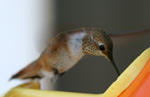
Late this afternoon, in the last good light for photography, I went out and took about 75 photos of the relatively few hummingbirds that were sucking sugar water from our feeders. The image immediately at right shows one of my favorites: a female Allen’s or Rufous (I can’t tell them apart). In the first two rows below are several more examples of females from the same species.

Click on any of these photos to get a (much) larger version…

Another one I particularly like is the male black-chinned hummingbird (at lower right, below). They’ve got a beautiful brilliant royal purple throat patch, but only if you catch them at exactly the right angle — which of course I failed to do in any of my photographs. The others are either Anna’s or black-chinned females.

Notice the hummer traffic jam in some of these pictures? And this was before things get really busy tonight!

For the shutterbugs out there: these were all taken at very short range: 3.5” to 11”. I used a nominal 100mm macro lens, but my camera body effectively multiplies the focal length by 1.6, so you can think of it as a 160mm lens. The light is all natural, late afternoon shade. Most of them were taken at 1/350th, time priority, and 100 ASA equivalent; a few were at 1/500th and 400 ASA equivalent. The equipment was a Canon D20 body and Canon EOS 100 macro lens. All were handheld.

Hummers

Last night just before sundown, and again this morning just after sunrise, I did something I’ve been doing a lot of recently — enjoying the company of hummingbirds. At that time of day (and also just after sunrise in the morning), we have a hundred or more hummingbirds feeding from about eight large feeders in our windows (each holds a quart or more of sugar water). Usually we just watch them through the windows, but a few years ago — after a few years of feeding them — we noticed that the hummingbirds were getting acclimated to our presence in their midst. They’d buzz around excitedly as we put newly-filled feeders out. A few times one of them landed on my hat, glasses, head, or (most memorably) ear. They’d zip away if we made a sudden move, but if we were still or moved very slowly, they’d come back.

Nowadays, especially in the morning and evening, if we go out and stand still next to the feeders we’ll have clouds of hummingbirds around us within 30 seconds. Some of our feeders are hung at eyeball level. If I stand so that my nose is just two or three inches from the feeder, the hummingbirds will soon be feeding right in front of my nose, quite literally. They’re so close I have to take my glasses off to see them clearly — but oh, what a view I have of them then! Some of them are very curious, and will hover right in front of my face, a couple inches away, inspecting me. Others will hover over the feeder, drinking “nectar”. And others yet will land on the feeder before drinking.

My favorite, at this close range, are the female Allen’s or Rufous hummingbirds. These species are very hard (for me, at least!) to tell apart. Both Sibley’s and the San Diego Bird Atlas tell me that I really shouldn’t be seeing either species here this time of year — but they are most definitely here; those are the only two species that look anything like the birds we’re observing. For some reason it is much more common for us to see the females at our feeders, though we do see the (rather spectacular) males a few times every day. But the females are my favorite, with their softer, more varied colors and patterns.

While watching these tiny critters there are many things to marvel at. One skill particularly fascinates me: their ability to hover such that their heads are absolutely still. The rest of their little bodies are vibrating and oscillating as they correct for wind and turbulence, but their heads are rock-steady. This skill is key to their feeding — it lets them insert their long beaks and tongues deep into flowers, to slurp up the nectar within them. It’s just amazing how good at it they are. This would be extremely difficult for any man-made machine to duplicate…

This morning I had two pairs of males battling within a foot of my face. A pair of Anna’s, with their bright red “helmets", had an extended contest; one of them was particuarly aggressive, attacking not only with his beak but with his feet. The other was a pair of diminutive black-chinned males. These are badly misnamed, as their most prominent feature isn’t the black chin, but rather their extraordinary royal purple throats. These two held a spectacular aerobatic display just six inches from my eyeballs, tumbling about and doing somersaults that just looked impossible. Of course, they made it look very easy indeed!

Both last night and this morning, I spent part of my time with the hummers in the company of one of our cats: Maka Lea, our little neurologically damaged kitty. He has trouble walking and jumping, but is otherwise quite normal (although he still has the playful personality of a kitten). He just loves to watch the hummingbirds, as do all our cats — but unlike them, he doesn’t have the physical skills to leap and try to catch them. None of the cats seem to understand about windows, so they keep trying even though it’s not possible. So I take Maka Lea out with me when I commune with the hummers. I hold him upside-down in my arms, bundling his paws up so he can’t reach out and snag one as they flit by. But his head is swiveling all over as he watches them, eyes big and round. He is clearly enjoying himself. The hummers couldn’t care less about his presence — they will zip down to within an inch or so of his face, with no apparent concern or caution. Most likely this is only because I’m holding him, and the hummers don’t realize there’s anything but me. Eventually Maka Lea can’t stand it any more, and he’ll start struggling to escape my containment — that’s when I put him back indoors. But when he sees me heading for the door to go commune with the hummers, Maka Lea will come trotting up to my feet, look up at me, and mewl — it isn’t hard to figure out what he wants…

Saturday, August 5, 2006

Archimedes Palimpsest

A “palimpsest” is a manuscript written on parchment or paper that was reused from an older manuscript. In the case of parchment, the old writing is scraped off the parchment, and the new document written on top of it. This was done because parchment was so expensive.

Over 1,000 years ago, probably in Constantinople, someone transcribed some of Aristotle’s original Greek manuscripts onto parchment. A couple centuries later (about 800 years ago), some monks scraped those parchments clean (along with parchments from four other manuscripts) and reused them to make a book of prayers — a palimpsest.

In modern times, a collector noticed that traces of writing were still visible “under” the prayer book’s writing. Some of this was recognized as the work of Archimedes — in some cases, the only remaining copy in Greek of those works. Many pages were recovered by scholars working with ultraviolet lighting and other techniques, but many other pages stubbornly resisted every attempt to recover them. This was very frustrating for the scholars, and over the years they have tried many techniques.

Most recently — and very successfully — they tried an exotic new X-ray technique that required the use of the Stanford Linear Accelerator (a huge piece of equipment used for particle physics research) to generate the required radiation. It works by detecting the iron atoms left by the original ink, even when very few atoms remain. The photo above right is an example of the result, which is ongoing as I write.

Here’s a decent newspaper article about the effort, and here’s the project web site.

Where Freedom Reigns

An organization called “Global Liberty” combined four published indexes of various perspectives on freedom to form a more comprehensive index of overall freedom. The map at right shows the result as a color-coded map. Interestingly, the top ranking country on this new index is Estonia:

It is justified by history that Estonia would sit atop this list. This small Baltic state fought Soviet socialism, defeating the Soviets in the Estonian Liberation War of 1918-1920 and winning 20 years of independence. During World War II, Estonia was invaded by the USSR following the 1939 signing of the Molotov-Ribbentrop agreement between the USSR and Nazi Germany, and the Soviets killed off the political and the intellectual leaders. The country suffered immensely under their rule.

Estonia finally won their freedom following the 1987-1991 Singing Revolution, in which Estonians gathered night after night, singing national songs and hymns banned by the Soviets and listening to rock music. When the Soviets attempted to quell the revolution, the Estonians used their bodies to shield radio and TV stations from being attacked by tanks. The revolution ended without any bloodshed, with 1/5th of the population having participated at some point. It marks one of the greatest triumphs of the power of liberty over authoritarianism in history. Estonia has since established a solid government, liberalized trade and expanded individual freedom. The Estonian Reform Party, a free market liberal political party, is also gaining influence and has made a significant impact on Estonian politics, controlling about 18% of parliament. While Estonia is far from a libertarian paradise (with a score of only 85.3%), it is closer than any other country on this list.

The indexes that comprise the new, combined index are:

The Heritage Foundation/Wall Street Journal: 2006 Index of Economic Freedom

The Frasier Institute/Cato Institute: 2005 Economic Freedom of the World

Freedom House: 2005 Freedom in the World

Reporters without Borders: Press Freedom Index

Thoughts

Some Saturday morning ponders…

You win and lose by the way you choose.

— David Avezzie —

I can accept failure, but I can’t accept not trying.

— Michael Jordan —

Genius is 1% inspiration and 99% perspiration.

— Thomas Edison —

Few men have virtue to withstand the highest bidder.

— George Washington —

Great Spirits have always encountered violent opposition from mediocre minds.

— Albert Einstein —

The world is a dangerous place, not because of those who do evil, but because of those who look on and do nothing.

— Albert Einstein —

Out of clutter, find simplicity. From discord, find harmony. In the middle of difficulty, lies opportunity.

— Albert Einstein —

Good luck is what happens when preparation meets opportunity. Bad luck is what happens when lack of preparation meets a challenge.

— Paul Krugman —

Darkness cannot drive out darkness; only light can do that. Hate cannot drive out hate; only love can do that.

— Dr. Martin Luther King Jr. —

Injustice anywhere is a threat to justice everywhere.

— Dr. Martin Luther King Jr. —

All of us do not have equal talent, but all of us should have an equal opportunity to develop our talents.

— John F. Kennedy —

Do not pray for easy lives. Pray to be stronger men.

— John F. Kennedy —

One cannot consent to creep when one has an impulse to soar.

— Helen Keller —

Many of life’s failures are people who did not realize how close they were to success when they gave up.

— Thomas Edison —

This above all, to thine own self be true.

— William Shakespeare —

Attitude, not aptitude, determines altitude.

— Jesse Jackson —

We learn more from our failures than from our successes.

— Henry Ford —

Be daring, be different, be impractical, be anything that will assert integrity of purpose and imaginative vision against the play-it-safers, the creatures of the commonplace, the slaves of the ordinary.

— Sir Cecil Beaton —

The man who follows the crowd will usually get no further than the crowd. The man who walks alone is likely to find himself in places no one has ever been.

— Alan Ashley-Pitt —

What lies behind us, and what lies before us, are tiny matters compared to what lies within us.

— Ralph Waldo Emerson —

Accept that some days you’re the pigeon, and some days your the statue.

— Roger C. Anderson —

The intuitive mind is a sacred gift and the rational mind is a faithful servant. We have created a society that honors the servant and has forgotten the gift.

— Albert Einstein —

I saw the angel in the marble and carved until I set him free.

— Michelangelo —

It is the mark of an educated mind to be able to entertain a thought without accepting it.

— Aristotle —

You miss 100 percent of the shots you never take.

— Wayne Gretzky —

I have not failed. I’ve just found 10,000 ways that won’t work.

— Thomas Edison —

God is a comedian playing to an audience too afraid to laugh.

— Voltaire —

To speak ill of others is a dishonest way of praising ourselves.

— Will & Ariel Durant —

He who feels it, knows it more.

— Bob Marley —

A dictionary is the only place that success comes before work. Hard work is the price we must pay for success. You can accomplish anything if you’re willing to pay the price.

— Vince Lombardi —

Expecting the world to treat you fairly because you are a good person is a little like expecting the bull not to attack you because you are a vegetarian.

— Dennis Wholey —

“We become just by performing just actions, temperate by performing temperate actions, brave by performing brave actions.”

— Aristotle —

“Criticism is something we can avoid easily by saying nothing, doing nothing, and being nothing”

— Aristotle —

“Anyone can become angry - that is easy, but to be angry with the right person at the right time, and for the right purpose and in the right way - that is not within everyone’s power and that is not easy.”

— Aristotle —

Speak when you are angry – and you’ll make the best speech you’ll ever regret.

— Dr. Laurence J. Peter —

It is wise to direct anger towards problems – not people; to focus your energies on answers – not excuses.

— William Arthur Ward —

Holding on to anger is like grasping a hot coal with the intent of throwing it at someone else; you are the one who gets burned.

— Buddha —

Three things can not be long hidden, the Sun, the Moon, and the Truth.

— Buddha —

I’m for truth, no matter who tells it. I’m for justice, no matter who it’s for or against.

— Malcom X —

Education is the passport to the future, for tomorrow belongs to those who prepare for it today.

— Malcom X —

A man who stands for nothing will fall for anything.

— Malcom X —

It is the function of speech to free men from the bondage of irrational fears.

— Louis Brandeis —

Yes, that’s the Paul Krugman quoted up there. He’s a moron 99% of the time, but then there’s that 1%…