Wednesday, May 16, 2007

Global Warming Skeptics

In my reading this morning, I found this interesting article in a most unlikely place:

Climate Momentum Shifting: Prominent Scientists Reverse Belief in Man-made Global Warming - Now Skeptics

Growing Number of Scientists Convert to Skeptics After Reviewing New Research

Following the U.S. Senate’s vote today on a global warming measure it is an opportune time to examine the recent and quite remarkable momentum shift taking place in climate science. Many former believers in catastrophic man-made global warming have recently reversed themselves and are now climate skeptics. The names included below are just a sampling of the prominent scientists who have spoken out recently to oppose former Vice President Al Gore, the United Nations, and the media driven “consensus” on man-made global warming.

The list below is just the tip of the iceberg. A more detailed and comprehensive sampling of scientists who have only recently spoken out against climate hysteria will be forthcoming in a soon to be released U.S. Senate report. Please stay tuned to this website, as this new government report is set to redefine the current climate debate.

In the meantime, please review the list of scientists below and ask yourself why the media is missing one of the biggest stories in climate of 2007. Feel free to distribute the partial list of scientists who recently converted to skeptics to your local schools and universities. The voices of rank and file scientists opposing climate doomsayers can serve as a counter to the alarmism that children are being exposed to on a daily basis.

Where did I find it? On the U.S. Senate’s web site, in the section from the Senate Committee on Environment & Public Works (EPW), where you can (and should!) read the whole thing

Tuesday, May 15, 2007

Fred vs. Michael

This is laugh-out-loud funny -- and devastatingly effective politics...

This morning, Michael Moore (the revolting "creator" of Fahrenheit 911) challenged Fred Thompson to a "Presidential" debate. This is wacky on several counts, including the fact that Fred Thompson isn't even in the race yet, and the fact that no candidate in their right mind -- on either side -- would debate a mindless, slimy, jiggling ball of self-righteous ignorance like Michael Moore.

Most candidates would simply ignore the squeals of a such a pig, figuring they wouldn't want to raise the likes of Michael Moore up in anyone's estimation (including his own) by deigning to respond. I'm pretty sure most PR flacks would recommend that approach. Which makes it all the more surprising to see this video response by Fred Thompson just a few hours after Michael Moore's "challenge".

If Fred keeps up this kind of fast, sharp, no-holds-barred politicking, he just might end up with my vote. He's got my interest and my full attention right now...

Cat Humor

These are funny to anyone, but probably most of all to anyone who is owned by a cat (or eight of them, like us):

"Managing senior programmers is like herding cats.” — Dave Platt

"Do not meddle in the affairs of cats, for they are subtle and will piss on your computer.” — Bruce Graham

"There is no snooze button on a cat who wants breakfast.” — Unknown

"Thousands of years ago, cats were worshipped as gods. Cats have never forgotten this.” — Anonymous

"Cats are smarter than dogs. You can’t get eight cats to pull a sled through snow.” — Jeff Valdez

"In a cat’s eye, all things belong to cats.” — English proverb

"As every cat owner knows, nobody owns a cat.” — Ellen Perry Berkeley

"One cat just leads to another.” — Ernest Hemingway

"Dogs come when they’re called; cats take a message and get back to you later.” — Mary Bly

"Cats are rather delicate creatures and they are subject to a good many ailments, but I never heard of one who suffered from insomnia.” — Joseph Wood Krutch

"People that hate cats, will come back as mice in their next life.” — Faith Resnick

"There are many intelligent species in the universe. They are all owned by cats.” — Anonymous

"I have studied many philosophers and many cats. The wisdom of cats is infinitely superior.” — Hippolyte Taine

"No heaven will not ever Heaven be; Unless my cats are there to welcome me.” — Unknown

"There are two means of refuge from the miseries of life: music and cats.” — Albert Schweitzer

"The cat has too much spirit to have no heart.” — Ernest Menaul

"Dogs believe they are human. Cats believe they are God.” — Anonymous

"Time spent with cats is never wasted.” — Colette

"Some people say that cats are sneaky, evil, and cruel. True, and they have many other fine qualities as well.” — Missy Dizick

"You will always be lucky if you know how to make friends with strange cats.” — Colonial American proverb

"Cats seem to go on the principle that it never does any harm to ask for what you want.” — Joseph Wood Krutch

"I got rid of my husband. The cat was allergic.” — Anonymous

"My husband said it was him or the cat … I miss him sometimes.” — Anonymous

"Cats aren’t clean, they’re just covered with cat spit.” — Anonymous

What Knot To Do

Courtesy of Mother Earth News, a handy-dandy chart with clear instructions for the ten most useful knots you can tie. As usual, click on the picture at right to get a large version…

Impress your friends, too!

Monday, May 14, 2007

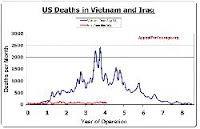
Vietnam vs. Iraq

Study the graph at right for a few minutes (click on it to get a larger version).

What’s your reaction?

If (like me) you’re old enough to remember the news reports during the Vietnam war, you might have the same reaction I did: the anti-war agitation in the media now is at least roughly similar to what we saw in the late 1960s and (especially) the early 1970s — but the casualties we suffered in Vietnam dwarfed the casualties we’re suffering in Iraq, and clearly the level of anti-war emotion in today’s American public doesn’t even come close to the anti-war emotion in the public toward the end of Vietnam, when we had many anti-war riots and (as I can personally attest) soldiers and sailors were routinely disrespected and reviled.

What do you think is going on here?

Saturday, May 12, 2007

Quote of the Day

Unknown source:

"Political correctness” is a doctrine fostered by a delusional, illogical liberal minority, and rabidly promoted by an unscrupulous mainstream media, which holds forth the proposition that it is entirely possible to pick up a turd by the clean end.

Yup, that pretty much sums it up.

Friday, May 11, 2007

Quote of the Day

Richard Perle:

George Tenet and, more important, our premier intelligence organization managed to find weapons of mass destruction that did not exist while failing to find links to terrorists that did—all while missing completely the rise of Islamist fundamentalism. We have made only a down payment on the price of that failure.

So that’s what an articulate bitch-slapper sounds like!

U.N. Insanity

In what alternative universe does this actually make sense?

Zimbabwe, which is enduring economic collapse and environmental degradation, could become chairman of the UN’s Commission on Sustainable Development when a formal vote of its 53 members takes place today.

If so, Francis Nhema, Mr Mugabe’s environment and tourism minister, will lead the body charged with monitoring the world’s pledges made at the Earth Summit in Rio de Janeiro in 1992.

By any rational measure I can think of, Zimbabwe would be one of the last countries we’d look to for leadership on anything (other than, perhaps, thuggery and maintenance of gerontological dictatorships). On “sustainable development” in particular, Zimbabwe has an admirable record … of the exact opposite! Their economic infrastructure has completely imploded under Mugabe’s rule. A once-thriving economy has degenerated into one of Africa’s worst economic basket-cases — and if you know anything about Africa, you know it’s tough to stand out amongst their economic basket-cases.

And yet the U.N. is quite likely to hand control of the U.N. Commission on Sustainable Development. Sadly, we can’t even claim this is some sort of bureaucracy fart — the U.N. really does seem to make a habit of this particular flavor of ludicrousness. Remember when the U.N. Commission on Human Rights was chaired by Libya?

It’s past time to simply get rid of the U.N. It’s doing more harm than good in the world. The few branches of it that are actually doing defensible work should be “spun out” into standalone charitable efforts — and the rest of it demolished. Some sort of monument at Turtle Bay would be appropriate — the inscription could read:

Here once stood the headquarters of an organization created with the idea that all nations were created equal. After some experience, it became clear that all nations were not created equal, so the experiment was terminated.

Wednesday, May 9, 2007

Super Mo'i!

This past weekend, Debbie and Mo’i were competing in agility trials held in Salt Lake City, Utah. The weather was very cool — just how Mo’i likes it — and he ran with unusual speed and energy. A photographer captured Mo’i just as he was charging out of the collapsible tunnel obstacle. Look at that face! Mo’i was having a grand old time out there!

Miki was also in Salt Lake City, but he was competing in conformation. Both Mo’i and Miki did well — Mo’i had two qualifying runs (both on the jumpers course), and was well under the course time on one of them. Miki got second place in one of his shows, but unfortunately there weren’t enough field spaniels competing for this to count.

Everybody is back home now, safe and sound…

Senate Boxing

Scott Adams (creator of the Dilbert comic) has a blog that is on my daily read list for several reasons, including the wicked sense of humor you’d expect from the guy who gave us Dilbert, Dogbert, Alice, and the pointy-haired boss. For example, today he posted about his ideal form of government, and the closest example on earth: Taiwan’s raucous democracy. Scott likes the fights in the legislature, and imagines the equivalent in the U.S.:

Pause to consider how much you would pay to see Nancy Pelosi kick Dick Cheney in the nuts on national television. I’ll bet it’s a big number. Imagine that after she delivers the kick, Trent Lott flings a wing tipped shoe at the back of her head and knocks her off the dais. Now how much would you pay? Personally, I’m in triple digits already and the imaginary brawl has barely started. Can it get any better?

Oh, yes it can — go read the whole thing!

And yes, Scott, I would most definitely buy a season ticket every year!

Tuesday, May 8, 2007

Terrorists in NJ

My four long-term readers will know that I grew up in New Jersey (admittedly not a fact that I brag about). My parents still live in New Jersey, quite close to a U.S. Army base called Fort Dix.

Yesterday six men were arrested for plotting a terror attack on the soldiers at Fort Dix. This is being covered by every news organization under the sun, and new facts are still emerging, so I’m not going to bother linking.

But one element of this event stands out: how the FBI discovered the plot.

It turns out that these terrorists, like their brethren in the Middle East, made a video of their training program. Apparently they wanted to use this in their recruiting program, so they needed some DVDs. So what did they do? They took the video tape down to a local store, and asked that copies be made. Fortunately a clerk at the store was bright enough to realize that this was something the authorities might want to know about, and he made a very welcome call. The rest, apparently, was traditional police work. The FBI tracked the terror cell until they thought it was getting ready to act, and then they rolled it up.

Way to go, G-men! And my thanks to that as-yet-identified clerk who made that call…

Monday, May 7, 2007

Dear God

Randall Munroe posts his original web comics, generally a few times a week, at his site XKCD (A webcomic of romance, sarcasm, math, and language). To anyone with even a small geek streak, they are often hysterically funny — and usually with a point.

Like today’s gem:

Geeks (or geek wannabes): put XKCD on your daily reading list. You won’t regret it!

Flying Pigs

If you’re paying any attention at all to what’s happening in the world, then you know by now that Nicolas Sarkozy has won the French presidential election. Sarkozy has been characterized by the French press (which is echoed by our own) as the conservative candidate — but we would recognize him only as conservative when compared to his rival. French politics are very different than ours, so a comparison is difficult — but many of his positions would strike us as rather far to the left, and his right-most positions would resonate with, say, Joe Lieberman.

But…Sarkozy is a raving “Yankeephile”. He loves America and Americans. In his acknowledgment speech he went out of his way to mention that his France will be a good friend to the Americans. This is flying pigs rhetoric coming from the mouth of the man who will be French president in just over a week! I’m so used to American-bashing by French politicians that I reflexively “raise the shields” when reading about any of them. This guy, on the other hand, would embarrass quite a few Americans with his unabashed admiration — one can imagine a great number of squirming French as they listen to him, not to mention all the other Europeans…

First Merkel in Germany, now Sarkozy in France. Have the Europeans finally had enough socialism? Merkel has been a huge disappointment in that regard; she’s hamstrung by the need to develop coalitions, and those coalitions cannot agree on substantive change. Will it be the same in France? I suspect it will. But one wild card, I think, is Sarkozy’s combative, assertive personality — he just might pull off substative change by sheer force of will.

I sure hope so, because if he fails to do so, I suspect France-as-we-know-it, love it or hate it, will disappear within a few years. In its place: a caliphate…

The youth of France protested Sarkozy’s victory by burning almost 400 cars and injuring 28 police. Unbeknownst to most Americans, this car-burning has been going on every night since 2005, with 100 or so cars being burned every night — some 125,000 cars in all so far. One wonders what this French fascination with burned cars is! The press has developed a tacit threshold of about 200 cars per night; below that threshold they don’t even report it. So the only thing remarkable about this car burning is that the numbers bumped up slightly in the wake of the election. Just last month they had two nights with over 500 cars burned, for no particular reason that I could discern. So last night’s low burnt car tally is actually comforting, in a small and perverse way…

Sunday, May 6, 2007

Quote of the Day

The Russia Journal (primarily a news site about Russia) provides today’s quote from their “Sunday Sermon” piece called “Stand Up for Estonia!":

That’s what makes this important. Estonia picked itself up from the gray rubble of Soviet colonization in 1991 and transformed itself into a first-world state with a true national identity. Its success is a standing rebuke to the backwardness of what Russia remains and what other oppressed nations can become if they are left alone.

Other countries in Eastern Europe are still trying to dig out from the legacy of the Soviet past. Estonia’s clean governance, low taxes, steadily growing economy, soaring foreign investment and 4% unemployment are an amazing and atypical transformation in just a decade and a half.

The last sentence of the first paragraph above particularly resonates with me…

From the news reports I’ve read in the past 48 hours, it appears that the Estonian/Russian tensions are easing a bit, and that Russia’s cutoff of trade with Estonia is backfiring. Little Estonia is getting lots of diplomatic support, including EU resolutions, threats about Russia’s bid to join the WTO, and a resolution from the gasbags in the U.S. Senate. I can’t imagine Putin being intimidated by any of these publicly visible reactions — after all, it’s just politicians yakking away and thinking themselves important — but I do have some hope that there have been some behind-the-scenes events that have made a difference…

Saturday, May 5, 2007

Incarceration and Homicide

Bernard Harcourt is one of those names that catches my attention whenever I see it — if he’s written something, it’s bound to be interesting and enlightening. Mr. Harcourt is Julius Kreeger Professor of Law and Criminology at the University of Chicago Law School — and he is also an inspired researcher and analyst.

This time I ran across him at the Volokh Conspiracy, one of my regular blog reads. Mr. Harcourt made a series of guest posts there, discussing his recently released study: From the Asylum to the Prison: Rethinking the Incarceration Revolution. The graph at right is taken from that study.

The thick black line at the top of the graph is the aggregate incarceration rate — the sum of prison incarceration and mental institution incarceration. Below that are two separate lines for each form of incarceration. Separately in the study (available at the link above) is a graph showing homicide rates: it is a nearly perfect inverse of the aggregate incarceration rate. In other words, the more people who are incarcerated (no matter where they are incarcerated), the lower the homicide rate. This comes as no surprise to me — if you’re willing to believe that usually the criminal justice system does its job correctly, then of course the more bad guys who are locked up, the less bad things they will do. Doh! But some liberals will be quite puzzled — the usual response to this sort of data will be to wonder why so many people are locked up if the crime rate is low. The problem is that these pesky facts don’t jibe very well with the liberal narrative, (sort of like the relationship between gun ownership and crime rates), so they are, naturally, puzzled.

But the graph at right was a real surprise to me. The biggest surprise was just how many people used to be incarcerated for mental illness — I had no idea that the rate was so high! The highest rate of mental institution occurred in 1948, when one of every 159 adults in the U.S. was in a mental institution. Today that rate is about one in 7,000 adults. By contrast, today’s prison incarceration rate is about one adult in 167 — a very high rate, and in fact the highest in the world — but not as high as our one-time mental institution incarceration rate.

If you stare at that graph for a moment (click on it to get a larger version), you’ll be tempted to think that when we dramatically changed the way in which we incarcerated mentally ill people (a reaction to revelations of horrible abuses in the '60s), we dumped tens of thousands of people onto the streets who later became criminals. You’re tempted because you see the precipitous decline in mental institution incarceration in the late 1960s and early 1970s followed a steady rise in the criminal incarceration rate starting in the mid 1970s. But Mr. Harcourt, seeing the same thing, warns us that this simple explanation cannot be right, because the populations are significantly different. If you read the study, you can get all the details, but basically mental institution incarcerees were considerably more likely to be white, female, and older than the prison incarcerees. The same population didn’t just move from mental institutions to prisons. Mr. Harcourt is as puzzled by this as we are.

But the inverse correlation between incarceration rates and homicide rates is clear and strong. These data strongly suggest that mental institutions and prisons, in their respective times, were both places where we safely “stored” people who were likely to commit homicide — and that both were effective protections against homicide for the rest of society. Of course there are more considerations than simply the homicide rate — I certainly would not advocate going back to the way we used to incarcerate people in mental institutions! Nevertheless, the lesson here is instructive: incarceration works. To many, like myself, this seems obvious — but to many liberals, it is an article of their political faith that incarceration (i.e., punishment and accountability) is an ineffective tool of social policy…

Friday, May 4, 2007

Hummers

Every winter, most of our hummingbirds (including the most numerous of our four local species) migrate to warmer climates (mostly Costa Rica). Each spring they straggle back into our area, until by roughly May 1st they are all back.

And so again this year. Our most common species is probably the Black-chinned (Archilochus alexandri), followed by Anna’s (Calypte anna), Costa’s (Calypte costae), and the fairly rare Allen’s (Selasphorus sasin). The male Allen’s stand out because of their coppery orange color. According to our reference books, they are strictly migratory visitors, though in the summer we see them at our feeders every day.

Speaking of feeders… At the moment we have seven feeders, each with eight feeding holes, holding a total of ten quarts of hummingbird “nectar”. While there are hummingbirds on them all day long, in the couple of hours closest to dawn and dusk is when they are the busiest. Last night, in a window with four feeders, I watched well over 100 hummingbirds jostling for access to the 32 feeding holes on those feeders. Watching with me were three cats (Maka Lea, Tippy, and Boots) and one dog (Lea). Hummingbirds don’t make a lot of noise individually, but…150 or so hummingbirds, all aggressively attacking the 32 feeding holes, that made quite a racket!

This morning I made six quarts of hummingbird food. We’ve experimented a lot with various ratios of sugar to water, food coloring, etc. I’ve also read many different opinions about how one should make the “nectar”. Some of these recipes are amazingly precise (e.g., “mix one quart of water with three cups plus one-and-a-quarter teaspoons of organic fructose"). Some sources said ordinary sugar (sucrose) is fine; other sources recommended pure fructose; still others recommended blends. My conclusion: either nobody really knows, or it doesn’t really matter. Ordinary table sugar is by far the least expensive of the alternatives, so we tried that. The hummingbirds loved it. We have several times experimented with various ratios of sugar to water — the hummingbirds will drink them all, even if there’s only a small amount of sugar. But if feeders with various ratios are hung side-by-side, the feeders will empty in order of the sugar concentration. The hummingbirds, given a choice, go for the feeder with the most sugar. We’ve also experimented with food coloring, to see if the hummingbirds cared. It’s clear that they do not care one whit about food coloring — we can leave it out altogether, make it the traditional red, or make it purple, orange, green, or even black — and they don’t care, they’ll happily drink it anyway.

In the summer, when we’re feeding hundreds of hummingbirds, it’s not at all unusual for us to use 25 or 30 pounds of sugar each month. I haven’t been rigorously tracking it, but subjectively our use is going up each year — and so is the number of hummingbirds visiting us. Last night’s show was the most I’ve ever seen in one place, anywhere. I suspect that our consistent feeding (we’re quite religious about keeping the feeders full) and the open water (a dripper bird-bath) nearby is maintaining an artificially large local population. It seems quite likely that this population is dependent on our feeders. And since we’ve been doing this for almost ten years, it is certain that there are now multiple generations of dependent hummingbirds. If something happened to us and the feeders were no longer filled, I’m sure the population would scatter elsewhere in a quest for food. But so long as we keep the feeding up, I suspect we’ll have this beautiful local concentration of hummers to enjoy…

Don't Abandon Us!

Did you ever wonder how the Iraqis themselves feel about the talk in the U.S. (and elsewhere) about withdrawing the troops? Listen to Hoshyar Zebari (the Iraqi Foreign Minister):

Iraqis are standing up every day, and we persevere because there is no other option. We will not surrender our country to terrorists. They have failed to cripple the elected government, and they have failed to intimidate us into submission. Iraqis reject their vision of a future whose hallmarks are bloodshed and hatred.

Those calling for withdrawal may think it is the least painful option, but its benefits would be short-lived. The fate of the region and the world is linked with ours. Leaving a broken Iraq in the Middle East would offer international terrorism a haven and ensure a legacy of chaos for future generations. Furthermore, the sacrifices of all the young men and women who stood up here would have been in vain.

Iraqis, for all our determination and courage, cannot succeed alone. We need a healthy and supportive regional environment. We will not allow our country to be a battleground for settling scores in regional and international conflicts that adversely affect stability inside our borders. Only with continued international commitment and deeper engagement from our neighbors can we establish a stable democratic, federal and united Iraq. The world should not abandon us.

Don’t Abandon Us is the title of his article; the excerpt above is his conclusion. Read the whole thing.

Reid, Murtha, Pelosi, Obama, Edwards, Kerry, and the overwhelming majority of Democratic kin unabashedly want to abandon the Iraqi people to their fate. I’m sure they would bristle to hear their position described as abandonment; they would prefer to describe it in friendlier terms. But abandonment is exactly what it is, and it would immoral to do so. I am convinced that it would also be a strategic error to hand Iraq to al Qaida; an error that would come back to bite us in future years. Ignoring the terrorist threat (of which al Qaida is but the most prominent example) won’t make it go away, no matter how much the white-flaggers would wish it to…

Thursday, May 3, 2007

Quote of the Day

Tip o’the hat to SimiL for this gem…

"It appears we have appointed our worst generals to command forces, and our most gifted and brilliant to edit newspapers! In fact, I discovered by reading newspapers that these editor/geniuses plainly saw all my strategic defects from the start, yet failed to inform me until it was too late. Accordingly, I’m readily willing to yield my command to these obviously superior intellects, and I’ll, in turn, do my best for the Cause by writing editorials - after the fact."

Robert E. Lee, 1863

Sounds like Rumsfeld channeled Lee…

Wednesday, May 2, 2007

Et Tu, Diane?

If David Keene is right, California Senator Diane Feinstein is another corrupt oinker stealing money from the U.S. taxpayers. A lot of money:

The problems stem from her subcommittee activities from 2001 to late 2005, when she quit. During that period the public record suggests she knowingly took part in decisions that eventually put millions of dollars into her husband’s pocket — the classic conflict of interest that exploited her position and power to channel money to her husband’s companies.

In other words, it appears Sen. Feinstein was up to her ears in the same sort of shenanigans that landed California Rep. Randy “Duke” Cunningham (R) in the slammer. Indeed, it may be that the primary difference between the two is basically that Cunningham was a minor leaguer and a lot dumber than his state’s senior senator.

If Keene’s analysis is correct, Feinstein advocated — from a very powerful perch — contracts which put millions of dollars into the pockets of she and her husband. The most charitable possible interpretation is that there was a severe and (illegally) undisclosed conflict of interest, whether or not it was abused. Appearances suggest much worse: the active advocacy of contracts that directly benefited her.

Why on earth hasn’t the Senate Ethics Committee sanctioned her? And why isn’t the news media all over this egregious corruption?

Oh, that’s right — she’s a Democrat. She’s exempt from petty moral and legal concerns, because she’s got, you know, truth and justice on her side…

One begins to wonder if California should start importing some politicians from Mexico, in order to reduce the levels of corruption…

Tree. Rope. Corrupt politician. Some assembly required…

Tuesday, May 1, 2007

Estonian Riots

As many of my readers already know, for over ten year ending in 2004 I was a frequent visitor to the little Baltic country of Estonia. Two different companies that I worked for in that period had software development facilities in Tallinn, the largest city in Estonia. In that period I made quite a few friends there, and traveled extensively throughout the country. I’m very fond of Estonia and its people.

Estonia’s history is one of turmoil and conflict, and amazingly complex for such a tiny country. Of relevance to this post is its history from World War II onwards.

The entire country of Estonia was overrun by the Nazis early in the war. Some Estonians — a small, but significant minority — actively collaborated with the Nazi occupiers. The Nazis drafted some men involuntarily into its armed forces, but other Estonians volunteered — including for concentration camp guard duty and extermination squad duty. There was also an active resistance against the Nazis, in which a number of Estonians were killed or injured. During this period there was a very small community of ethnic Russian people in Estonia, variously estimated at 1.5% to 3.5% of the total population.

Later in the war, the Soviet Army overran Estonia from the other direction. Just as with the Nazis, a small but significant minority of Estonians collaborated with the Soviets. There were Estonian units in the Soviet Army, but the most apparent collaboration was political — some ethnic Estonians joined the Communist party and became local implementors of the Soviet domination. Again, just as with the Nazis, there was an active military resistance to the Soviet occupation that wasn’t stamped out until the 1960s. During this period of Soviet occupation, hundreds of thousands of ethnic Russians emigrated to Estonia, which had become part of the Soviet Union. Most of these Russian immigrants were concentrated in approximately half the land area of the country, where they became the overwhelming majority of the population. Other parts of the country were still ethnic Estonian in majority. Depending on whether you count military personnel (the Soviets had several large military facilities in Estonia), and depending on who did the counting, the ethnic Russians at their peak formed between 45% and 65% of the total population of the country.

The Soviet occupation of Estonia lasted for over 40 years, until 1991. During this period, an entire generation of Estonians experienced life as a subjugated, second-class people. Many ethnic Russians in Estonia deny this, but the evidence seems incontrovertible to me — educational opportunity, economic opportunity, and freedom of movement were all different (and worse) for the ethnic Estonians. In 1991, as the Soviet Union was falling apart, ethnic Estonians (and a few ethnic Russians) formed a separatist movement and carried out an almost non-violent “singing revolution” that won Estonia’s independence.

After the Soviet withdrew their military, and after the initial waves of emigration (mainly ethnic Russians returning to Russia) and immigration (mainly ethnic Estonians who had escaped the occupations returning to their native land), the population over the whole country has settled down to roughly 60% ethnic Estonian and 40% ethnic Russian. Different sources for these numbers vary by a surprising amount even today, and of course there are other ethnic groups in Estonia as well.

For the past 16 years, since independence from the Soviet Union, little Estonia has been dealing with the tensions between these two ethnic communities. My ethnic Estonian friends largely perceive the ethnic Russians as the leftovers of a hated oppressor, as interlopers, and mainly interested in returning Estonia to Russia. My ethnic Russian friends have a much more varied set of perceptions and attitudes. Some of them appear to be exactly what the ethnic Estonians fear. Some of them are much more moderate, especially with respect to rejoining Russia. Most of them have learned enough Estonian to become citizens; some of them are quite fluent in Estonian. Only one amongst all my ethnic Russian friends ever stated assimilation into Estonian culture as an objective — all the rest seem, actively or passively, to be committed to keeping their Russian culture. For example, most of the children of my ethnic Russian friends attend Russian-language schools.

This past week, the Estonian government decided to move a monument in Tallinn out of the Old Town area to a military cemetery on the outskirts of the city. This particular monument had been erected by the Soviets in honor of their soldiers who were killed while driving the Nazis from Estonia. Many ethnic Estonians were insulted by this monument to an oppressor’s army — especially because it stood in the heart of Estonian history and culture: the Old Town of Tallinn. It was a highly visible reminder of the Soviet Army that not only drove out the reviled Nazis, but also forcibly evicted thousands of Estonians, herded them off to gulags where many died, and stomped the Estonian resistance out of existence. This Soviet Army was the instrument that enabled their oppression, and they resented this memorial to it. The ethnic Russians, on the other hand, see this memorial as honoring their fallen comrades who had been engaged in a wholly honorable duty: clearing the fair land of Estonia of the execrable Nazis. To them, moving the monument was an insult to heroes — and inexplicable, as the Estonians were themselves the great beneficiaries of their fighting.

So the movement of the monument was guaranteed to whip up tensions, as that action was keenly felt by the emotions of both groups. But to make matters worse, it appears that Russian intelligence was active amongst several ethnic Russian groups inside Estonia, doing everything they could to make the tensions even higher. Their objective: to topple the current government of Estonia, which the Russians perceive (quite correctly, I think) as unfriendly to their interests. The best documented example of their actions I’ve been able to find is the planting of outrageous stories in Russian-language newspapers, both in Estonia and in Russia. For example, one of these stories claimed that the Estonian government had not moved the monument in whole, but had instead hacked it up into dozens of pieces and reassembled it in a sloppy, disrespectful manner. This story is now known to have been written in Russia (presumably by the foreign intelligence agency), then distributed through the leader of a militant Russian group in Estonia (this leader is now under arrest). Russian intelligence stands accused of many other actions to raise tensions as well. Yesterday a delegation of Russian diplomats arrived in Tallinn for discussions — and before they left, they announced that their goal was to bring down the current Estonian government!

Over the past few days, thousands of people in several Estonian cities have rioted. Tallinn’s Old Town area saw the most violence and damage; one man was killed and dozens were injured. About 1,000 people were arrested, though most have been released. Tensions between the ethnic Estonian and ethnic Russian communities are very high; worse, I think, than even immediately following independence from the Soviet Union.

My ethnic Estonian friends are all worried that Russia will use these recent events and increasing tensions as a pretext to invade and re-occupy Estonia. At least one of my friends is worried enough to start sending her family and assets out of the country. I think this is overreaction, and quite premature, but I can’t blame them for their fear and concern. The EU and NATO memberships aren’t likely to translate into direct military defense if it were needed. I believe Finland, the U.S., Britain, and Poland are the most likely military forces who actually would come to Estonia’s aid — and only the Finns could do so very quickly.

My ethnic Russian friends seem much less concerned about a Russian invasion (and, so far as I know, none of them would welcome it). They are more inclined to believe that the Russian government will, at most, try to get a pro-Russian government installed in Tallinn. I think this is most likely myself; it would be quite a gamble for Russia to simply annex Estonia. On the other hand, as an American friend of mine commented yesterday, from Russia’s perspective the West probably looks quite wimpy right now — it’s not inconceivable that the Russians have talked themselves into believing that the West would not come to Estonia’s aid. We Americans are quite tied up now with various aspects of the global war on terror, plus the ongoing tension with Iran. The British don’t look like they’d be real excited about a front in Europe. Poland would almost certainly be willing, but their capabilities are limited. The Finns are hard to read — they’re committed by treaty to defend Estonia, and there are now substantial Finnish assets in Estonia — but on the other hand their politics are not generally supportive of military intervention. So I can make the case myself for Russia feeling as though they might be able to get away with retaking Estonia — but I believe they’d be making a terrible mistake (for Russia) by doing so.

More than anything, I just hate seeing these events happen to little Estonia, the Baltic land that I’ve come to love. All my friends are agitated by this, whatever side of the fence they’re on. And it’s very hard to see any path out of this mess that is good for everyone — I’m afraid that resolution likely means that one side or the other “wins” and the other “loses", and that’s a darned shame…