Saturday, January 7, 2006

Cats and Dogs

With two dogs and seven cats living in our house, we have our share of inter-species animosity (though much less than you might think). Add to that the fact that we have more than a few computers, and we can easily imagine this happening…

Click on the picture for a larger view…

Thursday, January 5, 2006

Solar Storage

As a homeowner in rural Southern California, you might think I’m nearly an ideal case for solar power. Throw a few solar panels on my roof, attach an inverter, and cut the umbilical cord to SDG&E (our local power company).

You would be wrong.

In fact, solar power is not yet practical (in the economic sense) as a total energy replacement. The problem is energy storage (more on this in a moment). It is possible today, under certain fairly restrictive circumstances, to economically justify solar energy as a supplement to the power grid. For instance, I might be able to justify a supplemental solar system designed to run my air conditioner. The analysis would include the capital expense (presumably financed) for purchasing and installing the solar system, compared with the estimated future cost of energy. The problem I have with the justifications for supplemental solar systems is that they only make sense when one assumes quite high future energy costs. You place a large bet, in effect, by buying (say) a $75K supplemental solar array — you pay (bet) $300 or $400 a month (on the loan) for 20 or 30 years, and hope that you save at least that much on energy costs. For me, that sounds like a very risky bet — the real payoff is just a few hot months per year, and then only if our energy costs remain at historically high levels. Of course, I might just be a chump who doesn’t realize energy prices are on some kind of inevitable upward spiral, but who knows?

The economic justification would be on much more solid ground if the solar system could completely replace the power grid. Earlier I cited energy storage as the culprit, and it’s a doozy of a problem. The person who comes up with an answer for this is going to make a lot of money! Here’s the problem: your house uses some power all day and all night. The pattern of power usage varies by individual, geography, lifestyle, etc. — but darned few of us would be interested in a home with zero power at night. But solar panels only generate useful amounts of power when there is bright sunlight shining on them. Most solar panels are mounted in a fixed orientation (e.g., on a rooftop) — and in that case, the panels generate much less power in the morning and evening than they do during the middle of the day. Fog, clouds, and rain all reduce the power generated. Less power is generated in the winter both because the days are shorter and because the sun is lower in the sky. The only way to provide power for your house all day and all night is to store the power (for example, in car batteries) during the day when the sun is bright, and use it from storage at other times. This means that your solar array must generate much more power (typically 5 to 10 times) than you actually need during the day to fill that storage — only in this manner will you have sufficient power to run your house day and night. And you really need more than one day’s worth of storage — you need enough to get through whatever worst-case assumption about weather you want to make. Here in Southern California I’d probably get away with four or five days worth of storage; in other places you might want more.

The least-expensive storage technology available today is a fancy version of the good old-fashioned car battery: a lead-acid cell designed for day-in, day-out deep discharge cycling. These batteries cost something like $0.15 to $0.20 per watt/hour of storage. Sound cheap? Suppose your home uses 8 kilowatts on average (that’s modest) when the sun is not at its peak. Further suppose that in the winter you have 16 off-peak hours per day, and you want 5 days worth of storage. That means you need 640 kilowatt/hours of storage — and that will set you back about $100,000, for something like 500 batteries weighing 10 tons. Yikes! You see what I mean about that being a problem?

And it gets worse. Your battery investment is not a one-time affair. The typical lifetime of such a battery is 3 to 5 years under ideal conditions — something few of us can practicably provide. Some batteries (more expensive) are maintenance free; others need regular checking and maintenance. All batteries have various ways to fail; some of these involve violent explosions, acid leaks, and other delightful scenarios. Oh, and also poisonous gas. Not to mention the disposal problem of a few tons of lead each year. So it’s not really a $100,000 expense — it’s more like $20,000 a year (forever!) and a not-insignificant amount of hassle and risk.

So I’m still connected to the grid. But I’d sure like someone to solve the energy storage problem!

I was reminded of this entire issue by a very interesting article about a solar energy generation system that uses the ocean as a storage mechanism. This idea generates power through the temperature difference between the sun-warmed surface water and the cold deep water. The idea is not new, though making it practical is. In my mind, the primary benefit of this approach is that it completely solves the energy storage problem. The bad news is that this won’t work in my back yard <smile>!

Wednesday, January 4, 2006

Churchill at War

I took the liberty of reproducing in entirety this very short op-ed piece in today’s WSJ:

No one knows how Winston Churchill would have fought the war on terror or what he might have thought of the U.S. practice of holding members of al Qaeda at Guantanamo or secret CIA prisons in Eastern Europe. But in newly declassified records of the British Bulldog’s War Cabinet meetings, Churchill offers some posthumous insights on wartime leadership.

In 1942, the Cabinet discussed the options were Hitler to fall into British hands. “All sorts of complications ensue as soon as you admit a fair trial,” Churchill said, according to notes taken by the deputy cabinet secretary Sir Norman Brook. To avoid such a “farce,” which he thought would distract from the war effort, Churchill favored swifter means of dealing with Hitler. “This man is the mainspring of evil. Instrument — electric chair, for gangsters."

Churchill called other Nazi leaders “outlaws” and argued that those who fell into British hands should be executed rather than put on trial. (There is no record of his views on water-boarding.)

At another Cabinet meeting, he advocated shooting German POWs if the Nazis were to kill British prisoners (the U.K., for the record, never did). After the Germans massacred the people of Lidice, Czechoslovakia, Churchill proposed, perhaps again half seriously, “wiping out German villages by air attack on a three-for-one basis.” The Cabinet overruled him.

Churchill might wonder at today’s attitudes toward fighting terrorists, about American “torture” of prisoners, and about the U.S. President who’s often derided in London as a “cowboy.” The British Prime Minister’s clarity about the Nazi threat in World War II got his nation and the world successfully through that conflict.

The more I learn about Winston Churchill, the more I admire his wartime leadership. I’m largely at least satisfied with President Bush’s leadership in the war on terror, and occasionally inspired. But I’d feel much safer — and more confident of the eventual outcome — if that war was being led by someone with the clarity and … ruthlessness … of Winston Churchill…

Economic Freedom

Estonia, that’s who.

In the 2006 Index of Economic Freedom (click on the thumbnail at right to read the whole chart), Estonia places 7th in the world — and the United States is in a three-way tie for 9th. Estonia’s Baltic neighbors Latvia and Lithuania come in at 39th and 23rd, respectively. Clearly little Estonia is doing something right, as I’ve been personally observing for more than ten years now…

In this morning’s Wall Street Journal, Mary Anastasia O’Grady (the co-editor of the 2006 Index) has an op-ed piece ($) specifically lauding Estonia’s economic miracle. Some highlights:

From “Wish They Could All Be Like Estonia ($)":

With the 1989 fall of the Berlin Wall the world witnessed a backlash against the overintrusive state. A rallying cry in favor of economic liberalization went up around much of the globe. Some governments — notably in Eastern Europe — used the momentum to push deep, structural reform. Others — notably in Latin America — bungled the opportunity.

Is there any way to explain why it is that some countries have been able to restructure their economies so radically while others have been left in the clutches of special interests?

...

Chile has been in various stages of economic reform since the 1973 coup that ousted Salvador Allende, who was threatening to take the country over the communist cliff. The return to democracy in 1989 brought about a series of left-of-center governments that, while boasting that they had not turned back the economic liberalism of the Pinochet dictatorship, slowed the pace of reform dramatically. The current socialist presidency of Ricardo Lagos even reversed liberalization in labor markets.

Meanwhile in Estonia, as former Prime Minister Mart Laar likes to explain, the post-Soviet period has been marked by rapid, deep reform. Communism was so reviled that policy makers, almost instinctively, chose its direct opposite and promptly enshrined the preference in law.

The results may explain why political support for economic liberalism continues in Estonia, while in Chile free markets are under assault even by center-right politicians. The difference is the rate of change of progress for citizens. In 2004, with reforms kicking in, Estonia’s per capita GDP was almost $7,500, nearly double what it was in 2001 — $3,951, when the country ranked 14th in the Index of Economic Freedom. In Chile, after 30 years of reform, per capita GDP remains below $5,900, edging up only slightly from $4,784 in 2001, when Chile ranked 13th.

The tale of two small nations tells a wider global story. Is it any wonder for example that Brazilians, who after almost two decades of being told they are converting to a market economy, widely reject the notion? Improvements have occurred, for instance in monetary stability, but the country is still ranked “mostly unfree,” with a per capita GDP of $3,500. Maybe Mr. Laar could pay them a visit.

Mart Laar has been getting a lot of good press in the past few months, world-wide. As has Estonia itself. And with good reason — each time I visit, I am impressed afresh with the vibrance of its rollicking economy. And as well with what I read of the process by which the country’s leaders make economic decisions, and by the decisions themselves. The changes in Estonia in just the 10+ years I’ve been visiting it are simply amazing — and contrasts with its neighbors (especially Russia) are especially astonishing.

It’s good to see their accomplishments being recognized…

Morning After

Yesterday morning Debi and I, along with Lea and Mo’i (our two beautiful field spaniels), took our usual walk a mile or so up the hill south of our home. It was special yesterday because this was the “morning after” the first big rain of the season.

Visually, everything was clean and bright and green. Olfactorally (??), the fresh and spicy desert smells were back — and we know from experience that they’ll keep getting better and better from now until early summer.

There were some more changes as well, some a little subtle (such as the more saturated colors of the damp rocks). My favorite: the many expanses of solid rock on the hillsides covered with a thin film of water, flashing and glinting in the morning light. These wet rocks are very common in this area. They’re caused by a seep or a spring that flows onto a sloped area of smooth rock — and the granite that our hills has many such rocks. Some of them are quite large (as much as a few acres), and when one of them has a sheet of water on it, the visual effect can be spectacular. Typically these rocks are curved and have small imperfections in them, which means that the reflective sheet of water is not flat — it’s more like a jumbled pile of broken mirror pieces in its visual effects. It sparkles, in other words. And the effects change as you move, as the wind blows, and as the sun moves through the sky…

Tuesday, January 3, 2006

Force Multipliers

Read this on Michelle Malkin’s site this morning — it was so good I just had to share it…

Russ Vaughn is a poet and Vietnam vet.

Force Multipliers by Russ Vaughn

Wikipedia: force multiplier-a military term referring to a factor that dramatically increases (hence multiplies) the combat-effectiveness of a given military force.

-

In Iraq an IED explodes,

An American soldier dies,

But that blast will grow as the media blow

It up before our eyes.

And trumpet to the watching world,

These fifth column falsifiers,

Like sheep they bleat we face defeat,

Our foe’s force multipliers.

-

Osama and his minions know,

In combat they can’t beat us;

So they hope and pray will come a day,

Our own media will defeat us.

Ignoring all the good we’ve done,

Liberals focus on the gore,

On losses mounting and body counting,

To prove we’ve lost this war.

-

They disgraced us once in Vietnam,

So now these leftists feel,

That again they’ll win with media spin,

And make America kneel.

But defeatists aren’t the only ones,

Learned lessons from the past;

Back then we swore we’d lose no more,

This time we’re standing fast.

-

The Internet’s exposed them,

As elitist media liars;

They stand unclothed and widely loathed,

Our foe’s force multipliers.

Some day when all our troops return,

With Iraq on freedom’s path,

The liberal elite who sought defeat,

May face some Righteous wrath.

-

Russ Vaughn

2d Bn, 327th Parachute Infantry Regiment

101st Airborne Division

Vietnam 65-66

Monday, January 2, 2006

Rain!

According to my weather instruments (click on the picture at right for a full-sized view), we’ve received just over an inch of rain in the past 24 hours — and close to an inch and a half in the past 48 hours. To those of you in the wetter parts of the (that would be just about anywhere else!), that may not sound like much. But for the desert rats like us, this is manna from heaven…

Within an hour of the rain starting, the formerly blackened moss on the rocks had turned bright green. Even though I’ve witnessed this dozens of times, it still amazes me how the first real shower of the rainy season transforms the chaparral country. The accumulated dust of months, caked and burned into the leaves and onto the bright red trunks of the manzanitas, is all washed away. The gusty winds that accompanied the rains blew most of the dead leaves off. And somehow many of the desert plants store away their chlorophyll during the dry season, and take it back out again after a good rain — producing exhuberant greens where before there was black or gray. The visual transformation is magical enough, but there’s more — with the rains, the wonderful and intense smells of the desert will be back in our mornings. Within a few days, it’s easy to predict, we’ll start smelling it again on our morning walks…

But best of all, of course: this inch of rain means the chaparral around us has at least a few more months of safety from fire.

Sunday, January 1, 2006

Happy New Year!

I don’t know about you, but ever since 2000 I’ve felt a bit like I’m living in a science fiction novel. When I was a kid, the year 2000 felt impossibly far away — so far that the fantastical science fiction stories set in those post-2000 years, with their exotic technologies, didn’t seem so very far-fetched…

Now we’re actually living in those times. The prognostications of those science fiction authors weren’t, I’m afraid, any more accurate than anyone else’s. But certainly the changes have been great in magnitude, and mostly interesting and enjoyable and making life generally better. I’d much rather be living in 2006 than in 1956. I can almost hear the liberal whining as I write that, that firm belief that things have gone solidly downhill in America and the world (especially since Reagan). But they’re all delusional; they just dismiss somehow the vastly increased standard of living (and not just in the U.S., but worldwide), the tremendous advance of medicine (with the corresponding increase in life expectancy), and the life-enriching technological developments that we use every single day (imagine — a car that goes for tens of thousands of miles between repairs, or phones that you put in your pocket and let you talk to your friends and loved ones wherever you might be!). Yup, they just ignore all that and concentrate on persuading themselves that they are worse off this year than they were in any year of their life…

Screw 'em.

I’ve had a very nice morning on this first day of 2006. All simple, little things:

— Maka Le’a, our new little kitten, played happily on my chest as I sat reclined. His goal was to eat my thumb, then my nose, and finally my ears. He failed, but punched many tiny holes with those needle-like kitten teeth and claws. Kittens are outrageously cute, but they are unexpectedly effective fighting machines…

— Our Lawson Valley sunrise was gorgeous, full of saturated reds and blues. I went outside to watch it unfold, and as I watched a Southwestern Airlines 737 passed about 2500 feet overhead to my west (on approach to San Diego). The sky in that quarter was still dark grey, but the orange-colored jet was brightly lit by the rising sun. It was like a little moving, sparkling jewel in the sky, with the same color scheme as the sunrise on the other side of the sky.

— We had rain last night, a great way to usher in the new year in this fire-prone area. It wasn’t a whole lot (0.2"), but it was enough to wet down all the fuel in the chaparral. And that means a greatly reduced fire danger for us. Better yet, the Weather Service is predicting a sizable storm will hit tonight and tomorrow. Oh, I hope they’re right — an inch or two of rain right now would turn our hills green and practically eliminate any fire danger until next summer…

— Debbie and I are healthy (if you don’t count the holiday overeating!), as are our animals. Debbie’s off to an agility competition, where one of our dogs (Mo’i) just earned his “Excellent B” rating on jumpers and weaves. She’s hoping he will earn that same rating on the standard course today, and also hoping that Le’a will qualify on a run or two today.

— We hear from our breeder (Sheila Miller, of Battle Mountain, Nevada) that she believes the breeding of Picaboo “took", and that means puppies around Valentine’s day — and one of that litter will be our third Field Spaniel, if all goes well. Big, anticipatory smiles in Lawson Valley.

Oh, there’s much more, too. It’s good to be in 2006.

When you hear those whiny liberals complaining about how awful everything is … stuff something in their mouth, will ya?

Saturday, December 31, 2005

Death Watch

Gateway Pundit has great presentation of something I’ve long suspected, but haven’t known for sure: that the casualties (meaning deaths) in Iraq have actually decreased after the Iraq war, as compared with Saddam’s period of rule — despite the insurgency and all the best efforts of al Zarqari. Well, the Gateway Pundit has researched the numbers and presented them in an easy-to-digest graph (at right, click to enlarge). As the Gateway Pundit says:

The red area in the graph below shows the estimated average deaths in Iraq under Saddam Hussein from 36 average deaths per day from mass grave discoveries, to 137 deaths per day. Saddam may have murdered up to 5% of the Iraqi population during his 20 years of rule.

The yellow area shows estimated total fatalities since the beginning of the War in Iraq from Iraq Body Count, an antiwar website. Yet, still with questionable tallies of death counts, the War in Iraq is definitely saving lives.

Go read the post to see the sources for yourself…

Friday, December 30, 2005

RIP, Luna

Mark (whom I know only through his blog) and I don’t share religious convictions, but we do share a love for our pets. Mark’s dog, Luna, was euthanized yesterday — and Mark is grieving, and he’s angry. He concludes with this:

Let them be damned who live to make fun of innocence, purity, and simplicity. They have cursed themselves, but oh, how I often wish they would feel it.

God, how I loved that dog.

Oh, yes, indeed. Mark’s wish is mine as well.

RIP, Luna. Your master’s grief and anger speak volumes of you…

Tip o' the hat to the Junkyard Blog

Bolton Bashing

Not so very long ago, there was much gnashing of teeth and wailing from the liberal part of the world, faithfully (and loudly) reported by their MSM lapdogs. The cause of the angst? George W.'s recess appointment of “Bully Boy” Bolton to be the U.S. Ambassador to the United Nations.

Well, now Ambassador Bolton has been there for a while. Last I heard, the U.N. headquarters is still standing (darn it!), and relatively few delegations have committed suicide (I was really hoping to see the North Koreans and Libyans stage something dramatic like that). So this makes me wonder — just what is Bully Boy up to, anyhow? Is he having any effect at all?

From Investor’s Business Daily, Bolton Comes Out Swinging:

Clearly, recent developments have made Annan testy. The biggest factor more than likely was the sight of Bolton checking off the top items on his agenda. Bolton created an international stir — marked by the European Union’s formal opposition — when he threatened to block the body’s 2006-07 budget unless the U.N. commenced serious self-reform.

Last week: a successful start. The 191-member General Assembly approved a resolution for a two-year, $3.8 billion administrative budget. Attached to the resolution was a spending cap at $950 million, enough for the first half of next year. Look for Annan in June to request more money to pay U.N. personnel.

Some countries — among them Egypt, India and Jamaica — deny the emergency budget was tied to any reforms. But Bolton, calling the vote a victory for the U.S., said the resolution implies the General Assembly must approve, according to Reuters, “a new human rights body, new international accounting standards, a review of programs older than five years and a stronger internal watchdog office."

Remind us: Just why did the Democrats oppose this guy?

Ah ha! Bully Boy has put strict limits on their allowance!

Well, maybe not so strict — $950M sounds like a lot of pocket change. But it’s a terrific start, though it doesn’t inflict near the bureaucratic pain that I’d like to see inflicted. Yup, I’m 100% for bureaucratic torture: elimination of third-world rape privileges, reduction of Mercedes budgets, and even (gasp) making “diplomats” responsible for their crimes (yes, that means parking tickets, too).

But I’ll take caps on the allowance as a start…

Wednesday, December 28, 2005

Democratic Color

Remember the “Aunt Jemima” jeers by so many Democrats (and not just Deaniacs, either)? Those were very troubling to me, especially as they were just one example of a pattern: any black in a prominent conservative, libertarian, or Republican (especially!) position is routinely subjected to this treatment.

The latest example is one I just heard about this morning, thanks to an opinion piece in the Wall Street Journal. It’s by Ted Hayes — a Southern California legend, a tireless and effective activist for the homeless, lauded far and wide. Ted happens to be black. And he happens to be a conservative Republican, and a strong supporter of George W. Bush. He had this to say in this morning’s paper:

From the WSJ’s "Prejudice” ($), by Ted Hayes:

American blacks who are affiliated with the Republican Party are vigorously vilified by Democrats, especially black Democrats. Uncle Tom, sell-out, Oreo — the list of slurs is long.

But it is not only insults. I am the founder and director of a unique, progressive homeless facility in downtown Los Angeles, known as the Dome Village. Yet the 35 men, women and children and their pets who call the Dome Village home are being “evicted” from privately owned property after 12-and-a-half years — apparently on account of my political beliefs and activities. You see, though I am a leading homeless activist, I am also a conservative Republican and a strong supporter of President Bush.

Here’s how the situation played out. Recently, I was invited to address a local Republican Women’s Club; my landlord read an article in the local paper reporting on the event. Soon after, I received a notice raising the Dome Village rent from $2,500 a month to $18,330. Shocked, I inquired as to the seriousness of the change and the property owner blurted out that the cause of our “eviction” was “because you are Republican.” He said that as a Democrat, he was tired of helping me and the Dome Village. In other words, let the homeless be damned.

And people think the Democrats are the party of compassion and tolerance.

Ted goes on to give examples, including the example I cited of Condoleeza Rice. Then he issues a call to action:

These conservatives are attacked not because of the validity or judicious consideration of their views but because those views are supposedly heterodox for American blacks. Yet it is my opinion that many black people in the U.S. are politically and philosophically conservative — and many are in fact actually closeted Republicans, fearful of persecution by friends, business associates, society clubs, school mates and even churches.

It is time for American blacks to have a conversation about the phenomenon of Democrats persecuting black Republicans. Why is this happening? What is it that the Democrats don’t want black folks to understand about Republicans? What is it that the Democrats don’t want black folks to know about Democrats? And how is it that we have come to this point — after having endured so much — where we have ourselves curtailed the freedom of political expression through the threat of retaliatory consequences?

"What is it that the Democrats don’t want black folks to understand about the Republicans?” Interesting question, that.

I’d like to see Ted lead that national conversation, and I hope he succeeds in provoking its beginning…

Tuesday, December 27, 2005

More Maka Le'a

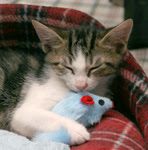
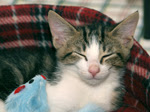
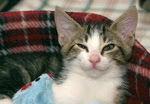
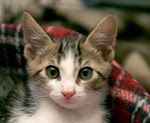
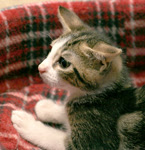
Maka Le’a is growing quickly — I think he’s nearly doubled in weight in the past couple of weeks. And he’s plainly getting stronger and more confident, even starting to climb our cat trees just a little. He climbed a short way up this tree a few times yesterday, making up perhaps three feet off the ground to the first platform, and falling off partway up on most attempts. It’s a good thing the bottom of the tree is nicely padded! Of course he’s in that stage of kittenhood where he plays at being the mighty hunter with anything that moves (and even a number of things that don’t!). His claws and teeth are gradually getting more effectve — and the rawness of my hands is growing progressivly worse! Another few days and I think he will start drawing blood; another couple of weeks and he’ll be taking pieces of meat from me…

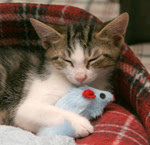
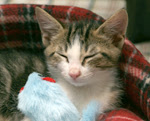
Maka Lea got a whole bag of toys for Christmas, including this little stuffed mouse (blue with red ears — what was the designer drinking?). For some reason, he’s taken to sleeping with this little stuffed mouse, making for a very good photo opportunity…

New Citizens

Meet Vera and Konstantin Stankevich — two of the newest American citizens. Their history is almost unimaginable to most Americans: growing up in the Soviet Union, then participating in the Estonian independence movement and living there for ten years as Estonia shed its Soviet experience, and finally living in the U.S. for six years until they could get their citizenship. Their story is an inspiring one, especially when you get the chance to learn some of the details. It gave us great pleasure to raise a toast to these fine new citizens…

Today they live in Lake Forest, about 120 miles from our home. We invited them down to see us, and yesterday they did so (after some driving adventures trying to find us!). We spent a very pleasant afternoon swapping stories, sharing some laughs, introducing them to those members of our menagarie that weren’t hiding, consuming intoxicating beverages and food, and even taking a short walk through through the hills around us. Konstantin instantly found a new “best friend” with Mo’i (our male field spaniel), and Vera was able to easily win over Lea, our normally very shy female field spaniel. Jim Barnick (our friend and neighbor) joined us, and afterwards commented on what very, very nice people they were. As indeed they are!

Konstantin is an avid photographer, and he took a lot of photos during their visit. They sent us a collection of those photos last night, and it was a lot of fun for us to see ourselves through someone else’s “eyes”. We weren’t surprised to see that Mo’i and Lea were in the limelight a lot — but we were a little surprised (and very amused!) to see a fine portrait of my little Kubota tractor in the collection!

Vera was a little worried about all the fierce wild animals that we have out here, but she went for a walk with us anyway. I’m sure the fact that we had five people and two dogs along helped considerably. We met a rather small woman walking alone, which struck Vera as impossibly brave. I’m not sure Vera entirely believed us when we said such things were commonly seen <smile>…

Debbie and Vera are making plans to meet when Debbie is up her way for an agility show. I’ll bet Vera would enjoy watching one of those shows. And we’re hoping to see them down here in the springtime, for desert flowers and the green growing season, so we can show them the high desert at its best.

Ah, we had such a good time!

Monday, December 26, 2005

Earthrise

Christmas, 37 years ago: I was 16, and I was more than usually excited about the holiday. Since the launch four days earlier (on December 21), I had been avidly following all the available news on the Apollo 8 mission, with astronauts Frank Borman, James A. Lovell Jr., and William A. Anders. I could hardly believe that I was living through a time when men were actually travelling away from Earth. What a moment in history!

It’s probably difficult for many people — especially those not old enough to remember those days — to imagine just how daring and amazing Apollo 8 was. No human had ever ventured more than a few hundred miles from the surface of the Earth before, and now these three were going about a quarter Bomillion miles away! I was also afraid for them, even with my then very lightweight understanding of just how risky that voyage was. The astronauts had a good ship, the best that we could give them — but our technology was far less capable then than it is today. Looking back, across decades of technological improvement and my own greater understanding of engineering, I am even more amazed at the audacity of this mission. Those were three very brave men…

From Apollo 8 Man Around the Moon, part of the online Apollo 8 Journal:

It was Christmas time, 1968, when man broke his bonds to Earth. Three Americans, Frank Borman, James A. Lovell Jr., and William A. Anders, guided their Apollo 8 spacecraft across nearly a quarter-million miles of black void, out of the grasp of Earth, into orbit around the Moon, and back once more to a chosen pinpoint on their home planet.

Never before had man traveled so far, so fast or looked so closely upon another celestial body. Never before had so many millions listened and watched, their imaginations stretched, as the explorers spoke across the emptiness. Never, indeed, had adventure ever borne all mankind so daringly near the boundaries of its aspirations.

What the astronauts saw of the Moon, from 70 miles above that foreboding surface, can now be seen by all and studied by scientists in the array of still and motion pictures, many of them in color, taken from Apollo 8. What the astronauts succeeded in proving about the reliability of the spacecraft and its rocket vehicle confirmed that some day soon men will actually set foot upon the Moon.

It was the first time that men had been launched into space by the Saturn V, America’s most powerful machine. It was the first time, too, that men had sped at nearly 25,000 miles an hour, as Apollo 8 hurled itself from orbit of the Earth and into flight toward the Moon.

Each time Astronauts Borman, Lovell, and Anders vanished behind the far side of the Moon they lost all contact with the Earth for 45 minutes on each of the 10 orbits. During the first long silence the black void crackled with tension until Mission Control in Houston reported, “We’ve got it! Apollo 8 is in lunar orbit."

"Good to hear your voice,” said Astronaut Lovell.

On the Eve of Christmas, as the eyes of the world followed Apollo 8 across the moonscape, the astronauts invoked another, older voice, reading in turn the first ten verses of Genesis, the Story of Creation. Its conclusion, “…and God saw that it was good” echoed in Astronaut Borman’s words as again Apollo 8 headed into the silent, tantalizing absence of earthly communications:

"God bless all of you — all of you on the good Earth."

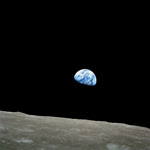
The famous image at above right, along with the astronauts' recitations described above, are what most people remember about Apollo 8 (if they remember it at all). While we could hear the reading of Genesis in realtime, the picture at right wasn’t available until months after the mission — for it was taken on plain old-fashioned silver halide film, with a Hasselblad 70mm camera. There was no such thing, back then, as “digital cameras” — and absolutely no way to get a high resolution image like this back to Earth across the void between the Moon and the Earth. No, we had to wait until Borman, Lovell, and Anders carried that film back home…

Just 7 months and three Apollow missions later, in July 1968, Apollo 11 landed on the moon. Those were heady times for anyone interested in the space program. We felt like we were living in a science fiction novel…

As usual, click on the picture at right for a (much) larger version…

Sunday, December 25, 2005

Maka Le'a

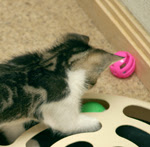
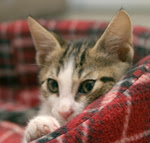
Maka Le’a is Hawai’ian for twinkly-eyed, mischevous — a fitting name for this little fellow who has adopted us. He was born just a few weeks ago, and he’s had a tough start — motherless (for reasons we don’t know), rescued by Jo Beaty (our vet) and bottle-fed, then taken seriously ill — twice. The second bout with the illness left him with some neurological problems that mostly affect his movements; he looks like he’s always just a little bit dizzy, and his rear quarters never seem to obey. We don’t know if his condition will get worse or better.

But we do know a good attitude when we see one, and Maka Le’a has that in abundance. He’s completely fearless — swats our dogs around without hesitation, and pounces on their paws or tails with complete abandon. When he’s wandering the livingroom floor, Lea and Mo’i (our two field spaniels) usually retreat to the couch, where Maka Le’a can’t get to them. Yet. My hands are all rough and chapped-looking right now, all from Maka Le’a’s “attacks”. He loves to chase things, just like any kitten, and he just refuses to let his handicap stop him. One of the consequences of his condition is that his pounces are usually off-target — sometimes by 6” or more. He seems not to care; he just gets up and tries again…

Click on any of the pictures for a larger view…

Thursday, December 22, 2005

M31

Wow! That’s all I can say about this image!

When I was a kid, a grainy and coarse black & white image of M31 was considered extraordinary. Now not so very many years later, just look at what our scientists and engineers can do!

From APOD:

The most distant object easily visible to the unaided eye is M31, the great Andromeda Galaxy some two million light-years away. But without a telescope, even this immense spiral galaxy - spanning over 200,000 light years - appears as a faint, nebulous cloud in the constellation Andromeda. In contrast, a bright yellow nucleus, dark winding dust lanes, gorgeous blue spiral arms and star clusters are recorded in this stunning telescopic digital mosaic with a cumulative exposure of over 90 hours. While even casual skygazers are now inspired by the knowledge that there are many distant galaxies like M31, astronomers seriously debated this fundamental concept only 80 years ago. Were these “spiral nebulae” simply outlying components of our own Milky Way Galaxy or were they instead “island universes” — distant systems of stars comparable to the Milky Way itself? This question was central to the famous Shapley-Curtis debate of 1920, which was later resolved by observations of M31 in favor of Andromeda, island universe.

As usual, click on the small photo for a larger view…

Wednesday, December 21, 2005

Doggy Wonderland

When our waitress discovered how much we enjoyed this poem, she told us that there were more doggy Christmas things underneath some of the other tabletops. And a little while later, she pointed out this one to us (sung to the tune of “Winter Wonderland"):

DOGGY WONDERLAND (unknown songwriter)

Dog tags ring, are you listenin'?

In the lane, snow is glistenin'.

It’s yellow, NOT white - I’ve been there tonight,

Marking up my winter wonderland.

-

Smell that tree? That’s my fragrance.

It’s a sign for wand’ring vagrants;

"Avoid where I pee, it’s MY pro-per-ty!

Marked up as my winter wonderland."

-

In the meadow dad will build a snowman,

following the classical design.

Then I’ll lift my leg and let it go Man,

So all the world will know it’s mine-mine-mine!

-

Straight from me to the fencepost,

flows my natural incense boast;

"Stay off of my TURF, this small piece of earth,

I mark it as my winter wonderland.

Christmas Dog

Debbie and I went out for dinner tonight, to the Descanso Junction restaurant — one of our favorite local spots. One of its charms (in addition, of course, to the fine food and cheerful help) is the collection of paper “stuff” they have under the clear tops of all the tables. These usually range from nostalgic pictures to magazine articles to granma’s recipes — entertaining reading, always. Tonight they had the joint decked out for Christmas, right down to thematic materials under those clear table tops. On our table there was this delightful poem (especially if you’re a dog person), a take-off on “'Twas the Night Before Christmas":

CHRISTMAS DOG (by Shel Silverstein)

Tonight’s my first night as a watchdog,

And here it is Christmas Eve.

The children are sleeping all cozy upstairs,

While I’m guardin' the stockin’s and tree.

What’s that now — footsteps on the rooftop?

Could it be a cat or a mouse?

Who’s this down the chimney?

A thief with a beard — And a big sack for robbin' the house?

What’s going on here?

I’m barkin', I’m growlin', I’m bitin' his butt.

He howls and jumps back in his sleigh.

I scare his strange horses, they leap in the air.

I’ve frightened the whole bunch away.

Now the house is all peaceful and quiet again.

The stockin’s are safe as can be.

Won’t the kiddies be glad when they wake up tomorrow

And see how I’ve guarded the tree!

And there’s more!

Lawson Valley Sunrise

This was the view from our patio, around 6:20 yesterday morning. The sky was full of unusually saturated color in a wide range of subtle hues and shades. A gorgeous display of Mother Nature’s art!

For those of you interested in the technical part: all of these were handheld at 1/60th, 100ASA setting. The panorama is composed of four shots, just by rotating myself in place on the patio. There actually is a hillside there causing things to move up on the right, that wasn’t me rotating oddly <smile>. I did minimal digital post-processing on these; it’s a pretty good representation of what we actually perceived.

As usual, click on the small photos for a larger view…