
Friday, August 15, 2014
Oopsie!

Thursday, August 14, 2014
Curiosity...

On-demand paper jamming...
On-demand paper jamming... This cracked me up, and brought back memories of some particularly funny bugs I've run into myself.
My favorite one of these was a stepping motor driver I wrote. I was annoyed by the noise that the head-positioning stepper in floppy drives made. The noise was caused by the constant step-rate employed by the simple software drivers generally used. I wrote one that accelerated and decelerated the stepper instead, and was virtually silent. However, I had a strange “bug” in my driver. When I first got it running, it would be quiet in the morning when I got to work – but by the afternoon, it was noisy again. Not as bad as without my driver, but much noisier than in the morning. How could my software behave differently in the afternoon than in the morning?
Eventually I figured out what was going on. Our office was ten degrees or so warmer in the afternoons, and the components of the stepper drive expanded a bit. This increased the rotational inertia in the system, which in turn reduced the acceleration the stepper could apply. To make it work right, I had to adjust the speed of my driver non-linearly as the ambient temperature (which, fortunately, the floppy drive measured) varied...
My favorite one of these was a stepping motor driver I wrote. I was annoyed by the noise that the head-positioning stepper in floppy drives made. The noise was caused by the constant step-rate employed by the simple software drivers generally used. I wrote one that accelerated and decelerated the stepper instead, and was virtually silent. However, I had a strange “bug” in my driver. When I first got it running, it would be quiet in the morning when I got to work – but by the afternoon, it was noisy again. Not as bad as without my driver, but much noisier than in the morning. How could my software behave differently in the afternoon than in the morning?
Eventually I figured out what was going on. Our office was ten degrees or so warmer in the afternoons, and the components of the stepper drive expanded a bit. This increased the rotational inertia in the system, which in turn reduced the acceleration the stepper could apply. To make it work right, I had to adjust the speed of my driver non-linearly as the ambient temperature (which, fortunately, the floppy drive measured) varied...
Humans need not apply...
The underlying premise of this little film is that jobs are being threatened, and that's bad. I agree with the first part, but I'm not so sure that's a bad thing. The centrality of jobs in our culture is an artifact of our culture, not necessarily a biological (or psychological) imperative.
Readers of science fiction will already be familiar with the many ideas about what happens to people who don't possess skills that robots can't do. After reading many of these myself, I find the most plausible scenarios involve hordes of entertainment-seeking people with lesser skills, coddled and pampered by smaller hordes of robots. Some people will find creative outlets, but many will pursue full time the same part-time leisure activities people pursue today, with TV at the head of the list.
I suspect that Mann is starting to understand something...
I suspect that Mann is starting to understand something... When Michael “Hockey Stick” Mann decided to sue Mark Steyn, Mann was spitting on Superman's cape. Not only is Steyn defending himself in a spectacularly aggressive way (unlike some others we won't mention) – but Steyn has also counter-sued, and looks to be bringing a world of hurt down on Mann's head.
Good. Couldn't happen to a more deserving warmist!
Good. Couldn't happen to a more deserving warmist!
Just shut it down!
Just shut it down! NASA has far outlived its usefulness. It's now turned into a pork machine, doling out multi-billion dollar useless projects to the home districts of powerful Congressmen. The few useful things that it continues to fund (mainly the robotic explorers) would be better handled with competitive contracts. Companies like SpaceX are already providing cheaper, better launch services.
Unionization is the last straw. It's a bureaucratic weed. Time for some bureaucratic Round-Up.
Unionization is the last straw. It's a bureaucratic weed. Time for some bureaucratic Round-Up.
Tide pool...

Maggie...
Maggie... Yesterday morning, as I was working out in my yard, I got quite a surprise: a beautiful Springer spaniel with unusual coloring showed up right in front of me. She was a mixture of brown and black spots on a white background all over her face, and larger patches on the rest of her. This dog – Maggie on her tag – came running straight through the thicket of roses that line the irrigation canal on the east side of our property. She was thoroughly wet, apparently having just walked through the canal. Lots of people in the area let their dogs and cats run loose, so I assumed this was one of my neighbors' dogs, though I hadn't seen her before.
I called to her, and she came right to me, very friendly. Being dog-deprived up here (our dogs are still all in Jamul), I took the opportunity to enjoy some canine company. We played together for a while, then I went back to work. That's when I started to suspect something might be wrong, as my new friend just wouldn't leave my side. She followed me all over the yard as I went about my work cutting down some pine seedlings that had gotten out of control in bad locations. Something about her behavior made me think that she might be lost. So I called her over to me again, and this time I looked at her tags. That's when I found out her name was Maggie – and that her home address was a mile and a half away, east of the town of Paradise. I took a closer look at her, and noticed that her pads were not very calloused – she wasn't accustomed to running around long distances – and her coat was mostly combed out and recently trimmed. This wasn't a dog used to field and stream; she was a pampered pooch.
So I walked over to my truck, Maggie trailing closely behind. I opened the passenger door, and Maggie jumped right in, looking happy and excited. I got into the driver's side, and Maggie crawled over the console onto the seat beside me (rather a tight squeeze!), and wouldn't leave. We drove off, crunched together, on a search for her house.
It took a while to find it, as the street she lived on isn't continuous. After a bit of exploration, though, I figured out how to get onto the right piece of her street, and finally located her house: a big, beautiful home on a hilltop, in a large lot (20 acres or so), with a commanding view of all of southern Cache Valley. The yard was beautifully landscaped in a style I associate with Arizona, with mostly plants that have low water needs. I rang the doorbell, and the lady of the house (Jill) came out with a baby on her hip. She gave me a funny look, probably because I was drenched with sweat (it was a hot and humid day), and wearing one of my goofy hats. But when I told her that I had a friend in my truck, she immediately knew that one of their dogs must have gotten out of her kennel. I opened my truck door, and a very happy Maggie hopped out to see her not-so-happy-with-her owner. Maggie had dug under her kennel wall, as apparently some of her fellow dogs had done before. However, Jill told me that they'd never had one wander so far away before – and certainly had never had one cross the highway before. I'd be pretty unhappy if I knew one of my dogs had done such a thing, and that's exactly how Jill reacted.
I suspect those kennels will be be fixed soon.
Maggie made my day yesterday, both with her company and because I was able to get her safely back home, where she belongs...
I called to her, and she came right to me, very friendly. Being dog-deprived up here (our dogs are still all in Jamul), I took the opportunity to enjoy some canine company. We played together for a while, then I went back to work. That's when I started to suspect something might be wrong, as my new friend just wouldn't leave my side. She followed me all over the yard as I went about my work cutting down some pine seedlings that had gotten out of control in bad locations. Something about her behavior made me think that she might be lost. So I called her over to me again, and this time I looked at her tags. That's when I found out her name was Maggie – and that her home address was a mile and a half away, east of the town of Paradise. I took a closer look at her, and noticed that her pads were not very calloused – she wasn't accustomed to running around long distances – and her coat was mostly combed out and recently trimmed. This wasn't a dog used to field and stream; she was a pampered pooch.
So I walked over to my truck, Maggie trailing closely behind. I opened the passenger door, and Maggie jumped right in, looking happy and excited. I got into the driver's side, and Maggie crawled over the console onto the seat beside me (rather a tight squeeze!), and wouldn't leave. We drove off, crunched together, on a search for her house.
It took a while to find it, as the street she lived on isn't continuous. After a bit of exploration, though, I figured out how to get onto the right piece of her street, and finally located her house: a big, beautiful home on a hilltop, in a large lot (20 acres or so), with a commanding view of all of southern Cache Valley. The yard was beautifully landscaped in a style I associate with Arizona, with mostly plants that have low water needs. I rang the doorbell, and the lady of the house (Jill) came out with a baby on her hip. She gave me a funny look, probably because I was drenched with sweat (it was a hot and humid day), and wearing one of my goofy hats. But when I told her that I had a friend in my truck, she immediately knew that one of their dogs must have gotten out of her kennel. I opened my truck door, and a very happy Maggie hopped out to see her not-so-happy-with-her owner. Maggie had dug under her kennel wall, as apparently some of her fellow dogs had done before. However, Jill told me that they'd never had one wander so far away before – and certainly had never had one cross the highway before. I'd be pretty unhappy if I knew one of my dogs had done such a thing, and that's exactly how Jill reacted.
I suspect those kennels will be be fixed soon.
Maggie made my day yesterday, both with her company and because I was able to get her safely back home, where she belongs...
Cat trees...

The photo was taken in the room that will be our new cattery. It's a large room (about 600 square feet) in the basement of our new home. We've floored it with ceramic tile for easy cleaning. The base will also be of the same tile, but we're waiting for the materials to come in for that. We also have a cabinet being built just for the cattery, with a huge stainless steel sink, ample storage, and a pull-out cat food bin. Despite being in the basement, the room is full of light from the seven casement windows around three sides. Next year, we're going to build an outdoor enclosure that the cats will be able to get to, through a tunnel from the basement, through a casement window, and up to the enclosure. This will give them outdoor access for three seasons of the year. We should have some happy cats up here!
Wednesday, August 13, 2014
The Internet hits another milestone of sorts...
The Internet hits another milestone of sorts... This is the fifth or sixth time in my own experience that a similar BGP size gate was hit. It sure seems silly these days to have just 512k route entries pose a RAM limit. The limit essentially comes from the conjunction of two things: (1) Cisco's dominance (now lessening) of the Internet backbone infrastructure, and (2) the insanely high prices that Cisco charges for RAM in their routers. All of this is starting to change, though, with the advent of serious competition for ISP-scale IP routing infrastructure...
Yesterday turned out a little differently than planned...
Yesterday turned out a little differently than planned... I had a list of projects to get to yesterday, a bunch of little jobs that I've just been letting go. I got a few of them done in the morning, ate some lunch, and then heard a strange noise in my backyard – some serious metallic clattering with a poorly-executed rhythm to it.
Upon investigating, I saw that my neighbor to the north (Tim D.) had someone baling his hay, which had been mowed and raked in the previous few days. Our weather forecast called for a storm to hit us yesterday afternoon, so I surmised that Tim was eager to get his hay off the field before the sky opened up. The fellow running the baler would be done in a half hour or so. Tim was driving his ATV, pulling a flat-bed wagon. He'd pull up next to a couple of bales, hop off the ATV, pile the bales onto the wagon, then hop back onto his ATV and drive off to the next one.
Well, it was easy to see this was an inefficient operation – poor Tim spent more time getting on and off the ATV than he did moving hay. Then I started thinking about the rest of the operation – that hay would have to be unloaded into his barn, where it's stacked high. That would be tough to do as a single-man operation, too.
So I laced up my boots, pulled on a pair of gloves, and headed out to give him a hand. Tim had some mild objections, said he's been doing this by himself for 3 or 4 million years ... but he didn't chase me off :). The two of us, working together, had that wagon loaded with 30 bales of hay in about a quarter of the time it would have taken him by himself. We drove it over to his barn and started unloading it, with each of us hoisting the bales halfway up his stack. Much easier with two.
As we were unloading that first wagon load, Tim's granddaughter (Taylor) showed up. She's 17 years old, and in great shape, and she went right to work with us. Now we had three people – and when we went out to load up the second wagon load, it went faster still. Taylor drove the ATV, and Tim and I stacked hay. We took that load back to stack, and now with three people working, we each only had to hoist the bales a third of the way up. That went much faster than the first wagon load.
When we finished that load, Taylor's dad (Tim's son-in-law) showed up. At about the same time, Tim called our mutual neighbors (Maria S.) to see if they'd like some hay. Tim's barn was completely full, and he had more hay than he needed to feed his horses over the winter. Maria's family have some sheep, and are about to get a milch cow, so they were happy to get some free hay – and they said they'd come right over to help. Next thing you know, we had 9 people loading the wagon: Tim, myself, Taylor, her dad, Maria, and Maria's four kids. An army! We loaded and unloaded that wagon onto Maria's haystack in just a few minutes, then loaded it and unloaded some more hay for Taylor's dad in another few minutes.
And then we were done.
It's been many, many years since I last loaded and unloaded hay – so I was sore and stiff last night (and still a bit stiff this morning). But I haven't done anything quite so satisfying in quite a while. I had the satisfaction of helping my cherished neighbor (Tim). It did storm yesterday afternoon – if we hadn't picked up that hay, it would have blown over half the county, and then been soaked. Tim wouldn't have been able to get it all up before the storm, working on his own. There was more satisfaction in working together with people that I liked. I know Tim and Taylor, but working with Maria's family was a new experience. Her kids jumped right into the work, laughing and fussing with each other to see who could do the most difficult things the best. I got to know all of them a lot better during the afternoon's work.
Best of all, though: when we'd finished, and I told Tim I was headed home, he came over, shook my hand, and said “Thanks for the help, my friend.”, with feeling evident in his tone. That “…my friend.” means a lot to me. We're fitting into this local community in a way that we never did in California. These are my kind of people up here, and I'm really happy to find out that the feeling is mutual.
When I got home, I had a big pot of beef stew waiting for me. Early this morning, I chopped up a nice beef round roast, a big white onion (from Tim's garden!), carrots, potatoes, a green pepper, and some mushrooms. All of that went into my slow cooker, along with some cream of mushroom soup and a few spices. That cooked for 9 hours. Yum! I'm really starting to like that slow cooker :)
This morning I have about half the jobs from yesterday still left to do. And in an hour or so, my new brush mower should arrive. Buh bye, weeds!
Upon investigating, I saw that my neighbor to the north (Tim D.) had someone baling his hay, which had been mowed and raked in the previous few days. Our weather forecast called for a storm to hit us yesterday afternoon, so I surmised that Tim was eager to get his hay off the field before the sky opened up. The fellow running the baler would be done in a half hour or so. Tim was driving his ATV, pulling a flat-bed wagon. He'd pull up next to a couple of bales, hop off the ATV, pile the bales onto the wagon, then hop back onto his ATV and drive off to the next one.
Well, it was easy to see this was an inefficient operation – poor Tim spent more time getting on and off the ATV than he did moving hay. Then I started thinking about the rest of the operation – that hay would have to be unloaded into his barn, where it's stacked high. That would be tough to do as a single-man operation, too.
So I laced up my boots, pulled on a pair of gloves, and headed out to give him a hand. Tim had some mild objections, said he's been doing this by himself for 3 or 4 million years ... but he didn't chase me off :). The two of us, working together, had that wagon loaded with 30 bales of hay in about a quarter of the time it would have taken him by himself. We drove it over to his barn and started unloading it, with each of us hoisting the bales halfway up his stack. Much easier with two.
As we were unloading that first wagon load, Tim's granddaughter (Taylor) showed up. She's 17 years old, and in great shape, and she went right to work with us. Now we had three people – and when we went out to load up the second wagon load, it went faster still. Taylor drove the ATV, and Tim and I stacked hay. We took that load back to stack, and now with three people working, we each only had to hoist the bales a third of the way up. That went much faster than the first wagon load.
When we finished that load, Taylor's dad (Tim's son-in-law) showed up. At about the same time, Tim called our mutual neighbors (Maria S.) to see if they'd like some hay. Tim's barn was completely full, and he had more hay than he needed to feed his horses over the winter. Maria's family have some sheep, and are about to get a milch cow, so they were happy to get some free hay – and they said they'd come right over to help. Next thing you know, we had 9 people loading the wagon: Tim, myself, Taylor, her dad, Maria, and Maria's four kids. An army! We loaded and unloaded that wagon onto Maria's haystack in just a few minutes, then loaded it and unloaded some more hay for Taylor's dad in another few minutes.
And then we were done.
It's been many, many years since I last loaded and unloaded hay – so I was sore and stiff last night (and still a bit stiff this morning). But I haven't done anything quite so satisfying in quite a while. I had the satisfaction of helping my cherished neighbor (Tim). It did storm yesterday afternoon – if we hadn't picked up that hay, it would have blown over half the county, and then been soaked. Tim wouldn't have been able to get it all up before the storm, working on his own. There was more satisfaction in working together with people that I liked. I know Tim and Taylor, but working with Maria's family was a new experience. Her kids jumped right into the work, laughing and fussing with each other to see who could do the most difficult things the best. I got to know all of them a lot better during the afternoon's work.
Best of all, though: when we'd finished, and I told Tim I was headed home, he came over, shook my hand, and said “Thanks for the help, my friend.”, with feeling evident in his tone. That “…my friend.” means a lot to me. We're fitting into this local community in a way that we never did in California. These are my kind of people up here, and I'm really happy to find out that the feeling is mutual.
When I got home, I had a big pot of beef stew waiting for me. Early this morning, I chopped up a nice beef round roast, a big white onion (from Tim's garden!), carrots, potatoes, a green pepper, and some mushrooms. All of that went into my slow cooker, along with some cream of mushroom soup and a few spices. That cooked for 9 hours. Yum! I'm really starting to like that slow cooker :)
This morning I have about half the jobs from yesterday still left to do. And in an hour or so, my new brush mower should arrive. Buh bye, weeds!
Tuesday, August 12, 2014
Slot machine science...
Slot machine science... I've read bits and pieces of this before, but this article tells the whole story quite nicely.
The whole phenomenon of slot machines is one of those things (there are many :) that make me wonder whether I'm a member of the same species as most other people (shut up, mom). I have never had even the tiniest desire to put money into a machine in return for the dubious pleasure of watching it work, and the small chance that I might win more than I spend. Almost any other way of spending time or money seems more attractive to me. I know quite a few people who do things that seem utterly crazy to me, such as drive for 10 hours to get to a casino, where they then spend two days shoveling money into a machine, and then come home with (usually substantially) less money than they departed with. Some of them even delude themselves into believing that they're net winners of the long haul, when clearly they are not.
I just don't get the attraction. I must be broken...
The whole phenomenon of slot machines is one of those things (there are many :) that make me wonder whether I'm a member of the same species as most other people (shut up, mom). I have never had even the tiniest desire to put money into a machine in return for the dubious pleasure of watching it work, and the small chance that I might win more than I spend. Almost any other way of spending time or money seems more attractive to me. I know quite a few people who do things that seem utterly crazy to me, such as drive for 10 hours to get to a casino, where they then spend two days shoveling money into a machine, and then come home with (usually substantially) less money than they departed with. Some of them even delude themselves into believing that they're net winners of the long haul, when clearly they are not.
I just don't get the attraction. I must be broken...
Riots and looting in Ferguson, Missouri...
Riots and looting in Ferguson, Missouri... By now I'm sure you've heard about the police shooting of an unarmed black youth, and the resulting riots and looting of stores. What you probably have not read, however, is that two stores in Ferguson emerged from the riots unscathed and unlooted. Can you guess why?
“...if you know what's best for you, you'll think twice before suggesting seven-year-old Aussie citizens waving around severed heads might be indicative of broader, er, assimilation issues within, ah, certain communities, or anything like that.”

The multicultural dogma of cultural equivalence is indefensible by any rational argument, and the photo above is a good piece of evidence for that. Do you really thing a culture that celebrates children lofting decapitated heads is as worthy as, say, the culture of modern-day Scientologists? Personally I have no difficulty ranking the two cultures – one of them would love to kill me, the other just wants my money. The evidence against the notion of cultural equivalence has been strong and hard to argue with since the dawn of the human race, and yet the multi-cultis persist in their nonsense, and drag the rest of us along with them towards doom.
I know! Let's give the multi-cultis their own island, and they can do what they want. There are a lot of multi-cultis, though, so we'll need a big island. Got it! Let's give 'em Australia – there are already plenty of multi-cultis there, so we won't have to transport quite so many...
Gender bias...

- 7 are predominantly conferred to women
- 1 is predominantly conferred to men
- 2 are conferred roughly equally to men and women
Are these freely made choices by the student entering school? Or are they determined by cultural context and expectations? I suspect the former, though these days that's not a politically correct position to take...
Monday, August 11, 2014
If you know me well...
If you know me well ... then you'll immediately understand why this morning's Dilbert strip gave me a good belly-laugh!

Curiosity has found something curious...

“It’s meant to completely obviate them.”
“It’s meant to completely obviate them.” Momentum Machines is making a “burger bot” (a robot that makes hamburgers). Says the company's co-founder:
Once again, the progressives take a perfectly good, functional capitalist economy and totally screw it up.
Mind you, eventually the natural rise of wages and the falling cost of robotics would cause this tipping point to occur anyway – but without the “help” of progressive economic meddling, this transition would have occurred some considerable time in the future (say, 10 or 15 years) and after a more gradual transition. Many industry observers are saying that the automation of fast food restaurants is likely to occur extremely fast, now that the economics have suddenly made it attractive. The rate of change is likely to be limited only by the production capacity of the robotics companies...
“Our device isn’t meant to make employees more efficient. It’s meant to completely obviate them.”Raising the minimum wage has great accelerated fast food companies' interest in such devices. The higher the wages that must be paid for a human to do the work – and the more entitled the young work force feels – the more economically compelling such robots are. Many observers think that the latest round of minimum wage increases has pushed the fast-food industry over the tipping point – and the industry's investments in robot research would seem to validate this.
Once again, the progressives take a perfectly good, functional capitalist economy and totally screw it up.
Mind you, eventually the natural rise of wages and the falling cost of robotics would cause this tipping point to occur anyway – but without the “help” of progressive economic meddling, this transition would have occurred some considerable time in the future (say, 10 or 15 years) and after a more gradual transition. Many industry observers are saying that the automation of fast food restaurants is likely to occur extremely fast, now that the economics have suddenly made it attractive. The rate of change is likely to be limited only by the production capacity of the robotics companies...
Sunday, August 10, 2014
When you've lost Alan Dershowitz...
When you've lost Alan Dershowitz ... it's pretty much time to turn in your “progressive” membership card. Even the progressive elite are starting to realize that Jimmy Carter is a hypocritical, pompous, lying, and corrupt son of a bitch...
Fish oil: the new snake oil?
Fish oil: the new snake oil? Reader and friend Simon M. passes along this article (caution: link goes to Slate, which may cause conservatives' heads to explode) and comments:
Back when I was still employed, I was 40 or 50 pounds overweight. Every time I went to my doctor (who has known me for 25 years or so) for a physical, I asked him if there are things about my diet I should change, or if I should be making an effort to get more exercise. His answer was always the same: there was nothing wrong with me, so whatever I was doing wasn't causing any problems, so don't worry about it.
Now that I'm retired, I'm getting much more exercise, sitting around far less, but my eating habits haven't changed at all. I've dropped about 40 pounds, and I think my weight is still headed down. At the time of my last physical, I'd dropped about 20 pounds. My doctor, upon hearing about my change in lifestyle, was sure it was due to the exercise – and once again, he found nothing for me to worry about. It's much easier now to go up stairs and to hike, and I feel better in general. But ... absolutely none of that is down to diet. It's entirely due to exercise, so far as I can tell. I'm tracking my weight now, though (at my doctor's advice), just to be sure that it's not changing in some way that's not in sync with my level of exercise. He warns me that come wintertime, when likely I'll be sitting on my butt a lot, I should expect that weight to pile back on...
“I enjoyed your drink when you're thirsty blog. Makes perfect sense to me.I totally agree, but I'll extend it a bit: eat when you're hungry, and eat whatever you want to – in moderation. Most of what I eat is relatively healthy (according to nutritionists), because that's what I like. But ... there are plenty of things I like – and eat – that most nutritionists (at the moment, anyway) would call unhealthy: rare (or raw) beef, premium ice cream, Braunschweiger, etc., etc.
Eat when you're hungry works too. :)”
Back when I was still employed, I was 40 or 50 pounds overweight. Every time I went to my doctor (who has known me for 25 years or so) for a physical, I asked him if there are things about my diet I should change, or if I should be making an effort to get more exercise. His answer was always the same: there was nothing wrong with me, so whatever I was doing wasn't causing any problems, so don't worry about it.
Now that I'm retired, I'm getting much more exercise, sitting around far less, but my eating habits haven't changed at all. I've dropped about 40 pounds, and I think my weight is still headed down. At the time of my last physical, I'd dropped about 20 pounds. My doctor, upon hearing about my change in lifestyle, was sure it was due to the exercise – and once again, he found nothing for me to worry about. It's much easier now to go up stairs and to hike, and I feel better in general. But ... absolutely none of that is down to diet. It's entirely due to exercise, so far as I can tell. I'm tracking my weight now, though (at my doctor's advice), just to be sure that it's not changing in some way that's not in sync with my level of exercise. He warns me that come wintertime, when likely I'll be sitting on my butt a lot, I should expect that weight to pile back on...
Air quality egg...


The community web site currently displays only temperature, humidity, NO2, and CO. The full data set is available at Xively for all the AQEs. Our AQE's page on the community site is here (note: the temperature is in degrees Celsius), and our Xively data feed is here (click the “graphs” link to see a timeline for the data).
Earthrise: the backstory...
My mom is a little more pissed off than usual this morning, because she had to call me to rescue her from a confusing (and deliberately misleading) Java update process left her with an unwanted, crapware-ridden Ask toolbar, and home pages reset to the Ask site. The folks at Oracle ought to be thoroughly ashamed of themselves for loosing this evil upon the world. We have this message for the Java product manager responsible for this horror: may the concerted efforts of 100 Congressmen be applied to your next software update...

Friday, August 8, 2014
Barn: the forms come off!
Barn: the forms come off! Early this morning the crew arrived and started disassembling the forms holding the foundation wall in place (photos below). They could do this because the concrete had cured sufficiently to safely hold the wall in place. I watched them start this work, then I ran some errands that took a couple hours. When I came home the forms were completely off, all the parts had been hauled away, and the foundation wall was fully exposed. It will sit like this for about a week so that it can completely cure...


Email from an Israeli...
Email from an Israeli... Reader Jim M. passes this email from a relative living in Israel along. I have no way to verify its authenticity, but ... it rings true.
From: Andi
Subject: How I feel today
Date: July 20, 2014 at 11:24:49 AM CDT
I feel like I weigh 500 pounds. Everyone I know feels like they are walking through water. And sad. We are all so very, very sad.
This is what I know right now, today:
The ugliness, the venom, and the sheer, violent hatred you are seeing in Paris, London, Berlin, LA, Boston, Denver…..this is just the beginning. We Jews are the canaries in the coal mine for all of humanity. Today, they are throwing bricks at synagogues and smashing chairs and saying "Kill the Jews." Tomorrow it will be someone else.
Do the French really think these people will protect and safeguard the treasures of the Louvre? Do Londoners really think these people will cherish the symbols of the British Empire? Does anyone really think this is only about Israel and the disputed territories?
Today it is Israel, tomorrow it will be you.
Maybe that is why everyone gets so disproportionately annoyed about this conflict. Because everyone knows that, after us, it gets real personal. Seeing these violent protests, hearing the sickening screams for death, we Israelis understand better than ever we must fight for every square inch and with all we have. It matters not how much better our military is, how much more precise our targets can be. It only matters that when the smoke clears Hamas is disarmed, destroyed, disabled, and defeated. Forever.
Hamas. NOT the people of Gaza. I feel so very sorry for them. Sorry they were misguided and elected these lunatics. Sorry that, in their desperation, they allowed Hamas to fill the empty bedrooms next to their children's room with rockets. Sorry that their leaders have mansions and swimming pools and are sitting in air conditioning in another city while they are sweating and wondering where the roof over their houses went (if not their house itself.) Sorry that they have been brought up with no inkling of who Israelis are or what compromise is.
Defeating Hamas will be a big problem for the power brokers because shame and honor are all that matter in this part of the world. Honor in the Middle East does not come from whether your children are literate, how successful you are, how much money you make, how civilized your community is, or how many paved roads you have, and whether or not you have garbage collection and recycling.
Here in this part of the world - for Hamas, honor comes from getting revenge. For them revenge is everything. For them revenge is the only thing. Remember we left Gaza. There was no blockade. They were free to build a model democracy - the first successful, shining, taste of the new, proud Palestine. But they didn't want that kind of success.
Fool me once, shame on you. Fool me twice, shame on me. We will not be fooled again. We have nowhere else to go. And the rockets won't stop. The folks in Ashkelon cannot shower, have a bowel movement, get more milk, or walk a dog without wondering if they are taking their lives in their own hands.
There is another Gaza underneath Gaza. Hamas could have built hundred of schools, paved thousands of roads, built hundreds of kindergartens with the cement and iron they have used to build these underground bunkers and tunnels. (And you wondered why Israel put a blockade on bringing building supplies into the Gaza strip?) These tunnels to hell are filled with ammunition. And no women or children, nor a single elderly person, are brought to safety there. They want them on the street, on the roof, standing right behind (nice and close to) the terrorist firing the rocket. Hamas has refused to let journalists out of Gaza. Why? They need them to take pictures and record the carefully staged piles of bloody children and women. If the journalists leave, they have lost the vehicle for distributing their bloody ad campaign.
Hamas asked for a cease-fire. And they broke it. They break every single one.
Israel is setting up a massive field hospital to treat ... our enemies. From 8 pm on tonight there will be a working maternity ward, an operating theater, a working hospital for ... our enemies. We are going to lose more boys. Last night we lost 13. With each day we are going to lose more. But everyone here now understands this is a fight to the death. It is them or us. They cannot compromise and they don't want peace or to share or to negotiate. They want revenge even if it means killing their own people. So we have to go in there and do things none of us want to do, but we have to. This is why we are all so sad. Israelis want peace so badly. But we also desperately want to live. We love life and we are not about to let anyone, let alone a bunch of deranged thugs, take it away from us.
So yes, this is a fight to the death for both sides. Remember, if they win, you are next. If we win, those symbols of civilization that everyone takes so for granted will remain standing. And everyone will criticize and complain about disproportionate responses and war crimes and all kinds of other irrelevant nonsense, but secretly I think everyone will be heaving a sigh of relief.
“Have the strength to doubt and question what you believe as easily as you're so quick to doubt his beliefs.”
“Have the strength to doubt and question what you believe as easily as you're so quick to doubt his beliefs.” Good advice from Andrew W. K. His music isn't my style, but for a 35 year old show business type, he's really got his shit together...
“I picture the enemy watching this video and laughing.”
“I picture the enemy watching this video and laughing.” What she said...
Thursday, August 7, 2014
Barn: the foundation wall is poured!
Barn: the foundation wall is poured! After all these weeks of waiting, now the barn construction seems to be proceeding at a breakneck pace. I went out to run a few errands, and when I got home the last concrete truck had just pulled out, and the concrete crew was making the final tweaks (see photos below). Tomorrow they'll be back to pull the forms off, and then we're just waiting for a few days for the concrete to cure...
 |
| Just before the pour... |
 |
| Tweaking the forms... |
 |
| Adding connectors... |
The most trusted name in news...

One hardly knows what to say...
Barn: the foundation wall is underway!
Barn: the foundation wall is underway! In the photos below you can see the outer side of the form being constructed, and the rebar reinforcement rods being wired in place. Once that's all done, the inner form side will go up, the form as a whole will be lined up, and then the concrete trucks (about a dozen of them) will start arriving. By early this afternoon, the entire foundation wall should be poured. It will sit undisturbed for a week or so to cure, then work will pick up again...


Comet 67P close-up...

But this is merely the beginning! Rosetta is currently orbiting 100 kilometers (about 60 miles) from 67P, but will be spiraling in to just 10 kilometers (about 6 miles) as the mission progresses. That will increase areal resolution by a factor of 100 on the images obtained. Even more important (if less attractive to the public): the science instruments are going to work very soon...
“But under the guise of enabling innovation, the agency is making an already complex regulatory climate even harder to navigate.”
“But under the guise of enabling innovation, the agency is making an already complex regulatory climate even harder to navigate.” The story is about FDA regulation of software, but that statement could be applied equally to almost any regulatory agency...
Wednesday, August 6, 2014
Barn: the first concrete is poured...
Barn: the first concrete is poured... Just after I published the last post, I heard a terrific buzzing from my back yard. It was the vibrator that sends the concrete down the placement chute – the first (of two) concrete trucks was placing some stiff concrete into the footing base forms the crew set up just a few hours ago. I ran out and took a few photos, just as the second concrete truck showed up. Just a few minutes later they were finished placing all the concrete, and the crew started setting up vertical pieces of rebar – the first step of the reinforcement construction. They're going to finish wiring the reinforcement in place, then set up the forms for the next step: pouring the footing and foundation wall. Woo hoo!
My neighbor Tim D. knew the barn was about to get underway, so a few days ago he dug a post hole, into which he wanted to put a piece of 4" steel tubing as a very strong corner post. That hole needed some concrete, and clever Tim knew they'd likely have a few cubic feet left over (they never try to get the quantity exactly, but rather always order a bit more than they actually need – knowing that to order less than they actually needed was courting disaster). Sure enough, when they finished pouring the barn's footing, there was still concrete in the truck. A minute later, Tim's post hole was filled to the brim with concrete – with no cost and almost no work for him!


My neighbor Tim D. knew the barn was about to get underway, so a few days ago he dug a post hole, into which he wanted to put a piece of 4" steel tubing as a very strong corner post. That hole needed some concrete, and clever Tim knew they'd likely have a few cubic feet left over (they never try to get the quantity exactly, but rather always order a bit more than they actually need – knowing that to order less than they actually needed was courting disaster). Sure enough, when they finished pouring the barn's footing, there was still concrete in the truck. A minute later, Tim's post hole was filled to the brim with concrete – with no cost and almost no work for him!
Barn: things are happening quickly all of a sudden!
Barn: things are happening quickly all of a sudden! This morning the builders laid out the location where a trench needed to be dug (for the footings). Shortly later, a large backhoe showed up and started digging. The depth that it dug to was measured by another laser level. As I watched, the builder drafted me to operate the “stick” – a measuring pole with an attached laser receiver. It was a good way to stop my pesky questions, as I was having a great time actually participating in the construction process – albeit in a role where I was quite unlikely to cause any trouble.
That backhoe (see photos below) was quite a capable piece of machinery, but the fellow operating it was a serious craftsman. He's 64 years old, and he's been running a backhoe for over 35 years. I've run a (much smaller) backhoe myself, so I have a pretty good idea what's involved. I know which things are easy, and which are difficult. This fellow made even the most difficult things look like they were trivial exercise. By eyeball alone, he could grade the level of the bottom of the trench to within a half-inch or so. The stick and laser receiver I was wielding just let him put the finishing touches on it. If I were doing it, I'd be lucky to be within 6 inches – even with the smaller and easier to operate backhoe.
Just as the backhoe was finishing up the trench, a crew of six guys showed up and started placing the forms for the footing base. Inside of an hour they had that done, and while they were waiting for the concrete truck to show up they started getting the real forms ready to go. In another hour or so, a concrete truck should arrive and start placing concrete!
Some photos from today:


That backhoe (see photos below) was quite a capable piece of machinery, but the fellow operating it was a serious craftsman. He's 64 years old, and he's been running a backhoe for over 35 years. I've run a (much smaller) backhoe myself, so I have a pretty good idea what's involved. I know which things are easy, and which are difficult. This fellow made even the most difficult things look like they were trivial exercise. By eyeball alone, he could grade the level of the bottom of the trench to within a half-inch or so. The stick and laser receiver I was wielding just let him put the finishing touches on it. If I were doing it, I'd be lucky to be within 6 inches – even with the smaller and easier to operate backhoe.
Just as the backhoe was finishing up the trench, a crew of six guys showed up and started placing the forms for the footing base. Inside of an hour they had that done, and while they were waiting for the concrete truck to show up they started getting the real forms ready to go. In another hour or so, a concrete truck should arrive and start placing concrete!
Some photos from today:

Rosetta arrives at Comet 67P...

I'm looking forward to seeing the science results roll in. We're about to learn a lot more about comets, and I'm sure there will be lots of interesting surprises...
Tuesday, August 5, 2014
Punctuation can be important...

“It looks really ancient!”
They'd probably say that about me, too :)
Barn: elevations...
Barn: elevations... Mere seconds after I posted the last entry, the barn builders showed up to “stake out” the barn and to take “elevations” for the barn's foundation. The objective of this work was to precisely locate where the outside corners of the barn's concrete foundation would go, and to determine exactly where the top of the barn's floor and the top of the foundation wall would be. In the process, they also collect the information required to tell them where the bottom of the “footings” will be.
Footings are a critical part of any foundation. They are steel-reinforced concrete structures that are underground, and they are the primary weight-bearing part of the foundation. In the case of our barn, there are two kinds of footings. The first one is an underground “wall” all the way around the barn. The studs that support most of the second floor and roof rest on this. The second kind of footings are interior footings that will go under a series of steel beams that support the center part of the second floor and roof. These footing will be square concrete pillars, upon which the steel supports will rest.
The way that these things are done has changed over the years, especially shooting the elevations. Before about 15 years ago, elevations were taken by using an instrument called a “surveyor’s level”. I own a modern version of a surveyor's level, and I'm very familiar with how to use them. They're a precision instrument that uses a combination of machinery and optics to very precisely locate a point that's at exactly the same height as the level itself. It took two people to shoot elevations this way: one to operate the surveyor's level, the other to walk around with a “stick”: a rod held vertically that has precise elevation markings on it.
The modern way of doing this uses a rotating laser (like an old fashioned lighthouse) that sweeps out a perfectly level plane (left photo below) – a “laser level”. Then you can take its companion gadget – a precision laser receiver – anywhere within 825' of the laser and you can locate a point on that level plane, in seconds. This can be done with a single person, since there's nothing to do at the laser level itself. This particular laser level has an accuracy of 3/32" in 100' – more than good enough for any construction work. The first step is to generate a benchmark. In this case, the top of the barn's floor is the reference benchmark, and in the middle photo below that's being marked on a benchmark stake. Then at each of the four corners the laser receiver was used to find the reference plane, and a simple subtraction told us how far down the bottom of the footing needed to be. The whole job was done in just a few minutes – much, much more easily than the old-fashioned way with a surveyor's level. Let's hear it for lasers!


Footings are a critical part of any foundation. They are steel-reinforced concrete structures that are underground, and they are the primary weight-bearing part of the foundation. In the case of our barn, there are two kinds of footings. The first one is an underground “wall” all the way around the barn. The studs that support most of the second floor and roof rest on this. The second kind of footings are interior footings that will go under a series of steel beams that support the center part of the second floor and roof. These footing will be square concrete pillars, upon which the steel supports will rest.
The way that these things are done has changed over the years, especially shooting the elevations. Before about 15 years ago, elevations were taken by using an instrument called a “surveyor’s level”. I own a modern version of a surveyor's level, and I'm very familiar with how to use them. They're a precision instrument that uses a combination of machinery and optics to very precisely locate a point that's at exactly the same height as the level itself. It took two people to shoot elevations this way: one to operate the surveyor's level, the other to walk around with a “stick”: a rod held vertically that has precise elevation markings on it.
The modern way of doing this uses a rotating laser (like an old fashioned lighthouse) that sweeps out a perfectly level plane (left photo below) – a “laser level”. Then you can take its companion gadget – a precision laser receiver – anywhere within 825' of the laser and you can locate a point on that level plane, in seconds. This can be done with a single person, since there's nothing to do at the laser level itself. This particular laser level has an accuracy of 3/32" in 100' – more than good enough for any construction work. The first step is to generate a benchmark. In this case, the top of the barn's floor is the reference benchmark, and in the middle photo below that's being marked on a benchmark stake. Then at each of the four corners the laser receiver was used to find the reference plane, and a simple subtraction told us how far down the bottom of the footing needed to be. The whole job was done in just a few minutes – much, much more easily than the old-fashioned way with a surveyor's level. Let's hear it for lasers!

The barn begins!

This is over two months later than originally planned, but ... it's started. The contractor promises completion 115 days after actual start, so that makes our tentative completion date around Thanksgiving...
Monday, August 4, 2014
Some new vacation posts are up...
Some new vacation posts are up... I know, I know, I'm way late putting these up. Here they are.
Clearly we need a continuous delivery system for ibuprofen...
Clearly we need a continuous delivery system for ibuprofen... Details here.
“...this is a case when that font of all quackery, New World Order conspiracy theories, and utter lunacy, NaturalNews.com, is less deluded than these homeopaths, albeit only marginally.”
“...this is a case when that font of all quackery, New World Order conspiracy theories, and utter lunacy, NaturalNews.com, is less deluded than these homeopaths, albeit only marginally.” The homeopathic loonies think they can cure Ebola, with an (incredibly) dilute solution of:
1. Crolatus horridus (rattlesnake venom)
2. Bothrops (yellow viper)
3. Lachesis (bushmaster snake)
4. Phosphorus
5. Mercurius Corrosivus
Barking mad, the lot of them...
1. Crolatus horridus (rattlesnake venom)
2. Bothrops (yellow viper)
3. Lachesis (bushmaster snake)
4. Phosphorus
5. Mercurius Corrosivus
Barking mad, the lot of them...
Sunday, August 3, 2014
Hey!
Farmers are different...
Farmers are different... Reader Jim M. passes this one along:
When you're from the farm, your perception is a little bit different.
A farmer drove to a neighbor's farmhouse and knocked at the door. A boy, about 9, opened the door. "Is your dad or mom home?" said the farmer.
"No, they went to town."
"How about your brother, Howard? Is he here?"
"No, he went with Mom and Dad."
The farmer stood there for a few minutes, shifting from one foot to the other, mumbling to himself, when the young boy says, "I know where all the tools are, if you want to borrow one, or I can give Dad a message."
"Well," said the farmer uncomfortably. "No, I really want to talk to your Dad, about your brother Howard getting my daughter Suzy pregnant".
The boy thought for a moment ... then says, "You'll have to talk to my Dad about that. I know he charges $500 for the bulls and $150 for the pigs, but I have no idea how much he charges for Howard."
Windows vs. Ford...
Windows vs. Ford... Reader Simi L. passes this along, with this note: “Update of an oldie, but with some new additions.” I never get tired of this one :)
For all of us who feel only the deepest love and affection for the way computers have enhanced our lives, read on.
At a recent computer expo (COMDEX), Bill Gates reportedly compared the computer industry with the auto industry and stated,
"If Ford had kept up with technology like the computer industry has, we would all be driving $25 cars that got 1,000 miles to the gallon."
In response to Bill's comments, Ford issued a press release stating:
If Ford had developed technology like Microsoft, we would all be driving cars with the following characteristics (and I just love this part):
P.S. - I'd like to add that when all else fails, you could call "customer service" in some foreign country and be instructed in some foreign language how to fix your car yourself!
- For no reason whatsoever, your car would crash ... twice a day.
- Every time they repainted the lines in the road, you would have to buy a new car.
- Occasionally your car would die on the freeway for no reason. You would have to pull to the side of the road, close all of the windows, shut off the car, restart it, and reopen the windows before you could continue. For some reason you would simply accept this.
- Occasionally, executing a maneuver such as a left turn would cause your car to shut down and refuse to restart, in which case you would have to reinstall the engine.
- Apple would make a car that was powered by the sun, was reliable, five times as fast and twice as easy to drive - but would run on only five percent of the roads.
- The oil, water temperature, and alternator warning lights would all be replaced by a single "This Car Has Performed An Illegal Operation" warning light.
- The airbag system would ask, "Are you sure?" before deploying.
- Occasionally, for no reason whatsoever, your car would lock you out and refuse to let you in until you simultaneously kifted the door handle, turned the key and grabbed hold of the radio antenna.
- Every time a new car was introduced car buyers would have to learn how to drive all over again because none of the controls would operate in the same manner as the old car.
- You'd have to press the "Start" button to turn the engine off.
Karsy's Giant Myriophone...

When you have appalled Barney Frank...
When you have appalled Barney Frank ... then it's clearly time for you to change your behavior – radically!
The 11 types of programmers...
The 11 types of programmers... I was easily able to identify former colleagues for each of these types :) I wonder where they would place me?
In defense of Zionism...
In defense of Zionism... That's the title of an excellent piece in today's WSJ, by Michael Oren, former Israeli ambassador to the U.S. (and an interesting fellow for many reasons)...
Breastfeeding in public...
Breastfeeding in public... This caught my eye because the incident described happened in Logan, Utah (just a few miles north of our new home in Paradise, Utah). The comment thread is quite entertaining if you can keep yourself from getting emotionally invested in it.
This is one of those issues that cause many foreigners (i.e., non-Americans) to look at us and wonder whether we're part of the same species as they. I've traveled a bit more than most Americans have, and I know from experience that in much of the world breastfeeding in public is absolutely the norm. In most of Asia (especially southeast Asia) and Africa, much of Europe, and in many other places, any mom who needs to feed her baby will simply do so. Usually there's no attempt at being “discreet” (whatever that is!), and clearly they're not uncomfortable about the public exposure of their breast while feeding their baby. I've never witnessed anyone in the vicinity of a breastfeeding mom exhibiting any sort of discomfort or embarrassment about seeing a baby being breastfed. In fact, quite the opposite – usually the people around are smiling, making conversation with the mom, and otherwise displaying the behaviors of people who are comfortable and in the presence of something attractive and pleasant. I've also never witnessed any male acting as though the spectacle of a breastfeeding woman was sexually provocative. Speaking as a member of the male community, I personally find the sight of a breastfeeding woman to be something quite beautiful to behold, and not sexually provocative at all.
So why is it so different in America? Reading that comment thread, it's quite clear that some number of Americans – both male and female – are quite disturbed at the sight of a breastfeeding woman. Some think its sexually provocative. Some think it will somehow be bad for their kids. Most Europeans I know would attribute this to our cultural prudishness, which they'll in turn attribute to our primitive religious beliefs. Maybe they're right.
We're quite a bunch of weirdos, we Americans...
This is one of those issues that cause many foreigners (i.e., non-Americans) to look at us and wonder whether we're part of the same species as they. I've traveled a bit more than most Americans have, and I know from experience that in much of the world breastfeeding in public is absolutely the norm. In most of Asia (especially southeast Asia) and Africa, much of Europe, and in many other places, any mom who needs to feed her baby will simply do so. Usually there's no attempt at being “discreet” (whatever that is!), and clearly they're not uncomfortable about the public exposure of their breast while feeding their baby. I've never witnessed anyone in the vicinity of a breastfeeding mom exhibiting any sort of discomfort or embarrassment about seeing a baby being breastfed. In fact, quite the opposite – usually the people around are smiling, making conversation with the mom, and otherwise displaying the behaviors of people who are comfortable and in the presence of something attractive and pleasant. I've also never witnessed any male acting as though the spectacle of a breastfeeding woman was sexually provocative. Speaking as a member of the male community, I personally find the sight of a breastfeeding woman to be something quite beautiful to behold, and not sexually provocative at all.
So why is it so different in America? Reading that comment thread, it's quite clear that some number of Americans – both male and female – are quite disturbed at the sight of a breastfeeding woman. Some think its sexually provocative. Some think it will somehow be bad for their kids. Most Europeans I know would attribute this to our cultural prudishness, which they'll in turn attribute to our primitive religious beliefs. Maybe they're right.
We're quite a bunch of weirdos, we Americans...
NASA validates the “impossible thruster”?
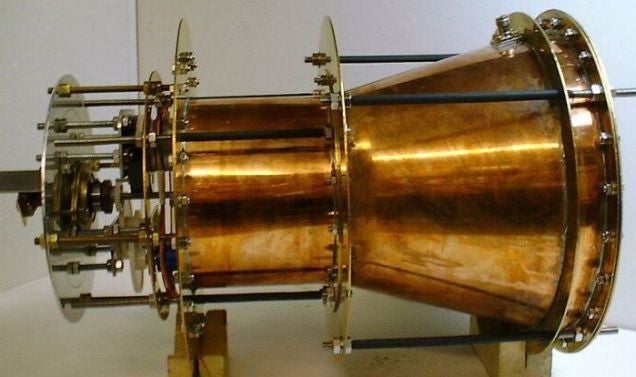
The claim of the designers of this thruster is extraordinary: that their thruster works without any reaction mass at all. It requires nothing but electricity to work. Every other thruster works by throwing something (anything!) away from it at high speed. Newton's third law says that every action causes a reaction – and all these other thrusters depend on that. It's the only way anyone has ever made a thruster that works.
Furthermore, an extremely well-tested physics principle – the conservation of momentum – requires that any change in momentum (as in a thruster accelerating something) must be accompanied by a precisely matching counter-change (as in the momentum of the quickly receding mass being thrown away from the rocket). A thruster that didn't throw away any mass would violate this principle, and nobody has ever before found a violation. You could justly call the conservation of momentum a bedrock physics principle. To find a violation of it would upset darned near everything we thought we knew about physics.
So...
I am very skeptical of this claim, despite the NASA “validation”. I put that word in quotes, because I note that the NASA engineers called the effect they detected an “anomalous thrust”, which I think is exactly right: it's a thrust whose source they have not yet identified. This thrust is incredibly tiny, too – just the sort of thing you might get from an instrumentation problem, an experimental error, or even measurement error. I infer from their wording that the NASA experimenters are themselves unconvinced – and it's easy to see why. To a physicist (even of the amateur flavor!), this claim is about as likely as claiming that you could fill your gas tank with water, then add a tiny tablet, made from dried yak dung fermented in sloth urine, to create high-octane gasoline. It's just too good to be true...
I say this very reluctantly, though. If it were true somehow, then all sorts of marvelous things might derive from it: interstellar travel, flying cars, backpacks that took a load off your feet, etc. I'd love for those things to magically become possible!
But I'm not betting on it :)
Friday, August 1, 2014
“This may seem like a classic case of ivory tower navel gazing...”
“This may seem like a classic case of ivory tower navel gazing...” Actually it seems to me more like a terribly overdue reality check. This piece in Slate is a good overview of the current flap in psychology concerning the irreproducibility of the majority of landmark psychological studies. Reproducibility of experimental results is a key part of what makes science credible. Certain branches of science – most notoriously the “soft sciences” like psychology – have been more lax than others (like, for example, physics). That's beginning to change in psychology, and the lessons from this are starting to be applied to some other soft sciences.
Mann et al should be listening, but of course they won't be. Their fame and fortune both depend on acceptance of their utterly failed models. This isn't exactly the same as irreproducible experimental results, but it's a close relative...
Mann et al should be listening, but of course they won't be. Their fame and fortune both depend on acceptance of their utterly failed models. This isn't exactly the same as irreproducible experimental results, but it's a close relative...
Thursday, July 31, 2014
Introverts Unite!
.jpg)
“…and I want to thank you for being here.”
“We have the temerity to exist at all, so we have it coming.”
“We have the temerity to exist at all, so we have it coming.” Thus Judith Levy concludes a beautiful and heart-breaking Ricochet post about how she's feeling right now as a denizen of Israel.
It scares me that so many Americans are neutral on the Israeli-Palestinian conflict, even when that neutrality is mainly derived from ignorance.
It shakes me to my core when I hear Americans overtly taking the Palestinian side and advocating the demise of Israel, as I have now quite a few times (mainly from Californians).
Neither of these attitudes reflects my America. Thankfully, neither is something I've heard yet in northern Utah. I hope I do not ever hear it here. There's a nearby university, though, so that hope will likely be dashed.
I cannot for the life of me understand how someone can honestly believe in the moral equivalence of the Hamas attacks and the Israeli defense. Something is badly broken in this world when millions of people can hold such an objectively falsifiable view. I can say the same thing for assertions of the moral equivalence of the respective cultures.
I have no answers. Today, only sorrow. It feels like grieving.
I can only hope that the Israeli people find the courage within themselves to resist the outside pressures to capitulate. They must win convincingly against Hamas, or the only light in the entire Middle East will be extinguished...
It scares me that so many Americans are neutral on the Israeli-Palestinian conflict, even when that neutrality is mainly derived from ignorance.
It shakes me to my core when I hear Americans overtly taking the Palestinian side and advocating the demise of Israel, as I have now quite a few times (mainly from Californians).
Neither of these attitudes reflects my America. Thankfully, neither is something I've heard yet in northern Utah. I hope I do not ever hear it here. There's a nearby university, though, so that hope will likely be dashed.
I cannot for the life of me understand how someone can honestly believe in the moral equivalence of the Hamas attacks and the Israeli defense. Something is badly broken in this world when millions of people can hold such an objectively falsifiable view. I can say the same thing for assertions of the moral equivalence of the respective cultures.
I have no answers. Today, only sorrow. It feels like grieving.
I can only hope that the Israeli people find the courage within themselves to resist the outside pressures to capitulate. They must win convincingly against Hamas, or the only light in the entire Middle East will be extinguished...
SF fans...
SF fans – a fascinating post and comment thread on the current state of science fiction, over at Eric S. Raymond's place.
I've been a science fiction fan since the '60s. In the last few years I've been mostly mining Amazon for past works that I've never read – because I found the vast majority of the modern works pretty, but uninteresting. ESR articulates exactly this, in a detailed way that I simply don't have the intellectual tools to do. In the process, he lists publishing houses and authors that may well provide me with a new source of reading material!
I've been a science fiction fan since the '60s. In the last few years I've been mostly mining Amazon for past works that I've never read – because I found the vast majority of the modern works pretty, but uninteresting. ESR articulates exactly this, in a detailed way that I simply don't have the intellectual tools to do. In the process, he lists publishing houses and authors that may well provide me with a new source of reading material!
$840 million...
$840 million... That's how much the federal government admits to having spent on the ObamaCare web site. That is an absolutely incredible figure. To anyone from the software industry (as I am), it is instantly clear that there is something terribly wrong here, because that number is at least an order of magnitude too high, and probably approaches two orders of magnitude too high. If I were to guess at a “reasonable” figure for that web site's development, it would be something more like $10 to $20 million – and even that would be making allowances for government inefficiency.
Let's break that down a little bit to see why I immediately know that figure can't possibly represent a well-run project. Let's assume we're hiring only American software engineers (which, it turns out, was not the case). Let's assume we're hiring only well-qualified, experienced programmers (which, it turns out, was also not the case). A guesstimate for the fully burdened cost (that is, salary plus benefits, etc.) of each such engineer would be about $160k annually. Now let's assume one manager for every 5 engineers (there were actually nearly as many managers as engineers), and that their burdened cost was $200k annually. There were three years of work. How big a team would $840 million buy us? That would be 4,200 software engineers, and a total of 12,600 engineer-years of work.
How much is that? Well, it's more work that it took to build Windows, Microsoft Office, and OS X combined. Each of those projects is clearly larger and more complex – and vastly more technically challenging – than the ObamaCare website and it's back-end.
From another perspective, though, it's not too surprising. Large software projects are notoriously difficult to manage. Like any veteran of the software industry, I can cite numerous examples of failed projects from my own personal experience. Sometimes the failures are technical, sometimes business, sometimes management – or any combination of the three. In a business, however, failures tend to get recognized and fixed relatively early, before the cost (relative to benefit) gets out of hand. When the government is running the show, none of the usual business incentives to find and fix a problem early are in place. Instead, there is a perverse opposite incentive, to keep the bureaucracy running – so the government's classic behavior in the face of a failed project is to throw more and more money at it. I'd be willing to bet you that that's what happened here.
Very sad, the way my tax dollars were totally wasted here.
Virtually every development executive – no matter how bad – in every software company I've ever worked with would likely have done a better job, if given business-like incentives.
Pardon me for a while, please. I need to go cry...
Let's break that down a little bit to see why I immediately know that figure can't possibly represent a well-run project. Let's assume we're hiring only American software engineers (which, it turns out, was not the case). Let's assume we're hiring only well-qualified, experienced programmers (which, it turns out, was also not the case). A guesstimate for the fully burdened cost (that is, salary plus benefits, etc.) of each such engineer would be about $160k annually. Now let's assume one manager for every 5 engineers (there were actually nearly as many managers as engineers), and that their burdened cost was $200k annually. There were three years of work. How big a team would $840 million buy us? That would be 4,200 software engineers, and a total of 12,600 engineer-years of work.
How much is that? Well, it's more work that it took to build Windows, Microsoft Office, and OS X combined. Each of those projects is clearly larger and more complex – and vastly more technically challenging – than the ObamaCare website and it's back-end.
From another perspective, though, it's not too surprising. Large software projects are notoriously difficult to manage. Like any veteran of the software industry, I can cite numerous examples of failed projects from my own personal experience. Sometimes the failures are technical, sometimes business, sometimes management – or any combination of the three. In a business, however, failures tend to get recognized and fixed relatively early, before the cost (relative to benefit) gets out of hand. When the government is running the show, none of the usual business incentives to find and fix a problem early are in place. Instead, there is a perverse opposite incentive, to keep the bureaucracy running – so the government's classic behavior in the face of a failed project is to throw more and more money at it. I'd be willing to bet you that that's what happened here.
Very sad, the way my tax dollars were totally wasted here.
Virtually every development executive – no matter how bad – in every software company I've ever worked with would likely have done a better job, if given business-like incentives.
Pardon me for a while, please. I need to go cry...
Hotel Viru...
Hotel Viru... I stayed here once, on one of the worst hotel experiences in my life (and I have a pretty good collection of personal hotel horror stories!). The year was 1992 (I believe). The hotel's management hadn't yet absorbed western ways; the experience was largely unchanged from Soviet times (which had ended just the year before), right down to the not-so-little old lady who sternly dispensed and handed out room keys in the hallway where my room was located. The highlight: my bed. It was made from a carefully stacked collection of thin, flat cinder blocks – each about the size and shape of a half-high shoe box. There were no holes in them; they were solid blocks. On top of this stack was a straw-filled “mattress”, roughly 2 inches thick. Pieces of straw stuck through the mattress and the sheet, leaving me full of skin irritations in the morning. I'm a civilized guy – sleeping on a pile of uncomfortable straw was not my idea of fun!
I was traveling with a colleague, who told me his room was ok. Nothing to write home about, but perfectly acceptable. We were there on a business trip, to meet with a small Estonian company that we were considering acquiring (we did). Several people we met from that company told us of the KGB reputation of the Hotel Viru. I felt as though I should be careful what I said, though I didn't really have anything to talk about that would be interesting to anyone at all, much less the KGB :)
I was traveling with a colleague, who told me his room was ok. Nothing to write home about, but perfectly acceptable. We were there on a business trip, to meet with a small Estonian company that we were considering acquiring (we did). Several people we met from that company told us of the KGB reputation of the Hotel Viru. I felt as though I should be careful what I said, though I didn't really have anything to talk about that would be interesting to anyone at all, much less the KGB :)
This is hard to credit...
On another level, it's very sad. It's as if dairy farmers never ate cheese or yogurt, or wheat farmers never had bread...
Bullshit is asymmetric warfare!
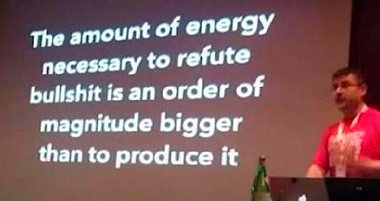
This has led directly to our current situation, where virtually all of our politicians lead with the bullshit – in which case it's not asymmetric anymore...
Wednesday, July 30, 2014
Back in town...
Back in town... And for a while this time. I just got back (late last night) from running Debbie back down to Jamul. We were on the road for just over 16 hours on Sunday, then I was on the road for 13 and a half hours yesterday. I don't want to drive anymore :)
When I walked into the house last night, I saw our refrigerator and our range out in the middle of the floor, with tile installed where they need to go. Hooray! But ... the dishwasher was still in its hidey-hole in the cabinetry. Turns out the installer (a kid who looked like he was about 12 years old) from Home Depot had hardwired a very short power wire to it. So I turned off the breaker and disconnected it – only to discover that the juvenile installer had done a horribly unsafe installation job. Yikes! I spent the next hour on the phone to Home Depot, letting them know what I thought of their installation service (which I paid good money for). I'm getting a refund. I'm also not ordering their installation service again. When I can easily do a better job myself, it just makes no sense. If it's a difficult job, I'll hire a craftsman. Someone who is at least 30 years old :)
When I walked into the house last night, I saw our refrigerator and our range out in the middle of the floor, with tile installed where they need to go. Hooray! But ... the dishwasher was still in its hidey-hole in the cabinetry. Turns out the installer (a kid who looked like he was about 12 years old) from Home Depot had hardwired a very short power wire to it. So I turned off the breaker and disconnected it – only to discover that the juvenile installer had done a horribly unsafe installation job. Yikes! I spent the next hour on the phone to Home Depot, letting them know what I thought of their installation service (which I paid good money for). I'm getting a refund. I'm also not ordering their installation service again. When I can easily do a better job myself, it just makes no sense. If it's a difficult job, I'll hire a craftsman. Someone who is at least 30 years old :)
Saturday, July 26, 2014
A brief history of lossless compression...
A brief history of lossless compression... This is from the IEEE history network. It's been over 20 years since I did anything serious with compression, back when I was (very) peripherally involved with the LZS algorithm (I worked for Stac Electronics and with Doug Whiting, the developer of LZS). I see a few small errors (especially with dates) in the stuff I have personal knowledge of, but generally it seems pretty accurate. Most everything they mention that's after about 2002 is all new to me...
Friday, July 25, 2014
House remodeling update...
House remodeling update... There was much progress while we were gone, but also a few disappointments:
- The barn still hasn't been started. There have been many reasons for the slippage, mostly small things, but they add up: the original start date was “before the end of April” – and here we are almost three months after that, and we're still being held up. The final hurdle (we hope it's the final hurdle!) is sign-off from the County planner after we got an engineer to sign off on the plans. We should have a permit by early next week...
- The flooring is about 90% done. The only remaining bits are some difficult stuff in the kitchen (under the range and refrigerator, mainly), the cattery (the easiest part of the entire flooring job), the trim around the cabinets, and the several transitions between tile and wood flooring in the house. Oh, and the two sets of stairs between the first and second floor. Ok, maybe 75% done :)
- The master bathroom is completely tiled, the new vanity and medicine cabinet are installed, the vanity has been measured for its granite top, and the granite slab is in the fabrication process. With any luck at all, we can have the granite installed within 2 weeks, and a week later we should have the finish plumbing and electrical work done – and we'll have an actual bathroom. The tiling job is gorgeous – the fellow who did it is an old-school craftsman who took his time on it. I had a chance to talk with him when he was maybe a quarter finished, and he was having a lot of fun with it – mainly because of the materials he was working with, and the challenges of the layouts he was employing. The walk-in shower will be by far the nicest shower we've ever had in any home we've lived in: 5'6" square, with an “ell” to keep the shower from splashing into the rest of the bathroom, even though there's no shower door.
- Our small balcony on the second floor now has a beautiful new railing, and it's strong enough to stop a tank. To compare it to the old railing is like comparing a toy pedal car to a Mercedes...
- The other remodeling projects (new main fireplace, new stovepipe for the basement, etc.) were all on hold while we were gone.
Subscribe to:
Posts (Atom)