Monday, April 3, 2006

The Wretched Refuse

On a bronze plaque inside the base of the Statue of Liberty, this poem by Emma Lazarus is graven:

Not like the brazen giant of Greek fame,

With conquering limbs astride from land to land;

Here at our sea-washed, sunset gates shall stand

A mighty woman with a torch, whose flame

Is the imprisoned lightning, and her name

Mother of Exiles. From her beacon-hand

Glows world-wide welcome; her mild eyes command

The air-bridged harbor that twin cities frame.

"Keep, ancient lands, your storied pomp!” cries she

With silent lips. “Give me your tired, your poor,

Your huddled masses yearning to breathe free,

The wretched refuse of your teeming shore.

Send these, the homeless, tempest-tost to me,

I lift my lamp beside the golden door!"

For me, and I think for many other Americans, this poem (especially the last stanza) captures the ideal of America’s acceptance — and welcoming — of immigrants. For the world’s most impoverished, most abused, most exploited…America is very profoundly the land of hope; the land where even the poor people are fat, and where anybody’s child can grow up to be president.

But for many people whose lives are described by Emma Lazarus' poem, the reality is much different. For reasons completely outside their control, their immigration into the U.S. is illegal. “The wretched refuse of your teeming shore” describes most of the Hispanic illegal aliens I’ve ever seen or met, but they are certainly not made welcome in today’s America — they can only get to the land of hope by sneaking in. Illegally.

Until 1875, there was no such thing as illegal immigration into the United States — anyone who showed up was welcome. How is it that we have illegal immigration today?

The beginning of it all was the “Chinese Exclusion Act” of 1882, which was aimed at preventing Chinese “coolies” and female prostitutes from entering the country. These people were lured by the huge numbers of jobs available for railroad construction, and the then-primarily Caucasian residents were unhappy (for various reasons both justified and unjustified) to have tens of thousands of very alien Chinese in their midst. That’s where it all started.

After that, a series of immigration acts more-or-less continuously increased the kinds of restrictions we put on immigration. Incrementally we have moved away from the spirit of Emma Lazarus' sonnet, to the point now where I doubt she’d feel motivated to write it. Today, if you’re a Cuban desperate to escape Casto’s hellhole, you can risk your life crossing the Carribean in a small boat — and if the U.S. Coast Guard happens to see you and pick you up 5 feet from shore, we’ll just send you right back to Cuba — you are not welcome here, bud, however wretched you might be, and however you yearn to breathe free. Today, if a high-tech employer in the United States wants to hire you and bring you to California from (say) Slovenia, chances are that you will be turned down. You’re not welcome, bud, no matter how much your education and skills would contribute to America, because the quota for the year was filled in March. There’s nothing about quotas or limits on our Statue of Liberty. The spirit that Emma so eloquently expressed has been lost somehow.

How did this happen? What’s different today than for the first hundred years of this country, when all immigrants were welcomed with open arms, and when there was no such thing as illegal immigration?

The answer to that is very complicated, and has many components. One of the major contributors to this, I believe, is modern liberalism and its desire to relieve the misery of the poor and down-trodden. Expressed as I just did, these goals sound wholly admirable and self-evidently good. But the long-term effect of the liberal programs and policies has done much to contribute to the situation today. Consider:

— In the first hundred years (and more, actually) of this country’s history, when someone immigrated to the United States, the only help they could count on was from relatives, employers, and the very few “safety net” kinds of charities. In the big cities there were some organized charities; in the countryside the help came from neighbors and churches. There was nothing even remotely like today’s network of assistance ("hand-outs") for everything from food to medical services. Generally (but not always) the children of immigrants were afforded an education equivalent to that of the citizens, but for just about everything else there was intense societal pressure on the new immigrants to work and to assimilate into the American way of life. They were expected to learn English, to work, and to earn their own way.

— Today, when someone immigrates into the United States (legally or illegally!), they have a vast array of assistance available to them. While it is certainly true that most immigrants still find work, they don’t actually have to do so. They can get medical care without cost; they can get free food; they have entitlements to education and job skills training. Their children are guaranteed access to free public education, and even special training programs. These are the programs and policies of modern liberalism — but look what the consequence has been: no longer do our immigrants feel pressure to assimilate; our society accepts their importation of language and culture. In parts of San Diego County today, you can easily imagine that you have somehow been transported to Mexico: all the signs are in Spanish, and the trashiness of Tijuana surrounds you. The people who live in these areas see no reason to become American — and in fact, many of these people would like to see California and Arizona returned to Mexico. And some of our institutions, including universities, support these notions!

It’s instructive, I think, to look at individual examples. I know many immigrants and some very well; California is quite a melting pot. I can, by and large, make a dichotomy from the immigrants I know: there are those who want to become Americans, and there are those who want to exploit America. Those are two very different mindsets, but in today’s America, both are equally welcomed. This is one of the bitter fruits of liberalism; the good intentions gone rotten. But here are a couple of examples that will serve to illustrate my points:

A couple who are friends of ours are immigrants from Estonia, which was part of the Soviet Union until 1991. They are roughly my age, so they grew up and became adults under the Soviet system. They immigrated into the United States in 2000, with some family members already here to act as a safety net. They were quickly gainfully employed; both have done very well. They have learned English, and continue to improve their English skills. They have — very deliberately — assimilated into American culture. They have not forgotten their own background and culture, and they continue to cherish things Estonian (and Russian, for they are ethnic Russians). Last year, they became U.S. citizens. As a lifelong American, I look at this couple and applaud them — and I am confident their arrival here is a good thing for my country. They are not exploiting America; they are enhancing it.

Another family I know lives in the same valley that we do. They came to the United States illegally, though I do not know what their current immigration status is. They have made almost no attempt to assimilate into American culture. The father speaks only rudimentary and limited English; not even enough to get by in the workplace. The wife speaks only Spanish. Their three children were educated in American public schools; the entire family’s medical care (including one episode of cancer) is paid for entirely by the U.S. taxpayer. The family has been on food stamps for most of their 15 years in this country, again at taxpayer expense. And in my most recent conversation with the husband, I discovered that he is very supportive of the efforts to have California become part of Mexico “again”. As a lifelong American, I look at this family and I am appalled. I am appalled at their miserable life — in America! — and at their lack of initiative to change that fact. And I am appalled that we Americans have created the conditions that allowed such families to be welcomed here. By that last sentence I do not mean that I favor stopping them at the border. Rather, I would like to see the return of the societal pressure to assimilate, and the removal of the modern liberal programs and policies that aid and abet the unassimilated immigrants. Yes, I really mean what I’m saying there, and I’ll say it more bluntly — I want to make life more difficult for immigrants. I want them to work, pay taxes, learn English, and…to have the freedom to fail. I want there to be consequences — economic and psychological — for the failure to assimilate and the failure to contribute.

And I want America to welcome all immigrants — again. I want Emma Lazarus' sonnet to describe my America — but only if the immigrants who yearn to breathe free want to breathe free as Americans. I want to see a return to the day when immigrants come to America, by and large, to become Americans and to enhance America, rather than to exploit America and its generosity. I would like to see a retreat from liberalism on this front, and a return to nasty old social Darwinism. I believe that would be very good for America, and that it would be quintessentially American.

But I don’t think it’s very likely to happen, sadly for me. Today’s liberals are promoting open borders with ever more liberal programs and policies that almost seem designed to entice immigrants away from assimilation and away from become Americans; these programs and policies positively encourage the exploitation of America. Our conservative politicians seem focused on border control and enforcement of our existing (stupid) immgration laws, probably for no better reason in general than political expediency — because many Americans seem to believe that building a fence is going to “solve” the immigration problem.

Give me your tired, your poor,

Your huddled masses yearning to breathe free,

The wretched refuse of your teeming shore.

Send these, the homeless, tempest-tost to me,

I lift my lamp beside the golden door!

This is a lovely ode to an equally lovely idea. Today it is just words; mere political “spin”. In truth our welcome mat is no longer out. We routinely slam our door to the wretched, even to the point of returning them to regimes that execute them. We say to these people yearning to breathe free “Go away. Die; we don’t care."

As an American, I am deeply ashamed of this.

But I am angry at the exploiters, and angry at us for creating the conditions that encourage the exploiters. And frustrated that the fact of the exploiters — the fact that they exist, I mean — is driving many Americans to try to keep immigrants out. If the vast majority of immigrants were in the first part of my dichotomy — hard-working, contributing people who assimilate into and enhance America — then I believe the vast majority of Americans would welcome them with open arms. The exploiter immigrants — tolerated and even encouraged by us and our liberal policies and programs — are the driver behind the “build a fence” movement. No American that I know of actually wants the exploiters to be here, not even liberals. But our liberal policies and programs are like an irresistable bait — of course the exploiters are going to come here when we treat them as we do.

Can we change? I am, I’m afraid, not confident…

Sunday, April 2, 2006

The Trip

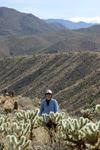
Yesterday we — Vera and Konstantin Stankevich, Jim Barnick, and myself — spent the whole day on a grand tour of the Cuyamaca mountain area and the southern Anza-Borrego desert. Our itinerary was a little different than our original plan, but we all had a splendid time.

We started by meeting up at the Descanso Junction restaurant. This little place is one our favorite haunts, but Vera and Konstantin (who are from Lake Forest, in Orange County) had never been there before. They arrived a little before us, and had already ordered before Jim and I could warn them about the enormous size of the servings. Konstantin order eggs with pork chops, and he was very surprised when he saw his plate with two huge chops on it. And Vera got an omlette the size of a small loaf of bread. Amazingly, Vera ate almost of her omlette — she must have been hungry! Konstantin could only eat one pork chop; the other went home with him…

After leaving the restaurant, we headed out of Descanso along Boulder Creek Road, which traverses the west face of Cuyamaca mountain, down around 3000' to 4000' in altitude. I was hoping for both wildflowers and birds; we got almost none of either one. On the flowers it looks like we’re just a week or two early, and I’m sure the birds would follow the flowers. The scenery and views were nice, though.

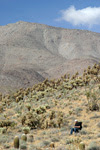
We zoomed through Julian and down to Banner, where we hooked a right (to the south) on the road past the gold mines to Oriflamme Canyon. On this road the Indian paintbrush were still nice, but the bush poppies we saw last week — while still very pretty — were clearly past their prime, with blossoms all beat up by the wind. Jim spotted two mineshafts that somehow we had never seen before; Vera is standing in front of one at right that extended far out of sight into the mountain. I didn’t want to chance a collapse, so we didn’t try walking inside — though the footprints all over the place make it clear that many others feel no such caution. Just before we got to Oriflamme Canyon itself, we came upon this red-tailed hawk, eyeballing us as if considering whether we’d make a good meal. The drive down the canyon itself was full of beautiful views, but not a single blossom graced the hills within our sight. I could see small lupine plants with buds, and other plants that I could not identify, so it must be that we were just to early.

After leaving Oriflamme, we continued down towards S2. Very close to that paved road, we came across a nice patch of agave, sparsely populating an area of a few acres extent. When Vera and Konstantin learned that yes, this was the same agave that tequila is made from, we got to wondering what kind of crazy person looked at an agave one day and said: “Hey, let’s ferment this thing, then distill it, and we’ll have a great drink!” Assuming, of course, that you think tequila is a great drink. To me it seems to be closely related to lighter fluid and gasoline, but I’m certainly no expert on fine tequila. We didn’t really come to any conclusions, but there did seem to be a consensus on the unlikeliness of the whole notion…

After leaving the agave “grove", we headed south on S2 to Smuggler’s Canyon. Though last week we had found preciously little here in the way of flowers, we did find some birds — and I was hoping a few more flowers would have magically appeared. Well, we saw darned few birds, and the collection at right is nearly ever blossom we saw on our walk. From left to right: a prickly pear, a tiny little barrel-shaped cactus, and I have no idea. But despite the lack of flowers and birds, it was still an interesting walk — especially for Vera and Konstantin, who had never been in the desert before.

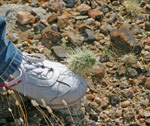
Speaking of which… Before we let Vera and Konstantin walk in Smuggler’s Canyon, we warned them about “jumping cholla” — we really did! But both of them managed to get jumped on anyway. Vera suffered only a minor attack (that’s her daintly little sneaker in the picture), but Konstantin was the victim of a full-fledged jumping cholla war, and he had direct hits on one leg and both feet. He took his battle wounds in good humor — just reached into his backpack and pulled out a pair of folding pliers, which he used to pull all the thorns out. It took him several tries to get them all, but he finally emerged thorn-free, albeit minus some of his blood…

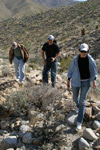
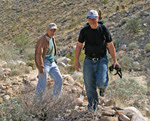
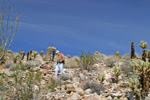
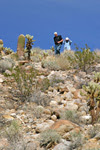
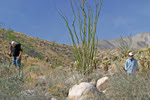
The photos below are of Vera, Konstantin, and Jim, walking in various parts of Smuggler’s Canyon. We walked up the wash, and the climbed the south slope and walked most of the way back over the generally flat top. At one point we all made our way down a fairly steep and scrabbly slope that was chock full of several species of cholla (including the wily jumping cholla) — and I was sure that at least one of us was going to have a bunch of holes punched in us. But we all made it down without incident…

After leaving Smuggler’s Canyon, we headed back up S2 and turned left on Oriflamme Canyon road. But a mile or so in, we took the right fork to go up Rogdriguez Canyon road, which I had not been on in a couple of years. This area burned out (I think four years ago), and the good birding we’d previously enjoyed there was destroyed. This road had always been a fairly challenging four-wheeling road, and I wan’t sure that it would even be passable after the rains last year. It turned out to be no worse than it ever was, but…Vera and Konstantin had never been four-wheeling before. This was quite an introduction for them! There’s a stretch of a half mile or so of this road that contains several challenging moments — some tight squeezes (at least for our LandCruiser!), some steep and scrabbly climbs, some big rocks to climb over, and some areas where large wheel traversal is required. But with all three differential locks engaged and in the low gear range, our vehicle made it up all of them without much trouble — and certainly no winch, jack, or shovel required. But Vera and Konstantin, especially at first, were not at all confident the vehicle would survive these challenges <smile>. Vera confided to me later that she was thinking about how could get out when the car got stuck. During the trip on the challenging parts, I was able to sneak in a few glances at Vera — she looked like she was in a state of both disbelief and shock. Konstantin was a little harder to read — but there were some moments, especially when the car was teetering, or when we were pointed steeply uphill, when his eyes got big and round, and he stuck his hands out front and made a noise like “whoa!” After we took a couple of these challenges and survived, both of them started to relax and enjoy it a bit more — and by the time we’d cleared them all, the car was full of delighted laughter. A whole bunch of fun was had by all…

After Rodriguez Canyon, the rest of the day was very tame and relaxed. We had some coffee in Julian, drove through the devastated Cuyamaca Park, and then back to the Descanso Junction restaurant (where Vera and Konstantin had left their car). There we parted company; Jim and I for the short drive home, Vera and Konstantin off for a much longer drive back to Lake Forest.

We had way too much fun!

We will do this again…

Saturday, April 1, 2006

Global Warming

Global warming, in the sense that most people I know understand it, is the notion that the Earth is getting catastrophically hotter, and it’s all mankind’s fault. The thesis is that our activities create greenhouse gases, which in turn trap solar radiation on the Earth’s surface and raise the temperature.

If you’re interested in understanding the truth of the matter, rather than simply being comfortable as the lapdog of the politically-correct environmentalist whackos, there are two important questions here:

1. Is the temperature of the Earth rising?

2. If so, are mankind’s activities causing or contributing to that rise?

Despite all the blather you hear in the lamestream media (and worse, from pandering politicians), neither of these questions has been answered. There are competing theories on both sides of the questions, and a dearth of evidence to prove either one.

On the first question, the challenges are these: (a) mankind first learned how to measure temperatures accurately less than two hundred years ago, and we need thousands of years of data to know if things have changed in the past 150 years, and (b) the change we’re trying to observe is on the order of a few degrees, while the normal variations from day-to-day and year-to-year are tens of degrees. On the issue of temperatures in the past, clever scientists are coming up with lots of ways to infer and estimate past temperatures, and the results of those are, as you might expect, conflicting, uncertain, and not particularly accurate. Some of these estimates of past temperatures rely on modeling, which (despite my being a computer professional) I am always skeptical of. It’s not the fact that the models are created by computer that makes me skeptical, it’s the fact that models (no matter how they’re made) are based on a bunch of assumptions about the thing being modeled — and usually, to make the model easier to compute, the model is also based on estimates. Modern computer-based models produce beautiful graphics and “movies” that make terrific presentations — but I think they entrance their producers into belief, much like “spreadsheet syndrome” entrances business users into believing the financial model they’ve computed (to 14 decimal places!) on their Excel spreadsheet. Nevertheless, the scientific community, from my reading, seems to have arrived at a consensus that there is a small increase in global temperatures over the past couple hundred years. I’d say there’s a good chance the consensus is correct.

But that leads to the next question, and here’s where things get really uncertain. Why? Why is the earth getting warmer?

The easy answer, and one that’s very attractive to those of a certain political mindset, is that mankind’s activities did it. //iWe// did it, it’s all our fault. I’ve long been intuitively skeptical of this notion. The oft-repeated, hoary old saw of the anti-global-warming crowd resonates with my intuition: we can’t even make a little thing happen (say, rain when we need it) on purpose — so how is it that we’ve caused the whole planet to heat up inadvertently? Now I know that’s not a defensible piece of logical analysis, but it is nonetheless an interesting point. Do we really think that mankind’s puny little activities can compete with mother nature when it comes to climate change?

But lets set my intuition aside, and go look at the evidence. In general, one can observe that proving a cause is more challenging than proving a fact. To illustrate: I can easily prove that the sun is shining; to prove that it shines because of nuclear fusion is much more difficult. The same relative difficulty applies to proving (or even just guessing at) the cause(s) of global warming. First of all, there are many candidates, of various likelihoods, for the causes; greenhouse gases caused by mankind’s activities is but one of them. Others include greenhouse gases produced by volcanoes or biological activity, increased radiation (brightness) of the sun, meteorite strikes, and many more. Greenhouse gases in general feature in several of these propsed causes, but it turns out that it isn’t actually a certainty that greenhouse gases will increase temperatures. We can’t make experiments to actually observe this, so the scientists rely on computer models (alarm bells should be ringing in your head!). These models make all sorts of assumptions about the effects of greenhouse gases. One of these effects — arguably the most controversial one — is how increased temperatures would affect cloud formation (remember we don’t actually know, from observation, any of this — these are assumptions). One school of thought is that increased temperatures will cause increased cloud production, through increased plant life and more water in the air. If that’s the case, the increased clouds will reflect more of the sun’s radiation, which will tend to cool the earth, offsetting the effects of the greenhouse gases. The real point is that we just don’t know the effects for sure.

Another of the possible causes has been in the news recently: increased solar radiation. Two completely separate studies (of different phenomena) offer evidence of increased solar radiation in the past few centuries. One of those studies is earthbound, and provides evidence that the sun’s magnetic activity has increased (and this is correlated with increased radiation). The other study shows that Mars is coming out of an Ice Age of its own, and the only plausible cause for that (on Mars) is increased solar radiation. Interesting stuff, but not proof that increased solar radiation is causing the Earth’s global warming.

This is one of those complicated topics that can’t possibly be covered adequately in a short post (if you call this short!). I’ve provided links to much more reading below, if you’re interested. There’s good reason, I think, for all of us to become informed enough to have an opinion on this topic: various politicians (such as Al “father of the Internet” Gore) want to spend a large fraction of your money on the unproven assumption that mankind’s activities are causing global warming. If they’re wrong, we’d simply be wasting that money; you might as well just burn it on your front lawn. The really sad part, though, is this: even if they’re right, even radicals like Al Gore are proposing very small changes that will not even make a dent in mankind’s production of greenhouse gases. For example (something you won’t learn from the lamestream media): the much-ballyhooed “Kyoto Treaty” (a favorite of the Gore) would only reduce mankind’s production of greenhouse gases by 4% to 6%, even if fully implemented! The main reason for that is the Kyoto treaty completely excludes India and China — two of the largest greenhouse gas producers, and (under the Kyoto treaty) completely without incentive to improve. In fact, their economic incentive would be to not improve. One last little factoid on the Kyoto treaty (again, one you won’t read in the lamestream media): how have the signatories to the treaty been performing? Well, it looks like at best, one country will meet their obligations (Ireland). Every other signatory is far, far from the mark — and most have publicly given up. And to put the icing on that particular cake, the U.S. — without being a signatory — is out-performing every single one of the signatories. All that hand-wringing! All that despair from the Gore! And we’re beating every one of them without their economy-destroying policies.

Take that and smoke it in your pipe, you environmentalist wackos!

More reading here, here, here, here, here, and here.

House Bidding

My mom reports on birdly goings-ons in the remote nether regions of New Jersey (yes, that New Jersey):

Want to share a 'fun' thing that is going on in the yard. Outside of my office window in the Bald cypress tree is hanging a bird house that I painted and Dad climbed a big ladder to hang so we could observe it from the dining area and my office. It has two pairs of birds giving it the once over. One pair of Carolina Wrens and one pair of Chickadees. They come to the house together and sit on the perch and look inside of the house. The wren has been seen putting small twigs inside but only a couple of times. Now this is about the 8th day and mostly they sit and look in - go inside the house for a very short time, hop out and sit on a branch nearby just looking. Sometimes they hop onto the roof to observe from there. The birds seem to come at different times of the day - that is chickadees at one time and wrens at another etc. I have seen the chickadees there 6 times in one day and the same day I saw the wrens there 3 times. The 'appointments' are well timed but I haven’t seen the 'realtor' as yet. It really is comical to watch this. Now however, this morning a new phenomenon has occurred. The wren was in the house looking out for a full 7 + minutes then hopped out and has now been in a branch near by for 12 minutes (longest time period yet) Methinks he knows some other critter has been in the house and is guarding it from the invasion. We are waiting with bated breath to see which pair wins the beautiful home. The bids are getting higher each day and the owner of this home is going to get a wonderful yield on his/her investment. <big smile> I know some of you couldn’t care less Mark BUT, it sure makes mom smile. Love you all

My readers on the west coast will may be surprised to discover that New Jersey hosts any wildlife (as opposed to “wild life"). They may also be surprised to hear that I have relatives (or even talk to anyone) in that land of liberalism, iniquity, corruption, concrete, and noxious smells. I have but two defenses: (1) I was smart enough to leave, even if my parents weren’t, and (2) southern New Jersey isn’t as bad as northern New Jersey, in the same way that Lieberman isn’t quite as bad as Hillary…

Day Off

I’m headed off into our local mountains and down to the Anza-Borrego desert for a day of sightseeing with three good friends. If we have any luck at all, we’ll see some birds, some wildflowers, and some beautiful vistas. At worst case, we have an entire day together; I, for one, will cherish that. The rest is just a potential bonus…

We start with breakfast at the Descanso Junction restaurant, then up to Julian (via the Sunrise Highway), down to the desert (via Oriflamme Canyon jeep road), a walk in Smuggler’s Canyon, and possibly some other desert adventures. Then we’ll return by Rodriguez Canyon jeep road (if it’s passable), through Julian and south along the west face of Cuyamaca Mountain on Boulder Creek Road. A long day! Two of the friends I’m going with have never seen this area at all, so we’re motivated to give them the grand tour…

See you all tomorrow, hopefully with some pictures!

Friday, March 31, 2006

Jamul Casino

Well, it looks like the Jamul Indian Tribe has secured financing to build their casino:

Lakes Entertainment, Inc. Announces Signing Development Financing and Services Agreement with Jamul Indian Village

MINNEAPOLIS — (BUSINESS WIRE) — March 31, 2006 — Lakes Entertainment, Inc. (Nasdaq:LACO) today announced that it has signed a development financing and services agreement with the Jamul Indian Village, a federally recognized tribe located near San Diego, California. This agreement will help assist the Jamul Tribe in developing a first class casino with related amenities/services on its existing six acre reservation which the Jamul Tribe will manage ("Casino Project").

Under the terms of the agreement, in addition to providing development design and construction oversight, Lakes will also advance to the Jamul Tribe sufficient sums to finance the design and construction of the Casino Project. Lakes will receive a flat fee of $15,000,000 for its development design services, and a flat fee of $15,000,000 for its construction oversight services. Each of these fees will be payable to Lakes evenly over the first five years after the opening date of the Casino Project. In connection with Lakes financing of the Casino Project, the Jamul Tribe will pay interest over a ten year period on sums advanced by Lakes equal to the rate charged to Lakes for obtaining the funds necessary plus 5%. Sums previously advanced by Lakes to the Jamul Tribe in connection with the Tribe’s proposed casino resort on land adjacent to the reservation are to be included in the financing for the Casino Project. Tim Cope, President and Chief Financial Officer of the Company stated, “We are extremely excited for the Jamul Indian Village as they take another step forward to achieving economic self-sufficiency. Designing, building and financing a large first class casino on their existing Indian land presents a tremendous opportunity for the Jamul Indian Village and our Company. We look forward to immediately starting the architectural plans and anticipate beginning construction within the next twelve months."

I’m not an expert on corporate finance, and especially not in the gambling industry — but I do know something about it (I was once the CEO of a public company, and I’m generally an entrepreneurial sort). This is a strange sort of deal. The two $15M flat fees seem outrageously exhorbitant, and they’re covering activities that would normally be billed hourly. The big, round numbers and huge amounts add up, basically, to a way to spin a large fee — I’d guess the PR folks think that’s more palatable to someone (I’m not sure who they care about pleasing). The rest of it (the construction cost) is structured as a straight loan, at cost plus 5% — which today would mean a 9% or 10% rate. Again, that’s outrageously high, and suggests one of several things: a large risk being covered by the large rate of return, an awesomely naive customer, or a downright desperate customer who can’t get financed anywhere else.

If you’re a regular reader, you know my stance on the casino: I hate the very idea of the thing, and I hope like hell that it won’t be built. But after reading this press release I can’t help but feel sorry for the Jamul Indian Tribe — because this deal stinks to high heaven. It looks to me like they’re being taken to the cleaners on this one…

Which is just one more reason to hope that the Jamul Casino is stopped…

Breaking the Law

Certainly I won’t argue that crossing the U.S. border without permission isn’t illegal. An interesting fraction — the more rabid — of the anti-immigration crowd stops thinking right there: it’s illegal!, they holler. Punish them! Don’t reward them with the right to stay here! End of story.

Personally, I don’t think the story ends there, and I don’t think it’s quite so simple. For starters, our immigration laws are a complete mess — a ludicrous mish-mash of stupidity, racism, failed initiatives with good intentions, failed initiatives with bad intentions, and a general lack of anything constructive, useful, or even moral. I have next to zero respect for our immigration laws, and even less for our lame “enforcement” of them.

Daniel Henninger of the Wall Street Journal touched on something close to this in a column today:

From Bastiat Knows What Frist Doesn’t About Immigration by Daniel Henninger:

Another 19th-century Frenchman close to the hearts of American conservatives is Frederic Bastiat, who had a further thought: “The surest way to have the laws respected is to make them respectable.” Is our immigration law “respectable"? Need you ask?

America is a nation of laws by now so numerous that it provides jobs for more lawyers per capita than any nation on earth. They serve as legal lifeguards, saving mostly honest citizens from the legal system’s capricious undertow. Medical malpractice and asbestos are two areas of law for which “respect” is about zero. A law’s existence requires compliance, but not respect.

Some of the anti-Mexican sentiment likely reflects an embarrassed awareness of our degraded laws, and so it has chosen to draw a line in the legal sand over immigration. That won’t change the fact that U.S. immigration law is a disrespectable morass.

Swaths of American business openly ridicule the immigration law regulating so-called H-1B temporary visas for highly skilled non-citizen engineers and computer scientists. This controversial boom-and-bust employment morass exists because there is no rational system to give permanent, green-card status to these non-citizen workers and their families. Insisting on “respect” for a law that is doing damage to the nation’s economy is cutting off one’s nose to spite one’s face. That is a bad habit.

The immigration law asking for respect is simply a system of legislated quotas, not much more than a numbers game. The people who play this game — anyone seeking entry to the U.S. for a spouse, sibling, child or worker — make monthly visits to the State Department’s Web-based Visa Bulletin. Have a look; it actually resembles a bingo card.

What he said.

Those of you who live far from a border may not realize just how dumb our “border control” is. I’ve lived within a few miles of the Mexican border for over 30 years, so I’ll claim some personal knowledge of how we deal with our border enforcement. Over that period we’ve changed our laws and our policies considerably — and nearly always in a way that makes them less sensible and less…respectable.

Just to pick on one example: several cities in San Diego County have enacted so-called “sanctuary laws", basically forbidding the police (or any emergency workers) from even asking about a person’s immigration status — much less actually enforcing U.S. law. And the U.S. Border Patrol is forbidden (by policy) from enforcing immigration laws outside the immediate border area. The illegal immigrants know exactly what cities have sanctuary laws, and of course they know that in those cities they are completely safe. Would you — do you — respect such a law and enforcement policy? I don’t.

It reminds me a bit of our laws and enforcement policies on speeding. It’s very clear to any motorist that enforcement of speeding laws is haphazard, and equally clear that in certain circumstances they are completely ignored. Just to pick on one local example: the traffic in the I-5 corridor through Camp Pendleton (which I used to commute on weekly) routinely runs at 80 to 85 MPH, in a 65 MPH zone. I’m not talking about the occasional speeder — I’m talking about virtually every vehicle, traveling 15 to 20 MPH over the speed limit. And yet enforcement is virtually zero; it has been years since I’ve seen someone being ticketed there, despite the CHP cars and motorcycles traveling along with the traffic frequently. That law is not respected, and clearly none of the motorists have any respect for the law. Should we levy heavy fines on those motorists? Imprison the repeat offenders? I don’t see a lot of support for that, for the reasons just given.

Is the immigration situation different in any significant way?

When it is true — and known to be true — that an illegal immigrant can live safely and openly in Chula Vista (a San Diego County city just 5 miles from the border), with the city openly declaring sanctuary and welcome for illegal immigrants, with economic opportunity beckoning (relative to Mexico), can we really say that breaking the immigration laws is entirely the illegal immigrant’s fault?

Myself, I think not. I think we American citizens are also culpable. We need, as Daniel Henninger put it, “respectable laws” — I’ll add sensible and moral laws — and we need to enforce them. Then, and I believe only then, can we hold the illegal immigrants fully responsible for their infractions.

Note that this is not an argument for any particular kind of immigration law — that’s a whole 'nother topic, for a whole 'nother day. All I’m arguing for here is laws that make sense — that are internally consistent, that are possible to enforce, that don’t violate any of the principles that we Americans hold (or should hold) dear. Respectable laws.

Politicians, want my vote? Are you listening?

Faster, please.

Thursday, March 30, 2006

Border Control and Security

I have mostly stayed out of this debate, mainly because I can’t think of much to contribute beyond some more whining. There’s one piece I will touch on, though, because I think it’s leading to some low quality thinking…

Recently the folks who are agitating for better border control have frequently — in fact, nearly universally — tied in the notion of border security against terrorism as more justification for drastically increased control at the border.

But this notion doesn’t withstand scrutiny. As others have observed, the vast majority of the folks agitating for increased border control are only asking for increased control at the Mexican border. If security against terrorism were really the issue that was motivating them, they would be agitating for across-the-board border control: the Canadian border, airlines, ships, and any other way people can enter this country. That’s not happening; the focus is entirely on the Mexican border. Therefore there must something else motivating those folks who are blathering on about border security, and that something is easy to identify: the economic impacts of illegal immigration. Not security.

I’m not going to engage the topic of illegal immigration here, just border security.

Suppose you really did want to secure America from any terrorist trying to enter. What do you suppose it would take to have a reasonable chance of success? It seems to me that a great many people simply don’t comprehend the magnitude of this problem. We’re talking about over 5,000 miles of land borders, even more ocean borders, hundreds of airports, and dozens of ships ports. We’re also talking about a large number of methods that a terrorist (or a group of them) could use to enter the U.S.

Without even trying hard, I can think of several different scenarios, each of which I believe is completely impracticable to defend against.

Example 1: Prevent any single human from walking across the Canadian border. That border is roughly 5,500 miles long. Technology can help (infrared scopes, UAVs, etc.), but in the end the only reliable “human detector” we know if is a pair of Mark I eyeballs. Let’s get really, really optimistic and suppose that one pair of eyeballs for every half-mile was adequate (and I think the real answer is probably more like half that, or even less) To man the Canadian border with a full time guard for every half mile would require 11,000 guards per shift. To handle three shifts a day, weekends, and vacation, you’d need about 50,000 guards! If you figure that with salary, benefits, expenses, equipment, and management overhead each guard cost $120,000 a year (that’s a very conservative number), then you’re talking about $6 billion per year. And that’s just for the Canadian border!

Example 2: Prevent any single human from sneaking into the US on a small boat (e.g., motorboat or sailboat) launched from a “mother ship” outside US territorial waters. The only way I can imagine how to do this (no matter what technology I invoke) is to surveil every single ship within a few hundred miles of the US, 24 hours a day (at night with infrared equipment). And even this wouldn’t work with bad weather — how could you possibly detect a sailboat departing under cover of fog or rainsqualls? I don’t think you need to be a very smart terrorist to see the attractions of this method (and it’s not the only “attractive” one I can think of). For starters, nobody even pretends to control small boats — many thousands of them depart and arrive our ports and beaches every day.

I think that effective border control, to the point of excluding terrorists from US territory, is simply infeasible. From a security perspective, clamping down on the Mexican border is useless (all but the absolutely most stupid terrorist would simply switch to Canada, or some other method of entry), and needlessly diverts resources from more promising approaches. Note that I’m speaking strictly from a security perspective, and I’m not making any arguments about illegal immigration (I’ll tackle that another day). If we’re trying to make the US safer from terrorists, I’d like to see the resources spent in a more useful way…

Iran vs. the UN

Unless you’ve been in a coma for the past year, you know that Iran has been aggressively pursuing nuclear weapons, all the while noisily denying that they are doing so. Instead, they claim they’re developing peaceful nuclear power — a claim that seems absurd given the enormous oil and gas reserves Iran has.

Likely you also know about the UN’s “action” this week: a resolution with no teeth, which Iran promptly announced they would ignore. The resolution carried no teeth because the five permanent Security Council members (the U.S., France, Russia, China, and the U.K.) could not agree on anything that even hinted at possible repercussions.

This is a ridiculous situation, ripe for satire — and Scott Ott at ScrappleFace leapt into the breech with “Iranians Terrified by UN Resolution”. On the toothless resolution:

The measure, which carries no consequences for non-compliance, nevertheless contains active verbs, challenging vocabulary and deliberate punctuation that pose a “clear and present danger” to the people of Iran, according to an unnamed spokesman for the Islamic Republic.

Active verbs, indeed. Heh. And on the ludicrous Iranian claim that they seek only peaceful nuclear power:

Holding one-tenth of the world’s known oil reserves and the second largest natural gas reserves, Iran desperately needs enriched uranium only to generate electricity, and not to make nuclear weapons to wipe Israel from the map.

Especially galling is the way part of the Iranian government claims the nuclear development is for peaceful purposes, while their President (and some of the mad mullahs) run around bragging about how they will wipe Israel from the map. How do they keep a straight face?!

Good thing we have Scott Ott to poke fun at them…

But how sad that the Iranian loonies are running circles around the civilized world (if you believe that the UN represents said civilized world).

Sounds like a job for cowboy W. to me…

Server Cost

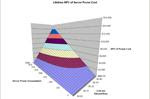
The other day I ran across an interesting statement in a technical article — the author asserted that recent power cost hikes had made the cost of power (over a server’s lifetime) greater than the cost of the server itself. The author didn’t back that up with any analysis, but if he’s correct, that really flips the cost picture on its head from just a few years ago. Intuitively it seemed likely to me, as the cost of servers keeps going down and the price of power keeps staggering up.

So I decided to do a little analysis to see if this assertion passes the laugh test. Long story short: it does. The chart at right (click for a larger view) tells the story. It shows the net present value (NPV) of the lifetime power cost for a server, for any combination of server power consumption and average power cost per kilowatt hour. For this analysis, I assumed a four year server lifetime and an 8% discount rate. Reading off the chart, if you have a 400 watt server and you’re paying 20 cents a kilowatt hour, that lifetime power cost is about $4,300 — and chances are you paid substantially less than that for your server. As I write this, we’re paying 32 cents per kilowatt hour at my home, and the last server I personally purchased cost about $2,400. There’s another factor that makes it even worse: almost all IT datacenters (or server closets!) use air conditioning to remove the heat generated by the servers — you can add another 20% to 30% to the power consumption for that.

Sounds to me like the next frontier in lowering IT hardware costs lies with “green” servers — boxes optimized for lower power consumption per delivered MIPS…

Puppy Journal

I came home Monday to a house full of puppies. :-) Debbie is on spring break this week and drove over to return the puppies and Picabo. They came home with twice as many toys as they left with.

They are doing well! Debbie provided them with wonderful experiences. I’m trying to keep them busy too.

It seems my whole house is now nothing but a series of x-pens. I took the crates out of the dog room, layed down a 6' X 9' vinyl floor remnant, and set up my big plastic x-pen. That is where they stay during the day and while we sleep. For the first time ever, I took down my dining room table and set up my compost bin/x-pen there. That allows them to see all the action going on in the house in the evening. I’m trying to cook more for my dinners. John is convinced that Crockett’s fear of the stove comes from a lack of exposure to one at a young age. Ha ha. Outside my patio door, just off the deck and under the tree, I have two metal x-pens clipped together. This is a great place to put awakening puppies to pee and poop. Then there is the 12' X 12' dog run that has been converted into the puppy run. The weather still isn’t great but it is good enough for 6 1/2 week old puppies to be out in for a little while each day. All these x-pens give me places to put the puppies while I clean all the other places they’ve been! LOL

I take puppy socialization very seriously. Three things have influenced the way I socialize young puppies:

1. I have owned unsocialized dogs. There is a difference between loving a dog and being happy with a dog. It is hard to be happy with an unsocialized dog.

2. The “Rule of Sevens” socialization guide that I first heard about years ago at a Pat Hastings seminar. In a nutshell, puppies should be exposed to seven different things in seven different categories by the time they are seven-weeks old. For instance, under the category “surfaces", my puppies have experience with and are confident on: carpet, linoleum, newspaper, wood decking, gravel, concrete, and grass. As a bonus, they will also walk across a fallen baby gate. The gate fell on Yellow Boy this morning, he crawled out from under it and proceeded to make several trips over it as he and his littermates traveled in and out of the dog room. Didn’t phase him a bit.

3. A National Geographic video about gorillas. One of the segments in this program shows a study done on captive gorillas to help them with their boredom. Every day they went into their exercise room, there was something new and exciting. Like yards and yards of butcher paper draped on everything. The gorillas loved it. They were excited to go into the room every day and played with the new stuff until they were exhausted. I try to do that with the puppies. Little things intrigue them. A big fluffy blanket with lots of folds to explore, a toddler’s tunnel, or a big pile of shredded paper. They have the traditional toys but every day I try to give them an untraditional toy. An empty water bottle, a cereal box, and scrub brush top their list of cool toys.

They are also at the age where they need physical challenges. They can go out the patio door and down the deck stairs. They can come up the deck stairs and Pink, Yellow, and Purple can come in through the patio door. Going out the back door and down those steps will be a different challenge.

My biggest challenge is to provide them with a lot of opportunities to relieve themselves in appropriate places. Yes, they are peeing and pooping all over my house but they are also peeing and pooping outside or on papers. The more time I put into this now, the easier it will be to housetrain them later. That means hauling them out in yesterday’s rain and this morning’s snow. Thanks to yesterday’s rain, I will probably have to mow my lawn this weekend. :-( BUT the sound of the lawn mower (or me cursing it for not starting) will be another good experience for the puppies.

Next week is their temperament test and the following weekend is their structural evaluation. Everything is happening so fast…

Sheila Miller

Wolftree Acres

Nevada, USA

sdmiller@the-onramp.net

http://www.wolftreeacres.homestead.com

Wednesday, March 29, 2006

Bird Blogging

One of the delights of living in the chaparral is the abundant bird life — dozens of species, ten or so of which are very common here. For instance, we have around a hundred hummingbirds visiting our feeders regularly, and about the same number of California quail.

I took these two pictures this afternoon, with two of our most common visitors. At far right is a female hummingbird on one of our feeders. I believe it’s an Anna’s Hummingbird, though it’s missing the red throat patch they usually have — perhaps it’s a juvenile. In any case, it sat unusually still for a moment, and I was able to get this quite clear photo. We have dozens and dozens of Anna’s here; they are the most common hummingbird around in the area.

The other bird is a male Lesser Goldfinch, one of a hundred or more that regularly visit our large thistle seed feeders. These little fellows aren’t much bigger than the hummingbirds, and are almost as brave (the hummers will feed happily while you’re a foot from the feeder, and with care you can get them to land on you). I can go outside while the goldfinches are feeding, and generally they’ll continue feeding if I don’t get closer than about 6 or 7 feet. This seems a little surprising in light of how hard it was to get these birds to the feeders at all — we had feeders out, full of thistle seeds, for two or three years before a single goldfinch showed up. After that, it was just days before huge numbers were crowding our feeders. We’ve had as many as 16 goldfinches on a single feeder at the same time, and it’s common for us to have all four feeders chock full of them, with many others awaiting their turn in the nearby pampas, fig tree, or liquid amber tree. One theory we have is that the goldfinches weren’t reticent to use the feeders — they simply didn’t know how they worked. And that could be, I suppose — but they certainly know now!

As usual, click on the small photos for a larger view…

The Last Helicopter

This morning’s Wall Street Journal (and its free Opinion Journal site) carries a column by Amir Taheri. Mr. Taheri describes in vivid prose the man driving foriegn policy of Iran’s President Mahmoud Ahmadinejad. The piece describes my fears about Islamic extremism, more beautifully and more precisely than I could ever do myself. It’s well worth your time to read the whole thing.

But here I want to discuss just one thing that passed through my little grey cells as I read this piece: this is what keeps me a supporter of President George W. Bush, despite all his other failings in my eyes:

From the Opinion Journal:

To hear Mr. Abbasi tell it the entire recent history of the U.S. could be narrated with the help of the image of “the last helicopter.” It was that image in Saigon that concluded the Vietnam War under Gerald Ford. Jimmy Carter had five helicopters fleeing from the Iranian desert, leaving behind the charred corpses of eight American soldiers. Under Ronald Reagan the helicopters carried the bodies of 241 Marines murdered in their sleep in a Hezbollah suicide attack. Under the first President Bush, the helicopter flew from Safwan, in southern Iraq, with Gen. Norman Schwarzkopf aboard, leaving behind Saddam Hussein’s generals, who could not believe why they had been allowed live to fight their domestic foes, and America, another day. Bill Clinton’s helicopter was a Black Hawk, downed in Mogadishu and delivering 16 American soldiers into the hands of a murderous crowd.

According to this theory, President George W. Bush is an “aberration,” a leader out of sync with his nation’s character and no more than a brief nightmare for those who oppose the creation of an “American Middle East.” Messrs. Abbasi and Ahmadinejad have concluded that there will be no helicopter as long as George W. Bush is in the White House. But they believe that whoever succeeds him, Democrat or Republican, will revive the helicopter image to extricate the U.S. from a complex situation that few Americans appear to understand.

Mr. Ahmadinejad’s defiant rhetoric is based on a strategy known in Middle Eastern capitals as “waiting Bush out.” “We are sure the U.S. will return to saner policies,” says Manuchehr Motakki, Iran’s new Foreign Minister.

President George W. Bush is not an aberration out of sync with this man’s character — nor that of most other Americans I know, on this specific issue. There will be no last helicopter on W’s watch — I do believe that, because I believe that W is truly acting on principle (a notion that most politicians wouldn’t even recognize) when it comes to the global war on terror.

Here’s the really frightening part for me: there are no other players on the national stage known to be interested in a 2008 run for president for whom I hold the same belief. Sexy Hillary? Puh-lease! She’d fly that last helicopter herself if she thought that would buy her a few votes. John (me-me-me!) McCain? Surely you jest! Bill Frist? I think not, and the same for the rest of the bunch… In fact, the only person I’ve heard even mentioned who gives me a W-like confidence that there would be no last helicopter is Condileeza Rice — and she swears she’s not running.

This is problematic for me, because at the moment the global war on terror is for me the overriding issue, swamping all other issues, foreign or domestic. Yes, I care about immigration, taxes, health care, and all the rest — but I’d gladly put them all off for a decade if I could be assured that doing so would help win the global war on terror. That sense of priorities is what will drive my vote in 2008, barring some miraculous victory between now and then.

And I don’t see anyone running whom I’d want to vote for…

Tuesday, March 28, 2006

Decline of the Rabbit

If you’re one of the (very few) people who read my blog regularly, you may recall my previous bemused ramblings about the strange things that bring visitors to my blog. The rabbit at right is the hands-down winner over the past year, bringing a very reliable stream of visitors to my blog every single day, via Google image searches or (to a much lesser extent) Yahoo image searches. It’s a nice picture, but it’s not that nice, and I continue to be very amused by this phenomenon. That photo shows up on the second page of hits for “rabbit” on Google Images — which means that every day there are at least a hundred people somewhere in the world who search Google Images for rabbits, got to the second page of hits, then find and click on my silly little image. Every day! Why on earth do so many people care so much about a photo of a rabbit?

Recently, though, a contender for the “leading referrer” has been creeping up the charts. You can see the page that’s the source of these referrals for yourself here. It’s an automatically translated version of the page where I posted the Danish cartoons that caused such a flap back in February (and the reverberations continue). It looks like Chinese to my eye, but I wouldn’t know Chinese from any other language written with similar characters. I’ve been unable to figure out (from my web server’s logs) where these requests are coming from. If any of my dear readers can read (or even identify) any Asian written languages, I’d really appreciate you taking a gander at that translated page, with two objectives: what language is it, and why would they be translating my cartoon posting? And of course if any other interesting information jumps off the page at you, I’d like to know about that as well!

Meanwhile the rabbit is getting a serious run for his money — the mysterious automatically translated page is running today at about half the hits of the rabbit, which makes it the runaway number two on the hits parade…

Monday, March 27, 2006

Alika

Alika (Hawai’ian for Alex), at about 16 lbs, is our biggest cat by a pretty good margin. Friends of friends trapped him when he was an itty-bitty little feral kitten. He was cute as a button as a kitten, but (as is normal with a feral cat) extremely shy. The photo at right caught him in a favorite perch, on our rocking couch. In the intervening year or so since we got Alika, he has gotten so big that I’m beginning to wonder if he might be some sort of hybrid between a housecat and (say) a Siberian tiger. With Debbie he’s a little shy and stand-offish, but she can approach him, scratch him, and handle him (her “cat magnet” demonstrated again). With me he’s still nearly as shy as when we first got him — if he’s really, really relaxed I can sort of sidle up to him and scratch him a bit. But as soon as he figures out it’s me (and not Debbie), he gets stiff as a board and skedaddles at the first opportunity. The only reliable way I can get close to him is through play — if I whisk a toy about enticingly, he’ll let his instinct to hunt and play overtake his fear, and he’ll come right up to me to get a piece of the toy action.

Click on the photo for a larger view…

Desert Wildflowers

Yesterday (Sunday) two friends and I trekked out to the local desert (the southern part of the Anza-Borrego) in search of wildflowers. My friends Rick Pugh and Ted Dunning (seen at right) had been out in the desert before, but they had missed last year’s super-spectacular wildflower show. We knew it wouldn’t be as good this year as last; but we were at least hoping for a decent showing. In that we were disappointed — the flowers were as scarce as I’d ever seen them. To some extent I suspect that’s because we were a bit early; perhaps a week or two. But it’s more than that, as there were darned few green plants propoking up in most of the areas we trekked.

We drove out I-8 and turned north on S2 at Ocotillo. The ocotillos were in bloom, but only in a desultory fashion; nothing like years past. It’s possible that we were either too early or too late for them; there was so much individual variation that I couldn’t really tell. Other than the ocotillo, the first really nice flowers we saw were the chuparosa (Beloperone californica, at right), reliable as always — but still not as nice as in most past years.

Desert lavendar (Hyptis emoryi) is another one we spotted early in the day, down south of the Carizzo Badlands overlook. We were clearly too late for this one; those few plants that were still blooming at all had only a few blossoms left, right on the ends of their flower clusters. The bees were very attracted to the desert lavendar; every plant had dozens of bees feeding on it. The bee photo at right was one of 12 that I took of the same bee, all within a few seconds of each other — and it was the only one with the bee reasonably in focus. Those little guys move fast, and on top of that there was a light breeze making the branches sway — a nice photo challenge…

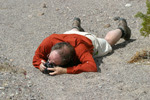
If I’m reading my field guide correctly, the flowers at right are Bigelow’s Monkey Flowers (Mimulus bigelovii), a figwort. These are the flowers that Ted is taking a photo of above; you can just barely make them out in the large version of the picture, a foot or so to the left of his camera. They are tiny! I took the rightmost photo by putting my camera right on the ground and aiming the lens in the general direction of the flower; I tried this three times before I managed to get the bloom framed. If I wanted to use the viewfinder, I would have needed to dig a hole for my chin! You can see the desolate micro-environment this individual was in, and according to the field guide that’s exactly what it likes: full sun, dry soil, and no competition.

Here are a few I was unable to identify. If anyone knows what these are, I’d appreciate a comment with the ID. These were taken down on the Anza-Borrego desert floor, between Ocotillo and Smuggler’s Canyon (inclusive). I forgot to mention earlier that we had darned near perfect weather for this sort of an outing — very pleasant temperatures, relatively humid (compared to what the desert normally is!) thanks to the recent rains and the subsequent evaporation, and some diffuse lighting because of a variable, mostly light cloud cover. We seemed to have no trouble finding things to talk about, and laugh about, all day long; that always makes for a more enjoyable day.

These are some others that I couldn’t identify, taken at higher altitudes at points along the Oriflamme Canyon jeep road, from the desert up to the top of the canyon. Just before we turned up the Oriflamme, we took a half-mile or so walk up Smuggler’s Canyon. That area is, in most years, prime wildflower territory; this year there was very little to see — though we just might have hit it a week or two too early. We got a nice surprise, though — the birding was better than I’d expected, given the dearth of flora. We were treated to several extended views of Lesser Goldfinches (Carduelis psaltria), with a behavior I’d never seen before — they were happily munching on the center flower parts of the ocotillos. We also saw another bird that I’ve been unable to identify from memory with my Sibley’s guide; I’m hoping Ted can pull that one out.

The rock-daisy (Perityle emoryi, far right) is usually quite abundant; this year we only saw a few plants (all southwards, between Carrizo Badlands and Ocotillo). This same area is where, in most years, I can find at least one or two desert lilies, which I just love. Not one this year; not only no bloom, but no plants, either. Their long leaves make distinctive, easy-to-spot rings in the sandy soil as the wind blows them around. We did spot a couple of gourds in a wash, and walked “upstream” until we spotted the plant’s remains from last year — with a bit of new growth just starting to show for this year.

The two far-right photos are of the same Indian Paintbrush (Castilleja miniata); this was an individual with a particularly nice color, and handsomely set off against a rock, on the mesa between the top of Oriflamme Canyon and Banner. The Indian Paintbrushes vary considerably in color and form from individual-to-individual, and there are several varieties of them all living in the same area. I’ve never been able to tell the various red or reddish-orange ones apart. The group of cactus (I’m not sure which species this is) was a particularly good-looking bunch we stumbled across near the southwest end of Smuggler’s Canyon.

These last three photos are of a plant that Ted identified as a “bush poppy", and from what I’ve been able to find on the Internet, he’s correct: Dendromecon rigida, and to my surprise it really is a member of the poppy family (Papaveraceae) — and, happily, it’s a native. We’ve seen this plant in many places, but it is particularly abundant (and accessible, if you have a four-wheel drive vehicle) on the Banner half of the Oriflamme Canyon jeep road and the Rodriguez Canyon jeep road. When it’s set off against a shaded background, or against a dark rock, those yellow blossoms are spectacular — an almost unnaturally saturated and pure yellow. The little beetle seemed to enjoy the flowers as much as we did. The center photo shows a typical plant growing out on flat ground; in general I found the individuals on road cuts and steep grades to be more attractive, especially the foliage.

After we exited the jeep trail at Banner, we zoomed it up to Julian (saw a couple of ceanothus along the way), and south toward Cuyamaca. We stopped briefly at the vista point just south of Julian to eat a lunch that Ted had brought along (he sees such a meal as an aethetic requirement for an outing like this) — some nice gruyere cheese, salami, and a banana. We would have had chocolate to top it all off, but the mild heat down on the desert had completly liquified it. If that was my chocolate, I’d have found a way to pour it down my gullet — that liquification really just helps the mastication process with a little “pre-processing", as it were. But it was Ted’s chocolate, so I just watched — with some regret — as he put it away to take it home, and managed to control my sobbing over the loss…

As usual, click on any of the smaller pictures to see a larger version…

Sunday, March 26, 2006

Gas Attack

The state of Oregon is experimenting with the idea of basing highway taxes on how many miles you drive, instead of how much gas you buy. To do this would require an elaborate system, including GPS trackers in every car. Why would they go to all this trouble?

From UPI:

Eighty percent of Oregon’s highway money comes from its 24-cents-per-gallon gas tax. If the state promotes reducing gasoline consumption and consumers tend to buy the fuel-efficient vehicles, including hybrids, highway revenues would take a hit, The New York Times reported.

Oregonians (especially from the western part of the state) tend to think of Californians as knuckle-dragging conservatives. So here’s this very, very liberal state with a gasoline tax that was specifically promoted as a way to get people into environmentally friendly cars. The bureaucracy there — operating as bureaucracies do everywhere — got very used to the huge revenue windfall that the new, larger tax raised. And now, when the tax is looking like it had its intended effect, are they happy about it? Mais non, of course! With typical bureaucratic malign myopia, they see the reduced gasoline usage as a threat, and on cue the roll out the standard bureaucratic response: scare tactics. Take away our money (you can be certain that’s how they think of it), and your roads will fall apart. You won’t hear a bit of discussion about how they used to get along just fine with much less money…

Lets look at this from a completely different perspective: good governance policy. Where should the funding for highways come from? Highways are used for so many different things — like any true utility service — that this one is hard to get a handle on. Certainly big chunks of users include commuters and shipping, but there are lots of other categories of users as well: emergency services, military, shopping, and on and on. And what are the costs of having a highway system? Certainly a big chunk of that is the original construction cost, but there is also a very high recurring cost — maintenance, related law enforcement and emergency services, and so on. And there are indirect beneficiaries — the businesses whose employees can now live further away, the cities who can now attract residents and businesses, increased visitors to a region, and so on.

My own inclination is that highways should be built and maintained out of state and federal governments general funds. Both gasoline taxes and mileage taxes are terribly anti-progressive — they hit the lower income folks far harder than they hit upper income folks. Here in San Diego County, where I live, there’s a great example of this: our county’s concentrations of businesses tend to be close to high-priced housing areas: downtown, Del Mar, Rancho Bernardo, etc. Many of the employees of these businesses have long commutes to “bedroom communities” with much lower cost housing. In fact, this accounts for much of San Diego’s notorious rush hour snarling. Those employees who drive long distances have (on average) substantially lower incomes than those employees who live close by. This was true for every company I’ve worked for in San Diego for the past 25 years. Consider how a mileage or gasoline tax works for those people — it’s upside-down, with lower income people paying more, both in absolute and in relative terms. For something that’s a pure utility, with such broad benefits, I think that’s wrong. Hence my belief that highways should be funded from general funds…and that gasoline and mileage taxes are morally wrong.

Saturday, March 25, 2006

Puppy Journal

When last I checked in, Debbie was taking the puppies for a week during the critical socialization period. Monday was Debbie’s reality check as she realized that no matter how prepared you are for a litter of puppies, you aren’t. :-) By Monday night Debbie knew she wasn’t going to get anything done as she all wanted to do was sit with them.

So she got up at 3:30 on Tuesday just so she could have that sit with them time before school started. :-) Tuesday afternoon was the first day she brought them to her classroom (4th graders). That was a learning day for all. They quickly learned that 25 students don’t evenly divide by six puppies. They learned you don’t rush puppies and that colored rick rack collars are pretty cool.

Wednesday afternoon and back to the classroom. The kids were expert by now and what a difference 24 hours made for the puppies. Tuesday was all new stuff to them, Wednesday was old hat. Her class nearly panicked when they noticed that Pink Girl lost her collar. “How do we know who this puppy is"?!!! Debbie said, “Is it a boy or a girl? Is it black or brown? Whatever color is missing, this is the puppy.” One by one, the other grades came in to see them. When the kindergarten class came, their teacher asked, “How many puppies are there?” “One, two, three, four, five, six, seven, eight, nine, ten, eleven…” OK, they need to work on that counting thing. :-) Then they named their colors (coat and collars).

Thursday was the best day yet. Her whole class has fallen in love with these puppies but especially one boy. On Thursday he came to school with six little wrapped packages. Each one with a different color bow: blue, white, pink, purple, green, and yellow. A present for each puppy. This is Nevada Reading Week and Debbie’s class divided up among the two first grades and kindergarten to read to those students and help them with their AR (accelerated reading). What about the puppies? One student said, “Six divided by three is two. Each group will take two puppies with them”. So they did and they brought the presents too so the little kids could be there for the opening. Each group sent a messenger back to Debbie, “The puppies like their presents"! Their presents were appropriately colored squeek or rope toys. This is so touching because I know the little town where Debbie lives and that young man in her class must have made his mother drive the 50 miles to Elko so he could get those presents.

Friday is going to be another good day. Debbie is very proud of how well her students handled the puppies and she is pretty darn proud of how the puppies have handled all of their new experiences. Each student in her class is going to have his/her picture taken with a puppy of their choice. I need to write a very special thank you to her class and send them updates and pictures of the puppies. I’m sure they will want to know where each of these puppies ends up living. Hey, that could be a geography lesson!

Sheila Miller

Wolftree Acres

Nevada, USA

Heads-Up, Kerry

The lead of an excellent article on the always-superb Brussels Journal blog:

Europe’s Ailing Social Model: Facts & Fairy-Tales:

Europe’s social disaster is unfolding while the rest of the world is booming at its fastest rate in three decades. 2004 and 2005 were record years for China and India, which have double-digit growth rates, and for the USA, which fully enjoys the benefits of globalization. The world’s economy is booming at an average rate of over 4%, but Europe’s pgrowth has stagnated at an inflated 1.5%.

Why is Europe performing so poorly? Europe’s deficient performance is incompatible with its huge potential as the world’s largest single consumer market. Its slow growth contradicts its unequalled industrial productivity and infrastructure, its outstanding education level and labour ethics, its favourable climate, “fair business” morality, and not in the least its tremendous potential provided by the opening of the iron curtain. Obviously Europe’s fairy-tale is not materializing. Nor are the inflated expectations prognosticated by Europe’s political elite at the launch of the Common Currency and the Lisbon Agenda.

This article contains a lot of interesting information about the current European economic situation, and how it got there. Basically the situation in Europe is bad and it’s deteriorating. The government bureaucracies are actively hiding the degree of trouble they’re in; no surprise there. What really got my attention, though, is the analysis of how Europe got into this sitaution — and the close parallels Europe’s recent past and the current U.S. situation. And of course, if the liberal Democrats have their way, we’ll be even more like the Europeans.

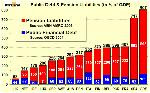
One example of what I mean: the article cites the almost unbelievably large size of Europe’s unfunded public debt and pension liabilities. For some countries, these unfunded liabilities are three or four times the country’s gross domestic product (GDP) — a staggering debt burden, and one that dwarves the U.S. debt and social security burden. How did this happen? Europe long ago adopted the pay-as-you-go pension model just like our social security, and now their aging population has increased to the point where the burden on the younger workers to pay for their retirees pensions (not to mention welfare) is stifling the countries' economies. They’re decades ahead of the U.S. on the aging phenomenon, but we’re headed that way — and for the same trouble, if we don’t do something about it. The article cites all the classic symptoms of a disintegrating economy, and finds them in today’s Europe. There are lessons for us (the U.S., I mean) in this European experience. If I were in the Democratic party, I’d be wondering about the wisdom of some of my party’s platform and rhetoric…

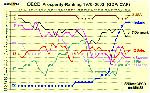
Another example: the changing prosperity rankings within Europe. On the chart at right you can see most of Europe slowly sinking, with the sole exception of Ireland, whose rankings have skyrocketed from 22nd to 4th in less than twenty years. If you know anything about what Ireland has been doing over the past 20 years, you already know why: they have the most pro-business environment in Europe, including low tax rates, incentives for businesses that locate in Ireland, and government initiatives (mainly pragmatic, focused eductation) to make their population better able to perform to today’s workplace. The result is very apparent from this chart — the Irish have gone from being emblematic of poverty to being the fourth most prosperous country in the world. More lessons there.

After reading this article yesterday, I sent an email to my state’s two Democratic Senators — both are notorious liberals — urging them to take a close look at this information, and to revise their positions on issues such as social security reform and education. I know there’s little chance of them modifying their positions (especially not Barbara Boxer, a card-carrying barking moonbat). One look at my blog and they’ll know that Karl Rove is controlling me through his mind-rays. But I can always hope…