Thursday, March 23, 2006

Of Mice and Men

Stephen Moore has an excellent piece in this morning’s Wall Street Journal:

Start of Of Mice and Men ($ WSJ):

DENVER — Here in Colorado, the hottest political issue of the day may not be the war in Iraq or the out-of-control federal budget, but rather the plight of a tiny mouse. Back in 1998, a frisky eight-inch rodent known as the Preble’s meadow jumping mouse gained protective status under the 1973 Endangered Species Act (ESA). What has Coloradans hot under the collar is that some 31,000 acres of local government and privately owned land in the state and stretching into Wyoming — an area larger than the District of Columbia — was essentially quarantined from all development so as not to disrupt the mouse’s natural habitat. Even the Fish and Wildlife Service concedes that the cost to these land owners could reach $183 million.

What we have here is arguably the most contentious dispute over the economic impact of the ESA since the famous early-'90s clash between the timber industry and the environmentalist lobby over the “endangered” listing of the spotted owl in the Northwest. That dispute eventually forced the closure of nearly 200 mills and the loss of thousands of jobs. Last week the war over the fate of the Preble’s mouse escalated when a coalition of enraged homeowners, developers and farmers petitioned the Department of the Interior to have the mouse immediately delisted as “endangered” because of reliance on faulty data.

The property-rights coalition would seem to have a fairly persuasive case based on the latest research on the mouse. It turns out that not only is the mouse not endangered, it isn’t even a unique species.

The man who is almost singlehandedly responsible for exposing the truth about the Preble’s mouse is Rob Roy Ramey, a biologist and lifelong conservationist, who used to serve as a curator at the Denver Museum of Nature and Science. Mr. Ramey’s research — published last year in the peer-reviewed journal Animal Conservation — concluded that the Preble’s mouse “is not a valid subspecies based on physical features and genetics.” The scientist who conducted the original research classifying Preble’s as unique now agrees with Mr. Ramey’s assessment. Even scientists who defend extending the mouse’s “endangered” status admit that it is 99.5% genetically similar to other strains of mice.

Nor is the mouse on the road to extinction. “The more people look for these mice, the more they find. Every time scientists do a new count, we find more of the Preble’s mouse,” Mr. Ramey says. It’s now been found inhabiting twice as many distinct areas as once thought. These are mice, after all, and the one thing rodents are proficient at is breeding. The full species of the meadow jumping mouse, far from being rare, can be found over half the land area of North America.

While I’ve known about this issue for a long time, we got slapped in the face with it ourselves a few years ago. About ten years ago, we purchased some undeveloped land in northern Idaho — beautiful mountain forest and stream, at a price that seemed downright cheap to a Californian. A few years after we bought the land, we discovered that we had a risk that we did not anticipate: the very real possibility that we would be forbidden to build a house on our land. The U.S. government would be the one forbidding us. We would get no compensation for the reduced value of our land. There was simply a rule that said “If x happens, then you, dear landowner, are just screwed — and there’s nothing whatsoever that you can do about it."

What’s x, you ask? If a bald eagle should decide to nest on our property, that’s what.

What made this especially infuriating is that I knew enough about bald eagles to know that they were not (at that point in time) “endangered” in any sense that normal people (by which I mean non-environmentalist wackos) would recognize. The locals, as you might well imagine, were even more furious about this. After all, the land they owned wasn’t an investment or a vacation home — it was their home or their business. We stayed at one bed & breakfast that happened to be in prime eagle nesting territory, and had a long conversation with the owner about the risks this posed to his business. It was very simple, really: should an eagle decide to nest on his property, he’d be bankrupt. With no recourse. He could not have guests, he could not drive a car onto his property, he could not maintain his building, and so on and so forth. This would be disastrous for him and his family — and he had no intention of letting it happen. After a few glasses of wine, he told us about the informal network of cooperating property owners that had formed in the area. This network had one solitary objective: to make absolutely certain that no eagle ever decided to nest on any of their property. They would use any means necessary to accomplish this, starting with scaring the eagles away upon sight. But if they had to, they would kill the eagles and remove all traces of their nesting efforts.

In other words, the actual effect of the EPA in that area was to increase the risk to the unendangered eagles, and to turn the generally conservation-supportive population in the area into foaming-at-the-mouth eagle haters. Stephen Moore makes reference to this same phenomenon later in his piece. It seems like the natural reaction of any property owner to me; I wouldn’t be a bit surprised to find out that it’s a universal occurrence in EPA-plagued areas.

And as Stephen Moore also illustrates with the Preble’s meadow jumping mouse, all too often the EPA provisions are used by anti-development activists as leverage to stop development with a proxy animal that actually isn’t endangered at all. The EPA gave the environmentalists a tool to confiscate property without having to pay for it (if you stop me from developing my property and reduce its value to zero, you’re taking it away from me just as effectively as if I handed you the deed). The only requirement for them to be able to use this tool is that the area they wanted to “protect” had to be home to an endangered animal. So the new modus operandi in environmental wacko-land is this: as soon as you identify an area that you want to control ("protect"), find an endangered animal that lives there. And if such an animal cannot be conveniently located, well, then, just make one up! And it turns out that inventing an endangered species is easy: you just need to find some cooperative biologist to declare that the mice (or whatever) living in the area in question are a unique species, and then by definition they’re rare — after all, they only live in that one meadow over there! Poof! Magic! An endangered species conveniently appears, right where the wackos need it in order to steal ("protect") all the property they want. Environmentalist wackos are no more honest or moral than your average politico, so naturally this dodge has been frequently employed. There are several very well documented cases that even include recanting biologists, just as in the case of the Preble’s meadow jumping mouse. And many others — most famously the spotted owl disaster — have been shown conclusively to be based on fraudulent or (to be kind) incompetent science.

It’s time to fix this problem, and I don’t think it would be all that hard to fix, actually. One simple change to the EPA rules would introduce a huge dose of reality: require the U.S. government to compensate landowners — at market value — whose rights are confiscated. That cost would force the whole process to exercise judgment that is today sorely missing. If an animal really, truly does need protection, then we’ll find a way to do it, we’ll collectively bear the cost, and no individual landowners will be screwed. The basis for listing an endangered species will be much more carefully examined, as now such a listing would have potentially great (and negative) political consequences.

I’ve written my Senators and representative asking for such a change. Will you?

Post of the Day

The setup is this story about Hillary Clinton:

NEW YORK — Invoking Biblical themes, Sen. Hillary Rodham Clinton joined immigration advocates Wednesday to vow and block legislation seeking to criminalize undocumented immigrants.

And here’s the start of the post of the day:

From the Anti-Idiotarian Rottweiler:

Too much fun in that lede to snark at in one line. First, to the MSM in general: Cut it out with the “undocumented immigrants” Newspeak, because nobody is falling for it. At least not anybody who isn’t already a drooling liberal moonbat. You’re only making yourselves look silly. Well, sillier actually, hard though that may be to imagine. What’s next? Bankrobbers being charged with “undocumented withdrawals?”

Second: We can think of nothing more hilarious than the Whore of Babylon invoking Scripture. Hilarious as long as we don’t get to stand next to her when she does it, that is. You never know when lightning might strike unexpectedly, but we hope and pray that it’s sooner, rather than later.

Third: “Block legislation seeking to criminalize criminals?” That may just be the single most skull-slappingly stupid thing we’ve ever read, although we can certainly see why Ms. Whitewater et al might be averse to legislation of that sort. Too bad for the Hildebeest. Criminalizing criminals is sort of the whole point of legislation.

Undocumented withdrawals. Heh.

Criminalizing criminals is sort of the whole point… Heh, again.

Go read the whole thing!

Time

People who know me often wonder how I can possibly find the time to do all the things that I do. Usually they offer various theories having to do with some super-powers I must possess. These are all amusing, but the truth is much simpler:

I don’t watch television.

My television abstinence isn’t quite absolute — I’ll watch the occasional documentary, or news coverage, or even a movie. But I do not watch television day in and day out, as most people (worldwide, not just in the U.S.) do.

A quick google will get you various estimates of the time that the average American spends watching television, varying from 25 to 35 hours per week. Let’s call it 30 hours a week. That works out to about 1,500 hours a year. So in the 25 years that I have not been watching television, I’ve had about 38,000 hours of time to do other things. That’s the equivalent of 19 years of full-time work.

That’s my secret. It really is that simple. I’ve spent that time on wonderful vacations (including one-day local vacations), on my hobbies, on reading, and learning (which is really my meta-hobby). It’s true that I can read faster than most people, but that’s a small factor compared with not watching television — and I suspect that in no small part my reading skills are the result of having more practice.

Sorry folks, no super-powers here. And while my rather complete ignorance of the “television culture” has been the source of much amusement for others over the years, I don’t miss it myself at all. In fact, I think it leaves my brain just a little less cluttered, and more available for other things that seem somehow much more important and consequential to me. I may not know anything about The Simpsons (never having watched it), but I have read the Federalist Papers. I’ve completely missed the pleasures of American Idol, but I’ve hiked in the sub-alpine wildflowers of the San Juan Mountains. I don’t know What Not to Wear, but I do know how to program computers in a few dozen languages, how to design electronic hardware, and how to compute the proportions of aggregate, sand, and cement to make concrete.

These are trade-offs I’m quite happy with. And they are trade-offs that I think just about anyone could make, if it’s the right choice for them…

Tuesday, March 21, 2006

Bits and More Bits

I have spent a considerable part of my career working in the general area of digital storage, on software related to hard disks, digital tape systems, CD-ROMs, etc.. The computer industry calls this entire area of technology simply “storage", by which (generally) they mean non-volatile secondary storage. More informally, storage is all those places your computer more-or-less permanently saves its bits, whether or not the computer’s power is on.

Virtually all aspects of storage have changed dramatically in the 30 odd years of my career, but clearly the most significant changes have been in hard disks. In the late 1970s, I purchased the first hard disk I ever owned. It was a used Memorex 630, manufactured in the late 1960s; I paid $10,000 for it. This marvel was the size of a extra-large washing machine, and had just over 7MB of storage. That works out to 0.14 cents per bit — very cheap at the time. I spent hundreds of hours designing and building a controller to interface that disk to my Z80 CP/M system, for the sole purpose of speeding up my software development process. By today’s standards 7MB is laughably small, but in the late 1970s that system gave me (so far as I know) the biggest, baddest microcomputer-based development system in the world. At that time, “serious” software development for microcomputers was mainly being done on minicomputers, and part of the reason for that was the better storage found on the minis.

Just recently I had to run down to Fry’s Electronics to buy a hard disk as a repair part for one of my servers. The disk that broke down and needed replacement was 40GB — over 5,000 times the capacity of that old Memorex 630. And it wasn’t the size of a washing machine — it was more like the size of a paperback book. But Fry’s didn’t have any disk drives as small as 40GB! The smallest one I could buy was 120GB — but hey, it was only $89, so what the heck. The cost per bit on that disk drive was about 0.000000074 cents per bit — almost two million times cheaper than that used Memorex 630.

Hard disks keep getting cheaper and cheaper, especially in terms of price per bit of storage (because they keep getting bigger as well). Over the thirty years since I bought that Memorex 630, the price per bit for storage has dropped at a quite consistent rate, with storage each year costing about 60% of what it cost the year before. If you project forward ten more years, a 10TB (10,000GB) hard disk should cost about $42 — except you probably won’t be able to buy one that small!

But will hard disks still dominate in the future?

Hard disks currently have the advantage in price per bit, and they are reasonably fast. But the rate of advance in the speed of hard disks has not kept pace with the increase in speed for every other aspect of computer systems. The result of this divergence is that hard disks are today the major bottleneck in computer system performance. The fact that your PC takes a minute or so to boot is almost entirely due to the low speed (by comparison to the rest of your computer) of the hard disk. A modern computer can retrieve an arbitrary chunk of data (a word, it’s called) from its main memory (RAM) in about one billionth of a second — but to do the same thing from a hard disk takes several thousandths of a second, which sounds fast until you realize that’s millions of times longer than from main memory.

So hard disks are the bottleneck. What kind of storage is faster than a hard disk? Several, actually, but only one is currently a serious contender: FLASH memory (which comes in several technical variations). The price per bit today for FLASH memory is about 100 times higher than hard disks — but it is falling much faster. The price per bit may cross that of hard disks as early as five years from now, and almost certainly by ten years. And FLASH memory is superior in just about every performance category: it is much faster than hard disks, much smaller, uses less power, and has no moving parts. There’s one big difference with FLASH, though, that points to an area where hard disks may remain cheaper: the cost of making FLASH is essentially linearly related to its storage capacity. This is not true for hard disks — it costs very little more to add more bits to a hard disk, once you have paid for the basic mechanism.

Tom’s prediction (barring the introduction of some radical new technology): ten years from now, FLASH memory will dominate storage, with hard disks relegated to the particularly large, and probably tertiary, storage systems. Old-timer storage geeks like myself will recognize this as being parallel to the old paradigm of RAM-disk-tape, wherein RAM was used for primary storage, disk for secondary, and tape for tertiary. I think we’re going to see tape completely relegated to backup (actually that process is already well underway), with disk becoming the new tertiary media, and FLASH the new secondary. If I’m correct, that means production volumes of FLASH will go up (driving price per bit down even more). The opposite will be true with hard disks: volumes will go down, at least reducing the rate by which the price per bit drops.

Given the rate of innovation in the storage industry, it’s always possible that some new storage technology will pop up and displace both FLASH and disk. Possible, but not, I think, very likely. The history of storage has been mostly one of incremental advances, with fundamental new technologies coming along relatively rarely. In fact, nearly all the contenders for mass storage have actually been based on the same technology (magnetic storage): hard disks, tape, core memory, and even bubble memory, are all variants of magnetic storage technology. FLASH is the first semiconductor contender, with battery-backed DRAM another variant that might gain some traction. Those two fundamental technologies underlie every commercially significant storage technology for the last forty years. Of all the experimental technologies I’ve read about or heard of, the only one that seems particularly promising to me is three-dimensional optical storage (especially holographic, but also the non-holographic). The reason I find them promising is the extraordinary densities they could theoretically achieve. But these are very much laboratory curiousities at the moment, and I wouldn’t give them too much of a chance of emerging into high-volume production within ten years.

Bet on FLASH.

Monday, March 20, 2006

Lockbox

Not long ago I read an article that said the overwhelming majority (I believe it was 85%) of American voters did not know how their Social Security taxes were actually being used. Some, amazingly, still thought that the money when into some sort of investment account that the government managed. Others knew that there was no investment account, but didn’t know what actually did happen. This situation is so frustrating, as our elected representatives have been perpetrating a gigantic fraud on the citizens of this country — one that dwarves any crime ever prosecuted — and they’ve been doing it continuously for decades. Every single citizen is being cheated out of a huge amount of money, and yet very few people even complain about it, much less do the one thing that would change this behavior: throw the bums out of office.

From Bonnie and Clyde Budgeteers ($WSJ):

Remember when Al Gore pledged to create a “lockbox” to protect Social Security trust fund surpluses from the annual Congressional spending raid? Well last week, while voting to raise the federal-debt ceiling to $8.96 trillion, Senators had a chance to terminate this notorious money-laundering scheme.

And guess what? Every Democrat in the Senate joined with eight Republicans to kill an amendment by GOP Senators Jim DeMint and Mike Crapo that would have stopped the Bonnie and Clyde budgeting. The vote was 53-46, and on the list of those voting to continue the Social Security raid is every potential 2008 Democratic Presidential aspirant in the Senate, including Hillary Clinton, John Kerry and Joe Biden. Worse, the list also includes Republicans Conrad Burns (Montana), Jim Talent (Missouri) and Gordon Smith (Oregon), who are running for re-election this year.

I hope my readers are better informed that the average American. But just in case this is news to you, let me describe how it works. Imagine that your 'Social Security' taxes (including the matching taxes that your employer pays) were being paid to a private investment firm instead of the U.S. Treasury. Every payday another dollop of your money goes into that account. Now what you’d expect from that private firm is that your money would be wisely invested, probably in a mix of investments that returned a modest but safe appreciation. But what if that firm didn’t bother investing at all? What if…they just took your money and did whatever they wanted to with it, leaving an IOU in your account? And then, whenever they feel like it, they pay the IOU with no interest or appreciation at all. Would you be content with this outcome?

I think not.

But that’s exactly what your elected representatives are doing to you, year in and year out.

Why are these criminals still in office? Forget the fact that (for the most part) their party affiliation is Democrat. I cannot understand how any voter would knowingly support someone who stole their retirement. There only two explanations I can conceive of: either American voters are incredibly stupid and gullible, or they don’t know. The latter explanation seems more plausible to me (though I could be wrong). Certainly it’s true that the lamestream media has not done a stellar job reporting this issue (and in fact, some editorials actually support the practice) — but they have reported it. So voters must be choosing not to become informed…

When I have a down day, facts like this can make me despair for the future of our democracy. If an electorate can’t be bothered to learn enough to keep themselves from being victimized by their elected representatives, is there hope for democracy succeeding? If most voters are willing to re-elect self-serving criminals, what kind of government can I look forward to?

Fortunately for my sanity, I have very few down days…

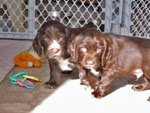
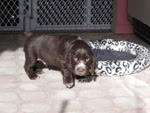
Puppy Journal

The puppies are five-weeks old today and weigh between 5 1/2 and 6 pounds each. In another week, their combined weight will outweigh Picabo. They are eating three meals a day and don’t need their food mashed up or goat’s milk added to it. They have graduated to yogurt. :-) It took Picabo a couple of days to get over her illness but she did and is back to 3+ double portion meals a day. She will still allow them to nurse but on her terms. She softly growls and gently snaps at any puppy sneaking in for a snack. I don’t blame her. Their teeth are sharp and they don’t have much bite inhibition at this age.

Their fourth week was spent with me studying them and seeing what they were ready to do. For instance, up until now, the bedroom door has been open when they were out of the Dura-Whelp. While they were eager to explore the bedroom, crossing the threshold was a different matter. The hallway is dark with a vinyl floor whereas the bedroom is bright with carpet and newspapers. They would venture to the door but would not pass through it. That is, until Tuesday. Purple Girl just nonchalantly passed through the doorway and into the hall. When nothing happened to her, her littermates cautiously followed her. That was my cue to go to the end of the hall, get down on my knees, clap my hands, and call “puppy, puppy”. The hallway is only six feet long but that was a long six feet for them. We worked on walking down the hallway and into the living room (love that room) and into the kitchen (don’t like that room yet - too bright - too hard to walk on the floor). Now I have to have a baby gate up in their bedroom to keep them in!

With me gone all day and sleeping a few hours each night, I worry that they spend too much time in isolation. So this was the week I utilized the compost bin/x-pen in the living room. While the other dogs were crated for dinner, I would be in the living room with the puppies while they explored and used me as a jungle gym and living pin cushion. I would then put them in the x-pen with their toys and let the other dogs out. This is good for the puppies to be in the center of the house seeing dogs walk around, sniff them, hear them bark, etc. The puppies were put back in the Dura-Whelp for bed.

Week Five begins the socialization period. Deliberate socialization is necessary for the entire first year but weeks five through seven are critical in helping the puppy develop problem solving skills and a “shake it off” attitude as he faces the challenges and fear periods of puppyhood and adolescence. Sights, sounds, people, dogs, surfaces, toys, food, the list is endless. You don’t socialize a puppy by scaring it or forcing it to do things it isn’t ready for. You socialize the puppy by putting it in new and different situations (not scary) and letting the puppy get used to it. Besides exposing the puppies to things like vacuum cleaners, plastic bags, and TV sounds, I try to put the puppies in situations where they will go forward (toward) instead of backwards. I only get so close to the puppies and then encourage them to come to me. I also try to get out of the habit of carrying them. It takes us a lot longer to get to places in the house, but it is better for them mentally to make the journey themselves.

The puppies had a big journey today. My sister Debbie volunteered to take the litter for a week to give me a break and to give the puppies some great experiences. The journey to my van took about 20 minutes. With Picabo’s supervision, I carried two puppies at a time out the front door and since it was sunny (OK, it was only 32 degrees), I put them down on the lawn. The first pair out were Pink Girl and Green Boy. They were initially stunned but got to sniffing everything and slowly walking around. Green Boy stopped to pee and Pink Girl pooped. I scooped them up and put them in the warm van. Next pair was Yellow Boy and Purple Girl. Purple Girl sat at my feet and shivered. She didn’t like this. Yellow Boy on the hand, practically bounded off. He scampered through the grass, ran up to a tree and looked at it, then scampered over to the gravel. I had to chase him down before he noticed the deck. The cotton tails fit under there and so would he. They went into the van. The last pair out was Blue Boy and White Boy. Blue Boy was very funny because he kept pawing the air like he was afraid to take a step. The texture of the grass was giving him a sensory overload. White Boy sniffed around but stayed close to Blue Boy. I got down, clapped, and called them and White Boy bounded toward me. Blue Boy came too and once he took that first step on grass, he was OK with it. I wish it would warm up so they could have more outside adventures. It is a two-hour drive to my sister’s house. We met at the halfway town (Elko). They traveled well and didn’t hesitate to come out of the crate. We transferred them to Debbie’s van and she brought them home. She called to tell me that they needed zero time to adjust to their new digs. They like her kitchen and the stuff she put in it for them. They also like her and never shied from climbing all over her and biting her face. They do that pretty well. :-)

Monday will be “develop a daily routine” day for Debbie and her dogs. Beginning on Tuesday, she will be bringing the puppies to her fourth grade classroom in the afternoon. Her students are so excited! I am excited that both kids and puppies will be learning lots of stuff this week.

This week is going to feel like a vacation. I don’t have to get up at 4:15. I can sleep until 5:00! :-) I’ve already taken the Dura-Whelp down. This week I will clean the bedroom where the puppies have been and then redesign my dog room so the puppies can have a 4’X6' x-pen space when they come back next week. If I had a place to put my table, I would set up another x-pen in the kitchen.

One other thing happened this week. Green Boy had an “awakening”. He is now on the same clock as everyone else and is a different puppy. He thinks wide awake puppies are more fun than sleeping ones. :-)

Sheila Miller

Wolftree Acres

Nevada, USA

sdmiller@the-onramp.net

http://www.wolftreeacres.homestead.com

Sunday, March 19, 2006

Screwed Up?

Almost three years ago, I read a column by Dinesh D’Souza that still often comes to mind. The column resonated so strongly with my own experiences traveling the world as a U.S. Navy sailor, and later as a businessman and vacationer. But most often I think of this column when I hear some American liberal blathering on about how screwed up America is, and how out of whack that is with the fact that most of the people on the planet would sacrifice a limb or two (or an inconvenient relative) for the privilege of living here. D’Souza had a wonderfully illustrative story on point:

From 10 things to celebrate Why I’m an anti-anti-American by Dinesh D’Souza:

Indeed, newcomers to the United States are struck by the amenities enjoyed by “poor” people. This fact was dramatized in the 1980s when CBS television broadcast a documentary, “People Like Us,” intended to show the miseries of the poor during an ongoing recession. The Soviet Union also broadcast the documentary, with a view to embarrassing the Reagan administration. But by the testimony of former Soviet leaders, it had the opposite effect. Ordinary people across the Soviet Union saw that the poorest Americans have TV sets, microwave ovens and cars. They arrived at the same perception that I witnessed in an acquaintance of mine from Bombay who has been unsuccessfully trying to move to the United States. I asked him, “Why are you so eager to come to America?” He replied, “I really want to live in a country where the poor people are fat."

Just once I would love for one of the blame-America-first crowd — right after they get done telling me how the evil corporations, run by nasty cigar-smoking capitalists are exploiting the rest of us, and how the moronic cowboy is killing zillions of innocents, and how we’re so stingy in our aid to the poor and hurting — to explain to me why America has an illegal immigration problem. I mean, we’re such a horrible people and all, why would anyone want to come here legally, much less illegally?

Yesterday I stopped in at Cafe Bravo to pick up a sandwich for my lunch. While I was waiting for my order, I struck up a conversation with a quiet young man, perhaps 30 years old, who was also waiting for his order. He spoke with a thick Arabic accent, and was obviously laboring with his English. With a little probing, I found out that he was born in Syria, joined their army, and got stationed in Lebanon. He’s Muslim, and in Lebanon met the Muslim girl of his dreams. They got married, and had two kids. All his life Ali and his wife had been indoctrinated by their governments and their imams about the evils of western civilization, and America in particular. At the same time, they watched American TV shows depicting ordinary people living in (to them) fantastic luxury, and they occasionally met ordinary Americans — soldiers and travelers — who seemed to them to be nice people. Their government and their imams said they were hearing lies about America, but Ali and his wife weren’t so sure that was true. And when they talked about and worried about their kids' futures, they became convinced that America was where they’d have the most opportunity.

America, land of opportunity. Where have I heard that before?

Ali and his wife somehow got out of Lebanon (he didn’t want to talk about that) and onto Cyprus. From there, they made their way to Italy and then applied for entry into the U.S. After a frustrating 18 months of paperwork and bureaucratic delays, Ali’s family finally was granted the right to come to America. A distant relative — an Iraqi, as it happens — lived near San Diego, and offered to help them get settled, so Ali and his family took a train out here.

That was almost three years ago. I asked Ali how things were going for him, and the most beautiful smile erupted on his face. “I am rich!", he said, and proceeded to tell me how he was able to quickly find work (Ali is a mason, specializing in decorative rock facades), paying him a salary that he still has trouble believing. He has joined a union; his family has medical insurance; his kids go to good schools where they have made many friends and speak English “just like the TV"; he sends money home to his wife’s mother. And best of all, Ali said, they had just purchased a little house of their own, on the outskirts of Santee — something that would never have happened had they stayed in Lebanon, as masons don’t make enough money.

"I am rich!", he said. On a mason’s wages.

Have you ever heard of such an evil, corrupt, horrible place to live?

Rainbow

Simon — one of my readers — sent along this site full of beautiful rainbow photos like the one at right (click for a larger view). This page is part of a larger site called Missouri Skies that has many more beautiful photos.

Thanks, Simon!

Saturday, March 18, 2006

Quote of the Day

John Hinderaker, at Powerline (who is a lawyer) says:

If a bunch of crazies show up waving signs at a funeral, the appropriate course is for an able-bodied man — there should be at least one at any funeral — to take a sign and break it over the ringleader’s head.

Read the whole thing. And cherish that legal advice!

Friday, March 17, 2006

Woo Hoo!

A few years ago when Debbie first started running our two field spaniels in agility, there was little thought of titles, ribbons, and so forth. Debbie was looking for something to do with our dogs and with her friends, and someone right down the road was giving lessons in obedience and agility. That’s dog obedience, of course — there’s no hope of the time-honored “obey your husband” with Debbie! The agility part, though, is a pretty even mix of human and dogly skills.

Well, in the time since that beginning, both our dogs (especially Mo’i) and Debbie have built their skills and experience. Field spaniels are an unusual — and arguably unlikely — breed to choose for agility, but they are the breed we love, they’re are pets and companions, and the agility has been secondary to those considerations. But looky here what’s happened: we’ve now got whole walls full of ribbons, and both dogs are now rated “Excellent” in agility. Mo’i has some Excellent-level titles; Lea is just getting started. Just this week, Debbie discovered — to her great surprise — that Mo’i’s accomplishments (which are modest in the grand scheme of things) have made him the number two Field Spaniel in agility — nationwide!

Woo Hoo!

This little fact has a very interesting side-effect. Several people have told Debbie (and her reading of the AKC rules confirm this) that the top three agility dogs in each breed are invited to compete in the AKC nationals. That’s an annual event where the top-ranking dogs and handlers end up on television. Who’d have thunk it? And it gets even better… If you click on the AKC report (the little picture above), you’ll see that there are only two rated field spaniels (e.g., field spaniels with points toward a Mach title and/or having double-qualified at the excellent level during meets). Mo’i is “Wolftree’s Pearl King” (and you can see he’s got quite a way to go to catch up to number one!). If Lea gets even a single point, or a single double-Q, she’ll show up here as number three field spaniel (assuming no other dog pops up) — and Debbie would be going to the nationals with two dogs.

Holey moley!

And the crowd went wild!!!

Wednesday, March 15, 2006

Froggy

A frog goes into a bank and approaches the teller. He can see from her nameplate that her name is Patricia Whack.

"Miss Whack, I’d like to get a $30,000 loan to take a holiday."

Patty looks at the frog in disbelief and asks his name. The frog says his name is Kermit Jagger, his dad is Mick Jagger, and that it’s okay, he knows the bank manager.

Patty explains that he will need to secure the loan with some collateral.

The frog says, “Sure. I have this,” and produces a tiny porcelain elephant, about an inch tall, bright pink and perfectly formed.

Very confused, Patty explains that she’ll have to consult with the bank manager and disappears into a back office.

She finds the manager and says, “There’s a frog called Kermit Jagger out there who claims to know you and wants to borrow $30,000, and he wants to use this as collateral."

She holds up the tiny pink elephant. “I mean, what in the world is this?"

The bank manager looks back at her and says…

"It’s a knickknack, Patty Whack. Give the frog a loan. His old man’s a Rolling Stone."

(You’re singing it, aren’t you? Yeah, I know you are........)

Never take life too seriously! Come on now, you grinned, I know you did!!!

Shibboleths

The magazine Skeptical Inquirer has an article in the current issue called “Critical Thinking — What Is It Good For? (In Fact, What Is It)?”. In that article I found a quote that led me to this more extended passage from a Town Hall column:

From Thomas Sowell:

Mere facts cannot compete with shibboleths when it comes to making people feel good. Moreover, shibboleths keep off the agenda the painful question of how dangerous it is to have policies which impact millions of human beings without a thorough knowledge of the hard facts needed to understand just what that impact has actually been. Shibboleths are the life blood of the media. Stories which seem to support the side of the angels are trumpeted from coast to coast, while stories which support the other side are either downplayed or ignored altogether. For example, vicious crimes committed by white people against black people are big news because these stories fit the shibboleths which establish the moral identity of the journalists who tell these stories. Vicious crimes committed by blacks against whites are not big news because these stories undermine the shibboleths — or, as it is phrased, “feed stereotypes.” Ditto with stories about the homeless, homosexuals and others favored by current shibboleths. Shibboleths are dangerous, not only because they mobilize political support for policies that most of the supporters have not thought through, but also because these badges of identity make it harder to reverse those policies when they turn out to be disastrous.

"Shibboleth” is an interesting word, with an interesting history. The best source I found on the subject was Wikipedia, and I encourage you to go read the entire article to get the history. Here’s how Wikipedia describes the modern usage of the word “shibboleth":

Today, “shibboleth” refers to words and phrases that can be used in a similar way—to distinguish members of a group from outsiders. The word is also sometimes used in a broader sense to mean specialized jargon, the proper use of which reveals speakers as members of a particular group or subculture. For example, people who regularly use words like “stfnal,” “grok,” “filk,” and “gafiate” in conversation are likely members of science fiction fandom. Shibboleths can also be customs or practices, such as male circumcision.

Cultural touchstones and shared experience can also be shibboleths of a sort. For example, people about the same age tend to have the same memories of popular songs, television shows, and events from their formative years. Much the same is true of alumni of a particular school, to veterans of military service, and to other groups. Discussing such memories is a common way of bonding.

A shibboleth can also be the manner in which a word is spelled. For example, the Perl programming language is sometimes rendered as PERL (in all capital letters, as if it were an acronym), which is a clear sign to Perl community members that the document lacks respect for the published materials, and is therefore from an outsider. This is frequently used to sort out “good” job offers (where the job shop understands Perl culture) from “bad” job offers (where they are not aware of cultural conventions) or to detect that a book on Perl probably is not useful, since the typography shows a lack of familiarity with the conventions of the language. Likewise, rendering Ada as ADA is a sign that the writer is unfamiliar with the Ada programming language, which was named in honor of Ada Lovelace.

My first thought, as I read the quote from Mr. Sowell, was the liberal moonbat realm, which is chock-a-block full of shibboleths — with the media yapping happily in the same vein. The notion that George W. Bush is dumb as a stump is one such liberal shibboleth; there are many more. The observable, confirmable facts about Mr. Bush’s IQ show him to be well ahead of a stump — but as Mr. Sowell says, facts cannot compete with shibboleths when it comes to making people feel good.

The last line I quoted from Mr. Sowell is the one that really got my attention: “Shibboleths are dangerous, not only because they mobilize political support for policies that most of the supporters have not thought through, but also because these badges of identity make it harder to reverse those policies when they turn out to be disastrous.” That one line is a beautifully concise explanation for the phenomenon of (as an example) the DailyKos (a favorite web hangout of moonbats). Every time I visit the DailyKos, after the requisite shower to wash off the disease-bearing filth, I’m left wondering how on earth the inhabitants of that loony bin could possibly believe their spew. Mr. Sowell has the first explanation I’ve heard that I can wrap my brain around: it feels good, it’s a way of being included, and they don’t even bother thinking their assertions through because that isn’t the point of their “membership”. The shibboleths let them identify their own, and they provide a fantasy world in which they are accepted.

If all this phenomenon did was to raise the self-esteem of the participants without causing harm to others, I’d ignore the whole thing. The problem is that these shibboleth-bearing moonbats are competing with serious folks in the world of politics. It’s shibboleths versus reality out there in the political world, and the unserious moonbats don’t even care whether the policies they favor make any sense — that’s not the point!

A contemporaneous example: Russ Feingold’s effort to censure President Bush. Moonbat Russ doesn’t care whether the censure motion makes any sense, or is based on anything like objective reality. His censure motion is a great, big, fat shibboleth. It’s a way of announcing to the moonbats he wants votes from (when he runs for President in 2008) that he’s one of them. He knows the secret code! And the shibboleth-loving media, of course, is all over it.

Mr. Sowell has given me a new power tool for analyzing political behavior. I feel a bit like I just came home from Home Depot with the biggest, baddest power drill avaialble (the kind they use to bore tunnels)…

Tuesday, March 14, 2006

Some Sad News

Lennart Meri — Estonian statesman, film maker, and much more — has died after a long illness. Mr. Meri was one of the more colorful characters I know of in Estonia. He was the President of Estonia for much of the period in which I was visiting the country: 1992 through 2001.

I had the pleasure of meeting Mr. Meri twice: once at a U.S. Embassy function promoting U.S. — Estonian ties, and the second time while I walking early one morning in Toompea (the “old town” walled city within Tallinn). In that first meeting (I don’t remember the date, but it was probably in 1995 or 1996) I spent perhaps 10 minutes talking with Mr. Meri (who spoke fluent, pleasantly accented English). When he learned that I lived near San Diego, he surprised me by jumping into a remarkably well-informed discussion of our problems with Tijuana, just across the border in Mexico. He knew more than most San Diegans do about the politics of the river of sewage that flows from Tijuana into the U.S. We also talked a bit about the role of the company I was working for (Stac, a now-defunct software company) in developing the newly-independent Estonia’s economy. The model we had settled on (having a wholly-owned subsidiary in Estonia for our software developers) was exactly what he has been promoting: foreign investors establishing permanent presences in Estonia, creating jobs and building bridges between countries. He foresaw Estonians creating independent, Estonia-based businesses as a result — and I know that at least two former Stac employees have done exactly that.

I came away from that first meeting with Mr. Meri with a very positive impression. My normal reaction to meeting politicians is a strong desire for a hot shower with strong disinfecting soap — but I liked Mr. Meri, and I was impressed.

A couple of years and several visits to Estonia later, I took my usual early morning walk. It was springtime, and pleasant weather, so I chose one of my favorite longer walks — all the way around the walls of Toompea. On one side there is a pretty little park, full of trees and grass, with paths between canals and ponds. I sat for a bit on a bench beside a pond, when a car pulled up alongside the nearby street, and several men in suits got out for a little walk. One of them was Mr. Meri; the others I didn’t know. Mr. Meri glanced my way, gave a little wave, and walked over — and said “Good morning, Tom. You are visiting again?” After a few pleasantries, he said he must be on his way, and that was that. I’ve run into lots of people with this skill (which I am completely lacking in!) of remembering people — names, faces, facts — but I’m always amazed by it. It seems almost impossible to me that someone would remember a brief meeting — one of thousands that a politician must have — and remember it well enough to connect a face to a name and some context. Mr. Meri clearly had that skill.

Estonia has lost one of the people who led her to thriving independence, and the civilized world has lost a good friend.

Newspaper articles about his death here, here, and here; a short “portrait” of Lennart Meri from a Tallinn newspaper (English) here.

Monday, March 13, 2006

Amish Elevator

An Amish boy and his father were in a mall. They were amazed by almost everything they saw, but especially by two shiny, silver walls that could move apart and then slide back together again.

The boy asked,"What is this Father?"

The father (never having seen an elevator) responded, “Son, I have never seen anything like this in my life, I don’t know what it is."

While the boy and his father were watching with amazement, a fat old lady in a wheel chair moved up to the moving walls and pressed a button. The walls opened and the lady rolled between them into a small room.

The walls closed and the boy and his father watched the small circular numbers above the walls light up sequentially.

They continued to watch until it reached the last number and then the numbers began to light in the reverse order.

Finally the walls opened up again and a gorgeous 24-year-old blonde stepped out.

The father said quietly to his son…

"Go get your mother."

Robots In Space

Some of this actually made the lamestream media, so there may actually be a tiny fraction of the population already aware of the great science returned this week by our fleet of robotic explorers.

Their successes serve to underscore the idiocy of ramping up a manned space program with no tangible objectives by gutting the budget for future robotic missions. Given a choice between idiocy and rationality in managing this nation’s expenditures on space science, of course our politicians — led, I’m sorry to report, by George W. Bush — are choosing idiocy.

Sigh.

The big news of the week was from the Cassini mission, where NASA announced the discovery of liquid water on Enceladus, one of the strange moons of Saturn. The graphic at right is from NASA, and shows one possible mechanism the explains the (very much) unexpected presence of liquid water in the cold environs of Saturn.

From NASA’s press release:

As Saturn’s active moon Enceladus continues to spew icy particles into space, scientists struggle to understand the mechanics of what is going on beneath the fractured south polar terrain. This graphic illustrates key aspects of the model proposed by the Cassini imaging science team in a paper published in the journal Science on March 10, 2006.

The model shows how proposed underground reservoirs of pressurized liquid water above 273 degrees Kelvin (0 degrees Celsius) could fuel geysers that send jets of icy material into the skies above the moon’s south pole. In the graphic, the vent to the surface pierces one of the “tiger stripe” fractures seen in Cassini views of the southern polar terrain (see Tiger Stripes Up Close for a look at the tiger stripes). Temperatures increase with depth.

Some combination of internal radioactive decay and flexing — perhaps concentrated within the tiger stripe fractures and brought about by the particular characteristics of Enceladus' orbit — is implicated as the source of the heat creating the liquid reservoirs. However, it is not yet clear how the deep interior of Enceladus functions, nor whether the moon is fully differentiated (separated into layers, with rock at the center and ice outside).

The main significance of liquid water is of course that its presence is one of the key precursors for life-as-we-know-it (LAWKI), meaning life based on carbon chemistry, with a major dependence on water as the matrix in which much of that chemsitry occurs. On earth, under the conditions hypothesized by the NASA scientists to explain liquid water on Enceladus, there would be life. This certainly doesn’t “prove” that Enceladus harbors LAWKI lifeforms — but it sure makes folks much more curious to find out if that’s the case.

Something you probably won’t hear from the lamestream media: this finding on Enceladus is a splendid example of why robots make better space explorers than humans. Cassini will spend several years studying Saturn and it’s moons; a manned mission could spend weeks at best. Cassini is free to spend months in space as it wanders from one moon to another; a manned mission couldn’t realistically do that. And Cassini can visit repeatedly (it will be back to Enceladus in 2008), whereas a manned mission would be little more than a one night stand. These capabilities overwhelm the cognitive and observational superiorities of humans — and the better our technology for instrumentation gets, the greater that gap becomes.

In other space news, the Mars Reconnaissance Orbiter (MRO) successfully inserted itself into orbit around Mars.

From the NASA press release:

The spacecraft, Mars Reconnaissance Orbiter, will provide more science data than all previous Mars missions combined.

Signals received from the spacecraft at 2:16 p.m. Pacific Time after it emerged from its first pass behind Mars set off cheers and applause in control rooms at NASA’s Jet Propulsion Laboratory, Pasadena, Calif., and at Lockheed Martin Space Systems, Denver.

"This is a great milestone to have accomplished, but it’s just one of many milestones before we can open the champagne,” said Colleen Hartman, deputy associate administrator for NASA’s Science Mission Directorate. “Once we are in the prime science orbit, the spacecraft will perform observations of the atmosphere, surface, and subsurface of Mars in unprecedented detail."

The spacecraft traveled about 500 million kilometers (310 million miles) to reach Mars after its launch from Florida on Aug. 12, 2005. It needed to use its main thrusters as it neared the planet in order to slow itself enough for Mars' gravity to capture it. The thruster firing began while the spacecraft was still in radio contact with Earth, but needed to end during a tense half hour of radio silence while the spacecraft flew behind Mars.

"Our spacecraft has finally become an orbiter,” said JPL’s Jim Graf, project manager for the mission. “The celebration feels great, but it will be very brief because before we start our main science phase, we still have six months of challenging work to adjust the orbit to the right size and shape."

For the next half-year, the mission will use hundreds of carefully calculated dips into Mars' atmosphere in a process called “aerobraking.” This will shrink its orbit from the elongated ellipse it is now flying, to a nearly circular two-hour orbit. For the mission’s principal science phase, scheduled to begin in November, the desired orbit is a nearly circular loop ranging from 320 kilometers (199 miles) to 255 kilometers (158 miles) in altitude, lower than any previous Mars orbiter. To go directly into such an orbit instead of using aerobraking, the mission would have needed to carry about 70 percent more fuel when it launched.

The instruments on Mars Reconnaissance Orbiter will examine the planet from this low-altitude orbit. A spectrometer will map water-related minerals in patches as small as a baseball infield. A radar instrument will probe for underground layers of rock and water. One telescopic camera will resolve features as small as a card table. Another will put the highest-resolution images into broader context. A color camera will monitor the entire planet daily for changes in weather. A radiometer will check each layer of the atmosphere for variations in temperature, water vapor and dust.

"The missions currently at Mars have each advanced what we know about the presence and history of water on Mars, and one of the main goals for Mars Reconnaissance Orbiter is to decipher when water was on the surface and where it is now,” said JPL’s Dr. Richard Zurek, project scientist for the mission. “Water is essential for life, so that will help focus future studies of whether Mars has ever supported life."

The orbiter can radio data to Earth at up to 10 times the rate of any previous Mars mission. Besides sending home the pictures and other information from its own investigations, it will relay data from surface missions, including NASA’s Phoenix Mars Scout scheduled for launch in 2007 and Mars Science Laboratory in development for 2009.

Scientists studying Mars have been waiting for MRO with great anticipation — I think almost in equal measure for the instruments MRO carries (and will use in long-term observations) and for the added communications capabilities MRO brings to the Mars neighborhood. MRO is partly an “upgrade” to current robots already at Mars, and even to robots yet to arrive. A poor analogy: its a bit like what happens to a town when they first get a telephone system installed.

And last, but certainly not least, the plucky Martian Rovers (Spirit and Opportunity) are still rambling around on the surface of Mars, doing great science work every day.

From the NASA Press Release:

The panoramic camera aboard NASA’s Mars Exploration Rover Opportunity acquired this panorama of the “Payson” outcrop on the western edge of “Erebus” Crater during Opportunity’s sol 744 (Feb. 26, 2006). From this vicinity at the northern end of the outcrop, layered rocks are observed in the crater wall, which is about 1 meters (3.3 feet) thick. The view also shows rocks disrupted by the crater-forming impact event and subjected to erosion over time.

To the left of the outcrop, a flat, thin layer of spherule-rich soils overlies more outcrop materials. The rover is currently traveling down this “road” and observing the approximately 25-meter (82-foot) length of the outcrop prior to departing Erebus crater.

The panorama camera took 28 separate exposures of this scene, using four different filters. The resulting panorama covers about 90 degrees of terrain around the rover. This approximately true-color rendering was made using the camera’s 753-nanometer, 535-nanometer and 423-nanometer filters. Image-to-image seams have been eliminated from the sky portion of the mosaic to better simulate the vista a person standing on Mars would see.

It would be hard to overstate the contributions these two little machines have made to our understanding of Mars. As in most scientific investigations, their discoveries have raised a lot more questions than they answered — but they sure have answered a lot! Thanks to them, we now know for sure something we’ve long suspected: the Martian surface once had standing and flowing water. For over two years now (long past the 90 day design lifetime), the rovers have been patiently exploring, returning panoramic photos like the one above, microscopic photos of rocks and minerals, detailed spectrographs at both long and short range, and much more. Amazing gadgets, they are…

Sunday, March 12, 2006

Puppy Journal

And in the blink of an eye, they are puppies. :-)

They bark, they bite, they pounce, they wag their tails, and they tumble ass over tea kettle. They make each other cry. They are inquisitive. They are underfoot. They are developing their personalities (though these are subject to major change as the weeks go by).

Pink and Purple Girls are the “Hey, what is that?” puppies. First to do everything.

Blue Boy is the most alert. He shakes and “kills” his toys. He protests when things don’t go his way. Case in point. He wants under the bed. I blocked the way. He wants under the bed. HE WANTS UNDER THE BED.

Green Boy is already marching to the beat of his own drummer. When his brothers and sisters are awake, he is asleep. When he is awake, they are asleep. He explores and plays by himself (or torments sleeping puppies).

White and Yellow Boys are my “good boys”. They are the “What are we doing now?” puppies. They are good to cuddle, game to eat, love to sleep, and willing to do whatever the other puppies are doing.

They are four-weeks old today and I don’t know how much weigh. The pan they sit in on the scale is the perfect size to block the corner of the bed (and foil Blue Boy’s attempts to get under the bed).

Last week I wrote that I would be starting the weaning process. I wasn’t going to waste my time fixing their first meals if they weren’t ready for it. So on Tuesday night I tried them on water. They were all curious about the dish and dipped their noses in it. Good sign. I decided that I would fix them their first meal on Wednesday when they were 3 1/2 weeks old.

Wednesday was the night of the flood. Flood #1 occurred after school when I was putting down a clean bowl of water in the laundry room (dogs come and go in and out of the house through the laundry room - I fix their meals in there - Booster bath is in there) and some blonde CBR head knocked it out of my hand. Much cursing ensued because I cleaned this room when I was home sick. Flood #2 occurred in the puppy room when I was putting Picabo’s dinner down and she jumped up and then down into her water dish sending water everywhere. More cursing (sorry you had to hear that puppies). I started a load of puppy laundry and fixed everyone else their dinner. Trip #1 and I carried the Field Spaniels' dishes into the dog room. Trip #2 and I carried Hope and True’s dishes into the dog room. Trip #3 was to put Mercy’s food down on the laundry room floor (she is 13-years old and eats in there. She eats a little, takes a break by going out into the yard, comes back and eats some more - it takes her about 20 minutes to eat). Trip #3 into the laundry room and splish splash there is water everywhere! The washer filled, overfilled, and overflowed! I rushed over to shut off the machine but the water kept flowing. The main water shut-off valve is right there so I shut water off to the house. I am speechless. No cursing this time. I put Mercy all the way outside to eat and grabbed my mop. You know that dog hair that collects under the washer and dryer? You know that dirt and hair that we never clean up often enough? There was my sparkling clean laundry room floor with all that dirt and hair floating on it. I mopped up enough water to stop the splashing, hauled the Booster Bath into the kitchen, and literally tossed my used-to-be clean but now soggy rugs out the back door (where they still sit in a frozen lump). The rest of the evening was spent cleaning the laundry room (it ain’t easy pulling out the washer and dryer) and puzzling out what was wrong with the machine (cold water valve is stuck open for some reason). I turned off water to just the washer and turned water back on to the house. Oh, to raise a litter without a washer. Not good. But not that bad. The washer works, it just has to be manually filled with water. I can do that with a hose from the laundry tub. Not convenient but workable until the local repairman gets a day off from his regular job. He’s supposed to be here this coming Friday after school. Needless to say, the puppies did not get their first meal on Wednesday.

Sometime during the school day on Thursday, it dawned on me that I wasn’t sick. I felt better than I had in over a month. I went home in good spirits. I opened the front door and a wave of something foul-smelling hit me. My FS were all there fine and well. I went into the puppy room and Picabo was sick. She had thrown up twice and had one bout of diarrhea. More cleaning up but this time without an easy to use washer. Picabo didn’t have a temperature and her gums were nice and pink. She was quite green around the gills and you could tell by looking at her that she didn’t feel well. I shrugged it off to the stress of raising a litter. This same thing happened to her with her first litter at exactly the same time. My plan was to let her fast until morning, put her on a bland diet, and of course, I would feed her puppies. If that didn’t work, I did have the pills the vet gave me when this happened before. Pills are a last resort because of the drug transference through her milk. It is now Sunday and she is bright and perky but not 100%. That little bit of extra weight I have been working so hard to keep on her is gone. She is positively gaunt. She is eating a 1/2 portion of her food with cottage cheese. She isn’t vomiting anymore but her stools are still really loose (but she goes hours and hours between poops). She is drinking water well. She will be fine. She just can’t bounce back as quickly as she could if she wasn’t under this stress.

So the puppies were given their first dog food meal on Thursday night and they think I am one heck of a cook. :-) My weaning formula is:

1. Put the kettle on to boil.

2. Put a small amount of mom’s kibble in a mixing bowl.

3. Cover with boiling water.

4. Let soak until cool.

5. Smash it up with a potato masher.

6. For six puppies, divide it into two shallow dishes. I’ve been using the little dishes that come with frozen entrees.

7. Pour a generous amount of either goat’s milk, buttermilk, or Esbilac on top. I’m using Esbilac Goat’s Milk. It takes one can per day.

8. As days go by, reduce the milk product and add things like yogurt and cottage cheese. Reduce the amount of mashing. If mom is getting puppy food, switch the puppies over to adult food once they get the hang of eating and digesting dog food.

These puppies have taken to food really well. Thursday night they basically lapped up the milk. This morning they actually ate the food. Speaking of mornings, now that they are eating (and pooping real poop), the 30 minutes extra minutes I need in the morning to take care of them is now 45 minutes (and 60 would be better). The puppies are more fun now but they are also a lot more physical work. Karen Miller called me Saturday morning and asked how things were going. I said weakly, “Oh, fine”. LOL I can’t help but think of the song lyric, “So you had a bad day”. :-) Actually, its not so bad. It could be a lot worse. Things just got a little complicated this week. :-)

Sheila Miller

Wolftree Acres

Nevada, USA

sdmiller@the-onramp.net

http://www.wolftreeacres.homestead.com

Wierd Weather

One doesn’t normally think of San Diego as the kind of place where one is likely to run into rain, much less hail and sleet — not to mention sub-freezing temperatures.

Yesterday we had all of that, and in astonishing abundance. Shortly after dawn we noticed the first examples of water falling from the sky and hitting the ground with a “tink” instead of a “splash” — hail. The hail was pea-sized at its largest, so it was far from threatening (thankfully!). But there certainly was a lot of it — all of the “white stuff” you see in these photos is accumulated hail, not snow.

The really intense hail started falling locally at just before noon yesterday; it continued intermittently will into the evening. At one point we had close to an inch of the stuff on the ground, and at the moment I drove down the hill to go rescue my blog server, there was so much ice on our driveway that my pickup actually broke loose on the slope and skidded ten feet or so downhill.

This is a brand-new experience for us in southern California. We’ve seen plenty of this sort of stuff in other places (such as New Jersey and Indiana, where Debbie and I grew up), but here?

What’s up with this global warming stuff, anyway? Sure doesn’t look like it on the evidence of the past few days!

Wrapping Complexity

As I was driving home from repairing my blog’s server, I got to thinking about the complexity of the technology that I’m using as a hobby. The cabinet in my friend’s basement contains two servers (with a few hundred gigabytes of storage between them), three routers, two network switches, and a dedicated “cabinet management” single-board computer. Between all of that gear there are several billion transistors and several trillion bits of stored data. The software I’m using, including the operating system, has something on the order of 100 million lines of source code. There’s also several thousand feet of cable, hundreds of connectors, and on and on. Basically it’s a pretty darned complex piece of equipment, full of very advanced technology (especially the hard disks and the CPU chips).

When I was a kid, I had a not-too-dissimilar hobby, at least at first blush: I was into audio and radio electronics. But the “systems” that I worked with had at most a handful of active devices (tubes, in my case — I couldn’t afford transistors, which were middling exotic at that point), and a few dozen other components in a really complex design. There were, of course, no computers involved, so no software at all.

So today’s hobby involves systems with something like 10 to the 13th “parts” (including software), and in my hobby as a kid something like 10 squared parts. That’s a ratio of 10 to the 11th in numbers of parts — something like the difference between traveling one inch and making 300 round trips to the moon. That’s a huge difference! But the difference in complexity is even larger — much, much larger, in fact, because the more parts you have, the more ways in which they can interact.

In my own life — and it ain’t over yet — the increase in the complexity of the machines that we use every day is so large that its hard to grasp and accept. It’s also amazing to me that all this new stuff, as complex as it is, can be used by ordinary people who understand nothing at all about how it works. You don’t have to be a programmer to enjoy a personal computer, or to use it in your work. You don’t have to be an electrical engineer to drive a modern car, with its thousands of electronic devices. A big part, I think, of the success of modern technology is the way we’ve been able to “wrap” it so that ordinary people can use it…

Something to think about the next time you watch your amazing television — the one with millions of transistors, gobs of software, and in many cases even hard disks for storage (that’s how Tivo works, folks)…

Blog Problems

The gods must be crazy. Or at least all pissed off at me. My evidence for this: my blog’s server had a meltdown around noon on Saturday, and the problem wasn’t the usual kind of thing, where a single failure occurred. No, we couldn’t have a normal kind of problem with our server. Of course not. We had to have a special sort of problem…

The first symptom was easy enough to observe: the blog stopped responding. Disappeared into the proverbial black hole. Some quick testing with the old standby “ping” utility confirmed that the server was definitely not alive, in the sense that the operating system was not booted and operating. At this point I couldn’t tell if the server hardware was operating or not.

If you followed my adventures in remote hosting in December and January, you know that I built a cabinet with remote reset and remote power-cycling capability, specifically to deal with situations like this. So with good cheer, and thanking myself for my foresight, I tried a remote reset of the server.

Nothing happened.

OK. Well, that’s why we also built the remote power cycling, because sometimes hardware gets “hung up” in funny modes that only a power cycling can cure. But that’s rare, so I’m beginning to worry at this point. Tried the power cycling.

Nothing happened.

Oops.

Now this looks bad, and most likely it means an outright hardware failure. Or, just maybe, it means that the remote reset and/or power cycling stuff I built didn’t work. And my server is a 40 minute drive from my house, where all my tools and spare parts are. Sigh. Off I go, “down the hill” as we say, out of Lawson Valley, through Jamul, and off to my remote hosting site (in my friend’s basement). Time to grab the server, take it back home, and hook the sucker up to a test environment.

Absolutely nothing happened. No video, no POST beeps. Something quite fundamental — power supply, CPU, etc. — must be broken. Took all the daughter boards out (except video), disconnected all the drives, etc., and tried booting again. This time I started getting really weird symptoms — I could see it starting to boot, then at random points failing and restarting. If I left it in this mode long enough, eventually the boot sequence would get to the point where it figured out that the drives were missing — but even then, after some random interval it would fail again. Ok. This was looking like either (a) some noise or intermittent failure in the power supply, or (b) a less-likely motherboard or CPU problem. Betting on the power supply, I drove back down the hill to a computer store, picked up a new 350W power supply (for $39!), and drove back home to install it. That took two hours, almost entirely for the driving.

With the new power supply, now the server booted very reliably. Ok, I must have guessed correctly on the power supply! Yippee! I figured I could just put it all back together and everything would be wonderful.

Oops. When I plugged everything back in and rebooted, I got an alarming message from my RAID board during power-up: one of my hard drives was either disconnected or not operable. And it wasn’t disconnected, I quickly figured out — it was really dead. Sheesh! Two problems at the same time!! This is very unlikely to be a random occurrence — much more likely is that either the power supply problem caused the drive to fail, or the drive problem caused the power supply to fail. If it’s the former, then I can most likely look forward to other early failures, as the most likely scenario there is some voltage was out-of-spec high, stressing everything connected to it. Not good. So I’m hoping it’s the latter case — the hard drive failed in some bizarre manner that took out the power supply (though this was a high-end power supply that really should be immune to anything the load might do to it). But, since I had no spare disk drives of the right type lying about, I had to go down the hill again, this time to Fry’s electronics, to pick up a new drive and install it. After I did that, the server booted, rebuilt its RAID array, and started up normally. Hooray! And this morning I reinstalled it, which is how you can read this…

Though this was a real pain in the neck sort of experience, I can’t help but think how amazing it is that in America, even someone like me living “out in the boonies” can get fast and inexpensive access to some of the most advanced technology in the world (hard disks, if you’re not already aware of it, are chock full of things that were in the realm of science fiction just a few years ago). This entire event, from failure to repair, took less than 8 hours (the server was down longer only because I didn’t want to wake my friend late Saturday night or early Sunday morning). In another country, it might take weeks to get such components — and I’d have paid a lot more for them. Here, even late on a Saturday evening, I just walked into a store (have you ever been in Fry’s Electronics? It’s quite an experience if you’re in the least geekly…), pick what I want from a large selection, and drive back home with my purchase. Think of all the things that had to happen for me to be able to do that: the scientists and engineers who invented the technology, the operations folks who took that technology from a lab to high-volume production, the distribution channels that got it to San Diego, etc. All of that so that my silly blog server could be repaired quickly and easily. Pretty close to miraculous, I’d say…

Wednesday, March 8, 2006

Iran

All this bad news from Iran might just be good news in disguise:

The Russians have given up trying to find a compromise, and have joined ranks with the U.S. and Europe. The Europeans (yes, even the French and the Germans) are making stern noises and telling Iran to watch out for the “consequences” if they keep pursuing nuclear weapons. An Iranian official tells leaders of other Muslim countries all about how the Iranians pulled the wool over the European’s eyes when they denied what we all knew was the truth — that they are in fact developing nuclear weapons. The Iranian president, openly, repeatedly, and forcefully calls for the destruction and “wiping out” of Israel. And finally, today, responding to Cheney’s (wonderful) AIPAC speech, the Iranians are directly threating the U.S.

That all sounds like uniformly bad news, right?

I think not. In fact, I think every bit of that was completely predictable if you accept as fact that the Iranian government is actually directed by the mad mullahs — and only the most committed ostrich would claim otherwise. The mullahs have made no secret of their radical Muslim beliefs. In particular, they have reiterated on many occasions their belief that all non-Muslims should either be killed or enslaved — and their definition of “non-Muslim” means, really, anyone who is not a Muslim of the same radical flavor as themselves.

So how can any of this bad news really be good news?

Until quite recently, the Iranians have played a quite effective PR game. As their envoy recently said (at a meeting he thought was private), they’ve been regularly pulling wool over the eyes of the Europeans, and anyone else who would rather believe a comfortable lie than the uncomfortable truth. This PR game has allowed the leftish liberals (in any country) to make the claim that the cowboys of the world were grossly overreacting to the peaceful Iranian intentions. After the news of the past few weeks, that’s a hard position to defend. The good news in all this bad news is this: all the bad news is tipping the entire world against Iran — a united front against Iran appears to be developing.

In the U.S., another phenomenon is likely to hurt the Iranian cause — the liberal Democrats are trying hard to get to the right of the Bush administration on the question of Iran. I’ll wager this is one the mullahs did not anticipate! When we have Hillary and Kerry accusing President Bush of being too soft on Iran it seems like almost anything is possible.

Cheney, in his AIPAC speech, made the point that one certain truth in the world we live in is that President Bush is a man of his word. At least on the War on Terror, I am perfectly willing to grant Mr. Cheney that point. The follow up, of course, is that President Bush has repeatedly stated that Iran will not be allowed to acquire nuclear weapons. Not “shouldn’t be allowed", but “will not be allowed.” When the man of his word makes a commitment like that, and the other side won’t voluntarily back down, then what’s left? I think the only remaining possibility is military action.

Donald Rumsfeld, in a question-and-answer session yesterday, made a related point. A reporter questioned him about the recent reports of sophisticated Iranian-made IEDs (bombs) being discovered in Iraq. Both Rumsfeld and General Pace (who was also present) talked about what these bombs were, and why we were sure they were coming from Iran. Then Mr. Rumsfeld said this: that he believed the Iranians would look back at this decision to aid the insurgents in Iraq and regret their decision to do so. He wouldn’t elaborate any more, but he’d made his point. One might legitimately ask whether that was posturing for propoganda effect, or whether that was a foreshadowing of future U.S. action. Knowing Mr. Rumsfeld’s track record, I’d bet on the foreshadowing.

I’m much more comfortable with the future’s possibilities when I see the world’s governments looking more and more united in opposition to Iran than I was when it appeared that the U.S. was a lonely voice in this particular wilderness. If nothing else, the supportive political environment makes unilateral — and possibly radical — action by the U.S. or Israel more likely. I can only think of two courses of action likely to be effective: military action (and this is a far larger and riskier course of action against Iran than it was against Iraq), and “regime change”. We’ve been told repeatedly that by and large the people of Iran do not support the mullahtocracy there. If this is true, then the preconditions for regime change are in place — and if we can help it along, wonderful.

So I’m actually feeling better about the Iranian threat, after all this “bad news”. Are you?

Tuesday, March 7, 2006

Puppy Journal

The latest from Sheila Miller:

The puppies were 3-weeks old as of Sunday. They weigh between 3 1/4 and 3 3/4 pounds each.

Their third week was a big one for them. Between 14 and 21 days old, several little miracles happened:

1. Eyes fully open and responsive

2. Can pee and poop on their own.

3. Ears open as evidenced by the first startle reactions to sound.

4. Have started wandering around the bedroom instead of staying put on their blanket while I clean the Dura-Whelp. :-)

5. Have noticed each other, especially each other’s noses.

6. Their milk teeth erupted!

7. They had their first nail trim.

This current week, going on 4-weeks old, is also a big one as they make the transition into real puppies. This is the week where I will see if they are interested in the weaning process. Picabo’s first litter wasn’t interested at all at this age. Puppies have to be hungry to try food. Picabo is too good of a provider. They will also become more curious about everything and more playful with each other. The game we can play now is the one where I kneel down half in/half out of the whelping box (not a very glamorous position) and the puppies come to me and explore my hair, face (take off the glasses!), and crawl over my arms. As each day goes by, I will be looking for signs of escape. I’ve given them their first toys - soft baby rattles - and they bite on the toys' little ears. They need to have more little adventures out of the whelping box now that they are comfortable in the bedroom. I put them on a blanket in the living room and they definitely knew they were somewhere else. They cried a little, wandered a little, and then piled up and went to sleep. Once they are comfortable in that room, I will set up an x-pen in there so the whole family can watch TV (is anything on??).

Let me tell you about my new x-pen for the living room. I bought it a couple of years ago from a gardening supply company. It is a 4-panel compost bin. Each panel is vinyl covered and is 28” high and 35 1/2” wide. It comes with clever connectors but I just use zip ties to hold it together. I bought two of them (8 panels) to keep the dogs off of my tomatoes (doesn’t work on chipmunks). I was excited about its potential use for puppies because of its height. I’m not a tall person and regular x-pens are hard for me to reach over and pick up a puppy. I should be able to reach over this. Because each panel is separate, I can overlap them to get exactly the size I what. If I put the ties on loosely, it will even fold up and out of the way.

The puppies are trying to suck the life out of Picabo but she is holding up very well. She is thin but still has flesh covering her bones. She is eating very well. She is on track to consume between 70 and 80 pounds of puppy food from her second trimester until weaning. Wow! That doesn’t include all of the yogurt, cheese, meat, eggs, and other snacks I give her. She is, however, quite bald. Her body has no intention of diverting any food to hair production. Time enough for that later. She comes outside with the other dogs and goes on walks with us. She is doing very well. I, on the other hand, am not. I’ve been fighting a virus or combination of viruses since a couple of days before the puppies were born. Every school is a cesspool of microbes. They usually miss me but not this year. The latest incarnation is in the form of laryngitis. Five days without any voice at all - just air. :-) I taught one day like that and called it quits. I’m about 75% now and will go back to school tomorrow. Raising a litter a puppies during the school year is tough. My life would be so much easier if I had a husband with a job, a wife with upper body strength, or a lover who could cook. Since I have none of those, I guess I will clean the Dura-Whelp again, run a load of laundry, and fix a bowl of cereal for supper. :-)

Sheila Miller

Wolftree Acres

Nevada, USA

sdmiller@the-onramp.net

http://www.wolftreeacres.homestead.com

Monday, March 6, 2006

GITMO Project

Captain Ed Morrisey (of Captain’s Quarters blog) is trying to harness the minds in blogosphere to analyze a small mountain of paperwork about the prisoners at GITMO. This paperwork was just released publicly by the Department of Defense. Shortly after the paperwork was released, two lawyers for some of the GITMO prisoners (Mark and Joshua Denbeaux) released a study purporting to analyze the released paperwork.

From the study by Mark and Joshua Denbeaux:

1. Fifty-five percent (55%) of the detainees are not determined to have committed any hostile acts against the United States or its coalition allies.

2. Only 8% of the detainees were characterized as al Qaeda fighters. Of the remaining detainees, 40% have no definitive connection with al Qaeda at all and 18% are have no definitive affiliation with either al Qaeda or the Taliban.

3. The Government has detained numerous persons based on mere affiliations with a large number of groups that in fact, are not on the Department of Homeland Security terrorist watchlist. Moreover, the nexus between such a detainee and such organizations varies considerably. Eight percent are detained because they are deemed “fighters for;” 30% considered “members of;” a large majority - 60% - are detained merely because they are “associated with” a group or groups the Government asserts are terrorist organizations. For 2% of the prisoners, a nexus to any terrorist group is not identified by the Government.

4. Only 5% of the detainees were captured by United States forces. 86% of the detainees were arrested by either Pakistan or the Northern Alliance and turned over to United States custody. This 86% of the detainees captured by Pakistan or the Northern Alliance were handed over to the United States at a time in which the United States offered large bounties for capture of suspected enemies.

5. Finally, the population of persons deemed not to be enemy combatants - mostly Uighers - are in fact accused of more serious allegations than a great many persons still deemed to be enemy combatants.

One might reasonably expect the lawyers for such defendants to make a case for their detention being unjustified. <sarcasm> Therefore one might also reasonably expect that a study by such attorneys might be the tiniest bit biased </sarcasm>. On the other hand, the circumstances of the “detainees” at GITMO are murky enough that I’d like to know myself what’s really going on there. And so would Captain Ed:

From Captain Ed:

In order for a study to have credibility, the results have to be replicable. That means that another group would have to spend the time to review and tally the same data that the Denbeauxs analyzed and determine if their numbers add up the same. Unfortunately, that sounds a little ambitious for one blogger. However, my good friend King Banaian at SCSU Scholars suggested to me that a blogswarm review — such as the one that Hugh Hewitt ran for the review of the John Roberts documentation — would work quickly through the stack of paperwork presented by the DoD.

What I propose is to have bloggers volunteer to review the data in the PDF files at the DoD link. We need to tally the SOEs to see how many include allegations of hostile acts, the type of affiliation for each detainee, and whether the SOE included mitigating information (found in Paragraph 4). Rather than look just for 3b, we need to review all of Paragraph 3 for the complete context of the threat presented by each detainee, at least according to the SOE.

This sounded like a worthy effort to me, so I signed up. Captain Ed sent me my assignment, which I’ve returned, with this comment:

After scanning this summary it was obvious that, as I expected, there was not enough information to reach an independent judgment. So I adopted this attitude as I read: I accepted the statements of fact as facts, and I interpreted as best I could any descriptions of what people actually said. I then made my best judgment as to the items you asked us to tabulate, based on the belief I had after reading the whole SOE. Most of these judgments could easily be debated by reasonable people, of course.

I feel like I’ve just taken a look at an alien (to me) culture from some distance, using a poor telescope. I was struck by the repeated descriptions of “recruitment” into jihad by religious figures. How strange, and frightening, such religious fervor! But these summaries are so shallow (as summaries usually are) that one cannot get any sense of the actual people (the “detainees", I mean) — though it was easy to see, in some cases, the hostility of the officer writing up the summary, especially in some of the cases where the detainees have exhibited awful behavior in GITMO.

One thing that jumped out at me: the mitigations nearly all fall into one of two categories — either a simple denial (e.g., “I was not an Al Qaida"), or completely irrelevant (e.g., “If released I will go home to my farm and get married."). The denials are not really informative, as (obviously) either a guilty or an innocent party is likely to deny the crime. To me, this basically complete absence of legitimate mitigating factors is the most compelling argument for bias in the process. If the process was fair, I’d expect to see things like “My good friend Dave is American” or “Here are the other five religious missions I went on before I was accidentally caught up in this mess in Afghanistan”. But those are not there at all. Of course, the alternative explanation for the absence of legitimate mitigating factors is that they are genuinely missing — because the detainees are in fact guilty — and that the U.S. officers acting on their behalf stretched hard to find the few mitigating factors they did list. I hope like hell its the latter (and the other evidence for guilt inclines me that way), but I don’t see a way to prove it from the SOEs…

This was a very interesting exercise to participate in, and I eagerly await the results. My little piece of the exercise was far too small a sample to draw any conclusions from.

If you’re interested in seeing some of the raw data yourself, they’re publicly available here.