Sunday, April 10, 2005

Sandmonkey

I ran across the Sandmonkey blog while doing some Googling, and right from its slogan it caught my attention:

Rantings of a Sandmonkey

Be forewarned: The writer of this blog is an extremely cynical, snarky, pro-US, secular, libertarian, disgruntled sandmonkey. If this is your cup of tea, please enjoy your stay here. If not, please sod off.

I was researching what the Michael Moore crowd were thinking now about the "Bush invaded Iraq to get the oil" theory. Sandmonkey has an interesting post on the matter; an exerpt:

Ok, here is the flaw in the "It was all done for oil" argument: The math doesn't add up. This war has cost the US over 175 Billion dollars and is projected to end up costing more then 500 Billion dollars over the next 2 years . No matter how big the Iraqi oil reserves are, there isn’t an economical way to sell enough of it for the next 10 years to just cover this cost and breakeven right now. Even if they increased the production to make up more money, the increased supply to a constant demand would bring the price of oil down, which brings you back to slot 1. If this was for oil, and to make money off of it for the "imperialist good of America", then it is the dumbest economical plan in existence. It would’ve been cheaper and less controversial to get the Oil through the UN Oil for Food program, which in case you didn’t know, had US companies as the #1 purchaser of Iraqi Oil. So let’s say this again and see if you get it: The US didn’t have to invade Iraq to get its Oil, cause they already were getting it cheap and hell of a lot cheaper then it costs right now. Not to mention, the Iraq oil money, will be needed for the reconstruction of Iraq. You think the Iraqis would let you just steal their oil and be ok with it? Right! Cause they are such docile toothless puppies.

As for the re-election, let's be honest, the Iraq war was Bush's weakest point up to the election. It was his most vulnerable side at the time, cause let's face it, back then it wasn't going very well. There was no Iraqi election or democratically elected Iraqi government. Just a US death toll. Yeah, Bush went to a highly expensive war that caused daily US death toll and divided a nation cause it would secure his re-election. Right! That makes perfect sense!

Not to mention, another War? With what Troops? The majority of the infantry is in Iraq and they are the ones who you need for ground control( that's why Iran and Syria support the insurgency with financing and agents; cause as long as the Americans are in Iraq, they are not in Iran or Syria). Not to mention, who would approve of another war while this one is still going on? You think the American people can take another War right now? You think anyone on both the left or the right would be for it? And with what money? How would they finance such a war anyway? Grr, I hate stupid people who say stupid illogical shit like that without thinking first.

Who'd have suspected more commonsense from a sandmonkey than from Michael Moore?

Owl update

Yesterday I told you how we discovered this nesting Great Horned Owl. This morning, I returned with the great morning light in a completely clear sky, and the "big gun": my 1280mm stabilized telephoto lens and tripod. The picture at right is one of the resulting pictures; I'm quite pleased with it.

Click on the picture for a very large view.

Follow-up on the baby that was kicked out: the raptor rescue folks arrived (a little grumpy, 'cause they took a wrong turn and ended up 25 miles or so in the wrong direction!) and picked up our little lost owl. This morning they called us up to let us know that the little guy is doing fine — especially after eating five mice! Once he's fledged and has learned to hunt and eat on his own, they're planning to release him right where they picked him up, on our friends place...

Steyn on the CIA and Iraq

Mark Steyn's latest column is dripping with contempt — in Mark's inimitable style, of course — for the CIA and its attempts to manipulate the politics of post-war Iraq. Here's a taste to whet your appetite:

Meanwhile, back in the real world, the glass in Iraq is three-quarters full, which is why stories on the subject are buried so deep in the paper they might as well be in Sandy's gusset. Saddam's old prison state is now the first Arab country with a non-Arab head of state: a Kurd, Jalal Talabani. When you're trying to make sense of the bewildering array of Iraqi politicians who prospered in the January elections, a good rule of thumb is: Chances are they're guys who've been stiffed by the CIA. President-to-be Talabani fell out with them a decade ago, when they pulled the plug on a U.S.-backed insurrection at 48 hours' notice and failed to pay the late cancellation fee. Talabani was part of the Kurdish delegation that had a ''secret'' meeting with CIA honchos in April 2002, in which the drollest exchange came when the Kurds expressed skepticism as to whether the officials present really represented the U.S. government.

And who can blame them for wondering? The CIA, as I wrote a couple of years back, now functions in the same relation to President Bush as Pakistan's ISI does to General Musharraf. In both cases, before the chief executive makes a routine request of his intelligence agency, he has to figure out whether they're going to use it as an opportunity to set him up, and if so how. For Musharraf, the problem is the significant faction in the ISI that would like to kill him. Fortunately for Bush, if anyone at the CIA launched a plot to kill him, they'd probably take out G. W. Bish, who runs a feed store in Idaho.

I wonder if anyone has warned Mr. Bish of the danger he's in? At the very least, he ought to change his middle initial...

Significant others

Big Al's girl lets you know. A taste:

#41 When I got sad when I thought of all the times that I was able to just pick up the phone and call him when he was stateside.
#42 When I got used to things always being up in the air - and when I could fully appreciate that oxymoron known as "military planning".
#43 When I started watching the Army movies that he has me order him off of Netflix just so I could marinate in the military way of doing things.
#44 When I started re-reading his old letters just because.
#45 When I started memorizing the names of the guys that he is with in Iraq and referring to them by rank.
#46 When I made this blog.
#47 When someone "dissing" the military will make every hair on my head stand up on end!
#48 When the word "Hooah" became part of my daily vocabulary.
#49 When I realized that I have come up with almost 50 ways of how deployment has taken over my life!!

Big Al is a lucky guy...

Iraqi perspective

This very moving post ends with this:

Some shortsighted people doubt the outcome of this day and think that it's not suitable to announce it a success but we say to them:You're free to think whatever you like, we got on the train, but you’re standing still.

I will save the effort of explaining to them what they missed because several years from now when Iraq becomes a beacon of civilization in the region you will find out the truth solid and clear but unfortunately I'm positive that they won't admit it and they will try to find another funeral to practice the only hobby they're good at; whining and weeping.So today we're offering a last chance to choose between joining the real world and joining Muqtada and Harith Al-Dhari.

Go and chant with them, condemn democracy and march against freedom if you like but don't forget that those thugs represent no one but themselves. They rejected democracy from the beginning and missed the chance of joining the greatest election of our time.And don't forget that millions of Iraqis had also rejected those fanatics when the people marched to the boxes ignoring the threats and "fatwas"

Those who really represent me and my people are the men and women we voted for and put our trust in; men like Ibrahim Al-Jafari and Jalal Talbani who are grateful for the nations that helped Iraq in the darkest times and freed its people when our "brothers" ignored us and silently watched the Ba'ath murder and torture our people and more worse, gave the Ba'ath a hand more than once.

These are the people who represent us now; they promise us freedom and prosperity and I intend to trust them and believe them as long as they prove to be honest to us but I will never listen to those who want to bring back the rule of the dark ages.

Finally, I would like to say it again and say it loud:Thank you our liberators.

Thanks, Mohammed...

Iraq and St. Peter

An American soldier was in St. Peter's square when he spotted something most unexpected: an Iraqi flag. The American (Seeba) made his way over to the flag and discovered a lone Iraqi:

He extended an arm to hug Bashar Behnam, 26, an Iraqi Syriac Catholic from the northern city of Mosul, who claimed to be Iraq's only representative at Friday's funeral of Pope John Paul II.

Seeba's final assignment during a year-long deployment in Iraq was to protect voters in Mosul during national elections in January. Five of his close friends were killed during his unit's deployment in Tikrit and Bajee. But Seeba described it as America's sacrifice for Iraqis to be free.

"When you see this," he said of Behnam's flag, "it makes it definitely worth it." Displaying the Iraqi flag in Vatican City "just lets them know they are getting their freedom, that they don't have to be afraid anymore."

He turned to Behnam and added, "I just hope you're happy with your country and how it's progressed."

"I feel so good, being the only Iraqi here today," Behnam replied, seeming a bit embarrassed by all the attention.

He said he visited the Iraqi Embassy on Thursday and asked if there was a flag that did not have "Allahu akbar" inscribed amid the banner's three green stars. He felt the Arabic inscription would carry too much of an Islamic connotation for such a Christian setting, but it was the only flag available.

He said embassy officials were proud that he was willing to wave it at the pope's funeral. "They were very cooperative," he said.

As he spoke, three Italians approached him to confirm that, indeed, he carried the flag of Iraq. Then they burst into applause.

Read the whole story here. A tip 'o the hat to Chrenkoff for the pointer.

Quote for the day

Imagination was given to man to compensate him for what he is not; a sense of humour to console him for what he is.

   Francis Bacon

Saturday, April 9, 2005

Great Horned Owl

Our friend was mowing her yard (on a tractor — we have big yards out here!) when she spotted a little ball of bloody white fluff in front of her. The blood made her think she'd injured or killed the little thing, but actually it was just a rat that (apparently) momma bird had left for it to eat. The little guy was just fine. Our friend called my wife (the rescuer of all things in distress — especially if they're cute), and she got a towel around it and put it in an animal carrier. The local raptor rescue folks are on the way out here to get it; they'll take good care of it and reintroduce it when it's ready.

That incident led to a search for the nest, which they found in short order. A not very happy momma owl can be seen at right, along with the backside of at least one more fledgling owl (and we saw it move a bit, so it's alive). Debi had our trusty Sibley's Guide to Birds, and she identified it as a Great Horned Owl, southwestern variant. We were a little surprised at how white the fledgling is — but Sibley says there is some variation. The sighting of the nest resulted in a call for me and my telephoto!

Click on the photo for a bigger view.

Viking Crater

With very little fanfare and almost no public recognition, the two Mars Rovers (Spirit and Opportunity) recently got funding for 18 more months of Martian exploration. These amazing little robots have been scuttling around on the Martian surface for 15 months already, even though their "design lifetime" was a mere 3 months. Nobody knows if they'll last another 18 months — it would be pretty amazing if they did — but now they've got funding to keep collecting science information as long as they do last.

Click on the photo to get a bigger image...

Army beards

This is the first I'd heard that beards were an issue in Afghanistan. Read the whole column; it's quite interesting. Here's the lead-in:

One of the interesting quirks of Muslim culture generally, and Afghan culture specifically, and Pashtun culture even more specifically, is the emphasis on facial hair. A beard is a sign of manhood, and to be clean-shaven is considered effeminate, unmanly, and is more or less tantamount to an open admission of homosexuality (and not the older man-teenage boy kind, which is tacitly tolerated among the Pashtuns.) The Hazara, an ethnic group in Afghanistan who are descendants of the Mongols who came there with Genghis Khan, had a terrible time under the Taliban partly because many of them couldn't grow beards. They were, by the way, excellent, fiercely loyal soldiers who didn't mind playing a little catch-up now that they were on the side that was on top.

All US soldiers are expected to be clean-shaven, according to AR 670-1, the army regulation covering uniforms and appearance. That created a bit of a problem, since working with the Pashtuns while clean-shaven was a lot like being an undercover cop trying to infiltrate a biker gang while wearing a pink tutu and a lacy top. The powers that be had therefore, reluctantly, grudgingly, and sorrowfully, authorized SF teams working with the Afghans to grow beards. Of course, it being the Army and all, no way was there going to be a clean implementation of a policy that radical. AR 670-1 is the regulation most beloved of a certain kind of Sergeant Major and those who aspire to be a certain kind of Sergeant Major, and for them, allowing SF operators to grow beards was the biggest blow to their perception of what the Army should be since Clinton instituted the "don't ask, don't tell" policy. Also, while the senior leadership of the special operations task force endorsed the policy, they were ambivalent about the results, as were many of their subordinates.

John Paul the Great

Those amongst my readers who know me well know that I am not a religious man. Further, they may know that I have some particular antipathy toward the Roman Catholic church — based, I hasten to explain, on my reading of the church's history and not at all on any personal experience.

Nonetheless, I find a great deal to admire about Karol Wojtyla, the man who became a priest and eventually Pope John Paul II. Much of the commentary I've read since his death, while full of the expected adulation, missed the mark in terms of what I found admirable about the man. This column, by Joseph Bottum (writing in the Weekly Standard) is directly on point from my perspective. An excerpt describing the incident that first caused me to express admiration for any Pope:

And yet, however weak the Communist edifice may have been in actuality, it still seemed formidable, and the pope was at the center of the cyclone that blew it down. The KGB's Yuri Andropov foresaw what John Paul II would be, warning the Politburo in Moscow of impending disaster in the first months after the Polish cardinal became pope. Figures from Mikhail Gorbachev to Henry Kissinger have looked back on their careers and judged that the nonviolent dissolution of the Communist dictatorships would not have happened without John Paul II.

"How many divisions has the pope?" Stalin famously sneered. As it happens, with John Paul II, we have an answer. At the end of 1980, worried by the Polish government's inability to control the independent labor union Solidarity, the Russians prepared an invasion "to save socialist Poland." Fifteen divisions — twelve Soviet, two Czech, and one East German — were to cross the border in an initial attack, with nine more Soviet divisions following the next day. On December 7, Brzezinski called from the White House to tell John Paul II what American satellite photos showed about troop movements along the Polish border, and on December 16 the pope wrote Leonid Brezhnev a stern letter, invoking against the Soviets the guarantees of sovereignty that the Soviets themselves had inserted in the Helsinki Final Act (as a way, they thought, of ensuring the Communists' permanent domination of Eastern Europe). Already caught in the Afghanistan debacle and fearing an even greater loss of international prestige and good will, Brezhnev ordered the troops home. Twenty-four divisions, and John Paul II faced them down.

Do yourself a favor and savor the whole column, slowly and carefully...

An Iraqi perspective

Today Mahdy Ali Lafta is the head of the Iraqi Teacher's Union, an educational activist. His story provides an interesting glimpse of how an Iraqi views the transformation of Iraq. Also interesting is that this article is from the Guardian, a British newspaper that isn't exactly known for reporting good news from Iraq. The article ends:

Which brings us to a difficult question. Is Iraq better now than under Saddam? "Certainly," replies Mr Lafta. "But the people of Iraq did not want the war. Which nation would want to see itself occupied with no sovereignty or freedom? But it was Saddam who brought this upon us.

"The Iraqis should not be made victims again by the occupation. Iraq has become a subject of international debate. It is open to the world to see. We fought Saddam Hussein and many died, now we want to build our nation. Where better to start but with our schools and universities? We need solidarity for that."

He pauses, then adds: "We should focus on the good news too. The heroic acts of the civil society, of men and women who work hard and sometimes pay the highest price. Of the teachers who continued to teach through those years, and those who want to help rebuild the country now. That's worth telling."

Before our interview Mr Lafta had wandered around an exhibition of Spitting Image puppets in the Guardian's newsroom. He was transfixed by the image of Saddam, grotesquely out of proportion and all the more recognisable for it, nestled among sketches of Lady Thatcher, Ronald Reagan and Osama Bin Laden.

Reflecting on it, Mr Lafta shivers. "He's the beast, and even an insult to the beast doesn't destroy the fear of that beast. I look at that and I think of mass graves and atrocities and for me, someone who loves teaching, I think of the damage to education."

"All those feelings, but I also feel happy that he can be depicted like that. That it's allowed. The rest look like saints compared with him."

I can't help but wonder why the U.S. liberals have so much trouble with stories like this. Some that I have spoken with seem to be focused on the fact that it was a war (spoken in tones that imply the obvious evil of it) that brought this good thing, so therefore it cannot possibly be justified. Others seem to be focused on the fact that these stories repudiate firmly held liberal beliefs and make some conservative positions look, well, good and effective — and therefore these stories must either be false or else examples of the shining exceptions plucked out of the muck by conservatives. What puzzles me most of all is that this denial, the liberal averting of the eyes, takes place no matter how credible the source of the information.

There are a few exceptions to this, of course. Some liberals have, however reluctantly, been recognizing that through some mysterious means they don't understand the American policies, led by President Bush, have accomplished some very good things indeed. But I'd feel a lot more comfortable about the sanity of my liberal countrymen if this was a more common reaction than it is...

A tip 'o the hat to Chrenkoff for the pointer to this story...

Apology privilege

TigerHawk proposes that an apology privilege be created in law, so that one could apologize to someone who felt wronged without admitting culpability under the law. TigerHawk says:

The problem, of course, is that the law burdens contrition with a significant legal cost. If you apologize, you can and will increase your liability, because the apology will be converted into evidence of culpability rather than civility. If you don't express your sorrow to an injured person, though, you both coursen our society and increase the chance that the person will become a plaintiff against you. You are damned if you do and damned if you don't. This is a ridiculous Hobson's choice, all to preserve the very dubious probative value of the apology.

Why is an apology of dubious probative value? Because in the absence of legal considerations, people apologize or express contrition or sorrow in all sorts of circumstances when they do not believe that they are actually culpable. They may do so because they want to help the victim, or because it is their habit stressful situations, or because their parents taught them to acknowledge the suffering of others. The fact of an apology in the moment of crisis or grief proves next to nothing, so justice does not benefit very much by making the apology available to the plaintiff's case.

The apology privilege, however, should extend beyond doctors to all potential defendants. As I wrote last time,

"It seems to me that we would benefit tremendously if corporations, CEOs, negligent neighbors, the local streets and sanitation department, the police, the school system, managers of playgrounds and athletic programs and the manufacturers of lawn darts all had the ability to apologize without fear that their sincere expression of remorse will expand their liability."

I also believe that there would be tremendous political power in a national apology privilege. Other than the trial bar, who could publicly object? What politician is going to vote against "saying you're sorry"? The benefits — a society in which people felt free to express their sorrow — would so outweigh the costs that every state in the country should adopt this legislation.

I don't doubt that there are an interesting number of cases where an apology would have headed off a lawsuit. And I also have no doubt that anger is a significant piece of the motivation for many, perhaps most, lawsuits. But I am very skeptical that something as simple as an apology would magically make very much litigation disappear.

A couple of reasons for my skepticism:

1. Even if someone is angry, and even if that anger was part of what motivated the lawsuit, there are still many cases where a genuine and unredressed (in the absence of litigation) harm was done. For instance, suppose the deliveryman drives his heavy truck across my yard, knocking down my fence, injuring my dog, and destroying some landscaping. I'll certainly feel better about it if the deliveryman and his company apologizes to me for the incident, but if they're not forthcoming with appropriate damages and nothing I say seems to convince them they should — well, then, I'm likely to sue them to recover my damages. Even though I got an apology.

2. Even if the law says that apologizing will not have legal ramifications, many people (I have no idea what percentage, though) simply will not apologize anyway. Most people have run into one of these stubbornly unapologetic types during their lives. Their motto seems to be "I'm right, whether I'm right or wrong." It doesn't matter one bit what the facts of the matter are, they still believe they're right, or justified, or both — and I can't imagine anything so wimpy as the lack of penalty forcing them to cough up an apology. They'd rather gouge out their eyeballs first.

So color me a skeptic. But I still like the idea, because a little more civility and a few less lawsuits is a winner no matter how you cut it. I just don't think it will be the panacea that TigerHawk thinks it will...

Quote for the day

Wicked men obey from fear; good men, from love.

   Aristotle

Friday, April 8, 2005

Iraqi democracy

Publius Pundit has a great post about yesterday's selection of an Iraqi prime minister and the early workings of the Iraqi democratic process. It's very encouraging...give it a read!

Terrorist scorecard

This scorecard is the best collection of information I've seen on the state of the war on al Qaeda. I learned quite a bit just scanning down the scorecard, and following some of the links provided. In particular, I was a little surprised to see just how much progress we've actually made — the strategy of "Iraq the al Qaeda meatgrinder" appears to be working quite well.

On the other hand, the scorecard makes it clear that we have a lot more work to do...

Predictions

This site is running a "futures market" (currently a game only, with no real money changing hands) for various political and military issues. For example, current futures include whether any of the Minutemen volunteers currently patrolling our border in Arizona will be injured or killed by Mexican troops, or whether the next Pope will be from the former Soviet Eastern Bloc. Because there isn't any real money on the table, I'm a little suspicious of this, but...their claimed accuracy rate to date (they've been running over a year) is very high, and the results are all openly posted. Interesting, at the least. At the best, the players may be predominantly well-informed and reasoning people, and their collective opinion (as expressed in the results of this game) may in fact be a good predictor...

Sideways galaxy

From Astronomy Picture of the Day. Click on the picture for a larger view.

Quote for the day

Morality: The haunting fear that someone, somewhere, may be happy.

   H. L. Mencken

Thursday, April 7, 2005

Titan flyby

The amazing Cassini robotic explorer continues its work around the planet of Saturn, most recently making another close flyby of the mysterious planet Titan, capturing this image (and much other science data). Click on the picture for a larger view.

It frustrates me that this relatively inexpensive project that's getting such a big bang for the buck gets so little attention in the media, and has utterly failed to capture the attention of most people. It's not often I run across someone, either socially or at work (with technical people!), who has ever even heard of the Cassini-Huygens probe. Something about the Mars rovers (their motion?) really captured the imagination of the public in a way that Cassini-Huygens has failed to do. And I think that indirectly this leads to NASA making choices to emphasize the incredibly expensive and almost fruitless manned space programs over the wonderfully productive (and comparatively cheap!) robotic missions. It's a darned shame...

A Baltic perspective

Actually most of my friends think I'm crazy, so my Estonian friend has no particular distinction in that regard.

I've long been fascinated that reasonable people can look at the same exact facts and arrive at completely different conclusions. The great Japanese director Akira Kurosawa explored this in his famous movie Rashomon, in which a crime (rape and murder) is viewed very differently by four different people.

My Estonian friend and I have had a long, intermittent correspondence that's a good example of the same phenomenon. Here's an email I received from him after he read some of my recent blog postings:

Still disagree! Yes, Taliban-driven Afgan was awful, but they put at least some control over drugs production. Right now everyone in Afgan plating opium poppy. In other words, from aside, your war in Afgan could be presented as drug-dealers-sponsored.

Also, I can not buy a democracy export, especially when civilians were killed instead of regular army solders, like it was in Yugoslavia and Iraq

Now, in Kosovo Muslims are killing or segregating Serbs under your country protection and Muslim Terrorists camps spread over Kosovo as mushrooms after the rain

What the democracy is it?

Here is Baltic the same. No one killing Russians, but We are kind of "€œoccupants"€, but WWII SS "€œveterans"€ are "€œfighters for freedom" Sux!

In Ukraine, with their Orange revolution, totally sponsored by USA, already started to prohibit Russian language! This is "€œyour" democracy?

Let'€™s forget this "€œdemocracy" shit and switch on simple and understandable matter Money (BIG Money) and "€œUSA area of interests" at least we'€™ll be honest to each other.

Sorry, if was little bit brutal.

My friend is worried about being "brutal," which made me smile — his rhetoric is very reasonable and calm compared with what Americans went through in the 2004 election! But take a look at the rest of his points...

My friend looks at Afghanistan and sees that the war caused a horrible problem: the opium growers that were more-or-less successfully suppressed by the Taliban are now back in business in a big way. His conclusion: the world was better off (and maybe the Afghans as well?) under the Taliban; we shouldn't have fought that war.

I look at Afghanistan and I believe the same underlying facts as he: that the Taliban did successfully suppress the opium poppy growers. But...that's a trade I'm very happy to make. First, I think the opium problem is a much less consequential and much more tractable problem than was the despicable Taliban. Everything I've been able to read coming out of Afghanistan shows that the people there (including even many former Talibani!) are very happy to have the Taliban lifted off their shoulders, and are very happy to be in a democracy. In other words, the Afghani people are far better off post-war than pre-war. Similarly, I see those same facts and believe that the rest of the world is also far better off without the Taliban's active support and refuge for some of the world's worst terrorists.

Certainly my friend and I get our information in different ways, and form our beliefs in different ways. But fundamentally we don't disagree over the facts — we disagree (when we do) instead over which "facts" to believe and how to interpret their meaning.

My friend has a very sour view of events in Kosovo. On these facts, I can't really comment, because I don't know much about the situation there. One piece of his comment is very interesting, though: he believes it is America who is responsible for the protection. But the peacekeeping operation in Kosovo is very much a U.N. operation; last I heard it was under the command of a French general, and included substantial numbers of European and Russian troops, with the U.S. contribution being a minority. And it's a well-documented fact that the intervention in Kosovo was initiated by Western European countries, though certainly that intervention had official (though not popular) American support. I have no idea why my friend believes it is an American operation, or how he came to hold that belief — but isn't it fascinating simply that he does?

My friend says that he doesn't think exporting democracy is worth it if civilians are killed, rather than regular army soldiers — and he believes that mostly civilians were killed in Yugoslavia and Iraq. Again, I don't know about Yugoslavia well enough to comment, but Iraq is a different story altogether. My friend is believing different facts than I do, and in this case I think I know where his information is coming from. There were many early reports from post-war Iraq about large civilian casualties during the war. But every single investigation into these reports has subsequently discredited them — and in fact, even such skeptics as the French and Chinese are now openly acknowledging that the Iraq war was the "cleanest" war ever fought, specifically in terms of minimizing civilian casualties. But that canard about high civilian casualties is still circulating in liberal circles even in the U.S., so it's easy to imagine the same thing is happening elsewhere. Further, I don't think anyone seriously disputes the high civilian casualties under Saddam; these are unambiguously far higher than the civilian casualties in the war. So I don't understand the conclusion from the facts on hand.

But take the point to a higher level, and consider: any violent revolution that occurs without outside military intervention will necessarily incur civilian casualties, for it is the civilians who are rebelling. The early American revolution is a good case in point; so is the French revolution (though I hate to use that as an example for democracy!). So...to say that civilian casualties make a revolution not worth it is the same as saying that no people should ever rebel violently against a tyrant. I'm not sure if my friend agrees with that extention of his own logic, but I certainly do not.

My friend (who is ethnically Russian) looks at the recent events in the Ukraine and says: that's an American-sponsored revolution. I got a big chuckle from that! Most Americans, I'm certain, wouldn't even be able to place Ukraine on a continent correctly, much less find it on a map. Probably most Americans wouldn't even know that Ukraine is a country, or that it used to be part of the Soviet Union. And it's certainly true that the vast majority of Americans still don't know that there was a revolution in the Ukraine, or that the result was a democracy. While it's clearly true that America's official position was to support free and fair elections, and it's also true that many private organizations actively supported the Ukranians who wanted the same thing — from where I sit that's hardly "sponsorship". Rather, it's a case of generous people helping others in need. And certainly America did not send troops, or military support of any kind. In the end, all that happened was that the Ukranian people voted for whom they wanted, and their selected leader is now in power. A good outcome, and I would have applauded that outcome no matter who won; that's how democracy works. But from where my friend sits, obviously the same facts look much different.

On the issue of outlawing language, I have mixed feelings myself based on recent experiences here in the southwestern U.S., where Spanish seems to be displacing English at a very rapid pace. In the Ukraine, the situation is much different, though. I know a few ethnic Ukranians, and the depth of their negative feelings about the Russians cannot be ignored. From this observer's perspective (and I have no axe to grind on either the Ukranian or Russian side of this issue) there is a long and very unfortunate history of Russian/Soviet oppression (I use that loaded word deliberately) in the Ukraine, both against the ethnic Ukranians and the Jews. There is also an unfortunate history of criminality amongst the Ukranians. The two together are a volatile brew, and the results are sadly predictable: a whole population of Ukranians who would like nothing better than to rid their world (or the whole world!) of Russians, and vice versa. I think the language issue in the Ukraine is very much a direct outcome of that history. The group currently in power wants to leverage that power to force their erstwhile oppressors to integrate or leave...and who can really blame them? I think it's at least possible that such a process is the only one likely to be successful, so deep are the divisions...

My friend is utterly convinced that financial interests and direct American interests entirely drive our foreign policy. In previous correspondence, he's told me that he believes the Iraq war was driven largely by our interest in their oil. Again, we're believing different facts: from all the evidence that I choose to believe, America is losing a great deal of money in Iraq — hundreds of billions of dollars. So I can't see how our financial interests are being served. Our oil companies (along with the rest of the world's oil companies) are making a lot of money these days, to be sure — but they're not making it from Iraqi oil. I do agree however, that our foriegn policy is driven by our own direct interests, though I would differ with my friend about what interest we're talking about. I believe our foriegn policy (especially in the Middle East) is being driven by our self-interest in reducing the threat of terrorist attack on our own country. And I think it's working. My friend disagrees on both points.

I'll end this long post on a point where my friend and I have one of our rare agreements, at least partially: the sad irony that in the Baltic states the Balts who joined the Nazi SS are being lauded, while the Russians are reviled as dictatorial occupiers. When I read the Estonian perspective on this topic, it seems to me that it is distorted by 20/20 hindsight: those who joined the SS are justified because they fought the Soviet oppressor. With hindsight, there's at least a grain of truth to this: the Soviets observably did come in and overrun and occupy the Baltic states, and they did it with the agreement (whether tacit or overt) of the Allies, none of whom did anything substantive about it. So in that very limited and warped sense, the SS volunteers were fighting the oppressor. But...at the time that they volunteered, nobody knew this would be the case. All any Estonian could know was that their country was caught between two evil titans. To volunteer to help either one, in my non-Estonian mind, was traitorous. There was in Estonia (and the other Baltic states) a weak but valorous and genuine patriotic defense. In Estonia they mostly hid in the woods and made minor attacks with very limited effect. And their situation was utterly hopeless — outnumbered by many times, poorly supported, vulnerable and with no safe haven. They persisted for many years of the Soviet occupation, and there is a literature documenting their resistance. I could see holding these folks up as heroes. I cannot see holding up the SS volunteers as anything other than traitors to Estonia; likewise those who collaborated with the Soviets. There's another piece of this phenomenon that bothers me as well, which is that "Russian" and "Soviet" seem to be almost synonomous in the Estonian commentary I've read. And of course they are not the same thing at all. I know quite a few proud Estonian citizens who happen to be of Russian descent (which they're also proud of, and that's not contradictory). This is a very familiar phenomenon to Americans, of course...we have many proud American citizens who are simultaneously proud of their heritage. But in the Estonian commentary, this distinction is rarely drawn.

Google maps

Google has a new (free) service up and running in beta form: Google Maps. Bookmark it now, and just delete your bookmarks to MapQuest or Yahoo! Maps — Google Maps makes them just look silly.

First, the basic street maps on Google Maps are just plain better: easier to read, in my quick checks more up-to-date, and with a simple and very intuitive navigation scheme. There's something very clever going on under the covers that gives Google Maps a very superior user experience while (especially) panning around trying to find something.

But best of all...when you find the place you're looking for, you can just click on the "satellite" link on the upper right part of the screen, and poof! You've got a satellite photo of the same place, in quite high resolution. When I did this for my home, I could see not only my rooftop, but the surrounding trees, large shrubs, water tanks, and even my car! Very, very impressive.

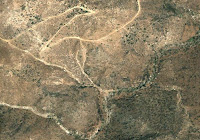
Just to give you a sample, at right is a section of a four-wheeling road we know well, called "Oriflamme Canyon" (click to get a full-sized view). The lower elevations are lower in the photograph, and you can see the tree-filled wash at the bottom (this is perhaps 25 feet across). Above it in the photograph you can see the four-wheel drive road, with a pair of switchbacks as it climbs the canyon wall. That road is just barely one car-width wide. You can also see side-washes descending from the road-cut into the main Oriflamme Canyon bottom. As I panned around this area (you can navigate wit the photos up just as easily!), I could pick out springs, streams, and areas where underground water made lush vegetation. This is high enough resolution to make an excellent hiking/four-wheeling planner. Amazing!

And it's all free. Google will make money, I presume, by targeted ads. For example, on the street map in my area I could see some restaurants and shopping areas marked. I suspect those markings will come in several graduations, and they will not be free to the vendor.

An Iraq followup

For a couple of years now, I've had "A Marine's Journal," written by Cpl. Brian Taylor, posted on my personal web site. That journal, originally published in the Wall Street Journal, was my best source of information about what it was like for the troops on the ground in the early days of the Iraq war. Cpl. Taylor's journal provided a gritty, obviously informed, and eloquent view of the Iraq war from a foot-soldier's perspective. It was great, and because of that, I've left it permanently posted on my site, where it has become one of the most popular areas for visitors.

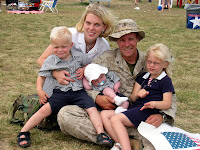
So you can imagine my delight to recieve emails the other day, first from Brian's brother Doug, and then from Brian himself. Brian and his family are pictured at right (click on the photo for a larger view), on the day of his return and reunion, which happened to be at Camp Pendleton, just north of where I live. I wish I could have been there to shake his hand and to say "Thank you" in person. This will have to do:

Thank you, Brian, for your service. And for that journal.

Brian has a family website up that includes a section on Operation Iraqi Freedom. This page includes a link to a page full of excellent and fascinating photographs — don't miss it. Brian has given me permission to use these photos, so you'll see some of them here as well.

Quote for the day

We're all in this alone.

   Lily Tomlin

Wednesday, April 6, 2005

Denzel 'da man!

I confess to having a nearly irresistable urge to skip reading anything that involves a Hollywood star — the probability is just too high that the story will involve outrageously inappropriate behavior by someone who is adored by millions (and who makes millions). These stories infuriate me.

But here's a story I'm glad I decided to read: Denzel Washington (an actor whose work I've long admired) just doing a little bit to to help our soldiers. Way to go, Denzel! From Gateway Pundit:

Denzel Washington was visiting BAMC (Brooke Army Medical Center, in San Antonio,Texas) the other day. This is where soldiers that have been evac'd from Germany come to be hospitalized in the States, especially burn victims.

They have buildings there called Fisher Houses. The Fisher House is a hotel where soldiers' families can stay, for little or no charge, while their soldier is staying in the hospital. BAMC has quite a few of these houses on base but as you can imagine, they are almost completely filled most of the time.

While Denzel Washington was visiting BAMC, they gave him a tour of one of the Fisher Houses. He asked how much one of them would cost to build. He took his check book out and wrote a check for the full amount right there on the spot.

The truth

Another excellent column by Claudia Rosett, posted up on OpinionJournal. The start (but don't miss the rest!):

A friend was wondering the other day what frontiers are left to explore, now that scientists have pretty much mapped the planet. The answer, I'd suggest, lies less in the stars than along the frontiers of human freedom--which over the past few decades have been edging out dictatorships from Asia to Latin America to Eastern Europe. Today, sped along by President's Bush's bold move two years ago to break the despotic gridlock of the Middle East by overthrowing Saddam Hussein, that same push for freedom has arrived at the region's palace gates.

Though Saddam has been the only Middle Eastern tyrant so far to fall, there is no question that in the politics of that region a shift is under way. It seems that even in a part of the world the West has long written off as the turf of dictators, oil and not much more, people want freedom. The removal of Saddam is reverberating far beyond Iraq. In recent months the message has become ever clearer, from the astounding election turnout in Iraq, to the demonstrations for democracy in Lebanon, to dissidents raising their voices in Syria, to public demands for pluralism in Egypt--as well as the continuing democratic foment in Iran.

In all this, no where has the clamor for liberty and accountable government been more acute than in Lebanon, a nation that during the last century boasted democratic institutions before there were mutilated by war, then smothered by Syria's occupying forces. And in recent weeks, in their struggle for freedom, the Lebanese people have voiced a vital demand, one that deserves far more attention than even the considerable amount it has already received. They have been telling it in English to the world press, and writing it in Arabic in white-and-black signs across their country, on walls, billboards and banners.

They are demanding, simply: "The Truth."

Defining victory

From AustinBay Blog, an answer from "a senior military officer":

The extremists that brought terror to our shores are intent on achieving – by force of arms - a xenophobic and repressive state based on a skewed understanding of Islam. They desire a future for the Muslim world that looks like something out of the seventh century with an extremist and intolerant interpretation of Islam. Their future-world would be a much larger version of the backward and authoritarian regime in Taliban-led Afghanistan, with no scope for liberty, basic women’s rights, or the freedom of religion. Such a future runs counter to basic concepts of freedom and human dignity, and is not what the vast majority of Muslims want for their children or grandchildren. The extremist-terrorists, however, are clever in hiding their ultimate goals. Their campaign plan is to mask their objectives while playing on unfounded, but deep-seeded fears in the Islamic world about the west via an intimidated news media, and with help from co-opted financial, educational and weapons smuggling organizations across with regional and global scope.

Our counter to the extremist plan is to apply unrelenting military pressure on the leadership and terrorists operatives that spearhead the ideology, while simultaneously applying the western financial, diplomatic, educational and social skills necessary to help Islamic states build effective governance that cares for people’s needs, allows them political participation, and dampens the appetite for violent action against perceived repression. This battle between moderation and extremism requires all nations to engage in the struggle – pressuring terrorist networks, and helping the governments of the Islamic world to succeed for their people.

The whole thing is worth reading, if for no other reason than as an object lesson in the danger of stereotyping "military thinking". I hope we have a lot of officers of this caliber. In my brief career in the U.S. Navy (many moons ago), I saw little evidence of intelligent life in the officers I knew (as an enlisted man), so this was of interest to me on several levels...

President Talbani

From Iraq the Model, some commentary:

This morning marked another turning point in the history of Iraq when the elected Iraqi National Assembly publicly elected and approved the new president of Iraq and his new deputies.

I personally welcome the decision of choosing Mr. Talbani for this position because this step proves again that Iraqis are willing and working hard to bridge the gap between the different components of the Iraqi nation and to overcome the differences and disputes among them.

This new formation of presidency in Iraq will certainly strengthen the unity of this nation and it prove again that Iraq is a home for all Iraqis; not only the Arabs, not only the She'at or any other single race or sect.

Looks to me like a big milestone on President Bush's strategy of spreading democracy. Celebrate!

Quote for the day

If you lose the power to laugh, you lose the power to think.

   Clarence S. Darrow

Monday, April 4, 2005

Dirty galaxy

Astronomy Picture of the Day quietly publishes a new and interesting picture every single day. It's one of my favorite daily browsing sites, partly because there's always an interesting and/or delightful surprise awaiting me. Like today's, at right (click on the picture for a larger view).

Basically, APOD says that this picture is of an elliptical galaxy with "dust lanes" that are the detritus of one or more collisions with spiral galaxies. And basically quite beautiful.

A German CEO's view

This is the fourth or fifth such column I've seen over the past few months, and by far the best. Could a turnaround in European attitudes be in the offing?

EUROPE - THY NAME IS COWARDICE
Commentary by Matthias Doepfner CEO, Axel Springer, AG

04.04.05 | A few days ago Henry Broder wrote in Welt am Sonntag, "Europe - your family name is appeasement." It's a phrase you can't get out of your head because it's so terribly true.

Appeasement cost millions of Jews and non-Jews their lives as England and France, allies at the time, negotiated and hesitated too long before they noticed that Hitler had to be fought, not bound to toothless agreements.

Appeasement legitimized and stabilized Communism in the Soviet Union, then East Germany, then all the rest of Eastern Europe where for decades, inhuman, suppressive, murderous governments were glorified as the ideologically correct alternative to all other possibilities.

Appeasement crippled Europe when genocide ran rampant in Kosovo, and even though we had absolute proof of ongoing mass-murder, we Europeans debated and debated and debated, and were still debating when finally the Americans had to come from halfway around the world, into Europe yet again, and do our work for us.

Rather than protecting democracy in the Middle East, European appeasement, camouflaged behind the fuzzy word "equidistance," now countenances suicide bombings in Israel by fundamentalist Palestinians.

Appeasement generates a mentality that allows Europe to ignore nearly 500,000 victims of Saddam's torture and murder machinery and, motivated by the self-righteousness of the peace-movement, has the gall to issue bad grades to George Bush... Even as it is uncovered that the loudest critics of the American action in Iraq made illicit billions, no, TENS of billions, in the corrupt U. N. Oil-for-Food program.

And now we are faced with a particularly grotesque form of appeasement... How is Germany reacting to the escalating violence by Islamic fundamentalists in Holland and elsewhere? By suggesting that we really should have a "Muslim Holiday" in Germany.

I wish I were joking, but I am not. A substantial fraction of our (German) Government, and if the polls are to be believed, the German people, actually believe that creating an Official State "Muslim Holiday" will somehow spare us from the wrath of the fanatical Islamists.

One cannot help but recall Britain's Neville Chamberlain waving the laughable treaty signed by Adolf Hitler, and declaring European "Peace in our time".

What else has to happen before the European public and its political leadership get it? There is a sort of crusade underway, an especially perfidious crusade consisting of systematic attacks by fanatic Muslims, focused on civilians, directed against our free, open Western societies, and intent upon Western Civilization's utter destruction.

It is a conflict that will most likely last longer than any of the great military conflicts of the last century - a conflict conducted by an enemy that cannot be tamed by "tolerance" and "accommodation" but is actually spurred on by such gestures, which have proven to be, and will always be taken by the Islamists for signs of weakness.

Only two recent American Presidents had the courage needed for anti- appeasement: Reagan and Bush.

His American critics may quibble over the details, but we Europeans know the truth. We saw it first hand: Ronald Reagan ended the Cold War, freeing half of the German people from nearly 50 years of terror and virtual slavery. And Bush, supported only by the Social Democrat Blair, acting on moral conviction, recognized the danger in the Islamic War against democracy. His place in history will have to be evaluated after a number of years have passed.

In the meantime, Europe sits back with charismatic self-confidence in the multicultural corner, instead of defending liberal society's values and being an attractive center of power on the same playing field as the true great powers, America and China.

On the contrary - we Europeans present ourselves, in contrast to those "arrogant Americans", as the World Champions of "tolerance", which even (Germany's Interior Minister) Otto Schily justifiably criticizes. Why? Because we're so moral? I fear it's more because we're so materialistic, so devoid of a moral compass.

For his policies, Bush risks the fall of the dollar, huge amounts of additional national debt, and a massive and persistent burden on the American economy - because unlike almost all of Europe, Bush realizes what is at stake - literally everything.

While we criticize the "capitalistic robber barons" of America because they seem too sure of their priorities, we timidly defend our Social Welfare systems. Stay out of it! It could get expensive! We'd rather discuss reducing our 35-hour workweek or our dental coverage, or our 4 weeks of paid vacation... Or listen to TV pastors preach about the need to "reach out to terrorists. To understand and forgive".

These days, Europe reminds me of an old woman who, with shaking hands, frantically hides her last pieces of jewelry when she notices a robber breaking into a neighbor's house.

Appeasement? Europe, thy name is Cowardice.

Sunday, April 3, 2005

Nesting towhee

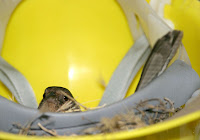
The chaparral environment we live in is particularly rich in bird life, and the California Towhee is one of the more common birds here. This particular female towhee decided that our enclosed patio (which is filled with all sorts of junk), and in particular this hanging safety helmet, was exactly the right place for her nest. I first noticed the nest a week or so ago, by the little piece of straw hanging out. I took the helmet off its hook and looked inside, and there was the nest, complete with five light blue eggs, speckled with black, gray, and brown. I carefully put the helmet back, and to my relief the momma towhee went right back to it.

Over the past week, we've been watching momma, and she's gradually gotten more used to our comings and goings. The helmet happens to be hanging right over a doorway that leads out of our patio and into our outdoors cattery. This isn't the kind of peaceful, out-of-the-way place I'd imagine a mother towhee would be looking for! We use that doorway perhaps 10 or 12 times a day, and there are two cats in easy visual range of the nest. But momma must have liked it for some reason...

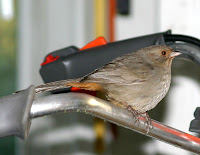
This morning I took my camera to see if I could get a picture or two. I took the first picture with a flash from about 6 feet; momma seemed completely unperturbed. I then put a stool about 3 feet from the nest and stood up on it — momma didn't like that one bit! She took off suddenly from the nest (startling me), and then landed a few feet away, scolding me. To my surprise, she then started darting at me, obviously trying to scare me away or to get my attention. She even landed briefly on my hand (still holding the camera) and flapped about. I stepped off the stool and momma landed on the handle of a hanging weed whacker, where I took this second picture (from about 8 feet, again with a flash). When I stepped back a couple of feet, she went right back to the nest.

Brave, good momma...

P.S. Click on the pictures for a larger verion...

"Hell, no"

Claudia Rosett, despite being a card-carrying member of the MSM, has a terrific track record of old-fashioned reporting combined with crisp (and often entertaining) prose. She's one of our secret weapons in the cause of freedom.

In a column in the Weekly Standard (registration required), she takes aim at Kofi Annan's recent response at a news conference to a reporter's question about whether he was considering resigning. Her column starts out with a crisp summary:

IN THE EPIC UNITED NATIONS Oil-for-Food scandal, we now have a moment of high farce, with what will surely be remembered as Kofi Annan's "Hell, no" press conference--named for the secretary general's belligerent answer on March 29 to a reporter who, quite appropriately, wondered if Annan shouldn't think about resigning sometime soon. The U.N.-authorized inquiry into Oil-for-Food wrongdoing, led by former Federal Reserve chairman Paul Volcker, clocked in last Tuesday with its second interim report on a program now infamous as the biggest fraud in the history of humanitarian aid. That same afternoon, Annan summoned the media to the blue-curtained U.N. briefing room to announce his great relief at "this exoneration."

What exoneration? Despite its scores of investigators, $30 million budget, and more than 10 months on the job, the Volcker inquiry has addressed only a few narrow issues. The focus of this second interim report was Annan's role in the U.N.'s hiring in 1998 of an Oil-for-Food contractor, Swiss-based Cotecna Inspection, S.A., which employed Kofi Annan's son, Kojo, as a consultant, while bidding on the lucrative U.N. contract to inspect Oil-for-Food imports in Saddam Hussein's Iraq. Cotecna, coincident with its U.N. labors, kept paying Kojo Annan from 1999 through early 2004, five years after he had quit. These are intriguing matters. But Volcker has yet to address the bulk of the Oil-for-Food program, and his final report is not expected till mid-summer. It was Annan himself who just last year was urging all and sundry to wait for Volcker's final wordbefore reaching any conclusions.

Now, in his rush to exonerate himself, the secretary general seems to have forgotten that Oil-for-Food was a vast endeavor, running from 1996 to 2003, in which the United Nations, in the name of providing for the sanctions-squeezed people of Iraq, oversaw more than $110 billion worth of Saddam Hussein's oil sales and relief purchases, much of that riddled with billions in graft. All but the first month of this exercise was administered and--in the words of one of Annan's spokesman--"audited to death" by Annan's Secretariat. It was Annan who personally signed off on Saddam's shopping lists, and repeatedly urged the Security Council not only to continue the program, but to expand it in size and scope, which allowed Saddam to rake in yet more illicit billions from oil smuggling.

The column goes on to back up these points with specifics.

We're left with the feeling that Kofi's "Hell, no" required quite a bit of chutzpah...and it just reinforces our previously held position that the world would be much better off without Kofi at the helm of the United Nations. And without the United Nations at all.

Dead wrong?

James Robbins at the National Review has an interesting take on this question. From his column:

Ultimately the Iraq Survey Group did not find as much evidence of WMD programs as expected. But note — the same Post poll cited above found that 56 percent of Americans still believe Saddam Hussein had WMDs before the war that have not been found. The Fall 2004 Duelfer report concluded that Saddam had intended to reconstitute his WMD program after sanctions were lifted, and desired to maintain the expertise necessary to do so. And it is still fair to ask, if Saddam was not trying to acquire WMDs, what was he doing? The Duelfer report notes the following changes in Iraq's Military Industrialization Commission (MIC), Saddam's secret organization in charge of WMD development, in the years leading up to the war:

"Between 1996 and 2002, the overall MIC budget increased over forty-fold from ID 15.5 billion to ID 700 billion. By 2003 it had grown to ID 1 trillion. MIC's hard currency allocations in 2002 amounted to approximately $364 million. MIC sponsorship of technical research projects at Iraqi universities skyrocketed from about 40 projects in 1997 to 3,200 in 2002. MIC workforce expanded by fifty percent in three years, from 42,000 employees in 1999 to 63,000 in 2002."

So the MIC enjoyed a budget increase from fifteen billion to one trillion Dinars over seven years for nothing? MIC technical research projects increased 80-fold for no particular reason? Then there was the very well-chronicled systematic deception campaign that U.N. inspectors encountered every time they went into Iraq. In more than one case inspectors would pull up to a site and be halted; surveillance would pick up vehicles being loaded in the back and hurrying away; inspectors would then be allowed in. What was being carted away so quickly? If nothing was there, what was going on? One theory behind the deception campaign was that it was itself a deception — it was not so much that Saddam had something to hide, but rather he wanted to make us think he had something to hide in order to deter us from attacking him. That rationale was clearly too clever by half if true, at least judging by the results. (It is better to act like North Korea and say you have nuclear weapons whether you do or not.)

But I don't buy that explanation. The deception campaign was too systematic, too thorough, in ways that went well beyond what would be necessary simply to generate suspicion. This activity continued during and after the war when it would make no difference. One case in point — an exploitation team went to check out an apartment in an otherwise unexceptional residential area that was allegedly being used as a WMD site. They arrived to find the apartment stripped. The floor tiles were missing, the walls cleaned, the plumbing fixtures gone, the pipes under the floors ripped out. This was not the result of looting — the apartment had been sanitized, disinfected. How many such sites could there have been in Iraq? Were they all found and checked? Strains of biological organisms that could be weaponized were found in a scientist's home refrigerator — how much such dispersal took place? Not to mention allegations that critical nuclear and chemical program components were taken to Syria, Iran, or Russia.

Indeed. It seems very unlikely that Saddam would invest all that time, effort, and money into a gigantic practical joke on his buddy Hans Blix.

I remember in the runup to the Iraq war there were news reports about a large freighter that had sailed from Iraq and was then circling about in the Indian Ocean. The speculation was that this freighter was carrying Saddam's stocks of biological and chemical weapons, and that he'd sink it rather than face the music on WMD charges. I never heard the end of this story, but...it seems much more plausible to me than the practical joke.

Meet the chairman

According to Mohammed at Iraq the Model, the Iraqi Assembly has finally selected a chairman. At this hour I could not find corroboration for this on any MSM outlet; coverage of the Pope's passing is dominating.

This is very good news for Iraq. Given the very complicated rules and the coalitions that had to be put together to accomplish this, and the fact that this is the first time the Iraqis have ever engaged in a process even remotely like this, the progress is remarkable.

Mohammed reports that the choice is Hachim Al-Hasani, currently the minister of industry. His description paints him as a trusted moderate, who is likely to focus on governmental corruption — which sounds like a terrific place to start.

Let's hope this good start translates into good execution...

UPDATE: This good news has now been confirmed by numerous sources.

Quote for the day

The natural flights of the human mind are not from pleasure to pleasure, but from hope to hope.

   Dr. Samuel Johnson

Saturday, April 2, 2005

Sunny Sunnis

A group of influential Sunni clerics — 64 imams and scholars — issued a fatwa directing their Sunni followers to start joining the Iraqi police and army. A tip of the hat to Captain's Quarters for alerting me to this story.

I was very surprised to see this news. So much so, in fact, that my initial instinct was that the announcement was either a hoax (it was April Fool's day, after all) or a trick of some sort. If it's the former, it's fooled a lot of people, including the New York Times (I know, I know — it wouldn't be the first time). If it's the latter, it's subtle enough to completely escape my ken. So I'm taking the announcement at face value. From the grey lady:

BAGHDAD, Iraq, April 1 - A group of Sunni Arab clerics, including some hard-line figures who fiercely oppose the American presence here, issued a statement on Friday urging their fellow Sunni Arabs to join the Iraqi Army and police.

The edict, signed by 64 imams and religious scholars, was a striking turnaround for the clerics, who have often lashed out in sermons at the fledgling army and police force and branded them collaborators.

Prominently missing from the signers was Harith al-Dari, the leader of the Association of Muslim Scholars and one of the most influential Sunni Arab clerics in Iraq, who is said to have close ties to the insurgency.

Still, the directive, which carried the signature of Ahmed Hassan al-Taha, an imam at an important Baghdad mosque who has been a strong critic of the occupation, seemed to represent a significant step.

Many if not most insurgent attacks in recent months have been aimed at the police and army, which are largely composed of Shiites. The cleric who announced the edict, Sheik Ahmed Abdul Ghafour al-Samarrai, said he hoped and believed that the new directive would undercut those attacks.

But Sheik Abdul Ghafour also made clear that the order was aimed at regaining some control over Iraq's new security forces, not saving Shiite lives. Sunni Arabs dominated the higher echelons of the military under Saddam Hussein, and many, enraged by the American decision to dissolve Mr. Hussein's army two years ago, joined the insurgency.

"The new army and police force are empty of good people, and we need to supply them," the edict said. "Because the police and army are a safeguard for the whole nation, not a militia for any special party, we have issued this fatwa calling on our people to join the army and police."

The edict contained a condition seemingly aimed at sweetening the pill for resistant Sunni Arabs: that a new police or army recruit must agree "not to help the occupier against his compatriots."

The edict contained a condition seemingly aimed at sweetening the pill for resistant Sunni Arabs: that a new police or army recruit must agree "not to help the occupier against his compatriots."

The condition about "not helping the occupiers against his compatriots" is a little troubling. One can imagine a scenario wherein a mixed force of Iraqi Army and US Marines is attacking an insurgent group, and the Sunni components of the Iraqi Army stand down, refusing to fight, when they discover (or believe) that the insurgents happen to be Sunni. Certainly not good. On the other hand, it's better than having those Sunni Army members in the insurgent group. So it's a step forward, though I'm not sure how big in practice.

In attitude, though, it seems like a huge leap. I can't help but wonder about the timing of it. What caused the imams and scholars to do this just now? The hopeful view would be that they've seen the positive results of the elections and the security forces and they want to be part of the success. I hope that's what it is. The more cynical and suspicious view would be that they see this as a way for their resistance to be more successful — and I certainly hope that's neither true nor accurate!

Quote for the day

It's a damn poor mind that can think of only one way to spell a word!

   Andrew Jackson

Friday, April 1, 2005

Light power

What you see at right is a picture of a very nearly perfect sunny Southern California day (today!), as seen by an instrument called a pyrometer. This instrument measures the incident solar power in my backyard every minute. This is just fancy talk for how much heating power the shining sun is delivering. It's calibrated in watts per square meter.

You can tell a lot from this simple graph. Most basically, you can see that the sun rose this morning at around 6 am, and it's going to set around 6 pm. You can see that it looks at least roughly like a chopped-off sine wave, and in fact it's very close to that, as a sine wave is exactly how it would look if the only effect on the sun's power was its elevation in the sky. But there are a few other things affecting the sun's power.

For instance, when the sun is low in the sky, its rays are traveling through more air to get to my yard. This additional air (and the junk floating around in it) attenuate the rays even more than is accounted for by the elevation. Then there's the scattering effect, most easily seen just before sunrise where the graph shows a little bit of slowly gathering power. If I had a pyrometer on the moon, there would be no such slow gathering of light — the light would either be there or not as the sun rose. But I live where there's an atmosphere (thank goodness!), so the scattering of light in the pre-dawn sky registers on this instrument as that gentle curve at sunrise that accelerates into the near sine wave when the rising sun strikes the instrument.

And finally there's the effects of the slight cloudiness that developed this afternoon just before 4 pm. You can easily see the sudden drop on power as a cloud obscures the sun, and the "choppiness" afterwards as clouds pass overhead.

More than you wanted to know ?

So different

...and it got me to thinking about my own first military homecoming. A very different one. I was an enlisted sailor in the U.S. Navy, serving on the USS Long Beach, a nuclear-powered guided missile cruiser. I'd gone out to sea on a cruise, and had been gone for many months. When I returned to our home port of Long Beach, California, and left the ship and base for the first time, I was in uniform because all my civilian clothes were in storage. At that time (this was the early '70s; the Vietnam War was still going on) sailors were not allowed to take their civilian clothes on the ship.

I had a long walk from the main gate to the "locker club" where my stuff was stored. At first, the walk was very pleasant — my first view in many months of good old America. But that pleasantness was soon destroyed. First by a pretty girl walking toward me, her face all twisted with emotion as she cursed me on her way by. "Baby killer" she called me. I was shocked, very shocked, though of course I had seen on TV and read plenty about anti-war protests. Then other things happened — people yelling hateful things from passing cars, signs in shop windows saying "Sailors and Dogs Not Welcome", a schoolbus full of high school kids telling me how despicable I was. But the worst was yet to come.

I got my clothes from the locker club (they were friendly in there, at least), and walked in civilian clothes toward the long-term car storage place where I had stashed my 1965 Ford Country Squire station wagon. I was still recognizable as a sailor because of my haircut, and I still got some trash from passers-by — though by this time I was getting pretty angry about it, and was no longer quite so shocked. By the time I arrived at the place that was storing my car, all I wanted to do was escape, as quickly as possible. I walked into the storage place's office, and presented the clerk — a long-haired, scroungy looking young man — with the paperwork for my car. He threw it back at me and said that I could not have my car, as he was not about to do anything to help "an enemy of all mankind" like me, and he told me in a quite vulgar and direct way what I could do with my paperwork. I've never forgotten that phrase: an enemy of all mankind. What a label to put on a returning sailor. Not exactly an uplifting moment.

At that time I was a very naive young man, quite literally straight off the farm, and I had no idea what I could do. I couldn't even imagine what recourse I might have in the face of this young man's simple refusal to serve me. I just stood there, gaping, for who knows how long...probably just a few seconds. And then a grizzled, grimy, greasy man of approximately World War II vintage came into the office; the owner, I found out later. He grabbed my paperwork, got my car, and I was on my way. After a few hours driving through the beautiful California countryside, down to Lake Elsinore where I camped over the weekend, I got my psychic balance back. But as you can probably imagine, the whole experience remains pretty fresh in my memory...

As I watch our soldiers being greeted in a much different way on their homecomings from Afghanistan and Iraq, I have a very strong emotional reaction. I find myself choking back tears at the simplest little such story. The ad from the Superbowl, with the returning soldiers being cheered by the passengers in the airline terminal had me teary-eyed — and unreasonably happy and proud — for days. And the simple story from TigerHawk, in its own way, did the same. Silly perhaps, but for this Vietnam-era veteran seeing the wonderful welcome these troops are getting is somehow putting to bed the last of the bad memories and feelings I've had ever since my Navy days.

Thanks, TigerHawk, for welcoming the troops as you did. Read TigerHawk's whole story here, but here's the good part:

Traffic cops and a slew of passersby lined the sidewalk. A Coast Guard helicopter buzzed in from Corpus Christi Bay then banked.

We joined the crowd on the corner of Water Street and Peoples. We may have waited three minutes, at the most. Here came the convoy — a police escort followed by two buses filled with young Marines. We cheered, saluted and clapped as the company rolled by. (I feel certain the company belongs to the 1/23rd Marines. The 1/23rd is a Marine reserve battalion just back from Iraq — and I have friends in Central Texas whose sons serve in that unit. If I’ve got the Corpus Christi unit misidentified, post a comment or drop me an email and I’ll correct it.)

Most of us old codgers wore short-sleeves and slacks, so it’s a fair bet the Marine reservists didn’t know their former Corps commander and his senior staff were cheering with the home crowd. (Probable wisecrack if someone informed a lance corporal: “Hey, sarge—are those the guys responsible for all the dumb orders you didn’t like?”)

Actually, the Marines were smiling and waving—the one memorable face I saw framed in the bus window as it shot past was that of a delighted but obviously tired young man.

Jet lag or Iraq lag? Or lag from a week at the 29 Palms Marine base? Doesn’t really matter now – welcome home.

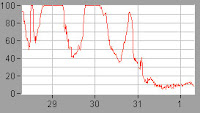
A hint of desert summer

The graph at right was produced from data collected by an automated weather instrumentation system we have at our home (a WeatherHawk system). For months, during our blessedly normal wet season, we've had very temperate weather — lovely temperatures and relative humidities that most people would at least recognize. But yesterday one of our notorious "Santa Ana" weather systems moved in, and the hot, dry, desert winds came in. At around 10 pm on Wednesday evening the humidity was 90%; just four hours later, at 2 am on Thursday morning, it hit 10%. The low yesterday was 4% and as I write these words on Friday morning it is 10% and falling as the sun rises in our perfectly clear eastern skies. The big surprise for me is that the relative humidity can be so low despite the fact that our ground (and the chaparral) is still soaking wet.

This is a foretaste of our summer!

The 100 best

Hat tip to TigerHawk for the pointer. Here's a sample:

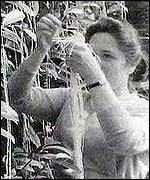
The Swiss Spaghetti Harvest

On April 1, 1957 the British news show, Panorama, broadcast a segment about a bumper spaghetti harvest in southern Switzerland. The success of the crop was attributed to an unusually mild winter. The audience heard Richard Dimbleby, the show's highly respected anchor, discussing the details of the spaghetti crop as they watched a rural Swiss family pulling pasta off spaghetti trees and placing it into baskets.

"The spaghetti harvest here in Switzerland is not, of course, carried out on anything like the tremendous scale of the Italian industry," Dimbleby informed the audience. "Many of you, I'm sure," he continued, "will have seen pictures of the vast spaghetti plantations in the Po valley. For the Swiss, however, it tends to be more of a family affair."

The narration then continued in a tone of absolute seriousness:

"Another reason why this may be a bumper year lies in the virtual disappearance of the spaghetti weevil, the tiny creature whose depradations have caused much concern in the past."

Dimbleby anticipated some questions viewers might have. For instance, why, if spaghetti grows on trees, does it always come in uniform lengths? The answer was that "this is the result of many years of patient endeavor by past breeders who succeeded in producing the perfect spaghetti."

And apparently the life of a spaghetti farmer was not free of worries: "The last two weeks of March are an anxious time for the spaghetti farmer. There's always the chance of a late frost which, while not entirely ruining the crop, generally impairs the flavor and makes it difficult for him to obtain top prices in world markets."

But finally, Dimbleby assured the audience that, "For those who love this dish, there's nothing like real, home-grown spaghetti."

Of course, the broadcast was just an April Fool's Day joke. But soon after the broadcast ended, the BBC began to receive hundreds of calls from puzzled viewers. Did spaghetti really grow on trees, they wanted to know. Others were eager to learn how they could grow their own spaghetti tree. To this the BBC reportedly replied that they should "place a sprig of spaghetti in a tin of tomato sauce and hope for the best."

To be fair to the viewers, spaghetti was not a widely eaten food in Britain during the 1950s and was considered by many to be very exotic. Its origin must have been a real mystery to most people. Even Sir Ian Jacob, the BBC's director general, later admitted that he had to run to a reference book to check on where spaghetti came from after watching the show.

The prestige of the Panorama show itself, and the general trust that was still placed in the medium of television, also lent the claim credibility. The idea for the segment was dreamed up by one of the Panorama cameramen, Charles de Jaeger. He later said that the idea occurred to him when he remembered one of his grade-school teachers chiding him for being "so stupid he would believe spaghetti grew on trees."

You can read the other 99 here (they're just as good!).

Quote for the day

If fifty million people say a foolish thing, it is still a foolish thing.

   Anatole France

Thursday, March 31, 2005

How does the man do it?

Mark Steyn: the man is a first-class column machine-gun stud. I can't imagine how any single human could produce stuff of this quality day in and day out.

And I didn't think anybody was going to be able to make me smile today, much less laugh. But Mark did:

Do you remember a fellow called Robert Wendland? No reason why you should. I wrote about him in this space in 1998, and had intended to return to the subject but something else always intervened — usually Bill Clinton’s penis, which loomed large, at least metaphorically, over the entire era. Mr Wendland lived in Stockton, California. He was injured in an automobile accident in 1993 and went into a coma. Under state law, he could have been starved to death at any time had his wife requested the removal of his feeding tube. But Rose Wendland was busy with this and that, as one is, and assumed there was no particular urgency.

Then one day, a year later, Robert woke up. He wasn’t exactly his old self, but he could catch and throw a ball and wheel his chair up and down the hospital corridors, and both activities gave him pleasure. Nevertheless Mrs Wendland decided that she now wished to exercise her right to have him dehydrated to death. Her justification was that, while the actual living Robert — the Robert of the mid-1990s — might enjoy a simple life of ball-catching and chair-rolling, the old Robert — the pre-1993 Robert — would have considered it a crashing bore and would have wanted no part of it.

You'll be sorry if you don't read the whole thing.

Tell me it ain't so!

Would you believe that 11 illegal aliens could board an U.S. airliner with minimal ID? Bryan Preston posts this scary report on Michelle Malkin's great new Immigration Blog.

The good news is that an air marshal's vigilence led to the capture of these illegal aliens, and they are now detained pending a deportation hearing (and after they're deported they'll probably bounce right back in, but that's another story). The bad news is that they got on that plane in the first place. As Bryan reports it:

Good for the air marshalls on this one, but bad for airline security. Read that second paragraph again--how did the illegals get on that plane? By presenting a "Mexican voter registration card that contained a name, age and photo." That should not be sufficient ID to board a plane in the post-911 United States. And yet it is.

Chances are, by the way, that the "voter registration card" in this story is actually a matricula consular card. Those cards are issued by the Mexican government to...well...just about anyone:

Management of Chaos

Nice report, TigerHawk. A teaser excerpt:

So where does the war stand now, according to al Qaeda? A leading al Qaeda operative has written a book, the title of which translates loosely to “The Management of Chaos.” According to al Qaeda, the current stage of revolution is the stage of “vexation and exhaustion” of the enemy. They have a notion of how to do this to the Americans and to their 'puppets'.

You vex and exhaust the Americans, according to al Qaeda, by making them spend a lot of money. The United States is a materialist society, and if forced to spend too much money it will “cut and run.”

The means to this end is to force the Americans to spread themselves thinly. Al Qaeda wants to strike everywhere, not just spectacular high value attacks. This will cause the Americans to defend a lot of places at high cost.

In addition, al Qaeda wants to force Americans to carry the war into the heartland of the Middle East [We have obliged them in this. - ed.] There are two reasons why al Qaeda sought an American invasion in the Middle East. First, it will be very costly for the United States and will therefore drain our treasury. Second, bringing the war to the heartland will have a polarizing effect within Muslim society. Doran believes that they borrowed this “polarization” idea from Palestinian organizations of the 60s and 70s. Americans striking back “without precision” will polarize Muslim society between supporters and proponents of jihad.

It is not necessary, according to al Qaeda, that they get the great masses on their side. The goal is to win over “an important segment of the youth.” Their propaganda is directed to young men. One of their propagandists says that “if we can win over only 5% of one billion Muslims, we will have an unbeatable army.”

Now go read the whole thing. There will be a test afterward. The lecture was by Professor Michael Doran.

That Lance

The Lance in Iraq blog of 1st LT Lance Frizzell has become a regular part of my blog-reading routine. Read it for a few days and I suspect you'll be hooked as well. Today he posted some commentary about the importance of winning over the Iraqi teens, along with a selection of endearing pictures like the one I've reproduced here. Don't miss it!

Hat tip to Lance for the pointer to this article on the significance of the Iraqi teens...

A big prize

Dr. Boyle is a radiologist who also happens to have an excellent blog. He's not happy about what he's heard on the media about the interpretation of Terri Schiavo's CT scans. His central points are:

-- The TV talking head docs pontificating on the CT scans are neurologists, not radiologists...and neurologists don't interpret CT brain scans, radiologists do.

-- He does not believe it is possible to reliably diagnose persistent vegetative state from CT scans.

And he's willing to put his money where his mouth is:

Who Wants To Be A Millionaire?

To prove my point I am offering $100,000 on a $25,000 wager for ANY neurologist (and $125,000 for any neurologist/bioethicist) involved in Terri Schiavo's case--including all the neurologists reviewed on television and in the newspapers who can accurately single out PVS patients from functioning patients with better than 60% accuracy on CT scans.

I will provide 100 single cuts from 100 different patient's brain CT's. All the neurologist has to do is say which ones represent patients with PVS and which do not.

If the neurologist can be right 6 out of 10 times he wins the $100,000.

I Said What I Meant, And I Meant What I Said

My points are what I first said about the image from Terri Schiavo's CT scan:

1) It is NOT as bad as the neurologists and bioethicists play it up to be; and,

2) There are many elderly patients with various levels of mental functioning who have severe atrophy that is difficult to distinguish from Terri Schiavo's atrophy

I stand by what I said. And I'm putting my money where my mouth is.

First, I can't help but applaud Dr. Boyle's activism here. Whether he's right or wrong, good for him for standing up and so forcefully making his case.

But on a different level, I find this quite troubling. Dr. Boyle is making a credible case (and standing behind it with his personal fortune!) that Terri's 'diagnosis' is even more flawed than I had heretofore believed. Making it even more likely that Terri has (had?) some hope of partial recovery through appropriate (but untried) therapy. And making it even more horrible that the courts have condemned her to die by starvation and dehydration. How could we let this happen in the U.S.? This is a series of actions of the type I'd expect to find in a place like North Korea or Yemen, not here...

Hat tip to Michelle Malkin for the pointer to this story...

We should worry

Peggy Noonan, writing in today's Opinion Journal, warns Republicans not to be dismissive of Hillary's run:

Republicans--I have been among many--are now in the stage of the Hillary Conversation in which they are beginning to grouse about those who keep warning that Mrs. Clinton will be a formidable candidate for president in 2008. She won't be so tough, they say. America will never elect a woman like her, with such a sketchy history--financial scandals, political pardons, the whole mess that took place between 1980 and 2000.

I tell them they are wrong. First, it is good to be concerned about Mrs. Clinton, for she is coming down the pike. It is pointless to be afraid, but good to be concerned. Why? Because we live in a more or less 50-50 nation; because Mrs. Clinton is smarter than her husband and has become a better campaigner on the ground; because her warmth and humor seem less oily; because she has struck out a new rhetorically (though not legislatively) moderate course; because you don't play every card right the way she's been playing every card right the past five years unless you have real talent; because unlike her husband she has found it possible to grow more emotionally mature; because the presidency is the bright sharp focus of everything she does each day; because she is not going to get seriously dinged in the 2008 primaries but will likely face challengers who make her look even more moderate and stable; and because in 2008 we will have millions of 18- to 24-year-old voters who have no memory of her as the harridan of the East Wing and the nutty professor of HillaryCare.

The Hillary those young adults remember will be the senator--chuckling with a throaty chuckle, bantering amiably with Lindsey Graham, maternal and moderate and strong. Add to that this: Half the MSM will be for her, and the other half will be afraid of the half that is for her. (You think journalists are afraid of the right? Journalists are afraid of each other.) And on top of all that, It's time for a woman. Almost every young woman in America, every tough old suburban momma, every unmarried urban high-heel-wearing, briefcase-toting corporate lawyer will be saying it. They'll be working for, rooting for, giving to the woman.

I am of course exaggerating, but not by much.

Of course underestimation of a political opponent is an absolutely classic mistake to make. I dismiss Hillary's opinions and world view (as expressed through the prism of her overriding ambition) all the time; 'tis but a small step from there to being dismissive of her political skills. I can easily see this happening -- much as happened to Mr. Bush in 2000. I'm with Peggy; I hope the Republican powers-that-be don't make the mistake of 'misunderestimating' Hillary Clinton.

Because the consequences would be very hard to bear...

Quote for the day

# It will be of little avail to the people that the laws are made by men of their own choice if the laws be so voluminous that they cannot be read, or so incoherent that they cannot be understood.

   Alexander Hamilton