Monday, March 27, 2017

Our man-killing window holes are now covered...

Our man-killing window holes are now covered...  And very nice-looking they are! These are the two covers that we traveled to Kalispell, Montana to pick up.  My brother Scott helped me install them today.  Both of them fit perfectly – another outstanding piece of work from the wonderful folks at Lazy K Wrought Iron!


I don't think I'll go out of my way to try this particular delicacy...

I don't think I'll go out of my way to try this particular delicacy...  Even though it's seafood, which I love.  Because it's fermented for six freakin' months, and I don't have to try that to know that I don't love it.

This stuff is from Sweden, it's called surströmming, and here's more than you ever wanted to know about it.  Watching the video is enough to convince me that Sweden should be quarantined from the rest of humanity, permanently.  First Volvos, then Abba, now surströmming?  That's three strikes, and they should be out!

Paradise ponders, burgers and Foyle's edition...

Paradise ponders, burgers and Foyle's edition...  We had kind of a lazy day yesterday.  I finished some chores in the house, built the second rib for the stairs, and then came inside for our afternoon meal: burgers.  That is, I had a burger (at right).  That's 3/4 pound of Macey's 85/15 burger (all that fat makes it delicious!), on a Macey's Asiago-and-onion roll, with avocado, ketchup, and sweet pickle relish.  Yum!  Debbie made her share of the ground beef into an enormous taco salad, low in sodium but apparently very tasty, as she ate the entire (gigantic!) thing.

After that meal we were so full that any resembling ambition flew off to an obscure country in southwest Asia.  So we crawled upstairs (slowly and carefully), and watched the last three Foyle's War episodes in a binge.  That's five hours of television, something I haven't done for decades.  The very last episode is a real shocker, ending with (literally) a big bang.  We're kind of sorry to be done with it.  But no matter, at our age we'll probably forget all about it within a few weeks, and can start it over as though it were brand new to us. :)

Today's big project for me is to help my brother Scott with his taxes.  I finished mine last week, except for the filing.  Doing my taxes never fails to put me in a bad mood, but the trip to Montana immediately following really helped pick me up.  In the future, I'm going to have to plan something nice for the few days immediately following tax prep.  It will help tamp down the anger I can't help feeling as I watch my hard-earned dollars being stolen by the government so they can waste it on something I don't believe in.

Before my brother gets here, I'm working on the stairs project.  I did an hour or so of sanding before I came up to write this post, and I'll probably go do some more in a little while.  Sanding is amazingly relaxing, and it's very good arm exercise. :)

Sunday, March 26, 2017

Back to the stairs project!

Back to the stairs project!  The stairs I'm building use a couple of “ribs” to hold up the big landing and the smaller stair.  These ribs will stand vertically, their bottom on the floor and their top inserted into a 1/2" deep slot routed in the bottoms of the redwood stairs.  I just finished fabricating the first one.

I started with a piece of redwood 2x12, cut to the right length on my chop saw.  Then I ripped it to the right maximum width on my table saw, and made the cuts that I could on my band saw.  The result is in the first photo below.  If you embiggen that one, you can see a couple of 1" cuts I made to make a notch – but the last cut (a 2 1/2" horizontal cut) there was no way to get the band saw in there.  I could have drilled a hole in there and then used the scroll saw, but that saw is not very good at straight lines (at least it isn't when I'm using it :).  So I decided to try chiseling that piece out, something I haven't done very often.  That's the middle photo, and it turned out to be much easier than I'd imagined it would be.  That notch will be invisible, so it didn't really have to be a nice straight line – but I'm glad it turned out that way anyhow.  The last photo shows the finished rib.  Now I need to make another one just like it...


Paradise ponders, sea bass and spinach edition...

Paradise ponders, sea bass and spinach edition...  My beautiful bride fed us in style yesterday afternoon, with the dish at right.  That's fresh sea bass, grilled perfectly, with a lovely sauce over it, on rice and steamed spinach.  That was great!

We ended up not doing much yesterday. :)  Our main activity was watching a couple of episodes of Foyle's War, one of our all-time favorite TV series, and one of the very few that I actually enjoy watching...

I'm not really surprised...

I'm not really surprised...  But I do feel the doom coming on...

Saturday, March 25, 2017

Paradise ponders, floods and snow stoppers edition...

Paradise ponders, floods and snow stoppers edition...  On Thursday morning, before the latest snow melted, I snapped the photo at right.  It shows our garage with a bit of snow on its roof, and if you squint hard you can see that there's a (new) piece of metal extending horizontally, about a foot above the gutter.  That's a “snow stopper” for standing seam steel roofs, invented by one of the employees (Tyler) of the roofer who installed all my roofing.  When he described it to me, I was a bit skeptical of its efficacy – so I had him install one on my garage (my worst snow falling-off-the-roof problem) as an experiment.  If it works, I told him, I have several other places that I'd add it to.

Well, based on the first test – admittedly an easy one, as we only got a half inch of snow – it's working exactly as he told me it would.  The snow is stopped in its tracks, and only a little bit escapes through the inch or so high open area underneath it.  That open area also allows the melted snow trickle through into the gutter.  We'll see how it does with a heavy snow, but for the moment I'm much encouraged.  I'm going to love it if this really does keep the giant piles of snow from forming right in front of my garage door!

Debbie and I took a drive up Blacksmith Fork Canyon this morning, mainly to see the river.  It's just barely above flood stage right now.  The muddy river is violently boiling through normally sedate rapids.  There are a dozen or so spots where the river is over its banks and onto fields or pastures.  There's some visible damage – bank erosion, trees toppled, etc. – but less than I'd expect for the power of the water we see.  That foot bridge that I snapped a photo of a week ago is gone with nary a trace – even the abutments, such as they were, have vanished.

Paradise ponders, 1,200 miles of electrons edition...

Paradise ponders, 1,200 miles of electrons edition...  Well, we rolled back into our garage late last night, after driving nearly 1,200 miles over the past two days.  For some reason I'm a little tired today. :)  We left home at 5 am on Tuesday, and pulled into our destination (Lazy K Wrought Iron's Kalispell shop) just under 12 hours later. 

This trip was a bit of an experiment for us, to see if we liked traveling a long distance in our Model X.  The big question mark was how the charging stops we'd have to make would work out.  Bottom line: it was great, and we'll do it again without hesitation.  We knew that traveling in such a comfortable, quiet, easy-handling, fun-to-drive car car would be great.  We weren't so sure that we'd like the stops every couple hundred miles to charge the car, though.  We stopped four times on the way up to Kalispell: in Idaho Falls (Idaho) and in Lima, Butte, and Missoula (Montana).  The amount of time we stopped varied from about a half hour to just over an hour, depending on how much charge we needed in order to reach the next Tesla Supercharger.

In the case of those particular Superchargers, there was something nearby to occupy our attention: a restaurant, a coffee shop, or the like.  I'm not sure if that's true for all Superchargers, but I wouldn't be surprised to find out that's true.  The Supercharger in Lima (at right) is in a tiny little town, but behind me was a restaurant (Jan's Cafe) that truckers seemed to favor.  We didn't eat there, but we noted that it got good reviews on both TripAdvisor and Yelp.  The other Superchargers were all in fairly large cities, with lots of possible charging-time activities within walking distance.

Each time we stopped for charging, we got out and walked around at the very least.  Often we grabbed something to eat or drink, and found a restroom.  This “stop every couple hundred miles or so” is not our usual traveling style when we're traveling to get someplace (as opposed to sightseeing).  For many years now, we've made high-speed dashes for long distances with very little stopping.  So this experience was a bit different for us, and ... we liked it.  It made the drive more relaxing and much less tedious.

Before this trip I spent some time with Tesla's Supercharger map and Google Maps, planning our route.  The tricky bit was trying to estimate how far our battery would take us, as I know it varies by what speed you're going, how much altitude change there is, what the temperature is, the wind, etc.  It's complicated!  Then when we started actually making the trip, I discovered completely by accident that the Tesla's navigation system does nearly all of this work for you – though not perfectly.  If I put our final destination in, the navigation system figures out all the Superchargers I'll need to stop at, and even tells me how long I have to stay there in order to get my charge up to snuff.  Very nice indeed!

But, as I mentioned previously, it's not a perfect system.  One thing in particular it seems to disregard is your speed.  I'm not sure what assumptions it makes, but it doesn't seem to take into account the high speed limit roads.  Several of the Interstates we took have 80 MPH speed limits, and that means the traffic was flowing along at about 85 MPH typically.  Aerodynamic drag on a car increases as the square of the speed, so the drag at 85 MPH is about double that at 60 MPH, and the drag probably dominates the power requirements for the motors at high speeds.  I suspect the navigation system simply assumes some fixed power consumption per mile, and when the road happens to be a high speed road, that estimate is considerably off.

So that meant we needed more charging than the navigation system estimated, which isn't really a big deal – those superchargers are fast.  But they're apparently not all created equal – our charging rate varied by about 2:1 from one Supercharger site to another.  I'm not sure why the rates varied, although some things I read this morning make me suspect that there was a partial failure in the lower speed ones we ran into.  It seems that the Supercharger equipment has a couple of levels of redundancy, including a modular approach that allows the charger to continue to work (albeit at lower speed) in the event of some kinds of electronics failures.  Slower charging is definitely better than no charging!

One thing we noted with a bit of surprise is that all eight of our charging stops (four up, four back), we were the only car charging.  We had been a bit worried about being delayed by a backlog of cars waiting to be charged, but that certainly wasn't an issue!  Each of the Supercharger sites we visited had eight charging stations, so at least at the moment there appears to be plenty of capacity.  I'm guessing that this is very dependent on exactly what route we're traveling, and probably on the time of day as well.

Another little imperfection in the navigation app took me a while to figure out: the navigation system didn't know about the existence of the Lima, Montana Supercharger site.  That led to it trying to route us from Butte to Idaho Falls, but at the 85 MPH speeds on that road the battery didn't have enough capacity to make it.  If we'd made that trip at 70 MPH, the car said we'd make it – but that would have been inconvenient, to say the least.  Fortunately I did know about the Lima Supercharger (from the Supercharger map on Tesla's web site), so I knew we could stop there.

When we stopped at Lazy K's shop, we got to meet Kevin and Abigail, the couple who owns Lazy K and with whom we worked remotely to get our fireplace door and sun room casement window covers built.  They were as nice in person as they were with all our calls and emails!  We also met their daughter, who helped us load the covers into our car.  Then we traveled just a few miles more to Whitefish, Montana and up to the Lodge at Whitefish Lake.  Though we were only there for the night, we enjoyed the beautiful view from our room's window (at right) and the nice people who helped us.  We ate dinner at the Tupelo Grille, where we had a wonderful mahi mahi entree and a shared appetizer of ahi poke (poke in Montana – what a world!).

Then yesterday on the drive back, we had beautiful scenery all the way, like that at left.  Debbie spotted a couple of pronghorn antelope herds, which made her day.  Along the way we saw signs advertising a “testicle festival” – you know you're in the western U.S. when you see that!

When we finally rolled into our garage it was about 9 pm.  We were dismayed to see that our property was covered in a blanket of snow, but by the middle of the next day it was all gone.

The objective of the trip was to bring home our new casement window covers, and that we did.  I've unloaded them from the car and brought them into our sun room.  On Monday my brother Scott will be here, and with his help I'll put them in place.  They're just as beautiful as the photos we saw.  Once they're in place, I'll snap a photo and post it...

Tuesday, March 21, 2017

Paradise ponders, eyeball pressures and drained batteries edition...

Paradise ponders, eyeball pressures and drained batteries edition...  But first: I stand accused of being an idiot, something I suspect is entirely possible.  The proximate cause of the accusation is that I failed to post a photo of the towel hanger in situ after I repaired it.  So ... there it is, at right.  Satisfied, accusers?

Some evil virus has invaded my body, and I've been feeling low the past few days.  Today, so far, is the worst of all.  Fever, sniffles, sneezes, and coughing – all the classic symptoms.  Sure don't like being sick...

I had my eyeballs examined today.  I've been going to see the optometrist roughly annually my entire adult life, even when I don't need a new prescription.  Mainly that's because glaucoma runs in my family, and if I'm going to get glaucoma, I want to know as early as possible.  My pressures today were 13 mm Hg, which is at the low end of normal.  Glaucoma is usually diagnosed by abnormally high pressures, so that was a relief.  Better yet, this past year my optometrist purchased an instrument that maps the thickness of the eye's retina.  Thinning indicates damage from a number of causes, including the two main ones that I'm worried about: glaucoma and macular degeneration.  I have no observable retinal thinning.  Yay! 

But this time my visit was also prompted by problems I've been having with my vision, especially at close distances.  This is less worrisome (it happens to nearly everybody older than about 60) than it is simply a necessity for a new prescription.  When the optometrist did the refraction (to measure how my eyeballs were working), sure enough my prescription had significantly changed.  New glasses are now on order, and I've been advised to get very friendly with magnifying devices for closeup work.  Sigh.  Sometimes getting old isn't so much fun.  Beats the hell out of the alternative, though!

This afternoon I worked for a while taking down a barbed wire fence.  The fence actually belongs to Tim D., my friend and neighbor to the north.  He normally puts it up every fall and takes it down every spring, so that his horses can pasture in his alfalfa field after the last cutting.  Tim just had back surgery two weeks ago, though, and even the modest effort of taking down a fence line is more than he's allowed to attempt.  I needed that fence down so that a contractor working for me could get a skid-steer machine with a trencher through to Tim's field.  The east/west row of risers that currently goes through the middle of my back yard is coming out, and we're putting a new row of risers next to Tim's field.  He's the only one that needs them any more, so we're also going to adjust the riser spacing to be correct for his odd-shaped field.  He and I spent an hour or so just talking this afternoon.  I get a lot of pleasure from those conversations, and simply being able to help him a little – he was so much help for me when I was getting the barn built...

Debbie and I are making a two day trip starting early tomorrow morning.  I'm not taking my laptop, so there will be no blogging on those days.  We're headed up to Kalispell, Montana to pick up some iron work that the folks at Lazy K Wrought Iron did for us.  We'll be staying at the lodge on Whitefish Lake (just north of Kalispell) tomorrow morning.

One little added frisson to this trip will be that we're making it in the Tesla Model X.  This is far enough from home that we'll have to charge the car several times in each direction.  The Tesla superchargers are in all the right places, so I don't expect this to present any challenges.  Nevertheless, it feels like we're living a little dangerously having our electric car several hundred miles from home!  I'll let you know how this goes...

Monday, March 20, 2017

Adjective order...

Adjective order...  Several times this past few years I've run across a discussion of this topic, but I don't remember doing so before that (though it's possible I've simply forgotten this).  I may have posted about it before, too.  Anyway, it's fascinating that we all subconsciously put multiple adjectives (or adjectival nouns) modifying a single noun into a particular order – and any other order just sounds wrong.  Consider this phrase that “sounds right” when I say it out loud:
  • small shiny steel ball
Does that sound right to you?  It does to me.  But there are five other orders we could have put those adjectives, and they all just “sound wrong” – even though by normal grammar rules they're all perfectly ok:
  • shiny small steel ball
  • shiny steel small ball
  • steel shiny small ball
  • steel small shiny ball
  • small steel shiny ball
The first one of these sounds less wrong than the others, at least to me.  The last four, though, grate on my sense of grammatical propriety.  There are some rules for this, not widely known.  I don't recall a teacher ever mentioning these rules – they're just something we all seem to “know”.  Can you recall ever hearing someone use adjectives in an order that seemed wrong?  I can't.

Things like this reinforce my understanding of just how complicated people are.  And how far artificial intelligence has to go to even come close to what we do – without even knowing it!

Paradise ponders, “My Ding-a-ling” and “Oopsie!” edition...

Paradise ponders, “My Ding-a-ling”  and “Oopsie!” edition...  I'm listening to Chuck Berry as I write today's post.  So sad that he's gone, but isn't it amazing that he made it to 2017?

Our big weeping willow is about to pop out in leaf – in a day or two we'll have the first deciduous green.  Yay!

Debbie and I have had a small hanger for kitchen towels for something like 20 years now.  As originally purchased, it was three plaster cats sitting with their backs to you, nicely painted, with a simple steel hook assembly below it (you can see these two parts in the third and fourth photos below).  The hooks were screwed directly into the bottoms of the cats, and the backside of the cats had a hanger on it, like a picture hanger.  This caused us problems on three separate occasions when we accidentally knocked the whole thing off the wall.  When it struck the cabinet below, the cats would break (once in two places), and twice the hooks detached because the threads stripped out of the plaster.

Well, we did it again yesterday, so I decided to fix it once and for all.  I cut a piece of scrap redwood 2x12 to the right size, then milled most of it down to 3/4" thick (first photo below), sanded, and painted with water-based acrylic.  Then I sanded the back side of the plaster cats perfectly flat (getting ride of its black paint in the process) and glued them to the milled part of the wood.  The second photo shows the clamp-up I did for that – six clamps for such a little thing!  But I wanted to be gentle with the plaster so I didn't crack it with the clamps, and yet I needed even pressure.  I was wishing I had a few bags of lead shot; that would have been easier, but this worked ok.  The third photo shows the completed hanger, ready to be mounted in the kitchen.

This is where the “Oopsie!” happened.  I assumed there was enough horizontal clearance for the board I cut to fit on the side of our kitchen cabinet.  Nope.  It was about a half inch too wide!  Doh!  Turns out there wasn't much clearance on the original hanger, and I'd added a little over two inches to the width.  Dang it!  Back to the shop, where I whacked off about 3/4" from both sides, re-sanded, and put a coat of acrylic on it.  I'll put a second coat on in a couple of hours, and then I'll try to hang it again.


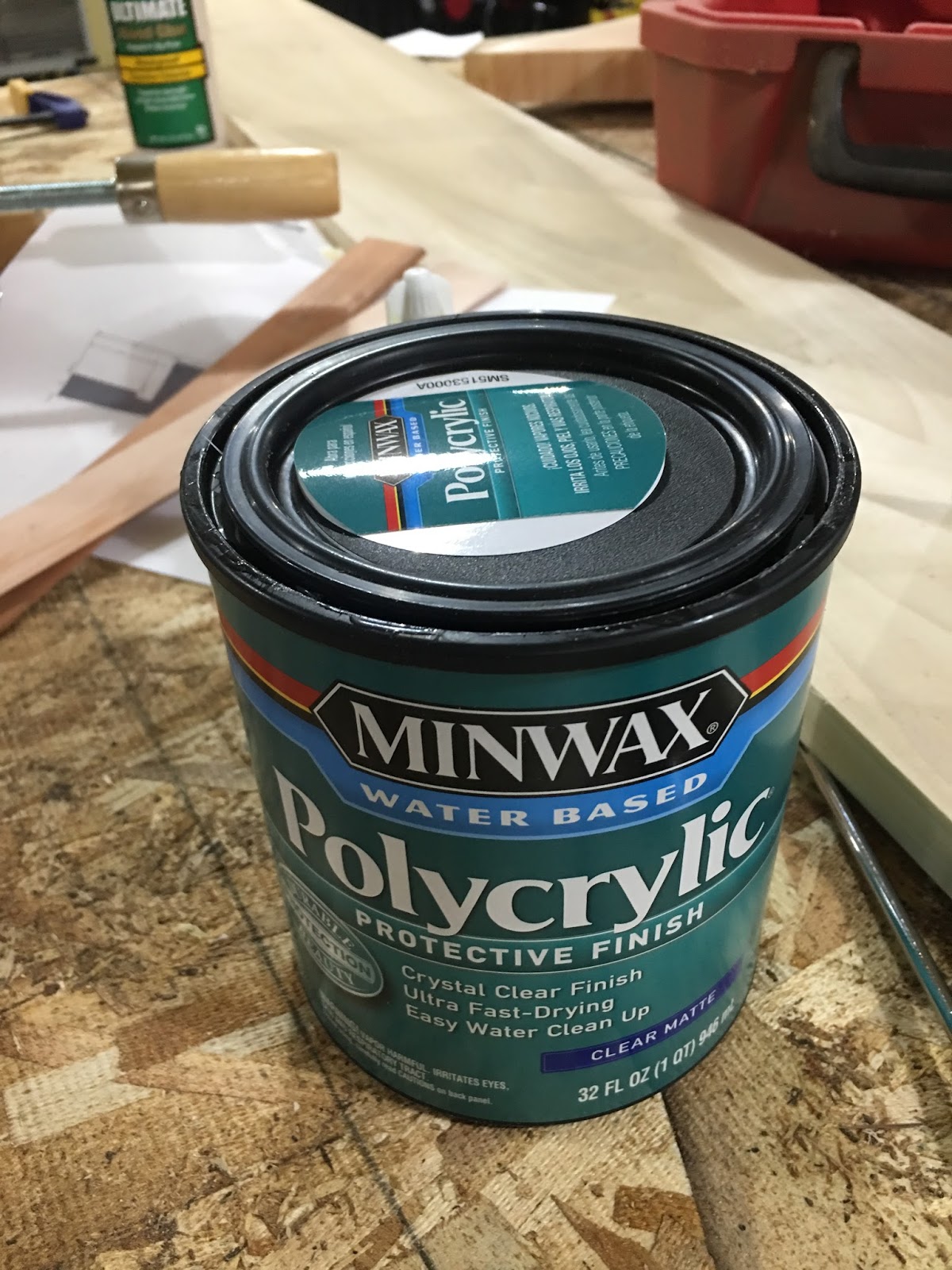
This little project is the first time I've used an acrylic finish in probably 20 years.  I bought it for my stairs project, on the recommendation of a very knowledgeable employee at our local paint store.  This stuff has come a long, long way.  First of all, it's water-based, so cleanup is a cinch: soap and water.  Second, it's a true matte finish – there's none of that “plastic look” that I so disliked with the acrylic and polyurethane finishes I'd used in the past.  Third, the drying time is just a few minutes to handle, and only two hours for re-coating.  Fourth, there's no obnoxious odor at all – its smell is actually pleasant.  Finally, the can it came in is a modern marvel.  It looks like a standard pressure-fit metal lid, but it's not.  It's made of plastic, and it opens easily and cleanly, and snaps right back into place with finger pressure.  Awesome!

Saturday, March 18, 2017

Paradise ponders, redwood “flour” and raging river edition...

Paradise ponders, redwood “flour” and raging river edition...  Yesterday I sanded the rest of one side of the largest redwood slab I made (44" x 38").  While I was doing that, I noticed a flaw that had escaped my attention before: about two inches of one joint, at the end, was not tight.  There was a narrow gap, around 1/64" wide at most, that ran from top to bottom.  Functionally this is harmless, and I was going to just ignore it until I had a brainstorm.  The sanding produced a cup or so of extremely fine sanding dust that is actually tiny particles of redwood (first photo below) with the consistency of white flour.  What if I mixed some glue with a bit of this “flour” and then squished it into the crack with a putty knife?  I'd done similar things with sawdust in the past, but that's far too coarse for this little crack.  So I tried it (second photo) and then this morning I sanded it off (third photo).  It worked perfectly!  Then I googled it to see if I'd thought of something new, and of course I got about 25,000 hits on “sanding dust glue” – and the first few I looked at were describing exactly this, right down to the putty knife.  :)  There really isn't anything new under the sun!  It's a great little trick, though, even if I wasn't the first to come up with it...


Debbie and I just got back from a jaunt up the Blacksmith Fork Canyon to Hardware Ranch.  We saw quite a bit of wildlife, including deer, elk, a mink, blue herons, kingfishers, red-winged blackbirds, and bald eagles.  The first three birds returned this past week, as we haven't seen them all winter until today. 

But the main event of our little drive this morning was the Blacksmith Fork River itself: it is very high.  There is some minor flooding in a few places, but for most of it's length it's less than a foot below the banks – meaning it's a couple feet above normal levels.  Instead of a clear, sparkling stream we have an angry, muddy stream full of debris.  This is happening because of the well-above-average precipitation we had this winter, which in the mountains was mainly in the form of snow.  That snow is now in the process of melting, and the streams are carrying it off.  Our reservoirs have been partially emptied in anticipation of this, so that these high (possibly flood) level waters can be safely captured.  There's considerable worry, though, that the reservoirs will be unable to capture all the runoff this year.  If that happens, there will be flooding below all the dams – flooding that hasn't been seen here for decades.

The first photo below shows a rickety little footbridge that we're very familiar with.  Normally it is two to three feet above the river.  Not so much right now – we're not sure that bridge will survive the spring.  The second photo is the view from that bridge, looking upstream.  Normally the river is only around 10 feet wide at this point.  It's about triple that right now...


And in response to a reader's complaint, the photo at right is the outbuilding that's being re-roofed right now.  I took this photo strategically, so that it would only show the complete sections. :)  On Monday the rest of the fascia and soffit should be installed, and they'll begin on the rain gutters.

Friday, March 17, 2017

This ain't yo' momma's belt sander!

This ain't yo' momma's belt sander!  I tried out my new belt sander for the first time this morning.  Wow!  It's been nearly 30 years since I last bought one of these, and I was very surprised at how much they've improved.  A belt sander is a pretty uncomplicated tool: a motor, a drive (usually a belt), a couple of rollers, a metal plate, and that's about it.  What could they do to improve that?

There are two huge differences between this sander and the one I purchased last century.  The first one I noticed was the noise: this one is much quieter than my old one, and blessedly free of the loud metallic rattles that my old one emitted constantly.  The second thing I noticed as soon as I applied pressure on the wood: virtually no sawdust escaped it.  My old one filled the room with fine sawdust in seconds.  This one emits so little that I don't even need to wear a mask!  I have no idea how they did this, but whatever they did seems to actually work.  Very nice, that is.  Then there is one slightly subtler improvement.  My old sander, when you turned it on, would generate so much torque that it would jump uncontrollably in your hands.  Because of that, I always started it in the air, then lowered it onto the work.  This sander starts much more gently; so much so that I can safely start it while resting on the work.  This isn't really terribly important, but it's a nice thing that I appreciate.

On the right bottom side of the photo above, you can see an area I sanded with a 60 grit belt.  In under a minute I removed all objectionable edges in about 1/6 of one side of that landing piece.  Even going through three finer grits it's only going to take me an hour or so to sand the whole piece down.  Very nice!

Until this morning, I was annoyed at myself for leaving my old belt sander in California.  Now I'm actually happy I did!

Expensive punctuation...

Expensive punctuation...  Consider this sentence, lifted from a Maine state law:
The canning, processing, preserving, freezing, drying, marketing, storing, packing for shipment or distribution of: (1) Agricultural produce; (2) Meat and fish products; and (3) Perishable foods.
That sentence defines what occupations are not eligible for overtime pay.  A recent dispute centered on the meaning of that sentence.  In everyday English usage, there are two possible interpretations of that sentence because there is no comma between "packing for shipment" and "or distribution". 

A US appeals court has ruled that the sentence above is ambiguous, and therefore a labor dispute should be decided in favor of the employees rather than the employer.  More examples of such ambiguous legislation or contracts here.

Reading about this reminded me (rather too forcefully) of one of my least favorite aspects of executive life, back in the bad old days when I was still one of them.  I spent a ridiculous amount of time reading all the language in contracts, including such details as whether to use the Oxford comma or not in any particular sentence.  On a large contract (as the examples linked above illustrate), a large amount of money might ride on possible interpretations of contract language.  What really got me going on this issue was discovering language that was almost certainly intended to deceive or trick us, in draft contracts coming from large multinational corporations we were considering doing business with.  It was easy to tell if these were deliberate constructions or not: we would simply red-line the language in question and propose an unambiguous alternate.  If the other company pushed back on our change ... then we knew it was deliberate.  I consider that dishonest behavior myself, and I see no need for that in a legitimate business contract.  Given what I saw, however, I have to conclude that mine was a minority viewpoint – at least with many large corporations.  There were exceptions, thankfully.  And the small businesses I dealt with never seemed to have this issue.  I suspect it has to do with the point at which a corporation becomes large enough to have a permanent legal staff – they seemed to believe that such trickery was part of their job description...

Paradise ponders, where the hell did that day go edition...

Paradise ponders, where the hell did that day go edition...  Yesterday I was scrambling all day long.  I was feeling a bit off (and I am today as well), but none of the day's activities were onerous – there were just a lot of them!  I never even thought about making a post, much less actually doing it...

Miki, our oldest field spaniel, went to the groomers for a haircut yesterday.  He came out looking sleek and fit, and acting very happy.  I'm thinking we let him get a bit too shaggy.  When I walked into the groomer's 45 minutes early, I expected a little confusion when I checked in.  Nope.  The groomer recognized Miki immediately, greeted him in a happy way, and it was clear Miki recognized her as a friend right away.  A little later, still talking with the groomer, she asked about Cabo and Mako – obviously remembering them from their one haircut about six months ago.  She especially asked about Cabo, wondering if she still had “those eyes”.  :)  When I assured her that Cabo still had that same face, the groomer was delighted – and then showed me the photo of Cabo that she kept on her phone.  Wow!  Then she went on to say that her experience with our four field spaniels (she's given Mo'i a cut as well) convinced her that her next dog needed to be a field spaniel.  Our dogs apparently made quite the impression!

For the past couple of days we've had roofers working on our small outbuilding.  This is the oldest structure on our property, built in 1990 by the owners who built the house we now live in.  They used that outbuilding (which has power, heat, and a bathroom) and an RV as their domicile for the two years it took to get the house built.  I don't think it's received any TLC since it was built.  The roof was fiberglass and asphalt shingle, the gutters aluminum.  The shingles were wearing out, the underlayment was all dried and cracked, and the gutters falling off.  That old roof has been removed, as have the gutters.  New underlayment is down, and the entire roof has been sheathed in standing seam steel, matching our house.  On Monday they will be back to install fascia and soffit (all aluminum), and later next week they'll put the new gutters up there.  They'll also be replacing the gutters on our house, which are also in bad shape plus the construction we did last year involved several roof-line changes that also require redesigned gutters.

Yesterday and today we have “Blue Stakes” people here to mark the locations of the various underground utilities (gas, electric, cable TV, and phone).  This is in preparation for another round of digging in our yard, scheduled to start next week.  This time, the digging will be in all our yard covered with lawn – about three acres in total, in four discrete pieces.  This round of digging is to get sprinklers installed.  This is a system I've been working on getting installed for nearly two years now; it's proved far harder to find a craftsman to do the work than I ever thought it would!  I finally did find one, though, and this same fellow is going to sod about an acre of our lawn, and overseed the rest.  He's also going to fix all the various grade problems caused by our paving our driveway three years ago, and from the construction last year.  All this right in the middle of mud season!  There's going to be quite the mess around here for a while...

I went to Angie's for breakfast yesterday with Bruce N., a local friend whom I hadn't seen for a while.  He's got lots of interesting things going on in his life, including plans to build an extension onto his home in Avon, and a large steel barn close by on the same property.  These projects are both derived from the fact that one of his sons has moved in with him, complete with wife and four grandkids (with another on the way!).  That leaves very little room for Bruce and his wife June, so they're building an extension for themselves.  The barn is something he's wanted all along; a place to park tractor, mowers, truck, etc., and to have a baby goat pen alongside for his grandkids.  He got surprised when they started looking for a contractor to excavate the foundations for these projects – everyone is so busy now that the times being quoted would completely mess up their plans.  So Bruce and his son decided to buy a medium-sized Komatsu excavator (similar to the one above), use it this year to complete a long list of earth-moving projects, then sell it.  That's way cheaper than putting 3 or 4 hundred hours on a rental, and they'll be able to tackle some other projects they'd like to do (drainage ditches, terracing, etc.).  They took delivery of it just yesterday, and now Bruce has to learn how to operate it.  Sounds like fun to me!

Debbie and I grabbed lunch at Los Primos yesterday.  She was really, really hungry and put away that entire carne asada plate at right.  I had a couple of gorditas.  As usual, all of this stuff was delicious.  Also as usual, the staff were super friendly and smiles were everywhere.  We love this place...

Also yesterday our persevering oven repairman  (Jim) came for his next attempt at repairing our two broken ovens.  This time, he succeeded with one!  Yay!  He had the right part, it was identical to the one he was replacing, and it all worked on the first try when he buttoned up the oven.  The oven he fixed had an intermittent temperature control problem, and in that oven all of the temperature control is contained in a single thermostat assembly, which is what he replaced.  So that oven should now work correctly.  The other oven was the one he worked on during his last marathon visit a couple of weeks ago.  That oven exhibited the same wildly high temperatures with 100°F swings even after he'd replaced the thermostat assembly.  This time he was on the phone with the manufacturer's technician (Viking is the manufacturer) trying to troubleshoot it.  After an hour or so on the phone, they concluded that a control board (electronics) was at fault.  The old thermostat probably was just fine.  So we've ordered that part (about $200), and now we're expecting Jim for the fourth visit in a couple of weeks.  The labor charge for the repair is fixed, and if you calculate the per-hour charge it's going to work out to about $5/hour.  Darrell's is taking a bath on this one.  Little do they know that a cloud of weirdness follows us everywhere.  Probably our address and phone number will be tacked to their wall after this, with instructions to hang up should we ever call again. :)

Wednesday, March 15, 2017

Non-standard addressing...

Non-standard addressing...  This blog post by national geek treasure Ken Shirriff details how the Intel 8008 designers saved a few then-precious gates by addressing a stack with a sequence that wasn't in the usual binary numerical order.  Long-time readers may know that the 8008 has a special place in my professional life: it was the heart of the first microcomputer that I designed and built myself.  Until I read Ken's post, I had no idea that the 8008 addressed its stack this way – as a user of the 8008, there was no way to detect that.

That general technique, though, I've used myself, back in the '70s and '80s when I was designing a lot of digital hardware.  I got there in two steps.

The first step was a mental leap I made when wire-wrapping a Z80 prototype that included some dynamic RAM and an EPROM.  The way the chips were oriented on the board, to connect the Z80's address lines to the eight RAM chips and PROM chip in the ordinary way (that is, A0 to A0, A1 to A1, etc.) would have caused the wires to cross over each other twice in an aesthetically annoying way.  It dawned on me as I thought about my stupid problem that the RAM chips really didn't need the address lines to be connected in the ordinary way at all – I could connect them in any way that was convenient, and it wouldn't change the operation of them.  In fact, the address lines could be differently connected to each individual RAM chip (though that wasn't convenient or neat) and even that would still work just fine.  All that really mattered is that the 12 bits (4k RAMs) of address all be connected, so that each possible address presented a different state of address lines to each RAM.  The EPROM was a slightly harder case, as it might be in either of two places: the Z80 board itself, or the EPROM programmer.  The programmer's address pins were wired in the usual way, so if I wired my board in an unusual way the addresses wouldn't match.  But that problem was easily solved, too: a simple little program would “scramble” the sequence of the bytes I wanted to program in the EPROM so that they'd match how I'd wired my Z80 board.  Unconventional, but it would work – and I built my board that way, along with several later boards that made it to printed circuit boards where the layout convenience actually saved us a layer.

The second step happened when I was building a piece of test equipment for the Marines.  There are a lot of good stories in that experience. :)  This piece of gear was based on a Z80, but had lots of discrete TTL logic associated with it.  One requirement included 16 bit address counters for some RAM that collected state information.  There were 32 channels of information, so 32 of these 16 bit counters were needed.  Extensible 4 bit counters were standard TTL parts, and the obvious choice – but I'd have needed 128 of them for the job.  Extensible 8 bit shift registers were also standard TTL parts, so if I could figure out how to use them I'd only need 64 of them, saving a hefty pile of parts in my design.  Remembering the lessons I'd learned above about “scrambling” the address lines, it occurred to me that there was no requirement for a standard binary sequence.  I was already familiar with using shift registers and a few gates to generate pseudo-random sequences for noise generators, so I jumped right to that as a design solution.  I ended up taking 2.5 parts (shift registers plus gates) to build each of those “address counters”, a very nice parts count reduction from the original approach that took 4 parts. 

It did cause a bit of an issue when my design went through an independent design review, though.  The engineer doing the review had never seen a pseudo-random sequence generator, so I had to spend quite a bit of time in the review convincing him that they actually worked.  Then he flat-out didn't believe the RAMs would still do the job if not addressed in sequential address order.  I actually had to step him through a chalkboard example of a 3 bit address memory to convince him.  My customer was quite discomfited by all the back-and-forth between the reviewer and I.  The reviewer had a reputation in San Diego for being a top-notch digital designer.  What kind of a weird design had I made, that this guy was so puzzled by it?  Fortunately for me, when the review was over (and my design approved with no changes) that reviewer went out of his way to say what a great design it was, and that he'd learned several things he expected to apply himself.  With that sort of endorsement, I was hopeful that I'd get more business from the Marines.  I would have, too, had I been willing to do the work – but it took nearly a year for me to get the check for the first work I did.  Not many small businesses can afford that sort of payment delay.  The Marines approached me several more times with projects they wanted me to do, but I turned them down.  I wanted to get paid!  :)

Tuesday, March 14, 2017

Doom. I feel the doom coming on...

Doom.  I feel the doom coming on...


Paradise ponders, puppy birthdays and irrational numbers...

Paradise ponders, puppy birthdays and irrational numbers...  Today (3/14/2017) is the first birthday of Mako and Cabo, our little field spaniel puppies.  The video at right is one I took of them last June, when they were about 3 months old.  It captured one of their play “battles” in slow motion.  They still do the same thing today, though the physics are now a bit different since they weight a lot more.

We celebrated this morning by giving them some half-and-half with their morning kibble, and by letting them have two bananas instead of their usual one (split between four dogs).  The little puppies have no idea why they got this bonanza this morning, but (trust me on this) they weren't complaining. :)

Today is also Pi Day, commemorating that most famous of irrational numbers: pi.  Of course there's a web site dedicated to it, where you can find the first million digits of pi if you're looking for some reading material.

A few years ago I read a study that attempted to measure adult innumeracy in various countries around the world.  There were two questions related to pi on there.  The first one asked for a definition of pi.  The second asked the test taker to write down as many digits of pi as he or she knew.  Americans stood out for their ignorance of these.  I don't remember the exact numbers any more, but it was something like 15% of Americans could define pi as the ratio of the circumference of a circle to its diameter.  The average number of digits known by Americans was less than one.  That means a great many Americans didn't even know that the first digit was “3”!  I remember comparing those results with those from Estonia, and being appalled at the gap.  The majority of Estonians could define pi, and the average number of digits was over 4.  On a good day, after my morning tea, I can remember 6 or 7 digits – which makes me extraordinary for an American, and slightly above average for an Estonian.

A friend of mine, Clay M., came up with a clever and fun way to help his daughters understand pi.  They baked a pizza, then cut it up into a lot of skinny slices, 20 or so.  Then they arranged these slices side-by-side, alternating the pointy end up or down.  This made a rough rectangle whose height was the radius of the pizza (diameter/2) and whose length was pi * radius.  By simply measuring the length of the “rectangle” they could measure pi – and then they got to eat the pizza.  Win!

Monday, March 13, 2017

Paradise ponders, acidic wood and big hunks of redwood edition...

Paradise ponders, acidic wood and big hunks of redwood edition...  Yesterday I got a bit of a scare: I discovered that wood I'd left on my table saw's cast iron table had left big ugly black marks and rusty corrosion on it.  What the hell did that?  Well, the wood was redwood (4x4s) that I'm using for the stairs I'm building.  It turns out that the red heartwood of redwood lumber is highly acidic – something I had no idea of until yesterday.  I'd left the wood on that table for just two days, and the corrosion that developed in that short time felt like sandpaper when I ran my hands over it.  Not good at all!  The wood also had a terrible black stain on it, but fortunately not on a side that will be visible when I've finished the stairs.  After trying various ways to remove the corrosion, I found one that worked: a combination of M1 oil, Scotch-Brite pads, and elbow grease.  Two hours and some sore arms later, I had removed nearly all trace of that corrosion.  The only way you can see it now is by spotting a slight discoloration when you get the light at the right angle.  I put a new coat of M1 on it and called it a day.  But I will never store redwood on metal again!

What I was really trying to do yesterday was to get my big redwood “landing” built.  And I did!  I cut up six 4x4s into eleven 44" lengths, then drilled holes in the ten butt joints for dowel pins (60 holes for 30 pins, 3 on each of the 10 butt joints).  I used the jig I made yesterday to do that, and it worked fine.  The first photo shows the finished glue-up in the clamps.  With a piece this big, there's a danger of bowing.  The easy way to minimize that is to have clamping from both the top and the bottom, which is why you see so many clamps here.  There are other ways to solve this problem, too, but if you've got the clamps, this is the easy way.  This morning I removed the clamps and put the two slabs (big one near the camera, small one away) up on my workbench to get ready for sanding.


I'm quite pleased with how well these turned out.  First, there's no bowing at all on either slab.  I'll be installing “ribs” on these before I'm finished, and that will (or should!) prevent any future bowing as well.  Second, the joint mismatches are all well under 1/32", thanks to the dowel pins.  This will make them easy to sand to an acceptable flatness.  Well, it would be easy if I had a belt sander.  I thought for sure my trusty old 4" belt sander made the trip to Utah with us, but I searched high and low for it yesterday and it's just not here.  Apparently I left it in California with some of my other tools.  I ordered one last night, as for work like this (which I'd like to do more of), it's an essential tool.  “Like this” means “too darned wide to fit in my planer!”  So work on the steps is stymied until Thursday, when I'll have the new sander...

I did have one thing go slightly wrong while gluing up that big slab.  If I do something this large again, I'll be doing it in two steps to avoid the issue.  Because this time I did it all in one step, by the time I got done gluing and doweling the tenth joint, the first two joints had partially hardened.  It took me about 30 minutes to do all the gluing, so apparently the limit for TiteBond II glue is around 20 minutes at the 70 °F I was working in.  The specs say 10 to 15 minutes, but it seems to be a tad more than that.  I know from past experience that the bond will still be strong – this is more an aesthetic issue than a structural one.  There is a tiny gap remaining on the first joint, and an even smaller one (nearly invisible) on the second.  I worked some more glue into them to hide the issue, which I'm sure nobody but me will ever notice.  Still, what I should have done is to first glue up two smaller slabs, then in a third step glue those two together.  Had I done so, my working time would have been within limits for all of it...

Sunday, March 12, 2017

Another sign that spring is springing...

Another sign that spring is springing...  The past week's production from our solar panels.  We had many weeks of zero production recently, because of snow (see 6 March, below).  They've been completely free of snow for four days now; the less-than-perfect production is because of intermittent cloud cover.  Soon we'll start seeing those perfect curves again, when we have our first clear days...