
Saturday, January 24, 2015
A domain name transfer experience...
A domain name transfer experience... If you've any experience with managing domains (like “jamulblog.com”), then you're probably already cringing. In the tech world, this particular service has about the same reputation as used car dealers, or schlocky lawyers. But I just had a good experience, and that's worth a shout out. I've now moved two domains to Namecheap, and something remarkable happened: it was easy, fast, and when I ran into challenges, I had very fast and good service. I selected them based on some reviews I read and the price. I've been surprised – in a good way! – by how easy their web site was to use, how zippy it was, and by the great service. An outstanding combination!

Progress report...
Progress report... Debbie and I worked on upgrading the lighting in the cattery today. The existing lighting is four sets of 6' long track lighting, each with four wimpy 25 watt spot lights – 400 watts total for a 500+ square foot room. That's not enough! We're replacing each track light with a fixture that holds three 100 watt bulbs, so we'll end up with 1,200 watts of light. Since we're using LED lamps, that means we'll really have about 150 watts of electricity used, to produce the same amount of light as 1200 watts of incandescent bulbs.
But...that's not going to happen until we get all those fixtures up, and naturally that's harder than we expected. When I took down the first track lighting, I discovered that the previous owner had installed a chintzy wall box (intended for outlets, and not very good even for that!), totally unsuitable for hanging a heavy ceiling fixture from. It was unsuitable (and not compliant with code) even for the danged track lighting, but for a normal ceiling fixture it would be downright dangerous. So it was off to the hardware store to buy a new junction box designed for the intended purpose. Actually, I wanted to buy four of them, since I figured that all four fixtures would have the same problem. Alas, they only had two in stock.
We spent the next couple of hours wrestling the old junction boxes out of the ceiling without enlarging the 4" hole. This involved hammers, chisels, pliers, and creative swearing (mostly at the previous owner, may lice of 1,000 jihadists infest him). Then I installed the new boxes (easy when you have the right one!) and Debbie held up the new fixtures while I wired them up. We got two up today – installed correctly – and we'll put the other two up once we can lay our hands on a couple more ceiling junction boxes of the type we need.
What should have been a 30 minute job ended up taking most of the day. Sheesh! But the new fixtures put out a nice, even lighting – perfect for the cattery.
 I did one other thing today that I've been putting off: testing the two network cables we buried, running between the house and the barn. I have a Fluke MS2-100 network cable tester – a lovely piece of kit – so this was an easy thing to do. I had Debbie in the basement on the phone to change the reflector (part of the tester) from one cable to the other, while I was out in the barn with the main part of the tester. Both cables tested out as 100% good, which I'm actually a little surprised at. Those cables are 4' underground, laid over uneven trench bottom that has some rocks, and then covered with soil that I drove over (with my tractor) to compact. I wouldn't have been a bit surprised if both were damaged, but it looks like they survived intact. Yay! My backup plan was to run a radio link between the two buildings, but the cable will give me a much faster link...
But...that's not going to happen until we get all those fixtures up, and naturally that's harder than we expected. When I took down the first track lighting, I discovered that the previous owner had installed a chintzy wall box (intended for outlets, and not very good even for that!), totally unsuitable for hanging a heavy ceiling fixture from. It was unsuitable (and not compliant with code) even for the danged track lighting, but for a normal ceiling fixture it would be downright dangerous. So it was off to the hardware store to buy a new junction box designed for the intended purpose. Actually, I wanted to buy four of them, since I figured that all four fixtures would have the same problem. Alas, they only had two in stock.
We spent the next couple of hours wrestling the old junction boxes out of the ceiling without enlarging the 4" hole. This involved hammers, chisels, pliers, and creative swearing (mostly at the previous owner, may lice of 1,000 jihadists infest him). Then I installed the new boxes (easy when you have the right one!) and Debbie held up the new fixtures while I wired them up. We got two up today – installed correctly – and we'll put the other two up once we can lay our hands on a couple more ceiling junction boxes of the type we need.
What should have been a 30 minute job ended up taking most of the day. Sheesh! But the new fixtures put out a nice, even lighting – perfect for the cattery.
Friday, January 23, 2015
How government is destroying small business...
How government is destroying small business... Warren Meyer (of CoyoteBlog, and a small business owner himself) has an outstanding discussion. Every politician should be forced to read this, and tested on his or her understanding – and the results made public...
The trip home...
The trip home... I flew from Richmond, Virginia to Salt Lake City (connecting through Houston) on Wednesday. The flight was almost uneventful. The exception was that on the last leg, about a half hour out of Houston, I ordered a soda to drink. The flight attendant handed me the soda, I set it on my tray table, and the guy in front of me chose that moment to violently lean his seat back. The soda went flying, and upended all over my lap. Soaked, I was, and in a most uncomfortable way. Then the jerk decided to get all angry about it, saying it was my fault for being so stupid as to put my soda on the tray table. The flight attendant just rolled her eyes, and I let it go – my experience with the stupid, which is far broader than I wish it was, suggests that pushing back against stupid that burns that hard is completely useless.
Upon arriving in Salt Lake City, I called Debbie (who was waiting in the cell phone lot) to come pick me up. Mere seconds later, she rolled up – with Miki and Race in the back seat. After a hug and a kiss and some happy dogs, we drove back home to a lovely shower and an even lovelier big, comfortable bed. It's always so good to get home, even after a wonderful trip like the one I just took, with a week to see my immediate family and their spouses.
I took the photos below as we approached Salt Lake City, crossing the Wasatch mountains. As always, click to embiggen...


Upon arriving in Salt Lake City, I called Debbie (who was waiting in the cell phone lot) to come pick me up. Mere seconds later, she rolled up – with Miki and Race in the back seat. After a hug and a kiss and some happy dogs, we drove back home to a lovely shower and an even lovelier big, comfortable bed. It's always so good to get home, even after a wonderful trip like the one I just took, with a week to see my immediate family and their spouses.
I took the photos below as we approached Salt Lake City, crossing the Wasatch mountains. As always, click to embiggen...
The Daily Shot...
The Daily Shot... If you're one of the three people who regularly read my blog, then you already know that I'm a fan of the Ricochet web site – despite the fact that its unabashedly conservative perspective is in considerable conflict with my own beliefs. It's chock full of interesting and entertaining writers, and (even better) a lively set of commenters who are remarkably civil. The site charges a small annual fee for anyone who wants to comment (or have full access), which means that they know who the commenters are. That small little bit of information is enough to let them control the flamers and trolls – and provide a lovely little island of civility of an otherwise verbally violent Internet. I cherish that!
The same web site publishes a free daily email called “The Daily Shot.” It's a little cheeky, full of information, and a good deal of fun to read. I've been reading it for a while now, and I still look forward to its arrival in my inbox every morning. Here's their own description:
The same web site publishes a free daily email called “The Daily Shot.” It's a little cheeky, full of information, and a good deal of fun to read. I've been reading it for a while now, and I still look forward to its arrival in my inbox every morning. Here's their own description:
The Ricochet Daily Shot is a quick, smart, fun way to catch up on today's big events -- and get a preview of what's coming up tomorrow. It's meant to be a fast snapshot of the news from a decidedly Ricochet perspective, packed with enough information to tide you over until you have a chance to sit down with your favorite non-left wing news outlet, assuming you've found such a thing.You can subscribe to it here. Recommended...
The Daily Shot gives you just the right amount of news, wit, and information to make it through the day, and to dazzle and dumbfound the liberals in your wake.
The Rosetta web site...

An upside-down iceberg...

4,018 days (11 years!) into its 90-day mission...

Learning sequence inversion...
Learning sequence inversion... I just read an article about one fellow's experience in learning about how computers work with ones and zeroes. This guy first learned how to program in some high-level language, and then took it upon himself to learn assembly and machine language. For him, the experience was revelatory – he clearly hadn't really understood how computers worked before that (and actually, he probably still doesn't understand how the hardware works).
It struck me, as I read, that this is precisely inverted from my own learning experience. The first thing I learned was how the computer hardware worked. Then I learned how the ones and zeroes stored in RAM controlled that hardware – machine language. Then I learned how assembly language made it easier for people to read and create machine language programs (by using an assembler). Much, much later I learned about higher level languages (BASIC, FORTRAN, CMS-2, PL/1, and COBOL, specifically).
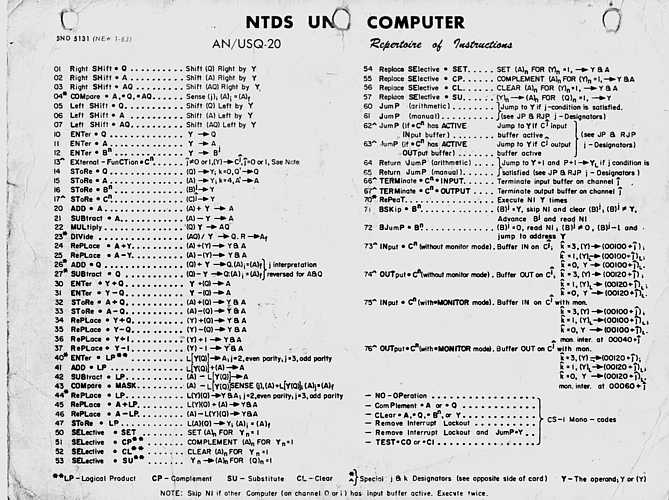 I learned machine language with the aid of a “repertoire card” (or “rep card” for short) – a one-page summary of all the machine language instructions the computer was capable of. The rep card that I owned was a single letter-sized piece of light cardboard, laminated, with printing on the front and back. It listed all the machine-language instructions, with the binary encoding, execution time (in clock cycles), and affected registers and flags. I'd love to have a copy of that thing, for old times sake, but I haven't been able to find one. The Computer History Museum appears to have one. This web page has a piece of a similar one, shown at right. That single sheet of cardboard was the only programming documentation I had for several years as I started to program.
This “bottoms-up” approach to learning how to program makes great sense to me, most likely because that's how I learned it :) For me, high level languages are still the fuzziest part of my knowledge, and I'm still learning more about them all the time. This isn't entirely because of the bottoms-up approach, of course – that area is changing rapidly, and even the top-down learners have to devote considerable effort to that if they want to keep up. But many (most, actually) programmers who learned top-down never learn assembly language, or machine language – a fact that I still have trouble wrapping my brain around...
It struck me, as I read, that this is precisely inverted from my own learning experience. The first thing I learned was how the computer hardware worked. Then I learned how the ones and zeroes stored in RAM controlled that hardware – machine language. Then I learned how assembly language made it easier for people to read and create machine language programs (by using an assembler). Much, much later I learned about higher level languages (BASIC, FORTRAN, CMS-2, PL/1, and COBOL, specifically).
This “bottoms-up” approach to learning how to program makes great sense to me, most likely because that's how I learned it :) For me, high level languages are still the fuzziest part of my knowledge, and I'm still learning more about them all the time. This isn't entirely because of the bottoms-up approach, of course – that area is changing rapidly, and even the top-down learners have to devote considerable effort to that if they want to keep up. But many (most, actually) programmers who learned top-down never learn assembly language, or machine language – a fact that I still have trouble wrapping my brain around...
Computers keep getting smaller...

Where do computers go from here? What do they look like when they get smaller?
Above right you see one group's vision: the computer shrinks to fit into the mouse. Video is transmitted wirelessly to a monitor. Everything else is in the mouse. Now I'm not at all sure these folks have a winner of an idea, but it certainly is illustrative of the possibilities as compute hardware keeps shrinking. I often marvel at the compute power I hold in my hand when using my iPhone; this really isn't much different than that. It will be interesting to see the computer form ideas popping forth over the next few years...
Wednesday, January 21, 2015
Want to feel better in five minutes?
Want to feel better in five minutes? Read this twitter thread. I read this and I had a twinge I haven't felt for a while. I think it was hope for the human race's future...
Sunday, January 18, 2015
I was having such a nice day...
I was having such a nice day ... until I read this. Damn you, Ilya Somin, damn you! Now I have the urge to short-sell America. But how?
Quote of the day...
Quote of the day... Rex Murphy (always read Rex Murphy when you have the chance):
This part of the world has a sack full of pieties when it comes to free speech, but its own actions, and frequently its own words, put the lie to all of them. Bowing to ruthless protest has become a habit. Labelling speech some people simply do not wish to hear as “hate speech” succeeds in silencing it. In matters big and small, on issues from global warming to abortion, there is collusion — we call it political correctness — over what should not be said, what cannot be said.You really should read the whole thing...
Thursday, January 15, 2015
Made it to Virginia...

A long day...
Wednesday, January 14, 2015
Light blogging alert...
Light blogging alert... I'm traveling to Virginia this morning, to visit with my mom and siblings. I'll be lugging my computer along, but I probably won't be blogging very much...
The return of the analog computer?
The return of the analog computer? Sort of. I worked on (as a maintenance tech) electro-mechanical analog fire control computers in the Navy. Those computers did integration and differentiation with gears, and arbitrary functions with cams. They were computers that could give you the wrong answer if you didn't keep them clean and lubricated. They were also far more interesting to watch work than a modern digital computer :)
How to guarantee the continued inferiority of U.S. broadband access?
How to guarantee the continued inferiority of U.S. broadband access? Simple. Just get the federal government involved. That will put us into North Korean territory.
There's a solution already proven to work: completely deregulate the industry, and eliminate all government-granted monopolies (especially the cable company monopolies). This is the approach Estonia took, and the result of competition unleashed is crazy high broadband speeds, access everywhere, and prices lower than our current crap broadband...
There's a solution already proven to work: completely deregulate the industry, and eliminate all government-granted monopolies (especially the cable company monopolies). This is the approach Estonia took, and the result of competition unleashed is crazy high broadband speeds, access everywhere, and prices lower than our current crap broadband...
Twisted string actuators...

We spent a fair bit of time evaluating twisted string actuators to build low-cost robots. Unfortunately, they have some major problems that are tough to overcome for our specific application(s). For one, their lifecycle is measured in the many thousands instead of millions -- despite our best efforts at material engineering. For another, they are highly nonlinear in response (twists vs displacement), which requires very precise calibration for precision movements. Plus, they're inherently linear motors; for rotary motion, you need two opposing motors or spring-return mechanisms. That said.... there are probably a lot of applications that could benefit from this type of actuator!It's a pity, because these actuators are ridiculously easy to build. The non-linear part was especially frustrating to me.
Analyzing these things was surprisingly easy – it turns out that it breaks down into a simple trigonometry problem, with the key variable being the diameter of the string or wire. I had the most success with graphite-lubricated mono-filament fishing line, and silicone grease lubricated mono-filament line came close...
Just plain stupid...
Just plain stupid... And probably coming to a federal government near you...
Banning encryption is a bit like banning safes because they might stop the police from looking at the contents. Let's make everybody unsafe because your “leaders” can't spy on you!
Things like this help me understand how revolutions get started...
Banning encryption is a bit like banning safes because they might stop the police from looking at the contents. Let's make everybody unsafe because your “leaders” can't spy on you!
Things like this help me understand how revolutions get started...
Tuesday, January 13, 2015
The world is in better shape than most people think it is...
 The world is in better shape than most people think it is... Well, most people in the U.S. or Europe, anyway. I saw quite a bit of the third world in the '70s, and again in the '90s and early '00s. The reduction of poverty in the third world just in those 20 or 30 years is astounding, and obvious if you've seen it (or if you're an inhabitant of the third world). Most Americans, though, are largely unaware of this, and have a seriously mistaken notion that America is getting wealthier at the expense of most of the rest of the world. The chart at right encapsulates the economic progress of the world very nicely (click to embiggen). More information here...
Subscribe to:
Posts (Atom)