On the advice of my dentist (given a decade or two ago), I finally broke down and bought one of those industrial-strength electric toothbrushes. I won't mention the make and model, as none of the following is specific to that.
Opening the box was quite an experience. I expected a motorized handle, a detachable brush head (I knew these wore out and were replaceable), and a charger. Those were indeed there, but they were just the beginning. There was an intimidatingly thick manual (it turns out, mainly thick because it's translated into approximately 1,400 languages). There were 4 AA batteries. Most mysteriously, there was a heavy, oddly-shaped piece of electronic gear about the size of a pack of cigarettes. I only knew it was electronic because the front of it had a liquid crystal display. Then there were assorted mounting brackets, screws, tape, etc.
After a half hour of manual reading and untangling cables, I had it basically figured out. The toothbrush bit worked about as expected. The big electronic gadget simply showed you where to brush – it's basically a timer with a hard-to-understand graphic display that allegedly shows you which teeth you should be brushing at any given moment. This left me wondering (a) what problem they were trying to solve, and (b) what the preceding said about mankind and its future. Nothing good, I'm sure.
So I let it charge for the prescribed 10 hours, and then it was time to try it. I'd never used one of these things before, so I really didn't know what to expect. I rinsed off the brush head, placed a dab of toothpaste on it, inserted the brush into my mouth, and switched it on.
There should have been warnings. Nowhere in the manual does it warn you about the visual hallucinations that occur when your entire head starts vibrating at 20Hz. Nor does it warn you about the merciful numbness that quickly ensues, much like the way your hands feel after using a mower or chainsaw for a while. Likewise, there's no mention of the unmentionable things shaken loose from your mucous membranes by the 350 horsepower vibrations. And most of all, there's no warning about the mangled, lacerated state of your poor, innocent gums after their first exposure to this infernal machine.
My teeth were nice and clean, though.
I'm going to devote this week to building up enough courage to try it for a second time...

Tuesday, March 8, 2011

The Tire Iron and the Tamale...
Here's a story that will make you feel better about humanity, though not necessarily about your fellow Americans.
We live out in the sticks, far away from the bustling city (though I commute to work there most days). One of the things we cherish about living out here is precisely that if you are in need of help, chances are good that your neighbors (and folks that pass you on the roads) will stop and lend you a hand. But we're all too familiar with the feelings of the author about how that would work out “down the hill” in the city.
Debbie and I make a regular practice of stopping to help people or animals in need. Because I commute to work quite early in the morning, I'm fairly often the first to happen upon some unfortunate situation, and many is the time that I've stopped to assist. Similarly, when I've stopped for whatever reason, I've had my people stop to see if I was ok. When Debbie and I are on one of our road trips, we're off in some fairly remote areas, and again are sometimes the first to pass by someone in need of help. Most of the time when we stop to ask someone if they're ok, they're perfectly fine – they may have simply stopped to eat lunch or to enjoy the scenery. Often these people are quite surprised that anyone would bother stopping to check on them. Pleased, but surprised.
Personally I think this is one of cultural consequences of cities, those vast accumulation of nameless strangers in whom you cannot afford to trust. Outside the cities, that simply isn't so – we all lean on each other when we need some help, and we're all looking out for each other as well. Of course it's not quite so absolute – there are certainly untrustworthy people living outside the cities, and not everyone out here is going to be neighborly. But the proportions are definitely skewed out in the country, skewed in the direction that I am much more comfortable with.
I suspect that's what the author ran into. His benefactor, I'll guess, wasn't willing to help because he was a poor Mexican. He was willing to help because he came from the culture of the countryside, not the city...
We live out in the sticks, far away from the bustling city (though I commute to work there most days). One of the things we cherish about living out here is precisely that if you are in need of help, chances are good that your neighbors (and folks that pass you on the roads) will stop and lend you a hand. But we're all too familiar with the feelings of the author about how that would work out “down the hill” in the city.
Debbie and I make a regular practice of stopping to help people or animals in need. Because I commute to work quite early in the morning, I'm fairly often the first to happen upon some unfortunate situation, and many is the time that I've stopped to assist. Similarly, when I've stopped for whatever reason, I've had my people stop to see if I was ok. When Debbie and I are on one of our road trips, we're off in some fairly remote areas, and again are sometimes the first to pass by someone in need of help. Most of the time when we stop to ask someone if they're ok, they're perfectly fine – they may have simply stopped to eat lunch or to enjoy the scenery. Often these people are quite surprised that anyone would bother stopping to check on them. Pleased, but surprised.
Personally I think this is one of cultural consequences of cities, those vast accumulation of nameless strangers in whom you cannot afford to trust. Outside the cities, that simply isn't so – we all lean on each other when we need some help, and we're all looking out for each other as well. Of course it's not quite so absolute – there are certainly untrustworthy people living outside the cities, and not everyone out here is going to be neighborly. But the proportions are definitely skewed out in the country, skewed in the direction that I am much more comfortable with.
I suspect that's what the author ran into. His benefactor, I'll guess, wasn't willing to help because he was a poor Mexican. He was willing to help because he came from the culture of the countryside, not the city...
Libyan Rebels Making Progress?
It's hard to know what's really going on with all the conflicing reports flying about. Here's the clearest summary of the current state of Libyan affairs I've found...
Monday, March 7, 2011
Tell Me It Ain't So...
If this news report is accurate, then the Obama administration is even lamer on foreign policy than I'd thought, and that's saying something...
Anti-Appropriations Committee?
I don't know enough about the inner workings of Congress to know whether this idea would actually be effective at cutting government spending. But it sure sounds good!
Sunday, March 6, 2011
Steyn on the Shooting of U.S. Airmen in Germany...
Mr. Steyn is back from his hiatus, with a vengence, with all of his trademark blend of wit and barbed commentary on display. This week he has a column on Arid Uka, the Kosovan Muslim jihadist who killed two American Airmen last week. My favorite phrase in it is “The strange shrunken spectator who serves as president of the United States...”
Just so.
A couple paragraphs of teaser:
Just so.
A couple paragraphs of teaser:
Okay, why is a Muslim who wants to kill Americans holding down a job at a European airport? That’s slightly easier to answer. Almost every problem facing the Western world, from self-detonating jihadists to America’s own suicide bomb — the multi-trillion-dollar debt — has at its root a remorseless demographic arithmetic. In the U.S., the baby boomers did not have enough children to maintain their mid-20th-century social programs. I see that recent polls supposedly show that huge majorities of Americans don’t want any modifications to Medicare or Social Security. So what? It doesn’t matter what you “want.” The country’s broke, and you can vote yourself unsustainable quantities of government lollipops all you like, but all you’re doing is ensuring that when, eventually, you’re obliged to reacquaint yourself with reality, the shock will be far more devastating and convulsive.But do go read the whole thing; it's Steyn at his best...
But even with looming bankruptcy, America still looks pretty sweet if you’re south of the border. Last week, the former director of the U.S. Census Bureau, Steve Murdock, told the Houston Chronicle that in Texas “it’s basically over for Anglos.” He pointed out that two out of every three children are already “non-Anglo,” and that this gap will widen even further in the years ahead. Remember the Alamo? Why bother? America won the war, but Mexico won the peace. In the Lone Star State, Murdock envisions a future in which millions of people with minimal skills will be competing for ever fewer jobs paying less in actual dollars and cents than they would have earned in the year 2000. That doesn’t sound a recipe for social tranquility.
Saturday, March 5, 2011
Morning Sex...
Via my mom (seriously):
She was standing in the kitchen, preparing our usual soft-boiled eggs and toast for breakfast, wearing only the 'T' shirt that she normally slept in. As I walked in, almost awake, she turned to me and said softly, "You've got to make love to me this very moment!"
My eyes lit up and I thought, "I am either still dreaming or this is going to be my lucky day!" Not wanting to lose the moment, I embraced her and then gave it my all, right there on the kitchen table.
Afterwards she said, "Thanks," and returned to the stove, her T-shirt still around her neck. Happy, but a little puzzled, I asked, "What was that all about?"
"The egg timer's broken," she explained.
Friday, March 4, 2011
Oldie-But-Goodie...
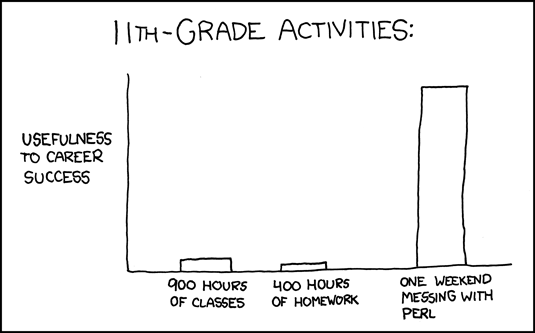
Of course this does not mean that education is without value. I have spent many, many hours educating myself – and I certainly don't consider that wasted time. But...for every hour I've spent educating myself, I've probably spent 20 hours practicing (all outside of any work context).
Personally, I think the quickest way to develop practical skills in software engineering (and, again, likely also in many other areas) is just such a lopsided mix of education and practice. I suspect the ideal ratio is different for different people, and also different over the course of a career. In my own case, I note that I can proportionally spend more time these days on educating myself, especially so when the subject matter is an extension of something I've already mastered.
The real point here is that formal educations that spend far more time empahsizing reading and lecture than they do practice seem wildly out of whack to me. My strongest evidence is the readiness of recent graduates to actually do something useful in the workplace – it's close to zero.
A Blind Man Who Sees...
An amazing and inspiring story of a totally blind man who has taught himself to “see” remarkably well – the same way bats do, with echolocation...
On Public Sector Unions...
Peggy Noonan, in today's WSJ:
I remember a high-school history teacher (can't remember his name) – in 10th grade, I think. He was a recently returned Vietnam War veteran, one of the first wave of Kennedy's “advisors”. He was deeply offended by the unionization of federal employees (something that Kennedy approved), and saw it as a betrayal of the values he fought for in Vietnam. His passionate lecture on that subject, over 40 years ago, is still a clear memory. His reasons for opposing public sector unions are the same reasons opponents use today, most emphatically the unholy alliance that Noonan refers to in this column (third paragraph above).
Unions have been respected in America forever, and public employee unions have reaped that respect. There are two great reasons for this. One is that unions always stood for the little guy. The other is that Americans like balance. We have management over here and the union over here, they'll talk and find balance, it'll turn out fine.It's been a long time since I had positive feelings about unions in general; I think they've long outlived their original worthy purpose and have become more a drag on progress and on the economy than any possible benefit could justify. Public sector unions have seemed wrong to me from their very beginnings in the early '60s.
But with the public employee unions, the balance has been off for decades. And when they lost their balance they fell off their pedestal.
When union leaders negotiate with a politician, they're negotiating with someone they can hire and fire. Public unions have numbers and money, and politicians need both. And politicians fear strikes because the public hates them. When governors negotiate with unions, it's not collective bargaining, it's more like collusion. Someone said last week the taxpayers aren't at the table. The taxpayers aren't even in the room.
As for unions looking out for the little guy, that's not how it's looking right now. Right now the little guy is the public school pupil whose daily rounds take him from a neglectful family to an indifferent teacher who can't be removed. The little guy is the beleaguered administrator whose attempts at improvement are thwarted by unions. The little guy is the private-sector worker who doesn't have a good health-care plan, who barely has a pension, who lacks job security, and who is paying everyone else's bills.
I remember a high-school history teacher (can't remember his name) – in 10th grade, I think. He was a recently returned Vietnam War veteran, one of the first wave of Kennedy's “advisors”. He was deeply offended by the unionization of federal employees (something that Kennedy approved), and saw it as a betrayal of the values he fought for in Vietnam. His passionate lecture on that subject, over 40 years ago, is still a clear memory. His reasons for opposing public sector unions are the same reasons opponents use today, most emphatically the unholy alliance that Noonan refers to in this column (third paragraph above).
Thursday, March 3, 2011
What Were the Odds...
...of death for a soldier in any particular war? Here's the answer, courtesy of Essential Militaria, via Gizmodo:
• War of Independence: 2 percent (1 in 50)You were about 200 times more likely to be killed in the Civil War than in the Persian Gulf War. I know from other reading that the Iraq and Afghanistan Wars are slightly less risky for soldiers than even the Persian Gulf War. I was a sailor at the end of the Vietnam War, never really at risk myself – but I certainly knew a lot of people who were at risk (and three who were killed there). The Vietnam War, as recent as it was, was nearly 15 times riskier to the soldiers participating in it than the Persian Gulf War. The difference in risk mainly has to do with technology (precision munitions, fantastically better sensors, communications) and medical care at the battlefront. The ratio of combat troops to REMFs has actually gone up (meaning proportionally more soldiers in a war are actually in combat in recent wars than in past wars)...
• War of 1812: 0.8 percent (1 in 127)
• Indian Wars: 0.9 percent (1 in 106)
• Mexican War: 2.2 percent (1 in 45)
• Civil War: 6.7 percent (1 in 15)
• Spanish-American War: 0.1 percent (1 in 798)
• World War I: 1.1 percent (1 in 89)
• World War II: 1.8 percent (1 in 56)
• Korean War: 0.6 percent (1 in 171)
• Vietnam War: 0.5 percent (1 in 185)
• Persian Gulf War: 0.03 percent (1 in 3,162)
Tuesday, March 1, 2011
Charles Koch Speaks Out...
The Koch brothers have been the subject of intense demonization by the liberals and progressives, especially concerning recent events in Wisconsin. The Wall Street Journal this morning provided a platform for the Koch brothers (Charles Koch is on the byline) to answer their critics. It's an interesting read, and led me to a ponder on the targets chosen by the left. I suspect they targeted the Koch brothers not at all for idealogical reasons, but rather because they perceive them as a threat. In other words, they see the Koch brothers as effective operatives for the right.
The Koch brothers don't appear to be in need of financial support. But they've got my moral support!
The Koch brothers don't appear to be in need of financial support. But they've got my moral support!
Libyan Rebels Having Some Success...
I don't know much about the factions in Libya, but it's hard to imagine a group I'd not prefer to Mohamar Gahdaffi. So I was happy to read that the rebels there are having some success against Gahdaffi's forces...
History of Computers...
If you're at all interested in computers, this graphic is fascinating.
If you've been involved with computers as long as I have, it's a little disconcerting to see the computers I first worked with so close to the beginning of the chart. Yikes!
In my case (and I suspect many others as well), that's not entirely due to my age. I first worked with computers in the U.S. Navy, and some of the systems I worked with were museum-fodder while I was working on them (and some of those stayed in service for a decade or more after I left!).
Nonetheless...there's a fair number of machines in the top quarter of that chart that I know from hands-on experience. What a short revolution the computer revolution has been!

If you've been involved with computers as long as I have, it's a little disconcerting to see the computers I first worked with so close to the beginning of the chart. Yikes!
In my case (and I suspect many others as well), that's not entirely due to my age. I first worked with computers in the U.S. Navy, and some of the systems I worked with were museum-fodder while I was working on them (and some of those stayed in service for a decade or more after I left!).
Nonetheless...there's a fair number of machines in the top quarter of that chart that I know from hands-on experience. What a short revolution the computer revolution has been!
Subscribe to:
Posts (Atom)