Friday, March 4, 2011

Oldie-But-Goodie...


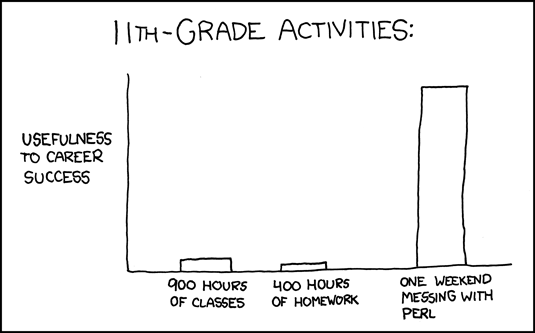
Saw this again on another site, and just had to post it. It's a beautiful graphic expostion of the idea that in software engineering careers (and most likely many other endeavors), experience is more valuable than education.

Of course this does not mean that education is without value. I have spent many, many hours educating myself – and I certainly don't consider that wasted time. But...for every hour I've spent educating myself, I've probably spent 20 hours practicing (all outside of any work context).

Personally, I think the quickest way to develop practical skills in software engineering (and, again, likely also in many other areas) is just such a lopsided mix of education and practice. I suspect the ideal ratio is different for different people, and also different over the course of a career.  In my own case, I note that I can proportionally spend more time these days on educating myself, especially so when the subject matter is an extension of something I've already mastered.

The real point here is that formal educations that spend far more time empahsizing reading and lecture than they do practice seem wildly out of whack to me. My strongest evidence is the readiness of recent graduates to actually do something useful in the workplace – it's close to zero.

A Blind Man Who Sees...

An amazing and inspiring story of a totally blind man who has taught himself to “see” remarkably well – the same way bats do, with echolocation...

On Public Sector Unions...

Peggy Noonan, in today's WSJ:
Unions have been respected in America forever, and public employee unions have reaped that respect. There are two great reasons for this. One is that unions always stood for the little guy. The other is that Americans like balance. We have management over here and the union over here, they'll talk and find balance, it'll turn out fine.

But with the public employee unions, the balance has been off for decades. And when they lost their balance they fell off their pedestal.

When union leaders negotiate with a politician, they're negotiating with someone they can hire and fire. Public unions have numbers and money, and politicians need both. And politicians fear strikes because the public hates them. When governors negotiate with unions, it's not collective bargaining, it's more like collusion. Someone said last week the taxpayers aren't at the table. The taxpayers aren't even in the room.

As for unions looking out for the little guy, that's not how it's looking right now. Right now the little guy is the public school pupil whose daily rounds take him from a neglectful family to an indifferent teacher who can't be removed. The little guy is the beleaguered administrator whose attempts at improvement are thwarted by unions. The little guy is the private-sector worker who doesn't have a good health-care plan, who barely has a pension, who lacks job security, and who is paying everyone else's bills.
It's been a long time since I had positive feelings about unions in general; I think they've long outlived their original worthy purpose and have become more a drag on progress and on the economy than any possible benefit could justify.  Public sector unions have seemed wrong to me from their very beginnings in the early '60s. 

I remember a high-school history teacher (can't remember his name) – in 10th grade, I think.  He was a recently returned Vietnam War veteran,  one of the first wave of Kennedy's “advisors”.  He was deeply offended by the unionization of federal employees (something that Kennedy approved), and saw it as a betrayal of the values he fought for in Vietnam.  His passionate lecture on that subject, over 40 years ago, is still a clear memory.  His reasons for opposing public sector unions are the same reasons opponents use today, most emphatically the unholy alliance that Noonan refers to in this column (third paragraph above).  

Thursday, March 3, 2011

What Were the Odds...

...of death for a soldier in any particular war?  Here's the answer, courtesy of Essential Militaria, via Gizmodo:
• War of Independence: 2 percent (1 in 50)
• War of 1812: 0.8 percent (1 in 127)
• Indian Wars: 0.9 percent (1 in 106)
• Mexican War: 2.2 percent (1 in 45)
• Civil War: 6.7 percent (1 in 15)
• Spanish-American War: 0.1 percent (1 in 798)
• World War I: 1.1 percent (1 in 89)
• World War II: 1.8 percent (1 in 56)
• Korean War: 0.6 percent (1 in 171)
• Vietnam War: 0.5 percent (1 in 185)
• Persian Gulf War: 0.03 percent (1 in 3,162)
You were about 200 times more likely to be killed in the Civil War than in the Persian Gulf War.  I know from other reading that the Iraq and Afghanistan Wars are slightly less risky for soldiers than even the Persian Gulf War.  I was a sailor at the end of the Vietnam War, never really at risk myself – but I certainly knew a lot of people who were at risk (and three who were killed there).   The Vietnam War, as recent as it was, was nearly 15 times riskier to the soldiers participating in it than the Persian Gulf War.  The difference in risk mainly has to do with technology (precision munitions, fantastically better sensors, communications) and medical care at the battlefront.  The ratio of combat troops to REMFs has actually gone up (meaning proportionally more soldiers in a war are actually in combat in recent wars than in past wars)...

Russian Pole Dancer...

This is over two years old, but new to me.  Amazing!


Tuesday, March 1, 2011

Charles Koch Speaks Out...

The Koch brothers have been the subject of intense demonization by the liberals and progressives, especially concerning recent events in Wisconsin.  The Wall Street Journal this morning provided a platform for the Koch brothers (Charles Koch is on the byline) to answer their critics.  It's an interesting read, and led me to a ponder on the targets chosen by the left.  I suspect they targeted the Koch brothers not at all for idealogical reasons, but rather because they perceive them as a threat.  In other words, they see the Koch brothers as effective operatives for the right.

The Koch brothers don't appear to be in need of financial support.  But they've got my moral support!

Libyan Rebels Having Some Success...

I don't know much about the factions in Libya, but it's hard to imagine a group I'd not prefer to Mohamar Gahdaffi.  So I was happy to read that the rebels there are having some success against Gahdaffi's forces...

History of Computers...

If you're at all interested in computers, this graphic is fascinating.

If you've been involved with computers as long as I have, it's a little disconcerting to see the computers I first worked with so close to the beginning of the chart.  Yikes!

In my case (and I suspect many others as well), that's not entirely due to my age.  I first worked with computers in the U.S. Navy, and some of the systems I worked with were museum-fodder while I was working on them (and some of those stayed in service for a decade or more after I left!).

Nonetheless...there's a fair number of machines in the top quarter of that chart that I know from hands-on experience.  What a short revolution the computer revolution has been!

Aging Rock Stars...

Via reader Dave H:, who says this strikes a little close to home...

Monday, February 28, 2011

Snow on Cuyamaca...

Cuyamaca Peak,
from Lawson Valley...
Yesterday morning, Debbie and I (along with Miki and Race) took off for our local mountains, which had heavy snow on Saturday night. As we drove toward Descanso, we could see the amounts of snow on the ground gradually increasing. We stopped for breakfast at the (incredibly busy!) Descanso Junction Restaurant, and then headed out on one of our favorite drives: Boulder Creek Road, along the western face of Cuyamaca Mountain. All of the photos below were taken on this drive. The photo at right is Cuyamaca Mountain taken from a vantage point along Lawson Valley Road, on our drive back home.

To say the drive was enjoyable would be a considerable understatement.  This was by far the most snow we've ever seen at these altitudes.  We spent about four hours gawking, playing with the dogs in the snow (video coming!), and taking a few short walks.  With our four wheel drive pickup we were able to drive almost all the way through Boulder Creek Road, even though it had not been plowed.  Eventually we had to turn around – not because of snow, but because a large oak had fallen across the road in the Inaja Indian reservation.  In places there was over a foot (30 cm) of snow on the ground, so there were some challenging moments driving.  The temperature hovered just above freezing until just after we turned around; then it rose to about 45°F (6°C) and the snow started to melt quickly.

We had a grand time.  Enjoy the photos!

Avalanches!
Ice on branches...
Piled snow, Cuyamaca Peak...
Piled high on the branches...
Cuyamaca Peak...
Cuyamaca Peak
and north shoulder...
North shoulder, Cuyamaca...
Distant mountains...
(San Jacinto, San Bernadinos)
Neatly piled fence posts...
Sheeting off the
Boulder Creek ford...
Ice on branches...
Ice on branches...
Ice on branches...
Ice on branches...
Ice on branches...
Ice on branches...
Ice on branches...
Ice on branches...
Ice on branches...
Boulder Creek scene...
A bazillion rivulets...
Charred stumps...
Charred stumps...
Charred stumps...
Toyon berries next to a tiny stream...
Snow-bound yucca...
Snow-bound yucca...

Sunday, February 27, 2011

Snow in Lawson Valley!

Late last night we got something like an inch (2.5 cm) of snow.  Wet, slushy, with hail mixed in – but recognizably snow.  You can see on the rain chart at right the nearly vertical line from our intense rains Friday night, followed by the gentler bump – that's the snow melting in my rain gauge this morning (note the dates and times at right are GMT, not PST).

When we got up this morning, our yard was filled with sights the likes of which we haven't seen for something like 7 or 8 years (since the last “real” snowfall here).  I ran out with my nice Canon camera to take photos, only to find out that I had a battery problem (or so I thought).  So I took a bunch of crappy cellphone photos. 

Later in the day I figured out that the real problem wasn't the battery at all: it was the danged charger!  So I used the charger I have that runs in the car to charge my batteries, and for the rest of the day (up on Cuyamaca Mountain) I got to use my real camera.  So here's your consolation prize: crappy cellphone photos of real snow in Lawson Valley!

Cold BBQ!
Frozen Daffodils...
Ice blocks the feeders...
Wildflowers, too early...
Neighbor's horses...


Manzanita...
Manzanita...
Even more manzanita...
Snow-capped palm!
Pyrocantha on Japatul Road...
More Pyrocantha...
Snow on our red roof...
Iced truck!