In the most recent edition of the Jamul Shopper, Sharon and Phil Freeman have a short article (on page 19) outlining the need for a web site for Jamulians to post notices about lost and found pets. They're absolutely right, as there is no better way to get the word out than the web. My local readers know that I already post such notices on request, or when I spot them – but what we really need is a place that everybody knows about.
I've written the Jamul Shopper, as the Freemans suggest in their article, to see if they would help publicize the “Lost And Found Pets in Jamul” section of my blog, which can be found by clicking here (and of course right now there's nothing in it but this post). Anyone in the Jamul area is welcome to post a notice of any lost or found pets. All you have to do is send me an email at slightlyloony@jamulblog.com. Describe the pet you've lost or found, provide contact information, and if possible, attach a photo or two. I'll post it as soon as I receive it.
And if the ad succeeds, please let me know – my readers will want to know if the pet was reunited with it's owners!

Sunday, August 5, 2007

Saturday, August 4, 2007
Last Week's Puzzler...
 Five of you got the right answer on this one, and only two got it wrong. But most of you didn't even try!
The scale of the universe is really difficult to truly grasp. Even the scale of our local neighborhood – the solar system – is amazing. If you were to continue the model used for last week's puzzler, if the sun is a foot in diameter, how big are we? Answer: about 17 billionths of an inch tall. We're pretty insignificant in the solar system!
This Week's Puzzler...
Imagine that you owned a water tank located on a hill behind your house. The water tank is 300 feet from the house, on an uphill slope that averages 30° from the horizontal. If you filled the tank with water, and ran a pipe from the tank to your house, what water pressure (in pounds per square inch) would you expect to see (at your house)? Enter your answer on the poll at right.
Friday, August 3, 2007
Fortress Update
 Another day of fine progress on our safe-house! Davy (the mason) showed up bright and early, with two of his sons (Roberto and Alfredo). As usual for them, they worked hard, straight through the day – from about 8:00 am until about 4:30 pm, right through the hot part of the day (and it was darned hot today!
 I learned today from Ruben (my contractor) that Davy has five sons – all of whom are budding masons – and one daughter. I've now met three of his sons, and my reaction could be summed up very simply: as far as I can tell, he's got every reason to be one proud papa. All three boys I've met are courteous, hard-working, and (especially considering their age) remarkably talented. It's a pleasure to watch them all work together; it reminds me of certain times in my childhood working with my father…
 The work today, for the most part, was a straightforward continuation of the earlier masonry work I observed. Just a couple of new things to talk about.
 Yesterday, as you know if you're following these events, we didn't have quite enough concrete on the truck to complete the grout lift. So this morning Alfredo and Roberto mixed several bags of concrete in a wheelbarrow, and lifted it up by hand about two gallons at a time in a bucket to finish the grout lift. It didn't take them long at all; just a half-hour or so.
 Partway through today, Davy finished laying blocks on both sides of the doorway. The next row would go over the cutout for the doorway – so how do you lay blocks in mid-air?
 He did it very simply, by building a temporary wooden support for the blocks (you can see it in the photo at right). Then he laid the next row of blocks right over the support. Over these “suspended” blocks, and for several block lengths on either side, several pieces of rebar (as called for in the plan) will be fit into notches. There are three more rows of block going over this one.
 If you think about this from the perspective of a mechanical engineer, it's quite a complex system: horizontal rebar near the door cutout to handle the tension created from the weight on the blocks above the doorway (which will be considerable when the roof is poured!), vertical rebar to handle the much lower vertical tensions, and the block plus grout to handle the compressive loads. It would take me quite a while to figure out how to model this system, but with such a mix of materials I know it would be tough to calculate…
And now some photos from the day:


Quote of the Day
John Fund, commenting in today's WSJ Political Diary ($ email), about the decision by every announced Democratic 2008 Presidential candidate to attend (or, as Mr. Fund puts it, “to genuflect before”) the YearlyKos convention in Chicago this weekend:
I sure hope that's true, as otherwise I'm not confident of the Republicans fielding a candidate likely to win against Clinton, Edwards, or even Obama…
There's a reason that the Democrats can still lose the 2008 elections even against a Republican Party that has lost much of both its elan and purpose. The party has gone over the ideological guardrails and may once again present a face to the American people that is too extreme. Watch the speeches of the Democratic candidates to the YearlyKos convention this weekend for clues as to just how far they feel compelled to have to bend towards the party's Loony Left.Mr. Fund is highlighting what I think is the Democratic Party’s single biggest weakness: the lunacy factor. The “Kos Kids” are widely perceived as members of the tin foil hat brigade – they tend to be “truthers” (denying that al Qaida was responsible for 9/11), supporters (or even members of) “Code Pink” (or other similarly radical anti-war organizations, and so on. Ordinary Americans generally get rather queasy upon close examination of Kos and his ilk. I suspect they'll feel a little queasy about voting for candidates closely allied with the loony left as well.
I sure hope that's true, as otherwise I'm not confident of the Republicans fielding a candidate likely to win against Clinton, Edwards, or even Obama…
The Italian Prescription
Writing in today's WSJ ($), Daniele Cappezone (president of the productivity committee of the Italian Chamber of Deputies) writes about what socialized medicine has done in his country:
Let's just say “no!”
This is what Hilary, Kennedy, Pelosi, Reid (and their buddy Michael Moore, of course) want for us.We live in an age of unprecedented medical innovation. Unfortunately, most of today's cutting-edge research is conducted outside Europe, which was once a pioneer in this field. About 78% of global biotechnology research funds are spent in the U.S., compared to just 16% in Europe. Americans therefore have better access to modern drugs. One result is that in the U.S., the annual death rate from cancer is 196 per 100,000 people, compared to 235 in Britain, 244 in France, 270 in Italy and 273 in Germany.
It is both a tragedy and an embarrassment that Europe hasn't kept up with the U.S. in saving and improving lives. What's to blame? The Continent's misguided policies and state-run health-care systems. The reasons vary from country to country, but broadly speaking, the custodians of public health budgets aren't devoting the necessary resources to get patients the most modern and advanced medicines, and are happier with the status quo. We often see news headlines about promising new cures and vaccines next to headlines about patients who can't get life-saving drugs as politicians impose ever stricter prescription controls on doctors.
The human toll can be measured in deaths and unnecessary suffering. It also costs us a lot of money. Prevention is cheaper than treatment. Modern medicine can prevent many medical complications that would otherwise require hospitalization and other expensive care. For every euro spent on new medicine, national health-care systems could save as much as €3.65 in later treatments, according to a National Bureau of Economic Research study.
This situation is especially dire in Italy. The government has capped spending on pharmaceuticals at 13% of total health-care expenditures while letting expenses for infrastructure and staff skyrocket. From 2001 to 2005, general health expenses in Italy grew by 31% while expenditure on medicines increased a mere 1.7%. Italian patients might well have been better off if the reverse was the case, but the state bureaucrats who make these decisions refuse to acknowledge the benefits of advanced drugs.
Let's just say “no!”
Pamela Adams Sentenced
 Pamela Adams used to be the president of the Friends of Jamul-Dulzura Schools, a non-profit organization dedicated to providing (with volunteers and funding) sports, cultural, and other after-school activities to the students in the area. She was convicted of stealing over $100,000 in donations from the organization she headed. Yesterday she was ordered to pay additional money back to the organization, and she was sentenced to one year in jail (from the San Diego Union-Tribune):
A former president of a nonprofit that raises money for an East County school district was sentenced to one year in jail yesterday for stealing more than $100,000 from the foundation.The bald details of her crime are bad enough – but what makes it even worse is that Ms. Adams is far from impoverished. She didn't even need the money she stole! I'm sure that one year in jail for someone of her age and life experience is going to be pure hell for her – entirely appropriate for the grief and misery she's caused others. I just hope she takes this lesson to heart, and never considers such behavior again after she is released. I hope others with similar inclinations will note the punishment and decide to take a righteous course. And I hope Ms. Adams moves to someplace far away when she is finally released. I recommend Detroit, Michigan, or Camden, New Jersey – or perhaps Washington, D.C.
Pamela Adams was sentenced to one year in jail for stealing more than $100,000 from the Friends of Jamul-Dulzura Schools nonprofit foundation.
“You violated a position of trust,” Superior Court Judge Patricia Cookson told a weeping Pamela Adams.
Adams, 48, was ordered to pay $55,639 in addition to the $93,000 she has already paid back to the Friends of Jamul-Dulzura Schools.
Revised Casino, Revised
Updated and bumped:
Mike W. (one of my readers) spotted an interesting change on the Lakes Entertainment web site. Here's what it says now:Casino HighlightsThey dropped the completion date! I'm not entirely sure what this change means, but it sure is hard to see it as anything other than good news!Project Status
- 1,000 gaming devices, 20 table games and 5 poker tables
- Enclosed parking garage
- 20 minutes to downtown San Diego
- Proven gaming market
- Population - 11 million/100 mile radius
- Signed development and financing agreement
- Currently planning to build on existing reservation
Original Post:
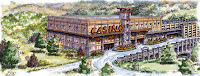 The Lakes Entertainment web site is now showing the revised casino plans:
Casino Highlights
- 1,000 gaming devices, 20 table games and 5 poker tables
- Enclosed parking garage
- 20 minutes to downtown San Diego
- Proven gaming market
- Population - 11 million/100 mile radius
Project Status
- Signed development and financing agreement
- Currently planning to build on existing reservation
- Opening estimated January 2009
Assuming those are Class 2 gaming devices (not requiring any agreement with the State), this is a plan for a tiny and far less profitable casino than the proposal we heard last fall. It appears to be either 3 or 4 stories high, versus the 27 or 30 or whatever was really being planned (I’ve heard so many variations that I’m not sure what the reality was).
While I’m sure that the tribe and Lakes Entertainment are completely correct to say there are fewer obstacles in the way of getting this plan implemented, I believe it’s also true that the (much) smaller profit incentive means it’s much less likely that Lakes Entertainment will be willing to fund a prolonged, difficult legal battle. In other words, I think this development means the casino project is now more vulnerable to challenge…
Indian Wisdom
Tip of the hat to my mom for this one:
An Indian walks into a cafe with a shotgun in one hand pulling a male buffalo with the other. He says to the waiter: “Want coffee. ”As Glenn would say, “Indeed.”
The waiter says, “Sure, Chief. Coming right up.” He gets the Indian a tall mug of coffee.
The Indian drinks the coffee down in one gulp, turns and blasts the buffalo with the shotgun, causing parts of the animal to splatter everywhere and then just walks out.
The next morning the Indian returns. He has his shotgun in one hand, pulling another male buffalo with the other. He walks up to the counter and says to the waiter “Want coffee.”
The waiter says “Whoa, Tonto! We're still cleaning up your mess from yesterday. What was all that about, anyway?”
The Indian smiles and proudly says “Training for position in United States Congress: come in, drink coffee, shoot the bull, leave mess for others to clean up, disappear for rest of day.”
Thursday, August 2, 2007
Fortress Update
The astonishing and unexpected progress continues! Despite the masons taking the day off (because of the uncertainty about the inspection time), a lot was accomplished. Ruben (my contractor) and the inspector showed up within moments of each other, before 8 am. A few minutes later, after some minor difficulty locating the rebar schedule (the specification for the size of the rebar) on the design drawing, we were approved – we passed the inspection!
Next came the really surprising part… I can't help but think of Ruben as the absolute master of procrastination – eight months of zero activity will do that to you. But today, after the pleasant surprise of an early-in-the-day inspection (passed!), Ruben turned into the whirling dervish of Jamul. With a few phone calls, he arranged for the delivery of the remaining materials we need for construction, for delivery this afternoon of the 3.5 yards of concrete needed for the next pour, for Carlos (the concrete pumper) this afternoon, and for the masons to show back up tomorrow. Whew!
 Even better – the material actually showed up, Carlos arrived and set up his pump, and the concrete arrived on time. Moments later, Carlos started pumping concrete into the voids inside the concrete blocks already laid. This operation is called a “grout lift” – the “grout” means filling the holes in the blocks with concrete, and the “lift” refers to filling the blocks up only to a certain height (five feet, in this case). The reason for limiting a grout lift to five feet is to limit the hydraulic pressure acting on the lower runs of block being filled – if the lift were made high enough (say, 10 feet), the pressure might be high enough to burst those blocks. What a mess that would be, with concrete running out all over the place!

 Tomorrow Davy starts early in the morning, putting up the last 7 runs of block. He and his sons should be finished with that in two or three days of work. After that, they'll begin installing the form and rebar for pouring the last grout lift (which will fill the new blocks they're about to lay) and the pour for the roof. My estimate is that we'll make that pour next Wednesday or Thursday. Woo hoo!
Next came the really surprising part… I can't help but think of Ruben as the absolute master of procrastination – eight months of zero activity will do that to you. But today, after the pleasant surprise of an early-in-the-day inspection (passed!), Ruben turned into the whirling dervish of Jamul. With a few phone calls, he arranged for the delivery of the remaining materials we need for construction, for delivery this afternoon of the 3.5 yards of concrete needed for the next pour, for Carlos (the concrete pumper) this afternoon, and for the masons to show back up tomorrow. Whew!
 Even better – the material actually showed up, Carlos arrived and set up his pump, and the concrete arrived on time. Moments later, Carlos started pumping concrete into the voids inside the concrete blocks already laid. This operation is called a “grout lift” – the “grout” means filling the holes in the blocks with concrete, and the “lift” refers to filling the blocks up only to a certain height (five feet, in this case). The reason for limiting a grout lift to five feet is to limit the hydraulic pressure acting on the lower runs of block being filled – if the lift were made high enough (say, 10 feet), the pressure might be high enough to burst those blocks. What a mess that would be, with concrete running out all over the place!
 Tomorrow Davy starts early in the morning, putting up the last 7 runs of block. He and his sons should be finished with that in two or three days of work. After that, they'll begin installing the form and rebar for pouring the last grout lift (which will fill the new blocks they're about to lay) and the pour for the roof. My estimate is that we'll make that pour next Wednesday or Thursday. Woo hoo!
The Blob
The unions who represent federal employees love to spin the image of their members as selfless civil servants, making sacrifices like long hours and low pay in order to (patriotically, of course) serve their country.
Don't you believe it!
At the same time that compensation for Federal employees is soaring, so is the percentage of the work force employed by the government. In 2006, the government employed 16% (20 of 128 million) of all employees.
We are slowly being transformed from a society of entrepreneurs with a small, idealistic government to a society that impedes entrepreneurs with a large, selfish government of leeches. This path leads to a bad place, similar to where Europe was a couple decades ago – and has been running away from ever since.
The more developed and entrenched our money-corrupted government becomes, the harder it becomes to throw the bums out. The recent earmark “reform” should be all the proof of this thesis that anyone needs – not only have the Democrats not followed through on their promise to clean up the corruption of earmarks, they're actually making it worse (mainly by eliminating any transparency on the earmarks at all).
Here's something for you to think about: in 2006, the government paid out 28% of all compensation paid in the U.S. What goods or services did those employees produce or provide? Not much, that's for sure.
Think leeches.
When leeches are sucking out your blood, do you leave them on your body so they can suck some more? No, of course not. You remove them.
We need to remove the government leeches. Short of a revolution, that can only happen as a political process: we must elect Representatives, Senators, and a President who are committed to reducing the size of government. Traditionally in our two-party system, that has been the position of the Republicans. In the last few years, it is not the position of either party.
We need a new party, before the Blob of Federal Leeches sucks out every bit of life this country has. Where is this new party going to come from? It seems unlikely to me that a brandy-new party could successfully be started from scratch. More likely is the emergence of a reformer from within an existing party who can transform the party's purpose. Given their respective ideologies, that seems much more likely from the Republican side. As I look at the announced and possible 2008 Presidential candidates there, limiting myself to those that have any realistic prayer of success, I come up with only two names (Fred Thompson and Newt Gingrich), and I'm not real sure about either one of them…
Don't you believe it!
The full report has much more detail.The new data for 2006 show that 1.8 million federal civilian workers earned an average $111,180 in total compensation (wages plus benefits). That is more than double the $55,470 average earned by U.S. workers in the private sector.
Looking just at wages, federal workers earned an average $73,406, which is 60 percent greater than the $45,995 average earned by private sector workers.
At the same time that compensation for Federal employees is soaring, so is the percentage of the work force employed by the government. In 2006, the government employed 16% (20 of 128 million) of all employees.
We are slowly being transformed from a society of entrepreneurs with a small, idealistic government to a society that impedes entrepreneurs with a large, selfish government of leeches. This path leads to a bad place, similar to where Europe was a couple decades ago – and has been running away from ever since.
The more developed and entrenched our money-corrupted government becomes, the harder it becomes to throw the bums out. The recent earmark “reform” should be all the proof of this thesis that anyone needs – not only have the Democrats not followed through on their promise to clean up the corruption of earmarks, they're actually making it worse (mainly by eliminating any transparency on the earmarks at all).
Here's something for you to think about: in 2006, the government paid out 28% of all compensation paid in the U.S. What goods or services did those employees produce or provide? Not much, that's for sure.
Think leeches.
When leeches are sucking out your blood, do you leave them on your body so they can suck some more? No, of course not. You remove them.
We need to remove the government leeches. Short of a revolution, that can only happen as a political process: we must elect Representatives, Senators, and a President who are committed to reducing the size of government. Traditionally in our two-party system, that has been the position of the Republicans. In the last few years, it is not the position of either party.
We need a new party, before the Blob of Federal Leeches sucks out every bit of life this country has. Where is this new party going to come from? It seems unlikely to me that a brandy-new party could successfully be started from scratch. More likely is the emergence of a reformer from within an existing party who can transform the party's purpose. Given their respective ideologies, that seems much more likely from the Republican side. As I look at the announced and possible 2008 Presidential candidates there, limiting myself to those that have any realistic prayer of success, I come up with only two names (Fred Thompson and Newt Gingrich), and I'm not real sure about either one of them…
Wednesday, August 1, 2007
Fortress Update
 Another day with great progress on our safe-house! Davy and his 14 year old son Alfredo (at right) worked a long day today, and actually they're still hard at work as I write this. They're going to finish up the seventh run of block, where the wall will be just shy of five feet high.
For some reason that I don't fully understand (and probably never will), the County planning department requires an inspection when the wall is no higher than five feet high. So now all work on the project must come to a crashing halt, while we wait for the inspector to show up tomorrow. Since we have no idea when the inspector will show up (they give us no clue at all), Davy and his sons will work on another job tomorrow. Hopefully they will return to the job on Friday – assuming, of course, that we pass the inspection tomorrow.
 The work done today was essentially a continuation of yesterday's process. I saw just a couple of new techniques. Davy used a piece of scrap lumber I had laying about, with a few blocks, to make a perfectly usable scaffold. If I understood him correctly, on future days when the wall is considerably higher, he'll bring a real scaffold to the work site. And I saw a simple and clever tool: a pair of cast metal pieces designed to grasp the top of the blocks on a corner while holding a string in exactly the right place to act as a guide for laying the block. With these tools, Davy had a guide string set for each new run with just a few seconds of work.
Here are some more photos of today's progress:


Scary Socialized Medicine
 My mom sent me an email copy of an interesting commentary piece by a person whose name I recognized: Dr. David Gratzer. He's a Canadian doctor, practicing in both the U.S. and Canada, and a crusader for capitalist (e.g., for-profit) medicine. Here's a quote from this latest piece, which appeared in Investor's Business Daily:
Dr. Gratzer is particularly good at rebutting the arguments of liberals who cite the “evils” of American medicine (think Michael Moore and Sicko). For example:Swinging open the door, I stepped into a nightmare: the ER overflowed with elderly people on stretchers, waiting for admission. Some, it turned out, had waited five days. The air stank with sweat and urine. Right then, I began to reconsider everything that I thought I knew about Canadian health care.
I soon discovered that the problems went well beyond overcrowded ERs. Patients had to wait for practically any diagnostic test or procedure, such as the man with persistent pain from a hernia operation whom we referred to a pain clinic — with a three-year wait list; or the woman with breast cancer who needed to wait four months for radiation therapy, when the standard of care was four weeks.
Government researchers now note that more than 1.5 million Ontarians (or 12% of that province's population) can't find family physicians. Health officials in one Nova Scotia community actually resorted to a lottery to determine who'd get a doctor's appointment.
These problems are not unique to Canada — they characterize all government-run health care systems.
If you have even the slightest inclination to support socialized medicine, or any legislation that reduces the independence or profitability of American medicine, please … read the whole thing. Another relevant commentary piece (in the Wall Street Journal) is here, an index of Dr. Gratzer's essays here, and his books here.Americans live 75.3 years on average, fewer than Canadians (77.3) or the French (76.6) or the citizens of any Western European nation save Portugal. Health care influences life expectancy, of course. But a life can end because of a murder, a fall or a car accident. Such factors aren't academic — homicide rates in the U.S. are much higher than in other countries.
In The Business of Health, Robert Ohsfeldt and John Schneider factor out intentional and unintentional injuries from life-expectancy statistics and find that Americans who don't die in car crashes or homicides outlive people in any other Western country.
And if we measure a health care system by how well it serves its sick citizens, American medicine excels. Five-year cancer survival rates bear this out. For leukemia, the American survival rate is almost 50%; the European rate is just 35%. Esophageal carcinoma: 12% in the U.S., 6% in Europe. The survival rate for prostate cancer is 81.2% here, yet 61.7% in France and down to 44.3% in England — a striking variation.
In my travels I have had the opportunity to meet and get to know quite a few people who live in countries with socialized medicine – especially in England, Germany, Estonia, and Russia. In each of these countries, I have posed a similar question to several people: “Suppose your spouse or child had a life-threatening cancer. Suppose that you were independently wealthy and could afford to have your loved one cared for anywhere in the world. Where would you take him or her for treatment?” Every single person I have asked this question of instantly said “America”.
Why is this so obvious to the people who live under socialized medicine? Most of the people I talked with had never even been to America – and yet they are absolutely certain our medical system delivers superior care. When I probed this, the typical answers were variants of “our system is so bad that America's must be better” and “America is where all the rich people go, and they'd know better than I”, with a few “I have friends or relatives who have moved to America, and they tell me the medical system is wonderful there”.
But our liberals tell us – against all evidence that I'm aware of (not to mention common sense!) – that socialized medicine is superior.
My mom's reaction to this editorial was to suspect it was exaggerated, but generally on target. I'm glad her instincts are to suspect the evils of socialist medicine. But I cannot for the life of me understand why so many Americans (including my mom) have so much trouble believing just how bad socialized medicine really is. For me, the essential problems are obvious: (1) any system in which a desirable good or service is “free” will inevitably lead to shortages and rationing, and (2) any system that does not provide financial incentives for success and excellence will decay into shoddiness. Our public education system suffers from these two problems. Socialized medicine, everywhere I've ever been, suffers from them as well. Examples of drug rationing, surgery backlogs (a form of rationing), and diagnostics rationing abound. Doctors – especially the good ones – flee from those countries to America, where they can make good money. Why is this so hard for so many Americans to absorb? I cannot fathom it.
Tuesday, July 31, 2007
Fortress Update
 I still can't quite wrap my brain around the fact that our safe-house is actually being built. After eight months of inactivity, suddenly (and completely inexplicably) my contractor has decided to finish the job. I mentioned earlier that I witnessed my contractor negotiating the job with the masons. Later I got to know the masons just a little bit better. It's a family affair: a father and his two sons. The father's name is Davey (at right, just before going home for the day); the older son Eduardo. I checked in a few times during the day today to see what progress there was, and if anything was needed. Each time, it was a pleasure to watch these men work – they clearly have a lot of experience as masons, and the way they make the job look effortless is a testament to their skills.
 The work started with some careful measuring and calculating. From what I could tell, the main objectives of all this was to figure out exactly how many blocks were required on each layer (“run”) of blocks, to figure out where their outer edges should lie on the slab, and to make sure the vertical pieces of rebar were all in the right place to poke through the holes in the block. A complicating factor was the doorway; one piece of rebar had to be bent slightly to make that work. Then the tangible work commenced: they laid a first run of block down all around the building.
 It was fascinating to watch carefully how the masons laid those blocks. They make it look so easy! The starting point was a single block, set down into a lot more mortar than was actually needed. Davey tapped this block gently into position, paying the most attention to the height of the block (I suppose to make sure the grout thickness underneath was correct). This block's height then became the reference height for all the rest of the blocks.
 For all the subsequent blocks, the masons followed a pattern. First the blocks were set on end near where they'd be used. Then they would put some grout (again, much more than actually needed) on the top end. Next they would lay down heavy lines of grout on the slab (or later, on the underlying row of block) where the blocks would go. Then, one at a time, the upended blocks were turned sideways and set roughly into place. Then Davey would work his magic, carefully maneuvering the block by gentle taps until it was in exactly the right place, as determined by eyeball, straight-edge, and level. The last step was performed by the youngest son: cleaning up and removing the excess grout from the inside of the joints (as you can see in the photo above right).
Thinking like a nerdy engineer for a moment, it was interesting to note that he moved that block with all six classical degrees of freedom: forward/backward, left/right, up/down, and rotation about all three of those axes. That's quite a feat of spatial manipulation, but he made it look effortless and easy. I know darned well that were I to attempt such a thing, the result wouldn't be nearly as pretty…
 On every second run of block, something slightly different occurs: a horizontal piece of rebar is run through all the blocks. They accomplished this by manually notching the three lengthwise segments of every block on that run. At right you can see Eduardo making cuts in those segments; later the youngest boy uses a hammer to carefully knock them out. After one of these notched runs is complete, the masons bend rebar as required to run it completely around the wall.
 By the third run of block, there was very little of the original vertical rebar pieces left showing. Yet the plans call for vertical rebar running all the way up the wall. On asking, I found out that this requirement will be satisfied by placing vertical pieces of rebar in place when the wall is completely built. This is much easier than trying to thread every block through 8 feet or so of rebar!
At right you can see Davy using the level as he completes a corner. This extra care is need to make sure that the runs of block along each wall meet up on the corners correctly. I watched him do this several times; he's not satisfied until the error is invisibly small.
 The end result is a perfect block wall. Well, at least it is perfect within the capacity of my eyeballs to detect error: I cannot see anything out of whack on these walls. In the photo at right, you can see the first three runs on the south wall – everything about it appears to be straight as an arrow and perfectly aligned.
 Davey and his sons are due back on the job at 7:30 am tomorrow morning. I don't know them well, but I know them enough to have developed a sense that Davey is a reliable, straight-up kind of guy (unlike someone else I might mention). When he tells me that he'll be here tomorrow morning, I'm inclined to believe him.
What a nice feeling that is, and what a refreshing change in the context of this project.
I'll end with these scenes of three skilled masons at work…


Botany Photo
 Today the Botany Photo of the Day site is featuring this Mexican plant (Mentzelia hispida). I wish it grew around here; it's gorgeous!
 Cox & Forkum nail it again, this time in response to the Democrat's maneuvers on Capitol Hill to eliminate a proposed “shield law” that would prevent lawsuits against citizen informants who notified authorities of suspicious behavior they'd observed.
Why would the Democrats want to eliminate this shield law? The only plausible answer that I've seen to that question is this: the Democrats are so beholden to the litigation attorney's (they are major contributors to the Democratic Party) that they are willing to trade off national security and American lives .
Cox & Forkum, as usual, perfectly capture the insanity.
Fortress Update
Debbie came into my office a few minutes ago with spectacularly good news: the masons have arrived, and they have begun laying the block for our safe house (aka “The Fortress”).
I have no idea why my contractor suddenly decided to get my job done, but it really does look like that's what's happening. The masons are subcontractors, and I heard him negotiate the job with them – all the way through to completion.
I'm feeling a little faint; I need to lie down for a few minutes…
I have no idea why my contractor suddenly decided to get my job done, but it really does look like that's what's happening. The masons are subcontractors, and I heard him negotiate the job with them – all the way through to completion.
I'm feeling a little faint; I need to lie down for a few minutes…
Monday, July 30, 2007
Electric Father
My father called me yesterday from my parents' home in New Jersey. I could tell that he was very excited, and I soon found out why – just a short while before he called, he had been outside on their covered porch when lightning struck a big oak tree just 10 feet away!
He reports that chunks of smoking oak and a number of fried squirrels fell out of the sky all around him. His hair (he has a few tufts left) stood straight up, because he had acquired a high-voltage static electrical charge. He had no trouble hearing the sound; his normal hearing aids were unnecessary. I think he was still pumped up with adrenaline when he called..
I've been near lightning strokes several times in my life, but never as close as 10 feet – and that's one experience I'd be happy to never have! He was actually quite lucky that none of the current flowed through him or his clothing, as that could have badly injured or even killed him – ten feet is close enough that it could have jumped over to him if he was the path of low resistance. But he was dry, and standing on a dry wooden porch, while surrounded by wet (from the pouring rain) trees and ground, so the lightning naturally took other, lower resistance, paths to ground.
He reports that chunks of smoking oak and a number of fried squirrels fell out of the sky all around him. His hair (he has a few tufts left) stood straight up, because he had acquired a high-voltage static electrical charge. He had no trouble hearing the sound; his normal hearing aids were unnecessary. I think he was still pumped up with adrenaline when he called..
I've been near lightning strokes several times in my life, but never as close as 10 feet – and that's one experience I'd be happy to never have! He was actually quite lucky that none of the current flowed through him or his clothing, as that could have badly injured or even killed him – ten feet is close enough that it could have jumped over to him if he was the path of low resistance. But he was dry, and standing on a dry wooden porch, while surrounded by wet (from the pouring rain) trees and ground, so the lightning naturally took other, lower resistance, paths to ground.
Tagged Again!
Simon tagged me on his blog, looking for eight random facts about me. The rules:
Eight random facts about me:
Well, I can easily supply eight random facts about me (I'm a very random guy!) – but I don't know any other bloggers (aside from Simon!) well enough to tag them back, so I'll just ignore that part.1) Post these rules before you give your facts.
2) List 8 random facts about yourself.
3) At the end of your post, choose (tag) 8 people and list their names (linking to them)
4) Leave them a comment on their blog letting them know they've been tagged!
Eight random facts about me:
- I've been to quite a few places in the world. In the 1970s, while in the U.S. Navy, I visited dozens of countries around the Pacific Ocean and Indian Ocean – and a few out-of-the-way places like Iceland and Greenland as the Navy flew me around the world to catch my ship. In the 1990s and later, business travel took me to Europe (especially England, Germany, Estonia and Russia) many times, and to some other places as well.
- I know next-to-nothing about sports (to the point where I cannot reliably tell baseball, football, socker, and tennis apart – I do recognize golf, though). I care about them even less.
- I wasn't always a software engineer. My initial professional interest was radio. That morphed into digital electronics when I got interested in microcomputers as a hobby in the 1970s. I didn't really get totally focused on software until the mid 1980s – and I still keep my hand in on electronic design.
- I don't watch any broadcast television at all, and haven't for quite a few years. I watch only a few movies each year (and only at home; I haven't been to a theater for many years). The most modern modern pop music I've listened to was made in the early '80s (and most of it before the mid-'70s). As a consequence, much to the amusement of my friends, there's a vast swath of modern culture that I am completely ignorant of. Just to give you a sample: I've never watched an episode of Friends, The Simpsons, or 24.
- I read a lot, both online and books – and my reading is eclectic, to say the least. Right at the moment, I'm reading several books: a Martha Grimes English murder mystery, a Java programming book, a book about the effects of randomness on financial systems, and a book about engineering failures and their causes. When I was young (and extremely introverted, and fearful of basically the whole world), reading was my major form of escape – I thought of the county and high school librarians as close friends. I read hundreds of books in my high school years, and actually won an ad hoc award in high school because they'd never seen anyone read so much. All that practice reading built very strong reading skills and a love of reading that has never waned.
- I detest beer; always have. I've tried roughly a dozen various beers over the years, usually with a friend telling me “Even if you've hated every other beer you've tried, you'll love this one!” They all suck. This is a bit of a social issue with my German, Estonian, and Russian friends!
- I used to skydive (in the '70s); I've made over 400 jumps. Every time I see skydivers in the air, I'm tempted to start again. I was jumping just before ram-air parachutes (the rectangular ones that basically every jumper uses today) were common and safe. My parachute was a round, 27' diameter “Russian Para-Commander”, a slightly more maneuverable than usual model. It had lift-over-drag ratio of about 1.1:1, which means for every 10 feet you fell, you could travel 11 feet forward. By contrast, modern parachutes can have lift-over-drag ratios of 5:1 or even higher.
- I'm obsessed with knowing how things work, whether it is something in nature or something man-made. I suspect this is related to loving engineering. I spend a lot of time (and reading) satisfying my own curiosity on such things, generally with nothing actually useful learned. I'm actually quite uncomfortable using a piece of machinery if I don't know (at least in a general way) how it works.
Sunday, July 29, 2007
Tippy Ships
 Here's last week's poll and its results (at right).
 Two people got it right – the correct answer is the longitudinal center of gravity.
Many moons ago, this little fact was vividly demonstrated to me, in a memorable way. I was serving on a U.S. Navy ship, the U.S.S. Long Beach. This was a nuclear-powered guided missile cruiser, a one-of-a-kind experimental platform for surface nuclear propulsion, electronic systems, and missiles. It was also, oddly enough, the tallest ship in the Navy – about 210' above the waterline if memory serves me right.
On the day of my center-of-gravity demonstration, we were cruising off the southern California coast. A storm moved in, quickly and a bit unexpectedly – and we were subjected to the fiercest winds and largest waves I'd yet experienced. In various maneuvers the ship was subjected to winds and waves that tipped it far over – 48°, according to the “barfometer” (clinometer) in my working space. The really remarkable thing was how long it took to straighten back up – and then swing the other way – it seemed to take forever, but I timed a couple of the recoveries at over 50 seconds (the time between maximum tipping and being back straight up).
Both the large angle of tipping and the slow recovery were caused by the ship having an unusually high longitudinal center of gravity (LCG): just a foot or two below the waterline. The further below waterline a ship's LCG is, the more stable it is.
But what is an LCG? The easiest way for me to visualize it is this: Imagine a ship with a shaft all the way through it, lengthwise. Then imagine this shaft is located so that the ship could be rotated around it while balanced. That shaft would be directly through the LCG.
Now imagine that same ship (with the magic LCD shaft) in the water. If that shaft were exactly at the water line, then it wouldn't matter to the ship whether it was right-side up or up-side down – it would neither right itself or flip up-side down. If the shaft were above the water line, the ship would immediately flip over, up-side down. And if the shaft were below the water line (as it would be on any real ship), the ship is stable in an upright position.
Naval architects (that's what the engineers who design ships are called) pay very close attention to the LCG; it is one of several critical design parameters for any ship. I was told that the U.S.S. Long Beach was initially designed with an LCG considerably lower than it was when I was on board. The LCG was raised when additional superstructure was installed in the 1960s, along with large amounts of additional electronic equipment – some of it located far above the waterline – in the last 1960s and early 1970s (I served on board in the mid-1970s). Whether that raised LCG was accidental or intentional, I couldn't say.
But it sure was uncomfortable!
Subscribe to:
Posts (Atom)