Tuesday, May 1, 2007

Estonian Riots

As many of my readers already know, for over ten year ending in 2004 I was a frequent visitor to the little Baltic country of Estonia. Two different companies that I worked for in that period had software development facilities in Tallinn, the largest city in Estonia. In that period I made quite a few friends there, and traveled extensively throughout the country. I’m very fond of Estonia and its people.

Estonia’s history is one of turmoil and conflict, and amazingly complex for such a tiny country. Of relevance to this post is its history from World War II onwards.

The entire country of Estonia was overrun by the Nazis early in the war. Some Estonians — a small, but significant minority — actively collaborated with the Nazi occupiers. The Nazis drafted some men involuntarily into its armed forces, but other Estonians volunteered — including for concentration camp guard duty and extermination squad duty. There was also an active resistance against the Nazis, in which a number of Estonians were killed or injured. During this period there was a very small community of ethnic Russian people in Estonia, variously estimated at 1.5% to 3.5% of the total population.

Later in the war, the Soviet Army overran Estonia from the other direction. Just as with the Nazis, a small but significant minority of Estonians collaborated with the Soviets. There were Estonian units in the Soviet Army, but the most apparent collaboration was political — some ethnic Estonians joined the Communist party and became local implementors of the Soviet domination. Again, just as with the Nazis, there was an active military resistance to the Soviet occupation that wasn’t stamped out until the 1960s. During this period of Soviet occupation, hundreds of thousands of ethnic Russians emigrated to Estonia, which had become part of the Soviet Union. Most of these Russian immigrants were concentrated in approximately half the land area of the country, where they became the overwhelming majority of the population. Other parts of the country were still ethnic Estonian in majority. Depending on whether you count military personnel (the Soviets had several large military facilities in Estonia), and depending on who did the counting, the ethnic Russians at their peak formed between 45% and 65% of the total population of the country.

The Soviet occupation of Estonia lasted for over 40 years, until 1991. During this period, an entire generation of Estonians experienced life as a subjugated, second-class people. Many ethnic Russians in Estonia deny this, but the evidence seems incontrovertible to me — educational opportunity, economic opportunity, and freedom of movement were all different (and worse) for the ethnic Estonians. In 1991, as the Soviet Union was falling apart, ethnic Estonians (and a few ethnic Russians) formed a separatist movement and carried out an almost non-violent “singing revolution” that won Estonia’s independence.

After the Soviet withdrew their military, and after the initial waves of emigration (mainly ethnic Russians returning to Russia) and immigration (mainly ethnic Estonians who had escaped the occupations returning to their native land), the population over the whole country has settled down to roughly 60% ethnic Estonian and 40% ethnic Russian. Different sources for these numbers vary by a surprising amount even today, and of course there are other ethnic groups in Estonia as well.

For the past 16 years, since independence from the Soviet Union, little Estonia has been dealing with the tensions between these two ethnic communities. My ethnic Estonian friends largely perceive the ethnic Russians as the leftovers of a hated oppressor, as interlopers, and mainly interested in returning Estonia to Russia. My ethnic Russian friends have a much more varied set of perceptions and attitudes. Some of them appear to be exactly what the ethnic Estonians fear. Some of them are much more moderate, especially with respect to rejoining Russia. Most of them have learned enough Estonian to become citizens; some of them are quite fluent in Estonian. Only one amongst all my ethnic Russian friends ever stated assimilation into Estonian culture as an objective — all the rest seem, actively or passively, to be committed to keeping their Russian culture. For example, most of the children of my ethnic Russian friends attend Russian-language schools.

This past week, the Estonian government decided to move a monument in Tallinn out of the Old Town area to a military cemetery on the outskirts of the city. This particular monument had been erected by the Soviets in honor of their soldiers who were killed while driving the Nazis from Estonia. Many ethnic Estonians were insulted by this monument to an oppressor’s army — especially because it stood in the heart of Estonian history and culture: the Old Town of Tallinn. It was a highly visible reminder of the Soviet Army that not only drove out the reviled Nazis, but also forcibly evicted thousands of Estonians, herded them off to gulags where many died, and stomped the Estonian resistance out of existence. This Soviet Army was the instrument that enabled their oppression, and they resented this memorial to it. The ethnic Russians, on the other hand, see this memorial as honoring their fallen comrades who had been engaged in a wholly honorable duty: clearing the fair land of Estonia of the execrable Nazis. To them, moving the monument was an insult to heroes — and inexplicable, as the Estonians were themselves the great beneficiaries of their fighting.

So the movement of the monument was guaranteed to whip up tensions, as that action was keenly felt by the emotions of both groups. But to make matters worse, it appears that Russian intelligence was active amongst several ethnic Russian groups inside Estonia, doing everything they could to make the tensions even higher. Their objective: to topple the current government of Estonia, which the Russians perceive (quite correctly, I think) as unfriendly to their interests. The best documented example of their actions I’ve been able to find is the planting of outrageous stories in Russian-language newspapers, both in Estonia and in Russia. For example, one of these stories claimed that the Estonian government had not moved the monument in whole, but had instead hacked it up into dozens of pieces and reassembled it in a sloppy, disrespectful manner. This story is now known to have been written in Russia (presumably by the foreign intelligence agency), then distributed through the leader of a militant Russian group in Estonia (this leader is now under arrest). Russian intelligence stands accused of many other actions to raise tensions as well. Yesterday a delegation of Russian diplomats arrived in Tallinn for discussions — and before they left, they announced that their goal was to bring down the current Estonian government!

Over the past few days, thousands of people in several Estonian cities have rioted. Tallinn’s Old Town area saw the most violence and damage; one man was killed and dozens were injured. About 1,000 people were arrested, though most have been released. Tensions between the ethnic Estonian and ethnic Russian communities are very high; worse, I think, than even immediately following independence from the Soviet Union.

My ethnic Estonian friends are all worried that Russia will use these recent events and increasing tensions as a pretext to invade and re-occupy Estonia. At least one of my friends is worried enough to start sending her family and assets out of the country. I think this is overreaction, and quite premature, but I can’t blame them for their fear and concern. The EU and NATO memberships aren’t likely to translate into direct military defense if it were needed. I believe Finland, the U.S., Britain, and Poland are the most likely military forces who actually would come to Estonia’s aid — and only the Finns could do so very quickly.

My ethnic Russian friends seem much less concerned about a Russian invasion (and, so far as I know, none of them would welcome it). They are more inclined to believe that the Russian government will, at most, try to get a pro-Russian government installed in Tallinn. I think this is most likely myself; it would be quite a gamble for Russia to simply annex Estonia. On the other hand, as an American friend of mine commented yesterday, from Russia’s perspective the West probably looks quite wimpy right now — it’s not inconceivable that the Russians have talked themselves into believing that the West would not come to Estonia’s aid. We Americans are quite tied up now with various aspects of the global war on terror, plus the ongoing tension with Iran. The British don’t look like they’d be real excited about a front in Europe. Poland would almost certainly be willing, but their capabilities are limited. The Finns are hard to read — they’re committed by treaty to defend Estonia, and there are now substantial Finnish assets in Estonia — but on the other hand their politics are not generally supportive of military intervention. So I can make the case myself for Russia feeling as though they might be able to get away with retaking Estonia — but I believe they’d be making a terrible mistake (for Russia) by doing so.

More than anything, I just hate seeing these events happen to little Estonia, the Baltic land that I’ve come to love. All my friends are agitated by this, whatever side of the fence they’re on. And it’s very hard to see any path out of this mess that is good for everyone — I’m afraid that resolution likely means that one side or the other “wins” and the other “loses", and that’s a darned shame…

Monday, April 30, 2007

Injured Dogs

Those two sad-looking, T-shirted field spaniels are Lea (on the left) and Mo’i (on the right). Within the space of a week, both of them managed to cause a late-night trip to the emergency veterinary hospital!

First was Mo’i. We had a mole removed (and tested for malignancy); a routine procedure. It was benign, which is wonderful. But the six stitches that closed the wound were to much for Mo’i — he chewed them out one evening. We discovered him with a gaping wound and no stitches — so off to the hospital we went.

Then just a couple of days after that, as we were getting ready to go to bed, we discovered a huge swelling on Lea’s front-right shoulder. We knew darned well it hadn’t been there just a few hours prior, and we were concerned about that fast growth. So off we went to the emergency veterinary hospital again! They diagnosed it as an infected abscess, and she had minor surgery that night to drain it and explore for the cause (suspect: foxtail). But the exploratory surgery found no cause at all, so we don’t know why she suddenly developed this alarming infection…

As I write this, Mo’i is almost completely healed — enough that he’ll be running in an agility competition this Thursday. Lea had her drain removed a few days ago, and is healing nicely — but it will be a couple of weeks before she can run again.

And the T-Shirts? They’re wearing them as a way to keep them from biting out their stitches. The only other way to keep those stitches intact is with a great big conical collar (the “Elizabethan collar"). The dogs really hate those things, so we prefer the T-Shirt route…

Mercenary Agency

StrategyPage has an interesting article about what troops are actually doing the U.N. peacekeeping duties around the world. Where the bullets are actually flying, those peacekeeping duties are dominated by South Asian troops. The European, Japanese, and Korean troops that are participating in these duties tend to be in the relatively safe areas, especially behind the lines in logistics roles:

The wealthier nations don’t like to send their own troops, because such missions are not politically popular. Sometimes they do anyway, but the politicians pay the price, and often pull the plug on the effort if it causes too much negative feedback from the voters. But for the South Asian nations, the peacekeeping is a source of national pride. Even the losses (123 Indians, 95 Pakistanis, 80 Bangladeshis and 56 Nepalis killed so far) do not discourage the folks back home, but simply reinforce the honorable and courageous nature of the service.

Pondering this, I realized that the U.N. is effectively an agency for mercenaries — the U.N. pays attractive wages and benefits for soldiers to do its “dirty work", and the rich nations pay for it. The U.S. and a few of our allies are exceptions to this general pattern, but otherwise it holds quite well. The fact that the U.N. is the paymaster (and not the rich nations directly) apparently puts enough makeup on the otherwise unattractive notion of using mercenaries so that the oh-so-moral rich nations (I’m thinking especially of Europe here, and most especially of France and Germany) can feel good about it. But wash off that makeup and look at the simple facts: those South Asian soldiers are paid (albeit indirectly) to do the fighting that the rich nations can’t muster the cojones to do themselves…

Through my own reading of history, I associate the use of mercenaries (and especially a dependence on mercenaries) with societies or cultures that are near the end of their rope. Prior to reading this article, I hadn’t thought of the U.N. as a mercenary agency. Now that I am, I’m also wondering what this portends for (especially) Europe…

Monday, April 23, 2007

The Big Mellow

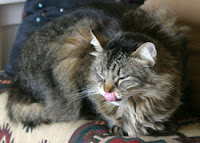
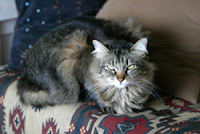
Halala Pala is one of our eight cats, the biggest of the bunch. His name ("Halala” or “Ha” for short) means “big mellow” in Hawaiian, and that fits his personality very well.

We’re pretty sure he’s mostly (or entirely) of a cat breed called “Maine Coon", which are noted for their appearance, their size, their reluctance to jump, and their funny little squeaky voices. Halala has all of these characteristic traits. Most cats that look this big are actually mostly fluffed up hair; Halala is really that big!

I caught him yesterday morning just hanging out on our chair…

Sunday, April 22, 2007

Title

Mark Steyn, in his column today, weighs in on the very predictable liberal hooting and hollering for more gun control following the Virginia Tech massacre. Naturally, being Mark Steyn, he does so in fine style. Here’s a story — a true story, by the way — that forms part of his argument:

A few years back, a couple of alienated loser teens from a small Vermont town decided they were going to kill somebody, steal his ATM cards, and go to Australia. So they went to a remote house in the woods a couple of towns away, knocked on the door, and said their car had broken down. The guy thought their story smelled funny so he picked up his Glock and told 'em to get lost. So they concocted a better story, and pretended to be students doing an environmental survey. Unfortunately, the next old coot in the woods was sick of environmentalists and chased 'em away. Eventually they figured they could spend months knocking on doors in rural Vermont and New Hampshire and seeing nothing for their pains but cranky guys in plaid leveling both barrels through the screen door. So even these idiots worked it out: Where’s the nearest place around here where you’re most likely to encounter gullible defenseless types who have foresworn all means of resistance? Answer: Dartmouth College. So they drove over the Connecticut River, rang the doorbell, and brutally murdered a couple of well-meaning liberal professors. Two depraved misfits of crushing stupidity (to judge from their diaries) had nevertheless identified precisely the easiest murder victims in the twin-state area.

Then Mr. Steyn articulates perfectly an observation I’ve never been able to say quite so clearly:

To promote vulnerability as a moral virtue is not merely foolish. Like the new Yale props department policy, it signals to everyone that you’re not in the real world.

Exactly. “Not in the real world” pretty much sums up the liberal perspective (if that’s actually a good characterization of their bleating) on gun control.

"Promoting vulnerability” is a very nice turn of phrase to describe the lunacy of disarming the law-abiding citizenry, don’t you think?

Thursday, April 19, 2007

Quote of the Day

Words just fail me…

"I believe myself that the secretary of state, secretary of defense and — you have to make your own decisions as to what the president knows — (know) this war is lost and the surge is not accomplishing anything as indicated by the extreme violence in Iraq yesterday,” said Senator Harry Reid, Democrat from Nevada and Senate Majority Leader.

In his following comments, Senator Reid made it clear that he meant exactly what he said in the preceding quote: that in his judgment, the war in Iraq is “not winnable militarily”.

So…

One of the highest ranking, most powerful members of the political party that controls the legislative branch of the Federal government has decided the United States — by far the most powerful country on the planet — cannot win the war in Iraq. The sniveling worm is ready to unilaterally hand victory to Al Qaida.

After five and a half years of open warfare and struggle on three continents…

After our military forces (with some help, to be fair) have taken out huge numbers of Al Qaida fighters and inflicted grievous harm to the organization…

After Osama Bin Laden has been driven into hiding, and dozens of other Al Qaida leaders killed or captured…

After we have freed the Afghan people from the Taliban and the Iraqi people from the evil despot Saddam…

And just as objective reports on the ground in Iraq cite much progress at just about every level — including ever-increasing readiness of the newly independent Iraqi government to stand on their own feet…

...Harry Reid, that sorry excuse for an American, wants to chuck it all in. Give up. Retreat. Declare defeat. And fight terrorism with economic sanctions and diplomacy. Which, after seeing the results of Nancy Pelosi’s trip to Damascus, we can say with some authority are just code words for appeasement.

Harry Reid and Nancy Pelosi are entirely representative of their party, unfortunately. About the most charitable interpretation I can make of their behavior is that they’ve allowed their partisanship to overwhelm their patriotism. But that’s really just another kind of spin — the truth is, I’m afraid, much simpler:

They’re traitors.

And they’re in charge of Congress.

And they want to put one of theirs in the White House…

Wednesday, April 18, 2007

The Unkindest Cut

As some of you actually noticed, the blog was down for a few hours today. I have monitors that continuously watch the Internet connectivity for my server, and today around noon every possible red light and warning buzzer went off. With a little bit of diagnostic work I figured out that it wasn’t one of my servers — it was the entire Internet connection to my server closet, dead as the proverbial doornail.

My servers are not in the boondocks with me — they’re located in the basement of a friend’s home in La Mesa, which is a relatively civilized place, with cable, DSL, grocery stores, etc. My friend’s home is about a 40 minute drive from my home, so whenever something like this happens (thankfully not very often!), I’m faced with the need to make a roughly 90 minute round trip. Usually the problem is simple to fix: just reboot (or power cycle) the DSL router, and I’m back on the air.

But that didn’t work today. Something more serious was wrong. And that meant I needed to get a cell phone (for nobody was home at my friend’s house), and the contact information, circuit number, etc. so I could call Covad (my ISP) and troubleshoot it with them. So off I went, back to my house to pick up this stuff, and then back again to my friend’s house.

When I got back to my friend’s house the second time, my friend (also Tom) was home, and he joined me for the troubleshooting. I went through all the troubleshooting procedures with the very friendly Covad folks, but they couldn’t bring the connection back to life. Through our testing, they figured out that there was a “connectivity problem” — in other words, that somewhere between the telephone company’s office and my friend’s house, the wiring was broken. Fixing this entails a long process involving phone company representatives, appointments, etc. It would take days or (worst case) weeks to get my system back on the air. It didn’t look good.

As a last resort, I decided to check the box where the phone company’s wiring connects to the wiring I had installed. I opened it up, made sure the connections were tight — it all looked fine. But my friend noticed that a foot or so from the box, the wiring to my server cabinet was taped together. The tape looked old, but neither of us could remember having made a junction — especially one that was taped like that. I figured the most likely thing was that we’d forgotten doing it — after all, it had been over a year since we installed this thing. But just for the sake of completeness, without any real hope that this would prove to be the problem, I decided to unwrap the tape and check it out.

I’m very glad I did, as what we discovered was, in fact, the problem!

The first thing we noticed under the tape was that all eight wires in each cable were twisted together — with the insulation still intact. That certainly wasn’t going to work! And after I untwisted them, the two pieces of cable just fell apart — it most definitely wasn’t connected at all.

Ah ha! The problem! And easily fixed, too — my friend noted that there was enough slack that we could simply connect the fresh cut directly to the phone company box, and voila! Everything came back up and worked great.

Which left one mystery: just how did the cable come to be cut at around noon today? My friend then remembered a crucial little bit of information: his gardener had been there today, and he had been wielding a power trimmer. This is just the sort of tool that could cause the damage we saw, and the timing was right as well. Apparently the gardener whacked the cable (sawing off my server cabinet from the Internet) and either decided to hide the accident by taping the wires back together, or he was so ignorant of the mysteries of electronics that he thought he actually fixed it by twisting it together and taping it up. He never mentioned it to my friend.

That’s a new one on me — my “data center” taken out by a gardener!

Gun Control Experiment

The tragedy at Virginia Tech is already being used by the left as a vehicle to push through gun control laws. Every time a gun is used in a high-profile crime, this is the predictable consequence.

This time, more than most, it seems to be a particularly moronic response.

Because, in fact, the Virginia Tech campus was a particularly good experiment in rather complete gun control. All guns are banned on campus — even the campus police have no guns, and even faculty and students with concealed-carry permits are not allowed to have those guns on campus. Cho (the murderer) was violating the law when he brought his weapons on campus and used them to kill and wound dozens of people. He had obtained the weapons illegally in the first place. In other words, under existing laws, every step of Cho’s path was illegal.

But it didn’t stop him.

And neither will another slew of laws stop future murders.

I’ve never been able to understand how the left can look at situations like this and decide that the answer is more gun control laws. There just seems to be something about guns that turns a leftish brain to mush. Not only do they have trouble understanding arguments that gun control is actually increases the risks to ordinary, law-abiding citizens — they also manage to avoid acknowledging the abundance of actual evidence supporting that notion.

There are a lot of places in the world (not just in the U.S.!) where ordinary, law-abiding citizens are allowed to carry guns — and in some cases, are actually encouraged to do so. And there are a lot of places in the world (including in the U.S.) where ordinary citizens are forbidden to carry guns. This is not a recent development; it has been true for many years. The world has been conducting an experiment on the effectiveness of gun control in reducing the incidence of violence — and scientists have studied this.

But you won’t hear the left crowing about the results of these studies, or using them as evidence to support their quest for more gun control legislation. Why not?

Because the studies show that increased gun control not only fails to reduce violence upon the citizenry, it actually increases it. The mechanism isn’t hard to discern: citizens who can defend themselves with weaponry equivalent to what the bad guys have are simply less vulnerable.

Well, duh!

There are already reports of several students and faculty who have concealed carry permits and who were in a position to stop Cho — but, being law-abiding citizens, they did not have their guns with them. It also turns out that last year, in response to yet another campus shooting, the Virginia state assembly considered a bill to allow students and faculty who passed a review and permit process to carry guns on campus. The Virginia Tech administration lobbied against this legislation, and in the end the bill never made it out of committee. Afterwards, the Virginia Tech spokesman crowed about their victory, and declared that because this bill was defeated, the students and their parents would feel safe on campus.

I wonder how safe they’re feeling today?

I wonder how the parents of the dead and wounded students would react to that spokesman’s declaration of victory today?

But most of all, I wonder at how anyone can look at situations like this and conclude that disarming the citizenry is the action needed. Me, I think it would be much more productive to train the faculty and students in firearms use and safety, and to issue weapons and ammunition just as we issue books. Think about it — Cho would have had weapons either way, but in my scenario he wouldn’t have gotten very far before some pissed-off coed dropped him in his tracks…

Sunday, April 15, 2007

A Modest Proposal

I have a sure-fire way to cut our income taxes substantially — by half, at least. My plan has just two elements:

Outlaw tax withholding.

Today the vast majority of Americans have both their federal and state income taxes withheld from every paycheck. Instead, I’d like to see every U.S. citizen who earns an income make out a check every quarter to pay their taxes (this is what contractors do today). By making every citizen cut a check, we’ll make every citizen aware that they’re paying it (many people never even think about the withheld taxes). By making it quarterly, the size of the tax bite will be that much more evident.

Hold all elections on April 16th.

It is no accident that “tax day” is a long way from election day. Let’s fix that, and hold elections when the pain of tax extraction is fresh and clear in the voter’s minds. I promise you that politicians promising tax cuts will get extra attention that close to tax day!

What do you think about my simple, two-step plan?

Saturday, April 14, 2007

Kevlar Shoelaces

About seven months ago, I posted about the non-breaking Kevlar shoelaces I’d discovered. Well, today I finally had to replace my first pair of them. They lasted seven months, instead of the few weeks (or even just a few days!) that I’d get out of the ordinary types of shoelaces. I have no complaints about them at all, and they were worth every penny!

Ceanothus

This afternoon I took Miki and Lea on a walk around the yard, and found this fellow in bloom uphill from where we park our cars. Gorgeous thing!

I also took about thirty photos of one of the bazillion bees working hard at collecting all the pollen and nectar, but not a single one of them came out. Those busy bees are amazingly difficult photographic subjects…

Adventurous Visitors

Just a few weeks ago I was searching for information on an unusual French slide rule (the “Supremathic"). I posted a question a Yahoo Group (ISRG), and a French slide rule collector named Marc Thomas responded with some very useful information. He and I exchanged several emails, and a couple of weeks ago he mentioned that he and his wife (Dominique) would be visiting the U.S. to see their daughter. It turns out that their daughter lives in Riverside, California, which is just 100 miles or so north of us. So Marc wondered if perhaps he could visit while he was over here.

Although meeting another collector (and showing off my collection!) sounded like an interesting experience, my first thoughts were to discourage him. Most Americans who try to find our home have trouble (we’re way, way out in the boondocks!), so what were the chances of a Frenchman, in unfamiliar territory, locating us? I wrote back to tell him I’d love to meet up, but that he should be concerned about the distance and remoteness. I figured that would be the end of that…

But yesterday morning, I got another email from Marc — he and his wife were in Riverside, and he wondered if it would be possible to visit with us that very afternoon! So I wrote up some very detailed directions for him, and sent them off by email. The plan was for him to arrive sometime after 4 PM, and he’d call if he couldn’t make it.

Well, 4 PM rolled around, and no call from Marc. And 15 minutes later, a little red car came rolling up our driveway, and out popped Marc and Dominique. They made it!

For the next couple of hours, we had a most enjoyable meeting with these folks. It turns out that Marc is a professor of mathematics, and Dominique a professor of history. Dominique and Debbie immediately got into a conversation about cats, and dogs — and Dominique was fascinated by our birds, especially the hummingbirds. Marc and I went through a couple dozen of my slide rules, and it was great fun to show him several that he had read about, seen photos of, but had never actually seen in person. Debbie got to show off her collection of ribbons from dog competitions, and it was a lot of fun to watch Dominique going through them — she particularly liked the multi-colored “title” ribbons.

Marc and Dominique wanted to drive back to Riverside in the daylight, so they had to leave quite early. We could hardly blame them for wanting to drive while it was light, but we would have greatly enjoyed a longer visit. It was quite an adventure for them to drive all the way down here, and they got to see some parts of California rarely seen by most Americans, let alone people from another country. And it was quite an adventure for us as well — meeting this very interesting couple with a vastly different life experience than ours, but still having many points of common interest. Marc is the first slide rule collector who has ever actually seen my collection — while I have parts of it on the web, and I correspond with dozens of collectors, not a single one has ever made it out here before!

Thursday, April 12, 2007

Term of the Day

applied troglodytics

Used in a WSJ piece by Michael Malone, describing the reaction of the music industry to Napster and the culture of free music downloads.

A Google search for the term reveals only one other use, which appears to be completely unrelated. So I think it’s safe to credit Mr. Malone with the creation of this delicious term…

Wednesday, April 11, 2007

Fudge Factors

Some people are so interesting that just seeing their name is enough to make me go investigate. Freeman Dyson is one of those names for me — he’s a famous physicist who hasn’t limited his interest or thinking to his own field. When I think of Freeman Dyson, I think of a fine mind, well stuffed with knowledge, romping about the open fields of questions about our universe. Reading his thinking is an adventure.

So yesterday, when I noticed that TCS Daily had published an interview with him, I had to go read it. It’s a very unfocused interview, ranging all over the place. In the middle of it, Dyson said this:

Concerning the climate models, I know enough of the details to be sure that they are unreliable. They are full of fudge factors that are fitted to the existing climate, so the models more or less agree with the observed data. But there is no reason to believe that the same fudge factors would give the right behavior in a world with different chemistry, for example in a world with increased CO2 in the atmosphere.

As someone who has created computer models in the past, hearing that they are full of fudge factors is pretty much the same thing as saying they are full of another soft brown substance, one that doesn’t smell so good. What Dyson is describing is a process that every modeler is all too familiar with. It goes like this: first, you study the problem you’re trying to model until you believe you understand it.

Just as an example, suppose you’re trying to model what happens when you throw a ball. Your model tries to predict where the ball will hit the ground. So you study the physics of this motion, and build a model that takes into account the speed and direction of the throw, gravity, the air resistance, the wind, etc. Then you test the model — you put some values in for speed and direction of the throw, the wind speed, and so on. Your model calculates where the ball will land. Then you actually throw the ball to see where it actually lands.

And oops! The ball doesn’t land exactly where your model said it would. Instead, let’s say it lands 2 feet short, and 6 inches to the left of where your model predicted. What do you do now? There are two basic ways to “fix” your model. One way is to say to yourself “Ok, there must be something I don’t understand…", and go back to study the problem some more until you do understand why your model didn’t match reality. This sort of reaction brings deeper understanding of many kinds of physical processes, and models used in this way have contributed much to human understanding of many things. The other way to fix your model is to add “fudge factors”. In our example above, perhaps you multiply the distance predicted by your model by 0.976 (fudge factor one) and the leftward motion by 0.994 (fudge factor two). Those numbers aren’t based on any understanding of why the unfudged model is different than reality; they’re just the factors needed to line the unfudged model up with reality.

The problem with fudge factors is that they mask what’s really going on. To continue our example with the ball, if a scientist investigated the mismatch further, he might discover that the spin on the ball was also contributing to its trajectory — and when he corrects for the spin (by building it into his model), the model can predict the landing point to within an inch. Now this model can be used to confidently predict the landing point of the ball. The model with the fudge factors, though, will continue to perform poorly — because the spin on the ball can be different on every throw.

So Dyson has discovered that the climate models used to predict global warming are full of fudge factors, and he’s as suspicious of them as I am. Knowing what I do about Freeman Dyson, I put a high value on his judgment in such matters. Not only is he possessed of a fine, well-educated mind — he is also possessed of independence, both of his intrinsic spirit and of any connections to the global warming “movement” amongst climatologists. His observations about the fudge factors can be made without any particular expertise on climatology; all one needs to know is the math and the elements of modeling. Both things are elemental tools for any physicist, so Dyson is well-equipped there.

My skepticism on the global warming hysteria just got turned up another big notch…

Tuesday, April 10, 2007

Liberal Appeasement

Jack Kelly (a columnist) thinks that liberals need to have their heads examined:

Some liken liberal appeasers to those Britons who wanted to make a deal with Hitler after the fall of France in 1940. That’s unfair to those appeasers. Their attitude was not honorable, but it was reasonable. The Nazis then possessed a substantial advantage in military power. Today’s liberal appeasers embrace dhimmitude even though it’s the West that has a huge military and economic advantage.

This extent to which liberals are willing to accept inferior status to Muslims even in their own countries is mind-boggling. In Britain, schools are dropping references to the Holocaust to avoid offending Muslims, the Daily Mail reported. In Minneapolis, some Muslim cab drivers reject passengers carrying alcohol, and Muslim clerks in a grocery store have refused to wait on customers who want to buy pork products. In several Western countries, some Muslim cab drivers have turned away blind passengers with seeing-eye dogs. (Many Muslims consider dogs “unclean.")

Liberals are not so much terrified by the threat radical Islam poses as they are oblivious to it. A recent poll indicated a majority of Democrats are more worried about global warming than Islamic terror. While many liberals do indeed need to have backbones surgically implanted, more need to have their heads examined.

Read the whole thing.

I had to stop after reading that last paragraph, just to savor the image Mr. Kelly’s words evoked. If I were to send your typical American liberal through an MRI machine, would I be able to detect either a spine or a brain?

Perhaps not…

Monday, April 9, 2007

Awwwww...

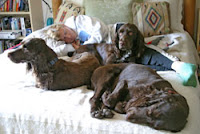
For some completely idiotic reason, Debbie and actually got up this morning at 1:30 AM. Consequently, by the early afternoon we were both feeling a little fagged out. I had to work, but lucky Debbie and the dogs got to take a nap.

Aren’t they cute?

Now that you’ve absorbed the cuteness, I’ll tell you what made me get up and take this photo. It was the snoring! Two of the dogs (Mo’i and Lea) and Debbie were sawing logs like mad — loud enough for me to hear it over all the computer noise in my office across the hall!

When I walked in, only Miki was alert enough to even notice. He’s looking at me here with some very sleepy puppy eyes…

Aren’t they cute?

War with Islam

Tip of the hat to Mike D. for forwarding this interesting piece by Solly Ganor (an Israeli and Dachau survivor). In it, Solly recounts his meeting with a Christian Arab. I’ve excerpted a passage where the Arab lectures Solly about Iran:

“Now is the time to stop them, not only because they are developing nuclear bombs, but because Iran has become the base for all Islamic terrorist. They supply, money, men, and weapons to Islamic terrorist around the world, quite often through their diplomatic mail. Billions of petro-dollars that are pouring into Iran are being funneled into terrorist organizations world-wide. They believe, and perhaps rightly so, that the West will do nothing to stop them in achieving their goals. Is history repeating itself? Are the Iranians making the same mistake that Hitler made when he attacked Poland? Is the situation similar?"

“As a history teacher who studied the subject thoroughly I can tell you that Western victory in World War Two was not all certain. Hitler could have won the war if he would have gone ahead with the atomic bomb development before the Americans. The Germans began working on it in the thirties, and it was Hitler’s decision to prefer building more conventional arms, as he considered atomic weapons sheer fantasy. Hitler made the wrong decision, but had he made the right decision the world would have been a different type of world today, wouldn’t it? The West won the war against Hitler by sheer chance. Very few people seem to realize that.”

I must say that his last words shook me up quite a bit. Had Hitler made a different decision, I would have died in Dachau, there wouldn’t have been a Jewish state called Israel, and most likely there wouldn’t have been any Jews left in the world. The idea that the Western democracies in general and the fate of the Jewish people in particular could have hinged on Hitler’s one decision, is a scenario of the worst nightmare.

Read the whole thing.

Solly’s Arab is much less optimistic than I am about the certainty of our eventual conflict with Iran — but he is just as certain as I am that there will be such a conflict…

So What?

I can hardly believe my eyes — an article in Newsweek (that bastion of liberal, politically-correct thinking) that actually wonders aloud about the Goracle’s view on global warming:

Many of the most alarming studies rely on long-range predictions using inherently untrustworthy climate models, similar to those that cannot accurately forecast the weather a week from now. Interpretations of these studies rarely consider that the impact of carbon on temperature goes down—not up—the more carbon accumulates in the atmosphere. Even if emissions were the sole cause of the recent temperature rise—a dubious proposition—future increases wouldn’t be as steep as the climb in emissions.

Indeed, one overlooked mystery is why temperatures are not already higher. Various models predict that a doubling of CO2 in the atmosphere will raise the world’s average temperature by as little as 1.5 degrees Celsius or as much as 4.5 degrees. The important thing about doubled CO2 (or any other greenhouse gas) is its “forcing"—its contribution to warming. At present, the greenhouse forcing is already about three-quarters of what one would get from a doubling of CO2. But average temperatures rose only about 0.6 degrees since the beginning of the industrial era, and the change hasn’t been uniform—warming has largely occurred during the periods from 1919 to 1940 and from 1976 to 1998, with cooling in between. Researchers have been unable to explain this discrepancy.

As they say, go read the whole thing.

I’m unreasonably cheered by this (and some other) recent lamestream media pieces that look like the first chinks in the Goracle’s “faith-based science” of global warming…

If This Offends

From the London Telegraph, this illuminating story about the girlie-men in the BBC:

Amid the deaths and the grim daily struggle bravely borne by Britain’s forces in southern Iraq, one tale of heroism stands out.

Private Johnson Beharry’s courage in rescuing an ambushed foot patrol then, in a second act, saving his vehicle’s crew despite his own terrible injuries earned him a Victoria Cross.

For the BBC, however, his story is “too positive” about the conflict.

The corporation has cancelled the commission for a 90-minute drama about Britain’s youngest surviving Victoria Cross hero because it feared it would alienate members of the audience opposed to the war in Iraq.

The BBC’s retreat from the project, which had the working title Victoria Cross, has sparked accusations of cowardice and will reignite the debate about the broadcaster’s alleged lack of patriotism.

"The BBC has behaved in a cowardly fashion by pulling the plug on the project altogether,” said a source close to the project. “It began to have second thoughts last year as the war in Iraq deteriorated. It felt it couldn’t show anything with a degree of positivity about the conflict.

That’s Private Johnson Beharry in the photo, holding his Victoria’s Cross.

While lamestream media stories of the heroism of America’s troops in Iraq aren’t common, they do exist — our media, lame as it is, hasn’t quite been reduced to the politically-correct pablum of the BBC. Not yet, anyway. And the independent outlets (including, most especially, the hundreds of excellent “mil blogs” out there, and the video outlets like YouTube) are very effective at getting these stories out to those who want to read or see them. Collectively, these sites have millions of visitors each day — a cheering fact to those who, like me, expect that some day in the not too distant future we’ll be needing some folks with a positive view of patriotism and heroism.

I hope the movie about Private Beharry finds another outlet; I’d like to see it. And how sad…how pathetic to see a formerly-great institution like the BBC descend to such limp-wristed depths. If you know anything at all about the history of World War II, you know that just 60 years ago the BBC could have been called “heroic” itself. Now they’d probably censor a history about themselves!

Confessions

One particular aspect of the recent incident involving the 15 British sailors captured by Iran has been nagging at me: the way that 13 of the 15 had “confessions” coerced from them very quickly, and without any apparent long-lasting consequences (within hours of returning home, all 15 appeared at a press conference, looking hale and hearty).

This was manifestly different than incidents I remember from the Vietnam war, especially the famous story of Admiral Stockman, but also including many other American heroes. These American soldiers resisted every attempt by the their captors to subvert them — and these attempts included physical torture so severe that many American prisoned died of the injuries sustained, and they went on for years. More recently, I recalled the stories of the U.S. Marines captured when Iranian “revolutionaries” captured the American embassy in Tehran almost 30 years ago. Mark Bowden, in Guests of the Ayatollah, put it like this:

For many weeks, Political Officer John W. Limbert, Jr. had no contact with anyone other than his guards. He began to worry that something had happened. Had everyone else been released? Had he been left behind? Had the others been killed?

Then one day a guard asked him to define some English words that he didn’t understand.

The words were “raghead,” “bozo,” “motherfucker,” and “cocksucker.” Limbert laughed. It warmed his heart. Someplace nearby his captors were still coping with the United States Marine Corps.

It warms my heart, too. I know it would be no different today.

This tradition of brave resistance was one that I thought the British shared. This recent incident indicates otherwise, and makes me wonder what has happened to the famous British grit in the space of one generation. These sailors behaved more like what I’d expect from mainland European soldiers, as the stories of NATO soldiers in Afghanistan reveal.

I suspect the Iranians had this softness — which they would know well from operations inside Iraq — in mind when they selected British targets instead of American targets…