Sunday, June 19, 2005

Birdblogging: Oak Titmouse

I took some time this afternoon to just sit in the shade about 12 feet away from one of our bird feeder "trees." These are stout wood poles (about 8" diameter) fitted with six cast-iron "branches" to hold feeders. We have three of these trees, with feeders on each for oil sunflower, Nyjer thistle, and safflower seeds. Also, right next to this particular tree we have a pole with another feeder: a suet/bug/seed mixture designed to attract woodpeckers, but which so far has attracted only nuthatches and grosbeaks (but ok on both of them!).

Anyway, one of birds that landed on the feeder whilst I was lurking was this perky little oak titmouse (baeolophus inornatus). Debi and I really enjoy watching these little guys — they flit about in a big hurry, rarely lighting anywhere for more than a few moments. This makes them a serious photographic challenge, and these pictures (click on them for a larger version) are the first in-focus pictures of the oak titmouse that I've ever been able to take. I've got a couple of additional ones that I didn't post, because they're blurry, but they're interesting nonetheless, as they show a behavior peculiar (at our house, anyway) to the oak titmouse. They will grasp an oil sunflower seed between their claws while they're perched on the cast-iron branch, and then hammer away at it like a woodpecker to get the hull off. Apparently their beaks are not strong enough to simply crack it, as a larger bird like a finch or jay would do. So he does it the hard way...

In our Sibley guide, the range for the oak titmouse is very limited; parts of California and a little bit of south-central Oregon. As usual they give the song in some kind of code that apparently makes sense to some people, but which I've never figured out. I know the song of the oak titmouse, and what I know doesn't seem to fit Sibley's description at all. Here's how Sibley says the oak titmouse sounds: "Song of strong, whistled, repeated phrases tjiboo...or paired tuwituwi...and other variations." Is that clear to you? If it is, could you please explain it to this befuddled one?

Yardblogging: flowers

I don't have a clue what this flower is, but it sure is a beautiful thing. Click on the photo for a larger view.

Each spring and summer as I walk my yard, I discover a few new wildflowers. Some return year-after-year; others show up just once and never (so far) again. This red flower I've never seen in my yard before (though I've seen it elsewhere); we'll see if it comes back. For some reason this year we have a fair number of (very pretty) yellow Mexican poppies in the lower part of the yard — we've seen these often in the Cuyamaca Mountains, but never before at our home. And just as oddly, these year we have almost none of the California poppies I love so much. Very mysterious, these flora comings-and-goings...

Yardblogging: classic chapparal

I took these pictures inside our fenced yard, on the hill directly above our home. To me, this scene is absolutely classic "chapparal in the summertime." The pale orange flowers (which I have not been able to identify) are very common at this altitude. I hope they're natives, and not some alien outcompeting the natives, as they're very successful. This year, with the rains, our hillsides are offering a spectacular display of them. And of course the manzanitais a classic native chapparal flora, and the rocks and dry grasses are very evocative of the environment.

I love living out here!

The leftmost photo is a closeup of the blooms visible near the bottom of the rightmost photo. Both were taken with a 100mm (effectively 160mm with my Canon EOS 10D) in the morning light (around 10 am). You can see in the wider view just how saturated with light the scene is; the extreme contrast between light and shadow makes for very tricky photography.

For the past five years, each summer when I whack weeds in my yard I've been preserving the plants of these blooms. The payoff was this year — huge mounds of these pale golden blooms all over the upper reaches of our yard. Lovely!

Yardblogging: oriole

More specifically, a male Hooded Oriole. All of these photos were taken from a window in the back of our home this morning, using a handheld 640mm stabilized telephoto. Click on any of them to get a larger version. Some information from Jeannie's Cottage Aviary:

Orioles are colorful tree-dwelling birds, quite different in habits, appearance, habitat preference, and nest structure from their ground-feeding relatives. All North American orioles have the same basic pattern. Adult males and most first-year males are strikingly marked with brilliant breasts, bellies, and rump patches that contrast with black wings, black throats or heads, and in many species black rounded tails. Most females are similar to one another and pose a real problem in the Southwest, where several species occur. All have conspicuous wingbars and very sharply pointed beaks.

Orioles migrate primarily by night, but loose bands of 5-10 may sometimes be seen just above the treetops in the early morning.

The nest is made from grasses, plant fibers, hair, strings, etc. and firmly interwoven and hung from the end of branches in shade or fruit trees at heights of from 10 to 90 feet. Eggs are four to six white with irregular streaks and blotches of brown and black. Orioles feed on caterpillars, beetles and other insects; wild and some cultivated fruits.

The Hooded Oriole (Icterus cucullatus) is from 7-7-3/4 inches long. This is the only common U.S. oriole with an orange crown. The bill is long and slightly curved. The song is a series of whistles, chatters and warbles. This species breeds from central California, southern Nevada, southwest Utah, central Arizona, southwest New Mexico, western and southern Texas (near the Rio Grande) to southern Mexico. A few winter in southern California and southern Texas. Its habitat is open woodlands, thickets, palms, and shade trees.

These beautiful birds, along with the nearly-as-beautiful Bullock's Oriole, are spring and summer visitors at our home. They seem to be attracted to the birdbath we keep, along with our hummingbird feeders. The couple of times we've tried attracting them with their own feeder, it didn't seem to work...

BTW, if you're looking at the leftmost picture and wondering what that green thing snaking under the oriole's feet is, here's the explanation: the oriole is perched about 15 feet above ground on a dead branch in a flowering plum tree. The entire tree is nearly dead, killed by the prolonged drought and...the owner of the green snake — a nearby Chinese wisteria that is taking over the skeleton of the flowering plum tree.

Yardblogging: California Towhee

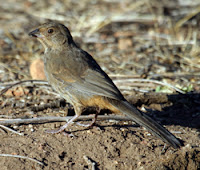
I took this photo with a handheld 640mm stabilized telephoto, shooting right out an open window to the bird about 20' away. Click on the picture for a larger view. About the California Towhee, from the Cornell Laboratory of Ornithology:

California Towhee Pipilo crissalis

Cool fact: The California Towhee was first named as a separate species in 1839. Yet when the first American Ornithologists' Union checklist was published in 1886, it had been lumped with the Canyon Towhee, and the two were known collectively as the Brown Towhee, despite conflicting views held by ornithologists because of the many differences in the two forms' appearances, songs, behaviors, and nests. Relationships between the two forms have recently been clarified through mitochondrial DNA studies, and they are each once again considered full species.

California Towhees are relatively common in brushy habitats from southern Oregon to Baja California and from the Pacific inland to the foothills of the Cascades and the Sierra Nevada. The primary habitat type is chaparral, followed by riparian thickets of alder and willow. Human disturbances have created additional habitat, which is found along roadsides, clearings, and open lawns. California Towhees are permanent residents and, except for the dispersal of juveniles away from nesting areas, are quite sedentary. They are highly territorial birds, aggressively defending their territories year-round. California Towhees often battle their own reflections in windows, hubcaps, and other such reflecting surfaces. Territories range from one to five acres in size.

Nests are sited in dense foliage in shrubs or trees usually within 4 to 12 feet from the ground. Nesting occurs from mid-April through June. The low height and openness of the California Towhee's habitat enables males to detect intruders and rivals visually. Accordingly, song is not as important in territorial defense, and males sing infrequently, most often in the evening. Song is used primarily to attract mates, and birds that sing most are unmated males. The song, delivered from an open perch, consists of the bird's typical chip note repeated three or four times, followed by a descending and decelerating trill. At other times, a faint warbling song can be heard. California Towhees apparently pair for life.

During the breeding season, insects make up most of the towhee's diet; at other times seeds and some fruit are important. Most food is found on the ground, and California Towhees may forage in the manner of Eastern or Spotted Towhees-by scratching the soil using both feet at once. They find water in dry habitats by drinking the dew from grass, and they can be frequent visitors at feeders.

Description: California Towhees are large, unstreaked sparrows (approximately 8.5 to 9.0 inches in length) with long tails. This towhee has a dark brown back, rump, wings, and tail. The crown is warm brown, contrasting slightly with the upperparts. The lores, chin, and throat are cinnamon, and there is a thin necklace of brown spots below the throat. The underparts are slightly paler and more buff-colored than the upperparts; undertail coverts are a distinct cinnamon brown. The bill and legs are brownish, and the eyes are orangish brown. Sexes are indistinguishable. Juveniles are similar to adults but streaked below.

The three brown towhees (California, Canyon, and Abert's) are closely related and similar in appearance. Abert's Towhee (P. aberti) is found in dense streamside thickets in desert areas in southwestern California and southern Arizona. It is distinguished by the dark face that contrasts with its pale bill and by the lack of throat or breast streaking. Canyon Towhees (P. fuscus) tend to inhabit territories at higher altitudes than California Towhees, and the ranges do not overlap. Canyon Towhees are slightly paler and more slender than California Towhees. Canyon Towhees are distinguished by a paler throat with a necklace of dark spots, a contrasting rufous-brown crown (some Mexican races lack this crown), pale buffy (rather than cinnamon) lores, whitish bellies, and a dark spot below the throat necklace.

If Cornell is correct about their territory size, then we have a super-abundance of California Towhees in our yard. We have something like 10 or 12 pairs of them who are either residents of our yard, or who are here so much they might as well be — including one pair who nests in a helmet on our patio!

Yardblogging: rabbit

Early this morning, I had the telephoto mounted (for some Hooded Oriole pictures), and this little guy showed up about 15 feet away. Seemed like too good an opportunity to miss!

It's very hard to accept just how many rabbits we have here — early in the morning, or in the evening, it's not unusual for us to have more than a dozen in sight (from our windows) at any given moment. My personal record is 27, early on a Saturday morning. They're attracted to us for several reasons: we have reliable water (an automatic waterer out for all the animals to use), we put cracked corn out (mostly for the quail, but it doesn't get any better if you're a bunny), and we've got about 3.5 acres fenced in around the house and largely free of four-footed predators (though we do see the occasional bobcat, and there are our neighbors' housecats out and about). We do have other predators, though: numerous hawks, and (if the rabbit is small enough) gopher snakes. Just once, we've seen a golden eagle sitting on a pole just outside our yard...

By and large these rabbits do us no harm. They keep our citrus trees trimmed to about 14" off the ground (apparently the limit of their reach), and they eat things we'd rather they didn't (this is one reason — along with gophers — why almost all non-native plants in our yard are in pots).

Saturday, June 18, 2005

Yon reports in

Michael Yon has filed another report, this one a little different. He's preparing us for reports yet-to-come, reports derived from talking with frontline soldiers, including alpha. An excerpt (but don't miss the rest of it!):

I did not come here with the intention of having someone tell me what the people on the "front lines" were thinking and feeling.

It's important to talk with Generals: they are all very smart or they wouldn't be Generals, but a General says what he wants people to hear, and sometimes they do lay it on pretty thick. I wanted to meet soldiers. Combat soldiers in particular. And combat soldiers before, during and after combat operations. That's the only place to figure out who is winning and losing this war. "Winning" meaning the Iraqis embrace and protect their freedom and most of our folks come home. Losing meaning something other than this, up to and including to any dreaded stasis.

My first day in Baghdad, about six months back, the sun was rising as I walked to the mess hall. It was cold and there had been explosions through the night, automatic weapons fire, and "flares" floating down on parachutes casting long, flickering shadows before their fires burned out. Helicopters zooming all around. There was a lot more war going on than I had expected; and I had done my homework.

But the birds were singing like they do at sunrise. War or peace, I can depend on the birds to sing in the mornings, and I selected that sound to hear as I walked out of the tent and headed for the mess hall. A group of soldiers, loaded for combat, were gathered in front of the mess hall. With serious expressions, their attention was trained on a map they'd spread across the hood of a Humvee. The soldiers were preparing for combat.

Healthy Sadirist

Ali at Free Iraqi brings us a story about the Iraqi Minister of Health being stoned and beaten on a recent visit to Najaf. That sounds awful, doesn't it? But wait: as you might expect, there's much more to the story. It turns out that the minister (as Ali puts it) "is one of the Sadirists that got appointed as a minister in the new government along with three others". This minister visited Najaf to investigate some corruption, and:

According to the minister himself, there was no reason at all and that he was on a visit to the health administration in Najaf to follow up an investigation about a corruption there. He refused to appear in front of the Iraqi parliament to clarify the details of this incident accusing "certain parties" that he refused to name of planning the aggression against him and his guards and other officials who accompanied him.This is also what I heard from my brother in law who's a friend of the director of the ministry of health's office who said that his friend (the director) was there and that he accused followers of Sistani and the SCIRI of committing this aggression without any reason.

However, sotal Iraq provides us with another story. According to sources in Najaf, the minister and his guards went to the shrine intending to enter it while they were carrying arms. They were stopped by the guards of the shrine who told them that they have to drop their arms to enter the shrine, which is the norm. The minister's guards refused and started swearing at the shrine guards and threatening them. Then the minister went on his way to the inside of the shrine while swearing at the shrine guards himself. The shrine guards told him that his behavior was unaccepted especially that he was in a holy place. He then said to them, "Muqtada will come soon and crush your heads". Najafis who were standing by and watching couldn't hold their anger after hearing what the minister said and started hitting him and his guards with stones, their shoes and whatever their hands reached. The minister barely escaped alive. (all this from sotal Iraq)

Read the whole thing here. And put Ali on your daily read list; his reports are infrequent but terrific!

Friday, June 17, 2005

Multicellular Microorganism

At The Truth Laid Bear, there is an "ecosystem" of blogs in which blogs are assigned to evolutionary rankings from "Insignificant Microbe" to "Higher Being." For reasons entirely unbeknownst to me, this blog's ranking has advanced to "Multicellular Microorganism" — and unexpected and delightful honor!

The complete ecosystem:

Higher Beings
Mortal Humans
Playful Primates
Large Mammals
Marauding Marsupials
Adorable Rodents
Flappy Birds
Slithering Reptiles
Crawly Amphibians
Flippery Fish
Slimy Molluscs
Lowly Insects
Crunchy Crustaceans
Wiggly Worms
Multicellular Microorganisms
Insignificant Microbes

I thought I understood how this worked: ranking in the ecosystem is related to the number of links that others make to your blog. But...so far as I know, the number of links to this blog hasn't changed (0 = 0!), so I'm not sure what caused my blog to make this evolutionary leap. But who cares! It's a good excuse to break out the bottle of good wine!

Onward and upward to wiggly wormhood...

PETA kills

The PETA organization has long disgusted me. My recent discovery that PETA is in the business of wholesale euthanization didn't improve my outlook on them. Now there's this news (from Fox):

PETA Workers Charged With Animal CrueltyFriday, June 17, 2005

AHOSKIE, N.C. — Two employees of People for the Ethical Treatment of Animals (search) have been charged with animal cruelty after dumping dead dogs and cats in a shopping center garbage bin, police said.

Investigators staked out the bin after discovering that dead animals had been dumped there every Wednesday for the past four weeks, Ahoskie police said in a prepared statement Thursday.

PETA has scheduled a news conference for Friday in Norfolk, Va., where the group is based.

Police found 18 dead animals in the bin and 13 more in a van registered to PETA. The animals were from animal shelters in Northampton and Bertie counties, police said.

The two were picking up animals to be brought back to PETA headquarters for euthanization, PETA president Ingrid Newkirk (search) said Thursday. Neither police nor PETA offered any theory on why the animals might have been dumped.

Police charged Andrew Benjamin Cook, 24, of Virginia Beach, Va., and Adria Joy Hinkle, 27, of Norfolk, Va., each with 31 felony counts of animal cruelty and eight misdemeanor counts of illegal disposal of dead animals. They were released on bond and an initial court date was set for Friday.

Hinkle has been suspended, but Cook continues to work for PETA, Newkirk said.

Newkirk said she doubted Hinkle had ever been cruel to an animal and said if the animals were placed in the bin, "We will be appalled."

Appalled. Indeed.

The Dick rolls on

At Technicalities, Teresa comments on her (Illinois) Senator Dick Durbin:

Can we say Linda Foley anyone? Now he's saying "if it did indeed occur" What does he mean? If he's not sure it occurred then why is he talking about it? Why did he state it as fact on Tuesday? If he's not going to compare our methods to Nazis, Soviets, and Pol Pot... why even bring them up?

The only reason is to shock people, to stick a thought in their mind where it will sit and grow. It doesn't have to be true... you only have to say it long enough and loud enough. That's the way it has worked over the years. That's how the liberals have always gotten things done. Keep repeating a lie long enough and people will start to believe.

Well, we have the internet and transcripts and we can go back and see exactly what was said by whom. Mr. Durbin has his lies repeated, but hopefully the lies won't win this time.

I find myself feeling rather slimy living in Illinois... And I am angry for the soldiers who are doing such a difficult, dangerous job. It just got a lot harder. According to Rush Limbaugh... Senator Durbin is earning high praise from al-Jazeera...

Later, Teresa calls for Senator Durbin to resign. And I agree with her, though I'd take it one step further (and I have, in an email to Senator Durbin): if he really, truly believes what he's said, he should renounce his U.S. citizenship and move to a country more to his liking.

Aliases

Major K. (a very good milblog, BTW) has an interesting post about the use of aliases by the Iraqi terrorists.:

The most annoying thing as far as intelligence goes, is the fondness for aliases. It is cultural phenomenon. Having children is such a mark of social distinction in the arab culture, that it creates a whole new name for the parent. Men become known as "Abu" which means "father of." So, if your name was Khaled, and you named your son Muhammed, your new nickname/alias is Abu Muhammed. The arhabi make good use of this dynamic. Half of the guys we are chasing here are only known by such "fatherly names." In case you hadn't noticed, the same is true of #1 scumbag Abu Musab al Zarqawi. His name means "father of Musab of the Zarqawi tribe." While these aliases make finding these scumbags frustrating, they do not make them invisible. We continue to put the puzzle together, and then go grab the guys that are shown by the completed puzzle. The raids are the part of the job that everyone is trained to do, and the part that everyone wants to do. Developing the intelligence that gives you the raid target is the hard part. It reminds me of math homework...

As many of my readers know, I have spent quite a bit of time in Russia and Estonia. When I've thought about the challenges facing our intelligence folks on the ground in Iraq, those places have been my mental model for a context. But as Major K. makes clear, it's actually much more difficult in Iraq. I've been to Japan (though just twice), and after reading Major K's post I suspect my experience there is a much better context. I remember well just how completely bewildering everything in Japanese was. Grocery stores were nearly impossible (even the packaging conventions are different!); maps were impossible, and navigation within a town or city was nightmarish. I cannot imagine trying to collect intelligence in an environment where even the alphabet was alien. In Japan, whenever I ran into someone who spoke English (no matter how badly!), it was an enormous relief. I used those occasions to get a whole bunch of questions answered; I'll bet our intelligence folks in Iraq do the same with the interpreters...

Polish twins

A fascinating political story from Chrenkoff, about identical twins running for different high political offices in Poland. And they might both win!

Bush on Iran

President Bush spoke yesterday on the election in Iran:

In recent months, the cause of freedom has made enormous gains in the broader Middle East. Millions of people in Afghanistan and Iraq defied terrorists to cast their ballots in free elections. Palestinians voted for a new president who rejects violence and is working for democratic reform, and the people of Lebanon reclaimed their sovereignty and are now voting for new leadership. Across the Middle East, hopeful change is taking place. People are claiming their liberty. And as a tide of freedom sweeps this region, it will also come eventually to Iran.

The Iranian people are heirs to a great civilization - and they deserve a government that honors their ideals and unleashes their talent and creativity. Today, Iran is ruled by men who suppress liberty at home and spread terror across the world. Power is in the hands of an unelected few who have retained power through an electoral process that ignores the basic requirements of democracy.

...

America believes in the independence and territorial integrity of Iran. America believes in the right of the Iranian people to make their own decisions and determine their own future. America believes that freedom is the birthright and deep desire of every human soul. And to the Iranian people, I say: As you stand for your own liberty, the people of America stand with you.

After I read the whole speech, I tried to imagine what any leading Democrat might have said. I've seen no coverage of any leading Democrat's remarks; this is purely my imagination:

Kerry: A 2,000 word speech leaving you with the vague impression that he supports the election, but with no particular interest in the outcome (or its fairness).

Reid: What election in Iran?

Dean: Arrwwrrgharwahwahwah!

Sorry. It's really hard to imagine anything rational, useful, or even entertaining coming out of that group. I just can't take them seriously...

Thursday, June 16, 2005

Quote for the day

Democracy is a beautiful thing, except for that part about letting just any old yokel vote.

   Unknown

Wednesday, June 15, 2005

Tsunami?

At about 7:50 pm (PDT) yesterday evening, there was a very large (magnitude 7.0) earthquake under the sea, offshore from Crescent City, California. This is along the northern coast of California, not very far south of the Oregon border. As some of you may remember, Crescent City has been hit by tsunamis before — see information here, here, and here.

The danger from tsunamis on the San Diego coastline is much lower, but still present. See information here.

The earthquake last night (pictured on a seismographic map at right) resulted in a tsunami alert; it was quickly lifted when seismologists realized that the earthquake was caused by a lateral slip and not subsidence. Slippages typically do not cause tsunamis (unless there is an associated collapse of some geological feature, like an undersea mountain). Tsunamis are usually caused by significant vertical movements over a large area. You can find more information about this quake here, here, and here.

Way down here in southern California, where we live, we never felt a thing. But...we were awakened by a friend and neighbor, just after 8pm, who was concerned about her parents. They live down by Mission Bay, only a couple of blocks from the ocean, and our friend had heard the tsunami alert being broadcast over the emergency radio network. Yikes!

As things turned out, the tsunami alert was quickly withdrawn, there was no tsunami, and nobody was injured. So far as I'm aware, there was also no property damage. That's about as good as things can get with a magnitude 7.0 quake, so I'll call that very good news.

I did sleep uneasily, though. It's a little disconcerting to know that some disaster truly could be visited on us at any time. For us, the biggest risk is probably that some (previously) unknown fault could suddenly make itself known through a powerful earthquake right near us...not a pleasant thought...

Quote for the day

In theory there is no difference between theory and practice. In practice there is.

   Yogi Berra

Sunday, June 12, 2005

Grasses

Saw these beautiful grasses in Cuyamaca State Park today, right in the middle of the burned out pine forests, on one of the sharp switchbacks in the main road.


It's rather amazing that just 20 months after the huge fire the plant life has recovered to such an extent. Thank goodness for the rains this winter!


Mystery flower

On a drive today, Debi and I spotted these flowers coming down toward Descanso from Cuyamaca State Park. I've no idea what they are, and I do not recall ever seeing them before. The plant is quite large — some individuals were over 8' tall, with stems about 3/4" diameter at the base.


If anyone can identify this for me, I'd sure appreciate an email with the particulars...


Chemise

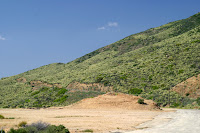
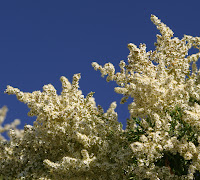
Chemise (adenostoma fasciculatum) is the most common plant in the chapparal that we live in. Today Debi and I took a drive up toward Mt. Laguna (one of the tallest peaks in San Diego County), and along the Sunrise Highway not far from Pine Valley we spotted some hills whose color was not the normal dull green (see at right; click on pictures for a larger view). Instead, there were splotches of white turning the hillside into a mottled and brighter mix of green and white. This turned out to be from all the chemise in bloom (second photo), and they were quite a sight (remember, this is a desert!). I'm sure the spectacular and unusually synchronous bloom is due to the heavy rains this year, though I don't know the actual mechanism.

At this point, the highway is about 4,500 feet above sea level, so the bloom here is a few weeks behind the chemise bloom at our home. The bloom there wasn't nearly as overwhelming as these hillsides. Plus we don't normally think of chemise as "attractive"...but that's a different story...


Anyone who knows us well is probably very surprised to see the word "chemise" without cuss words nearby in anything I've written. That's because most of the time, chemise is (a) ugly, (b) wretched looking, (c) out-competing much more desirable plants, (d) a serious fire hazard (dry, oily, easily ignited wood), and (e) ugly. Chemise is my enemy. I spend lots of time, effort, and money attempting to eradicate chemise from my property.

But just today, I'll grant that it can be, under certain very limited circumstances that include it being off my property, attractive.