Tuesday, February 22, 2005

How did Jamul get its name?

With a half-hour of googling, I could find very little information on the web about the origins of the name "Jamul". I did locate this site: Silvas in Old Town San Diego, which makes the assertion that Jamul is derived from "hamull", a Kumeyaay word that means "greens used for food". The site says further that the Kumeyaay named places according to what they saw at that place. They make no citations about sources for this information (though there are citations for other things, and a bibliography), so I have no way to judge its accuracy.

As I was doing this research, I happened across a paper posted on the San Diego Historical Society site about a piece of Jamulian history I'd never heard of: the Jamul Portland Cement Works. It's a fascinating read if you're interested in the small details of local history. But a search of the San Diego Historical Society's site led to an even more interesting article about the Jamul Massacre of 1837. I had no idea any such thing had occurred here!

SHA-1 broken

Bruce Schneier reports (on his excellent "Schneier on Security " blog) that SHA-1 has been broken. Many of you have never heard of SHA-1, so a brief explanation is in order: SHA-1 is the most commonly used "cryptographic hash" — a specialized software or hardware function that is used as a kind of building block for many kinds of cryptographic systems. For example, the certificates that your web browser decodes (to let you use secure web sites) depend on cryptographic hashes.

Bruce's posting is an interesting read, and contains a pointer to a short paper by the three Chinese scientists who actually did the breaking. As Bruce points out, the sky is not falling:

For the average Internet user, this news is not a cause for panic. No one is going to be breaking digital signatures or reading encrypted messages anytime soon. The electronic world is no less secure after these announcements than it was before.

But there's an old saying inside the NSA: "Attacks always get better; they never get worse." Just as this week's attack builds on other papers describing attacks against simplified versions of SHA-1, SHA-0, MD4, and MD5, other researchers will build on this result. The attack against SHA-1 will continue to improve, as others read about it and develop faster tricks, optimizations, etc. And Moore's Law will continue to march forward, making even the existing attack faster and more affordable.

Jon Callas, PGP's CTO, put it best: "It's time to walk, but not run, to the fire exits. You don't see smoke, but the fire alarms have gone off."

The bar in the (forever) ongoing war between the cryptographers and the cryptanalysts just got raised a bit higher. It reminds me a bit of an earlier technological battle that I participated in, between the copy protection vendors and the folks (like me) who found ways around their clever tricks. Whatever the underlying technology, physics, and mathematics, there always seem to be either mistakes made or unexpected vulnerabilities uncovered that allow the "other side" room to exploit. But there is a huge difference with the cryptographic systems: the world generally (cryptanalysts aside) takes the efficacy of cryptographic systems for granted as they're used every day for secure web browsing, digital signatures, and the like. These systems protect transactions involving immense sums (in aggregate, I mean), and they protect the privacy of all of us — even if you don't use the Internet, information about you is all over it.

So this was for me a somewhat discomfiting news report. The good news, I suppose, is that the team who first managed to break SHA-1 (at least I hope they were the first!) is more interested in publishing their results than they are in exploiting them. Let's hope that's a continuing phenomenon in the cryptographic wars...

Tornadoes in San Diego County?!

What's next? Locusts? Frogs? Volcanic eruptions? From the National Weather Service:

Bulletin - Eas Activation Requested Tornado Warning National Weather Service San Diego CA 248 PM PST Tue Feb 22 2005

The National Weather Service In San Diego Has Issued A

* Tornado Warning For... Orange County In Southwest California This Includes The Cities Of... Westminster... Tustin Foothills... Tustin... Stanton... Santa Ana... San Juan Capistrano... San Clemente... Placentia... Orange... Newport Beach... Mission Viejo... Laguna Niguel... Laguna Hills... Laguna Beach... Irvine... Huntington Beach... Garden Grove... Fullerton... Fountain Valley... El Toro... Dana Point... Costa Mesa... Anaheim Extreme Northwestern San Diego County In Southwest California This Includes The City Of Oceanside... San Onofre

* Until 345 PM PST

* At 247 PM PST... National Weather Service Doppler Radar Indicated A Severe Thunderstorm Capable Of Producing A Tornado 8 Miles South Of Dana Point... Moving North At 25 Mph. Spotters Have Indicated Funnel Clouds And Waterspouts With This Area Of Storms Which Will Likely Move Onshore Over The Next 45 Minutes To An Hour.

* The Tornado Is Expected To Be Near... Newport Beach By 300 PM PST Dana Point By 305 PM PST San Juan Capistrano By 310 PM PST San Onofre... And San Clemente By 315 PM PST

The Safest Place To Be During A Tornado Is In A Basement. Get Under A Workbench Or Other Piece Of Sturdy Furniture. If No Basement Is Available... Seek Shelter On The Lowest Floor Of The Building In An Interior Hallway Or Room Such As A Closet. Use Blankets Or Pillows To Cover Your Body And Always Stay Away From Windows.

If In Mobile Homes Or Vehicles... Evacuate Them And Get Inside A Substantial Shelter. If No Shelter Is Available... Lie Flat In The Nearest Ditch Or Other Low Spot And Cover Your Head With Your Hands.

Lat... Lon 3371 11810 3317 11737 3337 11740 3347 11753 3369 11747 3393 11791

Eleven inches!

Woke up this morning (again!) to the sound of gentle rain falling. Looked at the rain gauge, and...we've now had just over 11 inches for the year-to-date. And it's still raining, and the weather service is predicting two to four inches more for this storm.

Debi and I took a short drive through our valley late yesterday afternoon, just to see what the rainfall's effects had been. Every dirt road (and there are lots of them out here) has erosion gullies on it, and streamlets running through or along them. A friend's property that normally has a dry streambed running through it now has a raging stream, eroding away the banks and falls at a visible rate. And the creek running through Lawson Valley is at levels we've never seen in our six+ years living out here. In some places, culverts under driveways have been overwhelmed, and the creek is flowing over the driveway as if it were a ford. Where the main road traverses the creek, so far the bridges and culverts aren't threatened — but you can see how they might be if we got even more rain! If that should happen, we have an alternate way out of the valley, up a four-wheel drive road that doesn't cross any streams. We normally think of that road as our "fire escape" — but it may turn out to have other uses...

Monday, February 21, 2005

Betting on the hockey stick

The recent questions raised about the notorious "hockey stick" graph (by scientist Michael Mann) are gaining just a little bit more public traction than have other questions raised about global warming over the past few years. Dr. Mann's graph purports to clearly show global warming, and one can imply from the timing of the "warming" that the impact of human activity is at fault. But first amateurs (reminds me of the blogs!) and then mainstream scientists have started to raise questions about Dr. Mann's methodology. The usual response to these sorts of questions in the world of science is to make your methods available for peer review — something that Dr. Mann is apparently refusing to do. Of course, this raises all the more question, as there is no legitimate reason to withhold this information.

In an opinion piece on Friday, the Wall Street Journal briefly tells the story of Dr. Mann's graph, including the extraordinary impact his graph — because of its "clarity" — has had on the impetus behind responding to global warming. They summarize:

But the important point is this: The world is being lobbied to place a huge economic bet — as much as $150 billion a year — on the notion that man-made global warming is real. Businesses are gearing up, at considerable cost, to deal with a new regulatory environment; complex carbon-trading schemes are in the making. Shouldn't everyone look very carefully, and honestly, at the science before we jump off this particular cliff?

Well, that's a valid point all right — $150 billion a year is not chump change by any measure. Of course we should be sure of the science before we place this particular bet (or any like it).

But perhaps a more interesting issue is this: how do we avoid having this sort of tempest-in-a-teacup in the first place? Why is global warming being treated as though it were proven fact, instead of what it really is: an intriguing theory?

I am not a scientist, and I don't even have an opinion about whether global warming is in fact occurring. But it seems to me fairly obvious that the scientists who are investigating global warming have a clear vested interest in the world having great concerns about it. It is this great concern, after all, that causes governments and philanthropic organizations to cough up vast amounts of cold, hard cash for targeted research. Surely it's true that before the scary bogeyman of "global warming", scientists studying climatology didn't have nearly so effective a grant-generating tool. And equally surely, not every scientist (or their manager) is unaffected by this fact. Does anyone doubt that the climatologist whose work spectacularly supports global warming (like Dr. Mann) finds it easier to get grants than the climatologist whose work casts doubt on it? This is a classic setup for producing biased results — a system of incentives for those who produce one outcome, and disincentives for those who produce the other.

And it's exacty what we — the country and the world — don't need: biased information (whether it is flawed or not) to base vital policy-making on. Surely there must be a better way...

Ten inches!

Looked at my rain gauge a moment ago, and we've just crossed ten inches for the year. Yahoo!

Self-portraits from Mars

Spirit and Opportunity have been roving on Mars for over a year now, doing lots of great science. Both of them are long past their design lifetime, and are off on extraordinary unplanned exploration. Spirit is climbing some low mountains, hoping for both informative geology and a good view. Opportunity just finished thoroughly exploring a small crater, and after that found it's own heat shield and studied that. It's now off on a long trek across the mostly featureless plains its on, in the hope of making it to another crater.

Spirit is in pretty good shape, but is suffering from a few problems of old age. For example, it has a "sticky" wheel that sometimes drags a bit. And it has an intermittently shorted wire that is so far not causing any problems, but could. Spirit also has a coating of dust on its solar cells that reduces the amount of power they provide. This dusting of the solar cells was expected, and in fact was something that the mission planners thought was likely to be what finally killed off the rover — but so far, the coating is much less than expected and is not causing major problems. Occasionally the operations planners include relatively quiet days to let Spirit's batteries charge up, but that's about the only impact of the dust.

Opportunity, on the other hand, is surprising everybody. Not only is it still in tip-top shape, but it also inexplicably has far less dust than even Spirit! Also, photo observations have shown that the dust has been somewhat mysteriously cleaned off a few times during Opportunity's travels. Explanations proffered have included kindly Martians, dust devils, vibrations while travelling on steep hillsides, and (probably most likely) convenient gusts of wind. Whatever the causes, Opportunity is doing great — and there's good reason to hope that it can trek a few miles across the plains to visit another crater.

The two self-portraits at right (Spirit on top, Opportunity on bottom) were made by using the panoramic camera that each rover has. If you click on them, you'll get truly enormous high-resolution versions that are suitable for printing or making Windows desktop backdrops from. These panoramic cameras are mounted on a mast sticking straight up out of the middle of each rover. The mast was mostly intended to give this camera a little extra visual range. But that same mast allows pointing the camera straight down and taking a whole series of pictures (each covering a small piece of the rover) that can be laid side-to-side to make up a complete self-portait, like a mosaic. Software that's readily available even to amateur photographers (called "stitching" software) allows putting all these images together to make seamless composite images, and that's what the JPL folks did to make these. That's also why the images have such a strange shape — the rovers only took the small pictures where the rover would actually be in the picture.

In my opinion, the twin rover missions to Mars are great examples of federal government money well spent — as opposed to the enormously expensive and relatively unproductive manned space missions. The Mars mission is one that I cannot imagine attracting commercial interest sufficient to fund it, though the commercial world would certainly be interested in providing the vehicles, support systems, and services involved in such a mission (and of course to some extent private enterprise is involved). But the Mars missions have hard-core science as their objective, and they are abundantly delivering on that. To the extent we believe government should be funding pure science, such missions are excellent candidates. The manned missions, by comparison, are pathetic. There's little justification for them in terms of the science delivered, and even less justification when their stupendous cost is factored in. There may — may — be more plausible justification from a commerical angle. But if that is truly so, then private enterprise would do a much better job of funding and executing it. For all these reasons, I am very much opposed to a government-funded manned space program...

Of Moonbats and Leftist Loonies

Trying to figure this out led me on quite a googling expedition — there are hundreds of thousands of hits on the word "moonbat", nearly all of them from recent political blog postings. I kept getting distracted by intriguing phrases, like "AutoRantic Moonbat" and "barking moonbat", and "moonbat central". The challenge was to find anything that wasn't part of the blogosphere. I didn't find much:

    "Moonbat" is the name of a painting.

    A U.S. military plane (a night bomber) was once nicknamed "Moonbat".

    Lots of people have named their cats "Moonbat".

For me, the term made instant sense the first time I read it. "Moon" conjures up the crazies that come out in the full moon, and "bat" conjures up "batty" and all its related terms and phrases. Fits very nicely to those the term is applied to! It strikes me as one of the least contrived of the new words I've run into recently...

Several sites led me to either Little Green Footballs or Libertarian Samizdata (both are great blogs) as the originators. Wikipedia gives the nod to the latter, and just over two years ago:

Moonbat is a pejorative political slogan coined in 2002 by Perry de Havilland of "The Libertarian Samizdata," a libertarian weblog. The term enjoys great currency in the libertarian blogosphere, where it is used to disparage modern liberals, peace protestors, and other ideological opponents. SEE ALSO: Feminazi, Idiotarian.

Definitions

1. "Someone on the extreme edge of whatever their -ism happens to be." (de Havilland )

2. "someone who sacrifices sanity for the sake of consistency" (Adriana Cronin)

3. "... human whose cerebral cortex has turned to silly putty causing him or her to mentally slide down the evolutionary ladder to the level of a winged rat who is influenced by the moon and wants to suck your blood. Also not-so-affectionately known as a "Democrat"." (www.barking-moonbat.com F.A.Q)

4. Not liberals, but leftists. Whereas liberals are patriotic, leftists seek to undermine their national strength. Anti-war protestors, likely to call the US military "nazis," apt to blame the 9-11 attacks on a US government and Zionist conspiracy, are moonbats. Liberals who oppose the war, are not.

5. A poster at the liberal/progressive website Democratic Underground.

Whatever the actual origins of the word, it's a winner in my book...

Sunday, February 20, 2005

Negotiated peace with Baathists?

Time reports that multiple back-channel contacts are occurring, with the aim of both sides being a negotiated peace.

The consensus of the folks I've read seems to be that the bulk of the Iraqi insurgents fall into just two categories: they are either the former elite in Sadaam's reign (Baathist Sunnis), or they are al-Qaeda followers of al-Zarqawi. The Baathist's clearly have good reasons to settle down: they are Iraqis in their own country, and they see their insurgency failing with the obvious success of the recent elections. There have been numerous press reports of Sunnis admitting that their voluntary non-participation in the election was a huge mistake.

Suppose for the moment that the negotiations succeed (there are numerous obstacles). What then? Will this have a significant impact on al-Zarqawi et al? I'd sure like to think so, but I don't have much to go on about the two groups' interdepencies, or lack thereof.

Time has this to say about what the Baathist insurgents are asking for at the negotiating table:

What do the insurgents want? Top insurgent field commanders and negotiators informed TIME that the rebels have told diplomats and military officers that they support a secular democracy in Iraq but resent the prospect of a government run by exiles who fled to Iran and the West during Saddam's regime. The insurgents also seek a guaranteed timetable for U.S. troop withdrawal, a demand the U.S. refuses. But there are some hints of compromise: insurgent negotiators have told their U.S. counterparts they would accept a U.N. peacekeeping force as the U.S. troop presence recedes. Insurgent representative Abu Mohammed says the nationalists would even tolerate U.S. bases on Iraqi soil. "We don't mind if the invader becomes a guest," he says, suggesting a situation akin to the U.S. military presence in Germany and Japan.

This all sounds much more reasonable than I would have expected, and therefore I can't help but feel hopeful about it. A negotiated peace, if it actually held, can't possibly be bad news.

A little rain

We've had nearly ten inches of rain since January 1st, an amount that comes close to setting a record for all of recorded history. This year is already in the top ten for rainfall records, and there's no sign of it stopping.

Those of you who live where water falls out of the sky with some regularity (as in New Jersey, where I grew up) may be hard-pressed to understand how profoundly wonderful this rain is for us desert rats. In late 2003, the horrific wildfires in San Diego County made it to within a couple of miles of our house. Those fires were fed by the tinder-dry chapparal wood (both the abundant dead brush and the living plants). Those plants were so dry because we've had six years of terrible drought. This rain is soaking the chapparal -- you couldn't set it on fire if you tried!

Of course there were other major contributing factors to those fires, most especially the fact that we humans have been putting all the fires out for 50+ years, and the fuel load had accumulated way beyond anything Mother Nature would have permitted. In all previous history, random wildfires keep the fuel load to a sane level.

The wonderful, wonderful rains have turned our hills emerald green. Lush mosses have erupted on every shaded rock. Grass is growing exuberantly where just a couple of months ago was only reddish, dusty dirt. New growth is already popping on many plants, fooled into sprouting early by the rain and warmer-than-usual weather. And birds we haven't seen since the drought began (such as pine siskins) are back.

So don't believe the news reports that make Southern California look like it just got tsunamied. That picture is just about as accurate as the media's prediction that John Kerry would win. Sure, there are some people that have been hurt or killed by storm-related events -- but not many. The vast majority of us are staring out the window at the gentle rain with nothing but good cheer and thankfulness in our thoughts...

Caution: Puns!

Two vultures boarded a plane, each carrying two raccoons. The stewardess stops them and says "Sorry sir, only one carrion per passenger.

NASA recently sent a number of Holsteins into orbit for experimental purposes. They called it the herd shot round the world.

Two boll weevils grew up in N Carolina. One took off to Hollywood and became a rich star. The other stayed in Carolina and never amounted to much-and naturally became known as the lesser of two weevils.

Two Eskimos in a kayak were chilly, so they started a fire, which sank the craft, proving the old adage you can't have your kayak and heat it too.

A three-legged dog walks into an old west saloon, slides up to the bar and announces "I'm looking for the man who shot my paw."

Did you hear about the Buddhist who went to the dentist, and refused to take Novocain? He wanted to transcend dental medication.

A group of chess enthusiasts checked into a hotel, and met in the lobby where they were discussing their recent victories in chess tournaments. The hotel manager came out of the office after an hour, and asked them to disperse. He couldn't stand chess nuts boasting in an open foyer.

A women has identical twins, gives them up for adoption. One goes to an Egyptian family and is named "Ahmal" The other is sent to a Spanish family and is named "Juan". Years later, Juan sends his birth mother a picture of himself. Upon receiving the picture, she tells her husband she wishesshe also had a picture of Ahmal. He replies, "But dear! They're twins!! If you've seen Juan, you've see Ahmal!"

A group of friars opened a florist shop to help with their belfry payments. Everyone liked to buy flowers from the Men of God, so their business flourished. A rival florist became upset that his business was suffering because people felt compelled to buy from the Friars, so he askedthe Friars to cut back hours or close down! The Friars refused. The florist went to them and begged that they shut down. Again they refused. So the florist then hired Hugh McTaggert, the biggest meanest thug in town. He wentto the Friars' shop, beat them up, destroyed their flowers, trashed their shop, and said that if they didn't close, he'd be back. Well, totally terrified, the Friars closed up shop and hid in their rooms. This proved that Hugh, and only Hugh, can prevent florist friars.

Mahatma Gandhi, as you know, walked barefoot his whole life, which created an impressive set of calluses on his feet. He also ate very little, which made him frail, and with his odd diet, he suffered from very bad breath. This made him a super-callused fragile mystic hexed by halitosis.

And finally... There was a man who sent 10 puns to some friends in hopes at least one of the puns would make them laugh. Unfortunately, no pun in ten did.

Bush offers to buy Russia, Europe

Scott Ott at ScrappleFace is at it again, with this notion of Bush's mission.

Saturday, February 19, 2005

No giggling allowed

Mark Steyn is a wonderful columnist, writing for the London Telegraph and other outlets. His columns often make me laugh right out loud, and always make me think. Today he's posted a column about Bush's upcoming European trip, and why it really doesn't mean anything. As always, it's funny as hell. And the European perspective is interesting to read about. A longish passage from the column:

And now the President himself is on his way, staying up all night on Air Force One trying to master the official State Department briefing paper on the European Rapid Reaction Force, the European Constitution, the European negotiations with Iran, etc. ("When these subjects come up, US policy is to nod politely and try not to giggle. If you feel a massive hoot of derision coming on, duck out to the men's room, but without blaming it on the escargots.") The French Foreign Minister took to calling the US Secretary of State "chère Condi" every 30 seconds. It's doubtful if the French President will go that far, but, if he does, the White House line is that Mr Bush is happy to play Renee Zellweger to Chirac's Tom Cruise ("You had me at bonjour").

What does all this mean? Nothing. In victory, magnanimity – and right now Bush can afford to be magnanimous, even if Europe isn't yet ready to acknowledge his victory. On Thursday, in a discussion of "the greater Middle East", the President remarked that Syria was "out of step". And, amazingly, he's right. Not so long ago, Syria was perfectly in step with the Middle East – it was the archetypal squalid stable Arab dictatorship. Two years on, Syria hasn't changed, but Iraq has, and, to varying degrees, the momentum in Jordan, Egypt, Saudi Arabia, the Palestinian Authority and Lebanon (where the Syrians have overplayed their hand) is also in the Bush direction. Boy Assad finds himself in the position of the unfortunate soldier in Irving Berlin's First World War marching song, "They Were All Out Of Step But Jim".

The EU isn't the Arab League, though for much of the past three years it's been hard to tell the difference. But it, too, is out of step. The question is whether the Europeans are smart enough, like the savvier Sunnis in Iraq, to realise it. The Washington Post's Fred Hiatt compared the President's inaugural speech with Gerhard Schröder's keynote address to the Munich Conference on Security Policy last week and observed that, while both men talked about the Middle East, terrorism and 21st-century security threats, Mr Bush used the word "freedom" 27 times while Herr Schröder uttered it not once; he preferred to emphasise, as if it were still March 2003 and he were Arab League Secretary-General, "stability" – the old realpolitik fetish the Administration has explicitly disavowed. It's not just that the two sides aren't speaking the same language, but that the key phrases of Mr Bush's vocabulary don't seem to exist in Chirac's or Schröder's.

The differences between America and Europe in the 21st century are nothing to do with insensitive swaggering Texas cowboys. Indeed, they're nothing to do with Iraq, Iran, Kyoto, the International Criminal Court, or any other particular issue. They're not tactical differences, they're conceptual.

That last bit is an insight worth pondering.

Cheney to plow a road for Condi?

Captain Ed (of the excellent Captain's Quarters blog) pointed me to this intriguing article at WorldNetDaily's site. In it, Dr. Jack Wheeler reports on a rumor flying around Washington that Dick Cheney will step aside, perhaps citing health concerns. His stepping down would let President Bush (using procedures outlined in the 25th amendment) appoint a new VP to replace him. The rumor is that Bush would appoint Condi Rice, specifically to get her the experience and exposure she'd need to make a credible candidate in 2008.

Just a few hours ago, I posted an opposing take -- one that essentially said there was no way for Condit to gain that needed experience in time for 2008. Is the approach suggested in this rumor plausible? I'd say it might well be, especially if Condi turned in a stellar performance. Though I have to wonder how much of a canvas she'd have to paint on in the VP role, as opposed to the very expansive canvas afforded to her as SecState (but stretching my metaphor a bit, perhaps the canvas at State is not quite the right texture). In any event, it's an interesting speculation. An excerpt below:

Vice President Dick Cheney likely will step down next year due to health reasons and be replaced by Secretary of State Condoleezza Rice, according to a report by geopolitical expert Jack Wheeler.

On his website, To the Point, Wheeler reports there's a "red-breasted rumor bird" flying around Capitol Hill that has whispered the same thing to most congressional committee chairmen.

"We all know that Dick Cheney has been the best vice president of modern times, perhaps in American history," one such chairman told Wheeler. "And we know that he absolutely will not run for president in 2008. Further, he has an unfortunate history of heart trouble. So let's just say none of us will be surprised if, sometime next year, he will step down from the vice presidency due to his health."

Continued the source: "Should this happen, President Bush would need to appoint his replacement, just as Richard Nixon chose Gerald Ford to replace Spiro Agnew. It is quite clear to us whom the president would choose should he need to: Condoleezza Rice."

I'll be watching this for further developments...

The coffee gets its Tiger

I've been programming with Java 5.0 for several weeks now, and I'm much more impressed with it than I thought I'd be. I expected to find some interesting stuff that wasn't worth the risks (real or perceived) in switching from more mature versions of Java. After just the short experience I've had, I'd recommend that any sizable Java development effort seriously consider switching to Java 5.0. In my opinion, the benefits are so great that they outweigh those risks.

So what's so great about Java 5.0? Well, my favorite new features are generics (very similar to templates in C++), autoboxing (which lets you use basic types even where objects are ordinarily required) and the new for construct that virtually eliminates the need to explicitly instantiate iterators (or the ubiquitous i iteration index). While there are many more things to love about Java 5.0, I'm going to pick on these three and talk briefly about each of them, with some short examples.

Generics. What can I say? They're great! Below is an example of generics used to make a list of strings:

    // here's what you used to do...    List<String> myList = new ArrayList();    myList.add( "test" );    myList.add( new Integer(0) );   // compiles and runs just fine!    String gotIt = (String) myList.get(0);    // and here's what you do with generics...    List<String> myList = new ArrayList();    myList.add( "test" );    myList.add( new Integer(0) );  // won't compile -- sweet!    String gotIt = myList.get(0);

This one feature has greatly reduced the tediousness of using collections, reduced the errors in my code, and increased the readability. And I haven't even started writing my own generified classes yet!

Autoboxing. Autoboxing is a lovely thing. Java 5.0 automatically converts basic types to their equivalent object type when needed, and vice versa. This saves no end of tedium while writing code, and results in much more readable code. For example, the following code would have not have compiled pre-Java 5.0, but now it works fine (and as expected!):

    // before you'd do this...    int x = 5;    Integer y = new Integer(5);    x = y.intValue();    // now you just do this...    int x = 5;    Integer y = x;  // autoboxing instantiates the Integer...    x = y;  // autoboxing does the Integer.toValue()... 

for. With Java 5.0, there's no need to instantiate trivial iterators or index integers. The compiler does all the work for you. An example:

    // before you'd do this...    Iterator it = myCollection.iterator();    while( it.hasNext() ) {        // do stuff...    }    // now you do this...    for( Object o : myCollection ) {        // do stuff...    }    // or before you'd do this...    for( int i = 0; i < myArray.length; i++ ) {        // do stuff...    }    // now you do this...    for( Object o : myArray ) {        // do stuff...    }

Of course you can combine the new for syntax with generics, and that leads to much simpler and more readable code, and less prone to stupid typo errors as well. How many times have you typed that for( int i = 0;... pattern? It feels like about a million times for me! I'm very glad to leave that particular construct behind...

Bloggers will rescue the right

The Guardian has an interesting article by Iain Duncan Smith. Tip of the hat to PowerLine for the link (and some good commentary of their own). I was struck by this passage:

All this should put the fear of God into the metropolitan elites. For years there have been widening gaps between the governing class and the governed and between the publicly funded broadcasters and the broadcasted to.

Until now voters, viewers and service users have not had easy mechanisms by which to expose officialdom's errors and inefficiencies. But, because of the internet, the masses beyond the metropolitan fringe will soon be on the move. They will expose the lazy journalists who reduce every important public policy issue to how it affects opinion-poll ratings.

I've been an avid blog reader since they first started appearing a couple of years ago; certainly all that reading has had a big influence on me. But only after reading the passage above did I stop to think about how much I depend on blogs for timely political commentary. I've just about given up on magazines and newspapers, Wall Street Journal excepted. I read a lot of books, but they're necessarily not quite so immediate. So Mr. Smith's contention rings completely true with me. It's very interesting for this technologist to ponder what the Internet has wrought in this (seemingly) unlikely sphere...

Chirac: Hezbollah's best friend

President Jacques Chirac of France has a remarkable talent for raising my temperature, mostly when he demonstrates his world-class talent for hypocrisy. This week, he did it again.

The issue this week is an old one: France's ongoing refusal to declare Hezbollah a terrorist organization. That Hezbollah is a terrorist organization seems very hard to refute -- the evidence is overwhelming. They are supported by Iran and Syria. They occupy Lebanon in contravention of international agreements (but with the active cooperation of Syria). Hezbollah is widely suspected of having carried out this week's assasination of former Lebanese Prime Minister Hariri.

All right, all right, you say. So Hezbollah really is a terrorist organization. Why do we care whether Chirac will mouth the words? Because...until he does, Hezbollah can legally continue to seek and collect funds in Europe, which they are doing with great success. Of course the other European countries need to make the same declaration, but at the moment they're saying "Why bother?" because France will nix any such decree.

Why is Chirac (in the name of France) taking this position that seems contrary to all common sense? The only rational answer I can see is that France (and/or Chirac personally) has an economic interest in Syria, and Syria has a vital interest in Hezbollah. One hand washes the other, etc.

The Jerusalem Post has an article (free signup required) on the most recent brouhaha, excerpted below:

French Foreign Minister Michel Barnier was noncommittal when pressed to help change his nation's opposition to branding Hizbullah as terrorists during a visit to Jerusalem last week. President Jacques Chirac was more direct in his meeting with Foreign Minister Silvan Shalom on Monday. He said no.

France's argument for its position, that Hizbullah is a political faction in Lebanon, is ludicrous to the point of insult. This "political faction" has thousands of missiles pointed at Israel, is committed to Israel's destruction and is actively supporting Palestinian terrorism and undermining the PA.

Does this mean that if al-Qaida started a political party somewhere that it would no longer be a terrorist organization, no matter how deeply it is engaged in terrorism? How can France ban Hizbullah's television arm, Al-Manar, presumably for fomenting radicalism in France, and turn a blind eye to its doing much more than inciting terrorism against Israel?

The AP and New York Times had this to say:

Meanwhile, the Bush administration is arguing with European governments over whether they should designate the Lebanonbased Shiite group Hezbollah a terrorist organization, American and European officials say.

The disagreement over Hezbollah presents another challenge for President Bush, who will travel to Europe on Sunday on a mission to mend ruptures with Europe over the Iraq war.

In the past two weeks, the officials said, France has rebuffed appeals by both Rice and the Israeli foreign minister, Silvan Shalom, to list Hezbollah as a terrorist organization, which would prevent it from raising funds in Europe through charity groups.

The Europeans are not solidly opposed to listing Hezbollah as a terrorist group, the officials said. The Netherlands, Italy and Poland support the Bush administration’s view, several said, while Germany and Britain believe the issue is moot unless the French change their minds. One European diplomat said other countries were "hiding behind" France on the issue.

It doesn't look to me as if Chirac is actually fooling anybody. When even the rabidly liberal press (NYT) is pointing out your liberal hypocrisy, you know you've raised it to high levels. Meanwhile, the mere sight of Chirac's image raises my blood pressure. I swear Photoshop uttered some gagging noises as I processed the picture above...

Ethics Test Question

This test only has one question, but it's a very important one. By giving an honest answer, you will discover where you stand morally. The test features an unlikely, completely fictional situation in which you will have to make a decision based on your personal ethics.

Remember that your answer needs to be honest, yet spontaneous. Please scroll down slowly and give due consideration to each line.

You are in Florida, Miami to be specific. There is chaos all around you caused by a hurricane with severe flooding. This is a flood of biblical proportions. You are photojournalist working for a major newspaper, and you're caught in the middle of this epic disaster.

The situation is nearly hopeless. You're trying to shoot career-making photos. There are houses and people swirling around you, some disappearing under the water. Nature is unleashing all of its destructive fury.

Suddenly you see a woman in the water. She is fighting for her life, trying not to be taken down with the debris. You move closer. . Somehow the woman looks familiar. You suddenly realize who it is. It's Hillary Clinton!

At the same time you notice that the raging waters are about to take her under...forever. You have two options -- you can save the life of Hillary Clinton, or you can shoot a dramatic Pulitzer Prize winning photo, documenting the death of one of the world's most powerful women.

So here's the question, and please give an honest answer...

.

.

.

.

Would you select high contrast color film, or would you go with the classic simplicity of black and white?

Hillary and the ghosts

Hillary Clinton gets elected President and is spending her first night in the White House.
She has waited so long.....

The ghost of George Washington appears...
Hillary says, "How can I best serve my country?"
Washington says, "Never tell a lie."
"Ouch!" Says Hillary, "I don't know about that."

The next night, the ghost of Thomas Jefferson appears...
Hillary says, "How can I best serve my country?"
Jefferson says, "Listen to the people."
"Ohhh! I really don't want to do that."

On the third night, the ghost of Abe Lincoln appears...
Hillary says, "How can I best serve my country?"
Lincoln says, "Go to the theater!"

Jamulian Weather Radar

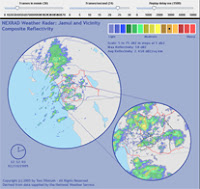
A few weeks ago I discovered that the National Weather Service (which has radars all over the U.S.) puts all of its radar data up on the Internet. The data is at most a few minutes old. There happens to be a NWS radar in Poway, which is less than 20 miles from where I live. So...if I could figure out how to read the radar data, I could have my very own radar -- with the convenience of someone else paying for its purchase and upkeep. What a deal!

So I spent a few weekends writing software to grab the data continuously, decode it, and then turn it into something pleasing to view. A reduced snapshot of the result is at right, but you can see the real deal by going to Tom's Weather Radar.

Note: you must have Java installed on your system (you can get it free at the Java site, and my web site is slow so it will take a minute or two for all the frames of the "weather movie" to download. But be patient -- it's worth it!

If you're interested in doing the same thing yourself, you can find out how to do it at the NWS Radar Product Central Collection Dissemination site.