Tuesday, December 10, 2013

Pater: floating island...

Pater: floating island...  At right, my dad is inspecting (with some amusement!) a giant wind vane.  The arrowhead is made from an old automobile hood.  We were in Humbug Valley, in the National Forest near Mt. Lassen National Park, in June 2007.  We later heard from the wife of the guy who made this thing; she said it really did work...
Floating island...

Way back before most of my readers were born, my grandfather (my mom's father) owned a “camp” on the shore of Long Pond, near North Lincoln, Maine.  It wasn't quite a house, but it was a big step up from camping.  It had one large room with an open-beam ceiling, a little attached bedroom, a mostly-watertight roof, a screened-in porch facing the lake, a sink, and a wood stove – and most vitally, a big octagonal table where we could play cards (this, along with drinking beer and fishing, being the primary occupation of the adults who weren't my dad).  The porch was set back about 25' from the lake's shore, and it had a steep staircase that let you walk down, over a boardwalk, and right onto a dock that floated perhaps 20' into the lake.  The smells of fish and beer were always present.

When we first started visiting the camp, the only “facility” there was an old-fashioned outhouse 50' or so inland from the camp.  Instead of toilet paper we had pages from some dodgy “detective” magazines that my grandfather liked to read, most of them featuring lurid cartoons of buxom, scantily-clad damsels in desperate need of being rescued.  Later some additions were made to the cabin, including a tiny little bathroom scabbed onto the back side.

We spent part of most summers there when I was younger, often several weeks at a stretch.  It was the kind of vacation that kids dream about – we had a canoe and a motorboat (with something like an 8 HP motor) at our disposal.  We could swim whenever we wanted to.  The weather was balmy and clear almost every day.  There were fascinating and exotic “Maniac” (native residents of Maine) characters who were constantly stopping by for a chat, a beer, or a card game.  There were loons on the lake, and sometimes we could watch them through the mist on the water in the mornings – and of course every night we'd hear their strange and wonderful cries.

And there was the floating island.

I've since discovered that floating islands are actually quite common, especially in certain parts of the world.  Minnesota and Wisconsin for example, with climates similar to Maine's, have a particularly rich collection of them.  But at the times I write of – late '50s and early '60s – I thought the floating island of Long Pond was something unique and nearly magical.

To get there required a long, slow motorboat trip from our camp, itself a grand adventure when we first made it (at quite a young age – I'm guessing 7 or 8 years old – for me).  The embedded map at right shows what I believe is the floating island, the one that I'm writing about.  Our camp was almost due west of it, about a mile away, on a stretch of Long Pond's shore that faces NNE. 

Somehow my dad knew of the floating island's existence.  It's exactly the sort of thing he'd be interested in seeing, for floating islands like that one are made up entirely of buoyant plants – and anything involving plants my dad would like :)

The first time I visited the floating island (I believe with my brother Scott and my sister Holly), my dad had already been there – so he knew exactly where it was, and what to expect when we got there.  He tried to describe it to us, but my mental picture of it (based on his description) didn't match the reality at all.  I was imagining an island that looked like other islands, with dirt and rocks, trees and shrubs, and maybe a cabin or two.  That's not what it was like at all, as we discovered when my dad pulled our little motorboat up alongside it.

The first challenge my dad had was finding something secure to tie the boat to.  Virtually everything on the floating island was just an inch or two above the water's surface – the tops of aquatic plants whose roots dangled in the water below and actually supplied the buoyancy that kept the island afloat.  Occasionally, though, there were spots on the island where ordinary plants had somehow managed to eke out an existence – a few stunted shrubs showed up here and there.  So he had to find a way to get the boat close enough to a shrub so that we could tie it up.  We certainly wouldn't want the boat drifting away as we were walking around on that island!

He finally did find a secure mooring for us, and we got out to walk around.  What an adventure that was!  Even as little kids we weighed enough to make the island sink beneath us.  The only reason we could walk around is that the roots of all these plants were thoroughly entangled with each other, making a sort of fabric of the entire island.  Right where we were stepping we might sink down six inches or more, but the rest of the island, acting like a piece of stretchy fabric, would keep us from going further.  However, once in a while one of us (especially my then much heavier dad) would tear the fabric of the island and one foot would suddenly drop toward the bottom of the lake!  I don't remember any of us actually punching through completely, so that fabric must have generally been pretty strong.

My dad was fascinated by the assortment of non-aquatic plants that had managed to survive on the floating island.  With basically no soil at all, it was a strange place to find things that ordinarily grew on land.  We were all fascinated by the carnivorous aquatic plants (pitcher plants) that grew there – what kid wouldn't love a plant that trapped and ate bugs?  As we walked about there, we were completely surrounded by the unusual.  Along with the odd plants and strange footing, there were holes in the island through which we could see down into the lake.  Occasionally a fish would come up through those holes to catch a bug, sometimes with a satisfyingly large splash.  There were chipmunks living on the island; apparently something grew there that they could eat.  When another boat passed by, it's wake would cause the entire island to wiggle up and down.  In a few places we spotted buoyant flotsam that had been incorporated into the fabric of the island – floats, pieces of lumber, driftwood, pine cones, and even a few beer bottles.  I loved that place, and visited it perhaps a half dozen times in later years.  I never saw another person there.

Before letting us off the boat to walk on the floating island, my dad told us kids what to do if we should find ourselves in the water – basically, grab onto the island and yell.  I remember his face as he was telling us this – he was uncharacteristically serious, and this surprised me, as (to me) it didn't seem like any more dangerous an adventure than any of a bazillion others I'd been on with my dad.  My not-necessarily-logical thought process went basically like this: I'm with my dad, so what could go wrong?  My dad was a bit more cautious, though in the end, nothing untoward actually happened.

But thinking back on it now, I can easily imagine why he'd have been  worried.  At the time, the floating island was a long way from any civilization (though the area around it has since been developed).  There was nobody around who could help him if something went wrong.  There were no cell phones on which he could call for help.  The closest telephones were probably a half-hour's boat trip away.  In that kind of isolation, he took three little kids out for a jaunt on an island that any one of us could have punched right through.  It's the kind of calculated risk that I suspect even back then relatively few parents would have taken, and today, of course, that number would be even smaller.

When I think of all the adventures we had with my dad – many of which involved some (usually quite small) element of risk – I'm overwhelmed with gratitude to him for making those choices.  My life is so much richer, with so many more now-cherished experiences and memories, because he judged the value of the experience greater than the risk.

Just once, on our 2005 trip to the San Juan Mountains, I brought this subject up in our conversation.  We had just come back to our rental cabin after eating a meal at a restaurant in Ouray, and on the way home we'd seen a family bicycling – all wearing the politically-correct helmets, but riding right in the middle of a busy street.  This amused my dad to no end, and he launched into an imaginative speculation about the degree to which the human gene pool would be improved if someone were to squash that family in the street.  It seemed like a good moment, so I asked him, then, if he was conscious of balancing the value of an experience against the risk, especially when we were little kids.

It took him a while to cough up the answer, which was something like this: no, he wasn't really conscious of it, because in his mind there never were any noteworthy risks we were taking.  If we fell off a cliff, sank under the floating island, or were stomped by an angry moose, then those were either just plain bad luck (which could happen at any time to anybody, no matter how cautious you were) or the result of us doing something stupid (in which case the species' gene pool might well be improved by our removal from it).  In no case, he believed, were such concerns a reason to avoid an adventure or experience.  He was not an advocate of reckless behavior – far from it, actually – but he also thought a that lot of behavior (like dangling your legs off a cliff top) was misjudged as reckless by the timid and stupid amongst us.

That's an uncommonly rational view of risk.  I didn't recognize it as such until I was an adult myself, but that's exactly what it was.  My dad's rational view of risk, combined with his love of experience and adventure, enriched my childhood beyond measure.  They also had a huge impact on my developing personality and character as a young man.  There have been many, many times when I've asked myself “What would my dad do?” – or, more often, “What decision would my dad most respect?” 

My dad is gone now, and I won't be able to share any more adventures with him.  But I have the memories of many adventures we did share, and his guiding voice still lives within me...


Monday, December 9, 2013

Factoid of the day...

Factoid of the day...  What gives gold its color?  And it's resistance to corrosion (inertness)?  You have to invoke special relativity to explain it – conventional chemistry can't do it.  I had no idea!

Today would have been Grace Hopper's 107th birthday...

Today would have been Grace Hopper's 107th birthday...  Google did the doodle at right to commemorate the occasion.  I once met Grace Hopper, as I wrote about here...

You can keep your doctor under ObamaCare!

You can keep your doctor under ObamaCare!  You just have to pay more.  A lot more.  So says Ezekial Emanuel, one of ObamaCare's architects.

So let me see if I've got this straight...  My old insurance policy was inferior.  The cheapest ObamaCare policies available are almost double the price of my old policy, and won't let me go to the same hospitals or keep my same doctor.  Oh, and the deductible is five times my old policy.  Check.  But – according to Emanuel – I can buy a better ObamaCare policy that will let me keep the same doctors and hospitals.  He's right – I found one such policy on the California site.  The premiums for that one are just over three times what I pay today.  The deductibles are just over twice those in my current policy.  With that policy, I can go to the doctors and hospitals that I want to use (rather than their much narrower network) – but for that privilege, I have a 30% co-pay that doesn't count toward the deductible.

I thought our system of payment for healthcare was screwed up before ObamaCare came along – far, far too much government regulation (especially with respect to mandates) was preventing me then from buying the kind of policy I really wanted: a simple, old-fashioned major medical policy that actually was insurance (in the normal sense of that word).  Now ObamaCare comes along, adds 500 more layers of government, bureaucracy, and regulation – and look at the outcome.  Isn't it just marvelous?  It's pretty much exactly what you'd expect if the DMV took over your healthcare...

Time to short eBay...

Time to short eBay...  John Donahue, eBay's CEO, said (in an interview by Bloomberg):
“We're not focusing on long-term fantasies, we're focusing on things we can do today.”
This was in response to Jeff Bezos' announcement about Amazon's drone deliveries.  Not exactly the kind of forward-looking vision I'd look for in a company like eBay.  That sounds to me like an invitation for a innovative startup to start stealing eBay's customers...

Newly discovered: large reservoirs of fresh water...

Newly discovered: large reservoirs of fresh water...  This might stave off the need for massive desalination for quite a while...

Tashirojima...

Tashirojima...  I stumbled across this in my meanderings around the web yesterday.  It's a Japanese island where the cats outnumber the human inhabitants, who feed and care for them as the bringers of good luck.  The image at right is from Tashirojima, as are many others here.  Debbie would love this place!

Bruce Schneier “facts”...

Bruce Schneier “facts”...  Long time readers know that I am a big fan of cryptographer and security guru Bruce Schneier.  Reading his blog yesterday led me to this store where they are selling T-shirts (men's and women's) with meme-image style “facts” about Bruce Schneier (the image at right shows one of them; click to embiggen).  Some of them are hilarious.  I think I need some of these T-shirts :)

Pater: mustard, sardines, and oatmeal...

Pater: mustard, sardines, and oatmeal...  At right you can see my dad, standing at the bottom of an old and quite large incense cedar (he stood there for scale, so we could later estimate its height).  This was one of many nice specimens we saw along the trail to Devil's Kitchen in Mt. Lassen National Park, in June 2007.  This was one of the days we ended in the Happy Garden Chinese Restaurant in Chester, California, with a huge bowl of wor wonton mein soup...
Mustard, sardines, and oatmeal...

When I was a kid living at home on our farm, we could normally count on eating first-class fare, thanks to my mom's old-fashioned cooking repertoire.  There were quite a few dishes – all vivid in my excellent memory for food :) – that we thought of as just ordinary, but which I later discovered were rarely to be obtained outside of a fine restaurant.  It's not that we had fish thermidor, deep-dish apple pie, or a perfectly roasted chicken every night – we did not.  But we did have quality, nutritious food on our plates, and plenty of it, as a matter of utter routine.

Except, that is, when my dad was responsible for preparing our meals.  That didn't happen all that often (I suspect my mom was afraid for our very survival under such circumstances), but once in a while it did occur.  I don't remember any long stretch when we kids were dependent on my dad for food, and I'm pretty sure I'd remember that if it ever happened.

You see, my dad thought it was very entertaining to combine foods in ways that we'd never seen before.  Some of those combinations I suspect have never been tried by anyone before we did.  Sardines on our oatmeal probably was one of those; yes, it was just as bad as it sounds – though we sure laughed a lot about it as he served it up.  And we ate it.  Some of the other things he tried have stuck in my memory: chocolate syrup over hamburgers (not too bad), scrambled eggs and peas (ok), mustard on chocolate ice cream (very bad), fried eggs with pickled herring in sour cream (excellent), and blue cheese sandwiches with ketchup (surprisingly good).

After one such occasion, I remember my mom's face upon learning from one of us kids what we'd had to eat.  She couldn't figure out whether to be angry or to laugh, and she ended up sort of being both at the same time – which wasn't actually a very convincing anger, and only encouraged my dad to be even more creative the next time.

I think if you were to ask any of his kids what my dad's most memorable food-related episode was, they'd likely answer the same way I would: it would be my dad's “mustard kick”.  I don't remember how long this actually went on, but it must have been at least several months, probably in the mid '60s.  I have no idea how it got started, either.  What I do remember, very plainly, is how he would delight in eating just about anything with a generous dollop of mustard on it.

When I say anything, I mean it.  He tried mustard on potatoes, on oatmeal, on shredded wheat, in yoghurt, on ice cream, on Swiss chard, and even (just once) in his coffee.  Every time he did this, to the horrified screeching of us kids (which, of course, absolutely delighted him), he'd swear that the mustard was the perfect compliment to whatever dish he was slathering it onto.  He slurped that mustard-laden coffee with great apparent relish, smacking his lips like a chimpanzee drinking a banana smoothie (though I don't think he ever put mustard in coffee after that one time).  He took a jar of mustard on our work trips, and as the rest of us ate our relatively normal sandwich, fruit, and yoghurt – he'd make a big show of dipping his apple wedges into mustard.

My dad had a great deal of fun torturing the rest of us with his mustard kick.  To this day, I still have no idea whether the entire thing was a show, done just for his own entertainment – or whether he really did enjoy mustard on his fried eggs.  Either way, it's a great example of my dad's nodding acquaintance with normalcy.  He'd never want to be known as “normal”, and I can safely say that there's very little chance that will ever happen...

Sunday, December 8, 2013

And a doctor I can't keep...

And a doctor I can't keep...  The 12 days of ObamaCare.  Via my mom.  The link will take you to a page on Fox News showing a video with a group of carolers singing a remake of the classic Christmas carol.  When they got to the fifth day, the refrain “Five Harry Reids!” had me howling.  The unrepentant Stalinists at Fox News have prevented embedding, sorry...

My eyes, they burn!

My eyes, they burn!  Friend and former colleague Aleck L. sent me the animated GIF at right, showing one dolphin apparently “punching” another.  I knew that dolphins did this to sharks, but I'd never heard of one dolphin doing this to another...

Thinking that this might be a clip from a longer video, I went to YouTube and searched for "dolphin punch" – and was immediately treated to an alarming collection of insanity on video.  Who are this people, and why do they make these videos?  My eyes, they burn!

Most awesome Martian panorama evah!

Most awesome Martian panorama evah!  Via APOD, of course.  The now-defunct rover Spirit took the photos that were stitched together to make this panorama while perched on top of “Husband Hill” in 2005; the Spirit team calls it the “Everest” panorama.  I don't think I'll ever be able to stand on Mars, but this sure gives you a good idea what it might look like if you could.  Totally awesome full resolution image here...

But the science is settled!

But the science is settled!  German scientists report that just four periodic processes can account for virtually all observed global temperature changes – and they're projecting global cooling until 2100...

Important advance in thermoelectric materials...

Important advance in thermoelectric materials...  I'd never really thought about it before, but commercially-available thermoelectric materials (Peltier modules, made with a special semiconductor) haven't changed at all in my entire career in electronics.  While the rest of the semiconductor world has undergone multiple revolutions since the '70s, the Peltier modules one can buy today are identical to the ones I purchased in the '70s.  Some researchers in Germany have changed that, finding ways to make more efficient thermoelectric semiconductors less expensively.

I can think of many, many applications for these, especially if they really can efficiently generate electricity from small temperature differentials.  The article linked cites recovering waste heat from cars, certainly a big possibility.  Possibly even bigger, though: generating electricity from sunlight warming water.  This has huge potential, as it is cheap and easy to build large-area solar energy collectors that warm water to temperatures less than boiling – such collectors don't require any optical concentration.  Past efforts to do this have been mostly based on Stirling engines, because their efficiency was higher than available thermoelectric systems.  That may be about to change – thermoelectric devices with conversion efficiencies considerably lower than the 15% or so that photovoltaic achieves would suddenly start looking quite attractive.  A large solar collector could be combined with a relatively small thermoelectric device to provide the same power levels that photovoltaics deliver – at a lower cost, and with built-in power storage possible with a reservoir of warm water...

Straight out of Nineteen Eighty-Four...

Straight out of Nineteen Eighty-Four...  Kim Jong-Un is bringing the pages of Orwell's classic to life – he's editing his uncle right out of history, right down to Photoshopping him out of TV broadcasts.  Winston Smith would feel right at home in North Korea's “Ministry of Truth”...

String phone...

String phone...  Did you make one of these when you were a kid?  My cousin and I made one with a couple of tomato paste cans and some fly-fishing line.  He sat in the basement of his house, and I in a crab-apple tree, and we could converse quite nicely...

This is pretty low-tech stuff, and I wouldn't have been surprised to hear that these were in use in, say, the 1600s or 1700s.  But the example pictured was used 1,200 to 1,400 years ago, by the Chimú people of modern PeruThat surprised me!

Welcome to the denial-free zone!

Welcome to the denial-free zone!  If you're an AGW skeptic who's been paying attention to the debate over the past few years, you'll enjoy this :)  Think of the children!  It definitely needs full screen mode...

A long-lost relative?

A long-lost relative?  My first thought on watching the videos at right: this guy is clearly related to us – he is to music what my brother Scott is to the visual arts.

In the Hungarian Dance video (the left one), I loved the shouted "Hey!" right in the middle.  And if you're a maker, check out the wonderful collection of stuff he's got lying about in his workshop.  Here's a guy who's really enjoying himself.

One of Scott's creations – a sea serpent made of driftwood – is pictured at left.

My morning smile...

Pater: “Glads”...

Pater: “Glads”...  I found another small trove of digital photos of my dad.  The one at right is from our trip to Mt. Lassen, on June 9, 2007, near Lost Creek.  Note the walking stick – that's something he started to use only in the early 2000s – before that, using any kind of a walking aid would never have occurred to him, as he had the sure-footedness of a mountain goat...
“Glads”...

I've written quite a few times about my dad's love of wildflowers – searching them out was a constant theme of our drives and hikes.  Knowing that my dad loved wildflowers and that he ran a retail nursery, one might expect to find lots of plants with beautiful flowers there – if not for sale, then for his own pleasure.  Oddly enough, that was truly not the case, with but one huge exception: the glads.

Even if you don't know Gladiolus blooms (“Glads” for short), you've probably seen them – you'll find them often in floral arrangements.  The image at left (not mine) gives you some appreciation for their variations, which are enormous.  My dad loved them, and for at least several years we grew a lot of them, out in the field near our house where we also had a vegetable patch.  Gladiolus grow from bulbs the size of small onions, but flatter – more like hockey pucks than balls (photo below right, also not mine).

I don't have a good memory of when we were growing these, which probably means it started when I was less than 10 or 11 years old, in the early '60s.  So far as I can remember, there was no commercial component to this – we cut the flowers for our own use, but I don't believe we ever sold them.  I also don't remember the nursery selling the bulbs.  I think we grew them just for the pleasure of having the flowers.

Thinking about those glads, several memories come to mind.

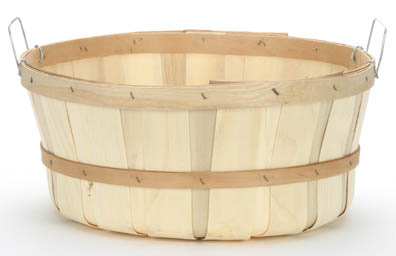
One is sitting in our basement in the autumn, sorting and cleaning the Gladiolus bulbs.  We had lots of those bulbs, bushel baskets full of them.  These were the old-fashioned wooden bushel baskets, which to my surprise I discovered one can still buy for just $3.  I remember sitting on low seats over our basement's concrete floor, at least a couple kids with my dad.  He showed us how to clean and trim the bulbs for storage in the basement over winter (this was so they wouldn't freeze, as they would have if we'd left them in the ground).  My dad enjoyed this process, though I don't remember there being anything fun or interesting about it – just tedious.  There was a strong, earthy aroma from those bulbs; I can't think of a way to describe it, but I know I'd immediately recognize it were I to come across it again.

Before we could sort and clean the bulbs, we had to dig them up.  They were easy to find, as some foliage was still attached – some quick work with a shovel or trowel and up they came.  We'd trim off any remaining foliage and toss them in a bushel basket.  I remember my dad carefully digging up any place where there ought to be a bulb (we planted them at intervals in a line), to make sure we got them all.  Most of all, I remember him exhorting us to be careful with our digging, so we didn't damage the bulbs.  Normally when we dug, it was to make a hole to plant a tree or shrub in – we had lots of practice at this.  In that process, we had no need to be careful – the only thing we were removing was dirt.  My dad had a challenge changing our careless digging habits.

Then of course in the spring, after the last possibility of a frost, it was time to plant those glad bulbs that had wintered in our basement.  My dad really enjoyed planting them; it combined many elements that were individually pleasurable for him.  First (and quite possibly foremost :), he could dig.  My dad loved to dig.  The rest of the family mercilessly teased him about his peculiar hobby.  How many people do you know who would go out into a field and dig holes for fun?  But my dad most definitely liked to dig, and he could do so for hours on end.  Planting those glads was also planting, another thing my dad clearly got pleasure from.  And finally, it was something he could do with his kids.  The small scale of glad planting was within our little capacities, so limited compared with his.  I remember him out in that field with us, in the bright spring sunshine, rich earth around us, and him smiling and laughing with us as we together planted those bulbs.

What inspired me to write this story of the glads, though, is a single clear memory of my dad.  It was in the summer, and the glads were in full bloom.  My dad and I had been out on a yard maintenance job, and we had worked hard.  Both of us were quite tired, and my dad was eagerly anticipating our dinner.  As he pulled our Volkswagen pickup (like the one at right, complete with the “Conestoga wagon” canvas top) into the nursery's entrance, he decided to forego our usual after-work exercise of putting tools away and cleaning up the truck, uncharacteristically saying we'd do it in the morning.  That was a good indication that he was quite exhausted.

To get to our house, one would drive past the nursery and its sheds, up our driveway that was perhaps a quarter mile long.  There was a tiny little grade to climb, and then you'd have a straight, flat drive to the front of our house, with our vegetable garden and Gladiolus patch in the field to the left.  On that day, the sun was shining brightly, but it had evidently sprinkled earlier in the day; everything was wet and sparkly.  My dad saw those glorious Gladiolus, rows of them – and just stopped the truck in the driveway.  The two of us got out and walked out into the rows of Gladiolas, and my dad and I wallowed in the experience.  Bright colors were all around us, made even brighter by the recent rain that left them clean and covered with droplets.  That same rain brought out the “farmer's perfume” of rich soil, and you could smell the plants (though I don't remember Gladiolus having a sweet fragrance of any kind).  What stands out most in my memory is my dad's tired and drawn face, transforming, lighting up as he enjoyed those those glads, and even more so as he cut a nice bunch of them to bring in for my mom.  As we (finally) pulled up to the house, she was standing on the back porch – she'd spotted us out in the field, and figured out what my dad was doing.  She had a huge smile and a hug for us, and took the flowers off to put in a vase.

Simple pleasures for simple folk?  Maybe.  But a damned fine memory I feel very privileged to have...

Saturday, December 7, 2013

He had a dream...

He had a dream...  My mom sent me a copy of this photo, which I remembered seeing several years ago.  It was originally posted by Nikolas Schiller on his blog, on September 12, 2009, on the occasion of the Taxpayer's March on Washington.  It's just a pithy a comment on That One today as it was even then...

Look out below!

Look out below!  Mark Steyn, witty-and-depressing on America's future.  His conclusion:
So what does every initiative of the Obama era have in common? Obamacare, Obamaphones, Social Security disability expansion, 50 million people on food stamps . . . The assumption is that mass, multi-generational dependency is now a permanent feature of life. A coastal elite will devise ever smarter and slicker trinkets, and pretty much everyone else will be a member of either the dependency class or the vast bureaucracy that ministers to them. And, if you’re wondering why every Big Government program assumes you’re a feeble child, that’s because a citizenry without “work and purpose” is ultimately incompatible with liberty. The elites think a smart society will be wealthy enough to relieve the masses from the need to work. In reality, it would be neo-feudal, but with fatter, sicker peasants. It wouldn’t just be “economic inequality,” but a far more profound kind, and seething with resentments.

One wouldn’t expect the governing class to be as far-sighted as visionaries like Bezos. But it’s hard to be visionary if you’re pointing in the wrong direction. Which is why the signature achievement of Obama’s “hope and change” combines 1940s British public-health theories with 1970s Soviet supermarket delivery systems. But don’t worry: Maybe one day soon, your needle-exchange clinic will be able to deliver by drone. Look out below.

Flash mob!

Flash mob!  This time, it's the United States Air Force band at the National Air and Space Museum...

On that unemployment report...

On that unemployment report...  Before you get too excited about the unemployment rate dropping to 7%, remember this: that number is thoroughly cooked, in a highly politicized way that is designed to make the administration look good.  The fact that for five years now, the administration has looked quite bad (with respect to unemployment) tells just how awful the situation is.  With actual numbers, so does the graph at right: the uncooked numbers, showing you the percentage of Americans who are working.  That doesn't look quite so good now, does it?

If you look closely at that chart (and you should!), you'll notice that vertical axis is highly “magnified”: it's only showing from 58% to 64%.  Here's a way to think about it: a mere 1% increase in this rate indicates that 3.2 million more Americans have a job.  Ponder that while you watch the self-congratulatory posturings of That One and his minions...

Five fold photographs...

Five fold photographs...  These were new to me, but were apparently quite popular as portraits in the late 1800s.  These are made with a single photograph taken using a pair of mirrors.  This article (PDF) explains in a lot more detail exactly how it was done.  This blog has more many examples...

Medical costs across the U.S...

Medical costs across the U.S...  Now here is a fascinating visualization of data on the cost of over 100 Medicare procedures.  I think of myself as being reasonably well-informed about the U.S. health care system, but the degree of variability in these costs was a big surprise to me.  I'm not surprised that where I live now (near San Diego) has some of the highest costs in the country – but I was very surprised to see that some procedures cost just 15% as much in the area we're most likely to move to (northern Utah)!  Where my mom lives (near Charlottesville, VA), there's a huge difference (over 2:1) in the same town, with the Jefferson Hospital being far cheaper than the nearby UVA Medical Center – but even the most expensive there were half of San Diego's.

Hothouses for socialism...

Hothouses for socialism...  James Taranto tears into a great example of how U.S. universities are prosecuting a war on men, in the name of progressivism (aka “socialism”)...

“Best of 2013”...

“Best of 2013”...  The first of many, I'm sure.  Here's a collection of images from The Wall Street Journal...

Supreme Court to decide in software patent case...

Supreme Court to decide in software patent case...  It's a curious lineup on both sides.  Our software patent system is badly broken, but ... I haven't thought of a solution that I liked, nor have I read any.  I'm not opposed to tinkering with the current system, though, because I don't see any politically-attractive changes that would actually make it worse...

You shall not pass, dog...

You shall not pass, dog...  Pitiful dogs afraid of passing by cute little kitties; very cute and funny.  We don't have this issue in our house :)  Via friend and former colleague Aleck L...

ObamaCare debacle update...

ObamaCare debacle update...  Because I'm retired and I have nothing better to do!

It begins.  One patients experiences with a doctor conscious of what ObamaCare plans will and will not pay for.  This is what Sarah Palin meant with her memorable phrasing: “death panels”...

One in four ObamaCare enrollments affected by technical bugs.  Even the Post Office does better than that!  Oh, our healthcare is in the very best of hands...

Congressional staffers frustrated by ObamaCare signup glitches.  Good.  Let them experience first-hand what it's like for the little people...

Where does the ObamaCare buck stop?  That One has the answer...

NPR reports that Californians are looking for healthcare policies off the exchange.  There are multiple unexpected things in that sentence...

The ObamaCare debacle finally tipped Californians over the edge: support for That One in California is in free-fall...

Seven of every ten California doctors are refusing to participate in ObamaCare.  The reimbursement rates here are insultingly low, and guess what?  The doctors are insulted.  Also, they want to stay in business.  You don't have to have much of an imagination to guess which 30% of the doctors are going to accept ObamaCare reimbursements, do you?  I didn't need any more reasons to get the hell out of this crazy state, but ... ObamaCare has conveniently provided one anyway...

ObamaCare's hidden tax on your health insurance.  This was new to me, but I can't say I'm surprised...

Indemnity!  Whiskey!  Sexy!  Taranto examines the idea that young people will be attracted to ObamaCare.  I love how he can take an infuriating topic and make it into something amusing, however briefly.  Here he is again, on the subject of those supposedly-better ObamaCare-compliant policies...

California leads the way ... in government-sponsored violations of your privacy.  Turns out that if you just visit the state's ObamaCare web site, they'll pass your contact information along to insurance agents.  It's almost like they're trying to provoke me – it's the one thing they're getting right!

Pater: fulgurites and pine nuts...

Pater: fulgurites and pine nuts...  At right is a nice example of “elephant’s head” flower (Pedicularis groenlandica) that my dad, Debbie, and I enjoyed in Corkscrew Gulch, above Silverton in the San Juan Mountains of Colorado, July 2005.  These often could be found in the same wet places that one of his other favorites (Parry's primrose) could be found, so we were always searching for the two of them...
Fulgurites and pine nuts...

On one of my family's epic camping trips “out west” – one of the earlier ones, I think – we stopped to camp in Great Sand Dunes National Park, in south-central Colorado.  The whole family was along: mom and dad, my siblings Holly, Scott, and Mark, and me.  We must have been there at least a couple of days, because we had time for two distinctly different little adventures.

If you've never been to Great Sand Dunes National Park, you might be completely unaware of it, as it doesn't have the popularity or cachet of other great western parks like Yellowstone, Zion, or Yosemite.  It's a weird place, full of things to marvel about, not least of which are the giant sand dunes themselves.  The satellite photo at left shows an area roughly 8 miles wide, with the great dunes in the middle.  To the east (the right) there's a mountain range which is actually the source of the dunes – they form a wall that causes the wind to slow down and drop its load of sand and dust.

In the visitor center for the park, we learned about the existence of fulgurites, something none of us had ever heard of before.  In the great photo at right (not mine!), you see a relatively small one.  They're hollow tubes of fused quartz (sand particles) made when lightning strikes a sand dune.  The park, with its giant sand dunes, has thousands of fulgurites form every year.  We talked with a ranger who encouraged us to look for them, and told us that on the surface they just looked like a little frozen patch of sand – so they were challenging to spot.  Below the surface of the dune they could extend many feet – the biggest ones ever found were something like 40 feet long!

So some of us set out to climb one of the sand dunes and look around on the top of it for evidence of fulgurites.  I remember my dad, Scott and I; it's entirely possible that Holly was along as well.  I think Mark was probably too young.  Climbing those dunes was really tough work, even though we were all hikers – the soft sand made footing challenging, and we'd often slip down almost as far as we climbed.

I have a crystalline memory of that climb: my dad, outlined against the sky above me, on the off-white dunes, laughing and horsing around with us.  We were pushing each other back down (which didn't make the climb any easier!), shouting at each other, and all of us laughing so hard we had trouble getting enough air to breathe.  Pure, simple, and innocent fun...

We finally did get to the top of a dune, and searched around for the top of a fulgurite.  And we found one, albeit a little tiny one, perhaps 10 inches long and a half inch in diameter, a strange and alien-looking thing.  I've no idea what happened to that.

The other adventure we had at Great Sand Dunes was of the botanical kind.  To the east of the road to the campground, the mountains rose quickly.  On the flanks of those mountains the pinyon pines were abundant (my dad knew this from his research).  There are several pinyon species; these were Pinus edulis (the Colorado pinyon), which my dad knew were particularly good eating.

In the years since then, I've collected (and eaten!) pinyon pine nuts (the seeds within the cones) many times; pinyons are very common near where I live.  But that little trip was the first time we kids had ever looked for them or eaten them, and we weren't entirely sure that my dad wasn't playing tricks with us.  Eat a pine cone?  That didn't seem very likely.  But not far into our walk, my dad spotted some specimens, and we went on the hunt for cones that the jays had not yet eaten (large flocks of Pinyon jays, specialists in pinyon nuts, were all around us).  This turned out to be well within the capabilities of little kids like us, and soon we were munching handfuls of pinyon nuts at a time.  We also collected a bag full of them to take back to my mom.

My dad was here, there, and everywhere as we collected those nuts.  Somehow he kept track of us all (I'm pretty sure that Holly, Scott, and I were on that adventure), helped us all identify the right kind of tree, the cones that still had nuts, and how to extract the nuts (the eating part we had under control :).  Somehow he also found moments to gaze around at the beautiful scenery, explain to us about any random thing we asked about (lots!  this was all new to us), and to crawl around looking at the various trees and shrubs there that were interesting to him.  This was actually completely typical for him on one of our hikes, but for whatever reason the memory of it is clearer for me in this instance than in most others.  If I close my eyes, I can still hear the sounds of the pinyon-juniper country (especially those jays!), smell the then-new, now-familiar smells of the American desert (especially sage and pine), and see my dad, shepherding his little flock on another of many little adventures...

Friday, December 6, 2013

Interesting twist on web search...

Interesting twist on web search...  This site (which I've now bookmarked) has an interesting thesis: what will happen to your search results if you eliminate the “hits” from the largest web sites?  Might you find new and useful sources that you'd otherwise have missed?  Judging from my results after a few trials, I'd have to say the answer is a resounding “yes”.  Give it a spin!

Water frozen in mid-air...

Water frozen in mid-air...  The water in the photo was extruded from a crack in the pipe, and froze immediately upon contact with the frigid air...

Opportunity is nearing its tenth anniversary on Mars...

Opportunity is nearing its tenth anniversary on Mars...  At right is a photo of the path it's taken on the Martian surface.  It's the little Martian rover that could!

Twenty four of the world's most beautiful trees...

Twenty four of the world's most beautiful trees...  Twenty-three more at the link, of course...

On raising the minimum wage...

On raising the minimum wage...  This is something that has long puzzled me – it seems obvious to me that a minimum wage harms the very people the progressives claim to be wanting to help with it: lower income workers.  You really don't need to be an intellectual giant to realize that the existence of a minimum wage (at any level) for private jobs means fewer jobs (through elimination or automation) and raises prices.  What business is going pay a 70 year old retired guy $15 an hour to sweep the sidewalk in front of their shop?  They'll just eliminate the job.  It follows quite simply that the higher the minimum wage, the more jobs it costs, and the more it raises prices.  Additionally, I have a moral problem with the notion that if a person is willing to work for (say) $3 and hour, and a business is willing to pay for that work – that we, as a society, will say: “No, you can’t do that!”  What right have we to interfere in that private, voluntary business transaction?  Lest you think you're hearing the ravings of a committed curmudgeon, you should know this: economists have broadly agreed that a minimum wage (at any level) is a bad idea for, oh, about 100 years now.  Here's a discussion on this topic from Reason, and another from The Federalist.

Scientists have long suspected the sun had giant convection cells...

Scientists have long suspected the sun had giant convection cells...  Now it appears that they've actually found them...

The immense scale of North Korea's political prison camps...

The immense scale of North Korea's political prison camps...  A new report out from Amnesty International, with links to high-resolution satellite photos like the one at right (click to embiggen).

The human race should be ashamed that we allow political considerations to prevent a concerted, united action to save other humans from things like this.  We've now allowed it to fester for over 60 years, and our collective inaction has doomed millions of people to needlessly suffer and starve...

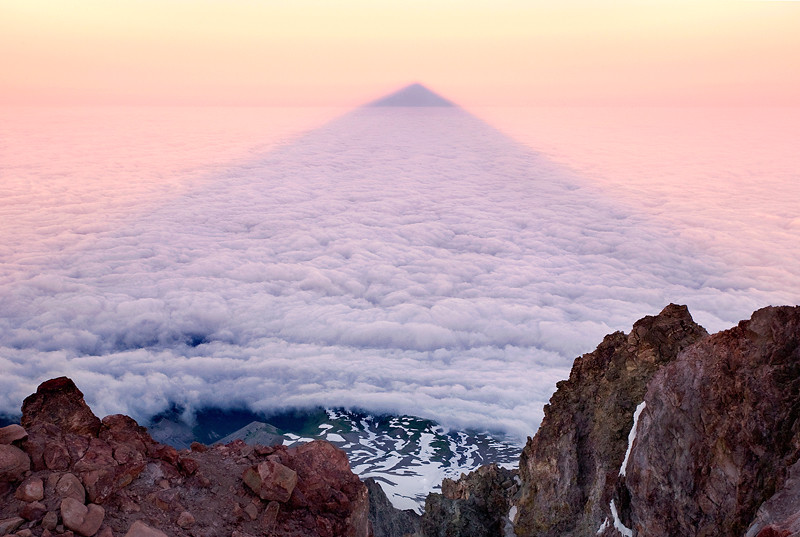
Mt. Hood's shadow...

Mt. Hood's shadow...  Awesome...

ObamaCare debacle update...

ObamaCare debacle update...  Because you really wouldn't want a stale debacle, would you?

ObamaCare – as if Apollo 11 took off for the moon, but landed in Newfoundland.  Classic Mark Steyn.  His conclusion:
Instead, we have government by people who read Thomas L. Friedman and use words like "interconnectedness" and give commencement addresses where they rave about how our world is changing so fast — and assume that just being glibly au courant is a substitute for being able to do, make, build. There are lessons here beyond the abysmal failure of one misconceived government program, lessons about what our esteemed (if not terminally self-esteemed) elites value as "smart," and about the perils of rule by a poseur technocracy. As for Obama, he's not Jay-Z, nor even Justin Bieber: He can't sing, or dance, or create a government bureaucracy that functions any more efficiently than a Soviet supermarket. He broke the lifelong rule that had served him so well — "Don't just do something. Stand there" — and for the first time in his life did something, terribly. It will bear his name forever.
Now, this is infuriating: IBM offered to build the ObamaCare site for free – and That One turned down the offer.  Instead, they spent nearly a billion dollars of taxpayer money on a disastrous turkey of a web site...
Major Obama “bundler” bets against ObamaCare site.  More precisely, he's short-selling CGI's stock.  That's the company that spent nearly a billion dollars of taxpayer money producing WWW (the World's Worst Website)...

Next ObamaCare horror cued up: “doc shock”.  California is the worst affected state.  Oh, joy.

More fiddling the numbers.  Seriously, you're not surprised by this, are you?  We mere citizens apparently can't handle the truth, so the lies are expected to do...

We may have reason to be grateful to this law professor.  He may have discovered the crucial legal vulnerability in ObamaCare; the cases he inspired are progressing toward a nearly inevitable review by the Supreme Court...

Not only is healthcare.gov a turkey, but we overpaid for it!  I agree with the basic premise of the linked piece: paying nearly a billion dollars for that web site is a ludicrously high figure.  The “experts” they cite contend that $5m to $10m would be the most it should cost.  I don't think that estimate is really quite fair – there are many sites on the Internet today that cost a lot more than $10m to build.  Perhaps a more reasonable estimate might be $20m to $30m – for a complete site, secure, fast, and usable.  But that's still a far, far cry from nearly a billion dollars for something so bad it's likely it needs to be pitched out and redone from scratch...

A doctor sues ObamaCare – wants ObamaCare strictly enforced.  He's not happy with the impact That One's regal actions have had on his business...
Pro Publica explains the “834 problem”.  I still shocked when I visit their site and find articles criticizing That One.  It's as if Jay Carney starting working for Paul Ryan...

ObamaCare's worst case scenario?  Maybe – somehow all those millions of people whose policies have been canceled have to get new insurance coverage in place before January 1st.  That date is not very far away.  Being the cynic that I am, somehow I think that a solution will be found – an expensive, taxpayer-funded, single-payer “solution”...

ObamaCare may wipe out volunteer fire departments.  IRS to decide.  ObamaCare: is there anything it can't do?

Pater: the typewriter...

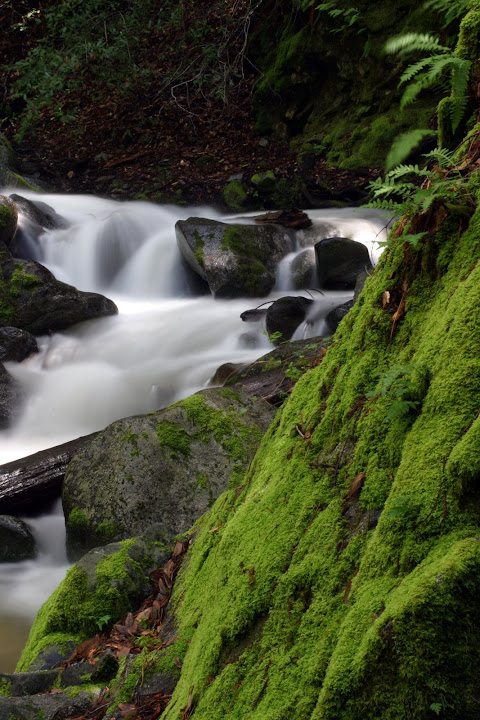
Pater: the typewriter...  At right is a waterfall along the Big Sur coast that my dad and I enjoyed together in April 2006.
The typewriter...

One thing we could always depend on hearing in the evenings, or all day in the winters, was the sound of my dad typing away on his IBM Selectric typewriter, a prized possession of his.  My memories of it begin when I was quite young (maybe 10), but it was first sold in 1961, so my dad either bought a brand new one or one that hadn't been used very long.  Given the unusual care he took of that typewriter, I suspect he bought it new – something he rarely did with a piece of kit like that.  We kids weren't allowed to touch that typewriter, and when not in use he always had its dust cover in place.  Both of these were unusual habits for my dad; more indication of just how valuable that typewriter was to him.

My dad's typewriter looked exactly like the one in the photo at left (which is not my dad's).  My younger readers will have no idea what a Selectric typewriter was.  For its time, it was a revolutionary piece of machinery.  A skilled typist could type faster on a Selectric than on any other kind of typewriter.  The documents it produced were of very high quality, especially if you used one of the special “high resolution” ink ribbons (which my dad rarely did, as they were expensive).  The first thing, though, that any typist would notice about the Selectric is something it didn't have: a moveable “carriage” to position the paper under the type.  Instead, the Selectric moved a “type ball” across the paper.

Now, one might reasonably ask why a nurseryman who was struggling financially – a man at ease with tractors, shovels, and long days of back-breaking work – would want with a fancy, expensive typewriter.  The reasons why it made sense for him were a mixture of his personal history, his personality, and the times he lived in.

His history came into it because he had, for a male adult of the '60s, an unusual skill: he could type, and very well indeed.  Back in those days, typing was closely associated with secretaries – and secretaries were almost exclusively women.  In fact, becoming a secretary was a major career path for women, and our high schools had classes designed around that need: stenography, typing, transcription, etc.  My dad learned how to type while in the U.S. Army Air Force during WWII, where he operated classified intelligence teletype machines, much like the Model 28 pictured at right.  After doing very well in a stateside typing school, my dad spent many hundreds of hours typing on just such a machine, sending intelligence reports from the bases where he worked (in North Africa and Italy) to all over Europe and the U.S., using special radio systems to transmit the information.  Often what he was sending was encrypted, which meant he was sending endless columns of numbers, all of which had to be absolutely perfectly typed – a single error on a single digit could render the entire message unreadable.  These systems were very widely used by both sides in WWII; they were the closest thing they had to today's Internet.

My dad's personality came into it because he was an introvert (as am I), and much preferred written communications to verbal.  He'd make phone calls when he needed to, but if he had a choice, he'd write.  Back then, long before anything resembling the Internet, writing to someone meant actually putting your writing down onto a piece of paper (pen, pencil, or typewriter), then folding that paper up, putting it into an envelope, addressing it, and putting a stamp on it.  Days or weeks later, if you were lucky, you'd get a response.  My dad had an extensive correspondence with dozens of people all across the U.S., mainly nurserymen, botanists, horticulturists, customers, friends, and arboretums.    It wasn't at all unusual for him to post a dozen letters after an evening of writing, nor was it unusual for him to get a five or six letters in response on one day.  He and his fellow nurserymen or horticulturists had more time in the winter, and the rate of correspondence would go up then.  My dad could write far faster with a typewriter than in longhand, and he already knew how to type – so typing those letters made good sense.

It wasn't until I was in high school that I came to appreciate just how good my dad was at typing.  He made it look very easy – he could whip out a dense one-page letter in just a few minutes, with no mistakes at all.  The reason I discovered this in high school is because I signed up for a typing class (mainly because it was full of girls!), and I went into that expecting that I'd have no trouble excelling.  Hah!  The classroom taught us on manual typewriters, which are far harder to use than an electric model – and even harder than the Selectric.  But I can't blame the challenges on the typewriter, not really – typing 100% error free is really quite hard to do.  “Error-free” would be sort of nonsensical today, as we have that magic backspace key (my favorite key!) on all our keyboards.  Those typewriters had no such thing.  To correct an error was a laborious process involving erasers or “white out” paint – and the finished result with errors would never look as good as an error-free page.  So typing with zero errors was highly prized – and quite difficult to actually accomplish.

In addition to his correspondence, my dad also typed up lots of other things: extensive notes on his horticultural work, articles for magazines, and copy for our catalogs and booklets.  Years later he shifted this work onto a personal computer, where (quite predictably!) the only things he really learned how to use were word processing software (he knew Microsoft Word quite well) and the web (for his plant research).  One thing that always surprised me was that we really never could get him interested in email – given his interest in correspondence, that seemed like it should be a natural for him.  I saved every email I ever received from my dad - all seven of them.  By contrast, I have over 4,000 emails from my mom!

I've no idea what happened to that old Selectric.  I can still remember some details about it, such as the way certain keys (“e”, “t”, the space bar, etc.) had depressions worn into them from the countless times my dad's fingers impacted them.  Sometimes the key's label was no longer legible, though of course for a touch typist like my dad that didn't actually matter...

Thursday, December 5, 2013

The best of dogshaming.com...

The best of dogshaming.com...  Via reader and friend Simon M., this “Best Of” collection.  I visit dogshaming.com every time I need a smile – in other words, every morning after I write the ObamaCare debacle post.  It's never let me down yet...

Words in Europe...

Words in Europe...  Fascinating maps of a few selected words and how they're said across Europe.  At right is but one example (for “church”), many more at the link.  Etymology is far more interesting than most people realize, and these visualizations are a great way to convey that.  The creator needs to work on the color selection though – that purple, that green!  My eyes, they burn!

I really didn't think I'd ever see this day...

I really didn't think I'd ever see this day...  The ObamaCare debacle seems to be waking up some folks (like Jonathan Turley) that I thought were very soundly asleep.  Some aspects of this news segment remind me of the events immediately prior to Nixon's resignation, and about Jimmy Carter in the run-up to the 1980 elections.  Prior to the ObamaCare debacle, Obama seemed to be immune to such criticism – and now we're seeing it on C-Span.  Awesome.  And Megan actually sounds like an informed, engaged reporter asking intelligent questions – kudos to Fox News for having the cojones to do that!

Photo of the day...

Photo of the day...  An Icelandic waterfall...

How to opt out of ObamaCare – legally...

How to opt out of ObamaCare – legally...  This is important.  I'm keeping this tucked way for the day our COBRA coverage runs out...

California leads the way...

California leads the way...  in unions keeping a choke-hold on state government.  But maybe there's a way to fix it (besides just leaving).  I'm skeptical.  I think it's much more likely that California will completely implode than be fixed rationally through political means...

The wrong side of history...

The wrong side of history...  John Hawkins, writing at TownHall.com, has an excellent, short, and easy read titled “Why liberalism is on the wrong side of history”.  It's chock full of important ideas.  An excerpt:
It's a kinder, gentler version of George Orwell's horrific "boot stamping on a human face - forever." In the liberal version, it's a boot gently pressing you to the ground, forever, "for your own good" – as if liberals have the slightest idea of what "your own good" might be. Certainly, they believe they know what's best for you. It's what they were told by their college professors, the New York Times and their friends. There's a whole echo chamber dedicated to telling them exactly what they want to hear about how other people should be living.

The problem with that is not so much liberals living how they want to live; it's that liberals want to force everyone else to live how they want to live. They don't like guns; so no one should have guns. They like gay marriage; so everyone must be forced to like gay marriage. They like PBS; so everyone should be forced to pay for PBS. 
Do go read the whole thing, please...

ObamaCare debacle update...

ObamaCare debacle update...  Because, because!

Can ObamaCare be tossed?  The simple fact that this is being discussed, by both sides of the aisle, brings nearly to tears for the sheer joy of it!  Yesterday, Obama felt the need to state that he had no intention of repealing it while he was president – as if (and it could only be in his own party) there were those who believed otherwise...

Oh, the hypocrisy!  Just one Congress-critter felt the need to exempt his staff from ObamaCare: Harry Reid.  Ed Morrissey isn't impressed.  The only person who could exceed that stunning level of hypocrisy would be Nancy Pelosi – but at last word, she was not going to exempt her staff.

Another legal challenge to ObamaCare.  Bring 'em on!  There can't possibly be too many of these...

An epic split parody combined with ObamaCare opposition.  What more could I possibly ask for?  I love his motto: “Overhaul DC” Oh, yeah...

Another burned ObamaCare supporter.  This time, a health care reporter for NPR.   Enough stories like this and even the low-information progressives might wake up and smell the bullshit...

“Young invincibles” spurning ObamaCare. Apparently smacking them upside their pocketbooks works way better than smacking them upside their pointed little heads...

52% of young people (18 - 29) would like to throw Obama out of office.  Rob Long marvels at the attitude turnaround, and Reason has more...

No, Virginia, ObamaCare is not getting better!  Of seven live broadcast attempts to log into the ObamaCare website on Monday, only one succeeded – and that one was only successful if you think being put in a queue equals success...

ObamaCare offers more goodies for insurers.  Megan McArdle points out the lengths That One's administration is going to in order to keep the insurance companies from joining the opposition.  Definitely smacks of desperation...

Pro Publica on the new, revised ObamaCare site: thumbs down.  That's gotta leave a mark...

Another ObamaCare casualty: Next year, seniors will start feeling the pinch of ObamaCare's $300m raid on MediCare.  Sorry, mom...

Republicans see one remedy for Obama: impeachment.  Dana Milbank says it like that was a bad thing!

Some people are being “automatically” switched to more expensive ObamaCare plans.  Great.  Just great.

Lame government in action.  The software to calculate subsidies isn't finished yet, and nobody knows when it will be.  So That One's administration is telling insurance companies to estimate it, and they'll be paid whatever the estimate is – then on some fine day down the road, they'll square it all up.  What could possibly go wrong?  The worst part is that we already know who's going to pay for the “squaring up”: taxpayers.  Through the nose!

“A fraudster’s dream come true.” That's the ObamaCare web site being described.  Oh, goody...


Pater: bagging it...

Pater: bagging it...  The beautiful plant at right is Sarcodes sanguinea – the “snow flower” – that my dad and I saw lots of on the flanks of Mt. Lassen in June 2007.
Bagging it...

There are many ways in which growing up on a farm is profoundly different than growing up in a city.  One of these is that farmers tend to put their kids to work at a very young age, and my dad was no exception to that.

One task my dad found for me when I was quite young was bagging oak leaf mold for resale at the retail nursery my family ran.  I'm not sure exactly how old I was, but I remember that the tools involved – shovel, three-tined pitchfork, and bag tie twister – were just barely within my abilities, so I'm going to guess I was 9 or 10.

For many of my readers, oak leaf mold is probably something you've never heard of before.  It's not the disgusting image that likely first came to mind – it's actually a very pleasant material to use; one that any gardener would feel right at home with.  It's what's left after oak leaves have been completely decomposed (composted) by fungus and bacteria.  When dry, it's very light and fluffy, almost black, with an earthy smell and a texture a bit like finely chopped peat moss.  The holly trees that were the bulk of my family's nursery stock liked acidic soil, and the oak leaf mold was the perfect soil amendment for them: it added soil acidity, and it also added other nutrients and the organic material needed to help the soil retain moisture.

My dad bought the oak leaf mold in bulk from a man in southern New Jersey (the name “Pete” springs to mind, but I'm not sure I've got that right) who had a big truck and the willingness to scout out and find natural deposits of oak leaf mold.  I don't recall ever seeing where it came from, but it must have been from deciduous oak forests growing in somewhat sandy soil, as the oak leaf mold he delivered had traces of sand in it.  Anyway, this fellow would on occasion deliver a load of oak leaf mold to us, and he'd unload it into a small mountain inside of one of our sheds.

For retail sale, though, that stuff needed to be bagged up into convenient, neat plastic bags.  To do that, my dad had purchased an industrial-strength gadget that we could mount the plastic bag into – a bit like the burlap bag holder at right.  Then we'd fill the bag with oak leaf mold using some combination of a shovel and a pitchfork, tamping it down as we went (if the oak leaf mold was dry, it would fluff up like a pillow).  When the bag was good and full, we'd dismount it from the holder contraption, then use a steel wire twist-tie and a tool similar to the one at left to cinch the top up tightly.

I remember my dad showing me how to do all of this, paying particular attention to how full the bags were.  He wanted our customers to feel like they were getting good value for their money, so he wanted those bags to look like they were bulging with the oak leaf mold.  It really did make a big difference how much you tamped it down; I'd guess you could add another 20% or so to the bag if you tried hard, and that really did make the bag look “stuffed”.  He told me that if the bags weren't full enough, he'd make me do them over.  Then he sealed the deal by telling me that he'd pay me for this work, on a piece work basis.  I've forgotten what the amount was, but it was probably 10 cents or so per bag.  But it would be the first thing my dad ever offered to pay me for – a big deal indeed for me.

So I set off to fill some of those bags.  If we had a video of that first effort, I suspect it would be fun to watch.  I remember that I could just barely poke the shovel into the big pile of oak leaf mold, and when the shovel was full it would frequently twist and dump its whole load on the concrete floor.  With the pitchfork, I could easily stick it into the pile, but it would frequently lose its load by slipping through the tines.  My dad, of course, made both of those actions look ridiculously easy – he could even hold a full shovel-load in one hand while holding the bag filler gadget with the other.

But the really, really tough thing for me turned out to be that tie-twister.  My dad made it look so easy!  Hold the bag closed with one hand, wrap the tie around with the other, then hook the twister tool through the loops and give it one easy little pull – and presto!  A sealed bag.  But when I went to try it, somehow it wasn't quite so easy.  The closed bag would escape me, and it would fall over and spill some.  I'd get the tie wrapped around the top, but the loops weren't lined up, so I couldn't get the twister tool's hook engaged.  Worst of all, I'd do all the other stuff correctly – and then I just didn't have the strength to pull the handle on that twister tool!

Every once in a while, as I was struggling with all this, my dad would saunter over and give me a little advice.  I'm certain now – though I never suspected it at the time – that he was struggling himself: to keep from laughing at me.  But he didn't – instead, he showed me how to hold the shovel, how to fill it just partially so the weight of its load was within my capacity, how to hold the filled bag with my knees so I could use both hands to wrap the tie around the neck, and most importantly – how to hold my arm next to my side so that I could actually apply my little muscles to the task of pulling that twister tool's handle.  I still remember the sweet feeling of victory when I was finally able to twist those ties.

When I'd finished with my bag filling for the day, I had a dozen or so bags filled and tied.  To me that seemed like a huge accomplishment, and I was tired.  My dad came over and inspected the bags, and there were a couple he judged to be not full enough.  He gave me a choice of either getting paid for the just good ones, or to take the time to redo the bad ones and get paid for them all.  I redid them, so I must have been a greedy little tyke :)  Then he sat down with me, paper and pencil, and we estimated how long it would take me to bag the rest of that pile.  At the rate I was going, it would take years – so clearly I needed to get more done each day.

When I look back on that now, I can appreciate (and be grateful for) the lessons I didn't even know I was being taught.  I had to earn that money with my labor – and he made it very clear that simply working hard wasn't enough – the work had to be done right.  He didn't shower me with praise for doing a small amount of work, but instead was happy for what I did and then gave me a good appreciation for what I really needed to accomplish.

My brother Scott and I had many, many such lessons over the next few years.  My dad's business at the time (landscaping, landscaping maintenance, and retail nursery) was an ideal vehicle for him to do this – there were always plenty of things within our capacity to do, some of which were genuinely helpful to him, and all of which could be used to teach us.  There have been many, many occasions over the years since then for me to be grateful for those lessons...

Wednesday, December 4, 2013

The Feynman lectures on physics...

The Feynman lectures on physics...  Long time readers know that Richard Feynman is one of my personal heroes.  His lectures on physics (at Caltech) are legendary, and they're now being put online, for free, by Caltech.  Two of the three volumes are now up, and the other is “coming soon”, the site promises.

One of my retirement goals is to work through as much of these as I can...

Low-information leadership...

Low-information leadership...  Peggy Noonan at The Wall Street Journal.  She's getting a lot of flack from conservatives and libertarians – well-deserved, I think – for coming around to this more grounded view after her initial support for That One.  Still, it's a good piece full of interesting observations...

Something to make you feel better about U.S. politics...

Something to make you feel better about U.S. politics: Afghan politics.  A great summary by Strategy Page.  I do feel a little better.  A little...

Good thing my dad never had this problem!

Good thing my dad never had this problem!  Prune a shrub, go to jail...

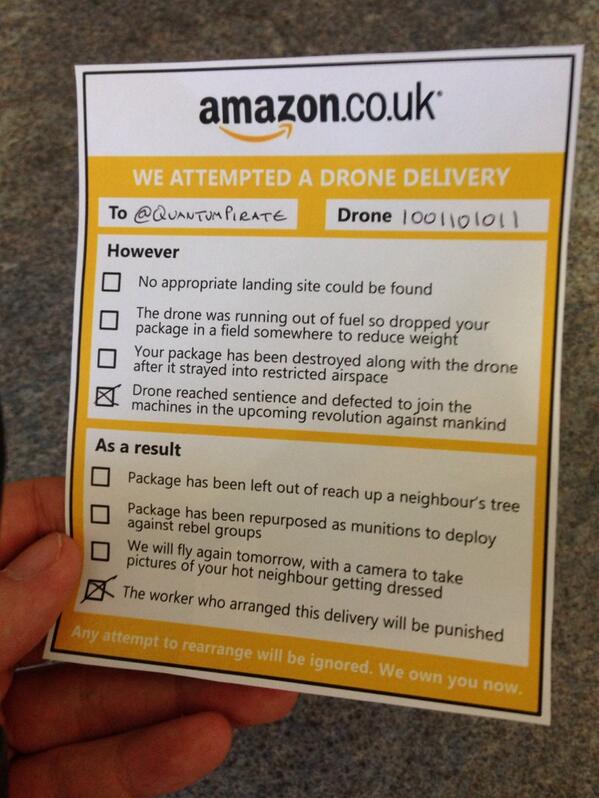
What happens when Amazon's drone doesn't deliver?

What happens when Amazon's drone doesn't deliver?  Click the thumbnail to embiggen...


New ObamaCare site...

New ObamaCare site...  Via reader and friend Simon M., this alternative site.  Try clicking on the button – you'll have the same success rate as you with the the real site, but more fun...

Ha!

Ha!  California's legislators building a Rube Goldberg set of fixes...

If you're not a taker, the only sensible reaction is to vote with your feet – get the hell out of this lunatic asylum...

California leads the way...

California leads the way...  In welfare insanity.  An Assembly committee in Sacramento is considering giving electric or hybrid cars to the poor.  It makes more sense than building the bullet train to nowhere – but that's about like saying that it makes more sense to drink gasoline than to drink hydrofluoric acid...

Pater: the “Holy Rock”...

Pater: the “Holy Rock”...  At right is a cherished artifact that sits on one of our bookshelves, one of the very few physical mementos of my dad that I have.  Every time I look at this rock and wallow in the memories it triggers, I laugh out loud – which will make no sense to you at all unless you know the backstory of the Holy Rock:
The “Holy Rock” of Gaviota State Park...

Sometime in the mid-'80s, in the summer, my parents came out to visit us.  At the time we lived in a tiny little house in Chula Vista, and my high school friend Nom L. was staying with us as well (he was trying to reboot himself from biology into a career as a programmer, but that didn't work out).  I was very busy those days trying to get my business going, but on one fine day, with beautiful weather, we took off for a day trip to the Santa Barbara area.  The main purpose of the trip was to locate a field where California poppies were grown for seed.  That was one of my dad's favorites, a fondness I shared.  We found the field and spent an hour or so just glorying in the eye-popping orangeness of a few hundred acres of Eschscholzi californica.  Unfortunately I don't have any electronic images from that field of orange...

Afterwards, we headed down to the shore to walk along the rock-edged sand beaches of Gaviota State Park.  My dad knew this area from his trip out here in the late '40s, and wanted to see it again.  The photo at right isn't mine, but it matches my memory exactly, except that the tide was lower at the time we visited.

My parents, my wife (Debbie), Nom and I walked for a half mile or so down the beach.  The day was picture-perfect: just a touch of a breeze, balmy, and very clear.  We could see the oil rigs and the Santa Cruz Islands on the horizon.  I don't recall any other people around.

At some point, my dad looked down at the ground and said “That makes me want to start a church!”  Not exactly what you'd expect to hear an irreligious man in his 60s say while walking down a beach, is it?

Now my mom, Debbie and I, knowing my dad very well, knew that we were expected to inquire as why this inclined him to start a church.  Nom knew my dad well, but not well enough – so he was the first one to ask.

“Look at that rock!” said my dad.  “Look how holey it is!  How could I be in the presence of such a holy rock and not want to start a church?”  The rock in question, of course, is the very rock you see at the top of this post.

Debbie then warned Nom: “Don’t ask!”   But Nom, intrigued, then gave my dad the perfect segue:  “What kind of a church?” asked Nom.  “A rock-worshiping church?”

Oh, no.  My dad could do much better than that!

For the next half-hour or so, my dad regaled the four of us with his vision of the church inspired by this rock.  It would be called The Church of the Chocolate-Covered Virgins, and it would feature the worship of chocolate (and other delicious food) and comely virgins (preferably naked).  He spun a tale of the church's many rituals, nearly all of which involved naked virgins.  There was the ceremony of virginal chocolate application, the ceremony of chocolate melting (supervised by the aforementioned comely naked virgins), the popular ceremony of chocolate removal, and of course, the ceremony of the virginity age limit.  The female church members, you see, were only allowed to be virgins until they were 20 – after that, they either had to leave the church or be de-virginized.  Obviously, there needed to be a means provided for them to end their sentence of virginity, and of course the church would oblige.  My dad was certain that enough male volunteers could be found to meet the need.

What inspired my dad to keep adding details to The Church of the Chocolate-Covered Virgins story was Nom's reaction, and to a much lesser extent, Debbie's.  Having grown up with this sort of story-telling, the only thing new to me were the slightly risque elements – we certainly didn't get that when I was a kid!  But to Nom, especially, my dad's story-telling was simply astonishing.  Nom's face – oh, how I wish I had a photo of him at that moment!

A few days later, after my parents had gone back home to New Jersey, Nom was at our table, holding the holy rock in his hands and remembering the story, laughing and still a little shocked.  He told me that he couldn't imagine his own father ever having fun with something like that rock, not even in his own mind, much less saying it out loud.  Nom said that prior to that walk on the beach, he didn't think there really were adults like that, who could think and say such things, and have such fun doing it.  He found the whole notion both disconcerting and fun – but he didn't think there could be many people like my dad, or the world would work differently than it did.

I think Nom was right on both counts.  There aren't many adults around with the playfulness that my dad had.  And if there were, the world would indeed be a different place – a much better place, and a hell of a lot more fun...
Update: when I first wrote this story, I remembered my mom being at the poppy fields with us, but I didn't remember her being at the beach – so I talked myself into thinking that my memory about the poppy fields must be mistaken.  I've since heard from my mom that she very clearly remembers being there at the beach with us.  Most especially, she remembers just how much we were all laughing at my dad's story!  So I've edited the story just a little to make it clear she was there as well, and I also fixed a grammatical error that Simon M. caught for me...