Friday, February 17, 2006

Hamas and Iran

In this morning’s Jerusalem Post is this story and its lead:

Mofaz: Hamas consulting with Iran how to lead PA

Hamas has asked for guidance, instructions and financial assistance from Iran as it prepares to take over the Palestinian Authority, [Israeli] Defense Minister Shaul Mofaz told the European Union’s foreign policy chief Javier Solana on Friday.

Now we really shouldn’t be surprised by this — Iran has a long history of assisting Hamas. But I am dismayed by it nonetheless. It looks like the first moves toward making Palestine a wholly-owned subsidiary of Iran. An Iranian colony, so to speak. Or even an Iranian “state”.

Iran, the country who has repeatedly vowed to wipe Israel off the face of the earth. Yup, that ought to help the peace process along all right…

If you’re not familiar with the Hamas/Iran connection, I’ve collected some reading material for you. I particularly recommend this paper [web] [pdf] by Matthew Levitt (a former FBI counterterrorism intelligence analyst). A sample:

According to press reports, moderate Palestinian parents find it increasingly difficult to shelter their children from Hamas recruiters seeking to breed future suicide bombers. One mother recounted how her son’s behavior changed when he started going to the mosque regularly:

At first I thought it was normal when my son Muhammad, who is eighteen, started going to the mosque frequently. But when I found out he was watching films about suicide attacks, I was worried … My son was going to the mosque late at night and early in the morning, adding to our fears … His behavior changed. He became introverted, which made his father and me search his room and spy on his comings and goings … We even locked the door to stop him going out … We later found out that those in charge of the mosque are members of Hamas, which teaches children about jihad and shows them documentaries about suicide bombings.

The father of fifteen-year-old Hamas recruit Musa Ziadah told a similar tale. Originally pleased with his son’s growing faith, the father did not realize Hamas had begun radicalizing his son when the boy was just ten years old and sweeping the mosque floors. Musa would later tell reporters that Hamas “taught me about the heroes of Islam who were killed as saints and how they are now in heaven beside God … I also learned that the Jews have no right to exist on this land, which belongs to Muslims.”

This paper is very well researched and cites numerous other papers publications (many with links). In addition, these two web sites (here and here) have lots of additional and useful background on Hamas and their relationship with Iran.

I worry that with Hamas now in power, and with the new-found aggressiveness that Iran is displaying, we’re going to see even more outrageous terrorist actions by Hamas against Israel — better funded, and using more sophisticated armaments openly imported from Iran. The only effective counter (at least, at the moment) is the Israeli military. Certainly none of the Middle East “peace efforts” have brought any relief from the terrorists; in fact, the continuous concessions wrung from the Israelis looks to Hamas (and Iran) like their enemy is weakening and is now more vulnerable than ever. In other words, the peace initiatives were actually counter-productive (just like the appeasement of Hitler before WWII) — not that anybody will learn from that, I’m sure.

Unsettling news for this otherwise fine Friday morning…

Casino Update

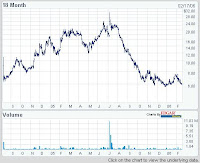
Lakes Entertainment, Inc. (based in Minnesota, of all places!) is the investor and speculator funding the Jamul Indian tribe’s attempts to build a casino just outside the town of Jamul. Lakes Entertainment is a public company, trading under the symbol WPTE. They were delisted from NASDAQ after getting into some trouble with the SEC; they claim to have resolved these issues and are now in the process of being re-listed.

My readers will know that this casino is something I am vehemently opposed to, so we try to follow the news on this issue. The process of getting approval for such a casino is far from transparent — there’s an awful lot about it that’s not only invisible, but unknown. An observer like me gets the impression that the process isn’t even well-defined. This is the perfect setup for corruption, for dirty money to drive the outcome.

Well, Lakes Entertainment just announced their fiscal 2005 results, and they’ve issued a press release about it (the usual practice for a public company). Buried in there is this little gem (emphasis added):

The net unrealized gain on notes receivable was $5.2 million and $3.1 million for 2005 and 2004, respectively, related to the adjustment to fair value of the Company’s notes receivable from Indian tribes. During 2005 the net unrealized gain of $5.2 million included unrealized gains of approximately $11.4 million, which were partially offset by unrealized losses of approximately $6.2 million primarily related to the termination of the agreement with the Kickapoo Traditional Tribe of Texas. The unrealized gains of approximately $11.4 million related primarily to increased probability of opening related to the casino development projects with the Pokagon Band of Potawatomi Indians in New Buffalo, Michigan and with the Jamul Indian Village near San Diego, California.

Read at face value, this says that the company believes its chances of getting the Jamul Casino built have increased so much that they should book some increased value (the “unrealized gains") on their balance sheet. However, as I read this company’s financial report (and look at their stock price), it’s easy to see that they must be desperate for anything resembling good news — so I have to be a bit skeptical of their statement. And its one of those judgment things; there’s no objective criteria that I’m aware of that would let us accurately set a fair value on this.

So I guess I’m not quite sure what to read into this. I am sure that I hate seeing anything that says the casino is more likely to be built!

And I really, really like the trend on the WPTE stock price — let’s hope that continues, right into the ground…

Thursday, February 16, 2006

Death Penalty Craziness

This story in yesterday’s Sacremento Bee (free registration required) has my head spinning. The lead:

California must either scrap plans to execute Michael Angelo Morales next week or change the way it will put the condemned inmate to death, a federal judge ruled Tuesday.

U.S. District Judge Jeremy Fogel of San Jose, responding to a defense challenge that the state’s method of carrying out lethal injection is cruel and unusual punishment, gave state authorities the option of defending their current procedure in a two-day court hearing.

The judge said official state logs “in at least six of 13 executions by lethal injection” raise “at least some doubt” whether inmates were rendered unconscious before being injected with chemicals that would cause “excruciating pain."

Set aside for a moment any feelings you have (pro or con) about the death penalty. It’s the law of the land here in California, and it’s this judge’s duty to uphold the law. And he’s concerned that the inmate may not be unconscious before the drugs that actually kill them — because these drugs can cause excruciating pain.

Ok, I can certainly see the judge’s concern here, though I’m not sure I agree with him. After all, if you’re going to kill somebody, why is it so bad to inflict some pain along the way? In fact, wouldn’t that provide some addition deterrent force — if those bad guys out there knew that their demise would be horrible, grisly, and excruciatingly painful, wouldn’t that give them a bit more pause? I can hear the screaming already from the criminal-coddling class…

But put that issue aside for a moment. When you read a little further in the article, you find out what the evidence is that inmates might be conscious when the fatal drugs are administered:

While “no direct evidence” showed anyone was conscious to feel pain, said Fogel, the logs noted “respirations” continuing at least until the start of the administration of pancuronium bromide in the six executions of Jaturun Siripongs, Manuel Babbitt, Darrell Keith Rich, Stephen Wayne Anderson, Stanley Tookie Williams and Clarence Ray Allen. Williams may still have been breathing when the administration of potassium chloride began.

Now wait just a doggone minute here! Just because someone is breathing, that’s evidence that they’re conscious? Last time I checked, someone who wasn’t breathing is dead, not unconscious! This argument amounts to the judge saying “The inmate isn’t dead yet, so you can’t kill him."

And we pay these people!

But back to the question of the death penalty… Most of my life, I’ve been a supporter of the death penalty for certain kinds of crimes (basically those involving the death of, or irreparable harm to, their victims). I based this support on the value of permanently removing the offender from society (I have no confidence that liberal judges will honor permanent incarcerations), along with the deterrent value.

But in the past few years, I’ve changed my position on this; I’ll call myself now a “reluctant opponent” to the death penalty. My opposition stems from the demonstrated failure of our justice system to actually execute convicted criminals (just look at the death row statistics compared to the execution statistics — 3,300 on death row vs. 60 executed in 2005), the alarming number of death row inmates being exonerated (often by contra-indicatory DNA evidence), and the costs of the process (including the long-term special incarceration of death-row inmates). It just isn’t working, no matter how much I would like it to.

So now I’m a supporter of permanent incarceration as a replacement for the death penalty, with supporting law that makes it impossible for a judge or the “Corrections” department to release inmates under such a sentence for any reason other than exoneration. I also support the notion of severely restricing “privileges” for such inmates (e.g., no TV, no reading, no Internet, no visitors, etc.) and requiring punitive labor (preferably mind-numbingly menial and physically taxing). Those animals are in there for punishment, not molly-coddling, and their misery should be as public as possible for its deterrent effect. I’d even support the idea — if carefully designed — of isolated “colonies” where criminals under such a sentence were turned loose to fend for themselves.

That ought to endear me to the liberals, don’t you think <smile>?

Wednesday, February 15, 2006

More UCSD Woes

A UCSD student named Jeff commented on my earlier post UCSD and Art. He said:

As a current UCSD student, I’m far less concerned with what a small minority of the students in the Literature deparment are doing as I am with what the administrators are doing.

He also passed long three links to examples of his concern here, here, and here.

I can see why he’s worried — from the facts reported in these stories, UCSD’s chancellor (Marye Anne Fox) appears to be very highly compensated (earning almost $700K in taxpayer’s money last year, making the big assumption that all compensation has now been disclosed) and very distracted by the obligations incurred by sitting on the Boards of ten corporations. She also earned about $340K in compensation from those Board positions; this is nearly as much as her (nominal) UCSD chancellor’s salary of $360K.

A little googling led me to Ms. Fox’s Board memberships. These aren’t little lightweight kinds of companies that one could imagine her just being a kind of token Board member — the organizations she’s a Board member of include SRI International, the Burroughs Wellcome Fund, and RedHat, for example. I’ve read somewhere that the average Board member spends 200 hours per year preparing for and attending Board meetings. Having been a Board member of a public corporation myself, I can attest to the investment of time required; if anything, that 200 hours seems too little to me. Ten companies? That would be 2000 hours per year, which is what most people would consider a full time job. When does Ms. Fox find the time to do her job at UCSD? Or is she short-changing all those shareholders at the companies she’s supposedly helping to manage? Any way you look at this picture, it’s disturbing.

On top of the preceding attention-deficit disorder, to be so highly cash-compensated is like salt being rubbed into the taxpayer’s wound. And as a taxpayer, I think Jeff is right — this is even more of a concern than what I described in my original post…

Sheesh!

UCSD and Art

From the UCSD Literature department comes this email (tip of the hat to Bob C., one of my readers, who forwarded this email to me):

Date: Tue, 14 Feb 2006 10:40:53 -0800 ( PST)

From: “UCSD Literature Dept.” <ucsd-flyers-relay@ucsd.edu>

To: “UCSD Flyers” <ucsd-flyers-dist@ucsd.edu>

Subject: Dept. of Lit - Sex Workers' Art Show This Thursday

Errors-To: ucsd-flyers-errors@ucsd.edu

Sender: ucsd-flyers-relay@ucsd.edu

Department of Literature and the T.M.I. Queer and Feminist

Performance Show

Sex Workers' Art Show

Thursday, February 16, 2006

7:30 PM

UCSD Price Center Theater

admission: $7 - $25, sliding scale

(no one turned away for lack of funds)

The Sex Workers' Art Show Tour is coming to San Diego!!! The show is an eye-popping evening of visual and performance art created by people who work in the sex industry to dispel the myth that they are anything short of artists, innovators, and geniuses!

The wildly successful cabaret-style show is hitting the road again, bringing audiences a blend of spoken word, music, burlesque, and multimedia performance art; as well as a visual art display that travels with the show. The artwork and performances offer a wide range of perspectives on sex work, from celebration of prostitution and sex-positivity to views from the darker sides of the industry.

This year’s incredible lineup of performers includes acclaimed Whitney Biennial artist and burlesque performer Julie Atlas Muz; iconic queer writer and author of The Chelsea Whistle Michelle Tea; hip-hop poet Juba Kalamka; foremother of the prostitutes' rights movement Scarlot Harlot; artistic director of the only existing Black burlesque troupe Harlem Shake, Simone de la Getto; filmmaker and performance artist Bridget Irish; writer and feminist smut purveyor Tralala Farsi Sentiamo; and tour founder and ringmaster Annie Oakley. Visual artists include infamous camgirl and artist Ana Voog and activist and filmmaker Teresa Dulce.

The show includes people from all areas of the sex industry: strippers, prostitutes, dommes, film stars, phone sex operators, internet models, etc. It smashes traditional stereotypes and moves beyond positive and negative into a fuller articulation of the complicated ways sex workers experience their jobs and their lives. The Sex Workers' Art Show entertains, arouses, and amazes while simultaneously offering scathing and insightful commentary on notions of class, gender, labor, and sexuality!

For more information or to schedule interviews, please visit www.sexworkersartshow.com, or email Annie Oakley at annie@sexworkersartshow.com.

Sponsored by T.M.I. Queer and Feminist Performance Show and UCSD Dept of Literature

Annie Oakley doesn’t need a gun. She’s armed with fierce creativity, political passion, big brains and exquisite sexiness. As the Sex Workers' Art Show’s director, Oakley leads a brilliant crew who serves up whore culture at its most delicious and satisfying.

-Annie Sprinkle, Phd

The Sex Workers' Art Show is not simply a display of those in the sex industry… but an active force in articulating, shaping, and contesting the meaning of the identity sex worker in the public sphere.

-Theatre Journal

What in the world is the University of California, San Diego (USCD) thinking? With all the serious subjects in the world that they could address, they choose this?

One could easily question the taste or propriety of this event, but never mind those. What frosts me is the notion that taxpayer dollars are being used to promote (and subsidize, I’d wager) this show, in the name of studying “literature”. Do you believe our tax dollars should be used to educate students on a “…wide range of perspectives on sex work, from celebration of prostitution and sex-positivity to views from the darker sides of the industry."? Do you believe our students need such an education — our would they be more likely to educate their teachers?

Lest you think this is a hoax, you can read all about this on UCSD’s web site. And you can also read all about the show itself on their web site.

I’ll just add this to the (long) list of reasons to worry about this country’s educational system. While our students study the finer points of the physics of tassle-twirling, other students will be studying mathematics, non-tassle-twirling physics, and perhaps even Steinbeck or Hemingway. That would be the students in those countries who will compete with us for economic leadership in the future. Who knows — maybe the U.S. can take over leadership in the sex industry? Come to think of it, that might be a significant economic sector!

Cartoons Revisited

A couple of weeks ago, I published the twelve controversial Danish cartoons that the Muslim world is still raging about. That post has received more comments than any other post I’ve ever made on this blog.

Some of the comments come from people who appear to be Muslims, such as this one from “Mohammed":

MR Dwayne, I am a Muslim, and i’m proud of my religion, by the way a fondamenta Muslim, by i am not willing to kill a ant not even a person is very similar to me, why should i kill, you have to understand that the meanning of ISLAM in english is PEACE, islam is for peace not for Killing, wake up and find out that the invisible enemy for mankind is everywhere, and they are making mass by the name of Islam, Killing people by the name of Islam, terrorizing by the name of Islam, making conflict between Christians and Muslims, by the name of Islam, they are killing our religion mentally not physically, physically they can’t do anything, if you are talking about physically, just have a look what happening nowadays in the world, do you want to know that who is that invisible enemy to the mankind???? do not just point your finger to the Muslims, we are not happy what happening to the world right now,,,,,,,,,,,,,,,,,,,,,,,That invisible enemy is afraid by our power now, they afraid by our knowledge, they are afraid by our media, they are afraid by our independence,,,,,,,,,, Shame on Israel=Invisible enemy of mankind

And others are clearly from non-Muslims, like this one from “Aerrys":

I’m completely sickened by this nonsense. I consider myself to be a fair minded liberal who believes in everyone’s right to believe as they see fit. I’m now in a position where I’m swaying toward the conservative side if only to preserve a way of life that allows for rational, lucid thought. We can no longer tolerate this idea of “one true religion” from any of you. You are all damaged and filled with vanity and pride. I’ve always said in passing “I don’t care what anyone believes in so long as they don’t use those beliefs to justify killing me” or “whatever you believe in that says you don’t get to kill me is fine by me”. But ALL of you who think they found the “one true religion/god that everyone should conform too” need to go burn in the hells of your own design. Your rights to live, inhabit the earth, govern your affairs, and secure happiness do not supersede mine or anyone else’s. You are not here to tell me what to believe. There is no god on your side that is against me. You are all corrupt. Join is in this century or perish.

Check out the whole collection — they make interesting, and sobering, reading.

And thanks to all my commenters…

A Valentine

Last night, a good friend emailed us a Valentine’s day “card” that included a slide show she knew we’d like. The pictures at right are some of my favorites…

Of course, as usual, click on the small picture for a bigger view…

New Jersey

For fellow New Jersey people and for those who make fun of it -check this out!!!!

If you’ve ever lived in Jersey…you’ll appreciate this!!! If you live somewhere else, you might find it interesting.

New Jersey is a peninsula.

Highlands, New Jersey has the highest elevation along the entire eastern seaboard, from Maine to Florida.

New Jersey is the only state where all of its counties are classified as metropolitan areas.

New Jersey has more race horses than Kentucky.

New Jersey has more Cubans in Union City (1 sq mi.) than Havana, Cuba.

New Jersey has the densest system of highways and railroads in the US.

New Jersey has the highest cost of living.

New Jersey has the highest cost of auto insurance.

New Jersey has the highest property taxes in the nation.

New Jersey has the most diners in the world and is sometimes referred to as the “Diner Capital of the World."

New Jersey is home to the original Mystery Pork Parts Club (no, not Spam): Taylor Ham or Pork Roll.

Home to the less mysterious but the best Italian hot dogs and Italian sausage w/peppers and onions.

North Jersey has the most shopping malls in one area in the world, with seven major ! shopping malls in a 25 square mile radius.

New Jersey is home to the Statue of Liberty and Ellis Island.

The Passaic River was the site of the first submarine ride by inventor John P. Holland.

The first Blimpies Sub Base (sandwich shops) was in Hoboken

New Jersey has 50+ resort cities & towns; some of the nation’s most famous: Asbury Park, Wildwood, Atlantic City, Seaside Heights, Long Branch, Cape May.

New Jersey has the most stringent testing along our coastline for water quality control than any other seaboard state in the entire country.

New Jersey is a leading technology & industrial state and is the largest chemical producing state in the nation when you include pharmaceuticals.

Jersey tomatoes are known the world over as being the best you can buy.

New Jersey is the world leader in blueberry and cranberry

production (and here you thought Massachusetts?)

Here’s to New Jersey - the toast of the country! In 1642, the first brewery in America, opened in Hoboken.

New Jersey rocks! The famous Les Paul invented the first solid body electric guitar in Mahwah, in 1940.

New Jersey is a major seaport state with the largest seaport in the US, located in Elizabeth. Nearly 80 percent of what our nation imports comes through Elizabeth Seaport first.

New Jersey is home to one of the nation’s busiest airports (in Newark), Liberty International.

George Washington slept here. Several important Revolutionary War battles were fought on New Jersey soil, led by General George Washington.

The light bulb, phonograph (record player), and motion picture projector, were invented by Thomas Edison in his Menlo Park, NJ, laboratory.

We also boast the first town ever lit by incandescent bulbs.

The first seaplane was built in Keyport, NJ.

The first airmail (to Chicago) was started from Keyport, NJ.

The first phonograph records were made in Camden, NJ.

The game Monopoly, played all over the world, named the streets on its playing board after the actual streets in Atlantic City.

And, Atlantic City has the longest boardwalk in the world,

Not to mention salt water taffy,

New Jersey has the largest petroleum containment area outside of the Middle East countries.

The first Indian reservation was in New Jersey, in the Watchung Mountains.

New Jersey has the tallest water-tower in the world. (Union, NJ!!!)

New Jersey had the first medical center, in Jersey City.

The Pulaski SkyWay, from Jersey City to Newark, was the first skyway highway.

NJ built the first tunnel under a river, the Hudson (Holland Tunnel).

The first baseball game was played in Hoboken, NJ, which is also the birthplace of Frank Sinatra.

The first intercollegiate football game was played in New Brunswick in 1889 (Rutgers College played Princeton). Rutgers won.

The first drive-in movie theater was opened in Camden, NJ, (but they’re all gone now!).

New Jersey is home to both of “NEW YORK’S” pro football teams!

The first radio station and broadcast was in Paterson, NJ. (WPAT)

The first FM radio broadcast was made from Alpine, NJ, by Maj. Thomas Armstrong. (The tower he built can be seen on the “Palisades” over looking the Hudson River)

All New Jersey natives: Sal Martorano, Jack Nicholson, Bruce Springsteen, Bon Jovi, Jason Alexander, Queen Latifah, Susan Sarandon, Connie Francis, Shaq, Judy Blume, Aaron Burr, Joan Robertson, Ken Kross, Dionne Warwick, Sarah Vaughn, Budd Abbott, Lou

Costello, Alan Ginsberg, Norman Mailer, Marilynn McCoo, Flip Wilson, Alexander Hamilton, Whitney Houston, Eddie Money, Linda McElroy, Eileen Donnelly, Grover Cleveland, Woodrow Wilson, Walt Whitman,

Jerry Lewis, Tom Cruise, Joyce Kilmer, Bruce Willis, Caesar Romero, Lauryn Hill, Ice-T, Nick Adams, Nathan Lane, Sandra Dee, Danny DeVito, Richard Conti, Joe Pesci, Joe Piscopo, Robert Blake, John Forsythe, Meryl Streep, Loretta Swit, Norman Lloyd, Paul Simon, Jerry

Herman, Gorden McCrae, Kevin Spacey, John Travolta, Phyllis Newman, Anne Morrow Lindbergh, Eva Marie Saint, Elisabeth Shue, Zebulon Pike, James Fennimore Cooper, Admiral Wm.Halsey,Jr., Dave Thomas (Wendy’s), William Carlos Williams, Ray Liotta, Robert Wuhl, Bob Reyers, Paul Robeson, Ernie Kovacs, Joseph Macchia, “Uncle Floyd,” Kelly Ripa, and, of course, Francis Albert Sinatra.

~~~~~~~~~~~~~~~~~~~~~~~~~~~~~~~~~~~~~~~~~

You know you’re from Jersey when . You don’t think of fruit when people mention “The Oranges."

You know that it’s called Great Adventure, not Six Flags.

A good, quick breakfast is a hard roll with butter.

You’ve known the way to Seaside Heights since you were seven.

You’ve eaten at a diner, when you were stoned, or drunk, at 3 A.M.

You know that the state isn’t one big oil refinery.

At least three people in your family still love Bruce Springsteen, and you know the town Jon Bon Jovi is from.

You know what a “jug handle” is.

You know that WaWa is a convenience store.

You know that the state isn’t all farmland.

You know that there are no “beaches” in New Jersey — there’s the shore — and you don’t go “to the shore,” you go “down the shore.” And when you are there, you’re not “at the shore"; you are “down the shore."

You know how to properly negotiate a circle.

You know that this is the only “New” state that doesn’t require “New” to identify it (try . . . Mexico . . York Hampshire — doesn’t work, does it?).

You know that a “White Castle” is the name of BOTH a fast food chain AND a fast food sandwich.

You consider putting mayo on a corned beef sandwich a sacrilege

You don’t think “What exit?” is very funny.

You know that people from the 609 area code are “a little different."

Yes they are!

You know that no respectable New Jerseyan goes to Princeton — that’s for out-of-staters.

The Jets-Giants game has started fights at your school or localbar.

You live within 20 minutes of at least three different malls.

You refer to all highways and interstates by their numbers.

Every year you have at least one kid in your class named Tony.

You know the location of every clip shown in the Sopranos opening

credits.

You’ve gotten on the wrong highway trying to get out of the mall.

You know that people from North Jersey go to Seaside Heights, and people from Central Jersey go to Belmar, and people from South Jersey go to Wildwood. It can be no other way. (The Schimmenti’s go to Long Beach Island)

You weren’t raised in New Jersey — you were raised in either North Jersey, Central Jersey or South Jersey.

You don’t consider Newark or Camden to actually be part of the state.

You remember the stores Korvette’s, Two Guys, Rickel’s, Channel,

Bamberger’s and Orbach’s.

You also remember Palisades Amusement Park.

You’ve had a boardwalk cheese steak and vinegar fries.

You start planning for Memorial Day weekend in February.

And finally You’ve NEVER, NEVER pumped your own gas.

Political Ponder

One of my readers emailed me yesterday, taking me to task for contributing to the general level of political hostility and polarization by my repeated use of the word “liberal", usually in a derogatory fashion, or even as a kind of cuss word. I replied that for a certain category of liberal — personified by the likes of Teddy Kennedy, Tom Daschle, Harry Reid, etc. — his description was exactly how I felt, and in those cases for me the word “liberal” really is a cuss word. I further said that I had no interest in a debate with the likes of them — my interest lies in stamping them out.

But my reader got me to thinking about exactly why I make this distinction between individual politicians. I can fit any of the politicians I know much about into a strict dichotomy: those with whom I think it’s useful (and it would be fun!) to have a debate, and those with whom I think all debate is useless and we should instead concentrate on getting them out of office. Note the absence of a category for politicians with whom no debate is needed — there’s no politician I know who is in complete agreement with my own views, including politicians I admire (President Bush, Rudy Guiliani, Zell Miller, Newt Gingrich, etc.).

In thinking about how I categorize politicians into one of these two buckets, I can identify two key factors.

One of them is easy to describe: it’s whether the politician is motivated more by ideology than by personal gain or power. Everybody is motivated to some extent by what benefits themselves, and I have no quarrel whatsoever with that. But my read of some politicians (i.e., McCain, Daschle, Teddy Kennedy, Kerry, DeLay, Pelosi) is that they are completely willing to set aside whatever ideological beliefs they have (if they even have any — I wonder about a lot of these folks) to further their drive for power or other personal gain. That’s another way of saying they put their personal interests ahead of the nation’s interests — which I call unpatriotic. Yes, that’s right, I’m calling every one of these people unpatriotic.

The other factor is a little squishier. It has to do with the basis for someone’s ideology, or perhaps the seriousness of their ideology. Some politicians can readily articulate why they believe what they believe, using facts that can be independently verified or arguments with supporting logic. Examples of these folks would include Ronald Reagan, Harry Truman, Newt Gingrich, Zell Miller, and President Bush. Some politicians can also be characterized as have a constancy of position, or at least of the reasons they choose positions. In other words, observers can look at the history of their actions and see a coherent theme. These are politicians I can respect, and whom I welcome into our political arena, even if their ideology doesn’t happen to agree with my own. I enjoy a political debate with these folks or their like-minded supporters. The flip side of this is are the politicians for whom ideology is an article of faith (by which I mean unsupported by facts or logic, just something you have to believe in), a matter of political convenience, or even completely absent (in which case factor one completely dominates their behavior).

Of course neither of these factors is completely black-and-white; there are many colors to all of this. But one can (and I do!) make a judgment about any individual politician on these factors. When I judge a politician to be (a) motivated mostly by aspirations to personal power and/or personal gain, and (b) taking actions based on an unarticulated, unsupported, or absent ideology, then I put that politican in the category of those with whom all debate is fruitless, and all we can do is to get them out of office before they hurt us too badly.

Back to my reader’s email (and my reply)… I told my reader that I considered politicians in the aforementioned category to be the second most consequential threat to the future of America (right after radical Islamic fundamentalism). For whatever reasons (there’s a lot of debate to be had on that point!), most — but certainly not all — of the politicians that fall into this dangerous category are self-identified liberal Democrats. So it’s easy to fall into the habit of using “liberal” as the cuss word to associate this enemy (and that is most definitely how I think of them). This is quite unfair, I freely admit, to those liberals who are not in this category (e.g., Lieberman, Miller, etc.) — and it unfairly excludes those non-liberals who are in this category (e.g., McCain, DeLay, etc.). I’d welcome any suggestions for a better, more descriptive label to apply to them.

But at least now you know what’s going through my mind you hear (or read) me say “liberal” with a sneer and some spittle…

Cheney's Coverup

My apologies to the Wall Street Journal, from whose pages I lifted this gem. With this piece of satire they have captured my feelings about the Cheney shooting incident perfectly. Somehow I suspect they will forgive my copyright transgression…

Cheney’s Coverup

The press corps is outraged that the White House waited 20 hours or so to disclose that Vice President Dick Cheney had shot a hunting companion, and we can see why. Don’t these Bush people understand that the coverup is worse than the crime?

In the name of media solidarity, and in the interest of restraining the Imperial Presidency, we have put together the following coverup timeline with crucial questions that deserve to be answered:

• 5:30 p.m., Saturday (all times Central Standard Time). Mr. Cheney sprays Harry Whittington with birdshot, and the Secret Service immediately informs local police. Who is Harry Whittington and whom does he lobby for? Does he know Scooter Libby?

• 6:30 p.m. White House Chief of Staff Andy Card informs President Bush that there’s been a hunting accident involving the Vice President’s party. Did Mr. Bush ask followup questions? Was he intellectually curious?

• 7 p.m. Karl Rove tells Mr. Bush that it is Mr. Cheney who did the shooting. Why was this detail withheld for a full 30 minutes from the President? Who else did Mr. Rove talk to about this in the interim? Was Valerie Plame ever mentioned?

• 5 a.m., Sunday. White House Press Secretary Scott McClellan learns that Mr. Cheney is the shooter. He also fails to alert the media. Did he rush to write talking points or fall back to sleep?

• 11 a.m. Katharine Armstrong, owner of the ranch where the shooting took place, blows the story sky-high by giving the news to the Corpus Christi Caller-Times. According to Ms. Armstrong, Mr. Cheney told her to do what she thought made sense. Has Ms. Armstrong ever worked for Halliburton?

• 11:27 a.m., Monday. Mr. McClellan finally holds a press conference and gets grilled. One reporter actually asks (and we’re not making this one up), “Would this be much more serious if the man had died?"

• 1:30 p.m. The Texas paper posts the story on its Web site, after calling the Veep’s office for confirmation. Everyone involved confirms more or less everything, or so the official line goes. Their agreement is very suspicious.

For the record, Mr. McClellan replied, “Of course it would.” We hope the 78-year-old Mr. Whittington recovers promptly after his heart attack yesterday. As for the Beltway press corps, it has once again earned the esteem in which it is held by the American public.

You just gotta love that closing line!

Tuesday, February 14, 2006

Hamas

As you most likely know, in the recent Palestinian elections the Islamic Resistance Movement — more commonly known as “Hamas” — won a resounding victory. They now hold a majority of the seats in the Palestinian Authority Legislative Council, effectively giving them control of the government. The folks at MEMRI (an absolutely essential resource on the Middle East) have translated the covenant of Hamas into English — the document that defines their beliefs, strategies, and policies. It is a chilling document, which I’ve reproduced a sample of below. But you really should go read the whole thing, to gain a appreciation of what we’re up against with radical Islamic fundamentalists…

From MEMRI’s English translation of the Covenant of Hamas:

Peaceful Solutions, Initiatives and International Conferences

Article Thirteen

The initiatives, the so-called peace solutions, and the international conferences for resolving the Palestinian problem stand in contradiction to the principles of the Islamic Resistance Movement, for to neglect any part of Palestine is to neglect part of the Islamic faith. The nationalism of the Islamic Resistance Movement is part of its [Islamic] faith. It is in the light of this principle that its members are educated, and they wage jihad in order to raise the banner of Allah over the homeland.

"And Allah has full control over His affairs; but most people do not know.” (Koran, 12:21)

From time to time there are calls to hold an international conference in order to seek a solution for the [Palestinian] problem. Some accept this [proposal] and some reject it, for one reason or another, demanding the fulfillment of some condition or conditions before they agree to hold the conference and participate in it. However, the Islamic Resistance Movement - since it is familiar with the parties participating in the conference and with their past and current positions on the issues of the Muslims - does not believe that these conferences can meet the demands or restore the rights [of the Palestinians], or bring equity to the oppressed. These conferences are nothing but a way to give the infidels power of arbitration over Muslim land, and when have the infidels ever been equitable towards the believers?

"The Jews will never be content with you, nor will the Christians, until you follow their religion. Say: 'The guidance of Allah is the right guidance.' But if you follow their desires after the knowledge which has come to you, then you shall have no protector or guardian from Allah.” (Koran, 2:120)

There is no solution to the Palestinian problem except by jihad. Initiatives, proposals and international conferences are a waste of time and a farce. The Palestinian people is far too eminent to have its future, its rights and its destiny toyed with. As stated in the Hadith: “The people of Al-Sha’m are [Allah’s] rod in His land. Through them, He wreaks vengeance on whomever He wishes among His servants. The hypocrites among them are not allowed to be superior to the believers among them, and they shall die in grief and distress.” (Recorded by Al-Tabarani with a chain of transmitters to Muhammad, and by Ahmad [Ibn Hanbal] with an incomplete chain of transmitters to Muhammad which may be the accurate record, the transmitters in both cases being trustworthy - Allah alone is omniscient).

In other words, Hamas' official position is that all this talk of peace initiatives, reconciliation, and co-existence is just a bunch of Jewish/Christian crap — the only answer is jihad, until the infidels are all gone or dead.

(from Webster’s)

Jihad \Ji*had"\, Jehad \Je*had"\, n. [Ar. jih[=a]d.] (Moham.)

A religious war against infidels or Mohammedan heretics; also, any bitter war or crusade for a principle or belief.

Their courage in war … had not, like that of the Mohammedan dervishes of the Sudan, or of Mohammedans anywhere engaged in a jehad, a religious motive and the promise of future bliss behind it. — James Bryce

Monday, February 13, 2006

A Special Letter

The 3rd Armored Cavalry Regiment has been in Tall 'Afar, Iraq; they are just returning home now. Read for yourself what the Iraqis think of them:

From the Mayor of Tall 'Afar, Iraq to the men and women of the 3rd Armored Cavalry Regiment and their families (via the excellent Mudville Gazette):

In the Name of God the Compassionate and Merciful

To the Courageous Men and Women of the 3d Armored Cavalry Regiment, who have changed the city of Tall’ Afar from a ghost town, in which terrorists spread death and destruction, to a secure city flourishing with life.

To the lion-hearts who liberated our city from the grasp of terrorists who were beheading men, women and children in the streets for many months.

To those who spread smiles on the faces of our children, and gave us restored hope, through their personal sacrifice and brave fighting, and gave new life to the city after hopelessness darkened our days, and stole our confidence in our ability to reestablish our city.

Our city was the main base of operations for Abu Mousab Al Zarqawi. The city was completely held hostage in the hands of his henchmen. Our schools, governmental services, businesses and offices were closed. Our streets were silent, and no one dared to walk them. Our people were barricaded in their homes out of fear; death awaited them around every corner. Terrorists occupied and controlled the only hospital in the city. Their savagery reached such a level that they stuffed the corpses of children with explosives and tossed them into the streets in order to kill grieving parents attempting to retrieve the bodies of their young. This was the situation of our city until God prepared and delivered unto them the courageous soldiers of the 3d Armored Cavalry Regiment, who liberated this city, ridding it of Zarqawi’s followers after harsh fighting, killing many terrorists, and forcing the remaining butchers to flee the city like rats to the surrounding areas, where the bravery of other 3d ACR soldiers in Sinjar, Rabiah, Zumar and Avgani finally destroyed them.

I have met many soldiers of the 3d Armored Cavalry Regiment; they are not only courageous men and women, but avenging angels sent by The God Himself to fight the evil of terrorism.

The leaders of this Regiment; COL McMaster, COL Armstrong, LTC Hickey, LTC Gibson, and LTC Reilly embody courage, strength, vision and wisdom. Officers and soldiers alike bristle with the confidence and character of knights in a bygone era. The mission they have accomplished, by means of a unique military operation, stands among the finest military feats to date in Operation Iraqi Freedom, and truly deserves to be studied in military science. This military operation was clean, with little collateral damage, despite the ferocity of the enemy. With the skill and precision of surgeons they dealt with the terrorist cancers in the city without causing unnecessary damage.

God bless this brave Regiment; God bless the families who dedicated these brave men and women. From the bottom of our hearts we thank the families. They have given us something we will never forget. To the families of those who have given their holy blood for our land, we all bow to you in reverence and to the souls of your loved ones. Their sacrifice was not in vain. They are not dead, but alive, and their souls hovering around us every second of every minute. They will never be forgotten for giving their precious lives. They have sacrificed that which is most valuable. We see them in the smile of every child, and in every flower growing in this land. Let America, their families, and the world be proud of their sacrifice for humanity and life.

Finally, no matter how much I write or speak about this brave Regiment, I haven’t the words to describe the courage of its officers and soldiers. I pray to God to grant happiness and health to these legendary heroes and their brave families.

NAJIM ABDULLAH ABID AL-JIBOURI

Mayor of Tall ‘Afar, Ninewa, Iraq

This should be required reading for liberals, even if, as in Clockwork Orange, we have to pin their eyes open to make them drink it in. The people of Tall 'Afar beg to disagree with you, Howard Dean, Al Gore, John Kerry, Harry Reid, and the rest of you sniveling, whining, unpatriotic chickenshit liberals.

Whew! I feel better now!

This Iraqi mayor has quite a command of English, doesn’t he? I wonder if he’s a re-patriated expatriate?

Are Reporters Citizens?

The Armed Liberal, posting at Winds of Change, has a very interesting post up today. I hope you’ll read the whole thing, as it is a great exploration of the intersection of war and reporting.

What got the Armed Liberal thinking about this, it seems, is The Los Angeles Times' story about Michael Yon, and its dismissive and typically liberal tone. The Times, and other lamestream media, seem to have a problem with Michael Yon’s openly pro-America, pro-military style. There’s also been a lot about an incident that Michael Yon reported on wherein he became part of the story, by picking up a gun to defend a wounded American soldier in imminent danger, and himself. Most reporters thought this action was inappropriate; Michael Yon (and the Army) did not. In other words, Michael Yon is an American citizen first, and a reporter second.

It seems that in the lamestream media, reporters are supposed to be reporters first, and American citizens second (and perhaps the latter is optional, even). The Armed Liberal repeats a story involving Mike Wallace (of 60 Minutes fame) that illustrates this very well:

Then Ogletree turned to the two most famous members of the evening’s panel, better known than William Westmoreland himself. These were two star TV journalists: Peter Jennings of World News Tonight and ABC, and Mike Wallace of 6o Minutes and CBS. Ogletree brought them into the same hypothetical war. He asked Jennings to imagine that he worked for a network that had been in contact with the enemy North Kosanese government. After much pleading, the North Kosanese had agreed to let Jennings and his news crew into their country, to film behind the lines and even travel with military units. Would Jennings be willing to go? Of course, Jennings replied. Any reporter would-and in real wars reporters from his network often had. But while Jennings and his crew are traveling with a North Kosanese unit, to visit the site of an alleged atrocity by American and South Kosanese troops, they unexpectedly cross the trail of a small group of American and South Kosanese soldiers. With Jennings in their midst, the northern soldiers set up a perfect ambush, which will let them gun down the Americans and Southerners, every one. What does Jennings do? Ogletree asks. Would he tell his cameramen to “Roll tape!” as the North Kosanese opened fire? What would go through his mind as he watched the North Kosanese prepare to ambush the Americans? Jennings sat silent for about fifteen seconds after Ogletree asked this question. “Well, I guess I wouldn’t,” he finally said. “I am going to tell you now what I am feeling, rather than the hypothesis I drew for myself. If I were with a North Kosanese unit that came upon Americans, I think that I personally would do what I could to warn the Americans.” Even if it means losing the story? Ogletree asked.

Even though it would almost certainly mean losing my life, Jennings replied. “But I do not think that I could bring myself to participate in that act. That’s purely personal, and other reporters might have a different reaction.” Immediately Mike Wallace spoke up. “I think some other reporters would have a different reaction,” he said, obviously referring to himself. “They would regard it simply as a story they were there to cover.” “I am astonished, really,” at Jennings’s answer, Wallace said moment later. He turned toward Jennings and began to lecture him: “You’re a reporter. Granted you’re an American"-at least for purposes of the fictional example; Jennings has actually retained Canadian citizenship. “I’m a little bit at a loss to understand why, because you’re an American, you would not have covered that story.” Ogletree pushed Wallace. Didn’t Jennings have some higher duty, either patriotic or human, to do something other than just roll film as soldiers from his own country were being shot? “No,” Wallace said flatly and immediately. “You don’t have a higher duty. No. No. You’re a reporter!” Jennings backtracked fast. Wallace was right, he said. “I chickened out.” Jennings said that he had gotten so wrapped up in the hypothetical questions that he had lost sight of his journalistic duty to remain detached. As Jennings said he agreed with Wallace, everyone else in the room seemed to regard the two of them with horror. Retired Air Force general Brent Scowcroft, who had been Gerald Ford’s national security advisor and would soon serve in the same job for George Bush, said it was simply wrong to stand and watch as your side was slaughtered. “What’s it worth?” he asked Wallace bitterly. “It’s worth thirty seconds on the evening news, as opposed to saving a platoon.” Ogletree turned to Wallace. What about that? Shouldn’t the reporter have said something? Wallace gave his most disarming grin, shrugged his shoulders and spread his palms wide in a “Don’t ask me!” gesture, and said, “I don’t know.” He was mugging to the crowd in such a way that he got a big laugh-the first such moment of the discussion. Wallace paused to enjoy the crowd’s reaction. Jennings, however, was all business, and was still concerned about the first answer he had given. “I wish I had made another decision,” Jennings said, as if asking permission to live the last five minutes over again. “I would like to have made his decision"-that is, Wallace’s decision to keep on filming. A few minutes later Ogletree turned to George M. Connell, a Marine colonel in full uniform, jaw muscles flexing in anger, with stress on each word, Connell looked at the TV stars and said, “I feel utter . . . contempt. " Two days after this hypothetical episode, Connell Jennings or Wallace might be back with the American forces — and could be wounded by stray fire, as combat journalists often had been before. The instant that happened he said, they wouldn’t be “just journalists” any more. Then they would drag them back, rather than leaving them to bleed to death on the battlefield. “We’ll do it!” Connell said. “And that is what makes me so contemptuous of them. Marines will die going to get … a couple of journalists.” The last few words dripped with disgust.

The interview above occurred in 1987, and the Armed Liberal counts this as the turning point whereafter reporters were reporters first, citizens second.

The attitude that Mike Wallace espouses I find almost incomprehensible. In fact, the only framework I can use to understand it is one where the reporter like Mike Wallace actually sees themselves as an adversary to America. How else could you be willing to allow, through your own inaction, other Americans to walk into an ambush and be slaughtered? The current liberal mindset is that reporters should be neutral third parties to what they’re reporting (sure, our reporters are neutral!). But I can’t see how that’s possible when the reporter is also an American citizen, reporting on a conflict in which America is one of the parties. I’m reminded of the fact that in general surgeons don’t operate on their own relatives, because they know that remaining objective in those circumstances is nearly impossible. Ditto with the reporters, I think. And who says they should be neutral, anyway? What’s wrong with reporters for the American press being pro-American? Who made that rule?

Personally, I wish we had a lot more Michael Yon-style reporting, and a lot less of the liberal blather that passes for reporting in the lamestream media. I have read every word that Michael Yon has published, and I’m hungry for more of the same. From him I get direct, blunt reporting of what it’s actually like on the ground in Iraq. He actually goes out with the troops — instead of hiding out in the Green Zone, like most reporters in Iraq. I’ve never caught him spinning a story in a pro-American way. He reports the facts as he sees them, and then tells you how he feels about those facts. I don’t mind hearing his feelings, so long as I’ve first heard the facts. The lamestream media, on the other hand, selectively reports the things they think I should hear, often twisting the facts in the first place — and then offers up their commentary as if it were fact as well. They think we’re all sheep who need to be herded in some direction; Michael Yon thinks we’re adults who can handle the straight scoop.

And if Michael Yon (who, BTW, has a Special Forces background) is man enough to pick up a rifle and engage America’s enemy while he’s reporting, I have no quarrel with that. In fact, quite the opposite: I admire his courage, and I admire the straightforward way that he reported the incident and his own thinking about it…

Gray Lady Sinking

Remember the bombshell reporting by the New York Times, revealing that the Bush administration was eavesdropping on conversations between Americans (citizens or residents) and suspected Al Qaeda members? The allegation from the Times was that this eavesdropping ("spying") was illegal, as it was conducted without warrants.

Well, things have gotten a little complicated for the Gray Lady. First, it turns out that most Americans have much more common sense when it comes to security than your average liberal elite — as President Bush said, if someone is talking to Al Qaeda, we want to know why and we want to know what they said. Duh! Next, it turns out that the supposedly illegal eavesdropping is in fact arguably completely legal, under the President’s power to conduct a war. In fact, many other Presidents have exercised this power, and aggressively defended its use — including those liberal icons and heroes to the New York Times: Presidents Dhimmy Carter and BJ Clinton. Oops!

The Democrats, after trying to use the NSA wiretaps as partisan political weaponry, are now in full retreat on the issue. One suspects they may have heard from their collective constituencies that they were about to saw off vital parts of the Democratic body politic. Democrats are now calling for the continuence of the NSA wiretap program (hard to fathom, after their rhetoric of the past few weeks!). They’d like to have Congressional control of the program, of course. Let’s hope the administration doesn’t fall for that one!

But the Gray Lady now has other problems. The biggest one is that their reporting was illegal. We have laws against the leaking of classified information, and we have laws against the knowing reporting of classified information, no matter what the source of it was. The New York Times is under investigation by the FBI, pursuant to these alleged (but rather obvious) violations of the law. And its reporters are likely to be called before a grand jury to testify about how they obtained the information — their sources, in other words. Oops.

The Times' executive editor had this to say:

From the New York Times (2/12/2006):

Bill Keller, executive editor of The Times, said no one at the paper had been contacted in connection with the investigation, and he defended the paper’s reporting.

"Before running the story we gave long and sober consideration to the administration’s contention that disclosing the program would damage the country’s counterterrorism efforts,” Mr. Keller said. “We were not convinced then, and have not been convinced since, that our reporting compromised national security."

As Dafydd at Big Lizards points out in a great roundup and commentary on this topic, that’s quite a interesting legal defense Keller posits. Dafydd calls it the “I don’t believe it!” defense. This is like someone stealing my car and then saying they committed no crime, because they weren’t convinced that they’d stolen it. Humbug.

I am greatly cheered by this development, and I hope the Bush administration pursues this to the point of obtaining convictions and sentences — both for the leakers, whoever those twits may be, and for the sanctimonious reporters who thought they were above the law. This would be a really good lesson for those liberals (or just generally anti-administration folks) who think they can, without consequences, commit acts that harm this nation in order to pursue their political agendas. Yup, that would be a good lesson.

The assertion, which Keller repeats above, that revealing the NSA wiretapping didn’t compromise security is utter nonsense that has been soundly demolished by many commentators. To believe otherwise, you’d either have to believe that Al Qaeda was so stupid that they’d continue making those calls even after finding out (thanks to the Gray Lady) that they were being listened to, or you’d have to believe that the NSA was so stupid that they were listening to conversations for no reason. In all other cases, revealing the existence of the NSA wiretapping program causes America real harm, as it removes a valuable source of intelligence information — and makes it easier for Al Qaeda to operate against us, securely.

What do you call an American who aids an enemy who is fighting America? A traitor, that’s what. And in my book, that’s exactly what the New York Times has shown itself to be…

Sunday, February 12, 2006

Searchlight in the Sky

Long, long ago — before my beard was gray, when I was still a spry young chap, 20 or 25 years ago — my wife and I went camping in our local mountains. Just north of Laguna Mountain, to be specific. There’s a long and high escarpment there, with spectacular views to the east, across the desert. We camped at about 5800 feet; a mile or so east of us the desert floor is nearly at sea level. It was a warm and clear summer night, and we pitched our tent just off a dirt track, in some low bushes and short trees just back from the edge of the escarpment. We’d driven to cthis point in our old, beat up Volkwagen Microbus — those things were remarkably agile, lightweight, relatively high clearance, and with a very low first gear to compensate for the pitifully wimpy engine.

Debbie and I were all snug in our sleeping bags, listening to the sounds of the wilderness, when we heard the most awful man-made ruckus coming from somewhere nearby. An engine was roaring loudly; we could hear wheels spinning and people yelling. The noise went on for a while, to our annoyance, but eventually it stopped. With the peaceful atmosphere restored, we fell asleep until the morning light woke us up.

We broke camp and headed out in the Microbus to do some exploring along the rim of the escarpment. This area is all closed to vehicles now, but back then it was wide open. Just a little way down the road, we saw what caused all the ruckus the previous evening: a great big huge American pickup truck, all jacked up, four wheel drive — apparently stuck on a steepish part of the hill. We drove on over to see if we could be of some assistance. I had a jack, some rope, and a shovel; I thought some of that might come in handy. I stopped just downhill from the stuck truck, and walked over. A young man came out to greet me.

You could easily tell he wasn’t happy. He was cussing up a blue streak — not very creative cussing, just a prolific use of the 'F' word. A little spittle dribbled now and then, adding to the atmosphere. He had a big mustache and longish hair, much frazzled — and he was really, really dirty. I asked if I could help, and he said all he needed was a jump start. No problem there; we both had jumper cables. But by this time I was close enough to see his engine compartment, and I was a little surprised by what I saw…

First, there were parts lying about. Not just a spare screw or a not-strictly-necessary dohickey — these were significant parts: the air filter assembly, a belt, some cables, the battery, and more. This was starting to look a little more serious than a jump start to me. So I asked my frazzled fellow just what the heck had happened. As he started to tell the story, his two passengers — young women — joined us.

Now I’ve got to pause for a second to tell you about these three, for looking back at what I’ve written it’s clear I’ve failed to convey something very important to the story. Watching and listening to these folks, Debbie and I knew right from the beginning that we were dealing with people that were a few cards shy of a full deck, if you know what I mean. Plus the light bulbs were clearly of the low-wattage variety. And as if that weren’t enough to make the social interaction a bit awkward, the girls spoke in some language that used English words, but apparently assigned different meanings to them — and the word “like” was heard from them as often as the 'F' word from him. I truly felt like I had been injected in to some kind of low-budget Hollyworld set…

But no, this was for real. As best I could tell from the story the guy told us, they had been trying to go up this hill yesterday evening, but they got stuck. How you could get stuck on such a gentle hill with a jacked-up four-wheel drive vehicle is beyond me, but somehow they seem to have done it. He told us that he backed down several times, and made flying starts at the hill, only to get stuck each time. Finally, on the final attempt, he decided that he was using the wrong strategy (of course he didn’t use any three-syllable words like “strategy"). His new strategy: starting from where he got stuck, rev up the engine as fast as it would go, all four wheels spinning madly. I guess he figured that he’d dig his way up or something.

This was the noise that had so offended us the preceding night.

But fate intervened — the engine caught on fire. I suspect something rather more drastic than just a fire happened first — a lifter or valve gone awry, perhaps. But whatever the actual cause of the fire, he was now sitting in a vehicle with flames coming out the front. Even my frazzled fellow had enough on the ball to know that wasn’t a good thing. Now you or I, were we to somehow find ourselves in this situation, would probably turn off the ignition as our very first action. Ah, but not our super-hero, no, not he. He left the truck running (though he was clever enough to take it out of gear), jumped out, threw open the hood (burning his hands in the process), and observed that the flames were erupting from the air cleaner. Remember, the engine is still running at this point, and flames are shooting from it. I knew he was reasonably accurate about this, because the inside of his engine compartment was a mass of charred and melted plastic and rubber parts.

Of course he had no fire extinguisher, so he did what any lobotomized gerbil would do: he jumped up into the burning engine compartment, unscrewed the wingnut holding the air filter assembly in place, and yanked it off. The flames that had before then been deflected sideways by the air filter then shot straight up — into his face, which explained the charring on his shirt and the red patches on his face.

Now my frazzled fellow jumped down from the engine compartment and surveyed the situation. Let’s see: the engine is running, half the engine compartment is burned or melted, and flames are shooting straight up, spraying along the upraised hood. Obviously (if your intellectual capacity is approximately the same as an earthworm’s) the answer is dirt — scoop up dirt from along the road, and throw it down the throat of the carburetor, that’s the ticket!

Now, to most of us the results of such an action are quite forseeable. But my frazzled friend professed to be pleased with how well the dirt put out the fire, but a little puzzled as to why the engine suddenly stopped running. Once the fire was out, he went back into the cab and tried to restart it (thinking that at last they could resume digging their way up the hill), but alas, the engine wouldn’t start. So he puttered around a bit until it occurred to him to check the spark plugs. He pulled one out, and what he saw triggered about half his complement of 14 neurons, indicating that he might be on to something here: the spark plug gap was completely choked up with a nice aggregate of oiled dirt and sand. Ah, ha! Just a little spark plug cleaning, that’s all that was needed!

So, my frazzled friend pulled out all the spark plugs, dug around with his finger to scrape out the oily mess (he described this as “picking his truck’s nose” — lovely), and cleaned all the plugs with gasoline and a rag. He put it all back together, and darn it, the engine still wouldn’t start. He kept trying, and trying, and trying, but nothing happened. Except, of course, he ran the battery completely down.

Which was why he needed a jump start, of course.

Oh, my. Were you in my shoes, what would you do at this point? What I did was to gently suggest to him that perhaps his problem was a bit more serious than just a battery. I got absolutely nowhere with this line of discussion — he took one look at me, dismissed any possibility that this geek could know the slightest thing about how an engine worked, and just insisted that all he needed was a jump start.

Somewhere in all this story-telling, I asked the girls how they did through the night. And somewhere in their completely incoherent response was one memorable nugget that has stuck in my brain ever since. One of the girls was complaining about how hard it was to go to sleep, because “…there was this big searchlight in the sky, all night, and it never went away!” The searchlight this fine specimen of young female gerbilhood was referring to was, of course, the moon. We had a fine full moon on that night. At the time I heard this, I didn’t believe anyone could really be that ignorant (now, in my dotage, I realize that wasn’t even a particularly remarkable display of ignorance — I’ve seen much better). But at that moment, early in my life, it seemed completely astonishing that someone old enough to drink, drive, vote, and get pregnant could really be unaware of the phenomenon of a full moon. But further questioning of the young lass established two things: that she really was that ignorant, and that I had insulted the gerbils of the world by claiming she was their intellectual equal. This little vignette has stuck in my head all these years, and every time (like this evening) I see a beautiful full moon, I’m transported back to that memorable experience…

My frazzled friend couldn’t get a jumpstart from me, as our ancient Microbus had a 6 volt electrical system, and his truck was a 12 volt system. So I ended up giving him a lift back to the town of Laguna, dropping him off so he could find a mechanic to help him. He insisted on bringing his battery along, as he was still certain that all he needed was to get it charged up, and he’d be on his way. We never did find out the end of his story; all we really know for sure is that his truck was gone the next time we went up to those parts.

Those girls are proabably in their late 30s or early 40s now. Do you suppose it would be fun to somehow find them, and see how they turned out? Or are we better off letting it remain a mystery?

Images of Muhammed

A few days ago I posted the 12 Danish cartoons whose publication (and subsequent carefully orchestrated agitation by a few radical Muslim clerics) has provoked widespread demostrations, rioting, and violence. I published them mainly to make them available for anyone who wanted to see what all the fuss was about, since our lamestream media wasn’t (and for the most part, still isn’t publishing them. They remain posted on my site.

One of the reasons that some of the lamestream media cite for not publishing the cartoons is a claim of sensitivity to the Muslim religion, which prohibits images of Muhammed. Besides the obvious hypocrisy (they’ve never hesitated — in fact, they’ve been eager — to publish images that are highly offensive to Christians and Jews), there’s also this little problem: the assertion that Islam prohibits images of Muhammed is false. In fact, Muslims through the ages have made many thousands of images of Muhammed, some of them beautiful works of art now hanging in the world’s museums — where they’ve been for many years, with no resulting riots.

If you’re skeptical that the lamestream media could get such a simple fact so very, very wrong, here are some resources for you to prove it to yourself. First, this excellent collection of images of Muhammed available online. This collection was made expressly to prove the point I’m making here: that Islam does not prohibit images of Muhammed, and in fact has a history of celebrating them. My favorite out of this collection is the one at above right, which is currently published in the Iranian newspaper Hamshahri (remember, Iran is a Muslim country that is ruled by Muslim clerics — fairly radical clerics who believe in things like wiping Israel off the map, and nuclear weapons as religious tools). Oh, the hypocrisy! Another source of information is the self-styled Cranky Professor, a man with some knowledge in these matters.

From my readings on this issue, it does appear that some radical Muslims — very much a minority — believe that images of Muhammed are forbidden. One of these radical groups you’ve probably heard of: the Taliban. Remember when they blew up the statues of Budha? Their reason was their belief that Islam prohibits any depiction of any living being (including Muhammed); their reasoning being that only Allah could create life. Through the ages, various splinter groups of Muslims held beliefs regarding images ranging from the Taliban-like extreme to much milder forms. This is all true. But it is not true that mainstream Islamic theology — past or present — prohibits images of Muhammed. The previously mentioned collection, and the fact that mainstream Islamic media currently publishes images of Muhammed, would seem to buttress my point.

Interestingly, in the comments on my cartoons post you’ll a mention of this alleged prohibition:

Maybe you don´t know, but muslims NEVER represent Mahoma, in any form. NEVER. Could you imagine that?? I´m sure it is not a matter of freedom, is much more a matter of respect.

This is the only such assertion out of dozens of comments, many of which appear to be written by Muslims (many of whom are quite distressed by the cartoons). The poster either is a member of a Muslim splinter group that holds Taliban-like beliefs, or is impersonating one. I wonder what he or she would think of the links I’ve posted that prove the lie in their assertion?

Saturday, February 11, 2006

Supply-Side 101

One of my six regular readers emailed me with a request: to educate him on supply-side economics. This post is my attempt at that…

At the very heart of supply-side economics is an assumption about the way that individuals and companies behave. In almost any system or theory of economics, you’ll find the notion that demand is influenced by price. Basically this says that you’ll sell more of any good or service if you lower the price — the lower the price, the more consumers will make the decision to buy. I don’t know anyone who quarrels with that assertion, most likely because it is everybody’s personal experience.

There’s a related notion that not everyone understands as well: that it isn’t necessarily better for the seller to sell more of something. Perhaps a simple example will make this obvious. Suppose you went into business selling lemonade on the street in front of your house. We’re keeping this very simple, so further suppose that the only costs you have are lemons, sugar, and plastic cups — and that those costs total 10 cents per glass of lemonade. Not knowing what price you should charge, you run an experiment: you try four different prices (15 cents, 20 cents, 25 cents, and 30 cents) for one week each, and record the resulting sales (250 cups, 170 cups, 140 cups, and 90 cups). Which week is best for you? If you do the math, you’ll find that your profit for each week was $12.50, $17, $21, and $18 — so the best price for you (the seller) is 25 cents. You’ll sell lots more at 15 cents, but you make so little per cup that you’re worse off. So as the seller, where do you set the price? If you went into business in order to make money, then of course you’d set it at 25 cents.

If you made it through that, you might be wondering what the heck this has to do with supply-side economics! Well, it turns out that this is the heart of the matter. Most likely, as you read the example above, you accepted the notion that the number of glasses of lemonade you sold varied according to how much your customers had to pay. Of course, right?

This is exactly what supply-side economics says about the behavior of people and companies as tax rates change. If you think about it, from the consumer’s perspective tax rates are just a different price for whatever good or service they’re buying. Let’s take one example to make it concrete: long term capital gains tax. This is a tax on the profit you make by selling any security (e.g., stocks) you’ve owned for over a year. Buy a stock at $10, sell it two years later for $12, and you’ve got $2 in capital gains — which the federal government taxes you on. When you are deciding whether to sell a stock you own, do you take that tax into consideration? Well, you’d have to be pretty darned dense not to! I know that every time I’ve ever sold stock, I paid very close attention to that (blankety-blank) capital gains tax! So doesn’t it stand to reason that if the capital gains tax is lowered (effectively lowering the cost for you to sell stock) that more people will sell stock? Also the converse: if you raise the capital gains tax, don’t you think that fewer people will sell stock? Not only is the preceding common sense, it’s also borne out by experience: every time the capital gains tax has been reduced, stock turnover went up, and every time it has been increased, stock turnover went down.

If you absorbed the preceding, then (in technical terms) you have dismissed the “static model” of tax economics. The static model (which our government still uses for many forecasts!) assumes that nobody will change their behavior because tax rates change. That model seems to me to be just plain stupid. Click on the chart above right to see a graph of this. The red line shows the results of a static model: as tax rates increase, so does the tax revenue. Even as the tax rate goes to 50%, the revenue keeps going up — as if people would really behave this way! The static model’s main advantage is that it gives liberals a reason to screech about tax reductions. This only works if we’re all stupid sheeple. Oh, don’t get me started on this!

A simple alternative to the static model, and one that often comes first to mind when thinking about this, is the “linear model”. In this model, the assumption is that consumer behavior does change as price (or tax rates) change — and it changes in proportion to the change in price or tax rate. In other words, if you drop the price by 10%, then 10% more people will buy. If this was reality in the tax world, then it wouldn’t matter what tax rate you set — the revenues to the government would be the same. How boring is that? The problem with the linear model, however, is that pesky reality. People don’t really behave like this. Let’s take an example to illustrate: suppose that the price of a movie ticket was $10, and at that price 100 people watched the movie at your theater. Now cut the price in half, to $5 — what do you suppose would happen? Most likely, you’d get more than double the number of customers, because $5 seems like a major bargain (by today’s standards, anyway!). Now try the proportional opposite: double the price to $20. Do you think half as many customers will show up? I rather doubt it — $20 is so much higher than the competition that practically everybody will go to them. This is very non-linear behavior, and it’s quite the norm in the real world.

There are many ways to model non-linear behavior, and economists and mathemeticians debate them endlessly. But for the purposes of this discussion, these debates are all details that don’t matter, since all the models have a more complex, “curvy” something like the green line on the chart. The non-linear models (and reality) all have something in common: there’s always a “sweet spot” where the most profit (or tax revenues) will be made; a certain price (or tax rate) where they are maximized. In the example I’ve used, tax revenues are maximized at around a 6% tax rate, considerably lower than the 15% starting point. The sweet spot could just as easily have been on the other side of the current rate, at a higher rate — it all depends on how those tax rates affect people’s behavior.

The premise of supply-side economics, translated into tax policy, is that the government should never set tax rates higher than that sweet spot. At the sweet spot, not only are tax revenues maximized, but it’s a healthy, vibrant economy that’s causing it. Setting tax rates higher than the sweet spot means lower economic activity — not good from anybody’s perspective — and less tax revenue. That’s not good even from a liberal’s perspective, though getting one to admit that is pretty darned hard! Setting tax rates lower than the sweet spot isn’t necessarily bad — while it reduces tax revenues, it encourages economic growth in whatever area of activity is being taxed. This sounds like something a liberal would reflexively reject, and a libertarian reflexively embrace <smile>. For example, suppose we’re talking about the tax on the purchase of solar cells for powering homes, offices, or factories. Suppose the sweet spot on that (for maximizing tax revenues) was 5%. To encourage the adoption of solar power, one might consider reducing that tax, even to zero — despite the reduction’s impact on tax revenues.

Another key element of supply-side economics is what I’ll call the “regenerative effect”. This is another common-sense notion that virtually every economics system or theory embraces: the idea that economic activity has an impact greater than the immediate participants in the activity. For example, if I grow some corn and sell it to you for $10, then you and I have each benefited. But I’m going to take my $10 and do something with it (I’m going to buy a big box of chocolate!). The guy who sold me the chocolate now has $10 to do something with. The same thing is true for companies: the profit they make regeneratively increases overall economic activity, to everybody’s benefits. Liberal interpretation of corporate profits often diverges from this; listening to them, and reading their writings, I get the idea that they believe corporate profits all end up in the hands of evil, filthy rich “capitalists” (voiced in disdainful tones) who, presumably, bury it all in the cellar — because in their view it’s certainly not doing the world any good. This is a remarkably ignorant mindset, so obviously wrong-headed that I presume it to be an article of faith, rather than a reasoned position.

You might also wonder how (for example) outsourcing might affect supply-side economics. Well, really outsourcing is a completely separate issue — except so far as tax rates affect the rate of outsourcing. If you assume (and I most certainly and emphatically do not!) that outsourcing is bad, then as a matter of policy one could lower tax rates in the affected industry to make our domestic suppliers more attractive. But this really has nothing to do with supply-side economics; one could do the same thing even under traditional liberal economic theory…

That’s the lesson for today!

Education Follies

California finally acted to ensure that high school students met some minimum performance criteria before they could graduate — and look what happens:

From the San Jose Mercury News:

A lawsuit seeking to ensure that no high school senior is denied a diploma simply for failing California’s new exit exam was filed Wednesday in San Francisco Superior Court on behalf of tens of thousands of 12th graders who have not passed the test.

The complaint asserts that there are so many inequities in California public schools that some students have not had a fair opportunity to learn the eighth-grade math and 10th-grade English language skills the exam measures. It also states that funding for extra instruction to help students pass has been inadequate.

The plaintiffs will seek an injunction preventing the state from enforcing the exit exam requirement for this year’s graduating class.

According to the article, the basis for the suit (the “angle” they’re using to get the result they want) is that the legislation requiring that students pass the “exit exam” before they can graduate offers no alternative — pass the exam, or you don’t graduate. I don’t understand the legal theory behind this, as I know of no requirement for “alternatives”. But what do I know about creative lawyering?

Some who know me are surprised at my stance on education, as I am myself largely “uneducated” (at least, in the conventional sense) — I graduated from high school, but not from college; my professional education was done on my own. So folks expect me to espouse the benefits of self-education and to dismiss the benefits of a formal education. They’d be right on the former, but dead wrong on the latter.

My concerns about the state of our formal education stem from my politics — and my patriotism. I know that the vast majority of people need that formal education to learn the skills they need to get a job (especially that first one), to contribute to society, and to prepare them for independent adulthood. Because I’ve spent my entire career in high-tech industries, and because I’ve hired many people into the companies I founded or worked for, I’ve had occasion to witness firsthand how well our educational system achieves these goals. And because for the past 12 years I’ve worked extensively with employees in foreign countries (Estonia, Russia, and England), I’ve also had a chance to compare the results of our educational system with that of other countries.

And this makes me fear for my country’s future, folks — because I see the young people of other countries being educated in a manner that is frighteningly superior to ours. The example I’m most familiar with is Estonia (and this includes, to some extent, older Estonians who received all or part of their education under the Soviet regime). I know hundreds of people there, and I’ve worked closely with many of them. For the most part these are software engineers and computer scientists (by our terminology). My general observation: right out of school, the majority of the Estonians have a much better fundamental background in computer science and have far better mathematics skills than the majority of their American-educated counterparts will ever achieve. The only area in my own experience where the Americans have an edge is in the process and management of software development — and even here, the Estonians are catching up rapidly.

But perhaps even more importantly, the Estonians (and other non-Americans) by-and-large have a cultural expectation that what matters for their personal success is results. Not how hard they try, not how they feel about things, but results. In engineering terms, they understand that they need to get the right answer, or to build something that actually works.

This is not to say that Americans all don’t get the need for results — obviously, many do. But it seems to me that our educational system is not helping in this regard. Our system produces graduates — not all of them, but enough for me to be concerned — who really, truly, don’t understand that in order to succeed in their profession, the actually have to get results. The right answer is important; engineers really do have to build things that work. And not all of our high school or university graduates understand this at all.

On many occasions in my career as an employer, I have run into this in fuzzy or indirect ways, where I can only suspect that our educational system has done my employee no favors. On a few memorable occasions I have been slapped upside the head with an incident that unambiguously made the point. One example: a couple of years ago I was running the IT organization for a company with a substantial datacenter and about 50 US employees. One of the guys working for me was a desktop technician; his job was to keep all the desktop computers and laptops that our employees used working correctly. From my observations of his work, I thought he was a mediocre technician — he took a long time to resolve problems, and was unable to resolve far too many of them. In his annual review, I gave him relatively low ratings, and in our discussion about those ratings I explained why. As we talked, I could see this poor fellow getting more and more puzzled, until finally I just asked him why. He said “You’re not giving me any credit at all for working hard! I’ve been working 10 or more hours every day for months!” That led into a (for me) very interesting discussion about this issue, and we finally got to a point where he asserted to me that it “should” be true that someone who worked very, very hard but didn’t achieve the desired would be more rewarded by the company (raises, bonuses, etc.) than someone who achieved all the desired results with little effort. He really, truly believed that, and I could not dissuade him — so I told him he needed to find work at a company with beliefs more compatible with his own. He left shortly after this discussion.

I have never run into this attitude with an Estonian employee.

Back to the article and the lawsuit: the whole point of the exit exam is to prove the student can get results with their education. I support that 100%! That’s exactly what will be expected of them in the careers most of them pursue; most careers (politics, therapy, and few others excepted) demand results — and there is no “alternative” way to succeed. I believe the same thing should be true of our educational system; the only thing that makes me unhappy about the exit exam is how low it sets the bar. I’d like to see similar objective requirements put in place for university graduates. And I’d like to see the bar set high in all cases.

Such objective criteria are but a beginning. Next on my list would be a return to grading systems that actually mean something; where only a few students achieve the top rankings, and they achieve those rankings because they stand out in terms of the results they’ve delivered. But now I’m dreaming…

This lawsuit is unadulterated liberal poppycock. I hope is is summarily dismissed, with prejudice.