Sunday, June 26, 2005

Listen up!

The National Guard Experience has Ten Golden Rules for Returning Home for Guardsmen returning from deployment, and their families. It's very funny...but practical and open as well. One sample (but got read the rest!):

I. Wives, Listen up. Seriously, if I could only list one rule, this would technically be it. BE PREPARED. Uhh, intimately. If you know what I mean. Even if your husband's deployment was only three months to six months, be prepared. If his deployment was a year, God Help you.

As Jean-Paul says: "Anyone who doesn't read these rules, deserves to be a punching bag."

Alice

Arthur Chrenkoff has move vote for "Best Line of the Day":

By the way, you have to be worried when a guy with too much mascara and a snake wrapped around his neck has a keener grasp of basic new millennium geopolitics than so many leading lights of the Democratic Party.

Delicious. Go read the interview with Alice that Chrenkoff posted. A sample:

INTERVIEWER: A lot of people in rock and roll, it's very fashionable to despise George W. Bush. That's not a view you subscribe to, is it?

ALICE COOPER: Well, I think if you're in a war, you don't want a poodle in there, you want a pit bull. I don't think that you want a guy in there going, "Gee, I don't know. Maybe. Could be." I think you want a guy in there who's either going to win it or lose it.

Hail, Alice, indeed!

Future of Iran

From Big Pharaoh (a new blog to me!), courtesy of TigerHawk, some commentary on the recent conservative win in Iran:

Now, ever since the youth of Iran brought Khatami to power, apathy started to contaminate the political veins of those youth who are the only ones capable of bringing the regime down. The youth were busy enjoying the few freedoms that Khatami brought (nail polish, pop music, lax dress codes, etc) and they were busy searching for jobs and getting stoned on mountains around Tehran. The protests of the late 90s seemed to be something of the past. I am hoping that AJ and his radical way of governing will shake the people up again...

I know that what I am saying sounds cruel and inhumane. In fact, who am I to say that the Iranian people have to endure the rule of a hardliner so that they might rise up and usher in another people revolution? However, I just cannot help but think that way even though I know that I would have voted for Rafsanjani to avoid an AJ term if I were an Iranian. Let us hope that... we'll see this one good thing in Ahmadinejad's Iran.

Big Pharaoh's post also includes a pointer to this article, which basically says that Iranian exiles agree with his assessment.

TigerHawk isn't nearly as optimistic; he thinks the conservative win signals the end of gradual (and improving) change. I'm sure TigerHawk is right about the end of gradual change, but I sure hope he's wrong (and Big Pharaoh is right) about the impact of this election on the probability of near-term revolution in Iran. I'm reminded, ever-so-slightly, of the history of the United States: it was a series of "conservative" moves by the British to clamp down on the upstart Americans the was the immediate provocation for the American Revolution. I'd like to believe that something similar may result in Iran...

Update: This is what I get for posting before I've completed my morning reading — I missed this post by Arthur Chrenkoff on the same topic (his conclusion):

Rafsanjani's ambitious plan could not compete, however, with Ahmadinejad's cure-all: increase pensions, raise health insurance, offer farmers interest-free loans, and push up minimum wages - that is, handouts for all. Now watch the mullah-approved brave economic program raise millions out of poverty and revive Iran's stagnating economy.

Iran's economy, already in bad shape, is heading for a meltdown under Ahmadinejad's theo-socialism. The poor might have given him the edge this time, but how happy are they going to be when the promised economic sunshine proves to be a mirage?

Sounds like he's on the same wavelength as Big Pharaoh and I...

Saturday, June 25, 2005

Conjunction

Went outside about a half hour after sunset tonight to view the unusual three-planet (Venus, Mercury, Saturn) conjunction that starts tonight, gets better tomorrow night, and Monday is the best of all. It looked pretty good tonight, with all three planet easily visible, once we spotted Venus. There's a good article about the conjunction here.

Uncivil liberals

The moonbats are twittering again, disgusting everybody whose social and emotional development is anything approaching normal. Hat tip to Michelle Malkin, though I'm feeling a little ill after wading through the swamp she pointed out:

Death would be to good for Cheney....... Now, if God would leave him in a vegitative state, that would be awesome!!!

The weight of his lies is causing Cheney his physical heart problems. If his death will bring back any semblence democracy to America, then I have no problem with it. However, I'd much rather see him tried and convicted of war crimes.

And so begins the Conservatives plan to remove Cheney from the VP spot and put someone else on deck to be President. This will also distract everyone from Iraq, DSM, and give them a much needed bump in the polls.
I dont know if its sad, brilliant, or one of the most frightening things our country will ever face. Will the power machine ever be stopped?

It's OK Dick; you won't have to fight in the war. Your too old now, so take a deep breath,we have young poor men to do that just like the ones who took the bullits for you in Vietnam tough guy.....

Whenever Cheney draws his last foul breath on this earth, and can deceive the American people no longer, I bet we'll all get to see HIS flag-draped coffin.

Doesn't this just make you feel like taking a long, hot shower with antibacterial soap?

I can't help but be worried about the unthinking, knee-jerk raw hatred illustrated by these posts. If the political debate in this country is essentially two-sided (conserverative vs. liberal), and one side is heavily tainted by such non-thought, what does that mean for the country's future? Certainly my premise about the debate being essentially two-sided is over-simplified. But the notion of the liberal side being "heavily tainted" is, if anything, understated. And so I do worry...

Update: By the (low) standards of this blog, it's being subjected to something of a "Huffalanche", apparently all due to the trackback I made for this post. Something tells me I'm very glad right now that comments are disabled here...though I suppose I should thank them for the increase in traffic the blog experiencing. If this keeps up, I may have to consider blog ads <smile>...

Update 2: As best I can tell, the twittering on the Huffington Post was all caused by this (AP):

Cheney visits orthopedist in Colorado

June 25, 2005

VAIL, Colo. (AP) -- Vice President Dick Cheney visited a renowned orthopedist Friday while in town for a forum held by a conservative think tank, his spokeswoman said.

Cheney met with Dr. Richard Steadman to evaluate an old football injury to his knee, Cheney spokeswoman Lea Anne McBride said.

Which of course the twitterers mainly dismiss as a lie (see the comments linked above; a little vaseline under your nose will make the stench more bearable).

Update 3: Somebody seems to have wiped out all the comments on this post (around noon Pacific time), though the trackbacks are still there. If this is evidence of maturity and/or good taste on the part of someone over at the Huffington Post, then I commend them for this action. These were just awful...

Update 4: Found this post by Arianna. I commend her. Thank you, Arianna!

Some of the comments posted to the Cheney news story are highly offensive, and we will therefore delete them. While we at the Huffington Post believe that the public has the right to know what the Vice President was at the Vail hospital for, we only wish him the best of health.

Hardliner wins in Iran

Mahmoud Ahmadinejad, the hard-line mayor of Tehran, has won the runoff election for president of Iran. Based on all the reading I've been doing about the Iran situation, I believe the most likely meaning of this is that the mullahs (who are really the rulers of Iran, both in practical terms and in legal terms) have had enough of "placating" the West with reformist politicians, and have decided to go back to basics (as they see them).

At first blush, this may sound like a terrible development, a big setback for reform in Iran. Now some may accuse me of being cynical, but...I suspect this is actually the best thing that could have happened for the reformist cause. Think about it...all those people, frustrated with the slow pace of reform in Iran, now being told that even that was too much! I think the mullahs have most likely overplayed their hand. If they don't fear dissension, they certainly should — they and their hardline supporters are vastly outnumbered by the more reform-minded and secular-leaning public...

Update:It seems that Ed Morrisey at Captain's Quarters is having similar thoughts:

The mullahs fear dissension more than anything else. Unfortunately for them, they have chosen the course that almost guarantees a revolution, and probably sooner rather than later.

Update 2:Robert Mayer at Publius Pundit weighs in, and he's not optimistic at all:

To those of us who know Rafsanjani’s background, we know that he isn’t the “centrist” that he has been portrayed as being. But because of the mass coverage to the rest of the world, Rafsanjani was the pragmatic, “moderate” face of the Iranian regime. What is so scary is that Khamenei, realizing that the gravest and closest threat to the regime is coming from the inside, is ready to pull off the mask and take off the gloves by choosing Ahmadinejad. You want pragmatic? Khamenei now openly controls all elected functions of the government; headed by the most extreme, fascistic few in Iranian society. This is a battle for all-out totalitarian survival, and it is beginning anew with the revival of the Islamic revolution.

It’s only a matter of time now before the liberal forces inside of Iran are cut off at the knees and shot in the head. This election alone has determined the future of hundreds of thousands of families; willingly escape, or unwillingly be trapped.

But make no mistake. Ahmadinejad was not selected by accident.

Update 2:TigerHawk has some interesting thoughts on the same topic:

In many cases, a defeat in a context like this could lead to rejectionism and even insurgency by the defeated. Unfortunately, it may well be that the hard-line position in Iraq is the populist one, even if its election victory is built on an entirely unreprepresentative foundation. Populists are particularly good at fending off civil resistance to their rule.

This election also forecloses Western options in its dealings with Iran. The problem with Iran's nuclear weapons programs is not that Iranians or even Muslims per se will control the launch codes, but that people who specifically advocate war with the United States and Israel by suicidal means will control the launch codes. A moderate government bent on rolling back the power of the mullahs and building a consumerist economy in Iran would have been deterrable as all governments who look to the future are. Unfortunately, our enemies inside Iran have consolidated their control. Any failure of the new government will morph into rage at the United States, and pressure will increase on the West to do something about it.

Friday, June 24, 2005

Roadrunner

Debi let out a quiet yell this afternoon, shaking me loose from the office to go see, of all things, a Greater Roadrunner (geococcyx californianus) sitting just outside our outdoor cattery, teasing the two cats out there.

It stayed in one place long enough for me to grab my camera, mount the telephoto, and get this shot (right through a window, so I'm surprised it came out as well as it did).

From About.com:

Found in folklore to cartoons, the Greater Roadrunner is somewhat of a legend. Preferring to run rather than fly, this bird is part of the Cuckoo family, Cuculidae. This species, Geococcyx californianus, is found mainly throughout the Southwest. Look for it in Texas, Oklahoma, New Mexico, Arizona, California as well as Nevada, southern Utah, Mexico, Arkansas and western Louisiana.

Roadrunners do not migrate but instead establish territories where both the male and female birds live year-round. These monogamous birds have an interesting way of courting: the male will dance about in front of his prospective mate, fanning his tail and alternately raising and dropping his wings. He then will prance back and forth with his wings and tail dropped low.

Once the female and male decide to become a pair, a nest is made in a short tree, bush or even cactus, with the nest off the ground but no higher than 12 feet normally. The pale yellow eggs are laid and incubated by both birds, although the male will usually do more of the nest-sitting. The baby birds will hatch in about 20 days, staying in the nest for 18 days before fledging. Both parents are kept busy, feeding the hungry young birds.

Greater Roadrunners are fairly large birds, being about 20-24 inches in length with a wingspan of around 32 inches. A long tail, long pale legs and feet, with brown, black, tan and white streaks on its neck, wings and back with a buffy underside, these birds are camoflagued in the brush, sand, and dirt. Roadrunners have a shaggy, spotted dark crest and a thick black hooked beak.

Although they certainly can fly, they normally do not, and then only for short distances, for instance up to a barbed wire fence from the ground. Their preferred mode of travel is to sprint about, running up to 15 miles per hour. They may flap their wings to get going, then run smoothly and swiftly with their head held low. Dining on a gourmet diet of snakes, insects, lizards, mice, rats and even some small birds, these birds will also eat fruit and seeds. Spying a lizard sunning itself on a rock, the Roadrunner will quickly run over and gobble up that tasty snack. Afterwards, they may take over sunning themselves on a fence post or even that same rock the unluckly lizard once occupied.

As usual, click on the thumbnail for a larger photo.

I am a statistic

Take the MIT Weblog SurveyIf you're a blogger, help these guys out (click on the picture).

Take my property?

As you have most likely seen on the news by now, the US Supreme Court has decided (in Kelo vs. New London) that it is perfectly acceptable for a city to use its power of eminent domain to take property from some private citizens and then transfer it to other private citizens — so long as a "public purpose" is served in doing so. The kicker is, if I'm reading this correctly (and I'm no lawyer!), that the city in question gets to determine whether a public purpose is being served.

Talk about letting the fox into the henhouse! The starry-eyed liberals on our highest court apparently believe in the inherent goodness of governments and the officials that form them. And apparently they don't often read the newspapers, or at least not when they carry the depressingly frequent stories about municipal corruption scandals. We're going through a couple of them in nearby San Diego right now: one involving over a billion dollars in unfunded pension benefits, and the other involving several city councilmen being bribed to loosen up the regulations on strip joints. Tasty. And, in the light of this Supreme Court decision, these shenanigans should scare the daylights out of any property holders within the San Diego City limits. And I would think this new threat hanging over everyone's heads would have a depressing effect on those property values as well...

I take some solace in the fact that this was a close vote (5-4, with O'Connor, Renquist, Scalia, and Thomas dissenting), allowing some hope that this misguided decision might be reversed in the future. Some further hope is that if enough citizens get provoked by this decision, some legislative changes might limit this power (and the opinion appears to support such legislation as controlling). But mostly I'm just very saddened that one of my country's central premises — the property rights of its citizens — has been so violated, and by the Supreme Court, no less. And I am very thankful that I live far out in an unincorporated area where the exercise of eminent domain appears to be exceedingly unlikely — for having the government seize my home (which I have a lot of "sweat equity" in) would be difficult for me to bear...

The dissenting opinion, written by O'Connor, is brilliant. It opens:

JUSTICE O’CONNOR, with whom THE CHIEF JUSTICE, JUSTICE SCALIA, and JUSTICE THOMAS join, dissenting.

Over two centuries ago, just after the Bill of Rights wasratified, Justice Chase wrote:

“An ACT of the Legislature (for I cannot call it a law) contrary to the great first principles of the social compact,cannot be considered a rightful exercise of legislativeauthority . . . . A few instances will suffice to explain what I mean. . . . [A] law that takes property from A. and gives it to B: It is against all reason and justice, for a people to entrust a Legislature with SUCH powers; and, therefore, it cannot be presumed that they have done it.” Calder v. Bull, 3 Dall. 386, 388 (1798) (emphasis deleted).

Today the Court abandons this long-held, basic limitation on government power. Under the banner of economic development, all private property is now vulnerable to being taken and transferred to another private owner, so long as it might be upgraded—i.e., given to an owner whowill use it in a way that the legislature deems more beneficialto the public—in the process. To reason, as the Court does, that the incidental public benefits resulting from the subsequent ordinary use of private property render economic development takings “for public use” is to wash out any distinction between private and public use of property—and thereby effectively to delete the words “for public use” from the Takings Clause of the Fifth Amendment.Accordingly I respectfully dissent.

In a particularly pithy part of her dissent, she writes:

Any property may now be taken for the benefit of anotherprivate party, but the fallout from this decision will not be random. The beneficiaries are likely to be thoseCite as: 545 U. S. ____ (2005) 13O’CONNOR, J., dissentingcitizens with disproportionate influence and power in the political process, including large corporations and developmentfirms. As for the victims, the government now has license to transfer property from those with fewer resourcesto those with more. The Founders cannot have intended this perverse result. “[T]hat alone is a just government,”wrote James Madison, “which impartially securesto every man, whatever is his own.” For the NationalGazette, Property, (Mar. 29, 1792), reprinted in 14 Papers of James Madison 266 (R. Rutland et al. eds. 1983).

Thomas adds his own powerful dissent, including this summary and tie-in to civil rights:

The consequences of today’s decision are not difficult to predict, and promise to be harmful. So-called “urban renewal” programs provide some compensation for the properties they take, but no compensation is possible for the subjective value of these lands to the individuals displaced and the indignity inflicted by uprooting them from their homes. Allowing the government to take propertysolely for public purposes is bad enough, but extendingthe concept of public purpose to encompass any economicallybeneficial goal guarantees that these losses will fall disproportionately on poor communities. Those communitiesare not only systematically less likely to puttheir lands to the highest and best social use, but are alsothe least politically powerful. If ever there were justificationfor intrusive judicial review of constitutional provisionsthat protect “discrete and insular minorities,” United States v. Carolene Products Co., 304 U. S. 144, 152, n. 4 (1938), surely that principle would apply with great forceto the powerless groups and individuals the Public UseClause protects. The deferential standard this Court has adopted for the Public Use Clause is therefore deeply perverse. It encourages “those citizens with disproportionateinfluence and power in the political pro- cess, including large corporations and developmentfirms” to victimize the weak. Ante, at 11 (O’CONNOR, J., dissenting).

Those incentives have made the legacy of this Court’s “public purpose” test an unhappy one. In the 1950’s, no doubt emboldened in part by the expansive understanding of “public use” this Court adopted in Berman, cities “rushed to draw plans” for downtown development. B. Frieden & L. Sagalayn, Downtown, Inc. How America Rebuilds Cities 17 (1989). “Of all the families displaced by urban renewal from 1949 through 1963, 63 percent of those whose race was known were nonwhite, and of these families, 56 percent of nonwhites and 38 percent of whiteshad incomes low enough to qualify for public housing, which, however, was seldom available to them.” Id., at 28. Public works projects in the 1950’s and 1960’s destroyed predominantly minority communities in St. Paul, Minnesota,and Baltimore, Maryland. Id., at 28–29. In 1981, urban planners in Detroit, Michigan, uprooted the largely “lower-income and elderly” Poletown neighborhood for thebenefit of the General Motors Corporation. J. Wylie,Poletown: Community Betrayed 58 (1989). Urban renewal projects have long been associated with the displacement of blacks; “[i]n cities across the country, urban renewal came to be known as ‘Negro removal.’ ” Pritchett, The “Public Menace” of Blight: Urban Renewal and the PrivateUses of Eminent Domain, 21 Yale L. & Pol’y Rev. 1, 47 (2003). Over 97 percent of the individuals forcibly removedfrom their homes by the “slum-clearance” project upheld by this Court in Berman were black. 348 U. S., at 30. Regrettably, the predictable consequence of the Court’s decision will be to exacerbate these effects.

You can download a PDF copy of the decision here.

Update: Randy Barnett at the Volokh Conspiracy has my favorite comment so far on this subject:

In his dissent in Kelo (buried on page 14), Justice Thomas may well have written my all-time-favorite line of any constitutional opinion (perhaps, in part, because it does not seem to be written to be famous):

"Something has gone seriously awry with this Court’'s interpretation of the Constitution."

Had this quote been available at the time, I would have led with it in Restoring the Lost Constitution (which began: "Had judges done their job, this book would not need to be written.") One day, it may be added to such "greatest" lines as "The Fourteenth Amendment does not enact Mr. Herbert Spencer's Social Statics."

Defined by what we do

Each time I read a Mark Steyn column, I am again astonished (and envious of) the man's prodigous talents. The moment I see his name on the byline, I prepare myself for an adventure in reading.

His latest column is no exception. This time he compares several real-world examples of the ineffective, "feel good", politically correct actions of the liberals with the direct, immediate, unilateral actions of the U.S. led by President Bush. An example:

For example, I’d be far more amenable to criticism of American policy in Iraq if it weren’t being levelled by the same folks — notably Do-Nothin’ Doug Hurd — who fiddled transnationally while Yugoslavia burned. Bosnia is, in fact, everything the anti-war crowd predicted Iraq would be: 250,000 people were killed, which is what the more modest doom-mongers estimated would happen in Iraq, and that’s 250,000 out of a population a fifth the size of Iraq’s. We were told that toppling Saddam would do nothing but create thousands more radical Islamists across the Middle East. In fact, it’s Bosnia where, under the nose of its EU viceroy, Wahabist infiltration is recruiting tomorrow’s jihadi. Week after week, we’ve seen sob stories on the TV news in which some hapless Baathist clerk from the Department of Genital Severing reveals that he’s been out of work now for two years, but when was the last time you read a piece on unemployment rates in Paddy Ashdown’s Bosnia? It’s officially 45 per cent, and it’s only the drug-dealing, child sex and white slave trade that boom around every UN mission that’s holding it down that low. However Iraq turns out, it’s already a hundred times healthier than Bosnia, and its effects are rolling on through Lebanon, Egypt, Syria, Kuwait, Jordan, and Saudi Arabia. But because Bosnia is the quintessential expression of international lack of will, it will always get a better press than Bush’s ‘war for oil’.

It's "...only the drug-dealing, child sex and white slave trade that boom around every UN mission..." Ouch and heh. Don't miss this one...

Quote for the day

A dreamer is one who can only find his way by moonlight, and his punishment is that he sees the dawn before the rest of the world.

   Oscar Wilde

Thursday, June 23, 2005

Lileks on Gitmo

James Lileks has a new column out — a wonderfully sarcastic FAQ on Gitmo for the under-informed. An example:

Q: History is boring. C'mon. Why do they hate us?

A: Because our women wear thongs, our media are naughty, our homosexuals walk around unstoned, and we refuse to let them finish Hitler's plans for the Jews. Because we are the infidel sons of monkeys and pigs who do not believe that most holy of books, "The Protocols of the Elders of Zion." Also because we had something to do with Afghanistan.

Q: Afghana-what?

A: Afghanistan is a large, mountainous country that suffered an unimaginable geographical calamity a few years ago, when the entire nation slid off the front pages of the newspapers. Poor country: not a single runaway Caucasian bride to interest the media.

Our women wear thongs, and we refuse to let them finish Hitler's plans. Heh.

Quote for the day

Anyone who isn't confused really doesn't understand the situation.

   Edward R. Murrow

Wednesday, June 22, 2005

Crunchy crustacean

Just a few short days ago, I was surprised to discover that my blog had reached the status of "Multicellular Microorganism" in the Truth Laid Bear blogospheric ecosystem. And I said, optimistically, onward and upward to the next stage of "Wiggly Wormhood". Well... Now something very unexpected has happened — for reasons that I do not understand at all, my blog has rocketed past Wiggly Wormhood and right into the "Crunchy Crustacean" neighborhood!

The complete Truth Laid Bear ecosystem:

Higher Beings
Mortal Humans
Playful Primates
Large Mammals
Marauding Marsupials
Adorable Rodents
Flappy Birds
Slithering Reptiles
Crawly Amphibians
Flippery Fish
Slimy Molluscs
Lowly Insects
Crunchy Crustaceans
Wiggly Worms
Multicellular Microorganisms
Insignificant Microbes

I'm even more puzzled now than I was on my blog's last evolutionary jump. But...I can't help but gloat over the way my blog is zipping up through the ecosystem's hierarchy! It's moved up three levels in a week — if I could keep up this rate, I might actually live long enough to see my blog make "Slithering Reptile", or (gasp) "Adorable Rodent"!

Now if only I understood why this was happening, so I could do more of the "right thing"!

Black-headed Grosbeak

Black-headed grosbeaks (pheucticus melanocephalus) migrate to our area and stay here spring through fall every year. The first time we saw them, we only saw an occasional bird; now there are several pairs who are regular visitors to our feeders. I've never seen them eat anything but oil sunflower seeds, but perhaps we're spoiling them.

One thing that strikes me as odd about these birds is that they are quite timid, even though they're quite large (jay-sized) and have very sturdy-looking beaks (I'll bet they could do some damage to my ears with those!). And yet they are amongst the first birds to fly as we approach the feeders, or even our windows. About the only bird species we have that's more timid is the hooded oriole...

The center picture is a non-breeding (juvenile?) female; the others are breeding males.

As usual, click on a picture for a larger view.

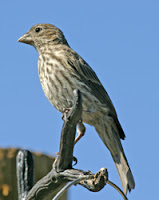
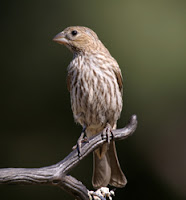
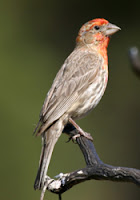
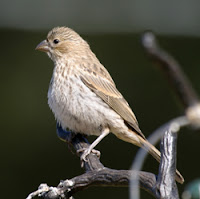
House finches

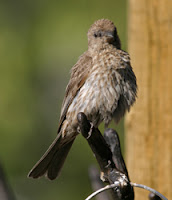
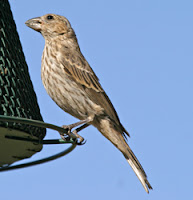
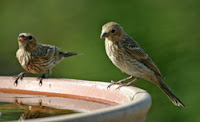
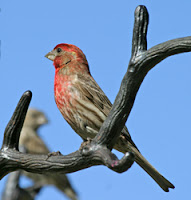
There are three common finch species in our area, according to Sibley: Purple Finch (carpodacus purpureus, Cassin's Finch (carpodacus cassinii, and the House Finch (carpodacus mexicanus. And they're challenging to tell apart, even with Sibley's excellent paintings and descriptions. But...we believe these are House Finches, judging mostly by the female's appearance. Whatever flavor of finch these are, they are the single most common songbird to visit our feeders. Often we have twenty or more of them feeding at once, mainly on oil sunflower seed and on safflower seed (which the finches love, but the jays don't).

These finches have been on our feeders since about 30 seconds after we first put them out. They're here year round, with their beautiful song (especially in the spring!) cheering us every time we hear them. Which is most of the time . They pore through prodigous quantities of sunflower and safflower seed, most evidenced by the thickness of the hulls they leave under the feeders. Their beaks are strong enough to crack the hulls directly, so they can eat very efficiently.

As usual, you can click on any picture for a larger view.

Lesser Goldfinches

Over the past few years, lesser goldfinches (carduelis psaltria) have become one of the most frequent visitors to our feeders. They particularly love the Nyjer thistle seed, which we have out in a half-dozen or so feeders. They're amongst the bravest of the visiting birds we have, sometimes lighting on the feeder even when we're carrying it back after refilling it.

What makes this especially delightful for us is that for the first five years or so that we lived here, we couldn't entice these little birds to our feeders. We hung a thistle seed feeder out for all those years, moving it around various places in our yard to attract them. Finally, about three years ago I placed the feeder on a pole in an area of our yard that was far removed from our house — and our feeder was discovered! Within a few weeks, we were being visited by dozens of goldfinches a day. Then we started putting up more feeders near the house, and the goldfinches figured it out. Now we're going through 40 to 50 pounds of thistle seed every month (and that stuff is expensive!), but we're rewarded by an all-day display of dozens of birds. It's not at all unusual for every single one of the perches on every thistle seed feeder to be occupied — sometimes by two birds! In the springtime the golden-yellow color of the males is something to behold; they're considerably more muted now...

Click on any picture for a larger view...

The first draft

Scott Ott at Scrappleface has a wonderful post on the Durbin apology, in which he posits the existence of a first draft that was considerably different than what Durbin actually delivered. An example:

Durbin: "I offer my apology for those offended by my words. I promise to speak out on the issues that I think are important to the people of Illinois and to the nation."
First Draft: "I offer my resignation from the U.S. Senate. I plan to seek a non-political job so I can get back in touch with real Americans and find out why they love this country so much."

Don't miss the whole thing!

Aligned moons

The Cassini probe, in orbit around Saturn, continues delivering outstanding scientific results day in and day out. It's a largely unheralded hero of space exploration; I hardly ever see a mention of it in the MSM. 'Tis a shame, because it's a terrific example of an international team of scientists and engineers focusing on real science results instead of romantic human exploration "results".

I sure would like to see us spending less on manned exploration and more on things like Cassini-Huygens...

Anyway, here's what the official Cassini site says about this magnificent photo (click for a larger view):

Cassini looks toward Saturn's night side in this view, capturing a glimpse of Dione's tortured surface in the foreground and a far-off view of Epimetheus beyond Saturn. The spacecraft was just a 10th of a degree above the ringplane when this image was taken.

Parts of Dione's surface have been stretched and ripped apart by tectonic forces. Some of these faults are visible here, as is a large impact basin (not seen in NASA Voyager spacecraft images) near the moon's south pole. Although this crater's diameter has not yet been measured by imaging scientists, it appears to be wider than 250 kilometers (155 miles), which would make it the largest impact structure yet identified on this moon. Dione is 1,118 kilometers (695 miles) across.

Epimetheus (116 kilometers, or 72 miles across) presents a similar face here to that revealed in a spectacular false-color view from March, 2005 (see Epimetheus: Up-Close and Colorful ).

The image was taken in visible light with the Cassini spacecraft narrow-angle camera on May 5, 2005, at a distance of approximately 910,000 kilometers (570,000 miles) from Dione, 1.28 million kilometers (800,000 miles) from Epimetheus and 1.42 million kilometers (880,000 miles) from Saturn. The image scale is 5 kilometers (3 miles) per pixel on Dione and 9 kilometers (6 miles) per pixel on Epimetheus.

APOD

APOD brings us...

What do Saturn's rings look like from the other side? From Earth, we usually see Saturn's rings from the same side of the ring plane that the Sun illuminates them. Geometrically, in the above picture taken in April by the robot Cassini spacecraft now orbiting Saturn, the Sun is behind the camera but on the other side of the ring plane. Such a vantage point gives a breathtaking views of the most splendid ring system in the Solar System. Strangely, the rings have similarities to a photographic negative of a front view. For example, the dark band in the middle is actually the normally bright B-ring. The ring brightness as recorded from different angles indicates ring thickness and particle density of ring particles. Images like these are also interesting for what they do not show: spokes. The unexpected shadowy regions once recorded by the Voyager missions when they passed Saturn in the early 1980s are not, so far, being seen by Cassini. Extra credit: Can you spot the small moon (Prometheus) among the rings?

Click on the picture for a larger view.

Quote for the day

When we are born, we cry that we are come
To this great stage of fools.

   William Shakespeare (King Lear)

Sunday, June 19, 2005

Birdblogging: Oak Titmouse

I took some time this afternoon to just sit in the shade about 12 feet away from one of our bird feeder "trees." These are stout wood poles (about 8" diameter) fitted with six cast-iron "branches" to hold feeders. We have three of these trees, with feeders on each for oil sunflower, Nyjer thistle, and safflower seeds. Also, right next to this particular tree we have a pole with another feeder: a suet/bug/seed mixture designed to attract woodpeckers, but which so far has attracted only nuthatches and grosbeaks (but ok on both of them!).

Anyway, one of birds that landed on the feeder whilst I was lurking was this perky little oak titmouse (baeolophus inornatus). Debi and I really enjoy watching these little guys — they flit about in a big hurry, rarely lighting anywhere for more than a few moments. This makes them a serious photographic challenge, and these pictures (click on them for a larger version) are the first in-focus pictures of the oak titmouse that I've ever been able to take. I've got a couple of additional ones that I didn't post, because they're blurry, but they're interesting nonetheless, as they show a behavior peculiar (at our house, anyway) to the oak titmouse. They will grasp an oil sunflower seed between their claws while they're perched on the cast-iron branch, and then hammer away at it like a woodpecker to get the hull off. Apparently their beaks are not strong enough to simply crack it, as a larger bird like a finch or jay would do. So he does it the hard way...

In our Sibley guide, the range for the oak titmouse is very limited; parts of California and a little bit of south-central Oregon. As usual they give the song in some kind of code that apparently makes sense to some people, but which I've never figured out. I know the song of the oak titmouse, and what I know doesn't seem to fit Sibley's description at all. Here's how Sibley says the oak titmouse sounds: "Song of strong, whistled, repeated phrases tjiboo...or paired tuwituwi...and other variations." Is that clear to you? If it is, could you please explain it to this befuddled one?
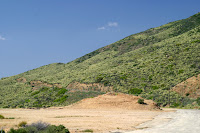
Yardblogging: flowers

I don't have a clue what this flower is, but it sure is a beautiful thing. Click on the photo for a larger view.

Each spring and summer as I walk my yard, I discover a few new wildflowers. Some return year-after-year; others show up just once and never (so far) again. This red flower I've never seen in my yard before (though I've seen it elsewhere); we'll see if it comes back. For some reason this year we have a fair number of (very pretty) yellow Mexican poppies in the lower part of the yard — we've seen these often in the Cuyamaca Mountains, but never before at our home. And just as oddly, these year we have almost none of the California poppies I love so much. Very mysterious, these flora comings-and-goings...

Yardblogging: classic chapparal

I took these pictures inside our fenced yard, on the hill directly above our home. To me, this scene is absolutely classic "chapparal in the summertime." The pale orange flowers (which I have not been able to identify) are very common at this altitude. I hope they're natives, and not some alien outcompeting the natives, as they're very successful. This year, with the rains, our hillsides are offering a spectacular display of them. And of course the manzanitais a classic native chapparal flora, and the rocks and dry grasses are very evocative of the environment.

I love living out here!

The leftmost photo is a closeup of the blooms visible near the bottom of the rightmost photo. Both were taken with a 100mm (effectively 160mm with my Canon EOS 10D) in the morning light (around 10 am). You can see in the wider view just how saturated with light the scene is; the extreme contrast between light and shadow makes for very tricky photography.

For the past five years, each summer when I whack weeds in my yard I've been preserving the plants of these blooms. The payoff was this year — huge mounds of these pale golden blooms all over the upper reaches of our yard. Lovely!

Yardblogging: oriole

More specifically, a male Hooded Oriole. All of these photos were taken from a window in the back of our home this morning, using a handheld 640mm stabilized telephoto. Click on any of them to get a larger version. Some information from Jeannie's Cottage Aviary:

Orioles are colorful tree-dwelling birds, quite different in habits, appearance, habitat preference, and nest structure from their ground-feeding relatives. All North American orioles have the same basic pattern. Adult males and most first-year males are strikingly marked with brilliant breasts, bellies, and rump patches that contrast with black wings, black throats or heads, and in many species black rounded tails. Most females are similar to one another and pose a real problem in the Southwest, where several species occur. All have conspicuous wingbars and very sharply pointed beaks.

Orioles migrate primarily by night, but loose bands of 5-10 may sometimes be seen just above the treetops in the early morning.

The nest is made from grasses, plant fibers, hair, strings, etc. and firmly interwoven and hung from the end of branches in shade or fruit trees at heights of from 10 to 90 feet. Eggs are four to six white with irregular streaks and blotches of brown and black. Orioles feed on caterpillars, beetles and other insects; wild and some cultivated fruits.

The Hooded Oriole (Icterus cucullatus) is from 7-7-3/4 inches long. This is the only common U.S. oriole with an orange crown. The bill is long and slightly curved. The song is a series of whistles, chatters and warbles. This species breeds from central California, southern Nevada, southwest Utah, central Arizona, southwest New Mexico, western and southern Texas (near the Rio Grande) to southern Mexico. A few winter in southern California and southern Texas. Its habitat is open woodlands, thickets, palms, and shade trees.

These beautiful birds, along with the nearly-as-beautiful Bullock's Oriole, are spring and summer visitors at our home. They seem to be attracted to the birdbath we keep, along with our hummingbird feeders. The couple of times we've tried attracting them with their own feeder, it didn't seem to work...

BTW, if you're looking at the leftmost picture and wondering what that green thing snaking under the oriole's feet is, here's the explanation: the oriole is perched about 15 feet above ground on a dead branch in a flowering plum tree. The entire tree is nearly dead, killed by the prolonged drought and...the owner of the green snake — a nearby Chinese wisteria that is taking over the skeleton of the flowering plum tree.

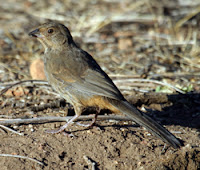
Yardblogging: California Towhee

I took this photo with a handheld 640mm stabilized telephoto, shooting right out an open window to the bird about 20' away. Click on the picture for a larger view. About the California Towhee, from the Cornell Laboratory of Ornithology:

California Towhee Pipilo crissalis

Cool fact: The California Towhee was first named as a separate species in 1839. Yet when the first American Ornithologists' Union checklist was published in 1886, it had been lumped with the Canyon Towhee, and the two were known collectively as the Brown Towhee, despite conflicting views held by ornithologists because of the many differences in the two forms' appearances, songs, behaviors, and nests. Relationships between the two forms have recently been clarified through mitochondrial DNA studies, and they are each once again considered full species.

California Towhees are relatively common in brushy habitats from southern Oregon to Baja California and from the Pacific inland to the foothills of the Cascades and the Sierra Nevada. The primary habitat type is chaparral, followed by riparian thickets of alder and willow. Human disturbances have created additional habitat, which is found along roadsides, clearings, and open lawns. California Towhees are permanent residents and, except for the dispersal of juveniles away from nesting areas, are quite sedentary. They are highly territorial birds, aggressively defending their territories year-round. California Towhees often battle their own reflections in windows, hubcaps, and other such reflecting surfaces. Territories range from one to five acres in size.

Nests are sited in dense foliage in shrubs or trees usually within 4 to 12 feet from the ground. Nesting occurs from mid-April through June. The low height and openness of the California Towhee's habitat enables males to detect intruders and rivals visually. Accordingly, song is not as important in territorial defense, and males sing infrequently, most often in the evening. Song is used primarily to attract mates, and birds that sing most are unmated males. The song, delivered from an open perch, consists of the bird's typical chip note repeated three or four times, followed by a descending and decelerating trill. At other times, a faint warbling song can be heard. California Towhees apparently pair for life.

During the breeding season, insects make up most of the towhee's diet; at other times seeds and some fruit are important. Most food is found on the ground, and California Towhees may forage in the manner of Eastern or Spotted Towhees-by scratching the soil using both feet at once. They find water in dry habitats by drinking the dew from grass, and they can be frequent visitors at feeders.

Description: California Towhees are large, unstreaked sparrows (approximately 8.5 to 9.0 inches in length) with long tails. This towhee has a dark brown back, rump, wings, and tail. The crown is warm brown, contrasting slightly with the upperparts. The lores, chin, and throat are cinnamon, and there is a thin necklace of brown spots below the throat. The underparts are slightly paler and more buff-colored than the upperparts; undertail coverts are a distinct cinnamon brown. The bill and legs are brownish, and the eyes are orangish brown. Sexes are indistinguishable. Juveniles are similar to adults but streaked below.

The three brown towhees (California, Canyon, and Abert's) are closely related and similar in appearance. Abert's Towhee (P. aberti) is found in dense streamside thickets in desert areas in southwestern California and southern Arizona. It is distinguished by the dark face that contrasts with its pale bill and by the lack of throat or breast streaking. Canyon Towhees (P. fuscus) tend to inhabit territories at higher altitudes than California Towhees, and the ranges do not overlap. Canyon Towhees are slightly paler and more slender than California Towhees. Canyon Towhees are distinguished by a paler throat with a necklace of dark spots, a contrasting rufous-brown crown (some Mexican races lack this crown), pale buffy (rather than cinnamon) lores, whitish bellies, and a dark spot below the throat necklace.

If Cornell is correct about their territory size, then we have a super-abundance of California Towhees in our yard. We have something like 10 or 12 pairs of them who are either residents of our yard, or who are here so much they might as well be — including one pair who nests in a helmet on our patio!

Yardblogging: rabbit

Early this morning, I had the telephoto mounted (for some Hooded Oriole pictures), and this little guy showed up about 15 feet away. Seemed like too good an opportunity to miss!

It's very hard to accept just how many rabbits we have here — early in the morning, or in the evening, it's not unusual for us to have more than a dozen in sight (from our windows) at any given moment. My personal record is 27, early on a Saturday morning. They're attracted to us for several reasons: we have reliable water (an automatic waterer out for all the animals to use), we put cracked corn out (mostly for the quail, but it doesn't get any better if you're a bunny), and we've got about 3.5 acres fenced in around the house and largely free of four-footed predators (though we do see the occasional bobcat, and there are our neighbors' housecats out and about). We do have other predators, though: numerous hawks, and (if the rabbit is small enough) gopher snakes. Just once, we've seen a golden eagle sitting on a pole just outside our yard...

By and large these rabbits do us no harm. They keep our citrus trees trimmed to about 14" off the ground (apparently the limit of their reach), and they eat things we'd rather they didn't (this is one reason — along with gophers — why almost all non-native plants in our yard are in pots).

Saturday, June 18, 2005

Yon reports in

Michael Yon has filed another report, this one a little different. He's preparing us for reports yet-to-come, reports derived from talking with frontline soldiers, including alpha. An excerpt (but don't miss the rest of it!):

I did not come here with the intention of having someone tell me what the people on the "front lines" were thinking and feeling.

It's important to talk with Generals: they are all very smart or they wouldn't be Generals, but a General says what he wants people to hear, and sometimes they do lay it on pretty thick. I wanted to meet soldiers. Combat soldiers in particular. And combat soldiers before, during and after combat operations. That's the only place to figure out who is winning and losing this war. "Winning" meaning the Iraqis embrace and protect their freedom and most of our folks come home. Losing meaning something other than this, up to and including to any dreaded stasis.

My first day in Baghdad, about six months back, the sun was rising as I walked to the mess hall. It was cold and there had been explosions through the night, automatic weapons fire, and "flares" floating down on parachutes casting long, flickering shadows before their fires burned out. Helicopters zooming all around. There was a lot more war going on than I had expected; and I had done my homework.

But the birds were singing like they do at sunrise. War or peace, I can depend on the birds to sing in the mornings, and I selected that sound to hear as I walked out of the tent and headed for the mess hall. A group of soldiers, loaded for combat, were gathered in front of the mess hall. With serious expressions, their attention was trained on a map they'd spread across the hood of a Humvee. The soldiers were preparing for combat.

Healthy Sadirist

Ali at Free Iraqi brings us a story about the Iraqi Minister of Health being stoned and beaten on a recent visit to Najaf. That sounds awful, doesn't it? But wait: as you might expect, there's much more to the story. It turns out that the minister (as Ali puts it) "is one of the Sadirists that got appointed as a minister in the new government along with three others". This minister visited Najaf to investigate some corruption, and:

According to the minister himself, there was no reason at all and that he was on a visit to the health administration in Najaf to follow up an investigation about a corruption there. He refused to appear in front of the Iraqi parliament to clarify the details of this incident accusing "certain parties" that he refused to name of planning the aggression against him and his guards and other officials who accompanied him.This is also what I heard from my brother in law who's a friend of the director of the ministry of health's office who said that his friend (the director) was there and that he accused followers of Sistani and the SCIRI of committing this aggression without any reason.

However, sotal Iraq provides us with another story. According to sources in Najaf, the minister and his guards went to the shrine intending to enter it while they were carrying arms. They were stopped by the guards of the shrine who told them that they have to drop their arms to enter the shrine, which is the norm. The minister's guards refused and started swearing at the shrine guards and threatening them. Then the minister went on his way to the inside of the shrine while swearing at the shrine guards himself. The shrine guards told him that his behavior was unaccepted especially that he was in a holy place. He then said to them, "Muqtada will come soon and crush your heads". Najafis who were standing by and watching couldn't hold their anger after hearing what the minister said and started hitting him and his guards with stones, their shoes and whatever their hands reached. The minister barely escaped alive. (all this from sotal Iraq)

Read the whole thing here. And put Ali on your daily read list; his reports are infrequent but terrific!

Friday, June 17, 2005

Multicellular Microorganism

At The Truth Laid Bear, there is an "ecosystem" of blogs in which blogs are assigned to evolutionary rankings from "Insignificant Microbe" to "Higher Being." For reasons entirely unbeknownst to me, this blog's ranking has advanced to "Multicellular Microorganism" — and unexpected and delightful honor!

The complete ecosystem:

Higher Beings
Mortal Humans
Playful Primates
Large Mammals
Marauding Marsupials
Adorable Rodents
Flappy Birds
Slithering Reptiles
Crawly Amphibians
Flippery Fish
Slimy Molluscs
Lowly Insects
Crunchy Crustaceans
Wiggly Worms
Multicellular Microorganisms
Insignificant Microbes

I thought I understood how this worked: ranking in the ecosystem is related to the number of links that others make to your blog. But...so far as I know, the number of links to this blog hasn't changed (0 = 0!), so I'm not sure what caused my blog to make this evolutionary leap. But who cares! It's a good excuse to break out the bottle of good wine!

Onward and upward to wiggly wormhood...

PETA kills

The PETA organization has long disgusted me. My recent discovery that PETA is in the business of wholesale euthanization didn't improve my outlook on them. Now there's this news (from Fox):

PETA Workers Charged With Animal CrueltyFriday, June 17, 2005

AHOSKIE, N.C. — Two employees of People for the Ethical Treatment of Animals (search) have been charged with animal cruelty after dumping dead dogs and cats in a shopping center garbage bin, police said.

Investigators staked out the bin after discovering that dead animals had been dumped there every Wednesday for the past four weeks, Ahoskie police said in a prepared statement Thursday.

PETA has scheduled a news conference for Friday in Norfolk, Va., where the group is based.

Police found 18 dead animals in the bin and 13 more in a van registered to PETA. The animals were from animal shelters in Northampton and Bertie counties, police said.

The two were picking up animals to be brought back to PETA headquarters for euthanization, PETA president Ingrid Newkirk (search) said Thursday. Neither police nor PETA offered any theory on why the animals might have been dumped.

Police charged Andrew Benjamin Cook, 24, of Virginia Beach, Va., and Adria Joy Hinkle, 27, of Norfolk, Va., each with 31 felony counts of animal cruelty and eight misdemeanor counts of illegal disposal of dead animals. They were released on bond and an initial court date was set for Friday.

Hinkle has been suspended, but Cook continues to work for PETA, Newkirk said.

Newkirk said she doubted Hinkle had ever been cruel to an animal and said if the animals were placed in the bin, "We will be appalled."

Appalled. Indeed.

The Dick rolls on

At Technicalities, Teresa comments on her (Illinois) Senator Dick Durbin:

Can we say Linda Foley anyone? Now he's saying "if it did indeed occur" What does he mean? If he's not sure it occurred then why is he talking about it? Why did he state it as fact on Tuesday? If he's not going to compare our methods to Nazis, Soviets, and Pol Pot... why even bring them up?

The only reason is to shock people, to stick a thought in their mind where it will sit and grow. It doesn't have to be true... you only have to say it long enough and loud enough. That's the way it has worked over the years. That's how the liberals have always gotten things done. Keep repeating a lie long enough and people will start to believe.

Well, we have the internet and transcripts and we can go back and see exactly what was said by whom. Mr. Durbin has his lies repeated, but hopefully the lies won't win this time.

I find myself feeling rather slimy living in Illinois... And I am angry for the soldiers who are doing such a difficult, dangerous job. It just got a lot harder. According to Rush Limbaugh... Senator Durbin is earning high praise from al-Jazeera...

Later, Teresa calls for Senator Durbin to resign. And I agree with her, though I'd take it one step further (and I have, in an email to Senator Durbin): if he really, truly believes what he's said, he should renounce his U.S. citizenship and move to a country more to his liking.

Aliases

Major K. (a very good milblog, BTW) has an interesting post about the use of aliases by the Iraqi terrorists.:

The most annoying thing as far as intelligence goes, is the fondness for aliases. It is cultural phenomenon. Having children is such a mark of social distinction in the arab culture, that it creates a whole new name for the parent. Men become known as "Abu" which means "father of." So, if your name was Khaled, and you named your son Muhammed, your new nickname/alias is Abu Muhammed. The arhabi make good use of this dynamic. Half of the guys we are chasing here are only known by such "fatherly names." In case you hadn't noticed, the same is true of #1 scumbag Abu Musab al Zarqawi. His name means "father of Musab of the Zarqawi tribe." While these aliases make finding these scumbags frustrating, they do not make them invisible. We continue to put the puzzle together, and then go grab the guys that are shown by the completed puzzle. The raids are the part of the job that everyone is trained to do, and the part that everyone wants to do. Developing the intelligence that gives you the raid target is the hard part. It reminds me of math homework...

As many of my readers know, I have spent quite a bit of time in Russia and Estonia. When I've thought about the challenges facing our intelligence folks on the ground in Iraq, those places have been my mental model for a context. But as Major K. makes clear, it's actually much more difficult in Iraq. I've been to Japan (though just twice), and after reading Major K's post I suspect my experience there is a much better context. I remember well just how completely bewildering everything in Japanese was. Grocery stores were nearly impossible (even the packaging conventions are different!); maps were impossible, and navigation within a town or city was nightmarish. I cannot imagine trying to collect intelligence in an environment where even the alphabet was alien. In Japan, whenever I ran into someone who spoke English (no matter how badly!), it was an enormous relief. I used those occasions to get a whole bunch of questions answered; I'll bet our intelligence folks in Iraq do the same with the interpreters...

Polish twins

A fascinating political story from Chrenkoff, about identical twins running for different high political offices in Poland. And they might both win!

Bush on Iran

President Bush spoke yesterday on the election in Iran:

In recent months, the cause of freedom has made enormous gains in the broader Middle East. Millions of people in Afghanistan and Iraq defied terrorists to cast their ballots in free elections. Palestinians voted for a new president who rejects violence and is working for democratic reform, and the people of Lebanon reclaimed their sovereignty and are now voting for new leadership. Across the Middle East, hopeful change is taking place. People are claiming their liberty. And as a tide of freedom sweeps this region, it will also come eventually to Iran.

The Iranian people are heirs to a great civilization - and they deserve a government that honors their ideals and unleashes their talent and creativity. Today, Iran is ruled by men who suppress liberty at home and spread terror across the world. Power is in the hands of an unelected few who have retained power through an electoral process that ignores the basic requirements of democracy.

...

America believes in the independence and territorial integrity of Iran. America believes in the right of the Iranian people to make their own decisions and determine their own future. America believes that freedom is the birthright and deep desire of every human soul. And to the Iranian people, I say: As you stand for your own liberty, the people of America stand with you.

After I read the whole speech, I tried to imagine what any leading Democrat might have said. I've seen no coverage of any leading Democrat's remarks; this is purely my imagination:

Kerry: A 2,000 word speech leaving you with the vague impression that he supports the election, but with no particular interest in the outcome (or its fairness).

Reid: What election in Iran?

Dean: Arrwwrrgharwahwahwah!

Sorry. It's really hard to imagine anything rational, useful, or even entertaining coming out of that group. I just can't take them seriously...

Thursday, June 16, 2005

Quote for the day

Democracy is a beautiful thing, except for that part about letting just any old yokel vote.

   Unknown

Wednesday, June 15, 2005

Tsunami?

At about 7:50 pm (PDT) yesterday evening, there was a very large (magnitude 7.0) earthquake under the sea, offshore from Crescent City, California. This is along the northern coast of California, not very far south of the Oregon border. As some of you may remember, Crescent City has been hit by tsunamis before — see information here, here, and here.

The danger from tsunamis on the San Diego coastline is much lower, but still present. See information here.

The earthquake last night (pictured on a seismographic map at right) resulted in a tsunami alert; it was quickly lifted when seismologists realized that the earthquake was caused by a lateral slip and not subsidence. Slippages typically do not cause tsunamis (unless there is an associated collapse of some geological feature, like an undersea mountain). Tsunamis are usually caused by significant vertical movements over a large area. You can find more information about this quake here, here, and here.

Way down here in southern California, where we live, we never felt a thing. But...we were awakened by a friend and neighbor, just after 8pm, who was concerned about her parents. They live down by Mission Bay, only a couple of blocks from the ocean, and our friend had heard the tsunami alert being broadcast over the emergency radio network. Yikes!

As things turned out, the tsunami alert was quickly withdrawn, there was no tsunami, and nobody was injured. So far as I'm aware, there was also no property damage. That's about as good as things can get with a magnitude 7.0 quake, so I'll call that very good news.

I did sleep uneasily, though. It's a little disconcerting to know that some disaster truly could be visited on us at any time. For us, the biggest risk is probably that some (previously) unknown fault could suddenly make itself known through a powerful earthquake right near us...not a pleasant thought...

Quote for the day

In theory there is no difference between theory and practice. In practice there is.

   Yogi Berra

Sunday, June 12, 2005

Grasses

Saw these beautiful grasses in Cuyamaca State Park today, right in the middle of the burned out pine forests, on one of the sharp switchbacks in the main road.


It's rather amazing that just 20 months after the huge fire the plant life has recovered to such an extent. Thank goodness for the rains this winter!


Mystery flower

On a drive today, Debi and I spotted these flowers coming down toward Descanso from Cuyamaca State Park. I've no idea what they are, and I do not recall ever seeing them before. The plant is quite large — some individuals were over 8' tall, with stems about 3/4" diameter at the base.


If anyone can identify this for me, I'd sure appreciate an email with the particulars...


Chemise

Chemise (adenostoma fasciculatum) is the most common plant in the chapparal that we live in. Today Debi and I took a drive up toward Mt. Laguna (one of the tallest peaks in San Diego County), and along the Sunrise Highway not far from Pine Valley we spotted some hills whose color was not the normal dull green (see at right; click on pictures for a larger view). Instead, there were splotches of white turning the hillside into a mottled and brighter mix of green and white. This turned out to be from all the chemise in bloom (second photo), and they were quite a sight (remember, this is a desert!). I'm sure the spectacular and unusually synchronous bloom is due to the heavy rains this year, though I don't know the actual mechanism.

At this point, the highway is about 4,500 feet above sea level, so the bloom here is a few weeks behind the chemise bloom at our home. The bloom there wasn't nearly as overwhelming as these hillsides. Plus we don't normally think of chemise as "attractive"...but that's a different story...


Anyone who knows us well is probably very surprised to see the word "chemise" without cuss words nearby in anything I've written. That's because most of the time, chemise is (a) ugly, (b) wretched looking, (c) out-competing much more desirable plants, (d) a serious fire hazard (dry, oily, easily ignited wood), and (e) ugly. Chemise is my enemy. I spend lots of time, effort, and money attempting to eradicate chemise from my property.

But just today, I'll grant that it can be, under certain very limited circumstances that include it being off my property, attractive.


Yon reports

Michael Yon is back with the troops in Mosul, and he's filed another (and quite long) report. An excerpt:

Hot information comes in that a high value target is at a specific house nearby. There is radio chatter as the Battle Captain in the TOC communicates with the Recon platoon on a quick plan to hit the house and the one next to it. Within minutes, the Recon soldiers roll up to the homes, drop ramps, and burst into the bottom floor. They rush in and begin securing the rooms on the bottom floor, where they detain three men, while other Recon soldiers flow up the stairs.

Benjamin Morton is part of Recon's raiding patrol. He lives directly across from me on base. Everyone calls him “Rat” because he saves everything. Rat moves upstairs, training his rifle above him. Rat’s the #1 man, in the most dangerous position. Two enemy men are hiding on the balcony, and one has an automatic weapon with a large drum of ammunition. As Rat comes round the corner, the insurgent sticks the weapon around the balcony corner and fires a long burst of about twenty rounds. Four bullets strike Ben Morton. His buddies come behind him and throw a flash bang into the room, and return fire, catching a bed ablaze with tracers. They pull Rat out and call for medics. Despite everyone's valiant efforts, Benjamin Morton does not survive his wounds. Had they thrown grenades first, three women and four children would have died alongside the four men who were captured or killed that night. The men were elements of a car bomb cell.

The night got worse for our people. Sometime later, soldiers from the 73rd Engineers (Deuce Four is their parent unit) patrolled the roads of Mosul searching for IEDs to clear the roads for other patrols and convoys. A bomb buried in the road exploded under a Humvee, rupturing the fuel tank, engulfing the men inside in flames, killing Creamean and Seesan, and severely burning another soldier.

The next day, we are rolling in the streets of Mosul when I hear radio chatter on the net that our brother unit, 3/21 across the Tigris, just found two men held as hostages in a dungeon-like basement. As the truth unfolded over the next few days, we learn that their captors were trying to blackmail one of the men into carrying a bomb into a police station, possibly to kill us.

This is don't-miss-it stuff.

Stay safe, Michael.

Ryan

KLEENEX ALERT: This is a real tear-jerker, in a good way.

From the Clovis, California newspaper, an excerpt:

Ryan was a special education student who would do anything to fit in and worked tirelessly to make that happen. His basketball career began as a ninth grader passing out balls to the girls' team. Then he hooked on with the boys' team, getting there every morning at 6:30, helping out in drills, running the practice clock and cleaning up afterward.

Now, he sat proudly on the sideline in his own white No. 12 uniform.

The crowd wanted him in the game. Amundsen wanted him in, too. But he was also afraid the slightly built 18-year-old might get hurt.

Amundsen considered all this as he walked toward Ryan and patted him on the shoulder. Off came the warmup jacket, the buzzer blew and Ryan kind of half hopped, half ran onto the court, his left leg trailing slightly at an odd angle.

The noise was deafening as he ran out on the court.

In the stands, Justin Belflower was near tears. A few years earlier, he was a jock at Clovis East, one of those big men on campus. He knew how hard his kid brother had worked for this moment.

"If you had said four years ago he'd play in a varsity basketball game, I'd say stop lying because it will never happen," Justin said.

On this afternoon in February, it did.

And Clovis East would never be the same.

Read the whole thing here.

APOD

APOD brings us...

Are stars better appreciated for their art after they die? Actually, stars usually create their most artistic displays as they die. In the case of low-mass stars like our Sun and M2-9 pictured above, the stars transform themselves from normal stars to white dwarfs by casting off their outer gaseous envelopes. The expended gas frequently forms an impressive display called a planetary nebula that fades gradually over thousand of years. M2-9, a butterfly planetary nebula 2100 light-years away shown in representative colors, has wings that tell a strange but incomplete tale. In the center, two stars orbit inside a gaseous disk 10 times the orbit of Pluto. The expelled envelope of the dying star breaks out from the disk creating the bipolar appearance. Much remains unknown about the physical processes that cause planetary nebulae.

Click on the picture for a larger view.

Quote for the day

The best computer is a man, and it's the only one that can be mass-produced by unskilled labor.

   Werner von Braun

Saturday, June 11, 2005

Engineering problem

Spent the morning this morning solving a minor problem in home engineering. The objective was to sink some drip irrigation tubing underground to water two clumps of pampas grass, a clump of red fountain grass, and to keep water dripping into our bird bath. Sounds easy — but here's the catch: the water fauce to which this all needed to be attached was on the other side of a solid concrete sidewalk. Somehow I needed to get some flexible 1/2" tubing run under that sidewalk!

The solution, as with virtually all home engineering projects, involved a trip to Home Depot. They get more of my paycheck than Arnold Schwarzenegger does, but somehow I'm less resentful of Home Depot's take. Oh, I guess it's because I get something tangible from Home Depot, and from the state I get...what? Anyway, I bought a length of 1/2" PVC pipe, a cap for that pipe, and the parts to allow the pipe to be attached to a garden hose. I drilled a few holes in the cap, attached it to a hose, turned on the faucet, and voila! A $5 drilling tool. Took me about 3 minutes to poke that thing all the way under the sidewalk.

Naively I thought that was just about the end of my job. All I'd have to do is push that tubing through the tunnel I'd just drilled, and I'd be in business. But would that tubing go through the tunnel? No way, Jose.

That's when the real battle commenced. It was over an hour before I finally had the tubing run through, and then only with the help of my wife. I won't bore you with all the failed attempts, but here's the one that worked: First, I attached a steel ballchain to a fiberglass "fish" and pushed that through the tunnel (the "fish" is designed for snaking cables through cielings and walls, but it worked great for this). The "fish" wouldn't make the turn at the opposite end of the hole, so I used a magnet on a string to fish up the steel ballchain from a foot or so below ground level. Then I tied a rope to the ball chain, and pulled the "fish", ballchain, and rope all the way through the tunnel. This gave me a rope all the way through the tunnel. Then I tied the end of the tubing to the rope, and pulled it back through the tunnel (I could pull it through, but not push it through — some kind of physics problem to solve someday). This is where my wife came in. You see, that *$*$@#) tubing didn't want to make the bend right at the end of the tunnel to come back above ground. So I got on the rope end and pulled like hell, and Debi got on the other end and wiggled the tubing around. Oh, and I also had water flowing through the tubing to help push debris out of the way. Well, with some heaving and a few oaths (from both of us), I finally got the tubing pulled through. Whew!

The rest of the project was just as straightforward as it sounds, and didn't take very long. Now I have three happy plants, a completely hidden system, and fresh water in the bird bath...

Broken tooth ponders

A couple weeks ago, while driving to work and chewing on a breakfast burrito, I felt something hard and odd-shaped moving around in my mouth. Strange feeling; I thought it was a piece of bone (which definitely didn't belong in my breakfast burrito!). So I spit it out, and by gosh it was about half of the top part of a molar. And sure enough, there was a vacant spot in my mouth, lower left hand side. Somehow, on something as soft as a breakfast burrito, I'd managed to break a tooth apart!

Fortunately for me, this was a pain-free broken tooth. Not like the fall-on-the-floor-writhing-and-screaming kind of broken tooth that I'd witnessed in others. So when I got to work, I called and made an appointment with my dentist, Dr. Tom Brassington ("Dr. B") of La Mesa, California.

This past Thursday, I went in to see him. He went to work on my mouth, full of good cheer and friendly conversation as always. I've known Dr. B for close to 30 years. We met in (I think) 1979, when I owned a business manufacturing business computers, Z-80 CP/M based machines with minimal software, but a nice oak or walnut cabinet (which we also made). Dr. B was one of the first customers we had, buying a computer for his business. I'm not entirely sure he knew what he was getting into, but he was positive he wanted one!

An hour or so later, I was on my way with a very numb face and tongue, and a brand-spanking-new temporary crown. I'll get the real thing in a few weeks, some kind of fancy porcelain-on-gold high-tech thingy.

But I couldn't help thinking about Dr. B some more. His work contrasts in many ways with mine. The most immediate difference, to me, is the simple fact that he's been doing basically the same work ever since I first knew him. I don't know how long he'd been a practicing dentist when I first met him, but I think it's safe to say he's been in practice at least 30 years. Compare that with my "career" — I haven't done the same thing for more than a few years at a stretch, ever. Then another difference: every single day, the work that Dr. B does helps people in a very direct and tangible way. My work (in software engineering, at the moment) can be positioned as helping people, in some kind of general, vague, and abstract fashion — but that help has nothing like the direct, personal nature of Dr. B's help. Then I had the chance on this visit to watch Dr. B handle a situation gone awry (of course this would happen to me!). Apparently my gum was bleeding and would not stop. In very rapid sequence, Dr. B did several things to attempt to staunch the flow. I'm not at all sure I can remember all of them, but there was an injection of some vasoconstricter (I know only because I asked him), some kind of electrical device (that was painful, even through the numbing), and some kind of ferrous chemical (that tasted extremely bad). Eventually the bleeding was stopped. What struck me, however, was the calm, competent, and practiced manner that Dr. B had throughout the whole affair. He was moving quickly, was obviously concerned, but knew exactly where everything was (and it was right at hand), knew what sequence to try them in, and just generally seemed to be in control. Some of this, I suspect, is because Dr. B really is a wonderful general practitioner dentist — and some, I suspect, is because he's been doing this for 30 years. I'm sure I'm not the first "bleeder" he's had to deal with. Contrast that with my work, where it's very common for me to run into something for the first time ever, and to bumble about trying to find the answer. Now it happens that I enjoy the troubleshooting and debugging; it's like solving a puzzle. And I do believe I have an above-average skill level in this area — but rarely do I ever have the opportunity to show the kind of all-encompassing competence that Dr. B does day in and day out.

I hope Dr. B finds his career as rewarding for him as it is for his patients...

Ali's back!

Ali at Free Iraqi hasn't posted for serveral weeks. I've been browsing to his blog every day in the hopes that he would return, but I was nearly ready to give up; truthfully, I was afraid something had happened to him. This morning, a fresh post appeared — whew! In it, Ali gives his thoughts on Operation Lightning. He begins:

Operation lightning seems to be going better than what I expected in terms of reducing violence in Baghdad. I think everyone who's following the news must've seen that the attacks in Baghdad these days are getting less than before, and here on the ground we can see the same thing. Not just terrorist attacks that has been reduced but even regular crimes, as it seems that part of the operation is focusing on capturing regular criminals who are in addition to their usual criminal activities do form, in my mind, the right hand for the Ba'athists.

It sounds like things are going reasonably well, from Ali's perspective, and I'm very glad to hear that. He goes on to tell the story of an Iraqi police raid right near his home (it went well), then concludes:

One of my greatest worries about operation lightning just as the whole war on terror is that it would give those in charge a more than needed and accepted power. In a place like Iraq where all our miseries came from unlimited power, that is certainly a huge concern. Still I know and feel that most Iraqis won't accept something like this to happen. It's not easy at all to explain where this feeling come from but it's there and I have full faith that most Iraqis will clench their teeth on every bit of freedom they gained through America's help and that we will and are ready to sacrifice to gain more; the type of freedom that even America cannot grant us.

Welcome back, Ali. I'm very glad you're safe. And it sounds like good news on Operation Lightning.

Read Ali's whole post, or I'll conjure up a plague of desert fleas to pester your dog and your sister.

APOD

APOD brings us...

No sudden, sharp boundary marks the passage of day into night in this gorgeous view of ocean and clouds over our fair planet Earth. Instead, the shadow line or terminator is diffuse and shows the gradual transition to darkness we experience as twilight. With the Sun illuminating the scene from the right, the cloud tops reflect gently reddened sunlight filtered through the dusty troposphere, the lowest layer of the planet's nurturing atmosphere. A clear high altitude layer, visible along the dayside's upper edge, scatters blue sunlight and fades into the blackness of space. This picture actually is a single digital photograph taken in June of 2001 from the International Space Station orbiting at an altitude of 211 nautical miles.

Click on the picture for a larger view. The expanded picture is gigantic (1499 x 1025), suitable for screen backgrounds or printing.

Koran reality

You'll recall the recent controversy over how our troops in Gitmo handle the Koran, with Newsweek fanning the flames and the MSM in general throwing fuel on the fire. I haven't posted on this previously because I really couldn't think of any way to respond with descending into anger and foul language directed at the media. Roger Kimball at the New Criterion took care of this for me; in a new column he nails it:

Should we laugh or cry at this exhibition of politically correct hyper-sensitivity? By all means, let us treat prisoners with the dignity and respect they lack in their own lives. Let us not besmirch or ridicule the Koran. But let us also preserve some rudimentary contact with reality. These people are terrorists and suspected terrorists. Many--probably most--of them have dedicated their lives to slaughtering innocent Westerners, inspired, note well, by the very document our soldiers are enjoined to handle as a “fragile piece of delicate art” (as distinct, one supposes from a “sturdy piece of delicate art”). Operating in the realm of fiction, Evelyn Waugh might have made an amusing episode out of this absurdity (talk about “Black Mischief”!) Perambulating in the precincts of real life, however, we should have the fortitude to acknowledge that the comedy has gone rancid. Those sections of the army’s “Detention Operations Group Standard Operating Procedures” that bear on the Koran should be respectfully excised, using only the right hand. They should then be carefully conveyed in a “clean, dry detainee towel” to the nearest outhouse and . . . flushed down the toilet.

That's his conclusion, but you won't want to miss the whole thing.

Quote for the day

A revolution is not a bed of roses ... a revolution is a struggle to the death between the future and the past.

   Fidel Castro

Why our soldiers fight

Believe it or not, this quote comes from Scott Ott at Scrappleface! I'm not going to spoil the punch line; you'll just have to read the whole thing.

"Men volunteer to fight, bleed and die for the United States of America because she is the last, best hope for peace and freedom on earth," he said. "They consider the evidence that America has pushed back the veil of tyranny and saved countless millions of men, women and children from imprisonment, torture, starvation, humiliation and brutal death. And they act on that evidence, knowing that the blood of free men is always the price of freedom.

Amen, Scott.