
Thursday, February 5, 2015

Oh, ain't that the truth!
Oh, ain't that the truth! My mother said it, so it must be :)
During a woman’s medical examination, the doctor says, "Your heart, lungs, pulse and blood pressure are all fine.
Now let me see the part that gets you ladies into all kinds of trouble."
The lady starts taking off her panties but is interrupted by the doctor: "No! No! Just stick out your tongue!"
Bumper snickers...
Bumper snickers... Friend, former colleague, and inheritor of my SSH bugs Tim B. passes along a couple of funnies:


Reading that second one got me to thinking... Here in Paradise, Utah, what we see is:
Reading that second one got me to thinking... Here in Paradise, Utah, what we see is:
- The sense that choices like home schooling or private schooling are smart and admirable.
- Everybody owns guns. I quite literally have yet to meet someone here who isn't a gun owner, and doesn't shoot.
- I haven't heard a protectionist word.
- There is intense opposition to government-dictated healthcare in general, and to ObamaCare in particular.
- Even though smoking violates the LDS church's health laws, and 90+% of the people here are Mormon, there are still a lot of smokers. More, in fact, than in California (I've read the rate is about double). Unlike in California, there is wide acceptance of smoking (and drinking, for that matter). Several of the tradesmen I've hired are Mormons and unabashed smokers. Surprisingly, to me, there doesn't seem to be nearly the stigma associated with smoking here as that which we see in California.
- None of the tradesmen I've hired here are union members. I've asked them all (it's a selection criteria for me). I've been told repeatedly that nobody here joins a union unless they're forced to by job circumstances, and even those folks are ashamed of themselves.
- I've met several fellow incandescent bulb hoarders.
- All the stores here default to plastic bags, though you can generally get paper bags if you ask.
- Logan is a small city (49,000 people). It has two Walmart supercenters, plus a Sam's Club. We go there often.
- The local restaurants, and all the homes we've eaten at, all serve plenty of red meat, sugary treats, and fatty foods. There seems to be a general sense that food guidelines issued by the federal government are somewhere between foolish and Communist sabotage – and they're completely ignored.
The next Turing test?
The next Turing test? Computer-controlled robots are now writing letters with pens. The motivation is direct mail marketers who want you to open their letter, instead of just throwing it in the recycle bin. Here's an interesting piece on that topic. This passage caught my eye:
But the other half the time I’m kind of cracked up by the fact that the most avid prosecutors of Alan Turing’s sly and audacious 1950 thought-experiment have been not philosophers or computer scientists or advanced A.I. labs but … marketers. The former folks have foundered for years on the difficulties of understanding the fractal contours of human consciousness. The latter just want you to open up their damn mail. Comprehending the mysteries of human thought and behavior is hard. Emulating it? Not so much! It’s partly why Turing’s test is so unsettling: Man, are we really that easy to copy?Marketers (of all kinds, not just direct mail) have long been pushing hard on technologists. Another classic example is animation – a lot of early computer-generated animations were done with marketing money. The linked article doesn't mention it, but there's another odd-at-first-glance driver for a lot of high tech stuff: pornography. Pornographers were amongst the first to see a way to earn money from online video, and they provided a lot of the funding for early video-on-computer development. Actually, they're still doing so – only these days their focus is on 3D video technology, online.
“Americans are begging for a deal...”
“Americans are begging for a deal...” So says a high-ranking Iranian military official.
Ordinarily I'd dismiss such talk as posturing twaddle from an entirely unreliable source. These days? It's all too believable that the Obama administration would place more value on the appearance of a deal than on the substance of Iran being armed with nuclear weapons. The more paranoid on the conservative side even posit that Obama wants a nuclear-armed Iran, to counterbalance the nuclear-armed Israel. Is that likely? I don't think so. Is it plausible? Unfortunately, yes. Yes, it is.
Ordinarily I'd dismiss such talk as posturing twaddle from an entirely unreliable source. These days? It's all too believable that the Obama administration would place more value on the appearance of a deal than on the substance of Iran being armed with nuclear weapons. The more paranoid on the conservative side even posit that Obama wants a nuclear-armed Iran, to counterbalance the nuclear-armed Israel. Is that likely? I don't think so. Is it plausible? Unfortunately, yes. Yes, it is.
Sick kitty...

Debbie first noticed that he had problems with urination, but two trips to the vet found nothing wrong. Yesterday afternoon he started vomiting, and last night it continued. He looks ok otherwise, and as any cat owner knows well, a cat vomiting isn't necessarily a sign of a problem. However, when it's repeated (as his has been) and combined with another symptom (like the urination problem), it's worrying. So we're off to the vet again today...
Wednesday, February 4, 2015
It's all a big lie...
It's all a big lie... The government's 5.6% unemployment figure, that is. If you're a regular reader of this blog, then you already know the published unemployment number is a crock of steaming, aromatic bovine excretion. Sadly, this reality is a big surprise to most Americans. One American who does understand it is Jim Clifton, CEO of Gallup (the folks who do all those polls). He wrote an article about this recently, calling it The Big Lie. Here's a passage from it:
Read the whole thing...
There's no other way to say this. The official unemployment rate, which cruelly overlooks the suffering of the long-term and often permanently unemployed as well as the depressingly underemployed, amounts to a Big Lie.
And it's a lie that has consequences, because the great American dream is to have a good job, and in recent years, America has failed to deliver that dream more than it has at any time in recent memory. A good job is an individual's primary identity, their very self-worth, their dignity -- it establishes the relationship they have with their friends, community and country. When we fail to deliver a good job that fits a citizen's talents, training and experience, we are failing the great American dream.
Read the whole thing...
Tuesday, February 3, 2015
Sushi in Cache County...
Sushi in Cache County... There are several sushi restaurants in Logan, and we've tried three of them. Two of them we'd rate as “ok”, but a long way from the glory of Hana Sushi in El Cajon (our favorite sushi spot before we moved up here).
But now we've discovered another source of sushi here – one that's just as good as any sushi restaurant we've tried here, but for less than half the price. It's a most unlikely place to find sushi: a grocery store. Macey's in Millville, to be specific. You can gorge yourself on decent sushi purchased there for under $20, which is remarkably inexpensive as sushi goes. And you can eat it at home, surrounded by peace and quiet.
I suspect we'll be visiting Macey's for sushi quite often :)
But now we've discovered another source of sushi here – one that's just as good as any sushi restaurant we've tried here, but for less than half the price. It's a most unlikely place to find sushi: a grocery store. Macey's in Millville, to be specific. You can gorge yourself on decent sushi purchased there for under $20, which is remarkably inexpensive as sushi goes. And you can eat it at home, surrounded by peace and quiet.
I suspect we'll be visiting Macey's for sushi quite often :)
The end days are nigh, part 40,273...
Homo sapiens is doomed...
My kind of groundhog...
You go, groundhog!
Can we ship Jimmy to Washington, D.C.?
Radio Shack is going down...
Radio Shack is going down... For the last time, it appears. It's hard to imagine how any physical store could compete with the likes of Amazon, DigiKey, Mouser, or the other 10M or so online stores...
Where do software developers dream of working?
Where do software developers dream of working? The best developers I've known over my career want to work either for themselves (that is, their own start-up company), for other start-ups, or for companies doing big, impressive, exciting things (Google, Apple, etc.).
What's not on that list? The federal government.
It's really, really hard for me to imagine that the U.S. Digital Service is going to attract a significant number of good engineers.
 It's really, really easy for me to imagine that it's going to attract hordes of incompetent, entitled engineers for whom Wally (of the Dilbert strip) is the model. Just contemplating the inevitable office buildings full of mandatory bureaucratic managers is enough to make me feel nauseous.
You know how the U.S. Post Office compares to, say, UPS, in customer service, responsiveness, reliability, and innovation? Yeah, that will be how the U.S. Digital Service compares with, say, Apple...
What's not on that list? The federal government.
It's really, really hard for me to imagine that the U.S. Digital Service is going to attract a significant number of good engineers.
You know how the U.S. Post Office compares to, say, UPS, in customer service, responsiveness, reliability, and innovation? Yeah, that will be how the U.S. Digital Service compares with, say, Apple...
It happens every time...
It happens every time... It seems like every few years, some technology pundits will start squeaking about how electronic technology has hit a wall: there's no way that devices can get any smaller or any faster. Every time they have reasons that sound plausible – this or that barrier is preventing any progress. And each and every time, some clever scientist, engineer, or (increasingly) team comes up with yet another breakthrough that completely demolishes the previously impossible-to-overcome barrier.
This just might be the next such breakthrough...
This just might be the next such breakthrough...
This is gonna leave a mark...
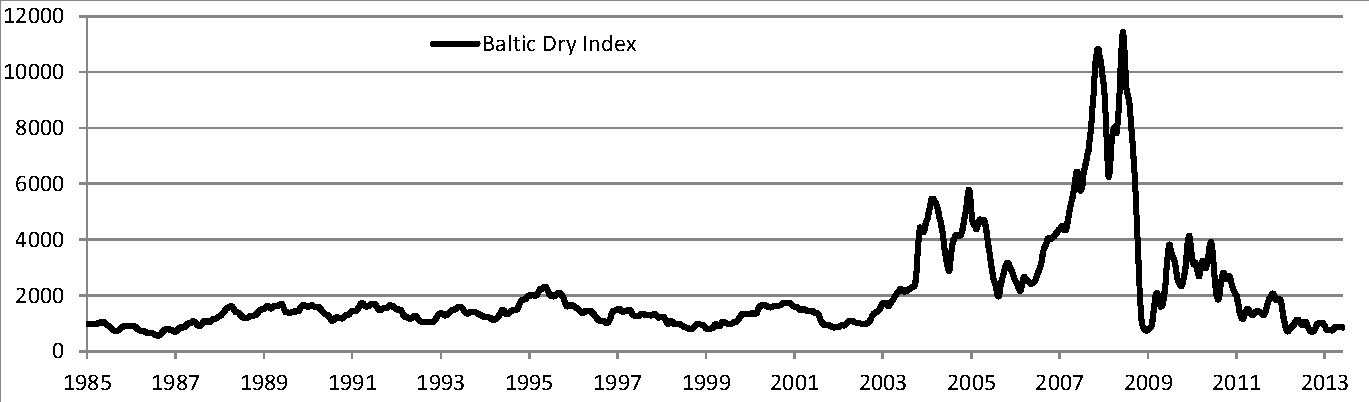
The graph at right is for the Baltic Dry Index, a rough gauge for the price of shipping stuff by sea. In our globalized economy, an amazingly high fraction of the ordinary things we all buy are shipped by sea (or their components are), so the cost of shipping has more of an impact than you might immediately think.
What drives this cost is complicated (see the linked Wikipedia article above) and interesting. There is of course the usual economic force of supply (shipping capacity) versus demand (goods to be shipped). Added to that, though, are the interesting variables of the high capital costs of ships, the typically high leverage of shipping companies (with some notable and large exceptions), and the long lag time to build new ships (generally 2 to 3 years. There's also another phenomenon: every time shipping capacity exceeds demand, there are idle ships – very expensive – and somehow the accident rate always goes up during these periods. Lots of ships are lost to storms, explosions and fires at sea, and never-explained circumstances.
Well, the bottom is falling out of the Baltic Dry Index. There's a lively discussion at Zero Hedge. What does it all mean? Partly it's over-capacity: ships ordered during the boom times of a few years ago are coming on line, and their added capacity exceeds even a growing demand. However, shipping demand plummeted during the recent recession, and still has a long way to go before it has recovered to pre-recession levels – thus making the over-supply situation even worse. With the price of shipping plummeting, the more leveraged and less profitable shippers are going to start failing (there will be bankruptcies and pennies-on-the-dollar buyouts), and there will probably be a jump in accidents at sea as ship owners see insurance payouts as a better route than non-profitable shipping runs. We'll also probably see price reductions – small for most things, but larger for those goods for which shipping costs are a significant fraction of their overall cost (think bulk goods like ores, coal, etc.). It might provide a boost for the stock market, too.
How long will it last? I haven't a clue. Are there bad outcomes possible? Oh, certainly. With enough failures in the shipping industry, capacity could fall dramatically – and as it approaches demand, shipping prices will crawl back up out of the cellar, unwinding all the positive effects of lower costs. In that respect, its a bit like oil prices – though the overall contribution of shipping costs to the economy is tiny by comparison to that of oil...
“We will come to regret this, bitterly.”
“We will come to regret this, bitterly.” That's a quote from the Patterico blog, talking about the (now presumed) FCC proposal to regulate the Internet in the U.S. Here's a slightly less succinct, but more pungent, assessment from Warren Meyer of CoyoteBlog:
Some members of the FCC have been rather publicly itching to get their bureaucratic mitts on the Internet for quite some time, and the money-motivated political types (that would be all but about three of them) have long been eying it as a source of untapped bribes campaign funding. What has stopped these leeches from following through with their desires is the utter lack of any excuse reason for doing so. What's different now? The notion of “net neutrality” has somehow caught on, giving them the perfect political cover for a power grab. Why the notion of net neutrality has caught on is a complete mystery to me – it's an entirely hypothetical problem, with zero current or historical examples. Competitive pressures seem very likely to keep it from ever being a problem. Nevertheless, the non-technical masses have somehow become terrified of net inequality, and the bleating can be heard far and wide. Me, I see the disgusting leers of toad-like bureaucrats as they reach for ever more power...
Here is my official notice -- you have been warned, time and again. There will be no allowing future statements of "I didn't mean that" or "I didn't expect that" or "that's not what I intended." There is no saying that you only wanted this one little change, that you didn't buy into all the other mess that is coming. You let the regulatory camel's nose in the tent and the entire camel is coming inside. I guarantee it.Mr. Meyer's post is titled “Sorry, But All You Internet Users Appear to Be Idiots” – rude, but definitely to the point.
Some members of the FCC have been rather publicly itching to get their bureaucratic mitts on the Internet for quite some time, and the money-motivated political types (that would be all but about three of them) have long been eying it as a source of untapped bribes campaign funding. What has stopped these leeches from following through with their desires is the utter lack of any excuse reason for doing so. What's different now? The notion of “net neutrality” has somehow caught on, giving them the perfect political cover for a power grab. Why the notion of net neutrality has caught on is a complete mystery to me – it's an entirely hypothetical problem, with zero current or historical examples. Competitive pressures seem very likely to keep it from ever being a problem. Nevertheless, the non-technical masses have somehow become terrified of net inequality, and the bleating can be heard far and wide. Me, I see the disgusting leers of toad-like bureaucrats as they reach for ever more power...
Monday, February 2, 2015
I love living here...
I love living here... Last night, near 6 pm, our “dog alarm” went off – someone was at the door, and the dogs were doing their usual berserker thing. Debbie and I were both upstairs, and it took me a bit to get down to the door. By then there was nobody in sight – but the paper cutouts (below left) were taped to our door. When I got up to the door, I could see a plate of yummy-looking cupcakes on our porch (two are missing from the photo below center, already gobbled up by the cupcake addict I'm married too) along with the card (at right). I went outside, and saw an unfamiliar car exiting our driveway onto the road.


We don't know who this was from. The card was addressed to “Tom & Debbie”, so it's someone who knows us – but that's quite a few people! I suspect it is from one of our immediate neighbors, but even from that group there are several people it could be.
But it really doesn't matter who did it. We lived in California for over 30 years, and never once had anything even remotely like this happen. We've only been here together for just over a month...
We don't know who this was from. The card was addressed to “Tom & Debbie”, so it's someone who knows us – but that's quite a few people! I suspect it is from one of our immediate neighbors, but even from that group there are several people it could be.
But it really doesn't matter who did it. We lived in California for over 30 years, and never once had anything even remotely like this happen. We've only been here together for just over a month...
Sunday, February 1, 2015

Three kinds of programmers...
Three kinds of programmers... I've never seen the three categories called out so specifically, but this article does a nice job of defining them:
One of the challenges I had when poking into the ClimateGate software dump was that those programs were written by computational scientists (the climatologists developing climate models). That was a challenge because the programs were not written to be maintainable or even understandable by anyone other than the author. They were also teeming with horrifying bugs, especially a tendency to fail utterly with the tiniest little issue in the inputs. That sort of program rarely emerges from a software development shop, even as a prototype. On the whole, I think the computational scientists could learn a great deal from both the other kinds of programmers.
Computer scientists, for me, are mostly a source of knowledge. Folks like Donald Knuth and James Gosling have, through their work, gave me the intellectual tools to be a better software developer. I've mooched a great deal from that group. Only rarely have I made any contribution at all to that body of knowledge – just a couple of email exchanges with real computer scientists where maybe I gave them an idea or helped them clarify a finding. One thing I know for sure: the best computer scientists are also great software developers, and have done a good deal of it...
- Computer scientist
- Computational scientist
- Software developer
One of the challenges I had when poking into the ClimateGate software dump was that those programs were written by computational scientists (the climatologists developing climate models). That was a challenge because the programs were not written to be maintainable or even understandable by anyone other than the author. They were also teeming with horrifying bugs, especially a tendency to fail utterly with the tiniest little issue in the inputs. That sort of program rarely emerges from a software development shop, even as a prototype. On the whole, I think the computational scientists could learn a great deal from both the other kinds of programmers.
Computer scientists, for me, are mostly a source of knowledge. Folks like Donald Knuth and James Gosling have, through their work, gave me the intellectual tools to be a better software developer. I've mooched a great deal from that group. Only rarely have I made any contribution at all to that body of knowledge – just a couple of email exchanges with real computer scientists where maybe I gave them an idea or helped them clarify a finding. One thing I know for sure: the best computer scientists are also great software developers, and have done a good deal of it...
Subscribe to:
Posts (Atom)