A little silver-haired lady calls her neighbor and says, "Please come over here and help me. I have a killer jigsaw puzzle, and I can't figure out how to get started."
Her neighbor asks, "What is it supposed to be when it's finished?"
The little silver haired lady says, "According to the picture on the box, it's a rooster."
Her neighbor decides to go over and help with the puzzle.
She lets him in and shows him where she has the puzzle spread all over the table.
He studies the pieces for a moment, then looks at the box, then turns to her and says, "First of all, no matter what we do, we're not going to be able to assemble these pieces into anything resembling a rooster."
He takes her hand and says, "Secondly, I want you to relax. Let's have a nice cup of tea, and then," he said with a deep sigh "Let's put all the Corn Flakes back in the box."

Monday, March 14, 2011
Joys of Aging...
Via my mom:

Origin of Some Common Sayings...
Again via my lovely wife, Debbie:
They used to use urine to tan animal skins, so families used to all pee in a pot & then once a day it was taken & sold to the tannery. If you had to do this to survive you were "Piss Poor." But worse than that were the really poor folk who couldn't even afford to buy a pot ... they "didn't have a pot to piss in" & were the lowest of the low.
The next time you are washing your hands and complain because the water temperature isn't just how you like it, think about how things used to be. Here are some facts about the 1500s:
Most people got married in June because they took their yearly bath in May, and they still smelled pretty good by June. However, since they were starting to smell, brides carried a bouquet of flowers to hide the body odor. Hence the custom today of carrying a bouquet when getting married.
Baths consisted of a big tub filled with hot water. The man of the house had the privilege of the nice clean water, then all the other sons and men, then the women and finally the children. Last of all the babies. By then the water was so dirty you could actually lose someone in it. Hence the saying, "Don't throw the baby out with the bath water!"
Houses had thatched roofs-thick straw-piled high, with no wood underneath. It was the only place for animals to get warm, so all the cats and other small animals (mice, bugs) lived in the roof. When it rained it became slippery and sometimes the animals would slip and fall off the roof. Hence the saying "It's raining cats and dogs."
There was nothing to stop things from falling into the house. This posed a real problem in the bedroom where bugs and other droppings could mess up your nice clean bed. Hence, a bed with big posts and a sheet hung over the top afforded some protection. That's how canopy beds came into existence.
The floor was dirt. Only the wealthy had something other than dirt. Hence the saying, "Dirt poor." The wealthy had slate floors that would get slippery in the winter when wet, so they spread thresh (straw) on floor to help keep their footing. As the winter wore on, they added more thresh until, when you opened the door, it would all start slipping outside. A piece of wood was placed in the entrance-way. Hence: a thresh hold.
In those old days, they cooked in the kitchen with a big kettle that always hung over the fire.. Every day they lit the fire and added things to the pot. They ate mostly vegetables and did not get much meat. They would eat the stew for dinner, leaving leftovers in the pot to get cold overnight and then start over the next day. Sometimes stew had food in it that had been there for quite a while. Hence the rhyme: Peas porridge hot, peas porridge cold, peas porridge in the pot nine days old. Sometimes they could obtain pork, which made them feel quite special. When visitors came over, they would hang up their bacon to show off. It was a sign of wealth that a man could, "bring home the bacon." They would cut off a little to share with guests and would all sit around and chew the fat.
Those with money had plates made of pewter. Food with high acid content caused some of the lead to leach onto the food, causing lead poisoning death. This happened most often with tomatoes, so for the next 400 years or so, tomatoes were considered poisonous.
Bread was divided according to status. Workers got the burnt bottom of the loaf, the family got the middle, and guests got the top, or the upper crust.
Lead cups were used to drink ale or whisky. The combination would sometimes knock the imbibers out for a couple of days. Someone walking along the road would take them for dead and prepare them for burial. They were laid out on the kitchen table for a couple of days and the family would gather around and eat and drink and wait and see if they would wake up. Hence the custom of holding a wake.
England is old and small and the local folks started running out of places to bury people. So they would dig up coffins and would take the bones to a bone-house, and reuse the grave. When reopening these coffins, 1 out of 25 coffins were found to have scratch marks on the inside and they realized they had been burying people alive... So they would tie a string on the wrist of the corpse, lead it through the coffin and up through the ground and tie it to a bell. Someone would have to sit out in the graveyard all night (the graveyard shift.) to listen for the bell; thus, someone could be saved by the bell or was considered a dead ringer.
How the Internet Started...
According to my lovely wife:
A revelation with an Incredibly Big Message (IBM):
Well, you might have thought that you knew how the Internet started, but here's the TRUE story ....
In ancient Israel , it came to pass that a trader by the name of Abraham Com did take unto himself a young wife by the name of Dot.
And Dot Com was a comely woman, broad of shoulder and long of leg. Indeed, she was often called Amazon Dot Com.
And she said unto Abraham, her husband: "Why dost thou travel so far from town to town with thy goods when thou canst trade without ever leaving thy tent?"
And Abraham did look at her - as though she were several saddle bags short of a camel load, but simply said: "How, dear?"
And Dot replied: "I will place drums in all the towns and drums in between to send messages saying what you have for sale, and they will reply telling you who hath the best price.
And the sale can be made on the drums and delivery made by Uriah's Pony Stable (UPS)."
Abraham thought long and decided he would let Dot have her way with the drums. And the drums rang out and were an immediate success. Abraham sold all the goods he had at the top price, without ever having to move from his tent.
To prevent neighbouring countries from overhearing what the drums were saying, Dot devised a system that only she and the drummers knew. It was called Must Send Drum Over Sound (MSDOS), and she also developed a language to transmit ideas and pictures - Hebrew To The People (HTTP)
But this success did arouse envy.. A man named Maccabia did secrete himself inside Abraham's drum and began to siphon off some of Abraham's business. But he was soon discovered, arrested and prosecuted - for insider trading.
And the young men did take to Dot Com's trading as doth the greedy horsefly take to camel dung.
They were called Nomadic Ecclesiastical Rich Dominican Sybarites, or NERDS.
And lo, the land was so feverish with joy at the new riches and the deafening sound of drums that no one noticed that the real riches were going to that enterprising drum dealer, Brother William of Gates, who bought off every drum maker in the land.
And indeed did insist on drums to be made that would work only with Brother Gates' drumheads and drumsticks.
And Dot did say: "Oh, Abraham, what we have started is being taken over by others."
And Abraham looked out over the Bay of Ezekiel , or eBay as it came to be known. He said: "We need a name that reflects what we are."
And Dot replied: "Young Ambitious Hebrew Owner Operators." "YAHOO," said Abraham. And because it was Dot's idea, they named it YAHOO Dot Com.
Abraham's cousin, Joshua, being the young Gregarious Energetic Educated Kid (GEEK) that he was, soon started using Dot's drums to locate things around the countryside. It soon became known as God's Own Official Guide to Locating Everything (GOOGLE)
And that is how it all began.
Friday, March 11, 2011
Japan Earthquake...

If there was ever a country prepared for earthquakes, it is Japan. Knowing this provides some comfort as I think of the impact on people there...
Initial reports are also indicating that Japan's quake-conscious building codes paid off – there was little of the sort of house-of-cards collapsing seen after quakes in places like Iran or Turkey.
There's a tsunami watch out for basically the entire Pacific Basin. Estimates for the tsunami's arrival at Hawai'i are shortly after 3 am local time (5 am PST). Fingers crossed and thumbs pressed. The estimates even list San Diego arrival (around 8:40 am PST), but with much smaller (and most likely insignificant) magnitude.
Just when you think mankind's problems are big and significant, along comes Mother Nature with a little hiccup to remind us all that we are but insignficant nothings, granted our meager existence at her whim...

Wednesday, March 9, 2011
Ripken is Lost!
 Please keep an eye out for Ripken:
 Sometime yesterday, March 8th, Ripken (Bobbie Sevier's Border Terrier) escaped
from his yard. If you live or are out and about in the Jamul area, PLEASE keep
an eye out for him. He is a very friendly, people oriented kind of guy.
Bobbie's home number is 619-669-4944
Tuesday, March 8, 2011
My New Toothbrush...
On the advice of my dentist (given a decade or two ago), I finally broke down and bought one of those industrial-strength electric toothbrushes. I won't mention the make and model, as none of the following is specific to that.
Opening the box was quite an experience. I expected a motorized handle, a detachable brush head (I knew these wore out and were replaceable), and a charger. Those were indeed there, but they were just the beginning. There was an intimidatingly thick manual (it turns out, mainly thick because it's translated into approximately 1,400 languages). There were 4 AA batteries. Most mysteriously, there was a heavy, oddly-shaped piece of electronic gear about the size of a pack of cigarettes. I only knew it was electronic because the front of it had a liquid crystal display. Then there were assorted mounting brackets, screws, tape, etc.
After a half hour of manual reading and untangling cables, I had it basically figured out. The toothbrush bit worked about as expected. The big electronic gadget simply showed you where to brush – it's basically a timer with a hard-to-understand graphic display that allegedly shows you which teeth you should be brushing at any given moment. This left me wondering (a) what problem they were trying to solve, and (b) what the preceding said about mankind and its future. Nothing good, I'm sure.
So I let it charge for the prescribed 10 hours, and then it was time to try it. I'd never used one of these things before, so I really didn't know what to expect. I rinsed off the brush head, placed a dab of toothpaste on it, inserted the brush into my mouth, and switched it on.
There should have been warnings. Nowhere in the manual does it warn you about the visual hallucinations that occur when your entire head starts vibrating at 20Hz. Nor does it warn you about the merciful numbness that quickly ensues, much like the way your hands feel after using a mower or chainsaw for a while. Likewise, there's no mention of the unmentionable things shaken loose from your mucous membranes by the 350 horsepower vibrations. And most of all, there's no warning about the mangled, lacerated state of your poor, innocent gums after their first exposure to this infernal machine.
My teeth were nice and clean, though.
I'm going to devote this week to building up enough courage to try it for a second time...
Opening the box was quite an experience. I expected a motorized handle, a detachable brush head (I knew these wore out and were replaceable), and a charger. Those were indeed there, but they were just the beginning. There was an intimidatingly thick manual (it turns out, mainly thick because it's translated into approximately 1,400 languages). There were 4 AA batteries. Most mysteriously, there was a heavy, oddly-shaped piece of electronic gear about the size of a pack of cigarettes. I only knew it was electronic because the front of it had a liquid crystal display. Then there were assorted mounting brackets, screws, tape, etc.
After a half hour of manual reading and untangling cables, I had it basically figured out. The toothbrush bit worked about as expected. The big electronic gadget simply showed you where to brush – it's basically a timer with a hard-to-understand graphic display that allegedly shows you which teeth you should be brushing at any given moment. This left me wondering (a) what problem they were trying to solve, and (b) what the preceding said about mankind and its future. Nothing good, I'm sure.
So I let it charge for the prescribed 10 hours, and then it was time to try it. I'd never used one of these things before, so I really didn't know what to expect. I rinsed off the brush head, placed a dab of toothpaste on it, inserted the brush into my mouth, and switched it on.
There should have been warnings. Nowhere in the manual does it warn you about the visual hallucinations that occur when your entire head starts vibrating at 20Hz. Nor does it warn you about the merciful numbness that quickly ensues, much like the way your hands feel after using a mower or chainsaw for a while. Likewise, there's no mention of the unmentionable things shaken loose from your mucous membranes by the 350 horsepower vibrations. And most of all, there's no warning about the mangled, lacerated state of your poor, innocent gums after their first exposure to this infernal machine.
My teeth were nice and clean, though.
I'm going to devote this week to building up enough courage to try it for a second time...
The Tire Iron and the Tamale...
Here's a story that will make you feel better about humanity, though not necessarily about your fellow Americans.
We live out in the sticks, far away from the bustling city (though I commute to work there most days). One of the things we cherish about living out here is precisely that if you are in need of help, chances are good that your neighbors (and folks that pass you on the roads) will stop and lend you a hand. But we're all too familiar with the feelings of the author about how that would work out “down the hill” in the city.
Debbie and I make a regular practice of stopping to help people or animals in need. Because I commute to work quite early in the morning, I'm fairly often the first to happen upon some unfortunate situation, and many is the time that I've stopped to assist. Similarly, when I've stopped for whatever reason, I've had my people stop to see if I was ok. When Debbie and I are on one of our road trips, we're off in some fairly remote areas, and again are sometimes the first to pass by someone in need of help. Most of the time when we stop to ask someone if they're ok, they're perfectly fine – they may have simply stopped to eat lunch or to enjoy the scenery. Often these people are quite surprised that anyone would bother stopping to check on them. Pleased, but surprised.
Personally I think this is one of cultural consequences of cities, those vast accumulation of nameless strangers in whom you cannot afford to trust. Outside the cities, that simply isn't so – we all lean on each other when we need some help, and we're all looking out for each other as well. Of course it's not quite so absolute – there are certainly untrustworthy people living outside the cities, and not everyone out here is going to be neighborly. But the proportions are definitely skewed out in the country, skewed in the direction that I am much more comfortable with.
I suspect that's what the author ran into. His benefactor, I'll guess, wasn't willing to help because he was a poor Mexican. He was willing to help because he came from the culture of the countryside, not the city...
We live out in the sticks, far away from the bustling city (though I commute to work there most days). One of the things we cherish about living out here is precisely that if you are in need of help, chances are good that your neighbors (and folks that pass you on the roads) will stop and lend you a hand. But we're all too familiar with the feelings of the author about how that would work out “down the hill” in the city.
Debbie and I make a regular practice of stopping to help people or animals in need. Because I commute to work quite early in the morning, I'm fairly often the first to happen upon some unfortunate situation, and many is the time that I've stopped to assist. Similarly, when I've stopped for whatever reason, I've had my people stop to see if I was ok. When Debbie and I are on one of our road trips, we're off in some fairly remote areas, and again are sometimes the first to pass by someone in need of help. Most of the time when we stop to ask someone if they're ok, they're perfectly fine – they may have simply stopped to eat lunch or to enjoy the scenery. Often these people are quite surprised that anyone would bother stopping to check on them. Pleased, but surprised.
Personally I think this is one of cultural consequences of cities, those vast accumulation of nameless strangers in whom you cannot afford to trust. Outside the cities, that simply isn't so – we all lean on each other when we need some help, and we're all looking out for each other as well. Of course it's not quite so absolute – there are certainly untrustworthy people living outside the cities, and not everyone out here is going to be neighborly. But the proportions are definitely skewed out in the country, skewed in the direction that I am much more comfortable with.
I suspect that's what the author ran into. His benefactor, I'll guess, wasn't willing to help because he was a poor Mexican. He was willing to help because he came from the culture of the countryside, not the city...
Libyan Rebels Making Progress?
It's hard to know what's really going on with all the conflicing reports flying about. Here's the clearest summary of the current state of Libyan affairs I've found...
Monday, March 7, 2011
Tell Me It Ain't So...
If this news report is accurate, then the Obama administration is even lamer on foreign policy than I'd thought, and that's saying something...
Anti-Appropriations Committee?
I don't know enough about the inner workings of Congress to know whether this idea would actually be effective at cutting government spending. But it sure sounds good!
Sunday, March 6, 2011
Steyn on the Shooting of U.S. Airmen in Germany...
Mr. Steyn is back from his hiatus, with a vengence, with all of his trademark blend of wit and barbed commentary on display. This week he has a column on Arid Uka, the Kosovan Muslim jihadist who killed two American Airmen last week. My favorite phrase in it is “The strange shrunken spectator who serves as president of the United States...”
Just so.
A couple paragraphs of teaser:
Just so.
A couple paragraphs of teaser:
Okay, why is a Muslim who wants to kill Americans holding down a job at a European airport? That’s slightly easier to answer. Almost every problem facing the Western world, from self-detonating jihadists to America’s own suicide bomb — the multi-trillion-dollar debt — has at its root a remorseless demographic arithmetic. In the U.S., the baby boomers did not have enough children to maintain their mid-20th-century social programs. I see that recent polls supposedly show that huge majorities of Americans don’t want any modifications to Medicare or Social Security. So what? It doesn’t matter what you “want.” The country’s broke, and you can vote yourself unsustainable quantities of government lollipops all you like, but all you’re doing is ensuring that when, eventually, you’re obliged to reacquaint yourself with reality, the shock will be far more devastating and convulsive.But do go read the whole thing; it's Steyn at his best...
But even with looming bankruptcy, America still looks pretty sweet if you’re south of the border. Last week, the former director of the U.S. Census Bureau, Steve Murdock, told the Houston Chronicle that in Texas “it’s basically over for Anglos.” He pointed out that two out of every three children are already “non-Anglo,” and that this gap will widen even further in the years ahead. Remember the Alamo? Why bother? America won the war, but Mexico won the peace. In the Lone Star State, Murdock envisions a future in which millions of people with minimal skills will be competing for ever fewer jobs paying less in actual dollars and cents than they would have earned in the year 2000. That doesn’t sound a recipe for social tranquility.
Saturday, March 5, 2011
Morning Sex...
Via my mom (seriously):
She was standing in the kitchen, preparing our usual soft-boiled eggs and toast for breakfast, wearing only the 'T' shirt that she normally slept in. As I walked in, almost awake, she turned to me and said softly, "You've got to make love to me this very moment!"
My eyes lit up and I thought, "I am either still dreaming or this is going to be my lucky day!" Not wanting to lose the moment, I embraced her and then gave it my all, right there on the kitchen table.
Afterwards she said, "Thanks," and returned to the stove, her T-shirt still around her neck. Happy, but a little puzzled, I asked, "What was that all about?"
"The egg timer's broken," she explained.
Friday, March 4, 2011
Oldie-But-Goodie...
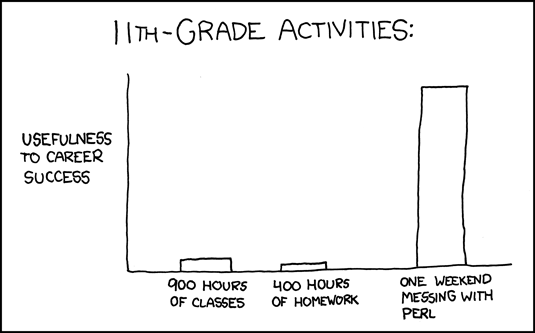
Of course this does not mean that education is without value. I have spent many, many hours educating myself – and I certainly don't consider that wasted time. But...for every hour I've spent educating myself, I've probably spent 20 hours practicing (all outside of any work context).
Personally, I think the quickest way to develop practical skills in software engineering (and, again, likely also in many other areas) is just such a lopsided mix of education and practice. I suspect the ideal ratio is different for different people, and also different over the course of a career. In my own case, I note that I can proportionally spend more time these days on educating myself, especially so when the subject matter is an extension of something I've already mastered.
The real point here is that formal educations that spend far more time empahsizing reading and lecture than they do practice seem wildly out of whack to me. My strongest evidence is the readiness of recent graduates to actually do something useful in the workplace – it's close to zero.
Subscribe to:
Posts (Atom)