Wednesday, August 9, 2006

Existential Threat

Tigerhawk has an interesting post today, in which he makes this observation:

Despite the external controversy associated with Israel’s reaction to the Hezbollah assault and subsequent war, the entire Israeli polity, left to right, is unified in its support for the War against Hezbollah. All of Israel is threatened by Hezbollah, Iran and Syria. It makes war mobilization and warfighting much clearer and simpler.

By contrast, the US polity is not unified on the matter of warfighting in the Middle East. Some see an existential threat arising from Islamism, others do not. This has made it politically impossible to preempt Iran. Therefore, it seems to me that we are likely to face a very unpleasant surprise in advance of any significant military action to upend the current Iranian regime.

Do go read the whole thing, because Tigerhawk carries through with the implications of that last sentence…

The observation about Israel being united in the fight against Hezbollah (and Hamas, for that matter) is not new, nor is the observation that the U.S. is not similarly united against Iran. But what is new (to me, at least) is the logical conclusion Tigerhawk draws: that because of our political divisions (with regard to the war on terror), we will not make pre-emptive strike against Iran. Instead, we must wait for Iran to make the first strike — thus uniting the U.S. against Iran as Israel is united against Hezbollah — and then (and only then) will we be able to muster the political will to strike. But only in response.

It’s an interesting thesis, and one that he develops a bit. But one part of his argument surprised me, though I know I really shouldn’t have been surprised. It’s when he said “Some see an existential threat arising from Islamism, others do not.” For those of you with less-than-Ivy-League vocabularies, “existential threat” is just a shorthand way of saying “a threat so powerful that it threatens your very existence”.

The momentary surprise for me was that any rational American observer could look at the radical Islamic fundamentalist movement and conclude that it did not pose an existential threat. And yet it’s obvious from the behavior of many of our leaders that in fact they see no such thing. Just to (almost) randomly pick an example: having watched Harry Reid in action, would you conclude that he behaves like someone who actually believes his country is at risk? I certainly don’t think so — I think Harry Reid is far more worried about how many seats the Democrats can pick up in the Senate this November than he is by Iran’s activities.

So why is it that many people, myself included, look at the recent history of the radical fundamentalist Islamic movement and conclude that it poses a clear existential threat — while many other people look at the same history and conclude that the threat is much less significant?

Throughout modern history we have seen the same scenario played out in Western civilization. The example I’ve read most about occurred just prior to Britain’s entry into World War II. If you read the contemporaneous political debates of the period — both in Britain and in the U.S. — you see much the same dichotomy. There’s one group of people (including both Churchill and Roosevelt) who see Hitler and Nazi Germany as an existential threat, and another group (most famously Chamberlain, but actually a clear majority of the polity in both Britain and the U.S.) who sounded a lot like our anti-war politicians of today. They really didn’t see the existenial threat. Until, that is, Hitler decided to invade Poland — a treaty partner with Britain. For whatever reason, this action of Hitler’s was enough, at last, to push the British polity over the edge to all-out war with Germany. It was clearly short of the bloody and direct first strike that Tigerhawk postulates as necessary to move the U.S. polity, however. And in World War II, it was not sufficient to move the U.S. polity — it took the strike on Pearl Harbor to do that.

So maybe Tigerhawk is right. He postulates, toward the end of his post, that even if Iran directly attacked Israel the U.S. polity might not unite — that we might not all see, even then, that existential threat. He suspects that it would take an Iranian attack on Iraq, on Europe, or directly on the U.S. (through terror cells) to hammer home the extent of the threat.

I sure hope he’s wrong.

I’d love to see someone credible poll this exact issue, the question of whether people in the U.S. perceive the radical fundamentalist Islamic movement as an existential threat. I really have no clue what the results would be…

Copper Hermes

The Hermes Copper butterfly (Lycaena hermes) is native to the area we live in — over the past seven years, I’ve spotted them four or five times. The species is rare, and getting rarer, as its habitat is either developed or burned by wildfires.

In 2004, shortly after the Cedar Fire, environmentalist David Hogan of the Center for Biological Diversity petitioned the U.S. Fish and Wildlife Service to list the Hermes Copper as “endangered”. Yesterday, the Center issued a press release that said in part:

The U.S. Fish and Wildlife Service announced today that is rejecting conservationists’ request to protect two imperiled butterflies from San Diego County under the federal Endangered Species Act.

The decision comes in response to a detailed scientific request, or “petition,” that the butterflies be added to the federal list of endangered species, which the Center for Biological Diversity submitted in October 2003. The petition was filed on the third anniversary of wildfires that caused serious harm to the two species. Today’s decision follows the Center’s 2005 lawsuit over the agency’s failure to respond to the request.

The press release continues with the usual anti-Bush propaganda, though it does mention in passing that David Hogan also petitioned to list the Hermes Copper in 1991 — and was denied “on a technicality” by the Clinton administration.

The reality is just a bit more complex than the environmentalists would have you believe…

A major premise of the recent petition (which is available from multiple locations online) is that the Cedar Fire destroyed much of the remaining Hermes Copper habitat. This premise, to put it mildly, is not a consensus view of scientists. With very little googling effort, I found several press reports from after the fire, of relieved biologists reporting that much of the Copper Hermes habitat survived intact. To be sure, there are also many scientists echoing David Hogan’s contention — but every such report I could find quoted scientists expressing concern before anyone actually went in and looked. The positive reports, on the other hand, were all made by scientists who actually went in and examined the habitat (and spotted the butterflies as well). In fact, one of the largest Hermes Copper habitats lies just southwest of us (the Rancho Jamul Ecological Preserve), and it did not burn. Another large habitat is just west of us (the Sycuan Peak Ecological Preserve), and it also did not burn. So it seems quite credible to me that the Hermes Copper escaped disaster in the Cedar Fire, and therefore the premise of this most recent petition is, at a minimum, suspect.

It’s interesting to note that while the Hermes Copper is threatened, many other closely related gossamer-winged Copper species are not — including four other Coppers native to San Diego County. Also, the Hermes Copper is dependent on a single (non-threatened) chapparal plant that is adapted to fire — it’s a “pioneer” plant that quickly propagates in burned areas. By extension, the Hermes Copper is indirectly fire-adapted as well.

The environmentalists have notoriously adopted the Endangered Species Act as a tool to have the courts enforce their anti-development agenda. They’ve been caught red-handed making petitions based on shaky or even fraudulent data, making it clear that their objective was to stop development, and not protecting an actually threatened species. The environmentalists have also been embarrassed by revelations — uncontested — that they have engaged in “species hunts” to find plausibly threatened species on land that they’d like to protect.

These shenanigans make it necessary for an intellectually honest conservationist to be skeptical of any petition arising from the environmentalist community. It’s unfortunate, but true, that they cannot be trusted.

And then of course there’s the tough issue that the environmentalists really don’t want to examine: even if the Hermes Copper really is endangered, is it worth it to save this species? For the environmentalists, the answer is always “yes”. For everyone else, the answer is a bit harder to come up with. Some simple and obvious facts that environmentalists hate to face are these: that the vast majority of all species that have ever existed are extinct, and that the history of our planet’s life is one of constant change in the mix of species. The environmentalists take it as a given that all species must be preserved. I, and many others, do not — rather, we take the view that a healthy ecology is one in which inferior species are continuously becoming extinct, and new, more robust species are continuously being created. When the main reason a species is threatened is because of mankind’s activities (and not because it’s a loser species), then I support taking a close look at the situation, to see if we can help. But I also support looking at a balance of the benefit to the threatened species versus the cost to us (mankind). And that balance must include the inevitability of that which the environmentalists hate: “development” — because the cost of restraining all development is just too high.

Which brings us around to the Copper Hermes and the denial of the petition to list it as endangered. Despite the environmentalist’s denials (because they know it would be very bad PR), if the Hermes Copper were listed as endangered, the impact on San Diego’s development would be very large — because the Hermes Copper’s habitat is very widespread, and mostly on private, undeveloped land. As we’ve seen in many other locales around the country, environmentalists would be filing lawsuits like mad every time someone tried to do anything to their property, if that property could construed by whatever stretch of the imagination to be Hermes Copper habitat. Worse yet, existing landowners would be prohibited from clearing the chapparal around their homes. Currently the County requires a 100' radius cleared around your home. Many insurance companies are requiring 300' or more cleared (my neighbor just went through this). In all of this brush clearing, you can be quite sure that Hermes Copper habitat is being destroyed — and you can be equally sure that environmentalists would file suit to stop you from clearing that brush, if the Hermes Copper were listed as endangered. If you could not clear the brush, then you’d be unable to get insurance. If you could not get insurance, not only are you at constant risk of losing your assets, but you couldn’t even move out practicably, as the value of your property would be greatly reduced. These results aren’t some imaginations on my part; very similar things have happened all over the U.S. when other species have been listed. The economic impact has been huge — just ask the loggers about spotted owls, if you’d like but one example.

The Bush administration, in denying the petition, cited exactly the issues I discussed above — the high cost to mankind of listing the Hermes Copper. They also cited the questions in the science community about just how badly threatened the Hermes Copper was. They also cited the fact that several closely related species were doing just fine. And they concluded that it just wasn’t worth it to list the Hermes Copper as endangered.

The Center for Biological Diversity calls the decision “…consistent with other administration efforts to undermine wildlife conservation and the Endangered Species Act.” I call it an act of common sense, and I support it.

But of course I have an axe to grind in this dispute. My guess is that my property value would be cut by at least 50% had the Hermes Copper been listed as endangered. And under the bizarre — and I believe, unconstitutional — Endangered Species Act, I would get exactly zero compensation for the government’s stroke of a pen taking my property away…

Tuesday, August 8, 2006

Full Moonbat?

Lanny Davis — a key member of the Clinton team — writes today (in a piece he calls “Liberal McCarthyism") about the bile-filled political climate. What’s interesting about his piece is that he’s mostly describing the vitriol on his side of the aisle. The lead:

My brief and unhappy experience with the hate and vitriol of bloggers on the liberal side of the aisle comes from the last several months I spent campaigning for a longtime friend, Joe Lieberman.

This kind of scary hatred, my dad used to tell me, comes only from the right wing — in his day from people such as the late Sen. Joseph McCarthy, with his tirades against “communists and their fellow travelers.” The word “McCarthyism” became a red flag for liberals, signifying the far right’s fascistic tactics of labeling anyone a “communist” or “socialist” who favored an active federal government to help the middle class and the poor, and to level the playing field.

I came to believe that we liberals couldn’t possibly be so intolerant and hateful, because our ideology was famous for ACLU-type commitments to free speech, dissent and, especially, tolerance for those who differed with us. And in recent years — with the deadly combination of sanctimony and vitriol displayed by the likes of Rush Limbaugh, Ann Coulter and Michael Savage — I held on to the view that the left was inherently more tolerant and less hateful than the right.

Now, in the closing days of the Lieberman primary campaign, I have reluctantly concluded that I was wrong.

...

Read the rest; it’s a kickass piece…

I haven’t commented much on the Lamont/Lieberman battle, mainly because I don’t really have anything to add to all the fine commentary out there. But if I think about that struggle as just another example of a larger phenomena — the transformation of the Democratic Party — then I have a little more to say.

Zell Miller and Joe Lieberman are, so far as I can tell, just about the last two old-fashioned Democrats left alive. The last two “honest men” left in the party, as some have said. And that’s very sad, because from my perspective they’re honorable, serious, respectable political opponents — unlike the Reids, Deans, Pelosis, Corzines, Lamonts, McKinneys, Schumers, and Kennedys (and I could go on and on) who seem to have successfully replaced them.

This is certainly not to say that the Republican Party doesn’t have any of the unserious partisan types for whom I have no respect — they do have them. But while I am not a member of either political party (neither even comes close to representing my own views), I have a lot more respect for the GOP, mostly because the partisan loonies haven’t taken over that asylum, as they seem to have on the Democratic side. Most of the time, when I hear a Republican speak, I can detect at least a whiff of something that smells like a position truly believed in. More often than not, when I hear a Democrat speak, my nose is overwhelmed by the foul odor of a position taken for momentary political advantage — even when that position is clearly not in the best interest of my country, my state, or my community.

For me, no single issue illustrates this difference better than the war on terror — and most especially the war in Iraq. This is the key issue in the Lamont/Lieberman Democratic primary battle, and I think it’s fair to think of that race as a kind of Democratic referendum on the war in Iraq. The conventional wisdom is that Lamont will easily win the primary — which means that the referendum’s results will be opposing the war in Iraq. I hope that the pundits and media are wrong, but I fear they are not.

And I shudder to think about the message that a Lamont win will send to those who control the Democratic party. I’m pretty sure they’d interpret it as a “mandate” to go all Full Moonbat on us. I would expect to hear Dean, Reid, and Pelosi start howling and screeching for immediate, unconditional withdrawal from Iraq. And I think nearly all paths from there lead to bad places…

One path leads to a Democratic party solidly committed to isolationism and denial of the fundamentalist Islamic threat to America. Depending on the degree of public support for their position, this could make prosecution of the war very difficult — and much less effective. This is reminiscent, in some ways, of the political atmosphere just prior to America’s entry into World War II. The serious political operatives on both sides of the aisle understood the need to stand with Europe, but popular sentiment was against them. In that case (unlike, apparently, 9/11) Pearl Harbor galvanized the whole country to persevere through to victory, an attitude sustained even when the political leadership decided to concentrate on Europe first, even though it was Japan that attacked us. It’s very hard for me to be confident about the general American support for the war in Iraq — there is so much apparently conflicting information out there to confuse us all…

Another path leads to the destruction of the Democratic party as an effective political force. This might well happen if most Democrats found the Full Moonbat didn’t really represent them, and they were frightened about the implications to their country. I’d like to think that that would be the case — but the likely outcome of that is (at least for the moment) that we’d have just a single effective party (the Republicans). And I don’t much like that, either — I think it’s very important for us to have political tension, especially at the national level.

There’s only one path that leads to a good place. It’s a variation of the preceding path, wherein the disintegration of the Democratic party leads to the creation of a new — and effective — political party. It’s happened before in the U.S., but not very often — and never in our modern age of instant communications and a relatively ill-informed population. I’m not at all optimistic that a new party could successfully be formed. But if it did form, and especially if its ideology resembled that of Zell Miller and Joe Lieberman, then I think that would be a very healthy thing for America.

That I would really like to see…

But I fear something much worse is more likely…

Monday, August 7, 2006

Hummingbirds

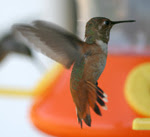
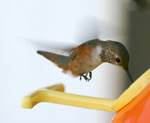
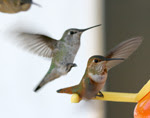
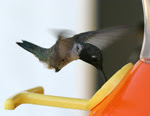
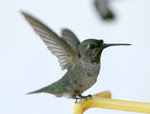
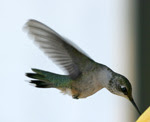
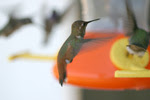
Late this afternoon, in the last good light for photography, I went out and took about 75 photos of the relatively few hummingbirds that were sucking sugar water from our feeders. The image immediately at right shows one of my favorites: a female Allen’s or Rufous (I can’t tell them apart). In the first two rows below are several more examples of females from the same species.

Click on any of these photos to get a (much) larger version…

Another one I particularly like is the male black-chinned hummingbird (at lower right, below). They’ve got a beautiful brilliant royal purple throat patch, but only if you catch them at exactly the right angle — which of course I failed to do in any of my photographs. The others are either Anna’s or black-chinned females.

Notice the hummer traffic jam in some of these pictures? And this was before things get really busy tonight!

For the shutterbugs out there: these were all taken at very short range: 3.5” to 11”. I used a nominal 100mm macro lens, but my camera body effectively multiplies the focal length by 1.6, so you can think of it as a 160mm lens. The light is all natural, late afternoon shade. Most of them were taken at 1/350th, time priority, and 100 ASA equivalent; a few were at 1/500th and 400 ASA equivalent. The equipment was a Canon D20 body and Canon EOS 100 macro lens. All were handheld.

Hummers

Last night just before sundown, and again this morning just after sunrise, I did something I’ve been doing a lot of recently — enjoying the company of hummingbirds. At that time of day (and also just after sunrise in the morning), we have a hundred or more hummingbirds feeding from about eight large feeders in our windows (each holds a quart or more of sugar water). Usually we just watch them through the windows, but a few years ago — after a few years of feeding them — we noticed that the hummingbirds were getting acclimated to our presence in their midst. They’d buzz around excitedly as we put newly-filled feeders out. A few times one of them landed on my hat, glasses, head, or (most memorably) ear. They’d zip away if we made a sudden move, but if we were still or moved very slowly, they’d come back.

Nowadays, especially in the morning and evening, if we go out and stand still next to the feeders we’ll have clouds of hummingbirds around us within 30 seconds. Some of our feeders are hung at eyeball level. If I stand so that my nose is just two or three inches from the feeder, the hummingbirds will soon be feeding right in front of my nose, quite literally. They’re so close I have to take my glasses off to see them clearly — but oh, what a view I have of them then! Some of them are very curious, and will hover right in front of my face, a couple inches away, inspecting me. Others will hover over the feeder, drinking “nectar”. And others yet will land on the feeder before drinking.

My favorite, at this close range, are the female Allen’s or Rufous hummingbirds. These species are very hard (for me, at least!) to tell apart. Both Sibley’s and the San Diego Bird Atlas tell me that I really shouldn’t be seeing either species here this time of year — but they are most definitely here; those are the only two species that look anything like the birds we’re observing. For some reason it is much more common for us to see the females at our feeders, though we do see the (rather spectacular) males a few times every day. But the females are my favorite, with their softer, more varied colors and patterns.

While watching these tiny critters there are many things to marvel at. One skill particularly fascinates me: their ability to hover such that their heads are absolutely still. The rest of their little bodies are vibrating and oscillating as they correct for wind and turbulence, but their heads are rock-steady. This skill is key to their feeding — it lets them insert their long beaks and tongues deep into flowers, to slurp up the nectar within them. It’s just amazing how good at it they are. This would be extremely difficult for any man-made machine to duplicate…

This morning I had two pairs of males battling within a foot of my face. A pair of Anna’s, with their bright red “helmets", had an extended contest; one of them was particuarly aggressive, attacking not only with his beak but with his feet. The other was a pair of diminutive black-chinned males. These are badly misnamed, as their most prominent feature isn’t the black chin, but rather their extraordinary royal purple throats. These two held a spectacular aerobatic display just six inches from my eyeballs, tumbling about and doing somersaults that just looked impossible. Of course, they made it look very easy indeed!

Both last night and this morning, I spent part of my time with the hummers in the company of one of our cats: Maka Lea, our little neurologically damaged kitty. He has trouble walking and jumping, but is otherwise quite normal (although he still has the playful personality of a kitten). He just loves to watch the hummingbirds, as do all our cats — but unlike them, he doesn’t have the physical skills to leap and try to catch them. None of the cats seem to understand about windows, so they keep trying even though it’s not possible. So I take Maka Lea out with me when I commune with the hummers. I hold him upside-down in my arms, bundling his paws up so he can’t reach out and snag one as they flit by. But his head is swiveling all over as he watches them, eyes big and round. He is clearly enjoying himself. The hummers couldn’t care less about his presence — they will zip down to within an inch or so of his face, with no apparent concern or caution. Most likely this is only because I’m holding him, and the hummers don’t realize there’s anything but me. Eventually Maka Lea can’t stand it any more, and he’ll start struggling to escape my containment — that’s when I put him back indoors. But when he sees me heading for the door to go commune with the hummers, Maka Lea will come trotting up to my feet, look up at me, and mewl — it isn’t hard to figure out what he wants…

Saturday, August 5, 2006

Archimedes Palimpsest

A “palimpsest” is a manuscript written on parchment or paper that was reused from an older manuscript. In the case of parchment, the old writing is scraped off the parchment, and the new document written on top of it. This was done because parchment was so expensive.

Over 1,000 years ago, probably in Constantinople, someone transcribed some of Aristotle’s original Greek manuscripts onto parchment. A couple centuries later (about 800 years ago), some monks scraped those parchments clean (along with parchments from four other manuscripts) and reused them to make a book of prayers — a palimpsest.

In modern times, a collector noticed that traces of writing were still visible “under” the prayer book’s writing. Some of this was recognized as the work of Archimedes — in some cases, the only remaining copy in Greek of those works. Many pages were recovered by scholars working with ultraviolet lighting and other techniques, but many other pages stubbornly resisted every attempt to recover them. This was very frustrating for the scholars, and over the years they have tried many techniques.

Most recently — and very successfully — they tried an exotic new X-ray technique that required the use of the Stanford Linear Accelerator (a huge piece of equipment used for particle physics research) to generate the required radiation. It works by detecting the iron atoms left by the original ink, even when very few atoms remain. The photo above right is an example of the result, which is ongoing as I write.

Here’s a decent newspaper article about the effort, and here’s the project web site.

Where Freedom Reigns

An organization called “Global Liberty” combined four published indexes of various perspectives on freedom to form a more comprehensive index of overall freedom. The map at right shows the result as a color-coded map. Interestingly, the top ranking country on this new index is Estonia:

It is justified by history that Estonia would sit atop this list. This small Baltic state fought Soviet socialism, defeating the Soviets in the Estonian Liberation War of 1918-1920 and winning 20 years of independence. During World War II, Estonia was invaded by the USSR following the 1939 signing of the Molotov-Ribbentrop agreement between the USSR and Nazi Germany, and the Soviets killed off the political and the intellectual leaders. The country suffered immensely under their rule.

Estonia finally won their freedom following the 1987-1991 Singing Revolution, in which Estonians gathered night after night, singing national songs and hymns banned by the Soviets and listening to rock music. When the Soviets attempted to quell the revolution, the Estonians used their bodies to shield radio and TV stations from being attacked by tanks. The revolution ended without any bloodshed, with 1/5th of the population having participated at some point. It marks one of the greatest triumphs of the power of liberty over authoritarianism in history. Estonia has since established a solid government, liberalized trade and expanded individual freedom. The Estonian Reform Party, a free market liberal political party, is also gaining influence and has made a significant impact on Estonian politics, controlling about 18% of parliament. While Estonia is far from a libertarian paradise (with a score of only 85.3%), it is closer than any other country on this list.

The indexes that comprise the new, combined index are:

The Heritage Foundation/Wall Street Journal: 2006 Index of Economic Freedom

The Frasier Institute/Cato Institute: 2005 Economic Freedom of the World

Freedom House: 2005 Freedom in the World

Reporters without Borders: Press Freedom Index

Thoughts

Some Saturday morning ponders…

You win and lose by the way you choose.

— David Avezzie —

I can accept failure, but I can’t accept not trying.

— Michael Jordan —

Genius is 1% inspiration and 99% perspiration.

— Thomas Edison —

Few men have virtue to withstand the highest bidder.

— George Washington —

Great Spirits have always encountered violent opposition from mediocre minds.

— Albert Einstein —

The world is a dangerous place, not because of those who do evil, but because of those who look on and do nothing.

— Albert Einstein —

Out of clutter, find simplicity. From discord, find harmony. In the middle of difficulty, lies opportunity.

— Albert Einstein —

Good luck is what happens when preparation meets opportunity. Bad luck is what happens when lack of preparation meets a challenge.

— Paul Krugman —

Darkness cannot drive out darkness; only light can do that. Hate cannot drive out hate; only love can do that.

— Dr. Martin Luther King Jr. —

Injustice anywhere is a threat to justice everywhere.

— Dr. Martin Luther King Jr. —

All of us do not have equal talent, but all of us should have an equal opportunity to develop our talents.

— John F. Kennedy —

Do not pray for easy lives. Pray to be stronger men.

— John F. Kennedy —

One cannot consent to creep when one has an impulse to soar.

— Helen Keller —

Many of life’s failures are people who did not realize how close they were to success when they gave up.

— Thomas Edison —

This above all, to thine own self be true.

— William Shakespeare —

Attitude, not aptitude, determines altitude.

— Jesse Jackson —

We learn more from our failures than from our successes.

— Henry Ford —

Be daring, be different, be impractical, be anything that will assert integrity of purpose and imaginative vision against the play-it-safers, the creatures of the commonplace, the slaves of the ordinary.

— Sir Cecil Beaton —

The man who follows the crowd will usually get no further than the crowd. The man who walks alone is likely to find himself in places no one has ever been.

— Alan Ashley-Pitt —

What lies behind us, and what lies before us, are tiny matters compared to what lies within us.

— Ralph Waldo Emerson —

Accept that some days you’re the pigeon, and some days your the statue.

— Roger C. Anderson —

The intuitive mind is a sacred gift and the rational mind is a faithful servant. We have created a society that honors the servant and has forgotten the gift.

— Albert Einstein —

I saw the angel in the marble and carved until I set him free.

— Michelangelo —

It is the mark of an educated mind to be able to entertain a thought without accepting it.

— Aristotle —

You miss 100 percent of the shots you never take.

— Wayne Gretzky —

I have not failed. I’ve just found 10,000 ways that won’t work.

— Thomas Edison —

God is a comedian playing to an audience too afraid to laugh.

— Voltaire —

To speak ill of others is a dishonest way of praising ourselves.

— Will & Ariel Durant —

He who feels it, knows it more.

— Bob Marley —

A dictionary is the only place that success comes before work. Hard work is the price we must pay for success. You can accomplish anything if you’re willing to pay the price.

— Vince Lombardi —

Expecting the world to treat you fairly because you are a good person is a little like expecting the bull not to attack you because you are a vegetarian.

— Dennis Wholey —

“We become just by performing just actions, temperate by performing temperate actions, brave by performing brave actions.”

— Aristotle —

“Criticism is something we can avoid easily by saying nothing, doing nothing, and being nothing”

— Aristotle —

“Anyone can become angry - that is easy, but to be angry with the right person at the right time, and for the right purpose and in the right way - that is not within everyone’s power and that is not easy.”

— Aristotle —

Speak when you are angry – and you’ll make the best speech you’ll ever regret.

— Dr. Laurence J. Peter —

It is wise to direct anger towards problems – not people; to focus your energies on answers – not excuses.

— William Arthur Ward —

Holding on to anger is like grasping a hot coal with the intent of throwing it at someone else; you are the one who gets burned.

— Buddha —

Three things can not be long hidden, the Sun, the Moon, and the Truth.

— Buddha —

I’m for truth, no matter who tells it. I’m for justice, no matter who it’s for or against.

— Malcom X —

Education is the passport to the future, for tomorrow belongs to those who prepare for it today.

— Malcom X —

A man who stands for nothing will fall for anything.

— Malcom X —

It is the function of speech to free men from the bondage of irrational fears.

— Louis Brandeis —

Yes, that’s the Paul Krugman quoted up there. He’s a moron 99% of the time, but then there’s that 1%…

Friday, August 4, 2006

Artboretum

Earlier this year, my father and I visited the arboretum at Palomar College. We traveled about 50 miles from south San Diego County to see it, after reading their web site and thinking we’d found a gem.

To put it bluntly, we were appalled. The arboretum appears to have been completely neglected for some years; dead and dying specimens are everywhere. Only the weeds were thriving. Labels and signs — a key part of any arboretum — were largely missing.

And in the middle of this aboretum disaster was the … thing … shown in the photo at right. It looked as beat up and defeated as the rest of the arboretum to us. A sign identified it as a work of art, and it’s a good thing there was a sign — otherwise we’d have been hard put to figure out just what it was. I know I’m displaying my primitive sense of art here, but … I can’t help but associate art with beauty. And beautiful this thing ain’t. It’s beyond me why anyone would want such a thing in the middle of what could be a beautiful arboretum.

But now I read that the “Friends of the Palomar College Arboretum” actually moved this piece of “art” into the arboretum they are in charge of. And they’re out there raising money through donations to have the original artist (a local, James Hubbel) design the surrounding display area and help with refurbishing the sculpture. They’re trying to raise $40,000 to $50,000 dollars to accomplish this. And they’re trying to bring more “art” into the arboretum.

I have a modest suggestion for the Friends of Palomar College Arboretum: figure out what your mission is, make your name reflect it, and then concentrate on that. If you really want to be the “Friends of Palomar College Home for Orphaned Outdoor 'Art'", then change your name and quit pretending to be an arboretum — put your dying specimens out of their misery and put in some gravel and silk plants. On the other hand, if you really want to be Friends of the Palomar College Arboretum", perhaps you should consider addressing the 50,000 or so things about the arboretum that should be a higher priority for you than salvaging pieces of art. Things like, say, keeping your specimen plants alive! You might even get a couple of hundred bucks together and label the four or five specimens that are still surviving!

Sheesh.

The North County Times has an article about this.

Title

Israel’s war with Hezbollah is acting as a kind of flashlight, illuminating the dark corners of politics all over the world.

A few things seem to be uncontroverted by any serious observer:

— Hezbollah’s goal is to eliminate Israel, preferably killing all the Jews in the process.

— Hezbollah deliberately targets civilians in Israel, and deliberately makes targets of civilians in Lebanon, all because of the high propaganda value of dead and maimed civilians of any nationality.

— Hezbollah is lavishly armed and trained, and occupies a large fraction of Lebanon, in defiance of UN proclamations and the Lebanese government.

— Hezbollah is actively supported by the governments of Syria and Iran, receiving hundreds of millions of dollars in financial support, plus millions of rounds of ammunition, hundreds of thousands of artillery shells, and tens of thousands of various kinds of missiles.

— Hezbollah has been fighting a guerilla war against Israel for over 10 years, sending suicide bombers, missiles, and artillery over the border from Lebanon to target Israeli civilians. Hundreds of Israelis have been killed and maimed in these cruel and barbaric attacks.

— The stated goal of Iran’s government is to “wipe Israel from the map”.

Then a few weeks ago, Hezbollah made a very provocative escalating attack against Israel (invading Israel with a military force, killing several soldiers and capturing two alive), and accelerated their missile bombardment. Israel said “Enough!” and basically declared open war on Hezbollah, with the explicit objective of eliminating Hezbollah’s capability to wage war against Israel (especially its ability to fire missiles into Israel).

My own take on this is, apparently, a distinctly minority view in the world’s community. I think it’s absolutely marvelous that the Israelis are taking on Hezbollah, and I wish them well in their war. I hope they don’t stop until every Hezbollah fighter is dead or surrendered. I hope they eliminate Hezbollah as a credible player on the Middle Eastern stage. I hope that all this chatter about “ceasefires” (as if you could have a ceasefire with terrorists!) and “disproportionate response” (as if that was a bad thing!) is ignored by Israel and the U.S., and doesn’t impede their efforts in the slightest. In the end, I’d like to see a democratic, secular Lebanese government that can be a stabilizing force in the heart of the Middle East — a partner to the U.S., Israel, Turkey, and Iraq, and a shining example to the masses living under autocrats in places like Iran, Egypt, Syria, and Saudi Arabia.

None of this will ever happen while Hezbollah occupies Lebanon and wages war on Israel.

But the most of the world (including the American left) doesn’t agree with me. There are varying positions, but the general consensus is that we must have an immediate ceasefire. I think it’s fair to say that most people in the world believe that Israel’s response is somehow unfair, or has ulterior motivations. The majority would like to see pressure put on the Israelis to stop fighting Hezbollah, and to withdraw from Lebanon.

In an article at the National Review, Victor Davis Hanson writes:

Our present generation too is on the brink of moral insanity. That has never been more evident than in the last three weeks, as the West has proven utterly unable to distinguish between an attacked democracy that seeks to strike back at terrorist combatants, and terrorist aggressors who seek to kill civilians.

I think Mr. Hanson is exactly right, and this war is acting like a flashlight to illuminate those morally insane people he’s talking about. Like Rep. John Dingell (D, Michigan) who said “I don’t take sides for or against Hezbollah.” Or John Kerry (D, Massachussets), maneuvering for political points, declaring that the Israel-Hezbollah war “would never have happened” had he been elected. Or any of dozens of other morally bankrupt statements and essays we’ve been treated to over the past few weeks, from both domestic and foreign wackos.

What to do? The best lesson I can take away from this flashlight’s revelations is to remember — remember which people said what, and (especially with respect to the U.S. politicians) take that into account the next time there’s an election. If enough morally sane people can do that, maybe we’ll have enough to make a difference.

I sure hope so, 'cause what I’m hearing now is downright dispiriting…

Wednesday, August 2, 2006

Lamestream Parody

Tip o’the hat to JimM for this gem:

The Pope is visiting Washington, D.C., and President Bush takes him out for an afternoon on the Potomac, cruising on the Presidential yacht, the Sequoia. They’re admiring the sights when, all of a sudden, the Pope’s hat (zucchetto) blows off his head and out into the water.

Secret Service guys start to launch a boat, but President Bush waves them off, saying, “Wait, wait. I’ll take care of this. Don’t worry."

Bush then steps off the yacht onto the surface of the water and walks out to the Holy Father’s little hat, bends over, picks it up, and then walks back to the yacht and climbs aboard. He hands the hat to the Pope amid stunned silence.

The next morning, the headlines in the New York Times, Boston Globe, Atlanta Constitution, Washington Post, Boston Herald, Buffalo News, Houston Chronicle, Milwaukee Sentinel-Journal, Minneapolis Tribune, Denver Post, Albuquerque Journal, Los Angeles Times, and San Francisco Chronicle all proclaim:

"Bush Can’t Swim!"

Oh, come on now — you know that’s exactly what would happen!

Rain in July...

And pretty soon, you’ve got a half inch of rain. In these parts, a half inch of rain is not the usual July experience — July here is normally comprised of wall-to-wall blue skies, hot and dry days, and cool, comfortable nights. This July saw us with relatively humid days (along with the hot), quite a few uncomfortably warm nights, and rain.

Weirdness!

But welcome weirdness. The native desert plants that surround us are experts at slurping up this unexpected moisture; they will all benefit (and they were already in robust good shape because of the spring rains). The weeds will most likely pop up again — we’ll know that in a day or two. And perhaps most importantly: the fuel (mainly dead plant material, wood, twigs, and leaves) is now all dampened down again, and it will take a bunch of hot, dry days to dry it all out. That translates into reduced fire danger for several weeks, at least.

We like rain!

Monday, July 31, 2006

Birds and Fire

For the past couple of days we’ve been marveling at the huge number of hummingbirds and orioles that suddenly appeared at our nectar feeders — double or more our usual number. We’ve seen as many as 50 hummingbirds simultaneously buzzing around just 4 feeders. We have two windows with 4 feeders, and both sets of feeders are equally busy.

This afternoon, Debbie made the connection between the appearance of the birds and the Horse Fire — and I suspect she’s totally correct. I’ll bet you we’re hosting a few hundred hummingbirds, and perhaps a dozen hooded orioles (hooded and Bullock’s).

They’re a real treat for us to see, and I suspect we’re actually helping them survive, as well.

With just a little sugar and food coloring…

Quote of the Day

Put down any hot beverages, swallow anything in your mouth, then read:

"If a drunken Mel Gibson did indeed call out, 'Jews are responsible for all the wars in the world,' then there can be only one possible place for a man who believes such things: as the next Secretary General of the United Nations."

David Frum, writing at National Review.com

Kofi deserved that one richly. Well delivered, Mr. Frum!

Yalla Ya Nasrallah

Nasrallah, of course, is the leader of Hezbollah in Lebanon (and currently rumored to be cowering in the basement of the Iranian embassy in Beirut). This song is Israeli, in Hebrew, with English subtitles.

Just go watch it!

Best. Music. Video. Ever!

Sunday, July 30, 2006

Hezbollah, the Bar Bully

Over at the FreeRepublic, there’s a post that makes the case for why the world should stand aside while Israel beats the living hell out of Hezbollah, until Hezbollah gives up. This is so good I’ve reproduced it in its entirety — and I hope this post will entice you to visit the excellent FreeRepublic often…

Posted by MBombardier at FreeRepublic:

I once witnessed a bar fight in downtown Olongapo (Philippines) that still haunts my dreams. The fight was between a big oafish Marine and a rather soft-spoken, medium sized Latino sailor from my ship.

All evening the Marine had been trying to pick a fight with one of us and had finally set his sights on this diminutive shipmate of mine…figuring him for a safe target. When my friend refused to be goaded into a fight the Marine sucker punched him from behind on the side of the head so hard that blood instantly started to pour from this poor man’s mutilated ear.

Everyone present was horrified and was prepared to absolutely murder this Marine, but my shipmate quickly turned on him and began to single-handedly back him towards a corner with a series of stinging jabs and upper cuts that gave more than a hint to a youth spent boxing in a small gym in the Bronx.

Each punch opened a cut on the Marine’s startled face and by the time he had been backed completely into the corner he was blubbering for someone to stop the fight. He invoked his split lips and chipped teeth as reasons to stop the fight. He begged us to stop the fight because he could barely see through the river of blood that was pouring out of his split and swollen brows.

Nobody moved. Not one person.

The only sound in the bar was the sickening staccato sound of this sailor’s lightning fast fists making contact with new areas of the Marine’s head. The only sound I have heard since that was remotely similar was from the first Rocky film when Sylvester Stallone was punching sides of beef in the meat locker.

Finally the Marine’s pleading turned to screams…a high, almost womanly shriek. And still the punches continued relentlessly. Several people in the bar took a few tentative steps as though they wanted to try to break it up at that point, but hands reached out from the crowd and held them tight. I’m not ashamed to say that mine were two of the hands that held someone back.

You see, in between each blow the sailor had begun chanting a soft cadence: Say [punch] you [punch] give [punch] up [punch]…say [punch] you [punch]were [punch] wrong [punch]”.

He had been repeating it to the Marine almost from the start but we only became aware of it when the typical barroom cheers had died down and we began to be sickened by the sight and sound of the carnage. This Marine stood there shrieking in the corner of the bar trying futilely to block the carefully timed punches that were cutting his head to tatters…right down to the skull in places. But he refused to say that he gave up…or that he was wrong.

Even in the delirium of his beating he believed in his heart that someone would stop the fight before he had to admit defeat. I’m sure this strategy had served him well in the past and had allowed him to continue on his career as a barroom bully.

Finally, in a wail of agony the Marine shrieked “I give up", and we gently backed the sailor away from him.

I’m sure you can guess why I have shared this story today. I’m not particularly proud to have been witness to such a bloody spectacle, and the sound of that Marine’s woman-like shrieks will haunt me to my grave. But I learned something that evening that Israel had better learn for itself if it is to finally be rid of at least one of its tormentors:

This is one time an Arab aggressor must be allowed to be beaten so badly that every civilized nation will stand in horror, wanting desperately to step in and stop the carnage…but knowing that the fight will only truly be over when one side gives up and finally admits defeat. Just as every person who had ever rescued that bully from admitting defeat helped create the cowardly brute I saw that evening in the bar, every well-intentioned power that has ever stepped in and negotiated a ceasefire for an Arab aggressor has helped create the monsters we see around us today.

President Lahoud of Lebanon, a big Hezbollah supporter and a close ally of Syria, has been shrieking non-stop to the UN Security Council for the past two days to get them to force Israel into a cease fire.

Clearly he has been reading his autographed copy of 'Military Success for Dummies Arab Despots' by the late Gamal Abdel Nasser of Egypt. Ever since Nasser accidentally discovered the trick in '56, every subsequent Arab leader has stuck to his tried and true formula for military success:

1. Instigate a war.

2. Once the war is well underway and you are in the process of having your ass handed to you…get a few world powers to force your western opponent into a cease fire.

3. Whatever you do, don’t surrender or submit to any terms dictated by your enemy. That would ruin everything! All you have to do is wait it out and eventually the world will become sickened at what is being done to your soldiers and civilian population…and will force a truce.

4. Once a truce has been called you can resume your intransigence (which probably caused the conflict in the first place), and even declare victory as your opponent leaves the field of battle. This tactic has never failed. Not once. In fact it worked so well for the Egyptians in 1973, that to this day they celebrate the Yom Kippur War - a crushing defeat at the hands of Israel - as a military victory! No kidding…it’s a national holiday over there!

President Lahoud has already begun to shriek like a school girl to the UN Security Council to “Stop the violence and arrange a cease-fire, and then after that we’ll be ready to discuss all matters."

Uh huh. Forgive me if I find that a tad hard to swallow. He allowed Hezbollah to take over his country. He allowed the regular Lebanese army to provide radar targeting data for the Hezbollah missile that struck the Israeli destroyer. He has turned a blind eye while Iranian and Syrian weapons, advisers and money have poured into his country. And now that his country is in ruins he wants to call it a draw. As much as it may sicken the world to stand by and watch it happen, strong hands need to hold back the weak-hearted and let the fight continue until one side finally admits unambiguous defeat.

Well said. I’m a long way from an expert on the Middle East, but what MBombardier proposes makes eminently good sense to me. I’m good and ready for a significant terrorist group to be so badly damaged that they’re forced into the humiliating position of having to give up, and having to admit they were wrong. Even better to have the object of their torment — Israel — be the one doing the damage. I still have some hope that this scenario is actually exactly what’s happening behind the scenes…

Tip of the hat to MikeD for the pointer…

Saturday, July 29, 2006

Horse Fire XVI

The map at right shows the satellite data (both WF-HMS and MODIS) overlayed with the Horse Fire’s perimeter (determined after the fact by human survey teams). It’s very interesting to see how they differ…

The east and west flanks of the fire both have particularly misleading satellite information — they show the fire extending well beyond where it actually was. On the western flank (the one nearest us), there are a couple of satellite paints and WF-HMS data (analyzed by a human) that show the fire extending toward us more than a mile further than it actually did.

On the northeast section of the fire, on the other hand, there are large areas that did burn for which there is no satellite data at all.

The biggest lesson I’ve learned from this experience is that the satellite data simply can’t be relied on. No matter how carefully I qualified the data (e.g., by how far away the satellite passed over), and even relying on the expertise of the NOAA analysts, the satellite data simply didn’t give us accurate information. And depending on the vagaries of the satellite’s orbits, it wasn’t always timely, either. I think the information we got by watching the smoke plumes from our yard was about as accurate and timely as the satellite data — and maybe even more so. The satellite data is just an indicator, and needs to be thought of in that way.

All the more reason to be happy that I’ve got the scanner…

Scanner

The recent Horse Fire was close enough to our home to make us very worried that it might burn us. During the fire, our biggest frustration was not getting accurate information in a timely manner. Several times we found ourselves in a situation where we had enough information to be concerned about an immediate threat, but not enough to know if we should start packing the vehicles for evacuation. This was very frustrating, and a couple of times we ended up taking a chance by doing a reconnoiter so we could either see for ourselves what was happening, or get some accurate information from someone who had seen for themselves. The risk there is that the fire could break out while we were away from home — we would never have done this if it had been windy, but fortunately it was not windy during the Horse Fire.

But this got me to pondering how I could possibly be better prepared the next time we have a fire in the area. It occurred to me that if I could listen to the radio communications of the fire and police, I’d most likely be able to learn a lot, as it happened, and from the horse’s mouth, so to speak. And that made me think of scanners, those radio receivers that “scan” a whole bunch of different frequencies, stopping when they hear someone talking on one. At least, that’s the way scanners worked the last time I had any contact with one, which was something like 20 or 25 years ago.

So I did some research on the web, and first I discovered that much (though not all) of the police and fire communications these days are handled on what are called “trunked” radio systems. These trunked systems work in a very different way than the radios of yesteryear. In particular, it’s no longer true that one particular radio “talks” on one particular frequency on these systems. Instead, each system is capable of talking on many frequencies, and the central system assigns a frequency each time the talk button is pushed. The central system keeps track of who’s talking on what frequency, and broadcasts that information on a special “control channel” frequency, with digital or analog codes. An old-fashioned scanner of the type I knew about would not be usable with these trunked systems, so at first I thought my idea was in trouble.

But with a little more research, I discovered that the scanner manufacturers have kept up with this technology, and scanners for trunked systems are readily available. After some research I settled on one particular model: the Uniden BCD996T. I got the unit a couple of days ago, and over the past couple of evenings and this morning I learned how to set it up for our local fire and police communications. The easiest way to configure this thing, by far, is to use the PC software that comes with it. It’s possible to do it all through the front panel, but very tedious; much less tedious with the software. This morning I entered the last of almost 400 frequencies and channels. Now the unit is sitting on my desktop, scanning away like mad.

Even though I’m a geek, I find myself completely amazed at the capabilities of this scanner. It has some very smart behaviors built in that make the scanning much more effective. For example, once it discovers someone talking on a particular channel and code, it will check that channel and code more frequently, making it more likely that you’ll catch the entire conversation — this works very well. The audio quality isn’t what I expected at all — it’s not the static-filled AM that I remember from 20 years ago; the modern systems are almost all FM and nearly static-free. And the sensitivity to weak signals is just awesome, especially by comparison to the radios of the 1960s, when I last did any serious RF work.

I’m particularly pleased with the ability to hear the firemen in the field, still working on the Horse Fire. I can hear the guys with walkie-talkies, way out in the boonies, as they work away at hot spots. This morning it is drizzling here, and I heard one team decide not to go into a steep-sided gorge, because they were afraid they couldn’t get out if the roads were wet. In the course of this conversation, they rattled off their GPS coordinates, so I was able to locate them precisely on a map. This is exactly what I hope to be able to do during a fire next time…

Next weekend I’ll be putting up a better antenna for my scanner. Right now I’m operating on just the little whip that came with it. A high-gain antenna, located outside and away from the electronic noise in the house, should work much better yet — especially for the weaker signals from walkie-talkies down in canyons, etc.

Debbie and I, as we listened this morning to the firefighters on the radio, were kicking ourselves for not having done this long ago. I’d encourage anybody living in the chaparral to get one of these scanners. And if you happen to live in San Diego, and you decide to get the same model that I did, I’d be more than happy to share the programming files with you (what Uniden calls “System” files) — just email me, and I’ll send them along…

Friday, July 28, 2006

One Liner of the Day

James Taranto notes this news story:

“Tour de France winner Floyd Landis denied on Thursday taking performance-enhancing drugs during the race and said he would fight to clear his name after testing positive for the male sex hormone testosterone,” Reuters reports.

And makes this quip:

Only the French would consider the presence of testosterone in a man’s system suspicious.

Ooooh…how I wish I’d thought of that!

1955

Hat tip to reader Richard F. for these gems…actual comments that ordinary people made in 1955.

I know a few younger folks that would have trouble believing these!

"I’ll tell you one thing, if things keep going the way they are, it’s going to be impossible to buy a week’s groceries for $20."

"Have you seen the new cars coming out next year? It won’t be long before $2000 will only buy a used one."

"If cigarettes keep going up in price, I’m going to quit. A quarter a pack is ridiculous."

"Did you hear the post office is thinking about charging a dime just to mail a letter?"

"If they raise the minimum wage to $1, nobody will be able to hire outside help at the store."

"When I first started driving, who would have thought gas would someday cost 29 cents a gallon. Guess we’d be better off leaving the car in the garage."

"Kids today are impossible. Those duck tail hair cuts make it impossible to stay groomed. Next thing you know, boys will be wearing their hair as long as the girls."

"I’m afraid to send my kids to the movies any more. Ever since they let Clark Gable get by with saying 'damn' in 'Gone With The Wind,' it seem’s every new movie has either “hell” or “damn” in it.

"I read the other day where some scientist thinks it’s possible to put a man on the moon by the end of the century. They even have some fellows they call astronauts preparing for it down in Texas ."

"Did you see where some baseball player just signed a contract for $75,000 a year just to play ball? It wouldn’t surprise me if someday they’ll be making more than the president."

"I never thought I’d see the day all our kitchen appliances would be electric. They are even making electric typewriters now."

"It’s too bad things are so tough nowadays. I see where a few married women are having to work to make ends meet."

"It won’t be long before young couples are going to have to hire someone to watch their kids so they can both work."

"Marriage doesn’t mean a thing any more; those Hollywood stars seem to be getting divorced at the drop of a hat."

"I’m just afraid the Volkswagen car is going to open the door to a whole lot of foreign business."

"Thank goodness I won’t live to see the day when the Government takes half our income in taxes. I sometimes wonder if we are electing the best people to congress."

"The drive-in restaurant is convenient in nice weather, but I seriously doubt they will ever catch on."

"There is no sense going to Lincoln or Omaha anymore for a weekend. It costs nearly $15 a night to stay in a hotel."

"No one can afford to be sick any more; $35 a day in the hospital is too rich for my blood."

"If they think I’ll pay 50 cents for a hair cut, forget it."

My favorite: “…I sometimes wonder if we are electing the best people to congress."

Hah!